Introduction
Work teams represent the core building blocks of many organisations (Aubé & Rousseau, Reference Aubé and Rousseau2010). With increasing global competition, consolidation, as well as innovation, is needed for organisations. That requires diverse skills, expertise and experience (Kozlowski & Bell, Reference Kozlowski and Bell2013), accompanied with rapid, flexible and adaptive responses and a great amount of creativity. Teams in organisations are key actors that can enable these responses.
Teams in organisations, like other collectives, include at least two individuals, who share one or more common goals, interact socially and are interdependent to a certain degree. They differ from other collectives, such as small groups or social groups, in that they are embedded in an organisational context which ‘constrains the team, sets boundaries and influences exchanges with other units in the broader entity’ (Kozlowski & Bell, Reference Kozlowski and Bell2003). Teams come in many different configurations and can be tasked with different types of functions (Mathieu, Maynard, Rapp, & Gilson, Reference Mathieu, Maynard, Rapp and Gilson2008). The configuration and type of a team reflect the different demands a team faces. Some teams function more effectively than others, and the ‘why’ and ‘when’ of team effectiveness has been the subject of study. In fact, the increasing prevalence of teams in organisations (Balkundi & Harrison, Reference Balkundi and Harrison2006) has been paralleled by an expansion of theories addressing team effectiveness, and an exploding number of empirical studies focused on work teams. Researchers have conducted various meta-analyses of the antecedents and mediational factors of team effectiveness. These meta-analyses find support for the effects of factors such as teamwork processes (LePine, Piccolo, Jackson, Mathieu, & Saul, Reference LePine, Piccolo, Jackson, Mathieu and Saul2008), task- and relationship conflict (De Dreu & Weingart, Reference De Dreu and Weingart2003), shared leadership (Wang, Waldman, & Zhang, Reference Wang, Waldman and Zhang2014), team efficacy (Gully, Incalcaterra, Joshi, & Beaubien, Reference Gully, Incalcaterra, Joshi and Beaubien2002), team diversity (Bell, Villado, Lukasik, Belau, & Briggs, Reference Bell, Villado, Lukasik, Belau and Briggs2011; Horwitz & Horwitz, Reference Horwitz and Horwitz2007), group cohesion (Beal, Cohen, Burke, & McLendon, Reference Beal, Cohen, Burke and McLendon2003; Gully, Devine, & Whitney, Reference Gully, Devine and Whitney1995) and team trust (Breuer, Hüffmeier, & Hertel, Reference Breuer, Hüffmeier and Hertel2016).
Despite the growing body of evidence on antecedents and intervening mediating factors of team effectiveness, understanding of a particular set of antecedents is limited. Although perceptions of agreement and fulfilment of psychological contracts in the work team can have important implications for team effectiveness because they have the potential to enhance motivation and engagement (Schaufeli & Bakker, Reference Schaufeli and Bakker2004) of team members, research on psychological contracts in teams is scarce. This study will examine how perceptions of shared fulfilment of contracts in work teams affect team extra-role behaviours and performance.
In contract literature, a psychological contract refers to ‘individual's beliefs regarding the terms and conditions of a reciprocal exchange agreement between that focal person and another party’ (Rousseau, Reference Rousseau1989: 123). Research has shown that perceptions of fulfilment of contract obligations affect important work-related outcomes, such as in-role performance (Turnley, Bolino, Lester, & Bloodgood, Reference Turnley, Bolino, Lester and Bloodgood2003; Zhao, Wayne, Glibkowski, & Bravo, Reference Zhao, Wayne, Glibkowski and Bravo2007), citizenship behaviours (Coyle-Shapiro, Reference Coyle-Shapiro2002), commitment (Coyle-Shapiro & Kessler, Reference Coyle-Shapiro and Kessler2000; Lester, Turnley, Bloodgood, & Bolino, Reference Lester, Turnley, Bloodgood and Bolino2002), trust (Bal, de Lange, Jansen, & van der Velde, Reference Bal, de Lange, Jansen and van der Velde2008; Robinson, Reference Robinson1996) and turnover intentions (Robinson & Rousseau, Reference Robinson and Rousseau1994; Turnley & Feldman, Reference Turnley and Feldman1999). Although the psychological contract fulfilment (PCF) literature is extensive (Rousseau, Reference Rousseau and Zedeck2011), it is mostly focussed on organisation–employee relationships. Here, we argue that PCF is not limited to this individual-level conceptualisation. The prevalence of teamwork in organisations has made the team as a social context much more important for the development and fulfilment of psychological contracts. In today's workplace, employee's evaluations of PCF are likely to be more influenced by social referents (Ho & Levesque, Reference Ho and Levesque2005), particularly when employees share psychological contracts (Ho, Reference Ho2005). Rousseau (Reference Rousseau1995) notes that employees who share psychological contracts can experience contract changes (e.g., violation, breach) as a result of other organisational member's experiences. Thus, the contribution of this study to the psychological contract literature is twofold. First, we explore the formation of psychological contracts and the evaluation in team–member relationships. That is, when employees perceive that their work team fulfils its obligations and delivers what is promised, they feel obliged as a kind of repayment to engage themselves more in their work and perform better. Second, we study what the effects of shared PCF are at the team level. We maintain that psychological contract perceptions are not only individual, but through social interactions also shared in teams. Both individual- and team-level perceptions contribute to team performance.
Goal orientation – individual goal preference in achievement situations – received a great deal of attention in organisational research (Payne, Youngcourt, & Beaubien, Reference Payne, Youngcourt and Beaubien2007). It is rarely considered as an antecedent of PCF, however. We argue that goal orientation is important to consider since research suggests that goal orientation can be a powerful motivator for both employees and teams (O'Leary-Kelly, Martocchio, & Frink, Reference O'Leary-Kelly, Martocchio and Frink1994). For example, although a work team can have a particular goal, members of the team may focus on different aspects of this goal or even pursue their own goals. Such differences in goals may affect member's interactions with other members, as well as their psychological (team)contracts and fulfilment perceptions. Behaviours and performance at the levels of the individual and the team are affected. Thus, to understand how the total of goal orientations within teams affects member's performance, alignment in goal orientations (i.e., goal congruence) as one of the team-level predictors of (shared) fulfilment perceptions in teams should be considered.
The relationship between goal congruence and PCF by the team is likely to be strengthened by team identification (Tanghe, Wisse, & Van Der Flier, Reference Tanghe, Wisse and Van Der Flier2010) and task interdependency (Mueller, Reference Mueller2012). When members identify with their team, they define themselves in terms of team membership. This identification may lead to conform more to norms, attitudes and values of the team, a sense of shared social identity (Ashforth & Mael, Reference Ashforth and Mael1989). In teams with high task interdependency, members depend on each other for information, materials and reciprocal inputs (Stewart & Barrick, Reference Stewart and Barrick2000). They must cooperate and work interactively to complete tasks. The intense interaction created by task interdependence results in a stronger sharing of perceptions. Therefore, team identification and task interdependence will influence the relationship between goal congruence and PCF.
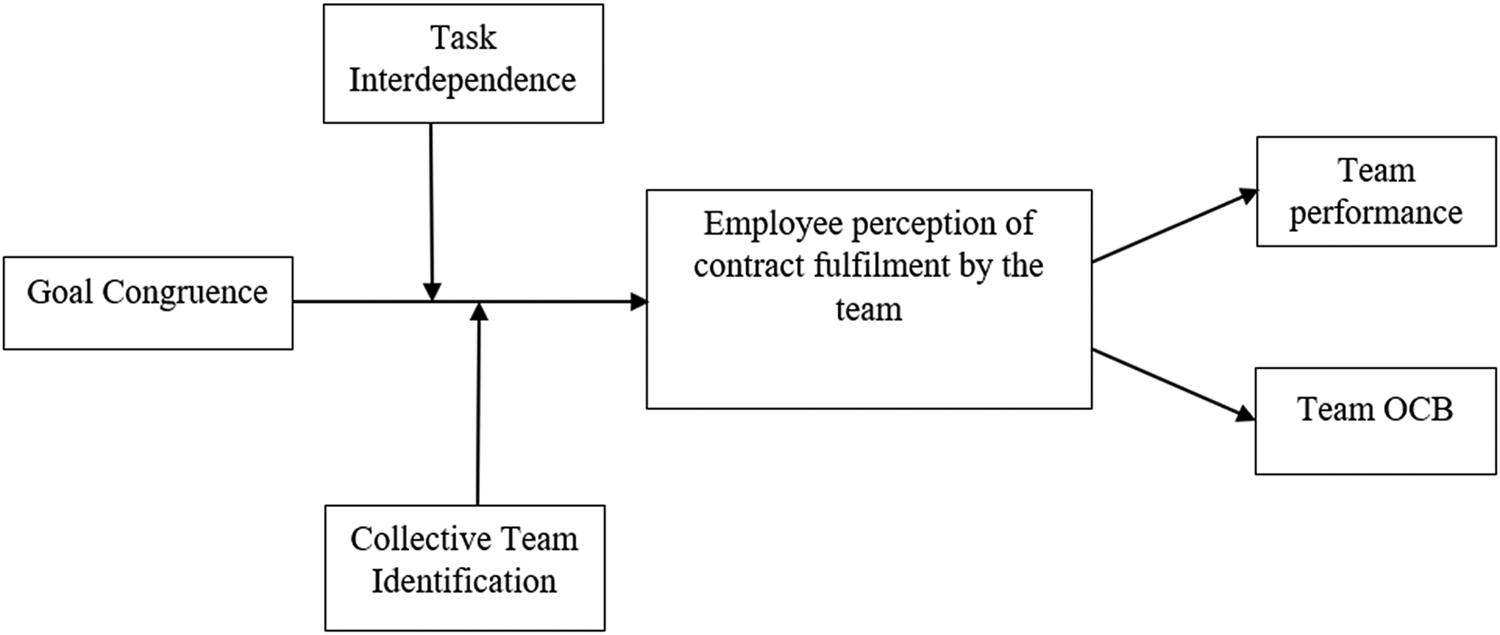
In the conceptual model depicted in Figure 1 below, we propose that (shared) fulfilment perception in teams is a key component in the process by which teams perform. Psychological contracts develop as a deliberate goal-oriented process (Shore & Tetrick, Reference Shore and Tetrick1994), in which employees attempt to establish implicit agreements with their work teams which will address a variety of work objectives. Parts of these psychological contracts will be shared in the team.
Research model.

Testing this model will provide information about the relative importance of work design interventions or managerial practices targeted at the team as a whole, compared to the individuals who comprise the team.
Theoretical framework
Goal orientations are defined by Dweck (Reference Dweck1986) as dispositions towards developing or demonstrating ability in achievement situations. According to Nicholls (Reference Nicholls1975, Reference Nicholls1984), goal orientations must be defined in terms of achievement behaviour in which individuals select tasks to develop or demonstrate high ability (success) or avoid low ability (failure). There is some debate in organisational research why individuals have different goal orientations. For example, Nicholls (Reference Nicholls1984) attributed goal orientations to the individual's own perceived mastery, understanding or knowledge versus perceived ability with reference to a normative reference group. Dweck (Reference Dweck1986) and colleagues, however, attributed goal orientations to theories of intelligence.
At least two goal orientations exist: performance orientations focus on gaining positive judgements and avoiding negative judgements of competence (i.e., demonstrating competence, see Pieterse, Reference Pieterse2009), and learning orientations are concerned with increasing competence (Dweck & Leggett, Reference Dweck and Leggett1988). Studies of person–environment fit (P–E fit) have shown that similarity in psychological characteristics of employees, including goal congruence (Vancouver & Schmitt, Reference Vancouver and Schmitt1991), is associated with improved work outcomes, such as job satisfaction and organisational commitment (Kristof-Brown, Zimmerman, & Johnson, Reference Kristof-Brown, Zimmerman and Johnson2005), higher performance and lower turnover intentions (Kristof-Brown & Stevens, Reference Kristof-Brown and Stevens2001). These relationships are in line with Byrne's ‘attraction paradigm’ (Byrne, Reference Byrne and Berkowitz1969, Reference Byrne1997); team members are attracted to, and like, other members who are similar to themselves in values and beliefs. They do so because the relationships with similar selves are believed to be more rewarding and supportive (Cable & Edwards, Reference Cable and Edwards2004). Team members who share similar values and goals find it easier to work together (Greguras & Diefendorff, Reference Greguras and Diefendorff2009), to interact and communicate with the coworkers in the team and develop high-quality relationships (which promotes affective sharing). Moreover, sharing similar values and goals in teams increases the predictability of how others in the team will act (Adkins, Ravlin, & Meglino, Reference Adkins, Ravlin and Meglino1996), how events will unfold (Edwards & Cable, Reference Edwards and Cable2009) and promote trust in relationships.
Sharing similar values in teams will reduce uncertainty, stimulus overload (Kalliath, Bluedorn, & Strube, Reference Kalliath, Bluedorn and Strube1999) and other negative features of work interactions. At the same time, members experience less role ambiguity and conflict (Meglino, Ravlin, & Adkins, Reference Meglino, Ravlin and Adkins1989), and are therefore more satisfied and committed to the team (Vancouver, Millsap, & Peters, Reference Vancouver, Millsap and Peters1994). Thus, similarity in goal orientations of team members is expected to have an effect beyond those of employee's own goals. Vancouver and Schmitt (Reference Vancouver and Schmitt1991: 339) referred to this similarity or alignment in goal orientation as goal congruence: ‘the agreement on group-level goals of one member of the group with all the other members of his or her group’. More specifically, when employees perceive that the goal orientations of the members in their team are congruent with their own, they think that the team will better fulfil perceived obligations with regards to support and the attainment of personal goals. The employee reciprocates with enhanced contributions to the team. In contrast, perceived discrepancies in self-team performance orientations will lead to imbalances in psychological contracts with the team with negative consequences for employee contributions.
In teams, the development of similar psychological contracts and shared perceptions of PCF is expected to occur. The presence of social referents (Ho & Levesque, Reference Ho and Levesque2005; Wong, Reference Wong2008) in the work team and social influence processes (Ho, Reference Ho2005) affects how team members interpret the fulfilment of their psychological contracts. The continuously strengthening or weakening of member's initial perceptions may result in a more homogeneous set of perceptions in teams. Thus, a shared individual PCF (Laulié & Tekleab, Reference Laulié and Tekleab2016) emerges from the member's perceptions. Shared individual PCF is defined in this study as ‘the convergence of team members’ perception of the degree to which their team fulfils individual psychological contracts’.
As depicted in Figure 1, we propose in the next team-level hypothesis a relationship between perceived similarity in goal orientations and shared individual PCF.
Hypothesis 1
The greater the congruence between the team member's goal orientations, the higher the shared employee perceptions of PCF.
Compliant with social exchange theory (Blau, Reference Blau1964), teams with high-shared fulfilment will try to balance the positive exchanges with a shared desire to perform effectively, which increases team performance. The positive environment of (shared) PCF motivates team members to contribute more to their team, displaying extra-role behaviour. Other members in the team are encouraged to imitate those behaviours, creating a shared (i.e., team level) extra-role behaviour. Therefore, we hypothesise at the team level of analysis:
Hypothesis 2a
Shared employee perception of fulfilment by the team is positively related to team performance.
Hypothesis 2b
Shared employee perception of fulfilment by the team is positively related to team extra-role behaviours (i.e., team OCB).
Following the relationships as described above, we propose a mediation effect of shared PCF between goal congruence and team performance and OCB. Perceived similarity in goal orientations enhances perceived fulfilment of obligations by the team. Members reciprocate by increasing performance and extra-role behaviours. Thus, we hypothesise:
Hypothesis 3a
Shared employee perceptions of fulfilment mediate the relationship between goal congruence and team performance.
Hypothesis 3b
Shared employee perceptions of fulfilment mediate the relationship between goal congruence and team OCB.
Factors that promote and strengthen sharing psychological contract beliefs in teams include team identification (Tanghe, Wisse, & Van Der Flier, Reference Tanghe, Wisse and Van Der Flier2010) and task interdependency (Mueller, Reference Mueller2012).
Task interdependency is one of the important structural variables that influence team performance (Liden, Wayne, & Bradway, Reference Liden, Wayne and Bradway1997). In addition, it has been pointed out that task interdependence often indirectly influences performance by moderating the effects of other variables on performance (Langfred, Reference Langfred2005). Task interdependence is defined in this study as the degree to which team members must rely on one another to perform their tasks effectively given the design of their jobs (Saavedra, Earley, & Van Dyne, Reference Saavedra, Earley and Van Dyne1993).
At the team level, we expect that the motivational effects of goal congruence depend on the level of task interdependence in the team. In teams that perform highly interdependent tasks, members have to work together (Van Der Vegt, Van De Vliert, & Oosterhof, Reference Van Der Vegt, Van De Vliert and Oosterhof2003) and need each other's information, materials, expertise (Van Der Vegt, Emans, & Vliert, Reference Van Der Vegt, Emans and Vliert2001) and support to achieve common goals. As each team member's contribution is required, high-quality interpersonal relationships based on trust, improved communication and increased ability to predict each other's behaviour enable each member to perform well in the attainment of shared goals. In less interdependent teams, on the other hand, members work more independently on their tasks. In such a situation, interaction with congruent team members may interfere with individual performance (Adkins, Ravlin, & Meglino, Reference Adkins, Ravlin and Meglino1996), as it is time-consuming and ineffective to reach team consensus on decisions. Excessive time may be spent in coordination activities team members feel are not necessary (Liden, Wayne, & Bradway, Reference Liden, Wayne and Bradway1997). Team members pursue their personal interests (Stewart & Barrick, Reference Stewart and Barrick2000), and may benefit from cooperation in the team without contributing in return (Van Der Vegt, Van De Vliert, & Oosterhof, Reference Van Der Vegt, Van De Vliert and Oosterhof2003).
In highly interdependent teams, the effects of perceived similarity in goal orientations are expected to be stronger than in less interdependent teams, because in highly interdependent teams, members need others to accomplish personal goals. Similarity is then perceived as increased performance of the team in personal goal attainment. Perceived obligations of the team in the psychological contract are met and levels of perceived PCF rise. These perceptions of fulfilment are subsequently shared in the team. Therefore, we hypothesise:
Hypothesis 4
An interaction effect between goal congruence and task interdependence is expected, such that teams with perceived similarity in goal orientations and high levels of task interdependence are likely to have higher levels of shared employee perceptions of PCF than teams with low levels of task interdependence.
Regarding team identification, when members identify with their team, they define themselves in terms of team membership. This identification may lead to conform more to norms, attitudes and values of the team. It is assumed that identification depends on a sense of shared social identity (Ashforth & Mael, Reference Ashforth and Mael1989). That is, identification with a team is much easier when members belonging to the same team do share similar perceptions of team identity (Van Knippenberg & Van Schie, Reference Van Knippenberg and Van Schie2000). Since we are interested in team identification as a motivational force that can enable high-quality relationships and interactions in teams, we focus on the emotional aspects of team identification in this study. Following Van Der Vegt and Bunderson (Reference Van Der Vegt and Bunderson2005: 533), we define team identification as ‘the emotional significance that members of a given group attach to their membership in that group’.
We argue that team identification strengthens the motivational effects of perceived similarity in goal orientation on perceived PCF. In teams with high levels of team identification, employees are committed to their work team and its goals rather than (or in addition to) to their own goals. They perceive that their team is able to fulfil obligations to its members to a higher degree, which will be reciprocated by expending more effort on behalf of the team, offering more support and loyalty. This feeling will more likely be shared as employees who are emotionally attached to the work team, are more motivated to pick up affective signals (Tanghe, Wisse, & Van Der Flier, Reference Tanghe, Wisse and Van Der Flier2010) of others in the team and are more attentive to their behaviours, feelings and attitudes. Thus, we hypothesise:
Hypothesis 5
An interaction effect between goal congruence and team identification is expected, such that teams with perceived similarity in goal orientations and high levels of team identification are likely to have higher levels of shared employee perceptions of PCF than teams with low levels of team identification.
Method
Population and sample
The data of this study were collected by student researchers following a strict protocol. In Spring 2018, employees and their team managers completed questionnaires on their work-related perceptions. The sample consists of 544 employees working in one of 127 work teams. Team size ranged from three to 11 members.
Most employees in the sample were female (57.6%) and had at least a bachelor degree (61.4%). They worked on average almost 5 years in the team with a few outliers of 10 years or more. The majority had a full-time job (53.7%) on a permanent basis (70.2%). The mean age of the employees was 35 years (SD = 12.9), the manager of their work team 42 years (SD = 10.6). The mean organisational tenure of the managers in the sample was 11.3 years, with large differences (SD = 9.3). In total, 39.9% of the managers worked in large organisations (>1.000 employees), 12.9% in small and medium-sized enterprises (<25 employees). Seventeen per cent of the managers in the sample are employed in commercial organisations (i.e., whole sale, retail, supermarket). The rest of the manager group worked as staff in a diverse range of sectors (e.g., industry 15.0%, public administration 13.7%, corporate services 11.6%).
Measures
To reduce common method variance (Podsakoff, MacKenzie, Lee, & Podsakoff, Reference Podsakoff, MacKenzie, Lee and Podsakoff2003), we collected data from multiple sources, namely the team members and their immediate supervisors. The team members provided data regarding individual-level attitudes and behaviours, whereas the supervisors provided data concerning task interdependence and team-level performance.
Employee perception of fulfilment by the team
We measured the perception of fulfilment by the team with the Schreuder, Schalk, and de Jong (Reference Schreuder, Schalk and de Jong2017) 15-item scale. Example items are ‘… the team would take your interests into account when making decisions.’ or ‘… the team would help you to get your job done’. Reciprocity in psychological contracts is rated from 0 (No, not at all) to 5 (Yes, but I received much more than promised). The scale measures psychological contracts at the individual level of analysis, showing good internal consistency (α = .913). Individual ratings were aggregated to the team level. To test whether such aggregation was justified (Chan, Reference Chan1998), we calculated a within-team interrater agreement statistic, r wg(J) (James, Demaree, & Wolf, Reference James, Demaree and Wolf1993) and intraclass correlation indices ICC(1) and ICC(2) (Bartko, Reference Bartko1976). The mean r wg(J) for the perception of fulfilment by the team, using a uniform null distribution, was .96 (SD = .13) indicating strong agreement (LeBreton & Senter, Reference LeBreton and Senter2008). ICC(1) and ICC(2) were calculated from one-way random-effects analysis of variance (McGraw & Wong, Reference McGraw and Wong1996). The results showed a significant F-statistic (F = 1.75, p < .001), an acceptable ICC(1) value (.16) and a moderate ICC(2) value (.43).
Goal congruence
To assess perceived similarity in goal orientations, we used the Van de Walle (Reference Van de Walle1997) 13-item goal orientation scale. The Van de Walle scale identifies three dimensions (i.e., learning, prove and avoid) in goal orientation, domain specific to work settings. Example items are ‘I enjoy challenging and difficult tasks at work where I'll learn new skills’ (learning), ‘I am concerned with showing that I can perform better than my coworkers’ (prove) and ‘I prefer to avoid situations at work where I might perform poorly’ (avoid). The items are rated on a Likert-type scale with answer categories ranged from 1 (totally disagree) to 5 (totally agree).
Since previous research found that the standard deviation in goal orientations was a stronger determinant of group processes and performance than mean levels (Pieterse, Reference Pieterse2009; Pieterse, Van Knippenberg, & van Ginkel, Reference Pieterse, Van Knippenberg and van Ginkel2011) and to incorporate team composition (LePine, Reference LePine2005) in the analysis, perceived similarity was assessed as the standard deviation in the goal orientations of the team.
Three competing a priori models were analysed. The first model measures goal congruence with three-correlated factors of goal orientation (learning, prove and avoid). The second model was a two-correlated factor model with a 5-item learning factor and a performance factor in which the four prove and four avoid items are combined. In the third model, we tested the possibility that the 13 items were the result of a general goal congruence factor. The second model showed a significantly better fit than the two other models: Model 3 factors versus 2: Δχ2 = 54.234, Δdf = 11, p <.01; Model 2 factors versus 1: Δχ2 = 5.174, Δdf = 2, p <.01. Cronbach's α of the items in the two-factor model is .74.
Team performance: comparative
We followed the practice adopted in a number of other surveys (e.g., Guest & Peccei, Reference Guest and Peccei2001; Ramsay, Scholarios, & Harley, Reference Ramsay, Scholarios and Harley2000) and asked team managers about comparative team performance. Supervisors were asked to rate the performance of the team in comparison with other teams in their organisation. The response categories ranged from 1 (much worse) through (about the same) to 5 (much better). Six items covering performance were selected from Wall et al. (Reference Wall, Michie, Patterson, Wood, Sheehan, Clegg and West2004) and revised for the team environment. Example items are ‘Productivity of employees’, ‘Quality of goods and services’ and ‘Employee absenteeism’. The internal consistency of the comparative team performance scale is satisfactory (α = .703).
Team OCB
Supervisors assessed extra-role behaviour of their work unit with an adapted version of the individual focused items of Lee and Allen (Reference Lee and Allen2002). Instructions are modified and the referent of the measures is changed from individual to the work unit. The items are prefaced with the phrase ‘Over the past month, how often have employees in your work unit’. Example items are ‘Helped others who had been absent’ and ‘Expressed loyalty towards the organisation’. Answer categories ranged from 1 (never) to 7 (always).
McNeely and Meglino (Reference McNeely and Meglino1994) suggested that extra-role behaviours intended only to benefit specific individuals (OCB-I) and those behaviours intended only to benefit the organisation (OCB-O) should be distinguished (see also Organ, Reference Organ1997; Williams & Anderson, Reference Williams and Anderson1991).
With CFA, we examined the fit of a model to the data in which the items loaded on these two targets of citizen behaviour, where OCB-O depicts behaviours to benefit the work team, and compared it with a model with only one citizen behaviour factor. The one-factor OCB model showed a significantly better fit than the two-factor OCBI–OCBO model: Δχ2 = 24.42, Δdf = 2, p <.01 with a good internal consistency of the scale items: α = .773.
Collective team identification
As a measure of team identification, we used the items of Van Der Vegt, Van De Vliert, and Oosterhof (Reference Van Der Vegt, Van De Vliert and Oosterhof2003). We asked team members to evaluate the relationship with their team on items such as ‘I feel like “part of the family” at my team’ and ‘I really feel as if this team's problems are my own’. The items are rated on a 5-point Likert-type scale ranging from 1 (totally disagree) to 5 (totally agree). The internal consistency of the scale is .71. Responses were aggregated to the team level. To test whether aggregation was justified, we calculated the within-team interrater agreement statistic r wg(J) (James, Demaree, & Wolf, Reference James, Demaree and Wolf1993) and intraclass correlation indices ICC(1) and ICC(2) (Bartko, Reference Bartko1976). The mean r wg(J) for collective team identification, using a uniform null distribution, was .82 (median = .89, SD = .20) indicating strong agreement (LeBreton & Senter, Reference LeBreton and Senter2008). Furthermore, ICC(1) was .17 and ICC(2) was .42, F = 1.72, p < .01.
Task interdependence
Task interdependence was measured with four items taken from Van Der Vegt, Emans, and Vliert (Reference Van Der Vegt, Emans and Vliert2001) and is rated by the team manager. The items underwent minor rephrasing to refer to the perspective of the supervisor in rating task interdependency of their teams. Example items are ‘In order to complete their work, people in my group have to obtain information and advice from each other.’ and ‘People in my group have to work closely with their colleagues to do their work properly’. The items are rated on a 5-point Likert-type scale ranging from 1 (strongly disagree) to 5 (strongly agree). The internal consistency of the scale is acceptable (α = .74).
Control variables
Shared PCF in employee–team relationships is likely to be associated with team tenure and team size (De Vos & Tekleab, Reference De Vos and Tekleab2014). When relationships with other team members are long standing, opportunities of interaction and exchange are increased which affects psychological contract terms. Widening the breadth and the scope of the psychological contract, the opportunity costs created by the long-standing relationships expand what parties expect from each other (i.e., mutuality) and enhance team spirit. Conversely, at larger team sizes, perceived support from the team (Mueller, Reference Mueller2012), member satisfaction, cohesion and participation levels tend to be lower (Wheelan, Reference Wheelan2009). The decreasing amount of communication initiated by team members and the increased social distances in large teams hinder social interaction among members and would harm the development of shared psychological contracts. Therefore, team size and team tenure are included as control variables.
Analysis strategy
First, the data set was screened for missing values. All variables had none or a small amount of missing values (<5%). For scale (continuous) variables with a low rate of missing values, the mean was imputed, for ordinal variables the median. After the data imputation phase, the skewness and kurtosis of the variables were assessed. All outcomes were below the threshold value of |3| and 94% below |2|.
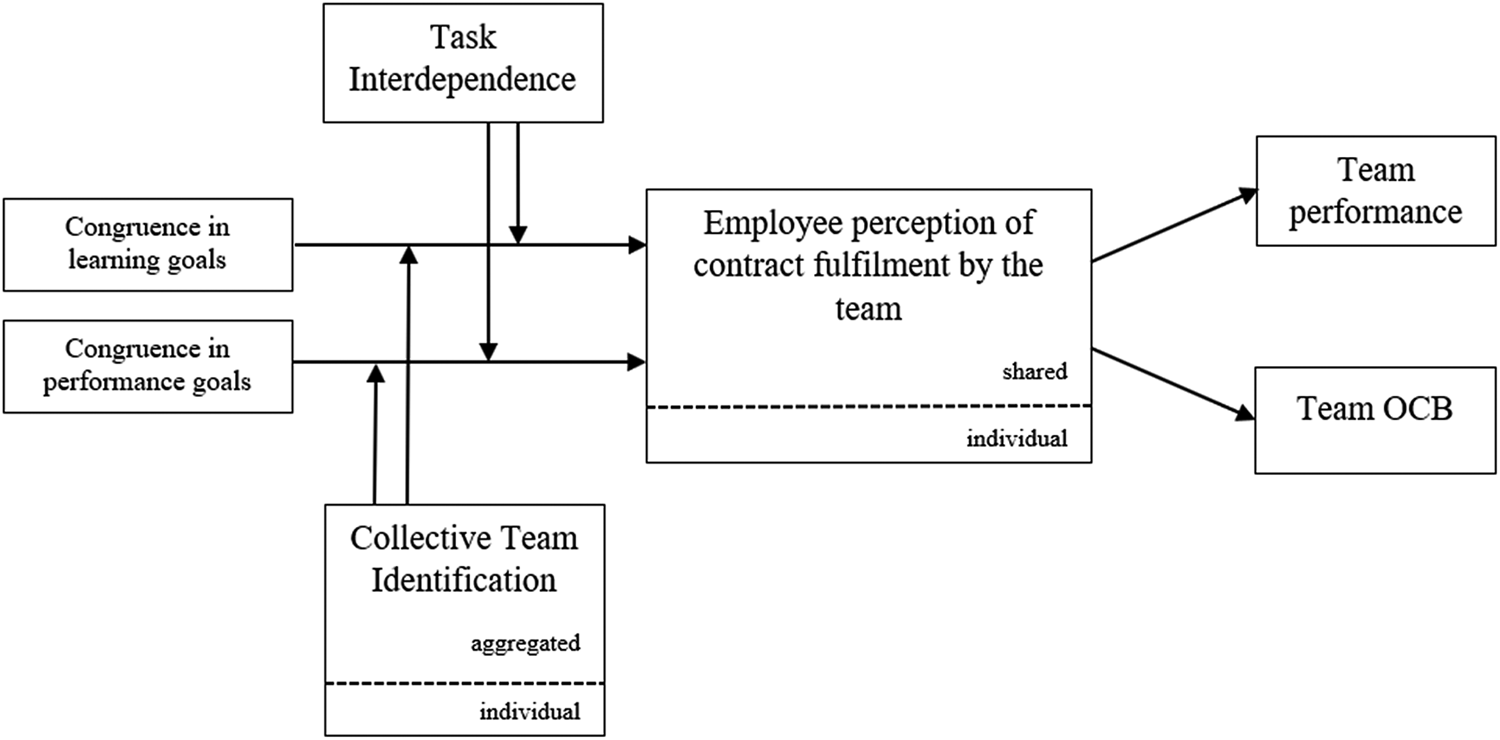
Second, we partitioned the PCF and team identification constructs in two parts to measure the distinctive effects operating at the individual level, the team level or both. Despite the sufficient homogeneity of item scores in teams for both constructs (i.e., r wg(J)) to warrant aggregation, the discussed theory of PCF and the moderate values of intraclass coefficients suggest that significant differences between teams are accompanied with differences between individuals. Therefore, to test whether the main effects of fulfilment and identification were due to differences between teams or between individuals, the scores on both constructs were partitioned into the mean score of the team and the within-team deviation (i.e., team member score−mean score of the team). If a regression coefficient is significant for the mean score and nonsignificant for the within-team deviation, then the effect operates only at the team level. If, conversely, the coefficient is significant for the within-team deviation and nonsignificant for the mean score, then the effect operates at the individual level (see also Van Der Vegt, Emans, & Vliert, Reference Van Der Vegt, Emans and Vliert2001).
The partitioning of the team identification scores into the mean score and the within-team deviation implies that the predicted interaction effects in the conceptual model have also to be partitioned into two parts. First, a goal congruence × aggregated collective team identification interaction, indicating that the hypothesised effect occurs due to differences between teams. Second, a goal congruence × collective team identification deviation interaction, indicating that the hypothesised effect occurs due to differences in identification between members of the same team.
The partitioning of PCF and team identification, when added to the division of goal congruence in a learning and a performance factor, results in a model depicted in Figure 2.
Measurement model.

Measurement model
We have done reliability and validity checks of the constructs in Figure 2 using CFA. Reliability, convergence validity and discriminant validity of all constructs proved to be satisfactory. The measurement model of the constructs showed a relatively good fit to the data: CFI = .905, RMSEA = .045, SRMR = .0426 and should be called a ‘close-fitting’ model (PCLOSE = .998).
Results
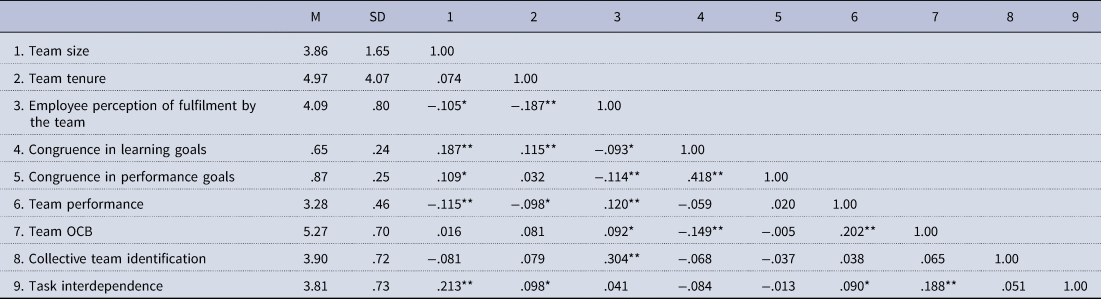
Table 1 presents the means, standard deviations and Pearson correlations of the main variables used in this study.
Means, standard deviations and intercorrelations of the main variables

**Correlation is significant at the .01 level (two-tailed).
*Correlation is significant at the .05 level (two-tailed).
The correlations between scale means indicate significant relations between goal congruence and fulfilment (negative as expected), and between fulfilment and team performance and team OCB. There is also a significant correlation between both outcome variables. Collective team identification is significantly correlated with PCF. Task interdependence is significantly correlated with team OCB.
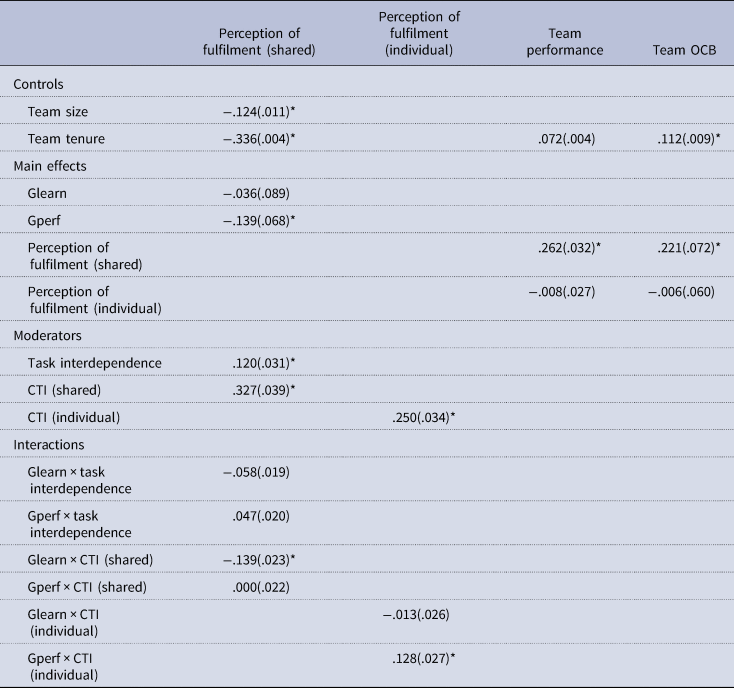
In Table 2, results are presented of the regressions used in hypotheses testing. The first column of the table reveals the partitioning of the team identification moderator and the perception of fulfilment construct in two parts; the team-level (shared) part and the individual part. Also, is shown the partitioning of the predicted interaction effects and the break-down of the goal congruence in two factors (i.e., learning and performance) as a result of confirmatory factor analysis.
Tests of hypotheses; direct effects and interaction effects

Notes. Table entries represent standardised estimates with standard errors in parentheses; n = 157 teams, 544 employees. Dependent variables in the columns. Predictors in the rows of the table. Goal congruence is divided into two factors: Glearn (i.e., congruence in learning goals) and Gperf (i.e., congruence in performance goals).
CTI=collective team identification.
*p < .05.
As CFA of the goal congruence construct revealed that a model with two team goal types (i.e., learning and performance) is the best-fitting model, two relationships between perceived similarity in goal orientations and shared individual PCF must be tested for Hypothesis 1. The results indicate that both relationships are in the predicted direction (i.e., negative), but only the relationship between the congruence of performance goals and shared perceptions of fulfilment proved to be significant (β = −.139, p < .001). Thus, Hypothesis 1 is partially supported by the data.
Furthermore, the results indicate that the mean scores of PCF, measuring shared perceptions in the work team, are positively related to the supervisor-rated performance of the team (β = .262, p < .001) and team OCB (β = .221, p < .001). The within-team deviations in PCF do not have significant effects. Thus, the effects of PCF in the data set operate only at the team level and support Hypotheses 2a and 2b.
Preacher and Hayes (Reference Preacher and Hayes2004: 719) argued that mediation is a special case of indirect effects, which implies that a total effect X → Y was present initially. Assessment of indirect effects by itself does not require that assumption. In testing Hypotheses 3a and 3b, we started with an indirect effects model because this model is ‘the most constrained or parsimonious as it implies that the only significant relationships observed are the combined effect (βmx × βym )’ (Mathieu & Taylor, Reference Mathieu and Taylor2006: 1039). The results showed significant indirect effects of alignment in performance goal orientations via shared PCF to work outcomes: team performance: β = −.045, 90% CI [−.067 to −.023]; team OCB: β = −.083, 90% CI [−.140 to −.033]. The indirect effects of alignment in learning goal orientations are all nonsignificant: team performance: β = −.015, 90% CI [−.045 to .010]; team OCB: β = −.028, 90% CI [−.089 to .019]. We judged whether or not the significant indirect effects of alignment in performance goal orientations also represent mediation by adding total effects to the model. While controlling for team size and team tenure, full mediation effects were not supported by the data. One partial mediation relationship proved to be significant: congruence in performance goals–team performance ( ${\rm \beta} _{yx.m} = \;. 085,\; p < \;. 05;\; {\rm \beta} _{mx} = -. 139,\; p\; < \;. 001;\; {\rm \beta} _{ym.x} = \;. 284,\; p < \;. 001)$. Thus, the findings do support Hypothesis 3a and are not supportive of mediation Hypothesis 3b. Shared PCF accounts for a significant portion of the goal congruence–team performance relationship. However, this partial mediation effect is only been demonstrated for congruence in performance team goals.
Task interdependence was expected to moderate the relationship between congruence in team goals and shared PCF. The results show a significant main effect (β = .120, p < .001) and nonsignificant interaction effects: learning (β = −.058, ns); performance (β = .047, ns). These findings are not consistent with Hypothesis 4.
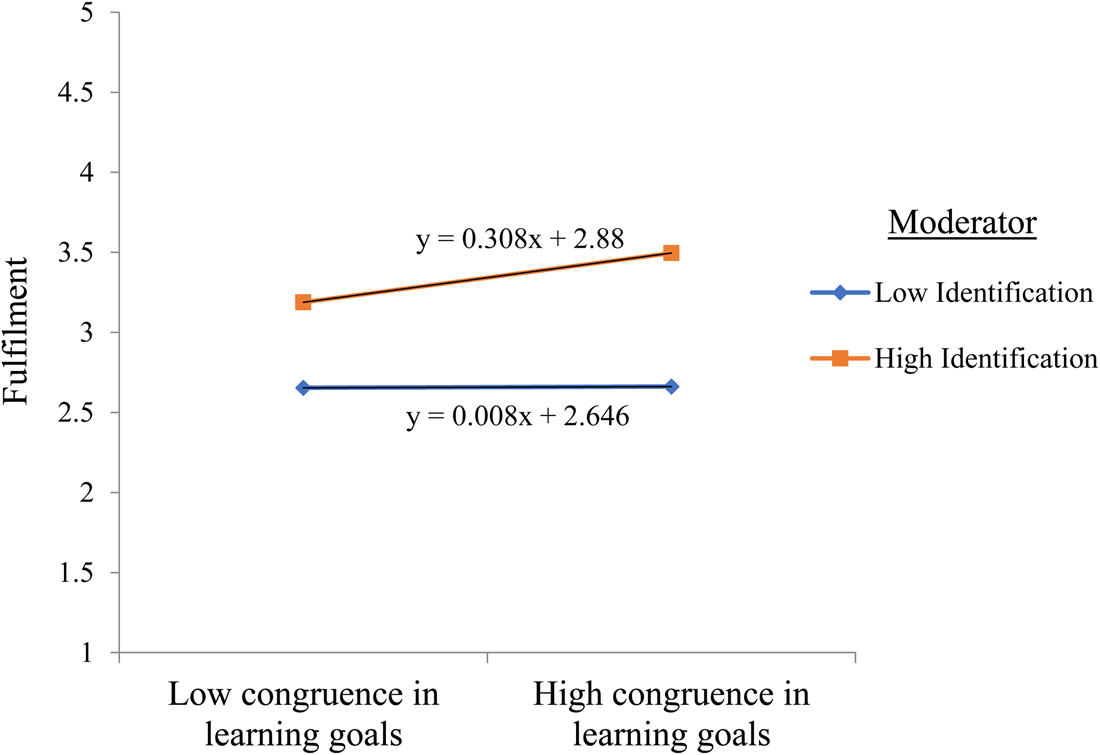
Hypothesis 5 proposes a moderating role of collective team identification in the goal congruence–shared PCF relationship. At the team level, the results indicate a significant main effect of team identification (β = −.139, p < .001) and a significant interaction effect on the positive relationship between alignment in learning goals (GcL) and perceived PCF. Figure 3 shows this interaction effect as a small, but a significant strengthening effect of team identification.
Association between congruence in learning goals and shared contract fulfilment moderated by collective team identification

The moderation effect of team identification on the alignment in performance goals–shared PCF relationship seems not to exist at all (β = .000, ns). However, a cross-level interaction effect of team identification was not hypothesised, but one of these proved to be significant: performance × team identification(individual) (β = .128, p < .05). Thus, Hypothesis 5 is only partially supported by the data.
Discussion
Implications for theory
To summarise our findings, we have found evidence that the significant effects of perceived similarity in goal orientations (i.e., goal congruence) on team performance are partially accounted for by shared PCF. Task interdependence and team identification do have significant effects on shared PCF, but do not act as moderators when considered in combination with the congruence of team goals. There is only one exception; the positive effects of perceived similarity in learning goal orientations are strengthened by higher levels of team identification. The main effect of this similarity proved not to be significant, whereas the main effect of perceived similarity in performance goal orientations is significant, but do not have significant interaction effects.
It might well be that the measurement of perceived similarity with the standard deviation of the goal orientations in the team may underestimate the effects of goal congruence and has affected the interplay of goal congruence with task interdependence and team identification in the model. A number of studies of P–E fit have found that individual's perception of how s/he fits is more strongly related to attitudes and behaviours than actual fit (e.g., Cable & DeRue, Reference Cable and DeRue2002; Kristof-Brown & Stevens, Reference Kristof-Brown and Stevens2001; Ostroff, Shin, & Kinicki, Reference Ostroff, Shin and Kinicki2005). That means that a focus on similarity between team member's goal orientation and their perceptions of the goal orientation of the rest of the team (i.e., subjective fit, see Cable & Judge, Reference Cable and Judge1996) would have led to larger effect sizes in the model.
The learning and performance goal orientations in the moderated mediation model do have different effects, although not always predicted. We may conclude that a distinction between goal orientations is indeed essential in studying the effects of perceived similarity in goal orientations on team performance and team extra-role behaviours. This is in line with previous research on goal congruence, value congruence and P–E fit. Learning goal orientation and performance goal orientation are not opposite ends of an underlying continuum, as Dweck (Reference Dweck1986) suggested, but are interrelated (Payne, Youngcourt, & Beaubien, Reference Payne, Youngcourt and Beaubien2007). In the measurement of both orientations in our congruence construct, we took account of these correlations. However, both orientations differ in their effects on attitudinal and behavioural outcomes as our research demonstrated. As previous research noted, performance goal orientation is in fact, multidimensional and should be partitioned in prove and avoid dimensions (Van de Walle, Reference Van de Walle1997). Results indicate that avoid performance do have opposite effects (Elliot & Harackiewicz, Reference Elliot and Harackiewicz1996) on outcomes than learning orientation and prove performance similar effects (Rawsthorne & Elliot, Reference Rawsthorne and Elliot1999) or none (Payne, Youngcourt, & Beaubien, Reference Payne, Youngcourt and Beaubien2007).
One could suggest that the motivational effect of similarity in prove performance goal orientations is stronger than perceived similarity in learning goal orientations. One explanation for this difference in effect is that the focus on strong performance outcomes relative to others and positive judgements about one's competence do require the support of others in the team. Conversely, members in a team with a learning goal orientation can gain, improve or master new skills regardless of actions taken by others in the team. It is possible for members to learn from team work even if other team members are not concerned about mastering new skills. That is not to say that they do not need the team in their learning orientation. Members with a learning goal orientation appreciate a team context that facilitates learning; they interpret feedback and suggestions of others as aids in skill development. In other words, for performance goal orientation is support and interaction with others a necessary condition. For learning orientation is the team context only a sufficient condition. Therefore, it is understandable that similarity in prove performance goal orientations would be more strongly related to shared individual PCF than similarity in learning goal orientations.
Implications for practice
Obviously, this study has implications for human resource practices in organisations. First, it is important to consider the goal orientations of employees, when selecting new team members. Organisations may either choose to select employees with similar goal orientations as team members or they may decide to create teams with different, but complementary, orientations. Both choices affect team dynamics, perceptions of PCF and team performance. A necessary condition for the effectiveness of either choice is that the goal orientations of others in the work team are apparent to each team member. When differences or similarities in goal orientations are unnoticed by team members, it will not manifest itself in distinct and recognisable behaviours.
Second, this study provides evidence to support manager behaviours that recognise employees as adding value to their teams. Verbal praise of knowledge, skills, abilities and orientations of team members may prove to be an effective way to increase team identification and member contributions to the team.
Third, providing opportunities to teams to strengthen social influence processes through, for example, team-building activities may increase the emergence of shared perceptions of PCF in the team.
Limitations
One issue that should be noted is that we used a cross-sectional design to test a causal model of goal congruence–team performance relationships. We acknowledge that in cross-sectional designs it is very difficult sorting out which causal sequences are plausible and which are not (Taris & Kompier, Reference Taris and Kompier2006). In other words, the design does not allow us to reach decisive conclusions about the causation between the variables in the models. For that reason, we have adapted the wording of our hypotheses in this study; we never talked about cause and effect, but always used the ‘relationship’ wording. A longitudinal design would overcome this limitation and uncover the causal paths between goal congruence, perceived PCF and work outcomes.
In addition, the cross-sectional design with the same respondents providing measurements of several variables in the moderated mediation model might have caused (common) method bias (Podsakoff et al., Reference Podsakoff, MacKenzie, Lee and Podsakoff2003). Method bias can be a problem, through its effects on the path coefficients in a structural model. In this study, we used several procedural remedies to control for the effects of common methods bias. For example, we obtained measurements of the predictor and criterion variables in the model from different sources (i.e., employees and supervisors). However, we acknowledge that the use of different sources does not preclude desirability biases, which may affect the results of this study. It might well be that team managers have rated their own teams higher, on average, than other teams or that employees overstate behaviours in the task proficiency construct. In addition, do team managers really know how well other teams in their organisation are doing.
In this study, we have controlled only for team tenure and team size and not for variables specifically known to be associated with various manifestations of job performance (e.g., Roth, Purvis, & Bobko, Reference Roth, Purvis and Bobko2012). Adding those controls may have had effects on the strength and significance of the relationships in the model.
Future Research
Although task interdependence does not have moderating effects in the model, it has a significant effect on perceived PCF. We recommend a prominent role of task interdependence in future replications of this research, because of the relationships between perceived similarity in goal orientations and task strategies and the possibilities to control task interdependence in the team by management. A moderator variable under managerial control that influences the effects of perceived similarity in team goals on perceived fulfilment and performance would be a valuable tool in the management of teams.
In this study, we used the Van de Walle (Reference Van de Walle1997) scale to measure at the team level perceived similarity in goal orientations. It would be interesting in future research to assess goal congruence with alternative measurement instruments (or develop new ones) and test the moderation and mediation hypotheses again. Will the same pattern of effects be found? What is the role of other elements in team psychological contracts, besides fulfilment, in team behaviours and performance?
Future research in the domain of goal orientations and psychological contracts in teams should focus on the psychological processes through which alignments in orientations and psychological contracts develop. This may provide new ways to increase the performance of teams in organisations.
Author ORCIDs
Frits Schreuder, 0000-0002-1536-139X