Introduction
Oaks (Quercus spp.) are a common component of temperate forests throughout the world and are economically one of the most important hardwood trees (Johnson et al., Reference Johnson, Shifley and Rogers2009). They are divided primarily into two groups: the red oak group (section Lobatae) and the white oak group (section Quercus). These two groups differ primarily in inner acorn shell texture, wood anatomy and leaf morphology. From a seed (acorn) consideration, these groups differ in their length of maturation, chemical composition and degree of dormancy (Bonner, Reference Bonner, Bonner and Karrfalt2008). The radicle and epicotyl are dormant in acorns of species belonging to the red oak group, whereas only the epicotyl is dormant in those belonging to the white oak group (Baskin and Baskin, Reference Baskin and Baskin2014). The exception to the red oak group is Quercus ilicifolia in which only the epicotyl requires cold stratification for dormancy break (Allen and Farmer, Reference Allen and Farmer1977). As such, a distinct time lag occurs in the emergence between radicles and epicotyls in the white oak group due to epicotyl dormancy (Baskin and Baskin, Reference Baskin and Baskin2014). However, there is much variation in the degree of dormancy and the amount of cold stratification that is required to overcome radicle and epicotyl dormancy in these two groups of oaks (Bonner, Reference Bonner, Bonner and Karrfalt2008; Baskin and Baskin, Reference Baskin and Baskin2014; Hawkins, Reference Hawkins2018, Reference Hawkins2020).
In our study, we focused on one of the economically and ecologically important hardwood species native to most of Europe (Eaton et al., Reference Eaton, Caudullo, Oliveira, de Rigo, San-Miguel-Ayanz, de Rigo, Caudullo, Houston Durrant and Mauri2016), pedunculate oak (Quercus robur L.), a member of the white oak group. This species grows in mixed broadleaved forests or in pure stands throughout Europe, except in more northerly regions, up to 59–60°N latitude and up to 63°N in the western portion of Norway. In the Mediterranean regions, it is found in the Apennine Peninsula and in Greece as well as in scattered populations in Asia Minor and as far east as the Caspian Sea. In northern Europe, it has been widely planted outside its natural habitats and is very common, except in the far north and west of the British Isles (Suszka et al., Reference Suszka, Muller and Bonnet-Masimbert1994).
Germination of this species has been studied in relation to desiccation tolerance (Finch-Savage, Reference Finch-Savage1992; Finch-Savage and Blake, Reference Finch-Savage and Blake1994; Berjak et al., Reference Berjak, Walker, Watt and Mycock1999; Doody and O'Reilly, Reference Doody and O'Reilly2008), temperature (Jastrzębowski and Ukalska, Reference Jastrzębowski and Ukalska2019), light and fire-related compounds (Pritchard and Manger, Reference Pritchard and Manger1990; Reyes and Casal, Reference Reyes and Casal2006; McCartan et al., Reference McCartan, Jinks and Barsoum2015). Radicle emergence occurs for most acorns soon after dispersal in autumn, but for a few acorns, it is delayed until spring (Jones, Reference Jones1959; Wigston, Reference Wigston1987). For acorns in which the radicle emerges in autumn, epicotyls emerge in spring. However, the rate of epicotyl emergence is increased when acorns are exposed to cold stratification. These results suggest that a portion of the acorn population of this species may require cold stratification for radicle and epicotyl emergence; hence, Baskin and Baskin (Reference Baskin and Baskin2014) inferred that at least the epicotyl of this species had physiological dormancy. Although much has been written about epicotyl dormancy in seeds with an underdeveloped embryo, much less has been written about epicotyl dormancy in seeds with fully developed embryos such as oaks (Baskin and Baskin, Reference Baskin and Baskin2014). The effect of temperatures following different lengths of cold stratification on the time lag between radicle and epicotyl emergence and duration of cold stratification necessary for epicotyl dormancy break has not been investigated on acorns of Q. robur.
A progressive warming of the climate is presently occurring, particularly in winters, which will influence the degree of cold stratification and dormancy break that will occur in seeds in Poland. However, winter temperatures in Poland depend strongly on the type of circulation that predominates. If the North Atlantic Oscillation (NAO) index is mostly negative, then usually a cold winter occurs. The NAO index (roughly expressed as the standardized difference in pressure values between the Icelandic low and the Azores high) seems to be cyclically changing over decades, which means that on the scale of a decade or two, this natural variability of climatic conditions in the Central European region may overshadow changes resulting from anthropogenic greenhouse gas emissions. Most climate models under the SRES A1B emission scenario (Nakicenovic and Swart, Reference Nakicenovic and Swart2000) suggest further warming and shortening of the winter season in Poland regardless of changes in NAO (Christensen et al., Reference Christensen, Hewitson, Busuioc, Chen, Gao, Held, Jones, Kolli, Kwon, Laprise, Magaña Rueda, Mearns, Menéndez, Räisänen, Rinke, Sarr, Whetton, Solomon, Qin, Manning, Chen, Marquis, Averyt, Tignor and Miller2007; Radu et al., Reference Radu, Déqué and Somot2008; Van Meijgaard et al., Reference Van Meijgaard, van Ulf, van de Berg, Bosveld, van den Hurk, Lenderink and Siebesma2008; Anonymous, 2013). Along with changes in the conditions for dormancy break, warming of autumn and spring temperatures will influence the emergence of the radicle and epicotyl.
The main objective of this study was to determine how current (10–16 weeks) and predicted future (2–8 weeks) length of cold stratification (winter duration) and current (15/6°C) and predicted future (25/15°C) post-stratification temperatures influence the time lag between radicle and epicotyl emergence in acorns of Q. robur. Following many researchers (e.g. Farmer, Reference Farmer1977; Suszka et al., Reference Suszka, Muller and Bonnet-Masimbert1994; Baskin and Baskin, Reference Baskin and Baskin2014; Jastrzębowski and Ukalska, Reference Jastrzębowski and Ukalska2019; Johnson et al., Reference Johnson, Shifley and Rogers2009), we made an assumption that cold stratification for epicotyl dormancy break is required, and we did not test acorns without any cold stratification period because the winter period still occurs in the Northern Hemisphere and according to many of climate change scenarios will continue to occur into the future but will be shorter and warmer than at present (IPCC, Reference Masson-Delmotte, Zhai, Pörtner, Roberts, Skea, Shukla, Pirani, Moufouma-Okia, Péan, Pidcock, Connors, Matthews, Chen, Zhou, Gomis, Lonnoy, Maycock, Tignor and Waterfield2018). For this reason, there were no ‘zero’ weeks of cold stratification as a control. Additionally, in preliminary experiments (data not provided), Q. robur acorns showed little or no germination without cold stratification under room temperature conditions.
In order to examine the dynamics of radicle and epicotyl emergence among the periods of cold stratification at each temperature regime, sigmoidal growth curves from the Richard's family were fitted (Jastrzębowski and Ukalska, Reference Jastrzębowski and Ukalska2019; Ukalska and Jastrzębowski, Reference Ukalska and Jastrzębowski2019). The growth curve model parameterizations that we used to study the dynamics of radicle and epicotyl emergence are very useful because they enable direct interpretation of the biological meaning of the phenomenon.
Material and methods
Acorn collection
Mature acorns were collected on 20 November 2018 under the canopy of individual trees growing on 1 ha area near Raszyn (52°09′21″N, 20°55′21″E, elevation: 102 masl) in central Poland. After collection, they were transported to the laboratory in paper bags and stored at room temperature (23°C).
Radicle and epicotyl emergence experiment
Within 2 weeks after collection, all acorns were mixed and sowed into 16 open-top plastic boxes (30 cm width × 21 cm length × 10 cm height). Boxes were filled with dune sand and peat in 1:2 proportion up to 8 cm deep. In each box, ten filled acorns were sown equally space apart. In total, we tested 160 acorns (80 acorns per temperature regime). In our research, we treated each acorn as an individual (i.e. replication) when studying germination dynamics, as germination was carried out under strictly controlled conditions. Furthermore, we calculated CVG (coefficient of variation of germinability) for germination capacity according to Ribeiro-Oliveira et al. (Reference Ribeiro-Oliveira, Ranal, de Santana and Pereira2016). We compared data from our previous research (where we compared different temperature and soil moisture levels with 60 acorns per treatment; Jastrzębowski and Ukalska, Reference Jastrzębowski and Ukalska2019) with the present study. Although the values for the CVG using 10 versus 60 acorns overlapped, the CVG with 10 acorns never reached the high values recorded with 60 acorns (Supplementary Table D). Thus, given our limitation on collection during a poor acorn production year along with the low values of CVG, we were confident that using 10 acorns would be sufficient to detect treatment effects in our study.
The sand in the boxes was watered initially and then maintained saturated throughout the experiment with distilled water. The boxes with acorns were placed into a dark cold room set at 3°C. Acorn moisture averaged 46.8% (range 42.1–48.8%) throughout the 16 weeks of cold stratification (data not provided). For moisture analysis, a few acorns were milled to obtain 2 g of sample (fresh weight). Moisture was measured every 2 weeks by infrared dryer/moisture analyser (Mettler Toledo LJ16). At 2-week intervals from 2 to 16 weeks of cold stratification, one box each was moved to two growth chambers (Mytron Bio-Und Solartechnik GmbH, Germany, model WB750 KFL) with 16/8 light/dark photoperiod and set at two day/night temperature regimes: 15/6 and 25/15°C with illumination from cool white fluorescent light (40 μmol m−2 s−1). Emergence of the radicle and epicotyl in all treatments was recorded every day for 160 d. At the end of the experiment, the viability of acorns that did not produce radicle or epicotyls was determined by a cut test.
Climatic criteria
The annual average temperature during the growing season (April–September) was 15 and 12.5°C during the epicotyl development phase (April–June) in central Poland (NOAA). According to KLIMADA (Anonymous, 2013), a Polish National Strategy for Adaptation to Climate Change, winter temperatures are expected to rise by 2.5°C between 2021 and 2050 and by 4.5°C between 2071 and 2100, especially in the northeastern part of Poland. This anticipated increase in winter temperature will also occur globally and is projected to rise from 1.5°C (2021–2050) to 3.5°C (2071–2100).
Statistical analyses
Three growth models were considered: logistics, Gompertz and Richards, each in two parameterizations (μi form and T λ form). The parameters of the logistic, Gompertz and Richards models – μi, Ti, T λ and A – explain the maximum absolute growth rate, time at inflection, lag time and cumulative radicle and epicotyl emergence, respectively (Table 1). The use of growth model parameterizations describing the properties of the phenomena enables the calculation of approximated standard errors and confidence intervals for the estimated parameters directly from the model. Parameter T 50 can also be determined according to the estimated parameters of the models using formulas given in Ukalska and Jastrzębowski (Reference Ukalska and Jastrzębowski2019). The parameterization of the μi form takes into account the time of maximum absolute growth rate (Ti) (Ukalska and Jastrzębowski, Reference Ukalska and Jastrzębowski2019), while T λ form allows for determining the time-lag phase in radicle and epicotyl emergence (T λ) (Zwietering et al., Reference Zwietering, Jongenburger, Rombouts and van't Riet1990; Ukalska and Jastrzębowski, Reference Ukalska and Jastrzębowski2019). Both parameterizations have the μi parameter enabling the determination of the absolute maximum growth rate. The time to the emergence of the radicle/epicotyl in 50% of the T 50 acorns can be determined using each parameterization, and the formulas are given in the papers of Ukalska and Jastrzębowski (Reference Ukalska and Jastrzębowski2019) and Jastrzębowski and Ukalska (Reference Jastrzębowski and Ukalska2019). The upper asymptote corresponding to the maximum percentage of emergence (A) was also determined.
Parameterizations of sigmoidal growth models

CG(t) is the expected cumulative percentage radicle and epicotyl emergence at time t; A is the upper asymptote (theoretical maximum for CG(t)); μi is the maximum absolute growth rate or the slope of the tangent at the inflection point; Ti is the time at an inflection; T λ is the lag time or delay in the onset of germination and e is the base of natural logarithms.
An estimation of model parameters was performed using the nonlinear least squares method according to the Levenberg–Marquardt algorithm (Marquardt, Reference Marquardt1963). Goodness-of-fit measures of nonlinear behaviour were determined for each model dataset. First, nonlinearity measures of the model's individual parameters were determined, such as Box's bias (b) (Box, Reference Box1971) and Hougaard's skewness (h) (Hougaard, Reference Hougaard1982, Reference Hougaard1985). Secondly, the global measures of nonlinearity, which consisted of two components, the intrinsic (RMS IN) and the parameter-effects (RMS PE) curvatures (Bates and Watts, Reference Bates and Watts1980), were determined. In addition, model-fit criteria were set: AICc and BIC. The final model selection was a compromise between model-fit criteria and the quality of model parameters’ estimators. Growth curves and measures of the nonlinear behaviour of model parameters were obtained using the NLIN procedure of SAS/STAT® 14.3 (SAS Institute Inc., 2017).
The number of days between radicle and epicotyl delay in emergence (RED) was considered a count variable and was modelled by means of the Poisson distribution. To test the effects of temperature regimes and weeks of cold stratification, a generalized linear model was used:
 $$g( {{\rm RE}{\rm D}_{ij}} ) = T_i + S_j + T_i\,\times S_j, \;$$
where g(REDij) is a log-link function, REDij is the expected mean number of days between radicle and epicotyl emergence for the ith temperature regime (i = 1, 2) in the jth week of stratification (j = 1,…, 8), Ti is the main effect of the ith temperature, Sj is the main effect of the jth week of stratification and Ti × Sj is the interaction effect. The significance of the model effects was tested by the Wald χ2 test for a type 3 analysis. For significant model effects, pairwise comparisons were made between least-square means with Tukey's post hoc test and the Tukey–Kramer correction for unequal sample sizes. Calculations were performed using the GENMOD procedure of SAS/STAT® v. 14.3 (SAS Institute Inc., 2017).
Results
Goodness of fit for growth models
Based on model information criteria (AICc and BIC), a best fit model was chosen (Supplementary Table A). In most cases, the Gompertz model was the best fit, but in a few cases, the logistic model was the best (Tables 2 and 3). Richard's model for most of cases did not converge (Supplementary Tables B and C). This model, according to both information criteria values, was a good fit for epicotyl emergence at 15/6°C following 8 weeks of cold stratification. However, we selected the logistic model since the RMS PE was above the critical value (Supplementary Table C). Richard's model (according to AICc) or the Gompertz model (according to BIC) was the best fit for epicotyl emergence at 25/15°C following 14 weeks of stratification. Global linear measures were below critical values for both models (Supplementary Table C). However, we selected the Gompertz model since the parameters were close to linear, where the d parameter in Richard's model was characterized by too large skewness and loads.
Parameter estimates of chosen, according to AICc and BIC values, growth models, approximated standard errors (SE) and measures of model adequacy for radicle and epicotyl emergence at 15/6°C following 2–16 weeks of cold stratification

μi is the maximum rate of radicle emergence; Ti is the time to achieve the maximum μi; T λ is the time of emergence delay and T 50 is the time to 50% emergence.
a A is the estimated maximum asymptote percentage of emergence.
b Radicles had already emerged by the end of cold stratification.
Parameter estimates of chosen, according to AICc and BIC values, growth models, approximated standard errors (SE) and measures of model adequacy for radicle and epicotyl emergence at 25/15°C following 2–16 weeks of cold stratification

μi is the maximum rate of radicle emergence; Ti is the time to achieve the maximum μi; T λ is the time of emergence delay and T 50 is the time to 50% emergence.
a A is the estimated maximum asymptote percentage of emergence.
b Radicles had already emerged by the end of cold stratification.
Radicle emergence
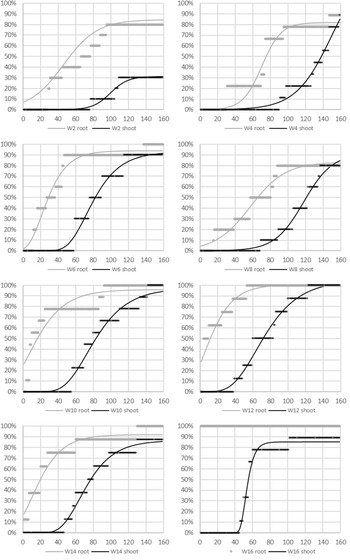
After moving the acorns to 15/6°C, the estimated maximum asymptote percentage of radicle emergence (A) was 82–101 and the maximum rate of radicle emergence (μi) was 1–2% regardless of the duration for cold stratification (Table 2; Fig. 1). Acorns with ≤8 weeks of stratification achieved μi later (Ti from 22 to 70 d) than those with 10–12 weeks (Ti from 5 to 7 d). Radicles had already emerged during stratification (i.e. before moving them to 15/6°C) by 14 or 16 weeks. Radicle emergence delay (T λ) for acorns given 2 or 8 weeks of stratification reached 17 d, but that for acorns given 4 weeks of stratification increased to 48 d and that for acorns given 6 weeks decreased to 6 d. Stratification lasting 10–12 weeks enabled faster radicle emergence in comparison with other stratification periods as evidenced by the negative values of T λ. The time to the radicle emergence of 50% of acorns (T 50) was from 70 d (following 4 weeks of stratification) to 12 d (following 12 weeks of stratification).
Time lag between epicotyl (shoot) and radicle (root) emergence at 15/6°C (cold variants). W2–W16: weeks of cold stratification of acorns.

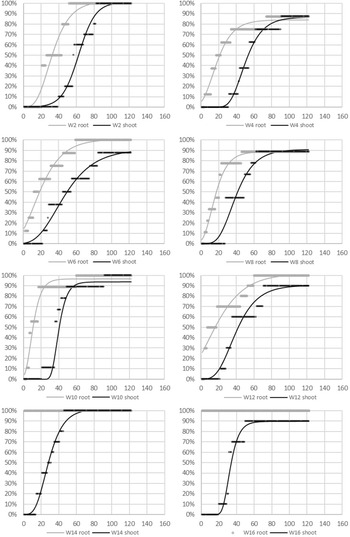
After moving the acorns to 25/15°C, the maximum asymptote percentage of radicle emergence (A) was 84–102, and the maximum rate of radicle emergence (μi) was 2–6% regardless of the duration for cold stratification (Table 3; Fig. 2). Acorns with ≤8 weeks of stratification achieved μi later (Ti from 12 to 28 d) than those with 10–12 weeks (Ti of 8 d). Radicles had already emerged during stratification (i.e. before moving them to 25/15°C) by 14 or 16 weeks. The lag in radicle emergence was relatively short (negative T λ values) or not longer than 2 d. The time necessary for the radicle emergence of 50% acorns (T 50) was from 33 d (following 2 weeks of stratification) to 10 d (following 10 weeks of stratification).
Time lag between (shoot) and radicle (root) emergence at 25/15°C (warm variants). W2–W16: weeks of cold stratification of acorns.

Epicotyl emergence
After moving the acorns to 15/6°C, the maximum asymptote percentage of epicotyl emergence (A) was 31 and 85–139 following 2 and 4–16 weeks of cold stratification, respectively (Table 2; Fig. 1). The maximum rate of epicotyl emergence (μi) was 1–2 and 6% following 2–14 and 16 weeks of stratification, respectively. The time (Ti) to achieve the maximum μi for epicotyl emergence decreased with increased cold stratification: from a high value of 150 d following 4 weeks of stratification to a low value of 51 d with 16 weeks of stratification. The lag in epicotyl emergence (T λ) varied among the periods of stratification, but generally decreased from 109 to 37 d with 4 and 12 weeks of stratification, respectively. T 50 for epicotyl emergence was reached the fastest for acorns stratified for 16 weeks (54 d) and the slowest for those stratified for 4 weeks (150 d).
After moving the acorns to 25/15°C, the maximum asymptote percentage of epicotyl emergence (A) was 87–101 regardless of the length of cold stratification (Table 3; Fig. 2). The maximum epicotyl emergence rate (μi) was from 1% following 6 weeks of stratification to 6% following 10 weeks of stratification. Acorns stratified for 2 weeks reached Ti after 62 d and those stratified for 14 weeks did so after 24 d. Epicotyl emergence delay (T λ) showed no consistent trend to the length of stratification, being 44 and 33 d after 2 and 4 weeks of stratification, respectively, and being 13–29 d after 6–16 weeks of stratification. The time needed for the emergence of 50% epicotyls (T 50) shortened as stratification lengthened, from 62 d after 2 weeks of stratification to 33 d after 16 weeks of stratification.
Time delay between radicle and epicotyl emergences
While temperature regime significantly affected the number of days (lag phase) between radicle and epicotyl emergence, the length of the cold stratification and the interaction between these variables did not (Table 4). The average number of days between radicle and epicotyl emergences was 61 d at 15/6°C and 29 d at 25/15°C, regardless of the length of stratification (Table 5). The shortest lag phase at 15/6°C was 53 d with 6 weeks of stratification, and the longest was 70 d with 14 weeks. At 25/15°C, the shortest lag phase was 24 d with 8 weeks of stratification, and the longest was 35 d with 16 weeks of stratification.
Results of a Wald test according to a type 3 analysis testing the effects of temperature regime and the length of cold stratification on the time delay between radicle and epicotyl emergence

Mean ± SE lag (days) between radicle and epicotyl emergence following 2–16 weeks of cold stratification and incubation at 15/6 or 25/15°C

Means with the same lowercase letters within a row or means with the same uppercase letter within a column are not significantly different at P ≤ 0.05.
Discussion
The process of seed dormancy break is characterized by changes in germination percentage over a range of post-stratification temperatures in response to a treatment such as cold or warm stratification (Baskin and Baskin, Reference Baskin and Baskin2004). After dormancy break, seed germination occurs in response to a specific treatment within 2–4 weeks of placing seeds at an appropriate temperature specific to each species. In the case of Q. robur acorns, the emergence of the radicle and epicotyl is initiated by different ranges of temperature. While the radicle begins to emerge at 5°C, a temperature of at least 10°C and above is necessary for the epicotyl to begin to emerge (Suszka et al., Reference Suszka, Muller and Bonnet-Masimbert1994). Our results indicate that at temperatures typical for early autumn (15/6°C), the time necessary for radicle emergence from 50% of acorns was longer than from acorns placed at 25/15°C. According to Farmer (Reference Farmer1977), radicles emerged from freshly harvested acorns of Quercus alba and Quercus prinus at 10–15°C. However, he did not test the influence of the duration for cold stratification on radicle emergence. In our research, the length of cold stratification influenced the time needed for radicle emergence from Q. robur. Four weeks of cold stratification extended 50% radicle emergence at 15/6°C to 70 d, whereas 12 weeks of stratification shortened the time to 11 d. When the acorns were incubated at 25/15°C, radicle emergence occurred faster than at 15/6°C.
The lag between radicle and shoot emergence is temperature-dependent, that is, shorter at optimal temperatures and longer at sub-optimal temperatures (McCartan et al., Reference McCartan, Jinks and Barsoum2015). Radicle emergence of acorns not treated by cold stratification started after 2 weeks since dispersing from the mother plant (Johnson et al., Reference Johnson, Shifley and Rogers2009) This observation confirms that in the mature acorns of Q. robur, the radicle is considered as non-dormant (Baskin and Baskin, Reference Baskin and Baskin2014). Early development of a large root system and delayed shoot growth is characteristic of all oak species (Johnson et al., Reference Johnson, Shifley and Rogers2009). Oak seedlings quickly develop a strong taproot, which usually grows to several centimetres in length within a few weeks after radicles emerge in autumn. In fact, radicle emergence can occur throughout autumn into winter since radicles emerged from Q. robur during 14 and 16 weeks of cold stratification, independent of the duration of cold stratification as evidenced by insignificant interaction temperature regime × stratification length (Table 4). The length of delay between radicle and epicotyl emergence depended only on the incubation temperature at which Q. robur acorns were incubated after cold stratification. For example, after 2, 10 and 16 weeks of cold stratification, the difference in the delay of epicotyl emergence between 15/6 and 25/15°C differed by 33, 38 and 25 d, respectively (Table 5).
Under natural conditions, the ambient temperatures during autumn are higher than the base temperatures for radicle emergence but generally lower than those for shoot emergence (McCartan et al., Reference McCartan, Jinks and Barsoum2015). For this reason, acorns usually produce radicles in autumn and produce shoots in spring. Farmer (Reference Farmer1977) and Wigston (Reference Wigston1987) noted that chilling (cold stratification) was not a requirement for shoot emergence in oaks under greenhouse conditions. In another research, the optimum temperature for the growth of epicotyls in Q. robur acorns was 20°C, but if acorns were stored at temperatures >15°C, several buds on the lower part of the epicotyl may develop but result in abnormal seedlings with multiple epicotyls (Corbineau et al., Reference Corbineau, Dacher, Lucchi and Côme2001).
Crocker and Barton (Reference Crocker and Barton1953), as well as Farmer (Reference Farmer1977), suggested that epicotyl dormancy is a kind of protection against seedling growth during inappropriate environmental conditions. Furthermore, Farmer (Reference Farmer1977) hypothesized that epicotyl dormancy is induced during the time when acorns are exposed to temperatures typical for the dispersal period (10–15°C). With changing climatic conditions of autumn and winter, dormancy break of the epicotyl could be impacted. Thus, shoots may emerge during autumn or winter (Kondo et al., Reference Kondo, Walck and Hidayati2018). Epicotyl emergence does not occur until acorns are chilled for a sufficient time. Under artificial conditions, embryo dormancy can be broken by storing acorns for 30–60 d at 0–5°C in moist sand or polyethylene bags (Olson, Reference Olson1974; Bonner and Vozzo, Reference Bonner and Vozzo1987). In a small proportion of germinants, shoots may begin to develop in autumn but overwinter as short succulent stems that require additional chilling to develop further (Farmer, Reference Farmer1977). On the one hand, early emergence could lead to increased competitive advantages of oak seedlings developing during winter since they could pre-empt resources. On the other hand, uncertain weather conditions – such as freezes – could lead to the mortality of seedlings, drastically impacting population dynamics.
In the last decade, in Europe and Poland forests, much attention has focused on the mitigation consequences of climate change by increasing the occurrence of Quercus spp. (Anonymous, 2018). However, artificial regeneration practices are commonly used and natural regeneration practices for this species have increased in the last few years. Understanding how seed germination of this species will be impacted by future climatic conditions is vital to maintaining oaks in our forests by natural regeneration and to developing efficient nursery practices for the production of seedlings for afforestation (Dey, Reference Dey2014).
Supplementary material
To view supplementary material for this article, please visit: https://doi.org/10.1017/S096025852100009X.
Acknowledgements
We thank MSc. Adam Guziejko for technical support.
Financial support
This research received no specific grant from any funding agency, commercial or not-for-profit sectors.
Conflict of interest
The authors declare no conflicts of interest.