Premature birth presents multiple risks for child development, both biologically and psychosocially (Minde, Reference Minde and Zeanah2000). Children and adolescents born very preterm are at risk for developmental problems (Bohnert & Breslau, Reference Bohnert and Breslau2008; Clark, Woodward, Horwood, & Moor, Reference Clark, Woodward, Horwood and Moor2008; Gray, Indurkhya, & McCormick, Reference Gray, Indurkhya and McCormick2004; Sun, Mohay, & O’Callaghan, Reference Sun, Mohay and O’Callaghan2008; van de Weijer-Bergsma, Wijnroks, & Jongmans, Reference van de Weijer-Bergsma, Wijnroks and Jongmans2008; Whitfield & Grunau, Reference Whitfield and Grunau2000). However, there is a gap in our understanding of the processes underlying relations between birth status and maladaptive outcomes (Tu et al., Reference Tu, Grunau, Petrie-Thomas, Hale, Weinberg and Whitfield2007; van de Weijer-Bergsma et al., Reference van de Weijer-Bergsma, Wijnroks and Jongmans2008). The high prevalence of disorders in children born preterm, especially in regard to cognition and behavior, has stimulated interest in the identification of developmental precursors of these problems (Olafsen et al., Reference Olafsen, Kaaresen, Handegard, Ulvund, Dahl and Ronning2008).
Temperament is an individual-level variable which can act as either a risk factor, predisposing children to maladaptive behavior patterns, or a protective mechanism, buffering the negative effects of stressful events (Rothbart, Posner, & Kieras, Reference Rothbart, Posner, Kieras, McCartney and Phillips2006). Awareness of the development of temperament and how it supports change at different periods of the lifespan can assist in the understanding of risk factors for psychopathology (Rothbart & Putnam, Reference Rothbart, Putnam, Pulkinnem and Caspi2002). To better understand developmental outcomes associated with preterm infants, one must take into account the relation between premature birth status and temperament characteristics.
Rothbart’s psychobiological theoretical approach defines temperament as constitutionally-based individual differences in reactivity and self-regulation that appear early in life and are influenced over time by heredity, maturation, and experience (Rothbart & Derryberry, Reference Rothbart, Derryberry, Lamb and Brown1981). Constitution means biologically based, with the individual’s relatively enduring biological make-up influenced over time by both genes and the environment. Reactivity refers to characteristics of the individual’s responsivity to changes in stimulation shown at multiple levels (e.g., behavioral, autonomic, neuroendocrine) and through parameters of latency, rise time, peak intensity, and recovery time. Self-regulation concerns processes modulating this reactivity, including approach, avoidance, inhibition, and attentional self-regulation (Rothbart, Reference Rothbart2004a). Within this theoretical approach, more reactive temperament characteristics such as emotionality become increasingly regulated by temperamental control mechanisms such as fearful inhibition and attentional self-regulation (Poehlmann et al., Reference Poehlmann, Schwichtenberg, Shah, Shlafer, Hahn and Maleck2010; Rothbart, Ellis, Rueda, & Posner, Reference Rothbart, Ellis, Rueda and Posner2003).
Premature birth has been shown to have an impact on infants’ regulatory processes. Grunau, Weinberg, and Whitfield (Reference Grunau, Weinberg and Whitfield2004) found that eight months old infants born preterm with extremely birth weight showed increased cortisol levels after had been exposed to novelty (i.e., a new toy) in comparison to infants born at term. They also found that, after controlling for neonatal clinical health status and time in artificial oxygen at NICU, higher cortisol basal levels in preterm infants at eight months (corrected for prematurity) was associated with a higher number of painful procedures undergone in NICU. It has also been shown that individual differences among preterm infants in reacting to pain and distress in the NICU are predictive of later temperament. Neonates who were hyper-reactive, both physiologically and behaviorally, were more likely to be toddlers who exhibited temperament with high levels of Negative Affect (Klein, Gaspardo, Martinez, Grunau, & Linhares, Reference Klein, Gaspardo, Martinez, Grunau and Linhares2009). Infants born preterm have been found to be more irregular in bodily functions, more distractible, more withdrawing, less adaptable (Hughes, Shults, McGrath, & Medoff- Cooper, 2002; Weiss, St. John-Seed, & Wilson, Reference Weiss, St. John-Seed and Wilson2004), and more active (Kerestes, Reference Kerestes2005), as well as to exhibit less attentional persistence (Hughes et al., Reference Hughes, Shults, McGrath and Medoff-Cooper2002) and more negative mood (Weiss et al., Reference Weiss, St. John-Seed and Wilson2004), in comparison to the standardized norms for full-term infants during the first year of age, corrected for prematurity. As toddlers, children who had been born preterm exhibited lower activity level, more adaptability, less intensity, more positive mood, and lower threshold of response than children born full-term (Sajaniemi, Salokorpi, & von Wendt, Reference Sajaniemi, Salokorpi and Wendt1998). Children born preterm also exhibited lower scores on attention focusing than their full-term counterparts when assessed as preschoolers (Nygaard, Smith, & Torgersen., Reference Nygaard, Smith and Torgersen2002). In contrast, at least two studies did not find differences in the temperament of preterm and full-term infants during the first year (Larroque, Tich, Gue´ Deney, Marchand, & Burguet, 2005; Olafsen et al., Reference Olafsen, Kaaresen, Handegard, Ulvund, Dahl and Ronning2008). It is important to highlight that samples differed in regard to illness severity of the children born preterm.
Examining temperament in preterm children using Rothbart’s theoretical approach represents an advance in the literature about temperament and prematurity. This approach has strongly influenced the study of temperament through an emphasis on the temperamental construct of Effortful Control, which includes the ability to suppress a dominant response in order to perform a subdominant response, to detect errors, and to engage in planning. It involves the voluntary deployment of executive attention, which allows children to regulate their more reactive tendencies (Rothbart, Reference Rothbart2004b; Rothbart et al., Reference Rothbart, Ellis, Rueda and Posner2003). This domain is particularly relevant to the issue at hand, as children born very preterm are more susceptible to developmental problems related to self-regulation (Clark et al., Reference Clark, Woodward, Horwood and Moor2008), executive function (Sun et al., Reference Sun, Mohay and O’Callaghan2008), attention (Bohnert & Breslau, Reference Bohnert and Breslau2008; Whitfield & Grunau, Reference Whitfield and Grunau2000; van de Weijer-Bergsma et al., Reference van de Weijer-Bergsma, Wijnroks and Jongmans2008), cognition (Anderson, Doyle, & Victorian Infant Collaborative Study Group, 2004; Bhutta, Cleves, Casey, Cradock, & Anand, Reference Bhutta, Cleves, Casey, Cradock and Anand2002) and behavior, such as somatic complaints, withdrawn, aggressive behavior (Reijneveld et al., Reference Reijneveld, Kleine, van Baar, Kollée, Verhaak, Verhulst and Verloove-Vanhorick2006), and emotional, conduct and social problems (Samara et al., Reference Samara, Marlow and Wolke2008).
Despite the promise of this approach for understanding developmental precursors to psychological maladjustment, few studies have examined the temperament of children born preterm from Rothbart’s theoretical approach. Although Kerestes (Reference Kerestes2005), Nygaard et al. (Reference Nygaard, Smith and Torgersen2002) and Olafsen et al. (Reference Olafsen, Kaaresen, Handegard, Ulvund, Dahl and Ronning2008) utilized measures based in the Rothbart tradition, these studies focused only on the first and fifth year of age, leaving critical gaps in the literature about temperament during toddlerhood of children born preterm. Toddlerhood is a period of rapid development of executive attention and effortful control (Rothbart et al., Reference Rothbart, Ellis, Rueda and Posner2003) and a time when problems with attention seem to become more apparent in children born preterm (van de Weijer-Bergsma et al., Reference van de Weijer-Bergsma, Wijnroks and Jongmans2008).
The present study aimed to examine the temperament and the behavior problems in Brazilian toddlers born preterm and very low birth weight, in comparison to toddlers born full-term. The study of the temperament in children born preterm has been primarily conducted in developed countries, and needs to expand to the vast majority of the world’s children who live in developing countries, and who encounter multiple and chronic life stressful events, as highlighted by Wachs (Reference Wachs2006). South America, particularly, is underrepresented in the developmental literature about temperament in children born preterm.
Empirical evidence regarding relationships between premature birth, temperament and behavior problems at toddlerhood will improve anticipatory guidance offered in clinical practice aimed at this specific population. In addition, greater understanding of temperament at toddlerhood will be valuable in the design of preventive interventions with children born preterm in order to orient their parents toward synchronous interactions with this vulnerable population.
Methods
Participants
The sample of the present study was composed of 56 toddlers distributed into two groups according to their birth status, as follows:
Preterm Group: Thirty-two children (16 boys; 16 girls) born preterm (< 37 weeks of gestational age) and very low birth weight (< 1500grams) were assessed between the ages of 18 and 35 months (M = 26 months; SD = ±4). Preterm neonates were recruited in the city of Ribeirão Preto, at the Neonatal Intensive Care Unit at the Hospital of Clinics, School of Medicine of Ribeirão Preto, University of Sao Paulo (Brazil), between April 2003 and September 2005 and followed until toddlerhood. Fifty preterm neonates were initially eligible to participate in the study. Due to health complications, five infants died in the neonatal period and one had died in toddlerhood before the assessment. Of 44 remaining infants, eight could not be located due to moving away to other cities. Of the 36 children who were available for the toddlerhood assessment, two refused to participate (one mother was in a clinic for drug abuse and one mother had lost custody of the child and this child was in an orphanage).
Full-term group: Twenty-five children born full-term, with no medical problems and with no need for hospitalization in the neonatal period, aged between 18 and 35 months (M = 27 months; SD = ±5) composed the Full-term Group (13 boys; 12 girls). They were recruited from 27 eligible families enrolled in a Day-care center in Ribeirão Preto (Brazil). Mothers of all eligible children at the center were invited to participate in the study, and two mothers (8%) refused.
Ethical Approval
The study was approved by the Clinical Research Ethics Board of the Hospital of Clinics, School of Medicine, University of São Paulo at Ribeirão Preto (n° 9973/2005), and informed consent was obtained from each mother prior to participation.
Instruments and Measures
Temperament Assessment
The Early Childhood Behavior Questionnaire- ECBQ (Putnam, Gartstein, & Rothbart, Reference Putnam, Gartstein and Rothbart2006), Brazilian version by Klein, Putnam, and Linhares (Reference Klein, Gaspardo, Martinez, Grunau and Linhares2009). This instrument comprises 201 items that assess 18 domains of temperament in children between the ages of 18 and 36 months. Parents are asked to rate the frequency of specific temperament-related behaviors observed over the past two weeks on an ordinal scale ranging from 1 (never) to 7 (always). Factor analysis of the original questionnaire has revealed a three-factor structure of Surgency (Sociability, Activity Level, Impulsivity, Positive Anticipation, and High Intensity Pleasure), Negative Affect (Soothability negatively loaded, Frustration, Discomfort, Motor Activation, Fear, Sadness, Perceptual Sensitivity, and Shyness), and Effortful Control (Low Intensity Pleasure, Attention Shifting, Attention Focusing, Inhibitory Control, and Cuddliness). Putnam et al. (Reference Putnam, Gartstein and Rothbart2006) reported internal consistency of scales ranging from .57 to .90 (average α = .81) and inter-rater agreement ranging from .09 to .57 (average r = .39). Klein (Reference Klein2009) reported internal consistency of scales in a Brazilian sample, including the sample of the present study, ranging from .43 to .88 (average α = .72).
Behavior Problems Assessment
The Child Behavior Checklist for Ages 1.5–5 - CBCL 1.5–5 (Achenbach & Rescorla, Reference Achenbach and Rescorla2000), translated by Santa Maria-Mengel and Linhares. The CBCL is a child behavior checklist utilizing parents’ report, appropriate for children between 18 months and 5 years old. The respondent is asked to rate 99 problem items about the child as 0 for not true, 1 for somewhat or sometimes true, and 2 for very true or often true, based on the preceding two months. Item scores (0–2) are summed and then converted to normalized T-scores (Achenbach & Rescorla, Reference Achenbach and Rescorla2000). Higher scores represent more deviant behavior. The CBCL consists of seven Syndrome Scale Scores for boys and girls, grouped into two broad Syndromes: (a) Internalizing, including Emotionally Reactive, Anxious/Depressed, Somatic Complaints, and Withdrawn; (b) Externalizing, including Attention Problems and Aggressive Behavior. The syndrome scale Sleep Problems is analyzed independently.
Neonatal Clinical History
The medical charts of the toddlers born preterm during the hospitalization and post-discharge were reviewed to obtain infants’ health characteristics. The severity of illness was measured by computing the Clinical Risk Index for Babies (CRIB) score (Cockburn et al., Reference Cockburn, Cooke, Gamsu, Greenough, Hopkins, Mcintosh and Wilkinson1993). The CRIB was created to predict mortality for very low birth weight infants (< 1500 g) based on birth weight, gestational age, presence or absence of congenital malformations, worst base excess and minimum and maximum appropriate fraction of inspired oxygen during the first 12 hours of post-natal age. The amount of pain exposure during the NICU stay was obtained by computing the frequency of exposure to the following procedures from birth to discharge from NICU: venipuncture, arterial puncture, heel-lance, intravenous cannulation, endotracheal tube insertion, endotracheal tube suctioning, and gavage insertion for feeding.
Socioeconomic Status
Brazilian Criteria for Economic Classification- Brazilian Association of Research Companies (CCEB-ABEP) (Brazilian Association of Research Companies, 2008). This questionnaire included questions such as family income, parent’s educational level, number of people living in the same house, and number of cars, refrigerator, and televisions per family. It provides a score that characterizes the family according to its socioeconomic status.
Procedure
Temperament and behavior problems were assessed when the children were between 18 and 35 months of age. The data collection of the Preterm Group was carried out at the Pediatrics Clinic of the Hospital of Clinics of Ribeirão Preto. The mothers of the toddlers born preterm were invited to come to the visit by phone, letter, or during medical appointments in the Pediatrics Clinic. An expert researcher interviewed each mother individually using the ECBQ and the CBCL 1.5–5. In this group, medical charts regarding infants’ neonatal clinical history were reviewed independently by research physicians. The data collection of the Full-term Group was conducted in a Child Care Center. Mothers were invited by the coordinator of this Center to a meeting with the main researcher. The purposes of the study were explained to the mothers and then they were invited to participate. At this occasion, mothers signed the informed consent form before being interviewed individually using the ECBQ and the CBCL
Data analysis
The Kolmogorov-Smirnov Test was used to test the normality of the ECBQ and CBCL scores distribution. Since these variables exhibited normal distribution, comparisons between groups were done using the Student’s t test for continuous variables and the Chi-square or Exact Fischer tests for categorical variables. The significance level for the study was set at p ≤ .05.
Results
Characteristics of the participants
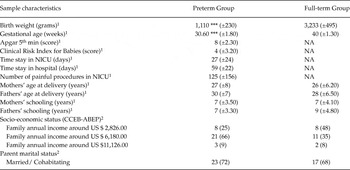
The characteristics of the participants are presented in Table 1. The 5th minute Apgar and the CRIB scores revealed a moderately severe prognosis for clinical progress in the Preterm Group. The amount of time spent in the NICU and number of painful procedures are consistent with hospital averages for infants born preterm and very low birth weight. There were no statistical differences (p > .05) between groups in terms of parents’ demographic characteristics or socio-economic status, with most families in both samples earning relatively low levels of income. In addition, review of medical records indicated that there were no toddlers with brain injury and sensorial impairment in either group.
Characteristics of the Preterm Group (n = 32) and the Full-term Group (n = 25)

Note:
1Mean (SD); 2Frequency (%) ***p ≤ .001; NA = Not Applicable; CCEB-ABEP: Brazilian Criteria for Economic Classification- Brazilian Association of Research Companies; 1 dollar = 1.8 Brazilian Reais.
Effect of Birth Status on Temperament
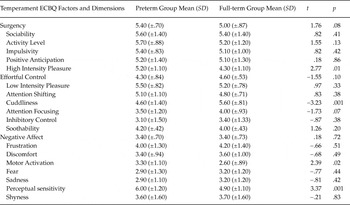
There were several differences between the Preterm Group and the Full-term Group in temperament dimensions at toddlerhood (Table 2). Children from the Preterm Group exhibited higher scores on Motor Activation, Perceptual Sensitivity, and High Intensity Pleasure, and lower scores on Cuddliness, in comparison to the children from the Full-term Group. Marginal differences suggested that the toddlers born preterm were lower on the Attention Focusing dimension and the Effortful Control factor, and higher on the Surgency factor, than the toddlers born full-term.
Temperament of the Preterm Group (n = 32) and the Full-term Group (n = 25)

Note:
ECBQ = The Early Childhood Behavior Questionnaire
Effect of Birth Status on Behavior Problems
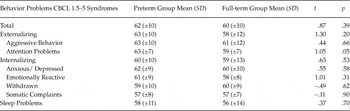
The results presented in Table 3 revealed that the Preterm Group exhibited higher scores on Attention Problems than the Full-term Group. No other statistically significant differences between groups were found in regards to behavior problems.
Behavior Problems of the Preterm Group (n = 32) and the Full-term Group (n = 25)

Note:
CBCL 1.5–5 = The Child Behavior Checklist 1.5–5
Discussion
Our findings indicated that children born preterm and very low birth weight differed in temperament from their term-born socially comparable peers. Although the groups did not differ in their expression of negative emotions, per se, toddlers born preterm were rated by their mothers as demonstrating higher perceptual sensitivity and motor activation, dimensions typically associated with aspects of negative affect in prior studies (e.g., Putnam et al., Reference Putnam, Gartstein and Rothbart2006). Considering perceptual sensitivity, we can hypothesize that repeated and prolonged exposure to excessive sensorial stimulation, such as high intensity of light, noise, and distressful and painful tactile stimulation (Gaspardo, Chimello, Cugler, Martinez, & Linhares, Reference Gaspardo, Chimello, Cugler, Martinez and Linhares2008; Grunau, Holsti, & Peters Reference Grunau, Holsti and Peters2006) may sensitize children to greater awareness of slight and low-intensity stimuli from their external environment. An alternative explanation is that a lack of input from regulating factors such as maternal heat, tactile sensation in skin-to-skin contact, autonomic regulation and voice feedback (Calkins, Reference Calkins, Olson and Sameroff2009) may lead to exaggerated responses to mild external stimuli. Our data confirm the findings of previous studies which identified higher tactile sensitivity in preterm neonates (Fitzgerald, Reference Fitzgerald2005; Grunau et al., Reference Grunau, Holsti and Peters2006), and suggest that the enhanced sensitivity continues through toddlerhood. This enhanced sensitivity may be associated with later problems, as high levels of temperamental perceptual sensitivity may increase susceptibility to stress, to negative emotions, and expressed discomfort (Putnam et al., Reference Putnam, Gartstein and Rothbart2006; Rothbart & Bates, Reference Rothbart, Bates, Damon, Lerner and Eisenberg2007).
The higher scores on the motor activation dimension, reflecting tendencies to engage in repetitive small-motor movements and fidgeting, in preterm toddlers may be an outcome of greater perceptual sensitivity. For instance, toddlers who are frequently aware of mild tactile sensations, such as tags on their clothes, may shift position in search of comfort; children who often note soft sounds or subtle visual stimuli may orient in search of their origins. The higher scores of preterm individuals on this proclivity warrants further study, as higher motor activation has been associated with high Internalizing and Externalizing Problems in toddlers born full-term (Gartstein, Putnam, & Rothbart, Reference Gartstein, Putnam and Rothbart2012), as well as to depression symptoms at adulthood (Zhong & Qian, Reference Zhong and Qian2005).
Regarding Surgency-related temperament dimensions, toddlers born preterm and very low birth weight exhibited greater pleasure or enjoyment related to situations involving high stimulus intensity, rate, complexity, novelty and incongruity (higher High Intensity Pleasure) in comparison to full-term ones. We speculate that the relatively high levels of stimulation encountered in the NICU may influence the selection of, and enjoyment by, the child of developmental contexts with similar characteristics. In toddlers born full-term, this dimension was correlated with the occurrence of externalizing problems (Gartstein et al., Reference Gartstein, Putnam and Rothbart2012).
Comparisons between groups on the dimensions that compose the Effortful Control factor showed that the toddlers born preterm and very low birth weight exhibited less expression of enjoyment in and molding of the body to being held by a caregiver (lower Cuddliness) than toddlers born full-term. This pattern of behavior in children born preterm might be associated with maternal separation in the neonatal period as well as the predominance of bottle feeding (Martins, Linhares, & Martinez, Reference Martins, Linhares and Martinez2005), which can have an impact on the attachment system.
In regards to behavior problems, our study showed that children born preterm and very low birth weight were rated by their mothers as experiencing more attention problems than children born full-term, a result complemented by marginal effects for temperamental attention focusing. Our findings are consistent with the results described in an extensive review of the literature about prematurity and attention development, indicating that infants born preterm show less mature visual orienting of attention, less sustained attention and have more trouble with executive attention when compared to infants born at term (van de Weijer-Bergsma et al., Reference van de Weijer-Bergsma, Wijnroks and Jongmans2008); and with studies demonstrating poor persistence and sustained attention during problem-solving tasks, and higher mother-rated attention problems in preschool-aged children born preterm (Assel et al., Reference Assel, Landry, Swank, Steelman, Miller-Loncar and Smith2002; Clark et al., Reference Clark, Woodward, Horwood and Moor2008). Suggesting a mechanism for this effect, Tu et al. (Reference Tu, Grunau, Petrie-Thomas, Hale, Weinberg and Whitfield2007) found that the greater total number of skin-breaking procedures from birth to term was associated with poorer quality of focused attention in infants born preterm.
On one hand, it is important to consider behavior problems at toddlerhood in children born preterm, because, according to Gray et al. (Reference Gray, Indurkhya and McCormick2004), behavior problems present moderate stability in this population, with fifty percent of preterm children who exhibit behavior problems at three years old continuing to exhibit these problems at the ages of five and eight years. On the other hand, the toddlerhood period is characterized by intense development of attentional self-regulation, as emphasized by Calkins (Reference Calkins, Olson and Sameroff2009). At this age, external regulators can influence the development of this regulatory dimension, potentially preventing these children from exhibiting difficulties in older ages. As such, it is important to examine developmental contexts that may moderate the negative effect of prematurity on attentional processes.
Our study showed a trend for the preterm group to present less sustained duration of orienting on an object in the face of distraction (lower Attention Focusing), according to mother’s report, in comparison to the full-term group. Although this between-groups difference did not reach statistical significance in the present study, these data are consistent with and extend previous findings with preterm children in different developmental periods. Preterm infants at twelve months of age exhibited less attention persistence than the comparison group (Hughes et al., Reference Hughes, Shults, McGrath and Medoff-Cooper2002). Also, during the first year corrected for gestational age, lower gestational age was correlated with shorter periods of orienting in a medically low-risk preterm sample (Kerestes, Reference Kerestes2005). Tu et al. (Reference Tu, Grunau, Petrie-Thomas, Hale, Weinberg and Whitfield2007) found poorer focusing attention in infants born preterm at eight months of chronological age when compared to infants born full-term. At five years of age, children born preterm presented lower scores on Attention Focusing than children born full term (Nygaard et al., Reference Nygaard, Smith and Torgersen2002). Clark et al. (Reference Clark, Woodward, Horwood and Moor2008) found that, at two and four years of age, children born extremely preterm exhibited poorer persistence and sustained attention during a set of problems solving tasks. The relationship between preterm birth and attention difficulties demonstrated by our study and by those mentioned above may be understood as a function of exposure to a considerable amount of painful and stressful events early in life to which preterm infants are vulnerable. According to Tu et al. (Reference Tu, Grunau, Petrie-Thomas, Hale, Weinberg and Whitfield2007), this early exposure to pain and stress might alter the developmental trajectory of cortisol secretion in preterm infants and toddlers, which can affect their attention development.
Our results showed that preterm birth has an impact in some aspects of temperament and in attention at toddlerhood. Neonates born preterm are exposed to a stressful environment, suffering from pain and stress during a period in which they should be developing in the protective environment of the maternal womb. Our findings suggest that this early exposure to chronic stress affects toddlers’ regulatory processes. The directions of our results regarding temperament and behavior problems in toddlers born preterm were similar to the ones obtained by studies conducted in the developed countries, allowing us to generalize them across cultures. The adverse effects of preterm delivery and low birth weight, however, may be particularly pronounced for Brazilian toddlers, who are at risk for exposure to multiple and chronic life stressful events, such poverty, parental divorce and low parental educational level, which represent risk conditions for social and emotional problems at older ages. It is important to provide opportunities for preterm infants to be followed by an interdisciplinary health professional team, which could play a protective role in the developmental pathways of these children born preterm.
To our knowledge, this is the first study to address whether children born preterm and very low birth weight differ from children born full-term in Rothbart’s temperament dimensions during toddlerhood. Despite the small sample size, our results regarding attentional processes were consistent with the literature, in addition to novel results concerning previously unstudied aspects of temperament. Replication with larger samples from different regions of Brazil will be beneficial in evaluating the generalizability of our results. Longitudinal studies starting in infancy using similar fine-grained measures designed for infants (e.g., Gartstein & Rothbart, Reference Gartstein and Rothbart2003) would be particularly beneficial to address questions concerning the impact of prematurity, stressful events in the NICU environment (such as number of painful procedures), and clinical health problems early in life on stability of early temperament.
Toddlers’ temperament was assessed through mother report. Despite concerns over rater bias, substantial objective validity of parent-report measures of temperament has been supported (Rothbart, Chew, & Gartstein, Reference Rothbart, Chew, Gartstein, Singer and Zeskind2001; Rothbart & Hwang, Reference Rothbart and Hwang2002). Parent report allows for measurement of individual differences both broadly and narrowly, taking advantage of the caregiver‘s extensive amount of observation (Rothbart et al., Reference Rothbart, Chew, Gartstein, Singer and Zeskind2001) and the ability of parents to view their children in a wide range of situations that are ethically and logistically impossible to recreate in the laboratory (Putnam, Ellis, & Rothbart, Reference Putnam, Ellis, Rothbart, Eliasz and Angleitner2001).
Nonetheless, the results from this study contribute to a better developed framework for understanding the developmental outcomes of children born preterm, suggesting that premature birth and associated contexts can alter the biobehavioral substrates of temperament, which have been shown to be related to developmental problems, specifically with regard to behavior and self-regulation. These findings highlight the relevance of including temperament assessments in post-discharge follow-up preventive intervention programs for children born preterm and very low birth weight. Early identification of temperamental vulnerabilities have been shown to be useful in training parents to understand, cope with, and effectively manage their children’s characteristics (McClowry, Rodriguez, & Koslowitz, Reference McClowry, Rodriguez and Koslowitz2008). Incorporation of temperament assessment in the treatment of children born premature and low birth weight holds promise for promoting healthy outcomes in these children.