Carinata, also known as Ethiopian mustard, is an oilseed crop that is currently being developed for biofuel production (Bouaid et al. Reference Bouaid, Martinez and Aracil2009; Cardone et al. Reference Cardone, Mazzoni, Menini, Rocco, Senatore, Seggiani and Vitolo2003). Among the advantages that this crop has for large-scale biofuel production is that seed shattering is considerably lower than that of other crops such as spring and winter canola (Brassica napus L.) (Choudhary et al. Reference Choudhary, Joshi and Ramarao2000; Prakash and Chopra Reference Prakash and Chopra1988), it can be grown and harvested using regular agricultural equipment (e.g., grain drills and small grain combines), and there are cultivars that can grow in either temperate or subtropical conditions (D. Males, personal communication), giving this crop a potentially large range of production opportunities. Another important trait is its high oil content (>40%) with particularly high levels of erucic and linoleic acids with little saturated fatty acid content (Cardone et al. Reference Cardone, Mazzoni, Menini, Rocco, Senatore, Seggiani and Vitolo2003; Seepaul et al. Reference Seepaul, Bliss, Wright, Marois, Leon, Dufault, George and Olson2016). The process of refining carinata into biodiesel and bio-jetfuel is simple and cheap because erucic and linoleic acids yield the desired longer hydrocarbon chains than other fatty acids, reducing the need for additional synthetic chemical reactions.
Most row-crop farms in northwest Florida grow cotton–cotton–peanut summer rotation with either fallow or cover crops of oats or wheat during the winter (Katsvairo et al. Reference Katsvairo, Wright, Marois, Hartzog, Rich and Wiatrak2006; Leon et al. Reference Leon, Wright and Marois2015). Recently, growers have been interested in growing carinata as a winter crop because of industry demand. Because carinata is a relatively new crop in the southeastern United States, it is necessary to identify tools and develop strategies to manage weeds effectively with minimal crop injury. Furthermore, if carinata is introduced into existing rotations, it is important to make sure that volunteer plants will not interfere with rotational crops. Thus, it is also valuable to develop methods to control volunteer carinata plants when needed. Unfortunately, there is little information available about herbicide safety on carinata (Gasol et al. Reference Gasol, Gabarrell, Anton, Rigola, Carrasco, Ciria, Solano and Rieradevall2007; Rana Reference Rana2006). The objective of the present study was to assess the safety of PPI, PRE, and POST herbicides on carinata seedling establishment and plant growth and development.
Materials and Methods
Field experiments were conducted between 2014 and 2016 at the West Florida Research and Education Center in Jay, FL (30.78°N, 87.14°W). The soil was a Tifton sandy loam (fine-loamy, kaolinitic, thermic Plinthic Kandiudult) with 2.3% organic matter and pH 6.0. All experiments were conducted under conventional tillage (two disk passes and a rotavator pass before planting). The experimental area was maintained weed-free for the duration of the experiment to test crop injury and not weed interference. Plots were six rows wide and 4.6 m long with 36-cm row spacing and had a 1.5-m buffer area between plots. Carinata ‘Avanza’ (Agrisoma, Inc., Saskatoon, Canada) was planted at 5.6 kgha−1 with a vegetable planter (Jang Seeder JPH-U, Jang Automation Co. Ltd., Chungcheongbuk-do, South Korea). All experiments were arranged as randomized complete block designs, had four replications, and were conducted at least twice.
Winter Experiment
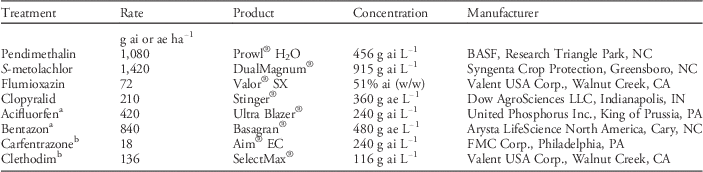
An experiment was conducted to evaluate carinata herbicide tolerance during the winter, which is the most favorable time to grow this crop in Florida (Seepaul et al. Reference Seepaul, Bliss, Wright, Marois, Leon, Dufault, George and Olson2016). The crop was planted the first week of November in both 2014 and 2015, and was fertilized with 20 kgNha−1 at planting and 40 kgNha−1 at bolting. The treatments were single or sequential applications of PRE herbicides including pendimethalin, S-metolachlor, and flumioxazin, and POST herbicides including clopyralid, acifluorfen, bentazon, carfentrazone, and clethodim, with single rates as specified in Table 1. A nontreated control was included for comparison. PPI treatments were applied the day prior to planting and were incorporated with a field cultivator. PRE treatments were applied immediately after planting and were incorporated with 12 mm of irrigation the same day. This irrigation was applied across all treatments after planting. POST treatments were applied when carinata plants reached the three- to six-leaf stage. Herbicides were applied with a tractor-mounted sprayer calibrated to deliver a spraying volume of 187 Lha−1 at 28 psi with 11003 flat-fan nozzles (TeeJet Technologies, Glendale Heights, IL).
Herbicide information and rates for treatments used in winter and summer experiments.

a Applied with crop oil concentrate at 0.5% (v/v) (Agri-dex®, Helena Holding Company, Collierville, TN).
b Applied with nonionic surfactant at 0.25% (v/v) (Induce®, Helena Holding Company, Collierville, TN).
Summer Experiment
The above described experiment was repeated during summer with the goal of assessing carinata tolerance to the same herbicide treatments applied in a high temperature environment. The crop was planted the first week of June of 2014, 2015, and 2016, and crop management and treatment application procedures were as described for the winter experiment.
S-Metolachlor Tolerance Experiment
In order to characterize in more detail carinata tolerance to S-metolachlor, an experiment was conducted evaluating S-metolachlor at 694, 1,070, 1,390, and 2,780 g ai ha−1 applied PRE, 3 d after planting, and POST at the three- to six-leaf stage. A nontreated control was included. Carinata was planted the first week of November 2015, and repeated in June 2016.
Data Collection and Analysis
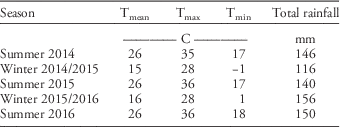
Four weeks after POST treatments (WAT), plant density was determined by counting carinata plants in a 0.5-m row length in the middle two rows of each plot. Herbicide injury (e.g., chlorosis, necrosis, stunting) of carinata was visually estimated using a 0% to 100% rating scale in which 0% indicated no symptoms and 100% indicated crop death. For experiments conducted during winter, grain was harvested 120 to 150 days after planting when grain moisture content reached 8% to 12%. Yield was determined by harvesting the four middle rows of each plot. Yield was adjusted to 10% moisture content. No yield data was collected for summer experiments because the crop was too stressed due to high temperatures (Table 2), and no seed set was observed.
Temperature (mean, minimum, and maximum) and rainfall during winter (November to May) and summer (April to August) experiments in Jay, FL.

Results were analyzed by ANOVA using PROC GLIMMIX with SAS (Statistical Analysis Systems, version 9.4, Cary, NC 27513). For the winter and summer experiments the model included herbicide, year, and their interaction as fixed effects, while block was considered a random effect. For the S-metolachlor study, the model included application timing, rate, year and their interactions as fixed effects, and block was considered a random effect. Treatments with all replications having values of 0% or 100% were not included in the ANOVA. Means separations were done using Tukey’s HSD test (α=0.05), and 95% confidence intervals were used to determine differences with treatments having means of either 0% or 100%.
Results and Discussion
For all experiments treatment by year interactions were significant (P<0.0001), so data were analyzed and are presented by year.
Winter Experiment
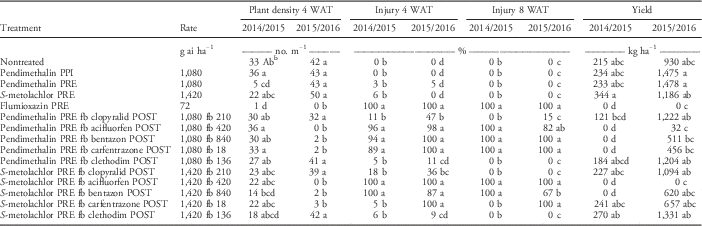
Pendimethalin PRE reduced carinata plant density in 2015 but not in 2016. Although some variation was observed across years, pendimethalin PPI and S-metolachlor PRE did not reduce plant density when compared with the nontreated control. These herbicides caused no visible injury or yield reductions (Table 3). Carinata can compensate for reductions (40% to 75%) in plant density by increasing plant size and branch production, thus preventing yield reductions (Angrej et al. Reference Angrej, Singh, Jagroop and Pal2002; D. Wright personal communication). Among PRE herbicides, only flumioxazin consistently reduced carinata plant density in both years (Table 3). Carinata was highly sensitive to flumioxazin, and plots treated with this herbicide had very few to no plants. Flumioxazin has been reported to effectively control other Brassica species such as wild mustard [Brassica kaber (DC.) L.C. Wheeler] and canola (Brassica napus L.). Also, because of its sensitivity to this herbicide, rotational intervals for canola vary from 6 to 12 months (Anonymous 2010). Therefore, flumioxazin can be an effective tool to control volunteer carinata in corn (Zea mays L.), cotton (Gossypium hirsutum L.), peanut (Arachis hypogaea L.), and soybean [Glycine max (L.) Merr.] (Anonymous 2010), which are common rotational crops in northwestern Florida.
Carinata plant density, injury, and yield in response to herbicide treatments in Jay, FL, during the winters of 2014/2015 and 2015/2016.Footnote a

a Abbreviation: WAT, weeks after treatment; fb, followed by; PPI, preplant incorporated.
b Treatments with the same letter within a column were not different based on Tukey’s HSD (α=0.05).
In 2014/2015, very few differences in plant density were observed among treatments with POST applications. Conversely, dramatic differences were present in 2015/2016 (Table 3). The reason for this is not clear, but in 2014/2015, during the 2 wk after POST applications, temperatures were at least 4 C lower than they were in 2015/2016 (data not shown). It is possible that herbicide action was slower with plants less affected. However, considering both plant density and injury results, a clearer pattern of the impact that POST treatments had on carinata can be observed. For example, clopyralid did not reduce plant density and only caused intermediate injury rating from 11% to 18% in 2014 and from 36% to 47% in 2014/2015 4 WAT. Despite these levels of injury, plants had recovered by 8 WAT and no yield reductions were found when compared with the nontreated control. Yield in 2014/2015 was considerably lower than it was in 2015/2016 because in February 2015 a frost caused partial flower abortion (Table 3). Clethodim did not reduce plant density or yield and caused less than 11% injury in both years. This was expected because clethodim is a grass herbicide (Shaner Reference Shaner2014). Therefore, clopyralid and clethodim could complement PRE herbicides by providing a broadleaf- and a grass-weed control option for carinata growers, respectively.
Unlike clethodim and clopyralid, acifluorfen, bentazon, and carfentrazone effectively terminated the carinata crop, causing 87% to 100% 4 WAT and 67% to 100% 8 WAT in both years (Table 3). In 2014, most of the acifluorfen, bentazon, or carfentrazone treatments produced no yield. In 2015, despite the high level of injury observed 4 WAT, a few plants survived and recovered by 8 WAT, but yield was less than 50% that of the highest yielding plots. Carfentrazone has provided >90% control of wild mustard (Durgan et al. Reference Durgan, Yenis, Daml and Miller1997) and it is highly injurious to canola at very low rates (<5 g ai ha−1; Légère et al. Reference Légère, Simard, Johnson, Stevenson, Beckie and Blackshaw2006). Similarly, acifluorfen and bentazon are used to control wild mustard (Anonymous 2012, 2013). Thus, based on their activity on other Brassicaceae species and the present results, acifluorfen, bentazon, and carfentrazone could be used to control volunteer carinata POST in rotational crops.
Summer Experiment
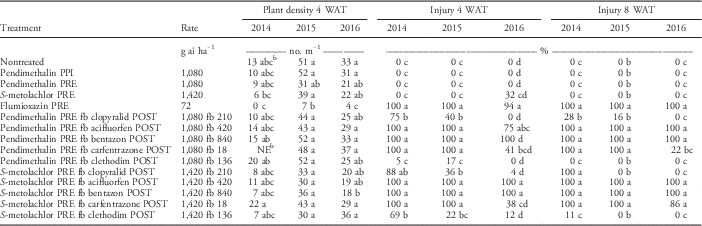
Temperatures during summer were on average more than 10 C higher than they were during winter (Table 2), creating stressful conditions for the growth of carinata, which is adapted to cooler temperatures (Cardone et al. Reference Cardone, Mazzoni, Menini, Rocco, Senatore, Seggiani and Vitolo2003; Seepaul et al. Reference Seepaul, Bliss, Wright, Marois, Leon, Dufault, George and Olson2016). More variability in carinata plant density was observed under this more challenging environment, and some treatments such as bentazon reduced densities when compared to the nontreated control during 2016 (Table 4). However, only flumioxazin treatments reduced plant densities in each of the three years. Under high temperatures, pendimethalin and S-metolachlor did not affect plant density. Higher summer temperatures increased carinata injury by POST treatments compared with values reported for the winter experiments (Table 3). Even treatments that exhibited limited injury during the winter, such as clopyralid and clethodim, caused 75% and 69% injury 4 WAT in the 2014 summer experiment and 40% and 22% in the 2015 summer experiment. However, plant injury decreased to 0% to 28% 8 WAT despite high summer temperatures (Table 4). It is not clear why clethodim, a grass herbicide, caused carinata plant injury, but it may be related to the heat stress the crop was experiencing. Acetyl coA-carboxylase–inhibiting herbicides have been reported to cause damage through oxidative stress regulatory mechanisms even in broadleaf species. For example, Luo et al. (Reference Luo, Sunohara and Matsumoto2004) reported that fluazifop-butyl caused membrane peroxidation in the broadleaf species bristly starbur (Acanthospermum hispidum DC.). In the present study, acifluorfen and carfentrazone caused 100% injury in two out of three years, and bentazon caused 100% injury in each of three years of the study. This experiment demonstrated that PRE herbicides identified as safe when evaluated under adequate growth conditions in the winter, such as pendimethalin and S-metolachlor, were also safe under summer growing season conditions.
Carinata plant density and injury in response to herbicide treatments in Jay, FL, during the summers 2014, 2015, and 2016.Footnote a

a Abbreviations: fb, followed by; NE, not evaluated; WAT, weeks after treatment; PPI, preplant incorporated.
b Treatments with the same letter within a column were not different based on Tukey’s HSD (α=0.05).
S-Metolachlor Tolerance Experiment
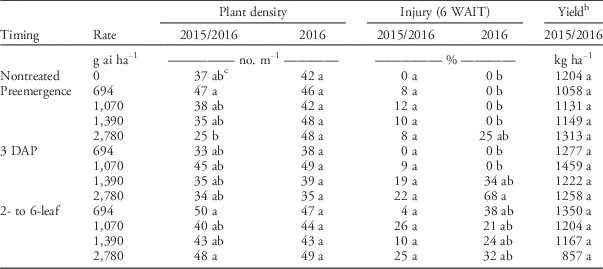
The previous two experiments indicated that S-metolachlor can be safely used for PRE control in carinata at a commonly recommended label rate (Anonymous 2011; Tables 3 and 4). In order to identify application strategies and to better characterize S-metolachlor safety on carinata, we evaluated different rates and application timings for this herbicide (Table 5). No differences were observed on carinata plant density or yield based on application timing and rate. There was an interaction between application timing, rate, and year (P<0.0001) for carinata injury, but the only difference observed was that plots treated with 2,780 gaiha−1 (twice the recommended label rate) exhibited 68% injury 6 wk after initial treatment during the 2016 summer trial. This same treatment did not differ from the nontreated in the 2015/2016 winter season (Table 5), suggesting that under adequate growing conditions for carinata, S-metolachlor is safe in this crop. Anecdotal information from growers growing carinata in Florida suggested that the risk of S-metolachlor injury might be higher in soils with coarser textures (i.e., sandy soils; Wright, personal communication) than the soil in the present study (i.e., sandy loam). Delaying PRE applications a few days after planting might reduce injury risk in sandy soils as reported by Sperry et al. (Reference Sperry, Ferrell, Leon, Rowland and Mulvaney2016) on sesame (Sesamum indicum L.).
Carinata plant density and injury in response to S-metolachlor treatments applied at different timings in Jay, FL, during the winter 2015/2016 and the summer 2016.Footnote a

a Abbreviations: DAP, days after planting; WAIT, weeks after initial treatment.
b No yield data was collected in the summer 2016 due to crop mortality caused by high temperatures.
c Treatments with the same letter within a column were not different based on Tukey’s HSD (α=0.05).
The present study identified two herbicides (pendimethalin and S-metolachlor) that can be safely used in carinata for PRE control, and a broadleaf and a grass herbicide for POST control (clopyralid and clethodim, respectively). Additionally, we identified a PRE herbicide (flumioxazin) and three POST herbicides (acifluorfen, bentazon, and carfentrazone) that can be used to effectively control volunteer carinata in rotational crops. Despite these findings, screenings of a larger number of herbicides and rates under different soil types and environmental conditions is needed. Additional research should investigate the development of cultural and mechanical approaches needed to provide growers with more weed control options for carinata production. This is particularly important to control closely related species such as wild radish (Raphanus raphanistrum L.) and to avoid carry-over issues with rotational summer crops.
Acknowledgements
We thank Michael Dozier and Robert Murrell for technical support and Agrisoma, Inc. for technical advice and providing seed for these studies. This research was supported by a Florida Department of Agriculture and Consumer Services grant #020649.