Introduction
Childhood trauma (CT) is a frequent form of maltreatment comprising sexual, physical, and emotional dimensions. In Western countries, 30–40% of the adult population reported experiences with at least some form of maltreatment during childhood (Scher, Forde, McQuaid, & Stein, Reference Scher, Forde, McQuaid and Stein2004). CT was revealed to influence the further course of life of the affected individuals, frequently leading to psychological symptoms and impairment in adulthood (Kessler et al., Reference Kessler, McLaughlin, Green, Gruber, Sampson, Zaslavsky and Williams2010; Scott, McLaughlin, Smith, & Ellis, Reference Scott, McLaughlin, Smith and Ellis2012). It has been shown to be associated with an increased risk for psychiatric disorders such as major depression, anxiety disorders, addiction, post-traumatic stress disorder and psychosis, including patients at clinical high-risk for psychosis (CHR) (Kessler et al., Reference Kessler, McLaughlin, Green, Gruber, Sampson, Zaslavsky and Williams2010; Palmier-Claus, Berry, Bucci, Mansell, & Varese, Reference Palmier-Claus, Berry, Bucci, Mansell and Varese2016; Sahin et al., Reference Sahin, Yuksel, Guler, Karadayi, Akturan, Gode and Ucok2013; Scott et al., Reference Scott, McLaughlin, Smith and Ellis2012; Varese et al., Reference Varese, Smeets, Drukker, Lieverse, Lataster, Viechtbauer and Bentall2012). Even in the general population, CT seems to have long-standing effects on individuals' social perception (Salokangas, From, Luutonen, & Hietala, Reference Salokangas, From, Luutonen and Hietala2018). Due to its high prevalence and detrimental effects on both, mental health and associated socioeconomic costs (Fang, Brown, Florence, & Mercy, Reference Fang, Brown, Florence and Mercy2012), a better understanding of CT as a risk factor is essential. Furthermore, the fact that CT occurs during a period of important neurodevelopmental steps underlines the potential for prevention or better care for CT victims to contribute to lower lifetime burden of psychiatric disorders (Mikton & Butchart, Reference Mikton and Butchart2009).
The sum of trauma exposure during childhood has been established as an important risk factor for mental health disorders. However, this has not been investigated in detail, although CTQ covers five different subcategories of different trauma exposure. These are in detail physical abuse (PA), physical neglect (PN), emotional abuse (EA), emotional neglect (EN), and sexual abuse (SA) (Bernstein & Fink, Reference Bernstein and Fink1998). A promising approach to investigate the complex granularity of CT as a risk factor is multivariate pattern analysis (MVPA) which was previously shown to identify neuropsychiatric conditions based on, e.g. neuroimaging data (Kambeitz et al., Reference Kambeitz, Kambeitz-Ilankovic, Leucht, Wood, Davatzikos, Malchow and Koutsouleris2015). The initial publication from the PRONIA study was on the prediction of functional and treatment outcomes based on clinical baseline data across multiple sites (Koutsouleris et al., Reference Koutsouleris, Kambeitz-Ilankovic, Ruhrmann, Rosen, Ruef, Dwyer and Consortium2018). Furthermore, two publications from the PRONIA consortium focused on different aspects of CT: Popovic et al. (Reference Popovic, Ruef, Dwyer, Antonucci, Eder, Sanfelici and Koutsouleris2020) identified distinct volumetric brain patterns associated with single dimensions of CT (in particular physical and sexual abuse and emotional trauma) in a transdiagnostic approach. Salokangas et al. (Reference Salokangas, Hietala, Armio, Laurikainen, From, Borgwardt and Koutsouleris2021) focused on CT in smaller patient groups and specifically investigated differences with respect to frontal lobe and hippocampal-amygdala complex volumes. In contrast, our study focuses on the potential ability of separating healthy controls (HC) and patient groups using machine learning techniques, and to identify potential clinical and volumetric brain correlates of CT in the entire cohort.
To answer these questions, the present study first investigated the discriminative value of CT for the individualized identification of transdiagnostic and diagnosis-specific psychiatric disorders using MVPA. In a second step, we examined whether the found CT patterns correlate with the measures of psychopathology and/or altered brain structure. The investigation was carried out in the PRONIA database (‘Personalized Prognostic Tools for Early Psychosis Management’; www.pronia.eu), a large, multi-site European cohort consisting of patients with recent onset depression (ROD), recent onset psychosis (ROP), CHR, and HC.
Aims of the study
We aimed to investigate whether (i) a predictive pattern of CT for transdiagnostic psychopathology exists, and whether (ii) CT can differentiate between distinct diagnosis-dependent psychopathology. Moreover, our aim was to identify associations between CT, psychopathology, and brain structure.
Methods
Participants
For the quality assurance of our proceedings, we followed the ‘Transparent reporting of a multivariable prediction model for individual prognosis or diagnosis’ (TRIPOD) checklist for prediction model development and validation (Collins, Reitsma, Altman, & Moons, Reference Collins, Reitsma, Altman and Moons2015).
All participants were recruited within the PRONIA project (‘Personalized Prognostic Tools for Early Psychosis Management’). PRONIA is a multisite observational study funded by the European Union under the 7th Framework Programme (grant agreement n° 602152). Seven clinical centers in five European countries participated in the evaluation of patients with ROD, ROP, CHR, and HC. Within a longitudinal study design, a comprehensive battery of clinical assessment tools was used every 3 months over 18 months (see online Supplementary Fig. S1). Neuroimaging examinations were carried out at the baseline and the 9-month follow-up points. The entire study design has been previously described in detail by Koutsouleris et al. (Reference Koutsouleris, Kambeitz-Ilankovic, Ruhrmann, Rosen, Ruef, Dwyer and Consortium2018).
All adult participants provided their written informed consent prior to study inclusion. Minors provided written informed assent and guardians written informed consent. The study was registered at the German Clinical Trials Register (DRKS00005042). The authors assert that all procedures contributing to this work comply with the ethical standards of the relevant national and institutional committees on human experimentation and with the Helsinki Declaration of 1975, as revised in 2008. All procedures involving human subjects/patients were approved by the local research ethics committees.
Inclusion and exclusion criteria
The included persons were aged between 15 and 40 years and recruited into the study between 1 February 2014 and 1 May 2016. Patients with CHR were included by Cognitive Disturbances (COGDIS) criteria, assessed by the Schizophrenia Proneness Instrument (SPI-A) (Schultze-Lutter, Addington, Ruhrmann, & Klosterkötter, Reference Schultze-Lutter, Addington, Ruhrmann and Klosterkötter2007), and/or UHR criteria (Phillips, Yung, & McGorry, Reference Phillips, Yung and McGorry2000), assessed using a modified version of the Structured Interview for Prodromal Syndromes (SIPS) (McGlashan, Walsh, & Woods, Reference McGlashan, Walsh and Woods2010). For ROD, specific inclusion criteria were having a DSM-IV (American Psychiatric Association, 2000) Major Depressive Episode that was present within the past 3 months and did not last longer than 24 months. ROP fulfilled DSM-IV criteria for affective or non-affective psychosis within the last 24 months and not before. General inclusion and exclusion criteria have been described in detail in Koutsouleris et al. (Reference Koutsouleris, Kambeitz-Ilankovic, Ruhrmann, Rosen, Ruef, Dwyer and Consortium2018) and were detailed as depicted in online Supplementary Table S1.
Procedure and instruments
The data used in this study were all acquired at baseline. As mentioned above, psychopathology of CHR patients was assessed using SIPS and SPI-A. ROP and ROD were diagnosed by DSM-IV. Depressive syndrome severity was additionally measured using the Beck-Depression-Inventory II (BDI-II) (Hautzinger, Bailer, Worall, & Keller, Reference Hautzinger, Bailer, Worall and Keller1995). Positive and negative symptoms were assessed by the Positive and Negative Syndrome Scale (PANSS) (Kay, Fiszbein, & Opler, Reference Kay, Fiszbein and Opler1987). For the assessment of CT, the Childhood Trauma Questionnaire (CTQ), developed by Bernstein and Fink (Reference Bernstein and Fink1998), was used. The CTQ is a self-assessment tool for the retrospective recording of mistreatment and neglect in childhood. It consists of 28 items, whereby three items (10, 16, 22) are used to determine denial and trivialization. It includes five subscales; emotional abuse (EA), physical abuse (PA), sexual abuse (SA), emotional neglect (EN), and physical neglect (PN). Rating was carried out on a five-point Likert scale (0 = never to 4 = very often). The convergent and discriminative validity has been reported as being good (Bernstein & Fink, Reference Bernstein and Fink1998). In addition, the cumulative sum of the equivalent doses received until T0 was calculated for SSRIs (Hayasaka et al., Reference Hayasaka, Purgato, Magni, Ogawa, Takeshima, Cipriani and Furukawa2015), chlorpromazine (Leucht, Samara, Heres, & Davis, Reference Leucht, Samara, Heres and Davis2016), olanzapine (Leucht et al., Reference Leucht, Samara, Heres and Davis2016), and benzodiazepines (diazepam) (Clinical Guidelines on Drug Misuse and Dependence Update 2017 Independent Expert Working Group, 2017).
MRI acquisition, preprocessing, and analysis
Participants underwent a comprehensive imaging protocol at seven sites respecting a minimal harmonization protocol including high-resolution 3D T1-weighted imaging. Detailed scanner and sequence specifications for all sites can be found in the online Supplementary Table S2. All images underwent quality control and were preprocessed using the CAT12 toolbox (version r1155; http://dbm.neuro.uni-jena.de/cat12/), an extension of SPM 12 as described previously (Koutsouleris et al., Reference Koutsouleris, Kambeitz-Ilankovic, Ruhrmann, Rosen, Ruef, Dwyer and Consortium2018). Images were smoothed with 10 mm before entering the subsequent analysis steps. The Quality Assurance framework of CAT12 was used to empirically check the quality of the GMV maps.
By computing the correlation of each image to all other 592 images, we found 11 (1.9%) images whose correlation exceeded two standard deviations from the sample mean. These images were inspected and nine were removed because of MRI artifacts. Thus, 583 persons could be included in the VBM analysis (109 CHR patients, 115 ROD patients, 110 ROP patients, and 249 HC). Notably, 98.47% of the images achieved a good overall weighted quality (B), and 83.0% of the data quality was rated with a B+ as provided by the internal quality assessment of CAT12 (Gaser & Dahnke, Reference Gaser and Dahnke2016). For analysis of brain structure and associations with CT, voxel-based morphometry (VBM) was employed. Preprocessed data entered a full-factorial general linear model design as implemented in SPM. Sex, site (coded as dummy regressors), and age were used as covariates of no interest to correct for potential confounds for VBM analyses. In order to investigate possible sex differences, male and female participants were also analyzed separately. Global proportional scaling for total intracranial volume was used to adjust for different global brain volume differences. Contrasts were defined for main-effects and interaction analyses to assess differences in mean and slope effects of associations between CTQ-based decision scores (DS) and local GM. Threshold-free cluster enhancement (TFCE) was used as implemented in the TFCE toolbox for SPM with 5000 permutations (Smith & Nichols, Reference Smith and Nichols2009). Significance threshold was set at p < 0.05, family-wise error corrected.
Machine learning strategies
To investigate discriminative patterns of CT experience in HC v. the combined three patient groups (PAT), we used an L2-regularized logistic regression (L2-LR) as provided by the LIBLINEAR library (Fan, Chang, Hsieh, Wang, & Lin, Reference Fan, Chang, Hsieh, Wang and Lin2008), which offers methods for classifying individuals instead of describing statistical group differences.
We used our open-source machine learning toolkit NeuroMiner (https://github.com/neurominer-git/) to implement a fully automated machine learning pipeline. We trained different models to predict psychiatric disorders based on the single CTQ items;
1. PAT v. HC
2. HC v. CHR; HC v. ROD; HC v. ROP
3. ROD v. CHR; ROD v. ROP; CHR v. ROP
We followed the internal–external validation approach recommended for the assessment of model generalizability in multi-site studies (Steyerberg & Harrell, Reference Steyerberg and Harrell2016) and validated our models using nested leave-one-site-out cross-validation (LOSOCV) (see in detail Supplementary Methods).
To compare the multivariate v. univariate methods, we repeated the HC v. PAT analysis after replacing the L2-LR (Fan et al., Reference Fan, Chang, Hsieh, Wang and Lin2008) algorithm with a univariate logistic regression model (uLR) in NeuroMiner. Algorithm performance was measured using the balanced accuracy (BAC) of the out-of-training (OOT) group membership predictions and assessed for significance using 1000 random label permutations (Golland & Fischl, Reference Golland and Fischl2003). Predictive features for each L2-LR model were compared by their mean weights.
A further validation analysis assessed whether our model generalized across study groups. Therefore, we used LOSOCV to train and cross-validate three binary L2-LR-based diagnostic classifiers (HC v. CHR; HC v. ROD; HC v. ROP) using the identical algorithmic setup described above. Each trained classification ensemble was then applied to the CTQ data of the other two clinical study groups following an out-of-sample cross-validation (OOCV) approach. Class membership probabilities/DS of the patients in the held-back study groups were computed for the OOT predictions.
These main analyses were supplemented by an investigation of univariate associations between measures of current psychopathology and the OOT DS of clinical participants produced by the L2-LR algorithms, which were trained in the HC v. CHR, HC v. ROD, and HC v. ROP comparisons. For the ROD, ROP, and CHR groups, the correlations of the CTQ-based DS with the BDI-II, SIPS-P, SIPS-N, SIPS-D, SIPS-G, PANSS total, positive, negative, and general domain scores were examined, respectively. Furthermore, the relationship between the equivalent doses of the individual drug classes (neuroleptics, SSRIs, benzodiazepines) and the CTQ-based DS was calculated for each group. In order to exclude recall bias in older participants (with longer time spans between CT and study inclusion), we performed correlation analyses between CTQ-based DS and age at study inclusion as a control analysis.
Results
Study group characteristics
In total, 643 subjects (57.2% male, mean age 27.69 ± 5.99 years) were included in the analysis. These consisted of n = 262 (40.7%) HC, n = 122 (19.0%) CHR, n = 130 (20.2%) ROD, and n = 129 (20.1%) ROP. CTQ total scores and subdomain scores were significantly different between PAT and HC. No group differences were found between the PAT groups ROP, ROD, and CHR regarding the total CTQ score. Please see Table 1 and online Supplementary Table S3 for details. The online Supplementary Table S4 shows the mean values of the drug equivalent doses that have been taken cumulatively so far. As expected, the highest equivalent doses for antipsychotics were found in ROP patients (chlorpromazine = 8072.71 mg/d, olanzapine = 280.02 mg/d), followed by CHR patients (chlorpromazine = 1025.06 mg/d, olanzapine = 42.04 mg/d). Surprisingly, the highest equivalent doses for SSRIs were found in CHR patients (3864.95 mg/d), followed by ROD patients (2630.83). We did not find an association between patient age and DS, making an age-dependent recall bias unlikely to have influenced our results (see online Supplementary Table S5).
Sociodemographic data and general psychopathology

U, Mann–Whitney U test; χ2, chi-squared test, M, mean; s.d., standard deviation; PAT, patients including ROP, ROD, and CHR; HC, healthy controls; CHR, clinical high-risk state; ROD, recent onset depression; ROP, recent onset psychosis; CTQ, Childhood Trauma Questionnaire, PANSS, Positive and Negative Syndrom Scale; BDI-II, Beck Depression Inventory II.
Statistical comparisons: sex with χ2 statistics; age, BDI-II, and CTQ with Mann–Whitney U test.
Comparison between healthy controls and patients.
a Comparison only between PAT and HC.
Childhood trauma profiles predict general psychopathology
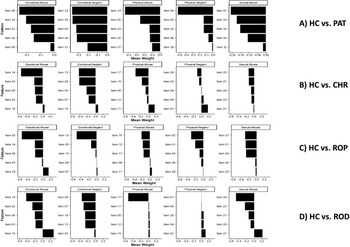
The classifier distinguishing HC from PAT performed with a BAC of 71.2% (sensitivity: 72.1%, specificity: 70.4%). Leave-site-out validation yielded good generalizability of the CTQ-based discriminative model (see Table 2). In order to deduct a CT profile predictive of general psychopathology, weights of CTQ single items from the MVPA were recorded and are depicted in Fig. 1. It must be emphasized that the resulting values do not allow to conclude on the direction of the prediction. The highest weights related to items within the subdomains EN and EA, namely: CTQ Item 5; ‘There was someone in my family who helped me feel that I was important or special’, CTQ Item 14; ‘People in my family said hurtful or insulting things to me’, and CTQ Item 13; ‘People in my family looked out for each other’. The uLR analyses for the same classification (HC v. PAT) led to a BAC of 67.1% (sensitivity: 66.0%, specificity: 68.2%). For detailed results, please see Table 2.
Predictive pattern of the single CTQ items and related subdomains in the different diagnostic groups.

Multivariate analyses

TP, true positive; TN, true negative; FP, false positive; FN, false negative; Sens, sensitivity; Spec, specificity; BAC, balanced accuracy; PPV, positive predictive value; NPV, negative predictive value; PSI, prognostic summary index; AUC, area-under-the-curve; HC, healthy controls; PAT, patients including ROP, ROD, and CHR; ROD, recent onset depression; ROP, recent onset psychosis; CHR, clinically high-risk; OOCV, out-of-sample cross-validation.
All analyses were single item based.
Childhood trauma profiles for diagnosis-specific psychopathology
Classifying the three diagnostic groups within the PAT cohort, namely CHR, ROD, and ROP did not perform above chance level (CHR v. ROD: BAC = 46.1%, sensitivity = 35.8%, specificity = 56.3%; CHR v. ROP: BAC = 47.1%, sensitivity = 42.5%, specificity = 51.7%; ROD v. ROP: BAC = 51.9 sensitivity = 58.0%, specificity = 45.3%). However, classifiers separating between HC and individual PAT groups performed well (HC v. ROD: BAC = 67.2%, sensitivity = 75.6%, specificity = 58.9%; HC v. CHR: BAC = 72.1%, sensitivity = 72.4%, specificity = 71.8%; HC v. ROP: BAC = 70.8%, sensitivity = 74.4%, specificity = 67.2%; please see Table 2).
Regarding the differentiation of HC v. CHR, highest weights belonged to items of the subdomains EA and EN (see Fig. 1); CTQ Item 14; ‘People in my family said hurtful or insulting things to me’, CTQ Item 13; ‘People in my family looked out for each other’, and CTQ Item 28; ‘My family was a source of strength and support’.
Analyzing the profile of HC v. ROD revealed the highest weights in items of the subdomains PA, SA, and EA (see Fig. 1); CTQ Item 17; ‘I got hit or beaten so badly that it was noticed by someone like a teacher, neighbor, or doctor’, CTQ Item 24; ‘Someone molested me’, and CTQ Item 14; ‘People in my family said hurtful or insulting things to me’.
Describing the profile which is distinguishing HC v. ROP, items of the subdomains EA, EN, and PN were most predictive (see Fig. 1); CTQ Item 25; ‘I believe that I was emotionally abused’, CTQ Item 13; ‘People in my family looked out for each other’, and CTQ Item 2; ‘I knew that there was someone to take care of me and protect me’.
Correlation between childhood trauma and psychopathology
Across all groups, correlations between the CTQ-based DS and GAF symptoms (r = 0.388, p ≤ 0.01) as well as disability and impairment (r = 0.412, p ≤ 0.01) were moderate to strong. In the CHR group, there were no associations between the CTQ-based DS and any SIPS domain, but a weak correlation between the DS and the BDI total score was observed (r = −0.175, p = 0.028). Moreover, a weak correlation between the PANSS total (r = −0.191, p = 0.038) and the PANSS negative domain score (r = −0.196, p = 0.033) was seen in the CHR patients. Regarding the ROD group, a moderate association between the CTQ-based DS and the BDI total score was found (r = −0.278, p = 0.001). In the ROP group, there was no significant correlation between the PANSS scores and the CTQ-based DS but a moderate association between the BDI total score and the CTQ-based DS (r = −0.246, p = 0.003). For details, please see Table 3.
CTQ-class probabilities associations with psychopathology

CHR, clinical high-risk state; ROD, recent onset depression; ROP, recent onset psychosis; PANSS, Positive and Negative Syndrom Scale; BDI-II, Beck Depression Inventory II; SIPS, Structured Interview for Prodromal Symptoms; GAF, Global Assessment of Functioning; r s, Spearman's correlation coefficient.
a Significant at the level of <0.01.
b Significant at the level of 0.05.
Correlation between childhood trauma and medication
Across all groups, weak negative correlations were found between the CTQ-based DS and all types of medication [chlorpromazine r = −0.213, p ≤ 0.001, olanzapine r = −0.213, p ≤ 0.001, SSRI r = −0.193, p ≤ 0.001, benzodiazepine (diazepam) r = −1.28, p = 0.001]. Interestingly, however, no significant correlations were found in the individual groups, except for a weak positive correlation with benzodiazepine in HC individuals. For details, please see online Supplementary Table S6.
Correlation between childhood trauma and brain structure
Despite several methodological approaches and adjusted statistical thresholds, we did not find any associations between CTQ-based DS and brain morphology in our cohort. Additionally, there were no significant associations between DS and brain morphology when examining male and female participants separately, also suggesting no sex-specific brain alterations associated with CTQ-based DS.
Discussion
We investigated CT and psychopathology in a large cohort of HC and patients with ROD, ROP, and CHR using MVPA. We found that CT significantly predicted transdiagnostic psychopathology using MVPA, while separation of diagnosis-specific psychopathology was not achieved. Qualitative analysis of CT patterns emphasized the importance of EN and EA for ROP and CHR identification while PA and SA yielded importance in ROD patients. The CTQ-based DS was significantly associated with the current severity of depressive symptoms in the ROD, ROP, and CHR group. Moreover, a correlation between the CTQ-based DS and the PANSS total and negative domain score was found in CHR patients. However, no further associations with psychopathology or structural brain alterations were found. Weak correlations between CTQ-based DS and medication were discovered across all groups, while no correlations were observed in the single groups, except for a weak positive correlation with benzodiazepine in HC individuals. The latter might reflect negative consequences of CT at a subthreshold level, resulting in higher tension and anxiety treated with benzodiazepine.
In order to investigate the association between CT and psychopathology, we tested whether PAT and HC could be separated based on CTQ information using a machine-learning model. We found that this distinction could be made with acceptable accuracy on the individual level and that the highest weights were assigned to domains pertaining to EA and EN. CT has been associated with several specific psychiatric disorders such as psychosis (Varese et al., Reference Varese, Smeets, Drukker, Lieverse, Lataster, Viechtbauer and Bentall2012), unipolar depression (Rubino, Nanni, Pozzi, & Siracusano, Reference Rubino, Nanni, Pozzi and Siracusano2009), and bipolar disorder (Palmier-Claus et al., Reference Palmier-Claus, Berry, Bucci, Mansell and Varese2016) and has been posited as a general risk factor for their development. Recent reviews and meta-analyses have shown that each subdomain of the CTQ is by itself significantly associated with the occurrence of psychiatric illness (Lindert et al., Reference Lindert, von Ehrenstein, Grashow, Gal, Braehler and Weisskopf2014; Nelson, Klumparendt, Doebler, & Ehring, Reference Nelson, Klumparendt, Doebler and Ehring2017; Varese et al., Reference Varese, Smeets, Drukker, Lieverse, Lataster, Viechtbauer and Bentall2012). These results agree with our findings showing that CT is globally associated with early-stage psychiatric disease phenotypes but predictive of these illnesses from an individualized transdiagnostic perspective.
In order to test whether CTQ profiles also allow for diagnosis-specific prediction of early mental health disorders, we applied the same machine learning model to separate CHR, ROP, and ROD. In these analyses, we found that it was not possible to distinguish reliably between the three diagnostic groups based on trauma exposure patterns. This is in line with studies describing increased rates of CT in psychiatric patients, irrespective of the exact diagnosis (Kessler et al., Reference Kessler, McLaughlin, Green, Gruber, Sampson, Zaslavsky and Williams2010; Palmier-Claus et al., Reference Palmier-Claus, Berry, Bucci, Mansell and Varese2016; Sahin et al., Reference Sahin, Yuksel, Guler, Karadayi, Akturan, Gode and Ucok2013; Scott et al., Reference Scott, McLaughlin, Smith and Ellis2012; Varese et al., Reference Varese, Smeets, Drukker, Lieverse, Lataster, Viechtbauer and Bentall2012). However, other studies exist describing distinct forms of early adversity in specific patient groups. Particularly, Bruni et al. found escape from home, cannabis abuse, psychological abuse, physical abuse, and loneliness to be more frequent in patients with schizophrenic spectrum disorder than in patients with major depression or bipolar disorder (Bruni et al., Reference Bruni, Carbone, Pugliese, Aloi, Calabro, Cerminara and De Fazio2018). Contrary to these results, our findings suggest that CT exposure is not associated with specific disorders but instead poses a rather general and transdiagnostic risk factor for early psychiatric disorders, which is also in line with an earlier study of our group (Popovic et al., Reference Popovic, Ruef, Dwyer, Antonucci, Eder, Sanfelici and Koutsouleris2020).
Regarding the individual CT patterns, we performed a qualitative comparison of the three CTQ questions which were assigned the highest weights. We identified the subdomains EN and EA playing the most important role across all groups. On the single item level, especially items that reflect the family climate showed the highest predictive power. These results are in line with a recent structure equation model analysis of Salokangas et al. (Reference Salokangas, Patterson, Hietala, Heinimaa, From, Ilonen and Ruhrmann2019), which indicated that subdomains EN and PA had the strongest association with depression and psychosis. Furthermore, in our analysis, EN and EA were most predictive in CHR patients, while PN was additionally predictive in psychosis. In contrast, an earlier work by Trauelsen et al. (Reference Trauelsen, Bendall, Jansen, Nielsen, Pedersen, Trier and Simonsen2015) showed beside EA and EN, PA to be significantly associated with psychotic disorders. Other works revealed specific associations between SA and psychosis (Bentall, Wickham, Shevlin, & Varese, Reference Bentall, Wickham, Shevlin and Varese2012) and hallucinations (Upthegrove et al., Reference Upthegrove, Chard, Jones, Gordon-Smith, Forty, Jones and Craddock2015). Interestingly, in ROD patients, besides EA, SA and PA were particularly predictive for a later depressive illness. In line with these observations, a meta-analysis of Lindert et al. (Reference Lindert, von Ehrenstein, Grashow, Gal, Braehler and Weisskopf2014) pointed out that especially SA and PA are strongly associated with later depression and anxiety disorders. Although this meta-analysis identified SA and PA as the most important risk factors of depression and anxiety disorder, which are also common in CHR patients (Albert, Tomassi, Maina, & Tosato, Reference Albert, Tomassi, Maina and Tosato2018), we found EN and EA to play the most important role across all groups. One reason for this discrepancy might be the lower frequency of SA and PA compared to other CT domains in our sample that might have led to an underestimation of their role in our cohort. Thus, our results provide more comprehensive evidence for a differentiated neurobiological imprint of the CT in different psychiatric disorders, while at the same time highlighting emotional trauma as particularly relevant to a person's clinical phenotype.
Furthermore, we found evidence that the participants' CTQ-based DS was significantly associated with the current severity of depressive symptoms but not with psychotic symptoms (positive, negative, and general) in the ROD, ROP, and CHR groups. Moreover, pre-psychotic symptoms measured by the SIPS were not correlated with the DS in the CHR group but a weak relationship was detected between the CTQ-based DS and the PANSS total and negative domain scores. These results support the hypothesis that CT constitutes a dimension of vulnerability that is dependent on the current depressive state of the patients. This observation is in keeping with previous work of our group showing that an emotional trauma signature was significantly correlated with higher depression scores, lower levels of functioning, decreased quality of life, and maladaptive personality traits (Popovic et al., Reference Popovic, Ruef, Dwyer, Antonucci, Eder, Sanfelici and Koutsouleris2020). In the past, depressiveness has also been shown to be a mediating factor in the effect of CT on alcohol consumption (Salokangas, From, Luutonen, Salokangas, & Hietala, Reference Salokangas, From, Luutonen, Salokangas and Hietala2018) and suicidal thoughts (Salokangas et al., Reference Salokangas, Patterson, Hietala, Heinimaa, From, Ilonen and Ruhrmann2019).
No associations were found between the CTQ-based DS and brain structure. It can be assumed that the changes at the single item level of the CTQ are too subtle for individual prediction of disease. In a recent publication from our group, we performed a data-driven analysis of brain structure and phenotypic data including CT exposure and found three latent signatures specifically associated with CT. In this previous paper, and latent representations of brain–phenotype associations, SA was associated with aberrant volumes in the prefrontal cortex, the hippocampus, and occipital lobe. EA and EN were associated with volumetric alterations in the occipital lobe and postcentral regions associated with sensory processing. No associations between specific diagnostic groups and CT exposure were found, which is in line with the absence of diagnosis-specific associations between CT and early mental health diseases, and in keeping with the current analysis (Popovic et al., Reference Popovic, Ruef, Dwyer, Antonucci, Eder, Sanfelici and Koutsouleris2020). In another previous mediation analysis of our group, PA was shown to be associated in particular with reduced volumes of the gray and white matter of the frontal lobe and amygdala-hippocampal complex in ROD and CHR patients (Salokangas et al., Reference Salokangas, Hietala, Armio, Laurikainen, From, Borgwardt and Koutsouleris2021). In addition, it was shown that the effect of PA on social anxiety in CHR patients was mediated by a reduced volume of gray matter in the frontal lobe. Since this was methodologically a mediation analysis and not a machine learning approach, these results should not be regarded as contradictory.
Limitations
Limitations of our study include the observational, retrospective, and cross-sectional character of the study. As with most CT assessments, the CTQ assesses trauma retrospectively, thus, running the risk of a ‘recall bias’ depending on the individual's current mental health situation, including the influence of depression severity (Colman et al., Reference Colman, Kingsbury, Garad, Zeng, Naicker, Patten and Thompson2016). Another possible limitation is the non-assessment of factors such as the age at onset, the frequency, and the extent of the suffering associated with exposure to CT. It must be critically taken into account that despite diverse adverse experiences, many victims of CT show no or only minor long-term psychological impairment, suggesting that resilience factors appear to be important mediating variables as well (Lee, Yu, & Kim, Reference Lee, Yu and Kim2020). Therefore, in the future, suitable methods and longitudinal population data utilizing methods such as structure equation models could be used to investigate the exact relationship between CT and functional or school outcome, against the background of the above-mentioned mediating variables.
Conclusions
In summary, our work has demonstrated that CT constitutes a discriminative transdiagnostic fingerprint of at-risk mental states and early-stage mental disorders. Focusing on the most predictive items of our analyses, we were able to show that a violence-free, supportive family environment as well as protection are important aspects for good mental health in later life. Our findings support the conclusions of a paper by Hudziak (Reference Hudziak2009) who called for a routine evaluation of CT history in persons presenting to mental health services in order to identify those who may need more intensive support and additional treatment. In line with that, Marshall, Shannon, Meenagh, Mc Corry, and Mulholland (Reference Marshall, Shannon, Meenagh, Mc Corry and Mulholland2018) emphasized the importance of special preventive measures, such as therapeutic intervention aimed at sufferers of past abuse, neglect, and poor parenting to prevent ‘trans-generational patterns’ continuing with their own children. In the future, further analyses of the longitudinally administered PRONIA sample should investigate whether there are differences in the course of the diseases related to CT experiences. Furthermore, suitable methods, such as structural equation models, should be used to highlight the exact relationship between CT and mental illness against the background of mediating variables and resilience factors.
Supplementary material
The supplementary material for this article can be found at https://doi.org/10.1017/S0033291721002439.
Acknowledgements
The authors would like to thank the entire PRONIA consortium for their excellent and valuable work.
Footnote ‡PRONIA Consortium
The PRONIA consortium members listed here performed the screening, recruitment, rating, examination, and follow-up of the study participants and were involved in implementing the examination protocols of the study, setting up its information technological infrastructure, and organizing the flow and quality control of the data analyzed in this article between the local study sites and the central study database.
Department of Psychiatry and Psychotherapy, Ludwig-Maximilian-University, Munich, Bavaria, Germany: Mark Sen Dong, M.Sc., Anne Erkens, Eva Gussmann, M.Sc., Shalaila Haas, Ph.D., Alkomiet Hasan, M.D., Claudius Hoff, M.D., Ifrah Khanyaree, B.Sc., Aylin Melo, M.Sc., Susanna Muckenhuber-Sternbauer, M.D., Janis Kohler, Ömer Faruk Özturk, M.D., Adrian Rangnick, B.Sc., Sebastian von Saldern, M.D., Rachele Sanfelici, M.Sc., Moritz Spangemacher, Ana Tupac, M.Sc., Maria Fernanda Urquijo, M.Sc., Johanna Weiske, M.Sc., and Antonia Wosgien.
University of Cologne, North Rhineland–Westphalia, Germany: Karsten Blume, Tanja Pilgram, M.Sc., and Christiane Woopen, M.D.
Psychiatric University Hospital, University of Basel, Basel, Switzerland: Christina Andreou, M.D., Ph.D., Laura Egloff, Ph.D., Fabienne Harrisberger, Ph.D., Claudia Lenz, Ph.D., Letizia Leanza, M.Sc., Amatya Mackintosh, M.Sc., Renata Smieskova, Ph.D., Erich Studerus, Ph.D., Anna Walter, M.D., and Sonja Widmayer, M.Sc.
Institute for Mental Health, University of Birmingham, Birmingham, United Kingdom: Chris Day, B.Sc., Sian Lowri Griffiths, Ph.D., Mariam Iqbal, B.Sc., Mirabel Pelton, M.Sc., Pavan Mallikarjun, M.B.B.S., D.P.M., MRCPsych, Ph.D., Ashleigh Lin, Ph.D., Paris A Lalousis MSc, Alexandra Stainton PhD
Department of Psychiatry, University of Turku, Turku, Finland: Alexander Denissoff, M.D., Anu Ellila, RN, Tiina From, M.Sc., Markus Heinimaa, M.D., Ph.D., Tuula Ilonen, Ph.D., Paivi Jalo, RN, Heikki Laurikainen, M.D., Maarit Lehtinen, RN, Antti Luutonen, B.A., Akseli Makela, B.A., Janina Paju, M.Sc., Henri Pesonen, Ph.D., Reetta-Liina Armio (Saila), M.D., Elina Sormunen, M.D., Anna Toivonen, M.Sc., and Otto Turtonen, M.D.
General Electric Global Research Inc, Munich, Germany: Ana Beatriz Solana, Ph.D., Manuela Abraham, M.B.A., Nicolas Hehn, Ph.D., and Timo Schirmer, Ph.D.
Workgroup of Paolo Brambilla, M.D., Ph.D., University of Milan, Milan, Italy: Department of Neuroscience and Mental Health, Fondazione IRCCS Ca' Granda Ospedale Maggiore Policlinico, University of Milan, Milan, Italy: Carlo Altamura, M.D., Marika Belleri, PsychD, Francesca Bottinelli, PsychD, Adele Ferro, PsychD, Ph.D., and Marta Re, Ph.D. Programma 2000, Niguarda Hospital, Milan: Emiliano Monzani, M.D., Mauro Percudani, M.D., and Maurizio Sberna, M.D. San Paolo Hospital, Milan: Armando D'Agostino, M.D., and Lorenzo Del Fabro, M.D. Villa San Benedetto Menni, Albese con Cassano: Giampaolo Perna, M.D., Maria Nobile M.D., Ph.D., and Alessandra Alciati, M.D.
Workgroup of Paolo Brambilla, M.D., Ph.D., University of Udine, Udine, Italy: Department of Medical Area, University of Udine: Matteo Balestrieri, M.D., Carolina Bonivento, PsychD, Ph.D., Giuseppe Cabras, Ph.D., and Franco Fabbro, M.D., Ph.D. IRCCS Scientific Institute ‘E. Medea’, Polo FVG, Udine: Marco Garzitto, PsychD, Ph.D. and Sara Piccin, PsychD, Ph.D. Workgroup of Professor Alessandro Bertolino, University of Bari Aldo Moro, Italy: Professor Giuseppe Blasi; Professor Linda A. Antonucci, Professor Giulio Pergola, Grazia Caforio, Ph.D., Leonardo Faio, Ph.D., Tiziana Quarto, Ph.D., Barbara Gelao, Ph.D., Raffaella Romano, Ph.D., Ileana Andriola, M.D., Andrea Falsetti, M.D., Marina Barone, M.D., Roberta Passatiore, M.Sc., Marina Sangiuliano, M.D.
Department of Psychiatry and Psychotherapy, Westfaelische Wilhelms-University Muenster, North Rhineland–Westphalia, Germany: Marian Surman, M.Sc., Olga Bienek, M.D., Georg Romer, M.D., Udo Dannlowski, M.D., Ph.D.
Department of Psychiatry and Psychotherapy of the University Düsseldorf, North Rhineland–Westphalia, Germany: Christian Schmidt-Kraepelin, M.D., Susanne Neufang, Ph.D., Alexandra Korda, Ph.D., Henrik Rohner, M.D.
Financial support
PRONIA is a Collaborative Project funded by the European Union under the 7th Framework Programme under grant agreement n° 602152. R.U. reports grants from Medical Research Council, grants from the National Institute for Health Research, and personal fees from Sunovion, outside the submitted work. N.K. and R.S. received honoraria for talks presented at education meetings organized by Otsuka/Lundbeck. C.P. participated in advisory boards for Janssen-Cilag, AstraZeneca, Lundbeck, and Servier and received honoraria for talks presented at educational meetings organized by AstraZeneca, Janssen-Cilag, Eli Lilly, Pfizer, Lundbeck, and Shire. C.P. acknowledges support by an Australian National Health & Medical Research Council (NHMRC) Senior Principal Research Fellowship (ID: 1105825), an NHMRC Program Grant (ID: 1150083). J.K. reports funding by the DFG (KA 4413/1-1) and received honoraria for talks presented at educational meetings organized by Janssen and Otsuka/Lundbeck. All other authors report no biomedical financial interests or potential conflicts of interest. The funding organizations stated above were not involved in the design and conduct of the study; the collection, management, analysis, and interpretation of the data; the preparation, review, or approval of the manuscript; and decision to submit the manuscript for publication.
Conflict of interest
None.