

I. Introduction
Champagne is a traditional wine-producing region in France, where the production process for its namesake sparkling wine, champagne, has undergone few changes since the turn of the twentieth century. The Comité Interprofessionnel du Vin de Champagne (CIVC) regulates the raw materials, production processes, and marketing of all bottles that bear the name champagne. Many of the CIVC's regulations remained unchanged between 1948 and 2013Footnote 1 (CIVC, 2017a). Unlike for some luxury goods, such as automobiles, which have seen major technological improvements and innovations, minimal adjustments have been made to the production process and basic properties of champagne.
This paper analyzes the evolution of champagne prices in New York City relative to real disposable income between 1948 through 2013 and examines how the real cost of champagne, expressed in the number of hours of work required to generate the after-tax income necessary to buy a bottle of champagne in a retail store, has changed over time.
The entire period covered by this study witnessed a rising stratification of champagne prices between nonvintage wines and flagship wines. The disposable-income ratio of the highest-income to lowest-income earners in the United States grew by approximately 60 percent between 1948 and 2013 (from 4.2 to 6.7), the ratio of champagne prices grew by up to 220 percent and thus far exceeded increasing disposable-income inequality.
The remainder of this paper is organized as follows: Section II introduces the data and the methodology, Section III presents the main results, and Section IV concludes.
II. Data and Methods
A. Champagne Data
Our champagne price data draw on the catalogs of New York City wine retailer Sherry-Lehmann.Footnote 2 Sherry-Lehmann, one of the largest wine retail stores in the United States, has been operating continuously in the same neighborhood since it first opened in 1934, shortly after Prohibition ended. It has been printing quarterly sales catalogs of its wines since 1935. Many of these sales catalogs have been recently digitized and are available for wine researchers at the University of California, Davis.
In this paper, champagne bottles are divided into three tiers: nonvintage, vintage, and “flagship.” I include prices of three brands: Bollinger, Louis Roederer, and Moët & Chandon.
Nonvintage champagne accounts for 80 percent of the bottles produced by volume and 70 percent by value, making it the “bread and butter” of the champagne industry (CIVC, 2017b). Each brand's nonvintage champagne minimizes any changes and maintains a consistency that customers expect and demand.
The combination of weather variation and changes in winemaker practices (either due to deliberate changes by the same winemaker or to changes implemented by a new winemaker) can result in variation to the vintage over multiple years. Vintage champagne is produced when the wine from a specific harvest is deemed particularly good, but it is not produced every year. According to the 2016 CIVC Bulletin (CIVC, 2017c), vintage champagne accounts for 1.5 percent of production; however 75 percent of prestige cuvée is vintage, and prestige made up 4.7 percent of champagne production in 2016.
The flagship bottles of champagne used in this dataset are a subset of prestige cuvée champagne, which is also designated as vintage.Footnote 3
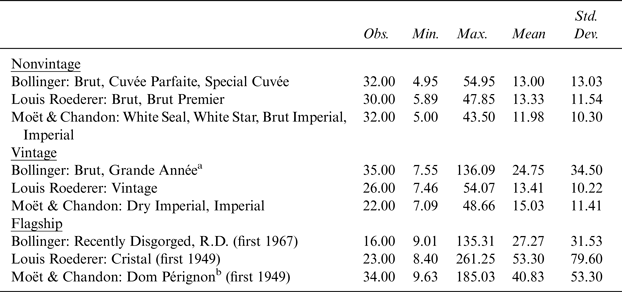
Table 1 reports the brands, their champagnes, and some descriptive price statistics. All prices provided include New York City and New York State sales tax. The historic tax rates were obtained from the pages of Sherry-Lehmann catalogs.
Descriptive Statistics of Nominal Champagne Prices

All prices include New York City and New York State sales tax; a Bollinger's Grande Année is a prestige cuvée. For the purposes of this paper, it fills a gap in Bollinger's offerings of a vintage champagne. b The 1988 Dom Pérignon was the final vintage that had “Moët & Chandon” on the packaging. This amounts to Dom Pérignon's being spun off as its own brand.
As is evident from the number of observations, there are some gaps in the price data. For nonvintage champagne, this omission is simply due to missing data. In addition, gaps in the vintage and flagship champagne data are also explained by the fact that they were only produced in outstanding years.
B. Income Data
The income data draw on figures provided by the U.S. Census Bureau and are for the entire United States (U.S. Census Bureau, 2016). I distinguish five income brackets, the lower four quintiles and lower limit of the top 5 percent of families of all races. I further distinguish gross (pretax) income and disposable family income.
Computation for disposable income is calculated by subtracting government entitlement payments, Social Security, disability and Medicare, New York State income tax liabilities, New York City income tax liabilities, and federal income tax liabilities from gross wages. Standard deductions are calculated based on a single person's exemption, multiplied by two, to normalize standard deductions across time.Footnote 4 Adjusted gross income is then applied to historical nominal federal income tax rates for single filers to calculate the federal tax liability (Tax Foundation, 2013). Social Security, Medicare, and disability payments are calculated by applying the rate for each year in the study (Social Security Administration, 2017).
New York City and New York State income tax liabilities are calculated for each year (New York Department of Finance, 2012). In this paper, I make use of the local and state income tax deductions, whereby the income that is subject to federal income tax is reduced by the amount of local income taxes paid or by the standard deduction allowed, whichever is larger.
All of these tax liabilities are subtracted from gross income to arrive at disposable income per year. All computed gross and disposable income figures are then converted into the number of hours of work necessary for the purchase per bottle of the nonvintage, vintage, and flagship champagnes. Additionally, for the purposes of these calculations, it is assumed that a person works 2,000 hours per year, which translates into 40 hours of work per week for 50 weeks per year. An advantage of this method is that it may be used for calculating the relative “cost” for other items in addition to champagne.
III. Results and Discussion
-
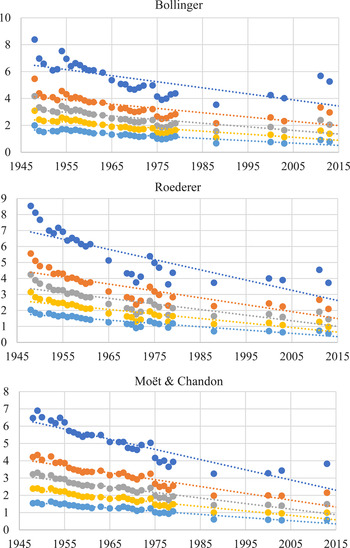
1. As compared to 1948, in 2013, income groups needed to work fewer hours to purchase a bottle of entry-level champagne across all three brands: Bollinger, Louis Roederer, and Moët & Chandon; this result was most apparent for lower-income groups. In 1948, the lowest-income group had to work approximately 8 hours, but in 2013, the lowest-income group had to work 5 hours, 3.5 hours, and 3.7 hours to purchase bottles of entry-level, nonvintage Bollinger, Louis Roederer, and Moët & Chandon, respectively.
Figures 1 and 2 show the slopes for the three brands’ entry-level, nonvintage champagnes for each of the five income groups.
-
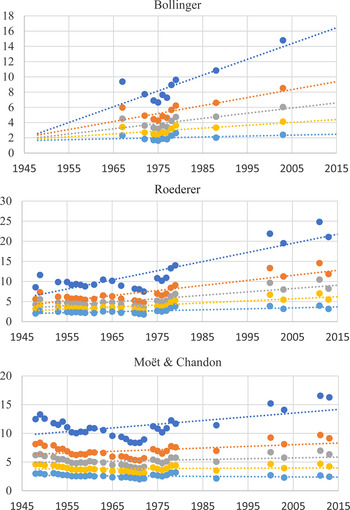
2. The highest-income group (fifth) required slightly fewer hours to purchase a bottle of Moët & Chandon's flagship in 2013 compared to 1948. All other income groups had to work more hours per bottle of flagship Bollinger and Louis Roederer in 2013 as compared to 1948.
-
3. For all income groups and all three tiers of champagne, the time series patterns for each of the three brands were similar. Because of the relative stability of the three champagne houses that were examined, the time series patterns were likely not a consequence of any idiosyncratic experience, such as winding down of operations or change of ownership.
-
4.a. Bollinger – Recently Disgorged
Hours of Work per Bottle of Nonvintage Champagne, 1948–2013

Hours of Work per Bottle of Flagship Champagne, 1948–2013

For the first income group, for Bollinger flagship champagne, the net change in the number of hours of work in 1967 was 9.37 hours and in 2003 was 14.37; this number represents an increase in net change of 5 additional hours. For the second income group, the net change in the number of hours of work in 1967 was 5.97 hours and in 2003 was 8.51; this number represents an increase in net change of 2.54 hours. For the third income group, the net change in the number of hours of work in 1967 was 4.52 hours and in 2003 was 5.85 hours; this number represents an increase in net change of 1.33 hours. For the fourth income group, the net change in the number of hours of work in 1967 was 3.41 hours and in 2003 was 4 hours; this number represents an increase in net change of 0.6 additional hours. For the fifth income group, the net change in the number of hours of work in 1967 was 2.31 hours and in 2003 was 2.36 hours; this number represents an increase in net change of 0.05 additional hours.
-
4.b. Louis Roederer – Cristal
For the first income group, for Louis Roederer flagship champagne, the net change in the number of hours of work in 1949 was 11.59 hours and in 2013 was 20.3 hours; this number represents an increase in net change of 8.71 hours. For the second income group, the net change in the number of hours of work in 1949 was 7.29 hours and in 2013 was 11.83 hours; this number represents an increase in net change of 4.54 hours. For the third income group, the net change in the numbers of work in 1949 was 5.55 hours and in 2013 was 7.87 hours; this number represents an increase in net change of 2.32 hours. For the fourth income group, the net change in the number of hours of work in 1949 was 4.04 hours and in 2013 was 5.26 hours; this number represents an increase in net change of 1.22 additional hours. For the fifth income group, the net change in the number of hours of work in 1949 was 2.64 hours and in 2013 was 3.05 hours; this number represents an increase in net change of 0.41 additional hours.
-
4.c. Moët & Chandon – Dom Pérignon
For the first income group, for Moët & Chandon flagship champagne, the net change in the number of hours of work in 1948 was 12.46 hours and in 2013 was 15.68 hours; this number represents an increase in net change of 3.22 hours. For the second income group, the net change in the number of hours of work in 1948 was 8.11 hours and in 2013 was 9.14 hours; this number represents an increase in net change of 4.54 hours. For the third income group, the net change in the number of hours of work in 1948 was 6.19 hours and in 2013 was 6.08 hours; this number represents an increase in net change of 0.11 hours. For the fourth income group, the net change in the number of hours of work in 1948 was 4.59 hours and in 2013 was 0.53 hours; this number represents a decrease in net change of 0.53. For the fifth income group, the net change in the number of hours of work in 1948 was 2.96 hours and in 2013 was 2.35 hours; this number represents a decrease in net change of 0.61 hours.
Thus, over time, it has become increasingly difficult for a person in the lowest-income group to afford a flagship bottle of champagne from any brand.
-
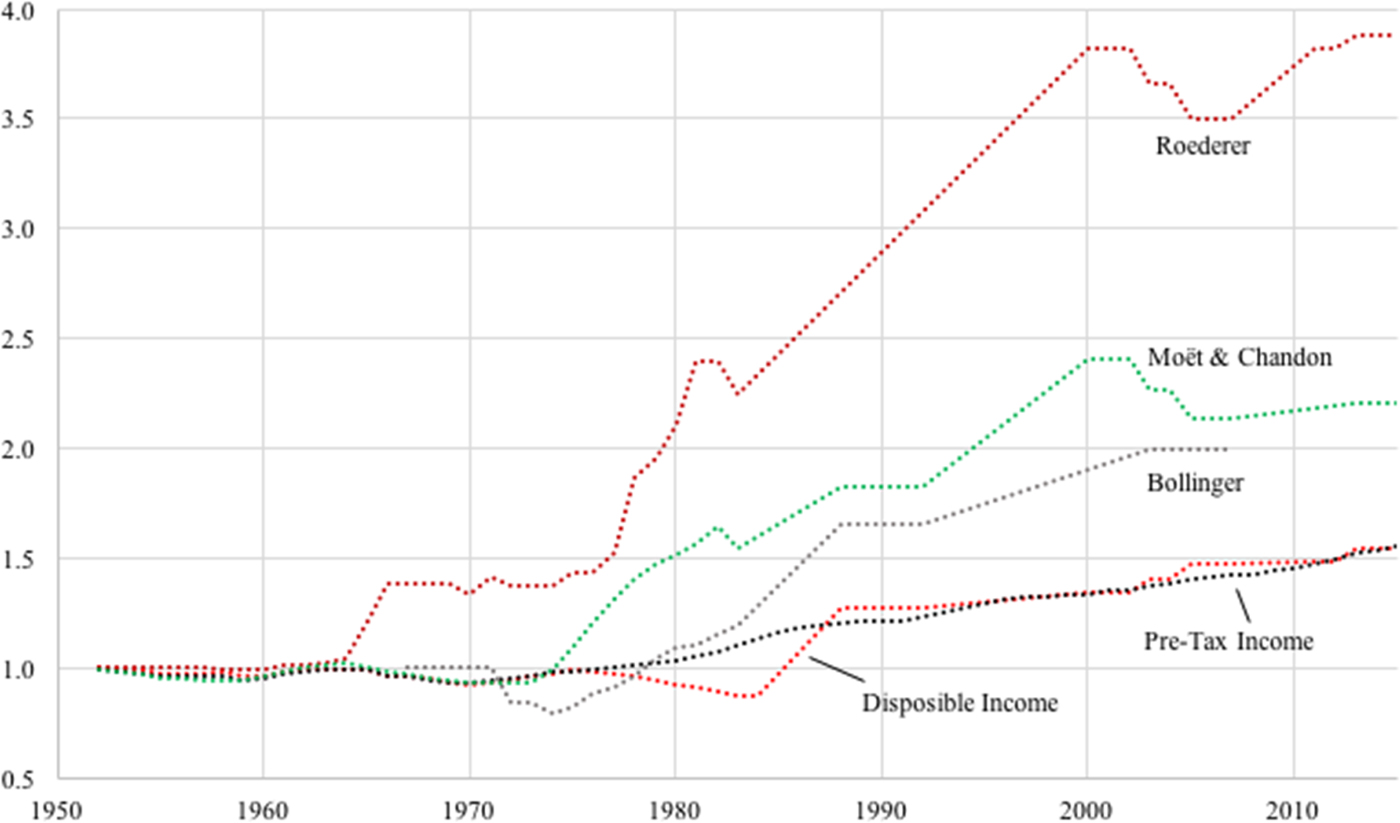
5. As Ashenfelter (Reference Ashenfelter2016) has suggested, over the past several decades, an increase in wage inequality has been mirrored by an increase in wine-price inequality between first-growth Bordeaux and petite châteaux Bordeaux. The findings in the current study can be extended to an analysis of inequality in champagne prices within the same brand over time. The current data indicate that inequality has increased in disposable income from wages and, to a greater degree, increased in champagne prices within the same brand.
Figure 3 shows the ratios of the top 5 percent income group's to the lowest 20 percent income group's pretax and disposable incomes from 1948 to 2013. The ratios are normalized to 1948 = 1. That is, in 2013, the pretax income ratio has grown to 1.58 times its 1948 value, suggesting a significant rise in income inequality. Interestingly, except for a short period in the 1970s, taxes have done little to reduce this gap, as the disposable income ratio closely follows the pretax income ratio.
Stratification of Incomes and Champagne Prices, 1948–2013
Ratios of Highest Income/Lowest Income and Flagship/Nonvintage, Moving 5-Year Averages Normalized 1948 = 1

Studies in the past have used a variety of approaches to compare consumption cost and standard of living over time. Ridley (Reference Ridley2010) provides the closest example to the methodology used here. Ridley employs a similar comparison of using hours-worked needed to buy for a “time-and -place” standardized commodity, 20 minutes of artificial light, to compare consumption costs across time, in different locations. The reciprocal of these consumption costs can be used as a partial measure of the changes in standard of living, although the introduction of new goods and services over time and different versions of similar-purpose goods across different locations, make full standard of living comparisons considerably more challenging.
This analysis uses quality differences of the same-function product, champagne, in a single location (New York City) instead of the same quality product in different locations, to provide cross-sectional comparisons of the cost of consumption at each point in time. This goes beyond Ripley’s approach by adding a third dimension that makes comparisons of the cost of consumption to consumers in different relative income/standard of living levels/strata as measured by after-tax, disposable income, in the same place and at the same time. Lastly, by introducing three tiers within the same product category entry, mid-level, and flagship wines a more nuanced story about champagne inflation and real household income growth emerges.
IV. Conclusion
This paper examines the evolution of champagne prices in New York City from 1948 to 2013 by drawing on retail prices of entry-level, vintage, and flagship champagnes by Bollinger, Louis Roederer, and Moët & Chandon. I find that real income, expressed in the number of hours needed to work for a bottle of entry-level champagne, has significantly increased since 1948. However, the opposite is true for flagship champagne. Champagne price stratification has far exceeded rising income stratifications, which suggests that the flagship tier of each brand's range is becoming less attainable to all income groups other than the highest-earning, top 5 percent income bracket.