Many studies have confirmed the importance of familial/genetic contributions to suicide attempts (SA) and suicide death (SD) (Baldessarini & Hennen, Reference Baldessarini and Hennen2004; Brent & Melhem, Reference Brent and Melhem2008; Kendler, Ohlsson, Sundquist, Sundquist, & Edwards, Reference Kendler, Ohlsson, Sundquist, Sundquist and Edwards2020; Pedersen & Fiske, Reference Pedersen and Fiske2010; Petersen, Sorensen, Andersen, Mortensen, & Hawton, Reference Petersen, Sorensen, Andersen, Mortensen and Hawton2013; Petersen, Sorensen, Kragh, Mortensen, & Hawton, Reference Petersen, Sorensen, Kragh, Mortensen and Hawton2014; Schulsinger, Kety, Rosenthal, & Wender, Reference Schulsinger, Kety, Rosenthal, Wender, Schou and Stromgren1979). Historically, the genetics of suicidality has been quite challenging to dissect due to low prevalence rates. Heritability estimates from twin and family studies range from 0.30 to 0.55 for suicidal ideation, attempts, and death (Edwards et al., Reference Edwards, Ohlsson, Moscicki, Crump, Sundquist, Lichtenstein and Sundquistin press; Fu et al., Reference Fu, Heath, Bucholz, Nelson, Glowinski, Goldberg and Eisen2002; Glowinski et al., Reference Glowinski, Bucholz, Nelson, Fu, Madden, Reich and Heath2001; Pedersen & Fiske, Reference Pedersen and Fiske2010; Tidemalm et al., Reference Tidemalm, Runeson, Waern, Frisell, Carlstrom, Lichtenstein and Langstrom2011). While many studies of candidate genes influencing suicidality were underpowered, recent collaborative efforts also support a role for genetic factors: Not only have specific loci been implicated in genome-wide association studies (GWAS), but SNP-based heritability estimates were h 2snp = 0.075 for SA (Mullins et al., Reference Mullins, Kang, Campos, Coleman, Edwards, Galfalvy and Starnawska2020) and h 2snp = 0.16 for SD (Docherty et al., Reference Docherty, Shabalin, DiBlasi, Monson, Mullins, Adkins and Chen2020). Furthermore, polygenic risk scores (PRS) derived from these GWAS are associated with suicidality in independent samples, as well as with a range of behavioral outcomes including substance use problems and other psychopathology. Despite these advances, little is known about how genetic liability to suicidality is reflected in its clinical features (e.g. age of onset for suicidality, repeated attempts) or mediated through psychiatric outcomes.
While familial clustering of psychopathology may also be attributable to shared environmental factors, previous studies support only a modest role for their influence on suicidality. We recently reported that shared environmental factors accounted for only 2–9% of the variance in SA, and were not detectable for SD, in a large (>1.3 million) Swedish cohort (Edwards AC, In Press). In an adolescent sample of US female twins, only 8% of the variance in SA was due to familial environmental factors (Glowinski et al., Reference Glowinski, Bucholz, Nelson, Fu, Madden, Reich and Heath2001), while Fu et al. reported a slightly higher estimate (19%) in an adult male sample (Fu et al., Reference Fu, Heath, Bucholz, Nelson, Glowinski, Goldberg and Eisen2002). Thus, while familial environmental factors contribute to risk for suicidality, their impact is quite modest relative to genetic factors and individual-level environmental exposures [e.g. divorce (Jamison, Bol, & Mintz, Reference Jamison, Bol and Mintz2019; Roškar et al., Reference Roškar, Podlesek, Kuzmanić, Demšar, Zaletel and Marušič2011), socioeconomic factors (Lorant, Kunst, Huisman, Costa, & Mackenbach, Reference Lorant, Kunst, Huisman, Costa and Mackenbach2005; Rosoff, Kaminsky, McIntosh, Smith, & Lohoff, Reference Rosoff, Kaminsky, McIntosh, Smith and Lohoff2020)].
Psychiatric and substance use disorders are all moderately to substantially heritable (Smoller et al., Reference Smoller, Andreassen, Edenberg, Faraone, Glatt and Kendler2019; Verhulst, Neale, & Kendler, Reference Verhulst, Neale and Kendler2015) and among the strongest predictors of SA and SD (Arsenault-Lapierre, Kim, & Turecki, Reference Arsenault-Lapierre, Kim and Turecki2004; Cavanagh, Carson, Sharpe, & Lawrie, Reference Cavanagh, Carson, Sharpe and Lawrie2003; Harris & Barraclough, Reference Harris and Barraclough1997; Nock et al., Reference Nock, Hwang, Sampson, Kessler, Angermeyer, Beautrais and De Girolamo2009). Three sets of findings suggest that genetic risk factors for many psychiatric disorders should impact substantially on SA and SD risk. First, controlling for familial transmission of psychiatric and substance use disorders attenuates the familial aggregation of SA and SD (Ballard et al., Reference Ballard, Cui, Vandeleur, Castelao, Zarate, Preisig and Merikangas2019; Brent & Melhem, Reference Brent and Melhem2008; Kendler et al., Reference Kendler, Ohlsson, Sundquist, Sundquist and Edwards2020; Pedersen & Fiske, Reference Pedersen and Fiske2010). Second, in a case–control Danish cohort, controlling for a family history of SD, a family history of psychiatric illness predicted SD (Qin, Agerbo, & Mortensen, Reference Qin, Agerbo and Mortensen2002). Third, a PRS for SD predicted risk in other samples for major depression (MD), psychosis, and alcohol use disorder (AUD) (Docherty et al., Reference Docherty, Shabalin, DiBlasi, Monson, Mullins, Adkins and Chen2020).
In this study, we seek to further explore this question by examining the impact of family genetic risk scores (FGRS) (Kendler, Ohlsson, Sundquist, & Sundquist, Reference Kendler, Ohlsson, Sundquist and Sundquist2021a, Reference Kendler, Ohlsson, Sundquist and Sundquist2021b) in the entire Swedish population on risk for SA and SD. The FGRS is calculated from risk in first through fifth-degree relatives, for SA, SD, MD, bipolar disorder (BD), schizophrenia (SZ), AUD, and drug use disorder (DUD) on risk for SA and SD. FGRS are distinct from PRS as the estimate of genetic risk derives from the rates of psychiatric and substance use disorders in their extended family members, not from variation in their DNA.
We address four questions:
First, how strongly are the FGRS for SA, SD, MD, BD, SZ, DUD, and AUD associated with risk for SA and SD?
Second, are these FGRS also related to the number of SAs and the age at SD and first SA?
Third, how do these FGRS impact on risk for SD after SA?
Fourth, what proportion of the effects of the FGRS for these psychiatric disorders on SA or SD are direct v. mediated through the development of these disorders by high-risk individuals?
For each of these questions, we examine whether results differ in men and women.
Methods
We collected information on individuals from Swedish population-based registers with national coverage linking each person's unique personal identification number which, to preserve confidentiality, was replaced with a serial number by Statistics Sweden. We secured ethical approval for this study from the Regional Ethical Review Board of Lund University (No. 2008/409, 2012/795, and 2016/679).
Our database included all individuals born in Sweden 1932–1995, to Swedish-born parents. In the database, we included date of registration for SD and SA defined so that individuals with a later SD were excluded. Furthermore, we included all registrations for BD, SZ, MD, AUD, and DUD utilizing ICD-8, 9,10 codes from primary care, specialist and hospital registries, and criminal registers for AUD and DUD (see Appendix text and Table 1 for details). We also included individual FGRS for SD, SA, SZ, BD, MD, AUD, and DUD. The FGRS were based on selected first to fifth-degree relatives to the probands, producing a mean of 42.1 relatives per proband (see Appendix Fig. 1 for flowchart). Briefly, we first calculated the morbid risk for the phenotype in our sample of relatives based on age at first registration of affected individuals and age at end of follow-up for unaffected relatives. We then transformed the binary phenotype into an underlying liability distribution, with the threshold equal to the prevalence of the phenotype based on decade of birth and gender. Thereafter, we calculated the mean z-score for relatives with the phenotype and the mean z-score for individuals without. For first-degree relatives, we also multiplied the z-score with a factor that sought to eliminate the influence of the shared environment separately for siblings and parent–offspring pairs.
Within each type of relative, we then had two components: the sum of the z-score and the total weighted number of relatives. These two components were weighted according to the genetic resemblance to the proband. For each proband, we summed the two components across all groups of relatives and used the quotient between the two components. Finally, to obtain the individual FGRS, we multiplied the quotient with a shrinkage factor based on the variance of the z-score across all relatives, the variance in the mean z-score across all probands, and the number of weighted number of relatives for each proband. So that the FGRS would be more comparable across phenotype and to reduce the effect of register coverage, we standardized the FGRS by year of birth and county of residence into a z-score with mean = 0 and s.d. = 1.
For question 1 (association between FGRS and SA/SD), we first calculated mean values for our seven FGRS for individuals with SA and SD. For multivariate analyses, we used a Cox regression model to investigate the risk of SA/SD as a function of the seven FGRS scores in the entire population. We followed individuals from age 15 (or age in 1973) until the end of follow-up (SA/SD registration, death, emigration, or 12-31-2017). We used left truncation as medical register coverage started in 1973.
For question 2 (FGRS->age at onset of SA/SD and FGRS->number of registrations of SA), we used a linear regression model, among individuals with SA/SD, with the FGRS as outcome and age at onset as a continuous variable while controlling for year of birth of the individual. We present the predicted FGRS at the 10th, 30th, 50th, 70th, and 90th percentile of the age at onset distribution for individuals at the mean year of birth. The same approach was used for number of registrations. New registrations within 7 days of a previous registration were censored to eliminate counting the same event twice. In the figures, we present the β coefficient and the corresponding p value.
For question 3, we selected all individuals with SA including those who had a later SD, fitting a cox regression model to the risk of SD as a function of our seven FGRS scores following individuals until the end of follow-up (SD registration, death, emigration, or 2017-12-31).
For question 4, we used a path model approach to investigate the mediation effect of the disorders themselves on the effect of the FGRS on SA/SD. Here we do not investigate the FGRS for SD and SA. For each trait, we fitted two different models, for the entire population, based on the timing of the registration of the disorder prior to the SA/SD: (i) within 1 year prior and (ii) any time prior to the SA/SD. For individuals without SA/SD, the registration could occur at any time. The path models included a single-headed arrow from the FGRS to SA (SD), a single-headed arrow from the FGRS to the trait itself, and a single-headed arrow from the trait to SA (SD). We report the direct effect of the FGRS on SA (SD) and the indirect effect (that goes through the trait itself). The path models were fit using the weighted least square mean and variance adjusted (WLSMV) estimator and the Theta parameterization in Mplus (Muthén & Muthén, Reference Muthén and Muthén2015). We present 59 statistical comparisons, many of them inter-correlated and use a p value of <0.001 as a guideline for statistical significance. All other models were performed using SAS 9.4 (SAS Institute, 2012).
Results
Our cohort included 7 661 519 subjects, 50.8% male. The mean age (±95% CIs) at follow-up, first SA and SD in this cohort were, respectively, 41.5 (41.4–41.6), 27.8 (27.7–27.8), and 35.4 (35.2–35.5). The prevalence of SA (without SD) and SD was, respectively, 3.27% and 0.57%. Among those with an SD, 28.6% had a prior SA. Our FGRS included a mean of 42.1 relatives.
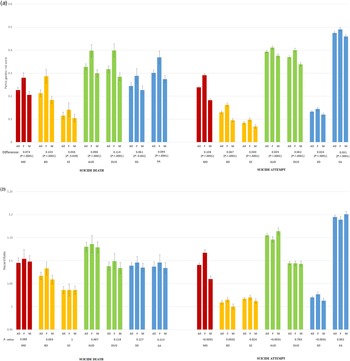
Figure 1a shows the mean standardized FGRS for our SA, SD, and our five disorders in those with SA and SD, separately in females and males. The risk for SD was most strongly associated with the FGRS for AUD followed by DUD, SA, SD, and MD. While all of the FGRS were higher for women with SD than men, the relative order was similar across sexes and all the differences were significant except for SZ. The largest FGRS effect size difference across men and women was for DUD FGRS followed by BD, AUD, and SA FGRS.
(a) The mean family genetic risk scores for five psychiatric and substance use disorders [(major depression (MD), bipolar disorder (BD), schizophrenia (SZ), alcohol use disorder (AUD), and drug use disorder (DUD)] and for suicide death (SD) and suicide attempt (SA) in individuals with suicide death and suicide attempt in the Swedish general population born 1932–1995. The y-axis is the standardized mean FGRS. For each comparison, we present first the result of the entire sample and then in females (F) and males (M). Internalizing disorders, here only MD, are presented in very light gray (red), psychotic disorders in light gray (yellow), substance use disorders in dark gray (green), and suicidal behaviors in black (blue). This figure presents results for suicide death in the left half of the figure and suicide attempt in the right half. The figures below the columns reflect the effect size of the difference between the FGRS in females and males and then the p value of that difference. Given the multiple number of tests utilized, we set the p value level of <0.001 as a guide to statistical significance. (b) The hazard ratios (95% CIs) from a multivariate Cox Proportional Hazard model investigating time to suicide death and suicide attempt as a function of the family genetic risk scores for five psychiatric and substance use disorders [(major depression (MD), bipolar disorder (BD), schizophrenia (SZ), alcohol use disorder (AUD), and drug use disorder (DUD)] and for suicide death (SD) and suicide attempt (SA) using the entire Swedish general population born 1932–1995. The y-axis is the hazard ratio. For each comparison, we present first the result of the entire sample and then in females (F) and males (M). Internalizing disorders, here only MD, are presented in very light gray (red), psychotic disorders in light gray (yellow), substance use disorders in dark gray (green), and suicidal behaviors in black (blue). This figure present results for suicide death in the left half of the figure and suicide attempt in the right half. The figures below the columns reflect the p value of the difference in the hazard ratio in males and females. Given the multiple number of tests utilized, we set the p value level of <0.001 as a guide to statistical significance.

In the entire sample, SA was most strongly associated with the FGRS for SA, followed by AUD, DUD, and MD. In the prediction of SA, all of the FGRS were significantly higher in women than in men and the rank order was the same. The largest effect size differences between the sexes were seen for MD FGRS followed by BD and DUD.
The multivariate results of the association between our seven FGRS and risk for SD and SA are seen in Fig. 1b. For the entire population, the strongest predictor of SD was the FGRS for AUD, followed by MD, SD, and DUD. In these analyses, none of the differences in FGRS across sexes were significant. For SA, in the entire sample, the strongest predictor was the FGRS for SA, followed by AUD, DUD, and MD. The FGRS for MD, BD, and SD were significantly higher in women with SA than in men. By contrast, the FGRS for AUD was significantly higher in men. We also see an appreciable difference in the rank order of effects by sex with the effect of the MD FGRS being substantially greater than the DUD FGRS in women with the reverse pattern in men.
Comparing the levels of our FGRS for SA v. SD, we focused on the multivariate model (Fig. 1b). The effect sizes for SA and AUD FGRS were appreciably higher in SA than in SD, while the reverse pattern was seen for the FGRS SD, BD, and SZ. Interestingly, the effect sizes for the MD and DUD FGRS were very similar for the two suicidal behaviors.
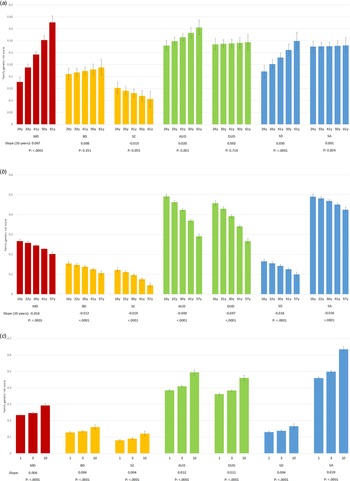
Figure 2a depicts the association between our seven FGRS and age at SD. Only the FGRS for MD, AUD, and SD differed significantly in the prediction of SD by age, all more strongly predicting SD in older individuals. The effect size was strongest for the MD FGRS. That is, in the extended families of individuals with SD, individuals who committed suicide at an older age were more enriched for individuals affected with MD, AUD, and SD. As seen in Fig. 2b, all of our FGRS were significantly stronger at predicting SA in younger individuals with the largest effect size seen for the AUD FGRS. Figure 2c demonstrates that all of our FGRS increase in individuals with SA with a larger number of recorded attempts with the strongest effect seen for the SA FGRS. That is, the extended families of individuals with high numbers of SA contain, on average, more members affected with all of the disorders we examine than the families of those with low numbers of SA.
(a) Results from a linear regression model with FGRS for five psychiatric and substance use disorders [major depression (MD), bipolar disorder (BD), schizophrenia (SZ), alcohol use disorder (AUD), and drug use disorder (DUD)] and for suicide death (SD) and suicide attempt (SA) as outcome and age at onset as a continuous variable while controlling for year of birth of the individual among individuals with a suicide death in the Swedish general population born 1932–1995. The y-axis is the FGRS, and we present the predicted FGRS at the 10th, 30th, 50th, 70th, and 90th percentile, which in our sample, equaled, respectively, 24, 33, 41, 50, and 61 years old at the mean year of birth. The figures below the columns reflect the increase in FGRS for each 10-year increase in age at onset and the p value. Given the multiple number of tests utilized, we set the associated p value level of <0.001 as a guide to statistical significance. (b) Results from a linear regression model with FGRS for five psychiatric and substance use disorders [major depression (MD), bipolar disorder (BD), schizophrenia (SZ), alcohol use disorder (AUD), and drug use disorder (DUD)] and for suicide death (SD) and suicide attempt (SA) as outcome and age at onset as a continuous variable while controlling for year of birth of the individual among individuals with a suicide attempt in the Swedish general population born 1932–1995. The y-axis is the FGRS, and we present the predicted FGRS at the 10th, 30th, 50th, 70th, and 90th percentile of the age at onset distribution, which in our sample, equaled, respectively, 16, 22, 30, 31, and 57 years old at the mean year of birth. The figures below the columns reflect the increase in FGRS for each 10-year increase in age at onset and the p value. Given the multiple number of tests utilized, we set the associated p value level of <0.001 as a guide to statistical significance. (c) Results from a linear regression model with FGRS for five psychiatric and substance use disorders [major depression (MD), bipolar disorder (BD), schizophrenia (SZ), alcohol use disorder (AUD), and drug use disorder (DUD)] and for suicide death (SD) and suicide attempt (SA) as outcome and the number of suicide attempts as a continuous variable among individuals with a suicide attempt in the Swedish general population born 1932–1995. The y-axis is the FGRS, and we present the predicted FGRS at the 10th, 90th, and 99th percentile, which in our sample, equaled, respectively, 1, 3, and 10 attempts. The figures below the columns reflect the increase in FGRS for one additional suicide attempt and the associated p value. Given the multiple number of tests utilized, we set the associated p value level of <0.001 as a guide to statistical significance.

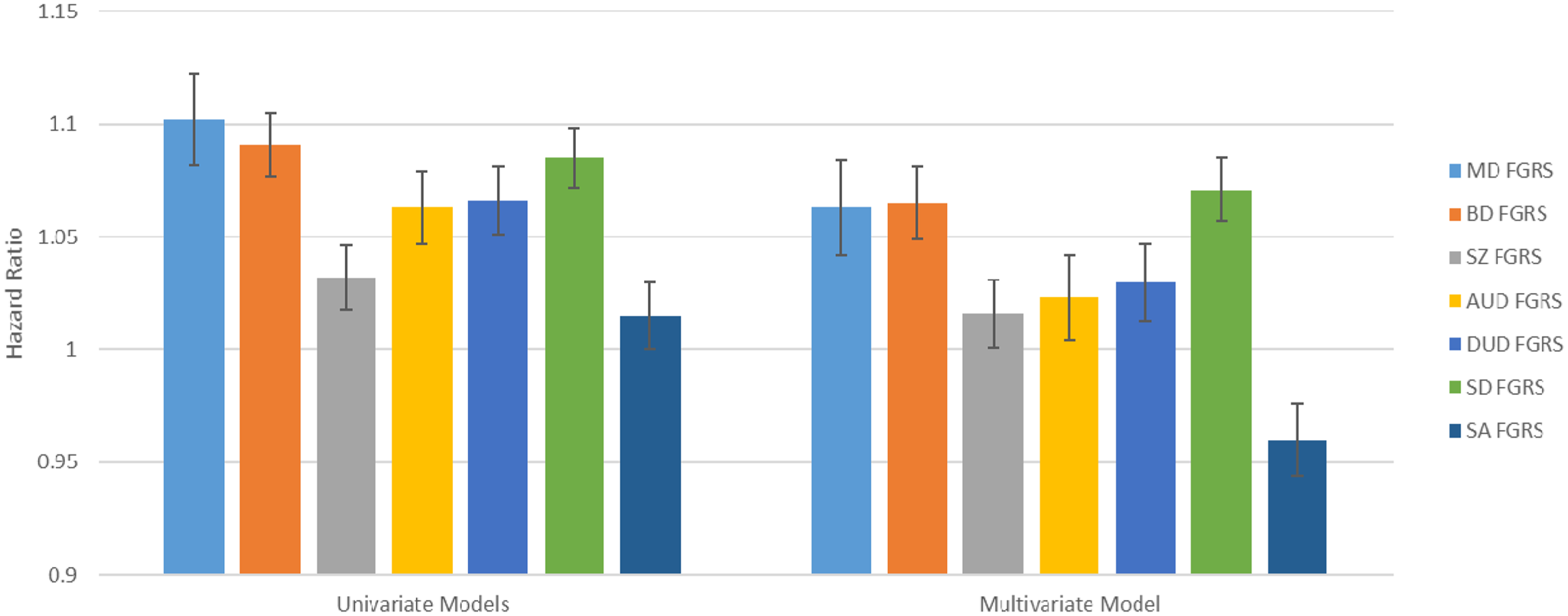
Using a Cox model, the univariate and multivariate predictions of SD in those with a prior SA are seen in Fig. 3. In the univariate analyses, the largest effect was seen for MD FGRS followed by BD and SD FGRS. In the multivariate analyses, the SD FGRS had the largest effect followed by the BD and MD FGRS.
The hazard ratios (95% CIs) from a multivariate Cox Proportional Hazard model investigating time to suicide death from first registration of a suicide attempt as a function of the family genetic risk scores for five psychiatric and substance use disorders [major depression (MD), bipolar disorder (BD), schizophrenia (SZ), alcohol use disorder (AUD), and drug use disorder (DUD)] and for suicide death (SD) and suicide attempt (SA) using all individuals registered with a suicide attempt in the Swedish general population born 1932–1995. The y-axis is the hazard ratio. The left part of the figure presents the results from the univariate models and the right part the results from the multivariate model.

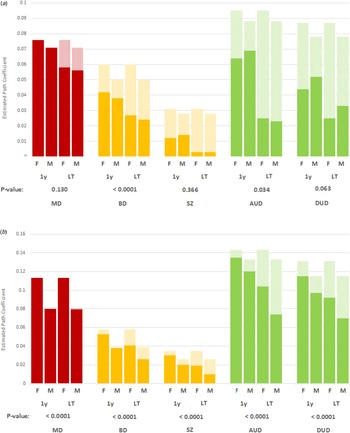
Figure 4a and b examines the degree to which the impact of our FGRS scores on risk for SA and SD is mediated through developing the disorder for which they are at high risk. Taking MD as an example and SA as an outcome, we construct a model containing both a direct path from MD FGRS→SA and an indirect path from MD FGRS→MD→SA. We then examine the proportion of the MD to SA association from the two paths under two conditions: having an MD diagnosis within a year of the SA and having a diagnosis of MD any time in their life prior to the SA.
(a) Estimates of path coefficients from two mediational path models for the association between genetic risk scores for five psychiatric and substance use disorders [major depression (MD), bipolar disorder (BD), schizophrenia (SZ), alcohol use disorder (AUD), and drug use disorder (DUD)] and suicide death in males (M) and females (F). The path models all included the diagnosis related to the FGRS score (i.e. the model for the MD FGRS looked at its mediation through having a diagnosis of MD). These models differed by the time period during which the diagnosis was counted: (i) within 6 months of the index suicide death and (ii) ever in the lifetime prior to the suicide death. The y-axis presents the estimate of the total effect of the paths connecting the FGRS score and suicide death. The sold portion of the column represents the direct effects of FGRS on suicide death. The stippled portion of the column represents the indirect or mediated effects passing through the history of having the relevant disorder. The p value represents the differences in the total effect in males and females. (b) Estimates of path coefficients from two mediational path models for the association between genetic risk scores for five psychiatric and substance use disorders [major depression (MD), bipolar disorder (BD), schizophrenia (SZ), alcohol use disorder (AUD), and drug use disorder (DUD)] and suicide attempt in males (M) and females (F). The path models all included the diagnosis related to the FGRS score (i.e. the model for the MD FGRS looked at its mediation through having a diagnosis of MD). These models differed by the time period during which the diagnosis was counted: (i) within 6 months of the index suicide death and (ii) ever in the lifetime prior to the suicide death. The y-axis presents the estimate of the total effect of the paths connecting the FGRS score and suicide death. The sold portion of the column represents the direct effects of FGRS on suicide death. The stippled portion of the column represents the indirect or mediated effects passing through the history of having the relevant disorder. The p value represents the differences in the total effect in males and females.

For SD in males and females, the broad pattern of both last-year and lifetime mediation effects varied across diagnoses being strongest for AUD, DUD, and SZ and weakest for MD (Fig. 4a). Also, as expected, more mediation is demonstrated for the lifetime than for the last year diagnosis. The mediation by diagnosis is consistently more modest in the prediction of SA than in the prediction of SD (Fig. 4b).
Discussion
In a large Swedish population cohort, we examined how genetic liability for SA, SD, MD, BD, SZ, DUD, and AUD impacted on risk for SA and SD. We initially examine the impact of the FGRS for our five psychiatric disorders and then review findings for the SA and SD FGRS.
Psychiatric FGRS
While psychological autopsy studies have consistently shown the strongest association for SD is with affective illness (Cavanagh et al., Reference Cavanagh, Carson, Sharpe and Lawrie2003), for both SA and SD, in both univariate and multivariate analyses, in both men and women, the associations were stronger for the AUD than for the MD FGRS. Consistent with recent epidemiologic and GWAS findings (Docherty et al., Reference Docherty, Shabalin, DiBlasi, Monson, Mullins, Adkins and Chen2020; Edwards, Ohlsson, Sundquist, Sundquist, & Kendler, Reference Edwards, Ohlsson, Sundquist, Sundquist and Kendler2020), our results suggest that, from both an etiologic and prevention perspective, greater emphasis needs to be given to the role of AUD risk in suicidal behaviors.
The FGRS for AUD and DUD were more strongly associated with SA while the FGRS for BD and SZ were more strongly predictive of SD. Given the younger age of SA v. SD in our sample, the more robust association of DUD and AUD FGRS with SA might arise from the strong link between substance misuse with suicidal behavior in the young (Kaplan et al., Reference Kaplan, McFarland, Huguet, Conner, Caetano, Giesbrecht and Nolte2013; Kessler, Berglund, Borges, Nock, & Wang, Reference Kessler, Berglund, Borges, Nock and Wang2005; Rich, Young, & Fowler, Reference Rich, Young and Fowler1986).
While all five of our psychiatric FGRS were strongly associated with early age at first SA, a significant association with age at SD was seen only for MD and AUD FGRS, where higher scores predicted later age at SD. These findings suggest a fundamentally different interaction between age, liability to psychiatric illness and risk for SA v. for SD. Our results are congruent with prior studies indicating that MD is more frequently seen in SD in older individuals (McGirr et al., Reference McGirr, Renaud, Bureau, Seguin, Lesage and Turecki2008; Rich et al., Reference Rich, Young and Fowler1986). We also saw associations for all of our psychiatric FGRS with the number of SAs, consistent with findings linking multiple attempts with greater clinical severity (Forman, Berk, Henriques, Brown, & Beck, Reference Forman, Berk, Henriques, Brown and Beck2004).
In subjects with a prior SA, the BD and MD FGRS were the most important psychiatric predictors for SD in both univariate and bivariate analyses. Our findings are consistent with prior evidence that long-term risk for SD following SA is most strongly predicted by SZ, BD, and MD (Tidemalm, Haglund, Karanti, Landén, & Runeson, Reference Tidemalm, Haglund, Karanti, Landén and Runeson2014; Tidemalm, Långström, Lichtenstein, & Runeson, Reference Tidemalm, Långström, Lichtenstein and Runeson2008).
Finally, we sought to evaluate the pathways through which our psychiatric FGRS impact on suicide risk by evaluating two plausible mediational models, in which the risk either arises through the direct effect of having the disorder v. through the adverse sequelae of the disorder. Examples of adverse sequelae for AUD might include the increased risk for divorce (Kendler, Lonn, Salvatore, Sundquist, & Sundquist, Reference Kendler, Lonn, Salvatore, Sundquist and Sundquist2017) and for poor social and occupational functioning (Kendler, Ohlsson, Karriker-Jaffe, Sundquist, & Sundquist, Reference Kendler, Ohlsson, Karriker-Jaffe, Sundquist and Sundquist2016).
Our results show that the direct effect of the disorder explains a moderate proportion of the effect of AUD and DUD FGRS, but very little for MD FGRS, with intermediate results for the BD and SZ FGRS. These results are congruent with prior findings that the impact of AUD on risk for SD is partly causal and partly the result of shared familial liability (Edwards et al., Reference Edwards, Ohlsson, Sundquist, Sundquist and Kendler2020). The disorder sequelae model explains a substantial proportion of the effects for AUD, DUD, and SZ FGRS. Mediation effects are substantially greater in SD than in SA.
FGRS for SA and SD
The FGRS for SA had the strongest impact on SA risk of any we examined, but also had an appreciable effect on SD risk. It also predicted early onset and recurrent SA but had minimal effect on predicting SD after SA. By contrast, the FGRS for SD was, in the multivariate model, only the third strongest in the prediction of SD, behind the FGRS for AUD and MD and predicted a late age at SD. Only in the multivariate model of risk for SD after SA was it, by a small margin, the strongest predictor.
These results are consistent with three prior findings of an extended adoption study of SA and SD in Sweden in demonstrating (i) a direct genetic effect for SA and for SD, (ii) that while correlated, FGRS for SA and SD are not identical, and (iii) that the genetic vulnerability to SA is transmitted within families both through the risk for psychiatric and substance use disorders and a direct genetic liability to SA (Kendler et al., Reference Kendler, Ohlsson, Sundquist, Sundquist and Edwards2020), a finding consistent with prior twin (Pedersen & Fiske, Reference Pedersen and Fiske2010) and family studies of SA (Brent & Melhem, Reference Brent and Melhem2008).
Limitations
Our results should be viewed in the context of four potential methodological limitations. First, the validity of our FGRS depends on the quality of the Swedish registry diagnoses on which they are based. Prior studies have supported the validity of the diagnoses of SZ (Ekholm et al., Reference Ekholm, Ekholm, Adolfsson, Vares, Osby, Sedvall and Jonsson2005; Lichtenstein et al., Reference Lichtenstein, Bjork, Hultman, Scolnick, Sklar and Sullivan2006), BD (Sellgren, Landen, Lichtenstein, Hultman, & Langstrom, Reference Sellgren, Landen, Lichtenstein, Hultman and Langstrom2011), MD (Kendler, Ohlsson, Lichtenstein, Sundquist, & Sundquist, Reference Kendler, Ohlsson, Lichtenstein, Sundquist and Sundquist2018; Sundquist, Ohlsson, Sundquist, & Kendler, Reference Sundquist, Ohlsson, Sundquist and Kendler2017), DUD, and AUD (Kendler et al., Reference Kendler, Sundquist, Ohlsson, Palmer, Maes, Winkleby and Sundquist2012, Reference Kendler, Ji, Edwards, Ohlsson, Sundquist and Sundquist2015).
Second, SAs not brought to medical attention were not registered so we are almost certainly studying more severe forms of SA and missing many of the milder attempts. In Sweden, unexpected deaths outside of hospitals are investigated through a forensic autopsy (National Board of Forensic Medicine, 2018), the accuracy of diagnoses in the Cause of Death Register is regularly evaluated (Statistics Sweden, 2004), and a recent systematic review of the reliability of suicide statistics supported the accuracy of Swedish data (Tollefsen, Hem, & Ekeberg, Reference Tollefsen, Hem and Ekeberg2012).
Third, our FGRS is based on clinical diagnoses in relatives and thus is a fundamentally different measure of genetic risk than the PRS based on DNA variants. As seen in the Appendix (Figs 2 and 3), we do see reasonable risk curves for SA and SD as a function of the FGRSSA. Our corrections for cohabitation in parents and siblings are only approximate. In Appendix Tables 2 and 3, we show, respectively, that our overall findings are not highly sensitive to particular features of the complex calculations underlying these statistics and results are relatively stable across time and space. In Appendix Fig. 4, we note that our FGRS measures for SA and SD were only modestly affected by birth cohort or geographical location within Sweden. Because of concerns that correlations in neighborhood deprivation in more distant relatives might be biasing upward our estimates of FGRS, we repeated our calculation of the FGRSAUD correcting for deprivation. As seen in Appendix Fig. 5, correcting for deprivation produced very modest changes on our estimates for FGRSAUD. To further validate the FGRS, we compared it to a recently proposed quantitative family-history score: LT-FH (Hujoel, Gazal, Loh, Patterson, & Price, Reference Hujoel, Gazal, Loh, Patterson and Price2020) based on parents and siblings. We applied that method to our Swedish sample and obtained a mean (s.d.) correlation with our FGRS across a range of psychiatric disorders of +0.56 (0.09). When we restricted the FGRS to parents and siblings and then eliminated our correction for cohabitation to increase comparability between the measures, these correlations increased to +0.93 (0.05) and +0.94 (0.02), respectively. These results in aggregate support the validity of our FGRS and suggest that it is not likely to be substantially impacted by shared environmental effects.
Finally, our analyses of mediation effects are imperfect. For example, someone with a high AUD FGRS might have problematic drinking which impacts on risk for suicidal behavior but is insufficiently severe to result in an AUD registration. To examine the sensitivity of our mediation models to potential covariates, we repeated the analyses adding year of birth to the structural model. As seen in Appendix Fig. 6, the differences in results were minor.
Conclusion
Our findings present a complex picture of the genetic risk factors for SA and SD consistent with the stress-diathesis model of suicidal behavior recently articulated by Mann and Rizk (Reference Mann and Rizk2020). The FGRS for five major psychiatric and substance use disorders – MD, BD, SZ, AUD, and DUD – and for SA and SD were all substantially elevated in individuals with SA or SD in a large population-based Swedish cohort. For SA, the strongest effects were seen consistently for the SA and AUD FGRS. The risk for SD was most strongly predicted by the FRS for AUD, MD, and SD. All FGRS scores significantly predicted younger age at SA and high recurrent attempts. Only the FGRS for SD, SZ, and BP were more strongly associated with SD than SA. SD after SA was most strongly predicted by SD, BD, and MD FGRS. A substantial proportion of the FGRS effects for AUD, DUD, and SZ on SD but not for MD FGRS appeared to result from long-term effects of having the disorder. Results were generally similar across the sexes. Our findings suggest that the genetic risks for SA and SD are related by far from identical. Transmission of risk for both SA and SD within families arises both from the liability to psychiatric disorders and the genetic risk for suicidal behaviors.
Supplementary material
The supplementary material for this article can be found at https://doi.org/10.1017/S0033291721003354.
Data
Kristina Sundquist M.D. Ph.D. had full access to all the data in the study and takes responsibility for the integrity of the data and the accuracy of the data analysis.
Acknowledgements
None. The work was done at Lund University, Virginia Commonwealth University.
Financial support
This project was supported by grants R01AA027522, R01AA023534, and R01DA030005 from the National Institutes of Health and from the Swedish Research Council (2016-01176), as well as Avtal om Läkarutbildning och Forskning (ALF) funding from Region Skåne. The funding source had no role in the design and conduct of the study; collection, management, analysis, and interpretation of the data; preparation, review, or approval of the manuscript; and decision to submit the manuscript for publication.
Conflict of interest
None.
Ethical standards
The authors assert that all procedures contributing to this work comply with the ethical standards of the relevant national and institutional committees on human experimentation and with the Helsinki Declaration of 1975, as revised in 2008. We secured ethical approval for this study from the Regional Ethical Review Board in Lund (No. 2008/409). As approved by Swedish ethical authorities in secondary use of data, informed consent was not obtained from individual participants included in this study.