INTRODUCTION
The conventional approach for estimating variance components and genotypic values in annual crop breeding is to use the analysis of variance (ANOVA) method and best linear unbiased estimation (BLUE). Recently, best linear unbiased prediction (BLUP) and Bayesian inference have emerged as alternative procedures for genetic evaluation by plant breeders (Piepho et al. Reference Piepho, Möhring, Melchinger and Büchse2008; Bauer et al. Reference Bauer, Reetz, Hoti, Schuh, Léon and Sillanpää2009). Best linear unbiased prediction was originally developed for predicting additive values in animal breeding (Henderson Reference Henderson1974) and it requires the parametric values of the variance components. As these values are unknown, predictions are commonly based on the restricted maximum likelihood (REML) estimates (Patterson & Thompson Reference Patterson and Thompson1971). Best linear unbiased prediction and Bayesian inference allow the inclusion of pedigree information in the analysis. The Bayesian approach allows incorporating prior knowledge about parameters of the model (Blasco Reference Blasco2001). Several studies have shown the efficacy of BLUP in annual crop breeding for predicting untested maize single crosses performance (Bernardo Reference Bernardo1996) and breeding values in recurrent selection and in the development of pure and inbred lines (Bauer et al. Reference Bauer, Reetz and Léon2006; Oakey et al. Reference Oakey, Verbyla, Cullis, Wei and Pitchford2007; Viana et al. Reference Viana, Faria, Silva and Resende2011).
In maize breeding, reciprocal recurrent selection (RRS) is one of the most commonly used methods. Comstock et al. (Reference Comstock, Robinson and Harvey1949) proposed the evaluation of interpopulation paternal half-sib families and recombination of S1 progeny. Hallauer (Reference Hallauer1967) suggested a modified method for continually assessing inbred interpopulation full-sib families to obtain hybrids. Full-sib RRS with S1 progeny recombination was proposed by Hallauer & Eberhart (Reference Hallauer and Eberhart1970). Ordás et al. (Reference Ordás, Butrón, Alvarez, Revilla and Malvar2012) compared the efficiency of the full-sib RRS with a modification to the method that essentially applied a selection index to include the S2 progeny performance (FS-S2-RRS). Both procedures efficiently improved the populations per se and the FS-S2-RRS was more efficient than the standard method for developing high-yielding and stable crosses between the two populations. dos Reis et al. (Reference dos Reis, Guedes, Abreu and Souza2012) investigated the efficiency of RRS strategies by determining the expected and realized responses to selection as well as changes in heterosis, concluding that the method proposed by Souza (Reference Souza1987) showed the highest efficiency in improving the interpopulation cross but not the parental populations. This method also increased heterosis in the interpopulation hybrid after three selection cycles. Romay et al. (Reference Romay, Ordás, Revilla and Ordás2011) evaluated the effect of full-sib RRS in two Spanish maize populations, observing that this method was effective for the improvement of grain yield in the interpopulation cross and in one of the parental populations. Furthermore, the grain yield heterosis increased significantly.
Reciprocal recurrent selection has proven to be a highly efficient procedure for improving the interpopulation cross regardless of the trait, populations, family or recombination unit (Penny & Eberhart Reference Penny and Eberhart1971; Romay et al. Reference Romay, Ordás, Revilla and Ordás2011). Experimental and simulated results have also shown improvement in one or both of the two populations (Keeratinijakal & Lamkey Reference Keeratinijakal and Lamkey1993; Peiris & Hallauer Reference Peiris and Hallauer2005; Viana et al. Reference Viana, Delima, Mundim, Condé and Vilarinho2013). Throughout the past 63 years of RRS use, identification of the best families has been made based on the BLUE of progeny genotypic values. Viana et al. (Reference Viana, Delima, Mundim, Condé and Vilarinho2013) showed that half-sib RRS is more efficient than full-sib RRS based on progeny genotypic value, but as efficient as full-sib RRS based on the general combining ability (GCA) effect. Unfortunately, as highlighted by Viana et al. (Reference Viana, Delima, Mundim, Condé and Vilarinho2013), with the standard full-sib RRS (evaluation of non-inbred full-sib progeny and S1 recombination) it is not possible to estimate or predict the GCA effects of the parents. The GCA prediction is possible with the assessment of inbred full-sib families based on BLUP with pedigree information (additive and dominance relationship matrices different from an identity matrix). This is because with non-inbred progeny there is only one covariance between relatives (full-sibs), which depends on the three components of the genotypic variance (two GCA variances and the specific combining ability (SCA) variance), assuming no epistasis. Even assuming absence of dominance the covariance depends on two components of variance. Then the additive and dominance relationship matrices must include at least three distinct covariances between relatives.
Thus, the objective of the present study was to present theory and application of BLUP for genetic evaluation in RRS.
MATERIALS AND METHODS
Experimental data
Expansion volume (ml/g) and grain yield (kg/ha) of seven progeny tests, corresponding to two programmes of RRS with Viçosa and Beija-Flor popcorn (Zea mays L. ssp. mays [syn. Zea mays L. ssp. everta (Sturtev.) Zhuk.]) populations were analysed. The first programme was conducted with full-sib families of the Beija-Flor Cycle 1 (BFC1) and Viçosa (VC0) populations, the second with half- and full-sib families of the Beija-Flor Cycle 3 (BFC3) and Viçosa Cycle 3 (VC3) populations. All of the improved populations were obtained by half-sib selection. Both programmes are based on the procedure proposed by Hallauer (Reference Hallauer1967).
In Programme 1, 188 full-sib families from the first selection cycle (S0×S0 hybrids) were evaluated during the 2002/03 growing season in a 14×14 simple lattice at Maringá State University (23°25′S, 51°57′W, 596 m a.s.l.), Paraná state, Brazil. One hundred and thirty six inbred interpopulation full-sib families from the second cycle (S1×S1 hybrids) were evaluated during the 2004/05 growing season in a 12×12 lattice with three replications. This trial was conducted in an experimental area of Federal University of Viçosa (UFV) located in Coimbra (20°51′S, 42°48′W, 720 m a.s.l.), Minas Gerais state, Brazil. In Programme 2, half- and full-sib families from the first cycle were evaluated in three different trials during the 2007/08 growing season, in experimental areas of UFV at Coimbra and Ponte Nova (20°24′S, 42°54′W, 431 m a.s.l.), Minas Gerais. The full-sib families test was designed as a 13×13 lattice with three replications. The half-sib family tests were designed as 11×11 and 12×12 lattices with three replications, for the Viçosa Cycle 3 and Beija-Flor Cycle 3 progeny, respectively. In these trials, eight checks were inserted as additional treatments (one plot by replication). Inbred interpopulation full-sib families from the second and third cycles (S1×S1 and S2×S2 hybrids) were evaluated during the 2009/10 and 2011/12 growing seasons at Coimbra, and the trials were designed as 9×9 lattices with three replications. These trials included 73 and 72 progenies, respectively.
Each trial plot corresponded to a 5 m row of 25 plants (ideal stand) spaced 0·9 m apart. Final stand and grain moisture (covariates) were measured in all plots of each trial. The expansion volume was assessed using 30 g samples in a 27-litre microwave oven (900 W). The only control variety common to all trials was the commercial hybrid IAC 112, which was developed by the Agronomic Institute of Campinas, São Paulo State, Brazil. With one exception (the test of S0×S0 progeny from Programme 1), all trials included the parental populations. The controls were not included in the BLUP and BLUE analyses for generating unbalanced datasets.
Genetic model
For two populations A and B in Hardy–Weinberg equilibrium, the genotypic mean of an interpopulation half-sib family of a plant from population A is
 $${\rm \overline G}_{{\rm HSF(A} \times {\rm B)}} = {\rm M}_{\rm H} + {\rm GCA}_{{\rm (A)}} $$
where MH is the mean of the interpopulation cross and GCA(A) is the GCA effect of the common parent (Viana et al. Reference Viana, Delima, Mundim, Condé and Vilarinho2013). Thus, selection among half-sib families is equivalent to selection for the GCA of the common parents because for each gene the correlation between the GCA effect and the number of genes that increase trait expression is 1 or −1, depending on the degree of dominance and gene frequency. This correlation can only be negative with overdominance. Assuming 100 genes for determining a quantitative trait, the correlation is 0·95 (average of 100 simulations) for degrees of dominance between −1·2 and 1·2 (bidirectional dominance as evidenced for the expansion volume) and between 0 and 1·2 (positive dominance as evidenced for the grain yield). The correlation approaches 1 as the degree of dominance approaches 0.
The genotypic mean of an interpopulation full-sib family of plants from populations A and B is
 $${\rm \overline G}_{{\rm FSF(A} \times {\rm B)}} = {\rm M}_{\rm H} + {\rm GCA}_{({\rm A})} + {\rm GCA}_{{\rm (B)}} + {\rm SCA}$$
where GCA(B) is the GCA effect of the parent from population B and SCA is the SCA effect (Viana et al. Reference Viana, Delima, Mundim, Condé and Vilarinho2013). The SCA effect primarily reflects the difference of gene frequencies between parents. Thus, selection among interpopulation full-sib families is equivalent to selection for general and specific combining ability. The model derived by Viana et al. (Reference Viana, Delima, Mundim, Condé and Vilarinho2013) is a generalization of the model proposed by Bernardo (Reference Bernardo1994) for a factorial design involving inbred lines from two heterotic pools, for any inbreeding coefficient. Additionally, Viana et al. (Reference Viana, Delima, Mundim, Condé and Vilarinho2013) presented the parametric values of the GCA and SCA effects and variances.
With half- and full-sib RRS (assessment of half- or full-sib progeny with recombination of selected S 1) Hardy–Weinberg equilibrium is expected in both parental populations. With continuous assessment of inbred full-sib progeny, because the process suggested by Hallauer (Reference Hallauer1967) involves random crosses between Sn+1 plants derived only from selected Sn parents, and not recombination of the selected inbred progeny (with this procedure Hardy–Weinberg equilibrium is also expected in both parental populations), Viana et al. (Reference Viana, Delima, Mundim, Condé and Vilarinho2013) assumed the following probabilities for AA, Aa and aa individuals: p 2+pqF, 2pq(1−F) and q 2+pqF, where p and q are allelic frequencies and F is the inbreeding coefficient. Viana et al. (Reference Viana, Delima, Mundim, Condé and Vilarinho2013) also assumed an independent assortment of genes.
BLUP analysis
The phenotypic values of the interpopulation half- and full-sib families can be expressed as:
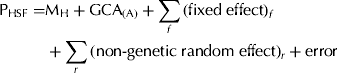 $$\eqalign{{\rm P}_{{\rm HSF}} = & {\rm M}_{\rm H} + {\rm GCA}_{{\rm (A)}} + \sum\limits_f {({\rm fixed}\;{\rm effect})_f} \cr & + \sum\limits_r {({\rm non \hbox{-} genetic}\;{\rm random}\;{\rm effect})_r} + {\rm error}} $$
and
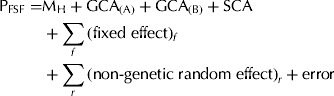 $$\eqalign{{\rm P}_{{\rm FSF}} = & {\rm M}_{\rm H} + {\rm GCA}_{{\rm (A)}} + {\rm GCA}_{{\rm (B)}} + {\rm SCA} \cr & + \sum\limits_f {({\rm fixed}\;{\rm effect})_f} \cr & + \sum\limits_r {({\rm non \hbox{-} genetic}\;{\rm random}\;{\rm effect})_r + {\rm error}}} $$
Considering a multi-generation analysis to increase the prediction accuracy and defining trial and replications within trial as fixed effects, and blocks within replication within trial as a random factor, the models are, in matrix terms:
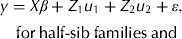 $$ y = X\beta + Z_1 u_1 + Z_2 u_2 + \varepsilon, \quad \ {\rm for}\;{\rm half \hbox{-} sib}\;{\rm families}\;{\rm and}$$
 $$y = X\beta + Z_1 u_1 + Z_2 u_2 + Z_3 u_3 + Z_4 u_4 + \varepsilon, \quad {\rm for}\;{\rm full \hbox{-} sib}\;{\rm families}$$
where y is the vector of phenotypic values; X is the incidence matrix of the fixed effects; β is the vector of fixed effects; Z 1, Z 2, Z 3 and Z 4 are the incidence matrices of the random effects; and ε is the residuals vector. For the interpopulation half-sib family model, u 1 is the vector of GCA effects of the common parents and u 2 is the vector of blocks within replication within trial effects. For the interpopulation full-sib family model, u 1 is the vector of GCA effects of the parents from population A; u 2 is the vector of GCA effects of the parents from population B; u 3 is the vector of SCA effects; and u 4 is the vector of blocks within replication within trial effects. All random vectors were assumed to be mutually independent.
The criterion used to obtain the BLUP of a random vector is the maximization of either the joint probability density function of y and the random vector(s) or the random vector(s) and ε, which obtains, assuming Normal distribution, the mixed model equations (MME) (Henderson Reference Henderson1974). Assuming Var(ε)=R, the MME for these models are:
 $$\eqalign{\left[ {\matrix{ {X'R^{ - 1} X} & {X'R^{ - 1} Z_1} & {X'R^{ - 1} Z_2} \cr {Z'_1 R^{ - 1} X} & {Z'_1 R^{ - 1} Z_1 + G_1^{ - 1}} & {Z'_1 R^{ - 1} Z_2} \cr {Z'_2 R^{ - 1} X} & {Z'_2 R^{ - 1} Z_1} & {Z'_2 R^{ - 1} Z_2 + G_2^{ - 1}} \cr}} \right] \left[ {\matrix{ {\beta ^o} \cr {\tilde u_1} \cr {\tilde u_2} \cr}} \right] = \left[ {\matrix{ {X'R^{ - 1} y} \cr {Z'_1 R^{ - 1} y} \cr {Z'_2 R^{ - 1} y} \cr}} \right]}$$
and
 $$\eqalign{\left[ {\matrix{ {X'R^{ - 1} X} & {X'R^{ - 1} Z_1} & {X'R^{ - 1} Z_2} & {X'R^{ - 1} Z_3} & {X'R^{ - 1} Z_4} \cr {Z'_1 R^{ - 1} X} & {Z'_1 R^{ - 1} Z_1 + G_1^{ - 1}} & {Z'_1 R^{ - 1} Z_2} & {Z'_1 R^{ - 1} Z_3} & {Z'_1 R^{ - 1} Z_4} \cr {Z'_2 R^{ - 1} X} & {Z'_2 R^{ - 1} Z_1} & {Z'_2 R^{ - 1} Z_2 + G_2^{ - 1}} & {Z'_2 R^{ - 1} Z_3} & {Z'_2 R^{ - 1} Z_4} \cr {Z'_3 R^{ - 1} X} & {Z'_3 R^{ - 1} Z_1} & {Z'_3 R^{ - 1} Z_2} & {Z'_3 R^{ - 1} Z_3 + G_3^{ - 1}} & {Z'_3 R^{ - 1} Z_4} \cr {Z'_4 R^{ - 1} X} & {Z'_4 R^{ - 1} Z_1} & {Z'_4 R^{ - 1} Z_2} & {Z'_4 R^{ - 1} Z_3} & {Z'_4 R^{ - 1} Z_4 + G_4^{ - 1}} \cr}} \right]\left[ {\matrix{ {\beta ^o} \cr {\tilde u_1} \cr {\tilde u_2} \cr {\tilde u_3} \cr {\tilde u_4} \cr}} \right] = \left[ {\matrix{ {X'R^{ - 1} y} \cr {Z'_1 R^{ - 1} y} \cr {Z'_2 R^{ - 1} y} \cr {Z'_3 R^{ - 1} y} \cr {Z'_4 R^{ - 1} y} \cr}} \right]}$$
With interpopulation half-sib families, Cov(u 1i,u 1j)=Cov(GCAi, GCAj)=0, as the common parents of the progenies i and j are not related. Then  ${\rm Var}(u_1 ) = G_1 = I\sigma _{{\rm GCA}}^2 $ where G 1 is the variance matrix of the GCA effects and
 $\sigma _{{\rm GCA}}^2 $ is the variance of the GCA effects. Furthermore,
 ${\rm Var}(u_2 ) = G_2 = I\sigma _b^2 $, where G 2 is the blocks within replication within trial variance matrix.
With full-sib families, the covariance between the GCA effects of two parents from population A is, for each gene:
 $${\rm Cov}({\rm GCA}_i, {\rm GCA}_j ) = {\rm Cov}[(\alpha _{\rm B} /2\alpha _{\rm A} ){\rm A}_i, (\alpha _{\rm B} /2\alpha _{\rm A} ){\rm A}_j ]$$
since (Viana et al. Reference Viana, Delima, Mundim, Condé and Vilarinho2013),
 $${\rm GCA}_{{\rm A}_{\rm 1} {\rm A}_{\rm 1}} = q\alpha _{\rm B} = (\alpha _{\rm B} /\alpha _{\rm A} )q\alpha _{\rm A} = (\alpha _{\rm B} /2\alpha _{\rm A} ){\rm A}_{{\rm A}_{\rm 1} {\rm A}_{\rm 1}}, $$
 $${\rm GCA}_{{\rm A}_{\rm 1} {\rm A}_{\rm 2}} = \left( {\displaystyle{{q - p} \over {\rm 2}}} \right)\alpha _{\rm B} = (\alpha _{\rm B} /\alpha _{\rm A} )\left( {\displaystyle{{q - p} \over {\rm 2}}} \right)\alpha _{\rm A} = (\alpha _{\rm B} /2\alpha _{\rm A} ){\rm A}_{{\rm A}_{\rm 1} {\rm A}_{\rm 2}}$$
and
 $${\rm GCA}_{{\rm A}_{\rm 2} {\rm A}_{\rm 2}} = - p\alpha _{\rm B} = (\alpha _{\rm B} /\alpha _{\rm A} )( - p\alpha _{\rm A} ) = (\alpha _{\rm B} /{\rm 2}\alpha _{\rm A} ){\rm A}_{{\rm A}_{\rm 2} {\rm A}_{\rm 2}} $$
where p and q are the allelic frequencies in the population A; αA and αB are the average effects of a gene substitution in the populations A and B, respectively; and A is the additive value.
Then:
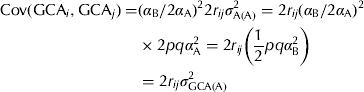 $$\eqalign{{\rm Cov}({\rm GCA}_i, {\rm GCA}_j ) = & (\alpha _{\rm B} /2\alpha _{\rm A} )^2 2r_{ij} \sigma _{{\rm A(A)}}^{\rm 2} = 2r_{ij} (\alpha _{\rm B} /2\alpha _{\rm A} )^2 \cr & \times 2pq\alpha _{\rm A}^2 = {\rm 2}r_{ij} \left( {\displaystyle{1 \over 2}pq\alpha _{\rm B}^2} \right) \cr &= {\rm 2}r_{ij} \sigma _{{\rm GCA(A)}}^2} $$
where  $\sigma _{{\rm A}({\rm A})}^2 $ is the additive variance in the population A.
Thus,  ${\rm Var (}u_{\rm 1} {\rm )} = {\rm G}_{\rm 1} = {\rm A}_{{\rm (A)}} {\rm \sigma} _{{\rm GCA(A)}}^2 $ where A(A)={2r ij} is the additive relationship matrix of the parents from population A and r ij is the coefficient of coancestry between the parents i and j. Then,
 ${\rm Var (}u_{\rm 2} {\rm )} = G_{\rm 2} = {\rm A}_{{\rm (B)}} {\rm \sigma} _{{\rm GCA(B)}}^2 $ where A(B) is the additive relationship matrix of the parents from population B and
 $\sigma _{{\rm GCA}({\rm B})}^2 = (1/2)\sum {rs\alpha _{\rm A}^2} $ where r and s are the allelic frequencies in the population B. Furthermore, defining i and j as the parents from population A and k and l as the parents from population B,
 ${\rm Cov}({\rm SCA}_{ik}, {\rm SCA}_{\,jl} ) = p_{(ik)(\,jl)} (1 + F)^2 \sigma _{{\rm SCA}}^2 $, where p (ik)(jl) is the probability that the parents of the two progenies have genotypes identical by descent and F is the inbreeding coefficient. This probability is p (ik)(jl)=u ijukl+u ilukj=u ijukl where u xy is the probability that the individuals x and y have genotypes identical by descent. Thus,
 ${\rm Var}(u_3 ) = G_3 = D(1 + F)^2 \sigma _{{\rm SCA}}^2 $ where D={p (ik)(jl)} is the dominance relationship matrix and
 $\sigma _{SCA}^2 = \sum {\,pqrsd^2} $ is the variance of the SCA effects where d is the deviation due to dominance (Viana et al. Reference Viana, Delima, Mundim, Condé and Vilarinho2013).
The accuracy (correlation between the true and predicted values) of the progeny, GCA and SCA effects were computed as 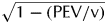 $\sqrt {1 - ({\rm PEV}/{\rm v})} $ (Mrode Reference Mrode2005) where PEV is the prediction error variance and
 $v = \tilde \sigma _{\rm G}^2 $,
 $(1 + F)\tilde \sigma _{{\rm GCA}}^2 $ or
 $(1 + F)^2 \tilde \sigma _{{\rm SCA}}^2 $, respectively, where
 $\tilde \sigma _{\rm G}^2 $,
 $\tilde \sigma _{{\rm GCA}}^2 $ and
 $\tilde \sigma _{{\rm SCA}}^2 $ are the REML estimates of the progeny, GCA and SCA variances. The ASReml v3.0 software (Gilmour et al. Reference Gilmour, Gogel, Cullis and Thompson2009) was used for all analyses (see code in the appendix). The additive and dominance relationship matrices were computed with a program developed in REALbasic 5.5 (REAL Software 2004).
BLUE analysis
Each progeny test was also analysed individually using the GLM procedure of the SAS System v.9.2 (SAS Institute 2007). Progeny and replication were defined as fixed factors and blocks within replication were regarded as a random factor (analysis with recovery of the interblock information). The estimated treatment genotypic means were used to compute the midparent heterosis and the realized interpopulation genetic gain in each selection cycle of each RRS programme. The realized interpopulation genetic gain was calculated as ΔM=mean of the Sn×Sn progeny – mean of the Sn−1×Sn−1 progeny – (mean of IAC 112 in the Sn×Sn trial – mean of IAC 112 in the Sn−1×Sn−1 trial).
Selection criteria
In each progeny test, 10 and 20% of the best progeny were selected adopting the following selection criteria: selection of the best Sn×Sn families based on the progeny genotypic value as estimated by BLUE or predicted by BLUP; and selection of the best parents for recombination of the Sn+1 (n⩾0) families based on either the BLUE of the progeny genotypic value or the BLUP of the GCA effect. Selection criteria were compared based on the correlation between estimated genotypic values and predicted GCA effects as well as the percentage of coincident Sn×Sn progeny and parents of the families selected.
RESULTS
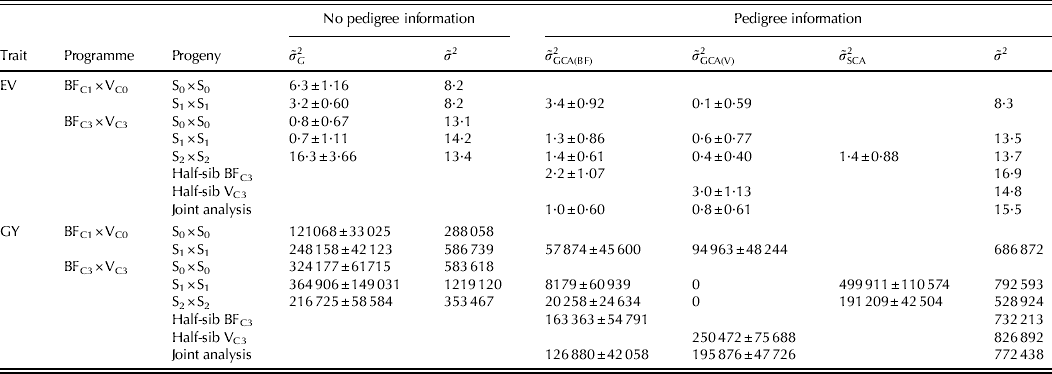
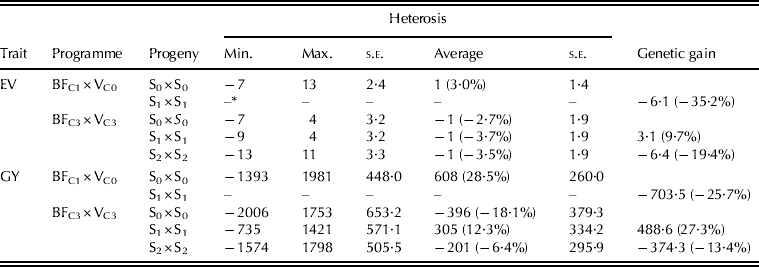
In general, for both traits and RRS programmes there was evidence of genetic variability in the parental populations (Table 1). If there is no pedigree information, only the progeny genotypic variance can be estimated. The additive and additive plus dominance models were fitted only with pedigree information and data from inbred full-sib progeny. The combined analysis of half- and non-inbred full-sib progeny did not allow the inclusion of dominance in the model. The evidence of dominance for expansion volume and grain yield is also shown by the estimates of heterosis (Table 2). The average heterosis ranged from −3·7 to 3·0% and from −18·1 to 28·5% for expansion volume and grain yield, respectively. The maximum values of average heterosis were observed for the parental populations of Programme 1 (BFC1×VC0). After the first cycle, positive average heterosis for grain yield (12·3%) occurred only with S 1×S 1 hybrids of Programme 2 (BFC3×VC3). Interpopulation genetic gain for expansion volume (9·7%) and grain yield (27·3%) was observed only in the first cycle relative to Programme 2. After the second cycle of Programme 2, a decrease in interpopulation genetic gain was observed for both traits.
Restricted maximum-likelihood estimates of the genotypic (G), general and specific combining ability and error variances, and the standard errors (s.e.) from the analyses with and without pedigree information, relative to expansion volume (EV; ml/g) and grain yield (GY; kg/ha) of progeny from two RRS programmes (BF=Beija-Flor and V=Viçosa)

Minimum, maximum and average heterosis, standard errors (s.e.) for progeny and for average heterosis and realized interpopulation genetic gain for expansion volume (EV; ml/g) and grain yield (GY; kg/ha) from two reciprocal recurrent selection programmes (BF=Beija-Flor and V=Viçosa)
* Trial without the parental populations as controls.
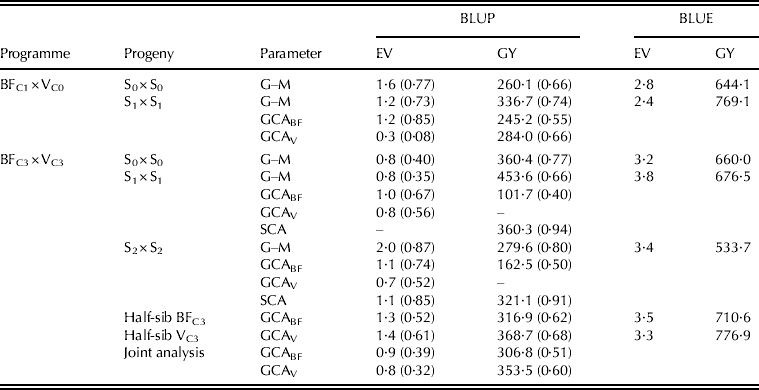
The standard error of prediction of the progeny effect was lower than the standard deviation of the BLUE estimate, even with no pedigree information, showing that BLUP analysis was superior to the BLUE approach (Table 3). For both traits, the higher accuracies of the progeny, GCA and SCA effects were observed in the S 2×S 2 test. The joint analysis of half- and non-inbred full-sib progeny did not increase the GCA prediction accuracy. The accuracy of the SCA effect was greater than the accuracy of the progeny and GCA effect. The accuracy of the GCA effect ranged from 0·52 to 0·85 for expansion volume and from 0·40 to 0·68 for grain yield.
Standard error of prediction or standard deviation and accuracy (in parenthesis) for the effects predicted by BLUP or estimated by BLUE, relative to the expansion volume (EV; ml/g) and grain yield (GY; kg/ha) of progeny from two RRS programmes (BF=Beija-Flor and V=Viçosa)*
* G–M, progeny effect; GCA and SCA, general and specific combining ability effects.
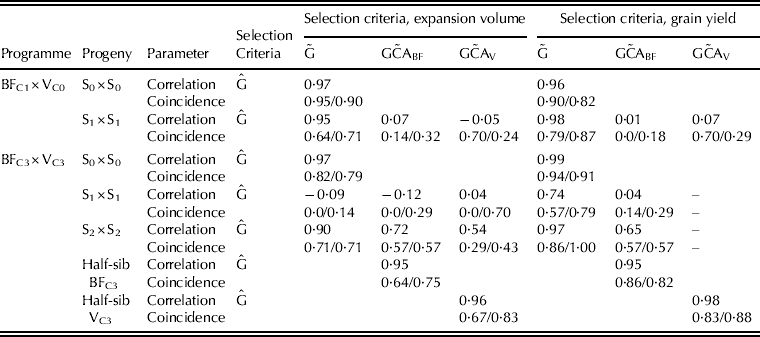
Regardless of the trait analysed and RRS programme used, the coincidences between the best S0×S0 families selected according to the progeny genotypic values obtained through BLUP or BLUE ranged from 79 to 95% (Table 4). The percentage of common Sn×Sn progeny (n⩾1) selected according to these criteria ranged from 57 to 100%, ignoring the cases of no coincidence due to absence of genetic variability (expansion volume, Programme 2, S1×S1 test). All correlations between genotypic values were, with one exception, >0·74. With half-sib families, the coincidences between selected parents were also high for both traits, ranging from 64 to 88%. The correlations ranged from 0·95 to 0·98. The best Sn (n⩾1) parents for recombination of inbred progeny based on the genotypic values of the Sn×Sn progeny estimated by BLUE analysis differed from the selected parents based on the BLUP of the GCA effects of plants from each population. According to these two selection criteria, the percentage of coincident selected parents ranged from 0 to 57%. The difference between these selection criteria is also evidenced by the lower correlations between progeny and GCA effects, which ranged from −0·05 to 0·72. The higher coincidences were associated with the lower selection intensity, equivalent to 20% of selected progeny.
Pearson's correlation between the estimated genotypic values and combining ability effects, and coincidence between selected Sn×Sn hybrids and parents according to different selection criteria and proportion of selected progeny*
*  ${\rm \hat G}$, selection based on the BLUE of the progeny genotypic value;
 ${\rm \tilde G}$, selection based on the BLUP of the progeny genotypic value;
 ${\rm G} {\rm \tilde C}{\rm A}$, selection based on the BLUP of the GCA effect of the parent (BF=Beija-Flor and V=Viçosa); coincidence for 10 and 20% of selected progeny.
DISCUSSION
In the last 63 years, some investigations based on simulations and many applied studies have shown the efficacy of RRS for the improvement of the interpopulation cross and populations. This selection procedure also determines increases in the heterosis of the populations, decreases in the inbreeding depression in the populations, population differentiation and decreases in genetic variability (Penny & Eberhart Reference Penny and Eberhart1971; Peiris & Hallauer Reference Peiris and Hallauer2005; Solomon et al. Reference Solomon, Martin and Zeppa2010; Romay et al. Reference Romay, Ordás, Revilla and Ordás2011). Until now, analyses have employed the BLUE for progeny genotypic means. Why should plant breeders change their analyses to BLUP or Bayesian inference? This question does not have an easy answer.
Several studies have compared the BLUE, BLUP and Bayesian inference methods for estimating variance components and predicting breeding values. Mathew et al. (Reference Mathew, Bauer, Koistinen, Reetz, Léon and Sillanpää2012) observed that REML estimates were as accurate as Gibbs sampling estimates for barley lines data, but the Bayesian analysis provided more accurate estimates for simulated data. Littell (Reference Littell2002) recognized the contribution of the least square methods to research in agriculture and other areas, but commented that the advantages of the residual maximum-likelihood method compared with ANOVA-based methods far exceed their disadvantages. Van Tassell & Van Vleck (Reference Van Tassell and Van Vleck1996) and Van Tassell et al. (Reference Van Tassell, Casella and Pollak1995) also verified that REML estimates were as accurate as Gibbs sampling estimates, especially for traits with high heritability. Harville & Carriquiry (Reference Harville and Carriquiry1992) commented that when the ratio between the estimates of genetic and error variances is small and datasets are either limited in extent or are highly unbalanced, the results produced by BLUP can be markedly superior to those obtained by least-squares methods.
The inclusion of pedigree information, historical data and prior knowledge about parameters of the model tends to make BLUP and Bayesian inference superior to BLUE regarding precision and accuracy of breeding values (Atkin et al. Reference Atkin, Dieters and Stringer2009; Piepho & Williams Reference Piepho and Williams2006; Piepho & Möhring Reference Piepho and Möhring2006). Forkman & Piepho (Reference Forkman and Piepho2013) compared these three methods in experiments with small number of treatments, based on simulation. The smallest root-mean-square error (RMSE) – a measure of precision of the difference between two treatment effects – was obtained with the Bayesian approach. The BLUP analysis provided consistently smaller RMSE compared with the BLUE analysis. Several experimental results have evidenced equivalence between breeding values predicted by BLUP and Bayesian analysis (Schenkel et al. Reference Schenkel, Schaeffer and Boettcher2002; Waldmann et al. Reference Waldmann, Hallander, Hoti and Sillanpää2008; Bauer et al. Reference Bauer, Reetz, Hoti, Schuh, Léon and Sillanpää2009; Mathew et al. Reference Mathew, Bauer, Koistinen, Reetz, Léon and Sillanpää2012). Furthermore, the breeding values presented the same accuracy. Harville & Carriquiry (Reference Harville and Carriquiry1992) showed that BLUP and Bayesian predictions are highly correlated when the ratio between the estimates of genetic and error variances is greater than zero. Henderson (Reference Henderson1986) commented that as covariance matrices estimated by ANOVA-based methods may be negative definite, very inaccurate predictions of breeding values can be obtained.
It should be emphasized that the success of BLUP and Bayesian inference in crop species breeding depends upon the availability of flexible software for data processing such as ASReml and Just Another Gibbs Sampler (JAGS) (Plummer Reference Plummer2012), the recognition of the advantages of these methods and the professional training to interpret results. These factors will determine the acceptance of BLUP and Bayesian inference by breeders of crop species, at least as alternative procedures for genetic evaluation or as the options for more complex models as highlighted by Blasco (Reference Blasco2001). Although Bayesian inference is still infrequently used in plant breeding (Bauer et al. Reference Bauer, Reetz, Hoti, Schuh, Léon and Sillanpää2009; Mathew et al. Reference Mathew, Bauer, Koistinen, Reetz, Léon and Sillanpää2012), genetic evaluation by BLUP has been used in recurrent selection programmes and for developing pure and inbred lines (Piepho et al. Reference Piepho, Möhring, Melchinger and Büchse2008).
In RRS programmes with inbred full-sib families (Sn×Sn, n⩾1), selection of parents for recombination of Sn+1 progeny is more efficient when based on the GCA effect compared with the average genotypic value of the family. Viana et al. (Reference Viana, Delima, Mundim, Condé and Vilarinho2013) showed increases in the intra- and interpopulation genetic gains ranging from 12 to 194%, depending on both the parental populations and the trait. Selection based on GCA, however, is only possible with BLUP or Bayesian approaches that include pedigree information. For selection of the best Sn×Sn hybrids (genotypic value-based selection) and with standard half- and full-sib RRS (no related parents), these methods are at least as efficient as BLUE.
We thank the Foundation for Research Support of Minas Gerais State (Fapemig), the Brazilian Federal Agency for Support and Evaluation of Graduate Education (Capes) and the National Council for Scientific and Technological Development (CNPq) for financial support.
Appendix