Introduction
India is one of the few countries in the world, which has contributed richly to the international livestock gene pool and improvement of animal production in the world. India possesses an enormous goat population numbering 125.46 million (FAO, 2010), which is the second highest in the world after China. As per the census report of the Department of Animal Husbandry, Dairying and Fisheries, Ministry of Agriculture, Government of India (2010), India is a rich repository of goat genetic resources having 23 well-recognized goat breeds and these breeds have evolved with respect to different geographical and climatic situation. These different breeds have specific importance in different agroclimatic zones and developed special adaptational features over the years to survive and simultaneously give sustained production under the agroclimatic conditions of their habitat. These breeds have generally been named after their place of origin and in some cases based on their prominent characteristics. Attempts have been made to characterize and register the breeds of goats in different regions, but so far only 23 breeds have been recognized, leaving about 75 percent of goat population being called as non-descript although they have certain unique characters.
Goats contribute greatly to the agrarian economy, especially in areas where crop and dairy farming are not economical, and play an important role in the livelihood of a large proportion of small and marginal farmers and landless labourers. However, intermixing of nearby breeds, introduction of exotic breeds and change in the farming system have resulted in decline in purebred population. Conservation of genetic resources in developing countries is far more complex, because, in a vast majority of the cases, information about available genetic resources, and need for and methods of conservation are not adequate. Determination of the status and characterization of indigenous goat genetic resources are essential for planning domestic animal diversity conservation plans (DAD-IS, 2010; FAO). Conservation of goat genetic resources, not only national but also an international issue, therefore, needs more attention to the present status of goat biodiversity and outlining the measures that are necessary if the goals of goat diversity conservation and self-reliance are to be combined.
Goat breeds and their distribution
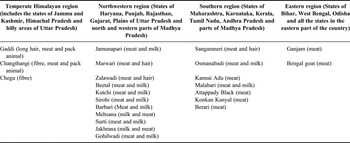
There are 351 breeds of goats in the world, out of which 23 well-recognized breeds are found in India. The number, however, varies from 20 to 29 depending upon the reports available in the published literature. The vast genetic resources of goat breeds in the country mainly constitutes about 20–25 percent of the total goat population and remaining is non-descript having mixed features. The goat breeds with varying capacities to produce meat, milk and fibre have developed in India primarily through natural selection as well as by selective breeding or cross-breeding to diversified agroclimatic conditions based on their utility and production function (Table 1).
Distribution of goat breeds along with their utility in different regions of India.

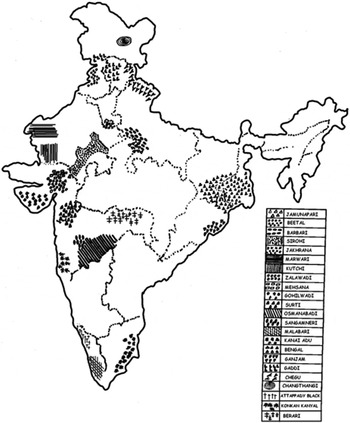
The goats are widely distributed all over the country in different agroclimatic regions (Figure 1) (2.4 percent of the total goat population in the temperate Himalayan region, 39.3 percent in the northwestern region, 32.1 percent in the eastern region and 26.2 percent in the southern region). The goat of the temperate Himalayan region grows fibres of good quality, where rainfall is low and possesses the finest quality of under coat called “Cashmere” or “Pashmina”. The goat breeds found in north and northwestern regions are reasonably large in size and primarily of dairy type. In the southern and peninsular part of the country, goats of dual utility (meat and milk) are found. The highly prolific meat breeds are found in the eastern region of the country (Bhattacharyya and Khan, Reference Bhattacharyya and Khan1988). Marwari in the western dry region of Rajasthan, Kutchi in the Gujarat plains and Black Bengal in the lower gangetic plains of West Bengal are the important goat breeds for the purpose of meat production. The Jamunapari in the upper gangetic plane, Jakhrana in the central plateau and Osmanabadi in the western plateau and hill regions have been breeds of choice for higher milk production.
Distribution of goat breeds of India.

Moreover, there is no clear demarcation of the habitat of the breeds as most of the breeds have spread to contiguous areas by various means, which encompass migration, market dictation and economic compulsion, besides natural existence beyond the political boundaries. Thus, the breed boundary is obliterated. Similarly, the population size does not reflect the true picture as there is existence of non-descript animals in very large numbers in the habitat of most of the breeds due to genetic admixture. It is observed that there is regular migration of the goats of Western Rajasthan to the adjoining states during feed and fodder scarcity. In the process, they mix with the local goats resulting in indiscriminate crossing and loss of identity of the recognized breeds. There is no Breed Registration Society in India so far to ensure breed purity in goats and to provide identity to the enlisted animals.
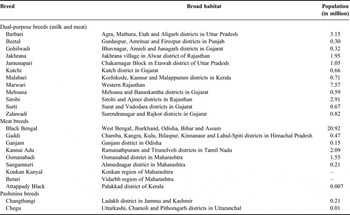
As per the census report of the Department of Animal Husbandry, Dairying and Fisheries, Ministry of Agriculture, Government of India (2010), the current population of registered goat breeds of India is depicted in Table 2. However, these figures in Table 2, differ quite widely from those submitted by India to the FAO's Domestic Animal Diversity Information System (DAD-IS) online database (dad.fao.org) and other published reports. The Jakhrana, a breed found only in the Alwar region of Eastern Rajasthan, was considered to be endangered (population 8 000 in 2004 as on the DAD-IS website). However, as per the Livestock Census 2007 Reports, its population was 1.95 million. The Jamunapari breed was also considered endangered with a population of 5 000 in 2004, as per the DAD-IS database, but according to the Livestock Census 2007 Reports, its population was 1.05 million. The extremely small number of pure-bred Jamunapari animals remaining was also confirmed by the Animal Husbandry Department of Uttar Pradesh (Ahlawat, Gupta and Kumar, Reference Ahlawat, Gupta and Kumar2009). The Barbari breed population in 1987 according to DAD-IS was about 80 000 and, according to the 2007 census, it was 3.15 million. According to a survey done by NBAGR, the Beetal goat breed population in Punjab in 1997 was 20 800 (Pundir, Reference Pundir2010), whereas the 18th Livestock Census puts it was 0.30 million. The Sangamneri breed population, according to DAD-IS, was 40–60 000 in 1995, and the 2007 census reports it to be 0.21 million. With such huge discrepancies of population figures, it is more than likely that the breeds that need urgent efforts to boost their populations will be neglected (SA PPLPP, 2012).
The habitat and population size of different goat breeds of India (Source: Official website http://dahd.nic.in/Default1.aspx).

Threatened goat breeds and its conservation
The modern goat breeds in India can be generally placed under two categories, i.e. endangered and vulnerable, although some of its wild predecessors that once existed in mountain ranges are already extinct. A breed is considered as endangered, when the effective population size is too small to prevent genetic loss through inbreeding leading to infertility and lack of survivability resulting in ultimate loss of the population (Bodo, Reference Bodo1989) According to Food and Agricultural Organization, a breed with a population size of 5 000 breeding females or less can be declared as endangered (FAO, Reference Scherf1995). On the other hand, a breed is vulnerable, when the population is rapidly declining numerically or its security is under threat (Maijala et al., Reference Maijala, Cherekaev, Devillard, Reklewski, Rognoni and Steane1984; Quartermain, Reference Quartermain1992). However, the need for conservation depends upon several factors, e.g. (i) the actual number of animals, (ii) the rate of decline in the population size, (iii) the closeness of relationship between individuals within the population, (iv) the sex ratio, (v) the geographical range and the rate of reduction of that range, (vi) special threats from introduced species, (vii) rapid changes in the environmental conditions including climate, (viii) predators, (ix) parasites, etc. (Henson, Reference Henson1992).
The recognized breeds of Indian goat population are facing a greater threat of becoming endangered due to various reasons such as lack of proper breeding policy, inadequate number of breeding bucks, indiscriminate breeding and intermixing among breeds with local animals, etc. The other factors such as dispersed home tract of goat in two or more district/states, non-availability of breed-wise figures in the Indian Livestock Census Reports, migration of flocks, higher slaughter rate of fast-growing goats and the increase of ratio of non-descript to descript animals in different parts of home tract of recognized breeds makes it difficult to assess the exact population size of particular breed to plan for their improvement in population size or to declare as endangered one. A sound conservation programme of goat breeds that are adapted to high altitude, harsh environment and marginal agricultural regions has been perpetually neglected. They have not been adequately maintained in their habitat for obtaining their maximum productivity. No attention has been given to valuable traits, such as fecundity, disease resistance, grazing habit, cheese quality, meat quality, skin characteristics, although these are crucial for the development programme of goats. Moreover, India is facing major environmental problems due to depletion in fallow land, increase in agricultural land, increase in human population, apathy for rangeland management and reservation of forests for wildlife protection, etc.
The purebred Jamunapari population has declined seriously and it is <8 500 in its habitat (Roy, Singh and Khan, Reference Roy, Singh and Khan1982) due to various reasons such as shrinkage of grazing land, inadequate veterinary help, frequent selling of goats and labourer problems, etc. Beetal goat is drawing attention for conservation as the number is declining due to changing agricultural patterns in Punjab. Barbari is facing dilution in breed characteristics due to cross-breeding with Sirohi and Jamunapari breeds in its home tract. Owing to decrease in natural browse in their habitat, Surti and Jakhrana are decreasing in number. The Changthangi breed of the Ladakh region is the subject for special concern as they are declining both in number and in performance. More weightage on improvement of some breeds and extensive use of these breeds, such as Beetal, Barbari and Jamunapari could result in the elimination of other distinctive breeds by cross-breeding. Means for the conservation, multiplication and improvement of these breeds in the pattern of Open Nucleus Breeding Scheme (ONBS) were suggested (Acharya, Misra and Patil, Reference Acharya, Misra and Patil1982). Moreover, Devendra and Burns (Reference Devendra and Burns1983) have also drawn attention for the conservation programme for specific goat populations in developing countries.
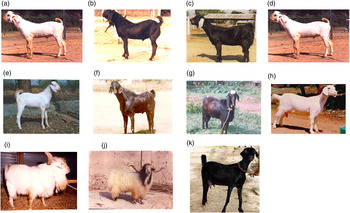
The need for conservation of distinct and well-adapted breeds has now lately been realized. It is apparent from the current population size, loss of habitat and introduction of other breeds in the area, the threatened breeds are Jamunapari, Beetal, Jakhrana and Surti in the northwestern region, Sangamneri, Osmanabadi, Malabari and Attappady Black in the southern region, Ganjam in the eastern region and Chegu and Changthangi in the temperate Himalayan region (Figure 2). The population of several breeds is more or less vulnerable except for Marwari and Black Bengal, who are at present in a rather comfortable position with respect to breed population, at large breeding tracts.
Threatened goat breeds of India (source: Roy, Roy and Mandal, Reference Roy, Roy, Mandal, Kumar, Sharma and Goel2009). (a) Jamunapari goat. (b) Beetal goat. (c) Jakhrana goat. (d) Surti goat. (e) Sangamneri goat. (f) Osmanabadi goat. (g) Ganjam goat. (h) Malabari goat. (i) Changthangi goat. (j) Chegu goat and (k) Attappady Black goat.

Necessity of conservation
The market competition created through introduction of exotic breeds, difficulties associated with low production potential of indigenous breeds and changes in the farming system have resulted in either steady decline in the number of purebred goats or dilution of the genetic material. The conservation of goat genetic resources is essential and is of paramount importance in recent times owing to their widespread destruction, overexploitation and degradation by mankind all over India. The conservation of animal genetic resources should now be a multidimensional activity, which has to encompass not only preservation and maintenance of existing breeds, but also their proper management and improvement. The overall aim is sustainable utilization, restoration and enhancement of resources so as to meet the needs of mankind for the present as well as for the future generations.
There has been awareness for conservation of natural resources with various types of flora and fauna since a long time. However, the livestock species such as goat-gained attention only recently, when it was realized that the production-oriented propagation of goat through cross-breeding and upgrading did not work in the long term and this approach is eroding the existing genetic architecture of breeds and/or genetic variability in indigenous goat germplasm. Goats are fundamental and having close bondage to most agro-ecosystems in India and it is considered as the important genetic material for each production system. This material is critical for system resilience and flexibility and enables production and productivity to be increased. Food production will only be achieved and maintained by utilizing appropriate genetic resources. The type of genetic material required to meet these challenges must be determined by the nature of the production environment, which differs greatly within zones/regions. Climatic conditions, the type and availability of feed resources, including palatability and digestibility of feeds, fodders and grasses, disease stress, level of management and the kind and quality of products required must all be taken into consideration while taking up conservation programmes.
Generally two approaches, i.e. ex situ and in situ methods of conservation may be adopted for the goat breeds in India. Generally, embryos are considered to be the best material for ex situ conservation because they store all genetic material in a single entity, which can give rise to new progeny. Sperm and embryos of goats like other farm animal species can be frozen and subsequently used to produce a normal offspring. Moreover, cryogenic storage of DNA of different goat breeds may be done as an alternative approach for conservation of goat genetic resources in India.
Phenotypic characterization
The phenotypic characterization with respect to physical appearance, body growth and body measurements of most of the goat breeds viz. Jamunapari, Barbari, Jakhrana, Marwari, Sirohi, Zalawadi, Gohilwadi, Beetal, etc. was carried out by the Central Institute for Research on Goats (CIRG), Makhdoom, Mathura under the All India Coordinated Research Project (AICRP) on Goats and also by the National Bureau of Animal Genetic Resources (NBAGR), Karnal, Haryana, India. The detailed physical characterization of different goat breeds of India has been described by Roy, Roy and Mandal (Reference Roy, Roy, Mandal, Kumar, Sharma and Goel2009).
Molecular genetic characterization
Molecular characterization of ten Indian goat breeds viz. Jamunapari, Barbari, Marwari, Sirohi, Jakhrana, Black Bengal, Pashmina, Osmanabadi, Kutchi and local goats has been completed at CIRG, Makhdoom, Mathura (Rout, Thangaraj and Mandal, Reference Rout, Thangaraj and Mandal2004a; Rout et al., Reference Rout, Joshi, Mandal, Laloe, Singh and Thangaraj2008). Furthermore, attempts are being made to characterize these goat breeds genetically based on microsatellite markers linked to fecundity rate variability (Rout, Mandal and Roy, Reference Rout, Mandal and Roy2006). Microsatellite analysis of Jamunapari, Barbari, Black Bengal, Sirohi, Jakhrana, Marwari, Kutchi and Pashmina goats was carried out using three microsatellite markers, i.e. BM4621, OarAE101 and Oar HH56, which have been reported to be linked with the fecundity rate in cattle and sheep. At BM4621 locus, Jamunapari goats showed the highest number of alleles (15 alleles) and the highest heterozygosity was observed in Black Bengal, Barbari, Jamunapari and Jakhrana goats in BM4621 locus. About 12 alleles were observed for the locus OarAE101 in all the eight goat breeds, of which Barbari and Marwari showed ten alleles each. At this locus, the highest genetic variability was observed in Barbari, Marwari and Sirohi goats. The locus OarHH56 showed a total of 14 alleles in all the analysed samples, in which Jakhrana goats showed 12 alleles and the highest genetic variability was observed in Jakhrana, Sirohi and Pashmina goats in this locus. Thus BM4621 marker exhibited the highest gene diversity in Black Bengal, Barbari and Jamunapari goats as compared with other two markers indicating the best suitable marker for fecundity traits of Indian goat breeds.
Beside this, NBAGR, Karnal, Haryana also started molecular characterization work on different Indian goat breeds using microsatellite markers (Dixit et al., Reference Dixit, Verma, Ahlawat, Aggarwal, Kumar and Singh2008, Reference Dixit, Verma, Aggarwal, Vyas, Rana, Sharma, Tyagi, Arya and Ulmek2010, Reference Dixit, Verma, Aggarwal, Vyas, Rana, Sharma and Chander2011; Kumar et al., Reference Kumar, Dixit, Verma, Singh, Pande, Chander and Singh2009; Mishra et al., Reference Mishra, Ali, Aggarwal, Dixit, Kawitkar, Dangi and Verma2012, Reference Mishra, Ali, Dixit, Aggarwal, Dangi, Tyagi, Dash and Verma2013).
Conservation measures
Ex-situ conservation
Some preliminary work on ex situ conservation of goat genetic resources has already been started at CIRG, Makhdoom, Mathura, India. The breeds covered in this programme were mainly Jamunapari and Barbari goats. Cryogenic storage of DNA of different goat breeds is also initiated by CIRG, Makhdoom, Mathura and NBAGR, Karnal, Haryana.
In situ conservation
The in situ conservation of goats has been started by the CIRG, Mathura, Uttar Pradesh, India and has brought the success to CIRG in terms of farmers' participation and breed improvement at the farmers' level. For this purpose, flocks of Jamunapari, Barbari and Jakhrana goats are being maintained at the CIRG under the scientific management system for producing and supplying superior bucks for the breed improvement programme at farmers' flocks. Beside this, breed improvement and conservation programmes of different goat breeds under field condition were launched under the AICRP on Goats by establishing several field units of different goat breeds of India (Swarup and Singh, Reference Swarup and Singh2011).
Under this in situ conservation programme, the most important Indian dairy goat breed, Jamunapari goats, received special attention. The breed improvement and conservation programme on Jamunapari goats in its home tract started functioning in 1993 in two villages of Chakarnagar block of Etawah district of Uttar Pradesh due to rapidly deteriorating state of Jamunapari goats in their home tract. The project was started with active support of farmers to restore the pride of the Jamunapari breed in its home tract. The goat population is a highly changing phenomenon due to frequent sale of animals. The selling pattern shows that the selling percentage of males has increased over the base year, whereas the sale of females has decreased. The increasing trend in body weight over the base populations observed in these two villages indicated the benefit of use of superior breeding bucks by villagers over the years. The average conception rate, kidding percentage, kidding rate and twinning percentage was 88, 77.4, 1.6 and 52.2 percent, respectively. The kidding rate and multiple birth rates are in increasing trend over the years. The multiple birth percentage had increased over the years, indicating selection of females having twin birth is preferred over single born kids. The fertility and viability are in increasing trend from the base population and the sex ratio is also maintained over the years. The effective population size has also increased from the base year and all these factors indicate that the conservation strategy is in desired direction and needs careful attention in future (Singh et al., Reference Singh, Rout, Mandal and Misra2003; Rout et al., Reference Rout, Mandal, Singh and Roy2004b).
Similarly, the other field-based units developed under AICRP on Goat Improvement programme were Rajasthan Agricultural University, Bikaner, Rajasthan; West Bengal University of Animal and Fishery Sciences, Kolkata, West Bengal; Odisha University of Agriculture and Technology, Bhubaneswar; Mahatma Phule Krishi Vidyapeeth, Rahuri, Maharashtra; Gujarat Agricultural University, Navsari, Gujarat; Livestock Research Station, Vallabhnagar, Udaipur, Rajasthan; Assam Agricultural University, Guhawati, Assam; Birsa Agricultural University, Ranchi, Jharkhand; Himachal Pradesh Krishi Viswavidyalaya, Palampur, Himachal Pradesh; Nimbkar Agricultural Research Institute, Phaltan, Maharastra; and Kerala Agricultural University, Mannuthy, Thrissur, Kerala for Marwari, Black Bengal, Ganjam, Sangamneri, Surti, Sirohi, Assam Hill, Black Bengal, Gaddi, Osmanabadi and Malabari goats, respectively (Swarup and Singh, Reference Swarup and Singh2011).
Furthermore, a programme for the conservation of the Beetal goat breed in Punjab was jointly implemented from 2005 to 2008 by the NBAGR with the Krishi Vigyan Kendra (KVK). This programme was operated by the Society for Creation of Heaven on Earth, an NGO working in Tepla, Ambala (Pundir, Reference Pundir2010). The objective of this programme was to reverse the declining trend in the population of Beetal goats since a survey conducted by NBAGR in 1997 showed the Beetal population is declining day by day. The programme was carried out in 92 farmers' flocks in 41 villages and the findings of this survey revealed that the Beetal goat rearing in Punjab is profitable and, as a result, many new farmers started rearing Beetal goats and population of this breed is now in increasing trend (Pundir, Reference Pundir2010).
Beside this, the Department of Animal Husbandry, Dairying and Fisheries, Ministry of Agriculture, GOI, had launched a programme for the conservation of threatened breeds of small ruminants (and rabbits, pigs, pack animals and equines), for which an outlay of Rs. 150 million was provided during the Tenth Plan (2002–2007). Its objective was to preserve the breeds of small ruminants, etc., which are on the verge of extinction by providing proper infrastructure and germplasm in association with State Governments and their undertakings, NGOs, professional bodies and institutes, private limited companies, etc. The Department intended to establish 18 units of small ruminants during the 10th Plan. However, funds were provided for the conservation of six goat breeds. The goat breeds were Terresa goat in the Andaman and Nicobar Islands, Malabari goat in Kerala, Sangamneri goat in Maharashtra, Black Bengal goat in Tripura and West Bengal, Jamunapari goat in Uttar Pradesh and the Long Haired goat in Nagaland. Of these, the Terresa and the Long Haired goat breeds are not registered. In the 11th Five Year Plan, Rs. 450 million was allotted for this programme. It was intended to support breeds with a declining population and an existing population of about 10 000 animals or less. Nucleus breeding units were to be supported along with strengthening of policy and institutional framework and linkages with research agencies. In the annual report of the Department for 2010–11, funding to the Government of Gujarat for a nucleus breeding unit of the Surti goat is also mentioned. However, no documented result is available on the impact of this project (SA PPLPP, 2012).
Discussion
Small ruminants play a vital role in the livelihood of small and marginal farmers, landless agricultural labourers in India. The strong association between people and goat is indicated by the fact that India ranks second in world's human as well as goat population. Goats are treated as part of rural family, sometimes particular buck and does are maintained till their death and only their offspring are sold for sustaining livelihood. Natural selection as well as selective breeding by the farmers leads to development of particular breeds, which can adapt well to a particular environment and produce well. So far, India has 23 recognized breeds of goats, but still more than 75 percent of goat population is categorized as non-descript. This is mainly due to the fact that attempts have not been made so far to characterize these populations rather than lack of any distinct characters in many of the goats. The emphasis on “breeds” in the context of conservation or improvement programmes, needs to be reconsidered. Instead of emphasizing “breed purity”, it is important to improve the existing adapted populations of various breed types in different parts of the country (SA PPLPP, 2012).
Overexploitation of a particular breed of goats for its unique character such as better meat quality leads to excessive/indiscriminate slaughter of younger ones even at early age, slaughter of breedable adults, insufficient numbers of breeding males leads to reduction in the population and possibility of becoming endangered. Flock migration, mixing up of different breeds in migratory flocks and indiscriminate cross-breeding lead to lack of uniqueness among the herd.
There is no better way to conserve an indigenous breed for future generations than to consistently keep the breed or population viable using an efficient, demand-driven, long-term breeding programme suitable to commercial and cultural needs of livestock owners (Phillipsson et al., Reference Phillipsson, Rege, Zonabend, Okeyo, Ojango, Malmfors and Okeyo2011). In situ conservation is, therefore, the most effective method of conservation, provided it is economically viable for livestock keepers. Smallholder livestock keepers should be supported to continue to maintain the breed. Well-implemented, small ruminant genetic improvement programmes delivering improved genotypes, together with other interventions such as improvements in health, nutrition and other aspects of livestock management, and establishing market linkages, have the potential to improve the income of the poorest of the poor rural households while contributing to the nation's food security.
Livestock genetic improvement programmes should be seen as investments because the effects of selection accumulate over time and will give benefits over all subsequent years without further intervention. Considering the constraints of lack of infrastructure, shortage of trained and experienced personnel, low level of literacy and awareness among livestock keepers in developing countries, even a benefit to cost ratio of 5 will make such improvement worthwhile. Small ruminant conservation and improvement programmes should, therefore, be seen as important parts of national and state policies, aimed at alleviating poverty and improving the food production of a country, region or locality and the income of livestock keepers. Funding agencies that support projects for “community development and livelihood promotion” should ensure that such projects have a livestock genetic improvement component, where appropriate. The duration of a genetic improvement programme – especially a selection programme – should be at least 10 years. At the end of 12–15 years, every effort should be made to make the programme self-sustainable. Funding and implementing agencies need to be aware that if they withdraw support half-way, the whole exercise would be meaningless. The extra investment due to the longer time period would be worthwhile because the gains due to genetic improvement are permanent and cumulative (SA PPLPP, 2012).
Steps are initiated by the Central and State Government agencies, non-governmental organizations to conserve certain breeds of goat as in situ as well as ex situ conditions. NBAGR and Central Institute of Research in Goats have made attempts in this line. Further financial support to the native rearers will help them to maintain the population without dilution.
Conclusion
The conservation of goat genetic resources in India helps maintain the uniqueness/traditional characteristics of indigenous goat breeds and biodiversity of this species. Among the various conservation approaches, the in situ conservation is the most effective method of conservation of goat genetic resources, provided it is economically viable for livestock keepers. Moreover, frozen semen and/or embryos of endangered or “at-risk” breeds should also be stored as ex situ conservation approach. Since reliable information on the actual numbers of different goat breeds in the country is not available, it is extremely difficult to identify breeds that are at the greatest risk of extinction. Mapping of well recognized/registered goat breeds and their present numbers must be undertaken urgently to identify the breeds that face the greatest risk of extinction. Furthermore, molecular genetic characterization of different breeds can also be helpful to characterize the relationships among the breeds and improvement programmes. The future of the goat in India lies in the appropriate approaches to conservation combining a number of integrally related components and effective action programmes approached holistically for successful conservation of goat genetic resources at the national level.