


%20--%3e%3c!DOCTYPE%20svg%20PUBLIC%20'-//W3C//DTD%20SVG%201.0//EN'%20'http://www.w3.org/TR/2001/REC-SVG-20010904/DTD/svg10.dtd'%3e%3csvg%20version='1.0'%20id='Layer_1'%20xmlns='http://www.w3.org/2000/svg'%20xmlns:xlink='http://www.w3.org/1999/xlink'%20x='0px'%20y='0px'%20width='64px'%20height='64px'%20viewBox='5.5%20-3.5%2064%2064'%20enable-background='new%205.5%20-3.5%2064%2064'%20xml:space='preserve'%3e%3cg%3e%3ccircle%20fill='%23FFFFFF'%20fill-opacity='0'%20cx='37.785'%20cy='28.501'%20r='28.836'/%3e%3cpath%20fill='%23595959'%20d='M37.441-3.5c8.951,0,16.572,3.125,22.857,9.372c3.008,3.009,5.295,6.448,6.857,10.314%20c1.561,3.867,2.344,7.971,2.344,12.314c0,4.381-0.773,8.486-2.314,12.313c-1.543,3.828-3.82,7.21-6.828,10.143%20c-3.123,3.085-6.666,5.448-10.629,7.086c-3.961,1.638-8.057,2.457-12.285,2.457s-8.276-0.808-12.143-2.429%20c-3.866-1.618-7.333-3.961-10.4-7.027c-3.067-3.066-5.4-6.524-7-10.372S5.5,32.767,5.5,28.5c0-4.229,0.809-8.295,2.428-12.2%20c1.619-3.905,3.972-7.4,7.057-10.486C21.08-0.394,28.565-3.5,37.441-3.5z%20M37.557,2.272c-7.314,0-13.467,2.553-18.458,7.657%20c-2.515,2.553-4.448,5.419-5.8,8.6c-1.354,3.181-2.029,6.505-2.029,9.972c0,3.429,0.675,6.734,2.029,9.913%20c1.353,3.183,3.285,6.021,5.8,8.516c2.514,2.496,5.351,4.399,8.515,5.715c3.161,1.314,6.476,1.971,9.943,1.971%20c3.428,0,6.75-0.665,9.973-1.999c3.219-1.335,6.121-3.257,8.713-5.771c4.99-4.876,7.484-10.99,7.484-18.344%20c0-3.543-0.648-6.895-1.943-10.057c-1.293-3.162-3.18-5.98-5.654-8.458C50.984,4.844,44.795,2.272,37.557,2.272z%20M37.156,23.187%20l-4.287,2.229c-0.458-0.951-1.019-1.619-1.685-2c-0.667-0.38-1.286-0.571-1.858-0.571c-2.856,0-4.286,1.885-4.286,5.657%20c0,1.714,0.362,3.084,1.085,4.113c0.724,1.029,1.791,1.544,3.201,1.544c1.867,0,3.181-0.915,3.944-2.743l3.942,2%20c-0.838,1.563-2,2.791-3.486,3.686c-1.484,0.896-3.123,1.343-4.914,1.343c-2.857,0-5.163-0.875-6.915-2.629%20c-1.752-1.752-2.628-4.19-2.628-7.313c0-3.048,0.886-5.466,2.657-7.257c1.771-1.79,4.009-2.686,6.715-2.686%20C32.604,18.558,35.441,20.101,37.156,23.187z%20M55.613,23.187l-4.229,2.229c-0.457-0.951-1.02-1.619-1.686-2%20c-0.668-0.38-1.307-0.571-1.914-0.571c-2.857,0-4.287,1.885-4.287,5.657c0,1.714,0.363,3.084,1.086,4.113%20c0.723,1.029,1.789,1.544,3.201,1.544c1.865,0,3.18-0.915,3.941-2.743l4,2c-0.875,1.563-2.057,2.791-3.541,3.686%20c-1.486,0.896-3.105,1.343-4.857,1.343c-2.896,0-5.209-0.875-6.941-2.629c-1.736-1.752-2.602-4.19-2.602-7.313%20c0-3.048,0.885-5.466,2.658-7.257c1.77-1.79,4.008-2.686,6.713-2.686C51.117,18.558,53.938,20.101,55.613,23.187z'/%3e%3c/g%3e%3c/svg%3e)
%20--%3e%3c!DOCTYPE%20svg%20PUBLIC%20'-//W3C//DTD%20SVG%201.0//EN'%20'http://www.w3.org/TR/2001/REC-SVG-20010904/DTD/svg10.dtd'%3e%3csvg%20version='1.0'%20id='Layer_1'%20xmlns='http://www.w3.org/2000/svg'%20xmlns:xlink='http://www.w3.org/1999/xlink'%20x='0px'%20y='0px'%20width='64px'%20height='64px'%20viewBox='5.5%20-3.5%2064%2064'%20enable-background='new%205.5%20-3.5%2064%2064'%20xml:space='preserve'%3e%3cg%3e%3ccircle%20fill='%23FFFFFF'%20fill-opacity='0'%20cx='37.637'%20cy='28.806'%20r='28.276'/%3e%3cg%3e%3cpath%20fill='%23595959'%20d='M37.443-3.5c8.988,0,16.57,3.085,22.742,9.257C66.393,11.967,69.5,19.548,69.5,28.5c0,8.991-3.049,16.476-9.145,22.456%20C53.879,57.319,46.242,60.5,37.443,60.5c-8.649,0-16.153-3.144-22.514-9.43C8.644,44.784,5.5,37.262,5.5,28.5%20c0-8.761,3.144-16.342,9.429-22.742C21.101-0.415,28.604-3.5,37.443-3.5z%20M37.557,2.272c-7.276,0-13.428,2.553-18.457,7.657%20c-5.22,5.334-7.829,11.525-7.829,18.572c0,7.086,2.59,13.22,7.77,18.398c5.181,5.182,11.352,7.771,18.514,7.771%20c7.123,0,13.334-2.607,18.629-7.828c5.029-4.838,7.543-10.952,7.543-18.343c0-7.276-2.553-13.465-7.656-18.571%20C50.967,4.824,44.795,2.272,37.557,2.272z%20M46.129,20.557v13.085h-3.656v15.542h-9.944V33.643h-3.656V20.557%20c0-0.572,0.2-1.057,0.599-1.457c0.401-0.399,0.887-0.6,1.457-0.6h13.144c0.533,0,1.01,0.2,1.428,0.6%20C45.918,19.5,46.129,19.986,46.129,20.557z%20M33.042,12.329c0-3.008,1.485-4.514,4.458-4.514s4.457,1.504,4.457,4.514%20c0,2.971-1.486,4.457-4.457,4.457S33.042,15.3,33.042,12.329z'/%3e%3c/g%3e%3c/g%3e%3c/svg%3e)
%20--%3e%3c!DOCTYPE%20svg%20PUBLIC%20'-//W3C//DTD%20SVG%201.0//EN'%20'http://www.w3.org/TR/2001/REC-SVG-20010904/DTD/svg10.dtd'%3e%3csvg%20version='1.0'%20id='Layer_1'%20xmlns='http://www.w3.org/2000/svg'%20xmlns:xlink='http://www.w3.org/1999/xlink'%20x='0px'%20y='0px'%20width='64px'%20height='64px'%20viewBox='5.5%20-3.5%2064%2064'%20enable-background='new%205.5%20-3.5%2064%2064'%20xml:space='preserve'%3e%3cg%3e%3ccircle%20fill='%23FFFFFF'%20fill-opacity='0'%20cx='36.924'%20cy='28.403'%20r='28.895'/%3e%3cpath%20fill='%23595959'%20d='M37.442-3.5c8.99,0,16.571,3.085,22.743,9.256C66.393,11.928,69.5,19.509,69.5,28.5c0,8.992-3.048,16.476-9.145,22.458%20C53.88,57.32,46.241,60.5,37.442,60.5c-8.686,0-16.19-3.162-22.513-9.485C8.644,44.728,5.5,37.225,5.5,28.5%20c0-8.762,3.144-16.343,9.429-22.743C21.1-0.414,28.604-3.5,37.442-3.5z%20M12.7,19.872c-0.952,2.628-1.429,5.505-1.429,8.629%20c0,7.086,2.59,13.22,7.77,18.4c5.219,5.144,11.391,7.715,18.514,7.715c7.201,0,13.409-2.608,18.63-7.829%20c1.867-1.79,3.332-3.657,4.398-5.602l-12.056-5.371c-0.421,2.02-1.439,3.667-3.057,4.942c-1.622,1.276-3.535,2.011-5.744,2.2%20v4.915h-3.714v-4.915c-3.543-0.036-6.782-1.312-9.714-3.827l4.4-4.457c2.094,1.942,4.476,2.913,7.143,2.913%20c1.104,0,2.048-0.246,2.83-0.743c0.78-0.494,1.172-1.312,1.172-2.457c0-0.801-0.287-1.448-0.858-1.943l-3.085-1.315l-3.771-1.715%20l-5.086-2.229L12.7,19.872z%20M37.557,2.214c-7.276,0-13.428,2.571-18.457,7.714c-1.258,1.258-2.439,2.686-3.543,4.287L27.786,19.7%20c0.533-1.676,1.542-3.019,3.029-4.028c1.484-1.009,3.218-1.571,5.2-1.686V9.071h3.715v4.915c2.934,0.153,5.6,1.143,8,2.971%20l-4.172,4.286c-1.793-1.257-3.619-1.885-5.486-1.885c-0.991,0-1.876,0.191-2.656,0.571c-0.781,0.381-1.172,1.029-1.172,1.943%20c0,0.267,0.095,0.533,0.285,0.8l4.057,1.83l2.8,1.257l5.144,2.285l16.397,7.314c0.535-2.248,0.801-4.533,0.801-6.857%20c0-7.353-2.552-13.543-7.656-18.573C51.005,4.785,44.831,2.214,37.557,2.214z'/%3e%3c/g%3e%3c/svg%3e)
%20--%3e%3c!DOCTYPE%20svg%20PUBLIC%20'-//W3C//DTD%20SVG%201.0//EN'%20'http://www.w3.org/TR/2001/REC-SVG-20010904/DTD/svg10.dtd'%3e%3csvg%20version='1.0'%20id='Layer_1'%20xmlns='http://www.w3.org/2000/svg'%20xmlns:xlink='http://www.w3.org/1999/xlink'%20x='0px'%20y='0px'%20width='64px'%20height='64px'%20viewBox='5.5%20-3.5%2064%2064'%20enable-background='new%205.5%20-3.5%2064%2064'%20xml:space='preserve'%3e%3cg%3e%3ccircle%20fill='%23FFFFFF'%20fill-opacity='0'%20cx='36.944'%20cy='28.631'%20r='29.105'/%3e%3cg%3e%3cpath%20fill='%23595959'%20d='M37.443-3.5c8.951,0,16.531,3.105,22.742,9.315C66.393,11.987,69.5,19.548,69.5,28.5c0,8.954-3.049,16.457-9.145,22.514%20C53.918,57.338,46.279,60.5,37.443,60.5c-8.649,0-16.153-3.143-22.514-9.429C8.644,44.786,5.5,37.264,5.5,28.501%20c0-8.723,3.144-16.285,9.429-22.685C21.138-0.395,28.643-3.5,37.443-3.5z%20M37.557,2.272c-7.276,0-13.428,2.572-18.457,7.715%20c-5.22,5.296-7.829,11.467-7.829,18.513c0,7.125,2.59,13.257,7.77,18.4c5.181,5.182,11.352,7.771,18.514,7.771%20c7.123,0,13.334-2.609,18.629-7.828c5.029-4.876,7.543-10.99,7.543-18.343c0-7.313-2.553-13.485-7.656-18.513%20C51.004,4.842,44.832,2.272,37.557,2.272z%20M23.271,23.985c0.609-3.924,2.189-6.962,4.742-9.114%20c2.552-2.152,5.656-3.228,9.314-3.228c5.027,0,9.029,1.62,12,4.856c2.971,3.238,4.457,7.391,4.457,12.457%20c0,4.915-1.543,9-4.627,12.256c-3.088,3.256-7.086,4.886-12.002,4.886c-3.619,0-6.743-1.085-9.371-3.257%20c-2.629-2.172-4.209-5.257-4.743-9.257H31.1c0.19,3.886,2.533,5.829,7.029,5.829c2.246,0,4.057-0.972,5.428-2.914%20c1.373-1.942,2.059-4.534,2.059-7.771c0-3.391-0.629-5.971-1.885-7.743c-1.258-1.771-3.066-2.657-5.43-2.657%20c-4.268,0-6.667,1.885-7.2,5.656h2.343l-6.342,6.343l-6.343-6.343L23.271,23.985L23.271,23.985z'/%3e%3c/g%3e%3c/g%3e%3c/svg%3e)
Introduction
Carbapenems are regarded as last-resort antibiotics for treating severe infections caused by multidrug-resistant (MDR) bacteria. As β-lactam agents, they inhibit bacterial cell-wall synthesis; the main agents are meropenem, ertapenem, doripenem, and imipenem. Reference Nicolau1
The emergence and rapid dissemination of carbapenem-resistant Enterobacterales (CRE; formerly Enterobacteriaceae) has become a major global public health concern. Reference Hussein, Raz-Pasteur and Finkelstein2,Reference Jacob, Klein and Laxminarayan3 Enterobacterales constitute a diverse order of gram-negative bacilli, the most prevalent being Klebsiella pneumoniae and Escherichia coli. Reference Potter, D’Souza and Dantas4 The World Health Organization has reaffirmed the classification of CRE, alongside carbapenem-resistant Acinetobacter baumannii and carbapenem-resistant Pseudomonas aeruginosa, as critical-priority pathogens in its 2024 Bacterial Priority Pathogens List, 29 requiring urgent development of new antibiotics. Globally, antimicrobial resistance is estimated to contribute to approximately 700,000 deaths annually. Reference Willyard5
Enterobacterales are responsible for a broad spectrum of severe infections, including bloodstream, respiratory, urinary tract, and intra-abdominal infections. Reference Lee, Lai and Chiang6–Reference Rodríguez-Baño, Gutiérrez-Gutiérrez, Machuca and Pascual8 Within Saudi Arabia specifically, few clinical studies have characterized the outcomes of CRE infections. One local study reported that four of nine patients with CRE infections died from refractory septic shock. Reference Alotaibi, Bukhari, Al-Mohizea, Hafiz, Essa and AlTokhais9 Similarly, Garbati et al reported a mortality rate of 31% among 29 patients with CRE infections, compared with 12.1% in a matched control group, and identified advanced age, comorbidities, prior carbapenem exposure, ICU admission, and mechanical ventilation as risk factors associated with higher mortality. Reference Garbati, Sakkijha and Abushaheen10
The Clinical and Laboratory Standards Institute (CLSI) defines Enterobacterales as carbapenem-resistant when they exhibit minimum inhibitory concentrations (MICs) of ≥4 μg/mL against doripenem, meropenem, or imipenem, and ≥2 μg/mL against ertapenem. 30 Resistance mechanisms include carbapenemase production, efflux-pump mutations, and porin alterations coupled with extended-spectrum β-lactamase (ESBL) activity. Reference Potter, D’Souza and Dantas4 Limited therapeutic options contribute to mortality rates reaching 44%, with Klebsiella pneumoniae identified as a principal pathogen. Reference Alotaibi, Bukhari, Al-Mohizea, Hafiz, Essa and AlTokhais9,Reference Falagas, Tansarli, Karageorgopoulos and Vardakas11
Current treatment strategies for CRE infections have historically relied on high-dose regimens of colistin and tigecycline, Reference Bassetti, Peghin, Vena and Giacobbe12 although resistance to these agents is increasing. Aminoglycosides and fosfomycin are also used as adjunctive options. Reference Tseng, Wang and Ma7,Reference Rodríguez-Baño, Gutiérrez-Gutiérrez, Machuca and Pascual8 More recently, international guidance, including the 2024 Infectious Diseases Society of America (IDSA) guidance, has prioritized newer β-lactam/β-lactamase inhibitor combinations such as ceftazidime–avibactam, together with plazomicin, cefiderocol, and eravacycline. Reference Tseng, Wang and Ma7,Reference Sheu, Chang, Lin, Chen and Hsueh13,Reference Eljaaly, Alharbi, Alshehri, Ortwine and Pogue14,Reference Tamma, Heil, Justo, Mathers, Satlin and Bonomo31 Additional agents include meropenem–vaborbactam, imipenem–relebactam, and aztreonam–avibactam; the last is approved in the United States for metallo-β-lactamase–producing isolates. Access to several newer agents remains limited in many Saudi centers, where colistin- and carbapenem-based regimens are still widely used. Reference Rodríguez-Baño, Gutiérrez-Gutiérrez, Machuca and Pascual8,Reference Tamma, Heil, Justo, Mathers, Satlin and Bonomo31
Factors contributing to the increasing prevalence of carbapenem resistance include international travel, inappropriate antibiotic prescribing, inadequate infection control practices, and the horizontal transfer of mobile genetic elements. Reference Swaminathan, Sharma and Blash15,Reference Xu, Gu and Huang16 CRE infections have been increasing across Saudi Arabia, representing a growing threat to public health. Reference Alshehri and Irekeola17 In the Saudi context, CRE are predominantly carbapenemase-producing, with blaOXA-48 and blaNDM reported as the most frequent carbapenemase genes. Reference Alraddadi, Heaphy and Aljishi32 The aim of this study was to evaluate the mortality and clinical outcomes associated with CRE infections among adults receiving care at Ministry of National Guard-Health Affairs facilities in Jeddah and Riyadh, Saudi Arabia, and to compare the effectiveness of monotherapy versus combination antibiotic therapy.
Methods
Study design
This was a multicenter retrospective cohort study using existing electronic medical records.
Study setting
The study was conducted across Ministry of National Guard-Health Affairs facilities, including King Abdulaziz Medical City (KAMC) in both Jeddah and Riyadh. Data were also obtained from King Abdullah International Medical Research Center (KAIMRC). The study period spanned five years, from January 2020 to December 2024.
Study population
Adults aged 18 years and older with microbiologically confirmed CRE infections were eligible for inclusion. Patients with incomplete medical records or those who did not receive treatment at KAMC facilities were excluded from the analysis.
Microbiological methods and case definitions
Identification and antimicrobial susceptibility testing were performed in each site’s accredited clinical microbiology laboratory as part of routine care, using automated systems (VITEK 2, bioMérieux; and/or BD Phoenix) interpreted according to contemporaneous CLSI breakpoints. 30 An isolate was classified as carbapenem-resistant when non-susceptible to at least one carbapenem (ertapenem, meropenem, imipenem, or doripenem). 30 Resistance was defined phenotypically; genotypic carbapenemase testing was not routinely performed, so mechanism-level data were unavailable. Only the first CRE isolate per patient was analyzed, and duplicates were excluded. CRE infection, as distinct from colonization, required isolation of a CRE organism from a clinical specimen together with signs and symptoms of infection and initiation of directed therapy; surveillance or screening isolates without clinical infection were not counted.
Sample size
Using the Raosoft calculator at a 95% confidence level and 5% margin of error, informed by a regional CRE prevalence report, Reference Taha, Mowallad and Mufti18 the estimated minimum was 377 participants. As this target could not be reached, all eligible patients meeting the inclusion criteria were enrolled, yielding a final sample of 224 patients.
Data collection
Under the supervision of the principal investigator, data were extracted from the BESTCare 2.0 electronic medical record system at MNGHA facilities in Jeddah and Riyadh using a standardized, secure Excel data collection instrument. Variables collected included demographic characteristics (age, gender), comorbidities, previous antibiotic use, initial antibiotic regimens prescribed, use of combination therapy, clinical cure at discharge, length of hospital stay, mortality, culture source, and causative organism.
The following operational definitions were applied. Previous antibiotic use denoted documented systemic antibiotic exposure during the current admission before the index culture. Combination therapy was the concurrent use of two or more agents with expected or documented in vitro activity against gram-negative organisms for at least 48 hours after the index culture; monotherapy denoted a single active agent, and purely empirical coverage before culture results was not counted. Clinical cure at discharge required resolution of the signs and symptoms of the index infection, completion of the intended course, and survival to discharge. Mortality was all-cause in-hospital mortality. When several specimens were positive, the source was assigned to the primary clinical site documented by the treating team, with secondary bloodstream isolates classified as bloodstream infections.
Data analysis
Statistical analyses were performed using IBM SPSS Statistics (Version 27.0) and Python (scipy, scikit-learn).
Descriptive statistics were used to summarize sociodemographic and clinical characteristics. Categorical variables were reported as frequencies and percentages. Continuous variables were assessed for normality using the Shapiro–Wilk test; as both age and length of hospitalization demonstrated non-normal distributions, they were reported as medians with interquartile ranges (IQR).
Bivariate analyses were performed to compare patient characteristics and outcomes between monotherapy and combination therapy groups. The Pearson χ2 test was applied for categorical variables, while the Mann–Whitney test was used for continuous variables given their non-normal distributions.
Multivariate analysis was conducted using binary logistic regression to identify independent predictors of mortality while controlling for potential confounders. The dependent variable was overall mortality. Independent covariates included age, gender, treatment regimen, and the presence of comorbidities including hypertension, diabetes mellitus, heart failure, arrhythmia, solid tumors, and hematologic malignant tumor. Adjusted odds ratios with 95% confidence intervals were reported, and model fit was assessed using the Nagelkerke R2.
Survival analysis used the Kaplan–Meier method, with survival time measured from the index CRE culture to in-hospital death or discharge and survival distributions compared by the log-rank (Mantel–Cox) test. An exploratory subgroup analysis stratified by solid-tumor status assessed whether the treatment–mortality association differed in immunocompromised patients; given the small strata, it was regarded as hypothesis-generating.
Ethical approval
This study was approved by the Institutional Review Board at King Abdullah International Medical Research Center (approval number: NRJ25-009/3). As a retrospective study involving de-identified data, the requirement for individual patient consent was waived. Patient confidentiality was maintained throughout data collection, analysis, and reporting in accordance with the Declaration of Helsinki.
Results
Sociodemographic and clinical characteristics
A total of 224 patients with microbiologically confirmed CRE infections were included in the study. The cohort was predominantly male (n = 140, 62.5%), with a median age of 70 years (IQR = 20.2). The detailed demographic and clinical characteristics of the study population are presented in Table 1.
Sociodemographic and clinical characteristics of patients with carbapenem-resistant Enterobacteriaceae infections (N = 224)

Table 1. Long description
The table presents the sociodemographic and clinical characteristics of 224 patients with carbapenem-resistant Enterobacteriaceae infections. It includes 13 rows and 4 columns. The columns are labeled Characteristic, Category, N, and %. The table is divided into several sections: Age, Gender, Comorbidities, Treatment regimen, Clinical cure, Mortality, Hospital stay, Causative organism, and Infection source. Each section lists specific categories with corresponding values for N and %. For example, under Age, the median age is 70 with an IQR of 20.2. Under Gender, there are 84 females (37.5%) and 140 males (62.5%). Comorbidities include conditions like Hypertension (140 patients, 62.5%), Diabetes Mellitus (130 patients, 58.0%), and others. Treatment regimen shows 45 patients (21.5%) underwent Monotherapy and 164 (78.5%) had Combination therapy. Clinical cure rates are 119 cured (53.1%) and 105 failed (46.9%). Mortality data shows 127 patients survived (56.7%) and 97 died (43.3%). The median hospital stay is 35 days with an IQR of 59.5. The causative organism is predominantly Klebsiella pneumoniae (215 patients, 96.0%). Infection sources include Urinary tract (77 patients, 34.4%), Respiratory Tract (60 patients, 26.8%), and others.
¹Treatment regimen was unknown for 15 patients. Percentages for treatment regimen are calculated from patients with documented treatment (N = 209).
IQR, interquartile range.
The study population exhibited a high burden of chronic comorbidities. Hypertension was the most prevalent condition (n = 140, 62.5%), followed by diabetes mellitus (n = 130, 58.0%) and renal disease (n = 51, 22.8%). Cardiovascular complications were common, with heart disease identified in 33 patients (14.7%) and stroke in 34 patients (15.2%). Notably, 12.5% of patients had solid tumors, and 4.5% had hematologic malignant tumors, indicating that a substantial proportion of the cohort was immunocompromised.
Klebsiella pneumoniae was the dominant causative organism, accounting for 215 of 224 isolates (96.0%), followed by Escherichia coli (n = 8, 3.6%) and Enterobacter cloacae (n = 1, 0.4%). The most common infection sources were urinary tract (n = 77, 34.4%), respiratory tract (n = 60, 26.8%), and bloodstream (n = 38, 17.0%).
Regarding treatment, most patients received combination therapy (n = 164, 78.5% of those with documented regimens), while 45 patients (21.5%) received monotherapy. Treatment information was unavailable for 15 patients. The overall mortality rate was 43.3% (n = 97), and among the 127 patients who survived to discharge, clinical cure was achieved in 119 (93.7%). The median length of hospital stay was 35 days (IQR = 59.5).
Mortality by infection source
Mortality rates varied significantly by infection source. Respiratory infections were associated with the highest mortality (58.3%), followed by bloodstream infections (55.3%), wound and tissue infections (37.1%), urinary tract infections (29.9%), and abdominal or fluid infections (16.7%).
Bivariate analysis of treatment effectiveness
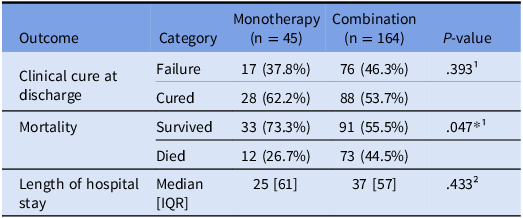
Bivariate analyses comparing clinical outcomes between monotherapy and combination therapy groups are summarized in Table 2. No statistically significant difference was observed in clinical cure rates between monotherapy (62.2%) and combination therapy (53.7%) (P = .393). However, a statistically significant difference in mortality was identified: patients receiving combination therapy had a mortality rate of 44.5%, compared with 26.7% among those receiving monotherapy (P = .047).
Bivariate analysis of treatment effectiveness according to clinical cure, mortality, and length of hospital stay (N = 209)

Table 2. Long description
The table presents a bivariate analysis of treatment effectiveness according to clinical cure, mortality, and length of hospital stay. It has four rows and three columns. The columns are labeled Monotherapy (n = 45), Combination (n = 164), and P-value. The rows are grouped under three outcomes: Clinical cure at discharge, Mortality, and Length of hospital stay. Each outcome has subcategories. For Clinical cure at discharge, the subcategories are Failure and Cured. For Mortality, the subcategories are Survived and Died. For Length of hospital stay, the subcategory is Median [IQR]. The values in the table are as follows: Row 1: Failure, 17 (37.8 percent), 76 (46.3 percent), 0.393; Row 2: Cured, 28 (62.2 percent), 88 (53.7 percent), 0.393; Row 3: Survived, 33 (73.3 percent), 91 (55.5 percent), 0.047; Row 4: Died, 12 (26.7 percent), 73 (44.5 percent), 0.047; Row 5: Median [IQR], 25 [61], 37 [57], 0.433.
¹Pearson chi-square test; ² Mann–Whitney U test.
*Statistically significant (P < .05).Values are presented as n (%) unless otherwise stated.
IQR, interquartile range.
Length of stay and mortality
The median length of hospital stay for non-survivors was 44 days (IQR = 64), compared with 30 days (IQR = 46) for survivors. Although non-survivors tended to have longer hospital stays, this difference did not reach statistical significance (P = .068).
Multivariate logistic regression
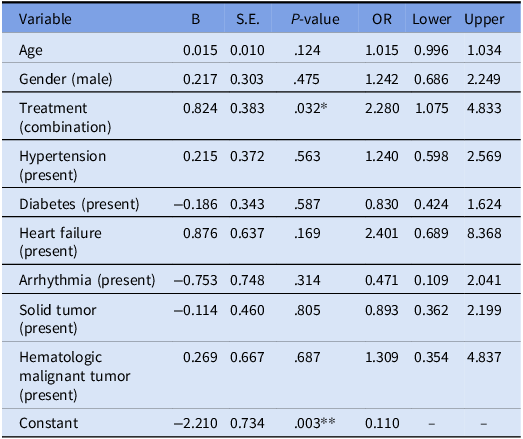
To evaluate the independent effect of treatment regimen on mortality while controlling for potential confounders, a binary logistic regression analysis was performed. The model included age, gender, treatment regimen, and key comorbidities as covariates. The results are presented in Table 3.
Multivariate binary logistic regression predicting mortality among patients with CRE infections (N = 209)

Table 3. Long description
A table with multivariate binary logistic regression results predicting mortality among patients with CRE infections. The table has 11 rows and 7 columns. The columns are labeled Variable, B, S E, P value, OR, Lower, and Upper. The rows list different variables and their corresponding values. Row 1: Variable, Age; B, 0.015; S E, 0.010; P value, .124; OR, 1.015; Lower, 0.996; Upper, 1.034. Row 2: Variable, Gender (male); B, 0.217; S E, 0.303; P value, .475; OR, 1.242; Lower, 0.686; Upper, 2.249. Row 3: Variable, Treatment (combination); B, 0.824; S E, 0.383; P value, .032*; OR, 2.280; Lower, 1.075; Upper, 4.833. Row 4: Variable, Hypertension (present); B, 0.215; S E, 0.372; P value, .563; OR, 1.240; Lower, 0.598; Upper, 2.569. Row 5: Variable, Diabetes (present); B, -0.186; S E, 0.343; P value, .587; OR, 0.830; Lower, 0.424; Upper, 1.624. Row 6: Variable, Heart failure (present); B, 0.876; S E, 0.637; P value, .169; OR, 2.401; Lower, 0.689; Upper, 8.368. Row 7: Variable, Arrhythmia (present); B, -0.753; S E, 0.748; P value, .314; OR, 0.471; Lower, 0.109; Upper, 2.041. Row 8: Variable, Solid tumor (present); B, -0.114; S E, 0.460; P value, .805; OR, 0.893; Lower, 0.362; Upper, 2.199. Row 9: Variable, Hematologic malignant tumor (present); B, 0.269; S E, 0.667; P value, .687; OR, 1.309; Lower, 0.354; Upper, 4.837. Row 10: Variable, Constant; B, -2.210; S E, 0.734; P value, .003**; OR, 0.110; Lower, –; Upper, –.
Dependent variable: Mortality (Died = 1, Survived = 0).
Nagelkerke R² = 0.074. Model chi-square = 11.777, P = .226.
* Statistically significant (P < .05); ** P < .01.
OR, odds ratio; CI, confidence interval; S.E., standard error; B, regression coefficient.
Reference categories: Female (gender), Monotherapy (treatment), Absent (all comorbidities).
After adjustment for covariates, combination therapy remained independently associated with increased odds of mortality (adjusted OR = 2.28, 95% CI: 1.08–4.83, P = .032). No other covariate—age, gender, or the assessed comorbidities—was a significant predictor (all P > .12; Table 3). The Nagelkerke R2 was 0.074, indicating that the model explained a limited proportion of the variance in mortality, suggesting that unmeasured factors contribute substantially to patient outcomes.
Subgroup analysis: impact of solid tumors
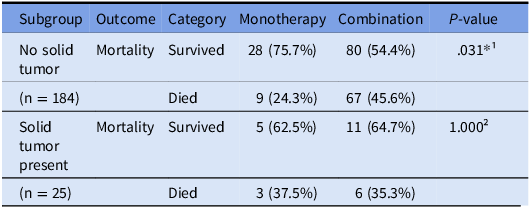
In an exploratory analysis, a stratified analysis was conducted to evaluate the relationship between treatment regimen and mortality based on the presence or absence of solid tumors (Table 4, Figure 1).
Subgroup analysis of mortality by treatment regimen stratified by solid-tumor status. Among patients without solid tumors, combination therapy was associated with significantly higher unadjusted mortality than monotherapy (45.6% vs 24.3%; Pearson χ2 test, P = .031). Among patients with solid tumors, no significant difference in mortality was observed between monotherapy (37.5%) and combination therapy (35.3%; Fisher’s exact test, P = 1.000). The number of patients in each subgroup is indicated above each bar. These findings suggest that underlying malignant tumor may attenuate any treatment-specific effect on mortality.

Subgroup analysis of mortality by treatment regimen stratified by solid-tumor status

Table 4. Long description
The table presents a subgroup analysis of mortality outcomes based on treatment regimen and the presence or absence of solid tumors. It has four rows and five columns. The columns are labeled Subgroup, Outcome, Category, Monotherapy, Combination, and P-value. The rows are labeled with specific subgroups and outcomes. For the subgroup with no solid tumor, 28 individuals (75.7 percent) survived with monotherapy, and 80 individuals (54.4 percent) survived with combination therapy. 9 individuals (24.3 percent) died with monotherapy, and 67 individuals (45.6 percent) died with combination therapy. The P-value for this subgroup is 0.031. For the subgroup with solid tumors present, 5 individuals (62.5 percent) survived with monotherapy, and 11 individuals (64.7 percent) survived with combination therapy. 3 individuals (37.5 percent) died with monotherapy, and 6 individuals (35.3 percent) died with combination therapy. The P-value for this subgroup is 1.000.
¹Pearson chi-square test; ²Fisher’s exact test.
*Statistically significant (P < .05).
Values are presented as n (%). Monotherapy: No Solid Tumor n = 37, Solid Tumor n = 8; Combination: No Solid Tumor n = 147, Solid Tumor n = 17.
Among patients without solid tumors, a statistically significant association was observed between treatment regimen and mortality (P = .031). Within this subgroup, the mortality rate was higher among patients receiving combination therapy (45.6%) than among those receiving monotherapy (24.3%). Among patients with solid tumors, no significant difference in mortality was observed between treatment groups (monotherapy 37.5% vs combination therapy 35.3%; P = 1.000, Fisher’s exact test).
Survival analysis
Kaplan–Meier analysis compared overall survival between the monotherapy and combination therapy groups (Figure 2). The monotherapy group had a longer restricted mean survival time (159.0 d; median survival 111 d) compared with the combination therapy group (149.9 d; median survival 79 d). However, the log-rank (Mantel–Cox) test indicated no statistically significant difference between the survival curves (χ2 = 2.413, P = .120).
Kaplan–Meier survival curves comparing overall survival between monotherapy (n = 45; blue) and combination therapy (n = 164; red) groups. Shaded areas represent 95% confidence intervals, and vertical tick marks denote censored observations (patients who survived to discharge). The monotherapy group had a longer restricted mean survival time (159.0 d; median survival 111 d) compared with the combination therapy group (149.9 d; median survival 79 d). The log-rank (Mantel–Cox) test indicated no statistically significant difference in survival distributions between the two groups (χ2 = 2.413, P = .120), suggesting that the timing of death events did not differ significantly between treatment groups over the follow-up period. The number-at-risk table is displayed below the curve.

Discussion
Disease burden and clinical characteristics
This multicenter study provides important insights into the burden and outcomes of CRE infections among adults in Saudi Arabia. Our findings confirm that CRE infections are associated with substantial mortality, with an overall rate of 43.3%, consistent with global estimates ranging from 30% to 80%, with higher rates typically observed in bloodstream infections. Reference Baek, Kim and Park19 The predominance of Klebsiella pneumoniae (96.0%) in our cohort mirrors regional surveillance data identifying this organism as the leading cause of CRE infections in Saudi Arabia, with blaOXA-48 and blaNDM as the most common carbapenemase genes. Reference Zakai20,Reference Alraddadi, Heaphy and Aljishi32
The high burden of comorbidities, particularly hypertension (62.5%) and diabetes mellitus (58.0%), is consistent with the known epidemiology of CRE infections in elderly, medically complex populations. Reference Alraddadi, Heaphy and Aljishi32 The substantial proportion of immunocompromised patients (12.5% with solid tumors, 4.5% with hematologic malignant tumors) adds further complexity, as immunocompromised patients face elevated mortality following CRE infection, with malignant tumor identified as an independent predictor of poor outcomes in gram-negative bacteremia. Reference Al-Hasan, Juhn, Bang, Yang and Baddour21
The variation in mortality rates by infection source is clinically relevant. Respiratory infections (58.3% mortality) and bloodstream infections (55.3% mortality) carried the highest mortality burden, consistent with the known virulence and systemic impact of these infection types. Reference Falagas, Tansarli, Karageorgopoulos and Vardakas11,Reference Baek, Kim and Park19 Urinary tract infections, the most common source in our cohort, had a relatively lower mortality rate (29.9%), likely reflecting less systemic involvement. These findings highlight the importance of early and aggressive management of respiratory and bloodstream CRE infections.
Treatment effectiveness and confounding by indication
A central finding of this study is that combination therapy was associated with higher mortality than monotherapy, both in unadjusted bivariate analysis (44.5% vs 26.7%, P = .047) and after multivariate adjustment (adjusted OR = 2.28, 95% CI: 1.08–4.83, P = .032). This warrants cautious interpretation given possible confounding by indication.
In clinical practice, physicians may preferentially select combination therapy for patients with more severe presentations, such as septic shock, multi-organ dysfunction, or high-risk comorbidity profiles. Reference Lai, Ma and Zhang23 Because this study was not designed or powered to measure disease severity, that prescribing pattern could not be verified in our data. Confounding by indication is a recognized limitation of observational treatment comparisons, and several unmeasured variables—prior CRE colonization or infection, other immunocompromised states, antibiotic exposure in the preceding 60 days, the choice of empirical agents, the time to active therapy, and source control—may have differed between groups and could contribute to the observed association.
The low Nagelkerke R2 of 0.074 is consistent with this interpretation, indicating that the model captured only a small proportion of the variance in mortality and that important prognostic factors—such as the Pitt bacteremia score Reference Durmaz and Coşkun22,Reference Henderson, Luterbach and Cober27 and other severity measures—were unmeasured.
These observations are consistent with broader challenges in the CRE treatment literature. Some observational and meta-analytic data suggest that combination therapy may improve outcomes when disease severity is adequately accounted for, Reference Wang, Wang and Cao24 whereas the randomized OVERCOME trial found no significant 28-day mortality benefit for colistin–meropenem over colistin monotherapy, with possible benefit in selected subgroups. Reference Kaye, Marchaim and Thamlikitkul25 Such discrepancies underscore the impact of confounding by indication and disease severity.
The Kaplan–Meier analysis is consistent with this interpretation: although the monotherapy group had a numerically longer mean survival time than the combination therapy group, the log-rank test showed no significant difference in survival distributions (P = .120), indicating that the timing of death was similar between groups. This pattern is compatible with baseline patient severity, rather than treatment regimen, being an important determinant of outcome, although it cannot be confirmed without severity data. Reference Henderson, Luterbach and Cober27
Impact of solid tumors on treatment response
In the exploratory subgroup analysis, among patients without solid tumors, combination therapy was associated with significantly higher unadjusted mortality (P = .031), a pattern again compatible with confounding by indication, although disease severity was not measured. In contrast, among patients with solid tumors, no significant difference in mortality was observed between treatment groups (P = 1.000), suggesting that the underlying malignant tumor and associated immunosuppression may attenuate any treatment-specific difference in outcome.
Immunocompromised patients, including solid-organ transplant recipients and those with malignant tumor, are well documented to be at increased risk of mortality from CRE infections, with elevated case -fatality rates reported for CRE bloodstream infections. Reference Anesi, Lautenbach and Thom26,Reference Alraddadi, Heaphy and Almaghrabi33 Malignant tumor-related immunosuppression may diminish the incremental benefit of any specific regimen, implying that management of immunocompromised patients should prioritize comprehensive supportive care alongside antimicrobial therapy.
Although hematologic malignant tumor did not reach statistical significance as an independent predictor of mortality in our multivariate analysis (P = .687), this likely reflects the small number of affected patients (n = 10) and limited power. Prior studies have identified hematologic malignant tumors as significant risk factors for CRE-associated mortality, Reference Bar-Yoseph, Cohen and Korytny28 and larger immunocompromised subgroups are needed to clarify this relationship.
Study limitations
Several limitations of this study should be acknowledged. First, the sample size of 224 patients, while representing all eligible patients at the study sites, was below the calculated minimum of 377, potentially limiting statistical power and contributing to wide confidence intervals for some estimates. Second, the absence of a control group with carbapenem-susceptible Enterobacterales precludes direct comparison of outcomes attributable to resistance. Third, the retrospective design introduces inherent limitations related to the completeness and accuracy of medical record data. Fourth, and perhaps most importantly, several determinants of outcome were not captured—standardized disease-severity and sepsis scores (eg, Pitt bacteremia, APACHE II, SOFA), prior CRE colonization or infection, other immunocompromised states, antibiotic exposure in the preceding 60 days, empirical agent selection, time to active therapy, and source control—so residual confounding by indication cannot be excluded. Fifth, genotypic carbapenemase characterization was not performed, precluding analysis of resistance mechanisms (eg, blaOXA-48 vs blaNDM). Finally, dosing, duration, in vitro activity of individual regimens, and adverse effects were not systematically collected, and the exploratory subgroup analysis by solid-tumor status was underpowered and hypothesis-generating.
Conclusion
This multicenter study demonstrates that CRE infections carry a substantial mortality burden among adults in Saudi Arabia, with an overall mortality rate of 43.3%. Klebsiella pneumoniae was the dominant causative organism, and respiratory and bloodstream infections were associated with the highest mortality rates. The finding that combination therapy was associated with higher mortality than monotherapy may, at least in part, reflect confounding by indication and unmeasured differences in baseline disease severity.
Based on these findings, future investigations should employ prospective designs incorporating standardized disease-severity scoring (eg, the Pitt bacteremia score and SOFA) to enable more rigorous treatment comparisons. Active surveillance for CRE colonization in high-risk populations, including patients with malignant tumors and transplant recipients, should be strengthened to enable earlier intervention. Antimicrobial stewardship should continue to optimize regimen selection while minimizing unnecessary broad-spectrum exposure. Finally, individualized treatment is essential, particularly for immunocompromised patients in whom underlying disease may dominate outcomes regardless of the regimen selected.
Data availability statement
The data sets generated and analyzed during the current study are available from the corresponding author on reasonable request.
Author contribution
All authors contributed to the study conception and design. Data collection was performed by all authors. Data analysis and interpretation were performed by all authors. The first draft of the manuscript was prepared by the first author, and all authors commented on earlier versions. All authors read and approved the final manuscript.
Financial support
The authors received no specific grant from any funding agency in the public, commercial, or not-for-profit sectors.
Competing interests
The authors declare no conflicts of interest.
Ethical standard
Approved by the Institutional Review Board at King Abdullah International Medical Research Center (NRJ25-009/3).
Declaration of generative AI and AI-assisted technologies in the manuscript preparation process
During the preparation of this work, the authors used Claude to improve sentence structure and readability. After using this tool/service, the authors reviewed and edited the content as needed and take full responsibility for the content of the published article.




 Open access

