Introduction
The loss of frugivorous vertebrates leads to disrupted seed dispersal in numerous tropical fleshy-fruited species, among which large-seeded trees are particularly vulnerable (Albert et al. Reference Albert, Flores and Strasberg2020b; Effiom et al. Reference Effiom, Nunez-Iturri, Smith, Ottosson and Olsson2013; Harrison et al. Reference Harrison, Tan, Plotkin and Davies2013; Terborgh et al. Reference Terborgh, Nuñez-Iturri, Pitman and Paine2008; Trolliet et al. Reference Trolliet, Bauman, Forget, Doucet, Gillet and Hambuckers2019; Vanthomme et al. Reference Vanthomme, Bellé and Forget2010). In turn, this disruption primarily leads to the inability of seeds to move away from mother trees and to the persistence of flesh around seeds because the reward is no longer consumed by frugivorous vertebrates. When both phenomena occur together, unconsumed fruits accumulate at the foot of parent trees where recruitment failure is often observed in tropical forests (see for example Plate 1 in Terborgh et al. Reference Terborgh, Nuñez-Iturri, Pitman and Paine2008). To explain the recruitment failure of many tree species that lost dispersal, Janzen–Connell effects have long been put forward as the central mechanism (Comita et al. Reference Comita, Queenborough, Murphy and Zhu2014; Connell Reference Connell1971; Hansen et al. Reference Hansen, Kaiser and Müller2008; Janzen Reference Janzen1970; Terborgh Reference Terborgh2012). However, the large meta-analysis of Rogers et al. (Reference Rogers, Cavazos, Gawel, Karnish, Ray, Rose, Thierry and Fricke2021 PREPRINT) has recently suggested that the absence of seed cleaning alone may have large demographic consequences on fleshy-fruited plant populations at all latitudes, on continents as well as on islands. Several field experiments have shown that flesh persistence strongly decreases the recruitment of fleshy-fruited trees independently of other mechanisms (Fedriani et al. Reference Fedriani, Zywiec and Delibes2012; Levi & Peres Reference Levi and Peres2013). Levi and Peres (Reference Levi and Peres2013) even suggested that Janzen–Connell effects are a second-order effect acting in numerous tropical plant species once seeds have been successfully cleaned. Apart from these works, field studies investigating the mechanisms involved in recruitment failure as a result of frugivore loss remain scarce to our knowledge.
Flesh persistence may lead to non-innate dormancy, which is the quiescence of seeds that are prevented from germinating only by the unfavourable environment within fleshy fruits (Baskin & Baskin Reference Baskin and Baskin2004). In other words, the loss of frugivores can theoretically lead to the dormancy of all seeds of certain fleshy-fruited species. Non-innate dormancy may be induced by germination inhibitors (chemical dormancy), low water potential and/or mechanical resistance within the pericarp (or other fleshy appendage such as aril) (Baskin & Baskin Reference Baskin and Baskin2004). Non-innate dormancy may be very problematic for numerous tropical rainforest trees that often show fast germination and possess recalcitrant seeds, i.e. that have a high moisture content and easily lose their viability because of low tolerance to dehydration (Vazquez-Yanes & Orozco-Segovia Reference Vazquez-Yanes and Orozco-Segovia1993). Thus, delaying germination beyond a critical threshold of dryness would lead to lower recruitment for recalcitrant species whose regeneration depends more on seedling stocks in the forest understory than on seeds persisting in soil banks (Hopkins & Graham Reference Hopkins and Graham2006). Finally, although most studies have focused on the role of seed coat scarification (Barnea et al. Reference Barnea, Yom-Tov and Friedman1991; Soltani et al. Reference Soltani, Baskin, Baskin, Heshmati and Mirfazeli2018; Traveset Reference Traveset1998) or even fantasized obligatory plant/seed-coat scarificator interactions (see the criticism of Temple [Reference Temple1977] in Baider & Florens [Reference Baider and Florens2006] for the iconic case of the dodo and the tambalacoque tree for instance), non-innate dormancy due to flesh persistence alone may be a major handicap for a large number of fleshy-fruited tree species (Rogers et al. Reference Rogers, Cavazos, Gawel, Karnish, Ray, Rose, Thierry and Fricke2021 PREPRINT).
A fleshy pericarp primarily rewards frugivores that will help disperse the plant seeds (Eriksson et al. Reference Eriksson, Friis and Löfgren2000; Rick & Bowman Reference Rick and Bowman1961; van der Pijl Reference van der Pijl1982). Although it may protect seeds by deterring seed-eating insects (Silvius & Fragoso Reference Silvius and Fragoso2002), its pervasive persistence due to frugivore loss can also entice natural enemies (Hansen et al. Reference Hansen, Kaiser and Müller2008; Levi & Peres Reference Levi and Peres2013; Wyse Jackson et al. Reference Wyse Jackson, Cronk and Parnell1988). In Sapotaceae for instance, fungal pathogens may be an important cause of germination failure (Levi & Peres Reference Levi and Peres2013; Wyse Jackson et al. Reference Wyse Jackson, Cronk and Parnell1988). The latter studies, however, do not disentangle whether fungi become pathogenic to seeds that have become dormant due to flesh persistence or whether they merely degrade seeds that are no longer viable. The persistence of flesh may similarly attract seed predators such as rodents in continental tropical forests (Levi & Peres Reference Levi and Peres2013), but also in island forests where they have been introduced and have become invasive since human colonisation (Hansen et al. Reference Hansen, Kaiser and Müller2008; Shiels & Drake Reference Shiels and Drake2011). For example, in Mauritius, Hansen et al. (Reference Hansen, Kaiser and Müller2008) report that ship rats are only interested in diaspores of Syzygium mamillatum (Myrtaceae) when seeds have not been hand-cleaned.
Here, we ran a field experiment to test whether flesh persistence decreases the recruitment of seedlings in tropical rainforests on Réunion (Mascarenes). Réunion is a relevant study system of frugivore loss since this oceanic island lost all its native large-bodied frugivores, jeopardising the regeneration of lowland forests (Albert et al. Reference Albert, Flores and Strasberg2020b, Reference Albert, Flores, Baider, Florens and Strasberg2021). To test the impact of flesh persistence, we studied two large-seeded fleshy-fruited tree species, Labourdonnaisia calophylloides Bojer and Mimusops balata (Aubl.) C.F. Gaertn (Sapotaceae), that lost their native dispersal agents (namely giant tortoises, fruit pigeons, flying-foxes and parrots) in less than two centuries of human colonisation (Albert, Reference Albert2020). The experiment was realised in the absence of conspecific trees nearby, to avoid possible Janzen–Connell effects. Because seeds should normally be dispersed in different spatio-temporal contexts, we tested the effect of seed cleaning under two canopy closure levels and two years apart. Finally, we monitored the interactions with introduced animals, particularly ship rats Rattus rattus and giant snails Lissachatina immaculata known for their potential negative impact on fruits, seeds or seedlings (Bissessur et al. Reference Bissessur, Baider and Florens2020; Meyer & Shiels Reference Meyer and Shiels2009; Shiels & Drake Reference Shiels and Drake2011).
Study site and focal species
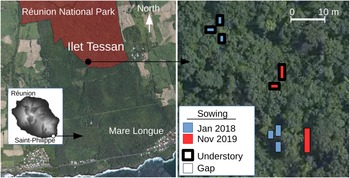
Located 750 km East of Madagascar and 230 km West-West-South of Mauritius, Réunion is the largest (2512 km2) and highest (3070 m) island of the Mascarenes. The study site was located in the South-East of Réunion on the wet windward side at Mare Longue (mean annual precipitation: ca 4300 mm, Réchou et al. Reference Réchou, Flores, Jumeaux and Bonnardot2019) which, at the ecozone scale, hosts one of the last corridors of native forest from the coastal area to the subalpine shrubland (Figure 1). The lowland tropical rainforest of Mare Longue mainly grows on a recent pāhoehoe lava flow (age = ca 430 years old) displaying a very thin soil on continuous rock (Meunier et al. Reference Meunier, Kirman, Strasberg, Nicolini, Delcher and Keller2010), which probably explains why this area has not been converted to agriculture (Albert et al. Reference Albert, Flores, Michon and Strasberg2020a). Although fairly recent, the native plant community assembly at Mare Longue occurred before the beginning of human colonisation and the rapid extirpation of all large native frugivores (Albert et al. Reference Albert, Flores and Strasberg2020b). With more than 40 tree species per ha and trees exceeding 20 m in height, this lowland forest is thus one of the best preserved in the Mascarenes (Cadet Reference Cadet1977; Strasberg Reference Strasberg1996). At low elevation, the forest corridor is composed of sixty-eight hectares of pristine native forest that were early protected in a national nature reserve in the 1980s and are now part of a larger national park. The pristine forest fragments are embedded in a matrix of secondary forest, quite heterogeneous regarding vegetation types, with native species-rich habitats alternating with plantations of native trees and invaded areas.
Study site. The forest corridor of Mare Longue, municipality of Saint-Philippe, is the most preserved corridor of native forests from sea level to high elevations (>2200 m asl) in the Mascarenes. The field experiment is located at Ilet Tessan around 150 m asl, at the edge of the Réunion National Park. In order to adapt to rugged terrain on a recent pāhoehoe lava flow, quadrats of varying size were delineated for each of the four sowing areas (combination of factors ‘date of sowing’ & ‘canopy closure’). In each sowing area and for both focal species, Labourdonnaisia calophylloides and Mimusops balata, ‘hand cleaning of seeds’ and ‘flesh persistence’ modalities were replicated 12 times at a rate of 20 seeds per modality. For a detailed view of the sowing, please report to Appendix 1.

Our field experiment took place at Ilet Tessan (Figure 1) with no conspecific mother trees nearby and therefore minimal influence of exogenous seeds and natural enemies of focal trees. We also chose sowing areas to avoid temporary streams that occur during heavy rain events and could strongly impact the distribution of seeds and fruits within the experimental design. Sowing areas were a maximum of 50 m apart. Understory situations initially showed a shrub stratum dominated by Syzygium jambos (Myrtaceae), a highly invasive species on Réunion (Macdonald et al. Reference Macdonald, Thébaud, Strahm and Strasberg1991). Sowing areas in canopy gaps were invaded mostly by the exotic shrub Clidemia hirta (Melastomataceae) (Mandon-Dalger et al. Reference Mandon-Dalger, Clergeau, Tassin, Rivière and Gatti2004). Both invasive species were uprooted before sowing and controlled all along the experiment.
The focal species are large-seeded (mean seed diameter of 12 mm in L. calophylloides and 24 mm in M. balata) and typical species of the Sapotaceae family that grow as long-lived shade-tolerant trees in mature tropical rainforests (Levi & Peres Reference Levi and Peres2013; Mahandran et al. Reference Mahandran, Murugan, Marimuthu and Nathan2018). These trees are often dominant in native lowland canopies and not threatened like other large-seeded Sapotaceae in the Mascarenes (Baider & Florens Reference Baider and Florens2006; Cadet Reference Cadet1977; Strasberg Reference Strasberg1996), despite their incapacity to recolonize the vast areas of historical lava flows due to frugivore loss (Albert et al. Reference Albert, Flores and Strasberg2020b). Both species have been massively planted by the French National Office in the area of Saint-Philippe. In old-growth forests, L. calophylloides sometimes regenerates very well and produces dense seedling banks, but the situation is often much more contrasted for M. balata (Albert et al. Reference Albert, Flores, Baider, Florens and Strasberg2021). Thus, if our field experiment were to show a strong negative impact of flesh persistence on tree recruitment, corroborating the work of Levi & Peres (Reference Levi and Peres2013), it is that other factors favour the recruitment of these two focal species in tropical rainforest despite the loss of all large native frugivores on Réunion.
Methods
Experimental design
We collected freshly fallen ripe fruits of L. calophylloides and of M. balata at the foot of parent trees in the forest of Mare Longue in late December 2017 and November 2019. For each species, we hand-cleaned 500 seeds and kept an equivalent number of seeds within intact fruits: 500 fruits for the single-seeded L. calophylloides and for M. balata, 168 fruits in January 2018 (mean of 2,9 seeds per fruit) and 250 fruits in November 2019 (mean of 2 seeds per fruit). By hand-cleaning, we mean removing the whole pericarp and rinsing the seeds to remove residual debris, without scarification. This task was particularly tedious for L. calophylloides whose latex-rich pericarp must be extracted with warm water. Fruits and seeds were stored in a cold room for three weeks maximum before sowing.
Ex situ tests
To test whether there was an intrinsic limitation prior to the field experiment, we hand-cleaned 500 additional seeds in January 2018 and realised viability and germination tests. We used the colorimetric test of tetrazolium chloride (0,1 % i.e. 0,1 g of powder/100 mL of filtered water), which leads to a carmine red colouration of the living embryos after six hours of soaking (Porter et al. Reference Porter, Durrel and Romm1947). We performed five repetitions on 20 seeds for each viability test. Seeds of L. calophylloides and M. balata showed a viability of, respectively, 93% ±2,7 sd and 86% ±4,2 sd. These results indicated that seeds used for the experiment showed a very high viability rate.
Field experiment
The effect of seed cleaning vs flesh persistence was tested under two levels of canopy closure, resulting in four combinations with 12 repetitions per combination. At the rate of 20 seeds per repetition, we thus sowed a total of 3840 seeds: 960 seeds for each species both in January 2018 and in November 2019. The experimental design was materialised with wire mesh on the ground, each repetition being represented as a 0,4 × 0,4 m quadrat (Supplementary material, Appendix 1).
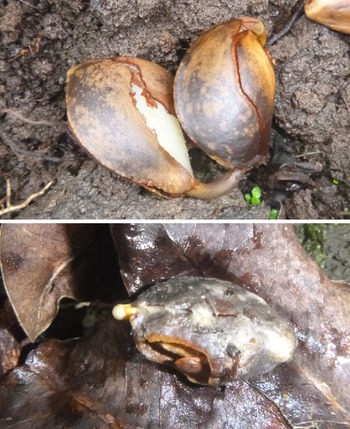
Rigorous evaluation of germination in this experiment was not possible because early stages of root development could not be observed when it took place within the fruit (Figure 2). We monitored seedling recruitment by counting the number of rooted seedlings after emergence. Réunion was subject to several tropical depressions during the first months of the experiment in 2018 (Berguitta and Dumazile cyclones in January and March 2018, respectively), we therefore monitored the number of fruits and seeds after cyclones, which was made possible thanks to the large size of focal species seeds (Figure 2 & Appendix 1). These cyclones had no impact on the experimental design.
Germination of Mimusops balata (above) and Labourdonnaisia calophylloides (below), photo taken five weeks after sowing. Here, i.e. ‘hand-cleaning of seeds’ modality, germination can be seen, but in the case of ‘flesh persistence’, only the emergence of seedlings from the fruit can be properly assessed. Photos: A. Gorissen

Seed and fruit predation by R. rattus has already been reported for Sapotaceae seeds in the Mascarenes (Baider & Florens, Reference Baider and Florens2006; Eric Rivière, pers. comm.), that is why we took into account the potential impact of this introduced species. Due to the difficulty in setting up predator exclosures on rough substrates like those at Ilet Tessan (Appendix 2), we monitored seed removal by counting the number of seeds and fruits in each replicate repeatedly during six months after sowing. We also used two Bushnell Trophy Cam HD to monitor potential seed and fruit predators from January 2018 to January 2020. These digital camera traps were set up in the understory about 1,5 metre from sown seeds and fruits and set to operate day and night with movement triggers.
After sowing in January 2018, temporal monitoring of seedling emergence was carried out approximately every 15 days for 8 months, then once a month thereafter. For the second sowing in November 2019, monitoring of seedling emergence could only be performed once, 6,5 months after sowing due to logistic restrictions, that is, when almost all seedling emergences had occurred.
Statistical analyses
Seedling recruitment was calculated as the proportion of emerged/rooted seedlings relative to the number of unremoved or unpredated seeds (data set available as Supplementary material II). We modelled seedling recruitment depending on four categorical variables with two levels: seed treatment (hand cleaning versus flesh persistence), canopy closure (canopy gap versus understory), date of sowing (January 2018 versus November 2019) and species (L. calophylloides versus M. balata) using a binomial generalised linear model (GLM) with a logit link. We tested all possible models with four explicative variables as well as their two-way interactions and eventually retained the model that displayed the lowest AIC.
Results
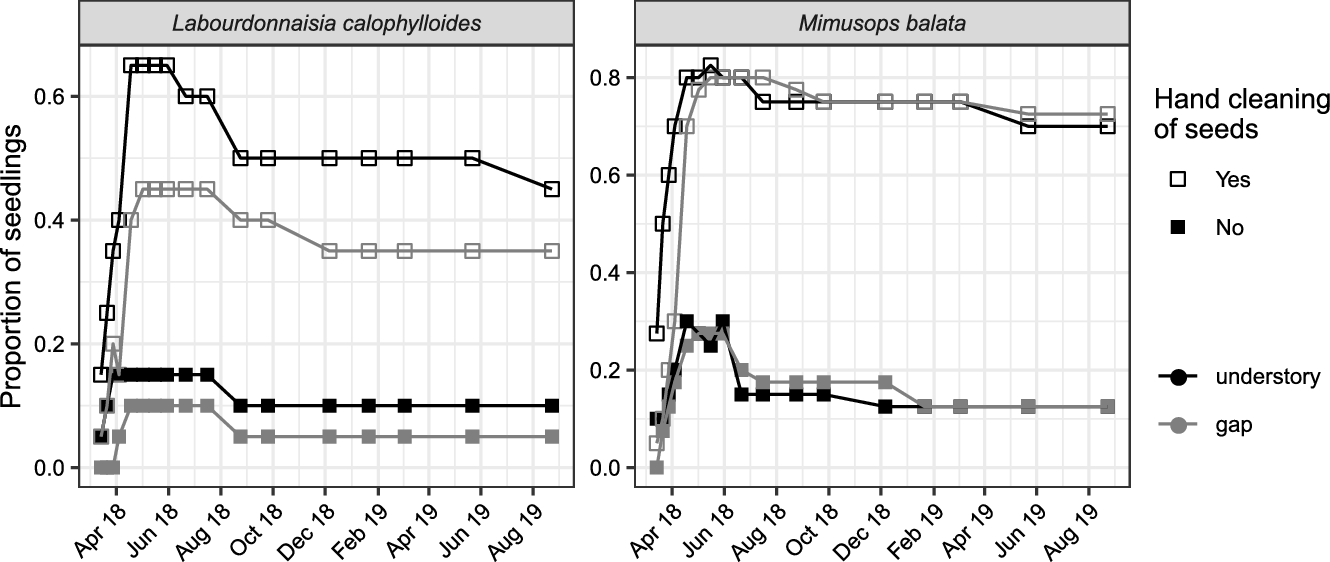
Temporal monitoring confirmed the emergence of seedlings as soon as two months after sowing in January 2018 (Figure 3). Emergence was especially frequent in hand-cleaned seeds for which median proportions peaked in May 2018. Field observations showed that the emergence of all seedlings occurred within the first six months after sowing. Seedling survival was relatively high afterwards despite an unusual drought event that struck the area between December 2018 and April 2019. Seedling recruitment subsequent to the two sowing periods was compared at 6.5 months.
Temporal monitoring of seedling recruitment of Labourdonnaisia calophylloides and Mimusops balata after the first sowing in January 2018. Seedling recruitment is calculated as the proportion of emerged/rooted seedlings relative to the number of unremoved or unpredated seeds. For each date, squares display the median values. Full and empty squares display ‘flesh persistence’ and ‘hand cleaning of seeds’ modalities, respectively; black and grey squares display ‘understory’ and ‘canopy gap’ modalities, respectively.

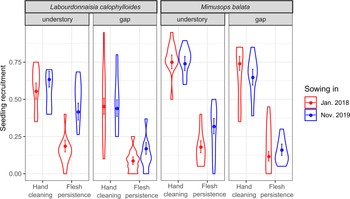
The best fitted GLM included the four factors (‘seed treatment’, ‘canopy closure’, ‘date of sowing’, ‘species’) with all possible two-way interactions (pseudo-R²glm = 0,697, Appendix 3). Seed treatment was by far the best predictors (Appendix 4), flesh persistence having a strong negative impact on estimated seedling recruitment (/3,2, Figure 4). Field observations showed that uncleaned seeds of L. calophylloides often remained trapped within the persisting pericarp (Appendix 5). Likewise, germination of uncleaned seeds often occurred in M. balata, but seedlings had difficulties rooting in the soil due to the thickness of the exocarp. Also the first roots remained exposed to open air after flesh disappearance (Appendix 6). The instability of the exocarp that generally persisted after the disappearance of the mesocarp often resulted in tilting movements of seedlings (Appendix 6). The positive impact of hand cleaning of seeds was stronger in the first year of the experiment, as illustrated by the highly significant interaction between both factors (Figure 4 & Appendix 4). In the second year, the effect of hand cleaning was mitigated in the understory where Lissachatina immaculata fed heavily on fruits of focal species (especially L. calophylloides, Appendices 7 & 8), but it remained strong in the canopy gap where few Lissachatina immaculata were observed. Over the two years of the experiment, M. balata showed overall higher estimated recruitment than L. calophylloides (0,46 versus 0,37) and a stronger positive effect of hand cleaning of seeds (× 3,7 versus × 2,4) resulting in higher recruitment rates for M. balata (0,72) than for L. calophylloides (0,52) (Figure 4). Finally, M. balata showed a higher recruitment than L. calophylloides in the canopy gaps.
Seedling recruitment of Labourdonnaisia calophylloides and Mimusops balata 6,5 months after sowing. Seedling recruitment is calculated as the proportion of emerged seedlings relative to the number of unremoved or unpredated seeds. Violin plots show raw data; points and error bars display mean values and confidence intervals predicted by the best-fitting GLM, respectively.

In 2018, we did not detect any noticeable impact of introduced vertebrates in terms of fruit or seed removal of focal species. The same year, however, observations by camera traps showed high levels of fruit or seed removal by R. rattus on other native tree species at Ilet Tessan (Appendix 7). In November 2019, 22 fruits of L. calophylloides and four seeds of M. balata were removed and predated by R. rattus, respectively. Likewise, although snails were seen eating the flesh of focal species in January 2018, the phenomenon was much more frequent in November 2019, and the giant snail Lissachatina immaculata sometimes performed very effective seed cleaning especially in the understory (for details on the other animals monitored at Ilet Tessan, see Appendix 7).
Discussion
Most studies exploring the consequences of frugivore loss on tree recruitment focused on the Janzen–Connell hypothesis (Comita et al. Reference Comita, Queenborough, Murphy and Zhu2014; Hansen et al. Reference Hansen, Kaiser and Müller2008; Terborgh Reference Terborgh2012; Terborgh et al. Reference Terborgh, Nuñez-Iturri, Pitman and Paine2008). In contrast, few field studies have investigated the impact of pervasive flesh persistence around seeds that results from the non-consumption of fruits after frugivores have been extirpated. The present field experiment confirms that flesh persistence may be a primary cause of recruitment loss of the two focal large-seeded Sapotaceae trees (L. calophylloides and M. balata). Our results corroborate other field studies in the Neotropics (Levi & Peres Reference Levi and Peres2013) and in the mediterranean area (Fedriani et al. Reference Fedriani, Zywiec and Delibes2012) and are also in accordance with numerous studies carried out under controlled conditions (Traveset Reference Traveset1998, Rogers et al. Reference Rogers, Cavazos, Gawel, Karnish, Ray, Rose, Thierry and Fricke2021 PREPRINT). Together, this demonstrates that the negative impact of flesh persistence has probably been underestimated to date. This also shows that the fleshy reward that has been selected to effectively disperse large seeds in a highly competitive environment (Eriksson et al. Reference Eriksson, Friis and Löfgren2000; but see Silvius & Fragoso Reference Silvius and Fragoso2002) may alone become a major handicap for large-seeded plants when mutualist partners are extirpated. Lastly, our study shows significant inter-annual fluctuations in recruitment resulting from the complex role played by invasive animals, which emphasises the difficulty of understanding the consequences of native frugivore extinction in island ecosystems with novel plant–animal interactions (Meyer & Shiels Reference Meyer and Shiels2009; Shiels & Drake Reference Shiels and Drake2011; Vizentin-Bugoni et al. Reference Vizentin-Bugoni, Tarwater, Foster and Sperry2019).
Mechanisms by which flesh persistence may strongly limit recruitment
Several mechanisms may be involved in the negative effect of flesh persistence on tree recruitment. We distinguish here between those which act before and after germination. Before germination, our results suggest that flesh persistence induces a non-innate dormancy in focal species (Baskin & Baskin Reference Baskin and Baskin2004). Indeed, the hardness of the exocarp, especially in M. balata (Appendix 6) and the presence of hydrophobic compounds in the latex-rich flesh of focal species (Appendix 5), might lead to a decrease in water level, preventing the induction of germination. Likewise, germination might be directly prevented by chemical dormancy or inhibited by mechanical resistance whatever the water potential (Baskin & Baskin Reference Baskin and Baskin2004). Germination failure might also be due to the action of pathogenic microorganisms, as suggested by Wyse Jackson et al. (Reference Wyse Jackson, Cronk and Parnell1988) and noted by Levi and Peres (Reference Levi and Peres2013) in the same botanical family. Further investigation is needed to unravel the mechanisms at this stage. After germination, we show that flesh persistence may limit the survival of seedlings. The hardness of the exocarp results in a major handicap for many seedlings because the root system not only has difficulty crossing the exocarp but also tends to develop in the flesh (Appendix 6). The roots of many seedlings thus remain in the open air once the flesh has disappeared. These seedlings are subsequently poorly anchored and vulnerable to biotic and abiotic hazards in the understory. As simple as this may seem, we did not find any studies documenting this type of recruitment limitation.
The negative impact on recruitment and the relative commonness of focal species: a paradox?
Focal species have been chosen also because they produce a large amount of fruit almost every year. Although these species have not been able to recolonize historical lava flows of the Piton de la Fournaise due to strong dispersal limitation (Albert et al. Reference Albert, Flores and Strasberg2020b), they reach high levels of recruitment locally in old-growth forests, especially L. calophylloides which is dominant at all stages of growth in permanent plots in Mare Longue forest for instance (Albert et al. Reference Albert, Flores, Baider, Florens and Strasberg2021; Strasberg Reference Strasberg1996). We suspect that the local dominance of L. calophylloides might be due to the recruitment failure of other large-fleshy-fruited canopy species leading to lower alpha-diversity and community evenness (Albert et al. Reference Albert, Flores, Baider, Florens and Strasberg2021). Given the strong recruitment limitation induced by flesh persistence in our experiment, then how to explain such a paradox? First of all, emergence rates of about 10% without seed cleaning might be enough to sustain populations where tree fecundity is high. Second, as an alternative (or complementary) hypothesis, the ability of several introduced animals to modulate the recruitment in our experiment suggests that focal species may have benefited from novel and complex interactions since the extirpation of native frugivores, as discussed hereafter and documented elsewhere (Loayza et al. Reference Loayza, Luna and Calviño-Cancela2020; Shiels & Drake Reference Shiels and Drake2011).
At Ilet Tessan, invasive giant snails Lissachatina immaculata usually known for their negative impact on native plants on islands (Tillier Reference Tillier1992) can partially support the recruitment of L. calophylloides by cleaning numerous seeds (Appendix 8). While the role of giant snails should not be overestimated because they do not have the capacity to move away large seeds from mother trees, they are usually seen feeding on large fleshy fruits of other tree species and might consequently favour their recruitment in the understory of old-growth forests. Also their impact on seedlings as herbivores might outweigh the benefits of seed cleaning, although we did not observe any browsing during our experiment.
R. rattus actually plays an ambivalent role as seed predator and secondary disperser (Shiels & Drake Reference Shiels and Drake2011). In our case, fruits and seeds of focal species were not attractive in 2018, unlike some other fleshy-fruited plants such as Hyophorbe indica the same year (Appendix 7). In November 2019, rats undeniably destroyed some seeds of M. balata as already shown for other large-seeded plants on Réunion (Albert Reference Albert2020), but behaved mainly as secondary dispersers of L. calophylloides. Doing so, one might argue that they significantly contribute to the recruitment of this tree. However, R. rattus is probably a poor disperser because fruits are usually stored in trees and seeds remain in the flesh of wasted fruits (Sébastien Albert, pers. obs.).
Poachers have been hunting birds with lime sticks charged with glue made from the latex of focal species (Cheke Reference Cheke and Diamond1987). Field observations show numerous seedlings of L. calophylloides near areas where poachers remove the flesh from fruits in old-growth forests. Until recently, this type of poaching was a widely practised tradition (Cheke Reference Cheke and Diamond1987), so poachers might have dispersed numerous seeds of this focal species for centuries.
Regarding the other focal species, M. balata, the situation is more contrasted in terms of sapling recruitment. For example, this species does not regenerate well in the two best-preserved permanent plots where large mother trees are encountered (Albert et al. Reference Albert, Flores, Baider, Florens and Strasberg2021; Strasberg Reference Strasberg1996). One may argue that this species is more light demanding than L. calophylloides which ultimately explains this lack of recruitment (Debroize Reference Debroize2003). Although the present experiment shows that this species also regenerates very well in the understory once the seeds have been hand cleaned, more time may be needed to detect seedling/sapling dieback in the understory. Since M. balata has the largest fruit in the native flora, the loss of native frugivores may have led to its pervasive inability to reach gaps where light conditions are favourable. Ongoing field experiments on Réunion should provide information in the coming years.
Lastly, our field experiment shows that large-seeded trees can reach high recruitment rates in previously weeded areas notwithstanding the hyperskelitic soil (Appendix 2). If these recalcitrant species are quickly sown, seedling recruitment rates in the field can be as high as germination rates in ex situ nursery reported by Debroize (Reference Debroize2003). Thus, combining invasive species control with direct sowing is relevant for considering restoration actions in the long term (Appendix 9), especially since native tree species that are still dispersed will probably benefit from alien plant weeding (Baider & Florens Reference Baider and Florens2011).
Supplementary material
To view supplementary material for this article, please visit https://doi.org/10.1017/S026646742200027X
Acknowledgements
We would like to thank Jean-Noël Eric Rivière and Cédric Leperlier who conducted tests of viability. We thank the following people for field assistance: Alexis Gorissen, Raphaël Solesse, Arnaud Rhumeur, Sohan Sauroy-Toucouère and Charlène Albert. Special thanks to Solène Irion for proofreading the draft. The Reunion National Park and the French National Office (ONF) provided permits for site access in protected areas. Logistic support was provided by CIRAD and the field station of Mare Longue, funded by the P.O.E., Reunion National Park and OSU Reunion. This research was financed by Région Réunion and FEDER through FEDER 1.16 ECOFORRUN.
Conflicts of interest
The authors declare none.