Introduction
In December 1942, the German writer Jochen Klepper met the SS leader Adolf Eichmann at 8 Prinz-Albrecht-Strasse in Berlin, where the Reichssicherheitshauptamt, the operational headquarters of the German police state, resided. He had come to plead for the life of his stepdaughter Renate, who was threatened by deportation due to her Jewish background. On this day, Klepper placed all of his hopes on the fact that his family had previously been exempted from deportation on account of Klepper's achievements for Nazi Germany. Klepper, it should be noted, was a successful writer. His novels on Prussian history were bestsellers, and his book The Father was compulsory reading in the Wehrmacht's officer corps. Certainly, Klepper must have stressed in his meeting with Eichmann that he himself had served at the Eastern Front.Footnote 1
Perhaps unbeknown to Eichmann, the devout Protestant Klepper was caught in a severe conflict of identity. Although he was directly confronted with the violence of the regime, he considered the German war effort to be fundamentally legitimate. While showing solidarity to the German Jews, he also admired the Prussian military tradition and the achievements of the Wehrmacht. In this conflicted worldview, only very few political options seemed to remain open to him.
It would be tempting to file Klepper as a confused nationalist who turned against the Nazis while supporting the German side in the war. Yet, what appears extraordinary and paradoxical in Klepper's case in fact illuminates some of the crucial dilemmas within German Protestantism, as Protestant nationalists tried to evaluate and define their own relationship with Nazism. This article examines the connections between Nazism and Protestant “common sense.” It discusses how German Protestants mixed religion and ideology and to what extent they were able to draw borders between National Socialism and their religious beliefs.
One way of getting at this problem is to recover the debates and discussions that Protestants engaged in with themselves and one another. A starting point can be found in nonaligned religious periodicals, which remained under relatively light censorship and control after 1933. This article, therefore, examines the journal Eckart. Blätter für evangelische Geisteskultur, which served as a forum for German Protestants who remained critical, yet undecided vis-à-vis the Nazi regime. Jochen Klepper himself contributed regularly to its pages.
Because it was almost continuously published between 1924 and 1960, Eckart stands for a continuity of conservative Protestant values, which were perpetuated from Weimar into the Federal Republic. The journal has predominantly been remembered as an intellectual hub for the Christian resistance movement and as a critical voice in favor of the supposedly oppositional Confessing Church, which had been founded by Martin Niemöller, Karl Barth, Dietrich Bonhoeffer, and others in 1934. By contrast, this article will not only show that the journal actually tolerated most policies of the Nazi regime, but also that it became a platform of German apologeticism and revisionism after 1945. To its authors, the postwar occupation of Germany and the exodus of Prussians from the eastern provinces appeared as a bitter confirmation of their wartime apprehensions. In this milieu, comparing Allied POW camps to Nazi concentration camps, and the Nuremberg verdicts on Wehrmacht officers to Roland Freisler's show trials following July 20, 1944, was entirely uncontroversial.
In light of the nationalism displayed in Eckart, the question emerges how these self-proclaimed regime critics actually interpreted Nazism and how they distinguished between ideological elements they took to be National Socialist and themes that they considered as Christian and apolitical. Even critical Protestants often engaged positively with Nazism in ways that seem contradictory and ambivalent from a present-day perspective. The challenge, therefore, is to analyze what can be learned about National Socialist society from the lives of its apologetic critics.
This article is much indebted to a whole range of recent scholarship on the concept of “national community” (Volksgemeinschaft).Footnote 2 In particular, it draws on Manfred Gailus's notion of a “conflicted national community” (zerstrittene Volksgemeinschaft).Footnote 3 Since the early 2000s, historians have recognized that Germans often supported the regime while maintaining their own reservations toward Nazi ideology, eugenic and racial policies, and Antisemitism. Martin Niemöller, for example, who had criticized the regime in his sermons in Berlin and was subsequently incarcerated in the Sachsenhausen concentration camp, attempted to volunteer for renewed service in the German navy at the outbreak of war in 1939.Footnote 4 Unsurprisingly, perhaps, Niemöller soon became an idol in the Eckart circle.
Although this study recognizes how much we have already learned from the discourse on Volksgemeinschaft about the functional character of the Nazi state, I would like to press the question as to what these findings can tell us about German society independently of National Socialism. This article questions the extent to which the regime was the active agent in the integrative processes recently uncovered by historians. Instead, it reveals possibilities of political self-mobilization engendered in Protestant theology.
A large body of research has emerged on Christian conservatives within the Nazi state. Books such as Dagmar Pöpping's Abendland and Hermann Beck's Fateful Alliance have shown that members of the Christian churches rarely endorsed or rejected Nazism without limitations, but were ultimately willing to pledge their loyalty to the regime.Footnote 5 This picture is also evident in regional and micro-historical studies by Samuel Koehne (on Protestants in Württemberg in 1933) and Thomas Brodie (on Catholics in the Rhineland during the war).Footnote 6 Even regime critics within Christian churches rarely crossed the line to active resistance. In this context, Clemens Vollnhals has written about forms of “ideological dissidence … which in itself had nothing to do with opposition or resistance.”Footnote 7 In addition, historians still struggle with the problem that critical religious worldviews overlapped with certain aspects of the Nazi agenda. Völkisch intellectuals and Christian theologians communicated in numerous ways.Footnote 8 Martin Greschat, Jochen-Christoph Kaiser, and Olaf Blaschke have pointed out, for instance, that common themes such as anti-Bolshevism and the ambition to “save the occident” could motivate even nonaligned Christians to endorse National Socialist policies.Footnote 9 Therefore, Friedrich Wilhelm Graf and Hans Günter Hockerts have raised the problem that Christian churches under the Nazi regime often exhibited “distance and proximity at once.”Footnote 10
This article further complicates this discourse by engaging more closely with the intellectual proclivities of Protestant conservatives. Traditionally, the political ambiguity of figures such as Klepper or Niemöller has been explained by notions of accommodation, opportunism, or even hypocrisy.Footnote 11 However, although these terms describe very real mechanisms and have their place in our analytical tool box, they do not allow us to fully understand the mindsets and mentalities of Protestant intellectuals. Ultimately, they explain political decision-making among religious Germans by personal moral shortcomings as if they were (or should have been) guided by the same ethical concerns then as now. By contrast, this article argues that political indecisiveness toward Nazism à la Klepper was intellectually rooted in German Protestantism itself and symptomatic of an entire generation.
In this context, it is necessary to distinguish between intellectual mindsets and concrete behaviors. Perhaps most notably, Manfred Gailus and Hartmut Lehmann have analyzed Protestant mentalities, showing how easy it was for German national Protestants to become committed National Socialists.Footnote 12 At the same time, historians have highlighted that even those with critical mentalities often behaved in passive ways. For example, Wolfgang Gerlach's seminal study And the Witnesses Were Silent has demonstrated that the Confessing Church failed to establish a meaningful public opposition against the persecution and the murder of the Jews.Footnote 13
Ultimately, this article explains contact points between the Nazi regime and religious intellectuals who did not identify as National Socialists. The aim is to challenge narrow behavioral labels, which tend to reduce participants’ actions to collaboration and resistance, without probing how far even critics of the regime could genuinely identify with some National Socialist endeavors. This article offers insights into the complexities of religious mentalities, which could be loyal and oppositional at the same time. It leads to the paradoxical conclusion that even critical mindsets often helped stabilize Nazi dictatorship or—years later—revive nationalist ideas in postwar Germany.
“Transforming the Mass into a Volk”
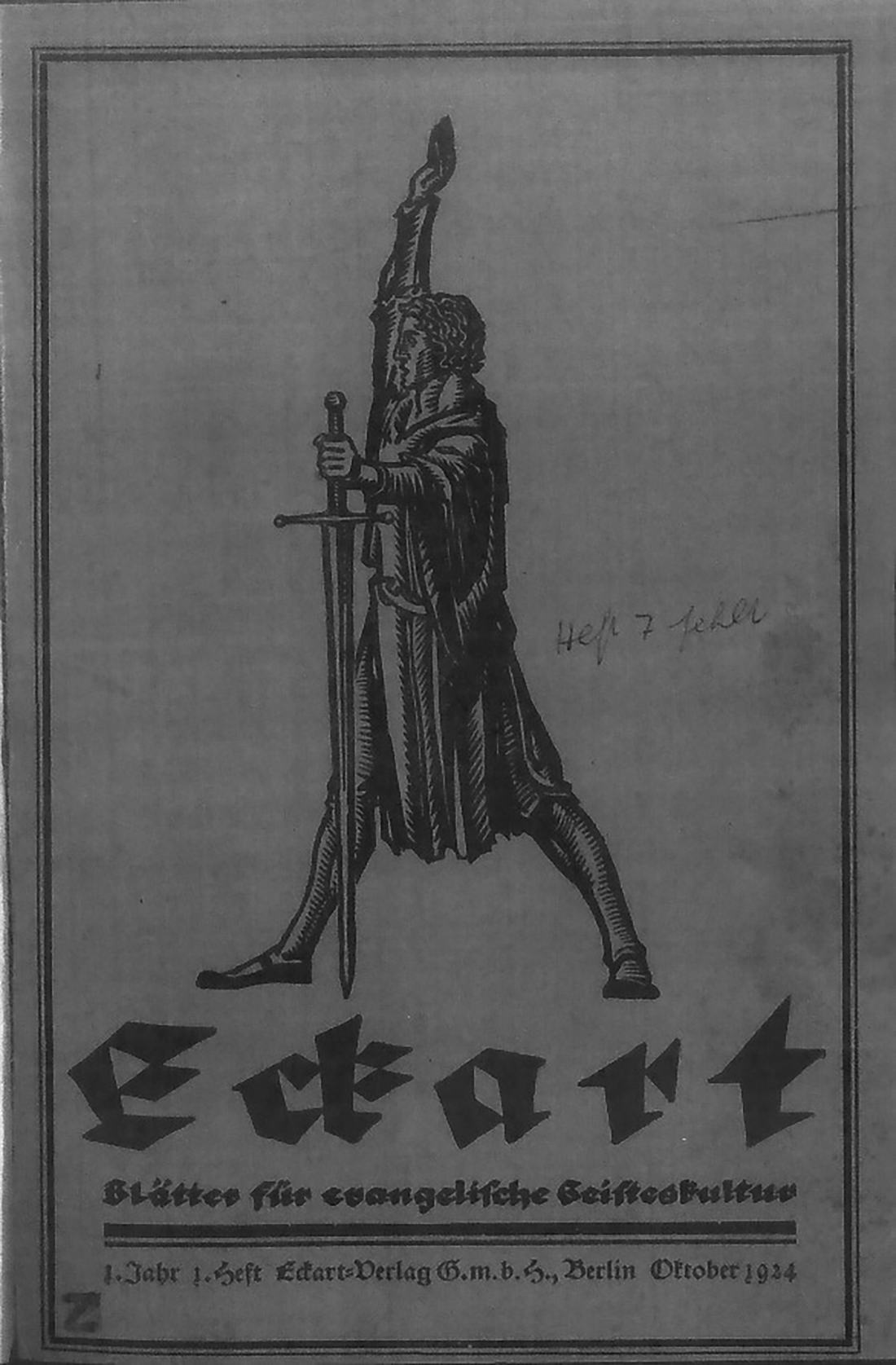
Eckart was first published in October 1924 by August Hinderer, the president of the Protestant Journalist League (Evangelischer Pressverband) in Berlin. Its readership was dominated by the Bildungsbürgertum: teachers, pastors, and professors. By 1933, the journal had approximately 1,500 monthly subscribers.Footnote 14 Surprisingly, this number almost doubled after Hitler's seizure of power and reached up to 2,500 per month in the late 1930s.Footnote 15
The anchor of the Eckart-Kreis, which may best be described as a loose intellectual network, were the so-called Eckart evenings organized by the pastor Kurt Ihlenfeld, who became senior editor in 1932–1933. This group united a number of writers, who have never been categorized in clear political terms.Footnote 16 The circle included famous authors such as Ricarda Huch, Rudolf Alexander Schröder, and Reinhold Schneider, a Catholic writer who would be accused by the Nazis of high treason.
No fewer than three writers for the journal–—Jochen Klepper, Werner Bergengruen, and Albrecht Schaeffer—suffered under the Nazis on account of their marriages to Jewish women. Just as Klepper served enthusiastically in the Wehrmacht, however, it is hard to credit from a present-day perspective how a book such as Bergengruen's The Great Tyrant and the Court of Justice (1935) could be interpreted by Sophie and Hans Scholl as a call for resistance and, simultaneously, by the Völkische Beobachter as a “great novel for the Führer.”Footnote 17
Eckart was not just a haven for the quietist critics of the regime. It also featured straightforwardly National Socialist authors such as Hanns Johst and Friedrich Blunck, who would both go on to become presidents of the Reichsschrifttumskammer (RSK), Nazi Germany's main censorship agency, which was founded after the book burnings in 1933. Such contradictions can also be found in individual biographies: the theologian Siegbert Stehmann, for example, was a member of the Confessing Church and caused a state scandal by publishing an openly critical letter to Nazi authorities in 1935 after being attacked and beaten by members of the SS. Although the Gestapo repeatedly interrogated him, Stehmann remained a member of the SA and later volunteered for officers’ training in the Wehrmacht.Footnote 18
The Guarding Eckart, cover page, Issue 1, October 1924.

For historians today the challenge is to analyze to what extent all of these authors shared a common theological horizon. Throughout the 1920s, writers unanimously condemned democracy and secular modernity, which seemingly threatened to “overgrow the state and to suffocate all culture.”Footnote 19Eckart saw its own role as a political guardian who warned Germany against materialism, decline, and rationalization.Footnote 20 A consensus-forming leitmotif, in this context, was the general fear for the cultural decline of the West.
The name Eckart referred to Ludwig Tieck's eighteenth-century tale The True Eckart and Tannhäuser. In this tale, Eckart guards the so-called Venus-mountain, the mountain of sin. For a Protestant journal, the name emblazoned the political motivation to “shield those who are careless from the fate of Tannhäuser,” who had succumbed to the devil inside the Venus-mountain. The Eckart of German mythology was “one who warns … who protects against hidden dangers and secret depths.” Thus, the symbol of the journal corresponded to the demand “to remain loyal to the deeply German, Christian spirit—even if it seems dead all around us.”Footnote 21
In one of the earliest articles published in 1924, the Silesian theology professor Martin Schian reviewed Oswald Spengler's bestseller The Decline of the West. In this article, the cultural pluralism and the parliamentary debates of the Weimar Republic were seen in typically Spenglerian-conservative terms as symptoms of decline. Schian identified a lack of unity and wholeness as the root of the problem. “We cannot have a unified culture,” he argued, “because we have no unified ideology.”Footnote 22 In parallel to völkisch movements, Schian's colleague Kurt Ihlenfeld even called for a savior-leader to overcome the perils of a diabolical, chaotic, and decadent Western liberalism.Footnote 23 Democracy, it would be argued throughout the 1920s and 1930s, had “betrayed the occident.”Footnote 24
After 1933, however, Eckart's self-image as a guardian against Weimar democracy was transferred to Nazism. Some intellectuals in this journal regarded Hitler's “national revolution” as an attack on their Christian tradition and were “deeply shocked … by the dangers threatening peace in the Occident.”Footnote 25 Many authors also kept a clear distance from anti-Semitic thought. As late as 1936, “Nordic and Jewish men” were publicly declared to be “unrecognized brothers.”Footnote 26 Long before the start of the war, theologians such as Friedrich Bartsch warned “with horror” against the consequences of a “new genocidal war” (Völkermorden).Footnote 27
In contrast to other oppositional journals, Eckart was able to publish such critical articles until 1943, when the journal was finally shut down due to wartime paper shortages.Footnote 28 Inevitably, therefore, the question must be raised how such a nonaligned journal could pass Nazi censorship. The Eckart author Harry Pross explained after the war that “the conspiring community of Eckart” had consciously attempted to morally undermine the Nazi regime from within. Through techniques of intellectual “camouflage,” Pross argued, Eckart had been able to write about “the good beyond the capabilities of censorship.” These authors, his argument went on, “represented morality so clearly that the discrepancy to the regime's corruption became obvious to all of their readers.”Footnote 29
In retrospect, it is difficult to assess what kind of strategy the journal pursued under Nazi dictatorship because Eckart's archives, including all editorial correspondences, were destroyed during an Allied bomb raid on March 2, 1943. Even without these documents, however, it is obvious that a critique of Nazism did not preclude critical authors from also promoting national-völkisch motifs. For instance, the regime critic Bartsch regarded the Völkisch as the “first fundamental fact” and the “basic phenomenon of the planet.”Footnote 30 In parallel to theologians of the “German Christians,” the Volk was understood as a direct product of God's creation. Yet, authors like Bartsch criticized National Socialism for perverting the nature of this Volk into a form of cultural collectivism.
The case of Eckart illustrates how political nonconformity could be tolerated by the regime within a certain semantic framework. Covered under völkisch catchwords and limited to the more abstract domain of cultural thought, the journal was granted an astonishing degree of autonomy and freedom of criticism. More importantly, however, the Nazi regime was criticized for the same reasons for which the Weimar Republic had earlier been rejected. When authors such as Bartsch railed in the 1930s that “we Germans are still too much of a mass,” they were deliberately reviving the themes of Kulturkritik against Weimar's secular mass society. In parallel to Nazism, critics like Bartsch hoped to share in the national mission of “transforming the mass into a Volk.”Footnote 31 The problem here is that theologians of the Eckart circle referred to the same categories as their Nazi colleagues and opponents, but interpreted them in different ways.
Articles such as Bartsch's illustrate that theories and catchwords, which are commonly placed today in a radical right-wing context, were just as much part of the conservative Christian mainstream of the Weimar era. Even the editor Kurt Ihlenfeld regularly used terms such as national soul (Volksseele) or ethnic body (Volkskörper) as if these concepts were axiomatic and their meaning transparent.Footnote 32 The challenge, therefore, is to analyze to what extent such central conceptual motifs were open to diverse political interpretations.
Throughout the 1920s and 1930s, political debates were stylized in metaphysical terms in order to reformulate them as religious questions. Here, the consensus was to defend a supposedly unified culture of religious Innerlichkeit against an anticultural tendency of an atomistic modernity, which was understood as hostile to nature. Eckart authors perceived themselves as “witnesses of a nonviolent war” within European culture. Against the prospect of liberalism, intellectuals hoped for a new form of state that was to be “non-ecclesiastic, but divine.”Footnote 33 They dreamed about a state that was to overcome the cultural crisis by unifying culture itself and replacing a rationalistic mass democracy with a more romantic form of religious community.
The most astonishing characteristic of Eckart was the openness and even the nonchalance with which aggressively nationalistic articles were placed right next to purely theological contributions and upright expressions of political criticism against the Nazi movement. In 1929, for instance, Eckart featured a variety of comments about George Grosz's famous trial for blasphemy. In one of his works of art, Grosz had painted Jesus Christ with a gas mask. In the conservative Eckart-Kreis, this caricature was understood as an insult to both God and the German soldier of the Great War.Footnote 34 National Socialist Eckart authors such as Friedrich Blunck and Rudolf Binding published contributions, in which they called for measures of cultural protection against “smug intellectuals” and for censorship of “filth and trash” (Schmutz und Schund).Footnote 35 Already in 1928, the Nazi poet Hanns Johst had declared in Eckart a “crusade of art” against modernistic decadence.Footnote 36
In 1935, the subtitle of Eckart, Blätter für evangelische Geisteskultur, was finally changed to the more committed Dichtung, Volkstum, Glaube. Yet, the partial Nazification of Eckart cannot be exclusively explained by the pressure exerted from figures like Johst. It is a typical principle for Eckart that ideological dissent was not necessarily interpreted as a form of cultural enmity. Protestant critics of the Nazi movement and National Socialist Christians entered into a dialogue here. On the one hand, this pluralistic sphere of discussion allowed for a limited degree of nonconformity, while on the other hand, it also permitted National Socialist ideas to be integrated into the moderate mainstream of the Protestant Bildungsbürgertum. Eckart, therefore, exemplifies the creation of an open forum of debate with its own nationalist religious parameters.
In this framework, Nazism could either be rejected as a symptom of modernity, materialism, and decline or endorsed as a promising strategy to overcome just these developments. Readers of Eckart now face the problem that common ideas and cultural themes expressed in a relatively narrow circle of authors could justify antagonistic political ideologies and radically different life choices. But even critics considered Nazi dictatorship as just one evil among others, seeing Nazism as a symptom rather than the cause for a European cultural crisis. The cultural danger for Christianity was not seen specifically in National Socialism, but rather in more general trends of global secularism and mass society. In this sense, many writers took Germany to be in a “time of decision ordained by God.”Footnote 37 However, it was clear that such a “time of decision” was never limited to National Socialism, but always reflected the perils of modernity in general.
Innerlichkeit and Passivity
Although Eckart was characterized by a lack of conceptual distance between National Socialism and national Protestantism, the relation between religion and ideology also proved to be far more complex. The regime was aware, of course, of Eckart's political ambiguity and its lack of outright ideological commitment. “There are still writers,” wrote Hanns Johst in 1933, “who do not respect the party, the [Nazi] movement, the government. … ”:
I say to these old people from yesterday: we are perfectly fine without you. We couldn't care less about the arrogance of self-proclaimed poets who think they can avoid a clear commitment to National Socialism via the detour of Innerlichkeit and phrases about eternal values.Footnote 38
Although Johst's statement is critical of the Eckart circle, it also makes clear that the regime did not perceive Eckart as a political threat that had to be met with violence. Hanns Johst, who played a major role in the censorship apparatus of the Nazi state, seems to have regarded the authors of Eckart as harmless and cowardly intellectuals who were lost in the theological debates of another era. However, in the totalitarian logic of the Nazi regime, which tended to divide the world into enemies and friends, this also means that authors like Johst at least considered Eckart to be politically reliable.
In fact, Eckart is full of statements explaining why the Third Reich had to be morally criticized, but also why it should be accepted in political and theological terms.Footnote 39 Taken together it would be easy to see Eckart's self-image as one of loyal criticism. Individually, however, writers followed two distinct intellectual paths: while some, like the National Socialist Johst, called for authoritarian measures of cultural revolution, those who expressed their fears of these radical ideas gravitated to a stance of political passivity rather than actual opposition.
Although there was a full-blown discourse in Eckart about how a total state “could revive the abuses of bureaucratic absolutism,” there hardly ever was a debate about real alternatives or about the question of how individuals should behave within a tyrannical system.Footnote 40 What seemed more important was the hope to heal society “from within” by purely spiritual means—which is also why most Eckart authors rejected ideas of open resistance. They admired instead nonviolent and inner forms of protest and intellectual nonconformity, and turned to figures such as Gandhi or Dostoevsky in their search for exemplars.Footnote 41
Jochen Klepper's book The Father may be considered as symptomatic for the simultaneity of criticism and acceptance after 1933. In this historical novel, Klepper described how Frederick Wilhelm I of Prussia established a “new Sparta” in the eighteenth century and pressed his subjects into a dictatorial order. Via the parable of Frederick Wilhelm, the Prussian “soldier king,” Klepper's novel identified the dangers of the kind of metaphysically motivated policymaking that he saw in Nazi ideology. Yet, with regard to the regime of the “soldier king,” Klepper wrote, “he felt his life punctured by a hard and dark fist. But he believed it was the hand of God; and therefore it had to be endured.”Footnote 42
Under the wider framework of the Protestant Doctrine of Two Kingdoms, which stressed the separation between the divine and the worldly order, authors discussed their moral duty not to revolt against God-given circumstances—even if criticism was justified. They accepted Nazi Germany as willed by God and sought for an inner connection between the political and the religious forces. “What happens in Germany,” argued Kurt Ihlenfeld, “is not entirely anti-Christian, but nourished by an intellectual unrest that also preoccupies ourselves.”Footnote 43 In a private letter in 1937, Ihlenfeld wrote that Eckart was all about “establishing a platform for fruitful exchanges of ideas” between theologians and “the Volk.”Footnote 44 After 1933, he wanted to “listen to the signs of the time.” Although Ihlenfeld identified as a member of the Confessing Church and opposed the German Christians who wanted to abolish the Jewish Old Testament, he also feared that a purely oppositional theology would be in itself un-Christian. “We have subscribed to Barth's theology [i.e., Karl Barth, one of the leaders of the united-reformed wing within the Confessing Church] from early on,” Ihlenfeld explained, “but if we continue like this, we have to end with our protestant church in a catastrophic dead-end.”Footnote 45
Similarly, Jochen Klepper expressed understanding for Nazism in his private diary. “I can understand that the Germans had to become as they now appear as a state,” he wrote in 1933, “in the middle of Europe—with open borders! It is a moving parallel to the permanent defensive position of the Jews.” Therefore, it was clear for Klepper on the day that Britain and France declared war in 1939 that “we cannot wish for the downfall of Germany due to our bitterness against the Third Reich … That is completely impossible. Also, we cannot hope in this hour of external threats for a rebellion or a putsch.”Footnote 46 Remarkably, this “we” also encompassed Klepper's Jewish wife, Johanna. In this context, he meant to justify his acceptance in biblical terms: “There is nothing else than to go back to Romans 13, the obedience to authority, even if it is hostile to me.”Footnote 47 Symptomatically, Klepper also thought he recognized the “theme of [his] life” in a choral verse: “to praise him in suffering, that is what He demands.”Footnote 48
Considering this attitude, however, we still need to take Klepper's suffering seriously. His family was threatened with being torn apart; his Jewish-born wife and stepdaughter faced deportation. Nonetheless, Klepper also believed that anti-Jewish policies jeopardized the special relationship between God and the Germans. “Because Germany is the country of Protestantism,” wrote Klepper in his diary, “it is such a special, difficult, bitter and frightening thing to be German. It is so difficult if you have to hate your own people.” And repeatedly, he asked, “What is more horrible? To be a people that feels God's hand as hard as the Jews? Or to be a people that must represent this severe hand like the Germans?”Footnote 49 In this context, the use of “must” not only hints at the much older nationalist Lutheran idea that the Germans had replaced the Jews as the chosen people, but also corresponds to Protestant conceptions of divine providence, which explained even the most criminal developments as part of a greater national fate.Footnote 50
After 1933, the Lutheran Two Kingdoms Doctrine led members of the Eckart circle to accept a tyrannical rule as God-given. At the same time, these ideas corresponded to a fundamental trust that the hidden purpose of this political order would be revealed by God via his worldly instruments. Herein, we may see a participation in National Socialism, which does not predispose agreement and does not exclude political antipathy. It is participation for the sake of participation. The wish not to exclude oneself from society was elevated by German Protestantism to a political virtue. Thereby, ideas of divine providence functioned as a kind of inverse of the “Hitler myth.”Footnote 51 Effectively, they allowed Nazi officials like Johst to make use of Eckart for National Socialist purposes.
The Eckart circle came to understand Nazism as a test of fate. In March 1933, Klepper declared: “In this sick perversion of nationalism, I do not turn to the other extreme [i.e., liberalism], but I understand for the first time what real nationalism is!” Klepper considered Nazism as a symptom for an outward decay, the origins of which were to be sought elsewhere. For him, Nazism merely represented the spasms of a dying century. Yet, the more he hated this destiny, the more he felt compelled to believe in it: “It is hardly bearable to witness a mystical fate in the year 1933 in central Europe.”Footnote 52 In a theological sense, he felt obliged to take part in this fate in order to prove his loyalty to God, who had ordained this worldly order.
By the same time, Klepper fundamentally differed from most other Protestant conservatives due to his unusual affinity to Judaism. The persecution of the Jews was not only a personal tragedy for his family, but also appeared in his worldview as a stroke of fate for the German nation, which Klepper regarded as deeply connected to Jewish culture. Just as his wife converted to Protestantism in 1938—which had been important for Klepper—so he in turn felt attracted to Judaism and closely analyzed his own feelings of sympathy and cultural admiration. Thus, he was able to align both Germans and Jews as tragic and victimized peoples. It was with great pride that Klepper privately adopted the label Judenchrist for himself, a term that originally denoted baptized Jews.Footnote 53 Although Klepper himself was not of Jewish descent, he used this term to express his inner solidarity with the Jews in Germany.Footnote 54
Notwithstanding these considerations, it should be noted that Klepper lived in National Socialism, became a successful author, and experienced social advancement despite his family's racial discrimination. For instance, Klepper built a rather luxurious house in Berlin, bought a new car, and established close contacts to members of the German political elite including army generals and members of the Hohenzollern dynasty. Curiously, the financial situation of his family had significantly improved compared to 1932. Klepper himself noted this paradox: “How strange … the art critics of the new era accept me as a contemporary writer. I am confronted with an enigma. Here I am welcomed and there I am excluded—in one and the same direction!?”Footnote 55
Klepper's diaries retrace an inner struggle with Nazism. They illustrate how even critics recognized their ideas in Nazi ideology and justified a stance of political passivity vis-à-vis the regime without ever identifying as National Socialist or being seen as such. Klepper might have found consolation in the credo of his colleague Rudolf Alexander Schröder that “all political Christianity is in error.” The Protestant, in this worldview, had a duty to participate in the sinfulness of the world because refusing to partake in the worldly order would mean to revolt against God. After all, “esto peccator et pecca fortiter, sed fortius fide et gaude in Christo,” had written Luther (“be a sinner and sin boldly, but more boldly believe and rejoice in Christ”).Footnote 56
Klepper's friend and Eckart editor Kurt Ihlenfeld interpreted such religious demands in terms of a “commitment to the nation and the state.” “The God that seems to have fled into the heavens,” Ihlenfeld quoted Rilke in 1939, “will reappear from the earth.”Footnote 57 Another Eckart author remarked in this period that “only in the life of the nation, the great transformation of the divine into the human does occur … World history is the Last Judgment.”Footnote 58 The state, as Ihlenfeld recalled, was “a thought of God” [Ranke] that had to be obeyed even if it meant to “eat your bread with tears” [Goethe].Footnote 59
Only few authors were able to see that this philosophy effectively made them allies of a criminal regime. In 1940, the historian Karl Buchheim, perhaps most notably, publicly attacked his friends by reminding them of the third appeal of the Lord's Prayer: “Thy will be done.” According to Buchheim, it was an “unchristian misunderstanding” that this verse required “resignation into the doom that has befallen us.” In Eckart, he observed that many of his contemporaries did not see anything else in these words than “a readiness to say yes to an inevitable fate, the amor fati” [Friedrich Nietzsche]. Buchheim criticized that the words Thy will be done! had become a fatalistic “prayer of the unbelievers.” The entire phrase of the Lord's Prayer, he reminded his readers, was “thy will be done, on earth as it is in heaven.” It was a prayer for earth to become like heaven, not a pledge to accept every sin on earth as willed by God. “It all depends,” Buchheim explained, “on the difference between the heaven and earth.” Fatalism, he concluded, amounted to “disbelief in God's answer to the [Lord's] prayer.”Footnote 60
Amor Fati and the Will of God
In 1939, Eckart did not comment on the beginning of World War II with a single word. The outbreak of war led to a retreat into theological spheres. More than ever, Eckart readers now had to learn to read between the lines. However, fundamental discussions remained unchanged. In 1939, for example, the writer Otto von Taube published an article about Protestant pastors who had continued preaching in Lithuania after the invasion of the Red Army in the 1920s. As a Protestant critic who felt religiously persecuted by the Nazi regime, these “Baltic martyrs” seemed to offer moral guidance: “How should I flee now in the face of danger?” Taube quoted a German pastor who had been imprisoned by the Soviet regime.Footnote 61 His readers, of course, must have understood that Taube's article really was about the Third Reich and not the Soviet Union. While his son would go on fighting at the Eastern Front, Taube would be hiding Jewish children in his house throughout the war.Footnote 62
World War II did not dissolve the inner conflicts and debates among Eckart authors, but rather made them more acute. “What has changed in our religious and moral mission?” asked Reinhold Schneider:
Only very little. Only that it became harder and more serious and that we take a far greater part in the suffering of the world. We want to carry our burden, however. We do not want to evade reality and we want to accept this suffering as large as it may be.
In essence, this meant that Schneider was aware of German war crimes, but still not ready to turn against the Nazi regime. Yet, he also recognized the tragic dimension of this decision. “However determined we are in our faith in God's grace,” Schneider acknowledged, “we do not want to turn a blind eye on humanity's suffering either.”Footnote 63
In 1939, Reinhold Schneider visited Jochen Klepper in Berlin-Nicolassee. Although both authors rejected Nazism in ideological terms, they also appreciated Hitler's “honest fight against the Versailles treaty.” Klepper and his wife could see that Schneider “feels like we do: he is not capable of the cult with foreign countries … To all reproaches of foreigners also Schneider can only reply: ‘Versailles.’”Footnote 64 This was not only a claim about the causes of the war, but morally coded via their ressentiment against 1920s liberalism: the West had sinned first.
Klepper described his own ideological commonalities with the regime as “contact points” (Berührungspunkte). However, he also regarded his own vision of nationalism as the very precondition for any meaningful opposition. The crimes of the regime demanded of the Germans a purification and internalization (Verinnerlichung) of their national identity. Paradoxically, the shame for the Third Reich did not diminish Klepper's sense of patriotism, but was rather understood as a challenge to make it deeper, more reflected, and more transcendental: “On a much more narrow line we now have to save what must be called the “spirit of the nation”—on a much more narrow and endangered line.”Footnote 65
Since the 1930s, Klepper had chosen highly romanticized visions of Prussia and the medieval Reich as fictive cultural antipodes to Nazism. For instance, he was deeply touched by a quote of Schneider. “If we want to create the Reich again,” Schneider had written, “then we have to descend into its crypt: to the original and indestructible; to the first source of life, from which the ephemeral forms have grown.”Footnote 66 In this self-understanding, Klepper was living in the “crypt of the Reich,” where he upheld a holy sense of a deeper nationalism, which seemed to have been lost in the hyper-nationalistic world all around him.Footnote 67
Medieval themes had frequently been discussed in editions of Eckart since the 1920s.Footnote 68 During World War II, however, many authors were unsure whether they should utilize the image of the medieval first Reich as a positive counter-example against the amoral Third Reich or whether they should glorify the Nazi state as the culmination of a thousand-year-old German history. Effectively, Eckart remained a platform for debates between committed Nazis and more skeptical intellectuals.
During the war, the writer Hans-Egon Holthusen was eager to glorify the attack on Poland as a crusade in the tradition of the Teutonic knights. “The mission of our march is a thousand years old,” he wrote in Eckart. “We want to ride to the East!’Footnote 69 Against a “docile and paralyzed vision of liberal culture,” the SS member Holthusen longed to fulfill the mission of historical destiny, which seemed to culminate in Hitler's person [“Sendung eines gewaltigen Täters”]. Germany, according to Holthusen, was a “militarily and metaphysically talented nation.” World War II, in this ideology, was “destiny written with blood.” The events at the Eastern Front gave meaning to history: it was a symbiosis of Geist and power, religion, and war.Footnote 70
Seemingly in line with his colleague Holthusen, the theologian Siegbert Stehmann wrote in 1941 that “the old occident is tired to death.” Having enlisted in the Wehrmacht, Stehmann took Germany to be in a struggle for the political renovation of a declining Christendom and believed to fight in a “white army” against both Eastern bolshevism and Western decadence. Nonetheless, he was reluctant to put his faith in National Socialism. “The forces of historical renovation,” Stehmann argued in the same article, “never arise from hubris, from demonic heroism, or Babylonian dreams and goals.”Footnote 71
Similarly, Jochen Klepper acknowledged how problematic it was to fight for a criminal government. “I feel myself being reduced to my core,” he wrote after the victory over France in 1940, “but this core is divided.”Footnote 72 Ironically, however, Klepper hoped to overcome depression and desperation through his enlistment in the Wehrmacht in December 1940. He was proud to have been considered fit for military service “and Hanni [his wife Johanna] was happy about that as well.” And “God grant,” Klepper wrote, “that I can become a soldier for the best of Hanni and Reni [his step-daughter Renate].”Footnote 73 He truly believed that fighting this war for Germany was also in the best interest of his Jewish-born family members.
What we may see today as undecidedness and political ambivalence could be understood by contemporaries as honesty, firmness, and moral uprightness. The Wehrmacht-officer Rolf Stöver, who had been a member of the Eckart circle during the war, recalled his memories years later:
Here were German citizens who felt attracted and obliged to national, clerical and military traditions. They knew about the terrible perversions of these traditions through the government of the Reich. But … they were still optimistic that these traditions had enough power to prevail over all lies.Footnote 74
Active resistance, however, was not a meaningful category in this worldview. A Protestant sermon delivered in this period brought the problem down to a point: the inscription “God with us” on the belt buckle worn by German soldiers seemed to recall the story of Gethsemane.Footnote 75 Obedience toward the worldly order was seen as the very precondition for obedience toward God. The officer August Töpperwien, a friend of Ihlenfeld, even came up with the pseudo-biblical formula “I give to the Führer what belongs to the Führer; and to Christ what belongs to Christ.”Footnote 76
After being deployed in Poland and the Balkans, Jochen Klepper took part in the invasion of the Soviet Union as part of Army Group South. Despite his enthusiasm, he was open and clear about his doubts: “Even the understanding that the relation between man and the sword must not expire and that Prussianism is hardly possible without military identity does not reconcile me to the idea of having to serve in this army and to be thrown into Europe's horrible military psychosis.” And yet he wrote that “human life must be fully experienced.” Klepper argued that “there is only one thing that saves us from the worst: to partake in the suffering under this horrendous crime”—a suffering, which he defined here as being a soldier of the Wehrmacht.Footnote 77
Such considerations must be understood against the background of earlier discussions in Eckart. Not long before the war, Reinhold Schneider had published an article about Friedrich Nietzsche, in which he drew links between Christian theology and the Nietzschean “amor fati.” Nietzsche, himself the son of a Protestant pastor, was more than a respected enemy of religion; he was a spiritual inspiration epitomizing the “doubt of the doubt” and a “longing for wholeness.” In this view, Nietzsche and Jesus were united by “the eternal deed to shout out to a world that had already learned to put everything in doubt: Do not doubt!” Nietzsche and Jesus seemed to stand “beside and against each other.” In the words of Schneider, Nietzsche was “serious about the commitment of his existence to an idea and lived for us his exemplary suffering in the great emptiness.”Footnote 78 Similarly, Luther had once proclaimed that “belief will have to learn to stand on nothingness.”Footnote 79
During the attack on the Soviet Union, the reserve officer and former high school teacher August Töpperwien wrote that he had “gone into this war in order to carry voluntarily … a little bit of the weight of exterior and interior sacrifices, which have been imposed on our nation.” For him, God's will and inner freedom were one and the same. Explicitly, Töpperwien also referred to Nietzsche's “amor fati,” in which “unconditional fatalism and final freedom are married.” “In accepting an unwanted fate as my own,” he argued, “I attain my freedom.” Amor fati was “more than obedience to a foreign power. It is commitment to an enigmatic will … It does not change anything, because it is the love for what is imposed.”Footnote 80
“And now, it is our profession to be a soldier,” wrote Töpperwien. In 1940, he quoted a student's letter from World War I: “to be human means: fighting until the end.”Footnote 81 Although Nietzschean in tone, fighting until the end also meant to uphold a belief in the special relation between God and the Germans. And only the war could bring a final proof for their special religious status as a chosen people.Footnote 82 Thus, fighting the war was also seen as a divine test, which was not to be failed as it had in 1918.Footnote 83
At the same time, Klepper even expressed gratitude for his service as a soldier. “How thankful I should be for the manner in which I am allowed to participate!” he wrote in his diary. Klepper even compared the clouds of smoke following the German advance into Russia with the Pillar of Fire followed by Moses and the people of Israel during the exodus from Egypt.Footnote 84 Just months later, however, Siegbert Stehmann used similar images to make a different point about the criminal nature of the war. Facing burning Russian villages in 1942, Stehmann publicly wrote in Eckart that “all illusions were broken in this moment. This was no metaphor, no image …, but the serious and sober reality. Distant forests and villages were burning and glowing. And the smoke of doom was glaringly rising and became an accusation, a warning, and a message!”Footnote 85
The crimes they witnessed changed the Prussian sense of patriotism of many Eckart authors, but for Klepper, German war crimes only made his nationalism deeper: “From the history of the age of Protestant Reformation and the present,” he wrote on Good Friday 1942, “I know the German greed. Yet, I have not known German cruelty before. Just like faith, patriotism is going through a process of catharsis and refinement in this time.”Footnote 86 As the love for his country became increasingly problematic and overshadowed by feelings of guilt, his nationalism could be transfigured to a more intense, religious level. To remain a nationalist despite National Socialism embodied for Klepper the highest and purest form of patriotism.
Paradoxically, military service seemed to offer to critical intellectuals a neutral way out of the moral dilemma posed by Nazism. Military status seemingly allowed one to commit to Germany while keeping a safe distance from National Socialism. While recognizing the scale of the ongoing genocide, Klepper suffered from the fact that he was drafted as a simple private and had been denied a career as an officer due to his mixed marriage. His dilemma was aggravated when he was finally discharged in October 1941 as “unworthy for military service” (wehrunwürdig).
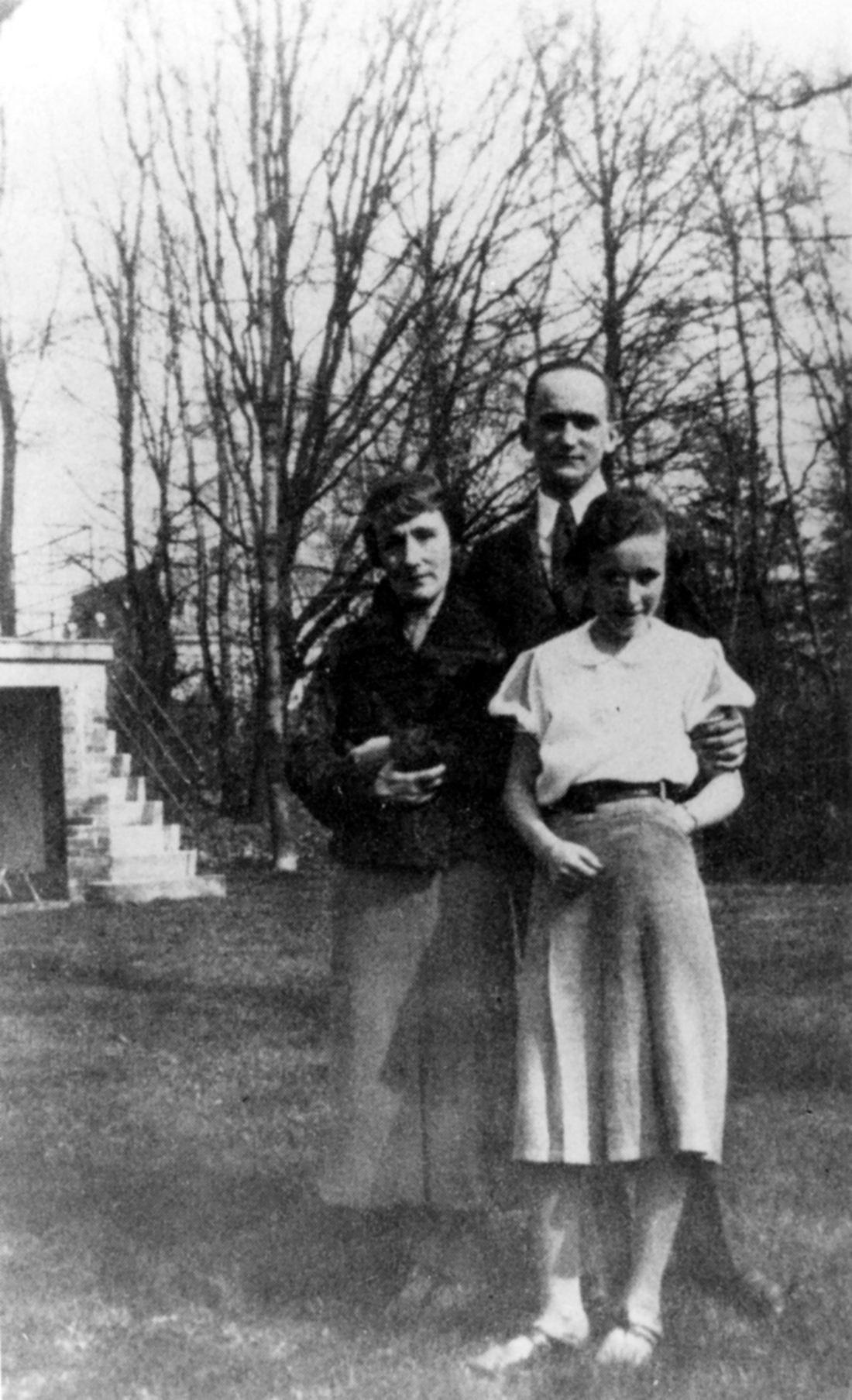
Jochen Klepper with his wife Hanni and daughter Reni on his birthday, Berlin, March 22, 1937. © Private collection / Reproduction of the German Resistance Memorial Center.

While upholding his faith in Germany as “Christ's fatherland,” Jochen Klepper fell into depression. His stepdaughter Renate was threatened with deportation and drafted for forced labor in Berlin's Siemens factories. Yet Klepper still hoped that the situation might change for the better and wondered “if there will ever be a time in which this can be read in my diary as the history of a miraculous divine providence.”Footnote 87 In vain, Klepper tried to convince Nazi authorities to spare his daughter. On December 11, 1942, just hours after pleading to Adolf Eichmann one last time, the Kleppers took sleeping pills and turned on the gas in their kitchen:
Now we die—alas! Also this is willed by God—this night we will go into death together. In the last hours the picture of Jesus is above us as he blesses and fights for us. Under his gaze our life ends.Footnote 88
Klepper's biography reflects his idolization of the mystical figure Eckart. In this medieval German myth, Eckart keeps his oath of loyalty toward the duke of Burgundy. Although the duke becomes a tyrant and kidnaps and kills his sons, Eckart saves the life of his lord. In this tale, the leitmotifs are faith and loyalty toward an amoral lord by holding to the Christian ideal of loyalty itself. To break the oath of allegiance in the face of tyranny was not a viable option in this worldview. Resistance would have amounted to usurpation. The theological necessity to accept the God-given order ranked higher than the ban on suicide.
The first Eckart edition after Klepper's suicide coincided with the German defeat at Stalingrad in winter 1942–1943. Ihlenfeld decided to open this new issue of Eckart with a quote from Friedrich Hölderlin dating back to the Napoleonic Wars, which seemed to speak directly both to Klepper and the dead soldiers in Stalingrad:
You have done your duty in this world. You should be happy. You have endured so much in recent times, but you understand that amidst all of these storms there is a good and eternal spirit in everyone and everything, which is sustaining us all: a spirit of peace and order, which only agrees to take part in this fight, in suffering and death, in order to establish a higher harmony.Footnote 89
These ideas did much to convince Eckart authors and readers to continue fighting. Although the last editions of Eckart in 1943 comprised only approximately fifty pages and were mostly concerned with literary and theological questions, its loyalist, yet critical worldview was upheld until the very end of the war.
On July 20, 1944, Töpperwien wrote that “it is a mark of honor in our history that … the spirit of revolt of 1918 cannot yet be seen in the faces of the soldiers!”Footnote 90 One day later, upon hearing the news of Stauffenberg's plot, Töpperwien was shocked. Although he understood and supported the motives of resistance, he took it to be sinful to change the course of history. Instead, he felt drawn to Luther's sermons from the sixteenth-century peasant wars, in which the excommunicated Luther had called upon the rebels not to revolt against the Catholic emperor even if their cause was justified.
In spring 1945, Töpperwien wrote into his diary: “Victory from the power of the sword is no longer possible. How long does the honor of our people oblige us to continue fighting? God grant that the Führer may decide well! I cannot!”Footnote 91
Postwar Perspectives
Many authors contributing to Eckart failed to recognize the connection between National Socialism and their own national Protestant ideas. Yet, I believe it would be wrong to describe the political mentality of the Eckart circle in terms of accommodation or opportunism. The political criticism expressed in this journal was genuine, but limited in nature due to its intellectual overlaps with Nazi ideology. Eckart's “loyal criticism” ultimately helped stabilize the Third Reich by providing a platform for intellectuals to criticize the regime while simultaneously convincing them to take part in its policies. The intention of these authors was neither to strengthen Nazism nor to egoistically advance their own careers. Instead, their moral failure was their inability to see to what extent their traditional values had been implicated in a dictatorial ideology.
Historians such as Manfred Gailus have written about the “pervasion” (Durchdringung) of Protestant milieus by National Socialism. Simultaneously, however, Gailus acknowledged that the majority of parishes in Berlin remained divided between German and “Confessing” Christians and that many Protestant communities were never fully Nazified.Footnote 92 Given this problem, I think we should conceptualize the relationship between the Nazi regime and German Protestants not only in terms of a struggle or conquest, but also in terms of political communication. It is crucial to make distinctions between Gleichschaltung from above and integration from below. Similarly, we should distinguish between opportunistic or indifferent accommodation and voluntary participation. Thus, it can be understood how critical Protestants self-mobilized for an imaginary national community that they did not necessarily understand as National Socialist.
These observations also explain why the mentality of the conservative Protestant milieu persisted after 1945. Eckart continued to be published until 1960 and Jochen Klepper, Rudolf Alexander Schröder, and Reinhold Schneider were among the most widely read authors of the postwar period. Their books were now included in practically all high school curricula. Most Germans who went to school in the 1950s and 1960s still remember these authors as courageous regime critics who upheld religious values against the Nazi regime. Effectively, these authors allowed German readers to retain conceptions of “national soul” (Volksseele), community, and Volkstum while making a sincere attempt to overcome what they took to be the Nazi heritage, as well as to establish a moral conscience about German war crimes.
Although historians have thoroughly analyzed mechanisms of silence, hypocrisy, and opportunism within West German culture, they are only beginning to grapple with continuities in Protestant mentalities.Footnote 93 The worldview of the Eckart circle helps us to understand why even those who genuinely sought to bring about a paradigm shift in the political culture of postwar Germany relied on much older leitmotifs, which were closely entwined with the development of Nazism itself. Ultimately, the challenge is to retrace consensual cultural themes, which were generally perceived as Christian or apolitical but fulfilled ideological functions both in the Third Reich and the postwar period.
Although World War II and the Holocaust were rarely mentioned in Eckart's postwar articles, National Socialism remained the elephant in the room. In this sense, the postwar Eckart hardly differed from the censored wartime editions, which had mostly focused on theological and literary topics, but had nonetheless tried to covertly comment on political events. This is important because postwar editions of Eckart represent an ideal speech situation that allows historians to understand that the silence of Eckart authors in Nazi Germany cannot entirely be explained by their fear of Nazi censorship. Instead, this silence about the war and the Holocaust must also be understood as the result of an inner tension and ambiguity.
In his 1950 book Der Große Verzicht (The Great Modesty), Reinhold Schneider defined the paradox with which Eckart authors continued to struggle: “the world is subject to the sword, and yet we have to obey the word ‘thou shalt not kill.’ ” A reviewer of Schneider in Eckart explained that even the Protestant Two Kingdoms Doctrine could not dissolve this contradiction. “The sinner,” the reviewer explained, “cannot be consoled, but he is sacralized through his suffering.” This argument was a great vehicle for self-commiseration and self-ennoblement. The sacral figure, notably, was not the victim, but rather the perpetrator who recognized the guilt “which ha[d] to be endured.” “I accuse myself,” Schneider had further written in his novel, “for being the son of my fathers and for being entangled in the guilt of the world.” While acknowledging the biblical Original Sin, neither Schneider nor his reviewers in Eckart lost a word on the murder of the Jews.Footnote 94 Instead, the review article was followed by a nostalgic poem from Kurt Ihlenfeld about the lost lands of East Prussia.
Ihlenfeld's new coeditor Heinz Fluegel, by contrast, was one of the few figures who tried to critically discuss the role Eckart had played in the Nazi period. “The word ‘politics,’” he argued in 1951, “is hateful to most of us. The ‘political’ seems dirty and ambivalent.” By contrast, Fluegel recognized that “we act in very political ways, especially when we think we are apolitical. … Our refusal to take political responsibility is a political issue of first rank. That means: a political mistake, a political guilt.” Fluegel even criticized Eckart's theological positions. “We have the audacity to refer to Christ himself when we opt against Him.” Despite these unusually open words, Fluegel still did not write about the Holocaust. Instead, he referred to Eckart's failure to have supported Claus von Stauffenberg's resistance movement. “The men of July 20,” he argued, “knew that they became guilty when they attempted to take the life of the one who was guilty a thousand times. But the fact that they suffered under this inevitable guilt constitutes their exemplary and venerable greatness.” The guilt of Stauffenberg, in other words, was not to have supported a criminal war for half a decade, but to have tried ending it by himself.Footnote 95
Although Eckart authors then started to glorify Stauffenberg's conservative nationalist resistance movement, which they had earlier refused to join, they simultaneously continued to justify their loyalty to the Nazi regime. Throughout the 1950s, resistance and loyalty in the Third Reich were presented as equally difficult choices. Kurt Ihlenfeld's novel Winter Storm from 1951, for example, reflected on the senseless killing at the Eastern Front. In the same book, Ihlenfeld justified the actions of his friend Siegbert Stehmann, who had been killed in action in 1945:
We are sacrificed. I have long resisted. I would have gone another way. But no one who refused to be sacrificed should think that he is without guilt … One day, the sacrifice will be held in just as high regard as the resistance.Footnote 96
Given this opinion, it was logical for Ihlenfeld to help friends who were subject to proceedings of “de-Nazification.” For example, the SS member Hans-Egon Holthusen, who had fantasized about the Teutonic Order and new Lebensraum in Eckart's wartime editions, had to justify his writings in front of an Allied commission after 1945. Ihlenfeld dismissed Holthusen's SS membership as a “bagatelle” and even wrote a letter in Holthusen's support in which he affirmed that his friend had in fact been a courageous regime critic.Footnote 97 Moreover, he claimed that several of Holthusen's articles had been banned by the propaganda ministry. In the Bundesarchiv, however, no evidence for this claim could be found in the files of the propaganda ministry.Footnote 98
Ihlenfeld's letter certainly helped Holthusen pass his “clearing.” The former SS man became the director of Goethe House (which later became the Goethe Institute) in New York. Later, Holthusen also got a professorship at Northwestern University, where he stayed until 1981 and gave lectures about the “German catastrophe of 1945” (ignoring the catastrophe of 1933) or criticized the works of authors such as Paul Celan.Footnote 99 None of this prevented him being awarded the Grand Cross of Merit of the Federal Republic in 1987.
While Eckart authors gained ever more fame and prestige in postwar West Germany, they also presented themselves as a vanguard of Aufarbeitung and German-Jewish “reconciliation.” Eckart featured articles from authors such as Max Brod and numerous contributions about Israel and Jewish culture.Footnote 100 Some of these articles, however, revived much older anti-Semitic stereotypes. In 1953, for example, Martin Beheim-Schwarzbach presented Germans and Jews as spiritual brothers who shared a cultural mission of mediating between the East and the West. Yet, he managed to not even mention the Holocaust in his article, but wondered instead whether he should call Judaism “a religiously founded race” or “a racial religion.”Footnote 101
Other authors went even further. In 1957, Christoph Meyer warned “against ignoring and forgetting what aspects of Nazism had been legitimate by exclusively focusing on the enormity of its crimes.” Meyer acknowledged that Eckart had shared at least some of the values of the Nazi regime. Here, Nazism was criticized for its methods rather than its ideology. “What is most compromising about Hitler's failures,” his conclusion read, “is that he wanted to accomplish everything at once.”Footnote 102
While many Eckart authors had acted as moral advisers and reluctant critics of Nazism until 1945, they also revived their antidemocratic and nationalist ideals after the end of the war. “The German nation,” the author Paul Karrenbrock wrote in 1958:
is forced to live in two separate states and in two political systems, which are unworthy of its historical destiny. If their history is to make sense, then the Germans did not go through the hell of Nazism to end in the inferno of communist totalitarianism or in the passé défini of a nineteenth-century liberal democracy which had already been destroyed by national socialism.Footnote 103
Although the authors of Eckart understood themselves as persecuted enemies of the Nazi regime, they also believed they had to preserve what had been good about Nazism after 1945. Most importantly, they continued to criticize not only “Eastern” communism, but also “Western” democracy. “The idea of Bonn's constitution,” continued Karrenbrock in 1958, “is in its essence again the Weimar constitution of 1919 … Again, the German nation is divided into political interest groups [i.e., political parties].” By contrast, authors like Karrenbrock hoped to overcome the “provisional arrangement of Bonn” and its “parliamentary monopolism.” Explicitly, they hoped that a new state would one day be built not on individuals, but rather on communities.Footnote 104
Given these nationalistic arguments, it might seem surprising that some Eckart authors chose to stay in East Germany. The theologian Friedrich Bartsch, for example, stayed in Berlin and founded the Evangelische Verlagsanstalt under Soviet supervision.Footnote 105 After having flirted with völkisch ideas in the 1920s, but then having endured a publication ban by the Nazis in the 1930s and 1940s, Bartsch now had a favorable opinion of the GDR. Yet, he remained in contact with his close friend Kurt Ihlenfeld. Ihlenfeld, for that matter, believed well into the 1950s that German intellectuals under Allied occupation lived in “unfreedom” in both the East and the West and thus shared a common national fate. By contrast, the optimist Bartsch refused to criticize the GDR. In March 1955, he wrote to Ihlenfeld that “unfreedom can also be something positive if it leads to spirituality, conversion, and new commitment” (Besinnung, Umkehr und neue Bindung). Bartsch was well aware of the SED's anti-Christian ideology. Yet, he felt compelled to quote the Jesuit Rupert Meyer, who had been a regime critic against the Nazis: “Now there is nothing and no one left to me except God. And that is enough, more than enough.”Footnote 106
Such examples inevitably lead to the conclusion that the authors of Eckart ultimately were loyal to whatever government they were forced to live under the Weimar Republic, Nazi dictatorship, the GDR, and the Federal Republic. More than that, in each of these periods, they criticized the existing political conditions, but also gave astonishingly similar theological reasons for why they had to be endured.
Conclusion
Why is it so relevant to retrace the mentality of a journal like Eckart today? From a methodological perspective, the paradoxical and exotic world of the Eckart circle escapes all the behavioral categories conventionally used by historians: the terms resistance, collaboration, accommodation, and criticism equally fall short of a far more contradictory reality. In Nazi Germany, Eckart was both loyal and oppositional. In the postwar period, it stood for nationalist continuity, but also for Aufarbeitung.
In contrast to historians who researched affinities between National Socialists and religious intellectuals, I would characterize the relation between Eckart readers and the Nazi regime as one of incomprehensibility (Unüberschaubarkeit)—not in the sense that men like Ihlenfeld or Klepper were unable to understand the implications of Nazi policy, but rather in the sense that they were never able to separate National Socialist themes from their own theological ideas. The intellectuals of the Eckart circle never asked themselves whether Protestantism was more important to them than nationalism because they were never able to establish a meaningful intellectual distinction between these terms.
Traditional historiography has been characterized by patterns of behavioral analysis, which revolve around binary distinctions between resistance and collaboration.Footnote 107 Although the pitfalls of such narrow distinctions are generally recognized, historians still struggle to formulate alternatives to such categorical models. Since the 1990s, historians have introduced a plethora of behavioral labels. These encompass nuanced terms such as Martin Broszat's Resistenz and Alf Lüdtke's Eigen-Sinn, but also notions of loyal reluctance, Dietmar Süß's antagonistic cooperations, as well as ideas about a participatory dictatorship.Footnote 108 In many cases, however, these new categories are either interpreted as forms of apologetics or complemented by the category of bystanders, which means “collaborators by default.”Footnote 109 Although ambivalent behaviors have been described in depth, their underlying psychological and political roots remain in the dark and are often framed in terms of hypocrisy, cowardice, and accommodation. As a result, argued Vesna Drapac and Gareth Pritchard, “behaviors are either inappropriately voided of their political impact or politicized inappropriately.”Footnote 110
Instead of focusing on notions of Anpassung, or accommodation, I think it is necessary to consider processes of Einpassung, or integration. In this context, this analysis of Eckart allows for at least two major observations. The first is obviously about the conceptual interaction between Nazism and Protestant theology. Divine providence and the Two Kingdoms Doctrine fostered a sense of political passivity under dictatorship while the nineteenth-century idea that the Germans were the new chosen people, who were to replace the Jews, prevented any real opposition against the racist distinction between Germans and Jews.
The second observation is about forms of loyal opposition. With this concept I would describe mechanisms of public dissent and open political non-alignment, which simultaneously allowed for political participation in the wider Volksgemeinschaft. A shared intellectual frame of reference allowed even critics to accept certain aspects of Nazi ideology without self-identifying as National Socialists. The biographies of Eckart authors highlight the fact that criticism and participation were not necessarily seen as mutually exclusive alternatives. The consideration of loyal critics such as Klepper, Ihlenfeld, or Stehmann leads to an understanding of German society in this period as being neither divided nor consensual.
In this context, it is important to note that the term loyal opposition had already been used by contemporaries. Hans Meiser, the Protestant Landesbischof of Bavaria, for example, had described himself and his followers as “the most loyal opposition of our Führer” (unseres Führers allergetreueste Opposition).Footnote 111 Accordingly, this mindset may also explain why Protestants such as Meiser were revered as regime critics in the immediate postwar period, but would later be criticized for their intellectual and political proximity to National Socialism.Footnote 112
The ambiguities discussed in this article were never limited to the Protestant milieu. Although Eckart included Catholic authors such as Reinhold Schneider, others, such as Werner Bergengruen, converted to Catholicism in the 1930s. In addition, Eckart may be understood as part of a larger Christian journal landscape in Nazi Germany that included other non-aligned periodicals such as the Catholic Hochland and the Weiße Blätter. Both journals, for that matter, were also published until the 1940s and overlapped with Eckart because they shared some of the same contributors, including Klepper, Schneider, Bergengruen, but also Klaus Bonhoeffer.Footnote 113 More significantly, however, historians have recognized that German Catholics were characterized by similar political ambiguities of Christian morality, conservative traditionalism, and German nationalism.Footnote 114
The challenge is to accept the ambiguities that are so characteristic for conservative Christian intellectuals. The genuine, albeit limited nature of Eckart's criticism has to be accepted as symptomatic of the Third Reich's functional character. In many ways, this is a modified functionalist argument à la Kershaw.Footnote 115 It shows not only that the coercive system of control and censorship in Nazi Germany was too inefficient and ideologically too incongruent to prevent all forms of political criticism in the public sphere. Ironically, however, it also shows that loyal critics like those in Eckart did much to stabilize the Nazi system by feeding illusions of political freedom.
The journal Eckart illustrates how the Nazi regime gained stability by accommodating diverging perspectives and even critical voices within the coercive framework of dictatorship. This article interprets the Third Reich as a society that was—despite its ideological goals of racial exclusion—internally integrative. It successfully relied on a divided population, whose support was often conflicted and ambivalent. This was, however, a political outcome rather than an ideological intention. In other words, this was not a strategic policy of the Nazi government, but a functional consequence of a dynamic development within German society.
Eckart authors did not reject the possibility of active resistance for lack of courage, but rather for theological reasons. Yet, although Eckart's opposition was genuine, it also fulfilled a regime-supporting function. Theology, thereby, must also be understood as a framework of intellectual dialogue, which allowed for the integration of political outsiders into a coercive racial state. Retracing the paradox of a loyal opposition leads to the conclusion that the Third Reich in many ways was neither divided in supporters and critics nor monolithic and uniform.
It is this previously unrecognized dimension of dialogue between Nazis and non-Nazis that allows for new perspectives on postwar continuities. As this article has shown, the observation that contemporaries were unable to draw borders between Protestant theology and National Socialism is also reflected in the incomplete processes of postwar Aufarbeitung. The same intellectual mechanisms that had facilitated the integration of self-proclaimed critics into the Third Reich later ensured the perpetuation of nationalistic patterns and ideals. At the same time, the mindsets of most Eckart authors were characterized by moral sincerity and the honest intention to achieve a new cultural beginning. The subsistence and perpetuation of supposedly apolitical national Protestant values, therefore, reveals a whole range of previously unconsidered discrepancies between political contents and moral intentions. Eckart had always aimed to preserve a traditionally Christian moral uprightness, but effectively perpetuated an unbroken sense of apologetic nationalism.