Introduction
Children in out-of-home care (OOHC) are at heightened risk of a range of negative outcomes that are mediated by educational success. These include homelessness, lack of stable employment and poverty (e.g. Courtney, Piliavin, Grogan-Kaylor, & Nesmith, Reference Courtney, Piliavin, Grogan-Kaylor and Nesmith2001; Tweddle, Reference Tweddle2007). While some researchers emphasise the potential for children in out-of-home care to achieve as much as their peers (e.g. Martin & Jackson, Reference Martin and Jackson2002), most describe the educational experience of children in out-of-home care as concerning (e.g. Tilbury, Reference Tilbury2010; Trout, Hagaman, Casey, Reid, & Epstein, Reference Trout, Hagaman, Casey, Reid and Epstein2008). Poor educational outcomes are influenced by the significant adversity and trauma children experience prior to entering care (DeGregorio & McLean, Reference DeGregorio and McLean2012), but also by a number of roadblocks that influence their educational experience during their time in care (Mendes, Reference Mendes2011).
It is important for agencies that support children in OOHC to be aware of the barriers or roadblocks to good educational experience, and design supports that maximise educational outcomes for children in their care. The barriers or roadblocks to good educational outcomes for children in OOHC are well documented and are largely influenced by systemic or institutional factors (e.g. placement stability), which can be heavily influenced by statutory organisations. For example, placement decisions may be made by statutory and legal systems and, as such, may fall largely outside the control of support agencies. Other barriers to good educational outcomes such as caregiver educational aspirations may be more amenable to agency input.
It is important for agencies that support children in OOHC to choose intelligent ways to monitor their effectiveness when supporting children to maximise their educational engagement and achievement. This article argues that service agencies need to think carefully about how they might track their impact on the educational experience of children in their care. That is, what measures might serve as ‘signposts’ that children in OOHC are doing well? It also calls for agencies to consider where they might be most influential in maximising the educational experience of the children for whom they care. Most importantly, there is a need for alignment in measures that agencies might use as signposts of educational progress with critical ‘points of influence’ for agencies. In doing so, agencies may be able to gain a more realistic appraisal of the quality and impact of the support they provide to children. Arguably, current performance indicators such as educational attainment and attendance run the risk of an overreliance on agencies evaluating the quality of their services in the context of systemic/institutional factors over which they have little influence.
The educational journey of children in Out-of-Home Care
Education may be thought of as the ‘gateway to future well-being’ (Tilbury, Reference Tilbury2010, p. 13) and as central to ensuring a child has the necessary academic and social skills to thrive as an adult. Academic and social skills prepare children for successful participation in higher education and employment, foster their ability to manage money, support them to navigate social and work place relationships and enable them to contribute as a member of society. Education literally ‘opens doors’ for our children (Ayers, Quinn, & Stovall, Reference Ayers, Quinn and Stovall2009) and is one of the best ways for children to escape social and economic disadvantage (Pilling, Reference Pilling1990). Children who perform better academically are more likely to experience a range of positive outcomes, such as stable employment and housing, than are poor academic performers (Wise, Pollock, Mitchell, Argus, & Farquhar, Reference Wise, Pollock, Mitchell, Argus and Farquhar2010).
Children in OOHC are more likely to miss significant periods of schooling. Approximately one third of children in care aged 10 years and over miss at least 10% of the required attendance for schooling (CREATE, 2006). The majority of children (61%) have also been suspended at some point during their schooling (Tilbury, Reference Tilbury2010) because of violence towards peers, threatening a teacher, smoking, vandalism and disobeying rules, amongst other reasons. Truancy is also a significant issue for these young people (e.g. Blome, Reference Blome1997).
Australian (e.g., Cashmore & Paxman, Reference Cashmore and Paxman1996; Cashmore & Paxman, Reference Cashmore and Paxman2007) and international (e.g., Courtney, Reference Courtney, Stein and Munro2008; Ekenrode, Laird, & Doris, Reference Eckenrode, Laird and Doris1993) research on the educational attainment of children in OOHC demonstrates that these children achieve below the level attained by their non-OOHC peers. International studies across a range of educational settings, measuring various academic skills, with children of varying developmental stages, and using direct or indirect (teacher report) measures, consistently confirm the relationship between maltreatment and poor educational outcomes (Allen & Oliver, Reference Allen and Oliver1982; Erickson, Egeland, & Pianta, Reference Erickson, Egeland, Pianta, Cicchetti and Carlson1989; Wodarski, Kurtz, Gaudin, & Howing, Reference Wodarski, Kurtz, Gaudin and Howing1990). For example, children in OOHC are also more likely to repeat at least one year of schooling (e.g., Ekenrode et al., Reference Eckenrode, Laird and Doris1993). One Australian study found approximately 24% of children in OOHC were reported to have repeated a grade (Wise et al., Reference Wise, Pollock, Mitchell, Argus and Farquhar2010).
Australian children on guardianship or custody orders are also less likely to achieve national benchmarks for reading and numeracy (AIHW, 2007). Depending on the jurisdiction, between 4 and 68% of children do not achieve national literacy and numeracy benchmarks (AIHW, 2011). These poor educational outcomes represent a significant liability for children in OOHC with the ‘deficiencies in educational functioning plac[ing] out-of-home care children and youth at risk for continued difficulties in adulthood, including low income, incarceration and chronic problems with employment and housing’ (Wise et al., Reference Wise, Pollock, Mitchell, Argus and Farquhar2010, p.6).
The picture for children leaving the care system is concerning. Children leaving care are less likely to complete Year 12 (42% of care leavers compared with 80% of age matched peers) (AIHW, 2003; 2007; 2011). Indeed, around one in five children in OOHC do not achieve year ten (Cashmore & Paxman, Reference Cashmore and Paxman2007). Children leaving care are also less likely to be engaged in education or training post 16 years of age (Courtney & Dworsky, Reference Courtney and Dworsky2006). Relatively few care leavers attend tertiary institutions (Martin & Jackson, Reference Martin and Jackson2002) with only 6% of maltreated children achieving a university degree, compared to approximately 30% of the general population (Boden, Horwood, & Fergusson, Reference Boden, Horwood and Fergusson2007).
Roadblocks in the Educational Journey
There is a wide range of factors that can act as road blocks in the journey to good educational engagement and achievement for children in OOHC. These include systemic factors but, also include the influence that those that care for children, such as foster carers, can have on a child's educational journey.
The principal road block to engagement and achievement is related to placement changes and instability. Half of the young people in OOHC change schools four or more times after beginning their formal education (Powers & Stotland, Reference Powers and Stotland2002). This mobility is considered a primary reason for poor educational outcomes in children in OOHC (Eckenrode, Rowe, Laird, & Brathwaite, Reference Eckenrode, Rowe, Laird and Brathwaite1995; Noonan et al., Reference Noonan, Matone, Zlotnik, Hernandez-Mekonnen, Watts, Rubin and Mollen2012). When planning for placement change there appears to be ‘no consideration of school stability’, which is highly problematic (Tilbury, Reference Tilbury2010). A lack of school stability can prevent children from forming and maintaining relationships with teachers and peers, joining and engaging in extra-curricular activities, finding their ‘niche’, and having continuity in the curriculum because their support systems are disrupted when they change schools (Trout et al., Reference Trout, Hagaman, Casey, Reid and Epstein2008). Multiple school changes require the child to adjust to new school environments (Bruskas, Reference Bruskas2008) and a loss of support systems – which is often a stressful experience. The other main road block to educational success for children in OOHC relates to the attitudes and beliefs of the significant adults in children's lives. Teachers’ attitudes, for example, have been identified as a potential impediment to the educational progress of children in foster care (Vacca, Reference Vacca2007). It has been argued that some teachers may believe that children are too damaged and incapable of overcoming educational adversity (Powers & Stotland, Reference Powers and Stotland2002), making teachers less likely to persist with students. Teachers may also feel inexperienced to deal with the particular behavioural and emotional challenges inherent in working with children in OOHC who have experienced trauma (Wise et al., Reference Wise, Pollock, Mitchell, Argus and Farquhar2010).
Critically, the aspirations of caregivers also appear central to the educational engagement and attainment of children in OOHC (Cheung, Lwin, & Jenkins, Reference Cheung, Lwin and Jenkins2012). The caregiver-child relationship is likely to be highly influential in setting educational aspirations for young people. For example, youth in family based care are more likely to achieve positive academic outcomes than those living in group homes (Stone, Reference Stone2007; Zima et al., Reference Zima, Bussing, Freeman, Yang, Belin and Forness2000). It appears that caregivers' aspirations may mediate the relationship between placement environment and children's educational outcomes. Consistent with this view, a higher level of caregiver expectations and aspirations regarding educational attainment are positively associated with higher educational achievement among children in their care (Cheung et al., Reference Cheung, Lwin and Jenkins2012; Jackson & Cameron, Reference Jackson and Cameron2012). Caregivers’ educational aspirations may affect children's academic attainment as they internalise these high expectations, which in turn leads to higher achievement (Cheung et al., Reference Cheung, Lwin and Jenkins2012). This internalisation of aspirations hypothesis is supported by research that demonstrates a link between caregivers’ educational aspirations and the child's educational aspirations (Rutchick, Smyth, Lopoo, & Dusek, Reference Rutchick, Smyth, Lopoo and Dusek2009; Zhan, Reference Zhan2006).
Aligning, monitoring and targeting
The road blocks described above can prevent an otherwise capable child from engaging, achieving and thriving in educational settings. Awareness of these road blocks can provide guidance to agencies about how to intervene and potentially enhance the educational climate for children in OOHC. It is most likely that many agencies will already be seeking to minimise these road blocks for children in care, to the extent that they are able to. A critical question for agencies supporting children in OOHC, is what aspects of a child's educational environment are they most able to influence?
Following on from this, how should agencies that support children in OOHC track the educational improvement of the children they care for? While a variety of measures, such as attainment and engagement, have been suggested as the best ways to monitor the educational progress of children in OOHC, there are myriad other factors contributing to these outcomes. This poses a challenge for agencies providing services for children with regard to how they measure the quality of their services.
Poertner, Moore, and McDonald (Reference Poertner, Moore and McDonald2008) have outlined some of the factors that agencies should consider before selecting measures or signposts that reflect the impact of service provision on the child's educational climate. They argue that any measure selected should be easy to understand, transparent in what it measures, and provide ‘just enough’ information to serve as an indicator of the agency's impact. Any measure that is used should be one that can be used throughout all stages of service provision and, ideally, be suitable for all developmental stages. Importantly, all signposts should avoid setting up perverse intentions – in other words, the choice of indicator leads to unintended changes in practice (e.g., specifying reduction in placement change may lead to reluctance to terminate a placement if needed). Moreover, indicators should be chosen that focus only on those aspects of agency work that are within the agency's control and that provide critical information relevant to service improvement and staff development.
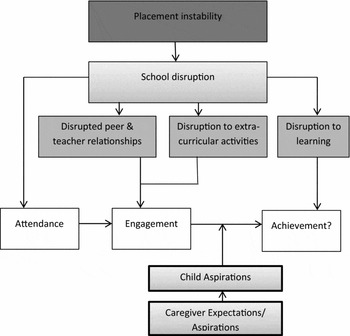
Educational attainment has been argued as the best predictor of outcomes for youth in OOHC (Mondy & Cook, Reference Mondy and Cook2009). The educational attainment of children in OOHC has often been compared with aged matched peers. Research consistently shows that children in care are doing less well than their aged match peers. However, educational attainment is influenced by a wide variety of factors; most notably placement and school stability (see Figure 1). When school moves occur they can be highly disruptive to the flow of learning for a child. Looking to educational attainment as a way to measure how children in care are faring may be misleading because children's true strengths and abilities can be overlooked. Educational attainment may not be wholly within the control of the supporting agency, or may not be amongst the core goals of an agency; they may focus on other areas of a child's educational experience, e.g. promoting relationships with peers through after school programmes, increasing foster care support to enhance educational engagement and encourage educational aspirations. The ‘points of influence’ of an agency may not align with the use of educational attainment as an indicator, and therefore, measuring attainment would misrepresent the relative influence of an agency.
Placement factors and educational outcomes of children in OOHC. Boxes outlined with thicker lines are theorised to represent areas of greater agency influence as they are less influenced by systemic or institutional factors. It is argued that such critical areas of agency influence represent a useful point through which to effectively evaluate how agencies are contributing to the educational outcomes and improving the lives of children they support.

Similarly, school attendance has also been used to assess how well children in OOHC are doing in an educational setting. Whether or not children in care are attending school is conceptually easy to measure, but may not be predictive of long term outcomes for children. While it is true that attendance is a necessary precursor to good outcomes, it is not sufficient to ensure good outcomes for children. The nature of a child's school attendance can vary markedly in terms of the number and type of lessons attended, and the level of support required to maintain a child's school ‘attendance’. In addition, a child's attendance may be determined by educational policy and practice rather than what the agency can achieve. Therefore, while recording attendance is important, it does not give a complete picture of a child's educational experience.
The relationships of systemic/institutional factors to the three main ways in which educational outcomes are commonly measured for children in OOHC are demonstrated below in Figure 1. The model also highlights areas which could be a focus of intervention to remove road blocks. For example, intervening with children's aspirations of educational attainment will moderate the relationship between engagement and achievement.
Implications for Future Practice and Monitoring
A percentage of children in OOHC do go on to achieve well (Martin & Jackson, Reference Martin and Jackson2002), yet there is little attention paid to how these children are able to overcome educational roadblocks and achieve positive developmental outcomes. More work needs to be done in this area as knowledge about how children with positive developmental outcomes jump over these roadblocks would help agencies inform interventions and develop policies.
A more complete picture might be obtained by considering the subjective aspects of a child's school experience, such as their level of engagement and enjoyment of school and expectations about their ability to succeed educationally. Educational engagement has not only been shown to be linked to improved performance, it also validates positive expectations about academic abilities (Skinner, Zimmer-Gembeck, & Connell, Reference Skinner, Zimmer-Gembeck and Connell1998). That is, a child that is engaged with, and enjoying school is more likely to believe in themselves and have positive expectations about their ability to achieve highly.
The educational aspirations of children and young people may also be a way we can measure how well children in OOHC are faring in education. Research demonstrates a strong link between how well children expect to do and their educational achievement (e.g. Lui, Ying-Yao, Chen, & Yuh-Yih, Reference Liu, Ying-Yao, Chen and Yuh-Yih2009). A recent longitudinal study by Zhang (Reference Zhang2011) found that a child's interpretation of the school environment was most crucial in forming their educational aspirations, which in turn was related to future academic achievements.
Teacher, carer and child reports of engagement and aspirations can be collected using traditional Likert scales (e.g. Cheung et al., Reference Cheung, Lwin and Jenkins2012). More creative ways of engaging children with assessment, such as using vignettes with storylines and asking which character they identify with may be more engaging and acceptable for children. It is our argument that services should be collecting information about carer and child aspirations and engagement with the school environment as part of their quality assurance processes, and as indicators or signposts of children's likely educational outcomes. These are factors upon which support agencies are able to have a significant impact – for example, by supporting the carer to generate an environment that values educational opportunity. They are also measures that are relatively easy to collect and provide an indicator of the support provided to carers that are largely, if not entirely, within the control of a support agency.
While the relationship between aspirations and educational outcomes is subject to discussion (Gorard, Huat See, & Davies, Reference Gorad, Huat See and Davies2012), it is likely that caregiver aspirations have attitudinal, knowledge and behavioural components that are amenable to change. Suggested possible areas of agency influence around enhancing caregiver aspirations include caseworkers facilitating caregiver understanding of the educational system, providing carers with training to become educational advocates for their youth and around how to make the home environment supportive of education (Mantilla, Reference Mantilla2012).
Conclusion
The picture of how to capture a child's educational environment is underdeveloped. This in turn provides support agencies very little guidance in how to monitor their impact on the educational achievements of the children they care for. Australian research has typically focused on measuring OOHC children's educational outcomes by comparing their level of achievement and attendance with their aged matched peers. This article has argued that attendance and achievement are only part of the picture of the educational journey experienced by children and young people in OOHC. The educational aspirations of children and young people (and those that care for them) may add significant explanatory power to our understanding of the outcomes for children and young people in OOHC. Critically, these are factors that support agencies can influence. This is in stark contrast to other measures such as educational attendance and attainment, which reflect a range of other influences. There is a need for research to focus on this part of the educational journey for children and young people in OOHC.