Introduction
Nephroma arcticum (L.) Torss. is a large foliose lichen with a circumpolar arctic-boreal distribution. It inhabits soils and bryophyte-covered rocks in spruce forests, in subalpine birch forests and in alpine and arctic heaths. In open subalpine forests the ground is often dominated by large thalli overgrowing terricolous bryophyte carpets. However, in the southern parts of its distribution it is restricted to bryophyte-covered rocks in old N-facing Picea abies forests (Hasselrot Reference Hasselrot1953). The main photobiont of N. arcticum is the green alga Coccomyxa sp., and the cyanobacterium Nostoc sp. is localized in scattered large internal cephalodia. Nephroma arcticum contains zeorin, nephroarctin, phenarctin, methyl gyrophorate and usnic acid (Vitikainen Reference Vitikainen2007). Methyl gyrophorate is produced in thallus tissues only where cephalodia are present (Tønsberg & Holtan-Hartwig Reference Tønsberg and Holtan-Hartwig1983). However, the cephalodia themselves contain no carbon based secondary compounds (CBSCs; Renner Reference Renner1980, Reference Renner1982).
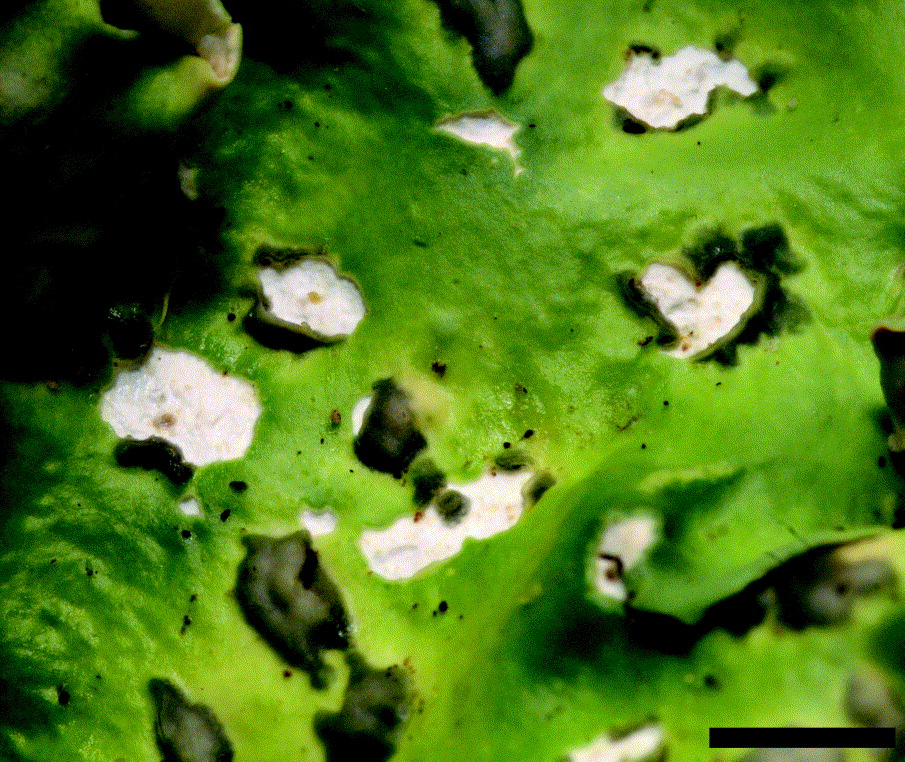
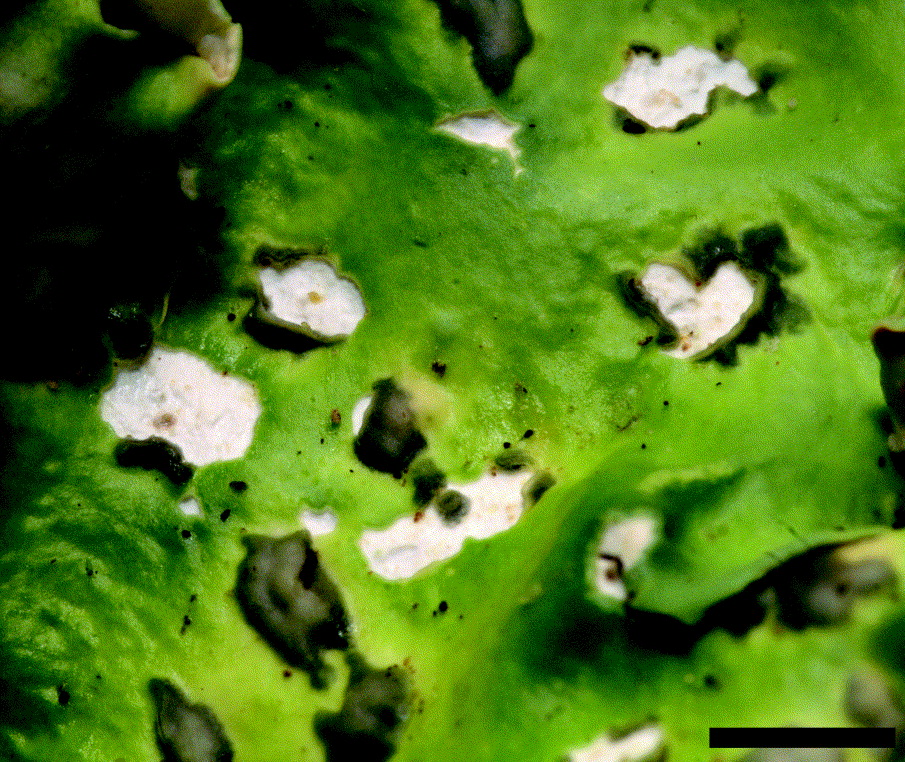
The habitat of N. arcticum is shared by a variety of mycophagous slugs, one of the more common is Arion fuscus. We have observed extensive grazing damage, probably by slugs, on the cephalodia of N. arcticum in the field, while the green algal thallus parts are usually untouched (Fig. 1). Since carbon based secondary compounds from a number of lichen species have been shown to deter grazing by various invertebrate lichen feeders (e.g. Reutimann & Scheidegger Reference Reutimann and Scheidegger1987; Gauslaa Reference Gauslaa2005; Pöykkö et al. Reference Pöykkö, Hyvärinen and Backor2005), we hypothesized that this might be the case here. The main objective of this study was to demonstrate the difference in gastropod preference for cephalodia and green algal thallus parts. Second, we aimed to investigate if the grazing preference depends on different chemical defence in these two thallus tissues. The grazing deterrent capacity of CBSCs in N. arcticum was studied using the acetone rinsing technique (Solhaug & Gauslaa, Reference Solhaug and Gauslaa1996; Reference Solhaug and Gauslaa2001). This method removes the CBSCs in living thalli and thereby allows a comparison of grazing in rinsed and control thalli.
Nephroma arcticum collected in mid-Norway with grazing restricted to the Nostoc-containing cephalodia. Photo: Johan Asplund. Scale: 3 mm.
Materials and Methods
Collection of material
Thalli of Nephroma arcticum were collected on 25 May 2008 in an open Picea abies forest on a west-facing slope at Reinfjellet, Nord-Trøndelag, Norway (64°18′ N, 11°22′ E, 300 m a.s.l.). The thalli were air-dried and stored in the freezer until the start of the experiments. The selected herbivore, the mycophagous slug A. fuscus Müller (1774), is known to consume lichens (Peake & James Reference Peake and James1967; J Asplund, pers. obs.). It shares habitats with N. arcticum and is common throughout the distribution range of the lichen in Scandinavia (Kerney & Cameron Reference Kerney and Cameron1979; Vitikainen Reference Vitikainen2007). Arion fuscus was collected from tree trunks and logs of P. abies in a riparian P. abies-Alnus incana forest close to UMB Campus, SE Norway (59°40′ N, 10°45′ E, 50 m a.s.l.). The slugs were starved for 24 h in the laboratory in a plastic container, lined with moist filter paper, before starting the feeding experiments.
Grazing experiments
Two feeding experiments were performed. First, we tested whether CBSCs deter grazing in N. arcticum. Ten thalli of N. arcticum were rinsed to remove litter and cut into two similar halves. One air-dry thallus from each pair was rinsed 4 times for 20 min in 100% acetone as described by Solhaug and Gauslaa (Reference Solhaug and Gauslaa2001). This rinsing procedure removes ∼ 97% (of the total amount) of nephroartin and phenarctin, but only ∼ 27% of usnic acid in this particular lichen species (McEvoy et al. Reference McEvoy, Solhaug and Gauslaa2007). The following morning all thalli were weighed (±0·01 mg) air-dry. Subsequently, each pair was placed in one plastic box (measuring 9 × 7 cm) and three randomly selected slugs were placed in between the thalli. Three animals were used in order to reduce individual feeding variability (Hanley et al. Reference Hanley, Bulling and Fenner2003). The boxes were sprayed with water and closed with a perforated lid, allowing air circulation and preventing slugs from escaping. The thalli were kept hydrated during the 24 h feeding experiment. Lichens were then rinsed from faeces and weighed when air-dry. In this experiment no distinction between different types of tissues were made. Preference was calculated as the biomass of one food type (with and without CBSCs) consumed divided by the total biomass consumed within each box (Lockwood Reference Lockwood1998).
In the second experiment we tested whether A. fuscus discriminates between green algal parts and cyanobacterial parts of the lichen. This experiment was performed on control and acetone rinsed thalli separately to test whether any discrimination was due to CBSCs. Hydrated thalli (10 of each treatment) were photographed with a Konica Minolta Dynax 7D digital SLR equipped with a Sigma 105 mm f2·8 DG EX Macro lens. For the photography, each thallus was placed on a millimetre graph paper and flattened with a piece of glass. Thereafter, each thallus was placed in a box together with 3 slugs for 24 h as described above. The areas of thallus, cephalodia and grazing marks on pre- and post experiment lichens were measured by polygon delineation in ArcGIS™ Version 9.2 (ESRI®, Redlands California). Images were georeferenced against the graph paper. The mean (± S.E.) area of the acetone rinsed thalli was 9·2 ± 0·4 cm2 of which the cephalodia comprised 0·76 ± 0·2 cm2 (8·3%). For the control thalli areas were 12·7 ± 1·3 cm2 and 1·6 ± 0·3 cm2 (12·6%) for whole thallus and cephalodia, respectively. The percentage grazed of the initial area of each thallus type was used as a response variable. We assumed that significantly different response values for the different thallus types indicate a non-random feeding pattern.
Quantification of CBSCs
Thallus parts with and without cephalodia were cut with a razor blade from 10 separate thalli. Several thallus parts, with the mean total dry weight 13·9 ± 1·2 mg, were used from every thallus. The thallus parts with cephalodia included adjoining fungal tissues.
Carbon based secondary compounds were extracted with 1 ml N,N-dimethylformamide (DMF) from hydrated thalli for nine days in a refrigerator. Compounds extracted with DMF were quantified by HPLC using an ODS Hypersil column, 250 × 4·6 mm using 0·25% orthophosphoric acid and 1·5% tetrahydrofuran in Millipore water (A) and 100% methanol (B) as mobile phases at 1 ml min−1, and UV detection at 245 nm. The run started with 30% B which was increased to 70% after 15 min. After a further 15 min 100% B was reached and held for 5 min after which the amount decreased to 30% in 1 minute. A 10 min post-run of 30% B was performed. Compound identification was based on retention times, online UV-spectra and co-chromatography of commercial standard usnic acid (Sigma, St. Louis, USA). All substances were quantified on a relative scale against response curves of the usnic acid standard.
Results
Purely green algal thallus parts contained twice the concentration of the medullary depsides, nephroarctin and phenarctin, as well as the cortical dibenzofurane, usnic acid, than did thallus parts with cephalodia (Table 1). However, the tridepside methyl gyrophorate was only found in thallus fragments with cephalodia.
Mean concentration (mg g−1 ± 1 S.E.; n = 10) of carbon based secondary compounds in thallus parts of Nephroma arcticum with or without cephalodia. Thallus parts with cephalodia also include cortex and medulla.

The slug A. fuscus clearly preferred acetone rinsed CBSC-deficient thalli of N. arcticum (49·7 ± 5·0 mg, or 85·2 ± 5·1% of total consumption) over control thalli (8·21 ±2·8 mg, or 14·8 ± 5·1%; t = 9·7, df = 18, P < 0·00001, t-test).
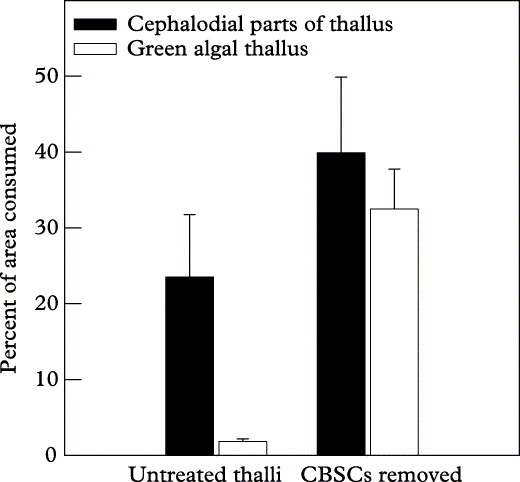
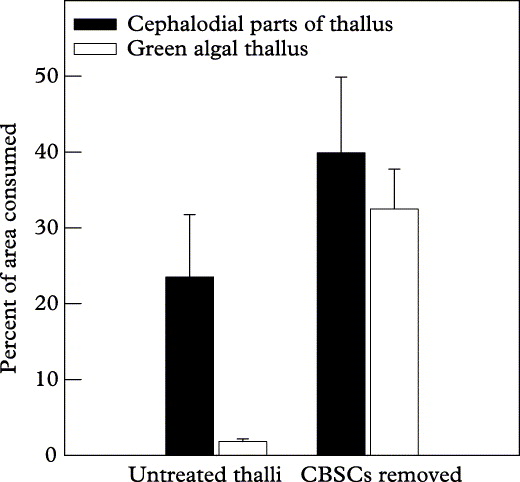
Arion fuscus also appeared to graze selectively on the cephalodia and avoid the green algal thallus (Fig. 2; t = 2·7, df = 9, P < 0·05, paired t-test). However, no such selective feeding pattern was observed following removal of CBSCs (Fig. 2; t = 0·72, df = 8, P = 0·49, paired t-test).
Differential grazing by the slug Arion fuscus on Nephroma arcticum. Percent of area removed of cephalodia and thallus for lichens with (n = 9) and without (n = 10) carbon based secondary compounds. Data are presented as mean % ± S.E.
Discussion
We have shown that mycophagous A. fuscus slugs selectively feed on the cephalodia on N. arcticum (Figs 1 & 2). However, the slugs did not show such selective feeding patterns after CBSCs had been removed. This indicates that CBSCs protect green-algal parts of N. arcticum against grazing, as has been shown for a number of different lichen species (Gauslaa Reference Gauslaa2005; Pöykkö et al. Reference Pöykkö, Hyvärinen and Backor2005). The observed preference for cephalodia can be explained by the lack of CBSCs in the cephalodia (Renner Reference Renner1980). Any substances observed in cephalodial thallus parts are produced in the fungal tissues below and/or above the cephalodia. Consequently, lichen compounds show lower concentrations in cephalodial thallus parts than in green algal parts. Since the tridepside methyl gyrophorate is found only in the presence of cephalodia (Tønsberg & Holtan-Hartwig Reference Tønsberg and Holtan-Hartwig1983), it is reasonable to assume that methyl gyrophorate does not significantly deter grazing.
Previous studies indicate no strong preference for lichen cephalodia generally. In many cases, cephalodia appear to be avoided. For example, in the case of Sticta canariensis, which lacks CBSCs, gastropods prefer the green-algal morphotype to the cyanobacterial one (James & Henssen Reference James, Henssen, Brown, Hawksworth and Bailey1976), suggesting that cyanobacteria per se are not attractive as slug fodder. Furthermore, lichenivorous snails on calcareous rocks fed primarily on green algal lichens, but the snails did feed on free-living cyanobacteria as well (Fröberg et al. Reference Fröberg, Baur and Baur1993). However, lichens were preferred over free-living cyanobacteria and a pure cyanobacterial diet resulted in lower growth rates of calcareous rock-dwelling snails than a lichen diet (Baur et al. Reference Baur, Baur and Fröberg1992, Reference Baur, Baur and Fröberg1994).
What are the possible ecological consequences of this preferential removal of Nephroma arcticum cephalodia by slugs? Thalli of N. arcticum subjected to N-starvation by removal of cephalodia were found to have 20% lower N concentration, which severely reduces thallus expansion (although weight gain is unaffected; Sundberg et al. Reference Sundberg, Näsholm and Palmqvist2001; Dahlman et al. Reference Dahlman, Näsholm and Palmqvist2002). This suggests that grazing of cephalodia might reduce competitive abilities of N. arcticum. In Europe (Poelt Reference Poelt1969) and North America (Brodo et al. Reference Brodo, Sharnoff and Sharnoff2001), N. arcticum is restricted to northern latitudes. Its abundance in Fennoscandia sharply declines towards the south (Hasselrot Reference Hasselrot1953), where there is also an increased diversity of lichenivorous gastropods in N. arcticum habitats (Kerney & Cameron Reference Kerney and Cameron1979). These opposite trends suggest that lichenivorous gastropods might play a role in shaping the southern distribution boundary of N. arcticum.
We thank Per Larsson for collecting Nephroma arcticum and Dr Line Nybakken for discussions.