1. Introduction.
A typical, informal characterization of symmetry goes: “The term ‘symmetry’ … is the Greek for ‘proportionality, similarity in arrangement of parts’” (Tarasov Reference Tarasov1986, 10). In our homely moments, we might use phrases like equality of parts, harmony or equivalence of parts, regularity in the arrangement of parts, to describe our intuitions about what makes an object symmetric. Despite the strength of our intuitions however, intuitive definitions remain vague and so there have arisen formal definitions of symmetry. Formal definitions come at a price. What was intuitively symmetrical may be formally asymmetrical and, as we will show for groups and groupoids, this can depend on the choice of formalism.
Some may object that symmetry already has a formalism: a symmetry is a group of automorphisms. But recent philosophical literature on symmetry has focused on three domains: (1) determination of consequences of particular symmetries in physics, (2) historical study of the concept ‘symmetry’, and (3) metaphysical implications of the presence of symmetry in scientific theories. That is, little or nothing has been published in philosophy examining the adequacy of the accepted formalism for capturing the concept of symmetry.Footnote 1 We suspect that most philosophers accept mathematical groups as the one formal definition of symmetry, many going as far as identifying symmetry with the formalism. At the very least, the group definition becomes the scythe with which to ‘mow down’ spurious cases; one might think some object or property has or is a symmetry, but if a group definition cannot be provided then it was not a ‘real’ symmetry after all.
A fundamental issue for the philosophy of science is the relation between mathematics and nature. We want to here consider symmetry in that light. That is, we want to allow, for the sake of argument, that the proper way to formalize symmetry is not yet settled; that our intuitions about what makes an object symmetrical can still inform the mathematics of symmetry. Specifically, we consider how the groupoid formalism relates to symmetry and how it might do a better job than groups of capturing our intuitions while still performing all the functions of groups.
Symmetry is central in physics, connected with the view that the goal of physics is ultimately to capture invariant physical features with respect to groups of physically equivalent situations, to capture the objective part of the physical world. The idea, very roughly, behind connecting symmetry and objectivity in this way is that there is ‘stuff’ that matters and ‘stuff’ that doesn’t. When we make changes that we think ought not to matter, some other things will change along with them; but some others will not. The things that do not change will be identified by symmetries. These will be the features that matter.
We do not challenge this position. Rather, as far as it goes, we endorse it. What this article explores, however, is the complex ‘bootstrapping’ that must occur when our intuitions about a concept initially drive formalization but that formalism is then turned around to prune our intuitions. We would like symmetries simply to tell us what is objective and what is not, but only symmetries with respect to those changes that do not alter the physical situation represent objective features. We must appeal to other reasons, including our intuitive ideas about symmetries, as to when situations are physically equivalent or not.Footnote 2
At the same time, mathematicians have argued for the more general groupoids as the correct formalism for treating symmetries. At the fork in the road between groups and groupoids lies a distinction between local and global symmetries. For physicists, the local/global symmetry distinction is aligned with the distinction between local and global transformations. For mathematicians, the distinction is based on whether part or the entire structure is conserved (the former requiring a groupoid and not group representation). Again, we take the salient point to be that this difference exists because intuitions about cases of symmetry are driving choices of formalism. This is notwithstanding the philosophically accepted identification of symmetries with automorphism groups regardless of intuitions. We explore wherein this difference of opinion lies and how to unify the two views.
The important further consideration is in what way the concept of physical objectivity must be revised if we extend the formal definition of symmetry. Does objectivity attach to the concept of symmetry or to the restricted notion of automorphism? It is not our goal to speculate how physics would be done in a universe of different-thinking physicists. Our goal is to examine the assumptions behind the use and formalization of symmetry and to motivate possible formal alternatives from a better understanding of those assumptions.Footnote 3
We first provide a description of the modern group formalization of symmetry, followed by the presentation of three examples we think demonstrate the incompleteness of the group formalization. We show, in Section 4, how the extension from group to groupoid naturally arises in conjunction with a generalization of the objects that the former concept ought to apply to.
Groupoids, we will show, allow us to consider symmetry among the parts of objects and not only symmetries of transformations of the object (that is, automorphisms.) However, we question whether this otherwise interesting generalization, as it is usually presented, ought to be considered a proper extension of the formal definition of symmetry. Our contention is that it goes too far. An interesting middle ground can be found, we will show, by starting with equivalence relations. First we must consider groups and automorphisms.
2. Symmetry and Groups.
Consider the familiar example of the (twodimensional) six-branched snowflake and those characteristics regarded as constituting its symmetry. Each branch is identical to any other in all its geometrical features, so equality of parts with respect to the whole ought to be involved in any notion of geometrical symmetry. This is not sufficient however, as not everything with six identical parts possesses the symmetry of a snowflake. The relation of the branches to each other is also essential, as is their regular distribution around the center. Furthermore, the snowflake lacks orientation, being neither left- nor right-handed. Parity (mirror reflection) is therefore also part of the symmetry.
All these properties characterize the geometrical symmetry of the snowflake. It is a typical case of what some authors (e.g., Castellani [Reference Castellani, Brading and Castellani2003, 426]) call the modern notion of symmetry.Footnote 4 On the modern notion, symmetry is always a property of the whole and the invariance that matters is with respect to a transformation of the entire object. On the modern notion, when an equivalence of parts characterizes the symmetry of an object, that symmetry is represented by a transformation of the entire object that results in the interchange of the equivalent parts. (More on this below.)
The modern notion of symmetry is, in fact, a special case of a much older notion of symmetry, exemplified for example by Vitruvius's ([1st century BCE] Reference Rowland1999, 25) definition: “Symmetry is proportioned correspondence of the elements of the work itself, a response, in any given part, of the separate parts to the appearance of the entire figure as a whole. Just as in the human body there is a harmonious quality of shapeliness expressed in terms of the cubit, foot, palm, digit, and other small units, so it is in completing the work of architecture.”
For Vitruvius, symmetry was a kind of relation between parts. Note he does not say equal correspondence of the elements but rather proportioned correspondence. The notion is broad—proportionality is enough, ‘as in the human body’. We will return to this in the following sections.Footnote 5
There is an elegant and easily generalizable way to formalize this geometrical symmetry of the snowflake. The identified regularities of the snowflake can be associated with certain changes of space that lead to a geometrically congruent configuration of the snowflake. (Notice we now talk of transformations of the space rather than the object. This is the first abstraction away from intuitive notions about symmetry having to do with the interchanging of equivalent parts.) Two figures are geometrically congruent when one can be transformed into the other by an isometry (a bijective map that preserves distances). We associate with the fact that the branches are identical and equally distributed around the center the set of rotations of a multiple of 60°. This set has six members, including the identity rotation, e, of 360°. The inverse of any of these rotations is also in the set (e being its own inverse.) Because of their reversibility, the rotations are isomorphisms. Because they preserve the structure of the object (geometric congruence) they are automorphisms.Footnote 6 Since the snowflake lacks orientation, some of its reflections are also automorphisms. Specifically, the set of automorphisms of the snowflake also includes reflections in any plane passing through the center of the snowflake and falling either on the axis of one of the branches or midway between those axes.
These automorphisms form a set  $\mathstrut{\cal S} $ that exhibits a certain, formally characterizable, structure. If we successively apply any two elements of the set, the resultant transformation is also in the set
 $\forall \, g,\,h\in \mathstrut{\cal S} ,\, gh=p\in \mathstrut{\cal S} $. For all automorphisms in
 $\mathstrut{\cal S} $, its inverse is also in
 $\mathstrut{\cal S} $:
 $\forall \, g\in \mathstrut{\cal S} $,
 $\exists \, g^{-1}\in \mathstrut{\cal S} $ such that
 $g^{-1}g=gg^{-1}=e$. Finally, automorphisms are associative:
 $\forall \, g,\, h,\, p\in \mathstrut{\cal S} $;
 $g( hp) =( gh) p$. These properties define a mathematical group: in our example the symmetry group, set
 $\mathstrut{\cal S} $, corresponds to an abstract group known as
 $D_{6}$. This abstract group can now be identified with the regularities that intuitively make the snowflake symmetrical.
We can now introduce Hermann Weyl's definition of symmetry based on the notion of group: “Given a spatial configuration  $\mathstrut{\frak F} $, those automorphisms of space which leave
 $\mathstrut{\frak F} $ unchanged form a group Γ, and this group describes exactly the symmetry possessed by
 $\mathstrut{\frak F} $” (Reference Weyl1952, 45; emphasis in original). From our beginning intuitions of symmetry we have passed to a rigorous definition based on the structural properties of a set of transformations of space.Footnote 7
The ‘cost’ of adopting this definition is proportional to its clarity. It clarifies by eliminating some of the diverse applications of the informal concept of symmetry. Of course to some, this is no cost at all—the point of the formal definition was to eliminate spurious intuitive cases and, especially in physical contexts, to guard against the merely aesthetic. The challenge then, is to give instances where nonspurious cases are eliminated. In the following section we provide a beginning in this direction. Our first move is to point out an inherent limitation in the group formalization of symmetry for representing equivalence relations in general.
The connection between the automorphism group and equivalence relations, which we make explicit here, reveals a limitation inherent in identifying symmetries with automorphism groups (Weyl's definition). This definition ties symmetry to a special property of the whole object that, in turn, excludes some local properties that we would like to call symmetries.Footnote 8
In the case of the snowflake, how should we interpret the already established group of automorphisms  $\mathstrut{\cal S} $? Among all morphisms of the snowflake, those belonging to the symmetry group
 $\mathstrut{\cal S} $ are those that transform the snowflake into an equivalent configuration. Based on that group, we can define an equivalence relation as follows: a configuration
 $u$ is equivalent to a configuration
 $v$ if and only if there exists a transformation
 $T\in \mathstrut{\cal S} $ such that
 $T( u) =v$. The formal characteristics of an equivalence relation are that they are reflexive, symmetric, and transitive. The definition just given has those properties, as can easily be proved from the properties of the group.
Symmetry thus implies invariance of the whole. From  $\mathstrut{\cal S} $ we can derive an equivalence relation of parts (in this case an ‘equality of parts’). The branches of the snowflake can transform into each other through rotations and reflections, which are operations on the whole snowflake. But not all equivalence relations among parts of an object correspond to an automorphism group. Since automorphisms are isomorphisms; they preserve relations among elements. In geometrical cases, they preserve neighborhoods. Consequently, an equivalence relation of parts that does not preserve neighborhoods will not correspond to an automorphism group. Given good reason to consider such an equivalence also a symmetry would then drive a wedge between symmetry and automorphisms. The following examples illustrate how such reasons might arise.
3. Some Examples.
The following are cases we feel suggest symmetries that are incompatible with the Weyl's definition as characterized up to now.
3.1. Potentially Infinite Structure.
Representation of the symmetry of infinite patterns requires the use of groups with an infinite number of elements. For example, for a band ornament composed of a repeated nonsymmetrical figure, the elements of the group of automorphisms  $\mathstrut{\cal S} $ can be generated by the indefinite iteration of the basic translation
 $T$ that brings a figure to its closest neighbor on the right (positive superscripts) or left (negative superscripts):
 $\mathstrut{\cal S} =\{ T^{n}\} $ where
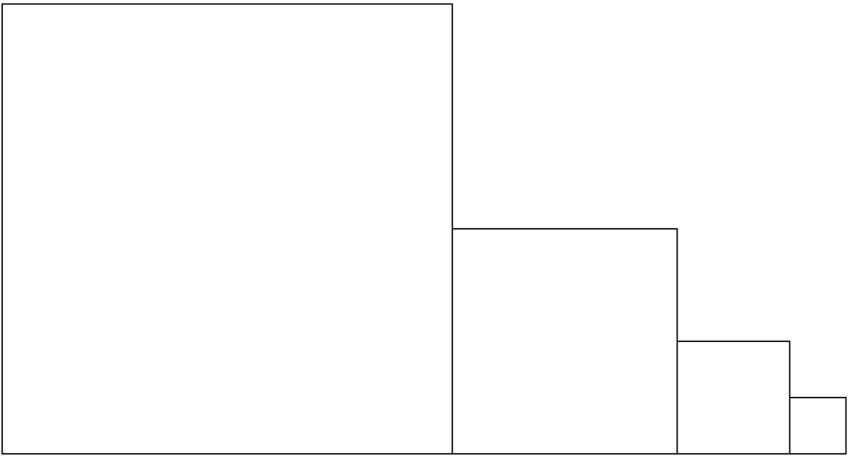
 $n=0,\,\,\pm 1,\,\,\pm 2,\,\ldots \,$. A problem arises, however, for potentially infinite but finite patterns such as Figure 1.
An example of a potentially infinite structure.

At least part of the symmetry of this figure can be represented by a dilatation transformation  $d=1/ 4$. If the pattern were completed in both directions, these transformations, which conserve similarity but not congruence, would form a group
 $\mathstrut{\cal S} =\{ d^{n}\} $, where
 $n=0,\,\,\pm 1,\,\ldots \,$.
 $\mathstrut{\cal S} $ is a symmetry group since its action conserves the shape of the infinite pattern. For the finite pattern, such a group cannot be defined because we do not have closure of the group operation.Footnote 9 In the absence of a group, does Figure 1 lack symmetry? Weyl, for one, classifies examples like these—consider seashells—as symmetrical examples.
Granted, the symmetry of such finite but potentially infinite patterns is taken to be the symmetry group of the associated infinite pattern. After all, symmetry transformations of the finite pattern are part of  $\mathstrut{\cal S} $. But this means that
 $\mathstrut{\cal S} $ describes not only the symmetry of Figure 1 but also all similar patterns with any number of square tiles. This is too crude. One single square, the pattern of Figure 1, and the infinite pattern do not intuitively exhibit the same symmetry. At the very least, if a richer formalism is available that tracks differences among these structures, we think one ought to employ it.
3.2. Abstraction and Group.
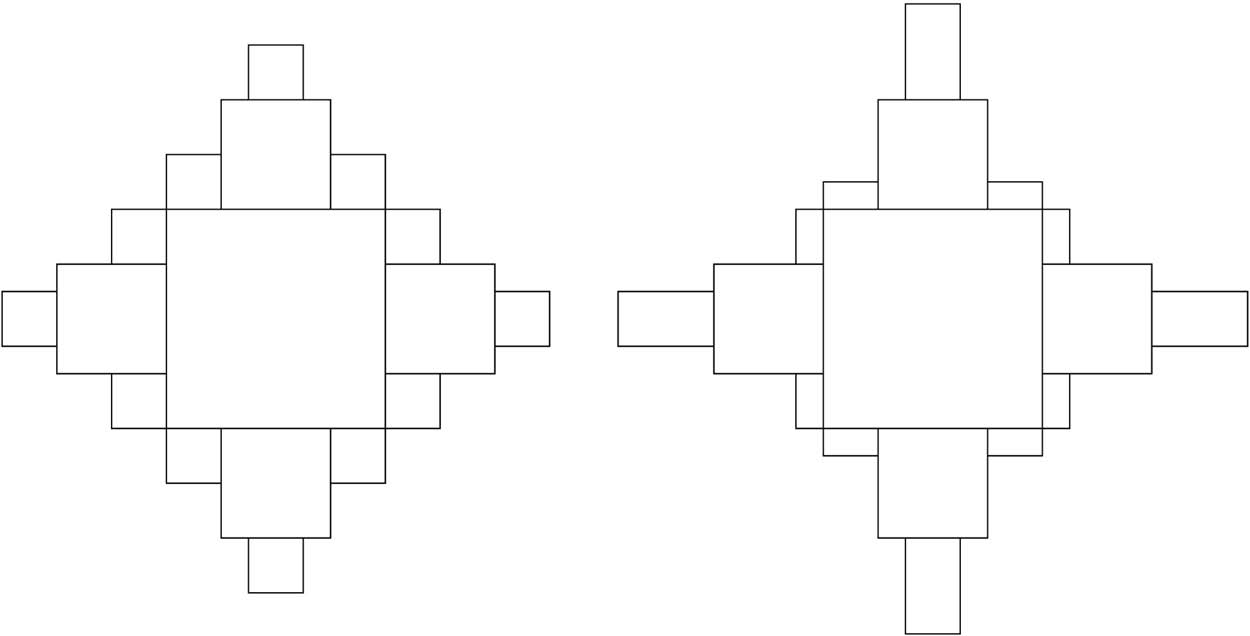
The two patterns in Figure 2 have the same automorphism group. Do they have the same symmetry? Based on the group of automorphisms  $\mathstrut{\cal S} $, one can define an equivalence relation between parts, and in particular between tiles.
 $\mathstrut{\cal S} $ associates all identical tiles but not nonidentical tiles. In the first pattern the ratio between the sides of the tiles is 2 or 4. The second pattern is not as regular. This discrepancy in the regularity of tiles is a difference in the symmetry of these patterns. The automorphism group does not discriminate between proportioned square tiles of the first figure and the irregular tiles of the second one. The group formalization of symmetry therefore, in this case, abstracts too much. By concentrating on symmetry as a property of the whole it neglects some local (ir)regularities. Again, we claim, a richer formalism is needed.
Figures with the same symmetry groups.

A few words about our last assertion: when we say that the automorphism group abstracts too much, this can be understood in two ways. First, the obvious meaning is that the group of automorphisms only represents ‘equality of tiles’ relations, thus it completely misses all information about the ‘proportioned correspondence’ between tiles that is part of the older notion of symmetry (see the Vitruvius definition). Second is a more mathematical meaning. In the spirit, if not in the letter, of the Erlangen Program, it is often understood that two geometrical entities with isomorphic automorphism groups are structurally the same, and therefore as far as mathematics is concerned, are the same. In the case of many mathematical abstractions, the loss of details in passing from a geometrical entity to its associated couple of manifold plus automorphism group is welcome because only invariant features are of any interest. However this is not always the case. In Figure 2, we would like to use a formalism where the invariant transformations differentiate the two figures.
3.3. The Hydrogen Spectrum.
The hydrogen spectrum is rather different, and perhaps more interesting, than the usual geometrical cases of symmetry.Footnote 10 Yet it serves as a compelling example of symmetry nonetheless.
In the nineteenth century it was discovered that light from a tube of pure gas, such as hydrogen, when analyzed with a spectrometer, is emitted as a certain number of lines of discrete wavelengths. This spectrum provides a signature for the element under consideration, having a specific structure. Rydberg showed that, for many atoms, the lines of the spectrum can be organized into a series indexed by  $m$, each having the form

where  $R$ is Rydberg's constant and
 $\lambda $ is the wavelength. If we consider frequencies
 $\nu =c/ \lambda $ rather than wavelengths, the measured spectrum can be defined as a set of differences of frequencies: introduce an auxiliary set of indexed frequencies,
 $I$, where
 $\nu _{i}=RC/ i^{2}\in I$, defined by the Rydberg formula such that the spectrum is the set of differences
 $\nu _{ij}=\nu _{i}-\nu _{j}$, where
 $\nu _{i}$,
 $\nu _{j}\in I$, and
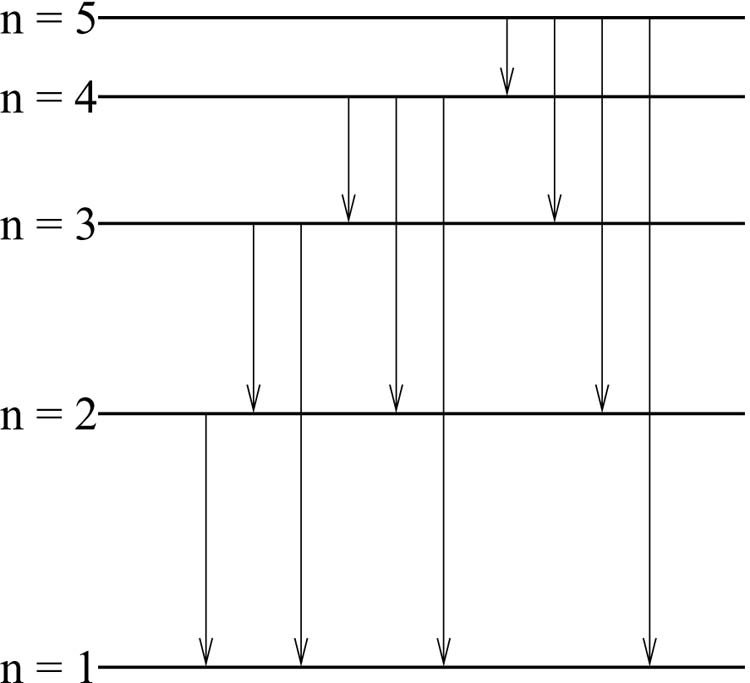
 $j> i$. Now that we rewrote equation (1) using frequencies, we note something that is obvious when we look at Figure 3. The Ritz-Rydberg combination principle follows immediately from this definition: for two frequencies
 $\nu _{ij}$ and
 $\nu _{jk}$, if they are in the spectrum,
 $\nu _{ik}=\nu _{ij}+\nu _{jk}$ is also in the spectrum. In order to be combined the frequencies must share the index
 $j$. The spectrum therefore has a partially defined law of composition, and so does not have a group description.
Spectrum for  $n=5$.

Figure 3 represents spectrum lines as arrows between the auxiliary frequencies  $\nu _{i}$, for
 $i=1,\, 2,\, 3,\, 4,\, 5$. This is an illustration of a symmetry that is not covered by the group definition, since it is a symmetry that goes beyond ‘equality of parts’ with respect to the whole. Firstly, it is not simply a matter of the spatial transformation of a figure. The spectrum exhibits a more general correspondence among its parts, exemplified by the Ritz-Rydberg principle. There is in the spectrum a kind of Vitruvian harmony of parts, based on an arithmetic relation with a regular development of structure but still strongly suggesting an application of the concept of symmetry. (However, in our terminology, this property is M-local not M-global.) The symmetry is a property associated to the structure of the set of frequencies
 $I$; however, its automorphism group does not represent it.
The suggestion of symmetry is made more precise by identifying the abstract mathematical structure of the spectrum and, while this structure cannot be given a group theoretic representation due to its partial definition, it can be captured by the groupoid formalism. To our knowledge, Alain Connes was first to identify the abstract structure of the spectrum as a groupoid, and the example plays an important role in his Noncommutative Geometry (Connes Reference Connes1994, 34–39). As Connes did not provide the details of his claim though, we do so in the next section.
4. From Symmetries to Groupoids.
A groupoid can be thought of as a group with many objects or as a collection of related groups.Footnote 11 It is formally defined as follows:Footnote 12
Definition 1 (Groupoid G). A groupoid on a set  $B$, called the objects or base, is a set
 $G$, called the elements or arrows, with mappings
 $\alpha $ (the source) and
 $\beta $ (the target) from
 $G$ to
 $B$ and a partially defined, closed binary operation
 $( g,\, h) \mapsto gh$, on the elements of
 $G$, satisfying the following conditions:
1.
 $gh$ is defined whenever $\alpha ( g) =\beta ( h) $, and in this case $\alpha ( gh) =\alpha ( h) $ and $\beta ( gh) =\beta ( g) $. (That is, arrows $g$ and $h$ can be composed only if the source of arrow $g$ is the target of arrow $h$.)
2. Associativity: if either of
$( gh) k$ or $g( hk) $ is defined so is the other and they are equal.3. For each
$g\in G$, there is a left and a right identity $\lambda _{g}$ and $\rho _{g}$ in $G$, respectively, satisfying $\lambda _{g}g=g=g\rho _{g}$.4. Each
$g\in G$ has an inverse $g^{-1}\in G$, satisfying $g^{-1}g=\rho _{g}$ and $gg^{-1}=\lambda _{g}$.





The limiting cases are:
• If a groupoid has only one object (
$B$ has one element), then it is a group. Groups are simple cases of groupoids.• If a groupoid contains only identities (arrows returning to the same element of
$B$), then this is a space without structure. It can be identified with the base $B$.


To illustrate this definition, let us define the groupoid  $\Delta $ associated to the Rydberg spectrum. The set of emitted frequencies does not form a group because the Ritz-Rydberg combination principle defines only a partial operation, but we can use the principle to build a groupoid. Define the base space as the set of auxiliary frequenciesFootnote 13
 $I$ and the elements of the groupoid
 $\Delta $ as the set of all pairs
 $( i,\, j) $ of indices of frequencies
 $I$. The source and target will be
 $\alpha {:}\thinspace \:( i,\, j) =\nu _{j}\in I$ and
 $\beta {:}\thinspace \:( i,\, j) =\nu _{i}\in I$, for all pairs
 $( i,\, j) \in \Delta $. The binary operation on these pairs, defined when
 $\alpha ( i,\, j) =\beta ( j,\, k) $, will be
 $( i,\, j) \cdot ( j,\, k) =( i,\, k) $. This type of groupoid is called a pair groupoid. We will return to this in the next subsection.The connection of
 $\Delta $ with the spectrum is defined by the homomorphism
 $( i,\, j) \mapsto \nu _{ij}=RC/ i^{2}-RC/ j^{2}$, where
 $\nu _{ij},j> i$ is an emission.Footnote 14
What we have done is easily understood if we look back at Figure 3. Each arrow in the figure (actual measured frequencies of the spectrum) correspond to an element of  $\Delta $. Each level
 $n$, which is associated to the frequency
 $\nu _{i}\in I$, corresponds to an element of the groupoid base space. The Ritz-Rydberg combination principle correspond to the partially defined operation of the groupoid. The only thing added to Figure 3 is the possibility of absorption lines, of arrows going backward in the figure.
Since groups are a special case of groupoids we can consider the groupoid to be a natural extension of the group concept. We see two ways to connect groupoids with the concept of symmetry. First, noting that a symmetry is traditionally represented by an automorphism group, an extension of the concept of automorphism to the groupoid formalism could also represent a symmetry. Second, we could concentrate on an analysis of the property that constitutes a symmetry itself. Weyl's definition denotes a certain kind of equivalence relation between parts, namely an equality of parts with respect to the whole. A more general equivalence relation among parts, formalized with groupoids, might also be a symmetry. We explore both possibilities in the next two subsections.
4.1. Groupoid and Automorphism.
We previously defined the symmetry group of an object or a system as its group of automorphisms. We now extend this notion to groupoids. That is, we want to generalize the notion of an automorphism group to more than one object or system. Consider an indexed family,  $E=\{ E_{x}\} _{x\in B}$, of structures. These structures can be thought of as constituting a bundle,
 $E$, over
 $B$, with a projection
 $\pi {:}\thinspace \: E\rightarrow B$, and with
 $E_{x}=\pi ^{-1}( x) $. The general automorphism group of such a complex structure is appropriately expressed by the groupoid
 $G( E) $, with object set
 $B$, and with elements consisting of all isomorphisms
 $E_{x}\rightarrow E_{y}$,
 $\forall \, x,\, y\in B$. For
 $x\in B$, the subgroupoidFootnote 15
 $G( E_{x}) $ of just those automorphisms of
 $E_{x}$ expresses the symmetry of
 $E_{x}$ (note that
 $G( E_{x}) $ is then a group.) These symmetries are included in the groupoid
 $G( E) $. But in addition to the symmetries of each object, any isomorphism between structures
 $E_{x}\rightarrow E_{y}$ allows us to define an isomorphism
 $G( E_{x}) \rightarrow G( E_{y}) $ of their groups, thus defining a transport of symmetry, a term owing to Ronald Brown (Reference Brown1987). Such a groupoid is called a symmetry groupoid.
This notion of transport of symmetry is the main novelty of the use of groupoids as a formalization of symmetry. However, labeling all isomorphisms  $G( E_{x}) \rightarrow G( E_{y}) $ in this way, as a transport of symmetry, can be misleading. As mentioned in the preceding section, the automorphisms of an object that ought to be included in a symmetry group depend on what structure is to be conserved and under what changes. Brown's notion of symmetry transport applies to any and all isomorphisms and so is too liberal.
Consider, for instance, a square  $E_{1}$ and a rectangle
 $E_{2}$. There is an isomorphism between these figures,
 $E_{1}\rightarrow E_{2}$, entailing an isomorphism between their symmetries,
 $G( E_{1}) \rightarrow G( E_{2}) $. But in this particular case,
 $G( E_{2}) $ will include transformations that are not isometries. We can say a square and rectangle have the same symmetry when metrical properties are not taken in account, but we may not want to ignore those properties in all contexts. Without a context dependence of its own, Brown's definition cannot be an adequate extension of a context dependent conception of symmetry (although it would remain a useful extension of the concept of automorphism). Symmetry is a kind of relation of parts. The kind of harmony of parts in which we are interested must be specified: equality, proportion, and so on.
There is a middle way however, between, on the one hand, restricting symmetry to only automorphisms (i.e., using only the group formalism) and taking all isomorphisms to identify symmetries, as with Brown's transport of symmetry. While symmetry groupoids, thus defined, are the natural mathematical generalization of the symmetry group concept, they are too large an extension. Mediating between these extremes requires consideration of the group to groupoid extension in terms of equivalence relations. We can then reconsider transport of symmetry: with the examples in mind, we take an isomorphism to be a symmetry transformation only when it denotes an equivalence relation between parts. We need, therefore, to clarify the relation between groupoids and equivalence relations.Footnote 16
4.2. Groupoids and the Equivalence of Parts.
Earlier we showed how symmetry groups can be associated with an equivalence relation between states of the object or system studied. Equivalence relations divided the state space into classes of equivalent states and symmetries were those transformations of state space that left the equivalence classes intact. We discuss next how groupoids are related to equivalence relations, but among parts, not states.
Take any set  $B$. The product
 $B\times B$ is a pair groupoid over
 $B$ if we define operations
 $\alpha ( x,\, y) =y$,
 $\beta ( x,\, y) =x$, and
 $( x,\, y) \cdot ( y,\, z) =( x,\, z) $ for pairs of elements of
 $B$.Footnote 17 A subgroupoid of
 $B\times B$, which is any subset of pairs closed under product and inversion and containing all identity elements, will have all the formal characteristics of an equivalence relation on
 $B$. The individuals of the pairs of that subgroupoid will be equivalent. We have the freedom to choose which equivalence relations we are interested in and hence which subgroupoids representing them.
Groupoids, then, can be understood not only as generalized groups but this last construction shows we can also see them as generalized equivalence relations. A groupoid over  $B$ represents for us (through its subgroupoids) which elements of
 $B$ are equivalent to one another and parameterizes the different ways in which elements are equivalent (isomorphisms between structures). With groups, one is forced to consider transformations of the object as a whole and hence, partial and internal symmetrical relations of parts of that object could not be represented. If we let elements of
 $B$ refer to parts, then an equivalence relation on
 $B$ is naturally associated with a groupoid. Groupoids open the door for what we will call local symmetries. This is clarified in Section 5 and demonstrated with the examples in the next subsection.
4.3. Groupoids and the Examples.
A restricted version of Brown's definition of the symmetry groupoid is appropriate for representing the symmetry of a potentially infinite structure like Figure 1. Define the family of structures  $E=\{ E_{x}\} _{x\in B}$ as the set of tiles. The groupoid
 $G( E) $ includes all automorphisms of the tiles themselves and the isomorphisms between tiles. Thus
 $G$ captures the symmetry of each tile and similarity relations between them. Addition or subtraction of tiles modifies
 $G$. If there is only one tile then
 $G$ reduces to the symmetry group of that tile, as expected. If the pattern is infinite then the symmetry group
 $\mathstrut{\cal S} $ is included in
 $G$.
In cases like Figure 2, where the relative position between tiles is key, we define the base space  $B$ to be the plane equipped with its usual metric. In this example the parts are points. If
 $H$ is the group of all Euclidean movements of the plane then the groupoid representing the symmetry is

 $G$ expresses the symmetry of the whole figure but also relations of similarity between tiles. This surplus of relations allows us to differentiate the symmetry between patterns in Figure 2. The condition ‘occupy the same relative position’ is shorthand for the equivalence relations we are allowing between the tiles. In the second figure, for example, points on long sides of rectangles are equivalent to those on other long sides. Just that amount of information needed to characterize the local regularities of these patterns—which we consider part of the symmetry—has been added to the symmetry group.
Groupoids are also the right formalism for capturing the symmetry of the spectrum. The arithmetic regularity of the spectrum, which we call its symmetry, is captured by the groupoid  $\Delta $. Having the notion of a symmetry groupoid in mind, we should not be surprised. In this context, the symmetry groupoid represents the geometrical symmetry of a multipart system;
 $\Delta $ represents the symmetry relating the different elements of the same system
 $\{ I\} $. In the spectrum case, the transport of symmetry concept is important since all isotropy groups are trivial.Footnote 18 What is significant is the arithmetic structure of morphisms between objects. And while the structure of this particular example is not that rich, the groupoid formalism is flexible enough to accommodate much richer structures.
Looking at the formalization of the symmetry of these examples, we note two common features of the use of groupoid: (1) The object space  $B$ refers to parts of the system under study. (2) Elements of the groupoid refer to equivalence relations of parts. It is of course possible to use the groupoid formalism to represent equivalence relations between states: take
 $B$ to be the state space and allow only groupoid arrows compatible with the equivalences classes generated by the symmetry. However, in this case, groupoids seem to provide no advantage over the group formalism. The symmetry in our three examples is a kind of equivalence of parts, however a kind that is not faithfully representable by an automorphism group. By using the fact that groupoids can be seen as generalized equivalence relations, we manage to formalize completely the properties that are responsible for the symmetry.
5. Global and Local Symmetry.
As we’ve shown, a symmetry group expresses an equivalence relation between states of an object or system. Normally it is composed of automorphisms of the structure under investigation. In such cases symmetries are properties of the whole. A groupoid, on the other hand, expresses an equivalence relation between the parts of an object. If we consider parts as elements of the base space the groupoid can then represent an equivalence relation between parts. The notion of equivalence of parts was also present in the context of group but only insofar as the interchange of parts could be achieved through a transformation of the whole object. In this section we will clarify relations between both formalisms. To make this clarification we will discuss the global/local symmetry distinction.
Symmetries that can be represented by groups we call M-global, global in the mathematicians sense. Any symmetry that cannot be represented by the group formalism is M-local. Both kinds of symmetries are representable by groupoids.
In physics, where symmetries are always captured by groups, the global/local symmetry obviously cannot be matched to a group/nongroup distinction. The tradition in physics is rather to distinguish global/local symmetries on the basis of whether the transformation is global or local. In physics, a P-global symmetry implies a group of global transformations. “A global transformation is not a function of space or time. It is a constant, the same everywhere and for all time” (Kosso Reference Kosso2000, 84). P-local symmetry on the other hand, implies a group of local transformations.
This definition is clear but its application seems incoherent. For example, in the literature, a rotation is a P-global symmetry since the entire system or object is subjected to exactly the same transformation. But a rotation in two dimensions is an automorphism of the plane that explicitly depends on a point of space, namely the center of rotation. On the other hand, a global transformation is constant—it must be the same everywhere. It is easy to see how a translation would be global in that sense, but we do not see how a rotation or a reflection are in the same category. A rotation has both a dependence on a particular point of space and is a function of space. Space dependence of transformation does not therefore seem to be the right feature to distinguish local from global symmetry in physics. A more abstract definition is needed. We propose the following distinction: in the case of P-local symmetry, the associated transformations depend on an infinite numbers of parameters. By contrast, in the P-global cases, the number of parameters is finite. What is important to note is that the physicist's distinction has little to do with the structure involved in the symmetry. Physicists distinguish transformations, not kinds of properties. When we suggested that the group definition of symmetry only applies to M-global symmetry, we were saying that even a symmetry represented by a group of local transformations is in a certain sense global since, being a group, it describes a property of the whole object.
The distinction between M-local and M-global symmetry clearly differs from that of the physicist. The geometrical global symmetry of the snowflake is described by a group of automorphisms of space  $\mathstrut{\cal S} $ composed of rotations and reflections. These automorphisms conserve the shape of the snowflake and preserve its local structure in that the metrical relationships are invariant under
 $\mathstrut{\cal S} $.
 $\mathstrut{\cal S} $describes an M-global symmetry.
There is a natural way to describe  $\mathstrut{\cal S} $ in terms of a groupoid. If we define the base space as
 $\mathstrut{\Bbb R} ^{2}$, with its Euclidian metric, we can define the transformations groupoid
 $G( \mathstrut{\cal S} ,\,\mathstrut{\Bbb R} ^{2}) =\{ ( x,\,\gamma ,\, y) \vert x,\: y\in \mathstrut{\Bbb R} ^{2},\:\gamma \in \mathstrut{\cal S} ,\:\mathrm{and}\,\: x=\gamma y\} $ with the partially defined operation
 $( x,\,\gamma ,\, y) ( y,\,\nu ,\, z) =( x,\,\gamma \nu ,\, z) $ and
 $\alpha {:}\thinspace $
 $( x,\,\gamma ,\, y) \mapsto y$ and
 $\beta {:}\thinspace \,( x,\,\gamma ,\, y) \mapsto x$. The groupoid
 $G$, which merely spells out the equivalence relation between parts implied by
 $\mathstrut{\cal S} $, contains no more information than the automorphisms of space group
 $\mathstrut{\cal S} $. But, in a certain way, it is a localized version of
 $\mathstrut{\cal S} $. Each element of
 $G$ is a transformation that does not conserve, by itself, neighborhoods. It is a transformation with an explicit dependence on
 $\mathstrut{\Bbb R} ^{2}$. In that specific sense, it is a local transformation. Thus, it is not because we have a groupoid description that it is M-local.
If we define the snowflake as a subset  $N$ of
 $\mathstrut{\Bbb R} ^{2}$, the symmetry groupoid will be defined as the subgroupoid

 $G\vert _{N}$ is not equivalent to
 $\mathstrut{\cal S} $.
 $G\vert _{N}$ does not represent transformations of space, but only transformations of the snowflake. It describes the symmetry of the snowflake, not of any object with a similar hexagonal shape. Where groups generalize, groupoids individualize.Transformations that do not conserve neighborhoods are now part of the formal construction. For example, the permutation of two branches of the snowflake, keeping all others branches still, can be represented by a set of elements of
 $G\vert _{N}$. Transformations of
 $G\vert _{N}$ do not form a group, but this groupoid describes a symmetry. An orbit of the groupoid
 $G\vert _{N}$ over
 $B$ is an equivalence class for the relation
 $x\sim {}_{G}\: y$ if and only if there is a groupoid element with
 $\alpha ( g) =x$ and
 $\beta ( g) =y$. In our example, two points are in the same orbit if they are similarly placed within their branch, defining in this way a symmetry. Note that this equivalence relation would be defined identically from
 $\mathstrut{\cal S} $.
 $G\vert _{N}$ and
 $\mathstrut{\cal S} $ thus define the same symmetry—the same property, as far as the snowflake is concerned.
With  $G\vert _{N}$ we can illustrate the transition between an M-global and an M-local symmetry.
• The symmetry group
$\mathstrut{\cal S} $ of the snowflake represents an M-global symmetry, a symmetry of the whole. $\mathstrut{\cal S} $ is not specific. It represents the symmetry of all hexagonal objects. $G$ is the explicit representation of the equivalence of parts implied by $\mathstrut{\cal S} $ if we consider points as parts.• The restriction of
$G$, $G\vert _{N}$, represents the specific equivalence of parts associated with the snowflake and only with this particular shape. In so far as we concentrate on the example of the snowflake it does not express a different symmetry from $\mathstrut{\cal S} $. It is a case of M-global symmetry.• However
$G\vert _{N}$ is a specification of the symmetry property of the snowflake. This specification goes in the reverse direction from the abstraction process. We can now easily imagine a groupoid representing an equivalence of parts for which no automorphism group corresponds. For example, we can think of $\Delta $, the symmetry groupoid associated with the spectrum. A groupoid that preserves only the local structure is the signature of an M-local symmetry. This is the conception of local/global symmetry that is present in mathematics. See Weinstein Reference Weinstein1996.


An example of a purely local symmetry associated with the snowflake can be defined as follows. Consider the plane  $\mathstrut{\Bbb R} ^{2}$ (the base space) as the disjoint union of
 $P_{1}=\mathstrut{\Bbb R} ^{2}\setminus N$ (the exterior of the snowflake),
 $P_{2}=\partial N$ (the border of the snowflake), and
 $P_{3}=N\setminus \partial N$ (the interior of the snowflake). Let
 $E$ be the group of all Euclidean motions of the plane, and define the local symmetry groupoid
 $G_{\mathrm{loc}\,}$ as the set of triples
 $( x,\,\gamma ,\, y) $ in
 $B\times E\times B$ for which
 $x=\gamma y$, and for which
 $y$ has a neighborhood
 $\mathstrut{\cal U} $ in
 $\mathstrut{\Bbb R} ^{2}$ such that
 $\gamma ( \mathstrut{\cal U} \cap P_{i}) \subseteq P_{i}$ for
 $i=1,\, 2,\, 3$. The operation is given by the same formula as
 $G( \mathstrut{\cal S} ,\,\mathstrut{\Bbb R} ^{2}) $.
 $G_{\mathrm{loc}\,}$ represents an M-local symmetry. It preserves only the local structure. It transports points of the interior of the snowflake to points of the interior, points of the border to points of the border … without preserving the relative position of the point in a branch. Therefore,
 $G_{\mathrm{loc}\,}$ represents an equivalence relation between parts (points) of the snowflake, a symmetry, which does not imply a property of the whole (M-global symmetry).
Summarizing, when a symmetry denotes a property of the whole, it is M-global. It is representable by a group of transformations. When it is concerned only with local structure, such as the parts of an object, it is M-local. An M-local symmetry is not representable by a group but only by a groupoid. P-local/P-global symmetries are both only representable by groups and so are strictly a subdivision of the M-global case.
6. Conclusion.
In this article we have shown that the formalization of the concept of symmetry suggests interesting philosophical questions. We showed that groupoids can represent symmetry, more flexibly, and more intuitively, as a kind of relation among parts. Different kinds of relations call for different formalizations, and each formalism frames what we mean by symmetry. A better understanding of how this is done is necessary. The path we chose in this article was to compare two formalisms: groups and groupoids. We showed how groupoids are a natural extension of groups and that they naturally extend the domain of the formal application of symmetry.
New tools bring new questions, but it is also interesting to see if this new tool, the groupoid formalization of symmetry, can help clarify old questions; in particular, how a broader formalization of symmetry can help to better understand regularities in physics such as the symmetry of quasi-crystals or the structure of local gauge symmetry. Our next essay will discuss these questions.