In Johnson v. United States (529 U.S. 694 [2000]), the US Supreme Court held that US district courts have the authority to add additional supervised released time for individuals who violate the conditions of an earlier supervised release. The Supreme Court’s decision explicitly states that such punitive actions by lower court judges do not violate the ex post facto clause of the US Constitution. Given the prodigious amount of criminal cases that come before the lower courts, the potential applicability of such a Supreme Court decision is notably broad. Later that same year, the justices heard another federal sentencing case that considered the constitutionality of a state criminal statute in Apprendi v. New Jersey (530 U.S. 466 [2000]). In Apprendi, the justices declared that it is an unconstitutional violation of the Sixth Amendment for any judge to increase a criminal sentence beyond the statutory maximum imposed by a jury (530 U.S. 466 [2000] at 23–24; 526 U.S. 277 at 252–53 [1999]). While neither of these decisions is considered salient by contemporary measures,Footnote 1 the difference in lower court application of the two precedents is stark. In the years that have followed, Johnson has been cited in approximately 500 decisions, with just over 100 positive treatments by the federal and state courts combined. By contrast, Apprendi became one of the most frequently relied on Supreme Court precedents, with approximately 33,000 citations and over 2,700 positive applications across inferior courts.Footnote 2
The disparity in lower court attentiveness to Johnson and Apprendi raises an interesting puzzle. Could we have predicted the disparate impact of these two Supreme Court decisions on the lower courts? If so, can Supreme Court justices influence the frequency with which the lower courts adopt their precedents? We contend that the answer to both questions is yes. We argue that the Supreme Court often provides lower court judges with information on the scope of a precedent either explicitly, in the content of the Court’s opinion, or implicitly, through actions, such as issuing a series of summary decisions “in light of” a specific, formally argued decision. We provide a framework in which such actions by the justices communicate important information down the judicial hierarchy and, as a consequence, increase aggregate lower court reliance on the high court’s precedents.
Given resource constraints and the inability to review the large number of lower court decisions, we argue that policy-oriented justices should primarily be interested in the aggregate impact of their precedents. We offer a theory in which the US Supreme Court is able to drive aggregate lower court responses to its precedents through its summary decisions. The Supreme Court’s summary decisions are brief, low-cost decisions that generally vacate a lower court decision and direct lower court judges to reconsider a previous decision “in light of” a specific, formally argued Supreme Court precedent. Our analysis provides both direct and indirect evidence that the mechanism by which the justices decide to grant additional petitions certiorari and issue these summary decisions represents a deliberate choice by the justices and is the single largest driver of lower court responsiveness to the Supreme Court’s precedents. We also provide evidence that issuing these decisions is not driven by the types of cases in the judicial pipeline, which separates the Supreme Court’s summary decisions from the over 10,000 petitions that are ultimately denied each term. We corroborate the causality of these links through distance matching techniques and simultaneous sensitivity analysis. This study holds theoretical and empirical implications for inquiries centered on the cumulative impact of the Supreme Court’s decisions and for studies exploring interactions across the American courts.
Judicial Impact and Policy-Oriented Justices
Existing studies on the US Supreme Court suggest that Supreme Court justices are particularly attentive to the policy impact of their decisions (see Maltzman and Wahlbeck Reference Maltzman and Paul1996; Klein Reference Klein2002; Segal and Spaeth Reference Segal and Harold2002; Baum Reference Baum2006; Zorn and Bowie Reference Zorn and Jennifer2010). Such a concern for the policy implications of their decisions suggests that the justices would also want to maximize the impact of their precedents on the decisions by the lower courts. Fortunately for the justices, the literature demonstrates that the lower courts are highly responsive to the precedents of the US Supreme Court (see Pacelle and Baum Reference Pacelle and Lawrence1992; Songer, Segal, and Cameron Reference Songer, Jeffrey and Charles1994; Benesh Reference Benesh2002; Klein and Hume Reference Klein and Robert2003; Hansford and Spriggs Reference Hansford and James2006; Corley Reference Corley2009; Westerland et al. Reference Westerland, Segal, Epstein, Cameron and Scott2010; Corley and Wedeking Reference Corley and Justin2014; Masood, Kassow, and Songer Reference Masood, Benjamin and Donald2017). Similarly, a series of studies suggest that the lower courts almost always follow the precedents of the US Supreme Court, in that there are few instances in which the lower courts publicly defy the Supreme Court or overtly refuse to accept the legitimacy of a Supreme Court precedent (see Johnson Reference Johnson1979; Songer and Sheehan Reference Songer and Reginald1990; Songer and Haire Reference Songer and Susan1992; Wahlbeck Reference Wahlbeck1998; Benesh and Reddick Reference Benesh and Malia2002; Klein Reference Klein2002; Luse et al. Reference Luse, Geoffrey McGovern and Sara2009).
The absence of overt defiance, however, does not guarantee that the Supreme Court will have a substantial impact on the decisions of the lower courts. As one judge on the US courts of appeals offers, “We would all follow clear precedent I can’t even think of any exceptions; of course, different judges may disagree on whether the precedent is in fact clear; and if it is not clear, then of course your judicial philosophy influences the way you decide.” Similarly, a second judge offers, “All judges would follow the precedent if it was really clear of course we don’t always agree which precedent is most relevant that is what a lot of the attorneys are arguing about in their briefs.”Footnote 3 Given this view of precedent, the primary threat to the ambitions of Supreme Court justices is not whether a lower court will overtly defy a precedent. Rather, policy-oriented justices should be most interested in how broadly and frequently their precedents are implemented in lower court decisions. We now discuss the mechanisms for how justices interested in the broader impact of their decisions can effectively communicate that certain precedents should be applied more broadly than others.
A Theory of Aggregate Supreme Court Impact
An important question that eludes the scholarship is the extent to which the Supreme Court’s actions influence cumulative responses to precedents by the lower courts. Empirical analyses suggest that the US Supreme Court is widely seen as a legitimate institution by judges on the lower courts, which enables the Court to have a substantial impact on aggregate legal policy, “defining the parameters” for implementing such legal policies in the decisions of the lower courts (Segal, Spaeth, and Benesh Reference Segal, Harold and Sara2005). It is therefore reasonable to expect that in the judicial system, the lower courts should respond favorably to the Supreme Court in the aggregate and that the justices should expect high levels of adherence with the vast majority of their precedents. Given the inability of the Supreme Court to examine each instance of lower court defiance or misapplication of precedent, Supreme Court justices should be interested in aggregate patterns of lower court adherence to their precedents. Our intuition is premised on the reality that the Supreme Court cannot conceivably review the large number of decisions issued by the lower courts each year. However, justices attuned to the impact of their decisions can follow the extent to which lower court judges rely on their precedents in the aggregate. We argue that justices communicate the applicability of their precedents through both explicit and implicit signals. Moreover, we contend that the information communicated by such actions represents a conscious choice by the justices.
A critical aspect of signaling is that the signals can be manipulated with the purpose of influencing the behavior of the recipient (Perry Reference Perry1991). For instance, Perry (Reference Perry1991) argues that such judicial signaling has a significant effect on the certiorari decisions of the US Supreme Court. Similarly, we theorize that lower court responses to the Supreme Court’s precedents can be influenced through key signals from the justices. Principally, we expect that the lower courts will more frequently cite and follow the Supreme Court’s precedents when a formally argued decision receives support through one or more summary decisions that direct a lower court to reconsider a decision “in light of” a new rule announced by the Court.Footnote 4 We also expect the lower courts to be influenced by the Supreme Court’s own application of its precedents. We argue that such actions by the justices serve as important signals to lower court judges to consider and follow certain Supreme Court precedents compared to others when such informational cues are absent.
While it is beyond the scope of this article to empirically examine when the Supreme Court issues summary decisions, the justices themselves note that a petition is likely to be granted, vacated, and remanded if a majority of the justices are uncertain that a case would not be reversed by the lower court after considering the new precedent (Benesh et al. Reference Benesh, Jennifer K. Jacobson and Nicole2014). If the justices believe that the potential delay and cost involved in a remand are not justified by the benefits of further consideration by the lower court, the Supreme Court is unlikely to grant certiorari and issue a summary decision. Additional evidence presented by Benesh et al. (Reference Benesh, Jennifer K. Jacobson and Nicole2014) demonstrates that the Supreme Court does not always follow the principles stated above. Benesh et al. provide two potential motivations for the justices to grant, vacate, and remand (GVR). The authors claim that the Supreme Court relies on GVRs as a way of monitoring the lower courts, as well as promoting the uniformity of law, by preventing random factors from denying an individual justice in a case. They also find that even though the rate with which the US court of appeals affirms a decision following a GVR is relatively high, a circuit opinion generally attempts to comply with the GVR order by addressing the formally referenced precedent in the GVR in some way. In other words, even if a circuit court does not ultimately change the outcome of a decision following a remand, it almost always attempts to incorporate the referenced precedent in its new decision (Benesh et al. Reference Benesh, Jennifer K. Jacobson and Nicole2014).
Returning to factors motivating lower court responses to precedent, the seminal work by Hansford and Spriggs (Reference Hansford and James2006) puts Supreme Court signals in broad perspective. Importantly, these scholars note that much of the leading work on the Supreme Court contends that the justices are motivated by substantive policy goals. As such, policy-oriented justices desire to set doctrine in a manner that reflects their preferences. Hansford and Spriggs see this as a dynamic process, one in which the justices constantly reconsider the applicability of prior precedents to new cases. In this process, the justices either positively apply prior precedent, reinforcing the precedent’s legal authority, or negatively treat prior precedent such that it restricts its reach or calls into question the continuing importance of the precedent (see also Corley Reference Corley2008; Westerland et al. Reference Westerland, Segal, Epstein, Cameron and Scott2010; Corley and Wedeking Reference Corley and Justin2014; Hinkle Reference Hinkle2015, Reference Hinkle2016). These positive and negative treatments of precedent send strong signals to actors involved in legal policy making that influence future decisions of the Supreme Court, the dispositions of cases in the lower courts, and the policy choices of external actors. These treatments of precedent signal changes in the “vitality” of the precedent.
Similarly, we argue that the Supreme Court’s summary decisions also send cues to the lower courts about the importance and potential relevance of given Supreme Court precedents. As Perry’s (Reference Perry1991) analysis of the certiorari process makes clear, the Supreme Court frequently receives petitions requesting review of multiple cases raising similar issues. At times, this may be contemporaneous to the justices issuing a noteworthy decision; at other times, it may follow an important decision in later terms. It is important to note that even when there are multiple petitions in a single term that raise similar issues, a large majority of those petitions are denied certiorari by the justices. The presence of a large number of petitions raising similar issues does not guarantee that the justices will automatically grant each of these certiorari petitions and issue a summary decision. In addition, according to Perry’s (Reference Perry1991) interviews, the justices’ issuing a summary decision is not considered standard operating procedure even when multiple petitions raise similar issues. In fact, a strong informal norm on the Supreme Court is that a summary decision will not be issued unless at least six justices agree (Perry Reference Perry1991, 101). Ultimately, Perry (Reference Perry1991) concludes that the decision to grant certiorari and issue a summary decision should not be considered automatic.
Regardless of the specific facts of any particular held cases, even if many summary decisions are based on held cases, the held cases still provide an opportunity for the justices to expand a precedent among a variety of cases. By doing so, this allows the Court to ensure that a new precedent, when warranted, will be inculcated among a variety of lower courts, encouraging increased lower court responsiveness to a given precedent in the aggregate. Theoretically, we believe that when the justices are holding petitions, pending a formally argued decision, they are still making some type of analogical decision as to which cases are relevant (Braman Reference Braman2006, Reference Braman2009; Braman and Nelson Reference Braman and Thomas2007). For cases that the justices believe are not potentially related to another contemporaneous precedent, the justices simply deny certiorari rather than hold over a petition (Perry Reference Perry1991). At the same time, if the justices see an opportunity to expand the applicability of a precedent by holding cases and issuing a summary decision, this represents an opportunity to increase lower court attentiveness to certain precedents.
Every instance in which Supreme Court justices grant certiorari to a petition is a rare event. When the justices grant certiorari in order to issue a summary decision, this also represents a rare occurrence.Footnote 5 The small proportion of total petitions that are summarily decided suggests that summary decisions represent a conscious choice by the justices, that a particular issue involved in the granted cases is not only relevant but important enough to grant certiorari. When the justices decide to resolve an issue raised in multiple certiorari petitions and want to indicate that the resolution is applicable both to other certiorari petitions currently before the Court and to similar cases on lower court dockets, the justices may hear arguments and issue a decision with a full opinion in one of the cases and resolve the other cases with a brief summary decision that explicitly directs the lower courts to reconsider their earlier decision. The reconsideration of the earlier case must be made by considering the merits of the formally argued precedent referenced in each summary decision. The presence of a summary decision, and particularly the presence of multiple summary decisions, directing the lower courts to consider a given precedent when reevaluating an earlier decision implicitly communicates to the lower courts that precedents referenced in summary decisions are applicable to diverse factual situations.
Notably, the justices have another contemporaneous option to expand the potential applicability of a precedent by consolidating or “bundling” multiple petitions. The consolidation of cases is most likely when the Supreme Court is confident that several cases are similar and important enough to be decided together. In other words, bundling cases is only possible when several petitions are similar in terms of the facts and the overall resolution by the lower courts. Bundling cases together that share little overlap or require different outcomes is more challenging. Such decisions may elicit separate opinions protesting the consolidation. An additional limitation of bundling cases is that the petitions that are placed into a single case must be received by the Supreme Court in approximately the same period as when a specific, formally argued decision is announced. The possibility of preemptively holding a case and waiting for a similar case to emerge on the Court’s docket is limited, unless such a case is in an area in which many cases are heard.
By contrast, the use of summary decisions affords the justices more flexibility compared with the bundling of several petitions that are extremely similar. Summary decisions allow the justices to hold a variety of cases that are related in some way to a precedent that is concurrently being decided by the Court ex ante, without undergoing the time-intensive process of hearing oral arguments and writing a formal opinion that fuses several petitions into a cohesive case that generates legal policy. Summary decisions can also be used as a method of error correction for lower courts that may “get the law wrong,” or they can be used after a precedent is created in an attempt to expand the applicability of such a precedent post hoc (Benesh Reference Benesh2008; Bruhl Reference Bruhl2009; Masood and Songer Reference Masood and Donald2013; Benesh et al. Reference Benesh, Jennifer K. Jacobson and Nicole2014). In contrast to the expedient nature of summary decisions, if the justices feel the need to correct lower courts through a formally argued decision, they must accept a case, hear oral arguments, bargain, and ultimately draft a detailed opinion. Doing so requires an extensive amount of work with potentially limited returns. Hence, the ease with which the justices can issue a summary decision, both contemporaneously when announcing a new precedent and shortly after announcing a new precedent, gives the Supreme Court flexibility to direct lower court judges to broadly and carefully consider the merits of a new precedent in future cases.
The two types of signals outlined above, the Supreme Court’s summary decisions and the vitality of a precedent, are not mutually exclusive.Footnote 6 The justices may signal the importance and wide applicability of a precedent by issuing one or more summary decisions that explicitly reference the precedent and by issuing several formally argued decisions that enhance the vitality of the original precedent. Brown v. Board of Education (347 U.S. 483 [1954]) is useful to illustrate this point. For more than a decade, the precedent in Brown was consistently reaffirmed by the Supreme Court in subsequent formally argued cases, adding to its vitality. Notably, the justices followed up their initial decision by also issuing several summary decisions that extended the Brown precedent to cases in substantially different factual contexts, which included prohibiting segregation in public parks, state universities, and city buses. The end result was a Supreme Court precedent that had a major impact on the lower courts.Footnote 7 Another prominent example is Miller v. California (413 U.S. 15 [1973]), in which the justices consolidated multiple cases encompassing various forms of obscenity. This signaled to the lower courts that the new standard for obscenity should be applied broadly. The justices coupled this action by issuing over 20 summary decisions “in light of” the new Miller precedent in the same or subsequent Supreme Court term. The direct effect of this action was that every summary decision issued “in light of” Miller produced a new lower court decision in which both federal and state judges considered the merits of Miller in diverse factual situations. In fact, our analysis of Miller suggests that the vast majority of positive treatments of Miller, in the initial years, were a direct result of the Supreme Court’s summary decisions. The practical effect of issuing summary decisions in various circuit and state courts is a quicker dissemination of the Supreme Court’s new precedent in various lower court jurisdictions requiring lower court judges to consider the applicability of the given precedent. Moreover, granting certiorari to multiple petitions to issue these summary decisions serves as a way to expand the “reach” of precedents by signaling that a new legal rule should be applied broadly.Footnote 8
Of course, to be effective, such Supreme Court signals must be received by lower court judges. Given the considerable increase in litigation, it is unlikely that many lower court judges read every Supreme Court decision. Instead, the role of lawyers who represent litigants before their courts is likely critical in bringing the signals to the attention of lower court judges. Lawyers have a vested interest in researching all Supreme Court precedents that may help them make an effective argument and bringing those new precedents to the attention of the judges considering their case. Once a precedent is called to the attention of lower court judges in briefs and oral arguments, judges will typically read the new precedent and assign their clerks to do additional research on the precedent. Once this is done, the signals should be clear to the clerks and, by extension, to the judges. Both the briefs and clerks’ memos will typically discuss the history of the precedent and will note whether it has been either consistently reinforced or called into question by subsequent decisions. Since the vast majority of the Supreme Court’s summary decisions are GVRs that result in the initial lower court decision remanded to the lower court with an order that the court issue a new decision upon considering a formally argued precedent, some lower court judges will directly become aware of the precedent cited in the Supreme Court’s summary decision (Masood and Songer Reference Masood and Donald2013). While lower court judges may not be attentive to all the actions by the Supreme Court, they are likely to pay attention to Supreme Court decisions that emanate from their own circuit or state court (Masood, Kassow, and Songer Reference Masood, Benjamin and Donald2017). Given the prominence of intercircuit and intercourt precedent in state courts (Klein Reference Klein2002; Hettinger, Lindquist, and Martinek Reference Hettinger, Stefanie and Wendy2006; Bowie, Songer, and Szmer Reference Bowie, Donald and John2014), all of the other judges in the circuit or state court receiving a GVR are likely to become aware of the new Supreme Court precedent. Summary decisions directed at other circuits or states are likely to come to the attention of lower court judges when relevant to a current case because lawyers arguing before their court will identify these external GVRs in their briefs if the new precedent supports the position they are arguing.Footnote 9 Thus, we expect that when the Supreme Court signals the broad applicability of a precedent through one or more summary decisions, such signals will increase the propensity of lower court judges to cite and follow a given precedent of the Court in future decisions. Compared to a formally argued decision, which entails considerable time and resource costs for the Supreme Court, a summary decision is relatively low cost in terms of time and resources allocated to the disposition of an accepted petition. Therefore, when one or several summary decisions are announced in close proximity to a given formally argued decision of the Court, it is indicative that the precedent addresses an issue that will be important or highly relevant to the lower courts in their future decisions.
Summary Decision Hypothesis. As the number of summary decisions issued “in light of” a given Supreme Court precedent increases, the frequency with which the lower courts cite and follow a Supreme Court precedent increases.
Data and Research Design
To assess the impact of the Supreme Court’s signals, we examine all lower court responses to the universe of the US Supreme Court’s formally argued decisions between 1995 and 2004.Footnote 10 We draw these cases from one of the longest natural Supreme Courts. We obtain data for the formally argued decisions of the Court via the US Supreme Court Database (Spaeth et al. Reference Spaeth, Epstein, Ruger, Martin, Ruger and Sarah2017).Footnote 11 We then code the universe of summary decisions of the Supreme Court between the 1995 and 2004 terms from the United States Reports.Footnote 12 In assembling this data set, we identify each formally argued precedent that the justices direct a lower court to consider in each summary decision of the US Supreme Court.
We test our predictions over two dependent variables, the aggregate number of lower court citations and positive treatments of the Supreme Court’s precedents. We analyze lower court citations and positive treatments of the Supreme Court’s decisions from 1995 through 2016. We obtain data for these variables from Shepard’s Citations via LexisNexis.Footnote 13 Following the conventions in Shepard’s, we count the designation that the lower court “cited” a majority opinion as a lower court citation of a Supreme Court precedent. We count the designation that a lower court “followed” a decision as a positive treatment of a precedent.
To test our central claim that the Supreme Court’s summary decisions influence lower court responses, we include a variable based on the number of summary decisions issued “in light of” a formally argued decision of the US Supreme Court. We take the natural logarithm of this count to compensate for the extreme range of the variable and because we do expect a nonlinear effect. Since it is not possible to take the natural logarithm of 0, we add 1 to each value of the number of summary decisions. Next, we include a variable to gauge the impact of precedent vitality on lower court responses. We follow Hansford and Spriggs (Reference Hansford and James2006) in coding this variable, which is the number of positive treatments by the Supreme Court minus the total number of negative treatments by the Supreme Court for a given precedent.Footnote 14 Since precedent vitality is inherently dynamic, as the values for vitality change each year, we use the median vitality score for each precedent in our sample.Footnote 15
In testing these predictions, we account for a number of confounders. Prior work suggests that the size of the Supreme Court’s majority coalition may influence the propensity of lower court judges or the Supreme Court itself to rely on a given decision in future cases (see Hansford and Spriggs Reference Hansford and James2006; Corley Reference Corley2009; Kassow, Songer, and Fix Reference Kassow, Donald and Michael2012; Wedeking Reference Wedeking2012; Corley, Steigerwalt, and Ward Reference Corley, Amy and Artemus2013; Corley and Wedeking Reference Corley and Justin2014). Thus, we include a variable that captures the margin by which the justices issue a decision. This variable is computed by subtracting the number of dissents from the number of majority votes. Next, we include the dichotomous indicator of whether a Supreme Court opinion includes a formal alteration of precedent (see Spriggs, Maltzman, and Wahlbeck Reference Spriggs, Forrest and Paul1999; Maltzman, Spriggs, and Wahlbeck Reference Maltzman and Paul2000; Corley Reference Corley2010). To gauge the salience of a precedent, we rely on Epstein and Segal’s (Reference Epstein and Jeffrey2000) measure of whether a Supreme Court precedent is cited on the front page of the New York Times. We also include a variable to control for the ideological direction of the Supreme Court decision as either conservative or liberal. We account for the inherent breadth of a precedent by including a variable that captures the number of legal provisions raised in a case. Additionally, since cases with and without summary decisions come from a single natural Court, which by definition means no changes in the ideological composition of the Court, the impact of ideological distance on the propensity of lower courts to cite or positively treat a given precedent is effectively controlled.Footnote 16 To mitigate any bias from the large number of criminal cases, we include a control for Supreme Court decisions that address a criminal issue. We include a variable for the age of the precedent, which is coded as the number of years a precedent is in the data set from the time the Supreme Court issues a decision to the end of the data set in 2011.Footnote 17 We include this control to mitigate any potential censoring bias based on differences in the amount of time that each precedent exists in the data set.Footnote 18 Finally, to account for the possibility that the age of the precedent exhibits a curvilinear effect, we include the squared transformation of the age of the precedent as a variable. We obtain data for all of these variables from the US Supreme Court Database (Spaeth et al. Reference Spaeth, Epstein, Ruger, Martin, Ruger and Sarah2017).
The values of the two dependent variables are counts of lower court citations and positive treatments of Supreme Court precedent. As is inherent with most count data, there is significant overdispersion, which would bias the estimates of a standard Poisson model.Footnote 19 To mitigate potential concerns of heteroskedasticity and to account for the nested nature of our data, we rely on a multilevel modeling framework.Footnote 20 Lower court responses to the Supreme Court’s precedents (level 1) are nested within case-level factors (level 2). Traditional approaches suggest specifying a single second-level factor, such as the Supreme Court term or the majority opinion writer. We estimate standard errors based on a combination of the majority opinion writer and the Supreme Court term. This is because we expect significant variation in how the lower courts may respond to the majority opinions of each justice and because we also expect variation in lower court responses from one Supreme Court term to another. Not accounting for the inherent variation in lower court responses across each majority opinion writer and each term requires making an assumption that there are no differences among the majority opinions written by the individual justices and that there are no differences across Supreme Court terms. Such assumptions are untenable. An added benefit of our approach is that it also allows us to obtain a larger number of second-level units. The models for both outcome variables are estimated with random intercepts.
Empirical Results
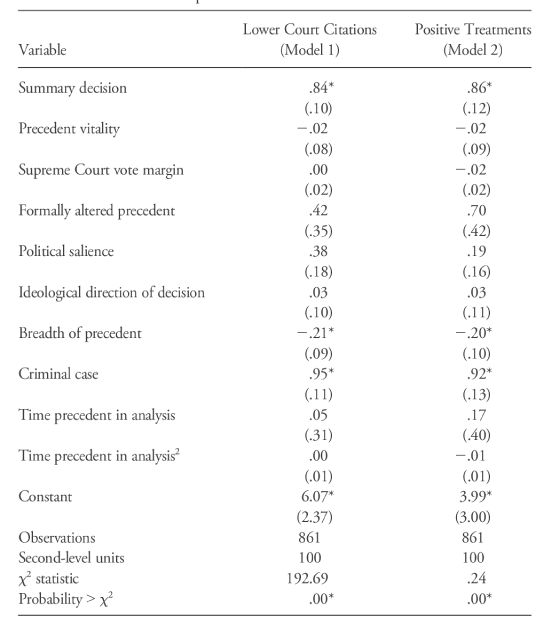
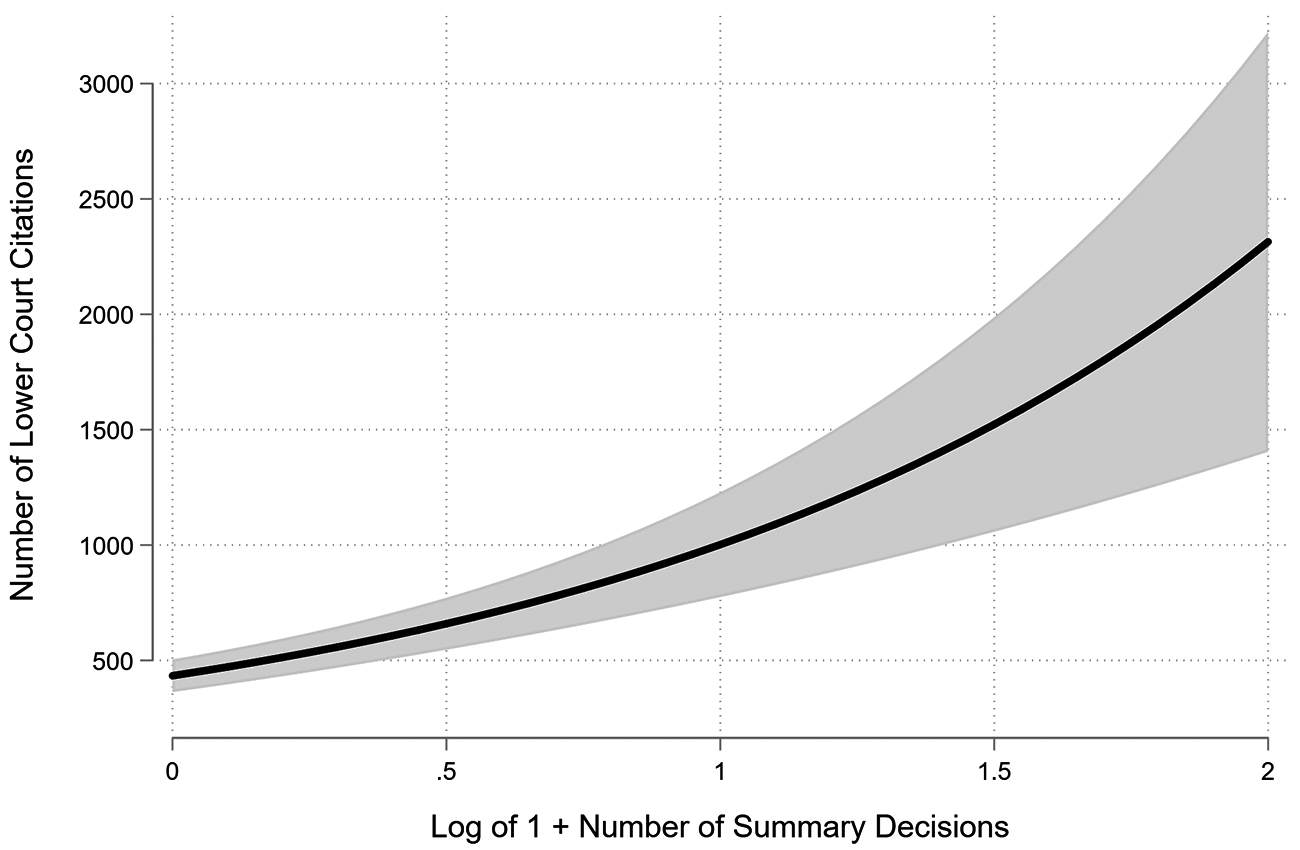
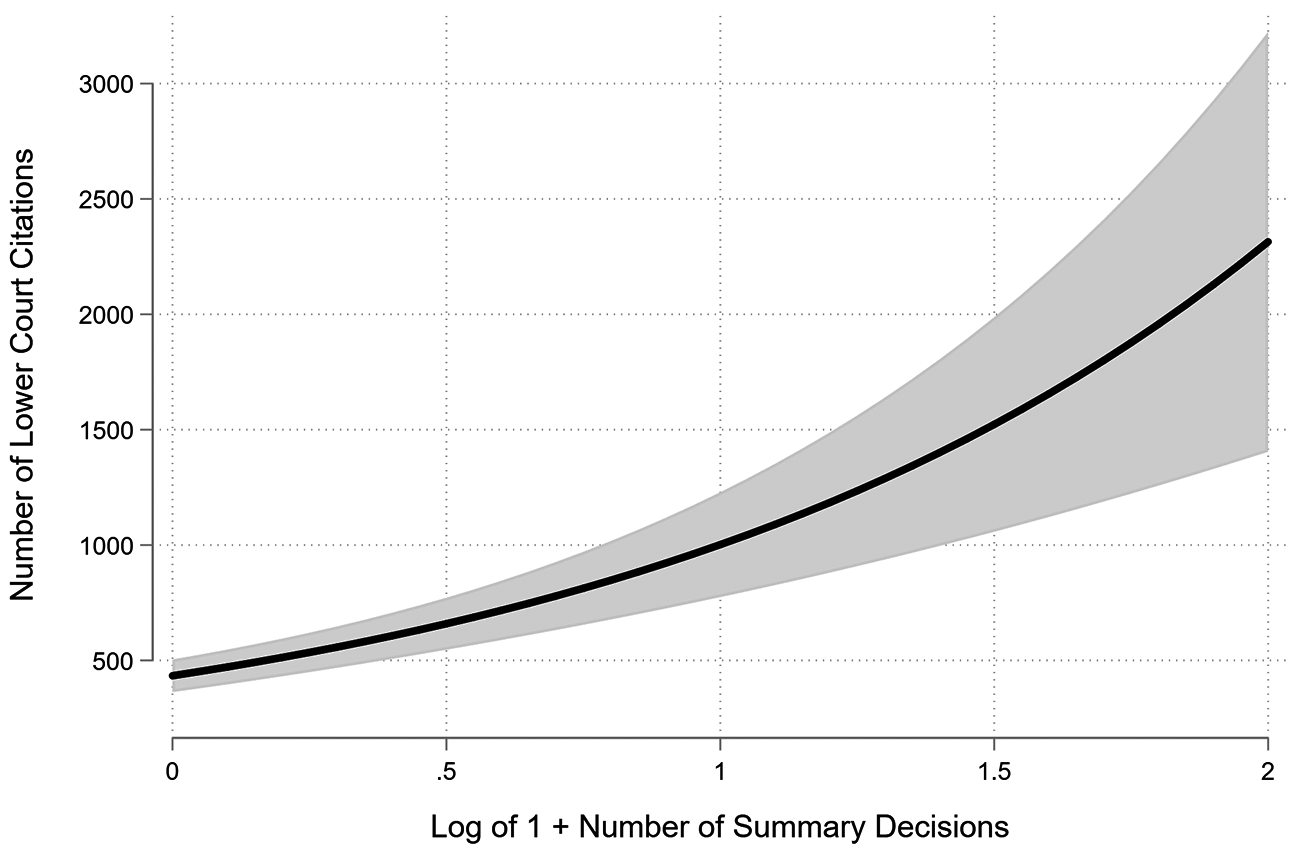
Table 1 presents the coefficient estimates for the Citation and Positive Treatment Models, respectively. Our key expectation is that the Supreme Court’s use of its summary decisions, issued “in light of” its formally argued decisions, increases the frequency with which the lower courts adopt a given Supreme Court precedent. The empirical results support this prediction. More specifically, the variable for summary decisions exerts a positive and statistically meaningful effect on the number of lower court citations. To illustrate the substantive effect of our primary variable of interest, we plot the impact of the summary decisions variable on the predicted number of lower court citations in figure 1. For precedents with no associated summary decisions, the mean number of lower court citations, over time, is approximately 434. When a Supreme Court precedent is accompanied by one summary decision (log value of 0.69), the number of lower court citations increases to 795. This represents an 83.18% increase in citations when a single summary decision is issued “in light of” a formally argued decision compared to Supreme Court decisions with no associated summary decision. For a precedent with two summary decisions (log value of 1.09), the mean number of lower court citations more than doubles from the base value to 1,088. This represents an increase of approximately 150.69% more lower court citations. For a precedent with five summary decisions, the number of lower court citations increases to approximately 1,944. Finally, for a precedent with ten summary decisions (a logged score of approximately 2.30), the average number of lower court citations increases to approximately 2,162. This means that going from zero summary decisions to the maximum value results in over a 700% increase in lower court citations. However, since 95% of the data are at or below a log of two summary decisions, the true effect of going from the minimum to the maximum value (from 0 to the log of two summary decisions) results in approximately 2,314 lower court citations. Needless to say, this represents a very large substantive effect. These results suggest that the presence of even a single summary decision, compared to its absence, drastically increases lower court attentiveness to the Supreme Court’s precedents.
Multilevel Negative Binomial Regression of Lower Court Citations and Positive Treatments of Supreme Court Precedent
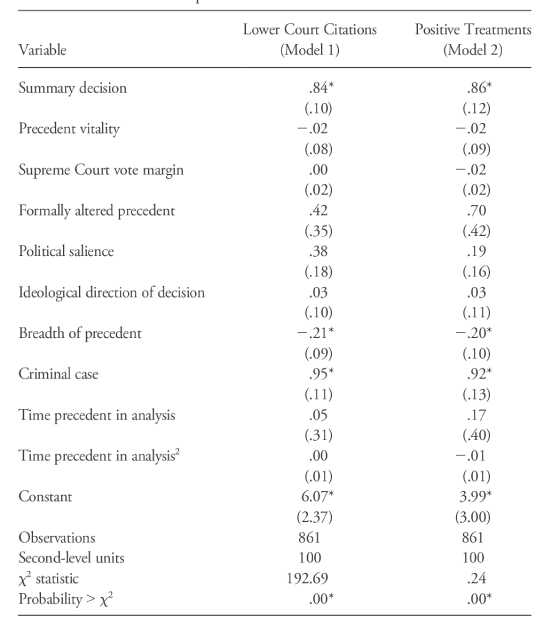
Note.— The dependent variables are the number of lower court citations and positive treatments of Supreme Court precedent in models 1 and 2, respectively. All p-values are based on one-tailed hypothesis tests, except for the Ideological Direction of Decision, Breadth of Precedent, and the two Time Precedent in Analysis variables. The multilevel estimates are based on random intercepts for each majority opinion writer and each Supreme Court term. The standard errors are in parentheses.
* p < .05.
Impact of summary decisions on lower court citations. The log number of summary decisions is plotted on the x-axis. Plot based on the average of the predicted counts across all real values in the data. Solid line, predicted number of citations. Shaded area, 95% confidence intervals.
The results in model 1 demonstrate that the variable for precedent vitality does not exert a meaningful effect on lower court citations to the Supreme Court’s precedents. This result departs from previous work, which suggests that the difference between prior positive and negative treatments by the Supreme Court exerts an important effect on the frequency of lower court citations (see Hansford and Spriggs Reference Hansford and James2006). It is worth noting that the vast majority of studies that explore the influence of vitality on the lower courts tend to focus on the US courts of appeals. Our analysis, in contrast, examines all lower court behavior. Specifically, we examine the impact of factors such as vitality on lower court responses by the US district courts, the US courts of appeals, and all state courts combined. We also aggregate these responses over time. Thus, while precedent vitality may affect a certain family of courts in initial years, this effect seemingly dissipates once we account for all lower courts over time. We elaborate on the implications of this finding in the conclusion.
The margin by which the Supreme Court decides a case, the formal alteration of precedent, political salience, the ideological direction of a decision, and the two time variables are all not statistically significant in the Citation Model. The variable for number of legal provisions associated with a precedent is significant but signed negatively. The results indicate that precedents that address a criminal issue, on average, have a higher number of citations by the lower courts than noncriminal cases. Holding all else constant, criminal cases result in approximately 841 additional lower court citations compared to noncriminal cases. This makes intuitive sense given the large number of criminal cases in the judicial pipeline. Finally, it is worth noting that when we subset models for criminal and noncriminal cases, the finding for summary decisions remains highly robust. The implication is that the presence of summary decisions increases lower court citations in both criminal and noncriminal cases.
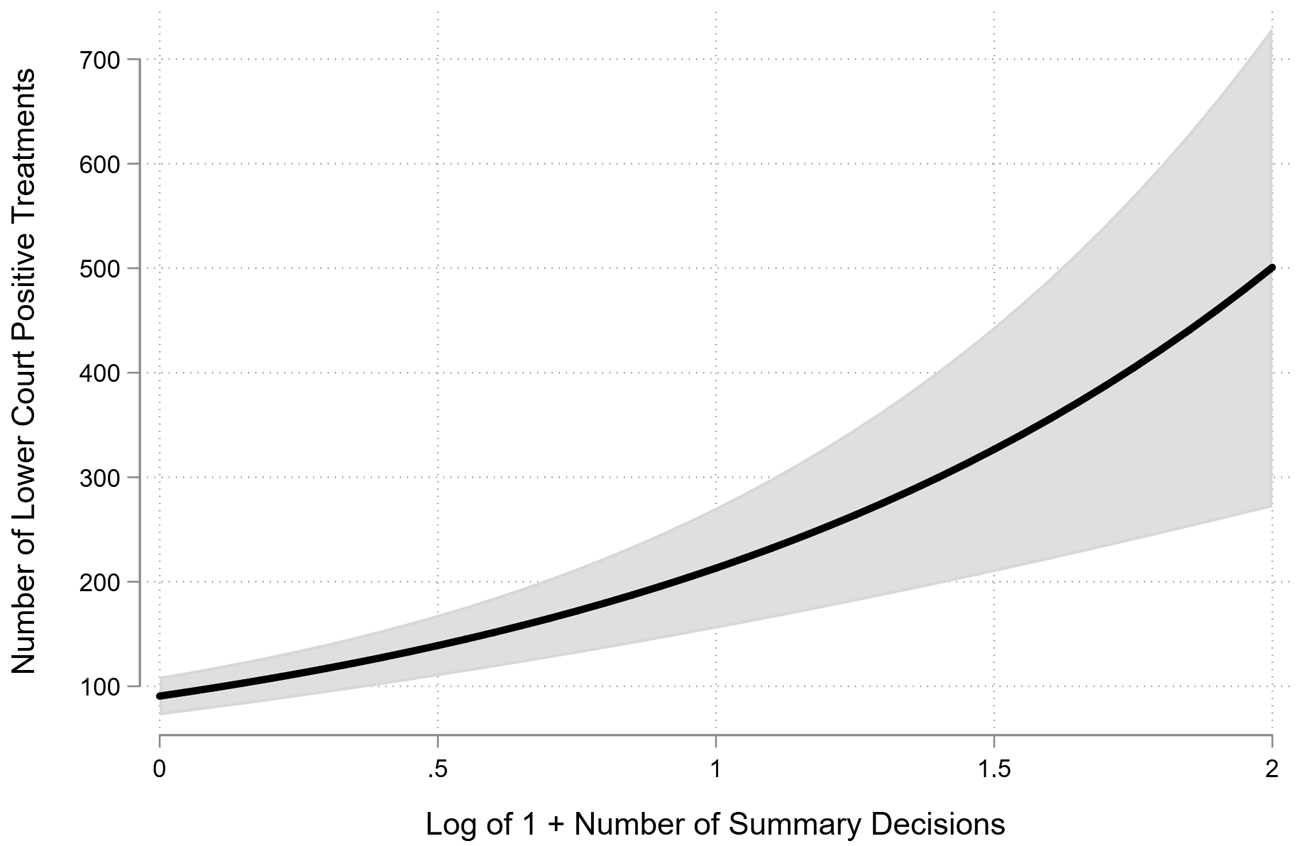
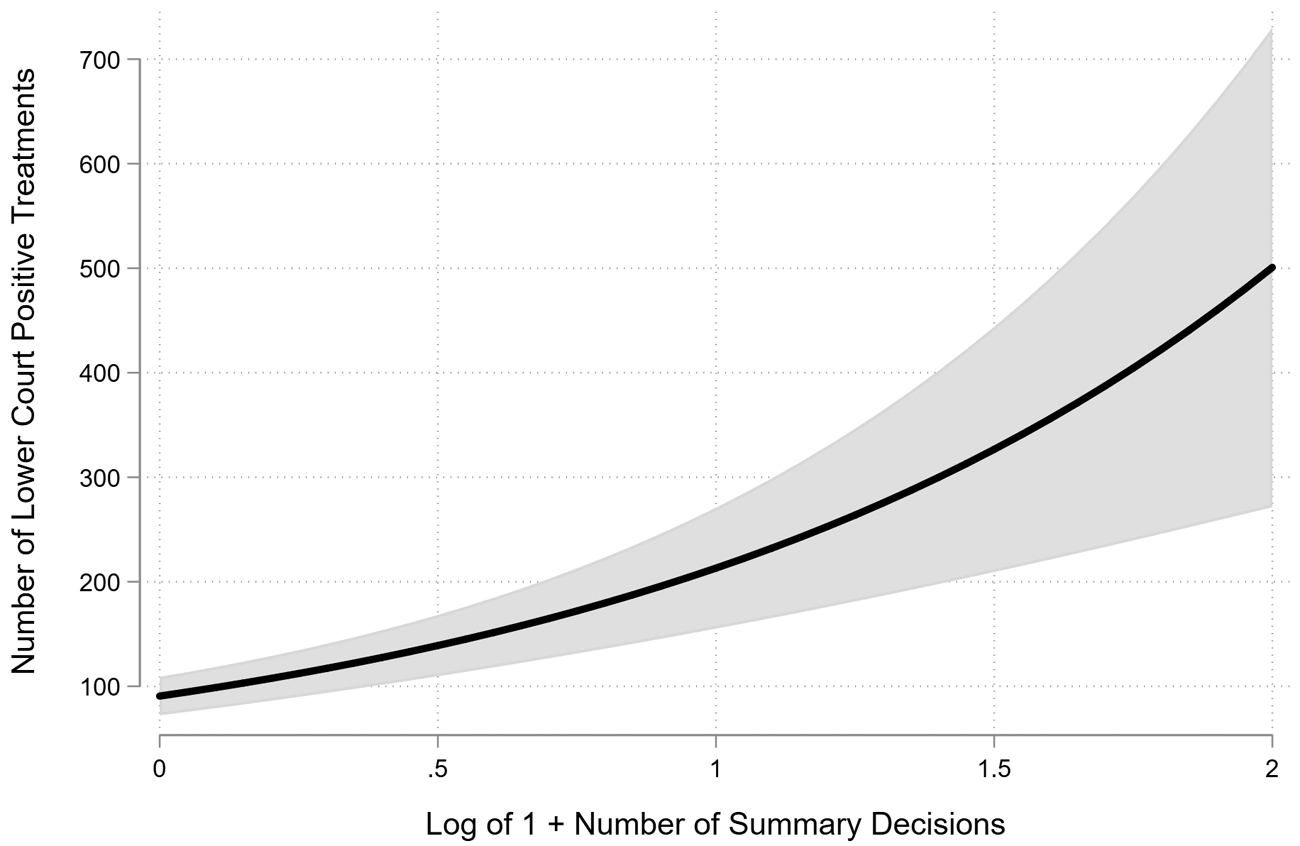
Table 1 also presents the coefficient estimates for the influences on lower court positive treatments of the Supreme Court’s precedents. Recall that our expectation is that the Supreme Court’s summary decisions should increase lower court adherence to the Supreme Court’s precedents. The results in the Positive Treatment Model demonstrate a statistically significant and substantively strong relationship between summary decisions and positive treatment by the lower courts. Figure 2 illustrates the substantive impact of the summary decisions on positive treatments by the lower courts. Supreme Court precedents with no associated summary decisions produce on average 91 positive treatments by the lower courts combined. A Supreme Court precedent with one summary decision increases aggregate positive treatments by the lower court by approximately 164. For a precedent with two associated summary decisions, the number of positive treatments increases to approximately 232. Supreme Court precedents with five summary decisions increase positive treatments to approximately 419. Finally, for a precedent with ten associated summary decisions, lower court positive treatments increase to 758, which represents a 733% increase compared to a precedent with no associated summary decisions. The results indicate that the effect of the variable for the Supreme Court’s summary decisions going from its minimum to its maximum value for 95% of the data represents an increase from 91 to 501 positive treatments, which represents a 450% increase in the total number of positive treatments by the lower courts.
Impact of summary decisions on lower court positive treatments. The log number of summary decisions is plotted on the x-axis. Plot based on the average of the predicted counts across all real values in the data. Solid line, predicted number of positive treatments. Shaded area, 95% confidence intervals.
The coefficient for precedent vitality does not reach conventional levels of statistical significance in the Positive Treatment Model. Similar to the Citation Model, the margin by which the Supreme Court issues a precedent, formal alteration of a precedent, political salience, the ideological direction of the decision, the breadth of a precedent, and the time a precedent is in existence do not meaningfully affect aggregate lower court positive treatments of the Supreme Court’s decisions. The variable for criminal cases is significant in the Positive Treatment Model. Substantively, criminal cases result in approximately 170 additional lower court positive treatments compared to noncriminal cases.
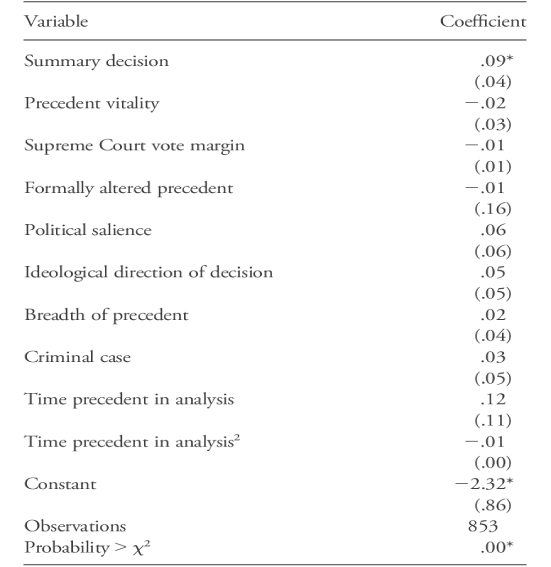
The results for the Positive Treatment Model are consistent with the results of the citations model. The key finding in both models is that when the US Supreme Court issues one or more summary decisions “in light of” one of its precedents, there is a significant increase in lower court utility of the Court’s precedent both in terms of citations and positive treatments. This finding is highly robust and substantively meaningful in predicting the propensity of lower courts to rely on the Supreme Court’s precedents. In fact, even when accounting for a number of important factors including the vitality of precedents, formal alteration of precedents, and the salience of the Court’s decisions, the substantive impact of the Court’s summary decisions remains the single strongest predictor of the frequency with which the lower courts cite and follow a precedent of the Supreme Court. Moreover, to alleviate concerns that our results may be driven by cases in the judicial pipeline, we also examine whether multiple cases that raise similar issues to formally argued decisions are driving the results. If our results are driven by changes in the Supreme Court’s docket, the increase in lower court responses may simply reflect increases in the size of the pool of potentially relevant cases. However, if the increase in positive treatments is driven by increases in the pool of relevant cases, the ratio of positive treatments to the ratio of positive treatments and citations combined should not increase. If the Supreme Court’s summary decisions are meaningful actions that lower courts pick up on, we should expect that in response to a greater number of summary decisions, the proportion of citations that are positive treatments should increase correspondingly. To test this, we estimate a model in which the dependent variable is a ratio of positive treatments to the total number of positive treatments and citations combined. Given that these data are proportional, where the values of the dependent variable are bounded between 0 and 1, we estimate a fractional logistic regression model with the original set of covariates.
The results in table 2 provide robust support to the claim that the Supreme Court’s summary decisions in fact strongly influence the propensity of the lower courts to adopt a given precedent. The results of the proportional model indicate that as the number of summary decisions increases, the proportion of positive treatments of the Supreme Court’s precedents also increases. This result provides additional insight in that it demonstrates that the impact of the Supreme Court’s summary decisions not only increases the total number of lower court citations and positive treatments; it also importantly influences a greater proportion of the citations to the Supreme Court’s precedents to be explicitly positive.
Fractional Logistic Regression of Lower Court Citations of Supreme Court Precedent That Are Positive Treatments
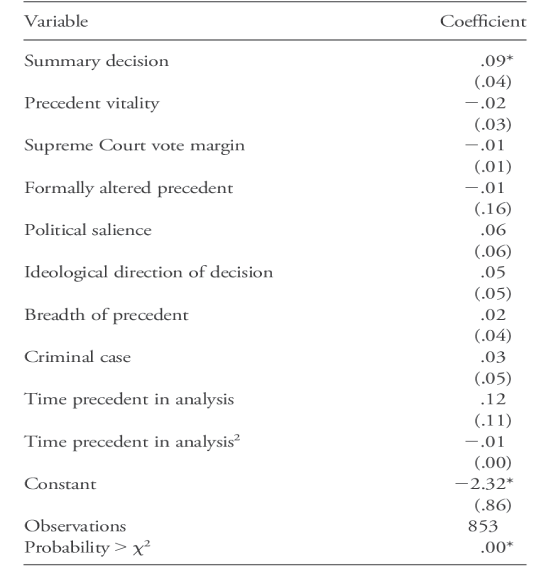
Note.— The dependent variable is the ratio of positive treatments to the total number of positive treatments and citations combined. The standard errors are clustered on the majority opinion writer–Supreme Court term.
* p < .05.
Addressing Questions of Spuriousness and Causality
While the empirical results demonstrate that summary decisions are the key element driving lower court attentiveness to the Supreme Court’s precedents, there may be questions regarding the causal impact of the Supreme Court’s summary decisions. For instance, it may be plausible to assume that the Supreme Court primarily issues summary decisions when there are many cases in lower court dockets, broadly defined, that raise similar issues to a particular Supreme Court precedent so that the choice to issue a summary decision does not reflect any systematic view by the Court on the importance of the case. Thus, if there are many similar cases that are being litigated as part of lower court dockets, there should be an increase in the number of citations and positive treatments by the lower courts even in the absence of such a signal. Another implication of this perspective is that the Supreme Court would give preference to cases to set aside for summary consideration in issue areas that receive a large number of certiorari petitions.
The notion that the Supreme Court grants certiorari and issues a summary decision that represents a conscious choice by the justices is reinforced by the consensus among the justices and their clerks that there are certain types of issues that the justices will usually not grant certiorari regardless of how often the issues are raised in other certiorari petitions. Among these are cases involving claims of ineffective assistance of counsel, diversity cases, cases that are “messy” or have “bad facts,” sufficiency of evidence cases, or other cases that appear to be “fact driven” (e.g., whether the police met the probable-cause standard to obtain a search warrant; Perry Reference Perry1991, 234). Such a selective approach for granting certiorari reinforces the conclusion that when the justices both grant certiorari and issue a summary decision, the action represents a conscious choice by the justices that a particular issue involved in the granted cases is of some significance to the justices.
The argument that the Supreme Court’s use of summary decisions communicates to the lower courts that they should apply a precedent widely to diverse factual situations is based on the actual behavior of the justices. Deciding that two cases involve similar issues represents an analogical choice by the justices rather than an objective assessment on the similarity of the issues. For instance, the cases receiving GVRs issued in light of Brown v. Board of Education do not, on the surface, appear to raise issues that are objectively similar to the issues decided in Brown. As a practical matter, the Supreme Court’s precedent in Brown might be read to apply only to the constitutionality of racially segregated public schools. But in a series of summary decisions, announced shortly after Brown, the Supreme Court quickly made the point that the ban of state-sponsored segregation was also applicable in prohibiting segregation in public parks, public universities, and public transportation.Footnote 21 Our data indicate that, as in Brown, the Supreme Court at times issues summary decisions to reflect its choice that a given precedent should be viewed as broadly applicable to a wide variety of issues that do not appear on their face to be objectively similar to the formally argued decision referenced in a summary decision.
To address any remaining concerns, we conduct additional analyses to support our findings. For our initial test of whether summary decisions represent a conscious choice by the justices to grant certain petitions certiorari or whether summary decisions are driven by the cases that raise a similar issue, we draw a random sample of 20 formally argued precedents with at least one summary decision from the 2000 Supreme Court term and carefully examine the issue area in the formally argued decision and the issue areas in lower court cases that receive a summary decision—defining “issue” in three separate ways. While for a majority of the case pairs the issues in the Supreme Court and the lower court decisions were the same or similar, we find that for six of the 20 precedents, the issue defined in the Supreme Court opinion was substantially different from the issue in the lower court decision for all three different ways of coding the issue. Together with the findings noted earlier—that many cases raising issues that appear to be objectively similar to issues in formally argued precedents are denied certiorari rather than resolved with a summary decision—the finding that the Supreme Court deliberately issues a summary decision for a number of cases that do not raise issues that are objectively similar provides strong evidence that when the Supreme Court issues a summary decision it represents a conscious choice by the justices (see also Hellman Reference Hellman1984). Thus, each summary decision represents a choice among the multiple ways in which the justices might dispose similar petitions.Footnote 22 However, since the Supreme Court uses summary decisions sparingly when faced with multiple cases raising similar issues and since the cases dealt with summarily almost always have different factual situations than the cases set for formal arguments, the use of summary decisions may be interpreted as a signal that a precedent is viewed more important or more broadly applicable to diverse factual situations.Footnote 23
Even though our initial test for whether summary decisions represent a conscious choice is supported by the analysis above, we conduct an additional analysis to corroborate the mechanisms at work. Using Westlaw, we search for all US courts of appeals decisions that include the same topic and key number as the sample of 20 Supreme Court precedents, with a time period of at least 9 months before the decision date but not exceeding 2 years before the precedent was announced. We further limited the search to cases that include a petition for certiorari to the Supreme Court. This search yields a list of cases that were “in the pipeline” in close proximity to the time the formally argued decisions in our sample were decided. Since each appeals court case identified by our search contains an issue that is similar to the issue announced in the Supreme Court’s formally argued decision, each of these cases would be a strong candidate to receive a summary decision. Thus, if the pipeline theory is correct, we should expect that many, if not all, of these petitions would be granted certiorari and disposed via a summary decision. Instead, we find that every single petition was denied certiorari. Stated differently, our analysis reveals that for 13 of the 18 formally argued precedents (72%) remaining in the sample, where one or more certiorari petitions raised an issue similar to the issue in the formally argued decision, all related petitions were denied certiorari. This finding demonstrates that for the vast majority of certiorari petitions that raise the same issue as a recently announced formally argued decision, the justices do not issue a summary decision but almost always deny these petitions certiorari.
The argument that the impact of the Supreme Court’s summary decisions is driven by the number of similar petitions is most plausible for those precedents that have a large number of summary decisions. The presence of several summary decisions suggests that there are a large number of cases that have already been petitioned to the Supreme Court in close proximity to the release of a new, formally argued decision. In such a situation, one may assume that when the Supreme Court decides to issue at least one summary decision “in light of” a given precedent, it will issue a summary decision for all petitions requesting certiorari that raise the same issue common to both the formally argued precedent and a case that has been adjudicated via a summary decision. For instance, if in a given term the Supreme Court receives 10 certiorari petitions that all raise issues that the justices believe are similar to the issue in a recent, formally argued decision, it would make little sense for the justices to resolve five of the 10 cases by issuing summary decisions and deny review to the remaining petitions. Thus, when the Supreme Court issues only a small number of summary decisions “in light of” a given precedent, it seems unlikely that in spite of the small number of summary decisions, there are actually a large number of similar cases on its docket. Consequently, if there is any credence to the idea that lower court citations and positive treatments are driven by the number of cases raising issues similar to the issues in a given precedent, one would expect the effects to be greatest in those situations in which there are a large number of cases on the Court’s docket raising the same issue. Deciding how to categorize a “large number” of summary decisions is not a fully objective decision. We employ an approach in which we designate anything greater than 10 as a large number of summary decisions. We then estimate models in which all Supreme Court precedents with more than 10 summary decisions are excluded from the analysis.
Assuming that the docket theory is valid and that summary decisions are merely a function of the number of cases petitioned to the Supreme Court, we would expect the impact of summary decisions to be significantly muted when excluding precedents with a large number of associated summary decisions. The empirical results provide evidence to the contrary.Footnote 24 Instead, the results demonstrate that the impact of summary decisions remains highly robust in increasing both the lower courts’ propensity to cite and follow the Supreme Court’s precedents. That is, even after removing all cases with a large number of summary decisions, the presence of summary decisions exerts a strong, positive effect on lower court adoption of the high court’s precedents. This result combined with all the analyses above should quell any concerns that (1) summary decisions only influence lower court responses when the Supreme Court issues a large number of summary decisions or (2) summary decisions are merely a function of the cases in the judicial pipeline.Footnote 25
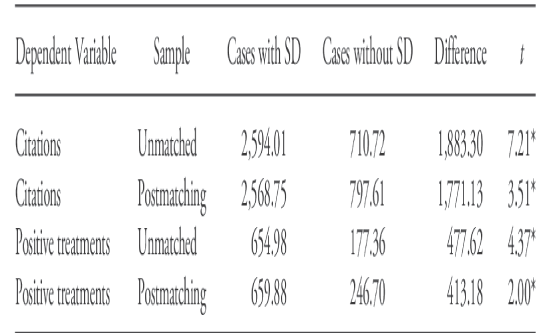
To address any remaining concerns about causal links, we turn to causal inference techniques. We rely on nearest-neighbor matching models along with a sensitivity analysis to test the robustness of our data against a hypothetical (omitted) confounder. In order to maximize the causal leverage, we use matched data to obtain the “average treatment effect on the treated” (ATT), through a Mahalanobis distance-based matching score estimator (see Ho et al. Reference Ho, Kosuke Imai and Elizabeth2007; Imai, King, and Stuart Reference Imai and Elizabeth2008; King and Nielsen, Reference King and Richardforthcoming). We specify a caliper value of 10, which is intended to prevent poor matches from being included in the final models at the expense of some marginal loss in observations. The idea of matching is to “prune” a data set so that comparisons between the “treated” and “not treated” data are as valid as possible by attempting to remove imbalance among the control variables from a data set. By doing so, we are able to dramatically reduce the amount of imbalance on all observed covariates that are included in the matching solution, thus reducing the degree of error in the statistical results based on imbalances among variables in the data.Footnote 26 Since the treatment variable must be binary, we convert our summary-decision (i.e., treatment) variable into a dichotomous variable. This treatment variable is coded 1 for all Supreme Court precedents with at least one associated summary decision and 0 for precedents with no summary decisions.Footnote 27
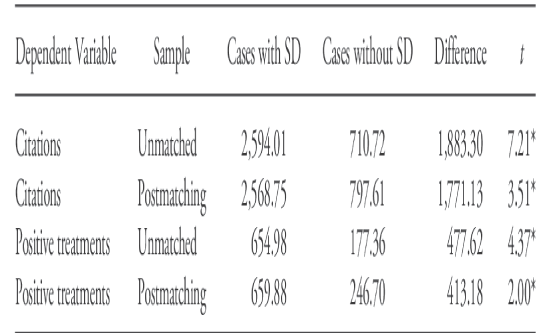
The results in table 3 demonstrate that the presence of a summary decision increases the number of citations even after removing the bias caused by the imbalance in the data through the matching analysis. For citations, under a “naive” model that does not incorporate matching, we find a treatment effect of the treated of approximately 1,883 more citations for a precedent that has at least one summary decision compared to precedents with no summary decisions. After matching, the ATT is approximately 1,771 more citations for a precedent with one or more summary decisions compared to precedents with no summary decisions. This postmatching analysis demonstrates that upon matching on all of the covariates, the Supreme Court’s summary decisions discernibly increase lower court citations to the Supreme Court’s precedents. Further, the size of the substantive effect of summary decisions is profound. To provide some context, the postmatching results reveal, on average, that precedents with summary decisions are cited approximately 220% more than precedents with no associated summary decisions.
Mahalanobis Distance Matching on Degree of Influence of Summary Decisions (SD) on Citations and Positive Treatments
* p < .05.
Table 3 also presents the results for positive treatments by the lower courts. For the base model with unmatched data, the ATT is approximately 478 more positive treatments when at least one summary decision is present compared to precedents with no summary decisions. After matching, the average treatment effect of the treated results in approximately 413 more positive treatments for precedents with one or more summary decisions compared to precedents with no summary decisions. The postmatching results demonstrate that Supreme Court precedents with one or more summary decisions have 167% more positive treatments, on average, compared to precedents with no associated summary decisions. This is by no means a trivial difference. Thus, even upon matching on a variety of potential confounders, we consistently find a statistically significant and substantively large difference in lower court responses to Supreme Court precedents with and without summary decisions.
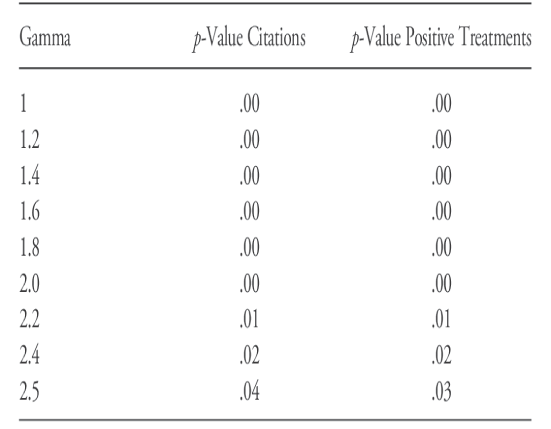
Finally, we supplement our matching estimates with a sensitivity analysis. Specifically, we conduct a sensitivity analysis using Rosenbaum bounds, which help show the degree of omitted-variable bias that is necessary to invalidate our results. The results for the Citation Model in table 4 indicate that our results are robust up to, and including, a gamma value of 2.5. What this indicates is that our key result regarding summary decisions is robust, even to omitted-variable bias that may cause a particular observation to be two and a half times as likely to receive a summary decision compared with an observation that has lower values (or no value) of a hypothetical omitted confounder. This means that in order to invalidate our results after matching, we would need to identify a confounder that is missing from our model that would cause the probability of receiving a summary decision to increase by more than 150% to negate the statistical significance. In general, having statistically significant treatment effects at a gamma value of 2 is sufficient to establish robustness against omitted confounders in a statistical model (see Keele Reference Keele2010). The Rosenbaum bounds test result for positive treatments is similar to that of the Citation Model, with the summary-decision finding remaining robust to a gamma value of 2.4, according to conventional (p-value) significance levels. The sensitivity analysis suggests that our key finding regarding summary decisions is robust to omitted-variable bias that may cause a particular a observation to be 2.4 times as likely to receive a summary decision compared with an observation that has lower values (or no value) of the hypothetical omitted variable. This demonstrates that our summary-decision finding is robust to any omitted confounder variables that would strongly affect the probability that a Supreme Court decision would have an accompanying summary decision. Ultimately, the sensitivity tests, analyses on matched data, and all of the other analyses provide overwhelming support for our argument that Supreme Court precedents with summary decisions are more frequently cited and followed by the lower courts compared to precedents with no associated summary decisions. The statistical analysis in this section demonstrates that this important finding is robust to hypothetical confounders and that the effect of the summary-decisions result is demonstrably not due to omitted-variable bias.
Rosenbaum Test for Impact of Summary Decisions on Citations and Positive Treatments
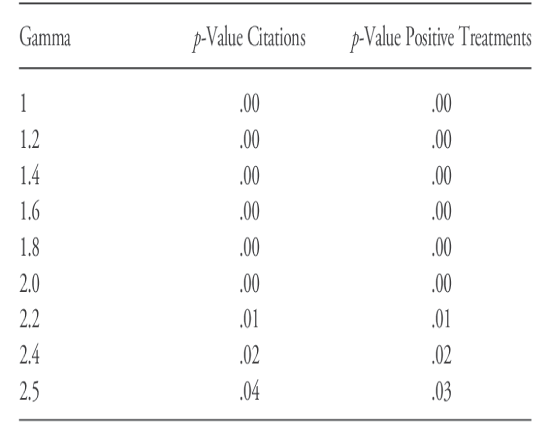
Note.— The p-value result shown here represents the upper bound p-value that is derived from the Rosenbaum sensitivity test. P-values below .05 are statistically significant.
Discussion and Conclusion
We began this article with a discussion of two Supreme Court precedents. We compared the Court’s decisions in Johnson and Apprendi to highlight an obvious truth that not all Supreme Court decisions have a comparable impact on the decision making of the courts lower down the judicial hierarchy. Our analysis offers several new and important contributions to the literature. First, we provide a framework for aggregate lower court responses to Supreme Court precedent. We argue that given the finite ability of the Supreme Court to review the large number of lower court decisions, justices of the Court should be interested in aggregate patterns of compliance in terms of citations and positive treatments to their precedents. Second, we propose a new theory that connects aggregate behavior of lower court responses to cues that come from the US Supreme Court, which is whether the justices issue one or more accompanying summary decisions along with the Court’s precedents. Third, we empirically assess lower court responses to the Supreme Court’s precedents cumulatively in federal and state courts. By doing so, we believe that our results are generalizable to a variety of lower level courts—including the US district courts, the US courts of appeals, and state courts of last resort.
Our analyses provide clear and incontrovertible evidence that there is a causal relationship between the Supreme Court’s summary decisions and the frequency with which the lower courts adopt the Supreme Court’s precedents. We find that as the number of summary decisions issued “in light of” a formally argued precedent increases, the number of lower court citations to those precedents substantially increases, and a greater proportion of citations are explicit positive treatments. This finding is important in that it provides evidence that the observed behavior is not simply due to the fact that cases similar to those that have summary decisions are especially common on lower court dockets. Interestingly, we also find lower levels of support for the impact of precedent vitality in influencing lower court attentiveness to the Supreme Court’s precedents. Specifically, we find that the substantive impact of precedent vitality dissipates considerably upon accounting for the Supreme Court’s summary decisions. Ultimately, this analysis demonstrates that the US Supreme Court can meaningfully drive aggregate responses to its precedents; however, the key factor through which the Court achieves greater levels of lower court adherence is by issuing one or more summary decisions along with its formally argued precedents. Our findings demonstrate that summary decisions exert the strongest substantive effect on cumulative lower court responses to precedents and that the overall reaction of the lower courts to precedents accompanied by summary decisions is overwhelmingly positive.
An important implication of our work is that when the Supreme Court issues a summary decision, it is usually not due to the number of cases that are petitioned to the Court that raise the same issue. Rather, it appears that it is the legal content of the case, whether it addresses an important legal or political question, that determines the likelihood that the Supreme Court will accept a case for review. Our analysis seemingly corroborates Hellman’s (Reference Hellman1984, 395) conclusion that it is not necessarily petitions that raise similar issues as a recently granted petition but rather it is “surface inconsistency in [the] results” of lower court decisions that “persuades the justices to remand [GVR] rather than deny review.” Ultimately, nearly all petitions to the Supreme Court raising similar or different issues as accepted cases are denied review each term.
What factors might determine whether the US Supreme Court uses summary decisions or revisits a case by issuing a new, formally argued decision? The impact of a potential signal is likely to be increased if it is a relatively rare event, and the Supreme Court’s summary decisions are such rare events. While the contemporary Supreme Court denies certiorari to over 10,000 petitions each year, the number of summary decisions issued is approximately 100 each term. We speculate that one key determinant as to whether the Supreme Court issues a new, formally argued decision or a summary decision relates to the time elapsed since the original precedent was announced. Given the large impact that even adding one case to the Court’s plenary docket likely has on the justices’ workload, we postulate that issuing summary decisions serves as a relatively low-cost method to signal to lower courts that a case is especially important or may have broad applicability to cases on lower court dockets. Consequently, when the justices want to reinforce a precedent using many cases in a small period of time or want to strengthen a precedent without incurring the cost of scheduling additional cases for formal arguments, summary decisions allow the Supreme Court to effectively and contemporaneously bolster lower court attentiveness to its precedents.
Our work also offers an empirical contribution to the impact literature through the use of matching and sensitivity analyses. While these analyses serve to improve the degree to which one can make causal claims, together they serve as a powerful tool to directly examine the robustness of results against omitted variables that have confounding effects. The matching estimates help to control for a lack of balance between cases that have associated summary decisions and cases that do not. Consequently, we can be confident that the results are a direct function of summary decisions rather than imbalances among the other variables in the data set. The sensitivity analysis allows us to examine the degree of omitted-variable confounding that would be necessary to negate our results. The results of the sensitivity analysis are clear and convincing. We find that for the statistical effect of summary decisions to completely go away, a hypothetical empirical model would require some endogenous confounder that has a very large effect on the onset of summary decisions and that simultaneously influences the frequency of lower court citations and positive treatments. Stated differently, the only way to invalidate our results is to identify an unknown, and impractical, confounder that would cause the probability of receiving a summary decision to increase by more than 150% while also significantly influencing lower court responses. Taken together, the matching estimates and the sensitivity analysis compellingly demonstrate that our results are robust to hypothetical confounders, and the effect of summary decisions is demonstrably not a function of omitted-variable effects.
Beyond understanding when the Supreme Court is most likely to issue summary decisions, a more in-depth analysis of how summary decisions may influence lower court norms is worth exploring in future studies. Moreover, do certain characteristics of particular lower courts make them especially prone to rely on summary decisions? Perhaps judges on more ideologically heterogeneous circuits (or state courts) use the precedents created by lower courts in response to a summary decision as a way to justify the inclusion of a Supreme Court precedent. It is also plausible that litigants and their attorneys are more likely to cite Supreme Court precedents with associated summary decisions, in their briefs, compared to precedents without summary decisions. If so, this would be one mechanism through which lower court judges are made aware of Supreme Court precedents that would otherwise not be applied as broadly. Taking up these questions will undoubtedly bolster our understanding of lower court interactions with the US Supreme Court.