Bovine milk is an important source of minerals that are important for human nutrition and dairy product quality (Gaucheron, Reference Gaucheron2005; Haug et al., Reference Haug, Høstmark and Harstad2007; Buitenhuis et al., Reference Buitenhuis, Poulsen, Larsen and Sehested2015). Although vitamins are organic substances, minerals are inorganic but are needed solely in minute values. Minerals can be grouped into trace or micro-elements (e.g. Fe, Zn, Se, Mn and I) that are needed in low values, and quantity or macro-elements (e.g. Mg, P, K and Ca) that are needed in greater quantities. When the dietary intakes of macro- and micro-minerals are inadequate, deficiencies can appear that can affect the health of human or animal consumer. Milk mineral concentration is known to differ by numerous variables, such as breed (Carroll et al., Reference Carroll, DePeters, Taylor, Rosenberg, Perez-Monti and Capps2006; Niero et al., Reference Niero, Visentin, Ton, De Marchi, Penasa and Cassandro2016), lactation stage (Carroll et al., Reference Carroll, DePeters, Taylor, Rosenberg, Perez-Monti and Capps2006; van Hulzen et al., Reference Van Hulzen, Sprong, van der Meer and Van Arendonk2009), lactation number (Kume et al., Reference Kume, Yamamoto, Kudo, Toharmat and Nonaka1998), and udder health situation (Summer et al., Reference Summer, Franceschi, Malacarne, Formaggioni, Tosi, Tedeschi and Mariani2009).
Milk minerals contribute to numerous essential physiological mechanisms. For example, Ca and P play a significant role in the metabolism of bone, Se and Zn in immune responses and Ca, K, and Mg in blood pressure control (Cashman, Reference Cashman2006; Haug et al., Reference Haug, Høstmark and Harstad2007). Moreover, increased levels of milk Na can be a benchmark for mastitis incidence (Gaucheron, Reference Gaucheron, Park and Haenlein2013). Milk minerals are also related to technological features of milk processing (Jensen et al., Reference Jensen, Poulsen, Andersen, Hammershoj, Poulsen and Larsen2012). Calcium phosphate impacts physicochemical stability of casein in milk, cheese-making characteristics and milk quality throughout storage (Gaucheron, Reference Gaucheron2005; Haug et al., Reference Haug, Høstmark and Harstad2007). This connection between milk minerals and cheese-making properties is held up by the genetic associations that were reported between them (Sanchez et al., Reference Sanchez, El Jabri, Minery, Wolf, Beuvier, Laithier, Delacroix-Buchet, Brochard and Boichard2018). Modifying Ca levels affected milk stability to heat treatment (Deeth and Lewis, Reference Deeth and Lewis2015).
The desire to include new phenotypes in the selection objectives for dairy cattle is increasing. Attention to both milk yield and composition as well as animal health and reproductive performance are all important (Fleming et al., Reference Fleming, Schenkel, Malchiodi, Ali, Mallard, Sargolzaei, Jamrozik, Johnston and Miglior2018) and environmental impact (or lack of it) will come into focus in the future. The inclusion of a new phenotype into a selection program requires the regular phenotyping of the trait at the population level. However, quantifying milk minerals on a large scale needs many resources due to the time and cost of reference laboratory analyses. This possible threat represents a restriction for the estimation of accurate genetic parameters for milk minerals, as well as being able to obtain high accuracy estimates of genetic merit for individual animals (Visentin et al., Reference Visentin, Niero, Berry, Costa, Cassandro, De Marchi and Penasa2019). Therefore, infrared prediction of milk minerals could be a very important and cheap addition to the collection of milk traits that are presently accessible for farm management and breeding programs (Zaalberg et al., Reference Zaalberg, Poulsen, Bovenhuis, Sehested, Larsen and Buitenhuis2021).
Accurate estimates of genetic parameters for economically important traits are mandatory to predict, precisely, the breeding values of animals in the breeding schemes (de Oliveira et al., Reference de Oliveira, Torres, Vinícius, Alencar, Renata, de Souza, de Siqueira Otávio Henrique Gomes Barbosa and e Silva2017). Satisfactory knowledge of the genetics underlying the mineral contents of milk and serum in dairy cattle is required to enable enhancements through feeding or breeding systems. Over the previous years, genetic parameter estimates have been reported for milk and serum minerals in dairy cows. However, these estimates have been reported in studies differing in terms of bovine population, breeds, samples size and considering different effects in the model. This has resulted in considerable variability among heritability and genetic correlation estimates. A meta-analysis considering variability among studies would be considered as an applied and well-planned solution to summarize all studies and overcome the variability problem (Sutton et al., Reference Sutton, Abrams, Jones, Sheldon and Song2000). Using the random-effects model of meta-analysis, it is possible to provide more reliable outputs than those obtained from individual studies (Borenstein et al., Reference Borenstein, Hedges, Higgins, Rothstein and Sharples2009; de Oliveira et al., Reference de Oliveira, Torres, Vinícius, Alencar, Renata, de Souza, de Siqueira Otávio Henrique Gomes Barbosa and e Silva2017). The reason for designing this study was the need for collecting estimates from previous studies to provide summary genetic parameter estimates for milk and serum minerals to develop breeding objectives in dairy cattle. Also, to prevent unfavorable correlated responses with other economically important traits, understanding the genetic correlations between them and with milk production is necessary before including milk minerals into dairy breeding objectives. To the knowledge of the author, a specific meta-analysis of the genetic parameters for milk and serum minerals has not been reported in the literature. Thus, the objective of this study was to conduct a meta-analysis based on a random-effects model to combine different published heritability estimates for milk and serum minerals and their genetic correlations in dairy cows.
Materials and methods
Description of the study scope and evaluated traits
A systematic search of the literature using electronic databases of ISI Web of Knowledge (https://apps.webofknowledge.com) and Google Scholar (https://scholar.google.com) was conducted to identify all references reporting estimates of heritability for milk and serum minerals and their genetic correlation in dairy cows. The most exhaustive research query was built, using synonyms and derivatives of the following keywords: ‘dairy cow’, ‘milk minerals’, ‘milk micronutrients’, ‘serum minerals’, ‘genetic parameters’, ‘heritability’, and ‘genetic correlation’. In total, 59 heritability and 25 genetic correlation estimates from 12 scientific articles were used in the present study. The considered articles were published between 2009 and 2021 (online Supplementary Table S1). The estimates were derived from restricted maximum likelihood (REML) and Bayesian inference estimation methods on a mixed animal model. Therefore, estimates obtained from reduced models, such as the sire model, were removed. The literature cited in the above-mentioned articles was also checked. Traits included in the study were milk concentrations of calcium (Cam), phosphorus (Pm), potassium (Km), magnesium (Mgm), sodium (Nam), copper (Cum), manganese (Mnm), selenium (Sem), zinc (Znm) and iron (Fem), and also serum concentrations of calcium (Cas), phosphorus (Ps), potassium (Ks) and magnesium (Mgs).
Data recorded
The data sets included information on direct heritability estimates for milk and serum minerals, genetic correlations between milk minerals and genetic correlations between milk calcium and phosphorus with milk yield, as well as published standard errors for these parameter estimates. Other information recorded was the publication year, journal name, the number of records, breed name, lactation number, country of origin, years of data collection, phenotypic mean and standard deviation, the used estimation method (REML or Bayesian) and model of analysis (univariate or multivariate). When the same estimate was reported in different publications, based on the same database, only the most recent publication was included in the analysis. Besides that, the meta-analysis was executed only for traits in which the estimates were based on at least two different databases, to minimize the possible impact of non-independence among articles.
For articles in which the standard error for the heritability or correlation estimates were not reported, approximated standard errors were derived by using the combined-variance method (Sutton et al., Reference Sutton, Abrams, Jones, Sheldon and Song2000), which is given by the following formula:
 $$SE_{ij} = \sqrt {\displaystyle{{\left({\displaystyle{{\sum\limits_{k = 1}^K {s_{ik}^2 n_{ik}^2 } } \over {\sum\limits_{k = 1}^K {n_{ik}} }}} \right)} \over {{{n}^{\prime}}_{ij}}}} $$
where SEij is the predicted standard error for the published parameter estimate for the ith trait in the jth article that has not reported the standard error, sik is the published standard error for the parameter estimate for the ith trait in the kth article that has reported the standard error, nik is the number of used records to predict the published parameter estimate for the ith trait in the kth article that has reported the standard error, and ńij is the number of used records to predict the published parameter estimate for the ith trait in the jth article that has not reported the standard error.
Phenotypic trait
Means and standard deviations were calculated for all traits using the sample sizes as weights. The total number of records for each phenotypic trait was calculated as the sum of the number of records in each article that reported the trait. The coefficient of variation in percentage (CVi(%)) for each ith trait was calculated as follows:
 $$CV_i( \% ) = \displaystyle{{s_i} \over {{\bar{X}}_i}} \times 100$$
where si is the standard deviation for the ith trait and  $\bar{X}_i$is the trait mean.
Heritabilities and genetic correlation
Meta-analysis was performed based on a random-effects model (Borenstein et al., Reference Borenstein, Hedges, Higgins, Rothstein and Sharples2009) using the Comprehensive Meta-Analysis (CMA) software version 2.2 (Biostat, USA) to calculate the effect size for genetic parameter estimates. In the random-effects model, observed differences among study results are due to the play of chance in repeated sampling and random changes in real values of parameters (Borenstein et al., Reference Borenstein, Hedges, Higgins and Rothstein2011). The random-effects model fitted was as follows:
 $$\hat{\theta }_j = \bar{\theta } + u_j + e_j$$
where  $\hat{\theta }_j$is the published parameter estimate in the jth article,
 $\bar{\theta }$ is the weighted population parameter mean, uj is the among study component of the deviation from the mean, assumed as u i ~ N(0, τ 2), where τ 2is the variance representing the amount of heterogeneity among studies, ej is the within-study component due to sampling error in the parameter estimate in the jth article, assumed as
 $e_j\sim N( {0, \;\sigma_e^2 } ) $, where
 $\sigma _e^2 $is the within-study variance.
Forest plots were constructed to indicate the effect size for each study. Effect sizes for forest plots were the mean heritability estimates for milk and serum minerals or genetic correlation estimates at a 95% confidence interval using the random-effects model.
Heterogeneity
Chi-square (Q) test and the I 2 statistic were determined to measure heterogeneity (Borenstein et al., Reference Borenstein, Hedges, Higgins and Rothstein2011). Variations among the study level were assessed using a Q test. The significance level was set at 0.10 because the Q test has relatively low power when a small number of studies are included (Huedo-Medina et al., Reference Huedo-Medina, Sánchez-Meca, Marín-Martínez and Botella2006; Lean et al., Reference Lean, Rabiee, Duffield and Dohoo2009). Although the Q test helps identify heterogeneity, the measure I 2 was used to measure heterogeneity as follows (Lean et al., Reference Lean, Rabiee, Duffield and Dohoo2009):
 $$I^2( \% ) = \displaystyle{{Q-( {k-1} ) } \over Q} \times 100$$
where Q is the χ2 heterogeneity statistic and k is the number of studies. Q is the Q statistics given by the following formula:
 $$Q = \sum\limits_{\,j = 1}^k {w_j( {{\hat{\theta }}_j-\bar{\theta }} ) } ^2$$
where wj is the parameter estimate weight (assumed as the inverse of published sampling variance for the parameter,  ${1 \over {s_j^2 }}$) in the jth article;
 $\hat{\theta }_j$ and
 $\bar{\theta }$ were defined above in the random-effects model, and k is the number of used articles. The I 2 statistic describes the percentage of variation across studies due to heterogeneity. Negative values of I 2 are set equal to zero; consequently, I 2 lies between 0 and 100% (Lean et al., Reference Lean, Rabiee, Duffield and Dohoo2009). Its value might not be important if it falls within the range of 0–40%. However, a value of 30–60% often indicates moderate heterogeneity, 50–90% might represent substantial heterogeneity, and a value in the range of 75–100% represents considerable heterogeneity (Higgins and Green, Reference Higgins and Green2011).
Results
Descriptive statistics
The number of literature estimates, measurement units, the total number of records, weighted mean, standard deviation, and the coefficient of variation for the concentrations of the minerals and milk yield of dairy cows are shown in Table 1. The weighted coefficients of variation for milk macro-minerals were generally low and varied from 4.23 (for Km) to 20.20% (for Nam). In general, micro-minerals of milk had greater weighted coefficients of variation which ranged from 10.22 (for Znm) to 66.32% (for Fem). For serum minerals, Mgs and Cas had low weighted coefficients of variation (1.16 and 6.72%, respectively), but Ps and Ks had high values (48.30 and 82.06%, respectively). In addition, the weighted coefficient of variation for milk yield was low (1.55%) in this study.
Number of literature estimates (N), measurement units (Unit), the total number of records (Records), weighted mean, standard deviation (sd), and the coefficient of variation (CV) for the concentrations of the minerals in milk and serum of dairy cows

‘m’ and ‘s’ subscripts indicated the concentrations of the minerals in milk and serum, respectively.
Heritability estimates
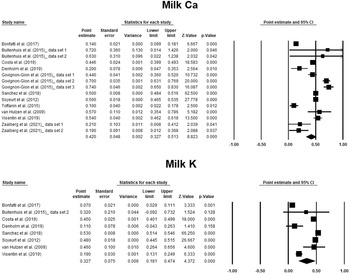
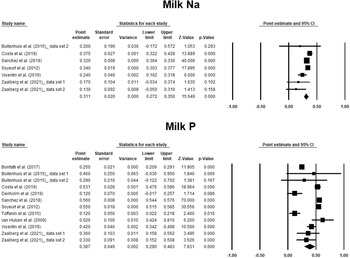
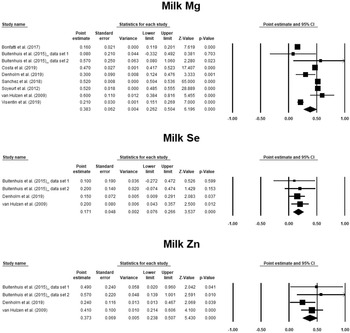
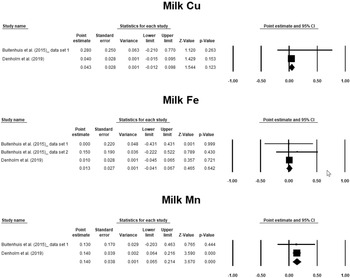
Effect size and heterogeneity of the heritability estimates (based on Q and I 2 statistics) for the concentrations of minerals in milk and serum of dairy cows obtained from the random-effects model of the meta-analysis are presented in Table 2. The heritability estimates for milk macro-minerals were moderate to high and ranged from 0.311 (for Nam) to 0.420 (for Cam). On the other hand, milk micro-minerals had lower heritabilities with a range from 0.013 (for Fem) to 0.373 (for Znm). The heritability estimates for serum macro-minerals were generally low and varied from 0.126 (for Ks) to 0.206 (for Mgs). The evaluation of heritability estimates for minerals showed that macro-minerals measured in milk had greater heritability than their counterparts in the serum of dairy cows. In general, most heritability estimates had low standard errors and their 95% confidence intervals were narrow. The heritability estimates for Fem and Cum were not significant (P > 0.05), and their 95% confidence interval included zero. Therefore, the heritability estimates for these two micro-minerals of milk would be considered as zero. The test of the heterogeneity of heritability estimates, performed by Q statistics, indicated that except for Sem (P = 0.940), Znm (P = 0.477), Cum (P = 0.340), Fem (P = 0.765), Mnm (P = 0.954), Cas (P = 0.131), Ks (P = 0.144), and Mgs (P = 0.412), which had low Q values and non-significant heterogeneity, other minerals showed significant heterogeneities (P < 0.10). Consistent with the results obtained by Q statistics, the values of the I2 index indicated the negligible heterogeneity for the heritability estimates of Sem, Znm, Cum, Fem, Mnm, and Mgs, but Cas and Ks showed moderate heterogeneities and the other minerals experienced considerable heterogeneities (Table 2). Testing for the occurrence of possible publication bias is not appropriate for the heritability estimates that showed heterogeneity because it could lead to false-positive claims, but the results of Egger's test showed no publication bias for Sem, Znm, and Fem (online Supplementary Table S2). Despite the no heterogeneous estimates of heritability for Cum, Mnm, Mgs, Cas, and Ks, Egger's test did not provide any output for these minerals because the average standard error of estimates obtained by random-model was very low.
Effect size and heterogeneity of the heritability estimates for minerals in milk and serum of dairy cows obtained from the random-effects model of meta-analysis

‘m’ and ‘s’ subscripts indicated the concentrations of the minerals in milk and serum, respectively.
The forest plots of individual studies and the overall outcome for heritability estimates of milk minerals are presented in Figures 1 to 4. Also, the forest plots of individual studies and the overall outcome for heritability estimates of serum minerals are depicted in online Supplementary Figures S1 and S2. Estimated effect sizes along with their 95% CI were visually displayed in these plots. The heterogeneity of heritability estimates for the majority of minerals was visually evident in forest plots. Funnel plot of mean heritability estimates for milk selenium is shown in Figure 5. The funnel plots of mean heritability estimates for Znm, and Fem are shown in online Supplementary Figures S3 and S4. Results from statistical tests to evaluate publication bias and the trim-and-fill method to correct funnel plot asymmetry in mean heritability estimates of minerals that did not present heterogeneity are shown in Table 3. Although Egger's test did not detect any bias (P > 0.10) with mean heritability estimates for Sem, Znm, and Fem, two missing studies were needed at the left side of the funnel plot for Znm to regain funnel plot asymmetry according to the trim-and-fill method (online Supplementary Table S2 and Fig. S3).
The forest plots of individual studies and the overall outcome (last line) for heritability estimates of Cam and Km in dairy cows. The mean effect size, calculated according to a random-effects model, is indicated by the diamond at the bottom of each plot. The size of the squares illustrates the weight of each study relative to the mean effect size. Smaller squares represent less weight. The horizontal bars represent the 95% confidence intervals for the study.

The forest plots of individual studies and the overall outcome (last line) for heritability estimates of Nam and Pm in dairy cows. The mean effect size, calculated according to a random-effects model, is indicated by the diamond at the bottom of each plot. The size of the squares illustrates the weight of each study relative to the mean effect size. Smaller squares represent less weight. The horizontal bars represent the 95% confidence intervals for the study.

The forest plot of individual studies and the overall outcome (last line) for heritability estimates of Mgm, Sem and Znm in dairy cows. The mean effect size, calculated according to a random-effects model, is indicated by the diamond at the bottom of each plot. The size of the squares illustrates the weight of each study relative to the mean effect size. Smaller squares represent less weight. The horizontal bars represent the 95% confidence intervals for the study.

The forest plot of individual studies and the overall outcome (last line) for heritability estimates of Cum, Fem and Mnm in dairy cows. Detailed information is provided in Figure 1.

Funnel plot of mean heritability estimates for Sem (empty circles). The solid dots are the potentially missing studies imputed from the trim-and-fill method. The open diamond represents the mean and confidence interval of the existing studies and the solid diamond represents the mean and confidence interval if the theoretically imputed studies were included in the meta-analysis.

Effect size and heterogeneity of the genetic correlation estimates between milk minerals, and between milk calcium and phosphorus with milk yield in dairy cows obtained from the random-effects model of meta-analysis

r g, Genetic correlation; MY, Milk yield.
‘m’ subscript indicated the concentrations of the minerals in milk.
Genetic correlation estimates
Effect size and heterogeneity of the genetic correlation estimates (based on Q and I 2 statistics) between milk macro-minerals, and between Cam and Pm with milk yield in dairy cows obtained from the random-effects model of the meta-analysis are presented in Table 3. The estimates of genetic correlation between milk macro-minerals varied from weak to strong. The weakest genetic correlations observed between Nam-Mgm (−0.015) and Nam-Km (−0.024), but the strongest genetic correlations were between Cam-Pm (0.500), Cam-Mgm (0.510), and Mgm-Pm (0.625). All estimates of genetic correlation between Nam with other milk minerals were negative (Table 3). Except for genetic correlations between Cam-Nam, Cam-Km, Nam-Mgm, and Nam-Km, other correlations were significant and statistically different from zero (P < 0.05). The 95% confidence interval of genetic correlations between Cam-Nam, Cam-Km, Nam-Mgm, and Nam-Km included zero. Therefore, zero genetic correlations could be concluded between these minerals. The genetic correlation estimates of Cam and Pm with milk yield were negative and significant (−0.171 and −0.211, respectively; P < 0.05). The test of the heterogeneity of correlation estimates, performed by Q statistics, showed that except for the genetic correlations between Cam-Km, Nam-Km, and Mgm-Pm which had lower Q values and non-significant heterogeneity (P > 0.10), the genetic correlations between other minerals showed significant heterogeneities (P < 0.10). The values of the I 2 index indicated considerable heterogeneities for the genetic correlations between Cam-Km, Nam-Km, Nam-Pm, and Mgm-Pm, moderate heterogeneities between Cam-Pm, Cam-Nam, and Nam-Mgm, and negligible heterogeneities between other mineral combinations (Table 3). The test of the heterogeneity of genetic correlation estimates between Cam and Pm with milk yield, based on Q and I 2 statistics, indicated non-significant (P > 0.10) and negligible heterogeneities for these estimates (Table 3).
The forest plots of individual studies and the overall outcome for genetic correlation estimates between milk macro-minerals, and between Cam and Pm with milk yield in dairy cows are presented in online Supplementary Figures S5 to S9. The funnel plot of the mean genetic correlation estimate between Cam and Pm is shown in online Supplementary Figure S10. Results from statistical tests to evaluate publication bias and the trim-and-fill method to correct funnel plot asymmetry in mean genetic correlation estimates that did not present heterogeneity are shown in online Supplementary Table S3. The results of Egger's test indicated non-significant (P > 0.10) publication bias for the genetic correlation between Cam and Pm. Two missing studies were needed at the left side of the funnel plot for genetic correlation between these two macro-minerals to regain funnel plot asymmetry according to the trim-and-fill method (online Supplementary Table S3).
Discussion
This meta-analysis study evaluated the extent of exploitable genetic variation in milk and serum minerals of dairy cows. This information is important to assess the possibilities to modify the mineral concentrations of the milk and serum by selective breeding (Buitenhuis et al., Reference Buitenhuis, Poulsen, Larsen and Sehested2015). Dairy products, such as milk and cheese, are substantial resources of minerals and contribute greatly to dietary intakes of Ca, P, I, Zn, and Mg (Denholm et al., Reference Denholm, Sneddon, McNeilly, Bashir, Mitchell and Wall2019). Mg and Ca are principally important factors in bone development, especially in children (Givens et al., Reference Givens, Livingstone, Pickering, Fekete, Dougkas and Elwood2014). Therefore, the circulating concentrations of these minerals in the blood and milk of dairy cows possibly associate with animal fitness given their important functions in several immunological and physiological mechanisms (Alpert, Reference Alpert2017). Ca plays a key role at the start of lactation. Hypocalcaemia is the most important macro-mineral disorder of the transition dairy cow (Tsiamadis et al., Reference Tsiamadis, Banos, Panousis, Kritsepi-Konstantinou, Arsenos and Valergakis2016). It is connected with health problems including retained fetal membranes, uterine infection, mastitis, ketosis, and displaced abomasum, as well as decreased dry matter intake and milk yield (Tsiamadis et al., Reference Tsiamadis, Banos, Panousis, Kritsepi-Konstantinou, Arsenos and Valergakis2016). Therefore, recognizing breeding schemes to optimize mineral concentrations for each cow would be of considerable benefit both for the cow and the human dairy product consumer (Denholm et al., Reference Denholm, Sneddon, McNeilly, Bashir, Mitchell and Wall2019).
The lower weighted coefficients of variation indicated the lower dispersion around the weighted means for milk macro-minerals and milk yield among studies which implied the more precise estimates of weighted means for these traits. The lowest weighted coefficient of variation was observed for Mgs (1.16%), showing that its phenotypic variation is restricted biologically. On the other hand, the greatest weighted coefficient of variation was estimated for Ks (82.06%), indicating that there is greater phenotypic variation in this trait than in other traits (de Oliveira et al., Reference de Oliveira, Torres, Vinícius, Alencar, Renata, de Souza, de Siqueira Otávio Henrique Gomes Barbosa and e Silva2017).
The standard errors and 95% confidence intervals of the mean heritability estimates for the majority of the minerals in this study were low which indicates that the mean heritability estimates reported in this study are accurate. The lower heritability estimates observed for serum minerals showed the more evident influence of non-genetic (environmental) factors, but the moderate to high heritability estimates for milk minerals showed a medium-to-high impact of genes with additive action on these traits and possibly a high selection response for them. Although heritability would affect the rate of genetic progress, other variables such as selection intensity, genetic variation and generation interval would also influence the rate in a population of animals. Because meta-analysis combines published parameter estimates reported by different studies, it is anticipated that the true parameter may differ from study to study (de Oliveira et al., Reference de Oliveira, Torres, Vinícius, Alencar, Renata, de Souza, de Siqueira Otávio Henrique Gomes Barbosa and e Silva2017; Ghavi Hossein-Zadeh, Reference Ghavi Hossein-Zadeh2021). Different studies used in the meta-analysis would be different according to the structure of populations (ie Holstein cows or not, first parity or multiparous cows, repeated records or not, lactation or test-day records, the lactation stage used), source of minerals (ie minerals in milk or serum, mineral contents measured by mid-infrared spectrometry or by prediction equations), analysis model (ie inclusion of random regression or not), data edits and method of analysis (REML or Bayesian).
The greatest genetic correlations were seen between Cam with Pm and Mgm, and between Pm with Mgm. Also, Nam had the weakest genetic correlations with Mgm and Km. The strong and positive genetic correlations between Cam with Pm and Mgm are the reason for similar genetic and physiological mechanisms controlling these traits. Also, the positive and strong genetic correlation between these traits suggests that selection on Cam would improve Pm and Mgm, resulting in large improvements in milk mineral contents for the advantage of the human dairy consumer. Based on very weak genetic correlation estimates between Nam with Mgm and Km, it would be stated that Nam did not seem to be genetically associated with these two macro-minerals of milk. The negative genetic correlations of Nam with other minerals indicated the opposite direction of changes when genetic selection is directly performed on Nam. These negative genetic correlations would be favorable because the present nutritional guidelines advise decreasing Na ingestion (Whelton and He, Reference Whelton and He2014). Therefore, if milk mineral concentration is considered as a breeding goal trait, Na should be included as a trait with negative selection pressure to keep it constant, or decrease it (Visentin et al., Reference Visentin, Niero, Berry, Costa, Cassandro, De Marchi and Penasa2019). Because of the positive and strong genetic correlation between Cam with Pm, the negative genetic correlation of these two macro-minerals with milk yield would be expected. The dilution effect would be considered as the possible reason for these negative genetic correlations. The negative genetic correlations of Cam and Pm with milk yield can prevent a simultaneous genetic gain for milk yield. This is particularly unfavorable when the payment system is mainly based on the quantity of milk delivered, suggesting milk yield as the main selection objective (Ghavi Hossein-Zadeh, Reference Ghavi Hossein-Zadeh2021).
Recording new traits will be always an expensive exercise. Therefore, regular recording of the concentration of minerals depends on the capability of dairy cattle breeders to incorporate these new phenotypes in a breeding plan or to apply them as a management help (Ghavi Hossein-Zadeh, Reference Ghavi Hossein-Zadeh2021). According to the results of the present meta-analysis, enough variability for milk and serum minerals was observed. This implied that these minerals could be modified by genetic selection. From the industry point of view, the delivery of milk appropriate for processing is a pertinent item (Visentin et al., Reference Visentin, Niero, Berry, Costa, Cassandro, De Marchi and Penasa2019). The participation of stakeholders in the construction of a selection index for milk quality traits, including milk minerals, must be supported in all stages of the process because the quality of milk is not only economically valuable but also is connected with public health problems (Visentin et al., Reference Visentin, Niero, Berry, Costa, Cassandro, De Marchi and Penasa2019).
In conclusion, the random-effects model meta-analysis performed in this study provided pooled genetic parameter estimates for milk and serum minerals in dairy cows. These estimates are needed for accurate genetic evaluation of dairy cows and the development of an optimum breeding goal. The results of this meta-analysis study showed the existence of additive genetic variation for milk and serum minerals in dairy cows that could be exploited in genetic selection plans. Improvement in milk minerals could be of benefit for the human nutritional and technological characteristics of milk.
Supplementary material
The supplementary material for this article can be found at https://doi.org/10.1017/S0022029922000127