




No CrossRef data available.
PROGRESS AND PROCRASTINATION IN SECOND LANGUAGE READING
Published online by Cambridge University Press: 21 July 2005
Abstract
This chapter presents a model of second language reading that illustrates the evolution of research and thought from the 1970s and 1980s, characterized as being influenced extensively by schema theory and psycholinguistics, and from 1990s thought and research that investigated the interdependence of language and literacy hypothesis versus the threshold hypothesis. The chapter then synthesizes the perspectives by acknowledging the necessary components of a contemporary L2 reading model, including L1 literacy level, L2 knowledge level, recognizing the interactions of background knowledge, processing strategies, vocabulary level, relationships between and among various cognate and non-cognate L1s and L2s, as well as the need to examine emerging L1/L2 readers in addition to adult L2 readers. The review argues for a compensatory processing conceptualization: one that recognizes that knowledge sources act in an interactive, synergistic fashion, not an additive one. Finally, the chapter notes a set of impediments to conducting research in the field: assessing subjects in languages unknown to researchers and the assessment of L1 literacy in an array of languages, and concludes with the recognition that second language reading is a critical area for research and scholarship well beyond the borders of applied linguistics.
Information
- Type
- LITERACY STUDIES
- Information
- Copyright
- © 2005 Cambridge University Press
Groundbreaking Work: The 1970s and 1980s
The field of second language reading has suffered historically from accusations of being derivative and nonoriginal (Weber, 1991). Certainly much of the research of the 1980s could be in part characterized as the slavish replication of studies conducted in first language. Studies such as Carrell (1983) and Lee (1986)— obvious, but by no means exclusive examples—seem at first glance to merit such criticism. Carrell (1983), for example, replicated the famous “washing clothes passage” and “balloon serenade” used in Bransford and Johnson (1973) with English as a second language subjects. And Lee (1986) translated the famous passages and replicated Carrell with Spanish as a second language subjects. Similarly, second language scholars routinely adopted first language conceptual frameworks for conducting research with second language learners. Their studies were considered to be psycholinguistic in nature and used either miscue or cloze as analytic tools (Barnett, 1986, Bhatia, 1984; Clarke, 1979, 1980; Connor, 1981; Cziko, 1978; Dank & McEachern, 1979; Devine, 1981, 1987; Elley, 1984; Groebel, 1980; Hodes, 1981; MacClean & d'Anglejan, 1986; McLeod & McLaughlin, 1986; Rigg, 1978; Tatlonghari, 1984; and others). The variables investigated within this framework are consolidated in Coady's (1979) perspective.
This imitative trend is also evidenced in the overadoption of schema theory—researchers making assumptions about the second language reading process based on first language literacy research without fully exploring the underlying dimensions of either the first or second language process. Most of this research can be characterized as the search for a smoking gun, a Holy Grail, that would conveniently and efficiently explain the process. The classic Steffensen, Joag-Dev, and Anderson study (1979) was often taken as the model and second language investigations examining background knowledge followed (Carrell, 1983, 1984a, 1987; Carrell & Wallace, 1983; Cohen, Glasman, Rosenbaum-Cohen, Ferrar, & Fine, 1979; Connor, 1981, 1984; Johnson, 1981, 1982; Mohammed & Swales, 1984; Steffensen, 1988; Zuck & Zuck, 1984; among others). The interpretation of the findings from these and other studies like them led the field to believe that the second language issue was either a “grammar issue” (if one looks at the result of the cloze studies) or a “prior knowledge issue” as in the case of the latter investigations. There were, of course, individuals who investigated word-level and phonological issues (Bernhardt, 1983; Favreau, Komoda, & Segalowitz, 1980; Favreau & Segalowitz, 1982; Hatch, Polin, & Part, 1974; Hayes, 1988; Haynes, 1981; Koda, 1987; Muchisky, 1983; Reeds, Winitz, & Garcia, 1977; among others). The variables were examined using classic quantitative research techniques and dependent measures such as time of voice onset and reading aloud.
Yet, seen as elements in the scientific process, whereby researchers must do broad and overreaching work to conduct their individual observations, these and studies like them must be seen as critical developmental steps in trying to unpack and then to understand the process whereby a reader who already has a first oral language attempts to cope with material written in a second. Continuing investigation into the 1990s called for holistic examinations of second language reading. How prior knowledge was being used by readers—whether that knowledge was text-based or extra-text based—seemed to be overrated and overemphasized. Research indicated it was highly possible that a reader who had all appropriate and relevant knowledge could fail to use it; other times, no apparent relevant or appropriate prior knowledge and didn't need it. And if one looked more closely at reader performances—well beneath the superficiality of whether readers “got” a text or did not—the interaction of word recognition, syntax, vocabulary, between and among each other and with prior knowledge also affected performance. Based on a synthesis of these studies and the addition of data from English-speaking readers of French, German, and Spanish, Bernhardt (1991) posited a model that tried capturing a holistic depiction of the interaction of variables in the second language reading process. The model is a developmental plot of sets of variable curves set against error rates using qualitative data. The examination of several hundred recall protocols made it appear at the time that processes such as word recognition and phonological issues involved in recognizing and understanding words became fairly rapid and accurate over a relatively short period of time in L2 reading development. The other classic bottom-up feature that appeared in the literature, syntax, was not as predictable. In fact, syntax appeared to function at an instance of low error rate at the early levels of proficiency and then appeared to become a complicating factor causing an increased error rate before leveling off. The function of syntax in second language reading (the more you learn the worse you get) is not intuitively obvious yet it is consistent with other observed “U-shaped” patterns in the second language acquisition literature (Ellis, 1986).
Within the data set, conceptual processes did not react throughout the development of proficiency in a consistent fashion. The development of understanding within particular texts followed no predictable pattern other than the fact that once readers made a decision about text content they did not go back to question that decision. In other words, readers did not seem to psycholinguistically guess their way through a text, testing hypotheses. Once second language readers made an initial decision, they guessed their way through that decision—not through the text. A parallel phenomenon occurred with background knowledge. Readers sometimes used the knowledge they had, and sometimes they did not. In some cases, it appeared that readers had no appropriate background knowledge and, nevertheless, achieved a high level of comprehension. These two features—essentially strategic features—did not appear to be part of the development process of reading; they were either at play or they were not; they emerged at times; they do not emerge at other times throughout the second language reading process.
The 1990s: Starting Over Again
The research in the 1970s and 1980s laid out many of the variables associated with the second language reading process. After 20 years of study, it was clear that the variables involved are significantly more complicated than the set involved in the general L1 reading, the general L1 literacy research literature. To summarize: the grammatical nature of a language, the orthographic nature of a language, sociocultural reader variables, sociocultural text variables, and additional influences were involved in second language reading. Yet, even though these variables were laid out and specified, there was still no satisfactory integrated model of these traits. Indeed, theory and studies still were rather unidimensional in nature. Text-based features such as text structure (Riley, 1993; Tang, 1992; Yano, Long, & Ross, 1994;); syntax (Berkemeyer, 1994; Takahashi & Roitblatt, 1994), and word knowledge (Chun & Plass, 1996; DeBot, Paribakht, & Wesche, 1997; Hulstijn, 1993; Kim, 1995; Knight, 1994; Leffa, 1992: Laufer & Hadar, 1997; Luppescu & Day, 1993; Parry, 1991; Zimmerman, 1997) remained areas of investigation as did conceptual features such as affect (Chi, 1995; Davis, 1992; Davis, Caron-Gorell, Kline, & Hsieh, 1992; Kramsch & Nolden, 1994). The interest in phonological aspects of reading examined the linking of reading to other language modalities, most specifically writing (Carrell & Connor, 1991; Hedgcock & Atkinson, 1993; Lund, 1991). Yet all of these investigations evolved as univariate studies without contributing to theory development.
The field owes much to Alderson (1984; Alderson & Urquhart, 1984) who consistently highlighted the need to examine the question of whether the field of second language reading should focus principally on the reading part of the proposition or on the language part of the proposition. Holding firm on this particular issue has brought the field to much of the progress it has experienced even though it confuses the procedures of reading and meaning construction with the social uses of literacy. The field remains conflicted about the relationship of literacy and language, often conflating issues of oral language, oral vocabulary, the ability to participate orally in school settings, with abilities in understanding written materials at social and academic levels. Somehow Cummins's (1984) view of Cognitive Academic Language Proficiency and Basic Interpersonal and Communicative Skills (CALP/BICS), an important conceptualization that distinguishes language use in the broadest sense in different social settings has often been taken as a model of literacy development. Cummins's work, which vivifies these distinctions in language use (academic or personal) with the metaphor of two mountain peaks that share a common foundation, does not stand as a model with explanatory or predictive power.
Ironically, the variable missing at the beginning of the 1990s was also the most obvious: the role of first language literacy in the second language process. Of course, there had been some substantial discussion of the social variables surrounding first language literacy—most of which was couched as cultural or background knowledge related And certainly, in the bottom-up/top-down/interactive period, there had been a discussion of transfer and interference of one language to another (Clarke, 1979, 1980; Dank & McEachern, 1979; de Suarez, 1985; Devine, 1981, 1987; Douglas, 1981; Elley, 1984; Groebel, 1980; Irujo, 1986; MacLean & d'Anglejan, 1986; Roller, 1988; Sarig, 1987; Wagner, Spratt & Ezzaki, 1989; among others). The 1990s witnessed a continued discussion of transfer and interference processes (Block, 1992; Chikamatsu, 1996; Everson, 1998; Everson & Ke, 1997; Harrington & Sawyer, 1992; Horiba, 1996; Kern, 1994; Koda, 1993; Royer & Carlo, 1991; Tang, 1997, among others). These interference/transfer studies investigated relationships or correlations and asked questions such as How do readers read in one language and then in the other?
Yet, the actual act or ability in using a first literacy was never really included in the array of research variables surrounding second language text processing until the mid-1990s. The late 1990s saw a revisiting of the “is it a reading problem or a second language problem?” (Alderson, 1984) from a different perspective. Late 1990s’ discussions of second language reading focused on the impact of first language literacy knowledge on the learning and the use of the second. In other words, the question was no longer one of difference and influence, but rather of accountability—how much did first language literacy account for literacy in a second? These studies also probed the language knowledge question. How much was raw grammatical knowledge in a language able to account for a given second language performance?
To probe these questions, significantly different kinds of research tasks and designs were required. Readers whose first language literacy level was known or measured had to be observed and measured reading the same text type in two languages. Further, the level of language knowledge in the second language also had to be established. Finally, there was an acknowledgement of continuous, developmentally constituted variables rather than of discrete variables, implying a need for a more sophisticated statistical design than ones used in previous contexts; i.e., a move from analysis of variance designs into multivariate designs such as regression. Reformulating the second language reading problem within new configurations and analytic designs enabled an analysis of the contribution of first language literacy and second language knowledge to second language reading performance. Two Turkish/Dutch studies (Bossers, 1991; Hacquebord, 1989), one French/English (Brisbois, 1995), and two Spanish/English studies (Bernhardt & Kamil, 1995; Carrell, 1991) constitute the group that approached second language reading in this reformulated manner. Considering that cognate and noncognate languages were studied; both children and adults were considered; and different measurement schemas employed, the studies produced remarkably consistent findings: They all estimated the contribution of first language reading to second language reading to be between 14% and 21% and the contribution of language knowledge to second language reading performance to be around 30%.
Yet, even the acknowledgement of those two critical variables, surely significant ones—for it appears that L1 literacy accounts for 20% of the variance in a second language performance and grammatical knowledge accounts for another 30% (according to Brisbois, 27% vocabulary and 3% syntax)—was insufficient. Including these two variables, too, falls short of providing satisfying explanations of the second language process or of second language reading instruction for in the end they only account for around half of the variance in any given second language performance. These quantitative studies were modeled in Bernhardt (2000).
This model tried to capture the development of second language reading over time and at different proficiency levels and underlines the vastness of the territory to be investigated. The role of affect and interest in second language text processing is yet to be understood. The role of alternative conceptions of literacy (i.e., non-Western) and the impact such conceptions have on cognitive processes is critical toward understanding how persons read and learn to read when one oral language already exists in cognition. Clearly, a theoretical distribution of factors should not be perceived in a generic fashion. There are issues of level of first language literacy in relation to actual language knowledge. At the same time, however, the relationship of factor to factor was acknowledged to be also a function of the linguistic overlap between two languages (Spanish-German, for example, sharing an overlapping orthographic system; Spanish-Thai, in contrast, having virtually nothing in common linguistically).
These recognitions mandate the formulation of a view based on the interrelationships of languages, on the impact of linguistic and literacy knowledge, and on principles of learning. This model also falls short of a satisfying model of second language reading particularly because it does not effectively capture interactivity and simultaneity. It still appears to reflect a sequential and additive process. The question is not if language and literacy skills transfer. The question is how much transfers, under what conditions, and in which contexts. The question is not one of identifying a linguistic threshold. It is one of clarifying the relationship of linguistic knowledge to literacy knowledge to individual/idiosyncratic knowledge.
Requirements of a Contemporary Model of Second Language Reading
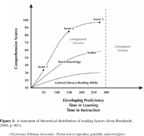
Part of the failure to provide a satisfying model thus far is actually the limitation of conceptualizing a multidimensional process within two dimensions. A contemporary model of second language reading must, in the first place, acknowledge the significant contribution of first language reading ability to second language comprehension. The 20% estimate appears to hold over age groups and languages fairly distinct from each other, but there are no such data from nonsyllabic languages. The field must come to understand whether this generalization holds. In addition, a contemporary model must enable a conceptualization of comprehension as consisting of different elements and influences (not just raw grammar and vocabulary). Different languages realize their meanings with different surface structures (such as restrictive word order in English versus relatively free word order in German) and models have to acknowledge that to move toward higher levels of proficiency, readers must acquire processing strategies specific to the language at hand. Further, a viable model of second language reading must also concede that in the reading of cognate languages there is no such thing as “no knowledge” if the reader is already literate and, at the same time, admit that when switching to noncognate languages, the threshold is set at a very different point. In Figure 1, the X axis refers to time (in learning, instruction, or development of proficiency); the Yaxis denotes percentage of comprehension. Scores 1, 2, and 3 refer to three points in time, either scores from one person over time or from three people at different stages of development.

A statement of theoretical distribution of reading factors (from Bernhardt, 2000, p. 803).
(©Lawrence Erlbaum Associates. Permission to reproduce gratefully acknowledged.)
In the 2000 model (Figure 1), the origin is not 0, but rather 10, acknowledging that there is already some literacy knowledge on the part of all readers especially from cognate languages. But perhaps for literate L1 readers from noncognate languages, there is an origin of “10-x”. This same concern reveals itself in considering and reconciling the performance of children and adults in second language reading for surely cognitive capacity has a role to play as well as how much and whether L1 literacy has developed if at all. Finally, a second language model must also encompass a consideration of unexplained variance in individual performance and after considerable time in learning (both formal and informal).

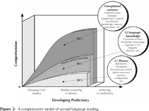
A compensatory model of second language reading.
Perhaps a more satisfying conceptualization of the second language reading process lies in the concept of compensatory processing. A compensatory model tries to model how knowledge sources assist or take over for other knowledge sources that are inadequate or nonexistent—i.e., what they use to compensate for deficiencies. This view is modeled in Figure 2. The model is three dimensional in nature and captures the current knowledge base regarding literacy knowledge, language knowledge with a particular emphasis on vocabulary, and dimensions under investigation, but not yet explained. It illustrates that knowledge sources are not additive, but rather operate synchronically, interactively, and synergistically. The model in Figure 2 attempts to conceptualize how familiarity with orthographic patterns can facilitate the word recognition process without actual language knowledge; or how the higher the L1 literacy level, the more it is available to buttress impoverished second language processes or how the more word knowledge is developed, the more it frees up resources to operate on more complex syntactic patterns and so forth. The model intends to revitalize the conceptualizations of the second language reading process as a juggling or switching process in cognition. Ironically, the primary author of compensatory processing, Stanovich (1980) is mentioned a number of times in the 1970–1990 generation of L2 reading studies. A mention of a model of compensatory processing in second language studies published since 1991 is virtually nonexistent.
Procrastination
The field of second language reading has progressed at a remarkable speed and is no longer the mere imitator of first language research and models. Several formidable hurdles still exist, however, that stymie research progress in the area. It remains much easier to conduct literacy research variable by variable. Although such research is pristine, it is also atheoretical. Future research must account for literacy knowledge and second language proficiency against the backdrop of an array of other variables. What impedes researchers from employing a range of procedures that account for these variables enabling the impact of other variables to be revealed?
First, the issue of language is a sensitive one and is of concern in first language and most certainly in second language research. There are not many reading researchers who can function in a language other than English. The result is that research is conducted principally in English. Models of reading such as Carpenter and Just (1977), Goodman (1968), Gough (1972), LaBerge and Samuels (1974), and Rumelhart (1977) have always been based on English. This means that they are inherently biased toward a particular surface structure (all published models are right-branching, for example) and a particular view of literacy (all take the view that there are no class and gender differences in the use of or access to literacy). How can one take an alternative view when one has no alternative view?
This is not an exclusive criticism to first language research. There is a notorious monolinguality within second language research. A review of the data base reveals this narrowness. There are many studies that have subject groups from across multiple language backgrounds. Of the 121 research studies reviewed in Bernhardt (1991), 56 provide no indication of the number and variety of subjects from different language backgrounds. “105 ESL learners at three proficiency levels” is the typical information given. In other words, in a huge portion of the second language reading data base, the variables introduced by these multiple languages have never been acknowledged. The field will not know truly rich research and have confident knowledge until the data base acknowledges and reveals crosslingual information. An added dimension to the concerns over monolinguality involves assessment. It is clear that the language of assessment with L2 populations is critical (Shohamy, 1982, 1984, for example). If readers are assessed in comprehension tasks in their stronger language (almost always L1 until the highest proficiency/fluency levels), their comprehension seems to be much more significant than when it is measured within the context of their impoverished second language skills. When called on this point, researchers often lament that because they do not know the language of the subjects with whom they are working, they are forced to assess them(the subjects) in the researchers' language. The field will not progress until researcher deficiencies no longer interfere with the ability to provide solid and trustworthy data. Alderson's book (2000) provides a helpful start in resolving these dilemmas as does Methods of Literacy Research (Kamil, Mosenthal, Pearson, & Barr, 2002).
The second dimension that encumbers research development is the measurement of literacy level. On the one hand, this, too, is an old-fashioned concept and a sensitive one. Measurement of literacy level somehow smacks of large-scale testing and the concomitant political agenda. But, politics aside, developing and validating a measure of literacy in an array of languages other than English is a formidable task—and the thought of doing it even before beginning a study of second language issues is even more formidable. But not measuring or accounting for L1 literacy has profound implications. If L1 literacy is truly the significant variable that it appears to be, then in most of the available studies, first language literacy level has merely been remeasured rather than revealing any credible information about second language reading. To be more concrete—it is a rare L2 study that appears to have an effect size large enough to overcome a 20% (or even a 10%) variance attributable to first language literacy.
Lingering Dilemmas and a Bright Future
A legitimate question is whether the field needs models. In truth, each scientific endeavor has a model whether that model is explicitly stated or not. Samuels and Kamil (1984) remind the field of the value of a good model: Such theory building consolidates information from the past, synthesizes present information, and predicts the future. In other words, good models and theory building are economical. They allow the field to move forward rather than reliving a past; they permit a conceptualization of the current state of affairs; and perhaps most importantly they aid in the direction of research development, revealing important variables and processes for fruitful investigation.
The model in Figure 2 highlights the need to examine critical literacy variables in light of variables that already exist.It calls, for example, for basic research in the interplay of syntax and vocabulary in text processing, posing questions such as, Can strategic knowledge compensate for weaknesses in syntax and can these elements be overwhelmed by vocabulary knowledge and so forth? The model also calls for true experiments involving presently unexplained variance. Can more variance be accounted for by using reading tasks that simulate different levels of interest and motivation against the backdrop of language and literacy knowledge? Samuels and Kamil (1984) contend that “an absolutely critical characteristic of a good model is that it be precise enough to lead to testable hypotheses. It is only through the process of testing a model that we are able to determine its validity” (p. 192).
The specter of effective instruction remains a lingering dilemma (Grabe, 2004; Grabe & Stoller, 2002). A theory is only as good as its practical application. If the variables outlined in Figure 2 effectively conceptualize the second language reading process, then the field needs to gather data regarding effective instruction that reflects this process. The model points toward nonadditive integrative instruction: instruction that accommodates literacy variables, language variables, and affective, social, and strategic variables. Key questions are what this accommodation looks like, which accommodations bring about the highest levels of comprehension among learners, and how to work with teachers who wish to learn new integrative methodologies. Another lingering dilemma is how to understand the use of electronic aids in independent reading. Readers with no instructional support, forced to fend for themselves, often rely on the internet in conjunction with electronic dictionaries for a significant portion of critical information. Yet these readers are haunted by the fact that they have no real way of knowing whether they have understood highly technical material. How the field can meet its ethical demand to support such readers is a critical yet open question.
Several bright spots also characterize the field. Every recent major synthesis on scientifically based reading research has acknowledged the importance of research in second language reading. These include The Handbook of Reading Research, Volume II (Barr, Kamil, Mosenthal, & Pearson, 1991) and Volume III (Kamil, Mosenthal, Pearson, & Barr, 2000); the National Reading Panel Report (National Institute of Child Health and Human Development, 2000); the RAND Study Group (2002); the U.S. Institute for Education Sciences commission, the National Literacy Panel for Language Minority Youth (forthcoming, 2005); and the International Reading Association, which has commissioned a special panel to work on second language literacy. These are critical indicators that the findings on second language reading development are much more broadly acknowledged than most work in applied linguistics. A new collection of essays (Brantmeier, forthcoming, 2005) also contributes crucial information to the data base as does important work in the journal Reading in a Foreign Language. All of these endeavors point to the vibrancy and urgency that surround the field of reading in a second language.
ANNOTATED BIBLIOGRAPHY
Alderson, J. C. (2000). Assessing reading.New York: Cambridge University Press.
This volume reviews and critques the most frequently used methods for assessing comprehension of written text. It clearly lays out the opportunity costs encountered in the use of each methodology both for research and for testing purposes.
Brantmeier, C. (2005, forthcoming). (Ed.). Adult foreign language reading: Theory, research, and implications.
This special issue published by The Southern Journal of Linguistics, 27(1), consists of reports that either offer new empirical evidence or examine existing investigations to support a comprehensive theory of second language reading research by researching both micro- and macrolevel features of the reading process with learners of several different languages at different levels of language instruction.
Grabe, W., & Stoller, F. L. (2002). Teaching and researching reading. New York: Longman.
This volume on reading is directed specifically at practitioners who wish an understanding of current research and theory perspectives and who wish to come to their own conclusions about the second language reading process. The volume urges teachers to investigate the reading behaviors of their students.
Kamil, L., Mosenthal, P. B., Pearson, P. D., & Barr, R. (2000). (Eds.) Handbook of reading research, Volume III.Mahwah, NJ: Erlbaum.
This is the most comprehensive volume to date on literacy research. With almost 1000 pages and 47 chapters, this volume focuses specifically on literacy policy, practices, and processes. The volume includes two chapters on second language reading.
Kamil, L., Mosenthal, P. B., Pearson, P. D., & Barr, R. (2002). (Eds.) Methods of literacy research; The methodology chapter from the Handbook of Reading Research, Volume III. Mahwah, NJ: Erlbaum.
This individually published excerpt from the third Handbook of Reading Researchfocuses specifically on research methodology and is extremely helpful for researchers designing studies in literacy. It emphasizes qualitative research methodologies in particular: narrative approaches, critical approaches, and think alouds as examples.
References
Alderson J. C.
1984.
Reading in a foreign language: A reading problem or a language problem?
In J. C. Alderson &
A. H. Urquhart (Eds.),
Reading in a foreign language
(pp. 1–
24).
London:
Longman.
Alderson J. C., &
Urquhart A. (Eds.).
1984.
Reading in a foreign language.
London:
Longman.
Barnett M.
1986.
Syntactic and lexical/semantic skill in foreign language reading: Importance and interaction.
Modern Language Journal,
70,
343–
349.Google Scholar
Barr R.,
Kamil M. L.,
Mosenthal P.,
Pearson P. D. (Eds.).
1991.
Handbook of reading research, Volume II.
Mahwah, NJ:
Erlbaum.
Berkemeyer V.
1994.
Anaphoric resolution and text comprehension for readers of German.
Die Unterrichtspraxis
27,
2,
15–
22.Google Scholar
Bernhardt E. B.
1983.
Three approaches to reading comprehension in intermediate German.
Modern Language Journal,
67,
111–
115.Google Scholar
Bernhardt E. B.
1991.
Reading development in a second language: Theoretical, research, and classroom perspectives.
Norwood, NJ:
Ablex.
Bernhardt E. B.
2000.
Second language reading as a case study of reading scholarship in the twentieth century.
In M. Kamil,
P. Mosenthal,
P. D. Pearson, &
R. Barr (Eds.),
Handbook of reading research, Volume III
(pp. 793–
811).
Hillsdale, NJ:
Erlbaum.
Bernhardt E. B., &
Kamil M. L.
1995.
Interpreting relationships between L1 and L2 reading: Consolidating the linguistic threshold and the linguistic interdependence hypotheses.
Applied Linguistics,
16,
15–
34.Google Scholar
Bhatia V.K.
1984.
Syntactic discontinuity in legislative writing for academic legal purposes.
In A. K. Pugh &
J. M. Ulijn (Eds.),
Reading for professional purposes: Studies and practices in native and foreign languages
(pp. 90–
96).
London:
Heinemann Educational Books.
Block E.
1992.
See how they read: Comprehension monitoring of L1 and L2 readers.
TESOL Quarterly,
26,
(2),
319–
343.Google Scholar
Bossers B.
1991.
On thresholds, ceiling, and short circuits: The relation between L1 reading, L2 reading, and L1 knowledge.
AILA Review,
8,
45–
60.Google Scholar
Bransford J. D., &
Johnson M.
1973.
Consideration of some problems of comprehension.
In W. Chase
Visual information processing
(pp. 383–
438).
New York:
Academic Press.
Brisbois J.
1995.
Connections between first- and second language reading.
Journal of Reading Behavior,
24,
565–
584.Google Scholar
Carpenter P. A., &
Just M. A.
1977.
Reading comprehension as eyes see it.
In M. A. Just & P. A. Carpenter (Eds.),
Cognitive processes in comprehension
(pp. 109–
139).
Hillsdale, NJ:
Erlbaum.
Carrell P. L.
1983.
Three components of background knowledge in reading comprehension.
Language Learning,
33,
183–
207.Google Scholar
Carrell P. L.
1984a.
Evidence of a formal schema in second language comprehension.
Language Learning,
34,
87–
112.Google Scholar
Carrell P. L.
1987.
Content and formal schemata in ESL reading.
TESOL Quarterly,
21
(3),
461–
481.Google Scholar
Carrell P.
1991.
Second language reading: Reading ability or language proficiency?
Linguistics,
12,
159–
179.Google Scholar
Carrell P., &
Connor U.
1991.
Reading and writing persuasive texts.
Modern Language Journal,
75,
314–
324.Google Scholar
Carrell P., &
Wallace B.
1983.
Background knowledge: Context and familiarity in reading comprehension.
In M. A. Clarke &
J. Handscombe (Eds.),
On TESOL '82
(pp. 245–
308).
Washington, DC:
TESOL.
Chi F-M.
1995.
EFL readers and a focus on intertextuality.
Journal of Reading
38
(8),
638–
644.Google Scholar
Chikamatsu N.
1996.
The effects of L1 or thography on L2 word recognition: A study of American and Chinese learners of Japanese.
Studies in Second Language Acquisition,
18
(4),
403–
432.Google Scholar
Chun D., &
Plass J.
1996.
Facilitating reading comprehension with multimedia.
System,
24
(4),
503–
519.Google Scholar
Clarke M. A.
1979.
Reading in Spanish and English: Evidence from adult ESL students.
Learning,
29,
121–
150.Google Scholar
Clarke M. A.
1980.
The short circuit hypothesis of ESL reading: Or when language competence interferes with reading performance.
Modern Language Journal,
64,
203–
209.Google Scholar
Coady J.
1979.
A psycholinguistic model of the ESL reader.
In R. Mackay,
B. Barkman, &
R. R. Jordan (Eds.).
Reading in a second language
(pp. 5–
12).
Rowley, MA;
Newbury House.
Cohen A.,
Glasman H.,
Rosenbaum-Cohen P.,
Ferrar J., &
Fine J.
1979.
Reading English for specialized purposes: Discourse analysis and the use of student informants.
TESOL Quarterly,
3,
551–
564.Google Scholar
Connor U.
1981.
The application of reading miscue analysis to diagnosis of English as a second language learners' reading skills.
In C. W. Twyford,
W. Diehl, &
K. Feathers (Eds.),
Reading English as a second language: Moving from theory
(pp. 47–
55).
Bloomington:
Indiana University School of Education.
Connor U.
1984.
Recall of text: Differences between first and second language readers.
TESOL Quarterly,
18,
239–
255.Google Scholar
Cummins J.
1984.
Bilingualism and special education: Issues in assessment and pedagogy.
Clevedon, UK:
Multilingual Matters.
Cziko G. A.
1978.
Differences in first- and second language reading: The use of syntactic, semantic, and discourse constraints.
Canadian Modern Language Review/ La revue canadienne des langues vivantes,
34,
473–
489.Google Scholar
Dank M., &
McEachern W.
1979.
A psycholinguistic description comparing the native language oral reading behavior of French immersion students with traditional English language students.
Canadian Modern Language Review/La revue canadienne des langues vivantes,
35,
366–
371.Google Scholar
Davis J.
1992.
Reading literature in the foreign language: The comprehension/response connection.
French Review
65
(3),
359–
370.Google Scholar
Davis J.,
Gorell L.,
Kline R., &
Hsieh G.
1992.
Readers and foreign languages: A survey of undergraduate attitudes toward the study of literature.
Language Journal,
73,
320–
332.Google Scholar
DeBot K.,
Paribakht S., &
Wesche M. B.
1997.
Toward a lexical processing model for the study of second language vocabulary acquisition: Evidence from ESL reading.
Studies in Second Language Acquisition,
19
(3),
309–
329.Google Scholar
Devine J.
1981.
Developmental patterns in native and non-native reading acquisition.
In S. Hudelson (Ed.),
Learning to read in different languages
(pp. 110–
114).
Washington, DC:
Center for Applied Linguistics.
Devine J.
1987.
General language competence and adult second language reading.
In J. Devine,
P. L. Carrell, &
D. E. Eskey,
Research in reading in English as a second language
(pp. 73–
86).
Washington, DC:
Teachers of English to Speakers of Other Languages.
Douglas D.
1981.
An exploratory study of bilingual reading proficiency.
In S. Hudelson (Ed.),
to read in different languages
(pp. 93–
102).
Washington, DC:
Center for Applied Linguistics.
Elley W. B.
1984.
Exploring the reading difficulties of second language readers and second languages in Fiji.
In J. C. Alderson &
A. H. Urquhart,
Reading in a foreign language
(pp. 281–
297).
London:
Longman.
Ellis R.
1986.
Understanding second language acquisition.
Oxford:
Oxford University Press.
Everson M. E.
1998.
Word recognition among learners of Chinese as a foreign language: Investigating the relationship between naming and knowing.
Modern Language Journal,
82,
194–
204.Google Scholar
Everson M. E., &
Ke C.
1997.
An inquiry into the reading strategies of intermediate and advanced learners of Chinese as a foreign language.
Journal of the Chinese Language Teachers Association,
32,
1–
20.Google Scholar
Favreau M., &
Segalowitz N. S.
1982.
Second language reading in fluent bilinguals.
Applied Psycholinguistics,
3,
329–
341.Google Scholar
Favreau M.,
Komoda M. K., &
Segalowitz N. S.
1980.
Second language reading: Implications of the word superiority effect in skilled bilinguals.
Journal of Psychology/Revue canadienne de psychologie,
34,
370–
380.Google Scholar
Goodman K. (Ed.).
1968.
The psycholinguistic nature of the reading process.
Detroit, Ml:
Wayne State University Press.
Gough P. B.
1972.
One second of reading.
In J. F. Kavanagh &
I. G. Mattingly (Eds.),
Language by eye and ear
(pp. 331–
358).
Cambridge:
MIT Press.
Grabe W.
2004.
Research on teaching reading.
Annual Review of Applied Linguistics,
24,
44–
69.Google Scholar
Groebel L.
1980.
A comparison of students' reading comprehension in the native language with their reading comprehension in the target language.
English Language Teaching Journal,
35,
54–
59.Google Scholar
Hacquebord H.
1989.
Reading comprehension of Turkish and Dutch students attending secondary schools.
Groningen:
RUG.
Harrington M., &
Sawyer M.
1992.
L2 working memory capacity and L2 reading skill.
Studies in Second Language Acquisition,
14,
25–
38.Google Scholar
Hatch E.,
Polin P., &
Part S.
1974.
Acoustic scanning and syntactic processing: Three reading experiments: First and second language learners.
of Reading Behavior,
6,
275–
285.Google Scholar
Hayes E. B.
1988.
Encoding strategies used by native and non-native readers of Chinese Mandarin.
Modern Language Journal,
72,
188–
195.Google Scholar
Haynes M.
1981.
Patterns and perils of guessing in second language reading.
In J. Handscombe,
R. Oren, &
B. Taylor (Eds.),
TESOL '83
(pp. 163–
176).
Washington, DC:
TESOL.
Hedgcock J., &
Atkinson D.
1993.
Differing reading-writing relationships in L1 and L2 literacy development?
TESOL Quarterly
27,
329–
333.Google Scholar
Hodes P.
1981.
Reading: A universal process.
In S. Hudelson (Ed.),
Learning to read in different languages
(pp. 27–
31).
Washington, DC:
Center for Applied Linguistics.
Horiba Y.
1996.
Comprehension processes in L2 reading: Language competence, textual coherence, and inferences.
Studies in Second Language Acquisition
18,
433–
473.Google Scholar
Hulstijn J.
1993.
When do foreign-language readers look up the meaning of unfamiliar words? The influence of task and learner variables.
Modern Language Journal
77,
139–
147.Google Scholar
Irujo S.
1986.
Don't put your leg in your mouth: Transfer in the acquisition of idioms in a second language.
TESOL Quarterly,
20,
287–
304Google Scholar
Johnson P.
1981.
Effects on reading comprehension of language complexity and cultural background of a text.
TESOL Quarterly,
15,
169–
181.Google Scholar
Johnson P.
1982.
Effects on comprehension of building background knowledge.
TESOL Quarterly,
16,
503–
516.Google Scholar
Kern R. G.
1994.
The role of mental translation in second language reading.
Studies in Second Language Acquisition,
16,
441–
461.Google Scholar
Kim S-A.
1995.
Types and sources of problems in L2 reading: A qualitative analysis of the recall protocols of Korean high school EFL students.
Foreign Language Annals,
28,
49–
70.Google Scholar
Knight S.
1994.
Dictionary: The tool of last resort in foreign language reading? A new perspective.
Modern Language Journal,
78,
285–
299.Google Scholar
Koda K.
1987.
Cognitive strategy transfer in second language reading.
In J. Devine,
P. L. Carrell, &
D. E. Eskey (Eds.),
in reading in English as a second language.
Washington, DC:
TESOL,
125–
144
Koda K.
1993.
Transferred L1 strategies and L2 syntactic structures in L2 sentence comprehension.
Modern Language Journal,
77,
490–
499.Google Scholar
Kramsch C., &
Nolden T.
1994.
Redefining literacy in a foreign language.
Unterrichtspraxis,
27,
28–
35.Google Scholar
LaBerge D., &
Samuels S.J.
1974.
Toward a theory of automatic information processing in reading.
Cognitive Psychology,
6,
293–
323.Google Scholar
Laufer B., &
Hadar L.
1997.
Assessing the effectiveness of monolingual, bilingual, and “bilingualized” dictionaries in the comprehension and production of new words.
The Modern Language Journal,
81,
189–
196.Google Scholar
Lee J. F.
1986.
Background knowledge and L2 reading.
Modern Language Journal,
70,
350–
354.Google Scholar
Leffa V.
1992.
Making foreign language texts comprehensible for beginners: An experiment with an electronic glossary.
System,
20,
63–
73.Google Scholar
Lund R.
1991.
A comparison of second language listening and reading comprehension.
The Modern Language Journal,
75,
196–
204.Google Scholar
Luppescu S., &
Day R.
1993.
Reading, dictionaries, and vocabulary learning.
Language Learning,
42,
(2)
263–
287.Google Scholar
MacLean M., &
d'Anglejan A.
1986.
Rational cloze and retrospection: Insights into first and second language reading comprehension.
Canadian Modern Language Review/La revue canadienne des langues vivantes,
42,
814–
826.Google Scholar
McLeod B., &
McLaughlin B.
1986.
Restructuring or automaticity? Reading in a second language.
Language Learning,
36,
109–
123.Google Scholar
Mohammed M. A. H., &
Swales J. M.
1984.
Factors affecting the successful reading of technical instructions.
Reading in a Foreign Language,
2
206–
217Google Scholar
Muchisky D. M.
1983.
Relationships between speech and reading among second language learners.
Language Learning,
33,
77–
102.Google Scholar
National Institute of Child Health and Human Development (NICHD).
2000.
of the NationalRreading Panel: Teaching children to read: An evidence-based assessment of the scientific research literature on reading and its implications for reading instruction: Reports of the subgroups.
Washington, DC:
Author.
National Literacy Panel for Language Minority Youth.
(Forthcoming, 2005).
Washington, DC:
US Department of Education.
Parry K.
1991.
Building a vocabulary through academic reading.
Quarterly,
25,
629–
653.Google Scholar
RAND Reading Study Group.
2002.
Reading for understanding: Toward an R&D program in reading comprehension.
Santa Monica, CA:
RAND.
Reeds J. A.,
Winitz H., &
Garcia P. A.
1977.
A test of reading following comprehension training.
International Review of Applied Linguistics (IRAL),
15,
307–
319.Google Scholar
Rigg P.
1978.
The miscue-ESL project.
In H. D. Brown,
C. Yorio, &
R. Crymes (Eds.),
On TESOL 77
(pp. 109–
117).
Washington, DC:
TESOL.
Riley G.
1993.
A story structure approach to narrative text comprehension.
Modern Language Journal,
77,
417–
430.Google Scholar
Roller C. M.
1988.
Transfer of cognitive academic competence and L2 reading in a rural Zimbabwean primary school.
TESOL Quarterly,
22
(2),
303–
328.Google Scholar
Royer J., &
Carlo M.
1991.
Transfer of comprehension skills from native to second language.
Journal of Reading,
34,
450–
455.Google Scholar
Rumelhart D.
1977.
Toward an interactive model of reading.
In S. Dornic (Ed.),
Attention and performance V
(pp. 573–
603).
Hillsdale, NJ:
Erlbaum.
Samuels S. J., &
Kamil M. L.
1984.
Models of the reading process.
In P. D. Pearson
Handbook of reading research
(pp. 185–
224).
New York:
Longman.
Sarig G.
1987.
High-level reading in the first and in the foreign language: Some comparative process data.
In J. Devine,
P. L. Carrell, &
D. E. Eskey (Eds.),
Research in reading in English as a second language
(pp. 105–
120).
Washington, DC:
TESOL.
Shohamy E.
1982.
Affective considerations in language testing.
Modern Language Journal,
66,
13–
17.Google Scholar
Shohamy E.
1984.
Does the testing method make a difference? The case of reading comprehension.
Language Testing,
1,
147–
170.Google Scholar
Stanovich K. E.
1980.
Toward an interactive-compensatory model of individual differences in the acquisition of literacy.
Reading Research Quarterly,
16,
32–
71Google Scholar
Steffensen M. S.
1988.
Changes in cohesion in the recall of native and foreign texts.
In P. L. Carrell,
J. Devine, &
D. E. Eskey (Eds.),
Interactive approaches to second language reading
(pp. 140–
151).
Cambridge:
Cambridge University Press.
Steffensen M. S.,
Joag-Dev C., &
Anderson R. C.
1979.
A cross-cultural perspective on reading comprehension.
Reading Research Quarterly,
15,
10–
29.Google Scholar
Suarez J. de.
1985.
Using translation communicatively in ESP courses for science studies.
In J. M. Ulijn &
A. K. Pugh (Eds.),
Reading for professional purposes: Methods and materials in teaching languages
(pp. 56–
68).
Leuven, Belgium:
Acco.
Takahashi S., &
Roitblatt H.
1994.
Comprehension processes of second language indirect requests.
Psycholinguistics,
15,
475–
506.Google Scholar
Tang G.
1992.
The effect of graphic representation of knowledge structures on ESL reading comprehension.
Studies in Second Language Acquisition,
14,
177–
195Google Scholar
Tang G.
1997.
The relationship between reading comprehension processes in L1 and L2.
Reading Psychology,
18,
249–
301.Google Scholar
Wagner D. A.,
Spratt J. E., &
Ezzaki A.
1989.
Does learning to read in a second language always put the child at a disadvantage? Some counter evidence from Morocco.
Applied Psycholinguistics,
10,
31–
48Google Scholar
Weber R.
1991.
Linguistic diversity and reading in American society.
In R. Barr, (Ed.)
Handbook of reading research, Volume III
(pp. 97–
119).
New York:
Longman.
Yano Y.,
Long M., &
Ross S.
1994.
The effects of simplified and elaborated texts on foreign language reading comprehension.
Language Learning,
44,
189–
219Google Scholar
Zimmerman C.
1997.
Do reading and interactive vocabulary instruction make a difference? An empirical study.
TESOL Quarterly,
31,
121–
140.Google Scholar
Zuck L. V., &
Zuck I. G.
1984.
The main idea: Specialist and nonspecialist judgments.
In A. K. Pugh &
I. M. Ulijn (Eds.),
Reading for professional purposes: Studies and practices in native and foreign languages
(pp. 130–
135).
London:
Heinemann Educational Books.
A statement of theoretical distribution of reading factors (from Bernhardt, 2000, p. 803).
A compensatory model of second language reading.
 You have
Access
- 151
- Cited by