INTRODUCTION
The family Amphinomidae presently represents around 180 nominal species in around 28 genera including 20 that are moderately well-defined, of which two represent fossil taxa, and eight whose present status and affinities are not well understood (Kudenov, Reference Kudenov, Dauvin, Laubier and Reish1994, Reference Kudenov, Blake, Hilbig and Scott1995; Read, Reference Read2014); given questions concerning the synonymy of other taxa, the actual number of valid genera is perhaps 21 (Borda et al., Reference Borda, Kudenov, Beinhold and Rouse2012). These worms, often called ‘fireworms’, are best known for colourful, large-bodied tropical species with brilliant white calcareous chaetae. A neurotoxin (complanine) associated with harpoon chaetae induces an irritating sensation in some predators and unlucky divers, and functions as a defence mechanism (Kudenov, Reference Kudenov, Blake, Hilbig and Scott1995; Nakamura et al., Reference Nakamura, Tachikawa, Kitamura, Ohno, Suganuma and Uemura2008). While the majority of amphinomids are reported from shallow and tropical waters, some inhabit polar and deep-sea habitats (Kudenov, Reference Kudenov1993, Reference Kudenov, Blake, Hilbig and Scott1995; Barroso & Paiva, Reference Barroso and Paiva2008, Reference Barroso and Paiva2011; Borda et al., Reference Borda, Kudenov, Beinhold and Rouse2012, Reference Borda, Kudenov, Chevaldonné, Blake, Desbruyères, Fabri, Hourdez, Pleijel, Shank, Wilson, Schulze and Rouse2013), others thrive in chemosynthetic environments (Borda et al., Reference Borda, Kudenov, Beinhold and Rouse2012).
Branchamphinome Hartman, Reference Hartman1967 is a moderately understood genus that differs morphologically from other genera in having an unusual chevron-shaped caruncle and branchiae from chaetiger 1.
Two species of Branchamphinome are presently known: Branchamphinome antarctica Hartman, Reference Hartman1967 was originally described based on deep-water specimens from Antarctica (333–1153 m), and subsequently reported by Amoureux (Reference Amoureux1982), who identified a single specimen from the North Atlantic. Detinova (Reference Detinova1985) later described B. islandica from deep North Atlantic waters near Iceland (1413–1605 m), centred on morphological differences in the branchiae and chaetae compared with those of B. antarctica.
While studies continue on the phylogeny of the Amphinomida (Borda et al., Reference Borda, Kudenov, Beinhold and Rouse2012, Reference Borda, Yáñez-Rivera, Ochoa, Kudenov, Sanchez-Ortiz, Schulze and Rouse2015), the exact phylogenetic position of Branchamphinome within the Amphinomidae has not been completely delineated. That is, in view of its lack of accessory dorsal cirri, Branchamphinome is clearly a member of the Amphinominae (Borda et al., Reference Borda, Yáñez-Rivera, Ochoa, Kudenov, Sanchez-Ortiz, Schulze and Rouse2015). It is also similar anatomically to Hermodice and Pherecardia in having branchiae on all chaetigers, while the caruncles of Branchamphinome and Pherecardia are constructed similarly.
The purpose of this study is to describe a new species of Branchamphinome from shallow tropical waters (19oS) of the the South-western Atlantic, Brazilian Continental Shelf (150–200 m deep), together with an emendation of the genus and to provide a key to all known species of this genus.
MATERIALS AND METHODS
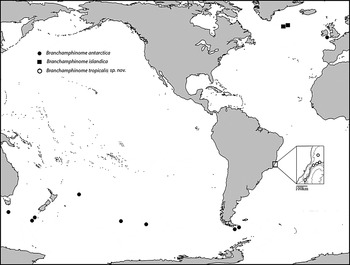
Specimens of Branchamphinome were collected from five stations (Figure 1) on South-eastern Brazil's continental shelf – off Espírito Santo State, during a survey conducted by PETROBRAS (Brazilian Energy Company) under the scope of the AMBES project ‘Caracterização Ambiental Marinha da Bacia do Espírito Santo e Porção Norte da Bacia de Campos’, coordinated by CENPES/PETROBRAS. Sediment sampled with a box corer was sieved using a 0.5 mm mesh; specimens were fixed in 10% formalin, and preserved in 70% alcohol.
Distribution of Branchamphinome species.

Specimens were later examined using stereo- and compound light microscopes and scanning electron microscopy (SEM). For the latter, specimens were first dehydrated in a series of progressively increasing concentrations of ethanol (70–100%), critical point dried, coated with ~35 nm of gold and then examined and photographed at the Laboratório de Microscopia Eletrônica (NEMA/PUC-Rio). Type material was deposited in the Museu Nacional da Universidade Federal do Rio de Janeiro (MNUFRJP) and the Museu de Zoologia da Unicamp (ZUEC).
Abbreviations for museum names:
- USNM
-
Smithsonian Institution National Museum of Natural History
- LACM
-
Natural History Museum of Los Angeles
- MNUFRJP
-
Museu Nacional da Universidade Federal do Rio de Janeiro
- ZUEC
-
Museu de Zoologia da Universidade Estadual de Campinas
RESULTS
SYSTEMATICS
AMPHINOMIDAE LAMARK, 1818
AMPHINOMINAE LAMARCK, 1818
BRANCHAMPHINOME Hartman, Reference Hartman1967, EMENDED Kudenov, Reference Kudenov1993, EMENDED
TYPE SPECIES
Branchamphinome antarctica Hartman, Reference Hartman1967, by original designation.
Branchamphinome antarctica Hartman, Reference Hartman1967, pp. 42–43, Plate 12, fig. A.
Branchamphinome antarctica.-Kudenov, Reference Kudenov1993, pp. 95–99, Figures 1A–H, 2A–L, 6.
?Branchamphinome antarctica.-Amoureux, Reference Amoureux1982, p. 34, Figure 2 (North Atlantic).
Not Branchamphinome islandica Detinova, Reference Detinova1985, pp. 104–105, Figure 1u–1o (North Atlantic).
Euphrosine armadilloides.-Hartman, Reference Hartman1967, p.45 (in part).-Not Ehlers, 1900.
Euphrosine magellanica.-Hartman, Reference Hartman1967, p. 45 (in part). Not Ehlers, 1900.
Euphrosine notialis.-Hartman, Reference Hartman1967, p. 45 (in part). Not Ehlers, 1900.
DIAGNOSIS
Body oval to elongate, rectilinear. Prostomium with anterior and posterior lobes present bearing five cephalic appendages. Caruncle chevron-shaped, with median keel and paired lateral lamellae. Parapodia biramous. Notochaetae include spurred and non-spurred capillaries and harpoons; notopodial hooks present in chaetiger 1. Neurochaetae include spurred and non-spurred capillaries plus bifurcate chaetae. Notoacicula and neuroacicula hastate, former sometimes spinous. Branchiae dichotomously branching tufts from chaetiger 1, continuing to end of body. Dorsal cirri cirriform; ventral cirri conical to subulate. Dorsal anus opening on last one or two chaetigers. Pygidial cirrus medial, unpaired.
EMENDED DESCRIPTION
The emended description by Kudenov (Reference Kudenov1993) is updated here to include the presence of a single delicate and inconspicuous hook in each notopodial fascicle of chaetiger 1.
REMARKS
The discovery of notochaetal hooks in chaetiger 1 of B. tropicalis sp. nov. from the South Atlantic (see below), led JDK to re-examine the lectotype of B. antarctica and confirm their presence (Figure 2N). The presence of hooks in Branchamphinome is interesting because it has long been considered a singularly diagnostic character of the genus Paramphinome. Whereas the presence of hooks remains a diagnostic generic trait, the two above taxa are readily distinguished from one another by the form of their caruncles (less developed in Paramphinome) and distribution of branchiae (confined to anterior region in Paramphinome). Interestingly, a primary anatomical difference between Paramphinome and Linopherus is the absence of notopodial hooks in the latter genus.
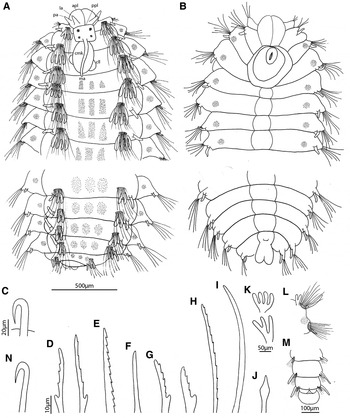
Branchamphinome tropicalis sp. nov. A. Holotype, anterior and posterior regions, dorsal view; B. Holotype, anterior and posterior regions, ventral view; C. notohook; D–F. notochaetae; H–J. Neurochaetae; K. branchiae; L. Paratype terminal chaetiger, lateral view; M. Paratype pygidium, ventral view; N. Branchamphinome antarctica (lectotype). notohook (not to scale). apl, anterior prostomial lobe; ca, caruncle; cmk, caruncle median keel; cll, caruncle lateral lobe; la, lateral antenna; ma, median antenna; ppl, posterior prostomial lobe.

DISTRIBUTION
Southern Ocean: Drake passage (384–494 m), Macquarie Ridge (333–798 m), South-west Pacific Basin (531–659 m), Pacific Antarctic Ridge (362–1153 m), Tierra del Fuego (771–903 m), South Tasman Rise (1028–1034 m) (Kudenov, Reference Kudenov1993); Atlantic Ocean: North Atlantic: off Iceland (1413–1605 m) (Detinova, Reference Detinova1985), off Bretagne-Ireland (1200 m) (Amoureux, Reference Amoureux1982); South Atlantic: Brazilian coast (134–163 m) (this study).
Branchamphinome tropicalis sp. nov.
TYPE MATERIAL
Holotype: complete specimen, 6 mm long, 0.5 mm wide (19°45′54.71″S 39°30′24.91″W; 138 m depth) (MNUFRJP-1196); coll. 15 January 2012.
Paratypes: 2 specimens. (19°36′4.32″S 39°10′34.07″W; 134 m depth) (MNUFRJP-1197); coll. 15 January 2012. 1 specimen. (19°36′3.57″S 39°10′33.64″W; 142 m depth) (MNUFRJP-1198); coll. 20 June 2013. 1 specimen. (19°36′5.08″S 39°10′32.85″W; 145 m depth) (MNUFRJP-1199); coll. 15 January 2012. 1 specimen. (19°36′5,17″S 39°10′32.93″W; 145 m depth) (ZUEC–191883); coll. 15 January 2012. 1 specimen. (19°31′51.52″S 39°3′4.3″W; 140 m depth) (MNUFRJP-1200); coll. 9 December 2011). 1 specimen. (19°31′51″S 39°3′4.79″W; 163 m depth) (MNUFRJP-1121); coll. 29 June 2013.
COMPARATIVE MATERIAL EXAMINED
Branchamphinome antarctica Hartman, Reference Hartman1967. Lectotype: USNM 55502; USNS ‘Eltanin’ Cruise 15 to Pacific Antarctic Ridge, Station 1343 (54°50′S 129°50W to 54°51′S 129°46′W); collected 7 November 1964 with Menzies trawl, 915–1153 m depth. Paralectotypes: USNM 99503, 139256–139260 (287 specimens); USNS ‘Eltanin’ Cruise 15 to Pacific Antarctic Ridge, Station 1343 (54°50′S 129°50′W to 54°51′S 129°46′W); collected 7 November 1964 with Menzies trawl, 915–1153 m depth. USNM 55934, 99308, 139095 (21 specimens); USNS ‘Eltanin’ Cruise 9 to Drake Passage, Station 740 (56°06′S 066°19′W to 56°07′S 066°30′W); collected 18 September 1963 with Blake trawl, 384–494 m depth. USNM 139098 (3 specimens); USNS ‘Eltanin’ Cruise 16 to Macquarie Ridge, Station 1411 (51°00′S 162°01′E to 51°01′S 162°01′E); collected 8 February 1965 with Blake trawl, 333–371 m depth. USNM 139099 (1 specimen); USNS ‘Eltanin’ Cruise 16 to Macquarie Ridge, Station 1414 (52°17′S 160°40′E to 52°22′S 160°34′E); collected 9 February 1965 with Blake trawl, 659–798 m depth. USNM 99305, 99307, 139096 (11 specimens); USNS ‘Eltanin’ Cruise 15 to Pacific Antarctic Ridge, Station 1343 (54°50′S 129°50W to 54°51′S 129°46′W); collected 7 November 1964 with Menzies trawl, 915–1153 m depth. USNM 55904 (5 specimens); USNS ‘Eltanin’ Cruise 15 to Pacific Antarctic Ridge, Station 1345 (54°50′S 129°48′W to 54°51′S 129°46′W); collected 7 November 1964 with Menzies trawl, 915–1153 m depth. USNS 55903, 139097, LACM 00000 (65 specimens); USNS ‘Eltanin’ Cruise 15 to Pacific Antarctic Ridge, 1346 (54°49′S 129°48′W to 54°50′S 129°46′W); collected 7 November 1964 with Blake trawl, 549 m depth. USNM 139100-139101 (26 specimens); USNS ‘Eltanin’ Cruise 16 to Pacific Antarctic Ridge, Station 1691 (53°56′S 140°19W to 53°56′S 140°17′W); collected 14 May 1966 with Blake trawl, 362–567 m depth. USNM 139102 (1 specimen); USNS ‘Eltanin’ Cruise 24 to South-west Pacific Basin, Station 1718 (38°27′S 168°07W to 38°30′S 168°04′W); collected 12 July 1966 with Blake trawl, 531–659 m depth. USNM 139103 (1 specimen); USNS ‘Eltanin’ Cruise 27 to South-west Pacific Basin, Station 1983 (47°11′S 147°47′E to 47°10′S 147°46′E); collected 12 July 1966 with Blake trawl, 531–659 m depth. USNM 139104 (2 specimens); RV ‘Hero’ Cruise 715 to Tierra del Fuego, Station 875 (54°55′S 064°00′W to 54°54′S 063°53′W); collected 26 October 1971 with trawl, 771–903 m depth.
DIAGNOSIS
Body elongate, short, fusiform to long, rectilinear; longitudinal midventral groove absent. Three rectangular brown patches on dorsum of each chaetiger, a round interparapodial patch and two ventral rounded patches near each neuropodium. Prostomium moderately developed, with anterior and posterior lobes, bearing five cephalic appendages including: paired lateral antennae and palps on anterior lobe; a median antenna on posterior lobe. Eyes numbering two pairs, typically well-developed. Caruncle chevron-shaped, including median keel with up to two paired, simple secondary lamellae, latter directed posteriorly; arising from posterior border of prostomium, not fused to body wall; confined to chaetiger 2. Mouth opening between chaetigers 2 and 3. Branchiae dichotomously branching tufts from chaetiger 1, continuing to end of body. Filaments digitiform, reaching the maximum number 4–6 filaments per branchiae in middle body chaetigers. Dorsal anus opening on terminal one or two chaetigers. Pygidium as a median unpaired papilla.
DESCRIPTION BASED ON HOLOTYPE
Holotype with 20 chaetigers, 6 mm long, 0.5 mm wide without chaetae (Figures 1A–C & 2A, B). Body subrectangular in cross section, with a specific pattern of pigmentation. Three rectangular brown patches on dorsum of each chaetiger, a round interparapodial patch and two ventral rounded patches near each neuropodium – totalling 7 pigmented patches on each chaetiger (Figure 2A, B). These patches are least pigmented in the first 2–3 anterior and the last several body chaetigers. Prostomium quadrangular, consisting of anterior and posterior lobes. Anterior lobe is large, with paired lateral antennae arising from its posterior region and paired palps, similar in form to lateral antennae, inserted ventrolaterally on anterior region; lateral antennae and paired palps are smooth and conical (Figure 2A). Posterior lobe of prostomium with two pairs of large, conspicuously rounded and well-separated eyes and a median antenna. First pair of eyes largest, median antenna similar in form to the lateral antennae and palps, inserted on posterior region of the prostomium, aligned between second pair of eyes and exceeding caruncle in length (Figures 2A & 3A, C). Caruncle pinnate; a medial keel with one lateral lobe each side, attached to the posterior edge of prostomium and free of body wall. Mouth composed of chaetigers 2–3, posterior lip formed by chaetiger 3 (Figures 2B & 3B). Pharynx muscular, eversible, with a longitudinal aperture when everted. Parapodia biramous with well separated rami. Notopodia circular in outline with marginal collars; dorsal cirri well developed, cirrophores longer than wide, distal cirrostyles smooth, tapering, emerging at apex of chaetal fascicles; neuropodia conical, with raised collars, conical, ventral cirri arising from body wall, posteroventral to fascicle, with cirrophores, increasing in length in posterior chaetigers, but shorter than dorsal cirri along entire body (Figures 2A & 4D). Branchiae present in all chaetigers, branching dichotomously, with each branch producing a palmate array of filaments posterior and superior to notopodia. Filaments digitiform, reaching the maximum number 4–6 filaments per branchiae in middle body chaetigers (Figures 2A & 3A, K).
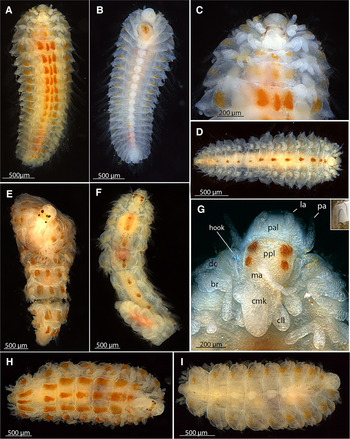
Branchamphinome tropicalis sp. nov. stereomicroscope images. A. Holotype, dorsal view; B. Holotype, ventral view; Holotype, anterior region. D. specimen prepared to SEM; E. Paratype, entire body, dorsal view; F. Paratype. Entire body, dorsal view; G. same specimen, prostomium, notohook in detail; H. paratype, dorsal view; I. same specimen, ventral view. Abbreviations: apl, anterior prostomial lobe; br, branchia; cmk, caruncle median keel; cll, caruncle lateral lobe; dc, dorsal cirri; la, lateral antenna; ma, median antenna; ppl, posterior prostomial lobe.

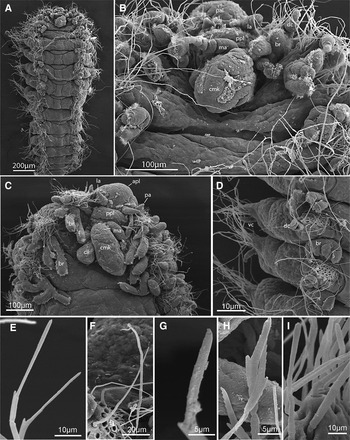
Branchamphinome tropicalis sp. nov. SEM images. A. Entire body, dorsal view; B. Prostomium and caruncle, dorsal view; C. Anterior region, dorsal view; Parapodia of midbody, dorsal view; E–F. Notochaetae; G–I. Neurochaetae. Abbreviations: apl, anterior prostomial lobe; br, branchia; ca, caruncle; cmk, caruncle median keel; cll, caruncle lateral lobe; dc, dorsal cirri; la, lateral antenna; ma, median antenna; ppl, posterior prostomial lobe; vc, ventral cirri.

Notochaetae of four types: One recurved and diminutive, inconspicuous hook is present on superior margin of each notofascicle of first chaetiger, located between each notopodium and the prostomium (Figures 2C & 3G); long thick harpoon chaetae (Figure 2E) – the least abundant kind of notochaeta; spurred and non-spurred capillaries with inner cutting margins serrated (Figures 2D & 4E, G); notoacicula of two types: hastate (2 per fascicle), and stout, abruptly tapered spines (4–5 per fascicle) (Figures 2F & 4F); all distally emergent. Neurochaetae of three types: bifurcate chaetae with the inner margin of long prong serrated (Figures 2G & 4H), serrated capillaries with dentate cutting edges lacking spurs (Figure 2H) and smooth capillaries (Figure 2I); neuroacicula hastate (Figures 2J & 4I), confined to upper margins of fascicle, numbering 2–4 per neuropodia. Anus dorsal on terminal chaetiger, pygidium with a median unpaired, distally incised papilla (Figure 2A, B).
VARIATION
Great variation in the caruncle, branchiae, dorsal pigmentation pattern, pygidium and presence of the notohooks on the first chaetiger was observed in the paratypes. For example, the caruncle varies from a simple, globular median keel lacking paired axial ridges (Figures 3A, C, D & 4B) to one having two pairs of axial ridges arising from each side of the median keel (Figures 2F, G & 4C). Although all specimens are distinctly pigmented, the typical dorsal pigmentation pattern described above is the presence of three dorsal patches per segment, each with the same intensity (Figure 3A, C, E, H); otherwise, the median patch is sometimes larger and more darkly pigmented than the lateral ones (Figure 3D, F). Specimens with more segments tend to be more pigmented. While branchiae are palmate and dichotomously branched, they are either symmetrical (Figures 3A & 4D) to asymmetrically divided (Figures 3E & 4C).
The notopodial hook on the first chaetiger is very difficult to detect. For example, we observed it in just four out of 12 specimens of B. tropicalis sp. nov., and do not know whether hooks are simply absent in some specimens or if they could have been broken or whether they are located internally in the parapodia, being engulfed with the growing of the animal (Figure 3E, H, I).
While the pygidium of the holotype is incised (Figures 2A, B & 3A, B), it is not incised in a complete paratype (Figures 2F & 3M). A possible explanation is that this bilobed structure could be an artefact of a regeneration process of terminal chaetigers, as observed in some specimens.
ETYMOLOGY
The name of this species, tropicalis, refers to the tropical region of Brazil (19°S), from where this species is described. This represents the first report of the genus Branchamphinome from the tropics.
REMARKS
The existence of a notopodial hook on the first chaetiger of Branchamphinome tropicalis sp. nov., which was also observed in the lectotype of B. antarctica, is described here for the first time and confirmed as a generic characteristic. As noted above, their presence is phylogenetically interesting in that it long has been considered to be a primary diagnostic feature of the genus Paramphinome, and the main anatomical difference separating Paramphinome and Linopherus. We speculate that the presence of notopodial hooks in chaetiger 1 may represent a size-related feature present in small-bodied species and/or specimens that may ultimately be lost during the later developmental stages of large-bodied amphinomids. Similarly, differences in mouth placement whereby chaetiger 3 forms the posterior lip in B. tropicalis in contrast to chaetiger 4 in B. antarctica is also probably an ontogenetic phenomenon; the latter species is considerably larger (size and segments) compared with the former. Similar trends in other size-dependent morphological features such as the ventral scutes of Archinome have also been documented (Borda et al., Reference Borda, Kudenov, Chevaldonné, Blake, Desbruyères, Fabri, Hourdez, Pleijel, Shank, Wilson, Schulze and Rouse2013).
Branchamphinome tropicalis sp. nov. further differs from B. antarctica in having poorly developed branchiae, maximally with 5–8 filaments emerging from one main stem in the midbody region of large specimens; those of B. antarctica have up to 20 branchial filaments emerging from two main stems, forming an ‘L’ pattern (when viewed from above).
Branchamphinome tropicalis sp. nov. is similar to B. islandica regarding the shape of branchiae and number of branchial filaments, but differs from this species due to its well separated pair of eyes, while those of B. islandica appear to be fused, giving an impression of a figure ‘8’. Due to its characteristics plus the geographic location, we strongly suspect that Amoureux's (Reference Amoureux1982) specimen represents B. islandica. We have not examined Amoureux's material, and note that he identified his specimen before Detinova (Reference Detinova1985) described B. islandica.
The caruncles of B. tropicalis sp. nov., B. antarctica and B. islandica all arise from the posterior margin of the prostomium, and are not fused to the body wall in the first two taxa; it is probably also not fused to the body wall in B. islandica, although the holotype should be re-examined to verify our surmise. However, the caruncles of these taxa vary in the degree of their development, with B. tropicalis sp. nov. having up to two lateral lobes on either side of the median keel; B. islandica with two lateral lobes (four total); and B. antarctica with six lateral lobes (12 total). Interestingly, Branchamphinome and Pherecardia are the only known amphinomids having similarly configured caruncles, although the simple caruncle of the former taxon lacks the intricate array of lateral lobes that are secondarily folded into a foliose plicate array.
Branchamphinome tropicalis sp. nov. was found in the Brazilian continental shelf at a depth of 150 m, and this report represents the first record of the genus from both shallow and tropical waters. Branchamphinome tropicalis sp. nov. differs from B. antarctica and B. islandica Detinova, Reference Detinova1985, mainly due to the highly developed body pigmentation pattern; the other species are apparently unpigmented.
The highly developed pigmentation pattern in B. tropicalis sp. nov. may be due to the shallow depth from where this species lives, in contrast to all previous depth records for this genus. Furthermore, it appears that B. tropicalis sp. nov. is restricted geographically to shelf depths (134–163 m); it has not been collected from numerous slope stations (up to 3000 m).
It is likely that shallow-water species are more intensely pigmented compared with their deep-water congeners. For example, Nygren et al. (Reference Nygren, Eklöf and Pleijel2010) found shallow species (Notophyllum foliosum) to be more pigmented than its deeper congener (N. crypticum). Similar findings were also reported by Barroso & Paiva (Reference Barroso and Paiva2011) for a deep-water species of Chloeia (Amphinomidae), which tend to be much less pigmented compared with shallower Chloeia species. Furthermore, pigmentation patterns have been demonstrated to be an important taxonomic character in the genus Notopygos (Yáñez-Rivera & Carrera-Parra, Reference Yañez-Rivera and Carrera-Parra2012).
TAXONOMIC KEY FOR BRANCHAMPHINOME SPECIES
-
1. Branchiae with 15 to 18–20 filaments in midbody segment………B. antarctica
-
– Branchiae with 4–8 filaments in midbody segment………2
-
-
2. Two pair of eyes nearly coalescent, forming a figure ‘8’; body not characteristically pigmented; caruncle with up to 4 lateral lobes arising from either side of the median keel………B. islandica
-
– Two pairs of eyes, not coalescent and not forming a figure ‘8’; body characteristically pigmented; caruncle with up to 2 lateral lobes arising from either side of the median keel………B. tropicalis sp. nov.
-
ACKNOWLEDGEMENTS
We are grateful to CENPES/PETROBRAS for providing the samples, to Karla Avelar for the SEM sections, and to Ana Claudia Brasil and Vinícius Miranda for the stereomicroscope sections. We also thank Karen Osborn, William Moser and Katie Ahlfeld, Smithsonian Institution (National Museum of Natural History, Department of Invertebrate Zoology) for accommodating JDK's examination of specimens during his December 2015 visit.