Introduction
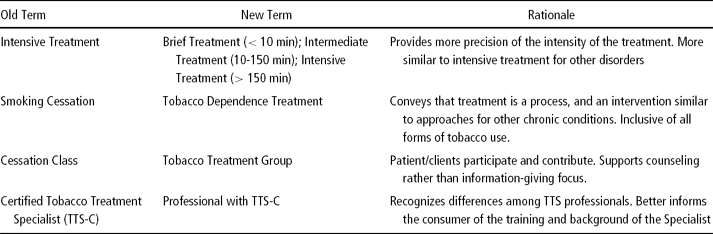
Tobacco dependence is characterised as a chronic, relapsing disorder that typically requires multiple quit attempts before successful, long-term abstinence is achieved (Steinberg, Foulds, Richardson, Burke, & Shah, Reference Steinberg, Foulds, Richardson, Burke and Shah2006). Best practice, evidence-based treatment includes multiple-session counselling and pharmacotherapy, or the combination of both (Fiore et al., Reference Fiore, Jaen, Baker, Bailey, Benowitz and Curry2008). The field has moved past the notion that tobacco dependence is simply a bad habit, a vice, or a moral deficiency that can be overcome by willpower or education alone (Mars & Ling, Reference Mars and Ling2008). However, the language used in discussing treatment has not always been consistent with this evidence. Some words and phrases used lend themselves to varied meanings, and could lead to significant misunderstanding not only among professionals in the field, but also among the general public (O'Brien, Reference O'Brien2010; Davis, Reference Davis1992; Perkins, Reference Perkins1999; Hughes, Reference Hughes2013). In this paper, we discuss some commonly used, problematic terminology, and suggest more appropriate terms (Table 1).
Suggested changes in terms

Intensive Tobacco Treatment
According to the 2008 US Public Health Service (USPHS) Guideline for the Treatment of Tobacco Use and Dependence (Fiore et al., Reference Fiore, Jaen, Baker, Bailey, Benowitz and Curry2008), an intensive treatment is defined as treatment of four or more sessions, each lasting 10 minutes or more. In comparison, outpatient treatment of non-nicotine psychiatric disorders is 9–14 visits of 30–60 minutes/session (da Silva & Blay, Reference da Silva and Blay2010). Thus, intensive treatment of tobacco dependence (total > 40 minutes) pales in comparison to the average treatment for other behavioural disorders (270–840 minutes). In fact, we could not locate a treatment of another behavioural disorder that lasted a total of only 40 minutes that was described as intensive.
One possible unfortunate consequence of labelling 40 minutes as intensive is that a smoker in tobacco treatment with three 15 min sessions may believe that they have received an intensive level of intervention, unaware that there is another level of intensity that may be available to her/him and may be warranted by the complexity of their condition(s). Also, the notion that 40 minutes constitute the intensive standard of care for tobacco dependence risks reinforcing antiquated beliefs that tobacco use is just a bad habit, or at best a minor addiction (Hughes, Reference Hughes2013), and does not demand the level of care that is the norm for other behavioural disorders (Hughes & Weiss, Reference Hughes and Weiss2009). The perpetuation of this view may in part explain the low numbers of tobacco users who access intensive treatment when available.
The American Psychiatric Association's Treatment Guidelines for Patients with Substance Use Disorders (Kleber et al., Reference Kleber, Weiss, Anton, George, Greenfield and Kosten2006) (including nicotine) recommends many activities that clearly could not be accomplished within 40 minutes. For example, it recommends:
a comprehensive psychiatric evaluation is essential to guide the treatment of a patient with a substance use disorder. The assessment includes 1) a detailed history of the patient's past and present substance use and the effects of substance use on the patient's cognitive, psychological, behavioral, and physiological functioning; 2) a general medical and psychiatric history and examination; 3) a history of psychiatric treatments and outcomes; 4) a family and social history; 5) screening of blood, breath, or urine for substance used; 6) other laboratory tests to help confirm the presence or absence of conditions that frequently co-occur with substance use. Psychiatric management has the following specific objectives: motivating the patient to change, establishing and maintaining a therapeutic alliance with the patient, assessing the patient's safety and clinical status, managing the patient's intoxication and withdrawal states, developing and facilitating the patient's adherence to a treatment plan, preventing the patient's relapse, educating the patient about substance use disorders, and reducing the morbidity and sequelae of substance use disorders. Psychiatric management is generally combined with specific treatments carried out in a collaborative manner with professionals of various disciplines at a variety of sites, including community-based agencies, clinics, hospitals, detoxification programs, and residential treatment facilities. Many patients benefit from involvement in self-help group meetings, and such involvement can be encouraged as part of psychiatric management. (Kleber et al, Reference Kleber, Weiss, Anton, George, Greenfield and Kosten2006, pp. 9–10)
We are not proposing that all tobacco users need this level of intensive treatment – nor that all tobacco users require treatment to be able to quit tobacco use – but even the USPHS guideline recognises that some tobacco users will need more intensive treatment and cites evidence that a) eight or more sessions appear to be more effective with some tobacco dependent individuals, and b) there is a strong dose-response relationship between the intensity of tobacco dependence counselling and its effectiveness (Fiore et al., Reference Fiore, Jaen, Baker, Bailey, Benowitz and Curry2008).
A possible remedy to avoid confusion would be to define three designations: 1) Brief Advice for the encounters that briefly engage and refer smokers (<10 min total treatment duration); 2) Intermediate Treatment (10–150 min total treatment duration) for the type of counselling offered by most phone-based Quit Lines (e.g., 2–4 sessions of 30 min each), and 3) Intensive Treatment (150 minutes; e.g., 5 sessions of 30 minutes each) for those whose disorder requires more assessment of the context of the individual's tobacco dependence and addressing other problems that are preventing abstinence.
As with the identification of the time criteria for ‘Intensive Treatment’ by the USPHS Guideline, there is currently no evidence that these new proposed time demarcations are the correct ones. They can serve, however, as time points, to begin to discuss how to define counselling levels of care.
Cessation vs Treatment and Recovery
Over 13 years have passed since John Slade, a pioneer in the tobacco treatment arena, recommended the permanent retirement of the term smoking cessation and transitioning to the routine use of tobacco dependence treatment (Slade, Reference Slade1999). Yet use of cessation medications, cessation counsellors, and cessation programmes continues to be the norm. Slade felt that the term cessation perpetuated the perception of smoking as a bad habit, that it served as a barrier to reimbursement and that it inadequately represented any interaction a professional would have with a smoker. He wrote,
The word cessation refers to something the patient does. It happens at a single moment in time; it is not a process or a continuing event. No clinical intervention is implied by the word itself. Using the term smoking cessation as a synonym for the treatment of tobacco dependence ignores both the clinician and valuable clinical tools such as pamphlets, videos, and medicines. In my work with patients, I don't do cessation. I treat them.
Use of the word cessation appears to be unique to the field of tobacco treatment; e.g., naltrexone is not an alcohol cessation medication and health professionals do not undertake heroin cessation or domestic violence cessation. The use of the term ‘cessation’ is appropriate when referring simply to the act of stopping smoking. Thus an individual attempting to quit on one's own is attempting smoking cessation, and researchers can study smoking cessation in the general population. But it is inappropriate for clinicians or counsellors to say that they ‘do smoking cessation.’ Some argue that moving away from cessation places too much emphasis on medical treatment (Chapman & MacKenzie, Reference Chapman and MacKenzie2010). However, the approach for chronic conditions today is to partner with patients for shared decision-making; as such, the tobacco user would systematically be offered the most effective treatments available and queried about their values and preferences (Barry & Edgman-Levitan, Reference Barry and Edgman-Levitan2012). In this model, the responsibility is not wholly on the tobacco user but is a shared responsibility with the health professional delivering the right treatment at the right time. While ‘cessation’ removes the treatment specialist from the equation, ‘treatment’ does not exclude the patient; treatment should always be a collaborative enterprise.
Labelling tobacco interventions as cessation does not convey their full and appropriate use. Cessation suggests initial abstinence is the major focus of treatment. Recent guidelines have recognised long-term abstinence often requires that tobacco treatment, both counselling and medications, be continued for extended periods beyond the initial quit attempt (Fiore et al., Reference Fiore, Jaen, Baker, Bailey, Benowitz and Curry2008; Steinberg et al., Reference Steinberg, Foulds, Richardson, Burke and Shah2006). In fact, there is evidence that providing these treatments prior to quitting is safe and effective (Shiffman & Ferguson, Reference Shiffman and Ferguson2008). If we accept that tobacco dependence is a chronic, relapsing condition, then recognising treatment as a process is more accurate than being viewed as a single event (cessation). Tobacco Dependence Treatment and Tobacco Treatment Training Programmes provide more accurate descriptions that more fully represent the work.
Another alternative to cessation is the concept of recovery, common in the field of addictions (Gagne, White, & Anthony, Reference Gagne, White and Anthony2007), yet generally not used in the field of tobacco treatment (Hughes, Reference Hughes2008). Recovery conveys the notion that even when one has quit the use of the substance to which the individual is dependent, one's recovery continues. For instance, in the case of alcoholism, an individual who has been many years abstinent, is not said to be a non-drinker, but rather a recovering alcoholic (Alcoholics Anonymous, 1939). To apply this to smoking would assume that abstinent smokers do not return to a state equivalent to never smokers. Experimental (Hughes, Rose, & Callas, Reference Hughes, Rose and Callas2000) and survey data (Schlam, Piper, Cook, Fiore, & Baker, Reference Schlam, Piper, Cook, Fiore and Baker2012; Ussher, Beard, Abikoye, Hajek, & West, Reference Ussher, Beard, Abikoye, Hajek and West2012; Hughes, Reference Hughes2010) suggest that some long-term former smokers continue to be at risk for smoking due to continued craving or increased response to a dose of nicotine. Recent findings that tobacco users may average 20 or more lifetime quit attempts (Borland, Partos, Yong, Cummings, & Hyland, Reference Borland, Partos, Yong, Cummings and Hyland2012) underscore this risk.
On the other hand, although many alcoholics continue to self-identify as in recovery and seek out and engage in lifelong participation in self-help groups such as Alcoholics Anonymous (AA), few former tobacco users embrace a lifelong identity as recovering from tobacco dependence (Lichtenstein, Reference Lichtenstein1999). As a result, it is difficult to sustain tobacco self-help groups such as Smokers Anonymous or Nicotine Anonymous. In the state of Maine, there were over 600 AA meetings in 2012, but only two Nicotine Anonymous meetings and no Smokers Anonymous meetings (Maine Office of Substance Abuse, 2012). Also, there is evidence that a cognitive transition to think of oneself as a non-smoker predicts continued abstinence (Vangeli, Stapleton, & West, Reference Vangeli, Stapleton and West2010), thus some smokers may see the term recovery as antithetical to this notion. From the point of view of a treatment provider, one advantage of a recovery mindset is that it offers a paradigm that extends beyond strategies that promote cessation to lifestyle changes that offer long-term healing from the physical, emotional and spiritual ravages of tobacco. We believe that more research is needed to determine how useful the term recovery is to tobacco users in helping them remain abstinent.
Treatment Classes vs. Groups
Is tobacco treatment provided to more than one individual a class, conducted by an instructor, or a therapy conducted by a counsellor or therapist)? This distinction is important, not only from the point of view of content and methods of the intervention, but also the ethics and dynamics of the relationship and the principles of the session. A class suggests a didactic model in which the teacher imparts information to students. Students may respond, interact, and ask questions, but the dynamic is characterised largely by the provision and exchange of information.
We believe very few ‘smoking cessation classes’ consist only of information provision and exchange. Usually, the instructor uses group dynamics to advance the process, soliciting individuals’ psychosocial functioning, coping strategies, barriers to quitting, and degree of social support. Often, participants are asked to share their feelings, beliefs and individual circumstances. In engaging in these dynamics, we contend ‘instructors’ have crossed the threshold from classroom mode to group counselling.
There are several important reasons to promote the term group as appropriate: 1) Dynamics – the word class is a concept having inherent limitations, and suggests counseling is best practiced in individual care but only instruction is necessary in a setting with more than one individual, 2) Expertise: professional training required to lead a counseling group is quantitatively and qualitatively different than that needed to provide information in a purely educational class; the field should systematically strive for professionals with effective counseling skills, in all treatment settings, 3) Relationship: group treatment for tobacco use should align with and mirror interventions for other chronic conditions, such as diabetes, alcohol dependence and chronic pain. Grown from the self-management and chronic illness care arenas (Wagner, E., Reference Wagner, Austin, Davis, Hindmarsh, Schaefer and Bonomi2001), groups have been shown to be effective (Deakin, McShane, Cade, & Williams, Reference Deakin, McShane, Cade and Williams2005). In addition, the contract between a patient/client and a counsellor differs from the contract between a student and a teacher. In a group, highly personal information is often shared by participants with the understanding that it will be handled with the utmost privacy and that there is an obligation on the part of the therapist to provide individualised care. In a counselling relationship there are expectations regarding confidentiality that may not exist, implicitly or explicitly, in a teacher/student relationship (Jain & Roberts, Reference Jain and Roberts2009). In a class, more generic information sharing is the norm with fewer safeguards for privacy and no clear expectation regarding individualised care.4) Complexity: the term class trivialises the disorder and treatment of the disorder. With tobacco dependence a chronic, relapsing disorder and an addiction equal among other addictions, it is unlikely that a simple instructional class will suffice to address its complexity. Addiction guidelines do not suggest simple provision of information will treat alcohol and drug dependence (Kleber et al., Reference Kleber, Weiss, Anton, George, Greenfield and Kosten2006).
Profession vs Specialty
Although it has been argued that tobacco treatment is a new profession (Hughes, Reference Hughes2008), the use of the concept of Tobacco Treatment Specialist (TTS) as a profession may be better replaced by the concept of TTS as a specialty within an existing profession. Educational programmes have emerged in the US and elsewhere to train and certify tobacco treatment providers (see http://attudaccred.org). These programmes typically provide 25 to 45 hours of instruction, have some minimal requirements, and include some type of examination to demonstrate knowledge or competence. Trainees, and those who ultimately become certified, represent an unusually wide range of professions, e.g., addiction counsellors, health educators, nurses, psychologists, physicians, pharmacists, respiratory therapists and social workers. Each of these professional backgrounds brings particular strengths and skill sets to this important work. Although this is an asset for the field, it could also be a problem in that one could assume that individuals certified in tobacco treatment bring a uniform set of skills to the table, when this is not necessarily the case. A registered nurse brings a set of skills and perspective to the work that substantially differs from a substance abuse counsellor, or a respiratory therapist, etc. A five-day training programme does not achieve equivalency in skill sets and knowledge. A nurse with limited mental health or addictions expertise may have greater difficulty in attaining proficiency in building motivation, establishing therapeutic alliance, and other counselling skills in a brief training programme. Conversely, an addictions counsellor tends to have less knowledge and experience in medical co-morbidity compared to a nursing professional.
The true and enduring professional identity for most TTSs will likely be defined by their professional background and experience in health care. Thus, we believe Tobacco Treatment Specialist signifies not a new profession but rather a specialty within an existing profession, that can be certified; e.g. Nurse Practitioner - TTS Certified.
This proposed way of identifying oneself could serve to clarify the mission of the many TTS training and certification programmes to add new skills to existing professionals rather than help professionals develop a new profession. It can also offer some safeguard to the consumer and to the referring professional. For example, a professional with no background in counselling should not be led to believe that a certification programme bridges that gap; those who have no medical training should not believe they have the expertise to go beyond approved use of medication. The originating profession thus sets the standard for professional ethic, scope of practice, appropriate setting and type of approach.
A related issue is the distinction between a TTS and a health care provider trained to give brief advice (Fiore et al., Reference Fiore, Jaen, Baker, Bailey, Benowitz and Curry2008) via a training programme, usually lasting eight hours or less. We are not proposing that only TTSs should provide treatment. Many primary care clinicians provide treatment for depression but refer to a specialist for non-responders. Also some depressed individuals would prefer to be seen by a specialist from the onset. We believe a similar paradigm should be adopted for tobacco treatment. Also, the term specialty affords the consumer a much clearer and more accurate understanding of the training and skill set of the TTS compared to non-TTS-trained health professional.
Summary
As any new discipline evolves, it is not uncommon for its language to lack precision, thereby needing to change over time. As understanding about a condition and evidence for its treatment expands, the terminology surrounding it develops greater accuracy. For example, in the field of addictions counselling, it took some time for the language of clinical practice to differentiate itself from the language of self-help. One of the most important insights about tobacco use has been that, for many, if not most, tobacco use is dependence – a chronic relapsing disorder, not merely a habit. Given this, for many tobacco users, it will not be resolved in a single cessation event through simple willpower or education, but rather through repeated treatment contacts. We urge professionals who specialise in tobacco treatment to consider adoption of a common language to reflect this.
Acknowledgements
We thank Jonathan Foulds, Denise Jolicoeur, Barbara Perry and Michael Steinberg for comments on this article.
Financial support
JH has received grants and consulting fees from several for-profit and non-profit organisations that develop or sell smoking cessation products and services or engage in tobacco education or tobacco control activities. FW receives salary support through a grant to MaineHealth from the Maine Center for Disease Control, Partnership for a Tobacco-Free Maine. SW receives support from the Veterans Health Administration.
Conflict of interest
None
Ethical standards
This article is drawn from literature review and did not involve human or animal experimentation.