Rumor and propaganda are ubiquitous features of warfare, yet they are largely absent from dominant theories of organized armed conflict within states. They are likely particularly important during a phase of civil warfare onset that is among the least studied: the uncertain and often secretive initial stages of insurgency, before each side's capabilities are fully demonstrated. As the opening words of Jeremy Weinstein's Inside Rebellion read, “Word of the rebels came first in the form of rumors.”Footnote 1
While scholars and policymakers seek to understand how violent intrastate conflicts begin, there are formidable barriers to observing nascent insurgencies since they are often clandestine and based in remote regions of states with under-resourced news media. As a result, case studies and other rich evidence about the early stages of group formation are extremely rare, particularly for the many groups that fail before producing substantial violence.Footnote 2 For related reasons, the initial formation of rebel groups is often poorly measured, and early-failed groups are omitted from standard quantitative data sets of civil war that underpin most recent analyses of conflict onset.Footnote 3 This fundamental problem for the study of civil conflict has led to a dearth of theory about how and why armed groups initially form.
We aim to examine explicitly the initial stages of insurgency, using a novel game-theoretic network model and unusual evidence about insurgent group formation from Uganda, including evidence about several groups that failed too early to be captured in standard conflict data sets. In particular, we seek to understand why, among rebel groups that begin to form, only some become viable challengers to a government. We define rebel groups as armed groups with a discernible command structure that seek to violently challenge a state, and conceptualize rebel groups as launching—in effect, entering the population we aim to study—after a group builds this command structure and commits an initial act of violence against the state. We conceptualize viability as a threshold that these rebel groups surpass once they have the capacity to minimally threaten the state by operating a base with a sizable number of troops on the state's territory.Footnote 4 We use “formation” to describe more generally these early phases of insurgency.
While most network-focused theories of rebellion center on the rebels’ networks, our theoretic approach explains how the structure and geographic dispersion of trusted communication networks among civilians where a rebel group initially operates influence whether the rebel group becomes viable. Because nascent rebel groups are typically small and vulnerable, we argue, rebels need local civilians to keep quiet about their existence and location if they hope to become viable; information leaks to the government about incipient rebels’ identity and whereabouts can be devastating. In our model, civilians face a coordination problem in which each civilian's decision to provide information about the rebels to the government depends on his expectations about the nascent rebels’ future capabilities relative to the government, about gains from a successful rebellion, and about the expectations and actions of his fellow civilians. To form these expectations, civilians draw on rumors that reach them through their established networks of trusted communication. For this reason, and counterintuitively, it is the networks among nearby civilians rather than among rebels that affect the success of rebels in the very early stages.
Rumors started by aspiring rebels aim to cast the early rebellion in a favorable light. When these rumors reach enough people quickly, they can convince civilians both that the rebels are worthy of support, and that enough others will keep quiet to make secrecy valuable. Civilian networks with certain properties—low fragmentation and short paths—facilitate this process, providing rebels with a shield of secrecy behind which they can attain viability. When applied to the setting of rural societies in weak states, the most common setting for insurgency, these results have important implications for our understanding of how ethnicity influences the early stages of civil conflict. We draw on ethnographic evidence to argue that in rural, Sub-Saharan Africa, kinship networks that form in homogeneous areas tend to feature low fragmentation and short paths, while those that form in heterogeneous areas do not. Because of this difference, attempts at organized rebellion are more likely to succeed when they occur in homogeneous areas; in heterogeneous areas, civilians have greater incentive to provide information to the government about the vulnerable rebels forming in their midst, leading to the rebels’ demise before they present a substantial threat.
We illustrate key implications of the model with new evidence on rebellion in Uganda. A focus on Uganda overcomes the main obstacle to studying the early stages of rebel group formation that has plagued earlier work: they are poorly documented, if at all. Uganda has a blanket amnesty law for former rebels who disavow violence, so the actors in these conflicts who are still alive can speak freely about their experiences. The analysis presented here draws heavily on evidence from interviews one of the authors conducted throughout Uganda with former insurgents, counterinsurgents, intelligence officials, other national and local officials, civilians living in communities where rebels formed, and other actors and observers of these rebellions. This approach allows us to retrace the initial stages of rebellion, not only for a relatively well-documented rebel group that became viable, but also for one that failed so early that it is omitted from existing historical accounts and standard conflict data on Uganda. Uganda is also a policy-relevant case, since its recent history and ethnic demography has much in common with nearby fragile states that continue to suffer from rebel-related violence, particularly the Democratic Republic of Congo, Central African Republic, Sudan, and South Sudan. Of all United Nations peacekeepers currently deployed, 60 percent are stationed in one of these countries, and over 80 percent are in Sub-Saharan Africa.
Our new empirical evidence from Uganda supports our two-fold claim that the structure of networks among civilians is a crucial determinant of early rebel success, and that these network structures correspond to ethnic demography: ethnically homogeneous areas tend to possess networks more favorable to rebel viability.
We thus advance a new understanding of how ethnicity influences conflict onset, arguing that ethnic grievances need not be the initial impetus for rebellion in a given community for the ethnic composition of that community to influence the trajectory of nascent rebel groups. While many of the implications of our model are consistent with the empirical findings of a growing body of literature that links geographic concentration of ethnic groups with civil war onset,Footnote 5 our reasoning for why this is the case differs from others’. Many accounts tend to assume that co-ethnics share common preferences over whether to rebel or not, often because they are excluded or otherwise mistreated by the central government. One of our primary theoretical contributions is to show precisely how local ethnic demography may influence the initial stages of internal conflict, regardless of the preferences of the local population. While others have similarly emphasized ethnicity's role in making rebellion more feasible, our theory and evidence offer a micro-level look inside the “black box” of this process.
Contributions to Existing Work
Recognition that the preponderance of warfare occurs within states, between a state, and at least one nonstate actor, has led to an expansive body of research on the causes of internal warfare. We advance this literature in several ways. First, we directly examine the initial stages of insurgency. Most of this recent research about internal conflict only briefly references, if at all, how groups of individuals with political goals initially come together and build organizations with an intent to commit violence against the state. Some studies center on rebellion-building activities like rebel recruitment or finance but take for granted the existence of an organization to absorb these resources. In other words, despite their clear importance to understanding the start of civil conflict and the voluminous literature on civil war onset that has emerged, the initial stages of insurgency remain in obscurity. Our model, combined with rich evidence from Uganda, allows us to shed new light on this topic.
In doing so, we call attention to a phenomenon that prior studies of conflict onset had largely overlooked: the prevalence of “small” insurgent groups and the intriguing question of why only some aspiring rebels manage to build viable groups. This is an important step since small, early-failed groups are a recurring feature of qualitative accounts of insurgency from the Central African Republic and Sri Lanka, to Pakistan and several Latin American countries—yet authors commonly acknowledge that information about such groups is typically too scant to provide much, if any, detail.Footnote 6 This problem also plagues the standard conflict data sets upon which the vast majority of recent conflict studies rely, since most rely on thresholds of observed violence that many groups never surpass. Thus, likely because of a lack of available information about what happens when rebel groups initially form, this process is undertheorized,Footnote 7 and the frequency of early rebel failure is largely overlooked and left unexplained.Footnote 8
Second, by directly examining the early stages of insurgency, we are able to specify the importance of rumor networks in influencing conflict onset. While such networks play a central role in theories and evidence on how interethnic riots start in urban contexts,Footnote 9 and rumor's importance has been demonstrated in conflict zones,Footnote 10 to our knowledge, no prior social science work has specified their relevance to the formation of armed groups. While foundational work has shown the fundamental importance of information and beliefs to the extent and character of violence amidst civil war,Footnote 11 and more recent research has shown the importance of social networks to sustaining rebellionFootnote 12 and shaping perceptions of threat that fuel mobilization during civil war,Footnote 13 our contribution is to bring some of these insights to why rebellions start. Information control and trust should be crucial during the highly uncertain and often-secretive initial stages of insurgency, before each side's capabilities are fully demonstrated.
Third, this contribution adds to a small but growing theoretical literature showing how group behavior depends on the structure of the network among that group's members.Footnote 14 Ours is the first to model nascent rebellion in this framework. We combine the intuition of information diffusion and contagion models on networksFootnote 15 with a model of collective secret-keeping to illustrate how strategic behavior can depend on new information spread through networks. Our approach is unusual in that it seeks to explain an outcome pertaining to one set of actors—nascent rebels—with the networks among a different set of actors—nearby civilians. This approach allows us to properly account for the role of rumors in the early stages of rebellion, and highlights the potential importance of considering the many channels through which networks can have an impact on cooperation.
Fourth, we advance knowledge about why geographically concentrated ethnic groups are associated with rebellion. Expanding on several works that emphasize local ethnic demography's importance in generating opportunity rather than (or in addition to) motivation for rebellion,Footnote 16 we argue an overlooked and critical way that ethnicity shapes conflict onset lies in how the kinship networks that comprise it structure communication among the relevant actors when and where insurgencies initially form. While prior works emphasize that a shared local ethnic identity allows for improved mobilization of recruits or general communication among rebels and their supporters, our theory and evidence isolate these networks of familial ties’ critical importance in secret-keeping during the vulnerable, formidable initial stages of group formation. In doing so, we argue that widespread ethnic grievances are not a necessary condition for the initial start of “ethnic rebellion.” Further, we demonstrate why communication networks in ethnically homogeneous areas may allow residents to more effectively coordinate “ethnic grievances.”Footnote 17 Therefore, our study bolsters existing arguments that ethnic grievances are often produced by initial violence;Footnote 18 retrospective observations of grievances amidst incipient organized violence risk inadvertently getting the “causal arrow” backwards,Footnote 19 or at a minimum, overlook the complexity of how a sense of shared grievance comes about.
Finally, we advance knowledge about processes of conflict onset in weak states; those with little institutional penetration of their territory beyond the capital city.Footnote 20 While this focus on weak states limits our scope, we believe this is a strength of our contribution, since most major, in-depth works on the start of rebellion focus on settings of strong states or foreign occupiers.Footnote 21 Understanding how organized violence starts in weak states is crucial, especially since larger and smaller-scale internal wars are both most likely to occur in countries with low GDP per capita.Footnote 22
A Theory of Rebel Group Viability
The initial stage of rebellion differs from later stages in that, first, nascent rebels typically have few material resources, and hence second, they are highly vulnerable to defeat. While a rebel group's material resource base may later play an important role in their behavior,Footnote 23 it takes time to acquire the capacity to attain funds and weapons. Initially, rebel groups in weak states are typically poor. For example, a study of thirteen civil wars for which natural resources were “most likely” to play a role finds that none of the armed groups used natural resource sales or extraction to fund their start-up costs.Footnote 24
At a later phase, rebel groups may be strong enough to survive attacks or the capture of top commanders, but for incipient groups—a small number of people with a small number of guns—information acquired by the government about the rebel leaders’ identities and whereabouts likely spell the end of the rebellion: rebel leaders will be captured, killed, or co-opted, which will lead to the cessation of organized violence.
In sum, nascent rebels seek to build an organization that will use violence against the government. However, initially they are resource poor and vulnerable. They seek to recruit and train a small, well-screened fighting force, and to plan their initial attacks. To do so, if they hope to at least build a viable force, rebels need secrecy from the government about their identities, their location, and even their intent to form an organization to violently challenge the state. The main threat to this secrecy is civilians—the people outside the initial cadre of rebels who interact with or observe the group as it forms. If civilians residing in the locality where rebels launch maintain secrecy, then the rebels will substantially increase their likelihood of becoming a viable force.
We present a model that isolates the role of civilians’ networks in their strategic decision to inform the government about the rebels or not. These networks spread rumors that rebels seed, touting their capabilities and cause. While all civilians near nascent rebels incidentally learn information that would be of value to the government, such as the direction they were moving when last seen, trusted communication networks allow civilians to spread difficult-to-verify rumors about the rebels’ fighting prowess and justness of their cause. While the former gives civilians something to tell the government, the latter affects civilians’ incentives to keep this secret or not.
In the model, keeping secrets is more valuable to a civilian when s/he expects other civilians to keep secrets too, and the first few informants are most damaging to the rebels. Consequently, this set-up can produce herding rather than classic free riding. When rebels start a pro-rebellion rumor, networks with low fragmentation and short paths allow the rumor to reach more people and give rebels greater control over it. In such networks, the number of civilians that come to value the rebels highly and expect many others to keep quiet can be large, incentivizing wide-scale secret keeping. All else equal, rebels launching in areas with these favorable networks have the best chance at maintaining the secrecy they need to become a viable force.
Model Set-up
We specify a simple model in which civilians are connected to one another in a network that transmits rumors about rebels, and these rumors affect incentives to keep secrets when the government tries to buy information. Here we present an overview of the model. The appendix presents the model in greater detail with proofs and contains an extended discussion of the set-up and the model's relationship to existing theories.
Consider a set N of n civilians who have a fixed and exogenously given “trusted communication network” defined by the pair (g, N) with n × n adjacency matrix g where g i,j = g j,i = 1 indicates an undirected, unweighted link between i ≠ j ∈ N. We will refer to the network as g for short. Among civilians in N, g is common knowledge.
Before the game begins, a rebel group begins operating near the civilians and all civilians incidentally learn some information about it. While rebels of course do not share important tactical information with those outside of their inner circle, locals, simply by nature of being nearby, will inevitably learn basic information about their existence, identities, and general whereabouts, which is sufficient to damage the rebel group if the government knew it.Footnote 25 Let the probability that the rebels are ultimately successful, p(#R), be decreasing in the number of informants (#R) such that the marginal impact of each additional informant is decreasing.
Suppose the rebels seek out a trusted contact i seed ∈ N from among the civilians and provide him with a framed, compelling message about the rebels, which may include goals, promises, glowing assessments of future capabilities, or arguments for why rebellion is just. Note that this framed account is about aspects of the rebels that are generally prospective or impossible to confirm; thus we call it a rumor, whereas aspects of the rebellion that the government seeks to learn are factual, for example, who and where they are; we call this information. After hearing the rebels’ message, i seed forms a belief about the benefits he expects the village would receive if the rebels were successful; call i seed's valuation of the benefits B.Footnote 26 Then i seed passes a rumor about the rebels’ message to his neighbors in the network g, who pass it to theirs, and so on. The rumor loses potency so that the benefit that any rumor hearer i expects to gain from the rebels if they succeed, b i, is a function of the network distance the message had traversed before reaching i and also of the seed's valuation. Let ℓ(i, j) be the number of links in the shortest path between i and j. Then b i = B ε ℓ(seed,i) for 0 ≤ ε < 1.Footnote 27 That is, the farther the rumor travels through the network, the less potent it becomes. If the message does not reach a player j (because ℓ(seed, j) = ∞), then b j = 0. The degradation process and ε are common knowledge to civilians in N. In sum, all civilians in the area where rebels form incidentally learn information that could damage the rebels if it is shared with the government, but only those connected via the trusted network g have the potential to hear the rebels’ rumor.
After the rumor seeded by the rebels spreads through the network, the game begins. In the game, the government arrives in the area and asks all civilians individually and simultaneously about the rebels. A civilian i chooses an action r i ∈ {0, 1}: inform the government about the rebels (r i = 1) or keep the information secret (r i = 0). The government offers each civilian γ > 0 for information (choosing r i = 1), 0 for silence (choosing r i = 0). Civilian i taking action r i earns payoff u i(r i) = b ip(R −i + r i) + r iγ where  $R_{ - i} = \sum\nolimits_{j \ne i} r_j$.
The strategic problem captured by the model differs from standard collective action problems. Rather than exhibit class free riding, here it can be that just a few informants could do significant damage to the aspiring rebels’ probability of success. When many civilians plan to keep secrets, a small number of informants could do significant damage, enough that a person may prefer to keep secrets if she expects others to do the same. The first person to identify the hidden rebel base or confirm that a rebellion is forming can be most damaging to the rebels. If instead she expects many others to inform, her marginal damage will be low, which increases her incentive to inform too.
Secret Keeping in Equilibrium
In this one-shot simultaneous game, an equilibrium is a subdivision of N into a (possibly empty) subset S of those who choose r i = 0 (keeping secrets) and a (possibly empty) subset R of those who choose r i = 1 (inform) such that  $S \cup R = N$,
 $S \cap R = \emptyset $, and no one in either subset has an incentive to switch their action given the partition.
The benefit of keeping secrets depends on the number of others who will keep secrets as well. To have an equilibrium with  $n^{\rm \star} $ secret keepers, there must be at least
 $n^{\rm \star} $ civilians who prefer to keep secrets given that
 $n^{\rm \star} - 1$ other civilians will keep secrets. With this logic, we can specify the necessary and sufficient conditions for an equilibrium with
 $n^{\rm \star} $ secret keepers.
Proposition 1
(Equilibrium Conditions): An equilibrium with  $n^{\rm \star} $ secret keepers exists iff
 $\exists $ a pair (
 $b_s^{\rm \star}, b_r^{\rm \star} $) such that
 $$b_s^{\rm \star} M_{n - n^{\rm \star}} = \gamma, $$
 $$b_r^{\rm \star} M_{n - n^{\rm \star} - 1} = \gamma, $$
 $$\# \{ i \in N \vert b_i \ge b_s^{\rm \star} \} = n^{\rm \star}, {\kern 1pt} \;and{\kern 1pt} $$
 $$\# \{ i \in N \vert b_i \le b_r^{\rm \star} \} = n - n^{\rm \star}. $$
The proof can be found in the appendix. Our interest is in equilibria with the most secret keeping possible. The conditions for the existence of an equilibrium in which every civilian keeps secrets follow from Proposition 1:
Corollary 1
(Secret Keeping): An equilibrium in which every civilian keeps secrets exists iff
 $$b_iM_0 \ge \gamma $$
 $\forall i \in N$.
Given the size of the government's offer and the sensitivity of rebels to a single informant, the condition for full secret keeping in equilibrium is easier to satisfy when lowest valuation of the rebels among the civilians is larger.
For especially high values of B ( $b_i \gt \displaystyle{\gamma \over {M_{n - 1}}} \forall i \in N$) civilians value the rebels so highly, they all prefer to keep secrets regardless of what the n − 1 other civilians do. For lower values of B that satisfy the condition in Corollary 1, this equilibrium need not be unique. We focus on the equilibrium with the largest number of secret keepers. This “maximal secrecy equilibrium” is both Pareto Efficient and strictly preferred by each civilian to other equilibria:Footnote 28
Lemma 1
When multiple equilibria exist, the equilibrium with the largest number of secret keepers yields the greatest total civilian welfare, and a civilian earns the greatest payoff in the equilibrium with the largest number of secret keepers compared to any other equilibrium.
Network Comparative Statics
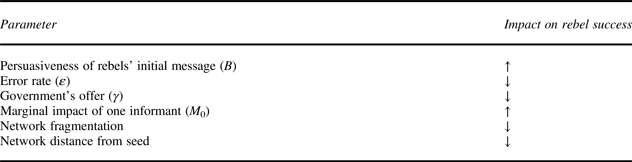
Table 1 presents an overview of the comparative statics in terms of the ultimate probability of rebel success. The first four are straightforward, though highlight important takeaways. For example, rebels with a particularly compelling case or access to a seed who is particularly amenable to the rebels’ message are more likely to be successful, and well-endowed governments who can make particularly large offers in exchange for information hurt the rebels’ prospects, all else equal.
Overview of comparative statics

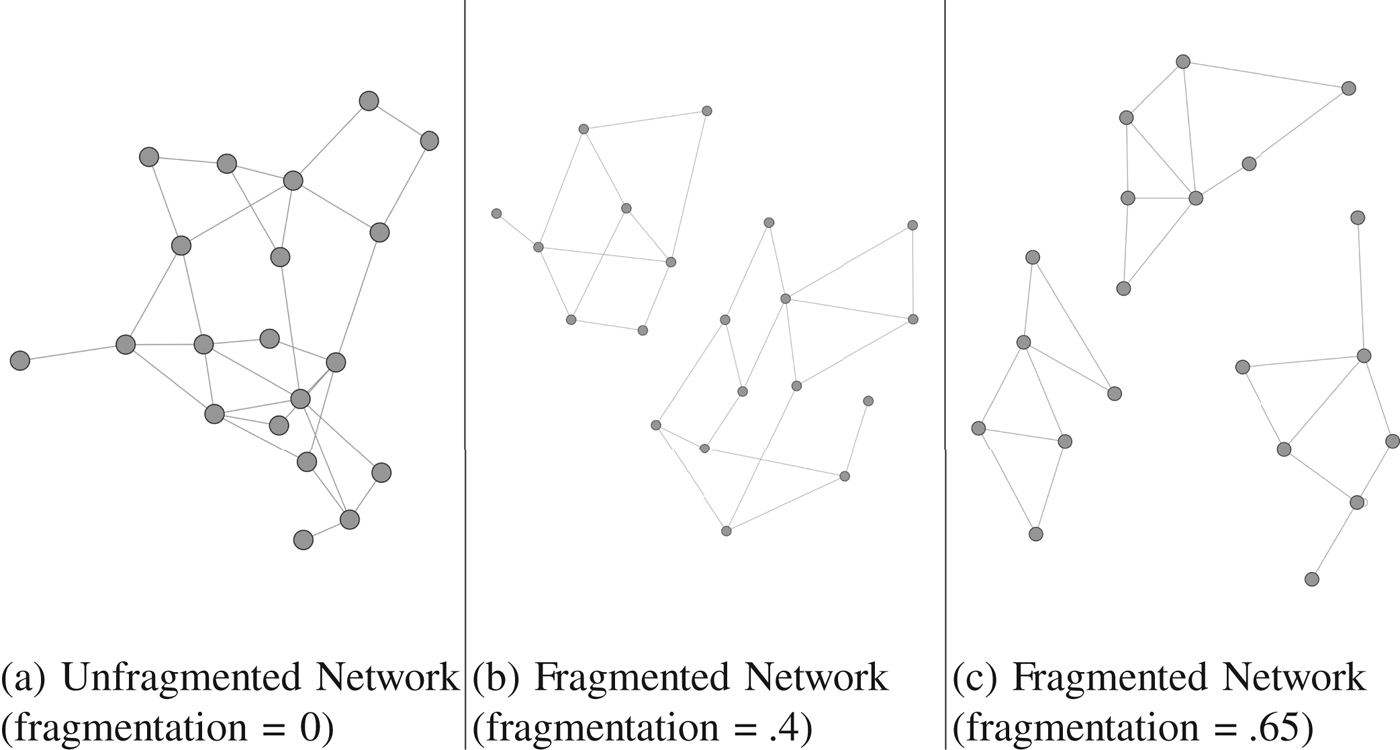
Here we explore the last two rows of Table 1, fragmentation and network distance, that relate rebel success to properties of the network. Networks that are separated into multiple components pose problems for rebels. Civilians in components outside the reach of the rebels’ message inform the government since for these civilians, b i = 0 and γ > 0. Call a network's “fragmentation” the proportion of nodes outside of the largest component. We then have a straightforward relationship between fragmentation and full secret keeping in equilibrium.
Proposition 2
(undermines full secret keeping): For a network g among a group of civilians N, if frag(g) > 0, a full secret-keeping equilibrium does not exist.
As we show in the supporting information, the greater the fragmentation, the larger the minimum number of informants in the equilibrium with the most secret keeping. For illustration, Figure 1 shows three hypothetical networks among twenty civilians with increasing fragmentation. In the network on the far right, because of high fragmentation, any rumor that rebels seed would necessarily fail to reach at least 65 percent of the civilians. These civilians would have an incentive to inform on the rebels; whether others would too depends on a second property of networks, their path lengths.
Example networks with 20 civilians and different levels of fragmentation

Individual i’s incentive to keep secrets increases in b i, and b i = B ε ℓ(seed,i) . Consequently, the fewer intermediaries between the rebels’ seed and i, the greater incentive i has to keep secrets; the fewer intermediaries between the seed and everyone, the greater the incentive everyone has to keep secrets.
Assuming rebels choose the best possible seed from the network,Footnote 29 full secret keeping depends on the following network property:
Definition 1
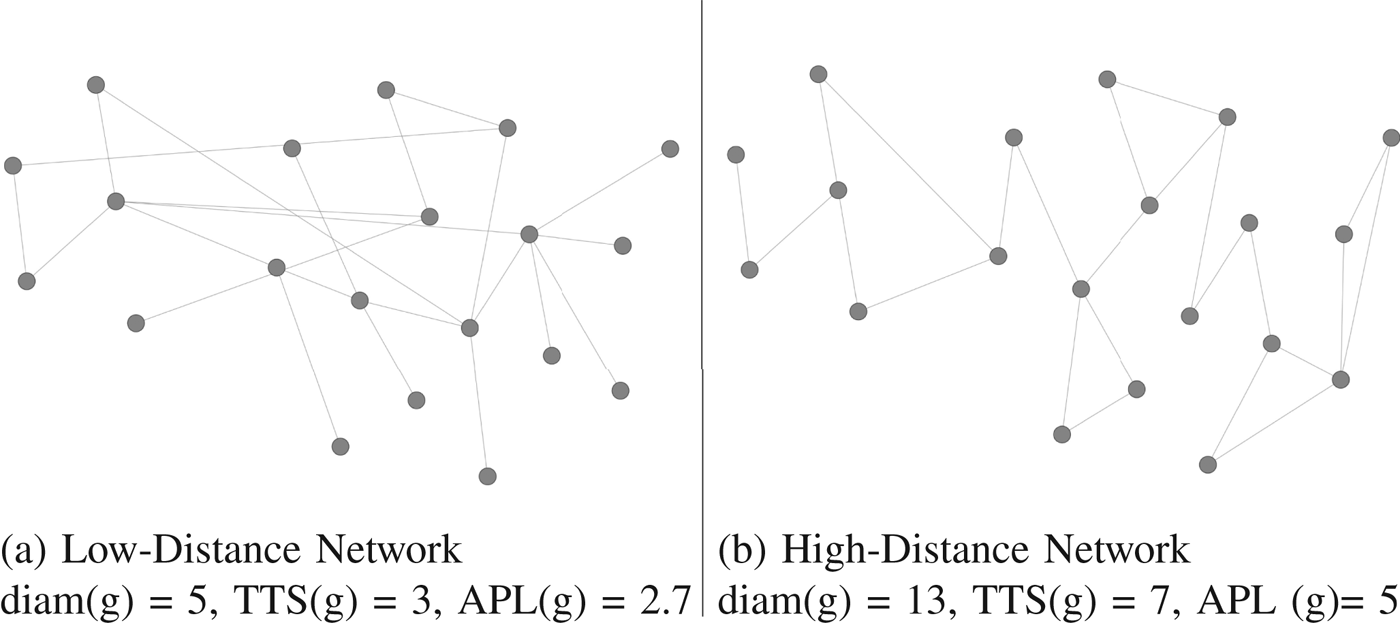
(to saturation): The time to saturation of a network g is the length of the shortest path that a rumor originating with one node would need to traverse to reach any other node:
 $$TTS(g) = \mathop {\min} \limits_i \{ \mathop {\max} \limits_j \{ \ell (i,j)\} \} $$
where ℓ(i, j) is the length of the shortest path between nodes i and j.
Then we have:
Proposition 3
(TTS helps rebels): Given γ, B and ε, for connected networks (components) g and g′, if TTS(g) < TTS(g′), then the condition for full secret keeping is easier to satisfy in g than in g′.
Figure 2 shows two example networks that both contain the same number of nodes and links, but one is characterized by substantially shorter distances than the other and hence is more favorable to rebel viability in equilibrium.
Example networks with same number of links (24) but different distances between nodes (reporting diameter, time to saturation, and average path length).

These results together imply that fragmented networks preclude full secret keeping, and that unfragmented networks with short paths are most favorable to rebel viability.
Summary of Results
In areas with minimal penetration of central government institutions, if rebels can manage to convince a small number of trusted contacts of their potential value, areas with communication networks that are unfragmented and feature short paths are most favorable to rebel success. Civilians who hear the rebels’ rumor in a favorable network are most persuaded by it and expect the rumor to reach and persuade many others, which increases the value of secret keeping for these civilians. In this sense, the rumors coordinate secret keeping, and do so best in unfragmented networks with short paths.
Unfavorable networks can undermine the good intentions of even strong rebel supporters, since even civilians who strongly favor the rebels may prefer to inform the government if they expect many others to do so as well. Likewise, favorable networks can incentivize civilians who do not genuinely support the rebels’ cause to nonetheless keep the rebels’ secrets if they believe enough others also plan to do so.
Such favorable networks are thus quite valuable for aspiring rebels—but potentially dangerous for civilians. Rebels with access to contacts they can convince to believe and transmit their message through their network have an advantage; once in, news spreads through the network and is deemed credible.Footnote 30 Rebels with such a contact could spread propaganda in support of the rebel cause, including perceptions of injustices or interpretations of the other side's motives—even if inaccurate or exaggerated—that later form the basis for widely held grievances. This also highlights the importance of villages that are outside the reach of the central government. If the government also had a trusted contact among the civilians, the government could spread competing rumors to dampen the rebels’ support. In the absence of that—and recall that we argue this absence is the status quo in the highly weak state contexts to which this theory applies—if rebels can get their rumor into the network, then it will be uncontested and could spread widely and convincingly enough to thwart the government's later attempts to enter the village and extract information to undermine the rebels.
Kinship Network Structures and Local Ethnic Demography
The results pertain to networks in which trusted communication occurs. The structure of these networks among civilians affects nearby aspiring rebels’ success. Here we argue that our results about network structure map onto ethnic demography generally in Sub-Saharan Africa.
A key source of trusted communication in rural Africa is kinship networks. The formation of kinship networks in ethnically homogeneous and ethnically heterogeneous areas resulted in different kinship network structures in each, a difference which corresponds to our model results. Homogeneous areas in general developed kinship networks characterized by low fragmentation and low network distances. This, combined with the model results, suggests that ethnic groups that launch in ethnically homogeneous areas are more likely to become viable than those that launch in heterogeneous areas.Footnote 31
Ties between kin are especially salient in rural Africa and beyond, since they establish bonds of trust.Footnote 32 Since kinship networks can facilitate the spread of trusted information,Footnote 33 the structure and geography of kinship networks matters for rebel viability; here and in the case studies that follow we sketch how variation in the structure of kinship networks maps onto variation in ethnic demography.
Ethnic groups in Sub-Saharan Africa and much of Asia are made up of an underlying web of kinship ties.Footnote 34 However, given the variety of kinship-based migration and familial practices that drive the emergence and spatial patterns of such ties, we argue it is likely that different kinship network structures underpin different patterns of ethnic demography. Specifically, we expect that ethnically homogeneous areas often have shorter path length and lower fragmentation than heterogeneous areas.
For example, consider how ethnically homogeneous areas tend to come about in kinship-based societies. While members of an extended family (known as clans, a subgroup of an ethnic group) tend to live in close proximity to one another, the common practice of exogamy—rules that necessitate that one marry outside one's own clan—typically lead to men seeking wives from areas outside their immediate home area. Exogamy thus generates kinship networks that span a rather large areaFootnote 35 (perhaps dozens of kilometers).Footnote 36 However, pressure often exists to marry within one's ethnic group. Groups that value exogamy and also marrying within one's ethnic group thus have resulting networks with many interconnections among clans within a given ethnic group. Such patterns, over time, generate ethnically homogeneous areas—dispersed areas where most inhabitants are part of the same ethnic group, yet their marriage relations mean that they are tied in an overlapping manner to other kinsfolk. Ties overlapping in this way generate short paths through a network.
In contrast, some rural areas are quite diverse. They may be homogeneous at a highly local (e.g., village, or roughly two and a half square kilometers), but at a slightly lower level of resolution (e.g., county or district, tens of square kilometers wide), numerous, distinct ethnolinguistic groups are present.Footnote 37 Such local ethnic diversity typically comes about as a result of processes that also generate fragmented kinship networks. This heterogeneity often exists along common migration routes or regions with diverse geography or land with rich soil.Footnote 38 Their diversity often comes about when several migrating ethnic groups pass through an area and some of their members decide to remain in that area. Assuming a preference to live among similar types or geographically specific skills, those that stay settle close to their co-ethnics in small clusters. In these areas, familial networks become more geographically concentrated and insular, and the kinship networks among the many ethnic groups in the region are fragmented—there are few familial ties that span the separate ethnic groups.
Empirical Illustration and Assessment: Evidence from Uganda
To illustrate the causal mechanisms that arise from our theory, we present detailed information about rebel group formation from Uganda. First, to provide context, we briefly examine all cases of Ugandan rebel group formation since 1986. We then focus on a paired comparison of a rebel group that became viable with one that did not.
Rebellion in Uganda since 1986
In January 1986, Yoweri Museveni—still president of Uganda today—and his National Resistance Movement (NRM) seized the central government. In the subsequent years, the NRM faced numerous insurgencies. In its first two decades in power, sixteen distinct groups launched. Only four of these groups—LRA, UPA, HSM, and ADF—became viable. The others failed before challenging the government or making much of an imprint on Ugandan history. These groups shared several characteristics: their stated goal was to seize control of Uganda's central government; their leaders were Ugandan citizens; the vast majority of their fighters were Ugandan; they sought to build a base on Ugandan territory; and they did not benefit from high-value natural resource wealth. Furthermore, external sponsors provided little, if any, initial funding or weaponry to any of these rebel groups until they existed for at least two years and demonstrated a substantial fighting capacity. The command structures of each of these organizations was clearly distinct, and coordination between groups was rare. No two rebel groups operated in the same region of Uganda at the same time.
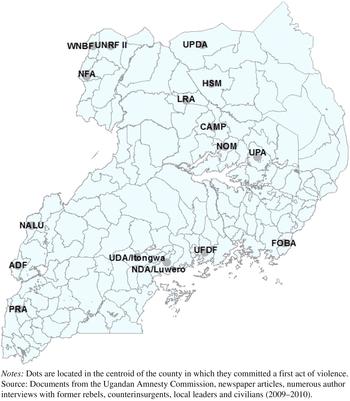
Figure 3 displays the county where each of the sixteen rebel groups initially launched in Uganda since 1986, measured by the location where they committed their first attack. Notably, there are few, if any, systematic relationships between the locations of these initial rebel group launches and factors that dominant theories associate with civil conflict onset, as indicated by county-level, cross-sectional ordinary least squares (OLS) and logistic regression analyses (n = 163). Recall that by “launch,” we refer to the very initial stages of a group building an organization and committing at least one act of violence; in contrast, most conflict onset analyses measure the dependent variable with a threshold of at least twenty-five recorded battle-related deaths. Our models use covariates drawn from the conflict-onset literature, including measures of terrain that favors rebellion,Footnote 39 ethnic exclusion from the central government,Footnote 40 local ethnic homogeneity,Footnote 41 state capacity,Footnote 42 local poverty and literacy levels, and others.Footnote 43 We discuss these analyses further in the appendix. Importantly for the discussion, these (non-) findings suggest that it is unlikely that factors that determined whether or how groups launched in the first place subsequently influence the later stages after groups initiated violence and sought to become viable.
Rebel groups launched in Uganda, 1986–2006.

Turning to the question of why only four of these sixteen already-launched groups became viable, as proof of concept and consistent with the theoretical discussion, those that launched in homogeneous areas were more likely to become viable than those that emerged in heterogeneous areas. Those that failed to become viable had launched in areas with an average Ethno-Linguistic Fractionalization (ELF) score of .47, while those that succeeded had launched in areas with an average ELF score of .20. These values are based on 1991 Ugandan census data. This difference is statistically significant (p-value of one-tailed test is 0.03), and holds when using alternative measures of local ethnic demography, such as the percentage of the total local population held by the largest ethnic group. The positive correlation between local ethnic homogeneity and rebel viability also persists when examined via trivariate regression models, with each model holding constant one of the variables drawn from the conflict onset literature used for the analysis of rebel launch we described earlier—terrain, ethnic exclusion, and so on.Footnote 44 We detail these analyses in the appendix. In sum, while people attempted to form rebel groups in both homogeneous and heterogeneous areas of Uganda, only those that formed in homogeneous areas were able to become viable.
This raises a question of selection: why do rebel groups not all attempt to launch in ethnically homogeneous areas if these are where they could most likely become viable? Even if rebels knew the ethnic demography of a region well enough to select on it, many constraints limit the practical choice of location. For example, according to our theory, one key constraint is the location of trusted contacts. If rebels have hope to win over neighboring communities and have their secrets kept, they must have a solid trusted contact in that community. In practice the option set may be small. Thorough knowledge of the local social and geographic terrain is crucial to aspiring rebels, limiting the option set further. Fourteen out of the sixteen Ugandan groups formed in the home region of one of the primary rebel leaders. We consider the issue of site selection further in the appendix. Now we turn to a more in-depth investigation of the mechanisms underlying this observed relationship between ethnicity and rebel success.
Paired Comparison of Two Rebel Groups
We compare the initial stages of rebellion for two rebel groups that launched in Uganda in the same year but in two distinct areas of eastern Uganda: the Uganda People's Army (UPA), which formed in an area called Teso and became viable, and a group typically known as Fight Obote Back Again (FOBA), which formed in an area called Bukedi and did not become viable.Footnote 45 The UPA launched in early 1987 and surpassed our threshold for viability in late 1987, when it had several hundred fighters on at least two bases on Ugandan soil, which operated without significant challenge from the government for approximately six months. Later, at its height in 1989 and 1990, the UPA recruited well over a thousand men, organized into eight brigades covering different portions of the Teso region in Uganda, an area of approximately 4,300 square kilometers. Fighting between UPA and the government forces became intense, presenting a fierce challenge to the Ugandan government and leading to over a thousand battle-related deathsFootnote 46 while displacing about 13,000 from their homes.Footnote 47 The rebellion eventually unraveled and ended with a peace agreement in 1992.
In contrast to the viable threat that UPA became to the Ugandan government, FOBA—despite aiming to overthrow the government and killing several local government officials—was never was able to defend a base on Ugandan territory for more than a few weeks. Their sole, sustained base was located in Kenya, about five kilometers over the border from Uganda. They tried repeatedly to build a base in Uganda but were repeatedly “flushed out” by the army as a result of information leaks about their presence. Despite numerous attempts, the FOBA had few successes against Ugandan military targets. Instead, they targeted local government officials in the night and absconded to their base in western Kenya by dawn. While accounts vary widely, at its height, FOBA likely reached between 300 and 500 fighters. A key leader was captured and jailed by the NRA in September 1988. By the early 1990s, FOBA had disbanded. Few Ugandans outside of the region where it formed remember FOBA today.
Controlled Comparison Design and Fieldwork Processes
The analysis employs a straightforward application of the comparative method. The UPA and FOBA cases vary in the factor we seek to understand the influence of: the extent of ethnic homogeneity in the local civilian population—which corresponds to differences in kinship network structure. We aimed to match cases as closely as possible on multiple other factors that could plausibly influence the outcome of interest, rebel viability. We take this approach because of its suitability to investigating complex causal mechanisms, and because of the limited information available on rebel groups that fail early. For example, only one of these sixteen Ugandan groups appears in the Correlates of War data set,Footnote 48 and just seven appear in the more fine grained UCDP/PRIO data set.Footnote 49 Extensive fieldwork was necessary to uncover details about each rebel group's start and the structure of local networks among which they emerged.
The factors “held constant” are drawn from the conflict-onset literature, similar to the quantitative analyses discussed earlier. Because these rebel groups both formed in 1987, the national political context of each is the same. Both regions of eastern Uganda had similarly limited experiences with the new government that had taken over the prior year. Neither Teso nor Bukedi was tied by political history or identity to the new ruling NRM party—but on the eve of the rebellion, they had no apparent reason to resent it either. The violence of the Bush War, which had brought the NRM to power, had not reached Teso or Bukedi and the war's protagonists had not been from eastern Uganda. The state was largely absent in both areas since local government institutions from the prior government had been dismantled and new structures were only just beginning to be formed; the state was similarly quite weak in both locations at the dawn of these rebellions. Initial rebel leaders from both groups had some prior military experience, but neither had experience in launching a rebellion, nor did they start with substantial material endowments or external support. Local government and military officials who were knowledgeable about both rebel groups did not report a difference in the quality of each group's leaders. Additionally, the areas where each rebel group formed had similar (or varied in the reverse direction anticipated by theory) types of terrain that could benefit insurgents (mountains or thickly forested areas), levels of development, and distance from international borders. Further discussion and data appear in the appendix.
Most of the evidence presented for the paired comparison is drawn from over 200 interviews one of the authors personally conducted for a larger project throughout Uganda between 2007 and 2011.Footnote 50 In Bukedi (Busia and Tororo districts as of 2009) and Teso (Soroti, Amuria, and Kumi districts as of 2009), there were fifty-three interviews with former rebels and government officials—military, intelligence, and civilian officials—who had operated in those districts in the late 1980s; in-depth interviews with over sixty civilians who lived in the villages near to initial UPA or FOBA bases; and four civilian focus groups (two in each region). The primary goals of this fieldwork were to create an accurate sketch of sequences of events when these groups initially formed, and in particular to retrace the impressions and experiences of key actors—the small, inner core of initial rebels, the government officials who responded to them, and the civilians who lived nearby. Since few events had been previously documented about the formative phases of these rebel groups, creating this sketch of events and experiences entailed gathering numerous accounts from each of type of actor, as well as other informed observers such as local journalists who had been present in the communities where and when rebels formed. All interviews were conducted in private and in English, except for interviews and focus groups with villagers, which required the assistance of a local translator. Translators were always from the ethnolinguistic group of the interviewees, but were not residents of the villages where interviews or focus groups were conducted.
Because these events occurred over twenty years prior to the fieldwork and because of their often clandestine nature, a central challenge was to identify individuals who were sufficiently knowledgeable about them. This challenge drove decisions about how to identify interviewees: rebel and government (including military and intelligence) interviewees were recruited based on their knowledge and position held during key events. An amnesty law and Uganda's relatively open political climate, at least with respect to these past events, allowed former rebels to speak relatively freely. Additionally, all interviewees were guaranteed confidentiality to ensure their protection and to avoid potential biases such as those driven by social desirability or (in the case of former rebel or government leaders) the hope of shaping one's legacy.
For civilian interviews and focus groups, local guides—who were typically village-level local government representatives—helped to identify civilians to recruit. Doing so was necessary because of the need to identify those who had lived in the area for at least twenty years and were sufficiently old and healthy to recall events that occurred over twenty years prior. The guides were instructed to identify men and women who represented a mix of perspectives, ages, and occupations. The interviewer (not the guides) chose the villages for the interviews each day; interviews were not scheduled in advance, and the guides did not attend the interviews. Neither the author nor the translator detected any sign that interviewees knew in advance of our arrival that a researcher would be approaching them.
Recall issues precluded capturing details such as precise dates of most events. However, asking multiple people about sequences of events—especially obtaining rebel, government, and civilian perspectives on the same events—usually produced consistent responses and thus a fairly clear sketch of events. To supplement this information, we reviewed a complete set of Ugandan newspaper articles on armed groups from 1986 to 2002.
Kinship Network Formation in Ethnically Homogeneous Area Generated Short Paths and Low Fragmentation
The region where the UPA formed, Teso, has long been one of Uganda's most homogeneous areas. Based on 1991 census data, the Iteso tribe made up about 85 percent of the Teso region; according to the 1948 census this figure was then 91 percent. In 1964, Fred G. Burke observed that Teso “is one of the most homogeneous districts in Uganda” and noted the presence of a “diffuse” political system there.Footnote 51 The Iteso are today the fifth largest ethnic group in Uganda.
The history of how Teso became so homogeneous reveals the dispersed, unfragmented nature of kinship networks in Teso, particularly of the primary tribal subgroup there: clans (or atekerin in the local language). Clans in Iteso culture represent lineages or proximate lines of ancestry. Members of each clan gather regularly for meetings and rituals.
When the nomadic, pastoralist Iteso people first reached the area now known as Teso, it was largely uninhabited, and so new settlements were rather dispersed. As Burke explains, “As plenty of land was available and no outside threat existed, the initial [land] holdings were large and scattered.”Footnote 52 Upon reaching this land, the Iteso gradually became accustomed to settled agriculture. At first, the Iteso lived in clusters of clans in areas called etem, but mobility and voluntary migration within Teso has since been common for several reasons.Footnote 53 In part, the plentiful land in Teso made this possible; the pastoralist heritage of the Iteso also likely predisposes them to mobility; and finally, the custom of primogeniture—the first-born male inheriting the family's entire wealth—means that excluded siblings often migrated to new land to seek wealth. Polygamy is permitted and relatively common, clans are patrilineal and exogamous, and wives become part of, and go to live with, the husband's clan. However, strong ties remain between the wife and her original clan; she will continue to visit them regularly, and her children will often also come to see the mother's clan as family.Footnote 54 These patterns have generated a patchwork of overlapping, extended family ties that compose the Iteso tribe, which has “a wide geographical distribution as well as a marked geographical concentration in any area.”Footnote 55 Over time, as people continually migrated within Teso and married outside of their clan, familial ties took a dispersed and overlapping form; numerous members of one clan would have many clan members in other areas of Teso, and be related by marriage to numerous members of other clans.
In contrast, Bukedi is located south of Teso on a well-worn migration path between eastern Uganda and western Kenya that is bounded by Mount Elgon to the north and Lake Victoria to the south. As a result, Bukedi has long served as a place of confluence, where Nilotics migrating south from Sudan to Western Kenya mixed with Bantus migrating eastwards from western and central Africa. Besides traveling through Bukedi, the only other route from Uganda eastwards to Kenya (other than going all the way around massive Lake Victoria via Tanzania), is travel around the northern side of Mount Elgon. But doing so would mean traveling through Karamoja, the area of Uganda with the harshest dry, flat terrain, and that is populated by the feared Karamojong tribe. Likely because of Bukedi's temperate climate, its relatively fertile land, and its proximity to the abundant water source of Lake Victoria, numerous groups on transit migration through this area opted to stay. Samwiri Karugire explains:
Lying on one of the major corridors of migration, [Bukedi] was to receive a heterogeneous collection of ethnic groupings and its population still reflects this … The result of this criss-crossing was that Bukedi had among its population Bantu ethnic groups (the Banyore, Bagwere, Bagwe and Samia), Nilotic Padhola, Nilo-Hamitic Iteso, and the Bankenyi. This diversity of ethnic groups in an area so small reflects the different migrations at different periods of peoples whose paths crossed here.Footnote 56
Similarly, Burke contrasts Teso's homogeneity in 1964 with Bukedi's “bewildering variety of traditional organization, reflecting the cultures of the many tribes inhabiting the area.”Footnote 57 Today, in contrast to a single dominant language and about three different dialects of Teso, Bukedi has roughly ten dialects of three distinct ethno-linguistic groups. He explains that, as a result, people there live in smaller, more culturally insular communities and, “with authority and solidarity clustering at levels lower than the district.”Footnote 58
While the distance between the two primary areas of Bukedi where FOBA launched—Mella and Busitema subcounties—is only about fifty kilometers, the area around Mella town is quite homogeneously Iteso, while the area around Busitema town is largely Basamia, with a sizeable Bagwe minority. There are also areas dominated by the Japhadola tribe nearby, particularly in neighboring Osukuru and Iyolwa subcounties. While the Basamia and the Bagwe speak similar languages, and intermarriage between them is relatively common, their Bantu-based language and culture is quite different from that of the Nilotic-based Iteso language, and both of those languages are quite different from the Luo-based Japhadola language. Intermarriage between these groups is quite rare, and so there is very little overlap in any of the kinship groups that exist within the ethno-linguistic clusters in Bukedi. In sum, the kinship network structure of this area is quite fragmented.
Rumor Dissemination and Expectations about Nascent Rebels
Villagers rely on kinship networks for transactions and news, particularly in contexts that require trust—such as periods of political and security upheaval. In 1986, before either of these rebellions began, the turnover in Uganda's central government had brought about a great deal of uncertainty throughout Teso and Bukedi. “There was a collapse of authority in Teso,” one local leader who had served as UPA intelligence said of the period just prior to the UPA's formation. Similarly, the turnover of Uganda's government in early 1986 and the formation of a rebel group in early 1987 brought about a similar environment of uncertainty in Bukedi. As one local leader explained: “There was confusion in the east beginning in 1985.” Another local leader said of Bukedi, “It was a state of fear and uncertainty.”
As soon as the UPA's initial attacks began in February 1987, rebel leaders sought to shape civilians’ perceptions of them, and news about the group spread rapidly among civilians throughout the region. One former rebel leader explained that word about the UPA initially spread, “mov[ing] like wild fire in the bush,” while another commented, “The news [of the new rebellion] went like a flame across Teso.” An indication of the speed and ease of rumor flow in such contexts is that twenty-eight out of thirty-four (over 80%) of civilians interviewed in the villages adjacent to the initial UPA base said that they heard about the existence of the rebel group for the first time through being told by another person in their village, before directly observing rebel activity, a meeting, or news media. Rumor spread faster than people could even come to learn information about the rebels through other means. These rumors shaped civilians’ impressions of the rebels. Several rebel leaders emphasized the critical importance of shaping civilian perceptions about their strength during this critical period, while conceding that the fledgling group was, at that point, small and poorly armed.
Interviews and focus groups with civilians in villages where the UPA formed indicate that soon after learning about the rebels’ existence, they believed that the rebels were strong and would succeed. Civilians had the impression that many others believed the same. Members of one focus group reported that most people in their community seemed to initially support the rebels, since their trusted sources believed in the rebels’ promise to take over the government and to help the Iteso people when they did so. Many people in another focus group in a different area of Teso agreed that at first, most people “believed that they could win.” It was not until after violence became severe, the group said, that they came to fear and doubt the rebels.Footnote 59 As further evidence, over half (18 out of 34) of civilians interviewed who had lived in villages adjacent to initial rebel bases during the rebellion agreed with the statement that “in the beginning of the rebellion most people [s/he] knew believed that the rebels would succeed in capturing Kampala.” Given that we would expect responses to be strongly, systematically biased against agreeing with this statement, since everyone knows today that the rebels were defeated, this number is arguably rather high.Footnote 60
From the perspective of the counterinsurgents, these dynamics created an impression that almost every villager in Teso believed in the rebels’ strength in the early stages of the war. Rumors seeded by rebels contributed to this impression. A military officer who led the counterintelligence effort against the UPA rebels in Teso said that his biggest challenge was overcoming how successful the rebels were at “convincing” people that they were strong, even though they were in fact a small group. Another senior military officer from the Teso region who served in the Uganda military's counterinsurgency operations against the UPA said: “The UPA was very successful at mobilizing people … [the people of Teso] were told lies and they believed them. Once you get a war in an area, the area is filled with rumors.” He went on to explain the extreme difficulty of countering rumors in Teso that the UPA was a strong group. Similarly, Ugandan scholar and Teso native J. Epelu Opio explains about the start of the rebellion, “There was widespread rebel propaganda amongst the population … The population believed what the rebels told them.”Footnote 61
In contrast, when FOBA formed in Bukedi, the fragmented nature of local kinship networks and the difficulty of spreading news that reaches everyone in every subgroup appeared to importantly shape events. Like the UPA, the FOBA conflict began in 1987 with the actions of a small number of individuals who sought to build an anti-government army, and FOBA lacked a large stock of weapons. FOBA's primary initial priority was to shape the perceptions and thus secure the support of the local population. One former FOBA leader said that “When forming a rebel group, the first thing is the support of population … [This is] more important than weapons.”
Information about FOBA began to spread as they committed their first attacks. For example, most people in the region knew that a rebellion was underway and were slipping across the nearby border with Kenya to hide. However, the fragmented structure of local kinship networks appear to have been disadvantageous for FOBA. Despite trying to do so, rebels failed to shape local perceptions about them early. Rumor traveled slowly relative to how quickly people became informed by direct observation. Compared to individuals interviewed in Teso about UPA, a smaller portion of the individuals interviewed in Bukedi recalled first hearing about FOBA via other civilians—more first learned about the existence of a rebel group in their territory when seeing direct evidence of the rebels, such as seeing members of an armed group moving around their community, or seeing a fire that the group had left in their wake.Footnote 62
It appears that the rebels, unable to rely on dispersed communication networks to spread rumors about their group, instead often personally traveled throughout the region to directly communicate with the people. One former rebel explained, “We had to move village to village, explain why we were rebelling, and ask for support.” The way rebel leaders had to shape perceptions of their group has two implications. First, this suggests that the structure of communication networks was not conducive to spreading rumors widely and quickly in general. Second, this may have made coordinating on secrecy, even for those who favored the rebels, more difficult because they were not sure that others had heard the same rumor and planned to behave similarly. Several villagers who identified as having supported FOBA also recalled concern at the outset of the rebellion that many others did not.
That communication networks were not conducive to the effective spread of influential rumors is further corroborated by accounts suggesting that the news that civilians did receive about the rebels was rather incoherent. Among civilian interviewees, individuals from different areas had different impressions about FOBA, including who led the group, what their objectives were, whether or not the group had a particular ethnic base, and how militarily strong they were. One local leader remarked that “FOBA was not properly politicized … it seemed that their objectives changed.” All of these factors, of course, bear on an individual's assessment of the group's competence and strength, and this incoherence is further evidence of the fragmented nature of communication networks in Bukedi.
Crucially, several comments in interviews suggest that from the beginning of the insurgency, civilians in Bukedi did not expect the rebels to succeed. Only twelve out of thirty-five (34%) of civilians interviewed near early FOBA bases believed that FOBA would succeed (compared to 53% for UPA). Over half of these interviewees lived in the primary FOBA's leader's home subcounty of Mella, where we would expect his access to trusted networks to be highest. This lack of confidence in the group, in contrast to the opposite for UPA, is striking given that FOBA benefited from a nearby porous border that UPA did not as well as more forested terrain, and the march to the capital city would have been much shorter. In one focus group, people reported that the rebels had wanted to give the citizens the “false” impression that the rebels were a large group. A local leader who served as government intelligence in Busia during this period said that “people were skeptical.” A group of former fighters claimed that FOBA would sometimes kill community members and try to spread rumors blaming the deaths on the government, but that the group had “failed propaganda because people did not trust [these rumors].” Several villagers interviewed remarked that they had not heard much about the rebels, and so they assumed they were “just thieves” or were “not serious.” A local leader said, “But when we first heard about FOBA, it looked like a joke … I didn't take it seriously … No one was certain about the new government, but no one expected [the rebels] to last.” Hence, networks that transmit rumors were fragmented near FOBA, and civilians never developed the impression that support for FOBA was widespread.
Information Leaks Led to Rapid Rebel Demise in Heterogeneous Area
According to accounts from rebels, former military officers, and civilians, information leaks about the UPA rebels were quite rare in the initial months. A local paper reported about Teso that “Especially during the first year of rebellion … This was the height of the ‘mam ajeni’ [I don't know] chorus response from the Teso peasants whenever NRA soldiers asked for the whereabouts of the rebels.”Footnote 63 A former rebel intelligence officer agreed. “Information leaks were rare. The NRA tried to infiltrate us, but were unsuccessful.” A former local police officer explained that it was very difficult for his forces to penetrate Teso and obtain information about the rebels. Further, a focus group in the subcounty where the UPA had their first base recollected that the UPA could gather citizens freely in the early stages of the rebellion, dozens of people at a time in broad daylight, without the government becoming aware of the meetings. They explained that while the locals knew about the rebel base near their community, they refrained from telling the government about it. The government did not discover the base for months. Without such secrecy, the UPA would likely have struggled to become a viable force. As one UPA intelligence officer said: “We had to keep our secrets early [in the rebellion] in order to gain strength.”
Numerous sources also cited information leaks in Bukedi as the key cause of FOBA's rapid demise. While FOBA repeatedly attempted to hold meetings to mobilize civilians in Bukedi, when they tried to do so, information about the time and place of the meetings would be leaked to the government as early as 1987 and 1988. Several former FOBA leaders lamented the difficulty of keeping secrets in Bukedi. Many civilians in Bukedi reported that they freely provided the government with information about the rebels, while this type of disclosure among interviewees from Teso was quite rare. A UPA commander observed that information leaks appeared to be more common in Bukedi than Teso. “[The military] infiltrated [FOBA] quickly … they didn't know how to keep their secrets.” A local community leader agreed. “The public was responsible for the break up [of FOBA], always reporting suspicious activities to authorities.”
Pre-War Ethnic Grievances Were Not Stronger Where Rebels Became Viable
Despite the shared impression among most former rebels, counterinsurgents, and civilians who lived in the area where the UPA formed that civilians initially did not share information about rebels with the government and a belief that the rebels would become strong, such evidence does not necessarily indicate that most Iteso shared a preference for rebellion. While it is of course difficult to ascertain true preferences for or against violent groups, particularly decades after the fact, most one-on-one interviews with Iteso civilians indicated mixed feelings about whether or not they initially believed that violent rebellion was a good idea. Crucially, when asked in individual interviews (with only one of the authors and a translator present), very few of over sixty villagers interviewed from Teso agreed that most people in their community had a strong distaste for the government prior to the initial start of violence in Teso.Footnote 64 One former rebel commander recounted feeling concerned early in the war about what people believed “in their hearts” about the UPA, which suggests that he believed that true preferences among villagers about his incipient movement were mixed—or at least it was not apparent that most civilians were pro-rebel. According to another account, after the NRM overtook the government in January 1986, the Iteso were optimistic about their relationship with the new government and “when [the NRM] entered Teso, it was received with ululations and jubilation.”Footnote 65
In secondary historical accounts and other data, there is an absence of evidence one would expect to find if ethnic grievances had helped UPA to become viable. For example, while exclusion from the central government is thought to be a primary motivation for ethnic rebellion,Footnote 66 neither area where UPA and FOBA each formed was particularly under-represented in the central government when each rebellion began. The Iteso ethnic group that formed the basis of the UPA were about 6 percent of Uganda's population and held 3.2 percent of national-level cabinet seats, while the Samia and Japadhola groups that formed much of the early leadership of FOBA were 1.1 and 1.5 percent of Uganda's population and both held 3.2 percent of cabinet seats.Footnote 67 Additionally, villagers in both Teso and Bukedi had minimal, if any, prior experience with the NRM government or the westerners they supposedly represented, since few would have traveled to the west and the NRM's rebellion against the prior regime—which offered exposure to the NRM for affected communities—had not touched eastern Uganda. Because of this lack of direct experience with the fledgling NRM government, the predominant sentiment throughout the region in 1986 and early 1987 was uncertainty and concern about how the new government would treat them—not resentment or hatred.
Intriguingly, while grievance narratives do exist today in justifying the UPA rebellion, those narratives often appear to have been a result of incidents that occurred in the early phases of the insurgency. For example, people often cite the numerous raids of the Iteso's cattle by the neighboring Karamojong tribe in the late 1980s as a reason that the Iteso people disdained the NRM government and therefore supported rebels. According to this narrative, the Iteso resented that the government did not prevent the raids, and some suggest that the NRM government abetted the raiders. However, the most severe cattle raids to hit Teso did not occur until several months after the UPA rebellion began, so the raids could not likely have generated widespread support for rebellion until after the rebels were already under way. In fact, in one interview, a UPA rebel leader explained that the rebels were aware that the cattle raids could help their cause, and that the rebels were complicit in spreading rumors that the government had intentionally allowed the raids to occur.Footnote 68
Naturally, this evidence does not eliminate the possibility that other mechanisms such as pre-existing ethnic grievances can aid nascent rebels attempting to become viable. Rather, it demonstrates that such grievances may not be necessary for the emergence of what later appears to have been an “ethnic rebellion.” It suggests why ethnic grievances can be present in after-the-fact discussions of war's early phases regardless of whether they in fact preceded the start of rebellion.
Additional Evidence and External Validity
Extensive fieldwork on two attempted rebellions in eastern Uganda does not strongly support a connection between pre-existing, anti-government grievances and civilians’ initial refusal to share information about rebels from the government. Instead, ethnicity's relevance in Teso was primarily in facilitating the spread of rumors across a fairly wide geographic area that generated a shared belief among civilians that many others would withhold information about the UPA rebels from the government. Owing to the paired comparison research design, we also ruled out the influence of several factors unrelated to ethnicity—such as differences in terrain and level of education of regions where rebels formed, among other factors commonly theorized as causing violent conflict—that could drive the viability of the UPA and the failure of FOBA.
Beyond this case study evidence, findings from a field experiment we conducted more recently in Teso also support the contention that ethnic homogeneity facilitates the rapid spread of news by word of mouth. In 2013, our research team seeded news with randomly selected households in one homogeneous village and one more heterogeneous village, both in Teso.Footnote 69 Surveys subsequently conducted in those villages showed that villagers passed accounts of this news from person to person, which reached many more villagers in the homogeneous village.Footnote 70 The homogeneous village in the study is located in the highly homogenous part of Teso where the UPA initially formed; the ethnic demography of Teso has changed little in the intervening years between the rebellion and 2013. While for obvious ethical reasons the news we seeded was not about violence or rebellion, the news was nonetheless novel and potentially sensitive; these results provide useful, suggestive support for a key contention of our theory.
To examine whether the mechanisms posited here operate beyond the UPA/FOBA cases, one of the authors conducted fieldwork for another controlled comparison of Ugandan rebel groups. These groups, the Lord's Resistance Army (LRA) and the West Nile Bank Front (WNBF), both formed in 1988 in different regions within northern Uganda—under similar initial conditions to one another, including similarly poor local populations, subject to a government that was similarly weak and neglectful of both regions, access to similar terrain, and limited external financing—but the LRA formed in the highly homogeneous Acholi region while the WNBF formed in the heterogeneous West Nile region. The largest ethnic group in Acholi makes up 90 percent of the population there, while the largest ethnic group in West Nile is only 33 percent of that region's population. A full discussion of these cases is beyond the scope of this paper, though similar patterns emerge in contrasting these cases as we did in the UPA/FOBA cases. While the LRA later become notorious for terrorizing civilians, focus groups and numerous interviews there indicated that initially there was a widespread belief in Acholi that it would be an effective fighting force against the government. The LRA did not suffer from civilians sharing information about the incipient group with the government. In contrast, despite arguably having a great advantage over the LRA because of nearby access to international borders with extremely weak states, the WNBF struggled from the earliest days to generate expectations of success, and in keeping secrets from the government. Despite numerous attempts to maintain bases on Ugandan soil, these information leaks prevented the WNBF from doing so.
Are our findings generalizable beyond Uganda? While a benefit of our empirical focus is its ability to deeply probe causal mechanisms that had been previously obscure on an understudied phase of rebellion, an inherent drawback is the difficulty of ascertaining whether the mechanisms operate elsewhere. It is exceedingly difficult to learn about a given area's trusted network structure, and details about the initial phases of rebel group formation, without conducting extensive research in each region. Recall that a scope condition of our argument is that it applies to weak states where governments do not have a strong institutional presence or strong local intelligence capabilities in rural areas—where rebellions are most likely to form but also the most challenging to study.
Still, it is well documented that early-failed groups are common in such contexts. As a RAND corporation report explains, the considerable vulnerabilities of “proto-insurgencies” leads the vast majority of them to be defeated before becoming full-fledged insurgencies.Footnote 71 Although systematic data about nascent insurgencies are rare, the fragility of nascent rebels that our theory emphasizes does appear where rich qualitative accounts of insurgencies exist. For example, the BBC describes the Maoist rebels in Nepal as initially being “a small group of shotgun-wielding insurgents.”Footnote 72 In another example, the Zapatista guerillas (the EZLN) began in Chiapas, Mexico in 1983 as a group of just three people, growing to twelve members in 1986. It operated clandestinely until the group grew substantially until the late 1980s and early 1990s.Footnote 73 A growing body of empirical work using evidence from several continents supports a long-standing assertion that locally concentrated ethnic groups are associated with the onset of organized violence,Footnote 74 and both classic and recent works highlight the importance of rumors in bringing about ethnic violence.Footnote 75 Our theory and evidence illuminate a mechanism that ties these findings together. Future work will need to probe rigorously how well it travels.
Conclusion
While civilian support has long played a central role in theories of insurgency and counterinsurgency, and rumors commonly feature in accounts of war's start, we have presented a new, more precise understanding of how both matter in the critical, initial stages of insurgent group formation. Civilians, we posit, are important in this formative stage because their potential to provide information to the government presents an existential threat to incipient rebels. Our model shows that when trusted kinship networks are unfragmented and can spread rumors rapidly to everyone, the rebels are best able to convince civilians to keep their secrets—and thus substantially increase their chances of becoming a viable threat to the government. Networks structured in this manner that are helpful to aspiring rebels are more likely, we have argued, in ethnically homogeneous areas.
Evidence from extensive fieldwork on a controlled comparison of two insurgencies—including one that was barely previously documented because it failed before becoming even minimally viable—substantiates the empirical importance of our theory. This evidence enables us to trace how distinct kinship network structures came about in different regions of Uganda, how they underlie local ethnic demographic patterns, and how they relate to the spread of rumors. It also shows that accounts from actors involved in rebel group formation are consistent with the idea that different network structures among civilians where rebels launched importantly affected whether civilians provided information about rebel activities to the government—which in turn, influenced whether nascent rebels became viable. Especially given the extreme rarity of the micro-level evidence needed to study rebel group formation, these case studies provide an important window into these phases. We leave for future work more controlled tests of the model's implications in and beyond Uganda.
Our theory and evidence also allow us to contribute to a long-standing debate about whether and how ethnicity causes intrastate warfare. They suggest that ethnic networks can coordinate grievances. Observing ethnic grievances alongside viable, successful rebel groups can be a natural result of the process that allowed the rebel groups to become viable in the first place. Yet this suggests a high risk of a selection problem in the study of conflict onset. If grievances are in fact the product of the earliest stages of rebellion, if groups with the “right” networks coordinate grievances best, and if such groups are also the most likely to produce a viable challenger to the state, then one may make an erroneous inference that because ethnic grievances appear so frequently among major rebellions in homogeneous areas, they must be the cause of rebellion. These findings underscore the need for great care in disentangling the relationship between ethnicity and conflict onset in future research.
Supplementary Material
Supplementary material for this article is available at <https://doi.org/10.1017/S0020818318000243>.