INTRODUCTION
Advance care planning has been slowly transitioning from a “legal transactional” model toward a framework of integrated communication (Sabatino, Reference Sabatino2010). Patients are asked to designate their choices of surrogate decision makers via healthcare proxy or medical power of attorney documents and life-sustaining treatment directives via medical orders such as “Do Not Resuscitate” (DNR), “Do Not Intubate” (DNI) and more recently, through the Physician Orders for Life-Sustaining Treatment (POLST) paradigm (POLST, 2011).
The mere existence of these forms, however, is not enough to eliminate the problems that surround end-of-life care. For example, in their infancy, many of these forms were not properly executed and/or interpreted (Stone, Reference Stone1994). More recent studies find that a significant proportion of patients (or proxies) were found to have executed DNR orders on the day of death, indicating “delayed end-of-life palliative care and suboptimal doctor-patient communication” (Levin et al., Reference Levin, Li and Weiner2008). It has also been demonstrated that healthcare proxies were often unaware of the specific preferences of their designated patients (Seckler et al., Reference Seckler, Meier and Mulvihill1991; Shalowitz et al., Reference Shalowitz, Garrett-Mayer and Wendler2006). Finally, the determination of a patient's mental capacity to make decisions is very complex, and, as noted by Wilkinson et al. (Reference Wilkinson, Wenger and Shugarman2007), “capacity may wax and wane and variable levels of capacity may be required for different decisions” (Wilkinson et al., Reference Wilkinson, Wenger and Shugarman2007).
Despite the existence of palliative services in >80% of United States hospitals with >300 beds, physicians are often reluctant to ask a palliative care team to consult with a patient, because of the perception that they are admitting that there is “nothing more they can do” (Kelley & Meier, Reference Kelley and Meier2010). However, Temel et al. (Reference Temel, Greer and Muzikansky2010) found that patients with lung cancer who received palliative care lived longer and reported better quality of life than did patients who received the usual care only.
Further complicating this issue is the fact that racial and cultural differences can add to the mistrust, confusion, and lack of conversation among physicians, patients, and family members (Loggers et al., Reference Loggers, Maciejewski and Paulk2009; Bullock, Reference Bullock2011; Muni et al., Reference Muni, Engleberg and Treece2011). It has been documented that racial and ethnic differences exist in terms of preferences and beliefs related to advance directives (ADs) (Searight & Gafford, Reference Searight and Gafford2005; Wallace et al., Reference Wallace, Weiner and Pekmezaris2007; Johnson et al., Reference Johnson, Kuchibhatla and Tulsky2008; Parsons et al., Reference Parsons, de la Cruz and Zhukovsky2010). It is also recognized that palliative care consultations (PCCs) increase the rate of AD completion (Alano et al., Reference Alano, Pekmezaris and Tai2010; O'Mahony et al., Reference O'Mahony, McHenry and Blank2010; Pekmezaris et al., Reference Pekmezaris, Cooper and Efferen2010), and that the trends of the past are slowly changing (Parsons et al., Reference Parsons, de la Cruz and Zhukovsky2010). This study sought to determine if racial and ethnic differences in AD completion continue after the introduction of a PCC.
Racial and Ethnic Trends
African Americans
Mack et al. (Reference Mack, Paulk and Viswanath2010) found that African-American patients receive “more life-prolonging measures and less comfort-directed care” at the end of life than do white patients, despite comparable rates of end-of-life discussions. Even when DNR orders were in place, these trends continued. Research by Muni et al. (Reference Muni, Engleberg and Treece2011) found that African Americans were more likely to have greater discord among family members or with clinicians than were whites. Muni et al. (Reference Muni, Engleberg and Treece2011) also found that when African Americans were in the intensive care unit, they were more likely to die with life-sustaining measures being utilized, and less likely to have ADs. Dobalian (Reference Dobalian2006) found that African Americans in nursing facilities were less likely to have a DNR or a living will than were their white counterparts. Similarly, Mebane et al. (Reference Mebane, Oman and Kroonen1999) found that African-American physicians who were asked about personal preferences for future treatment involving their own end-of life-choices reported wanting more aggressive treatment more often than did their white counterparts in the situations presented. Johnson et al. (Reference Johnson, Kuchibhatla and Tulsky2008) found that African Americans reported more discomfort regarding discussing their own death, were more likely to have spiritual beliefs conflicting with the goals of palliative care, and reported less trust in the healthcare field than did whites.
Asians
Kwak and Haley (Reference Kwak and Haley2005) found that Asians (like Hispanics) were more likely to prefer family-based decision making than were whites or African Americans. Kiely et al. (Reference Kiely, Mitchell and Marlow2001) studied nursing home residents and their AD choices and found that Asians were equally likely as whites and more likely than African Americans and Native Americans/Alaskan Natives to have a surrogate decision maker, but less likely than whites to have a DNR.
Whites
Perkins et al. (Reference Perkins, Geppert and Gonzales2002) found that whites were more likely than African Americans and Hispanics to voice preferences regarding end-of-life care through AD execution. Mebane et al. (Reference Mebane, Oman and Kroonen1999) found that white physicians, when asked about personal preferences if faced with a persistent vegetative state, were more likely than African American physicians to desire physician-assisted suicide. Muni et al. (Reference Muni, Engleberg and Treece2011) found that whites and their families were more likely to request that life support be removed than their nonwhite counterparts.
Hispanics
Smith et al. (Reference Smith, McCarthy and Paulk2008) found that Hispanic patients with advanced cancer, when compared with white patients with advanced cancer, were more likely to desire life-prolonging care even if their death was imminent, and that Hispanic patients were also less likely to acknowledge their terminally ill situation. Perkins et al. (Reference Perkins, Geppert and Gonzales2002) found that Mexican-American patients were more likely to entrust end-of-life decision making to their family members and the healthcare system than were whites, and that they typically did not discuss their preferences with anyone.
Racial and ethnic variability
Given the racial and ethnic variability in documenting ADs and the consequent impact on healthcare resource utilization at the end of life, we sought to investigate whether these racial and ethnic differences persist after PCC. Specifically, we were interested in exploring whether the PCC impacted the rates of AD completion for different racial and ethnic groups.
METHODS
The study was a chart review of patients seen by the PCC Service from January 1, 2010 to September 30, 2010 at the Long Island Jewish (LIJ) Medical Center, an academic tertiary hospital in New Hyde Park, New York. Data collected included ethnicity, race, age, gender, religion, primary diagnosis, date of admission, date of PCC, date of execution of an AD, date of discharge or death, and final disposition of the patient. For this study, ADs were defined as DNR and/or DNI. Also, for the purposes of this study, we defined race and ethnicity based categories defined by the United States federal government as: African American or black, Asian, Hispanic, and white (United States Census Bureau, 2000).
LIJ Medical Center established a Palliative Medicine Consultation team with two board-certified hospice and palliative medicine physicians in 2008. A nurse-practitioner was added in 2010. The team evaluates 1600 patients a year. The average length of stay from admission to consultation is 6 days. The consultation is performed at the request of the primary team in critical care, oncology, surgery, and internal medicine. The patient's hospitalization often represents a change in the patient's condition, offering an opportunity to complete an assessment, focusing on physical, financial, psychosocial, and spiritual distress. The team designs a plan of care that:
• provides relief from pain and other distressing symptoms
• establishes goals of care based on symptoms, treatment preferences, and prognosis
• integrates the psychological and spiritual aspects of the patient and family experience
• offers a support system to help the family cope during the patient's illness and during the bereavement period
The consultation is individualized to meet the unique needs of the patient and family. There is always a physical examination, a meeting with the patient and surrogate decision maker when applicable, and communication with the primary medical care team. The most successful consultation occurs early in the course of the hospitalization in conjunction with other therapies that are intended to reduce the burden, such as chemotherapy or radiation therapy. The consultation includes a discussion of ADs and the benefits and risks of life-sustaining interventions related to the current medical condition. Frequently, the consultation is the first time that the patient/surrogate learns that cardiopulmonary resuscitation (CPR) or respiratory support may not be an appropriate treatment for the underlying disease. The team explains that a care plan will be recommended that intends neither to hasten nor postpone death, but to improve the quality of life while coping with a life-threatening illness.
Statistical Approach
Descriptive statistics such as means and proportions were calculated. Group comparisons (between groups such as gender, race, ethnicity, religion, diagnoses) were made using either the t test or the Mann–Whitney test, as appropriate, for continuous variables; and either the χ2 test or Fisher's exact test for categorical variables, as appropriate. The proportion of individuals signing an AD before the PCC, after the PCC, or never, were estimated using standard methods of estimating proportions and compared among racial and ethnic groups. Bonferroni-adjusted pairwise comparisons were made as necessary.
RESULTS
Of the 533 medical records with consultations completed by the PCC service at LIJ during the 9 month period of the study, 400 charts had complete documentation of the AD variables specified by the protocol. More than half (57%) of the study population was female (227/400). Racially, 47% of subjects were white (187/400), 35% were African American (142/400), and 11% were Asian (44/400). Further, 7% of respondents reported their ethnicity as Hispanic (27/400). The average age of the respondents was 74.4 years. In terms of religious beliefs, 38% (153/400) were Christian, 33% (132/400) were Catholic, 16% (63/400) were Jewish, 4% (18/400) were Hindu, 3% (11/400) were Muslim, 2% (8/400) were atheist, and for 4% (15/400), religion was unknown.
Nineteen percent (75/400) of ADs were signed prior to the PCC, and 38% (123/325) were signed after the PCC. Of the 123 patients who executed an AD after the PCC, 77% (95/123) signed on the day of the PCC; 20% (25/123) signed within 7 days of the PCC, and 2% (3/123) signed >7 days of the PCC.
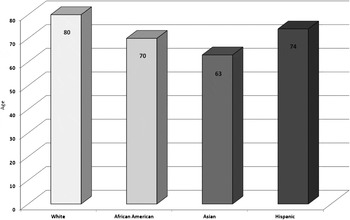
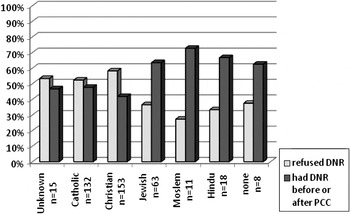
Age was significantly different across ethnic and racial groups (p < 0.0001). The mean age of white patients was 80 (SD = 13, median = 84, range 31–106), compared with that of African Americans (70, SD = 21, median = 75, range 20–98), Asians (63, SD = 20, median = 70, range 21–91) and Hispanics (74, SD = 13, median = 76, range 50–94) (Fig. 1). Religion was found to be strongly associated with likelihood of signing an AD (Fig. 2).
Race and ethnicity and average age of patients who received a palliative care consultation.

Religion and advance directive completion.

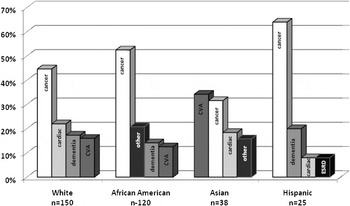
There was also a statistically significant difference in diagnosis distribution across race and ethnicity (p = 0.007), with cancer being most common in all races and ethnicities except Asians (36% in whites, 44% in African Americans, and 59% in Hispanics). Whites were documented to have a higher proportion of cancer (36%), followed by cardiac disease (18%), and dementia (14%). In African Americans, cancer was the most common diagnosis (44%), followed by “other” (18%), and dementia (12%). Asians had a higher proportion of cerebral vascular accident (CVA) (30%), followed by cancer (27%), and cardiac disease (16%). Finally, for Hispanics, cancer was the most frequent principal diagnosis (59%), followed by dementia (19%), end- stage renal disease (7%), and cardiac disease (7%) (Fig. 3).
Percentages of diagnosis distributions across race and ethnicity of patients who received a palliative care consultation.

The AD execution rate before versus after the PCC (including those never completed) is presented by race/ethnicity in Table 1. There is a significant association between the timing of AD completion in relation to the PCC and race/ethnicity (p < 0.0008). Bonferroni-adjusted pairwise multiple comparisons for each racial/ethnic group reveal that the patterns of AD completion differ with respect to whites, African Americans (p < 0.0005), and Hispanics (p < 0.0042). Further analysis of the table shows that African Americans differed from whites in the likelihood of AD execution rates pre-PCC, but not post-PCC. Interestingly, Hispanics differed from whites in the overall rate of AD completion, irrespective of the timing of AD completion.
Frequency of advance directive completion for different races/ethnicities of patients who received a palliative care consultation (PCC)

DISCUSSION
It is no surprise that our study confirmed the well-established differences between racial and ethnic groups with regard to AD completion. On the other hand, the PCC quite strikingly “levels the playing field” among the groups, particularly between whites and African Americans. This study demonstrates that the choice of African Americans not to withhold care at end of life, historically attributed to limited healthcare access (Liao et al., Reference Liao, Bang and Cosgrove2011), can be altered through the implementation of a single PCC.
Although the PCC may level the playing field, it should be noted that a large minority (43%) of patients, across racial and ethnic groups, still chose not to execute an AD. Although we must fully respect a patients’ rights to determine their end-of-life care, the authors wonder whether a follow up PCC would have further modified AD rate completion.
Another intriguing finding of the study was the significant age difference across racial and ethnic groups (p < 0.0001). Whites, with a median age of 84, were much older than African Americans (median age 75), Asians (median age 70), or Hispanics (median age 76), raising the possibility that age alone, rather than race or ethnicity, may at least partially explain differences in AD completion.
Finally, it should be noted that whereas the observed rate of AD completion during the pre-PCC time period is technically a prevalence rate, the rate completed post-PCC is an incidence rate, and, therefore, the two rates cannot be directly compared. In order to compute a proper pre-PCC incidence rate, there would have to be a defined interval of time (e.g., from first determination of terminal/critical illness until AD prior to PCC). However, under the assumption that, for subjects in this study, this time interval was fairly short, the pre-PCC rate can be thought of as an incidence rate. One further assumption required about the pre-PCC period is that the mortality rates for subjects from completion of AD do not vary appreciably among subject subgroups (e.g., by age, gender, race, ethnicity).
Our study did encounter some limitations. Specifically, the Hispanic data subset contained a relatively small number of subjects. In addition, given the multicultural backgrounds of most Americans today, classification into strict categories is becoming increasingly inaccurate.
CONCLUSION
This study demonstrates the significant impact of a PCC on the successful completion of ADs, particularly in African American patients. It clearly demonstrates that, despite racial, ethnic, and cultural differences documented in the literature, physicians and other healthcare practitioners should be encouraged to have discussions regarding end-of-life preferences with patients and family members of all backgrounds.
ACKNOWLEDGMENTS
The authors recognize the efforts of Theresa Szpila, Marie Ilagan, and Jill Cotroneo for their administrative support, and Caroline Trezza for her assistance with the literature review.