


Introduction
Numerous studies have focused on the thoughts reported by pain sufferers. (Helmes and Goburdhun, Reference Helmes and Goburdhun2007; Philips, Reference Philips1989; Eccleston, Crombez, Aldrich and Stannard, Reference Eccleston, Crombez, Aldrich and Stannard1997; Aldrich, Eccleston and Crombez, Reference Aldrich, Eccleston and Crombez2000). Reports of catastrophic thoughts about the future (Sullivan, Bishop and Pabik, Reference Sullivan, Bishop and Pabik1995) and/or negative self-appraisals (Tang, Salkovskis and Hanna, Reference Tang, Salkovskis and Hanna2007; Tang, Goodchild, Hester and Salkovskis, Reference Tang, Goodchild, Hester and Salkovskis2010) are common. Recently, the study of pain cognitions has expanded to include a second type of cognition: “images” associated with pain experience. Three examples of repetitive intrusive distressing images that occurred in association with pain were described to Philips (Reference Philips2011):
-
1. I am an old woman alone in my chair. I can't look after myself at all. I am alone without my family.
-
2. I see myself fall backwards from my truck, on my back. . .and I die. I don't move again.
-
3. I see myself inflamed. . .protected. . .hunched. . . looking old and in pain. . . .looking sad, giving up. . .defeated.
A small proportion (3.6%) of these images have been found to be images of pain itself (Philips, Reference Philips2011; Gillanders, Potter and Morris, Reference Gillanders, Potter and Morris2012) but the majority (87.7%) are of past and future events (Philips and Samson, Reference Philips and Samson2012). The most distressing images (Index images) associated with pain experiences are vivid, repetitive, frequent and disturbing. They are accompanied by significant increases in pain, emotional distress (anxiety, anger, sadness) as well as increases in appraised threat and likelihood (probability) of the imagined-event actually occurring (Philips and Samson, Reference Philips and Samson2012). More than 85% of pain sufferers with pain-associated Index images saw their images a few times a week or more frequently. These repetitive Index images had become foreboding events and participants reported trying to avoid them. In the studies of Index images (Philips, Reference Philips2011; Philips and Samson, Reference Philips and Samson2012) some pain sufferers expressed their fear that repeatedly seeing their Index image might make the event in the image more likely to occur. These observations suggested that a cognitive bias might be operating in people who experience repetitive distressing images. In particular, it appears to be a likelihood cognitive bias of the type reported in various psychological disorders (Shafran and Rachman, Reference Shafran and Rachman2004). If a likelihood cognitive bias occurs in pain sufferers, it might promote avoidance of the image, feelings of threat when the image is “seen”, and lowered mood. Evidence of such responses was noted by Philips and Samson (Reference Philips and Samson2012) and stimulated this formal study of cognitive likelihood bias in pain sufferers. Pincus and Morley's (Reference Pincus and Morley2001) review provides a useful meta-analysis of information processing in pain (attentional, memory and interpretational biases), but does not extend to likelihood cognitive bias, which is the focus of the present study.
In their exploration of the “boundaries of rationality”, Tversky and Kahneman (Reference Tversky and Kahneman1973) and Kahneman (Reference Kahneman2011) investigated a range of cognitive biases that significantly influence decision making and expectations (priming, framing, loss-aversion, availability). A prominent thought pattern bias is the availability heuristic that operates to some extent in most people's thinking. It occurs when a person makes a prediction on the frequency and likelihood of an event, based on the most available knowledge he or she may have, at that time. It seems likely that the distressing Index images of pain sufferers, which provide frequent powerful available information, might affect expectations about the likelihood of future events. This study investigates such a possibility, given the emotional potency of Index images in pain sufferers (Philips, Reference Philips2011), and the reports of increases in threat and likelihood of occurrence of imaged events (Philips and Samson, Reference Philips and Samson2012).
In addition to the important work of Tversky and Kahneman (Reference Tversky and Kahneman1973) and Kahneman (Reference Kahneman2011), there are a number of contributions to the cognitive psychology field that encourage the investigation of likelihood cognitive bias. In his book on irrationality, Sutherland (Reference Sutherland1992) discusses the characteristics of experienced events that would make them readily available, and affect estimates of likelihood of their occurrence. He emphasizes that the key features of readily available information are events that produce strong emotion, are dramatic, and that contain concrete information (as opposed to abstract). It is notable that these three characteristics of available knowledge are all found in Index images of pain sufferers (Philips, Reference Philips2011; Philips and Samson, Reference Philips and Samson2012). Hence, one would expect that recurrent pain images become available information, primed for affecting beliefs about the likelihood of occurrence of imaged-events. Following Tversky and Kahneman, Carroll (Reference Carroll1978) found that imagining an event affected expectations of that event occurring. Subjective likelihood increased as the events become easier to imagine. He explained this result as a manifestation of the availability heuristic (Tversky and Kahneman, Reference Tversky and Kahneman1973). Philips (Reference Philips2011) found that Index imagery of pain sufferers is remarkably clear, easily/quickly “seen” and frequently occurring. Sherman, Cialdini, Schwartzman and Reynolds (Reference Sherman, Cialdini, Schwartzman and Reynolds1985), in a study comparing imaging and reading, found that imaging significantly increased the probability estimates of the event seen in the image. The more available the seen image, the more likely the occurrence of the seen event is perceived to be. In his 1985 study, Sherman hypothesized two possible ways increases in perceived likelihood might develop: the development of an image of the outcome, and the creation of a cognitive bias that impairs the ability to picture an event in an alternative way. Interestingly, Koehler (Reference Koehler1991) found that imaging a possibility increases confidence in the truth of that possibility “at the expense of alternatives”. Such findings in the field of cognitive psychology support the value of studying the presence/strength of likelihood cognitive bias in pain sufferers.
The aim of the current study was to investigate the occurrence of likelihood cognitive bias in people who experience recurrent distress images associated with pain experience. As no pain likelihood cognitive bias scale was available, a questionnaire to assess likelihood cognitive bias in pain sufferers was developed (Image-Event-Fusion-pain: IEF-p). The extent of likelihood cognitive bias in pain sufferers was assessed by this scale, and related to key cognitive appraisals of Index imagery and psychological characteristics of the participants assessed on established psychological inventories. It was hypothesized that (i) likelihood cognitive bias (measured by the IEF-p) is significantly associated with Index image occurrence in pain sufferers; (ii) Index images are associated with significantly increased estimates of threat; and (iii) inflated estimates of the likelihood that the events “seen” (in their Index images) will occur in the future. It was predicted that higher likelihood cognitive bias scores would correlate significantly with elevated anxiety and depression (DAPOS-Depression and Anxiety), elevated PTSD symptoms (PCL-C), and elevated levels of mental defeat (PSPS).
Method
Participants
The participants were attendees at an Occupational Rehabilitation Centre, where pain sufferers are referred for back-to-work programs. This centre differs from specialist pain clinics where most clinical psychological research on pain has been conducted. The program is predominantly re-activation and work hardening. Participants were referred by insurance companies for 6–10 weeks. Almost all participants had pain as well as physical disabilities from accidents/surgery. Individuals with addictions (drug or alcohol) or psychiatric problems are not accepted in the centre. Participants were told that the research project was independent of their training programs, and would be undertaken anonymously and only for those with pain who wished to volunteer.
Fifty-nine participants volunteered to participate in the research on “thinking when in pain”. Index images were reported by 78% (n = 46) of these volunteers. Two participants with Index imagery dropped out, leaving a sample of n = 44. All participants undertook a structured interview to obtain demographic details, and establish the presence of Index imagery. In those with imagery, four cognitive responses were obtained to their Index images. Prior to the interview all volunteers completed four inventories (DAPOS Anxiety and Depression, PCL-C, PSPS, and IEF-p) .Of the 44 participants with imagery, 37 agreed to repeated the IEF-p scale 7–10 days later, to provide test-retest data.
An exploratory factor analysis of the new scale was undertaken using all 59 volunteers for this study, who had each filled in the IEF-p scale. A further 37 volunteers were added to the data set from an earlier study (Philips, Reference Philips2011) to provide an adequate sample for the factor analysis. This was deemed appropriate as all administrative, selection criteria, and sample characteristics of the studies, location of the study, and investigator were comparable. As a consequence, a total of 96 participants with IEF-p scores were available (59 from the current study and 37 from an earlier study) in the factor analysis of the scale.
Procedure
Participants were approached by the staff at the Rehabilitation Centre and asked if they wished to volunteer for a research study on “how people think, when they are in pain”. It was made clear that the study was unconnected to their treatment or funding. A small percentage of those approached declined because of disinterest or time constraints; no information was available on these individuals. Participants were excluded from the study if they suffered from brain damage or were unable to speak and read English.
After providing demographic information, they (1) completed a number of reliable and validated psychological questionnaires (DAPOS Anxiety and Depression; Pincus, Rusu and Santos, Reference Pincus, Rusu and Santos2008; PCL-C; Ruggerio, Del Ben, Scotti and Rabalais, Reference Ruggiero, Del Ben, Scotti and Rabalais2003; and PSPS; Tang et al., Reference Tang, Goodchild, Hester and Salkovskis2010; (2) filled in the new 10-item scale (IEF-p) to measure likelihood cognitive bias; and (3) used analogue rating scales (0–100) to report four cognitive responses to their Index images during voluntary image exposure(VIE). This procedure (VIE) involved voluntarily forming the image and maintaining it as they made ratings about its meaning (Philips, Reference Philips2011; Philips and Samson, Reference Philips and Samson2012).
Measures
Inventories
DAPOS (Depression Anxiety and Positive Outlook Scale) is designed to measure mood in pain populations without contamination from somatic symptoms (Pincus et al., Reference Pincus, Rusu and Santos2008). Somatic symptoms overlap with pain symptoms and can distort assessment of anxiety and depression in a pain population as they may result in inflated scores. DAPOS has excellent psychometric properties and is appropriate for pain sufferers (Taylor, Lovibond, Nicholas, Cayley and Wilson, Reference Taylor, Lovibond, Nicholas, Cayley and Wilson2005). It is a short, self-administered instrument that takes 2–4 minutes to complete.
PCL-C (PTSD Symptom Checklist) is a short self-report measure of DSM-IV symptoms of Post-Traumatic Stress Disorder (Lang and Stein, Reference Lang and Stein2005; Ruggiero et al., Reference Ruggiero, Del Ben, Scotti and Rabalais2003). It was selected for ease of administration (2–5 minutes), established sensitivity, specificity and positive predictive values. It covers symptom intensity and not the full DSM-IV criteria. Blanchard, Jones-Alexander, Buckley and Forneris (Reference Blanchard, Jones-Alexander, Buckley and Forneris1996) reported that a cut-off criterion of over 44 provides the highest diagnostic efficiency.
PSPS (Pain Self Perception Scale; Tang et al., Reference Tang, Salkovskis and Hanna2007) is a 24-item instrument to assess “mental defeat” in relation to pain. Respondents are asked to recall a recent episode of intense pain and then rate the extent to which each item applies on a scale from 0–4 (0 = never/not at all to 4 = very strong). The summed score ranges from 0–96. This scale has excellent internal consistency and test-retest reliability with chronic pain respondents.
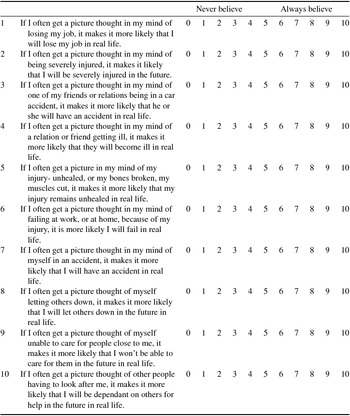
Image-Event-Fusion-pain (IEF-p) is a new short measure of the likelihood Cognitive Bias associated with pain images. It assesses the bias that adverse events seen in an image tend to increase the perceived likelihood that the adverse event will actually occur. To obtain this measure of a likelihood cognitive bias (or tendency in judgement), participants were required to rate (0–10) 10 discrete items (see in Results: 2). The themes of these items were collected from a pilot study of the Index image (most distressing image) reports of 106 pain sufferers collected at the Rehabilitation Centre (Philips, Reference Philips2010). In this sizeable pilot sample, the 10 most frequently described image themes were: loss of work, severe injury, accident to friend or member of the family, illness in friend or member of the family, failure at work, accident to self, letting others down, and dependence on others. These predominant themes were used in the development of the 10-item questionnaire.
Each image description was embedded in one of the 10 items and all described as “a picture thoughts that often come in to the mind of people in pain”. (The term “image” was avoided due to the sensitivities of previous participants evaluated during the initial preliminary pilot study (Philips, Reference Philips2010). Participants appeared to be uneasy about an overlap between “image” and “imagined pain”, and some appeared to feel judged negatively by the term “image”. “Picture thought” avoided this possible misinterpretation, and appeared to result in an easier access to a discussion of image cognitions. All participants were requested to read each of the 10 statements, and rate their belief (0–10) that if they saw such an image, it would make the event seen more likely to happen. The scale was not intended to assess an individual's specific Index image, but his or her likelihood cognitive bias. A number of participants remarked that the questions were novel, and that they had not previously thought of, or been asked about, pictures in their minds/images.
In summary, the questionnaire was developed to sample the extent to which pain sufferers believed that perceiving images would make the events (seen in the images) more likely to occur. The items did not focus on any participant's idiosyncratic Index images, but provided a set of 10 relevant images of pain sufferers. The questionnaire (IEF-p) provided an assessment of the presence and extent of likelihood cognitive bias in pain sufferers. It is comparable to the TAF questionnaire developed in the studies of OCD (Shafran, Thordarson and Rachman, Reference Shafran, Thordarson and Rachman1996; Shafran, Teachman, Kerry and Rachman, Reference Shafran, Teachman, Kerry and Rachman1999; Berle and Starcevic, Reference Berle and Starcevic2005). However, the present scale is specially designed to facilitate the study of image cognitive bias in pain sufferers. (The scale name purposely refers to “event” rather than the action, given the image contents found in the initial pilot study).
Analogue scales
A number of analogue scales were obtain during Voluntary Image Exposure (VIE) to gain cognitive judgments of Likelihood, Threat, Premonition, and Responsibility provoked by their Index images:
-
- Likelihood: What do you feel is the likelihood or probability that the event (seen in the Index Image) may actually happen? (0–100)
-
- Threat: As you see the picture thought, how threatened do you feel? (0–100)
-
- Premonition (bad luck): Do you believe/think that the picture thought means you will have bad luck in the future? How strongly do you believe this? (0–100)
-
- Responsibility: Do you feel because you keep seeing the picture, you will be in some way responsible for the event occurring in the future? (0–100)
Results
Participant characteristics
The mean age of participants was 45.6 (SD = 10.5); 2/3 were female. The average pain was 4.99 (SD = 1.67), on a scale of 0–10 (in which 10 equals unbearable pain). Peak pain was reported as 7.1 (SD = 2.1) on the same scale. Chronicity of pain symptoms was 37.4 weeks (SD = 31.68). Further details of the group can be found in Philips and Samson (Reference Philips and Samson2012). These characteristics are comparable to those collected by the Occupational Rehabilitation Centre in which pain is a correlate of their physical disabilities rather than a primary problem.
Development of a scale to assess cognitive bias in pain: Image-Event-Fusion-p (IEP-p)
As different groups (i.e. OCD, eating disorders, health anxiety, pain sufferers) experience idiosyncratic distressing Index images, it was necessary to develop a questionnaire specifically designed for pain sufferers (see Table 1).
Image-Event-Fusion-pain (IEF-p): participant instructions and scale Participant instructions: please read the instructions below and fill in each of the 10 questions. Most people have picture thoughts or image thoughts that repeatedly come into their minds. It is a type of thinking that is normal and common. Below are 10 statements about the meaning of these picture thoughts. Please consider each of the statements and record how much you believe them from 0 (never believe) to 10 (always believe) by circling a number from 1–10.

1. IEP-p: internal consistency and factor structure
The internal consistency of the IEF-p scale is high (Cronbach's α = .95). Items in the scale hold together extremely well and probably overlap. An exploratory factor analysis undertaken after examination of the correlation matrix found all items correlated with each other and no multi-linearity was evident (correlations >.9). The principal component analysis revealed either 1or 2 factors based on a scree test, but the second factor consisted only of two items, and both of these were complex (i.e. they also loaded significantly on the first factor). Hence, a 1 factor solution was considered the most parsimonious solution, accounting for approximately 70.4% of the total variance. Component loadings of individual items were all in excess of .72 (range: .73-.90).
2. IEP-p: reliability
A sub-group of 37 of the 59 participants were able to return 7–10 days after their initial assessment for a second assessment using the IEF-p scale. (The failure to get retest data from all 59 was due to disinclination or a clash with their rehabilitation schedules). The Pearson correlation between the two time points was highly significant (r = .81, p<.000), providing strong evidence of high test-retest reliability of the IEF-p scale.
3. IEP-p: validity
As a preliminary assessment of criterion validity, IEF-p scores were correlated to belief ratings (0–100) given to the following question, asked after “seeing” their Index images using the Voluntary Image Exposure (VIE) methodology: Philips, Reference Philips2011; Philips and Samson, Reference Philips and Samson2012): “What do you feel is the likelihood or probability that the event (seen in the Index image) may actually happen?” A significant correlation (r = .33, p = .02) was found between this scale measuring cognitive bias and the specific likelihood bias the participant reported with respect to his/her own Index image. This result provides preliminary support for the validity of the IEF-p scale to assess the likelihood of cognitive bias in pain sufferers.
In summary, the assessment instrument (IEF-p) was found to be stable, internally consistent, with a single factor structure, and criterion validity.
Levels of cognitive bias in a pain sample
Using the total sample of 59, the mean score on IEF-p scale was 26.62 (SD 24.92) with a minimum of 0 and a maximum of 88 (maximum possible score = 100). There were 20 participants who scored 0 on the scale indicating no belief that seeing any of images described would result in the occurrence of the seen event. Thus they showed no imagery likelihood cognitive bias; 87% of these participants scoring 0 on the IEF-p reported no Index images associated with pain.
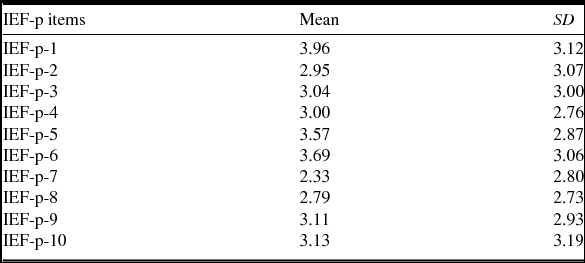
Taking only the IEF-p results of the 44 with Index imagery associated with their pain, two had failed to complete the Image Action Fusion-p, leaving a sample of 42. The mean (SD) scores for this sample for each of the 10 items are shown in Table 2, with range of means between 2.3–3.96.
Means and standard deviations for Image Event Fusion Scale items for participants with Index images when in pain

The themes of the items with the highest cognitive bias estimates (IEF-p scores) (in descending order) are concerned with job loss (#1), failure at work (#6), dependence (#10), and inability to care for others (#9). These themes are common concerns of pain sufferers at a rehabilitation/back to work program.
Cognitive bias (IEF-p) and cognitive appraisals of Index images
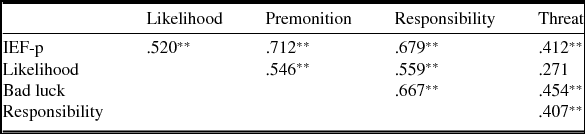
It was postulated that those with higher cognitive bias scores (on the IEF-p) would have higher ratings on the 4 analogue scales that assessed cognitive responses to their Index images (see Table 3) and this prediction was confirmed. All the cognitive appraisals were significantly correlated to the IEF-p scale responses. Given the common finding of significant correlations between depression and a range of psychometric tests (Berle and Starcevic, Reference Berle and Starcevic2005; Shafran and Rachman, Reference Shafran and Rachman2004; Thordarson, Radomsky, Rachman and Shafran (Reference Thordarson, Radomsky, Rachman and Shafran2004), and the possibility that depression scores were inflating IEF-p, a partial correlation was undertaken to see whether the significant correlations between these four appraisals and IEF-p are still present when depression levels were controlled. Three remained significant - Likelihood: r = .389, p = .013; Premonition: r = .468, p = .002; Responsibility: r = .415, p = .008; Threat: r = .117, n.s. Thus the IEF-p is highly correlated to three of the four cognitive appraisals, independent of depression levels. Threat lost its correlation with cognitive bias.
Correlations (Pearson) between IEF-p and four cognitive appraisals: Likelihood of the imaged event occurring; Premonition (bad luck in the future); Responsibility for the event occurring; and Threat (provoked by the Index image)

** Correlation significant at the 0.01 level (2 tailed)
Cognitive bias and psychological state: anxiety, depression, PTSD symptoms, and mental defeat
It was predicted that higher levels of IEF-p would be found in participants with higher state anxiety, depression, PTSD symptomatology, and mental defeat scores. The results confirm these predictions. IEF-p was significantly correlated with both depression and anxiety levels on the DAPOS (r = .70, and r = .68 respectively; p < .001). Higher cognitive bias is associated with higher anxiety and depression scores.
The same is true of the correlation of IEF-p and PTSD symptoms, assessed with the PCL-C. Dividing the total sample into high scorers (>60) and low scorers (<40), the means on the IEF-p were 49.3 and 12.8 respectively. Using an ANOVA analysis, IEF-p scores were significantly different in the high and low PTSD symptom groups (F = 32.3, p = .01). Finally, mental defeat (PSPS), a measure of catastrophic self-appraisals in pain sufferers, correlated significantly with IEF-p (r = .327, p = .01).
Cognitive bias and pain chronicity
Participants ranged in the chronicity of their pain symptoms, and their average pain duration was 9.35 months. There was no significant difference in the cognitive bias scores in the IEF-p scale when the sample was divided into acute (< 24 weeks: n = 21) and chronic (>24 weeks: n = 23) pain groups. However, it is important to note that all participants experienced Index images.
Discussion
The current study found the recurrent distressing and often unrecognized images of pain sufferers are significantly associated with likelihood cognitive bias. All three hypotheses are confirmed: (i) likelihood cognitive bias (measured by the IEF-p) is significantly associated with Index image occurrence in pain sufferers; (ii) Index images are associated with significant estimates of threat; and (iii) inflated estimates of the likelihood that the event seen in the Index image will occur in the future. It is confirmed that Index imagery is associated with likelihood cognitive bias. In addition, the ratings of threat and likelihood of the Index image events occurring correlated significantly with the assessment of likelihood cognitive bias (on the IEF-p), supporting the hypothesized relation of cognitive bias and threat and likelihood estimates of Index imagery. These results are supported by previous studies in which recurrent distressing images reported by pain sufferers (Index images) were shown to be significantly associated with elevations of appraised threat and increased estimates of the likelihood of the “seen” event in the image actually occurring (Philips and Samson, Reference Philips and Samson2012). In addition, seeing the distressing image significantly increases anxiety and threat. These findings strongly suggest that images, like thoughts (Shafran and Rachman, Reference Shafran and Rachman2004), can be associated with cognitive bias. It has been shown that cognitive bias is present in non-clinical populations (Marino-Carper, Negy, Burns and Lunt, Reference Marino-Carper, Negy, Burns and Lunt2010; Zucker, Craske, Barrios and Holguin, Reference Zucker, Craske, Barrios and Holguin2002) as well as pathological groups (Shafran and Rachman, Reference Shafran and Rachman2004). In addition, the prediction that high cognitive bias scores correlate significantly with elevated anxiety, depression, PTSD symptoms and mental defeat was confirmed.
The short measure of likelihood cognitive bias in pain sufferers (IEF-p scale) is a stable questionnaire found to be psychometrically robust, and to measure a single factor: likelihood cognitive bias. Although the high correlation between items in the factor analysis might encourage item reduction and a shorter scale, this may not be a clinically useful step. It was observed that participants often rated a particular item notably higher than other items on the scale. This appeared to be due to the content similarity of a particular item on the scale, and the participant's idiosyncratic Index image. For this reason, it is worthwhile retaining all the items of the scale in the questionnaire as it may give efficient access to key concerns, and alert therapists to potent imagery. In the future, item analysis as well as a derived total score will be useful in validating the scale, and in guiding clinical applications.
This measure of likelihood cognitive bias in pain proved to be significantly correlated to four key beliefs about specific Index images associated with pain experience: likelihood (of seen event occurring); threat (of an upsetting event); premonition (bad luck in the future); and responsibility (for future threatening events). The elevated scores on responsibility, a major factor in anxiety disorders (Salkovskis, Reference Salkovskis and Salkovskis1996) suggests that future studies may need to investigate the morality factor as well as the likelihood factor of cognitive bias in pain sufferers with Index images (Shafran and Rachman, Reference Shafran and Rachman2004). If having the image makes the events more likely, it could well lead to heightened feelings of responsibility and consequent feelings of guilt. With likelihood cognitive bias present, blocking of distressing images by avoidance, interruption and distraction become increasingly understandable responses to distressing images (Philips, Reference Philips2011). It will be useful in further research to investigate the relationship of cognitive bias and the repetitive occurrences of Index images. Avoidance of these distressing images inflated by likelihood cognitive bias may perpetuate, if not increase, the frequency of image intrusions.
Examining the 10 themes included in the IEF-p scale, it was possible to delineate the image themes with highest likelihood cognitive bias scores. Further clinical research using the scale will help determine how readily specific item elevations on the scale imply the presence of specific Index images of a participant. If this is found, the IEF-p could become useful assessment and evaluative tool in cognitive therapeutic methods, including Rescripting (Philips and Samson, Reference Philips and Samson2012).
It could be argued that the significant correlations of IEF-p scale and the four key appraisals assessed are merely a function of low mood. Although the participants did not have significantly elevated DAPOS-D scores (Philips and Samson, Reference Philips and Samson2012), this possibility was evaluated. A partial correlational analysis found the IEF-p scores retained their significant correlations with three of the appraisals (Likelihood, Premonition, and Responsibility) when DAPOS-D scores were used as a covariate. Interestingly, the relationship of Index image threat appraisal to cognitive bias was no longer significant when depression scores were controlled. This finding will need further study as it suggests a vicious cycle that may evolve in pain sufferers who become depressed. Past studies have found that distressing Index imagery in pain sufferers raises anxiety and depression (Philips, Reference Philips2011; Philips and Samson, Reference Philips and Samson2012). It seems likely that when likelihood cognitive bias is present, pessimism (Keefe and Wren, Reference Keefe and Wren2013) and foreboding about the future may increase. The latter has been investigated in studies of mental defeat, and found to be significantly elevated in those with chronic pain (Tang et al., Reference Tang, Salkovskis and Hanna2007, Reference Tang, Goodchild, Hester and Salkovskis2010). In the current study, mental defeat (PSPS) scores correlated significantly with IEF-p scores.
The significant correlation of the IEF-p and PTSD symptoms (PCL-C.) suggests the value of considering a likelihood cognitive bias in PTSD sufferers. Pain sufferers with intrusive Index images had elevated PCL-C scores. Unfortunately, the percentage of these participants with trauma/PTSD Index images was not established in this study, although many reported trauma images. Intervention to reduce cognitive bias in those with tormenting intrusive imagery may prove a useful addition to the cognitive therapy of PTSD sufferers as well as pain sufferers with trauma images.
The relationship between the chronicity of pain problem and the evolution of cognitive bias cannot be resolved in this study. No difference was found between IEF-p scores of participants (with Index images) with chronic (>24 weeks) and acute (<24 weeks) pain problems. A longitudinal study is needed to illuminate this issue. Having high cognitive bias beliefs independent of pain (i.e. prior to the pain injury) may well lead to pain associated imagery increasing in prominence. Intrusive and distressing images could become a focus of pessimistic ruminations concerning foreboding events. Pain provoked threatening images may then increase in frequency. This hypothesized evolution need not take time to develop when threat levels are deemed high (i.e. loss of a job, livelihood, family). It is predicted that Index image frequency and IEF-p strength will be better related to perceived threat and depression than passing time (chronicity). Certainly, anecdotal remarks of certain participants in this study support this hypothesis, such as the following:
It was only when my GP told me finally, after many months of rehab and time off work, that there was nothing else he could do for me – that I had to live with the pain – that the images rapidly increased in frequency.
The results of this study support the findings of Carroll (Reference Carroll1978), Sherman et al., Reference Sherman, Cialdini, Schwartzman and Reynolds1985, and the views of Sutherland (Reference Sutherland1992) summarized in the introduction. It appears that repetitive distressing images seen by pain sufferers become readily available information that significantly affects beliefs about the likelihood of “seen” events actually occurring, or re-occurring. The availability heuristic (Tversky and Kahneman, Reference Tversky and Kahneman1973) affects the image cognitions of pain sufferers.
The clinical and research implications of this study for pain management are considerable. Unwanted intrusive images are laden with meaning, frequent, powerful, and readily evoked (Philips, Reference Philips2011; Rachman, Reference Rachman2013). They are an important component of pain experience and are likely to encapsulate core issues not evident in pain thoughts (i.e. “why me?”; “How will I cope in the future?”). Enquiries of pain sufferers of the presence and personal meaning of intrusive upsetting images will be a valuable addition to a cognitive assessment and is likely to enhance treatment/management methods (Berna, Tracey and Holmes, Reference Berna, Tracey and Holmes2012). The IEF-p scale is a simple and useful preliminary screening for the presence of cognitive bias, as well as fast track identification of specific belief sensitivities using IEF-p item analysis (i.e. dependence, responsibility for others). Using the IEF-p before and after treatment may prove a useful and independent measure for assessing cognitive changes. In non-clinical participants, direct reduction in TAF has been shown to be relatively easy (Marino-Carper et al., 2009; Zucker et al., 2010) but less so in clinical populations (Rachman, Reference Rachman2013).
This research draws attention to the importance of assessing the beliefs of those tormented by repeated and threatening images - in this case, pain sufferers. Providing ways for sufferers to “change” or improve on the content of their intrusive distressing images is undertaken in rescripting (Philips and Samson, Reference Philips and Samson2012; Brewin et al., Reference Brewin, Wheatley, Patel, Fearon, Hackmann and Wells2009). Using the interesting comment of Koehler (Reference Koehler1991), the process of rescripting may lead to increased confidence in “an alternative possibility”. An alternative meaning of an image may develop that had previously been overlooked or blocked by the repeated Index images. The effect of rescripting pain images upon IEF-p score strength will be an interesting direction for future research. It is predicted that rescripting Index images of pain sufferers (Philips and Samson, Reference Philips and Samson2012) will lower likelihood cognitive bias scores. Although this research focused exclusively on the imagery of pain sufferers, it is a reminder that intrusive imagery and cognitive bias in other clinical groups may be a useful area for study by both clinicians and researchers. Overall, it is unsurprising that cognitive bias affects an individual's response to his/her distressing images, given that images are known to be more powerful cognitions than thoughts (Holmes and Mathews, Reference Holmes and Mathews2010). Further research into this strong phenomenon is certainly warranted.
This study has a number of limitations. The number of participants is small and restricted to those attendees at an Occupational Rehabilitation Centre suffering from pain. This will be rectified by replication studies in both assessment and treatment in rehabilitation and in chronic pain services. The current study did not have sufficient numbers to assess the relationship of image frequency (availability) and the strength of cognitive bias. A larger sample will enable the availability heuristic to be fully evaluated, in a pain group. The lower mean levels of pain and lower chronicity levels of this Rehabilitation sample are a reminder of the importance of a replication of these findings in a pain clinic context where pain is the primary reason for treatment. The extension of the enquiry of the relation of pain and likelihood cognitive bias in specialist pain clinics is highly recommended. It will also clarify the generalizability of these preliminary findings to other pain groups. It is predicted that the results with respect both to Index images and likelihood cognitive bias will be even stronger in specialized pain clinics.
Although differences in likelihood cognitive bias were not found between chronic and acute pain participants, it must be kept in mind that the participants all had reported Index images. Future studies will need to evaluate likelihood cognitive bias in pain sufferers irrespective of Index imagery to clarify this issue further.
This study did not assess the history of the Index images itself. A number of participants reported experiencing their Index images far more frequently at the onset of their pain difficulties (often trauma images), and then diminishing in frequency of occurrence with time. Others reported images beginning well after pain onset, post-surgery, or with difficulties returning to work. A longitudinal assessment is needed to clarify the evolution and persistence of Index images, and their relation to likelihood cognitive bias. An arbitrary, though customary acute/chronic cut-off at 24 weeks (6 months) will not permit a fully satisfactory evaluation of the evolution if IEF-p, or its relation to Index imagery in pain sufferers.
It was found that some participants scored 0 in the IEF-p. The significance of these responses needs further study. There are a number of possible interpretations of the 0 responses: no evidence of likelihood bias beliefs, failure to understand the instructions, intentional defacing of the questionnaire or an absence of images cognitions (in concrete thinkers). As 87% of 0 scorers reported no Index images, the 0 response may well be genuine rather than a dubious response to the questionnaire.
The factor analysis in this study will need to be repeated on a larger sample. The current exploratory factor analysis is considered encouraging, but not definitive. The re-test reliability of the scale needs to be repeated on a much larger sample.
Participants volunteered to take part in the research. As a consequence no data are available on those who did not wish to take part, and a selection bias is acknowledged. In addition, a proportion of attendees in the Rehabilitation Centre could not be used as they had insufficient English fluency to be included and were using interpreters to manage their rehab program. The nature of this study on cognitions required English fluency.
Acknowledgements
This research was made possible by the generous response to research by Back in Motion staff and Dr Debbie Samson, and clients who gave their time, during their attendance at the Occupational Rehabilitation Centre. Statistical help was provided by Dr M. Papsdorf and Dr A. Radomsky. Useful comments on the manuscript were provided by Dr S. Rachman and Dr D. Samson.



Comments
No Comments have been published for this article.