I. INTRODUCTION
The emission of nitrogen oxides (NOx) from the combustion process has raised significant concerns due to their great contribution to haze, acid rain, and photochemical smog.Reference Liu, Shi, Gao and Niu1–Reference Jin, Shen and Zhu3 Selective catalytic reduction (SCR) of NO with NH3 has been considered as one of the most efficient technologies to remove the NOx. Various types of SCR catalysts have been studied, including metal oxides, noble metals, and ion-exchanged zeolites, among them Vanadia-based catalyst has been successfully used in industrial applications.Reference Jin, Shen, Zhu, Li and Li4 However, there are some unavoidable problems for Vanadia-based catalysts, such as the volatility and harmfulness of V2O5, high oxidation rate of SO2 at high temperature, and narrow active temperature range (310–410 °C).Reference Wan, Zhao, Yu, Liang, Wang, Cui, Gu, Li and Shi5–Reference Zang, Zhang, Qiu, Song, Zhang and He7 Besides, the temperature of some stack gases were generally low after dedusting and desulphurization, which was not suitable for the operation of the Vanadia-based catalysts. Thus, development of highly efficient and eco-friendly low temperature SCR catalysts has become the research hotspot.
In recent years, many transition metal oxides have been studied for low temperature SCR reactions, such as NiO, CoOx, FeOx, CuOx, CeO2, and MnOx.Reference Han, Meeprasert, Maitarad, Nammuangruk, Shi and Zhang8–Reference Xu, Xu, Lin, Cao, Lan, Li, Feng, Gong and Chen16 Among them, the manganese-based catalysts showed optimal potential for low temperature SCR reactions due to the intrinsic properties of labile oxygen. CeO2 is commonly used to modify the catalysts due to its outstanding oxygen storage ability, NH3 adsorption properties, and high redox abilities via Ce4+ to Ce3+ transition.Reference You, Sheng, Yu, Yang, Xiao and Wang17–Reference Yang, Guo, Pan, Chen, Wang, Lu and Wang19 Mn-CeOx catalysts exhibited outstanding activity for the SCR of NO,Reference Lu, Song, Jia, Tong, Tang and Teng20–Reference Liu, Gao, Shi, He, Li, Bai and Niu22 and the conversion of NO was more than 87% at 100 °C.Reference Qi, Yang and Chang23 Boningari et al. investigated Ce-MnOx supported on TiO2 for the SCR reaction, and they found that the distribution and concentration of the acid sites could be considerably improved by co-loading Mn and Ce into TiO2.Reference Boningari, Ettireddy, Somogyvari, Liu, Vorontsov, Mcdonald and Smirniotis24 Zhao et al. used Nb to modify the MnCeOx/TiO2 system, and it is found that the introduction of Nb could increase the specific surface area and strengthen the acidity of the catalyst.Reference Zhao, Ran, Guo, Cao, Xu, Chen, Wu, Si and Weng25
In the past, barium was commonly studied in NOx storage reduction, NO decomposition, and NO oxidation processes due to its excellent capacity for NO adsorption and storage.Reference Yan, Shen, Zhu, Jin, Liu and Li26–Reference Zhou, Feng, Zhang, Hu, Chen, Shan, Yin, Wang and Huang28 Recently, Mousavi et al. preliminarily explored the effect of Ba on the Mn-CeOx catalyst for NH3-SCR, but they did not systematically investigate the promoting factors.Reference Mousavi, Niaei, Gómez, Salari, Panahi and Abaladejo-Fuentes29 Hence, in this work, a series of Ba-modified MnCeOx/TiO2 catalysts were prepared by a wet impregnation method and their catalytic performance for NH3-SCR of NO at low temperature was tested. Furthermore, the effect of Ba additives on the solid-phase, textural structure, redox properties, basicity, and element valence of the catalysts were characterized by techniques of XRD, BET, SME, HRTEM, H2-TPR, CO2-TPD, and X-ray photoelectron spectroscopy (XPS), and the promotional role of Ba additives on the BaMnCeOx/TiO2 catalyst was discussed.
II. EXPERIMENTAL
A. Catalyst preparation
All chemicals used in this research were of analytical grade and obtained from Aladdin Reagent Co (Shanghai, China). The MnCeOx/TiO2 and yBaMnCeOx/TiO2 (y represents the percentage of the loading of barium oxide) catalysts were prepared by a wet impregnation method using TiO2 as a support. Typically, for the MnCeOx/TiO2 catalyst, the desired amounts of manganese nitrate solution (50 wt%) and Ce(NO3)3·6H2O (molar ratio of Mn/Ce = 1:1) were dissolved in deionized water to obtain a mixed solution. Then mixing the mixed solution with calculated amount of TiO2 (10 wt% MnO2). Finally, the mixture was dried in air at 80 °C for 12 h and calcined at 500 °C for 2 h in air atmosphere. To prepare the BaMnCeOx/TiO2 catalyst with various amounts of barium oxide (1–7 wt%), the Ba(OH)2·8H2O was first dissolved in glacial acetic acid, and then with the addition of Ce(NO3)3·6H2O and Mn(NO3)2 to form a homogeneous solution. The subsequent steps are the same as preparing the MnCeOx/TiO2 catalyst.
B. Activity test
The catalytic activities of the obtained samples in NH3-SCR of NO were tested in a fixed-bed quartz reactor (inner diameter 8 mm) containing 5 mL catalysts. The feed gas mixture consisted of 900 ppm NO, 900 ppm NH3, 10 vol% O2, 5 vol% H2O (when used), 200 ppm SO2 (when used), and balanced by N2 with a total flow rate of 1066 mL/min and a GHSV of 12,800 h−1. The reaction temperature range was 80–200 °C. The NOx concentrations were detected by using a flue gas analyzer (VARIO PLUS, MRU, Neckarsulm, Germany), and the data were recorded after the reaction was stabilized.
C. Catalyst characterization
The powder X-ray diffraction patterns were obtained using an X-ray diffractometer (Rigaku DMAX-RB, Miami, Florida). The data were obtained in the 2θ range of 10–85° with a step size of 0.02°. Micromeritics ASAP 2020 automatic equipment (Micromeritics Instruments, Norcross, Georgia) was used to measure the specific surface area, pore volume, and pore size distribution. The BET surface area of the catalysts was measured by N2 adsorption–desorption isotherms. The morphological and structural information of the catalysts have been investigated using a transmission electron microscope (JEOL, JEM-2010UHR, Tokyo, Japan).
H2-TPR profiles were obtained on Micromeritics TPD/TPR 2900 equipment (Micromeritics Instrument, Norcross, Georgia). The samples were pretreated in Ar at 400 °C for 1 h, and then cooled to 50 °C in the same stream. Then the catalysts were exposed to a flow of 5% H2/95% Ar (20 mL/min). The temperature was increased from room temperature to 600 °C at a rate of 10 °C/min. The XPS experiment was performed by an AXIS ULTRA DLD instrument (Shimadzu, Kyoto, Japanese) with an Al-Kα radiation source. After complete removal of moisture from the catalyst by drying at 100 °C for 24 h, the catalysts were analyzed without surface sputtering or etching so that the degree of vacuum in the XPS equipment was maintained at 10−7 Pa.
TPD profiles of ammonia, nitric oxide, and carbon dioxide were obtained on an automated chemisorption analyzer (Quantachrome Instruments, Miami, Florida). About 200 mg of the sample was used; the samples were pretreated at 300 °C under a helium stream for 1 h, and then cooled to 50 °C. Afterward, the pretreated sample was exposed to 1 vol% NH3 or 1 vol% NO or 1 vol% CO2 balanced with helium for 1 h to achieve saturated adsorption. Subsequently, the samples were purged with helium for 30 min to remove the weakly adsorbed species. Finally ammonia, nitric oxide, and carbon dioxide was desorbed using helium at a flow rate of 70 mL/min from 50 to 500 °C (50–400 °C for CO2-TPD) at a heating rate of 10 °C/min.
III. RESULTS AND DISCUSSION
A. Catalytic activity for NH3-SCR of NO
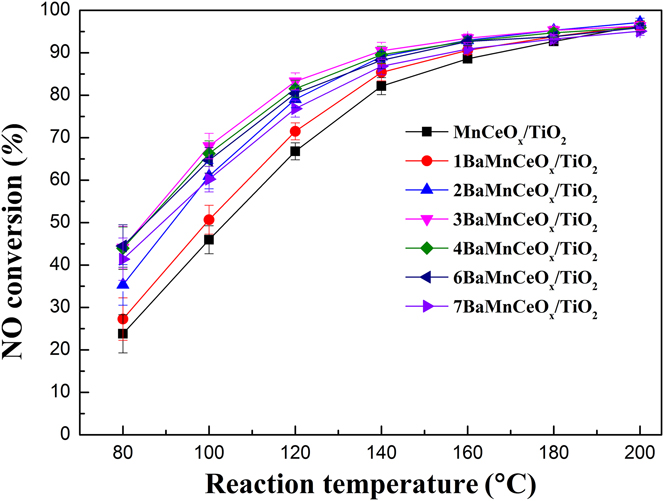
Figure 1 shows NO conversion for MnCeOx/TiO2 and BaMnCeOx/TiO2 catalysts. The MnCeOx/TiO2 catalyst exhibited a poor catalytic activity at low reaction temperature, where NOx conversion only 23% was obtained at 80 °C and 81% at 140 °C, and the catalytic activity was obviously improved after the Ba incorporation. The activity of the BaMnCeOx/TiO2 catalyst presented a volcano-type tendency with an increasing content of Ba and that the 3BaMnCeOx/TiO2 catalyst showed the optimal performance. When the barium content further increases, the activity of the catalyst begins to decrease, but they were still higher than that of MnCeOx/TiO2.
NO conversion at various temperatures over different catalysts. Reaction conditions: [NO] = [NH3] = 900 ppm, [O2] = 10%, with N2 balance; GHSV = 12,800 h−1.

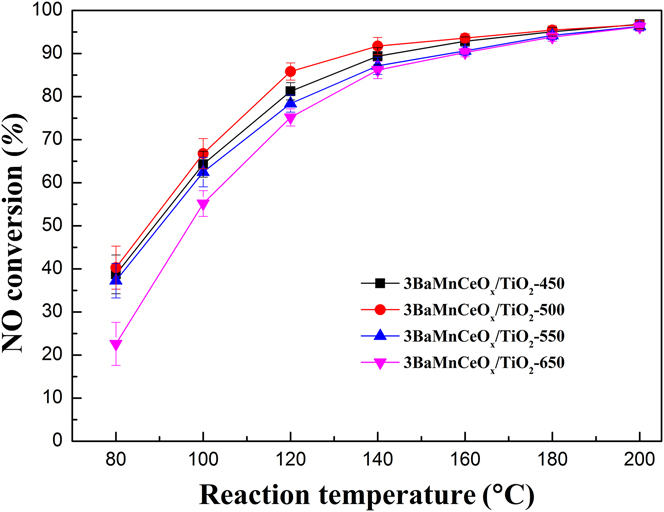
To investigate the effect of calcination temperature on catalytic performance of the catalyst, the 3BaMnCeOx/TiO2 catalyst was calcined at 450, 500, 550, and 650 °C, respectively. The relationship between calcination temperature and performance is presented in Fig. 2. It can be seen that the calcination temperature significantly affected the catalytic performance, and the optimal calcination temperature was 500 °C. Besides, it is noted that the low-temperature (80–140 °C) catalytic activity of the sample calcined at 650 °C was obviously lower than other samples, which could be attributed to the partly crystalline transformation of anatase to rutile of TiO2 carriers at 650 °C.Reference Jin, Shen, Zhu, Liu, Li and Yan30 Furthermore, the stability of the 3BaMnCeOx/TiO2 catalyst was investigated as shown in Fig. S1. The NO conversion of the 3BaMnCeOx/TiO2 catalyst remained about 96% during 35 h continuous operation at 200 °C, indicating that the 3BaMnCeOx/TiO2 catalyst has excellent stability.
NO conversion of 3BaMnCeOx/TiO2 catalysts with different calcination temperatures. Reaction conditions: [NO] = [NH3] = 900 ppm, [O2] = 10%, with N2 balance; GHSV = 12,800 h−1.

B. Effects of H2O and SO2
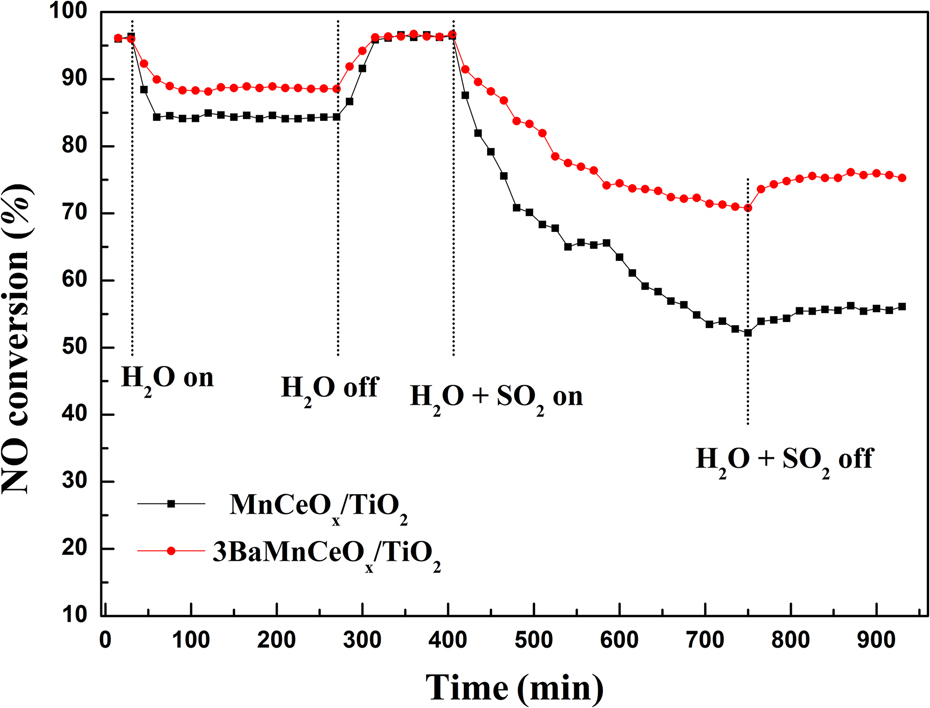
MnCeOx/TiO2 and 3BaMnCeOx/TiO2 showed the similar catalytic activity at 200 °C, as can be seen from Fig. 1; therefore, the effect of the Ba additives on the resistance toward water vapor and SO2 was investigated at 200 °C. As shown in Fig. 3, the initial efficiency was about 96% with both catalysts; when 5 vol% H2O was added to the feed gas, the NO conversions of MnCeOx/TiO2 and 3BaMnCeOx/TiO2 dropped by 12% and 7%, respectively. When H2O was removed from the gas flow, the activity rapidly recovered to initial efficiency. This could be explained by the competitive adsorption between NH3/NOx and H2O on the active sites, and the change of acid sites on the catalyst surface, which led to an inhibiting effect on the NH3-SCR process at low temperatures.Reference Dong, Nam and Hong31 The results showed that the 3BaMnCeOx/TiO2 catalyst had higher resistance to H2O compared with MnCeOx/TiO2 one, which could be attributed to the more abundant surface active sites of the 3BaMnCeOx/TiO2 catalyst, as evidenced by BET and XPS analyses.
NOx conversion in the presence of SO2 and H2O over MnCeOx/TiO2 and 3BaMnCeOx/TiO2 at 200 °C. Reaction conditions: NO = NH3 = 900 ppm, O2: 10%, H2O: 5 vol%, SO2: 200 ppm; GHSV: 12,800 h−1.

When 5 vol% H2O and 200 ppm SO2 were added to the feed gas simultaneously, both of the MnCeOx/TiO2 and 3BaMnCeOx/TiO2 showed signs of deactivation. The NO conversions of MnCeOx/TiO2 and 3BaMnCeOx/TiO2 decreased to 52% and 71% over 6 h, respectively. Moreover, the activity of both catalysts barely recovered even after the removal of H2O and SO2. It was due to the metal sulfates and ammonium sulfates formed on the surface of the catalyst, covering the active sites.Reference Meng, Zhan, Guo, Guo, Wang and Lu32,Reference Dong, Nam and Hong33 It is obviously found that the 3BaMnCeOx/TiO2 catalysts showed better resistance to SO2 and H2O. The reason might be that the presence of Ba could induce the formation of bulk-like sulfate on BaO (like other alkaline earth metals), protecting the active sites of MnOx and CeOx from the poisoning effect of SO2.
C. Solid-phase structure and textural parameters
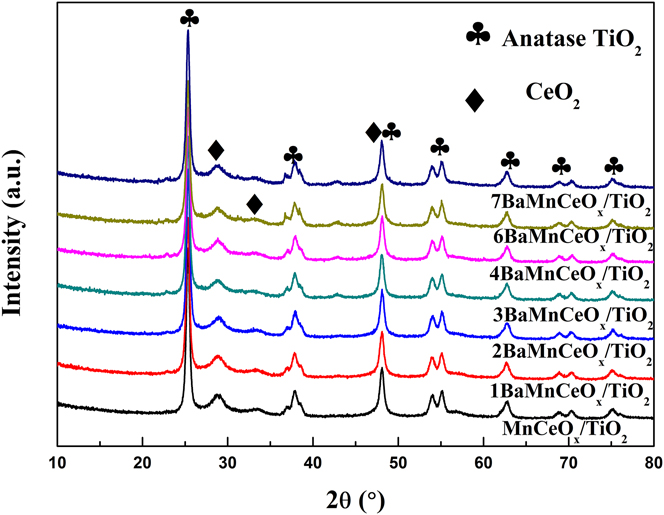
X-ray diffraction was performed to study the chemical compositions and phases of all catalysts, as displayed in Fig. 4. All the intense and sharp peaks could be assigned to anatase TiO2 (2θ = 25.2°, 37.5°, 47.8°, 53.5°) (PDF-ICDD 65-5714), and some diffraction peaks attributed to CeO2 (2θ = 28.8°, 33.5°, 48.1°) (PDF-ICDD 73-1539) were detected, though the peaks were quite broad and weak. No Mn or Ba species peaks were detected, which suggested that Mn and Ba species were existed as amorphous species in the catalyst.
X-ray diffraction patterns of different catalysts.

To further study the morphology of the catalysts, SEM and TEM techniques were used, as shown in Fig. S2. SEM images revealed that the two catalysts had similar morphologies, consisting of numerous irregular small particles. Figures S2(c) and S2(d) showed that the average size of MnCeOx/TiO2 was about 20 nm while that of 3BaMnCeOx/TiO2 was about 16 nm. In other words, the grain growth was suppressed with the addition of Ba. In addition, the HRTEM image [Figs. S2(e) and S2(f)] of MnCeOx/TiO2 and 3BaMnCeOx/TiO2 displayed the same lattice fringes with an interplanar distance of 0.357 and 0.310 nm, corresponding to TiO2 (101) and CeO2 (111) planes, respectively. Almost no lattice fringes of Ba and Mn species were detected in the HRTEM image, indicating that the Mn and Ba species presented as the amorphous phase, which was consistent with the XRD results.
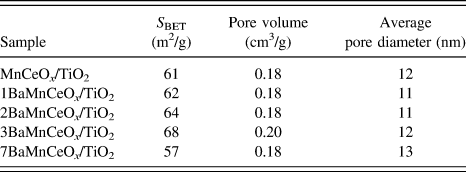
The N2 adsorption–desorption isotherms and the pore size distribution of different catalysts are shown in Fig. S3. As displayed in Fig. S3(a), all the samples displayed type-IV isotherms with an obvious hysteresis loop in the region of P/P 0 > 0.5, indicating the existence of mesoporous structures, which are ascribed to the interstices between the particles.Reference Shen, Zhang, Sun, Wang, Zhong, He, Wei and Sun34 Figure S3(b) presents the BJH pore size distributions of the catalysts. For all the samples, the main pore sizes were distributed between 5 and 30 nm. The specific surface area and pore volume of catalysts are summarized in Table I. It could be seen that the specific surface area of the catalysts were slightly increased by adding appropriate amount of barium, and 3BaMnCeOx/TiO2 had the largest specific surface area of 68 m2/g.
Textural parameters of different catalysts.

D. XPS analysis
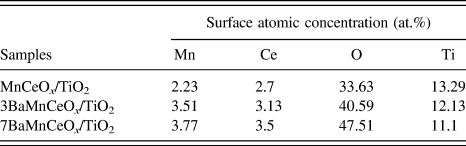
The surface composition and elemental chemical states of the catalysts were investigated by XPS. The surface atomic concentrations of the catalysts are shown in Table II. It is interesting that the surface atomic concentration of Mn and Ce increased after adding Ba, indicating that more Mn and Ce species could be exposed on the surface of the catalyst by the introduction of Ba.
Atomic concentration (at.%) on the surface of the catalysts determined by XPS.

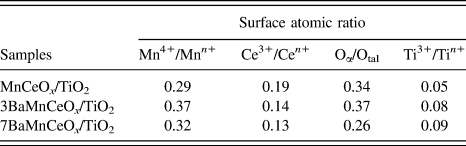
The XPS spectra of Mn 2p are shown in Fig. S4(a). Two main peaks attributed to Mn 2p 3/2 and Mn 2p 1/2 were observed. The Mn 2p 3/2 peak of each catalyst could be deconvoluted into three peaks corresponding to Mn4+, Mn3+, and Mn2+.Reference Lin, He, Wang, Ma, Whiddon, Zhu and Liu21 The Mn4+/Mnn+ atomic ratio on the surfaces of the catalyst are presented in Table III. The Mn4+/Mnn+ ratio of MnCeOx/TiO2 was 0.29, while the Mn4+/Mnn+ ratio of 3BaMnCeOx/TiO2 and 7BaMnCeOx/TiO2 catalysts were 0.37 and 0.32, respectively. It could be found that the Mn4+/Mnn+ ratio increased with the Ba incorporation, and 3BaMnCeOx/TiO2 had the highest Mn4+/Mnn+ ratio. It has been reported that Mn4+ species was responsible for the high activity in the low temperature NH3-SCR process.Reference Lee, Park, Kim, Kwon and Hong35,Reference Kang, Park, Kim and Yie36 Thus 3BaMnCeOx/TiO2 exhibits better performance and all the BaMnCeOx/TiO2 catalysts exhibited higher activity than MnCeOx/TiO2.
Surface atomic ratios of different catalyst surfaces.

Figure S4(b) displays the Ce 3d spectra. For convenience, Ce 3d 5/2 and Ce 3d 3/2 spin–orbit components were denoted as “u” and “v”, respectively. According to the literature studies,Reference Dong, Nam and Hong31,Reference Zhou, Li, Zhao, Zeng, Gao, Wang and Yu37 the u2 and v2 represent the 3d 104f 1 initial electronic state associated with Ce3+, and the u1, u3, u4, v1, v3, and v4 represent the 3d 104f 0 state of Ce4+. The Ce3+/Cen+ ratio decreases with the addition of Ba (Table III), indicating a lower average valence state of Ce ions on the surface of Ba-containing catalysts compared with MnCeOx/TiO2.
The O 1s spectra could be fitted into two sub-peaks originated from chemisorbed oxygen (Oα) and lattice oxygen (Oβ),Reference France, Yang, Li, Chen, Guang, Guo, Wang and Li38,Reference Zhou, Yu, Yang and Sheng39 as shown in Fig. S4(c). Interestingly, the Oα/Otal ratio increased to 0.37 for 3BaMnCeOx/TiO2 and decreased to 0.26 for 7BaMnCeOx/TiO2, in comparison with Oα/Otal = 0.34 of MnCeOx/TiO2, which confirmed that the addition of appropriate Ba was probably favorable for the formation of surface-labile oxygen. Oα was more reactive than Oβ due to its higher oxygen mobility, which was more effective in the oxidation of NO.Reference Zhang, Zhang, Zhang, Cai, Fang, Huang, Li, Gao and Shi40 Figure S4(d) displays the Ti 2p spectra, which could be divided into Ti3+ and Ti4+, the Ti3+/Tin+ ratio slightly increased after the Ba incorporation (Table III), and higher surface Ti3+ ratio was beneficial for enhancing the catalytic performance. That is one of the reasons why the BaMnCeOx/TiO2 catalysts exhibited higher activity than MnCeOx/TiO2.
E. NH3-, CO2-, and NO-TPD analyses
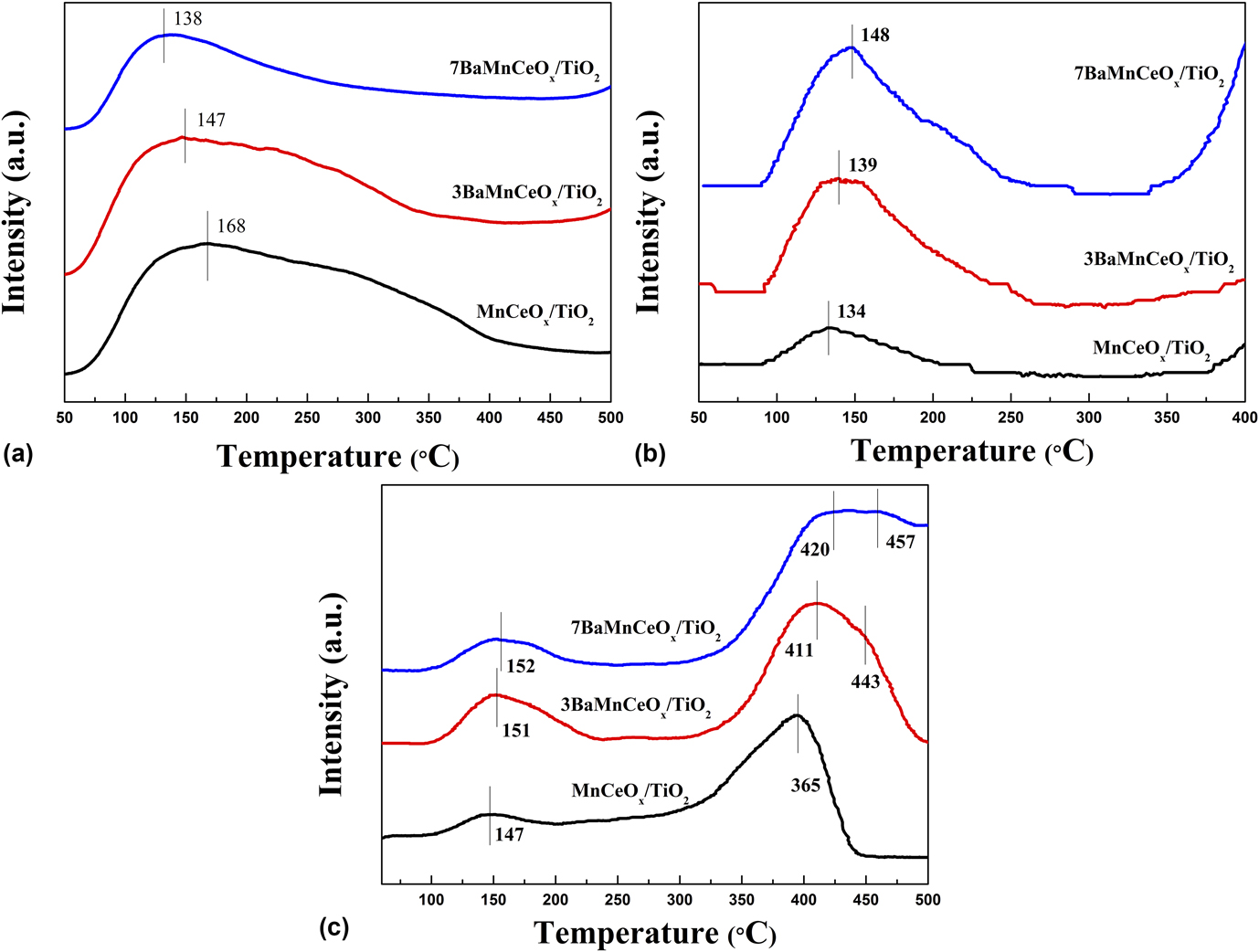
To investigate the influence of Ba on the surface acid amount and strength of the catalysts, NH3-TPD was performed. Figure 5(a) shows the NH3-TPD profiles of the MnCeOx/TiO2, 3BaMnCeOx/TiO2, and 7BaMnCeOx/TiO2 catalysts. All the samples showed a similar and broad desorption peak spanning in the temperature range of 50–500 °C, which was related to NH3 desorption on weak acid sites.Reference Song, Shao, Yuan, Wang, Zhan, Guo, Guo and Lu41 It was well accepted that the position of the desorption peak was correlated with the acid strength and the peak area was directly proportional to the amount of acid. As shown in Fig. 5(a), the peak position gradually shifted to lower temperature with the increasing content of Ba, indicating that the strength of the acid sites was weakened by the introduction of Ba. Besides, compared with MnCeOx/TiO2, there was a slight reduction in the desorption peak area of 3BaMnCeOx/TiO2, and the absorption peak area of 7BaMnCeOx/TiO2 was significantly reduced, suggesting an inhibitory effect of Ba on the acid site. Therefore, the superior catalytic performance of Ba-containing catalysts was not related to the acid sites in this study.
(a) NH3-TPD, (b) CO2-TPD, and (c) NO-TPD of different catalysts.

On the other hand, CO2-TPD was applied to evaluate the influence of Ba on the basicity of catalysts. As shown in Fig. 5(b), all the samples showed a similar desorption peak around about 140 °C spanning in the temperature range of 80–300 °C, which could be assigned to CO2 desorbed from weak and medium basic sites on the catalyst surface.Reference Shang, Sun, Che, Wang, Wang, Cao, Zhan, Guo, Guo and Lu42 Noticeably, the area of the desorption peak was greatly increased after the addition of Ba and the position of the absorption peak was shifted to higher temperature, suggesting that the basicity of catalysts were enhanced by the introduction of Ba.
The NO-TPD profiles of the catalysts are also shown in Fig. 5(c). For MnCeOx/TiO2, two desorption peaks were observed. According to the literature studies,Reference Fang, Guo, Shu, Luo, Chu and Li43–Reference Lian, Liu, He, Shi, Mo and Wu45 the desorption peak appeared at 147 °C was ascribed to the dissociation of physisorbed NO, and the high temperature peak located at 365 °C was assigned to NO2 desorption arising from the decomposition of bidentate and/or monodentate nitrates species coordinated to Mnx+ and Cex+ sites. For Ba-modified catalysts, three desorption peaks were found, and a new desorption peak could be observed at higher temperature, which was associated with the desorption of NO2 derived from the decomposition of barium nitrate.Reference Wu, Liu, Lin and Weng44 It can be observed that the desorption peak area was greatly increased after the introduction of Ba, indicating that the presence of Ba markedly enhanced the NO adsorption of the catalyst. This could be ascribed to the improvement of surface basicity of the catalyst confirmed by CO2-TPD, because the enhancement of surface basicity of the catalyst helped to improve the adsorption of NO.Reference Shang, Sun, Che, Wang, Wang, Cao, Zhan, Guo, Guo and Lu42 An outstanding low temperature NO adsorption capacity was beneficial to enhance the catalytic activity of SCR at low temperature.Reference France, Yang, Li, Chen, Guang, Guo, Wang and Li38
In addition, according to the adsorption characteristics of NO/NH3 and catalytic performance of the MnCeOx/TiO2 and BaMnCeOx/TiO2 catalysts, we found that although the introduction of Ba inhibited the adsorption of NH3, it promoted the adsorption of NO and enhanced the catalytic performance of catalysts. Previous studies have proved that the NH3-SCR of NO over the manganese-based catalyst followed both Eley–Rideal (E–R) and Langmuir–Hinshelwood (L–H) mechanisms at low temperature, and the reaction of adsorbed NOx with adsorbed NH3 species was an important reaction route (L–H mechanism) for NH3-SCR, especially at low temperature.Reference Meng, Zhan, Guo, Guo, Wang and Lu32,Reference Chen, Guan, Lin and Zhu46,Reference Chen, Zhang, Liu, Mi and Wang47 Hence, it may be inferred that the superior NO absorbability of BaMnCeOx/TiO2 could be considered as an important promoting factor for its high SCR activity at low temperature through the L–H reaction pathway, as described in Fig. S5.
F. H2-TPR analysis
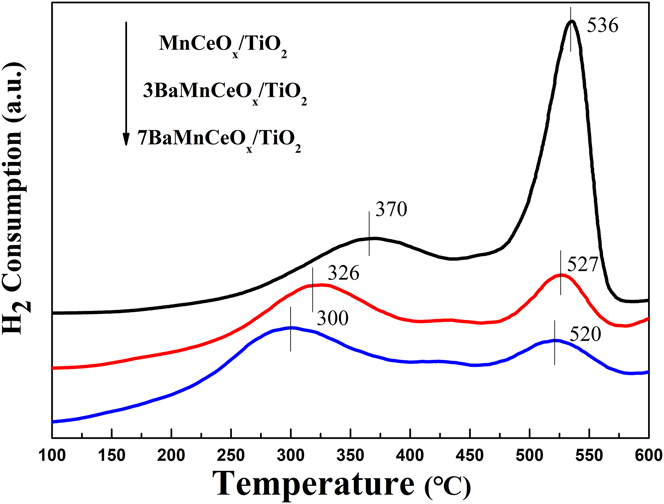
The redox property is one of the important factors for NH3-SCR. To investigate the redox properties of catalysts, H2-TPR was performed and the corresponding profiles are shown in Fig. 6. Two broad peaks were observed for all the catalysts, the peaks appeared at 200–420 °C could be ascribed to the reduction of easily reducible Mn4+ and Mn3+ species, and the peaks appeared at 450–580 °C could be assigned to the reduction of Mn3O4 → MnO and together with the reduction of surface Ce4+ → Ce3+.Reference Xiong, Tang, Yao, Zhang, Li, Wang, Deng, Gao and Dong48,Reference Hong, Iwamoto, Hosokawa, Wada, Kanai and Inoue49 For MnCeOx/TiO2, two reduction peaks were centered at 370 and 536 °C. After introduction of Ba, the reduction peaks of 3BaMnCeOx/TiO2 was shifted to 326 °C and 527 °C, respectively, and much lower reduction temperature was detected on 7BaMnCeOx/TiO2, proposing that the introduction of Ba significantly enhanced the redox performance of the catalyst and 7BaMnCeOx/TiO2 had optimal reducibility. In general, a higher Mn4+ ratio (0.37 for 3BaMnCeOx/TiO2 and 0.32 for 7BaMnCeOx/TiO2) was preferable for redox properties, but the reducibility of 3BaMnCeOx/TiO2 was worse than 7BaMnCeOx/TiO2. This could be attributed to the presence of more manganese species on the surface of 7BaMnCeOx/TiO2, as evidenced by XPS analysis. Additionally, the reducibility of the catalyst is directly related to the activity in the SCR reaction, while 7BaMnCeOx/TiO2 did not exhibit the highest catalytic activity, which could be caused by the lower NO and NH3 adsorption capacity of 7BaMnCeOx/TiO2 that had been confirmed by NO-TPD and NH3-TPD.
H2-TPR of different catalysts.

IV. CONCLUSION
In this work, the Ba-modified MnCeOx/TiO2 catalysts were developed for NH3-SCR of NO at low temperatures. It is found that BaMnCeOx/TiO2 catalysts were efficient to remove NO, and the 3BaMnCeOx/TiO2 catalyst exhibited the optimal catalytic performance. In addition, 3BaMnCeOx/TiO2 also showed higher resistance toward water and SO2 than the MnCeOx/TiO2 catalyst. The 3BaMnCeOx/TiO2 catalyst had higher specific surface area, better reducibility, stronger NO adsorption capacity, larger surface Mn4+ ratio, and higher concentration of chemisorbed oxygen. All these advantages were beneficial for enhancing the catalytic performance. We expected that those results could provide some basis in the design and mechanism research of the catalyst for NH3-SCR of NO at low temperature.
Supplementary Material
To view supplementary material for this article, please visit https://doi.org/10.1557/jmr.2018.179.
ACKNOWLEDGMENTS
This work was supported by the National Key Research and Development Program of China (No. 2016YFC0205500), the National Natural Science Foundation of China (51772149), the Priority Academic Program Development of Jiangsu Higher Education Institutions (PAPD), and Postgraduate Research & Practice Innovation Program of Jiangsu Province.