Introduction
The primary responsibilities of a Canadian Search-and-Rescue Technician (SAR-Tech) is rescuing victims of marine and aviation disasters, although they may be called upon to respond to any natural or man-made disaster. In the modern world, there is unfortunately an ever-increasing demand for such skills. “Unpredictable, unpreventable, and impersonal” disasters have cost more than 1.3 million lives lost and at least USD$2 trillion in economic damage in the last two decades alone.Reference Andrews and Quintana1 Typically, in both natural and man-made disasters, innumerable lives are lost early because of the lack of medical/surgical resources to treat those with potentially survivable injuries. Disasters disrupt and destroy not only the local medical facilities, but also the supporting communicative and logistical infrastructure as well as often the local health care personnel.Reference Andrews and Quintana1 Therefore, Andrews has recommended that to minimize morbidity and mortality from disasters, medical treatment must begin immediately, within minutes ideally post-disaster.Reference Andrews and Quintana1 This will practically require that all medical and logistical resources be portable and readily available. Search-and-Rescue Technicians are very likely to be the first responders able to deploy to such disasters and as such will be critically tasked with the initial response to saving lives, which may be expected to involve treating pneumothoraxes (PTXs).
Traumatic injuries constitute the leading cause of potentially preventable lost years of life in both civilian and military environments.Reference Eastridge, Hardin and Cantrell2,Reference Eastridge, Mabry and Seguin3 On Earth, most deaths occur in the prehospital environment before a patient can be transported to hospital.Reference Eastridge, Mabry and Seguin3 While preventing bleeding to death is the most critical task required, extremity hemorrhage can now be adequately addressed with an armamentarium of techniques, including tourniquet use, although unfortunately torso and junctional hemorrhage remain unsolved challenges without ideal prehospital solutions. Notably however, PTX is a common, serious intra-thoracic injury following trauma4 and a notable cause of potentially preventable death that may also be manageable in the prehospital environment despite challenges.Reference Robitaille-Fortin, Norman, Archer and Mercier5 For instance, Karmacharya has reported that PTXs are more common in earthquake victims and more often require tube-thoracostomies (TTs).Reference Karmacharya, Devbhandari, Tuladhar, Shrestha and Acharya6 Tension pneumothorax (TPTX) may develop rapidly, especially with positive pressure ventilation.Reference Stocchetti, Pagliarini, Gennari, Baldi, Banchini and Campari7–Reference Martin, Satterly, Inaba and Blair12 Even in the second decade of the 21st century, reviews of preventable death note untreated or inadequately treated TPTX as a prominent cause in highly sophisticated and established developed world trauma systems.Reference Kleber, Giesecke, Tsokos, Haas and Buschmann13 Theoretically, many of these preventable deaths might be addressed through simple needle thoracentesis (NT). Unfortunately, there are marked limitations with NT, with success rates varying from 5%-95%.Reference Fitzgerald, Mackenzie, Marasco, Hoyle and Kossmann9,Reference Ball, Wyrzykowski and Kirkpatrick14–Reference Chen, Nadler, Schwartz, Tien, Cap and Glassberg16 Therefore, the placement of a formal TT has recently been recommended as the initial preferred management of TPXT.Reference Fitzgerald, Mackenzie, Marasco, Hoyle and Kossmann9,Reference Kaserer, Stein, Simmen, Spahn and Neuhaus17
Although required to save lives, formal TT is an “out-of-scope” and potentially technically daunting procedure of non-physician first responder such as SAR-Techs. However, modern informatic technology and novel treatment paradigms might benefit such victims. The Damage Control Surgery in Austere Environments Research Group (DCSAERG) has pursued informatic enhanced solutions to enable remote life-saving interventions (RLSIs) guided remotely by expert clinicians. In most practical circumstances, RLSIs will need to be performed by non-physician first responders. Previous research suggests that motivated, remotely supported, non-surgical non-physician caregivers may be remarkably enabled and reassured with stress mitigation by remote virtual experts.Reference Kirkpatrick, Tien and LaPorta18 Real-time communication allows for real-time education, problem solving, and correction of potentially dangerous techniques.
Realistically though, despite much promise,Reference Kirkpatrick, LaPorta and Brien19,Reference Kirkpatrick, Hamilton and Beckett20 nearly all the rich details regarding technique and technology remain to be learned, and cautions include the fact that despite great potential, experience has also shown that remote-telementoring (RTM) may on occasion be unnecessary or even a hinderance in situations where the point-of-care (POC) responders were confidant and well-trained, the remote mentors were out-of-synch with the situation, or both.Reference Kirkpatrick, McKee and Netzer21 Another major challenge when considering the provision of RLSIs is the concern that often in disasters that communications fail, leaving first responders truly “on their own.” When caregivers have no access to mentoring, they will need to rely upon their training (which may be negligible) or upon resources they have onboard or with them. This could potentially involve a video-modelling (VM) library of RLSIs. Video-modelling is a form a behavior modelling that involves the demonstration of desired behaviors, outcomes, and attitudes through active visual representations.Reference Bellini and Akullian22 Although VM is in near ubiquitous use for everyday life by the lay public (ie, in fixing house-hold appliances or changing tires), remarkably little has been done investigating the utility of VM to improve performance during RLSIs when performed by first responders. A pilot trial was conducted to examine the performance metrics and subjective experiences of Canadian Forces Search-and-Rescue Medics when asked to perform life-saving interventions (LSIs) when randomized to either RTM or pre-procedure, just-in-time VM.
Methods
Ethical approval was obtained from the University of Calgary (Calgary, Alberta, Canada; REB14-0634) and operational support was received from the Canadian Forces Medical Services. Canadian Forces SAR-Techs were asked to perform a TT on a Trauma Man Trauma Simulator (Abacus ALS; Meadowbrook, Australia) randomly assigned to either RTM or VM support. All SAR-Techs were provided informed consent and were under no obligation to participate. All participating volunteers were given a brief introductory lecture involving the description of the project and an overview of the topics of RTM and VM that specifically did not include detailed instructions on how to insert a TT (Supplementary Material 1; available online only).
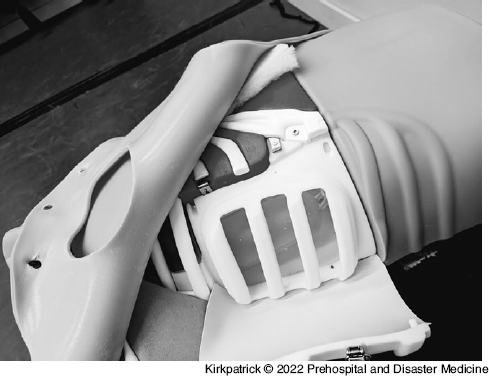
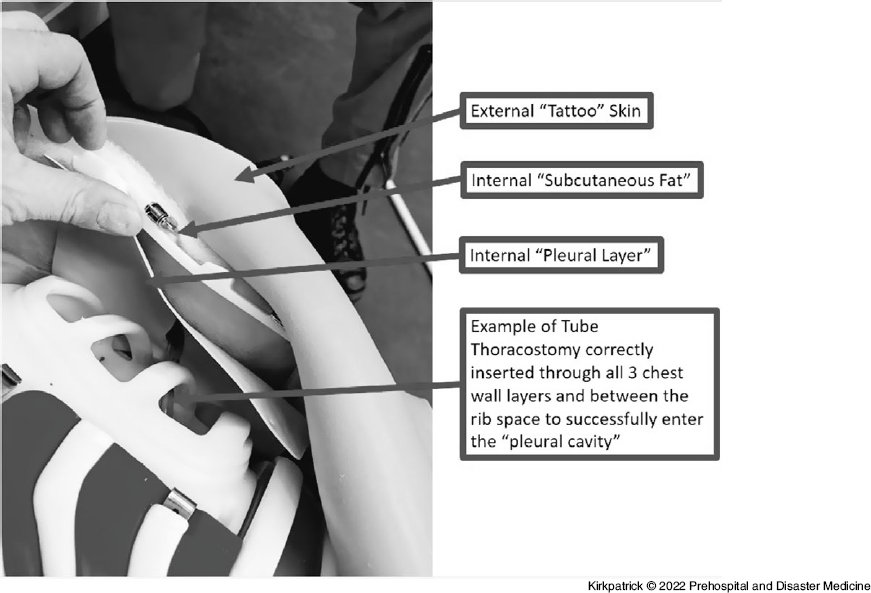
The commercial TT simulator utilized for the project typically has simulated latex skin that must be incised or punctured to allow access to the pleural cavity which contains a lung within and ribs between which the tube must be placed (Figure 1). To increase the fidelity of the study, the model was enhanced with three additional chest wall layers. One layer corresponded to a “skin” consisting of a thicker commercial tattoo skin, a “subcutaneous fat” layer consisting of cotton baton, and a “pleural” layer consisting of a thinner layer of commercial latex tattoo skin (Figure 2). The required procedure had no time limit and required each SAR-Tech to incise the chest wall with a scalpel, puncture the “pleural lining” with a Kelly clamp, insert a standard 32 French TT within the pleural cavity, and thereafter secure the TT to the chest wall using an iTClamp (Innovative Trauma Care; San Antonio, Texas USA),Reference Bellini and Akullian22,Reference McKee, McKee and Bouclin23 as previously described in prior studies of trans-Atlantic telementored TT insertion.Reference McKee, McKee and Bouclin23,Reference Kirkpatrick, McKee and Netzer24 Times were recorded for all phases of the procedure with the total-time-of-procedure being the time for starting the beginning of the scenario to the secure placement of the tube within the pleural cavity. For the RTM group, this involved only the time from when the remote mentor introduced themselves and began mentoring until secure tube placement. For the VM group, this included the total time from watching the demonstrative video (time-to-watch) followed by the time to actually conduct the procedure. None of the participants had previous exposure to this simulator.
Typical Trauma Man Simulator with Single Latex Skin.

Enhanced Tube-Thoracostomy Simulator with Three-Layer Thoracic Wall Enhancement.

The SAR-Techs were members of the 442 Search-and-Rescue Squadron, from 19 Wing of the Canadian Forces based in Comox, British Columbia, Canada. This search-and-rescue organization must mitigate great geographic and environmental challenges each day in order to perform their jobs successfully. These SAR-Techs are required to deliver whatever POC resuscitation is required in critical environments; environments that are made even more austere by darkness, ambient noise, temperature extremes, wind, and potentially hostile forces. However, even with all the training for prehospital resuscitation in austere environments, they are not trained or experienced with the placement of TTs, which is considered an “out-of-scope” procedure.
In order to facilitate the SAR-Techs to perform the TT task, they (N = 24) were randomly allocated (using random number generation) to: (1) VM immediately prior to task; or (2) real-time RTM during the task guided remotely be an experienced critical care trauma surgeon (AWK). Objective outcomes for TT application were safety of procedural performance, effectiveness of tube placement, and security of the tube once placed and secured using a standard methodology previously described and validated.Reference McKee, McKee and Bouclin23 Briefly, these objective measures of binary success included whether the medic attempted any unsafe or dangerous maneuvers with sharp instruments, whether they placed the TT physically within the pleural cavity or not upon post-test inspection, and whether pulling with enough force to actually lift the simulator off the ground dislodged the TT from the simulator as previously described.Reference McKee, McKee and Bouclin23,Reference Kirkpatrick, McKee and Netzer24
Real-Time Telementoring Informatics and Logistics
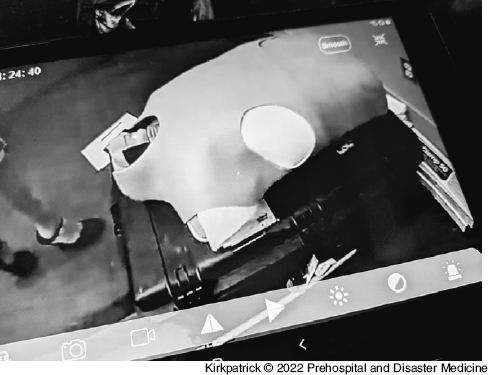
The RTM Medics wore a standard Canadian Forces SAR-Tech helmet augmented with a commercial off-the-shelf WIFI-enabled wireless surveillance camera (ZZCP; mini-wireless spy camera). When connected to the internet, the camera’s WIFI mode supported real-time online viewing via mobile phone APP (JHCamera, Version 2.2.8; Joyhonest; Shenzhen, China). The mentor accessed the camera app, in order get the SAR-Tech’s point-of-view image, from an LG-V533 Tablet Computer (LG Corporation; Englewood Cliffs, New Jersey USA) connected to the internet using Cellular data on the Rogers’ network (Toronto, Ontario, Canada; Figure 3). While the camera app supports audio communication, previous experience has encouraged redundant audio. In order to achieve this, the mentor and the mentee simply had a direct cell phone call for audio.
Image of the Simulator upon which the Task was to be Performed upon as Viewed by the Remote Mentor’s Computer Screen.

Video-Modelling Informatics and Logistics
The SAR-Techs who were randomized to VM watched a concise, focused video explaining the critical principles involved in TT placement and demonstrating how to perform the procedure immediately prior to performing it on the simulator (Supplementary File 2; available online only). They were not able to ask questions as would be consistent with communications failure in a disaster.
Results
Demographics
Twenty-four (24) SAR-Techs (23 men, one woman), median age 37 years (IQR 12) and median 16.5 years (IQR 11) of military experience, participated. There was no difference in age, gender, or years of experience between the groups.
Procedural Results
Thirteen (13) SAR-Techs were randomized to VM and eleven (11) to RTM. With the VM paradigm, 12/13 (92%) were successful, 12/13 (92%) safe, and 12/13 (92%) secure in their TT placement, although one procedure was terminated due to concerns over the abilities of the SAR-Tech and their risk of self-injury. In those randomized to RTM, 11/11 (100%) were successful, 11/11 (100%) safe, and 11/11 (100%) secure in mentored TT placement. Statistically, there was no difference (P = 1.000) between mentored (11) or video-modelled (13) SAR-Techs in terms of safety, success, or tube security when performing the TT. However, with VM, one subject cut himself with the scalpel, one did not puncture the pleura, and one, while deemed safe, technically successful, and secure, had a barely adequate tube placement. There were no such issues in the mentored group, although two operators in the RTM received real-time corrective guidance that was perceived to have avoided an unsuccessful TT. While not statistically significant, RTM was associated with no errors in TT placement and facilitated guidance and correction by the mentor that was presumed to lead to failure if not taken.
Procedural Times
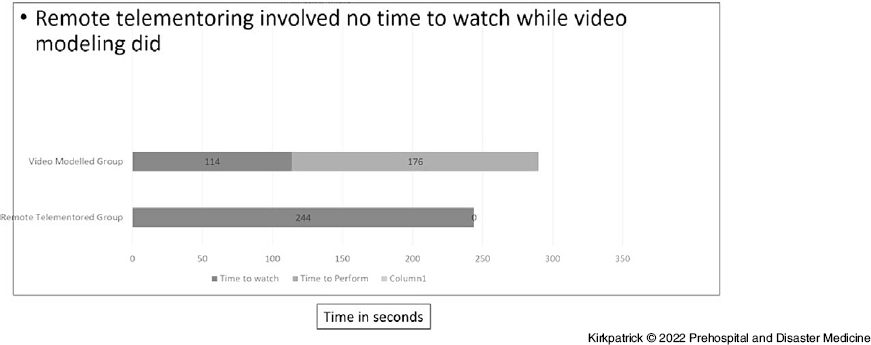
The total trial time was significantly faster using RTM when the time-to-watch the video was included (VM mean time 290 seconds; SD = 38 seconds versus RTM mean time 244 seconds; SD = 50 seconds; P = .02) with mentoring, even despite three (27.2%) of the sessions experiencing video disruptions (albeit with intact audio). However, if the time-to-watch the video was discounted, VM was quicker (VM mean time 114 seconds; SD = 38 seconds versus RTM mean time 244 seconds; SD = 50 seconds; P = .000; Figure 4).
Time Lines for Randomized Groups.
Note: Total times (in seconds) for both paradigms to place chest tube within the pleural cavity. However, if the time-to-watch the video is discounted, then the VM paradigm is much shorter than the RTM paradigm.

Discussion
In this pilot evaluation, there was no obvious differential comparing either RTM or pre-procedural VM as potential disruptive techniques to enable non-physician but motivated prehospital providers to perform simulated TT. From a performance perspective, both techniques allowed inexperienced providers to perform “out-of-scope” and to perform beyond their normal expectations to complete the task with either a 92% or 100% effectiveness. The highest-level conclusion was that both techniques have great merit and may facilitate bringing invasive RLSIs far-forward and might impact the continuously current dismal outcomes for serious trauma in society, where most death occurs before patients can be transported to definitive hospital care. Video modelling may, however, have particular attractiveness for Operational Medicine, including Disaster Medicine, Space Medicine, and Expedition Medicine, as will be elaborated.
While there is no formal single definition of “disaster” that is universally accepted, common themes emphasize the impact of extreme events on humanity and the ability to overwhelm existing resources.Reference Willson, FitzGerald and Lim25 Besides the environmental challenges occurring, the threshold to overwhelm any health care or logistical resource will also be dictated by the pre-existing resources and their redundancy. As Operational Medicine is defined by the scarcity of such pre-existing resources, any life-saving techniques intended for use by first responders in challenging environments such as SAR-Techs will need to take into consideration the practical, logistical challenges involved in delivery of the RLSI.
Tube-thoracostomy was selected as an example of a necessary RLSI required in extreme environments.Reference Kleber, Giesecke, Tsokos, Haas and Buschmann13,Reference Cullinane, Morris, Bass and Rutherford15,Reference Dulchavsky, Schwarz and Kirkpatrick26 A recent consensus on the design criteria, constraints, and behaviors for flight crew to effectively handle medical events of space missions, even ranked PTX in the red area of threat versus potential for countermeasures development.Reference Robertson, Dias and Gupta27 Technically, NT is a potential tool to treat TPTXs, but has many limitations of NT with greater risks of kinking, occlusion due to clots, or technical inadequacy of drainage,Reference Fitzgerald, Mackenzie, Marasco, Hoyle and Kossmann9,Reference Martin, Satterly, Inaba and Blair12 such that actual success rates vary from 5%-95%.Reference Fitzgerald, Mackenzie, Marasco, Hoyle and Kossmann9,Reference Cullinane, Morris, Bass and Rutherford15 Therefore, TT may be the initial preferred management of TPXT,Reference Fitzgerald, Mackenzie, Marasco, Hoyle and Kossmann9,Reference Kaserer, Stein, Simmen, Spahn and Neuhaus17 constituting one example of many possible necessary RLSIs that challenges extreme medical systems to provide. In this pilot study, both RTM and VM appeared to offer the potential for future development towards empowering POC providers to provide such a therapy.
Remote Telementored Approaches
The TeleMentored Ultrasound Supported Medical Interventions (TMUSMI) Research Consortium has long been of the opinion that an expert mentor, or potentially a multi-disciplinary panel of mentors,Reference Kirkpatrick, McKee and Netzer24,Reference Kirkpatrick, Blaivas and Sargsyan28 is a critical factor to facilitate “out-of-scope” prehospital interventions. The TMUSMI group and others have attempted to translate remote-telementored LSIs from a specific technology aimed at caring for a handful of astronauts onboard the International Space StationReference Sargsyan, Hamilton and Jones29–Reference Kirkpatrick32 to practical and user-friendly life-saving technology on Earth.Reference Kirkpatrick31,Reference Kirkpatrick32 Realistically “Mission Control” facilities where assembled clinical experts await communications from space are likely impractical for real-world terrestrial trauma care.Reference Kirkpatrick, Hamilton and Beckett20,Reference McBeth, Crawford and Tiruta33 Terrestrial clinicians will not accept any delay in real-world acute care medical interactions, and immediate responses on hand-held smartphones represent the general expectations of real-world practicing clinicians.Reference McBeth, Crawford and Tiruta33,Reference Wachs, Kirkpatrick and Tisherman34 Therefore, it is suggested that on-going studies continue to further investigate and practicalize RTM as a means of empowering heath care globally, with just such initiatives beginning.Reference Wachs, Kirkpatrick and Tisherman34
However, the human factors element of RTM is the least standardized and understood factor in the opinion of the TMUSMI group. Previous studies involving both successes and failures have reinforced the preposition that the general emotional intelligenceReference McKee, McKee and Bouclin23,35 is a critical factor that enables unknown strangers to contribute to guiding stressed POC providers in performing tasks that are critical but outside of their previous training and comfort zones.Reference Kirkpatrick, Tien and LaPorta18,Reference Kirkpatrick, McKee and Netzer21,Reference Al-Kadi, Dyer and Ball36 It has been frequently documented that in many instances, remote mentors successfully calmed the prehospital providers.Reference Kirkpatrick, Tien and LaPorta18,Reference Willson, FitzGerald and Lim25,Reference Kirkpatrick, Blaivas and Sargsyan28,Reference Sargsyan, Hamilton and Jones29,Reference Netzer, Kirkpatrick and Nissan37 However, there were also situations wherein remote mentors who were technical experts in their field, but unaware of the prehospital environment or had awkward interpersonal conversation, disrupted prehospital interventions and were detrimental to the overall mission of facilitating prehospital remotely mentored LSIs. Therefore, formal structured studies into the human factors of how to best mentor, with what technological adjuncts, and how to train the trainers of mentoring all need to be further understood and may warrant consolidation as a distinct body of knowledge sub-specialty within medicine, that of remote-mentored medicine.Reference Kirkpatrick31
Video Modelled Approaches
Video modeling is an alternative potential approach that does not require a real-time human mentor and removes this variable and may potentially be independent from networked telecommunications. This is a technique originating from the field of medical education that has been largely focused on psychological care of autistic childrenReference Stocchetti, Pagliarini, Gennari, Baldi, Banchini and Campari7,Reference Bellini and Akullian22 or patients in general.35,Reference Krouse38 Video modeling as a technique that might provide just-in-time education and may increase confidence bears further evaluation in Operational Medicine emergency paradigms. Objectively, therefore, it seems surprising that so little scientific consideration has been devoted in Disaster, Space, Operational, and even in Acute Care Medicine/Surgery considering this potential utility.
Although much further research will be required to validate the techniques and to learn how to optimize logistics, it is proposed that VM for catastrophic emergencies in operational environments with advanced technological capabilities but without real-time communications could facilitate two broad potential approaches to VM, namely: (1) a pre-recorded library of demonstrated just-in-time emergency life-saving procedures that could be autonomously selected by decision support medical software for immediate use by the in-bound first-responder; and (2) customized VM demonstrations that are created “just-in-time” and uploaded for and urgent requirement as needed. The second class of video models could also be potentially customized or individualized for each patient using stored biometric data. Just-in-time VM is a technique that deserves much more evaluation, especially regarding its potential to enable badly needed medical/surgical care in extreme environments. A final factor to consider in discussing any support to prehospital providers such as SAR-Techs required to deliver RLSIs is the issue of the impact of disaster upon the mental health of medical responders. It is well-established that first responders are at risk, and mitigation strategies include encouraging teamwork, two-way communication, and easy approachability of superiors,Reference Naushad, Bierens and Nishan39 all extreme challenges in disaster response. It is hypothesized that, if possible, including a human mentor whenever possible may be psychologically reassuring,Reference Kirkpatrick, Tien and LaPorta18 although this is a topic that requires further study.
The investigators recommend that any means of potentially enhancing the ability to provide RLSIs in extreme environments should be pursued, and this pilot has suggested merit to both RTM and VM. However, for potentially improving RLSIs in extreme environments when telecommunications fail, VM should be considered.
Limitations
Limitations of the current work include the limited numbers of SAR-Techs who were able to participate as they are a small and unique trade. A further limitation was the fact the procedures were conducted on a standard training simulator and not live patients. Thus, caution against accepting or adopting the conclusions into current care paradigms is encouraged, but a strong advocate for further consideration and study is advised.
Conclusions
From a performance perspective, both techniques facilitating prehospital care providers to perform “out-of-scope” procedures allowed inexperienced providers to perform beyond their normal expectations to complete the task with either a 92% or 100% effectiveness. There was no statistical difference between success with either supportive paradigm, although both techniques have great merit and may facilitate bringing invasive RLSIs far-forward.
Acknowledgements
The authors wish to express gratitude to the SAR-Techs of the 19 Wing and 422 Squadron Search Air Rescue, Canadian Forces Base Comox, Comox, British Columbia for their enthusiastic donation of their time and efforts to support this research. This manuscript was presented virtually at the Trauma Association of Canada 2021 Virtual Conference April 12-16, 2021.
Conflicts of interest/funding
This work was partially supported by the Canadian Forces Medical Services, the Andrew W Kirkpatrick Professional Corporation, and the National Science Foundation NSF Grant #2140612 (J Wachs). JL McKee has consulted for Innovative Trauma Care, SAM Medical, Aceso, Acelity (3M/KCI), ZOLL Medical, and the Andrew W. Kirkpatrick Professional Corp. She has previously disclosed a personal relationship with AW Kirkpatrick.
AW Kirkpatrick has consulted for the Zoll, Acelity (3M/KCI), CSL Behring, Innovative Trauma Care, and SAM Medical Corporations, is the PI of a randomized trial partially supported by the Acelity Corporation, and has previously disclosed a personal relationship with JL McKee. JP Wachs discloses that material is partially based upon work supported by the National Science Foundation under Grant NSF #2140612. Any opinions, findings, and conclusions or recommendations expressed in this material are those of the author(s) and do not necessarily reflect the views of the NSF. Major AW Kirkpatrick, Major C Tomlinson, and MCpl N Donley disclose that the opinions expressed in this manuscript represent their own views and do not represent any official policies of the Department of National Defence or any other agencies of the Government of Canada. No other author reported any disclosures.
Supplementary Materials
To view supplementary material for this article, please visit https://doi.org/10.1017/S1049023X22000097