Candida auris is a globally emerging fungal pathogen that has caused outbreaks in healthcare settings, including in long-term care facilities (LTCFs) and long-term acute-care hospitals (LTACHs). 1 Contaminated surfaces and equipment have been implicated as a source of transmission. 1-Reference Eyre, Sheppard and Madder5 To reduce the risk for transmission from surfaces and fomites, the Centers for Disease Control and Prevention (CDC) recommends thorough cleaning and disinfection of surfaces and shared equipment using disinfectants effective against C. auris. 1 In LTCFs and LTACHs, implementation of cleaning and disinfection protocols may be challenging due to factors such as limited resources, long length-of-stay, presence of personal items in rooms, and multiple occupancy rooms.
Ultraviolet-C (UV-C) light room-decontamination devices are increasingly used as an adjunct to manual cleaning and disinfection in hospitals, but they are not commonly used in LTCFs, in part due to the high cost of many devices (ie, ∼$40,000 to >$100,000 purchase cost for a room decontamination device). Reference Donskey6 UV-C light is effective against C. auris, although increased exposure times may be required in comparison to vegetative bacteria such as methicillin-resistant Staphylococcus aureus (MRSA). Reference Cadnum, Shaikh and Piedrahita7 In addition, some studies suggest that C. auris strains may have variable susceptibility to UV-C light. Reference de Groot, Chowdhary, Meis and Voss8,Reference Chatterjee, Choi and Ochoa9 Recently, lower-cost UV-C technologies have become available, including room decontamination devices and smaller devices intended for decontamination of portable items or smaller spaces such as bathrooms. Less costly UV-C devices might be useful to address C. auris and other pathogens in resource-limited settings, but limited information is available on the efficacy of these devices. Therefore, we tested the effectiveness of several relatively low-cost UV-C technologies against multiple strains of C. auris. For comparison, we assessed efficacy of the devices against MRSA and bacteriophage Phi6, an enveloped RNA virus used as a surrogate for coronaviruses. Reference Cadnum, Li, Jones, Redmond, Pearlmutter, Wilson and Donskey10
Methods
Test organisms
The C. auris test strains included isolates from the 4 major phylogenetic clades, including Antibiotic Resistance Bank (AR)-0381 (clade II; East Asia origin), AR-0389 (clade I; South Asia origin), AR-0383 (clade III; Africa origin), and AR-0385 (clade IV; South America origin). The MRSA test strain was a clinical isolate of pulsed-field gel electrophoresis type USA800. Bacteriophage Phi 6 (Félix d’Hérelle Reference Center for bacterial viruses of the Université Laval HER 102) was propagated in Pseudomonas syringae. Reference Cadnum, Li, Jones, Redmond, Pearlmutter, Wilson and Donskey10,Reference Casanova and Weaver11
UV-C test devices
We defined relatively low-cost UV-C technologies as devices with a list price <$15,000 per device. We studied 3 low-cost hospital room decontamination devices. A UVDI-360 Room Sanitizer (UltraViolet Devices, Santa Clarita, CA) was also included as a standard room decontamination device for comparison with the lower cost devices. Reference Cadnum, Tomas and Sankar12,Reference Cadnum, Jencson and Gestrich13 The Helix 450XL Mobile Room Sanitizer (MRSA-UV, West Palm Beach, FL) has 2 adjustable arms with 2 bulbs in each arm. The Obelisk UV Portable Total Room Sanitizer (MRSA-UV) is a compact device with eight 56-cm bulbs that can be carried from room to room. Placement on a mobile wheeled stand is recommended if elevated heights are required for room decontamination. For both the Helix 450XL and the Obelisk devices, the manufacturers recommend operating 2 devices simultaneously for room decontamination with 1 device on each side of the bed. For the UVDI-360 device, two 5-minute cycles are recommended with 1 cycle on each side of the bed.
The GermAwayUV Mobile UVC Surface Sanitizer (CureUV, Delray Beach, FL) is a smaller tower device intended for use in small rooms such as bathrooms. We tested 3 enclosed box UV-C devices, including the KR615 Germicidal Enclosure (Advanced Ultra-Violet Systems, South Hill, VA), the Cubby+ UV Box (Vioguard, Bothell, WA), and the Sky 6Xi device. The Sky 6Xi device (Diversey, Fort Mill, SC) is an enclosed box intended for decontamination of tablets and cell phones. Reference Mathew, Cadnum, Sankar, Jencson, Kundrapu and Donskey14 The UV Angel Adapt Series (UV Angel, Wyoming, MI) is an unenclosed, low-power UV device that sits just above keyboards or other devices and provides automated 6-minute UV cycles after each use. Reference Donskey6
The purchase costs were provided by the manufacturers for loaned devices or were based on the charges for purchased devices. The power consumption in Watts was calculated based on the manufacturer’s information provided regarding voltage and ampere delivery of the devices. UV-C irradiance measurements were obtained using a Lutron UVC-254SD UV-C ultraviolet light meter (Lutron Electronics, Coopersburg, PA). For the room decontamination devices, irradiance measurements were collected ∼1 m (3 feet) from the bulbs. For the UV-C box devices, readings were collected in a central location within the box.
Colorimetric indicators for visual assessment of UV-C dose delivery
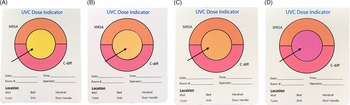
UV-C colorimetric indicator readings were obtained using UVC 100 Dosimeter Cards (Intellego Technologies AB, Gothenburg, Sweden). The colorimetric indicator cards have a central circular indicator that is yellow in the absence of UV-C exposure. For reference, an outer circle shows orange and pink colors that indicate UV-C doses of ∼50 and ∼100 mJ/cm2, respectively. According to the manufacturer, a change of the central circular indicator to orange and pink indicates a UV-C dose adequate to kill MRSA and C. difficile spores, respectively. Figure 1 shows representative colorimetric results for the following indicators: unexposed, exposed with some color change but inadequate to kill MRSA, exposed with an orange color indicating an MRSA dose, and exposed with a pink color indicating a C. difficile dose. The colorimetric indicators were placed at ∼1 m (3 feet) and ∼2 m (6 feet) from the room decontamination devices in parallel with the bulbs. For the box devices, the indicators were placed in a central location within the box. For the UV Angel device, the indicators were placed ∼15 cm (6 inches) from the bulbs.
Representative colorimetric indicator results for indicators that were (A) unexposed (yellow indicator), (B) exposed with some indicator color change but without an adequate ultraviolet-C (UV-C) dose to kill MRSA, (C) exposed with an orange color indicating a dose adequate to kill MRSA and other vegetative bacteria, and (D) exposed with a pink color indicating a dose adequate to kill Clostridioides difficile spores. Arrows point to the central circles that indicate the level of UV-C exposure.

Efficacy of the UV-C devices against C. auris, MRSA, and bacteriophage Phi6
Testing was performed using a modification of the American Society for Testing and Materials (ASTM) standard quantitative disk carrier test method (ASTM E 2197). 15 The inocula were spread to cover 20-mm steel disk carriers. An organic load comprised of 5% bovine serum albumin, 7% yeast extract, and 20% mucin was used. 15 For the room decontamination devices, we tested UV-C cycles of 10 minutes at ∼1 m (3 feet) from the device with the carriers oriented in parallel with the bulbs. For other devices, we used the manufacturer’s recommended cycle times. Disks were processed as previously described. Reference Cadnum, Shaikh and Piedrahita7 For C. auris, quantitative cultures were performed by plating specimens on Sabouraud dextrose agar (Becton Dickinson, Sparks, MD) and incubating at 37°C for 72 hours.
Log10 reductions were calculated by subtracting viable organisms recovered from treated versus untreated control carriers. Reference Cadnum, Shaikh and Piedrahita7 The tests were performed in triplicate. A 3-log10 or greater reduction in the test organisms in comparison to untreated controls was considered effective. Reference Rutala, Kanamori, Gergen, Sickbert-Bennett and Weber16
Because several devices that did not achieve a 3-log10 or greater reduction in all 4 C. auris isolates in initial testing, we tested whether longer cycle times would be effective. For the Helix 450XL Mobile Room Sanitizer, the Obelisk UV Portable Total Room Sanitizer, and the GermAway UV Mobile UV-C Surface Sterilizer devices, a 20-minute cycle was tested. For the enclosed box devices, 120-second cycles were tested. For the UV Angel device, we assessed the efficacy of five 6-minute cycles.
Results
Table 1 shows the characteristics of the UV-C devices including measured UV-C irradiance and colorimetric indicator results. Of the 3 reduced-cost room decontamination devices, only the Guardian UVC device had irradiance measurements equivalent to the UVDI-360 device. The colorimetric indicator results also demonstrated equivalent UV-C output by the Guardian and UVDI-360 devices, with both devices delivering doses adequate to kill C. difficile spores at ∼1 m (3 feet) and ∼2 m (6 feet) from the bulbs. In comparison to the UVDI-360 device, the Helix 450XL and Obelisk room decontamination devices had lower power consumption, lower irradiance readings, and reduced UV-C dose delivery based on colorimetric indicator results. The GermAwayUV device for small room decontamination also had lower power consumption, lower irradiance, and reduced UV-C dose delivery.
Characteristics of the Ultraviolet-C (UV-C) Devices Tested and UV-C Output Based on Irradiance Measurements and Colorimetric Indicators

Note. MRSA, methicillin-resistant Staphylococcus aureus; C. diff, Clostridioides difficile.
a Unless otherwise specified.
b UV output provided by manufacturer.
c For room decontamination the manufacturer recommends that 2 devices be used in tandem (1 on each side of the bed) with placement on a mobile stand when elevated heights are required.
The KR615 and Cubby+ enclosed UV-C box devices had irradiance readings measured close to the bulbs that were higher than readings of the room decontamination devices measured at ∼2 m (3 feet). All 3 enclosed box devices had adequate UV-C dose delivery to kill C. difficile spores based on colorimetric indicator results. The unenclosed UV Angel device had a low irradiance reading (0.11 mW/cm2) and a single cycle delivered adequate UV-C to kill MRSA but not C. difficile based on the colorimetric indicator results.
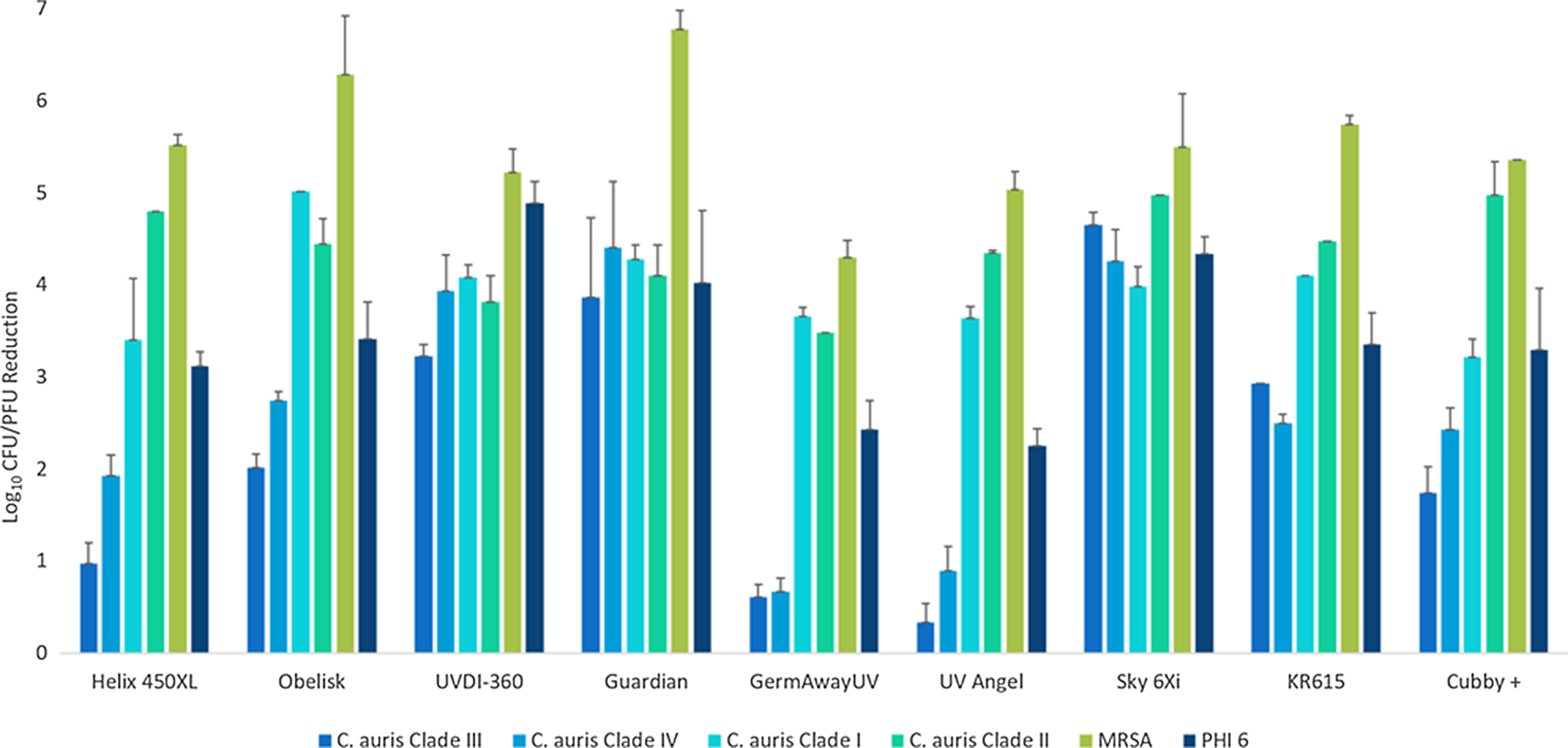
Figure 2 shows the log10 reductions in the C. auris strains, MRSA and Phi6 for each of the devices. All the devices reduced the MRSA strain by ≥3 log10 colony-forming units (CFU) and 7 of 9 devices reduced Phi6 by ≥3 log10 plaque-forming units (PFU). For C. auris, we detected considerable variability in reductions for isolates from the different clades. The clade I and II isolates were reduced by ≥3 log10 CFU by each of the devices. The clade III and IV isolates were only reduced by ≥3 log10 CFU by the UVDI-360 Room Sanitizer, the Guardian UVC Room Disinfection Device, and the SKY 6Xi device.
Efficacy of ultraviolet-C light decontamination devices in reducing Candida auris isolates, methicillin-resistant Staphylococcus aureus (MRSA), and bacteriophage Phi6 on steel disk carriers. The cycle times for each device are shown in Table 1. A 3-log10 or greater reduction in the test organisms was considered effective for decontamination. Note. CFU, colony-forming unit. PFU, plaque-forming unit.

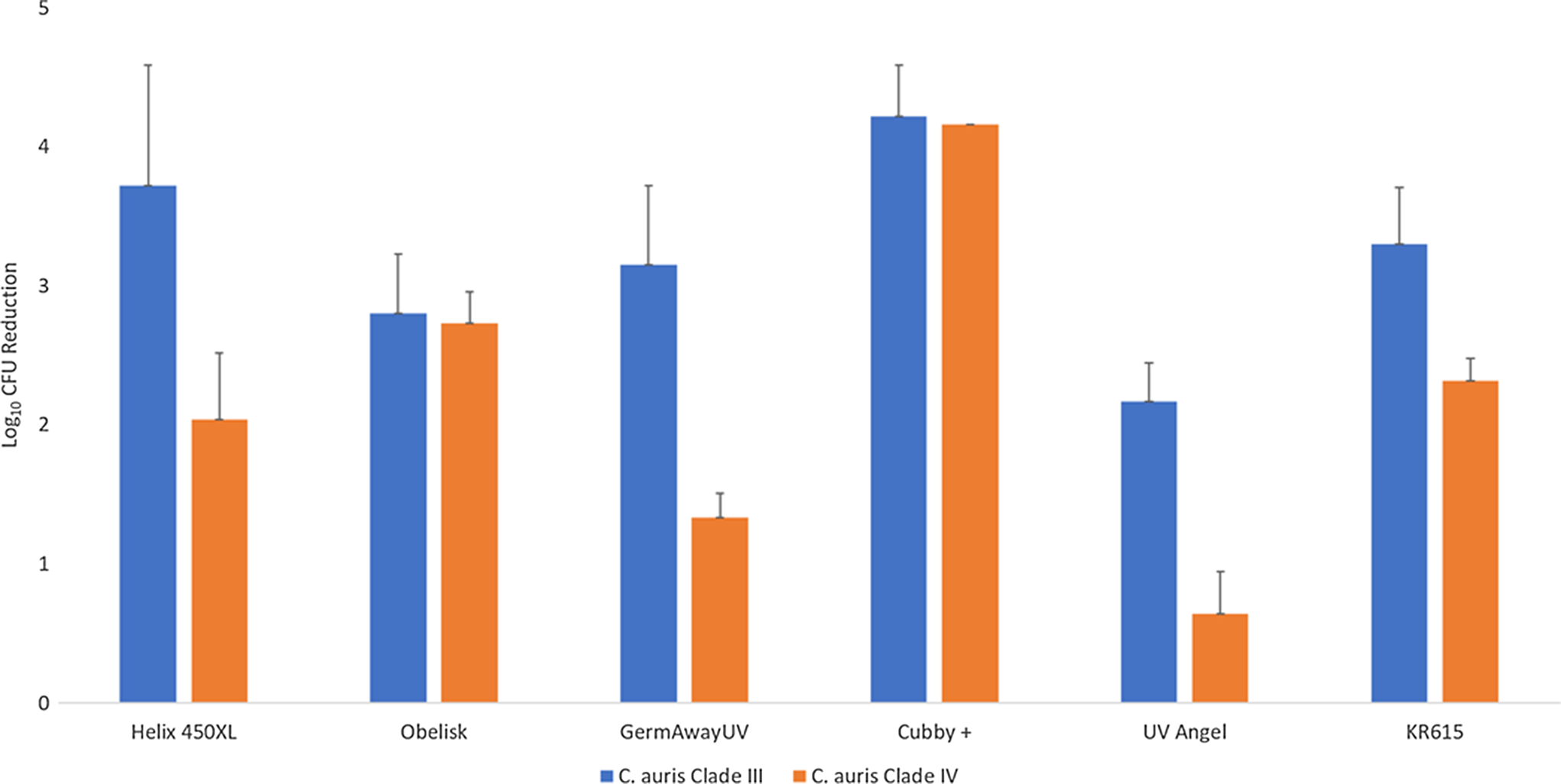
Figure 3 shows the log10 reductions in the C. auris clade III and IV strains with longer exposure times for those devices that did not meet criteria for decontamination in initial testing. For the Cubby+ UV box, increasing the cycle time to 120 seconds resulted in log10 reductions that met the criteria for effective decontamination (≥3 log10 reduction) for both strains.
Efficacy ultraviolet-C light decontamination devices in reducing Candida auris clade III and IV strains on steel disk carriers with longer exposure times for devices not meeting criteria for decontamination (≥3 log10 reduction) in initial testing. The cycle time for the Helix, Obelisk, and GermAwayUV devices was 20 minutes; the cycle time for the Cubby+ and AUVS boxes was 120 seconds; the cycle time for the UV Angel was 30 minutes (five 6-minute cycles). A 3-log10 or greater reduction in the test organisms was considered effective for decontamination. CFU, colony-forming unit.

Discussion
We found that several low-pressure mercury UV-C light technologies with a cost of <$15,000 were effective against C. auris isolates from clades I and II, MRSA, and bacteriophage Phi6. However, C. auris isolates from clades III and IV were substantially less susceptible to UV-C. Only the standard UV-C room decontamination device, 1 of the reduced-cost room decontamination devices, and 1 enclosed box device met the pre-established criteria for effective decontamination of these isolates. A second UV-C box achieved effective decontamination with an increased cycle time of 120 seconds. Our results suggest that some, but not all, relatively low-cost UV-C technologies could be useful as an adjunct measure to address C. auris in resource-limited settings.
The findings for the 3 low-cost UV-C room decontamination devices demonstrate that reduced-cost technologies may vary considerably in effectiveness. The Guardian UVC device was equivalent to the standard UVDI-360 device in measured irradiance, microorganism reduction, and colorimetric indicator readings. The Obelisk and Helix 450XL devices had substantially lower measured irradiance; colorimetric indicator readings suggested that neither device would be effective against C. difficile at ∼2 m (6 feet) from the device. Nevertheless, both the Obelisk and Helix 450XL devices were able to reduce the relatively UV-C susceptible organisms MRSA and bacteriophage Phi6 by >3 log10 at ∼1 m (3 feet). Notably, the power consumption of the devices correlated well with the measured irradiance; information on power consumption is routinely provided by manufacturers of UV-C devices.
Our finding of variability in the susceptibility of C. auris isolates to UV-C light is consistent with other recent studies. Reference de Groot, Chowdhary, Meis and Voss8,Reference Chatterjee, Choi and Ochoa9,Reference Lemons, McClelland, Martin, Lindsley and Green17 de Groot et al. Reference de Groot, Chowdhary, Meis and Voss8 demonstrated significant but relatively modest differences in UV-C reduction of C. auris strains from different countries (ie, strains from Japan/Korea [clade II] were more susceptible to UV-C than strains originating from Venezuela, Spain, and India). Lemons et al Reference Lemons, McClelland, Martin, Lindsley and Green17 also demonstrated variable UV-C susceptibility among C. auris isolates with the clade II isolate AR-0381 having the greatest susceptibility. Chatterjee et al Reference Cadnum, Shaikh and Piedrahita7 studied the efficacy of broad-spectrum UV light generated by a pulsed-xenon device and reported that C. auris isolates that formed aggregates (2 isolates from clade III and 1 from clade I) had reduced susceptibility. We also demonstrated formation of aggregates under light microscopy by the clades III and IV, but not I and II, isolates studied (data not shown). A clade IV isolate of C. auris (AR 0385) was also less susceptible to low concentrations of sodium hypochlorite than a clade II isolate (AR 0381). Reference Sexton, Welsh, Bentz, Forsberg, Jackson, Berkow and Litvintseva18
In addition to efficacy, safety is a concern for UV-C technologies. The low-cost room decontamination devices and the unenclosed low-intensity device for keyboards have sensors that automatically shut off the device if motion is detected. The enclosed devices prevent exposure to UV-C, and the cycle is automatically discontinued if the door is opened. Although room decontamination devices cannot be used while patients or personnel are in the room, if it is feasible for patients and personnel to be out of the room for a time, daily UV-C decontamination cycles can be provided. Reference Donskey6 Such daily decontamination cycles have been effective in reducing MRSA and Clostridioides difficile contamination on surfaces and personal use items in rooms of LTCF residents. Reference Donskey6
Our study has some limitations. We did not test all the relatively low-cost UV-C devices currently available. Only 1 isolate from each of the 4 predominant clades of C. auris was tested. Additional studies are needed with more C. auris strains. The UV Angel device provides a 6-minute cycle after each use of a keyboard and in practice many cycles could occur each day. Thus, our results for 1–6 cycles may underestimate the potential effectiveness of the device in reducing C. auris in clinical settings. Reference Mathew, Cadnum, Sankar, Jencson, Kundrapu and Donskey14 Finally, we only completed laboratory assessments of the study devices.
In conclusion, a standard UV-C room decontamination device, 1 reduced-cost room decontamination device, and 2 enclosed box devices were effective decontamination of all 4 C. auris strains tested. Several other UV-C devices were not effective against all 4 C. auris strains and we do not recommend their use in settings with C. auris outbreaks. Future studies are needed to evaluate the use of the effective devices in hospitals and LTCFs, including assessments of durability, ease-of-use, and effectiveness for decontamination of soft surfaces and personal items.
Acknowledgments
We thank Camillus, UltraViolet Devices, Advanced Ultra-Violet Systems, Diversey, Vioguard, and UV Angel for loaning devices for use in the study.
Financial support
The authors acknowledge funding from the Centers for Disease Control and Prevention’s investments to combat antibiotic resistance (grant no. 2019-37809 to C.J.D).
Conflicts of interest
C.J.D. has received research funding from Clorox, PDI, and Pfizer. The other authors report no conflicts of interest relevant to this article.