INTRODUCTION
In the period leading up to the 2012 election, the issue of vote dilution and voter suppression garnered a substantial amount of media attention. Pundits and liberal activists worried that a range of new state voting laws— restricting the hours, days, and places for voting; limiting voter registration; removing eligible voters from the lists of registered voters; and requiring photo identification—had the potential to disenfranchise large numbers of African Americans, Latinos, young people, the poor, and the elderly. According to the Brennan Center for Justice at New York University School of Law, these laws may adversely impact five million people who would otherwise be eligible to vote. The requirement that registered voters present government-issued photo identification prior to voting is perhaps the most pernicious of these changes, given that upward of one in ten voters lack this form of identification.Footnote 1
Somewhat surprisingly, virtually no attention has been paid to vote dilution and suppression of Native Americans and Alaska Natives, the last group of persons born in the United States to gain citizenship and the franchise.Footnote 2 Yet from the late 1970s onward, the Native vote has become an important factor in a number of electoral contests where the margin between victory and defeat has been razor thin. In a number of western states, a large and unified Native voting bloc is crucial to electing Democrats. According to McCool, Olson, and Robinson, the Native vote first gained national attention in 2000, when Indians mobilized to defeat Senator Slade Gorton (R-WA), who was “widely perceived as anti-Indian,” and helped provide Al Gore enough votes to carry New Mexico in the presidential race.Footnote 3 In the 2002 South Dakota Senate race, Democratic Senator Tim Johnson credited the Native vote with providing him with the 524-vote margin to be re-elected. In 2006 in Montana, another Democrat, Jon Tester, attributed his narrow Senate victory to the support he got from Native voters, and, in the even closer 2008 Minnesota Senate race, Democrat Al Franken's 225-vote margin was attributed to his “ace-in-the-hole”—the Native American vote.Footnote 4 Senator Lisa Murkowski (R-AK) credits much of her successful write-in campaign in 2010 to support garnered from Alaska Native Villages.Footnote 5 In the 2012 presidential race, Native voters across the country turned out and voted for Barack Obama. Shannon County in South Dakota, which encompasses the Pine Ridge Reservation, was the most pro-Obama county in the country, giving him 93 percent of the votes.Footnote 6
Although Indians tend to vote for Democrats, some tribes historically had supported Republicans. Some tribes in South Dakota and Arizona that had supported Republicans switched in the 1950s when Republicans, under the leadership of Utah Senator Arthur Watkins, chair of the Senate Interior Subcommittee on Indian Affairs, pursued a policy of terminating tribal relations.Footnote 7
In the lead-up to the 2012 election, the National Congress of American Indians (NCAI), which represents the more than 560 tribal nations across the country, identified eighteen states where “Native Vote is focusing on voter protection, engagement and education.” Eleven of these states had voter ID laws that were of concern and, of these, six states (Alaska, Florida, Michigan, Minnesota, South Dakota, and Wisconsin) were “states where voter ID laws may have a heightened impact on Native voter disenfranchisement.”Footnote 8
There is a large body of research on voting rights, most of which explores different questions related to enforcement and interpretations of the 1965 Voting Rights Act. Although the Fifteenth Amendment to the Constitution states that the “right of citizens of the United States to vote shall not be denied or abridged by the United States or any state on account of race, color, or previous condition of servitude,” that was a hollow promise for many Americans before the passage of the 1965 Voting Rights Act. Not surprisingly, early research focused on voting rights in the South, and a growing literature focuses on Latino voting rights, but there is very little scholarship on Indian voting rights.Footnote 9 Most scholars distinguish between “first-generation” voting rights protections—those that ensure access to the ballot box—and “second-generation” voting rights issues that involve claims of vote dilution by manipulation of the electoral process to undermine the ability of racial minorities to meaningfully affect political outcomes. There is a broad consensus among scholars that first-generation problems have largely disappeared.Footnote 10 But as we will show, this is not true with respect to Native Americans and Alaska Natives, who make up a very small proportion of the nation's population and live in rural communities, located far away from the centers of political and economic power—and as a result have to a large extent been ignored by academics studying voting rights issues. Moreover, we argue that the underlying causes of this can be explained by references to particular aspects of American political development that affect the civic status of Native populations in the United States.
American Political Development and the Civic Status of Native Americans
Although the scope of American political development scholarship has expanded dramatically over the past three decades, the unique political and civic status of the indigenous inhabitants of North America has garnered relatively little attention. In this paper, we draw upon two theoretical frameworks within the American political development subfield for understanding the historical roots of vote dilution and suppression efforts directed at Native Americans, but also argue that the existence of tribal nations means their civic status is quite distinct from that of any other population. The first analytical framework is a geographical/spatial one based on differences between the core and the geographical periphery. For much of the nation's history, the political and economic incorporation of the western periphery has been a major challenge. Although Orren and Skowronek in their seminal work on American political development describe territorial expansion thusly: “Outward-reaching ambitions were vented by the most elemental instruments of state power, the War Department and the State Department; the authority of others was dislodged by armed force, diplomatic negotiation, or often, some combination of the two,” they did not plumb the long-term implications of this expansion.Footnote 11
The westward movement not only involved the incorporation of a territory encompassing nearly ten times as much space as was included in the original thirteen states, it also involved subordinating the indigenous peoples occupying those lands. Government policies vis-à-vis the Native populations can be viewed as part of a series of core/periphery conflicts, nearly all of which have involved the dispossession of Indian land.Footnote 12 Through a combination of military and diplomatic means, the federal government vigorously laid claim to western lands. The dispossession of Native peoples from lands their ancestors had lived on since time immemorial was justified through the “discovery principle,” which held that the indigenous inhabitants occupied the lands, but did not own it. Instead, the major European powers, and later the American government, “discovered” lands—and such discovery gave title to the government whose citizens first claimed the land and was used to resolve conflicts between different countries.Footnote 13 After the claims of rival colonial powers were resolved, the land conflicts were tripartite in nature, involving federal government entities, white settlers, and Native populations.
During the nineteenth century, national-level elites were split between those who argued on legal, moral, and tutelary grounds that treaty-protected lands needed to be protected from European encroachment and those who advocated Indian removal or even annihilation for economic and security reasons. The latter group at various times included Southern slaveholders, who believed that the presence of nearby Indians lands outside of state control undermined their ability to control their slave populations and recover fugitive slaves, and northern economic elites, including those associated with railroads and extractive industries.Footnote 14 When the federal government succeeded in removing Indians from lands, they gained support from the settler populations, but when they acted to halt settler intrusions into treaty-protected Indian lands, they set into place a core–periphery conflict between the two white populations, which already had reasons to distrust one another.Footnote 15 Given the number of broken treaties, Native peoples had little reason to trust the integrity of elites in Washington, but they had an even more acrimonious history with the land-hungry settler populations.Footnote 16 As will be seen in subsequent sections, core–periphery conflicts among the three parties continue to the present day.
Yet one cannot discuss relations among the different parties without considering the work of King and Smith, who argue that American political development must take into account the ongoing conflicts between two competing “racial institutional orders”: a “white supremacist” order and an “egalitarian transformative” order.Footnote 17 With respect to the indigenous peoples of North America, this tension has been present since the earliest periods in American history, albeit oftentimes with sharp differences between attitudes among white elites in the core and those held by settler communities in the periphery.Footnote 18 Although some elites in the core espoused policies of exclusion and possible extermination, many others endorsed the view that, once “civilized,” indigenous peoples could become members of the body politic, albeit possibly in a permanently subordinate position. Proponents of the latter position believed they had a “tutelary” duty to help Indians become “civilized,” defined as learning English, taking on white ways, and rejecting the tribal identities.Footnote 19 From the earliest period onward, the impact of Enlightenment thinking about the intrinsic worth of all human beings had to compete with the idea that indigenous peoples were incapable of civilization and must be excluded from the body politic. Settlers on the periphery strongly espoused the view that Indians were “savages,” incapable of civilization, and held that they had no actual right to their ancestral lands because they did not use it for agricultural purposes.Footnote 20
These two American political development frameworks only explain part of the story with respect to the citizenship status of Native Americans. The final factor is that many Native peoples hold tribal citizenship as well as state and federal citizenship status. As Wilkins and Stark note, “indigenous peoples are nations, not minorities.”Footnote 21 It is this unique characteristic that most differentiates the civic status of Indians from any other group within the United States.Footnote 22 Although King and Rogers's framing of struggles between the “white supremacist” and “transformative egalitarian” institutional orders have occurred in many venues, legal disputes over Native American citizenship statuses have been exceptionally important—and generally have involved disputes not only between whites and Natives, but often also have involved core–periphery issues that have divided whites.
Although conflicts over the social construction of Indians have social, cultural, and economic dimensions, the focus in this study is on disputes over civic status. Reference to ongoing struggles in those other domains will only be referenced in light of their effects on the primary question of Native Americans' citizenship status. We discuss the evolution of core–periphery tensions, “racial institutional orders,” and tribal identities over time. Since the principle of government resting upon the consent of the governed is a fundamental aspect of the Revolutionary War's “transformative egalitarian” impulse, we begin by exploring how and why Native peoples were excluded from the body politic at the time of the founding and then move forward, paying attention to the ways that restrictive and inclusive patterns overlap and evolve across different eras.
We start with a discussion of the relevant constitutional provisions concerning Native Americans and citizenship and then turn to the ongoing conflict over whether Indians must give up tribal nationhood to gain U.S. citizenship, and whether even that would be sufficient. In the next section, we show how many western states and localities adopted strategies akin to those used by southern racists to disenfranchise Native Americans, as well as developing some unique techniques to divorce national citizenship status from suffrage rights and from the right to participate in state and local governance. We then show how the passage of the 1965 Voting Rights Act and its amendments exacerbated core–periphery conflicts among whites, while providing indigenous peoples with a powerful legal mechanism for guarding against ongoing efforts by state and local governments to dilute and suppress Native voting. The final section of the article explores the most recent series of state and local government enactments that threaten the ability of Native peoples to fully participate in the political system on an equal footing with other citizens. We develop an argument rooted in race and core–periphery divisions to explain why those elites who generally support “transformative egalitarian orders” have not mobilized to support Indian voting rights. Of particular concern is the impact of Shelby County v. Holder (2013), which has severely weakened the most important provisions of the Voting Rights Act.Footnote 23
THE STRUGGLE FOR CITIZENSHIP
Constitutional Provisions with Respect to Citizenship
James Madison in Federalist Papers 42 criticizes the Articles of Confederation for being “obscure and contradictory” with respect to dealings with tribes and then goes on to write, “What description of Indians are to be deemed members of a State is not settled, and been a question of frequent perplexity and contention in federal councils.”Footnote 24 In this quote, Madison suggests that Native Americans might become part of the body politic. The Constitution did not include any provisions suggesting this, but the government, during the Revolutionary War, entered into a defense treaty with the Delaware that promised them their own state at the end of the war.Footnote 25 On the other hand, Alexander Hamilton, perhaps in reaction to most tribes choosing to support the British during the war, writes in Federalist Papers 24 that Indian nations are “savage tribes” and “natural enemies” of the United States.Footnote 26
There are only two constitutional provisions dealing with Native peoples. When it comes to representation in the House and direct taxes, Article I, Section 2, directs that states be apportioned according to “their respective Numbers, which shall be determined by adding to the whole Number of free Persons, including those bound to Service for a Terms of Years, and excluding Indians not taxed, three fifths of other Persons.” Article I, Section 8 also treats Native Americans as separate with respect to Congress's power to regulate commerce with “foreign Nations, and among the several States, and with the Indian Tribes.” While these constitutional provisions make it clear that the Founders did not consider most indigenous peoples to be under their political jurisdiction, the question raised by Madison about under what circumstances they could become part of the polity is left unaddressed.Footnote 27
Marshall Court Decisions
In the 1820s and 1830s, the Supreme Court addressed the relationship between the tribes and U.S. governmental entities, but left many issues unresolved. Chief Justice Marshall, writing for the court in Johnson v. McIntosh (1823), described Natives as “a people over whom the superior genius of Europe might claim an ascendency,” and then went on to describe Indians as “merely occupants of the land” who did not actually hold “absolute title.”Footnote 28 Eight years later, in Cherokee Nation v. Georgia (1831), Marshall described tribes as “dependent nations” whose relations to the United States resemble that of a “ward to his guardian.”Footnote 29 The following year, Marshall, however, reversed course in Worcester v. Georgia (1832), holding that the United States considers “Indian nations as distinct political communities, having territorial boundaries, within which their authority is exclusive, and having a right to all the lands within those boundaries, which is not only acknowledged, but guaranteed by the United States.”Footnote 30 The court also held that “all intercourse” with Indian nations be carried out by the federal government, and that state laws would have no force in Indian Country unless specifically authorized by Congress.Footnote 31
While clearly endorsing the “white supremacist” institutional order, the Marshall Court decisions, in total, left ambiguous whether Native peoples had some civic status within the United States. The language in Cherokee Nation v. Georgia (1831) seemed to imply a “tutelary” relationship, while Worcester v. Georgia (1832) seemed to view tribes as distinct and separate governing entities. Even forty years later, the ambiguity remained in place, as can be seen by Indian Commissioner Edward Smith's congressional testimony, where he expressed dismay and confusion over the meaning of tribal nations' “double condition of sovereignty and wardship.”Footnote 32
Early Paths to Citizenship
From very early on, some elites in the capitol adopted policies that provided paths to U.S. citizenship for individual Indians, but only if they became “civilized.” In 1789, President Washington, with congressional approval, initiated the “civilization program” under the jurisdiction of Secretary of War Henry Knox, who believed that Indians would be completed integrated into American society within fifty years. However, the program immediately ran into conflict with land-hungry whites living in the affected regions. The goal of the program was the total integration of Native people east of the Mississippi by extinguishing title to tribal lands held in common and turning Indian families into self-sufficient farmers, each on their own individual plot of land.Footnote 33
One example of this policy was the 1817 treaty that included provisions allowing Cherokee heads of families to stay in the East, provided they severed tribal relations and began farming on individual 640-acre plots, while requiring unassimilated Cherokees to move west of the Mississippi River.Footnote 34 The western lands promised to Cherokee, as well as those promised to the Choctaw and Chickasaw in their treaties, already had many white settlers, thereby continuing the cycle of conflict between Indians and land-hungry settlers.Footnote 35 Gaining U.S. citizenship required the giving up of tribal membership, taking on the ways of white Americans, and learning English.Footnote 36 The experiment was a complete failure. Elites in the affected state governments, as well as whites on the frontier, actively sought to undermine the program and drive out any Indians who accepted individual plots of land. At the same time, opposition from leaders of the Cherokee Nation meant that those who joined the program faced social approbation from friends and family.Footnote 37
The possibility of U.S. citizenship was undermined in 1856, when Attorney General Caleb Cushing stated that Natives could not become citizens through naturalization.Footnote 38 Instead, he stated, “Those [naturalization] acts apply to foreigners, subjects of another allegiance. The Indians are not foreigners, and they are in our allegiance, without being citizens of the United States. Moreover, those acts only apply to ‘white’ men.”Footnote 39 Although a New Englander, Cushing's racist views and strong endorsement of territorial expansion dovetailed with the interests of settlers in the periphery.
Postbellum Developments
The question of Indian citizenship got renewed attention after the Civil War. The 1866 Civil Rights Act included the following language: “That all persons born in the United States and not subject to any foreign power, excluding Indians not taxed, are thereby declared to be citizens of the United States.” But even that was considered insufficient protection for African Americans, so much of the language of the 1866 act, but minus the phrase “excluding Indians not taxed,” was incorporated into the Fourteenth Amendment. Some senators sought to re-insert the phrase, but were placated after the bill's sponsors assured them that nothing in the amendment would apply to “Indian savages.”Footnote 40 The Senate Judiciary Committee reiterated that point in 1870, when they issued a report stating that Native Americans who continued their relationship with tribal nations were not U.S. citizens under the Fourteenth Amendment and did not have the right to vote.Footnote 41
Two events in 1868 highlight the different approaches toward relations with Native Americans. Colonel George Armstrong Custer's slaughter of Cheyenne women and children at the Washita River was an example of the genocidal approach to solving the Indian problem. Conversely, the treaty with Lakota Sioux was noteworthy in that it provided for the first time a possible means for tribal members to become citizens of the United States without abandoning their tribal identity.Footnote 42 But, only a few years later, in 1871, Congress radically undercut tribal sovereignty by prohibiting the President from making further treaties with tribal nations.Footnote 43
The U.S. citizenship status of Native peoples on and off reservations was undermined further by the Supreme Court in the 1887 Elk v. Wilkins case.Footnote 44 John Elk, a man whose tribal affiliation was unknown and who lived among whites, tried to vote, but the registrar in Omaha refused to give him a ballot. Elk sought judicial redress, but the Supreme Court ruled that Indians could not be citizens. Although born in the United States, their legal status was akin to children of foreign ambassadors born within the territorial boundaries of the United States.
The impact of Elk v. Wilkins, however, was mitigated somewhat by the 1887 Dawes Act (also known as the General Allotment Act), its 1901 amendments, and the 1906 Burke Act that allowed many Indians to petition for U.S. citizenship after accepting individual parcels of land in exchange for leaving reservations. The Dawes Act had garnered substantial support among white philanthropic-oriented elites who believed that “Indians' tribal structure, generally founded on common stewardship of land, was the major obstacle to their ‘progress’ toward civilization.”Footnote 45 Probably the biggest support among core region elites for these acts came from Progressives, who saw them as a means of inculcating western values about land ownership and farming practices.Footnote 46 Also, in many cases, Indian allotments and white-held lands were interspersed, resulting in checkerboard patterns of land ownership. The aim was for the white farmers to take on “tutelary” roles. The Dawes Act also gained enormous support from white settlers in the periphery because it made available for purchase a huge amount of what had been treaty-protected tribal lands.
Tribes that accepted provisions of the act had part of their reservations broken into individual plots (160 acres for heads of households, 80 acres for single adults, and 40 acres for those under 18 years of age), with the remainder sold off. Between 1890 and 1900, 53,168 Indian allottees gained citizenship, and another 101,506 did so in 1901, but the price was steep, turning over vast swaths of land to the government, which made the land available to non-Indian settlers.Footnote 47 For example, the Iowa Tribe had over 90 percent of its tribal lands declared as “surplus” and made available to whites at bargain prices. The Cherokee and Arapaho were required to sell off over three million acres, more than 80 percent of their tribal territories.Footnote 48
By the turn of the century, more than half of all Native Americans had gained U.S. citizenship, but in a manner that provided huge economic benefits to whites living in the periphery.Footnote 49 Moreover, the acquisition of citizenship did not necessarily imply that Indian citizenship was equivalent to that of non-Indian citizens. In 1901, a federal court held that Indian citizens were still “wards” of the federal government and subject to restrictions that did not apply to other citizens.Footnote 50
The Indian Citizenship Act
By the early 1920s, nearly two-thirds of Native peoples had become U.S. citizens through a series of piecemeal acts or through military service in World War I. In 1924, Congress unilaterally granted citizenship to all Indians and Alaska Natives, regardless of whether they continued tribal membership or relinquished it.Footnote 51 In short, no longer did tribal members have to give up an integral element of their identities in order to gain U.S. citizenship. Much of the congressional support for full citizenship came from Progressives within the two main political parties. While much of their support for citizenship rights came from a strong sense that Indians, through their service in World War I, had proved their civic fitness, Progressives also believed that such rights would provide Indians with the political wherewithal to attack what was viewed as widespread corruption within the Bureau of Indian Affairs.Footnote 52 As such, the descendants of North America's earliest inhabitants ostensibly gained citizenship rights on an equal basis with all those whose origins were much more recent. But fairly early on, core–periphery differences as to the meaning of citizenship became evident.
Although the Indian Citizenship Act did not include specific provisions delineating what rights were associated with citizenship, the minutes of the House Indian Affairs Committee clearly show that the intent of the legislation was the enfranchisement of Indians, who met the same qualifications as other citizens.Footnote 53 Federal government entities also issued statements indicating that the act conferred full voting rights.Footnote 54 Many whites, particularly those living in the affected states, did not share that sentiment. Indian Affairs Commissioner Charles Burke recognized this and wrote a letter to local Indian superintendents noting that “some States require electors to be taxpayers, etc., in order to vote in certain elections, such as those involving the creation of bonded indebtedness, etc., you should endeavor to advise your Indians so as to avoid embarrassment or disappointment.”Footnote 55
CITIZENSHIP DOES NOT NECESSARILY CONFER VOTING RIGHTS
Disenfranchisement by State Governments
Commissioner Burke recognized that federalism meant that implementation of the Indian Citizenship Act (ICA) was going to be left to state governments. Article I, Section 4, of the Constitution explicitly gives state governments the authority to regulate “The Times, Places and Manner of holding Elections for Senators and Representatives” and then is silent about all other elections, thereby leaving that authority completely under the purview of state and local governments. When the ICA was passed, at least seven states had constitutional provisions excluding some Indians from exercising the franchise.Footnote 56 While the ICA rendered racial prohibitions on Native voting invalid, the law did not automatically invalidate other means of limiting their ability to vote. For example, the constitutions of Idaho, New Mexico, and Washington withheld the right to vote from “Indians not taxed,” language that mimics the wording of the 1787 U.S. Constitution.
In the years immediately following the passage of the ICA, states with substantial Native populations passed a range of laws designed to disenfranchise Indians; none of these laws engendered action on the part of national elites to support Indian voting rights. These laws can be divided into the following five categories: literacy, taxation, residency, self-termination, and guardianship. While overlapping to some extent with Jim Crow–type laws in the South, most of these laws used different rationales, in particular those related to tribal identity, to exclude Native Americans from voting. As was the case with African Americans in the South, six western states had literacy tests that required a prospective voter to satisfy registrars that they were able to read and write English.Footnote 57 Not only were many English-speaking Indians functionally illiterate, a result of the poor education systems, members of many tribes only spoke their traditional languages.
Instead of using a poll tax, as was used to disenfranchise African Americans in the South, a number of states initially excluded “Indians not taxed” from voting, and five states (Idaho, Maine, Mississippi, New Mexico, and Washington) were still doing so in 1940.Footnote 58 At least three states (New Mexico, Utah, and Arizona) argued that Native Americans living on reservations were not actually residents of the aforementioned states, and thereby ineligible to vote in state and local elections.Footnote 59 In a similar vein, Minnesota, South Dakota, and North Dakota had provisions linking voting with “self-termination,” another version of the requirement that Indians give up being Indian in order to vote.Footnote 60 And, last but not least, registrars in Arizona argued that the guardianship clauses in their state constitutions that preclude the mentally incompetent from voting applied to Indians; this stretching of the guardianship clause had previously been struck down in a North Dakota case, Swift v. Leach (1920), but that did not stop the same reasoning from being applied in Arizona.Footnote 61
Pre-Voting Rights Act Court Decisions
During the first two decades after the passage of the ICA, there was only one significant court challenge to state laws disenfranchising Native Americans. Two members of the Pima tribe in Arizona tried to vote in the 1928 presidential election, but the registrar refused to put them on the voting rolls. The Arizona Supreme Court struck down the argument that the Gila River Reservation was not part of the state, but concluded that the men were “under guardianship.” The court drew upon Chief Justice Marshall's language in Cherokee v. Georgia (1831) that their “relation to the United States resembles that of a ward to his guardian.”Footnote 62 Chief Justice Ross issued a strong dissent, pointing out that Marshall used the term “resembles” and then went on to show the many ways that the legal status of Indians differed from that of common law guardianship, but the precedent in Porter v. Hall (1928) held for the next twenty years.Footnote 63
World War II changed the cultural and political landscape. Military service was higher among Indians than among any other racial/ethnic group, and that experience brought members of many different tribes into close contact with one another.Footnote 64 Stephen Cornell describes the war as the “catalyst” that launched a movement for full citizenship rights.Footnote 65 As was the case with African American veterans returning to the Jim Crow South, these veterans believed they had earned the right to fully participate in the nation they had defended. The National Congress of American Indians (NCAI), which was formed in 1944, initiated a suffrage campaign.
In 1948, with NCAI support, a former Marine, who tried to register to vote and was refused on the grounds that the New Mexico constitution had an “Indians not taxed” provision, filed a legal challenge. Miguel Trujillo pointed out that he paid income taxes, sales taxes, and a motor vehicle tax, although he did not pay property taxes. The court in Trujillo v. Garley (1948) issued a permanent injunction against enforcing the “Indians not taxed” constitutional provision.Footnote 66 In Arizona, two veterans tried to register to vote, challenging the precedent established in Porter v. Hall (1928) that Indians were under guardianship. Their lawyers argued that the Nationality Act and the Selective Service Act had “emancipated the Indians from guardianship,” but the court held that the phrase “under guardianship” had not been intended by the framers to apply to Indians, and that Indians who could pass the literacy test could vote for the first time in Arizona.Footnote 67
Then, in 1956, the Utah Supreme Court in Allen v. Merrell took up the residency and self-termination questions with respect to voting.Footnote 68 The Utah court accepted the state's reasoning that denying the franchise to people living on reservations was not a race-based violation of the Fourteenth Amendment's equal protection clause, but, upon appeal, the U.S. Supreme Court vacated this decision and remanded it back to the lower court. In the intervening period, Utah changed its election statutes. The residency issue was addressed in a second case, this one involving a losing political candidate's effort to throw out votes cast by Navajos and raising issues about malfeasance at polling stations located on reservations.Footnote 69 The New Mexico Supreme Court found these arguments spurious in Montoya v. Bolack (1962).Footnote 70
Although the NCAI engaged in lobbying at the national level in the 1950s and 1960s, they had limited success at best. The one notable exception was the ending of a disastrous 1950s policy that sought to terminate tribal nations and eliminate reservations. In 1953, with unified control of both Congress and the presidency, Republicans initiated a policy designed to eliminate all tribal entities. Senator Arthur Watkins (R-UT) and Representative E. Y. Berry (R-SD) played leading roles in getting House Concurrent Resolution No. 108 passed on August 1, 1953. This measure led to the termination of tribal entities and resulted in at least 1,362,155 acres of tribal lands being transferred into private ownership, and mostly sold to non-Indians.Footnote 71 This policy was not officially ended until 1970.
Although national-level elites found it impossible to ignore racial issues—thanks to the media's attention to civil rights struggles in the South—the NCAI was not able to gain similar attention to the blatant abuses directed at their peoples.Footnote 72 Instead, national-level elites and the federal government largely turned a blind eye to violations of the basic civil rights of Indians living far away from the corridors of power.Footnote 73
THE VOTING RIGHTS ACT
Enactment and Main Provisions
Shortly after the televised attack on peaceful civil rights marchers in Selma, Alabama, Congress, with strong majorities from both political parties, passed the 1965 Voting Rights Act (VRA). The adoption of the VRA can be viewed as an example of core elites attempting to impose a “transformative racial egalitarian” order against the vehement opposition of many whites living in regions distant from the capitol. Although virtually all of the attention at the time focused on systematic disenfranchisement and vote dilution of African Americans in the South, the Act's provisions have had a tremendous impact on Native Americans.
There are no indications that proponents of the VRA considered the unique conditions affecting Native peoples or the fact that Indians had been systematically disenfranchised. The 1965 Congressional Record includes nearly 1,000 pages of debates and reports about the legislation, but there are only two very brief mentions of Indians; one of which can be viewed as hostile to their becoming a significant part of the electorate.Footnote 74 The first significant discussion of the legislation's effect on Indian voting occurred during the 1975 renewal, when the minority language provisions in Section 203 and 4(f) were adopted.
The VRA, along with subsequent amendments, is a complex piece of legislation. It includes permanent provisions, as well as special nonpermanent provisions that have been applied only in jurisdictions with a long history of discrimination.Footnote 75 The most general language is in Section 2, which prohibits voting qualifications, prerequisites, or other practices that “deny or abridge the right of any citizen of the United States to vote on account of race or color.”Footnote 76 Permanent provisions include national bans on such things as literacy tests, which had been used both in the South and parts of Indian Country.
The most important nonpermanent provision, Section 5, has been applied in political jurisdictions with histories of discrimination.Footnote 77 The goal is to prevent voting rights violations before they might occur. Under Section 5, these covered jurisdictions have been required to submit any changes in voting laws or procedures to the U.S. Department of Justice or to the Circuit Court for the District of Columbia for “preclearance.”Footnote 78 The criteria for determining whether a jurisdiction is defined as “covered” and subject to Section 5 preclearance mandates was set in Section 4(b), which has not been modified since 1975. A jurisdiction was covered under Section 4(b) if it met the following two criteria: 1) It had used a prohibited “test or device” to determine whether one could register or vote, and 2) Less than 50 percent of the eligible population was either not registered or failed to vote. The original date used for assessing whether a jurisdiction was covered or not was November 1964, was subsequently moved to November 1968, and, finally, to November 1972. Section 4(a) allows covered jurisdictions to “bail out” of preclearance requirements with approval from the Circuit Court for the District of Columbia. As originally written, a covered jurisdiction seeking to bail out had to show that its use of a “test or device” had not been discriminatory in intent, but that section was amended in 1982 to make bailout significantly easier. Under the updated formula, a jurisdiction could bail out if it could show that it had not discriminated in the ten years prior to filing and that it had taken actions to increase minority registration and voting.
Finally, Sections 203 and 4(f)4 cover jurisdictions where a significant portion of the population have limited knowledge of English, and they require that notices, registration forms, ballots, voter information, and oral assistance be provided in the minority languages.Footnote 79 Although the initial impetus for this change came from Puerto Ricans, the 1975 amendments are applicable to four broad categories of minority language groupings: “persons who are American Indian, Asian American, Alaskan Natives or of Spanish heritage.”Footnote 80 This is the first point where congressional deliberations included more than a perfunctory mention of Indians and Alaska Natives and, again, there are both similarities and differences in the ways that the Sections are applied to Native peoples and to the other two groups covered by the provisions. Unlike the languages of other non-English-proficient populations, the vitality of traditional Native languages cannot be maintained by populations speaking the languages outside of the United States. Many of the hundreds or possibly thousands of different dialects spoken by Native peoples prior to the arrival of Europeans have been lost.Footnote 81 A key element in attempts to “civilize” Indians involved the destruction of their culture, in particular traditional languages, all of which makes recent preservation efforts extremely important. It also is one of the ways that Indians and Native Alaskans differ from other racial/ethnic minorities affected by the VRA.
During congressional debates over the minority language provisions, core–periphery divisions among non-Indian elites were very evident. The divisions were partisan, as well as geographically based. Despite his state having large non-English-proficient populations, Senator Pete Domenici (R-NM) tried to get his state excluded from the minority language provisions, but the Senate voted 68–27 to table the amendment.Footnote 82 Senator Barry Goldwater (R-AZ) also actively opposed the legislation.Footnote 83 Most of the Alaska delegation sought to get either their state excluded from coverage in entirety or to exclude Alaska Native languages from being covered.Footnote 84 In the House, Representative Donald Young (R-AK) tried and failed in an effort to get all Alaska Natives excluded from the minority language provisions.Footnote 85 Senator Ted Stevens (R-AK) argued that the dominant language in his state was English, and as a result Alaska should not be covered by minority language provisions, but he eventually supported a provision that passed and provided for only oral translations of voting materials written in English when the minority language was “historically unwritten.”Footnote 86 Since all traditional Native languages did not have a written form prior to contact with European peoples, state officials have used this as a reason to not provide information in these languages.Footnote 87 To a large extent, the congressional disagreements over the minority language provisions pitted Democratic political elites from the core against conservatives, usually Republican, from the periphery. Most of the votes to weaken the provisions came from Republicans representing states with large Native populations and those representing southern states.
In 2006, after holding twenty-one hearings with more than eighty witnesses, Congress reauthorized the VRA for another twenty-five years. The vote in the House was 390–33, and in the Senate it was unanimous, but the apparent bipartisan comity masked objections from two groups of Republican legislators—again comprised of those from mostly southern jurisdictions covered by Section 5 and those opposed to minority language provisions.Footnote 88 At one point prior to final passage, more than 80 percent of House Republicans voted in favor of a subsequently defeated amendment that would have banned multilingual ballots.Footnote 89 These opponents of reauthorization, particularly in the House, had appeared to be gaining ground, but some Republican Party leaders were able to turn the tide after getting strong backing from important national elites, including major corporations with strong southern roots and leading newspapers in the home states of leaders of the rebellion.Footnote 90 But, as we will show later, the Supreme Court in its recent 5–4 decision in Shelby v. Holder (2013) picked up many of the arguments put forth by Republican opponents of preclearance requirements.
General Impact of the Voting Rights Act on Native Americans
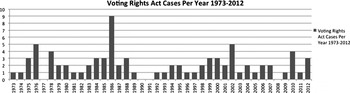
An obvious way of getting a sense of the VRA's aggregate impact on Native Americans is by examining voting rights litigation involving them. We have identified more than ninety Indian voting rights cases, most of which originated in western and Great Plains states. As can be seen by an examination of the cases listed in the Appendix, there is a significant time lag between the passage of the VRA and the start of litigation. To some extent this is simply a function of the difficulties associated with this type of litigation, but it also is a function of the Justice Department's uncertainty over the scope of the act and technical issues about enforcement.Footnote 91
We believe the depth of the problem, however, is greater than the number of cases might indicate, because as McCool, Olson, and Robinson note, litigation is, “complex, time-consuming, and heavily dependent on access to sophisticated counsel.”Footnote 92 Native communities typically are located in isolated rural areas, lack resources, have limited access to legal counsel, and often find it difficult to get assistance from the Department of Justice, which is subject to political vagaries.Footnote 93 Although described as the “fulcrum for government's civil rights efforts,” the Civil Rights Division of the Justice Department has become one of the most politicized entities within the federal government, with struggles between conservative political appointees and career staff attorneys increasingly the norm during Republican administrations.Footnote 94 Moreover, as McDonald, Pease, and Guest note, “Indian country was largely bypassed by the extensive voting rights litigation campaign that was waged elsewhere, particularly in the South.”Footnote 95
Another reason why a simple listing of litigation understates the propensity of jurisdictions to engage in discriminatory voting practices is the Justice Department's practice of requesting additional information from covered jurisdictions that submit plans for preclearance. These “more information requests” (MIRs) are a means for the department to signal that a plan may violate an aspect of the VRA, thereby giving the jurisdiction an opportunity to withdraw the plan and make revisions before resubmitting. There have only been a few voting rights cases in Alaska, which has the highest proportion of indigenous citizens of any state, but the state has gotten many MIRs about redistricting plans that appear to dilute Indian and Alaska Native voting strength.Footnote 96
A quick perusal of the listing of cases in the Appendix illustrates two additional points. First, nearly all have been resolved in a manner favorable to Native Americans, and, second, the problem has not disappeared. More than one-third of the cases have been heard during this century (i.e., from 2000 onward). Of these thirty-four cases only three at this juncture have not been settled in the Indians' favor. Two of these have been appealed to higher courts, resulting in one already being sent back to the district court.
Analytical Framing of the Voting Rights Act Cases Involving Indians
It is fruitful to consider the interplay between core–periphery concerns, competing “racial institutional orders,” and the unique nature of tribal citizenship in shaping voting rights disputes involving Indians. Although the Voting Rights Act had strong support from national elites associated with both political parties, elected officials in Indian Country—nearly all of whom identified as Republicans—from the beginning resisted its implementation. Many of the early VRA cases were very similar to those litigated in the period after the ICA, in that states and localities pursued a range of legal strategies that treated tribal members living on reservations as not actually residing in the local political jurisdictions that included their reservations. When these attempts failed, they passed statutes to create subgovernment units that excluded Indian lands or even deannexed them. While the more recent voting rights cases of the past three decades are less explicitly rooted in the unique tribal status of Native Americans, there are important aspects that continue to differentiate some of this litigation from the types of cases generated by states and localities attempting to dilute African American voting in the South.
Geographic issues, which can be to some extent characterized as core–periphery distinctions, both between the national centers of power and within states, also figure prominently and in ways that are unique to Indians and Alaska Natives. Geographically isolated reservations, sometimes encompassing hundreds of miles, provide ample opportunities for vote dilution in ways that are distinct from those impacting African Americans. Some of these include the refusal to provide or accept voting registration cards from people living on reservations, the failure to locate polling stations on reservations, and limiting opportunities for early voting on reservations. Most reservations do not include street addresses, something that many states require when individuals seek to register and vote. In all of these cases, the political jurisdictions can cite what on the face appear to be reasonable grounds—financial constraints and concerns about voting fraud—as reasons for their actions, but which end up supporting “white supremacist” orders. At the national level, elites are split between those who are supportive of “transformative egalitarian” institutional orders, but rarely pay attention to what happens in Indian Country, and those who strongly endorse the view that voting fraud is prevalent and must be combatted through means that end up disenfranchising Indians, as well as some other groups. This split is usually along party lines, with the former group primarily comprised of Democrats and the latter overwhelmingly comprised of Republicans.
A related issue is how to address the continuing existence of large numbers of Indians and Alaska Natives with limited or no knowledge of English. Whether due to the geographic isolation of their populations or due to the lack of decent education opportunities, upward of 20 percent of Natives are not proficient in English. Although the largest single group of those who are not English proficient is the Navajo of the Four Corners region, lack of English proficiency also affects large numbers of Alaska Natives, many of whom live in isolated, rural communities where everyone speaks traditional languages. In some cases, the rationale for not providing voting materials in these languages is that these were “historically unwritten,” per the VRA amendment that Alaska Republican Ted Stevens got passed in 1975.
SECTION 2 DISPUTES (1965–2008)
Jurisdictions have tried many different strategies to get around the VRA's core provision, Section 2, that prohibits rules and practices that “deny or abridge” the right to vote. These efforts often run into challenges because Section 2 prohibits procedures that provide minorities with “less opportunity than other members of the electorate to participate in the political process and to elect representatives of their choice.” Section 2, as amended in 1982, takes into account the “totality of circumstances” that was expounded upon in Thornburg v. Gingles (1985) as: 1) whether the minority group is “sufficiently large and geographically compact,” 2) whether it is “politically cohesive,” and 3) whether “the white majority votes sufficiently as a bloc to enable it . . . usually to defeat the minority's preferred candidate.”Footnote 97
Voting Rights Act cases per year, 1973–2012.

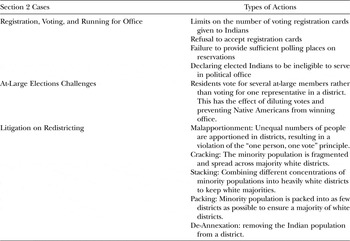
For the purposes of this article (and as laid out in the Appendix), we have divided the Section 2 cases into three categories based upon the mechanisms used to impinge upon the voting rights of Native Americans. However, as will be evident in the sections that follow, the three analytical frameworks (core–periphery, “racial institutional orders,” and tribal citizenship) continue to be applicable. The first category encompasses a range of “first-generation” voting rights abuses that impinge on the ability of Native Americans to access the ballot box and run for political office. Many of these first-generation cases sought to overturn state and local voting practices that denied the franchise to Indians and used rationales akin to those raised in earlier court decisions that focused on Native status as members of tribal nations with distinct territories. The other two categories involve “second-generation” litigation dealing with two very common vote-dilution strategies—at-large elections and redistricting disputes—and are much more likely to be similar to cases involving African Americans in the South, again occasionally with aspects related to geographic and core–periphery elements. These categories are summarized in Table 1.
Types of Section 2 Voting Rights Act Cases

Litigation on Registration, Voting, and Running for Office
More than a quarter of all the cases in our study involve South Dakota, which statutorily excluded Indians from voting and running for political office until the 1940s. The level of hostility from state and local officials there far surpasses that of officials in any other state, and all three of the previously mentioned analytical frameworks are applicable to these cases. In 1975, the state's Republican attorney general, William Janklow, called for the repeal of the VRA, which he called an “absurdity.” Janklow subsequently labeled as “garbage” a U.S. Commission on Civil Rights report outlining the many ways that South Dakota had violated the civil rights of Native Americans.Footnote 98 Unfortunately, the concerns of the national elites who produced the report were not accompanied by a consistent national effort from the Justice Department or other national elites to force reforms in South Dakota.
Although South Dakota is generally considered a reliably Republican state, it does occasionally have closely fought Senate and House races. When this occurs, the votes of Native Americans can tip the balance toward the Democrat. Throughout most of South Dakota's history, the state had designated counties containing reservations as “unorganized,” which meant they had to contract with surrounding “organized” counties for public services. The overwhelmingly Indian residents of the unorganized counties were prohibited by law from voting and running for political office, until forced to do so by a series of VRA cases in the 1970s and early 1980s.Footnote 99 When it became clear that state laws excluding Native Americans from voting were impermissible, officials tried other vote-suppression and dilution tactics. Courts found these attempts, from limits on the number of voting registration cards given to Indians to the outright refusal to accept registration cards from Native Americans, to be violations of the Fourteenth and Fifteenth Amendments and Section 2.Footnote 100 Counties also were sanctioned for failing to provide sufficient polling places on reservations,Footnote 101 but efforts to increase reservation voting were strenuously resisted. And, in 2004, Democratic Senator Tom Daschle had to get a temporary restraining order to halt such tactics as the copying of license plate numbers and the following of Indians voters, which could be viewed as a form of intimidation.Footnote 102
Other states also used these first-generation and second-generation strategies to undermine Indian voting. Probably the next-most problematic state, at least in terms of the seriousness of Section 2 voting rights charges, was Arizona, where Apache County got a permanent injunction against seating a duly-elected Navajo to the Board of Supervisors. Even though Tom Shirley got three times as many votes as his non-Indian opponent, the county Board of Supervisors and the defeated Republican candidate, Thomas E. Minyard, argued that Shirley was ineligible to serve because he lived on the reservation and therefore did not pay property taxes—an extension of the “Indians not taxed” distinction going back to the Constitution. A lower court ruled in favor of the county, but the Arizona Supreme Court rejected the argument and ruled that Shirley had to be seated.Footnote 103 Apache County in other cases tried to deny the vote to Native Americans on the grounds that the Indian Citizenship Act was unconstitutional, and also engaged in gerrymandering and closing polling places to dilute the Indian vote.Footnote 104 In all of these cases, as well as in a number of cases from New Mexico that involved unequal access to polling places, the Native litigants were successful.Footnote 105 For more on these cases, see the Appendix.
A different first-generation access issue was raised in Minnesota, where two hundred tribal members in 2004 were turned away at polling stations. The Republican secretary of state, Mary Kiffmeyer, instructed poll officials to reject photo tribal identification as a valid form of voter ID.Footnote 106 The state subsequently entered into a settlement agreement that would allow tribal identification to be used, although Kiffmeyer has continued to be an activist in terms of trying to get stiffer voting ID laws passed.Footnote 107 While voting ID laws make it more difficult for many groups to vote, the unwillingness to accept tribal identification is yet another example of the way that tribal citizenship intersects with “white supremacist” racial orders in a unique fashion.
Another troubling case comes from Montana, where the Citizens Equal Rights Alliance and Montana Citizens Rights Alliance filed suit to force the state to remove polling places from the Crow reservation after making unsubstantiated charges of widespread vote fraud.Footnote 108 Both county officials and tribal leaders labeled the accusation baseless. Not only was the case was dismissed in federal court, the main instigator publicly apologized.Footnote 109 Again, it is worth noting that there are similarities with cases charging voter fraud in African American communities, as well as similarities in efforts making it more difficult for African Americans to cast their vote, but the effects are more chilling with Native Americans because of two sorts of core–periphery issues. First, the geographic distances that reservation dwellers have to travel if polling places are removed is far greater than in cases involving the closing of polling places in African American communities. Second, although large numbers of national elites raise concerns when vote-suppression policies are directed against African Americans, this rarely occurs when the affected populations are Indians and Alaska Natives who live far away from the centers of power.
At-Large Election Challenges
At-large election challenges constitute an important subset of the second-generation Section 2 cases. One of the ways that southern racists tried to dilute the impact of the African American vote and maintain “white supremacist” orders after the passage of the VRA was to run at-large elections rather than district elections. In at-large election, the entire electorate vote for all of the representatives rather than having the voters divided into separate electoral districts, each of which vote only for the representative for that district. Minority voters often are unable to gain any representation in at-large electoral systems. As long as the size of the African American electorate was smaller than the white electorate, their vote was meaningless in terms of actually being able to elect candidates and to influence policy outcomes.Footnote 110 The same vote-dilution strategy was followed with respect to Native Americans, who like African Americans challenged the practice, arguing that was a violation of Section 2's “totality of circumstance” as stipulated in Thornburg v. Gingles (1986).
There have been challenges to at-large electoral systems that dilute Native voting in at least eight states and, in almost all of the cases, at-large elections were found in violation of the preconditions established in Gingles. The most vehement disputes have occurred in Montana, starting with a challenge by Crow and Northern Cheyenne living in Big Horn County. Even though Natives made up more than 46 percent of the population, none had ever been elected to the school board or county commission. In 1986, a district court ruled in favor of the plaintiffs and mandated that the county switch to single-member district elections.Footnote 111 This decision led to a number of other challenges to at-large voting systems in Montana, with the longest dispute being over the at-large election of county commissioners in Blaine County, where members of the Gros Ventre and Assiniboine tribes make up 45 percent of the population. In 1999, the Department of Justice challenged the at-large electoral system, and both the district and federal court of appeals ruled that Indian voting was being diluted in violation of Section 2.Footnote 112 Blaine County, with support from the Mountain States Legal Foundation tried to appeal to the Supreme Court on the grounds that Section 2 was unconstitutional, but that was denied in 2005.Footnote 113
Litigation on Redistricting
Most redistricting disputes involve conflicts over the drawing of district boundaries. Legislative bodies that use district voting systems are required to redistrict every ten years, following the census, to ensure that districts are of roughly equal size and that thereby each vote is equally weighed. Most redistricting techniques that dilute the electoral clout of Native Americans were first developed by southern racists, but again, the existence of reservations makes their application against Native Americans somewhat different. In addition to minority vote dilution caused by malapportionment, four other techniques can be used to limit the impact of minority voters. “Cracking” is when the minority population is fragmented and spread across majority white districts. “Stacking” is combining different concentrations of minority populations into heavily white districts, to keep the districts with white majorities. “Packing” is when the minority population is heavily packed into as few districts as is possible to ensure the largest number of majority population districts.Footnote 114 A final means is de-annexation, where redistricting removes a geographic section from being part of the whole, thereby eliminating the Indian populace. This is a technique that has been mostly used against tribal members living on reservations as a means of denying them services provided to other citizens.
The most egregious recent example of a malapportioned district involving Native American vote dilution is the system that Buffalo County, South Dakota, used to choose its three county commissioners. The county has a population that is 17 percent white and 83 percent Crow Creek Sioux, but the boundaries of the electoral districts were designated so that whites were split among two districts and nearly all of the Indians were lumped into a single district, which meant they could elect only one commissioner and he was always outvoted by the other two. In 2003, the tribe brought suit and the case was settled after the county admitted to malapportioning the boundaries in violation of the “one person, one vote” principle.Footnote 115 A few years later, another South Dakota county adopted a redistricting plan that malapportioned Indian citizens, albeit not quite as grossly, and they were forced to redraw the boundaries.Footnote 116
“Cracking” can be illustrated by examining a nearly eight-year-long legal battle over redistricting in Montana. In 1996, the chair of the Blackfeet challenged a plan that fragmented the Blackfeet and Flathead populations by splitting the Fort Belknap Reservation into two Senate districts, while the Fort Peck Reservation was split into three Senate districts. On the House side, the Rocky Boy Reservation was divided into two districts, while the Blackfeet Reservation was split into four districts, but, even worse, the Flathead Reservation was split into eight districts. The plaintiffs proposed a plan that would have created additional majority Indian districts that were compact, contiguous, and had less than a 5 percent deviation from ideal district sizes.Footnote 117 Despite a number of documented racially derogatory comments made by the all-white redistricting commission, the district court ruled the redistricting plan's intent was not discriminatory and that the 2000 census required the appointment of a new redistricting commission.Footnote 118 The plaintiffs decided to appeal the ruling, but that became moot when the new commission's plan included seven majority Indian districts within the one-hundred-member House and four majority Indian districts in the fifty-member Senate.Footnote 119 The Republican-controlled state legislature, on a straight party-line vote, passed a bill requiring that the “mean-spirited” plan be redone.Footnote 120 The commission still adopted the plan, but the Republican secretary of state refused to enforce it and appealed to the state court. However, the state court rejected the claim and said the redistricting plan had to be accepted.Footnote 121
“Stacking,” which entails combining different minority communities into majority white districts, is less common, but there have been several cases in New Mexico where different tribal nations have found their electoral impact diluted by being combined—sometimes in conjunction with Latinos—into majority white districts. In Jepsen v. Vigil-Giron (2001), the New Mexico Court of Appeals stated that “tribal self-determination” was a legitimate factor to consider in redistricting and supported the efforts of Jicarilla Apache and Navajo in having legislative districts that did not dilute those interests.Footnote 122
Redistricting that involves the “packing” of minority voters into as few districts as possible in a manner that minimizes their electoral clout also has been found to violate Section 2. In Bone Shirt v. Hazeltine (2006), a South Dakota redistricting plan that “packed” Native Americans into one district was rejected by the court.Footnote 123 The boundaries of four legislative districts had been adjusted to create one district that was 90 percent Native American, another 30 percent Native American, and two nearly all-white districts. Without the boundary manipulation, two of the four legislative districts would have Indian majorities.
A final way that redistricting can be used to minimize Indian political influence is through de-annexation. This strategy has been used mostly by local political jurisdictions rather than by state governments. Several midwestern towns tried to de-annex lands that also were part of reservations. In U.S. v. Town of Bartelme (1978), a Wisconsin town that had sought to remove part of the Stockbridge-Munsee Reservation from the township and thereby stop tribal members from voting in township elections was stopped from doing so.Footnote 124 When a Minnesota town tried to de-annex a Sioux reservation and save money by not providing police and fire protection to the residents, this also was found to be a violation of Section 2 of the VRA.Footnote 125
A South Dakota county tried a novel means of avoiding these precedents. Rather than de-annexing reservation lands as a way to avoid providing services to Native American residents, the county decided to create a special sanitary district.Footnote 126 The proposed sanitary district included noncontiguous plots of land owned by whites, but excluded the remaining 87 percent of the land around the lakes, land which was held by the Sisseton-Wahpeton Sioux Tribe. This strange pattern of land ownership was due to tribal lands being divided into individual plots—some purchased by whites and others kept by the descendants of the original allottees—as a result of the 1887 Dawes Act. When challenged, the local officials admitted that the plan unfairly disenfranchised members of the tribe, who had a legitimate interest in sanitation issues around the lakes.Footnote 127
LITIGATION INVOLVING NONPERMANENT PROVISIONS (1965–2008)
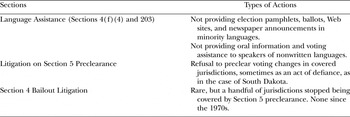
As noted earlier, the nonpermanent provisions of the VRA were designed to prevent violations rather than address violations after they occurred. There are three types of litigation involving nonpermanent provisions relevant to Native Americans. Most of the cases are charges that jurisdictions violated VRA provisions regarding minority languages, although one could argue that Section 5, which involves preclearance of voting changes in jurisdictions with histories of discrimination, has been the most important. While the bailout provisions are potentially important, they have not been utilized much, at least in Indian Country. These provisions are summarized in Table 2.
Types of Nonpermanent Provisions Voting Rights Act Cases

Litigation on Language-Assistance Provisions
An important, but little known, aspect of the VRA is the requirement under Section 203 that election materials and voting assistance be provided in languages other than English in communities where more than 5 percent of the population or reservation speak a different language and have an illiteracy rate higher than the national average.Footnote 128 According to the most recent census data, more than a fifth of American Indians have limited English proficiency and likely could benefit from assistance in voting.Footnote 129 The aim of Section 203 is to remedy the continuing problem of “unequal education opportunities afforded [Indians], resulting in high illiteracy and low voting participation.”Footnote 130 For some groups, particularly indigenous peoples in Alaska, their geographic location is a major contributing factor, given that nearly all day-to-day activities are conducted in traditional languages and English is rarely used outside of the classroom. Many of these jurisdictions also are covered by special provisions related to preclearance and through Section 4(f) might be required to have federal examiners.Footnote 131
Although minority language litigation has taken place in at least six states, most cases have involved Navajo speakers—primarily in Arizona and New Mexico.Footnote 132 Other cases, however, have involved Cherokee, Apache, Keres, Zuni, Lakota, Inupiaq, and Yu'pik speakers and, aside from a few very early cases decided before these provisions were added to the VRA, have resulted in remedial actions taken to assist the minority language speakers. This is one of the most important areas of recent Justice Department activity, with more Section 203 filings between 2001 and 2006 than in the earlier two decades of VRA coverage.Footnote 133 Settlement agreements, such as was reached in U.S. v. Bernalillo County (1998), may require audio tapes of voting information be used to provide help to those whose primary language is not written.Footnote 134
The final case is atypical in that it is the first Section 203 case that we have identified as coming from Alaska, which is surprising in that many Indians and Alaska Natives primarily speak indigenous languages with Central Yup'ik, Inupiaq, Siberian Yup'ik, Suypiaq, Tlingit, and Tutchone being the most common ones.Footnote 135 Most of the 228 Alaskan tribes that the Bureau of Indian Affairs recognizes are “small and remote” and their populations are three times as likely as other Alaskan residents to be poor.Footnote 136 As such, Alaska Natives find it especially difficult to pursue litigation. In 1995, the Native Village of Barrow and non-English-speaking Alaska Natives sued the city of Barrow for failing to provide written election materials in Inupiaq and for poll workers providing incorrect information about ballot measures.Footnote 137 The city settled, so there is no court decision or remedial order.Footnote 138
Section 5 Preclearance Litigation
The aim of Section 5 was to prevent instances of voter suppression, denial, and dilution before they occur. In a limited number of political jurisdictions with histories of voting rights abuses, officials must show the Department of Justice or the Circuit Court for the District of Columbia that proposed changes in voting laws or procedures do not have discriminatory effects.
Without a doubt, the preclearance provisions of Section 5 have been the most hotly contested aspect of the VRA and provide a stark example of the lack of importance that core level elites attach to Native voting rights abuses. The vast majority of cases involving Native Americans are from South Dakota, where state and local white elites have been extraordinarily hostile to Indian voting. Republican William Janklow, as state attorney, and later as governor, instructed state and local officials to not comply with preclearance in covered jurisdictions.Footnote 139 In his appeal for the repeal of Section 5, Janklow used states' rights rhetoric, very much in the same vein as has been used by southern racists to disenfranchise African Americans. Janklow argued that preclearance provisions were a power grab by the federal government.Footnote 140 Between 1976 and 2002, the state adopted more than six hundred regulations and laws overseeing elections in two covered counties, but sought preclearance for fewer than ten.Footnote 141
Early on, the Department of Justice successfully pursued legal action against South Dakota for its failure to comply with Section 5, but has not done so for more than thirty years, even though the covered jurisdictions continue to adopt changes without getting clearance.Footnote 142 Despite this lack of support from the Department of Justice, Native Americans have still had success in court, but litigation without government assistance is time consuming and expensive.Footnote 143
Section 4 Bailout Litigation
Under Section 4 of the VRA, jurisdictions covered by Section 5 preclearance provisions were given the ability to ask the District of Columbia U.S. Circuit Court to remove them from coverage if they could show to the satisfaction of the court that there was no discrimination. There have only been a handful of Indian bailout cases, all from more than thirty years ago. The earliest case involved three Arizona counties that included Navajo and Hopi reservations and in 1964 had used literacy tests.Footnote 144 The court allowed the counties to be removed from Section 5 preclearance on the grounds that the Department of Justice had not adequately investigated practices in the affected counties. After the 1970 VRA amendments, these types of literacy tests were banned, and the three counties were again placed under Section 5 preclearance provisions, which they did not try to fight.Footnote 145 There were four bailout requests in the 1970s, three of which were not disputed and had support from the Justice Department and one from Montana that was denied.
CURRENT VOTING RIGHTS ISSUES IN INDIAN COUNTRY
Voter Dilution and Suppression
In early summer 2012, Jefferson Keel, the president of the National Congress of American Indians, described difficulties that Native peoples had in registering and voting as a “civic emergency.”Footnote 146 In considering whether his characterization is accurate, we examine current voting rights litigation. Again, we find a range of first-generation and second-generation issues that are subject to litigation, as well as some rationales that closely resemble those used against African Americans, but also those that particularly affect Native populations living on reservations. As was true with many of the cases previously outlined, the offending jurisdictions have sought to justify their measures on “Indians not taxed” or fraudulent voting grounds, but, regardless of the official rationale, these efforts have served to buttress the political power of entrenched white elites in those jurisdictions. Again, these abuses have occurred on the geographical periphery, both in terms of being far from the attention of national elites as well as distant from the centers of power within the states.
Electoral participation by Indians and Alaska Natives is among the lowest of any group in the country, with almost 40 percent of those eligible not even registered.Footnote 147 When asked questions in the Current Population Survey about why they did not vote, many cited difficulties in registering.Footnote 148 The following example illustrates the unique challenges faced by Native peoples in trying to register and vote. Shortly after Naomi White, a lawyer, moved onto an Arizona reservation, she turned in a voting registration card. In early summer, White contacted the county recorder to find out what she needed to do to vote early in the August primary. The registrar told White that she had not been registered because she did not have a street address that the post office could verify—a common occurrence on reservations. Along with more than five hundred other residents of the reservation, White was placed on the suspect list, which meant she had to prove to the satisfaction of the registrar that she did indeed have a legitimate address. It took more than two election cycles before White managed to satisfy the registrar.Footnote 149 This illustrates the ways that state requirements may appear reasonable and racially neutral, but in reality help preserve an “antitransformative” racial order.
Two recent court cases, one in South Dakota and the other in Montana, deal with reservation access to registration and voting sites in the 2012 election. To a large extent these can be considered examples of core–periphery disputes, but with two different core–periphery contexts. First, as we have shown previously, there is a national versus state distinction, with national elites supportive of an egalitarian transformative order largely unaware of conditions within distant states. There is, however, a second core–periphery dimension, but within those states, where elites treat reservation residents as the discriminated-against periphery. Finally, these cases make very clear the connections between the Republican Party and supporters of the “white supremacist” racial institutional orders. The lead defense attorney in both cases is Sara Frankenstein, the secretary of the South Dakota Republican Party. On her official party Web site, Frankenstein is described as someone who “particularly enjoys defending public bodies against lawsuits brought by the ACLU and other ‘civil rights’ groups.”Footnote 150
The first case involves Shannon County, which encompasses much of the Pine Ridge Reservation. Because the county lacks the institutional capacity to run its own elections, it contracts out the administration of voting to Fall River County. South Dakota law allows for early voting for forty-six days prior to the election date, but residents of Shannon County were only provided with an opportunity to vote within their county for six days.Footnote 151 If residents did not vote on those days, they would have to drive for between fifty-three minutes to three hours in order to reach a polling place in Fall River County.Footnote 152 This constituted a severe hardship for reservation residents, more than half of whom are below the federal poverty level and many of whom do not have vehicles.Footnote 153 County officials stated that a lack of funds was the reason for offering only limited voting times and sites, but they refused an offer from a local Indian organization to pay the extra cost of providing full voting options to county residents. South Dakota law also allows the state to step in when a county is not able to run elections, but the Republican secretary of state, Jason Gant, refused to either make available federal funds through the Help America Vote Act or have the state take over elections for the county. Just prior to the court hearing, and after the state Democratic Party endorsed the suit, the state and county discovered they did have funds to provide the same voting opportunities to Shannon County residents as were available to other South Dakotans.Footnote 154
The Montana litigation involves charges that in Rosebud, Blaine, and Big Horn Counties, residents of the Crow, Northern Cheyenne, and Fort Belknap Reservations face registration and voting barriers because the late registration and early voting sites are located in white population centers far distant from the reservations. The disparity between the average distances traveled in the three counties was from 189 to 322 percent greater for Indians than for whites. Although Montana law allows for satellite early voting and late registration sites to be established, the counties claimed a lack of funding precluded them from providing the sites. The district court judge denied the request for an emergency order to create them for the 2012 election.Footnote 155 Upon appeal, the Ninth Circuit Court of Appeals dismissed the case because it applied to the 2012 election, which was past. However, the appeals court “vacated” the district court's denial because the district judge admitted the elections system denied Natives an equal opportunity to participate. The district judge, Richard Cebull, however, did not rehear the case because he resigned after widespread media reports that he sent out hundreds of racist and sexist e-mails about President Obama.Footnote 156
The partisan dynamics, however, are somewhat different than in South Dakota because Montana Democrats refused requests from the Native litigants to formally support their action. Rather than choosing to endorse the lawsuit, a spokesperson for the Montana Democratic Party stated that the party wanted to focus their efforts on registering tribal members and on get-out-the-vote activities.Footnote 157 Given there is no reason why the party couldn't have endorsed the lawsuit as well as focusing on registration and getting out the vote, the party's stance seems inexplicable. Several possible related explanations come to mind. The most obvious explanation is that the lead defendant, Secretary of State Linda McCulloch, is a Democrat.
Although counties administer elections, the ultimate authority for regulating elections is with the secretary of state's office. This, of course, raises the question of why McCulloch resisted reaching a settlement with the litigants. McCulloch, who formerly served in the state legislature, had a history in that body of being supportive of policies that benefitted tribal members and had gotten substantial political support from them.Footnote 158 What is not clear is whether McCulloch had delegated responsibility for handling tribal groups' request for satellite voting to underlings and basically was out of the loop, or if she made a conscious political decision to align herself with anti-Indian forces. On June 9, 2014, the assigned date for the litigants to begin pretrial mediation, the partisan dynamics shifted dramatically when Attorney General Eric Holder announced that the Department of Justice was going to work with tribal leaders from across the nation in developing voting rights legislation to address abuses in Indian Country. Holder singled out an Alaska example and Wandering Medicine v. McCulloch. Holder stated, “These conditions are not only unacceptable, they're outrageous. As a nation, we cannot—and we will not—simply stand by as the voices of Native Americans are shut out of the democratic process.”Footnote 159 A settlement, which provided for the establishment of the satellite centers on the three reservations starting with the 2014 election, was reached the following day.Footnote 160
The academic research is quite clear that travel distance affects registration and voting, so it makes perfect sense for Republican officials in these states to take actions likely to dampen down turnout among Native Americans, who vote overwhelmingly for Democrats.Footnote 161 Brady and McNulty found that even quite small distances of less than a quarter of a mile in additional distance resulted in statistically significant declines in voting.Footnote 162 Travel distances of 100 to 200 miles, such as exist for Indians on reservations in South Dakota and Montana, clearly constitute a major impediment to registration and voting. While it is not unusual for other racial minorities to face obstacles in terms of access to polling stations, no other group must travel anywhere near to this distance. It is again a function of two related core–periphery factors: 1) the existence of tribal lands that are treated as the hostile periphery by elites in their respective states, and 2) often a lack of interest among national elites in confronting racial bias against such a small and geographically distant population. There are two very important factors about the role of national elites in the Wandering Medicine case. It shows how rapidly the partisan considerations can shift when national elites choose to exert influence. While one cannot “prove” that the settlement was due to Holder's actions, it is hard not to think that both the timing of his announcement and the almost immediate settlement of the case affected decision-making among Democratic elites in Montana. But, a more troubling factor is that Holder's statement, as well as the settlement of the case, garnered almost no media attention.
Section 2 Redistricting and Malapportionment Vote-Dilution Cases
There have been three recent vote-dilution cases involving Native litigants in South Dakota, Wyoming, and Montana against local elected officials in those states. The legal issues raised in these cases are nearly indistinguishable from those in many voting rights cases involving African Americans. The South Dakota case involves a challenge to a redistricting plan, while the other two cases involve attempts to reverse systems that Native voters believe have diluted their electoral strength for years.
Nearly half of the residents of Martin, South Dakota, a small town adjacent to the Pine Ridge and Rosebud Reservations, are tribal members. The town adopted a redistricting plan that fragmented the Oglala Lakota and Sioux residents among three council wards, all of which had substantial white majorities. Even though the plaintiffs showed bloc voting by both groups and that an Indian-preferred candidate had never been elected, in 2005 the district court ruled in favor of the defendants. The following year, the Eighth Circuit Court reversed the ruling, labeled it a clear example of “vote dilution,” and remanded the case back to the district court. The district court then asked that town to devise a new plan that did not violate Section 2, but they refused. The district court issued an order that required the implementation of a cumulative voting system, but Martin officials appealed to the U.S. Court of Appeals, which, on a 7–4 decision, allowed the original district plan to be put in place.Footnote 163 The plaintiffs appealed to the Supreme Court, but as of this moment, “cracking” in South Dakota is legally sanctioned.
Northern Arapaho and Eastern Shoshone make up about one-fifth of the population in Fremont County, Wyoming, but the at-large method of electing county commissioners has made it extremely difficult for any Indian-preferred candidates to be elected. Having a voice on the council is extremely important, given there are a number of energy and environmental policy disputes that pit the interests of reservation inhabitants against people living off-reservation, as well as a long-running conflict over reservation boundaries. In 2005, voters from the Wind River Reservation filed Section 2 charges against the county. The Mountain States Legal Foundation decided to represent the county on a pro bono basis.Footnote 164 In 2010, the U.S. District Court ruled in favor of the plaintiffs and ordered the county to establish five districts, including one that encompassed much of the reservation, and, in early 2012, a federal appeals court refused to hear an appeal from the county.Footnote 165
The final case involves school board elections. Most of the students served by the Wolf Point School District are drawn from the Fort Peck Reservation in northeastern Montana, but the district allocated three seats on the school board to voters from the non-Native areas, and five seats to voters from predominantly Native areas. On average, each school board member from the non-Native areas represented electoral districts with 43 residents, as opposed to the 841 residents represented on average by each member from the Native electoral districts. In 2013, Indian residents filed Section 2 Voting Rights Act and Fourteenth Amendment charges, claiming that the system denied Native voters equal representation. In early 2014, the school district conceded that there was malapportionment and shortly thereafter agreed to adopt a new plan that was approved by the district court.Footnote 166
Although it is always risky to generalize on the basis of a small number, two facts about these three vote-dilution cases are worth noting. First, local elected officials in communities that include or are adjacent to reservations clearly have not stopped trying to create electoral districts that minimize the voting power of Indians. Second, the question of whether Native litigants are successful is likely to vary depending upon the judicial philosophy of the presiding judges. It makes little sense that a redistricting plan in Martin, South Dakota, that resulted in nearly 50 percent of the residents being unable to elect a candidate of their choice was upheld, while a system that disadvantaged 20 percent of the residents in Fremont, Wyoming, was rejected. The final case, involving the Wolf Point School District, was such an extreme example of malapportionment that the defendants realized there was little chance of it withstanding judicial scrutiny and quickly settled.
Language Assistance Litigation
The recent language assistance litigation is very similar to earlier cases where government entities had failed to provide a broad range of electoral assistance to minority language speakers. New Mexico again was found to provide inadequate assistance to Navajo speakers, resulting in federal election observers being sent to Sandoval County.Footnote 167 And, once again, Shannon County in South Dakota was found to have violated sections of the VRA (Sections 4 and 203 this time) by failing to provide assistance to Lakota speakers.Footnote 168
Nick v. Bethel (2010), where the court found state and local officials in Bethel had failed to provide language assistance to Yup'ik speakers, may be the first VRA case involving Alaska Natives to go through litigation.Footnote 169 Yup'ik is spoken by more than 10,000 people in the Bethel region, and the state had provided materials about other governmental services in the language, but had failed for more than thirty-five years to provide the necessary language assistance for elections.Footnote 170 The only accommodation that the state provided to minority language speakers was that they could ask for an oral translation of English ballot measures, but many polling stations did not provide translators. Election officials cited the “historically unwritten” amendment to argue that they did not need to do more.Footnote 171 While running for the Senate in 2008, Democrat Mark Begich asked the state's election officials to allow him to pay to have registration forms and absentee ballots translated into Yup'ik and other indigenous languages, but he was turned down.Footnote 172 In Nick v. Bethel (2010), the court found Alaskan officials had violated the minority language provisions of the VRA by not providing election materials in Yup'ik and failing to provide Yup'ik speakers with help when they came to the polls.Footnote 173
Voter Denial in Indian Country
Since 2001 there have been nearly one thousand voter identification bills introduced into state legislatures, and thirty-three states have passed these laws.Footnote 174 This type of legislation has been strongly supported by the Republican Party at the national level as well as within states, but is generally opposed by Democrats. The National Congress of American Indians has identified three aspects of voter ID laws that have a “disproportionate” effect on Native voters and often involve issues that are unique to their tribal status and geographical isolation.Footnote 175 First, several states with substantial Native American populations do not include tribal identification as an acceptable form of ID. Alaska, where Natives make up 18 percent of the population, does not accept tribal identification. The current voter ID law in Alaska does not require photo identification, but the Republican-controlled state legislature is considering strengthening the law to require photo identification. Because of the difficulties posed for many of the indigenous peoples living far away from population centers and government offices, airlines operating out in many parts of the state do not even require picture identification. The proposed Alaska legislation draws upon materials from a model proposed by the American Legislative Exchange Council.Footnote 176
Second, according to the NCAI, many of the laws pose “significant logistical, cost and distance challenges for tribal citizens and create major barriers to participation.”Footnote 177 As noted earlier, many people living on reservations do not have street addresses so cannot even provide utility bills with addresses as required by some voter ID laws, as well as often living far from government offices. Obtaining a birth certificate can be a challenge or even impossible for those born at home. While problematic for people living in the lower forty-eight states, the challenges are much worse for Alaska Natives.
Finally, voters without the required forms of identification are given provisional ballots, which are not counted unless the person returns in a short period with the requisite forms of identification. Unless these documents are readily available at home, it is unlikely that the individual can obtain them in the required time period. In 2004, voters in Arizona passed a proposition requiring people provide proof of national citizenship when registering to vote by mail. When Navajos were unable to provided identification, such as birth certificates, they were given provisional ballots. This led Navajo litigants to file a challenge to this revision of the state laws governing voter registration, arguing that many tribal members had used federal voter registration forms that conformed to the requirements of the National Voter Registration Act, but which did not require this identification. While the Supreme Court struck down the requirement that individuals using these forms provide identification proving U.S. citizenship, it opened up the possibility of there being different registration requirements for voting in national versus state/local elections.Footnote 178
The rationale behind stiff voter ID laws is the need to prevent voter fraud, the evidence of which is based on anecdotal accounts of fraudulent voting.Footnote 179 In 2011, the Republican National Lawyers Association (RNLA) issued a report claiming there had been roughly 375 voter fraud prosecutions and convictions since 2000.Footnote 180 Leaving aside the fact that the data lump prosecutions and convictions together, at best the RNLA data would translate into roughly thirty-three cases per year, or, on average, less than one a year per state. An outside group, News21, examined all of the RNLA cases and discovered there were actually only seventy-seven voting fraud cases, and, of those, they found only thirty-three that resulted in a conviction. Moreover, none of the cases actually involved voter impersonation, such as would be caught through voter identification laws.Footnote 181 Then News21 asked elections officials in all fifty states to provide them with all fraudulent activity in the same time period, but they were given only ten cases of voter impersonation fraud.Footnote 182 This finding is consistent with the findings of academics. The best indications are that numbers of fraudulent voters are miniscule, in the range of 0.000044–0.000045 percent for all forms of voter fraud.Footnote 183 Despite evidence to the contrary, many conservatives believe voting fraud is common.Footnote 184
There have been many accusations of voter fraud in Indian Country, but none have been substantiated. For example, during South Dakota's closely fought 2002 Senate race, the state attorney general, Republican Mark Barnett, launched an investigation into alleged fraudulent voter registration in counties with reservations, after a get-out-the-vote drive registered two thousand new voters. No fraud was discovered, and the state attorney general subsequently announced there was “no basis” for the charge.Footnote 185 After Democrat Tim Johnson eked out a very close victory, the state enacted a photo ID law, which one legislator described as retaliation because, “the Indian vote was a big factor in new registrants and a close Senate race.”Footnote 186 As noted earlier, the same thing occurred in Montana, where the Citizens Equal Rights Alliance tried to stop polling on the Crow reservation and made unsubstantiated charges of widespread vote fraud.
Native Americans, like African Americans, also are disproportionately affected by state laws that disenfranchised felons. In South Dakota, the incarceration rate for Indians is more than three times higher than for whites. State law disenfranchised felons sentenced to prison terms, but not those given probation.Footnote 187 However, in 2008, two Native American women convicted of felony offenses but given probation rather than prison time were removed from the Shannon County voting rolls. The women filed suit, and in 2010 the county was forced to reregister them.Footnote 188 However, the following year Secretary of State Jason Gant changed the language on the state's Web site to indicate that anyone serving a felony sentence, including those placed on probation, lost the right to vote. Gant refused to change the Web site, even though the ACLU threatened legal action.Footnote 189 Shortly thereafter, the Republican-controlled state legislature passed HB1247, which changed the state law to explicitly disenfranchise all felons. The vote was 51–18 in the House and 20–13 in the Senate, with no Native American legislators voting in favor of the change.Footnote 190
CONCLUDING THOUGHTS
As we approach the fiftieth anniversary of the enactment of the Voting Rights Act, there are many who believe the act has outlived its usefulness and that the abuses that triggered its enactment have long since disappeared.Footnote 191 Over the past several years, the Supreme Court has issued a number of rulings that, while affirming the basic intent of the VRA, have signaled that a 5–4 majority of its members agree with those who favor limiting the reach of the act.Footnote 192 Three days after Barack Obama was reelected with very strong support from racial minorities, the Supreme Court agreed to hear the Shelby case, a challenge to Sections 4 and 5.Footnote 193 A district court and the U.S. Court of Appeals for the District of Columbia Circuit had ruled that an Alabama county's failure to obtain preclearance for elections, annexations, and redistricting was in violation of Section 5. The Court of Appeals favorably quoted House Report No. 109-478, submitted as part of the 2006 VRA reauthorization, that “second-generational tactics” that dilute the minority vote are “more subtle than the visible methods used in 1965,” but their “effects and results are the same, namely a diminishing of the minority community's ability to fully participate in the electoral process and to elect their preferred candidates of choice.”Footnote 194
A perusal of the list of authors of the amicus curiae briefs in support of the county in the Shelby case reads like a Who's Who of national conservative organizations and includes individuals who served in appointed Justice Department positions in the Voting Rights Division during the George W. Bush administration. Although its potential impact on Indians and Alaska Natives was ignored by national elites, the case did garner some attention in Indian Country. Not surprisingly, a couple of Republican-controlled states (Arizona and Alaska) with substantial Native populations submitted briefs supporting the repeal of Sections 4 and 5, as did the Mountain States Legal Foundation. However, only the Navajo Nation and Alaska Federation of Natives filed briefs in support of the respondents and explained why this case matters in Indian Country—another indication of the extent to which supporters of an “egalitarian transformative” order continue to ignore what occurs on the periphery.Footnote 195
On June 25, 2013—the 137th anniversary of Custer's defeat in the Battle of Little Big Horn—the Supreme Court disagreed with the lower court rulings. Chief Justice John Roberts, in a decision joined by the four other conservative justices, ruled that Section 4(b), which established the formula for whether a jurisdiction is subject to preclearance, was unconstitutional in that it violates the “equal sovereignty of the states” by treating them differently based on “40 year old facts that have no relationship to the present day.”Footnote 196 While the decision left open the question of the whether Section 5 itself is constitutional, that provision is of limited use without a statutory provision establishing the criteria for including or excluding jurisdictions from coverage. Although the court provided an opening for Congress to revise Section 4(b), current partisan acrimony has rendered that outcome unlikely.
Based on our analysis of case law, not only do we expect the Shelby decision to have deleterious effects on voting rights in Indian Country, we also anticipate these actions will generate little notice from national elites committed to racial justice. Understandably, their attention will be focused on efforts in the South to undermine African American electoral gains, not on what happens to relatively small populations geographically distant from the centers of power. Without preclearance, we expect state and local officials will be free to adopt a host of enactments that deny, dilute, and suppress Native voting.
Given its past history, our expectation is that the worst offender is likely to be South Dakota, sometimes called the “Mississippi of the North” because of the racism toward its Native American citizens.Footnote 197 Not surprisingly, state officials in Pierre, the state capitol, lauded Shelby and immediately took steps to make it more difficult for Indians to vote, but did so in a manner that disguised the racial animus. As we discussed earlier, people living on reservations have been forced to travel long distances to vote and have often had access to fewer early voting days than were provided for non-reservation-dwellers. Even though the Republican state attorney general, Jason Gant, had access to Help America Vote Act (HAVA) funding from the federal government, he refused to use those funds or other state money to increase polling opportunities in 2012 until forced to do so by litigation.Footnote 198 He has already taken steps to reverse that progress.
One week after the Shelby decision, the South Dakota Board of Elections rejected a request by three tribes that HAVA funds be used to provide satellite voting stations on reservations in 2014. The deciding vote in the 4–3 decision was cast by Gant, who argued that it was not clear whether HAVA funds could be used for this purpose, and that the state had to seek clarification from the federal Elections Assistance Commission (EAC). This apparently quite reasonable stance by state officials was actually a very clever way to derail any action on behalf of reservation voting, because the EAC is massively understaffed, has a several-year backlog in requests, and could not respond before the 2014 election. In fact, Jason Gant has been actively involved in attempts eliminate the EAC.Footnote 199
To a large extent, the Shelby decision and the actions of South Dakota officials illustrate the ways that an “antitransformative” racial order can be strengthened without appearing to be overtly racist. The importance of the geographical/spatial dimension cannot be overstated. Indian Country is far from the centers of power and influence, and the lands inhabited by Alaska Natives are even more remote. Moreover, local and state elites in those areas have long histories of disputes, not only with indigenous peoples, but also with national elites. Federalism, however, provides those state and local elected officials with the authority to regulate voting and elections. The ongoing conflicts between competing “racial institutional orders” involving Indians are further complicated by the existence of reservation lands and tribal sovereignty—both of which have been used as excuses for vote denial and dilution—as well as by large numbers of indigenous peoples with limited English proficiency.
While the focus in this research has been on voting rights, it is important to recognize that the struggle is not simply about whether Indians have an opportunity to elect their own to county councils and local school boards. It also is about the control of land and the valuable resources now recognized to exist on reservation lands. Reservations encompass roughly 87,000 square miles of territory, a figure that sounds very large until one recognizes that this is only 2.3 percent of the total landmass of the United States. Many whites in states with reservations, just like their nineteenth-century predecessors, have never accepted the rights of tribal nations to their lands. Examples include local elected officials leading a group of flag-wielding whites riding on all-terrain vehicles (ATVs) through Bureau of Land Management lands containing archeological sites sacred to the Paiutes as well as the efforts of white elites in Wyoming to decrease the size of the Wind River Reservation—an action that has been supported by Republican Senator Michael Enzi, who had introduced congressional legislation to do just that.Footnote 200 Consider also the 2012 South Dakota Republican Party platform, which calls for “dialogue pertaining to Article VI of the United States Constitution concerning treaties related to South Dakota.”Footnote 201 Given the only treaties of relevance to the state are those involving tribal nations, it is hard to see this as anything other than yet another attempt by Republicans to terminate tribes and gain access to their lands.
The near absence of elite interest in Native voting rights is evident in media responses to the Shelby decision. A content analysis of major world publications following the Supreme Court ruling reveals that out of more than three hundred articles written about the decision and its effects, there was only one that focused on Native Americans and voting rights. LexisNexis searches on August 9, 2013, with Major World Publications as the source and with publication dates after June 24, 2013, turned up no publications.Footnote 202 A Google search uncovered two stories. One had a single mention of “Indians,” while the other in the Huffington Post provided a thoughtful critique of the recent steps taken into South Dakota to reduce voting on reservations.Footnote 203
The political implications of the Shelby decision and state laws making it more difficult for Natives to vote are likely to be felt far beyond Indian Country. Simply consider the fact that in 2012 Native American votes may have been the tip factor in two closely contested red-state Senate races that New York Times number cruncher Nate Silver got wrong. Silver predicted a 92.5 percent chance of a Republican victory in North Dakota and a 65.6 percent chance of the same in Montana, but with strong Native turnout and support Heidi Heitkamp in North Dakota and Jon Tester in Montana prevailed.Footnote 204 Heitkamp's victory margin was 2,994 votes, and her net gain in three counties with reservations was 4,282 votes.Footnote 205 Without the Indian and Alaska Native vote from 2000 onward, the U.S. Senate following the 2012 election would have likely been in Republican hands.Footnote 206 This is not simply a partisan issue, rather it cuts to the core question of whether the United States is “a fundamentally democratic, rights-respecting regime.”Footnote 207
This country was founded upon the principle that governmental legitimacy is derived from the “consent of the governed,” and over our two-hundred-year history many have struggled mightily to make these words a true reflection of the nation. An electoral system that makes a mockery of the “consent of the governed,” especially when these governed are the descendants of the country's original inhabitants, is one that fails to live up to those principles. While the Shelby decision represents a significant legal setback, it also can be viewed as a major wake-up call in Indian Country. As Mark Trahant of the Shoshone-Bannock tribes writes, “there is a weakness in the Court's ruling: the more that those in power try to use cheap tricks—voter ID laws, limited ballot access—the more people will demand to vote. . . . Vote because ‘they’ say you can't.”Footnote 208
SUPPLEMENTRY MATERIALS AND METHODS
The supplementry material referred to in thie article can be found online at http://dx.doi.org/10.1017/S0898588X1400011X.