1 Introduction
Dendric shifts are defined in terms of extension graphs that describe the left and right extensions of their factors. Extension graphs are bipartite graphs that can roughly be described as follows: if u is a word in the language
 $\mathcal {L}(X)$
of the shift space X, one puts an edge between the left and right copies of letters a and b such that
 $aub$
is in
 $\mathcal {L}(X)$
. A shift space is then said to be dendric if the extension graph of every word of its language is a tree. These shift spaces were initially defined through their languages under the name of tree sets [Reference Berthé, De Felice, Dolce, Leroy, Perrin, Reutenauer and RindoneBDFD+15a] and were studied in a series of papers. They generalize classical families of shift spaces such as Sturmian shifts [Reference Morse and HedlundMH40], Arnoux–Rauzy shifts [Reference Arnoux and RauzyAR91], codings of regular interval exchange transformations [Reference OseledecOse66, Reference ArnoldArn63] (IETs) or else shift spaces arising from the application of the Cassaigne multidimensional continued fraction (MCF) algorithm [Reference Cassaigne, Labbé and LeroyCLL17].
Minimal dendric shifts exhibit striking combinatorial [Reference Berthé, De Felice, Dolce, Leroy, Perrin, Reutenauer and RindoneBDFD+15c, Reference Berthé, Dolce, Durand, Leroy and PerrinBDD+18], algebraic [Reference Berthé, De Felice, Dolce, Leroy, Perrin, Reutenauer and RindoneBDFD+15a, Reference Berthé, De Felice, Dolce, Leroy, Perrin, Reutenauer and RindoneBDFD+15b], and ergodic properties [Reference Berthé, Bernales, Durand, Leroy, Perrin and PetiteBBD+21]. They for instance have factor complexity
 $\#(\mathcal {L}(X) \cap \mathcal {A}^n) = (\#\mathcal {A}-1)n+1$
[Reference Berthé, De Felice, Dolce, Leroy, Perrin, Reutenauer and RindoneBDFD+15a] and topological rank
 $\#\mathcal {A}$
[Reference Berthé, Bernales, Durand, Leroy, Perrin and PetiteBBD+21], where
 $\mathcal {A}$
is the alphabet of the shift space. They also fall into the class of shift spaces satisfying the regular bispecial condition [Reference Damron and FickenscherDF20], which implies that the number of their ergodic measures is at most
 $\#\mathcal {A}/2$
. An important property for our work is that the derived shift of a minimal dendric shift is again a minimal dendric shift on the same alphabet, where derivation is here understood as derivation by return words (see §3 for definitions). This allows to give
 $\mathcal {S}$
-adic representations of such shift spaces [Reference FerencziFer96], that is, to define a set
 $\mathcal {S}$
of endomorphisms of the free monoid
 $\mathcal {A}^*$
and a sequence
 ${\boldsymbol {\sigma }} = (\sigma _n)_{n \geq 1} \in \mathcal {S}^{\mathbb {N}}$
, called an
 $\mathcal {S}$
-adic representation, such that
 $$ \begin{align*} X = \{x \in \mathcal{A}^{\mathbb{Z}} \mid u \in \mathcal{L}(x) \Rightarrow \text{there exists}\ \ n\in {\mathbb{N}}, a\in \mathcal{A}: u \in \mathcal{L}(\sigma_1 \sigma_2 \cdots \sigma_n(a))\}. \end{align*} $$
 $\mathcal {S}$
-adic representations are a classical tool that allows to study several properties of shift spaces such as the factor complexity [Reference Durand, Leroy and RichommeDLR13, Reference Donoso, Durand, Maass and PetiteDDMP21], the number of ergodic measures [Reference Berthé and DelecroixBD14, Reference Bédaride, Hilion and LustigBHL21, Reference Bédaride, Hilion and LustigBHL20], the dimension group and topological rank [Reference Berthé, Bernales, Durand, Leroy, Perrin and PetiteBBD+21], or yet the automorphism group [Reference Espinoza and MaassEM20]. In the case of minimal dendric shifts, the involved endomorphisms are particular tame automorphisms of the free group generated by the alphabet [Reference Berthé, De Felice, Dolce, Leroy, Perrin, Reutenauer and RindoneBDFD+15c, Reference Berthé, Dolce, Durand, Leroy and PerrinBDD+18]. This in particular allows to prove that minimal dendric shifts have topological rank equal to the cardinality of the alphabet and that ergodic measures are completely determined by the measures of the letter cylinders [Reference Berthé, Bernales, Durand, Leroy, Perrin and PetiteBBD+21, Reference Bédaride, Hilion and LustigBHL20].
An important open problem concerning
 $\mathcal {S}$
-adic representations is the
 $\mathcal {S}$
-adic conjecture whose goal is to give an
 $\mathcal {S}$
-adic characterization of shift spaces with at most linear complexity [Reference LeroyLer12], that is, to find a stronger notion of
 $\mathcal {S}$
-adicity such that a shift space has an at most linear factor complexity if and only if it is ‘strongly
 $\mathcal {S}$
-adic’. Our work goes one step further towards this conjecture by studying
 $\mathcal {S}$
-adic representations of minimal dendric shifts. Our main result is the following that gives an
 $\Sigma _3\mathcal {S}_3\Sigma _3$
-adic characterization of minimal dendric shifts over a ternary alphabet, where
 $\mathcal {S}_3$
is defined in §5.1 and
 $\Sigma _3$
is the symmetric group. It involves a labeled directed graph
 $\mathcal {G}$
with two vertices and which is non-deterministic, that is, a given morphism may label several edges leaving a given vertex.
Theorem 1.1. A shift space
 $(X,S)$
is a minimal dendric shift over
 $\mathcal {A}_3 = \{1,2,3\}$
if and only if it has a primitive
 $\Sigma _3\mathcal {S}_3\Sigma _3$
-adic representation
 ${\boldsymbol {\sigma }} \in (\Sigma _3\mathcal {S}_3\Sigma _3)^{\mathbb {N}}$
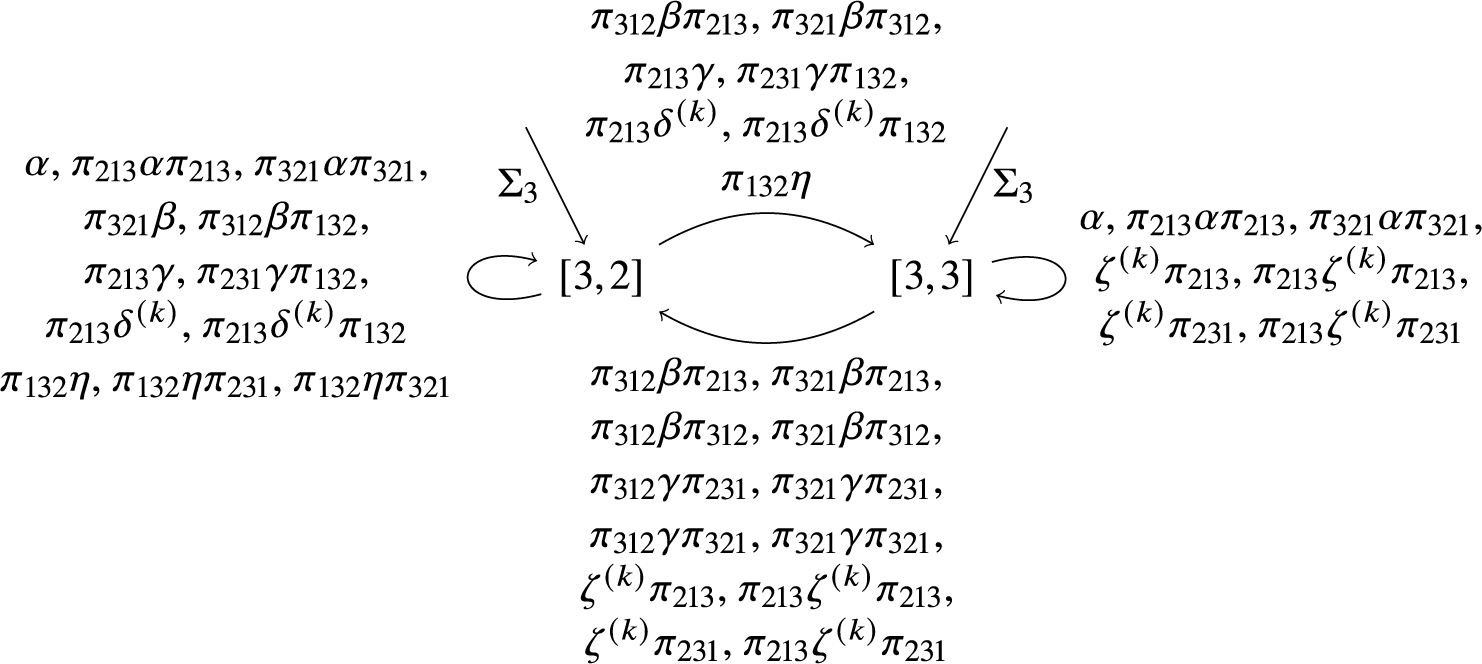
that labels a path in the graph
 $\mathcal {G}$
represented in Figure 7.
We then characterize, within this graph, the well-known families of Arnoux–Rauzy shifts and of coding of regular 3-IET (Theorem 6.13). We also show that shift spaces arising from the Cassaigne MCF are never Arnoux–Rauzy shifts, nor codings of regular 3-IET (Proposition 6.14). Observe that minimal ternary dendric shifts have factor complexity
 $2n+1$
and another S-adic characterization could be deduced from [Reference LeroyLer14]. This other S-adic characterization would also involve a labeled graph, but with nine vertices.
Observe that we do not focus only on the ternary case. We investigate the
 $\mathcal {S}$
-adic representations of minimal dendric shifts over any alphabet obtained when considering derivation by return words to letters. We for instance show that when taking the image Y of a shift space X under a morphism in
 $\mathcal {S}$
, the extension graphs of long enough factors of Y are the image of the extension graph of factors of X under some graph homomorphism (Proposition 4.7). This allows us to introduce the notion of dendric preserving morphism for X which is the fundamental notion for the construction of the graph
 $\mathcal {G}$
. We also characterize the morphisms
 $\sigma $
of
 $\mathcal {S}$
that are dendric preserving for all X using Arnoux–Rauzy morphisms (Proposition 4.11).
The paper is organized as follows. We start by giving, in §2, the basic definitions for the study of shift spaces. We introduce the notion of extension graph of a word, of dendric shift, and of
 $\mathcal {S}$
-adic representation of a shift space.
In §3, we recall the existence of an
 $\mathcal {S}$
-adic representation using return words for minimal shift spaces (Theorem 3.1) and the link between return words and Rauzy graph.
In §4, we then study the relation between words in a shift space and in its image by a strongly left proper morphism (Proposition 4.1). We deduce from it a link between the extension graphs (Proposition 4.7) using graph morphisms, and we prove that the injective and strongly left proper morphisms that preserve dendricity can be characterized using Arnoux–Rauzy morphisms (Proposition 4.11).
In §5, we study the notions and results of §4 in the case of a ternary alphabet. We then prove the main result of this paper (Theorem 1.1) which gives an
 $\mathcal {S}$
-adic characterization of ternary minimal dendric shifts using infinite paths in a graph.
Finally, in §6, we focus on three sub-families of dendric shifts: Arnoux–Rauzy shifts, interval exchanges, and Cassaigne shifts. For interval exchanges, we first recall the associated definitions and basic properties, then provide an
 $\mathcal {S}$
-adic characterization (Theorem 6.13) in the ternary case using a subgraph of the graph obtained in the dendric case. We also prove that the families of Cassaigne shifts, of Arnoux–Rauzy shifts, and of regular interval exchanges are disjoint.
2 Preliminaries
2.1 Words, languages, and shift spaces
Let
 $\mathcal {A}$
be a finite alphabet of cardinality
 $d \geq 2$
. Let us denote by
 $\varepsilon $
the empty word of the free monoid
 $\mathcal {A}^*$
(endowed with concatenation), and by
 $\mathcal {A}^{{\mathbb {Z}}}$
the set of bi-infinite words over
 $\mathcal {A}$
. For a word
 $w= w_{1} \cdots w_{\ell } \in \mathcal {A}^\ell $
, its length is denoted
 $|w|$
and equals
 $\ell $
. We say that a word u is a factor of a word w if there exist words
 $p,s$
such that
 $w = pus$
. If
 $p = \varepsilon $
(respectively,
 $s = \varepsilon $
) we say that u is a prefix (respectively, suffix) of w. For a word
 $u \in \mathcal {A}^{*}$
, an index
 $ 1 \le j \le \ell $
such that
 $w_{j}\cdots w_{j+|u|-1} =u$
is called an occurrence of u in w and we use the same term for bi-infinite word in
 $\mathcal {A}^{{\mathbb {Z}}}$
. The number of occurrences of a word
 $u \in \mathcal {A}^*$
in a finite word w is denoted as
 $|w|_u$
.
The set
 $\mathcal {A}^{{\mathbb {Z}}}$
endowed with the product topology of the discrete topology on each copy of
 $\mathcal {A}$
is topologically a Cantor set. The shift map S defined by
 $S ( (x_n)_{n \in \mathbb {Z}} ) = (x_{n+1})_{n \in \mathbb {Z}}$
is a homeomorphism of
 $\mathcal {A}^{{\mathbb {Z}}}$
. A shift space is a pair
 $(X,S)$
where X is a closed shift-invariant subset of some
 $\mathcal {A}^{{\mathbb {Z}}}$
. It is thus a topological dynamical system. It is minimal if the only closed shift-invariant subset
 $Y \subset X$
is
 $\emptyset $
and X. Equivalently,
 $(X,S)$
is minimal if and only if the orbit of every
 $x \in X$
is dense in X. Usually we say that the set X is itself a shift space.
The language of a sequence
 $x \in \mathcal {A}^{{\mathbb {Z}}}$
is its set of factors and is denoted
 $\mathcal {L}(x)$
. For a shift space X, its language
 $\mathcal {L}(X)$
is
 $\cup _{x\in X} \mathcal {L}(x)$
and we set
 $\mathcal {L}_n(X) = \mathcal {L}(X) \cap \mathcal {A}^n$
,
 $n \in {\mathbb {N}}$
. Its factor complexity is the function
 $p_X:{\mathbb {N}} \to {\mathbb {N}}$
defined by
 $p_X(n) = \#\mathcal {L}_n(X)$
. We say that a shift space X is over
 $\mathcal {A}$
if
 $\mathcal {L}_1(X) = \mathcal {A}$
.
2.2 Extension graphs and dendric shifts
Dendric shifts are defined with respect to combinatorial properties of their language expressed in terms of extension graphs. Let F be a set of finite words on the alphabet
 $\mathcal {A}$
which is factorial, that is, if
 $u \in F$
and v is a factor of u, then
 $v \in F$
. For
 $w \in F$
, we define the sets of left, right, and bi-extensions of w by
 $$ \begin{align*} E_F^-(w) &= \{ a \in \mathcal{A} \mid aw \in F\}; \\ E_F^+(w) &= \{ b \in \mathcal{A} \mid wb \in F\}; \\ E_F(w) &= \{ (a,b) \in \mathcal{A} \times \mathcal{A} \mid awb \in F\}. \end{align*} $$
The elements of
 $E_F^-(w)$
,
 $E_F^+(w)$
, and
 $E_F^-(w)$
are respectively called the left extensions, the right extensions, and the bi-extensions of w in F. If X is a shift space over
 $\mathcal {A}$
, we will use the terminology extensions in X instead of extensions in
 $\mathcal {L}(X)$
and the index
 $\mathcal {L}(X)$
will be replaced by X or even omitted if the context is clear. Observe that as
 $X \subset \mathcal {A}^{\mathbb {Z}}$
, the set
 $E_X(w)$
completely determines
 $E_X^-(w)$
and
 $E_X^+(w)$
. A word w is said to be right special (respectively, left special) if
 $\#(E^+(w))\geq 2$
(respectively,
 $\#(E^-(w)) \geq 2$
). It is bispecial if it is both left and right special. The factor complexity of a shift space is completely governed by the extensions of its special factors. In particular, we have the following result.
Proposition 2.1. (Cassaigne and Nicolas [Reference Cassaigne and NicolasCN10])
Let X be a shift space. For all n, we have
 $$ \begin{align*} p_X(n+1)-p_X(n) &= \sum_{w \in \mathcal{L}_n(X)} (\#E^+(w)-1) \\ &= \sum_{w \in \mathcal{L}_n(X)} (\#E^-(w)-1). \end{align*} $$
In addition, if for every bispecial factor
 $w \in \mathcal {L}(X)$
, one has
 $$ \begin{align} \#E(w) - \# E^-(w) - \# E^+(w) + 1 = 0, \end{align} $$
then
 $p_X(n) = (p_X(1)-1)n +1$
for every n.
A classical family of bispecial factors satisfying (2.1) is made of the ordinary bispecial factors that are defined by
 $E(w) \subset (\{a\} \times \mathcal {A}) \cup (\mathcal {A} \times \{b\})$
for some
 $(a,b) \in E(w)$
. A larger family of bispecial factors also satisfying (2.1) are the dendric bispecial factors defined below.
For a word
 $w \in F$
, we consider the undirected bipartite graph
 $\mathcal {E}_F(w)$
called its extension graph with respect to F and defined as follows: its set of vertices is the disjoint union of
 $E_F^-(w)$
and
 $E_F^+(w)$
and its edges are the pairs
 $(a,b) \in E_F^-(w) \times E_F^+(w)$
such that
 $awb \in F$
. For an illustration, see Example 2.2 below. We say that w is dendric if
 $\mathcal {E}(w)$
is a tree. We then say that a shift space X is a dendric shift if all its factors are dendric in
 $\mathcal {L}(X)$
. Note that every non-bispecial word and every ordinary bispecial word is trivially dendric. In particular, the Arnoux–Rauzy shift spaces are dendric (recall that Arnoux–Rauzy shift spaces are the minimal shift spaces having exactly one left-special factor
 $u_n$
and one right-special factor
 $v_n$
of each length n and such that
 $E^-(u_n) = \mathcal {A} = E^+(v_n)$
; all bispecial factors of an Arnoux–Rauzy shift are ordinary). By Proposition 2.1, we deduce that any dendric shift has factor complexity
 $p_X(n) = (p_X(1)-1)n +1$
for every n.
Example 2.2. Let
 $\sigma $
be the Fibonacci substitution defined over the alphabet
 $\{0,1\}$
by
 $\sigma \colon 0 \mapsto 01, 1 \mapsto 0$
and consider the shift space generated by
 $\sigma $
(that is, the set of bi-infinite words over
 $\{0,1\}$
whose factors are factors of some
 $\sigma ^n (0)$
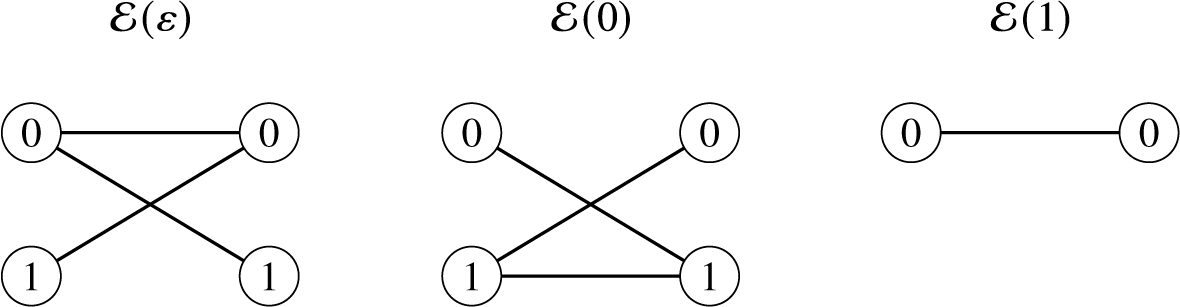
). The extension graphs of the empty word and of the two letters
 $0$
and
 $1$
are represented in Figure 1.
The extension graphs of
 $\varepsilon $
(a),
 $0$
(b) and
 $1$
(c) are trees.

2.3
 $\mathcal {S}$
-adicity

Let
 $\mathcal {A}, \mathcal {B}$
be finite alphabets with cardinality at least 2. By a morphism
 $\sigma :\mathcal {A}^* \to \mathcal {B}^*$
, we mean a non-erasing monoid homomorphism (also called a substitution when
 $\mathcal {A} = \mathcal {B}$
). By non-erasing, we mean that the image of any letter is a non-empty word. We stress the fact that all morphisms are assumed to be non-erasing in the following. Using concatenation, we extend
 $\sigma $
to
 $\mathcal {A}^{\mathbb {N}}$
and
 $\mathcal {A}^{\mathbb {Z}}$
. In particular, if X is a shift space over
 $\mathcal {A}$
, the image of X under
 $\sigma $
is the shift space
 $$ \begin{align*} Y = \{S^k \sigma(x) \mid x \in X, 0\leq k < |\sigma(x_0)|\}. \end{align*} $$
The incidence matrix of
 $\sigma $
is the matrix
 $M_{\sigma } \in \mathbb {N}^{\mathcal {B} \times \mathcal {A}}$
such that
 $(M_{\sigma })_{b,a} = |\sigma (a)|_b$
for any
 $a \in \mathcal {A}$
,
 $b \in \mathcal {B}$
.
The morphism
 $\sigma $
is said to be left proper (respectively, right proper) when there exists a letter
 $\ell \in \mathcal {B}$
such that for all
 $a \in \mathcal {A}$
,
 $\sigma (a)$
starts with
 $\ell $
(respectively, ends with
 $\ell $
). It is strongly left proper (respectively, strongly right proper) if it is left proper (respectively, right proper) and the starting letter (respectively, ending letter)
 $\ell $
only occurs once in each image
 $\sigma (a)$
,
 $a \in \mathcal {A}$
. It is said to be proper if it is both left and right proper. With a left proper morphism
 $\sigma :\mathcal {A}^* \to \mathcal {B}^*$
with first letter
 $\ell $
, we associate a right proper morphism
 $\bar {\sigma }:\mathcal {A}^* \to \mathcal {B}^*$
by
 $$ \begin{align*} \sigma(a)\ell = \ell \bar{\sigma}(a) \quad \text{for all}\ \ a \in \mathcal{A}. \end{align*} $$
Let
 ${\boldsymbol {\sigma }} = (\sigma _n : \mathcal {A}_{n+1}^* \to \mathcal {A}_n^*)_{n \geq 1}$
be a sequence of morphisms such that
 $ \max _{a \in \mathcal {A}_n} |\sigma _1 \circ \cdots \circ \sigma _{n-1}(a)| $
goes to infinity when n increases. We assume that all the alphabets
 $\mathcal {A}_{n}$
are minimal, in the sense that for all
 $n \in \mathbb {N}$
and
 $b \in \mathcal {A}_{n}$
, there exists
 $a \in \mathcal {A}_{n+1}$
such that b is a factor of
 $\sigma _n(a)$
. For
 $1\leq n<N$
, we define the morphism
 $\sigma _{[n,N)} = \sigma _n \circ \sigma _{n+1} \circ \cdots \circ \sigma _{N-1}$
. For
 $n\geq 1$
, the language
 $\mathcal {L}^{(n)}({{\boldsymbol {\sigma }}})$
of level n associated with
 ${\boldsymbol {\sigma }}$
is defined by
 $$ \begin{align*} \mathcal{L}^{(n)}({{\boldsymbol{\sigma}}}) = \{ w \in \mathcal{A}_n^* \mid w\ \mbox{occurs in}\ \sigma_{[n,N)}(a)\ \mbox{for some}\ a \in \mathcal{A}_N\ \mbox{and}\ N>n \}. \end{align*} $$
As
 $\max _{a \in \mathcal {A}_n} |\sigma _{[1,n)}(a)|$
goes to infinity when n increases,
 $\mathcal {L}^{(n)}({{\boldsymbol {\sigma }}})$
defines a non-empty shift space
 $X_{{\boldsymbol {\sigma }}}^{(n)}$
that we call the shift space generated by
 $\mathcal {L}^{(n)}({{\boldsymbol {\sigma }}})$
. More precisely,
 $X_{{\boldsymbol {\sigma }}}^{(n)}$
is the set of points
 $x \in \mathcal {A}_n^{\mathbb {Z}}$
such that
 $\mathcal {L} (x) \subseteq \mathcal {L}^{(n)}({{\boldsymbol {\sigma }}})$
. Note that it may happen that
 $\mathcal {L}(X_{{\boldsymbol {\sigma }}}^{(n)})$
is strictly contained in
 $\mathcal {L}^{(n)}({{\boldsymbol {\sigma }}})$
. Also observe that for all n,
 $X_{{\boldsymbol {\sigma }}}^{(n)}$
is the image of
 $X_{{\boldsymbol {\sigma }}}^{(n+1)}$
under
 $\sigma _n$
.
We set
 $\mathcal {L}({{\boldsymbol {\sigma }}}) = \mathcal {L}^{(1)}({{\boldsymbol {\sigma }}})$
,
 $X_{{\boldsymbol {\sigma }}} = X_{{\boldsymbol {\sigma }}}^{(1)}$
, and call
 $X_{{\boldsymbol {\sigma }}}$
the
 $\mathcal {S}\kern-0.5pt$
-adic shift generated by the directive sequence
 ${\boldsymbol {\sigma }}$
. We also say that the directive sequence
 ${\boldsymbol {\sigma }}$
is an
 $\mathcal {S}\!$
-adic representation of
 $X_{{\boldsymbol {\sigma }}}$
.
We say that
 ${\boldsymbol {\sigma }}$
is primitive if, for any
 $n\geq 1$
, there exists
 $N>n$
such that for all
 $(a,b) \in \mathcal {A}_n \times \mathcal {A}_N$
, a occurs in
 $\sigma _{[n,N)}(b)$
. Observe that if
 ${\boldsymbol {\sigma }}$
is primitive, then
 $\min _{a \in \mathcal {A}_n} |\sigma _{[1,n)}(a)|$
goes to infinity when n increases,
 $\mathcal {L}(X_{{\boldsymbol {\sigma }}}^{(n)})= \mathcal {L}^{(n)}({{\boldsymbol {\sigma }}})$
, and
 $X_{{\boldsymbol {\sigma }}}^{(n)}$
is a minimal shift space (see for instance [Reference DurandDur00, Lemma 7]).
We say that
 ${\boldsymbol {\sigma }}$
is ((strongly) left, (strongly) right) proper whenever each morphism
 $\sigma _n$
is ((strongly) left, (strongly) right) proper. We also say that
 ${\boldsymbol {\sigma }}$
is injective if each morphism
 $\sigma _n$
is injective (seen as an application from
 $\mathcal {A}_{n+1}^*$
to
 $\mathcal {A}_n^*$
). By abuse of language, we say that a shift space is a (strongly left or right proper, primitive, injective)
 $\mathcal {S}$
-adic shift if there exists a (strongly left or right proper, primitive, injective) sequence of morphisms
 ${\boldsymbol {\sigma }}$
such that
 $X = X_{{\boldsymbol {\sigma }}}$
.
3
$\mathcal {S}$
-adicity using return words and shapes of Rauzy graphs

3.1
$\mathcal {S}$
-adicity using return words and derived shifts

Let X be a minimal shift space over the alphabet
 $\mathcal {A}$
and let
 $w \in \mathcal {L}(X)$
be a non-empty word. A return word to w in X is a non-empty word r such that w is a prefix of
 $rw$
and,
 $rw \in \mathcal {L}(X)$
and
 $rw$
contains exactly two occurrences of w (one as a prefix and one as a suffix). We let
 $\mathcal {R}_X(w)$
denote the set of return words to w in X and we omit the subscript X whenever it is clear from the context. The shift space X being minimal,
 $\mathcal {R}(w)$
is always finite.
Let
 $w \in \mathcal {L}(X)$
be a non-empty word and write
 $R_X(w) = \{1,\ldots ,\#(\mathcal {R}_X(w))\}$
. A morphism
 $\sigma : {R(w)}^* \to \mathcal {A}^*$
is a coding morphism associated with w if
 $\sigma (R(w)) = \mathcal {R}(w)$
. It is trivially injective. Let us consider the set
 $\mathcal {D}_w(X) = \{x \in {R(w)}^{\mathbb {Z}} \mid \sigma (x) \in X\}$
. It is a minimal shift space, called the derived shift of X (with respect to w). We now show that derivation of minimal shift spaces allows to build left proper and primitive
 $\mathcal {S}$
-adic representations. We inductively define the sequences
 $(a_n)_{n \geq 1}$
,
 $(R_n)_{n \geq 1}$
,
 $(X_n)_{n \geq 1}$
, and
 $(\sigma _n)_{n \geq 1}$
by:
-
•
$X_1 = X$
,
$R_1 = \mathcal {A}$
and
$a_1 \in \mathcal {A}$
; -
• for all n,
$R_{n+1} = R_{X_{n}}(a_n)$
,
$\sigma _n: R_{n+1}^* \to R_n^*$
is a coding morphism associated with
$a_n$
,
$X_{n+1} = \mathcal {D}_{a_n}(X_n)$
and
$a_{n+1} \in R_{n+1}$
.


Observe that the sequence
 $(a_n)_{n \geq 1}$
is not uniquely defined as well as the morphism
 $\sigma _n$
(even if
 $a_n$
is fixed). However, to avoid heavy considerations when we deal with sequences of morphisms obtained in this way, we will speak about ‘the’ sequence
 $(\sigma _n)_{n \geq 1}$
and it is understood that we may consider any such sequence. Also observe that as we consider derived shifts with respect to letters, each coding morphism
 $\sigma _n$
is strongly left proper. It is furthermore a characterization: a morphism
 $\sigma :\{1,\ldots ,n\}^* \to \mathcal {A}^*$
is injective and strongly left proper (with first letter
 $\ell $
) if and only if there is a shift space X over
 $\mathcal {A}$
such that
 $\sigma $
is a coding morphism associated with
 $\ell $
.
Theorem 3.1. (Durand [Reference DurandDur98])
Let X be a minimal shift space. Using the notation defined above, the sequence of morphisms
 ${\boldsymbol {\sigma }} = (\sigma _n:R_{n+1}^* \to R_n^*)_{n \geq 1}$
is a strongly left proper, primitive, and injective
 $\mathcal {S}$
-adic representation of X. In particular, for all n, we have
 $X_n = X_{{\boldsymbol {\sigma }}}^{(n)}$
.
In the case of minimal dendric shifts, the
 $\mathcal {S}$
-adic representation
 ${\boldsymbol {\sigma }}$
can be made stronger. This is summarized by the following result. Recall that if
 $F_{\mathcal {A}}$
is the free group generated by
 $\mathcal {A}$
, an automorphism
 $\alpha $
of
 $F_{\mathcal {A}}$
is tame if it belongs to the monoid generated by the permutations of
 $\mathcal {A}$
and by the elementary automorphisms
 $$ \begin{align*} \begin{cases} a \mapsto ab, \\ c \mapsto c & \text{for } c \neq a, \end{cases} \quad \text{and} \quad \begin{cases} a \mapsto ba, \\ c \mapsto c & \text{for } c \neq a. \end{cases} \end{align*} $$
Theorem 3.2. (Berthé et al [Reference Berthé, De Felice, Dolce, Leroy, Perrin, Reutenauer and RindoneBDFD+15c])
Let X be a minimal dendric shift over the alphabet
 $\mathcal {A} = \{1,\ldots ,d\}$
. For any
 $w \in \mathcal {L}(X)$
,
 $\mathcal {D}_w(X)$
is a minimal dendric shift over
 $\mathcal {A}$
and the coding morphism associated with w is a tame automorphism of
 $F_{\mathcal {A}}$
. As a consequence, if
 ${\boldsymbol {\sigma }} = (\sigma _n)_{n \geq 1}$
is the primitive directive sequence of Theorem 3.1, then all morphisms
 $\sigma _n$
are strongly left proper tame automorphisms of
 $F_{\mathcal {A}}$
.
3.2 Rauzy graphs
Let X be a shift space over an alphabet
 $\mathcal {A}$
. The Rauzy graph of order n of X, is the directed graph
 $G_n(X)$
whose set of vertices is
 $\mathcal {L}_n(X)$
and there is an edge from u to v if there are letters
 $a,b$
such that
 $ub = av \in \mathcal {L}(X)$
; this edge is sometimes labeled by a.
Assuming that X is minimal, any Rauzy graph
 $G_n(X)$
is strongly connected. It is also easily seen that any return word to a non-empty word
 $w \in \mathcal {L}(X)$
labels a path from w to w in
 $G_{|w|}(X)$
in which no internal vertex is w. As a consequence, the shape of the Rauzy graph
 $G_1(X)$
provides restrictions on the possible return words to a letter a in X. Furthermore, for the extension graph of the empty word having for edges the pairs
 $(a,b) \in E_X(\varepsilon )$
, it completely determines
 $\mathcal {L}_2(X)$
, and hence the Rauzy graph
 $G_1(X)$
. Therefore, the extension graph
 $\mathcal {E}_X(\varepsilon )$
provides restrictions on the possible return words to letters in X.
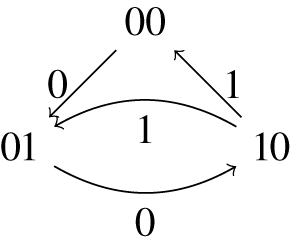
Example 3.3. The Rauzy graph of order two of the shift space X generated by the Fibonacci substitution is given in Figure 2. The word
 $00100$
belongs to
 $\mathcal {L}(X)$
, so that
 $001$
is a return word to
 $00$
and it labels the circuit
 $(00,01,10,00)$
. The converse however does not hold, that is, there might exist paths from w to w whose label is not a return word. For any
 $n \geq 1$
, the word
 $0(01)^n$
labels a path from
 $00$
to
 $00$
but does not belong to
 $\mathcal {L}(X)$
when
 $n \geq 3$
.
Rauzy graph of order two for the Fibonacci shift.

4 Bispecial factors in
$\mathcal {S}$
-adic shifts

4.1 Description of bispecial factors in injective strongly left proper
$\mathcal {S}$
-adic shifts

Our aim is to describe bispecial factors and their bi-extensions in an
 $\mathcal {S}$
-adic shift
 $X_{\boldsymbol {\sigma }}$
. A classical way to do this is to ‘desubstitute’ a bispecial factor u, that is, to find the set of ‘minimal’ factors
 $v_i$
in
 $\mathcal {L}(X_{\boldsymbol {\sigma }}^{(k)})$
such that u is a factor of the words
 $\sigma _{[1,k)}(v_i)$
and then to deduce the extensions of u from those of the
 $v_i$
. The set of such
 $v_i$
can be easily described when
 ${\boldsymbol {\sigma }}$
is an injective and strongly left proper sequence of morphisms.
Proposition 4.1. Let X be a shift space over
 $\mathcal {A}$
,
 $\sigma :\mathcal {A}^* \to \mathcal {B}^*$
be an injective and strongly left proper morphism (with first letter
 $\ell $
), Y the image of X under
 $\sigma $
, and u a non-empty word in
 $\mathcal {L}(Y)$
. If
 $\ell $
does not occur in u, then there exists
 $b \in \mathcal {A}$
such that u is a non-prefix factor of
 $\sigma (b)$
. Otherwise, there is a unique triplet
 $(s,v,p) \in \mathcal {B}^* \times \mathcal {L}(X) \times \mathcal {B}^*$
for which there exists a pair
 $(a,b) \in E_{X}(v)$
such that
 $u = s \sigma (v)p$
with:
-
(1) s a proper suffix of
$\sigma (a)$
; -
(2) p is a non-empty prefix of
$\sigma (b)$
.


In the case where
 $\ell $
occurs in u, the left, right, and bi-extensions of u are governed by those of v through the equation
 $$ \begin{align} E_Y(u) =\,& \{(a',b') \in \mathcal{B} \times \mathcal{B} \mid\ \text{there exists}\ \ (a,b) \in E_X(v)\nonumber\\ &:\sigma(a) \in \mathcal{B}^* a' s \wedge \sigma(b)\ell \in p b' \mathcal{B}^* \}. \end{align} $$
Proof Since u is a word in
 $\mathcal {L}(Y)$
, it is a factor of
 $\sigma (w)$
for some
 $w \in \mathcal {L}(X)$
. The word u being non-empty, any such w is non-empty as well. We say that w is covering u if u is a factor of
 $\sigma (w)$
and for any proper factor
 $w'$
of w, u is not a factor of
 $\sigma (w')$
. Recall that
 $\ell $
is the first letter of
 $\sigma (a)$
for all
 $a \in \mathcal {A}$
. Thus, if
 $|u|_\ell = 0$
, then any word w covering u is a letter and u is a non-prefix factor of
 $\sigma (w)$
.
Now assume that
 $|u|_\ell \geq 1$
and let
 $u = s u' p$
with
 $|s|_\ell = 0$
,
 $p \in \ell (\mathcal {A}\setminus \{\ell \})^*$
, and
 $u' \in \{\varepsilon \} \cup \ell \mathcal {A}^*$
. As the letter
 $\ell $
occurs only as a prefix in any image
 $\sigma (a)$
,
 $a \in \mathcal {A}$
, any word w covering u is of the form
 $x v' y$
with
 $x \in \mathcal {A} \cup \{\varepsilon \}$
and
 $y \in \mathcal {A}$
, where one has
 $\sigma (v') = u'$
, s is a suffix of
 $\sigma (x)$
(which is proper if
 $x \neq \varepsilon $
), and p is a prefix of
 $\sigma (y)$
. In particular, the triplet
 $(s,v,p)$
satisfies the requirements of the result (take
 $b = y$
and
 $a = x$
if
 $x \neq \varepsilon $
or any
 $a \in E^-(vy)$
if
 $x = \varepsilon $
).
Let us show the uniqueness of
 $(s,v,p)$
. Assume that
 $(s',v',p')$
is a triplet satisfying the requirements with the extension
 $(a',b') \in E(v')$
. As
 $u = s'\sigma (v')p'$
, where
 $s'$
is a proper suffix of
 $\sigma (a')$
and
 $p'$
is a non-empty proper prefix of
 $\sigma (b')\ell $
, we have
 $|s'|_\ell = 0$
,
 $p' \in \ell (\mathcal {A}\setminus \{\ell \})^*$
, and
 $\sigma (v') \in \{\varepsilon \} \cup \ell \mathcal {A}^*$
. This implies that
 $(s',\sigma (v'), p') = (s,\sigma (v),p)$
and, as
 $\sigma $
is injective, that
 $(s',v',p') = (s,v,p)$
.
Let us now prove (4.1). The inclusion
 $$ \begin{align*} E_Y(u) \supset\,& \{(a', b') \in \mathcal{B} \times \mathcal{B} \mid\ \text{there exists}\ \ (a,b) \in E_X(v)\\ &: \sigma(a) \in \mathcal{B}^* a' s \wedge \sigma(b)\ell \in p b' \mathcal{B}^* \} \end{align*} $$
is trivial. For the other one, assume that
 $(a',b')$
is in
 $E_Y(u)$
. Thus we have
 $a'ub' \in \mathcal {L}(Y)$
. Let
 $w \in \mathcal {L}(X)$
be a covering word for
 $a'ub'$
. By definition of v, v is a factor of w, and thus one has
 $w = xvy$
for some words
 $x,y$
. We then have
 $a'ub' = a's\sigma (v)pb'$
, with
 $a's$
a suffix of
 $\sigma (x)$
and
 $pb'$
a prefix of
 $\sigma (y)\ell $
. In particular, x and y are non-empty. Let a be the last letter of x and b be the first letter of y. We have
 $(a,b) \in E_X(v)$
and, as
 $|s|_{\ell } = 0$
, s is a proper suffix of
 $\sigma (a)$
, from which we have
 $\sigma (a) \in \mathcal {B}^* a's$
. We also have that p is a prefix of
 $\sigma (b)$
. If it is proper, then
 $pb'$
is a prefix of
 $\sigma (b)$
so that
 $\sigma (b)\ell \in pb' \mathcal {B}^*$
. Otherwise,
 $p = \sigma (b)$
, y has length at least 2, and
 $b'$
is the first letter of
 $\sigma (c)$
, where c is such that
 $bc$
is a prefix of y. Otherwise stated,
 $b' = \ell $
and we indeed have
 $\sigma (b)\ell \in pb'\mathcal {B}^*$
.
Motivated by the previous result, if X is a shift space over
 $\mathcal {A}$
and
 $\sigma :\mathcal {A}^* \to \mathcal {B}^*$
is a strongly left proper morphism (with first letter
 $\ell $
), then for any words
 $v \in \mathcal {L}(X)$
and
 $x,y \in \mathcal {B}^*$
, we define the sets
 $$ \begin{align*} E_{X,x}^-(v) &= \{ a \in E_X^-(v) \mid \sigma(a) \in \mathcal{B}^* x \}, \\ E_{X,y}^+(v) &= \{ b \in E_X^+(v) \mid \sigma(b)\ell \in y \mathcal{B}^* \}, \\ E_{X,x,y}(v) &= E_X(v) \cap (E_{X,x}^-(v) \times E_{X,y}^+(v)). \end{align*} $$
Thus (4.1) can be written as
 $$ \begin{align*} E_Y(u) = \{(a',b') \in \mathcal{B} \times \mathcal{B} \mid\ \text{there exists}\ (a,b) \in E_{X,a's,pb'}(v) \}. \end{align*} $$
Remark 4.2. Observe that, as we have seen in the previous proof (and using the same notation), as s is a proper suffix of
 $\sigma (a)$
, the letter
 $\ell $
does not occur in it. As a consequence, for any
 $a' \in E^-_{X,s}(v)$
, s is a proper suffix of
 $\sigma (a')$
.
Whenever u and v are as in the previous proposition with
 $|u|_\ell \geq 1$
, the word v is called the antecedent of u under
 $\sigma $
and u is said to be an extended image of v. Thus, the antecedent is defined only for words containing an occurrence of the letter
 $\ell $
and an extended image always contains an occurrence of
 $\ell $
. Whenever u is a bispecial factor, the next result gives additional information about s and p. We first need to define the following notation. If
 $\sigma : \mathcal {A}^* \rightarrow \mathcal {B}^*$
is a morphism and
 $a_1, a_2 \in \mathcal {A}$
, let us denote by
 $s(a_1,a_2)$
(respectively,
 $p(a_1,a_2)$
) the longest common suffix (respectively, prefix) between
 $\sigma (a_1)$
and
 $\sigma (a_2)$
.
Corollary 4.3. Let X be a shift space over
 $\mathcal {A}$
,
 $\sigma :\mathcal {A}^* \to \mathcal {B}^*$
be an injective and strongly left proper morphism (with first letter
 $\ell $
), Y the image of X under
 $\sigma $
, and v a word in
 $\mathcal {L}(X)$
. A word u is a bispecial extended image of v if and only if there exist
 $(a_1,b_1),(a_2,b_2) \in E_X(v)$
with
 $a_1 \neq a_2$
,
 $b_1 \neq b_2$
, and
 $u = s(a_1,a_2) \sigma (v) p(b_1,b_2)$
. In particular, the antecedent v of a bispecial word u is bispecial.
Proof First assume that there exist
 $(a_1,b_1),(a_2,b_2) \in E_X(v)$
with
 $a_1 \neq a_2$
,
 $b_1 \neq b_2$
, and
 $u = s(a_1,a_2) \sigma (v) p(b_1,b_2)$
. Let us fix
 $s = s(a_1,a_2)$
and
 $p = p(b_1,b_2)$
. Since
 $\sigma $
is injective,
 $\sigma (a_1) \neq \sigma (a_2)$
, and hence s is a proper suffix of one of them. Thus, as
 $\sigma $
is strongly left proper, s does not contain any occurrence of the letter
 $\ell $
. As a consequence, s is a proper suffix of both
 $\sigma (a_1)$
and
 $\sigma (a_2)$
. In particular, u is left special. The same reasoning shows that p is a proper prefix of
 $\sigma (b_i)$
for some
 $i \in \{1,2\}$
and that u is right special, and hence bispecial. Furthermore, p is non-empty since it admits
 $\ell $
as a prefix. The pair
 $(a_i,b_i)$
thus satisfies Proposition 4.1.
Now assume that u is a bispecial extended image of v with
 $u = s \sigma (v)p$
. Since u is bispecial, there exist
 $(a_1',b_1'),(a_2',b_2') \in E_Y(u)$
with
 $a_1' \neq a_2'$
and
 $b_1' \neq b_2'$
. From 4.1, there exist
 $(a_1,b_1),(a_2,b_2) \in E_{X,s,p}(v)$
such that
 $$ \begin{align*} \sigma(a_i) \in \mathcal{B}^* a_i's \quad \text{and} \quad \sigma(b_i)\ell \in pb_i'\mathcal{B}^* \end{align*} $$
for all
 $i \in \{1,2\}$
. We deduce that
 $s = s(a_1,a_2)$
and
 $a_1 \neq a_2$
. As
 $b_1'$
and
 $b_2'$
cannot be simultaneously equal to
 $\ell $
, we deduce that
 $b_1 \neq b_2$
and that
 $p = p(b_1,b_2)$
.
Example 4.4. Consider the morphism
 $$ \begin{align*} \delta: \begin{cases} 1 \mapsto 1 \\ 2 \mapsto 123 \\ 3 \mapsto 1233 \\ \end{cases} \end{align*} $$
that will appear again in §5. Assume that v is a bispecial factor of
 $X \subset \{1,2,3\}^{\mathbb {Z}}$
whose extension graph is

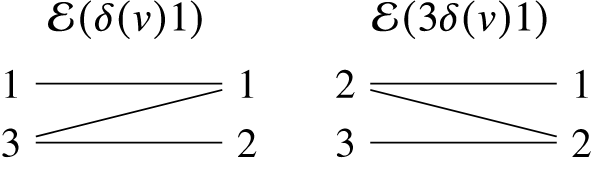
By Corollary 4.3, the word v admits
 $\delta (v) 1$
and
 $3 \delta (v) 1$
as bispecial extended images. Using Proposition 4.1, their extension graphs are given in Figure 3.
Extension graphs of the bispecial extended images of v.

Assume that
 $X_{\boldsymbol {\sigma }}$
is an
 $\mathcal {S}$
-adic shift where the directive sequence
 ${\boldsymbol {\sigma }} = (\sigma _n:\mathcal {A}_{n+1}^* \to \mathcal {A}_n^*)_{n \geq 1}$
is primitive and contains only strongly left proper injective morphisms. The directive sequence
 ${\boldsymbol {\sigma }}$
being primitive, the sequence
 $(\min _{a \in \mathcal {A}_n} |\sigma _{[1,n)}(a)|)_{n \geq 1}$
goes to infinity. Hence, iterating Proposition 4.1, with any word
 $u \in \mathcal {L}(X_{\boldsymbol {\sigma }})$
, one can associate a unique finite sequence
 $(u_1,u_2,\ldots ,u_k)$
such that
 $u_1 = u$
,
 $u_k \in \mathcal {L}(X_{\boldsymbol {\sigma }}^{(k)})$
does not have any antecedent under
 $\sigma _k$
and, for
 $i <k$
,
 $u_{i+1} \in \mathcal {L}(X_{\boldsymbol {\sigma }}^{(i+1)})$
is the antecedent of
 $u_i$
under
 $\sigma _i$
. We say that u is a descendant of each
 $u_i$
,
 $1 \leq i \leq k$
, and, reciprocally, that each
 $u_i$
,
 $1 \leq i \leq k$
, is an ancestor of u. The word
 $u_k \in \mathcal {L}(X_{\boldsymbol {\sigma }}^{(k)})$
is its oldest ancestor and it is either empty or a non-prefix factor of
 $\sigma _k (b)$
for some letter
 $b \in \mathcal {A}_{k+1}$
. Observe that with our definition, u is an ancestor and a descendant of itself.
Let X be an
 $\mathcal {S}$
-adic shift with a strongly left proper and injective
 $\mathcal {S}$
-adic representation
 ${\boldsymbol {\sigma }}$
. Let u be a bispecial factor of X. From Corollary 4.3, all ancestors of u are bispecial factors of some
 $X_{\boldsymbol {\sigma }}^{(k)}$
. From Proposition 4.1, the extensions of u are completely governed by those of its oldest ancestor. More precisely, we have the following direct corollary.
Corollary 4.5. For all
 $k \geq 1$
, there is a finite number of bispecial factors of
 $X_{\boldsymbol {\sigma }}^{(k)}$
that do not have an antecedent under
 $\sigma _k$
. They are called initial bispecial factors of order k. Furthermore, for any bispecial factor u of X, there is a unique
 $k \geq 1$
and a unique initial bispecial factor
 $v\in \mathcal {L}(X_{\boldsymbol {\sigma }}^{(k)})$
such that u is a descendant of v. Finally,
 $\mathcal {E}_X(u)$
depends only on
 $\mathcal {E}_{X_{\boldsymbol {\sigma }}^{(k)}}(v)$
, that is, if Y is a shift space such that
 $\mathcal {E}_{Y}(v) = \mathcal {E}_{X_{\boldsymbol {\sigma }}^{(k)}}(v)$
and if Z is the image of Y under
 $\sigma _{[1,k)}$
, then
 $\mathcal {E}_Z(u) = \mathcal {E}_X(u)$
.
4.2 Action of morphisms on extension graphs
Proposition 4.1 shows that whenever v is the antecedent of u under
 $\sigma $
, the extension graph
 $\mathcal {E}_Y(u)$
is the image under a graph morphism of a subgraph of
 $\mathcal {E}_X(v)$
(where by subgraph we mean the subgraph generated by a subset of edges). In particular, if
 $\#(E^-_Y(u)) = \#(E^-_X(v))$
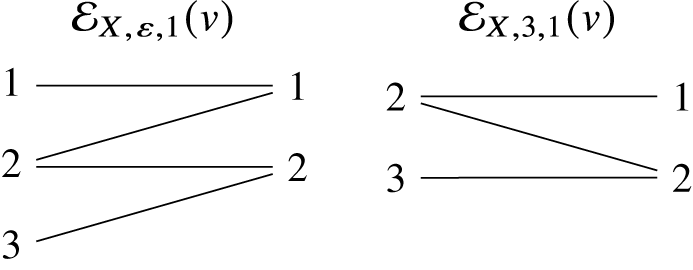
and
 $\#(E^+_Y(u)) = \#(E^+_X(v))$
, then
 $\mathcal {E}_Y(u)$
and
 $\mathcal {E}_X(v)$
are isomorphic. In this section, we formalize this observation and study the behavior of a tree structure when we consider the extension graphs of bispecial extended images.
In this section, X is a shift space over
 $\mathcal {A}$
,
 $\sigma :\mathcal {A}^* \to \mathcal {B}^*$
an injective and strongly left proper morphism (with first letter
 $\ell $
), Y the image of X under
 $\sigma $
, and v a bispecial word in
 $\mathcal {L}(X)$
. By Corollary 4.3, the bispecial extended images of v under
 $\sigma $
are the words u of the form
 $s \sigma (v) p$
where
 $s=s(a_1,a_2)$
and
 $p=p(b_1,b_2)$
for some
 $(a_1,b_1),(a_2,b_2) \in E_X(v)$
such that
 $a_1 \neq a_2$
and
 $b_1 \neq b_2$
. For any such
 $\sigma $
and v, we introduce the following notation:
 $$ \begin{align*} \mathcal {T}^{\kern1.5pt-}(\sigma) &= \{s(a_1,a_2) \mid a_1, a_2 \in \mathcal{A}, a_1 \neq a_2\}; \\ \mathcal {T}^{\kern1.5pt+}(\sigma) &= \{p(b_1,b_2) \mid b_1, b_2 \in \mathcal{A}, b_1 \neq b_2\}; \\ \mathcal {T}^{\kern1.5pt-}_v(\sigma) &= \{s(a_1,a_2) \mid a_1,a_2 \in E^-_{X}(v), a_1 \neq a_2\}; \\ \mathcal {T}^{\kern1.5pt+}_v(\sigma) &= \{p(b_1,b_2) \mid b_1,b_2 \in E^+_{X}(v), b_1 \neq b_2\}; \\ \overline{\mathcal {T}^{\kern1.5pt-}_v(\sigma)} &= \mathcal {T}^{\kern1.5pt-}_v(\sigma) \cup \sigma(E_X^-(v));\\ \overline{\mathcal {T}^{\kern1.5pt+}_v(\sigma)} &= \mathcal {T}^{\kern1.5pt+}_v(\sigma) \cup \sigma(E_X^+(v)) \ell. \end{align*} $$
The prefix strict order (respectively, suffix strict order) defines a tree structure called radix tree on
 $\overline {\mathcal{T}^{\kern1.5pt+}_v(\sigma )}$
(respectively, on
 $\overline {\mathcal {T}^{\kern1.5pt-}_v(\sigma )}$
), where the root
 $p_0$
(respectively,
 $s_0$
) is the shortest word of the set. In particular,
 $E^-_{X,s_0}(v) = E^-_X(v)$
and
 $E^+_{X,p_0}(v) = E^+_X(v)$
. Furthermore, the leafs of
 $\overline {\mathcal{T}^{\kern1.5pt+}_v(\sigma )}$
(respectively,
 $\overline {\mathcal {T}^{\kern1.5pt-}_v(\sigma )}$
) are exactly the elements of
 $\sigma (E_X^+(v)) \ell $
(respectively,
 $\sigma (E_X^-(v))$
) and every internal node (that is, every element of
 $\mathcal{T}^{\kern1.5pt+}_v(\sigma )$
or
 $\mathcal {T}^{\kern1.5pt-}_v(\sigma )$
) has at least two children.
For
 $(s,p) \in \mathcal {T}^{\kern1.5pt-}_v(\sigma ) \times \mathcal{T}^{\kern1.5pt+}_v(\sigma )$
, we define the subgraph
 $\mathcal {E}_{X,s,p}(v)$
of
 $\mathcal {E}_X(v)$
whose vertices are those involved by the edges in
 $E_{X,s,p}(v)$
. Observe that the sets of left and right vertices of
 $\mathcal {E}_{X,s,p}(v)$
are respectively included in
 $E^-_{X,s}(v)$
and
 $E^+_{X,p}(v)$
. Furthermore, if
 $s'\in \overline {\mathcal {T}^{\kern1.5pt-}_v(\sigma )}$
(respectively,
 $p'\in \overline {\mathcal{T}^{\kern1.5pt+}_v(\sigma )}$
) is a child of s (respectively, of p), then
 $\mathcal {E}_{X,s',p}(v)$
(respectively,
 $\mathcal {E}_{X,s,p'}(v)$
) is a subgraph of
 $\mathcal {E}_{X,s,p}(v)$
.
Example 4.6. Using the notation from Example 4.4, we have the following radix trees:

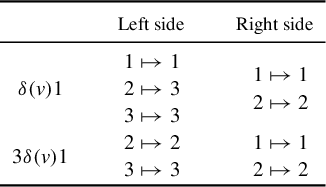
These structures help us understand the construction of the extension graphs of Figure 3. Let
 $s \in \mathcal {T}^{\kern1.5pt-}_v(\sigma )$
and
 $p \in \mathcal{T}^{\kern1.5pt+}_v(\sigma )$
be such that
 $u = s\sigma (v)p$
. The extension graph of u can be obtained from the extension graph of v as follows.
-
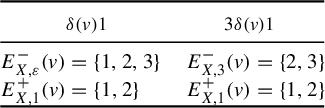
(1) Start by selecting the elements of
$E^-_{X, s}(v)$
and
$E^+_{X, p}(v)$
(see Table 1). These elements are the letters such that the corresponding leaf in
$\overline {\mathcal {T}^{\kern1.5pt-}_v(\sigma )}$
(respectively,
$\overline {\mathcal{T}^{\kern1.5pt+}_v(\sigma )}$
) is in the subtree with root s (respectively, p).Table 1Step 1.
-
(2) Take the subgraph of
$\mathcal {E}_X(v)$
with only the vertices which are in these two sets and remove the isolated vertices that were created. This gives the graph
$\mathcal {E}_{X, s, p}(v)$
(see Figure 4).Figure 4Step 2.
-
(3) For any letter
$a \in \mathcal {A}$
, merge the vertices b on the left side such that
$\sigma (b) \in \mathcal {A}^*as$
into a new left vertex labeled by a. In other words, for any left vertex b, map it to the left vertex labeled by the letter a such that the leaf corresponding to b is in the subtree whose root is the only child of s ending by
$as$
. Do the same on the right side with the vertices b such that
$\sigma (b) \ell \in pa\mathcal {A}^*$
(see Table 2).Table 2Step 3.


The next result gives a more formal description of this construction and directly follows from (4.1).
Proposition 4.7. If
 $(s,p) \in \mathcal {T}^{\kern1.5pt-}_v(\sigma ) \times \mathcal{T}^{\kern1.5pt+}_v(\sigma )$
is such that
 $u = s \sigma (v)p$
is an extended image of v, the extension graph of u is the image of
 $\mathcal {E}_{X,s,p}(v)$
under the graph morphism
 $\varphi _{v,s,p}:\mathcal {E}_{X,s,p}(v) \to \mathcal {E}_{Y}(u)$
that:
-
• for every child
$s'$
of s in
$\overline {\mathcal {T}^{\kern1.5pt-}_v(\sigma )}$
, maps all vertices of
$E^-_{X,s'}(v)$
to the left vertex with label
$a \in \mathcal {B}$
such that
$s' \in \mathcal {B}^* as$
; -
• for every child
$p'$
of p in
$\overline {\mathcal{T}^{\kern1.5pt+}_v(\sigma )}$
, maps all vertices of
$E^+_{X,p'}(v)$
to the right vertex with label
$b \in \mathcal {B}$
such that
$p' \in pb \mathcal {B}^*$
.


In particular, if
 $\mathcal {T}^{\kern1.5pt-}_v(\sigma ) = \{s_0\}$
and
 $\mathcal{T}^{\kern1.5pt+}_v(\sigma ) = \{p_0\}$
, then v has a unique bispecial extended image u and the associated morphism
 $\varphi _{v,s,p}$
is an isomorphism.
Observe that the morphism
 $\varphi _{v,s,p}$
of the previous result acts independently on the left and right vertices of
 $\mathcal {E}_{X,s,p}(v)$
, that is, it can be seen as the composition of two commuting graph morphisms
 $\varphi ^-_{v,s}$
and
 $\varphi ^+_{v,p}$
, where
 $\varphi ^-_{v,s}$
acts only on the left vertices of
 $\mathcal {E}_{X,s,p}(v)$
and
 $\varphi ^+_{v,p}$
acts only on the right vertices of
 $\mathcal {E}_{X,s,p}(v)$
. Furthermore, if a letter a belongs to
 $E^-_{X,s}(v) \cap E^-_{X,s}(v')$
(respectively, to
 $E^+_{X,p}(v) \cap E^+_{X,p}(v')$
) then
 $\varphi ^-_{v,s}(a) = \varphi ^-_{v',s}(a)$
(respectively,
 $\varphi ^+_{v,p}(a) = \varphi ^+_{v',p}(a)$
). Thus we can define partial maps
 $\varphi ^-_{s},\varphi ^+_{p}:\mathcal {A} \to \mathcal {B}$
by
 $\varphi ^-_{s}(a) = \varphi ^-_{\varepsilon ,s}(a)$
whenever
 $a \in E^-_{X,s}(\varepsilon )$
and by
 $\varphi ^+_{p}(a) = \varphi ^+_{\varepsilon ,p}(a)$
whenever
 $a \in E^+_{X,p}(\varepsilon )$
.
4.3 Stability of dendricity
In this section, we use the results and notation of the previous section to understand under which conditions a dendric bispecial factor only has dendric bispecial extended images under some morphism. We then characterize the morphisms for which every dendric bispecial factor only has dendric bispecial extended images.
If X is a shift space over
 $\mathcal {A}$
and v is a dendric bispecial factor of X, we say that an injective and strongly left proper morphism
 $\sigma :\mathcal {A}^* \to \mathcal {B}^*$
is dendric preserving for
 $v \in \mathcal {L}(X)$
if all bispecial extended images of v under
 $\sigma $
are dendric. We extend this definition by saying that a morphism is dendric preserving for a shift space X if it is dendric preserving for all
 $v \in \mathcal {L}(X)$
.
Proposition 4.8. Let X be a shift space over
 $\mathcal {A}$
and
 $v \in \mathcal {L}(X)$
be a dendric bispecial factor. An injective and strongly left proper morphism
 $\sigma :\mathcal {A}^* \to \mathcal {B}^*$
is dendric preserving for v if and only if the following conditions are satisfied:
-
(1) for every
$s \in \mathcal {T}^{\kern1.5pt-}_v(\sigma ) \setminus \{s_0\}$
,
$\mathcal {E}_{X,s,p_0}(v)$
is a tree; -
(2) for every
$p \in \mathcal{T}^{\kern1.5pt+}_v(\sigma ) \setminus \{p_0\}$
,
$\mathcal {E}_{X,s_0,p}(v)$
is a tree.


Proof Let us first assume that every bispecial extended image of v is dendric. We show condition (2), the other one being symmetric. Consider
 $p \in \mathcal{T}^{\kern1.5pt+}_v(\sigma )$
. The graph
 $\mathcal {E}_{X,s_0,p}(v)$
is a subgraph of
 $\mathcal {E}_{X}(v)$
, which is a tree. Thus,
 $\mathcal {E}_{X,s_0,p}(v)$
is acyclic. Let us show that it is connected. As there is no isolated vertex, it suffices to show that for all distinct right vertices
 $b_1,b_2$
of
 $\mathcal {E}_{X,s_0,p}(v)$
, there is a path in
 $\mathcal {E}_{X,s_0,p}(v)$
from
 $b_1$
to
 $b_2$
. Assume by contrary that there exist two right vertices
 $b_1,b_2$
of
 $\mathcal {E}_{X,s_0,p}(v)$
that are not connected.
For
 $i \in \{1,2\}$
, let
 $A_i$
denote the set of left vertices of
 $\mathcal {E}_{X,s_0,p}(v)$
that are connected to
 $b_i$
. Consider a maximal word
 $s'$
(for the suffix order) in
 $\{s(a_1,a_2) \mid a_1 \in A_1,a_2 \in A_2\}$
. Let also
 $B_i$
,
 $i \in \{1,2\}$
, denote the set of right vertices of
 $\mathcal {E}_{X,s',p}(v)$
that are connected to vertices of
 $A_i$
and consider a maximal word
 $p'$
(for the prefix order) in
 $\{p(b_1',b_2') \mid b_1' \in B_1,b_2' \in B_2\}$
. We claim that the extension graph of the bispecial extended image
 $u = s' \sigma (v) p'$
is not connected.
Let Y be the image of X under
 $\sigma $
and let
 $\varphi $
be the morphism from
 $\mathcal {E}_{X,s',p'}(v)$
to
 $\mathcal {E}_Y(u)$
given by Proposition 4.7. By maximality of
 $s'$
and
 $p'$
, the morphism
 $\varphi $
identifies two left vertices
 $a,a'$
(respectively, right vertices
 $b,b'$
) only if they belong to the same
 $A_i$
(respectively,
 $B_i$
). This implies that
 $\mathcal {E}_Y(u)$
is not connected, which is a contradiction.
Let us now show that, under the conditions (1) and (2), any bispecial extended image of v is dendric. By Corollary 4.3, the bispecial extended images of v are of the form
 $s \sigma (v) p \in \mathcal {L}(Y)$
where s is in
 $\mathcal {T}^{\kern1.5pt-}_v(\sigma )$
and p is in
 $\mathcal{T}^{\kern1.5pt+}_v(\sigma )$
.
For any such pair
 $(s, p)$
, we first show that the graph
 $\mathcal {E}_{X,s,p}(v)$
is a tree. It is trivially acyclic as it is a subgraph of
 $\mathcal {E}_{X,s,p_0}(v)$
, which is assumed to be a tree. Let us show that it is connected. Let
 $b_1,b_2$
be right vertices of
 $\mathcal {E}_{X,s,p}(v)$
. As
 $\mathcal {E}_{X,s,p}(v)$
is a subgraph of both
 $\mathcal {E}_{X,s_0,p}(v)$
and
 $\mathcal {E}_{X,s,p_0}(v)$
which are trees, there exist a path q in
 $\mathcal {E}_{X,s_0,p}(v)$
and a path
 $q'$
in
 $\mathcal {E}_{X,s,p_0}(v)$
connecting
 $b_1$
and
 $b_2$
. In particular, the right vertices occurring in q belong to
 $E^+_{X,p}(v)$
and the left vertices occurring in
 $q'$
belong to
 $E^-_{X,s}(v)$
. As
 $\mathcal {E}_{X,s_0,p}(v)$
and
 $\mathcal {E}_{X,s,p_0}(v)$
are both subgraphs of
 $\mathcal {E}_{X,s_0,p_0}(v)$
, which is a tree, the paths q and
 $q'$
coincide. It means that this path only goes through left vertices belonging to
 $E^-_{X,s}(v)$
and through right vertices belonging to
 $E^+_{X,p}(v)$
. This implies that it is a path of
 $\mathcal {E}_{X,s,p}(v)$
, and hence that
 $b_1$
and
 $b_2$
are connected in
 $\mathcal {E}_{X,s,p}(v)$
.
We now show that if
 $u = s \sigma (v)p$
is an extended image of v, then it is dendric. By Proposition 4.7,
 $\mathcal {E}_Y(u)$
is the image of
 $\mathcal {E}_{X,s,p}(v)$
under some graph morphism
 $\varphi $
, and hence it is connected. We proceed by contradiction to show that it is acyclic. Assume that
 $c = (a_1,b_1,a_2,b_2, \ldots , a_{n},b_{n},a_1)$
,
 $n \geq 2$
, is a non-trivial cycle in
 $\mathcal {E}_Y(u)$
, where
 $a_1,\ldots ,a_{n}$
are left vertices and
 $b_1,\ldots ,b_{n}$
are right vertices. Again by Proposition 4.7, for every
 $i\leq n$
, there exist
-
• a child
$s_i$
of s in
$\overline {\mathcal {T}^{\kern1.5pt-}_v(\sigma )}$
, -
• a child
$p_i$
of p in
$\overline {\mathcal{T}^{\kern1.5pt+}_v(\sigma )}$
, -
• left vertices
$a_i', a_i"$
of
$\mathcal {E}_{X,s,p}(v)$
, belonging to
$E^-_{X,s_i}(v)$
, -
• right vertices
$b_i', b_i"$
of
$\mathcal {E}_{X,s,p}(v)$
, belonging to
$E^+_{X,p_i}(v)$
,


such that
 $\varphi (a_i') = \varphi (a_i") = a_i$
,
 $\varphi (b_i') = \varphi (b_i") = b_i$
and such that the pairs
 $$ \begin{align*} & (a_j',b_j'), (a_{j+1}",b_j"), \quad j < n, \\[-3pt] & (a_n',b_n'), (a_1",b_n"),\\[-24pt] \end{align*} $$
are edges of
 $\mathcal {E}_{X,s,p}(v)$
.
Observe that as
 $\mathcal {E}_{X,s,p}(v)$
is a tree, for each
 $i\leq n$
there is a unique simple path
 $q_{i}$
from
 $a_{i}"$
to
 $a_{i}'$
and a unique simple path
 $q_i'$
from
 $b_i'$
to
 $b_i"$
. In
 $\mathcal {E}_{X,s,p}(v)$
, we thus have the circuit
 $$ \begin{align*} c' = \,&(\underbrace{a_1",\ldots,a_1'}_{q_1}, \underbrace{b_1',\ldots,b_1"}_{q_1'}, \underbrace{a_2",\ldots,a_2'}_{q_2}, \underbrace{b_2',\ldots,b_2"}_{q_2'}, \ldots,\\ &\underbrace{a_n",\ldots,a_n'}_{q_n}, \underbrace{b_n',\ldots,b_n"}_{q_n'}, a_1"). \end{align*} $$
We will now prove that the image of
 $c'$
by
 $\varphi $
reduces to the non-trivial cycle c of
 $\mathcal {E}_Y(u)$
. By reducing, we mean that we remove consecutive redundant edges, that is, every occurrence of
 $a,b,a$
in the path is replaced by a. This will imply that
 $c'$
is not trivial and contradict the fact that
 $\mathcal {E}_{X,s,p}(v)$
is a tree, which will end the proof.
As
 $\mathcal {E}_{X,s_i,p}(v)$
is a sub-tree of
 $\mathcal {E}_{X,s,p}(v)$
, the path
 $q_i$
is a path of
 $\mathcal {E}_{X,s_i,p}(v)$
, otherwise this would contradict the fact that
 $\mathcal {E}_{X,s,p}(v)$
is acyclic. In particular, the only left vertex of
 $\varphi (q_i)$
is
 $a_i$
and thus
 $\varphi (q_i)$
reduces to the length-
 $0$
path
 $a_i$
in
 $\mathcal {E}_Y(u)$
. Similarly,
 $q_i'$
is a path of
 $\mathcal {E}_{X,s,p_i}(v)$
and thus
 $\varphi (q_i')$
reduces to the length-
 $0$
path
 $b_i$
. This concludes the proof that
 $\varphi (c')$
reduces to c.
Corollary 4.9. If v is an ordinary bispecial factor of a shift space over
 $\mathcal {A}$
, then any injective and strongly left proper morphism
 $\sigma : \mathcal {A}^* \to \mathcal {B}^*$
is dendric preserving for v. In particular, the image under
 $\sigma $
of an Arnoux–Rauzy shift space over
 $\mathcal {A}$
is a minimal dendric shift.
The previous result is illustrated in the preceding examples. Indeed, for
 $\delta $
and v as in Example 4.4, we have
 $\mathcal {T}^{\kern1.5pt-}_v(\delta ) = \{3, \varepsilon \}$
and
 $\mathcal{T}^{\kern1.5pt+}_v(\delta ) = \{1\} = \{p_0\}$
. The extension graph
 $\mathcal {E}_{X,3,1}(v)$
in Figure 4 being a tree, v has only dendric bispecial extended images, as already observed in Figure 3.
Another consequence of Proposition 4.8 is given by the following corollary.
Corollary 4.10. Let
 $\sigma :\mathcal {A}^* \to \mathcal {B}^*$
be an injective and strongly left proper morphism. The following properties are equivalent.
-
(1) The sets
$\mathcal {T}^{\kern1.5pt-}(\sigma )$
and
$\mathcal{T}^{\kern1.5pt+}(\sigma )$
both only contain one element. -
(2) For any shift space X on the alphabet
$\mathcal {A}$
and any dendric bispecial factor
$v \in \mathcal {L}(X)$
,
$\sigma $
is dendric preserving for v.


Proof If
 $\mathcal {T}^{\kern1.5pt-}(\sigma ) = \{s_0\}$
and
 $\mathcal{T}^{\kern1.5pt+}(\sigma ) = \{p_0\}$
, the fact that
 $\sigma $
is dendric preserving for any dendric bispecial word v is a direct consequence of Proposition 4.8 since
 $\mathcal {T}^{\kern1.5pt-}_v(\sigma ) \subset \mathcal {T}^{\kern1.5pt-}(\sigma )$
and
 $\mathcal{T}^{\kern1.5pt+}_v(\sigma ) \subset \mathcal{T}^{\kern1.5pt+}(\sigma )$
.
To prove the other implication, let us assume that
 $s_0,s_1 \in \mathcal {T}^{\kern1.5pt-}(\sigma )$
, where
 $s_0$
is the root of
 $\mathcal {T}^{\kern1.5pt-}(\sigma )$
and
 $s_1 \neq s_0$
. Let
 $a, b$
be such that
 $s_1 = s(a, b)$
. As
 $s_0 \in \mathcal {T}^{\kern1.5pt-}(\sigma )$
, there exists c such that
 $s_1$
is not a suffix of
 $\sigma (c)$
. In particular, we have
 $\#\mathcal {A} \geq 3$
.
Let
 $a_1, \ldots , a_n$
be the elements of
 $\mathcal {A} \setminus \{a, b, c\}$
. Let us denote by X the shift space coding the interval exchange transformation represented below (for precise definitions and more details about interval exchanges, see Subsection 6.2).

The extension graph of the word
 $\varepsilon $
is given by

It is a tree and thus
 $\varepsilon $
is dendric bispecial. However, the graph
 $\mathcal {E}_{X, s_1, p_0}(\varepsilon )$
is not connected as it does not contain the vertex c on the left but both a and b are left vertices. By Proposition 4.8,
 $\sigma $
is not dendric preserving for
 $\varepsilon $
. This proves that
 $\mathcal {T}^{\kern1.5pt-}(\sigma )$
must contain exactly one element. Similarly,
 $\mathcal{T}^{\kern1.5pt+}(\sigma )$
also contains exactly one element.
The previous result characterizes injective and strongly left proper morphisms for which every dendric bispecial factor has only dendric bispecial extended images. However, the condition does not imply that the image of a dendric shift by such a morphism
 $\sigma $
is again dendric. Indeed, the result gives information only on the bispecial factors that are extended images under
 $\sigma $
, that is, that have an antecedent. The next result characterizes those morphisms
 $\sigma $
for which even the new initial bispecial factors are dendric. For any letter
 $a \in \mathcal {A}$
, let
 $\alpha _a$
and
 $\bar {\alpha }_a$
denote the so-called Arnoux–Rauzy morphisms
 $$ \begin{align*} \alpha_a(b) = \begin{cases} a & \text{ if } b = a,\\ ab & \text{ otherwise,} \end{cases} \quad \bar{\alpha}_a(b) = \begin{cases} a & \text{ if } b = a,\\ ba & \text{ otherwise.} \end{cases} \end{align*} $$
Proposition 4.11. The injective and strongly left proper morphisms preserving dendricity, that is, such that the image of any dendric shift is a dendric shift, are exactly the morphisms
 $$ \begin{align*} \bar{\alpha}_{a_1} \circ \cdots \circ \bar{\alpha}_{a_n} \circ \alpha_\ell \circ \pi \end{align*} $$
for any
 $n \geq 0$
, any
 $a_1, \ldots , a_n \in \mathcal {A} \setminus \{\ell \}$
and any permutation
 $\pi $
of
 $\mathcal {A}$
.
Proof Using Corollary 4.10, an injective and strongly left proper morphism
 $\sigma $
for the letter
 $\ell $
preserves dendricity if and only if the following conditions are satisfied:
-
(1) the sets
$\mathcal {T}^{\kern1.5pt-}(\sigma )$
and
$\mathcal{T}^{\kern1.5pt+}(\sigma )$
both only contain one element; -
(2) if
$F_\sigma $
is the set then any word
$$ \begin{align*} F_\sigma = \operatorname{\mathrm{Fac}}(\{\sigma(a)\ell : a \in \mathcal{A}\}), \end{align*} $$
$w \in F_\sigma $
such that
$|w|_\ell = 0$
is dendric in
$F_\sigma\kern-1.2pt $
.


Let
 $\sigma = \bar {\alpha }_{a_1} \circ \cdots \circ \bar {\alpha }_{a_n} \circ \alpha _\ell \circ \pi $
for
 $a_1, \ldots , a_n \in \mathcal {A} \setminus \{\ell \}$
. It is easily verified that
 $\sigma $
is injective and strongly left proper for the letter
 $\ell $
. As conditions (1) and (2) only depend on the set
 $\sigma (\mathcal {A})$
, one can assume that
 $\pi = {\textrm {id}}$
. For any letter c,
 $\ell c$
is a prefix of
 $\alpha _\ell (c) \ell $
and thus
 $$ \begin{align*} (\bar{\alpha}_{a_1} \circ \cdots \circ \bar{\alpha}_{a_n}(\ell)) c \end{align*} $$
is a prefix of
 $\sigma (c) \ell $
. This shows that
 $$ \begin{align*} \mathcal {T}^{\kern1.5pt+}(\sigma) = \{\bar{\alpha}_{a_1} \circ \cdots \circ \bar{\alpha}_{a_n}(\ell)\}. \end{align*} $$
Similarly,
 $c \ell $
is a suffix of
 $\ell \bar {\alpha }_\ell (c)$
and thus
 $$ \begin{align*} c (\alpha_{a_1} \circ \cdots \circ \alpha_{a_n} (\ell)) \end{align*} $$
is a suffix of
 $$ \begin{align*} \ell (\alpha_{a_1} \circ \cdots \circ \alpha_{a_n} \circ \bar{\alpha}_\ell(c)) = (\bar{\alpha}_{a_1} \circ \cdots \circ \bar{\alpha}_{a_n} \circ \alpha_\ell(c)) \ell = \sigma(c) \ell. \end{align*} $$
Thus
 $\mathcal {T}^{\kern1.5pt-}(\sigma )$
only contains one element and
 $\sigma $
satisfies the condition (1). To prove condition (2), let us proceed by induction on n. If
 $n = 0$
, then the only bispecial word is
 $\varepsilon $
and it is easy to verify that it is dendric. If
 $\sigma ' = \bar {\alpha }_{a_2} \circ \cdots \circ \bar {\alpha }_{a_n} \circ \alpha _\ell $
satisfies condition (2), then simple adaptions of Proposition 4.1 and of Proposition 4.8 tell us that, as
 $\bar {\alpha }_{a_1}$
is strongly right proper for the letter
 $a_1$
and the images of letters by
 $\bar {\alpha }_{a_1}$
have a unique longest common suffix and a unique longest common prefix, it suffices to prove that the words
 $w \in F_\sigma $
such that
 $|w|_{a_1} = 0$
are dendric. These words are the elements of
 $\{\varepsilon \} \cup \mathcal {A} \setminus \{a_1\}$
, of which only
 $\varepsilon $
is bispecial. The conclusion follows.
Let us now assume that
 $\sigma '$
is a strongly left proper morphism for the letter
 $\ell $
which satisfies conditions (1) and (2). As
 $\mathcal {S}(\sigma ') = \{s_0\}$
, for any letter
 $a \in \mathcal {A}$
,
 $as_0$
is the suffix of some
 $\sigma '(b)$
. In particular, for
 $a = \ell $
, this implies that there exists
 $b \in \mathcal {A}$
such that
 $\ell s_0 = \sigma '(b)$
and that, for any letter
 $c \ne b$
,
 $\sigma '(c)$
is strictly longer than
 $\sigma '(b)$
. Similarly,
 $p_0 \ell $
is the prefix of some
 $\sigma (b') \ell $
and thus
 $\sigma '(b') = p_0$
and, as
 $\sigma '(b')$
must be strictly shorter than any other
 $\sigma '(a)$
, we obtain
 $b = b'$
and
 $p_0 = \ell s_0$
. We can thus assume that
 $\sigma ' = \sigma \circ \pi $
where
 $\pi $
is a permutation of
 $\mathcal {A}$
such that
 $\ell s_0 a$
is a prefix of
 $\sigma (a) \ell $
for all
 $a \in \mathcal {A}$
. In particular,
 $\sigma (\ell ) = \ell s_0$
. We have
 $$ \begin{align*} F_\sigma = F_{\sigma'}. \end{align*} $$
By construction, for any prefix u of
 $s_0 \ell $
and any suffix v of
 $\ell s_0$
,
 $$ \begin{align*} E_{F_\sigma}^-(u) = \mathcal{A} \quad \text{and} \quad E_{F_\sigma}^+ = \mathcal{A}. \end{align*} $$
In particular, if
 $s_0 \ell \in a \mathcal {A}^*$
and
 $\ell s_0 \in \mathcal {A}^* b$
, then
 $$ \begin{align*} E_{F_\sigma}(\varepsilon) = (\mathcal{A} \times \{a\}) \cup (\{b\} \times \mathcal{A}) \end{align*} $$
because
 $\varepsilon $
is dendric in
 $E_{F_\sigma }$
. Thus, any occurrence of
 $c \ne b$
in
 $F_\sigma $
can only be followed by an occurrence of a. Let us use this observation to prove that
 $\sigma = \bar {\alpha }_{a_1} \circ \cdots \circ \bar {\alpha }_{a_n} \circ \alpha _\ell $
for some letters
 $a_1, \ldots , a_n \in \mathcal {A} \setminus \{\ell \}$
. If
 $s_0 = \varepsilon $
, then
 $a = b = \ell $
and thus
 $\sigma (c) = \ell c$
for all
 $c \in \mathcal {A} \setminus \{\ell \}$
and
 $\sigma = \alpha _\ell $
. If
 $s_0$
is not empty, then a is the first letter of
 $s_0$
and b the last one. In particular, a and b cannot be the letter
 $\ell $
and, as
 $s_0\ell $
is an element of
 $F_\sigma $
, a cannot only be followed by occurrences of a; thus a must be equal to b. For any letter
 $c \in \mathcal {A}$
, we know that
 $\sigma (c)$
begins with
 $\ell $
and that any letter
 $d \ne a$
in
 $\sigma (c)$
is followed by an a; thus
 $$ \begin{align*} \sigma(c) \in \ell a (\{a\} \cup (\mathcal{A} \setminus \{\ell\}) a)^*. \end{align*} $$
Let us define the morphism
 $\tau $
such that
 $$ \begin{align*} \sigma(c) = \bar{\alpha}_a \circ \tau(c). \end{align*} $$
This morphism is unique and
 $\tau (c)$
is obtained by removing an occurrence of a after each letter
 $d \ne a$
in
 $\sigma (c)$
. By construction,
 $\tau $
is injective and strongly left proper for the letter
 $\ell $
. In addition,
 $s_0$
begins and ends with the letter a, and thus there exists
 $s_0' \in \mathcal {A}^*$
such that
 $$ \begin{align*} a \bar{\alpha}_a (s_0') = s_0. \end{align*} $$
It is easy to check that, as
 $\ell s_0 c$
is a prefix of
 $\sigma (c) \ell $
,
 $\ell s_0' c$
is a prefix of
 $\tau (c) \ell $
and that, as
 $c s_0$
is a suffix of
 $\sigma (c)$
,
 $c s_0'$
is a suffix of
 $\tau (c)$
for all
 $c \in \mathcal {A}$
. Thus,
 $\mathcal {S}(\tau )$
and
 $\mathcal {P}(\tau )$
both contain only one element and
 $\tau $
satisfies the condition (1). In addition, for all
 $w \in F_\tau $
and all
 $c, d \in \mathcal {A}$
 $$ \begin{align*} cwd \in F_\tau \Leftrightarrow ca \bar{\alpha}_a(w) d \in F_\sigma. \end{align*} $$
Indeed, this equivalence is direct if
 $c \ne a$
and, for
 $c = a$
, it derives from the fact that
 $a \ne \ell $
; thus, if
 $awd \in F_\tau $
, then there exists
 $c'$
such that
 $c'awd \in F_\tau $
. As a consequence, the extension graph of w in
 $F_\tau $
is the same as the extension graph of
 $a \bar {\alpha }_a(w)$
in
 $F_\sigma $
and
 $\tau $
satisfies the condition (2). By construction, we have
 $|s_0'| < |s_0|$
and thus we can conclude by iterating the proof on
 $\tau $
.
5 The case of ternary minimal dendric shifts
In §3, we showed that any minimal dendric shift X over the alphabet
 $\mathcal {A}$
is
 $\mathcal {S}$
-adic with
 $\mathcal {S}$
a set of tame automorphisms of
 $F_{\mathcal {A}}$
, a directive sequence of X being given by Theorem 3.1. In this section, we give an
 $\mathcal {S}$
-adic characterization of minimal dendric shifts over the alphabet
 $\mathcal {A}_3 = \{1,2,3\}$
. More precisely, we strengthen Theorem 3.1 by exhibiting a set
 $\mathcal {S}$
(several choices are possible) and a subset
 $D \subset \mathcal {S}^{\mathbb {N}}$
such that a ternary subshift is minimal dendric if and only if it has an
 $\mathcal {S}$
-adic representation in D.
5.1 Return morphisms in the ternary case
Let us start with an example. Assume that X is a minimal dendric shift over
 $\mathcal {A}_3$
and that the extension graph of
 $\varepsilon $
in X is

The associated Rauzy graph
 $G_1(X)$
is

From it, we deduce that:
-
• the return words to
$1$
are
$1$
,
$12$
, and
$132$
; -
• the return words to
$2$
are of the form
$21^k$
or
$21^k3$
with
$k \geq 1$
; -
• the return words to
$3$
belong to
$3(21^+)^+$
.


An additional restriction concerning the powers of
 $1$
occurring in the return words to
 $2$
can be deduced from the fact that X is dendric. We claim that if
 $21^k$
is a return word to
 $2$
, then the other return words cannot be of the form
 $21^\ell $
for some
 $\ell \geq k+2$
. Indeed, if both
 $21^k$
and
 $21^{\ell }$
,
 $k \geq 1$
,
 $\ell \geq k+2$
, are return words, then by definition of return words, the words
 $21^k2, 21^\ell 2$
belong to
 $\mathcal {L}(X)$
. This implies that there is a cycle in the extension graph of
 $1^{k}$
, which contradicts the fact that X is dendric. In addition, the third return word cannot be of the form
 $21^n3$
with
 $n \geq \min \{k, \ell \} + 2$
for the same reason. Similarly, if
 $21^k3$
and
 $21^\ell 3$
are return word to
 $2$
then
 $|k - \ell | \leq 1$
and the third return word is
 $21^n$
with
 $n \leq \min \{k, \ell \} + 1$
. Therefore, the set of return words to
 $2$
is one of the following for some
 $k \geq 1$
and some
 $1 \leq \ell \leq k+1$
:
 $$ \begin{align*} \{21^k,21^{k+1},21^\ell 3\}, \ \{21^\ell, 21^k 3,21^{k+1}3\}. \end{align*} $$
Return words to
 $3$
are less easily described. Since
 $\mathcal {R}(3) \subset 3(21^+)^+$
and
 $\#(\mathcal {R}(3)) = 3$
, the set
 $\mathcal {R}(3)$
is determined by three sequences
 $(k^{(j)}_i)_{1 \leq i \leq n_j}$
,
 $j \in \{1,2,3\}$
such that
 $$ \begin{align*} \mathcal{R}(3) = \{321^{k^{(j)}_1}21^{k^{(j)}_2} \cdots 21^{k^{(j)}_{n_j}} \mid j \in \{1,2,3\}\}. \end{align*} $$
Similar arguments show that there exist inequality constraints between the
 $k^{(j)}_i$
, but precisely describing the three sequences
 $(k^{(j)}_i)_{1 \leq i \leq n_j}\kern-1pt$
,
 $j \in \{1,2,3\}$
, is much more tricky. The main reason for this difference is that the letter
 $3$
is not left special in X. If u is the smallest left special factor having
 $3$
as a suffix, then writing
 $u = v3$
, we have
 $v \mathcal {R}(3) = \mathcal {R}(u)v$
. To better understand the possible sequences
 $(k^{(j)}_i)_{1 \leq i \leq n_j}$
, we thus need the Rauzy graph of order
 $|u|$
of X and not just
 $G_1(X)$
.
With the notation of Theorem 3.1, any choice of sequence of letters
 $(a_n)_{n \geq 1}$
leads to a directive sequence of X. Consequently, in the following we will only consider return words to left special letters with the ‘simplest’ return words. In other words, if the extension graph of the empty word in X is as in the previous example, we will only consider the coding morphisms associated with the left special letter
 $1$
.
Up to a permutation on
 $\mathcal {A}_3$
, the possible extension graphs of the empty word for minimal dendric shifts on
 $\mathcal {A}_3$
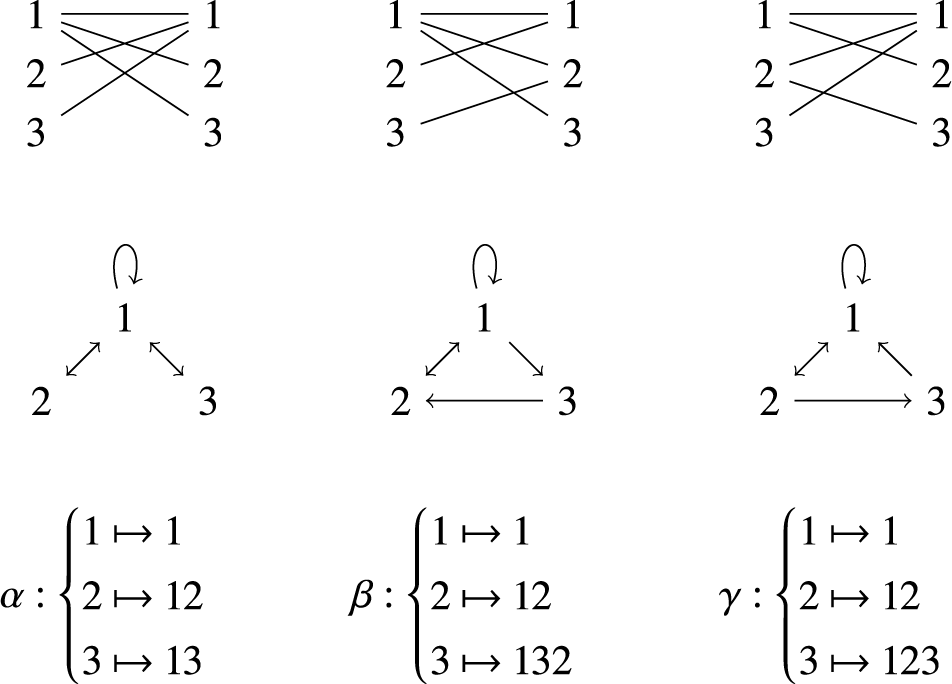
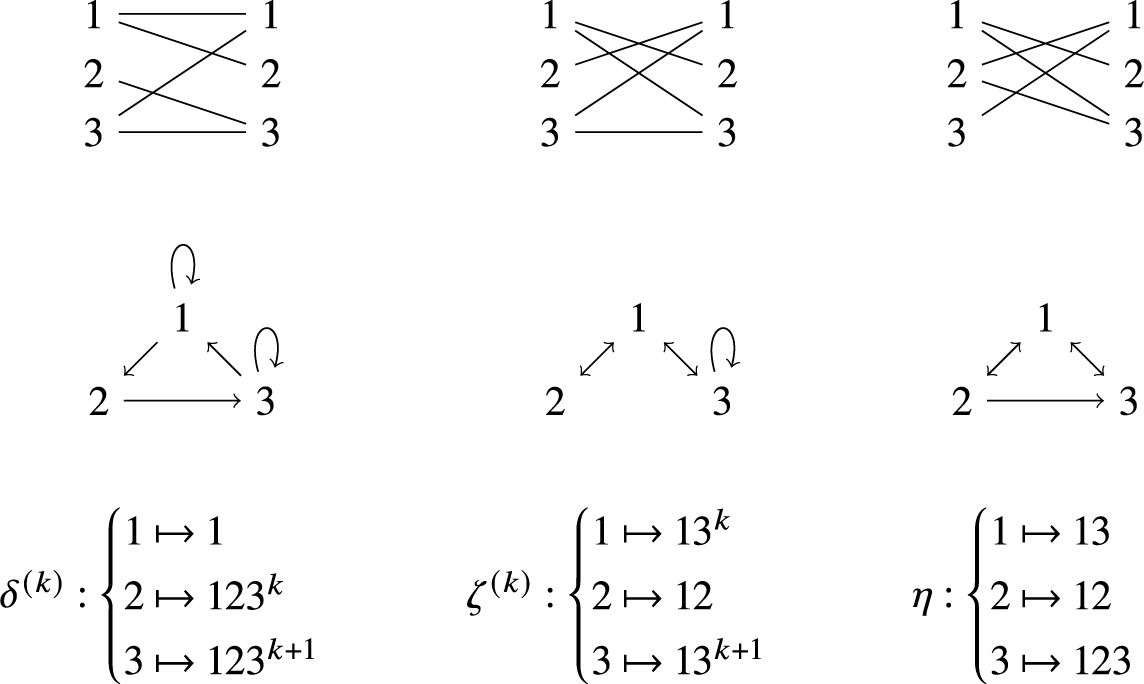
are given in Figures 5 and 6. They must satisfy two conditions:
 $\mathcal {E}(\varepsilon )$
must be a tree and the associated Rauzy graph
 $G_1(X)$
must be strongly connected (by minimality of X). We always assume that
 $1$
is a left special letter and we present these associated Rauzy graph of order 1 as well as coding morphisms associated with
 $\mathcal {R}(1)$
. Whenever some power appear in an image, we always have
 $k \geq 1$
. The reason why we only have k and
 $k+1$
as exponent is the same as in the previous example: a bigger difference would contradict dendricity by inducing a cycle in some extension graph. We denote the set
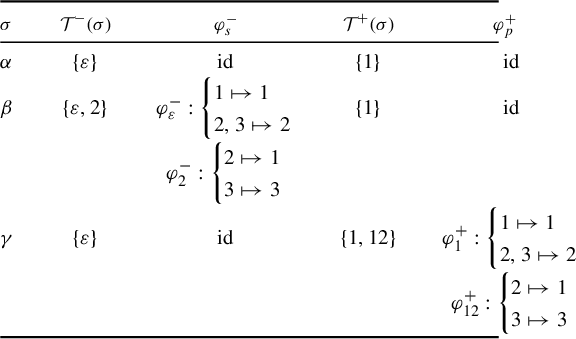
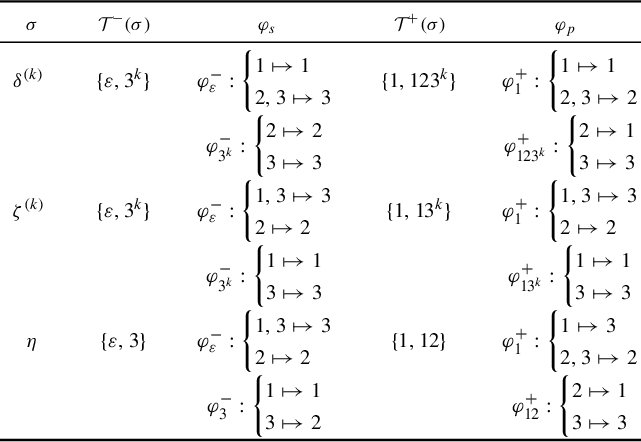
 $$ \begin{align*} \mathcal{S}_3 = \{\alpha,\beta,\gamma,\eta\} \cup \{\delta^{(k)},\zeta^{(k)} \mid k \geq 1\} \end{align*} $$
of morphisms as defined in Figures 5 and 6.
The cases with a unique left special letter and/or a unique right special letter.

The cases with two left special letters and two right special letters.

Let
 $\Sigma _3$
be the symmetric group on
 $\mathcal {A}_3 = \{1, 2, 3\}$
. If
 $\mathcal {A}_3 = \{a, b, c\}$
, we let
 $\pi _{abc} \in \Sigma _3$
denote the permutation
 $1 \mapsto a$
,
 $2 \mapsto b$
,
 $3 \mapsto c$
.
Proposition 5.1. Any ternary minimal dendric shift X has a primitive
 $\Sigma _3\mathcal {S}_3\Sigma _3$
-adic representation
 $\boldsymbol {\sigma }$
and, for each such representation,
 $X_{{\boldsymbol {\sigma }}}^{(n)}$
is a ternary minimal dendric shift for each n.
Proof For the existence, we consider the construction of a directive sequence following Theorem 3.1 where at each step, we choose the left special letter
 $a_n$
for which
 $\sigma _n$
is in
 $\Sigma _3\mathcal {S}_3\Sigma _3$
. Using Theorem 3.1 and Theorem 3.2, we obtain that for each
 $\Sigma _3\mathcal {S}_3\Sigma _3$
-adic representation
 ${\boldsymbol {\sigma }}$
and each n,
 $X_{{\boldsymbol {\sigma }}}^{(n)}$
is a ternary minimal dendric shift.
Note that the previous result is also true when considering
 $\Sigma _3\mathcal {S}_3$
-adic representations but, for our results,
 $\Sigma _3\mathcal {S}_3\Sigma -3$
-adic representations are more convenient.
While Proposition 5.1 deals with
 $\Sigma _3\mathcal {S}_3\Sigma _3$
-adic representations, it is obvious that only the morphisms in
 $\mathcal {S}_3$
really matter. In the next sections, we essentially focus on them and we involve permutations only when they are needed.
5.2 Conditions for having only dendric bispecial extended images
Assume that X is a minimal shift space over
 $\mathcal {A}$
and that
 $v \in \mathcal {L}(X)$
is a bispecial factor and let Y be the image of X under some injective and strongly left proper morphism
 $\sigma : \mathcal {A}^* \to \mathcal {B}^*$
. Recall from §4.2 (and, in particular, Proposition 4.7) that the extension graph of any bispecial extended image of v under
 $\sigma $
is the image under two consecutive graph morphisms
 $\varphi ^-_s$
and
 $\varphi ^+_p$
of a subgraph of
 $\mathcal {E}_X(v)$
. In this section, we determine those graph morphisms when
 $\sigma $
is a morphism in
 $\mathcal {S}_3$
and we give necessary and sufficient conditions on the extension graph of
 $v \in \mathcal {L}(X)$
so that v only has dendric bispecial extended images. In this particular case, since the alphabet has cardinality 3,
 $\mathcal{T}^{\kern1.5pt+}(\sigma )$
and
 $\mathcal {T}^{\kern1.5pt-}(\sigma )$
have cardinality at most 2. Tables 3 and 4 define the (possibly partial) maps
 $\varphi ^-_s, \varphi ^+_p: \mathcal {A}_3 \to \mathcal {A}_3$
associated with each morphism
 $\sigma \in \mathcal {S}_3$
.
Definition of the graph morphisms
 $\varphi ^-_s$
and
 $\varphi ^+_p$
associated with the morphisms
 $\alpha $
,
 $\beta $
, and
 $\gamma $
.

Definition of the graph morphisms
 $\varphi ^-_s$
and
 $\varphi ^+_p$
associated with the morphisms
 $\delta ^{(k)}$
,
 $\zeta ^{(k)}$
, and
 $\eta $
.

A direct application of Proposition 4.8 shows that whenever v is dendric, then v has only dendric bispecial extended images if and only if the following conditions are satisfied:
-
(1) either
$\mathcal {T}^{\kern1.5pt-}_v(\sigma ) = \{s_0\}$
, or both
$\mathcal {T}^{\kern1.5pt-}_v(\sigma ) = \{s_0,s\}$
and
$\mathcal {E}_{X,s,p_0}(v)$
is a tree; -
(2) either
$\mathcal{T}^{\kern1.5pt+}_v(\sigma ) = \{p_0\}$
, or both
$\mathcal{T}^{\kern1.5pt+}_v(\sigma ) = \{p_0,p\}$
and
$\mathcal {E}_{X,s_0,p}(v)$
is a tree.


We first give a handier interpretation of these conditions. Observe that for convenience, we actually characterize the dendric bispecial factors
 $v \in \mathcal {L}(X)$
that have a non-dendric bispecial extended image. When considering a letter
 $a \in \mathcal {A}_3$
as a vertex of
 $\mathcal {E}(v)$
, we respectively write
 $a^-$
or
 $a^+$
to emphasize that a is considered as a left or right vertex.
For
 $v \in \mathcal {L}(X)$
, we define
 $\mathcal {C}_X^-(v)$
(respectively,
 $\mathcal {C}_X^+(v)$
) as the set of letters
 $a \in \mathcal {A}$
such that the subgraph of
 $\mathcal {E}_X(v)$
obtained by removing the vertex
 $a^-$
(respectively,
 $a^+$
) and all the induced isolated vertices (if any) are not connected. When the context is clear, the subscript X will be omitted.
Remark 5.2. If
 $v \in \mathcal {L}(X)$
is a dendric factor, then
 $a \in \mathcal {C}^-(v)$
if and only if
 $a^-$
has at least two neighbors that are not leaves, that is, that have degree at least 2. In particular, v is bispecial. Observe also that as
 $\mathcal {E}(v)$
is a tree, this implies that the left side of
 $\mathcal {E}(v)$
contains three vertices. Hence, another equivalent condition when
 $\mathcal {E}(v)$
is a tree is that, writing
 $\mathcal {A}_3 = \{a,b,c\}$
, the path from
 $b^-$
to
 $c^-$
has length 4.
Proposition 5.3. Let X be a shift space over
 $\mathcal {A}_3$
and
 $\sigma $
be a morphism in
 $\mathcal {S}_3$
.
If
 $v \in \mathcal {L}(X)$
is a dendric bispecial factor, then v has a non-dendric bispecial extended image under
 $\sigma $
if and only if one of the following conditions is satisfied:
-
(1)
$1 \in \mathcal {C}_X^-(v)$
and
$\sigma \in \{\beta ,\delta ^{(k)} \mid k \geq 1\}$
; -
(2)
$2 \in \mathcal {C}_X^-(v)$
and
$\sigma \in \{\zeta ^{(k)},\eta \mid k \geq 1\}$
; -
(3)
$1 \in \mathcal {C}_X^+(v)$
and
$\sigma \in \{\gamma ,\delta ^{(k)},\eta \mid k \geq 1\}$
; -
(4)
$2 \in \mathcal {C}_X^+(v)$
and
$\sigma \in \{\zeta ^{(k)} \mid k \geq 1\}$
.


Proof The negation of condition (1) of Proposition 4.8 is equivalent to ‘there exists
 $a \in E^-_X(v)$
such that
 $\mathcal {E}_{X, s(b, c), p_0}(v)$
is not a tree’. As
 $\mathcal {E}_{X, s(b, c), p_0}(v)$
is a subgraph of
 $\mathcal {E}(v)$
, it is acyclic and, if
 $s(b, c)$
is a suffix of
 $\sigma (a)$
, it is also connected (indeed, we then have
 $\mathcal {E}_{X, s(b, c), p_0}(v) = \mathcal {E}_{X, s_0, p_0}(v) = \mathcal {E}(v)$
). Thus, the first condition of Proposition 4.8 is not satisfied if and only if there exists a permutation
 $\{a, b, c\}$
of
 $\mathcal {A}_3$
such that
 $s(b, c)$
is not a prefix of
 $\sigma (a)$
and
 $a \in \mathcal {C}^-(v)$
. Using Figures 5 and 6, we see that it is equivalent to condition 1 or 2. We proceed in a similar way to show that the second condition of Proposition 4.8 is not satisfied if and only if one of the conditions 3 and 4 above is.
Example 5.4. Assume that v is a dendric bispecial factor in some minimal ternary shift space X with extension graph

Thus, we have
 $3 \in \mathcal {C}^-(v)$
and
 $1 \in \mathcal {C}^+(v)$
. If
 $Y_1$
is the image of X under
 $\beta $
, the bispecial extended images of v in
 $Y_1$
are
 $u_1 = \beta (v)1$
and
 $u_2 = 2 \beta (v)1$
and they have the following extension graphs:

Similarly, if
 $Y_2$
is the image of X under
 $\gamma $
, the bispecial extended images of v in
 $Y_2$
are
 $w_1 = \gamma (v)1$
and
 $w_2 = \gamma (v)12$
and they have the following extension graphs:

5.3 Ternary dendric preserving morphisms
Assuming that
 $v \in \mathcal {L}(X)$
is a dendric bispecial factor, Proposition 5.3 characterizes under which conditions v has a non-dendric bispecial extended image under
 $\sigma \in \mathcal {S}_3$
or, in other words, under which conditions
 $\sigma \in \mathcal {S}_3$
is not dendric preserving for v. As we consider the ternary case, we denote by
 $\operatorname {\mathrm {DP}}(v)$
the set of dendric preserving morphisms for v in
 $\mathcal {S}_3$
.
When X is a ternary dendric shift, we extend the notation
 $\mathcal {C}^-$
and
 $\mathcal {C}^+$
and set
 $$ \begin{align*} \mathcal{C}^-(X) & = \bigcup_{v \,{\in}\, \mathcal{L}(X)} \mathcal{C}^-_X(v), \\ \mathcal{C}^+(X) & = \bigcup_{v \,{\in}\, \mathcal{L}(X)} \mathcal{C}^+_X(v), \\ \operatorname{\mathrm{DP}}(X) &= \bigcap_{v \,{\in}\, \mathcal{L}(X)} \operatorname{\mathrm{DP}}(v). \end{align*} $$
Using Proposition 5.3, the sets
 $\mathcal {C}^-(X)$
and
 $\mathcal {C}^+(X)$
completely determine the set
 $\operatorname {\mathrm {DP}}(X)$
of all morphisms in
 $\mathcal {S}_3$
that are dendric preserving for X. In this section, we in particular show that
 $\mathcal {C}^-(X)$
and
 $\mathcal {C}^+(X)$
contain at most one letter and we show that, when Y is the image of X under
 $\sigma \in \operatorname {\mathrm {DP}}(X)$
,
 $\mathcal {C}^-(Y)$
(respectively,
 $\mathcal {C}^+(Y)$
) is completely determined by
 $\mathcal {C}^-(X)$
(respectively,
 $\mathcal {C}^+(X)$
) and
 $\sigma $
. The next lemma is a trivial consequence of Remark 5.2.
Lemma 5.5. Let X be a shift space over
 $\mathcal {A}_3$
. For every dendric bispecial factor
 $v \in \mathcal {L}(X)$
,
 $\mathcal {C}^-_X(v)$
(respectively,
 $\mathcal {C}^+_X(v)$
) contains at most one letter.
Lemma 5.6. Let X be a shift space over
 $\mathcal {A}_3$
which is the image under
 $\sigma \in \mathcal {S}_3$
of another shift space Z over
 $\mathcal {A}_3$
. The sets
 $\mathcal {C}_X^-(\varepsilon )$
and
 $\mathcal {C}_X^+(\varepsilon )$
are given in Table 5.
Sets
 $\mathcal {C}_X^-(\varepsilon )$
and
 $\mathcal {C}_X^+(\varepsilon )$
whenever X is the image under
 $\sigma $
of a shift space over
 $\mathcal {A}_3$
.

Proof Indeed, the morphism
 $\sigma $
completely determines the extension graph
 $\mathcal {E}_X(\varepsilon )$
. The result thus directly follows from the definitions of
 $\mathcal {C}_X^-(\varepsilon )$
and
 $\mathcal {C}_X^+(\varepsilon )$
.
Lemma 5.7. If X is a ternary dendric shift and if Y is the image of X under some morphism
 $\sigma \in \mathcal {S}_3$
, then Y is dendric if and only if
 $\sigma \in \operatorname {\mathrm {DP}}(X)$
.
Proof Indeed, if
 $\sigma \in \operatorname {\mathrm {DP}}(X)$
, every bispecial extended image of a bispecial factor of X is dendric by definition of
 $\operatorname {\mathrm {DP}}(X)$
. Any other bispecial factor of Y is the empty word or a non-prefix factor of an image
 $\sigma (a)$
,
 $a \in \mathcal {A}_3$
(by Proposition 4.1). It suffices to check that any such bispecial factor is dendric when
 $\sigma $
belongs to
 $\mathcal {S}_3$
to prove that Y is dendric.
Assume now that Y is dendric. If
 $\sigma $
is not in
 $\operatorname {\mathrm {DP}}(X)$
then there exists
 $v \in \mathcal {L}(X)$
such that
 $\sigma \notin \operatorname {\mathrm {DP}}(v)$
and thus v has an extended image in Y which is not dendric.
We say that a morphism
 $\sigma \in \mathcal {S}_3$
is left-invariant (respectively, right-invariant) if
 $\mathcal {T}^{\kern1.5pt-}(\sigma )$
(respectively,
 $\mathcal{T}^{\kern1.5pt+}(\sigma )$
) is a singleton, that is,
 $\mathcal {T}^{\kern1.5pt-}(\sigma ) = \{s_0\}$
(respectively,
 $\mathcal{T}^{\kern1.5pt+}(\sigma ) = \{p_0\}$
). The next lemma directly follows from the definition of the morphisms in
 $\mathcal {S}_3$
.
Lemma 5.8.
-
(1)
$\alpha $
is both left-invariant and right-invariant; -
(2)
$\beta $
is right-invariant, but not left-invariant; -
(3)
$\gamma $
is left-invariant, but not right-invariant; -
(4)
$\delta ^{(k)}$
,
$\zeta ^{(k)}$
and
$\eta $
are neither left-invariant nor right-invariant.


We let
 $\mathcal {S}_{\textrm {LI}}$
and
 $\mathcal {S}_{\textrm {RI}}$
respectively denote the left-invariant and right-invariant morphisms, that is,
 $$ \begin{align*} \mathcal{S}_{\textrm{LI}} = \{\alpha,\gamma\} \quad \text{and} \quad \mathcal{S}_{\textrm{RI}} = \{\alpha,\beta\}. \end{align*} $$
Observe that if
 $\sigma \in \mathcal {S}_{\textrm {LI}}$
(respectively,
 $\sigma \in \mathcal {S}_{\textrm {RI}}$
), then the associated graph morphism
 $\varphi ^-_{s_0}$
(respectively,
 $\varphi ^+_{p_0}$
) is the identity. Moreover, from Table 5, a morphism
 $\sigma $
belongs to
 $\mathcal {S}_{\textrm {LI}}$
(respectively, to
 $\mathcal {S}_{\textrm {RI}}$
) if and only if
 $\mathcal {C}_X^-(\varepsilon )$
(respectively,
 $\mathcal {C}_X^+(\varepsilon )$
) is empty, where X is the image under
 $\sigma $
of a shift over
 $\mathcal {A}_3$
.
Lemma 5.9. Let X be a shift space over
 $\mathcal {A}_3$
,
 $\sigma \in \mathcal {S}_3$
a non-left-invariant (respectively, non-right-invariant) morphism and Y the image of X under
 $\sigma $
. If
 $v \in \mathcal {L}(X)$
is a dendric bispecial factor, then any dendric extended image u of v is such that
 $\mathcal {C}^-_Y(u) = \emptyset $
(respectively,
 $\mathcal {C}^+_Y(u) = \emptyset $
).
In particular, if X is dendric and
 $\sigma $
is in
 $\operatorname {\mathrm {DP}}(X)$
, then
 $\mathcal {C}^-(Y) = \mathcal {C}^-_Y(\varepsilon ) \ne \emptyset $
(respectively,
 $\mathcal {C}^+(Y) = \mathcal {C}^+_Y(\varepsilon ) \ne \emptyset $
).
Proof Let us show the result for a non-left-invariant morphism, the other case being symmetric. By definition of left-invariance,
 $\mathcal {T}^{\kern1.5pt-}(\sigma )$
contains two elements
 $s_0$
and
 $s_1$
. It suffices to check in Tables 3 and 4 that for each of them, the range of the associated graph morphism
 $\varphi ^-_{s_i}$
has cardinality 2. As the left vertices of
 $\mathcal {E}_Y(u)$
are images of the left vertices of
 $\mathcal {E}_X(v)$
,
 $\mathcal {E}_Y(u)$
contains at most two left vertices. By Remark 5.2,
 $C^-_Y(u)$
is empty.
Now assume that X is dendric and that
 $\sigma $
belongs to
 $\operatorname {\mathrm {DP}}(X)$
. By Lemma 5.7, Y is a dendric shift. Let u be a non-empty factor of Y. By Proposition 4.1, either u is a non-prefix factor of
 $\sigma (a)$
for some letter
 $a \in \mathcal {A}_3$
, or u is an extended image of a factor
 $v \in \mathcal {L}(X)$
. In the first case, it suffices to check that
 $\#(E_Y^-(u)) \leq 2$
, which implies that
 $\mathcal {C}^-_Y(u) = \emptyset $
. In the second case, as X is dendric, v is also dendric so by the first part of the lemma,
 $\mathcal {C}^-_Y(u) = \emptyset $
. Thus
 $\mathcal {C}^-(Y) = \mathcal {C}^-_Y(\varepsilon )$
and, by Lemma 5.6, it is non-empty.
Lemma 5.10. Let X be a shift space over
 $\mathcal {A}_3$
,
 $\sigma \in \mathcal {S}_3$
a left-invariant (respectively, right-invariant) morphism and Y the image of X under
 $\sigma $
. If
 $v \in \mathcal {L}(X)$
is a dendric bispecial factor, then
 $$ \begin{align} \mathcal{C}^-_X(v) &= \bigcup_{u \text{ bispecial extended image of } v} \mathcal{C}^-_Y(u)\nonumber \\ \bigg(\text{respectively, } \mathcal{C}^+_X(v) &= \bigcup_{u \text{ bispecial extended image of } v} \mathcal{C}^+_Y(u)\bigg). \end{align} $$
In particular, if X is dendric and
 $\sigma $
is in
 $DP(X)$
, then
 $\mathcal {C}^-(Y) = \mathcal {C}^-(X)$
(respectively,
 $\mathcal {C}^+(Y) = \mathcal {C}^+(X)$
).
Proof Let us assume that
 $\sigma $
is left-invariant, the other case is symmetric. We first show that if u is a bispecial extended image of v, then
 $\mathcal {C}^-_Y(u) \subset \mathcal {C}^-_X(v)$
. As
 $\mathcal {T}^{\kern1.5pt-}(\sigma ) = \{s_0\}$
, there exists
 $p \in \mathcal{T}^{\kern1.5pt+}(\sigma )$
such that
 $u = s_0 \sigma (v) p$
. Assume that
 $a \in \mathcal {C}^-_Y(u)$
. Writing
 $\mathcal {A}_3 = \{a,b,c\}$
, Remark 5.2 states that the path q from
 $b^-$
to
 $c^-$
in
 $\mathcal {E}_Y(u)$
has length 4. This path q is the image under
 $\varphi _{s_0,p}$
of a path
 $q'$
of length at least 4 in
 $\mathcal {E}_X(v)$
. As
 $\mathcal {E}_X(v)$
is a tree with at most six vertices and the extremities of
 $q'$
are left vertices, the path has length exactly 4. As
 $\varphi ^-_{s_0}$
is the identity, we conclude that
 $q'$
is a path of length 4 from
 $b^-$
to
 $c^-$
in
 $\mathcal {E}_X(v)$
, and hence that
 $a \in \mathcal {C}^-_X(v)$
.
If
 $\mathcal {C}^-_X(v) = \emptyset $
, then equality (5.1) is direct. Thus we only need to prove it when
 $\mathcal {C}^-_X(v) \neq \emptyset $
. As
 $\sigma $
is left-invariant, we have by Lemma 5.8 that
 $\sigma = \alpha $
or
 $\sigma = \gamma $
.
If
 $\sigma = \alpha $
, then as
 $\alpha $
is also right-invariant (see Lemma 5.8), Proposition 4.7 implies that u is the unique bispecial extended image of v and that
 $\mathcal {E}_Y(u) = \mathcal {E}_X(v)$
(the graph morphism is the identity), and hence that
 $\mathcal {C}^-_Y(u) = \mathcal {C}^-_X(v)$
.
If
 $\sigma = \gamma $
, then as
 $\mathcal{T}^{\kern1.5pt+}(\sigma ) = \{1,12\}$
, (see Table 3), Corollary 4.3 implies that v has at most two bispecial extended images
 $u_1 = \sigma (v)1$
and
 $u_2 = \sigma (v)12$
. Let
 $\varphi = \varphi _{\varepsilon ,1}$
and
 $\varphi ' = \varphi _{\varepsilon ,12}$
. The morphism
 $\varphi ^-_{\varepsilon }$
is the identity and thus we have
 $\varphi = \varphi ^+_{1}$
and
 $\varphi ' = \varphi ^+_{12}$
.
As
 $\mathcal {C}^-_X(v) \neq \emptyset $
, by Lemma 5.5 there is a letter
 $a \in \mathcal {A}_3$
such that
 $\mathcal {C}^-_X(v) = \{a\}$
. Using Remark 5.2, the path q from
 $b^-$
to
 $c^-$
has length 4 in
 $\mathcal {E}_X(v)$
. Let us write
 $q = (b^-,x^+,a^-,y^+,c^-)$
, with
 $x,y \in \mathcal {A}_3$
.
If
 $1 \in \{x,y\}$
, we assume without loss of generality that
 $1 = x$
. Then we have
 $\varphi (q) = (b^-,1^+,a^-,2^+,c^-)$
which is a path of length 4 from
 $b^-$
to
 $c^-$
in
 $\mathcal {E}_Y(u_1)$
. By Remark 5.2 and Lemma 5.5, one has
 $\mathcal {C}^-_Y(u_1) = \{a\}$
. As
 $\mathcal {C}^-_Y(u_2) \subset \mathcal {C}^-_X(v)$
by the first part of the proof, we get
 $\mathcal {C}^-_Y(u_1) \cup \mathcal {C}^-_Y(u_2) = \mathcal {C}^-_X(v)$
.
If
 $\{x,y\} = \{2,3\}$
, we assume without loss of generality that
 $(x,y) = (2,3)$
. Then we have
 $\varphi '(q) = (b^-,1^+,a^-,3^+,c^-)$
which is a path of length 4 from
 $b^-$
to
 $c^-$
in
 $\mathcal {E}_Y(u_2)$
. By Remark 5.2 and Lemma 5.5, one has
 $\mathcal {C}^-_Y(u_2) = \{a\}$
. As
 $\mathcal {C}^-_Y(u_1) \subset \mathcal {C}^-_X(v)$
by the first part of the proof, we also get
 $\mathcal {C}^-_Y(u_1) \cup \mathcal {C}^-_Y(u_2) = \mathcal {C}^-_X(v)$
.
Let us finally show that
 $\mathcal {C}^-(Y) = \mathcal {C}^-(X)$
. With
 $\sigma \in \{\alpha , \gamma \}$
, the non-prefix factor of
 $\sigma (a)$
,
 $a \in \mathcal {A}_3$
, are not bispecial. Hence, using Proposition 4.1, a bispecial factor
 $u \in \mathcal {L}(Y)$
is either empty, or a bispecial extended image of some bispecial factor
 $v \in \mathcal {L}(X)$
. As
 $\sigma $
is left-invariant, we have
 $\mathcal {C}^-_Y(\varepsilon ) = \emptyset $
by Lemma 5.6. Using equation (5.1), we get
 $$ \begin{align*} \mathcal{C}^-(Y) &= \bigcup_{v \in \mathcal{L}(X), \text{ bispecial}} \bigcup_{u \text{ bispecial extended image of } v} \mathcal{C}^-_Y(u) \\ &=\bigcup_{v \in \mathcal{L}(X), \text{ bispecial}} \mathcal{C}^-_X(v) \\ &= \mathcal{C}^-(X), \end{align*} $$
which ends the proof.
The following corollary is a direct consequence of Lemmas 5.9 and 5.10.
Corollary 5.11. Let X be a dendric shift over
 $\mathcal {A}_3$
,
 $\sigma \in \operatorname {\mathrm {DP}}(X)$
and Y the image of X under
 $\sigma $
. If
 $\mathcal {C}^-(Y) = \emptyset $
, then
 $\mathcal {C}^-(X)=\emptyset $
and
 $\sigma $
is left-invariant. Respectively, if
 $\mathcal {C}^+(Y) \,{=}\, \emptyset $
, then
 $\mathcal {C}^+(X)=\emptyset $
and
 $\sigma $
is right-invariant.
Proposition 5.12. Let X be a ternary minimal dendric shift. Then
 $\mathcal {C}^-(X)$
and
 $\mathcal {C}^+(X)$
contain at most one letter. Moreover, if
 ${\boldsymbol {\sigma }}=(\sigma _n)_{n \geq 1}$
is a
 $\Sigma _3\mathcal {S}_3\Sigma _3$
-adic representation of X, then:
-
(1)
$\mathcal {C}^-(X) = \emptyset $
if and only if
${\boldsymbol {\sigma }}$
belongs to
$(\Sigma _3\mathcal {S}_{\textrm {LI}}\Sigma _3)^{\mathbb {N}}$
, if and only if X has a unique left special factor of each length; -
(2)
$\mathcal {C}^+(X) = \emptyset $
if and only if
${\boldsymbol {\sigma }}$
belongs to
$(\Sigma _3\mathcal {S}_{\textrm {RI}}\Sigma _3)^{\mathbb {N}}$
, if and only if X has a unique right special factor of each length.


Proof Using the notation of §2.3, we have
 $X = X_{{\boldsymbol {\sigma }}}$
and for each
 $n \geq 1$
,
 $X_{{\boldsymbol {\sigma }}}^{(n)}$
is dendric by Proposition 5.1. Let
 $\sigma _n = \pi _n \sigma ^{\prime }_n \pi ^{\prime }_n$
with
 $\pi _n, \pi ^{\prime }_n \in \Sigma _3$
and
 $\sigma ^{\prime }_n \in \mathcal {S}_3$
. The shift spaces
 $\pi ^{\prime }_n(X^{(n+1)}_{\boldsymbol {\sigma }})$
and
 $\pi ^{-1}_n(X^{(n)}_{\boldsymbol {\sigma }})$
are dendric and
 $\pi ^{-1}_n(X^{(n)}_{\boldsymbol {\sigma }})$
is the image of
 $\pi ^{\prime }_n(X^{(n+1)}_{\boldsymbol {\sigma }})$
under
 $\sigma _n'$
. Thus,
 $\sigma ^{\prime }_n \in \operatorname {\mathrm {DP}}(\pi ^{\prime }_n(X_{{\boldsymbol {\sigma }}}^{(n+1)}))$
by Lemma 5.7. We first show item (1).
Assume that
 $\mathcal {C}^-(X) = \emptyset $
. We have, by induction using Corollary 5.11, that
 $\mathcal {C}^-(\pi ^{\prime }_n(X^{(n)}_{\boldsymbol {\sigma }})) = \emptyset $
and
 $\sigma ^{\prime }_n \in \mathcal {S}_{\textrm {LI}}$
for all n and thus
 ${\boldsymbol {\sigma }} \in (\Sigma _3\mathcal {S}_{\textrm {LI}}\Sigma _3)^{\mathbb {N}}$
.
Now assuming that
 ${\boldsymbol {\sigma }}$
belongs to
 $(\Sigma _3\mathcal {S}_{\textrm {LI}}\Sigma _3)^{\mathbb {N}}$
, we deduce that any bispecial factor of X is a descendant of the empty word in some
 $X_{\boldsymbol {\sigma }}^{(n)}$
. Using Figure 5, the bispecial factor
 $v = \varepsilon \in \mathcal {L}(X_{\boldsymbol {\sigma }}^{(n)})$
has a unique right extension
 $va$
,
 $a \in \mathcal {A}_3$
, which is left special and it satisfies
 $E_{X_{\boldsymbol {\sigma }}^{(n)}}^-(va) = \mathcal {A}_3$
. It then suffices to observe, using Proposition 4.1, that this property is preserved by taking bispecial extended images under some morphism
 $\sigma \in \Sigma _3\mathcal {S}_{\textrm {LI}}\Sigma _3$
. This shows that any bispecial factor u, and hence any left special factor, of X satisfies
 $E_X^-(u) = \mathcal {A}_3$
. Proposition 2.1 then implies that X has a unique left special factor of each length.
Finally assume that X has a unique left special factor
 $u_n$
of each length n. By Proposition 2.1, we have
 $E_X^-(u_n) = \mathcal {A}_3$
. Using Remark 5.2, the set
 $\mathcal {C}^-_X(u_n)$
is non-empty if and only if there are two letters
 $x,y \in \mathcal {A}_3$
such that both
 $u_nx$
and
 $u_ny$
are left special factors of X. This implies that
 $\mathcal {C}^-_X(u_n) = \emptyset $
. Any non-left-special factor u is such that
 $\mathcal {C}^-_X(u) = \emptyset $
by Remark 5.2, and hence
 $\mathcal {C}^-(X) = \emptyset $
.
The proof of item (2) is symmetric.
We finish the proof by showing that
 $\mathcal {C}^-(X)$
and
 $\mathcal {C}^+(X)$
contain at most one letter. Assume by contrary that
 $a,b \in \mathcal {C}^-(X)$
for some different letters a and b. By Lemmas 5.5, 5.9, and 5.10, all morphisms
 $\sigma ^{\prime }_n$
are left-invariant. But then item (1) implies that
 $\mathcal {C}^-(X)\,{=}\,\emptyset $
.
5.4
$\mathcal {S}_3$
-adic characterization of minimal ternary dendric shifts

By Proposition 5.12, any ternary minimal dendric shift X satisfies
 $\#\mathcal {C}^-(X),\#\mathcal {C}^+(X) \leq 1$
. To alleviate the notation in what follows, we consider the alphabet
 $\mathcal {A}_00 = \mathcal {A}_3 \cup \{0\}$
and we write
 $\mathcal {C}^-(X) = a$
instead of
 $\mathcal {C}^-(X) = \{a\}$
and
 $\mathcal {C}^-(X) = 0$
instead of
 $\mathcal {C}^-(X) = \emptyset $
(and similarly for
 $\mathcal {C}^+(X)$
). We then define the equivalence relation
 $\sim $
on the set of minimal ternary dendric shifts by
 $$ \begin{align*} X \sim Y \Leftrightarrow (\mathcal{C}^-(X),\mathcal{C}^+(X)) = (\mathcal{C}^-(Y),\mathcal{C}^+(Y)). \end{align*} $$
For all
 $l,r \in \mathcal {A}_00$
, we let
 $[l,r]$
denote the equivalence class of all minimal ternary dendric shifts satisfying
 $(\mathcal {C}^-(X),\mathcal {C}^+(X)) = (l,r)$
.
Lemma 5.13. Let X and Y be minimal ternary dendric shifts. We have
 $X \sim Y$
if and only if
 $\operatorname {\mathrm {DP}}(X) = \operatorname {\mathrm {DP}}(Y)$
. Furthermore, if
 $X \sim Y$
, if
 $\sigma \in \operatorname {\mathrm {DP}}(X) \cup \Sigma _3$
, and if
 $X'$
and
 $Y'$
are the respective images of X and Y under
 $\sigma $
, then
 $X' \sim Y'$
.
Proof The equivalence between
 $X \sim Y$
and
 $\operatorname {\mathrm {DP}}(X) = \operatorname {\mathrm {DP}}(Y)$
follows from Proposition 5.3. The second part of the statement follows from Lemma 5.9 and Lemma 5.10.
Lemma 5.14. For each
 $l, r \in \mathcal {A}_00$
, the equivalence class
 $[l, r]$
is non-empty.
Proof Let X be an Arnoux–Rauzy shift space. By Corollary 4.9, the image of X under any morphism
 $\sigma \in \Sigma _3\mathcal {S}_3$
is dendric. More precisely
 $\mathcal {C}^-(X)$
and
 $\mathcal {C}^+(X)$
are both empty. Using Lemmas 5.6, 5.9, and 5.10, we can then choose such a morphism
 $\sigma $
to X to obtain an element of any equivalence class.
Using the previous lemmas, we can define, for each equivalence class
 $C = [l,r]$
, the set
 $$ \begin{align*} \operatorname{\mathrm{DPP}}(C) = \{\pi \sigma \pi' \mid \pi, \pi' \in \Sigma_3, \sigma \in \operatorname{\mathrm{DP}}(\pi'(X))\}, \end{align*} $$
where
 $X \in C$
. Thus it corresponds to the set of morphisms in
 $\Sigma _3\mathcal {S}_3\Sigma _3$
that are dendric preserving for X (
 $\operatorname {\mathrm {DPP}}$
stands for dendric preserving with permutations). Furthermore, for any
 $\sigma \in \operatorname {\mathrm {DPP}}(C)$
, there is a unique equivalence class
 $C'$
such that when
 $X \in C$
and Y is the image of X under
 $\sigma $
, then
 $Y \in C'$
. We call
 $C'$
the image of C under
 $\sigma $
.
For each morphism
 $\sigma \in \mathcal {S}_3$
, the classes C such that
 $\sigma \in \operatorname {\mathrm {DPP}}(C)$
and their images are summarized in Table 6. They are computed using Proposition 5.3 (to determine the allowed classes C), Table 5, and Lemmas 5.9 and 5.10 (to determine the corresponding image).
Images of classes under the morphisms of
 $\mathcal {S}_3$
.

Up to permutations, we can distinguish five types of set
 $\operatorname {\mathrm {DPP}}([l,r])$
, depending on whether l or r is
 $0$
and on whether
 $l = r$
or not. We thus build the following directed graph
 $\mathcal {G}'$
, whose set of vertices is
 $V = \{[0,0], [0,3], [3, 0], [3, 2], [3, 3]\}$
. For each vertex, there is an incoming edge labeled by each permutation and, for every vertices
 $C, C' \in V$
and every morphism
 $\sigma \in \Sigma _3\mathcal {S}_3\Sigma _3$
, there is an edge from C to
 $C'$
with label
 $\sigma $
if
 $\sigma \in \operatorname {\mathrm {DPP}}(C')$
and C is the image of
 $C'$
under
 $\sigma $
. In other words, we have an edge labeled by
 $\pi \sigma ' \pi '$
,
 $\pi , \pi ' \in \Sigma _3$
,
 $\sigma ' \in \mathcal {S}_3$
, from
 $[l, r]$
to
 $[l', r']$
if the class
 $[\pi '(l'), \pi '(r')]$
Footnote
†
is in Table 6 for
 $\sigma '$
and its image is the class
 $[\pi ^{-1}(l), \pi ^{-1}(r)]$
.
This graph is a co-deterministic automaton, that is, for every vertex C and every morphism
 $\sigma $
, there is at most one edge with label
 $\sigma $
reaching C. It gives a first
 $\Sigma _3\mathcal {S}_3\Sigma _3$
-adic characterization of minimal dendric shifts.
Theorem 5.15. A shift space X is a minimal dendric shift over
 $\mathcal {A}_3$
if and only if it has a primitive
 $\mathcal {S}$
-adic representation labeling an infinite path in
 $\mathcal {G}'$
.
Proof Assume that X is a minimal ternary dendric shift. By Proposition 5.1, X has a primitive
 $\Sigma _3\mathcal {S}_3\Sigma _3$
-adic representation
 ${\boldsymbol {\sigma }}$
where for each n,
 $X_{{\boldsymbol {\sigma }}}^{(n)}$
is a ternary minimal dendric shift. In addition, up to changing the permutations and considering a permutation of X instead of X itself, we can assume that, for all n, the equivalence class of
 $X_{{\boldsymbol {\sigma }}}^{(n)}$
is an element of V. By construction,
 $X_{\boldsymbol {\sigma }}^{(n)}$
and
 $X_{\boldsymbol {\sigma }}^{(n+1)}$
are dendric; thus
 $\sigma _n$
is dendric preserving for
 $X_{\boldsymbol {\sigma }}^{(n+1)}$
and
 $\mathcal {P} = ([\mathcal {C}^-(X_{{\boldsymbol {\sigma }}}^{(n)}),\mathcal {C}^+(X_{{\boldsymbol {\sigma }}}^{(n)})])_{n \geq 1}$
is a path in
 $\mathcal {G}'$
with label
 ${\boldsymbol {\sigma }}$
.
Now consider a primitive sequence
 ${\boldsymbol {\sigma }}$
labeling a path
 $([\mathcal {C}^-_n,\mathcal {C}^+_n])_{n \geq 1}$
in
 $\mathcal {G}'$
and let us show that the shift space
 $X_{{\boldsymbol {\sigma }}}$
is minimal and dendric. It is minimal by primitiveness of
 ${\boldsymbol {\sigma }}$
. If it is not dendric, there exists a bispecial factor
 $u \in \mathcal {L}(X_{{\boldsymbol {\sigma }}})$
which is not dendric. Using Corollary 4.5, there is a unique
 $k \geq 1$
and a unique initial bispecial factor v in
 $\mathcal {L}(X_{{\boldsymbol {\sigma }}}^{(k)})$
such that u is a descendant of v and
 $\mathcal {E}_X(u)$
depends only on
 $\mathcal {E}_{X_{\boldsymbol {\sigma }}^{(k)}}(v)$
. By definition of initial bispecial factors, v is either the empty word or a non-prefix factor of
 $\sigma _k(a)$
for some letter a. Moreover, by Lemma 5.14, there is a dendric shift space Y such that
 $Y \in [\mathcal {C}^-_{k+1},\mathcal {C}^+_{k+1}]$
. Thus, if Z is the image of Y by
 $\sigma _k$
,
 $Z \in [\mathcal {C}^-_k,\mathcal {C}^+_k]$
and, as
 $\mathcal {E}_{X_{\boldsymbol {\sigma }}^{(k)}}(v)$
is completely determined by
 $\sigma _k$
, we have
 $\mathcal {E}_{X_{\boldsymbol {\sigma }}^{(k)}}(v) = \mathcal {E}_Z(v)$
. By definition of the edges of
 $\mathcal {G}'$
, the morphism
 $\sigma _{[1,k)}$
is dendric preserving for v. Thus, u is a dendric bispecial factor of X, which is a contradiction.
We now improve the previous result by considering a smaller graph. We will need the following lemma.
Lemma 5.16. Let
 $\sigma = \pi \sigma '\pi '$
with
 $\pi , \pi ' \in \Sigma _3$
,
 $\sigma ' \in \mathcal {S}_3$
. Let
 $l,r,l',r' \in \mathcal {A}_00$
be such that
 $\sigma \in \operatorname {\mathrm {DPP}}([l,r])$
and the image of
 $[l,r]$
under
 $\sigma $
is
 $[l',r']$
.
-
(1) If
$\sigma '$
is left-invariant, then for all
$\lambda \in \mathcal {A}_00$
, we have
$\sigma \in \operatorname {\mathrm {DPP}}([\lambda ,r])$
and the image of
$[\lambda ,r]$
under
$\sigma $
is
$[\pi \pi '(\lambda ),r']$
. -
(2) If
$\sigma '$
is not left-invariant, then
$l' \neq 0$
, there is a unique
$\lambda \in \mathcal {A}_3$
such that
$\sigma \notin \operatorname {\mathrm {DPP}}([\lambda ,r])$
and for all other
$\lambda ' \in \mathcal {A}_00$
, the image of
$[\lambda ', r]$
under
$\sigma $
is
$[l', r']$
. -
(3) If
$\sigma '$
is right-invariant, then for all
$\rho \in \mathcal {A}_00$
, we have
$\sigma \in \operatorname {\mathrm {DPP}}([l,\rho ])$
and the image of
$[l, \rho ]$
under
$\sigma $
is
$[l', \pi \pi '(\rho )]$
. -
(4) If
$\sigma '$
is not right-invariant, then
$r' \neq 0$
, there is a unique
$\rho \in \mathcal {A}_3$
such that
$\sigma \notin \operatorname {\mathrm {DPP}}([l,\rho ])$
and for all other
$\rho ' \in \mathcal {A}_00$
, the image of
$[l, \rho ']$
under
$\sigma $
is
$[l',r']$
.


Proof It follows from Table 6.
We are now ready to prove Theorem 1.1. We say that two sequences
 $(\sigma _n)_{n \in \mathbb {N}}$
and
 $(\tau _n)_{n \in \mathbb {N}}$
are equivalent if, for all n, there exist a permutation
 $\pi _n$
on the alphabet such that
 $$ \begin{align*} \sigma_1 \cdots \sigma_n \pi_n = \tau_1 \cdots \tau_n. \end{align*} $$
It is then clear that
 $(\sigma _n)_{n \in \mathbb {N}}$
is a primitive
 $\mathcal {S}$
-adic representation of a shift space X if and only if
 $(\tau _n)_{n \in \mathbb {N}}$
also is.
Proof of Theorem 1.1 Let
 $\mathcal {G}$
be the subgraph of
 $\mathcal {G}'$
obtained by deleting the vertices
 $[0,0]$
,
 $[0, 3]$
, and
 $[3, 0]$
. By definition of the edges of
 $\mathcal {G}'$
, for each edge incoming in
 $[3,3]$
and labeled by
 $\sigma $
, there is also an edge incoming in
 $[3,3]$
labeled by
 $\sigma \pi _{213}$
(for instance,
 $[3,2]$
is the image of
 $[3,3]$
under both
 $\pi _{132}\eta $
and
 $\pi _{132}\eta \pi _{213}$
). In
 $\mathcal {G}$
, for each such pair, we only keep one of the two edges. The choice is made so as to reduce the total number of different morphisms labeling an edge in the graph. This subgraph contains two vertices and is represented in Figure 7.
We show that for each infinite path
 $\mathcal {P}$
in
 $\mathcal {G}'$
labeled by
 ${\boldsymbol {\sigma }} = (\sigma _n)_{n \in \mathbb {N}}$
, there is an equivalent path in
 $\mathcal {G}$
, that is, a path labeled by a sequence
 $\boldsymbol {\tau } = (\tau _n)_{n \in \mathbb {N}}$
equivalent to
 ${\boldsymbol {\sigma }}$
.
We thus consider a path
 $\mathcal {P} = ([l_n,r_n])_{n \geq 1}$
in
 $\mathcal {G}'$
with label
 ${\boldsymbol {\sigma }} = (\sigma _n)_{n \geq 1}$
(hence
 $\sigma _n$
labels the edge from
 $[l_n,r_n]$
to
 $[l_{n+1},r_{n+1}]$
). For all
 $n \geq 1$
, let
 $\sigma _n = \pi _n \sigma ^{\prime }_n \pi ^{\prime }_n$
with
 $\pi _n, \pi ^{\prime }_n \in \Sigma _3$
,
 $\sigma ^{\prime }_n \in \mathcal {S}_3$
.
We first prove that we can delete the vertices
 $[0,0]$
,
 $[0,3]$
, and
 $[3,0]$
. If
 $\mathcal {P}$
goes through one of the deleted vertices, then there exists N such that
 $l_N$
or
 $r_N$
is
 $0$
. Assume that N is the smallest integer such that
 $l_N = 0$
. By Corollary 5.11, we deduce that for all
 $n \geq N$
,
 $\sigma ^{\prime }_n$
is left-invariant and
 $l_n = 0$
.
We prove by induction that there exist a sequence
 $(\psi _n)_{n \geq 1}$
of permutations and a sequence
 $(l^{\prime }_n)_{n \geq 1} \in \mathcal {A}_3^{\mathbb {N}}$
such that
 $\psi _1 = {\textrm {id}}$
and for all
 $n \geq 1$
, the morphism
 $\tau _n = \psi _n \sigma _n \psi _{n+1}^{-1}$
labels an edge from
 $[l^{\prime }_n, \psi _n(r_n)]$
to
 $[l^{\prime }_{n+1}, \psi _{n+1}(r_{n+1})]$
in
 $\mathcal {G}'$
. The sequence
 $(\tau _n)_{n \in \mathbb {N}}$
is trivially equivalent to
 ${\boldsymbol {\sigma }}$
.
A shift space on
 $\mathcal {A}_3$
is minimal and dendric if and only if it has a primitive
 $\Sigma _3\mathcal {S}_3\Sigma _3$
-adic representation labeling an infinite path in this graph denoted
 $\mathcal {G}$
.

If
 $N = 1$
, we take
 $l^{\prime }_1 = 3$
. If
 $N> 1$
, we take
 $\psi _n = {\textrm {id}}$
and
 $l^{\prime }_n = l_n$
for all
 $n \leq N - 1$
. Assume that we have found such
 $\psi _n$
and
 $l^{\prime }_n$
for
 $n \geq \min \{N-1,1\}$
and let us find
 $\psi _{n+1}$
and
 $l^{\prime }_{n+1}$
. We first show that we can find
 $l' \in \mathcal {A}_3$
such that
 $\psi _n\sigma _n \in \operatorname {\mathrm {DPP}}([l', r_{n+1}])$
and the image of
 $[l', r_{n+1}]$
under
 $\psi _n\sigma _n$
is
 $[l^{\prime }_n, \psi _n(r_n)]$
. Recall that
 $\psi _n\sigma _n$
is in
 $\operatorname {\mathrm {DPP}}([0, r_{n+1}])$
and that the image of
 $[0, r_{n+1}]$
under
 $\psi _n\sigma _n$
is
 $[\psi _n(l_n), \psi _n(r_n)]$
.
For
 $n = N-1$
(with
 $N> 1$
), by Lemma 5.10,
 $\sigma ^{\prime }_{N-1}$
is not left-invariant. Thus, since
 $l^{\prime }_{N-1} = l_{N-1} = \psi _{N-1}(l_{N-1})$
, we can choose such an
 $l' \in \mathcal {A}_3$
by Lemma 5.16. If
 $n \geq N$
,
 $\sigma ^{\prime }_n$
is left-invariant; thus, by Lemma 5.16, for any
 $l' \in \mathcal {A}_3$
,
 $\psi _n\sigma _n$
is in
 $\operatorname {\mathrm {DPP}}([l', r_{n+1}])$
and, in particular, if
 $l' = (\psi _n\pi _n\pi ^{\prime }_n)^{-1}(l^{\prime }_n)$
, then the image of
 $[l', r_{n+1}]$
under
 $\psi _n\sigma _n$
is
 $[l^{\prime }_n, \psi _n(r_n)]$
.
Let
 $\psi _{n+1}$
be a permutation such that
 $[\psi _{n+1}(l'), \psi _{n+1}(r_{n+1})]$
is a vertex of
 $\mathcal {G}'$
and let
 $l^{\prime }_{n+1} = \psi _{n+1}(l')$
. The morphism
 $\psi _n\sigma _n\psi _{n+1}^{-1}$
then labels an edge from
 $[l^{\prime }_n, \psi _n(r_n)]$
to
 $[l^{\prime }_{n+1}, \psi _{n+1}(r_{n+1})]$
.
We have thus found a path
 $\mathcal {P}' = ([l_n',\psi _n(r_n)])_{n \geq 1}$
equivalent to
 $\mathcal {P}$
and that does not go through vertices of the form
 $[0,r]$
. Note that for all n,
 $\psi _n(r_n) = 0$
if and only if
 $r_n = 0$
.
Starting from
 $\mathcal {P}$
or
 $\mathcal {P}'$
, we similarly find another path
 $\mathcal {P}"$
equivalent to
 $\mathcal {P}$
. This path
 $\mathcal {P}"$
does not go through the vertices
 $[0,0]$
,
 $[0,3]$
, or
 $[3,0]$
.
We now show that we can delete half of the edges incoming in
 $[3,3]$
, as explained in the beginning of the proof. It follows from the fact that if
 $[l_{n+1}, r_{n+1}] = [3, 3]$
, then
 $\tau _n = \sigma _n \pi _{213}$
labels an edge from
 $[l_n, r_n]$
to
 $[3,3]$
and
 $\tau _{n+1} = \pi _{213} \sigma _{n+1}$
labels an edge from
 $[3,3]$
to
 $[l_{n+2}, r_{n+2}]$
. Replacing
 $\sigma _n$
by
 $\tau _n$
and
 $\sigma _{n+1}$
by
 $\tau _{n+1}$
then gives an equivalent path. This concludes the proof.
We can make several observations regarding equivalent sequences in
 $(\Sigma _3\mathcal {S}_3\Sigma _3)^{\mathbb {N}}$
. The first one is that, if
 ${\boldsymbol {\sigma }} = (\pi _n\sigma ^{\prime }_n\pi ^{\prime }_n)_{n \in \mathbb {N}}$
and
 $\boldsymbol {\tau } = (\psi _n\tau ^{\prime }_n\psi ^{\prime }_n)_{n \in \mathbb {N}}$
, with
 $\pi _n, \pi ^{\prime }_n, \psi _n, \psi ^{\prime }_n \in \Sigma _3$
and
 $\sigma ^{\prime }_n, \tau ^{\prime }_n \in \mathcal {S}_3$
, are equivalent, then
 $\sigma ^{\prime }_n = \tau ^{\prime }_n$
for all n. Indeed, let
 $\xi _n$
be the permutation such that
 $\sigma _1 \cdots \sigma _{n-1} \xi _n = \tau _1 \cdots \tau _{n-1}$
. The morphism
 $\tau _1\cdots \tau _{n-1}$
is injective and thus
 $\tau _n = \xi _n^{-1}\sigma _n\xi _{n+1}$
. The conclusion follows from the fact that composing a morphism of
 $\mathcal {S}_3$
with some permutations on the left and on the right will not give a different morphism of
 $\mathcal {S}_3$
.
Another observation is the following result.
Proposition 5.17. Any two
 $\Sigma _3\mathcal {S}_3\Sigma _3$
-adic representations of a shift space are equivalent.
Proof Let
 ${\boldsymbol {\sigma }} = (\pi _n\sigma ^{\prime }_n\pi ^{\prime }_n)_{n \in \mathbb {N}}$
and
 $\boldsymbol {\tau } = (\psi _n\tau ^{\prime }_n\psi ^{\prime }_n)_{n \in \mathbb {N}}$
, with
 $\pi _n, \pi ^{\prime }_n, \psi _n, \psi ^{\prime }_n \in \Sigma _3$
and
 $\sigma ^{\prime }_n, \tau ^{\prime }_n \in \mathcal {S}_3$
, be two
 $\Sigma _3\mathcal {S}_3\Sigma _3$
-adic representations of a shift space X.
We prove by induction on
 $n \geq 0$
that there exists a permutation
 $\xi _n$
such that
 $\sigma _1\cdots \sigma _n = \tau _1\cdots \tau _n\xi _n$
and
 $\xi _n(X_{\boldsymbol {\sigma }}^{(n+1)}) = X_{\boldsymbol {\tau }}^{(n+1)}$
. For
 $n = 0$
, it suffices to take
 $\xi _0 = {\textrm {id}}$
. Assume now that we have found such
 $\xi _{n-1}$
,
 $n \geq 1$
. The shift
 $X_{\boldsymbol {\tau }}^{(n)}$
can then be seen as the image of
 $\pi ^{\prime }_n(X_{\boldsymbol {\sigma }}^{(n+1)})$
under
 $\xi _{n-1}\pi _n\sigma ^{\prime }_n$
or as the image of
 $\psi ^{\prime }_n(X_{\boldsymbol {\tau }}^{(n+1)})$
under
 $\psi _n\tau ^{\prime }_n$
.
The shape of the extension graph
 $\mathcal {E}_{X_{\boldsymbol {\tau }}^{(n)}}(\varepsilon )$
and the lengths of the longest power of
 $1$
(respectively,
 $2$
,
 $3$
) in
 $\mathcal {L}(X_{\boldsymbol {\tau }}^{(n)})$
uniquely determine the morphisms
 $\sigma ^{\prime }_n = \tau ^{\prime }_n$
. Moreover, if
 $\sigma ^{\prime }_n \ne \alpha $
, we even have
 $\xi _{n-1}\pi _n\sigma ^{\prime }_n = \psi _n\tau ^{\prime }_n$
and thus
 $\sigma _1\cdots \sigma _{n-1}\pi _n\sigma ^{\prime }_n = \tau _1\cdots \tau _{n-1}\psi _n\tau ^{\prime }_n$
. We then take
 $\xi _n = (\psi ^{\prime }_n)^{-1}\pi ^{\prime }_n$
. If
 $\sigma ^{\prime }_n = \alpha $
, then either
 $\xi _{n-1}\pi _n = \psi _n$
and we proceed as above, or
 $\xi _{n-1}\pi _n = \psi _n\pi _{132}$
. In that case,
 $\xi _{n-1}\pi _n\sigma ^{\prime }_n = \psi _n\tau ^{\prime }_n\pi _{132}$
. Let
 $\psi ^{\prime \prime }_n = \pi _{132}\psi ^{\prime }_n$
. We then take
 $\xi _n = (\psi ^{\prime \prime }_n)^{-1}\pi ^{\prime }_n$
and the conclusion follows as in the previous case.
6 Descriptions in
$\mathcal {G}$
of well-known families of minimal ternary dendric shifts

The class of minimal ternary dendric shifts contains several classes of well-known families of shift spaces, namely Arnoux–Rauzy shifts, codings of regular 3-interval exchange transformations, and Cassaigne shifts. In this section, we study the
 $\Sigma _3\mathcal {S}_3\Sigma _3$
-adic representations of these particular families in the light of
 $\mathcal {G}$
.
6.1 Arnoux–Rauzy shifts
A shift space
 $X \subset \mathcal {A}_3^{\mathbb {Z}}$
is an Arnoux–Rauzy shift if it is a minimal shift space with factor complexity
 $p(n)=2n+1$
that has exactly one left and one right special factor of each length. Another equivalent definition is that X admits a primitive representation
 ${\boldsymbol {\sigma }} \in \{\alpha , \pi _{213}\alpha \pi _{213}, \pi _{321}\alpha \pi _{321}\}^{\mathbb {N}}$
[Reference Arnoux and RauzyAR91]. This equivalence is also a consequence of Proposition 5.12 and Theorem 1.1.
6.2 Interval exchange shifts
Let us recall the definition of an interval exchange transformation. We use the terminology of [Reference Ferenczi and ZamboniFZ08] with two permutations. Let
 $I = [l,r)$
be a semi-interval,
 $\lambda = (\lambda _1,\ldots ,\lambda _d)$
be a positive d-dimensional vector such that
 $\|\lambda \|_1 = r-l$
, and
 $(\pi _0,\pi _1)$
be two permutations of
 $\{1,2,\ldots ,d\}$
. The two permutations induce some partitions of I by semi-intervals whose lengths are given by the vector
 $\lambda $
and that are ordered according to
 $\pi _0$
and
 $\pi _1$
respectively. More precisely, we consider the partitions
 $\mathcal {I} = \{I_1,\ldots ,I_d\}$
and
 $\mathcal {J} = \{J_1,\ldots ,J_d\}$
, where for each i,
 $$ \begin{align*} I_i &= \bigg[ l + \sum_{\pi_0^{-1}(j)<\pi_0^{-1}(i)} \lambda_j, l + \sum_{\pi_0^{-1}(j)\leq\pi_0^{-1}(i)} \lambda_j \bigg) \quad \text{and} \\ J_i &= \bigg[ l+ \sum_{\pi_1^{-1}(j)<\pi_1^{-1}(i)} \lambda_j, l+ \sum_{\pi_1^{-1}(j)\leq\pi_1^{-1}(i)} \lambda_j \bigg) \end{align*} $$
are semi-intervals of length
 $\lambda _i$
. Setting
 $\mu _0 = \nu _0 = l$
and, for every
 $i \in \{1,\ldots ,d\}$
,
 $\mu _i \,{=}\, l+\sum _{\pi _0^{-1}(j) \leq i} \lambda _j$
and
 $\nu _i = l+\sum _{\pi _1^{-1}(j) \leq i} \lambda _j$
, we have
 $I_{\pi _0(i)} = [\mu _{i-1},\mu _i)$
and
 $J_{\pi _1(i)} \,{=}\, [\nu _{i-1},\nu _i)$
for all i.

The IET on I associated with
 $(\lambda ,\pi _0,\pi _1)$
is the piecewise translation
 $T_{\lambda ,\pi _0,\pi _1}:I \to I$
such that
 $T_{\lambda ,\pi _0,\pi _1}(I_i) = J_i$
for every i. Thus it is the bijection defined by
 $$ \begin{align*} T_{\lambda,\pi_0,\pi_1} (x) = x - \sum_{\pi_0^{-1}(j)<\pi_0^{-1}(i)} \lambda_j + \sum_{\pi_1^{-1}(j)<\pi_1^{-1}(i)} \lambda_j \quad \text{if } x \in I_i. \end{align*} $$
When we want to emphasize the number of intervals, we talk about d-IETs and when the context is clear, we write T instead of
 $T_{\lambda ,\pi _0,\pi _1}$
. Obviously, up to translation and rescaling, we can always assume that
 $I = [0,1)$
. More precisely, we define the normalized IET associated with T by
 $\bar {T}:[0,1) \to [0,1)$
by
 $\bar {T}(x) = ({1}/({r-l})) (T((r-l)x+l)-l)$
. Observe that if
 $\tau $
is the permutation of
 $\{1,\ldots ,d\}$
defined by
 $\tau (i) = d+1-i$
, then replacing
 $\pi _0$
and
 $\pi _1$
by
 $\pi _0 \circ \tau $
and
 $\pi _1 \circ \tau $
, respectively, defines another interval exchange transformation which is also conjugate to
 $T_{\lambda ,\pi _0,\pi _1}$
; we denote it by
 $\tilde {T}_{\lambda ,\pi _0,\pi _1}$
.
We let
 $\binom {\pi _0(1)\pi _0(2)\ldots \pi _0(d)}{\pi _1(1)\pi _1(2)\ldots \pi _1(d)}$
denote the pair of permutations
 $(\pi _0,\pi _1)$
.
Example 6.1. A
 $3$
-IET on
 $[0,1)$
with pair of permutations
 $\binom {123}{231}$
. It is the rotation
 $R:[0,1)\to [0,1),\ x \mapsto x+\lambda _2+\lambda _3 \bmod 1$
.

6.2.1 Regular interval exchange transformations
Let T be an IET on I. The orbit of a point
 $x\in I$
is the set
 $\{T^n(x)\mid n\in {\mathbb {Z}} \}$
. The transformation T is said to be minimal if, for any
 $x\in I$
, the orbit of x is dense in I.
A d-IET is said to be regular if the orbits of the points
 $\mu _i$
,
 $1 \leq i < d$
, are infinite and disjoint. A regular interval exchange transformation is also said to be without connections or to satisfy the idoc condition (where idoc stands for infinite disjoint orbit condition). As an example, any non-trivial
 $2$
-IET is a rotation and, if normalized, it is regular if and only if the angle of the rotation is irrational. The following result is due to Keane.
Theorem 6.2. (Keane [Reference KeaneKea75])
A regular interval exchange transformation is minimal.
The converse is not true. Indeed, consider the rotation of angle
 $\alpha $
with
 $0<\alpha <1/2$
irrational, as a
 $3$
-IET with
 $\lambda =(1-2\alpha ,\alpha ,\alpha )$
and permutations
 $\binom {123}{312}$
. The transformation is minimal as any rotation of irrational angle but it is not regular since
 $\mu _1=1-2\alpha $
,
 $\mu _2=1-\alpha $
and thus
 $\mu _2=T(\mu _1)$
.
The following necessary condition for minimality of an IET is useful. If an IET
 $T=T_{\lambda ,\pi _0,\pi _1}$
is minimal, then the pair of permutations
 $(\pi _0,\pi _1)$
is indecomposable, that is,
 $\pi _0(\{1,\ldots ,k\}) \neq \pi _1(\{1,\ldots ,k\})$
for every
 $k<d$
. When
 $d=3$
, any IET with an indecomposable pair of permutations is conjugate to a 3-IET with a pair of permutations
 $\binom {123}{231}$
or
 $\binom {132}{231}$
.
6.2.2 Codings of IET
Let
 $T = T_{\lambda ,\pi _0,\pi _1}$
be a d-IET and let
 $\mathcal {A} = \{1,\ldots ,d\}$
. We say that a word
 $w=b_0b_1\cdots b_{m-1} \in \mathcal {A}^*$
is admissible for T if the set
 $$ \begin{align*} I_w=I_{b_0}\cap T^{-1}(I_{b_1})\cap\cdots\cap T^{-m+1}(I_{b_{m-1}}) \end{align*} $$
is non-empty. The language of T is the set
 $\mathcal {L}_T$
of admissible words for T. It uniquely defines the shift space
 $$ \begin{align*} X_T =\{x \in \mathcal{A}^{\mathbb{Z}} \mid \mathcal{L}(x) \subset \mathcal{L}_T\} \end{align*} $$
that we call as the natural coding of T. If T is regular, then
 $X_T$
is minimal, and hence
 $X_T =\{x \in \mathcal {A}^{\mathbb {Z}} \mid \mathcal {L}(x) = \mathcal {L}_T\}$
. Of course,
 $X_T$
is invariant under normalization and reflection, that is, we have
 $X_T = X_{\tilde {T}} = X_{\bar {T}}$
.
6.2.3 Derivation and induction
The
 $\Sigma _3\mathcal {S}_3 \Sigma _3$
-adic representations of minimal dendric subshifts that we consider are based on derivation by return words. In the context of codings of IET, this derivation can be understood through induced transformations and in particular Rauzy inductions [Reference RauzyRau79].
Let
 $T = T_{\lambda ,\pi _0,\pi _1}$
be a d-IET on I. A semi-interval
 $I' \subset I$
is said to be recurrent for T if for all
 $x \in I'$
, there exists
 $n>0$
such that
 $T^n(x) \in I'$
. In that case, the transformation induced by T on
 $I'$
is the map
 $T_{I'}:I' \to I', \ x \mapsto T^{r_{I'}(x)}(x)$
, where
 $r_{I'}(x) = \min \{n>0 \mid T^n(x) \in I'\}$
. The following result is classical (for a proof, see for instance [Reference Dolce and PerrinDP17]).
Proposition 6.3. If T is a regular d-IET. Then for every non-empty word
 $w \in \mathcal {L}_T$
, the transformation induced by T on
 $I_w$
is a regular d-IET
 $T'$
and one has
 $X_{T'} = \mathcal {D}_w(X_T)$
.
Induced transformations on
 $I_w$
can be obtained by the (left or right) Rauzy induction. Set
 $l' = \min \{\mu _1,\nu _1\}$
,
 $r' = \max \{\mu _{d-1},\nu _{d-1}\}$
,
 $I_L = [l',r)$
and
 $I_R = [l, r')$
. Observe that
 $I_L$
(respectively,
 $I_R$
) is recurrent and, for all
 $x \in I_L$
,
 $r_{I_L}(x) \leq 2$
(respectively, for all
 $x \in I_R$
,
 $r_{I_R}(x) \leq 2$
). The left Rauzy induction and right Rauzy induction of T are then the transformations induced by T on
 $I_L$
and
 $I_R$
, respectively. We denote them as
 $L(T)$
and
 $R(T)$
.
A d-IET
 $T = T_{\lambda ,\pi _0,\pi _1}$
is said to be L-inducible (respectively, R-inducible) if
 $\lambda _{\pi _0(1)} \neq \lambda _{\pi _1(1)}$
(respectively,
 $\lambda _{\pi _0(d)} \neq \lambda _{\pi _1(d)}$
). Observe that if T is L-inducible (respectively, R-inducible), then
 $L(T)$
(respectively,
 $R(T)$
) is a d-IET. A word
 $F_1\cdots F_n$
over
 $\{L,R\}$
is said to be valid for T if it defines a sequence
 $(T_0,T_1,\ldots ,T_n)$
of d-IET by
 $T_0 = T$
and for all
 $k <n$
,
 $T_k$
is
 $F_{n-k}$
-inducible and
 $T_{k+1} = F_{n-k}(T_k)$
.
Lemma 6.4. Let T be a d-IET and let
 $F_1\cdots F_n$
be a word over
 $\{L,R\}$
which is valid for T. Then
 $T_n$
is a d-IET on a semi-interval
 $I' \subset I$
recurrent for T and we have
 $T_n = T_{I'}$
.
Proof It suffices to prove it for
 $n = 2$
. The general case will follow by induction. As
 $F_1 F_2$
is valid for T,
 $T_1$
and
 $T_2$
are d-IETs on
 $I_1 \subset I$
and
 $I_2 \subset I_1$
, respectively. Let
 $x \in I_2$
. By definition, for all
 $k \geq 0$
,
 $T_1^k(x) = T^{n_k}(x)$
for a strictly increasing sequence
 $(n_k)_{k \geq 0}$
such that
 $n_0 = 0$
and, if
 $n_k < i < n_{k+1}$
, then
 $T^i(x) \notin I_1$
. Let
 $r = \min \{k> 0 \mid T_1^k(x) \in I_2\}$
. As
 $I_1 \subset I_2$
,
 $n_r$
is the smallest exponent
 $k> 0$
such that
 $T^k(x) \in I_2$
and thus
 $T_2(x) = T_1^r(x) = T^{n_r}(x) = T_{I_2}(x)$
.
The next result summarizes several classical results concerning Rauzy inductions [Reference RauzyRau79, Reference Dolce and PerrinDP17].
Theorem 6.5. Let
 $T = T_{\lambda , \pi _0,\pi _1}$
be a
 $3$
-IET, where
 $(\pi _0,\pi _1) \in \{ \binom {123}{231}, \binom {132}{231}, \binom {321}{132} \}$
.
If
 $\lambda $
satisfies the condition c and there is an edge from
 $(\pi _0,\pi _1)$
to
 $(\tilde {\pi }_0,\tilde {\pi }_1)$
, labeled by
 $(c, (\sigma (1), \sigma (2), \sigma (3))$
in the following graph, then
 $L(T) = T_{M_{\sigma }^{-1}\lambda ,\tilde {\pi }_0,\tilde {\pi }_1}$
and
 $X_T$
is the image of
 $X_{L(T)}$
under
 $\sigma $
.

If
 $\lambda $
satisfies the condition c and there is an edge from
 $(\pi _0,\pi _1)$
to
 $(\tilde {\pi }_0,\tilde {\pi }_1)$
, labeled by
 $(c, (\sigma (1), \sigma (2), \sigma (3))$
in the following graph, then
 $R(T) = T_{M_{\sigma }^{-1}\lambda ,\tilde {\pi }_0,\tilde {\pi }_1}$
and
 $X_T$
is the image of
 $X_{R(T)}$
under
 $\sigma $
.

6.2.4
$\mathcal {S}$
-adic representations of regular
$3$
-interval exchange transformations


Let
 $\mathcal {X}_{[3,2]}$
denote the set of codings of IETs associated with the permutations
 $\binom {123}{231}$
, or equivalently, with the permutations
 $\binom {321}{132}$
, and
 $\mathcal {X}_{[3,3]}$
the set of codings of interval exchanges with permutations
 $\binom {132}{231}$
. We study the link between the two classes using inductions.
Proposition 6.6. Let
 $X \in \mathcal {X}_{[3,2]}$
and let T be the corresponding IET with permutations
 $\binom {123}{231}$
and length vector
 $\lambda $
. We have the following cases.
-
• If
$\lambda _1> \lambda _2 + \lambda _3$
, then
$I_1$
is recurrent and, if
$T' = T_{I_1}$
,
$X_{T'} \in \mathcal {X}_{[3,2]}$
and X is the image of
$X_{T'}$
under
$\alpha $
. -
• If
$\lambda _2, \lambda _3 < \lambda _1 < \lambda _2 + \lambda _3$
, then
$I_1$
is recurrent and, if
$T' = T_{I_1}$
,
$X_{T'} \in \mathcal {X}_{[3,2]}$
and X is the image of
$X_{T'}$
under
$\pi _{132}\eta \pi _{321}$
. -
• If
$\lambda _2 < \lambda _1 < \lambda _3$
, then
$I_3$
is recurrent and, if
$T' = T_{I_3}$
,
$X_{T'} \in \mathcal {X}_{[3,3]}$
and X is the image of
$X_{T'}$
under
$\pi _{312}\beta \pi _{213}$
. -
• If
$\lambda _3 < \lambda _1 < \lambda _2$
, then
$I_2$
is recurrent and, if
$T' = T_{I_2}$
,
$X_{T'} \in \mathcal {X}_{[3,2]}$
and X is the image of
$X_{T'}$
under
$\pi _{213}\gamma $
. -
• If
$\lambda _1 < \lambda _2, \lambda _3$
and
$k \lambda _1 < \lambda _3 < (k+1) \lambda _1$
for some integer
$k\geq 1$
, then
$I_2$
is recurrent and, if
$T' = T_{I_2}$
,
$X_{T'} \in \mathcal {X}_{[3,3]}$
and X is the image of
$X_{T'}$
under
$\pi _{213}\delta ^{(k)}$
.


Moreover, the vector of interval lengths in
 $T'$
is equal to
 $M_{\sigma }^{-1} \lambda $
where
 $\sigma $
is the morphism given by the cases above.
Proof It follows from Lemma 6.4 by applying Theorem 6.5 several times until we obtain the induction on the given interval. Let us detail the steps for the third case.
Assume that
 $\lambda _2 < \lambda _1 < \lambda _3$
and assume that T is normalized. We start by applying a left Rauzy induction and, as
 $\lambda _1> \lambda _2$
, by Theorem 6.5,
 $T_1 := L(T)$
is the IET on
 $[\lambda _2, 1[$
with permutations
 $\binom {132}{231}$
and length vector
 $(\lambda _1 - \lambda _2, \lambda _3, \lambda _2)$
. Moreover, X is the image of
 $X_{T_1}$
under the morphism
 $\sigma _1 : 1 \mapsto 1$
,
 $2 \mapsto 3$
,
 $3 \mapsto 21$
. We then apply another left Rauzy induction on
 $T_1$
. As
 $\lambda _1 - \lambda _2 < \lambda _1 < \lambda _3$
, this gives the transformation
 $T_2$
on
 $[\lambda _1, 1[$
with permutations
 $\binom {321}{132}$
and interval lengths
 $(\lambda _2 + \lambda _3 - \lambda _1, \lambda _1 - \lambda _2, \lambda _2)$
. The shift
 $X_{T_1}$
is the image of
 $X_{T_2}$
under the morphism
 $\sigma _2 : 1 \mapsto 2$
,
 $2 \mapsto 21$
,
 $3 \mapsto 3$
. We apply a third left Rauzy induction on
 $T_2$
to obtain the transformation
 $T_3$
on
 $[\lambda _1 + \lambda _2, 1[ = I_3$
. Since
 $\lambda _2 < \lambda _2 + \lambda _3 - \lambda _1$
, the associated permutations are
 $\binom {132}{231}$
. Moreover,
 $X_{T_2}$
is the image of
 $X_{T_3}$
under
 $\sigma _3 : 1 \mapsto 2$
,
 $2 \mapsto 1$
,
 $3 \mapsto 13$
. By construction,
 $X_{T'} = X_{T_3}$
is in
 $\mathcal {X}_{[3,3]}$
, the lengths of the intervals in
 $T'$
are given by
 $M_{\sigma _1\sigma _2\sigma _3}^{-1}\lambda $
and X is the image of
 $X_{T'}$
under the morphism
 $\sigma _1 \sigma _2 \sigma _3 = \pi _{312}\beta \pi _{213}$
.
For the other cases, we simply give the steps and leave the details to the reader.
-
• If
$\lambda _1> \lambda _2 + \lambda _3$
, then we do two consecutive right Rauzy inductions. -
• If
$\lambda _2, \lambda _3 < \lambda _1 < \lambda _2 + \lambda _3$
, we do three right Rauzy inductions. -
• If
$\lambda _3 < \lambda _1 < \lambda _2$
, we apply a left and a right Rauzy induction then swap the letters
$1$
and
$2$
. -
• If
$\lambda _1 < \lambda _2, \lambda _3$
and
$k \lambda _1 < \lambda _3 < (k+1) \lambda _1$
, we apply a left Rauzy induction and
$k + 1$
right Rauzy inductions then swap the letters
$1$
and
$2$
.


The proof of the next result is similar.
Proposition 6.7. Let
 $X \in \mathcal {X}_{[3,3]}$
and let T be the corresponding IET with permutations
 $\binom {132}{231}$
and length vector
 $\lambda $
. We have the following cases.
-
• If
$\lambda _1> \lambda _2 + \lambda _3$
, then
$I_1$
is recurrent and, if
$T' = T_{I_1}$
,
$X_{T'} \in \mathcal {X}_{[3,3]}$
and X is the image of
$X_{T'}$
under
$\alpha $
. -
• If
$\lambda _2> \lambda _1 + \lambda _3$
, then
$I_2$
is recurrent and, if
$T' = T_{I_2}$
,
$X_{T'} \in \mathcal {X}_{[3,3]}$
and X is the image of
$X_{T'}$
under
$\pi _{213}\alpha \pi _{213}$
. -
• If
$\lambda _2 < \lambda _1 < \lambda _2 + \lambda _3$
and
$k( \lambda _1 - \lambda _2) < \lambda _3<(k+1)( \lambda _1 - \lambda _2)$
for some integer
$k \geq 1$
, then
$I_1$
is recurrent and, if
$T' = T_{I_1}$
,
$X_{T'} \in \mathcal {X}_{[3,3]}$
and X is the image of
$X_{T'}$
under
$\zeta ^{(k)}\pi _{213}$
. -
• If
$\lambda _1 < \lambda _2 < \lambda _1 + \lambda _3$
and
$k( \lambda _2 - \lambda _1) < \lambda _3< (k+1)( \lambda _2 - \lambda _1)$
for some integer
$k \geq 1$
, then
$I_2$
is recurrent and, if
$T' = T_{I_2}$
,
$X_{T'} \in \mathcal {X}_{[3,3]}$
and X is the image of
$X_{T'}$
under
$\pi _{213}\zeta ^{(k)}\pi _{213}$
.


Moreover, the vector of interval lengths in
 $T'$
is equal to
 $M_{\sigma }^{-1} \lambda $
where
 $\sigma $
is the morphism given by the cases above.
Remark 6.8. If
 $X \in \mathcal {X}_{[3,2]} \cup \mathcal {X}_{[3,3]}$
is the coding of a regular IET, then it satisfies one of the cases of Proposition 6.6 or Proposition 6.7 and, by Proposition 6.3,
 $X_{T'}$
is also the coding of a regular interval exchange.
Using Propositions 6.6 and 6.7, we can define the graph
 $\mathcal {G}_{\mathrm {IET}}$
represented in Figure 8. It has two vertices
 $[3,2]$
and
 $[3,3]$
and, for each of the cases of Proposition 6.6 (respectively, of Proposition 6.7), it has an edge leaving
 $[3,2]$
(respectively,
 $[3,3]$
) going to the vertex
 $\mathcal {C}$
such that
 $X_{T'} \in \mathcal {X}_{\mathcal {C}}$
and labeled by the morphism
 $\sigma $
such that X is the image of
 $X_{T'}$
under
 $\sigma $
. Moreover, we add incoming edges labeled by each of the permutations. Remark that it is a subgraph of the graph
 $\mathcal {G}$
represented in Figure 7 used to characterize ternary dendric shifts.
A shift space on
 $\mathcal {A}_3$
is the coding of a regular interval exchange if and only if it has a primitive
 $\Sigma _3\mathcal {S}_3\Sigma _3$
-adic representation labeling an infinite path in this graph denoted
 $\mathcal {G}_{\mathrm {IET}}$
.

Before using this graph to give a
 $\mathcal {S}$
-adic characterization of regular interval exchanges, we recall the notion of letter frequency.
A shift space X over
 $\mathcal {A}$
is said to have letter frequencies if for all
 $a \in \mathcal {A}$
, there exists
 $\lambda _a \in [0,1]$
such that for all
 $x \in X$
,
 $\lim _n ({|x_1 x_2 \ldots x_n|_a}/{n}) = \lambda _a$
. A classical result of Boshernitzan [Reference BoshernitzanBos85] shows that minimal dendric shift spaces over
 $\mathcal {A}_3$
(hence codings of regular 3-IET) are uniquely ergodic and thus have letter frequencies that are given by the measure of the letter cylinders. In particular, when X is the coding of a regular 3-IET, then the letter frequencies are given by the lengths of the intervals. The following result is a direct consequence of [Reference Berthé and DelecroixBD14, Theorem 5.7].
Proposition 6.9. Let X be a uniquely ergodic shift space with primitive
 $\mathcal {S}$
-adic representation
 ${\boldsymbol {\sigma }}$
. For all n, if
 $f_n$
is the vector of letter frequencies in
 $X_{\boldsymbol {\sigma }}^{(n)}$
, then
 $f_1$
is proportional to
 $M_{\sigma _{[1,n)}} f_n$
.
Lemma 6.10. Let X be a minimal ternary dendric shift space,
 ${\boldsymbol {\sigma }} = (\sigma _n)_{n \in \mathbb {N}}$
a primitive
 $\Sigma _3\mathcal {S}_3\Sigma _3$
-adic representation of X, and
 $\lambda _1$
,
 $\lambda _2$
,
 $\lambda _3$
the letter frequencies in X. If
 $\sigma _1 \in \{\alpha , \pi _{132}\eta \pi _{321}, \pi _{312}\beta \pi _{213}, \pi _{213}\gamma \} \cup \{\pi _{213}\delta ^{(k)} \mid k \geq 1\}$
, then
 $\sigma _1$
is determined by
 $\lambda _1$
,
 $\lambda _2$
and
 $\lambda _3$
in the following way:
-
•
$\lambda _1> \lambda _2 + \lambda _3$
if and only if
$\sigma _1 = \alpha $
; -
•
$\lambda _2, \lambda _3 < \lambda _1 < \lambda _2 + \lambda _3$
if and only if
$\sigma _1 = \pi _{132}\eta \pi _{321}$
; -
•
$\lambda _2 < \lambda _1 < \lambda _3$
if and only if
$\sigma _1 = \pi _{312}\beta \pi _{213}$
; -
•
$\lambda _3 < \lambda _1 < \lambda _2$
if and only if
$\sigma _1 = \pi _{213}\gamma $
; -
•
$\lambda _1 < \lambda _2, \lambda _3$
and
$k \lambda _1 < \lambda _3 < (k+1) \lambda _1$
if and only if
$\sigma _1 = \pi _{213}\delta ^{(k)}$
.





Proof Let
 $\mu _1$
,
 $\mu _2$
,
 $\mu _3$
be the letter frequencies in
 $X_{\boldsymbol {\sigma }}^{(2)}$
. The vector
 $(\lambda _1 \ \lambda _2 \ \lambda _3)^t$
is proportional to
 $M_{\sigma _1} (\mu _1 \ \mu _2 \ \mu _3)^t$
and, by minimality, the letter frequencies in
 $X_{\boldsymbol {\sigma }}^{(2)}$
are positive. Thus, given
 $\sigma _1$
, the inequalities follow. As
 $\lambda _1$
,
 $\lambda _2$
,
 $\lambda _3$
can satisfy at most one (and exactly one) set of inequalities, we have the equivalences.
Lemma 6.11. Let X be a minimal ternary dendric shift space,
 ${\boldsymbol {\sigma }} = (\sigma _n)_{n \in \mathbb {N}}$
a primitive
 $\Sigma _3\mathcal {S}_3\Sigma _3$
-adic representation of X and
 $\lambda _1$
,
 $\lambda _2$
,
 $\lambda _3$
the letter frequencies in X. If
 $\sigma _1 \in \{\alpha , \pi _{213}\alpha \pi _{213}\} \cup \{\zeta ^{(k)}\pi _{213}, \pi _{213}\zeta ^{(k)}\pi _{213} \mid k \geq 1\}$
, then
 $\sigma _1$
is determined by
 $\lambda _1$
,
 $\lambda _2$
, and
 $\lambda _3$
in the following way:
-
•
$\lambda _1> \lambda _2 + \lambda _3$
if and only if
$\sigma _1 = \alpha $
; -
•
$\lambda _2> \lambda _1 + \lambda _3$
if and only if
$\sigma _1 = \pi _{213}\alpha \pi _{213}$
; -
•
$\lambda _2 < \lambda _1 < \lambda _2 + \lambda _3$
and
$k(\lambda _1 - \lambda _2) < \lambda _3 < (k+1)(\lambda _1 - \lambda _2)$
if and only if
$\sigma _1 = \zeta ^{(k)}\pi _{213}$
; -
•
$\lambda _1 < \lambda _2 < \lambda _1 + \lambda _3$
and
$k(\lambda _2 - \lambda _1) < \lambda _3 < (k+1)(\lambda _2 - \lambda _1)$
if and only if
$\sigma _1 = \pi _{213}\zeta ^{(k)}\pi _{213}$
.


We will also need the following result. The proof can, for example, be found in [Reference DelecroixDel15].
Proposition 6.12. Let X be the coding of a d-IET. If
 $p_X(n) = (d - 1)n + 1$
then the IET is regular.
Theorem 6.13. A shift space X is the coding of a regular 3-IET if and only if it has a primitive
 $\Sigma _3 \mathcal {S}_3 \Sigma _3$
-adic representation labeling a path in the graph
 $\mathcal {G}_{\mathrm {IET}}$
represented in Figure 8.
Proof First assume that X is the coding of a regular 3-IET. Possibly starting the representation with a permutation, we can assume that
 $X \in \mathcal {X}_{[3,2]} \cup \mathcal {X}_{[3,3]}$
. The sequence obtained by iterating Propositions 6.6 and 6.7 gives a
 $\Sigma _3\mathcal {S}_3\Sigma _3$
-adic representation
 ${\boldsymbol {\sigma }}$
of X and, if
 $X_{\boldsymbol {\sigma }}^{(n)} \in \mathcal {C}_n$
, then
 ${\boldsymbol {\sigma }}$
labels the path
 $(\mathcal {X}_{\mathcal {C}_n})_{n \in \mathbb {N}}$
by construction of the graph. Using Theorem 3.1 and Proposition 6.3, the sequence is primitive.
It remains to prove that if X has a primitive
 $\Sigma _3 \mathcal {S}_3 \Sigma _3$
-adic representation
 ${\boldsymbol {\sigma }} = (\sigma _n)_{n \in \mathbb {N}}$
labeling a path
 $(\mathcal {C}_n)_{n \in \mathbb {N}}$
in the
 $\mathcal {G}_{\mathrm {IET}}$
, then X is the coding of a regular 3-IET. We can assume that the initial permutation is the identity. As
 $\mathcal {G}_{\mathrm {IET}}$
is a subgraph of the graph
 $\mathcal {G}$
, X is minimal dendric by Theorem 1.1 and the letter frequencies exist by [Reference BoshernitzanBos85]. Similarly, for all
 $n \in \mathbb {N}$
, the letter frequencies exist in
 $X_{\boldsymbol {\sigma }}^{(n)}$
. Let
 $\lambda ^{(n)}$
denote the vector of frequencies in
 $X_{\boldsymbol {\sigma }}^{(n)}$
. By Proposition 6.9,
 $\lambda ^{(n+1)}$
is proportional to
 $M_{\sigma _n}^{-1} \lambda ^{(n)}$
.
For every n, let
 $Y_n \in X_{\mathcal {C}_n}$
be the coding of the IET whose vector of interval lengths is
 $\lambda ^{(n)}$
. We prove that
 $Y_n$
is the image of
 $Y_{n+1}$
under
 $\sigma _n$
. This will prove that
 ${\boldsymbol {\sigma }}$
is a primitive
 $\Sigma _3 \mathcal {S}_3 \Sigma _3$
-adic representation of
 $Y_1$
, and hence that
 $X = Y_1$
. The fact that the underlying IET is regular then follows from Proposition 6.12.
If
 $\mathcal {C}_n = [3,2]$
, then
 $\sigma _n \in \{\alpha , \pi _{132}\eta \pi _{321}, \pi _{312}\beta \pi _{213}, \pi _{213}\gamma \} \cup \{\pi _{213}\delta ^{(k)} \mid k \geq 1\}$
. By Lemma 6.10, the vector
 $\lambda ^{(n)}$
satisfies some inequalities that make
 $Y_n$
fall into one of the cases of Proposition 6.6. By checking the different cases, we deduce from this result that
 $Y_n$
is indeed the image of
 $Y_{n+1}$
under
 $\sigma _n$
. The proof is similar if
 $\mathcal {C}_n = [3,3]$
, using Lemma 6.11 and Proposition 6.7 instead.
6.3 Cassaigne shifts
A shift space X over
 $\mathcal {A}_3$
is a Cassaigne shift if it has a primitive
 $\mathfrak {C}$
-adic representation, where
 $\mathfrak {C} = \{c_1,c_2\}$
and
 $$ \begin{align*} c_{1}: \begin{cases} 1 \mapsto 1 \\ 2 \mapsto 13 \\ 3 \mapsto 2 \end{cases} \!\text{and}\quad c_{2}: \begin{cases} 1 \mapsto 2\\ 2 \mapsto 13\\ 3 \mapsto 3 \end{cases}{\kern-1pc}. \end{align*} $$
Cassaigne shifts are minimal ternary dendric shifts and a directive sequence
 $(\sigma _n)_{n \geq 1} \in \mathfrak {C}^{\mathbb {N}}$
is primitive if and only if it cannot be eventually factorized over
 $\{c_1^2,c_2^2\}$
, that is, there is no
 $N \in \mathbb {N}$
such that for all
 $n \geq N$
,
 $c_{N+2n}=c_{N+2n+1}$
[Reference Cassaigne, Labbé and LeroyCLL17].
By considering products of morphisms, we obtain that a shift space is a Cassaigne shift if and only if it has a primitive
 $\mathfrak {C}'$
-adic representation where
 $\mathfrak {C}' = \{c_{11},c_{22},c_{122},c_{211},c_{121},c_{212}\}$
and
 $$ \begin{align*} \begin{array}{lll} c_{11} = c_1^2: \begin{cases} 1 \mapsto 1 \\ 2 \mapsto 12 \\ 3 \mapsto 13\end{cases}{\kern-1pc}; &c_{122} = c_1 c_2^2: \begin{cases} 1 \mapsto 12 \\ 2 \mapsto 132 \\ 3 \mapsto 2\end{cases}{\kern-1pc}; & c_{121} = c_1c_2c_1: \begin{cases} 1 \mapsto 13 \\ 2 \mapsto 132 \\ 3 \mapsto 12 \end{cases}{\kern-1pc}; \\ \\[-5pt] c_{22} = c_2^2: \begin{cases} 1 \mapsto 13 \\ 2 \mapsto 23 \\ 3 \mapsto 3 \end{cases}{\kern-1pc}; & c_{211} = c_2 c_1^2: \begin{cases} 1 \mapsto 2 \\ 2 \mapsto 213 \\ 3 \mapsto 23 \end{cases}{\kern-1pc}; & c_{212} = c_2c_1c_2: \begin{cases} 1 \mapsto 23 \\ 2 \mapsto 213 \\ 3 \mapsto 13 \end{cases}{\kern-1pc}. \end{array} \end{align*} $$
Thus, a shift space is a Cassaigne shift if and only if it has a primitive
 $\mathcal {S}$
-adic representation using morphisms from the set
 $$ \begin{align*} \{\alpha, \pi_{321}\overline{\alpha}\pi_{321}, \pi_{213}\overline{\gamma}\pi_{231}, \pi_{231}\beta\pi_{132}, \pi_{132}\eta\pi_{231}, \pi_{321}\overline{\eta}\pi_{231} \} \end{align*} $$
or, equivalently, if and only if it has a primitive
 $\mathcal {S}_C$
-adic representation where
 $$ \begin{align*} \mathcal{S}_C = \{\alpha, \pi_{321}\alpha\pi_{321}, \pi_{213}\gamma\pi_{231}, \pi_{231}\beta\pi_{132}, \pi_{132}\eta\pi_{231}, \pi_{321}\eta\pi_{231} \}. \end{align*} $$
Proposition 6.14. There is no Cassaigne shift which is an Arnoux–Rauzy or the coding of a regular interval exchange.
Proof Let X be a Cassaigne shift and
 ${\boldsymbol {\sigma }} = (\sigma _n)_{n \geq 1}$
be a primitive
 $\mathcal {S}_C$
-adic representation of X. First, it is clear that X is not an Arnoux–Rauzy shift. Using Proposition 5.12, it would indeed require
 ${\boldsymbol {\sigma }}$
to only use left-invariant and right-invariant morphisms from
 $\mathcal {S}_3$
, and hence to be in
 $\{\alpha ,\pi _{321}\alpha \pi _{321}\}^{\mathbb {N}}$
. It then suffices to observe that there is no primitive sequence in
 $\{\alpha ,\pi _{321}\alpha \pi _{321}\}^{\mathbb {N}}$
.
By Proposition 5.17 and Theorem 6.13, if X is the coding of a regular interval exchange, then
 ${\boldsymbol {\sigma }}$
is equivalent to a primitive sequence
 $\boldsymbol {\tau } \in (\Sigma _3\mathcal {S}_3\Sigma _3)^{\mathbb {N}}$
(preceded by a permutation
 $\psi _0$
) labeling an infinite path in the graph
 $\mathcal {G}_{\mathrm {IET}}$
. Let
 $\sigma _n = \pi _n \sigma ^{\prime }_n \pi ^{\prime }_n$
and
 $\tau _n = \psi _n \tau ^{\prime }_n \psi ^{\prime }_n$
with
 $\pi _n, \pi ^{\prime }_n, \psi _n, \psi ^{\prime }_n \in \Sigma _3$
and
 $\sigma ^{\prime }_n, \tau ^{\prime }_n \in \mathcal {S}_3$
.
As
 ${\boldsymbol {\sigma }}$
and
 $\boldsymbol {\tau }$
are equivalent,
 $\sigma ^{\prime }_n = \tau ^{\prime }_n$
; thus,
 $\tau _n \notin \{\pi _{213}\delta ^{(k)}, \zeta ^{(k)}\pi _{213}, \pi _{213}\zeta ^{(k)}\pi _{213} \mid k \,{\geq}\, 1\}$
. Since
 $\boldsymbol {\tau }$
is primitive, it cannot belong to
 $(\Sigma _3\mathcal {S}_3\Sigma _3)^*\{\alpha ,\pi _{213}\alpha \pi _{213}\}^{\mathbb {N}}$
; thus the path labeled by
 $\boldsymbol {\tau }$
stays in the vertex
 $[3,2]$
and
 $\boldsymbol {\tau } \in \{\alpha , \pi _{132}\eta \pi _{321}\}^{\mathbb {N}}$
. Moreover, there exists N such that
 $\tau _N = \pi _{132}\eta \pi _{321}$
.
Let us show that we obtain a contradiction. Let
 $\xi _n$
be the permutation such that
 $\psi _0\tau _1\cdots \tau _{n-1} = \sigma _1\cdots \sigma _{n-1}\xi _n$
. Since
 $\psi _0\tau _1\cdots \tau _{n-1}$
is injective,
 $\tau _n = \xi _n^{-1}\sigma _n\xi _{n+1}$
for all
 $n \geq 1$
. For
 $n = N$
, this equality becomes
 $$ \begin{align*} \pi_{132}\eta\pi_{321} = \xi_N^{-1}\pi_N\eta\pi_{231}\xi_{N+1}; \end{align*} $$
thus,
 $\pi _{321} = \pi _{231}\xi _{N+1}$
and
 $\xi _{N+1} = \pi _{213}$
. If
 $\tau _{N+1} = \alpha $
, then we have
 $$ \begin{align*} \alpha = \pi_{213}\pi_{N+1}\alpha\pi_{N+1}\xi_{N+2}. \end{align*} $$
This is impossible as
 $\pi _{N+1}$
is either the identity or
 $\pi _{321}$
. If
 $\tau _{N+1} = \pi _{132}\eta \pi _{321}$
, then
 $$ \begin{align*} \pi_{132}\eta\pi_{321} = \pi_{213}\pi_{N+1}\eta\pi_{231}\xi_{N+2} \end{align*} $$
which is also impossible since
 $\pi _{N+1} \in \{\pi _{132}, \pi _{321}\}$
.
7 Further work
The problem of finding an
 $\mathcal {S}$
-adic characterization of minimal dendric shift over larger alphabets is still open. It is likely that, for any fixed alphabet
 $\mathcal {A}_k = \{1,2,\ldots ,k\}$
, there exists a graph
 $\mathcal {G}_k$
that allows to extend Theorem 1.1, but its definition is more tricky. We will attack this problem in a future work.
In particular, for Lebesgue-almost every three-dimensional probability vector
 $\lambda $
, there is a Cassaigne shift X with vector of letter frequencies
 $\lambda $
and with the additional property of being finitely balanced [Reference Cassaigne, Labbé and LeroyCLL21], that is, there is a constant K such that for every
 $a \in \mathcal {A}_3$
and every
 $n \in {\mathbb {N}}$
,
 $\mathop {\mathrm {sup}}\nolimits _{u,v \in \mathcal {L}_n(X)} |u|_a-|v|_a \leq K$
. It is an open problem to generalize Cassaigne shifts over larger alphabets and it seems reasonable to look for such a generalization among minimal dendric shifts. Better understanding the
 $\mathcal {S}$
-adic representations of minimal dendric shifts could thus be helpful.
Another interesting question would be to study the
 $\mathcal {S}$
-adic representations obtained by factorizing the morphisms of
 $\mathcal {S}_3$
into elementary automorphisms. Such factorizations always exist (see Theorem 3.2) and therefore yield to another graph where the edges are labeled by elementary automorphisms of
 $F_{\mathcal {A}_3}$
.
Acknowledgements
We thank the anonymous referee that helped us improve the graphs
 $\mathcal {G}$
and
 $\mathcal {G}_{\mathrm {IET}}$
. F.G. and M.L. were supported by a FNRS fellowship.