Introduction
Wisdom as a concept dates to antiquity, although its entry as a construct in Western psychological research dates to the 1970s stimulated by the pioneering work of Clayton (Reference Clayton1975). Despite the lack of accord on what the components of wisdom might be, there is consensus from different theoretical frameworks that wisdom is a complex multidimensional psychological concept (Ardelt, Reference Ardelt2003; Bangen et al., Reference Bangen, Meeks and Jeste2013; Webster, Reference Webster2003, Reference Webster2007, Reference Webster, Sternberg and Glück2019) that has proved elusive to define and assess. One of the greatest challenges faced by wisdom researchers has been to agree on its basic components because the construct has been conceptualized in many ways by both experts and others (Bangen et al., Reference Bangen, Meeks and Jeste2013; Grossmann and Kung, Reference Grossmann, Kung, Kitayama and Cohen2019; Jeste et al., Reference Jeste, Ardelt, Blazer, Kraemer, Vaillant and Meeks2010). Wisdom researchers have attempted to capture the complexity of the construct in measures (Ardelt, Reference Ardelt2003; Brienza et al., Reference Brienza, Kung, Santos, Bobocel and Grossmann2018; Greene and Brown, Reference Greene and Brown2009; Jeste et al., Reference Jeste2021; Levenson et al., Reference Levenson, Jennings, Aldwin and Shiraishi2005; Webster, Reference Webster2003, Reference Webster2007; to name a few). Webster (Reference Webster2003, Reference Webster2007) developed a personal wisdom measure the Self-Assessed Wisdom Scale (SAWS) after an extensive search of the literature. At first, Webster (Reference Webster2003) developed a 30-item scale with five 6-item facets, which he expanded to a 40-item measure with five 8-item facets comprising Experiences, Reminiscence/Reflection, Emotional Regulation, Openness, and Humour.
The SAWS has become a popular wisdom measure translated and used extensively in research in different cultural settings both in Western (Glück et al., Reference Glück2013; Webster et al., Reference Webster, Westerhof and Bohlmeijer2014) and non-Western societies (Fung et al., Reference Fung, Chow and Cheung2020; Hayat et al., Reference Hayat, Khan and Sadia2016). Based on Webster’s (Reference Webster2007) SAWS, Leeman et al. (Reference Leeman, Knight, Fein, Winterbotham and Webster2021) constructed a short form of the SAWS, the SAWS-15 with five 3-item subscales similarly measuring the five facets proposed by Webster. SAWS-15 total scores exhibited high levels of internal consistency reliability. SAWS-15 demonstrated the expected curvilinear association with age, with lower scores early and later in life as other measures of wisdom reported in contemporary literature (e.g., Ardelt et al., Reference Ardelt, Pridgen and Nutter-Pridgen2018; Thomas et al., Reference Thomas, Bangen, Ardelt and Jeste2017; Webster et al., Reference Webster, Westerhof and Bohlmeijer2014) and gender with women scoring higher than men (Dortaj et al., Reference Dortaj, Noghabi, Ferrari, Jahan and Esmaeili2018; Webster, Reference Webster2003) supporting the validity of this brief scale. Furthermore, given that wisdom is a psychological individual difference variable, as anticipated, the lower-order factors supported a single higher-order wisdom factor (Leeman et al., Reference Leeman, Knight, Fein, Winterbotham and Webster2021). However, there are conceptual challenges to the composition of the scale, especially with regard to the inclusion of Openness and Humour as components of wisdom.
How is wisdom conceptualised?
Wisdom researchers have proposed a range of definitions, often emphasizing different components of the concept. The literature defining the most common subcomponents of wisdom point to issues regarding the SAWS Openness and Humour facets. The review by Meeks and Jeste (Reference Meeks and Jeste2009) of the commonly listed subcomponents of wisdom included neither Openness nor Humour. Yet, Bangen et al. (Reference Bangen, Meeks and Jeste2013) and Jeste et al. (Reference Jeste, Ardelt, Blazer, Kraemer, Vaillant and Meeks2010) reported Openness and Humour as common wisdom components; although Bangen et al. stressed that these two subcomponents appeared in less than half of the 24 wisdom definitions they reviewed. Openness and Humour also failed to make the list by Grossmann and Kung (Reference Grossmann, Kung, Kitayama and Cohen2019), an exclusion supported by other wisdom researchers (Ardelt, Reference Ardelt2011; Brown and Greene, Reference Brown and Greene2006; Glück and Bluck, Reference Glück, Bluck, Ferrari and Weststrate2013; Glück et al., Reference Glück, Bluck and Weststrate2018).
Openness to experience is a trait that has been of interest to wisdom scholars (Ardelt, Reference Ardelt2011; Glück and Bluck, Reference Glück, Bluck, Ferrari and Weststrate2013; Glück et al., Reference Glück, Bluck and Weststrate2018; Webster, Reference Webster2003, Reference Webster2007) and personality researchers (Costa and McCrae, Reference Costa and McCrae1992; McCrae et al., Reference McCrae2000). Costa and McCrae (Reference Costa and McCrae1992) and McCrae et al. (Reference McCrae2000) regarded Openness to experience as a basic dimension of personality, postulating that it would emerge early in life (Roberts et al., Reference Roberts, Walton and Viechtbauer2006). Work by Ardelt (Reference Ardelt2011) suggested that personality traits such as Openness are predictors of wisdom, given that it is highly unlikely that all persons open to new experiences are also wise. Moreover, Glück and Bluck (Reference Glück, Bluck, Ferrari and Weststrate2013) and Glück et al. (Reference Glück, Bluck and Weststrate2018) have argued that Openness, like the other personal resources in their MORE Life Experience Model, is antecedent to wisdom.
Similarly, the SAWS Humour facet has attracted some criticism as a core wisdom component. Ardelt (Reference Ardelt2011) contended that the wise possess a sense of Humour due to being less self-centred than others, therefore, more Humour is not an essential component of wisdom. Jason et al. (Reference Jason, Reichler, King, Madsen, Camacho and Marchese2001) considered that the wise use Humour because of their kindness and compassion for others. Even though the scholarship of Damon (Reference Damon and Brown2000), Perry et al. (Reference Perry, Komro, Jones, Munson, Williams and Jason2002), and Taranto (Reference Taranto1989) acknowledged Humour in their work, they excluded it as a component of wisdom. Brown and Greene (Reference Brown and Greene2006) reasoned that because humor as a concept has not been identified in implicit or folk studies of wisdom, its presence as an essential component of wisdom is unsupported.
In summary, while there is a lack of clarity about the key components of wisdom, the SAWS subscales of Openness and Humour have been challenged more often than the other components. Thus, the conceptual question underpinning this article is whether the contested SAWS factors of Openness and Humour are components of wisdom or antecedent and consequence, respectively, of being wise. However, to properly test this notion that Openness is an antecedent to wisdom while Humour is a consequence of wisdom would take a series of interrelated studies. Namely, to argue for the generative role of Openness on wisdom, and the causal role of wisdom on Humour would require the use of longitudinal designs because cross-sectional designs prohibit the testing of temporal order between constructs.
However, before using a longitudinal design to test the temporal order of effects between openness as a precursor to wisdom then wisdom’s role as an antecedent of humor, the mediation should be tested with cross-sectional data to show that the mediation effect exists at one point in time. This paper presents the first step in the process: an initial cross-sectional study where the proposed mediation effects are tested at one point in time. This would then be followed by a longitudinal study measuring openness at time 1, as a precursor to wisdom, wisdom at time 2, and humor at time 3.
Therefore, we tested models of the relationship of wisdom with Openness and Humour by analyzing the fit of a model separating out these two components from the SAWS-15 and modeling Openness as an antecedent and Humour as a consequence. In order to generalize this analysis beyond the SAWS and its conceptual basis, we also explored the relationship of these two SAWS factors with a measure of wisdom from a different conceptual framework, using the short form of the Three-Dimensional Wisdom Scale (3D-WS; Ardelt, Reference Ardelt2003), the Three-Dimensional Wisdom Scale-12 (3D-WS-12; Thomas et al., Reference Thomas, Bangen, Ardelt and Jeste2017). The 3D-WS-12 like the parent scale is based on the view of wisdom as having cognitive, reflective, and affective components. While both the SAWS and the 3D-WS are self-report measures of personal wisdom, their conceptual background is distinct and the item content differs. In terms of common aspects, the SAWS and the 3D-WS are both multidimensional in nature, with noncognitive and reflective components even though each measure has a different emphasis (Webster, Reference Webster, Sternberg and Glück2019). The SAWS and the 3D-WS are moderately correlated, with Taylor et al. (Reference Taylor, Bates and Webster2011) reporting r = .33 and Glück et al. (Reference Glück2013) r = .26. The correlations between the SAWS and the 3D-WS suggest that although they assess a shared construct, they may be tapping different aspects of wisdom (Webster, Reference Webster, Sternberg and Glück2019). It was hypothesised that the SAWS Openness facet would be distal to wisdom whereas the Humour facet would be an outcome of wisdom. We anticipated this to apply to both the SAWS-9 (i.e., the SAWS-15 with Openness and Humour removed) and the 3D-WS-12.
Methods
Design and participants
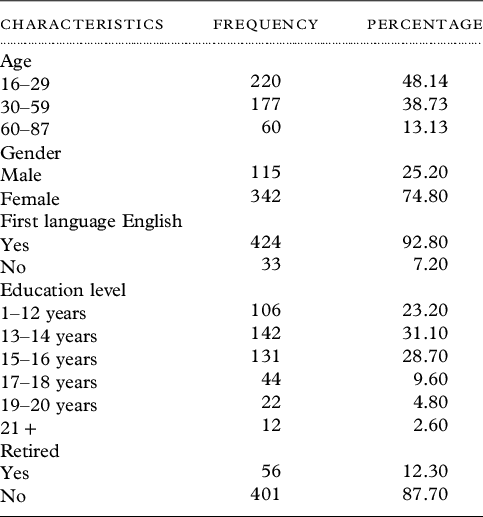
The study employing a cross-sectional survey design was conducted in Australia. Items measuring wisdom were self-assessed. All the measurements were incorporated into an online electronic survey format. The sample initially consisted of 461 cases from the target population of 16–87 years, to indicate an approximate 70-year range. Four respondents were under the age of 16 and thus their data were deleted. The final sample (N = 457, M = 35.19, SD = 17.45; age range = 16–87 years) included 115 men and 342 women. The ethnic identity of respondents indicated that 88.40% were White Australians, 3.30% Asians, 2.20% Aboriginal or Torres Strait Islanders, 1.10% Africans, and 5% identified other ethnicities. The sample was well educated, according to the Australian education system, having completed at least 12 years of schooling or more (M = 14.46 years, SD = 2.86; range = 1–29 years). The overall self-rated health of participants on a 10-point scale (1 = poor, and 10 = excellent) was above average (M = 7.47; range = 1–10). Most of the participants (92.80%) spoke English as their first language. Table 1 summarizes the demographic characteristics of the sample.
Participant characteristics (N = 457)

Note. Completion of year 12 = 12 years of education.
Potential respondents were sourced through local newspaper advertisements, social media outlets (e.g., Facebook and Twitter) and local community groups, such as senior citizen clubs, and word of mouth at the School of Psychology courses at a regional Australian university. The studies were approved by the university’s Human Research Ethics Committee and data were collected according to the protocol for online surveys. Some student participants received minimal course credits for psychology-related courses, but no other incentives were offered. Participation was voluntary and anonymous and no deception was used. Although non-student respondents were required to be 18 years or older, psychology university students could be as young as 15. Potential volunteers were informed that the surveys would take about 30–45 minutes to complete and could be accessed individually at home via the provided link. If the individual wished to participate, they indicated their consent by proceeding with the survey and returning a hard copy (if paper-based).
Measures
The Self-Assessed Wisdom Scale-15 (SAWS-15). The SAWS-15 is an abbreviated version of Webster’s (Reference Webster2007) 40-item SAWS constructed by Leeman et al. (Reference Leeman, Knight, Fein, Winterbotham and Webster2021). The SAWS-15 like its parent scale has five dimensions of: Experience, Reminiscence/Reflection, Emotional Regulation, Openness, and Humour (see Appendix A). Each subscale is made up of three positively phrased statements and responses are rated on a 6-point Likert-type scale (1 = strongly disagree to 6 = strongly agree). Participants were asked to consider a series of statements. For example, from the Experience dimension “I have lived through many difficult life transitions”, from the subscale of Reminiscence/Reflection “I reminisce quite frequently”, from the Emotional Regulation subscale, “I am very good at reading my emotional states”, from the Openness subscale “I enjoy sampling a wide variety of different ethnic foods”, and from the Humour facet, “I can chuckle at personal embarrassments”. Leeman et al. (Reference Leeman, Knight, Fein, Winterbotham and Webster2021) reported good internal consistency reliability for the total scale (α = .80). Exploratory and confirmatory factor analyses supported a five factor structure. Raw scores are summed up to produce a total wisdom score. The SAWS-15 is related to age, showing a curvilinear relationship with lower scores in early and later life, and to gender, with women scoring significantly higher than men (Leeman et al., Reference Leeman, Knight, Fein, Winterbotham and Webster2021). In this study, we further reduced the scale by removing the subscales for Openness and Humour in order to see if a model using them as antecendent and consequence of wisdom fit the data. For the current study, internal consistency reliability for the total scale was high (α = .82), as was also for the SAWS-9 (α = .80).
The Three-Dimensional Wisdom Scale-12 (3D-WS-12). The 3D-WS-12 (Thomas et al., Reference Thomas, Bangen, Ardelt and Jeste2017) is a short form of the Three-Dimensional Wisdom Scale (3D-WS; Ardelt, Reference Ardelt2003). The brief measure includes four items each on the Cognitive, Reflective, and Affective or Compassionate dimensions of wisdom (see Appendix B). One item from the Reflective, and two from the Affective subscales are reverse scored. A sample item from the Cognitive subscale “A problem has little attraction for me if I don’t think it has a solution”, from the Reflective dimension “When I look back on what has happened to me, I can’t help feeling resentful” and from the Affective subscale “I’m easily irritated by people who argue with me”. Responses are self-rated with five options (1 = Strongly agree or definitely true of myself to 5 = strongly disagree or not true of myself). Reverse worded items are recoded, and responses are summed up to obtain a total wisdom scale score. The scale developers Thomas et al. (Reference Thomas, Bangen, Ardelt and Jeste2017) reported adequate internal consistency reliability for the total 3D-WS-12 (α = .73). The 3D-WS-12 correlated highly with the parent 3D-WS (r = .70). Thomas et al. (Reference Thomas2019) reported an α = .66 for the 3D-WS-12. The internal consistency reliability for the total scale calculated for the current study was (α = .74), and the correlation between the SAWS-9 and the 3D-WS-12 was moderate (r = .24).
Data analyses
Missing values accounted for less than 5% of the dataset and Little’s (Reference Little1988) Missing Completely At Random (MCAR) test was not significant χ2 (401) = 364.71, p = .903. We note that with large samples that have been coupled with relatively small percentages of missing values (Scherbaum, Reference Scherbaum, Leong and Austin2006), consider mean replacement to give similar results to lengthier and more intricate multiple imputation methods. Therefore, taken together, when applicable we used mean replacement to impute MCAR values, with item-level imputation in the SAWS and the 3D-WS-12.
Analysis of Moment Structures (AMOS) version 26 software was employed for the structural equation modelling (SEM) incorporating bootstrapping with bias-corrected confidence intervals. Data from Likert scales are usually treated as interval-level data, but formally Likert scales are in fact ordinal scales (Wu and Leung, Reference Wu and Leung2017). Many researchers suggest arguments for treating ordinal Likert scale data as interval level under almost all condition (Robitzsch, Reference Robitzsch2020; Wu and Leung, Reference Wu and Leung2017). However, because some controversy exists with respect to Likert scales with ordinal points of measurement, in respect to the extent that these ordinal points can be used to generate ordinal data that approximate interval data, we employed two corrections. First, in accord with several researchers (Moustaki, Reference Moustaki2000; Newsom, Reference Newsom2018), we used the asymptotic distribution free (ADF) function as a form of arbitrary generalized least squares (AGLS) distribution free estimation procedure. We also used bootstrapping with ADF estimation, rather than the more commonly applied multiple maximum likelihood estimation procedure to remedy deviations from normality, which is suggested in using latent variable models for ordinal data (Cagnone et al., Reference Cagnone, Mignani and Moustaki2009; Moustaki, Reference Moustaki2000). Within our SEM analyses, we used a parcelling approach to model wisdom as an overarching latent construct. In accordance with best practices for parcelling, we completed separate confirmatory factor analyses (CFAs) for the items composing the parcels to ensure single dimensionality (Matsunaga, Reference Matsunaga2008). Namely we performed five CFAs when testing the SAWS components – comprised of CFAs for Openness and Humour and the SAWS specific wisdom components of Reminiscence and Reflection, Emotional Regulation, and Experience. We also completed three other CFAs to check the first-order factor integrity of the cognitive, reflective, and affective components within the 3DWS construct measure. All manifest variable error terms are uncorrelated with the exception if items 9 and 10 in Affect. The error terms of these two items were correlated due to negative wording which resulted in a negative frame of reference, setting them apart of items 11 and 12.
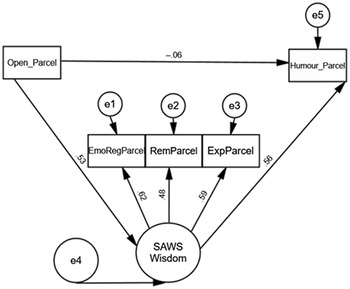
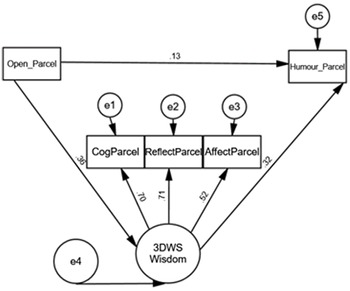
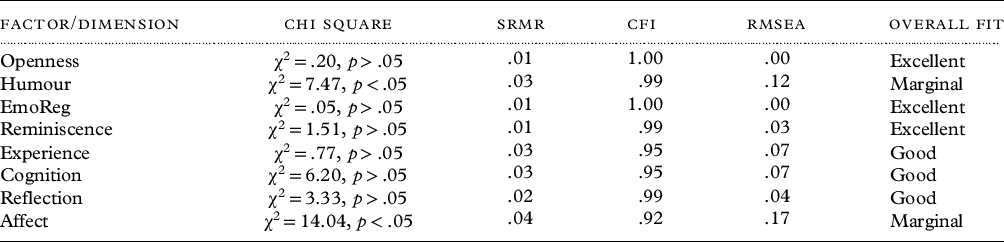
The results of these CFAs can be seen in Table 3, which shows fit indices within acceptable ranges (Hu and Bentler, Reference Hu and Bentler1999; Lai & Green, Reference Lai and Green2016), which after a balanced interpretation across indices indicates that SEM can be performed using a parcelling approach. Accordingly, because all of these first level CFA’s displayed good fit using the traditional fit indices we could proceed to a parcelling approach for SEM using two different parcels of wisdom. Namely parcels for experience, reminiscence reflection, and emotional regulation to underpin the SAWS model of wisdom, and parcels for cognition, reflection, and affect, to underpin the 3D W S model of wisdom. The forms of these partials can be seen in Figures 1 and 2.
Mediation model with SAWS-9 measure of wisdom.

Mediation model with 3D-WS-12 measure of wisdom.

For subsequent interpretations, model fit was assessed based on several fit indices (Hu and Bentler, Reference Hu and Bentler1999; Lai & Green, Reference Lai and Green2016). These indices included the Goodness of Fit Index (GFI), where values greater than .95 indicate well-fitting model, with values above .90 being adequate fit, the Standardized Root Mean-square Residual (SRMR; <.08), and the Root Mean Square Error of Approximation (RMSEA; <.06 indicates good fit, .06–.09 satisfactory fit, and >.10 poor models), and the comparative fit index (CFI) with values above .95 suggesting good fit and values less than .90 described as unacceptable fit (McDonald and Ho, Reference McDonald and Ho2002).
Results
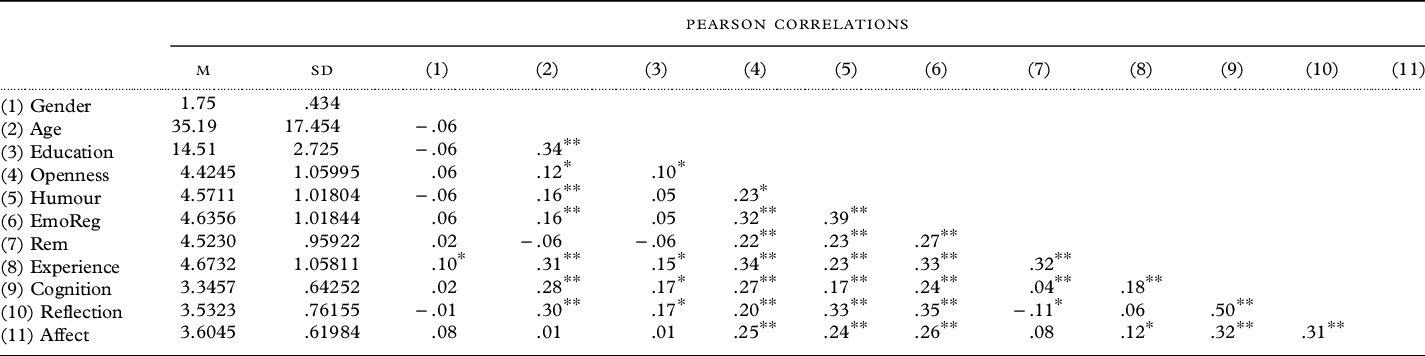
We produced a correlation table to examine relationships between the wisdom parcel subscales and demographic variables (see Table 2). Inspection of this table indicates that the wisdom parcels are positively related, as would be expected from subscales of the same broader factor. Of the demographic variables, age displayed a consistent pattern of positive relationships with the wisdom parcel subscales.
Summary of means, standard deviations, and correlations
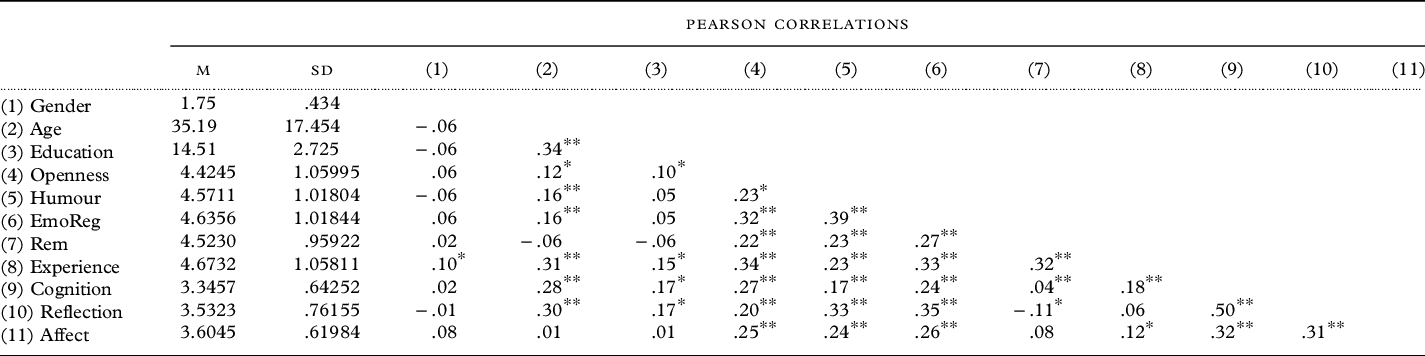
Note. Mean, standard deviation, and intercorrelations for all survey participants (n = 457).
* p < .05. ** p < .01.
The Self-Assessed Wisdom Scale-9 (SAWS-9). From the shortened version of the SAWS the SAWS-15, we developed an abbreviated form, the SAWS-9, so we could examine the research questions posed in this paper. From a conceptual viewpoint the current study looked at the three central SAWS components of Experience, Reminiscence/Reflection, and Emotional Regulation that have a more general grounding in the research literature on wisdom. In Table 3, we report CFA results of the SAWS-9 factors, showing that overall these factors are a good fit for the data. Thus, the SAWS-9 is adequate for use in the SEM to test whether Openness and Humour work well as antecedent and consequence of wisdom.

The Three-Dimensional Wisdom Scale 12. From the 3D WS 12, we conducted three CFAs that examined the three central components of Cognition, Reflection, and Affect that underpin much of the research literature on wisdom. In Table 3, we report CFA results of the 3D WS 12 factors, showing that overall these factors are a good fit for the data. Thus, we have evidence that the 3D WS 12 factors are adequate for use in the SEM and to test whether Openness and Humour work well as antecedent and consequence of wisdom.
The SEM analyses
Using the same sample (N = 457), as indicated in Figure 1, we performed a SEM with the three parcels from the SAWS 9 model – Emotional Regulation, Reminiscence, and Experience – as manifest indicators of the latent wisdom measure, with a SAWS Openness parcel as the antecedent to the SAWS latent wisdom variable and with a SAWS Humour parcel as outcome (see Figure 1). Results showed an adequate fit to the data, χ2 (4) = 40.40, p < .05, GFI = .99, CFI = .93, SRMR = .03, RMSEA = .06, 90% CI [.02, .11]. Using standardized ADF estimates, the direct path from Openness to Humour was insignificant at b = −.06, p > .05. However, the path from Wisdom to Humour was significant at b = .53, p < .05, and the path from Openness to Wisdom was significant at b = .56, p < .05. Therefore, the model produced full mediation.
Using the same sample (N = 457), as indicated in Figure 2, we performed a SEM with the 3D-WS-12 as the wisdom measure with a SAWS Openness parcel as the antecedent to the 3D-WS-12 latent wisdom variable composed of parcels of Cognitive, Reflective, and Affective manifest indicators, with a SAWS Humour parcel as outcome (see Figure 2). Results showed an adequate fit to the data, χ2 (4) = 19.73, p < .001, GFI = .90, CFI = .89, SRMR = .04, RMSEA = .09, 90% CI [.05, .14]. Using standardized ADF estimates, the direct path from Openness to Humour was insignificant at b = .13, p > .05. However, the path from Openness to Wisdom was significant at b = .36, p < .05, and the path from Wisdom to Humour was significant at b = .32, p < .05. Therefore, the model produced full mediation.
Discussion
This study set out to contribute to answering a conceptual question in the literature: whether the Openness and Humour facets of the Self-Assessed Wisdom Scale (SAWS) are core components of wisdom or whether Openness may be antecedent to wisdom whilst Humour could indicate an outcome of being wise. To our knowledge, there are no other studies addressing these issues.
The pattern that emerges from the SEM is that the SAWS measure of wisdom demonstrated that an adequate fit to our data can be obtained by a model with Openness as antecedent and Humour the outcome of wisdom using the remaining three factors of Experience, Emotional Regulation, and Reminiscence/Reflection as the core components of wisdom. These results align with theories that have postulated Openness to be a precursor for wisdom development. Indeed, the MORE Life Experience Model of wisdom (Glück and Bluck, Reference Glück, Bluck, Ferrari and Weststrate2013; Glück et al., Reference Glück, Bluck and Weststrate2018) proposes that Openness is a resource required for wisdom to actualise, as such, appearing before wisdom. Furthermore, our findings are congruent with Ardelt’s (Reference Ardelt2011) views of Openness as a personality trait predicting wisdom. Supporting this notion is also personality literature (Costa and McCrae, Reference Costa and McCrae1992; Erikson, Reference Erikson, Schustack and Friedman2008; McCrae et al., Reference McCrae2000; Roberts et al., Reference Roberts, Walton and Viechtbauer2006) that considers personality traits such as Openness to be stable individual differences, emerging early in life. Interestingly, when Dortaj et al. (Reference Dortaj, Noghabi, Ferrari, Jahan and Esmaeili2018) subjected the 40-item SAWS to principal component analysis, the researchers failed to retain Openness.
The exclusion of Openness as a common subcomponent of wisdom was noted in the list compiled by Meeks and Jeste (Reference Meeks and Jeste2009), and later by Grossmann and Kung (Reference Grossmann, Kung, Kitayama and Cohen2019). Similarly, although Jason et al. (Reference Jason, Reichler, King, Madsen, Camacho and Marchese2001) and Yang (Reference Yang2001) incorporate Openness as part of their wisdom construct, it did not appear as an independent facet in their conceptualisations of wisdom.
Likewise, for the SAWS, the Humour factor is best described as a consequence of being wise a view supported by Ardelt (Reference Ardelt2011). Ardelt indicates that those who are already wise display humor, which Webster (Reference Webster2003, Reference Webster2007) theorized is utilized by the wise in social interactions to reduce stress.
These current results are also consistent with the relatively low frequency inclusion of Humour in definitions of wisdom in the literature reviewed, first by Meeks and Jeste (Reference Meeks and Jeste2009), as well as by Grossmann and Kung (Reference Grossmann, Kung, Kitayama and Cohen2019) and more recently by Karami et al. (Reference Karami, Ghahremani, Parra-Martinez and Gentry2020). Although some wisdom scholars (e.g., Damon, Reference Damon and Brown2000; Jason et al., Reference Jason, Reichler, King, Madsen, Camacho and Marchese2001; Perry et al., Reference Perry, Komro, Jones, Munson, Williams and Jason2002; Taranto, Reference Taranto1989) recognize the role of Humour in wisdom, they consider Humour as a lesser aspect of the construct, rather than a core component. Indeed, Brown and Greene (Reference Brown and Greene2006) argued that since humor as a concept had not been identified in implicit or folk studies of wisdom, its presence as an essential component of wisdom was unsupported.
When adding (SAWS) Openness as antecedent and (SAWS) Humour as outcome to wisdom as measured by the 3D-WS-12, we found an acceptable fit to our data. This finding provides some additional support to this interpretation of the relationship of Openness and Humour to wisdom by showing fit with a different wisdom measure based on distinctive definition of wisdom.
Why then, does Openness serve as a precursor to wisdom? The arguments have been addressed earlier in the paper, but it seems that Openness as a personality trait signifies adaptions whereby individuals explore multiple options to cope with the world. Coping forms and behaviors may require activities such as Reminiscent/Reflection on experience, and Emotional Regulation and Cognitive and Affective self-regulation, but more research is needed here.
Finally, why is it that Openness is mediated by Wisdom in its effect on Humour. In other words, why must Openness move through Wisdom to effect Humour rather than producing a direct effect? One implication is that some level of Wisdom is a necessary or sufficient state to produce Humour, while in contrast simply being Open is not enough to produce Humour.
Obviously, our own prior work (Leeman et al., Reference Leeman, Knight, Fein, Winterbotham and Webster2021) reported a good fit of the SAWS-15, which included Openness and Humour to a different data set. There is no direct way to compare the fit of the CFA for the SAWS-15 and the fit of the SEM models reported here. Instead, the argument is rooted in conceptual discussions from the literature of the core components of wisdom, supported here by the finding that these models fit the data well using two different measures of wisdom.
Limitations and future research
We note that there are several limitations to the current study. First, from a conceptual viewpoint the current study looked at the relationship of three central SAWS components of Experience, Reminiscence/Reflection, and Emotional Regulation that have a more general grounding in the research literature on wisdom with Openness and Humour. The analysis used cross-sectional data. To test this properly, a longitudinal study is needed with Openness measured at Time 1, the nine-item SAWS at Time 2, and Humour at Time 3, which would then indicate a temporal precedence. Nevertheless, psychometric validity was useful to prepare the groundwork for the longitudinal study.
Second, specifically in relation to the recruitment process which employed convenience samples, there may well be sampling bias due to the voluntary nature of the sample which may include unknown selection biases. Third, although the study sampled a wide age range, the majority were young to middle-aged female Australians of Caucasian heritage, thus generalisability is thus potentially limited. Future research would benefit from the inclusion of a more balanced sample of men and women incorporating different cultural groups in a longitudinal study. Finally, the reduction of the SAWS to a nine-item measure, while necessary for these analyses and potentially useful as a brief form, makes comparison to other studies using longer versions difficult. Despite the limitations, many of which are shared by other wisdom research, this study employed two wisdom measures with different conceptualizations of wisdom, which provides greater confidence in the validity of our findings.
Conclusion
The overall indication is that the fit of the models with Openness as a precursor and Humour as a consequence of wisdom was quite good. Therefore, we suggest that future research use the other three SAWS components without including Openness and Humour. While the types of covariance structure analyses employed in this study are commonly used to test alternate models such as these, our findings would support further research on this question using longitudinal data to further test whether Openness is a component of wisdom or exists prior to the development of wisdom and similarly, whether Humour is a marker of wisdom or the characteristic of those who are wise. Given complexities inherent in wisdom conceptualisations and analyses, these findings provide to our knowledge the first direct empirical evidence that Openness is antecedent to wisdom and Humour the outcome of being wise using both the SAWS-9 and the 3D-WS-12. An ongoing challenge for improved understanding of wisdom and its measurement is distinguishing which of the qualities associated with wisdom are components, which are precursors, and which are consequences.
Conflict of interest
The authors have no conflict of interest.
Source of funding
None.
Description of authors’ roles
T. Leeman: data analyses and writing.
Bob Knight: study design and writing.
Erich Fein supervised data analyses and contributed to writing.
Supplementary material
To view supplementary material for this article, please visit https://doi.org/10.1017/S1041610222000400