Hafting, defined as the process of attaching stone tools to nonstone shafts or handles, is an important facet in understanding past systems of lithic technological organization. The development of hafting specifically and of composite tools in general has been identified as one of several indicators of human behavioral modernity (Barham Reference Barham2013; Shea Reference Shea2006; Wilkins et al. Reference Wilkins, Schoville, Brown and Chazan2012). Hafting changes the socioeconomic choices people made about where and when to move, what resources to procure, and when to discard and when to resharpen tools (see Bettinger et al. Reference Bettinger, Garvey and Tushingham2015; Clarkson et al. Reference Clarkson, Haslam, Harris, Goodale and Andrefsky2015; Eren Reference Eren2012; Kelly Reference Kelly2007). Although normally associated with projectile technologies, many hafted tools, such as knives, drills, scrapers, and sickle blades, are not used as projectiles. Despite hafting's importance, it has remained an undertheorized part of lithic technological organization. In particular, the lack of models for variability in hafting strategies and of quantitative measures for assessing hafting's efficacy has prevented the potential of hafting to inform our understanding of human behavior from becoming fully realized.
Studying the organization of technology provides one path for using hafting and lithic industries to better understand socioeconomic behavior in the past. Building on Binford (Reference Binford and Wright1977, Reference Binford1978, Reference Binford1979, Reference Binford1980) and Nelson (Reference Nelson1991), Carr and Bradbury (Reference Carr and Bradbury2011, Reference Carr, Bradbury, Price and Carr2018) have outlined how technological strategies, such as stone tool hafting, mediate environmental and demographic conditions; social, economic, and ideological strategies; and decision making around stone tool design and activities. Technological strategies are variable and responsive to the socioeconomic contexts in which they are situated (Hadley and Carr Reference Hadley, Carr, Galloway and Peacock2015), and technological organization is sensitive not only to subsistence and settlement patterns but also to kinship, politics, and religion (Carr et al. Reference Carr, Bradbury, Price, Carr, Bradbury and Price2012:8). Because the process of hafting stone tools is informed by technological needs, economic restrictions, and social conventions, it can provide unique insights into how people navigated novel socioeconomic contexts in the past.
The emergence of sedentary villages, which occurred in many different places and times across the globe, represents a significant transformation in human socioeconomic organization. In the southern Levant, the establishment of permanent villages approximately 11,000 years ago created a novel context in which existing socioeconomic systems, identities, and strategies underwent significant transformation. There were changes in food and craft production technologies (Bar-Yosef and Kislev Reference Bar-Yosef, Kislev, Harris and Hillman1989): decreasing mobility as a result of increasing sedentism necessitated the development of new conventions for stone procurement and exchange (Bamforth Reference Bamforth1990; Odell Reference Odell1998). Early villages were also locales of population aggregation and growth. In these contexts, people found themselves living in larger numbers, with people they may not have known well, and perhaps they had less ability or incentive to “vote with their feet” to mitigate social tensions.
Early villages are an ideal context in which to study the intersection of technological needs, economic restrictions, and social conventions in hafting technologies. Across the globe, sedentism and population aggregation are associated with the creation of different mechanisms for communal integration (Barrier Reference Barrier2017; Birch Reference Birch2014). In the southern Levant, sedentism emerged at the same time as community-building integrative mechanisms, such as communal storage (Kuijt and Finlayson Reference Kuijt and Finlayson2009); communal architecture like the tower of Jericho in the earliest Neolithic (the Pre-Pottery Neolithic A [PPNA]; Kenyon and Holland Reference Kenyon and Holl1981); and subsequently in collectivizing rituals such as the complex mortuary practices reflected by skull plastering and cult buildings during the Neolithic (Byrd Reference Byrd1994; Kuijt Reference Kuijt1996, Reference Kuijt2008; Rollefson Reference Rollefson2005). However, the investment in the performance of communal identity indicates the persistence of differences among early villagers. These differences and how they were materialized have not yet been fully explored. We argue that curation approaches to lithic technological organization can help elucidate patterns of social differences within early villages that necessitated these community-integrative mechanisms.
In this article, we explore how lithic technological organization, particularly hafting and curation patterns, near the start of the population aggregation process at the early Neolithic site of Dhra’, Jordan, can inform our understanding of technological, economic, and social strategies in these early settlements. Our approach combines elements of practice theory and curation methodologies with a broader consideration of lithic technological organization. We use a curation index to compare retouch patterns for hafted and unhafted pointed stone tools. The curation index helps clarify tool function and quantifies if, and how much, hafting economizes lithic raw materials. We also use the curation index to characterize two different hafting traditions for pointed tools in the Dhra’ assemblage: el-Khiam and Salibiya points. Through an examination of hafting as part of the lithic technological organization at an early village site, we argue that community-integrative mechanisms co-occurred with technological traditions that maintained social differences while humans made the transition to new sedentary lifeways.
Why People Haft Stone Tools
People haft stone tools for three general, but not mutually exclusive, reasons: technological, economic, and social. First, as a technology, hafting provides an opportunity to create new tools and increase the efficiency of existing tools. Some stone tool functions require hafting. For example, hunting, through thrusting or projectile technologies, requires that stone tools be delivered with speed, force, and accuracy from a distance (Bleed Reference Bleed1986). Many of the studies of the origins of hafting in human history have focused on its technological advantages, often seen through the initial appearance of spears and later as projectile points with the bow and arrow (e.g., Ames et al. Reference Ames, Fuld and Davis2010; Goodale et al. Reference Goodale, Jones and Beck2011; Shea Reference Shea2006). The choice to haft seems straightforward when it is required for the tool to function, although stone tools are not always necessary for effective projectile technology (e.g., Waguespack et al. Reference Waguespack, Surovell, Denoyer, Dallow, Savage, Hyneman and Tapster2009). The type of haft can also affect the tool's functional efficiency, as Story and colleagues (Reference Story, Eren, Thomas, Buchanan and Meltzer2019) suggest for fluted and unfluted projectile points. Second, hafted tools are often more efficient than unhafted tools when used for the same activity. For example, a hafted scraper facilitates greater dexterity, increased leverage, and a more comfortable grip that together enable the user to scrape faster, more accurately, and longer (Tomka Reference Tomka and Andrefsky2001; although see Clarkson et al. Reference Clarkson, Haslam, Harris, Goodale and Andrefsky2015). Small flakes, blades, and tools that are difficult to grip can be used more efficiently when hafted (Clarkson et al. Reference Clarkson, Haslam, Harris, Goodale and Andrefsky2015:131). Third, hafting can be adapted to make lithic technologies more flexible. For example, a hafted biface can become a multipurpose tool when used as a knife while in the foreshaft of a spear (Andrefsky Reference Andrefsky2006).
Researchers have also argued that hafting extends the use-life of stone tools and thereby economizes lithic resources (see Keeley Reference Keeley1982; Odell Reference Odell1994; Shott Reference Shott1997; Weedman Reference Weedman2006). Archaeologists argue that economization is linked to risk minimization (Odell Reference Odell1994), mobility, and resource procurement (Clarkson et al. Reference Clarkson, Haslam, Harris, Goodale and Andrefsky2015:132–133; Shott Reference Shott1986). It is often suggested that predictable access to high-quality tool stone affects the investment in more formal and less expedient technologies such as hafting (Andrews et al. Reference Andrews, Knell and Eren2015; Goodale et al. Reference Goodale, Kuijt, MacFarlan, Osterhoudt, Finlayson and Andrefsky2008; Herzog and Goodale Reference Herzog, Goodale and Prentiss2019; Oswalt Reference Oswalt1976; Shott Reference Shott1986, Reference Shott1989). The rate of retouch has also been demonstrated to be influenced by the availability of high-quality raw material (e.g., Smith Reference Smith2015). Yet hafting does have economic costs that mitigate the benefits of raw material conservation. The costs of hafting, such as the resources necessary for the haft element and the time required to attach the stone to the haft, have rarely been taken into account (cf. Clarkson et al. Reference Clarkson, Haslam, Harris, Goodale and Andrefsky2015; Finlayson Reference Finlayson1990). Additionally, hafting can increase the transport costs for mobile toolkits (Eren Reference Eren2012). Clarkson and colleagues (Reference Clarkson, Haslam, Harris, Goodale and Andrefsky2015) took into account the time of manufacturing a haft in their exploration of the decisions of when to haft, retouch, or discard tools; they argue that archaeologists often overestimate the benefit of hafting to the functional efficiency of tools.
Hafting is also an important medium through which social information can be transferred (Goodale et al. Reference Goodale, Andrefsky, Osterhoudt, Cueni, Kuijt, Goodale and Andrefsky2015; Lipo et al. Reference Lipo, Hunt, Hundtoft, Goodale and Andrefsky2015; Prentiss et al. Reference Prentiss, Goodale, Harris, Crossland, Goodale and Andrefsky2015; Sinopoli Reference Sinopoli, Miracle, Fisher and Brown1991; Weedman Reference Weedman2006; Wiessner Reference Wiessner1983). In addition to their utilitarian function, tools can play a social role in communicating individual and communal identities (Weedman Reference Weedman2018; Wobst Reference Wobst and Cleland1977). Ethnographically, there is clear evidence that stone tool hafts can be a means of social information exchange (Weedman Reference Weedman2006; Wiessner Reference Wiessner1983). Hafts, which are commonly made of perishable materials, are often saved and can be passed down to multiple generations as heirlooms (Gould Reference Gould1980; Lillios Reference Lillios1999). Variability in decoration, form, and the use-life of hafts has been linked to different social identities of individuals, language groups, and ethnicity (Deacon and Deacon Reference Deacon and Deacon1980; Gould Reference Gould1980; Larick Reference Larick1985; Weedman Reference Weedman2006:190; Wiessner Reference Wiessner1983). Hafts can enable people to signal difference through color, style, embellishments such as feathers, and ornamentation while using a single homogeneous lithic resource. It is unclear how haft elements, which would normally be hidden when hafted, were involved in social information exchanges. It is possible, however, to distinguish distinct lithic technological learning traditions in the manufacturing of haft elements (see Goodale et al. Reference Goodale, Andrefsky, Osterhoudt, Cueni, Kuijt, Goodale and Andrefsky2015).
Curation Indexes, Tool Utility, and Hafting
Curation approaches to lithic technological organization provide one means of exploring the technological, economic, and social dimensions of hafting (Andrefsky Reference Andrefsky, MacDonald, Andrefsky and Yu2014; Buchanan et al. Reference Buchanan, Eren, Boulanger and O'Brien2015; Morales and Vergés Reference Morales and Vergès2014). Over the past two decades, curation studies have become an integral part of archaeological approaches to lithic technology (see Andrefsky Reference Andrefsky2008; Hiscock and Tabrett Reference Hiscock and Tabrett2010). Quantifying curation is critical to understanding technological organization (Shott Reference Shott, Robinson and Sellet2018). Following Shott (Reference Shott1996:268), we define curation as the “relationship between maximum and realized utility” in an artifact. Maximum utility in stone tools is the total amount of the object that can be effectively worked, whereas realized utility is expressed as the portion of the original object that is used. In curation studies, realized utility is equated to the amount of material that has been removed through use and retouch. This quantitative approach has been applied to many different archaeological contexts as researchers have sought to use retouch of tools as a proxy for an estimate of utility (e.g., Andrefsky Reference Andrefsky2006, Reference Andrefsky2008, Reference Andrefsky2009; Connell and Clarkson Reference Connell, Clarkson, Marwick and Mackay2011; Davis and Shea Reference Davis and Shea1998; Eren and Sampson Reference Eren and Garth Sampson2009; Eren et al. Reference Eren, Dominguez-Rodrigo, Kuhn, Adler, Le and Bar-Yosef2005; Hiscock and Clarkson Reference Hiscock and Clarkson2005; Horowitz and McCall Reference Horowitz and McCall2013; Quinn et al. Reference Quinn, Andrefsky, Kuijt, Finalyson and Andrefsky2008; Shott Reference Shott, Clarkson and Lamb2005; Shott and Seeman Reference Shott and Seeman2015; Shott and Sillitoe Reference Shott and Sillitoe2005; Shott and Weedman Reference Shott and Weedman2007; Shott et al. Reference Shott, Hunzicker and Patten2007).
There are several reasons why curation indexes are an ideal tool for reconstructing the organization of hafting technologies. First, they can help distinguish finished objects from objects that are still in production. Artifacts that lack visible evidence of hafting, such as notches, could be in progress, intentionally unhafted, or hafted in a different way from other tools with notches. If these tools were discarded before completion, we expect curation indexes to indicate that no utility has been realized. In contrast, if curation indexes demonstrate that a significant amount of utility had been realized, then these materials were intentionally unhafted or hafted in a distinct way. As a result, curation approaches can help reveal decision-making strategies regarding when hafting was technologically advantageous or superfluous. Second, indexes can be applied to both hafted and unhafted versions of tools to quantify the amount of utility that is realized for each individual tool. With the use of standardized measurements, curation studies provide a way of measuring realized utility across entire assemblages. Third, curation indexes can demonstrate the presence of different hafting and retouch techniques within assemblages. The co-occurrence of multiple hafting styles is an indicator of social difference and multiple learning traditions. In early settlements where different families and groups began to aggregate in the same place, identifying different learning traditions can provide insight into the challenges of village life. Together, curation indexes provide a critical analytical tool for understanding hafting as part of a broader lithic technological organization in early villages.
Dhra’, Jordan: An Early Neolithic Village
We center our discussion of lithic technological organization in early villages at one of the first examples in the world: Dhra’, Jordan. The site of Dhra’ is located next to Wadi ed-Dhra’ in the Jordan Valley and was occupied at approximately 11,000 cal BP during the forager–farmer transition in Southwest Asia (Figure 1; Finlayson et al. Reference Finlayson, Kuijt, Arpin, Chesson, Dennis, Goodale, Kadowaki, Maher, Smith, Schurr and McKay2003; Goodale et al. Reference Goodale, Kuijt and Finlayson2002, Reference Goodale, Kuijt, Finlayson, Astruc, Binder and Briois2007; Kuijt and Finlayson Reference Kuijt and Finlayson2009). The site had an extensive occupation during the PPNA that covered an area of approximately 1 ha, although with a lower density than later settlements. Excavations directed by Kuijt and Finlayson (in 1994, 2001–2002, and 2004–2005) uncovered numerous structures, features, faunal remains, paleobotanical evidence, as well as a substantial lithic assemblage of more than one million artifacts attributed to the PPNA occupation (see Finlayson et al. Reference Finlayson, Kuijt, Arpin, Chesson, Dennis, Goodale, Kadowaki, Maher, Smith, Schurr and McKay2003 and Goodale et al. Reference Goodale, Kuijt and Finlayson2002, Reference Goodale, Kuijt, Finlayson, Astruc, Binder and Briois2007 for detailed descriptions of the lithic assemblage). Pointed tools of several morphological types—el-Khiam and Salibiya points, awls, and borers—are abundant in the assemblage: it contains more than 1,000 points and 1,500 awls.
The Southern Levant region in Southwest Asia, depicting Dhra’, Jordan, and other early Neolithic sites.

Research at Dhra’ has made important contributions to our understanding of how early village life affected the organization of the economy and society (Kuijt and Finlayson Reference Kuijt and Finlayson2009; Kuijt and Goodale Reference Kuijt and Goodale2009). Among the contributions from research at Dhra’ are the earliest evidence of communal storage facilities (Kuijt and Finlayson Reference Kuijt and Finlayson2009) and new information about plant cultivation practices on the path to domestication (Goodale et al. Reference Goodale, Otis, Andrefsky, Kuijt, Finlayson and Bart2010; see also Asouti and Fuller Reference Asouti and Fuller2013), as well as on social and economic decision making and identity in stone tool production (Goodale et al. Reference Goodale, Kuijt, MacFarlan, Osterhoudt, Finlayson and Andrefsky2008, Reference Goodale, Andrefsky, Osterhoudt, Cueni, Kuijt, Goodale and Andrefsky2015; Quinn et al. Reference Quinn, Andrefsky, Kuijt, Finalyson and Andrefsky2008). Examining how and when Dhra’ knappers chose to haft, retouch, and discard stone tools provides a greater understanding of the social, economic, and subsistence strategies associated with the transition from primarily mobile hunter-gatherers to sedentary agriculturalists in Southwest Asia.
Dhra’ is an ideal case study for exploring hafting and lithic technological organization. The assemblage contains both hafted and unhafted tools with similar morphologies and retouch techniques, which allows for the development and application of a single curation index to quantify tool use-life and retouch. Unlike other early villages, raw material was not a constraint on Neolithic flintknappers at Dhra’. The site is positioned next to a large, medium- to high-quality flint outcrop (Goodale et al. Reference Goodale, Kuijt, MacFarlan, Osterhoudt, Finlayson and Andrefsky2008). Previous research has suggested that raw material availability significantly affected decisions to invest in formal tool technologies, including hafting (Andrefsky Reference Andrefsky1994; Goodale et al. Reference Goodale, Kuijt, MacFarlan, Osterhoudt, Finlayson and Andrefsky2008; Smith Reference Smith2015). Formal hafted tools conserve raw materials and maximize cutting edges, which are important factors in minimizing risk when the resupply of tool stone is unpredictable or difficult. With less of a need to conserve material, the choices to haft by the residents of Dhra’ were likely informed by the full range of possible reasons for hafting stone tools.
Pointed Tools at Dhra’
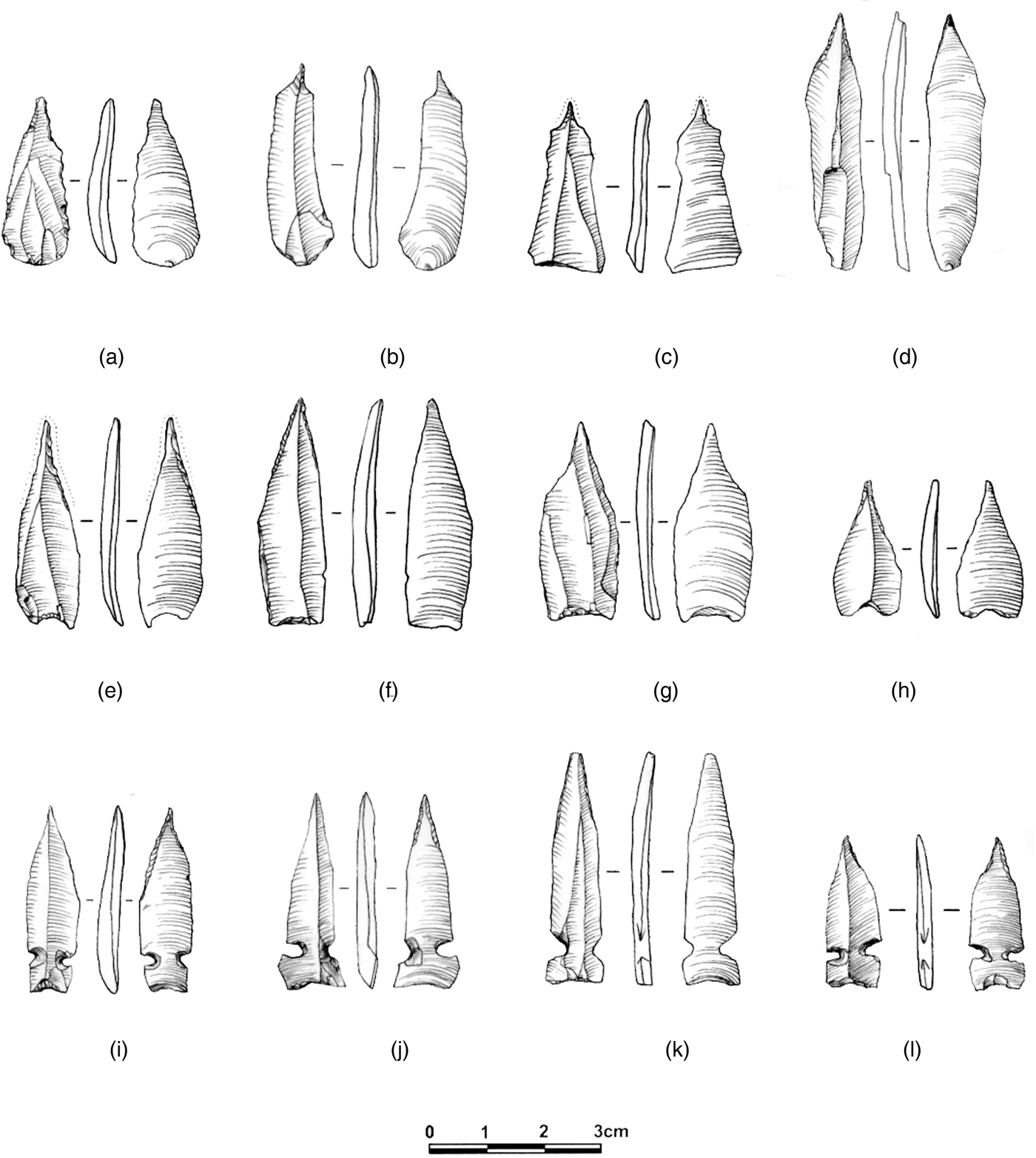
In this study we focus on three types of early Neolithic pointed tools at Dhra’: el-Khiam points, Salibiya points, and awls (Figure 2). These tools share similar morphological characteristics: all are unifacial pointed tools made on blades removed from unidirectional and multidirectional blade cores (Nadel Reference Nadel, Bar-Yosef and Gopher1997). Most tools have a single dorsal arris, although tools with multiple parallel dorsal arrisses are also found. These tool types primarily differ in their basal finishing. El-Khiam points were retouched at the distal end of the original blade to make the tip. Points were manufactured through unimarginal flaking on both the left and right margins. The unifacial retouch on the tip is present either only on the ventral surface of the original blade, only on the dorsal surface, or in opposed positions (one margin is retouched on the ventral surface and the other on the dorsal surface). The medial section of the tool was originally unretouched, although it became reduced with greater tool resharpening. El-Khiam point notches were usually bimarginally retouched and varied in respect to number, location, and size. The Dhra’ lithic assemblage contains el-Khiam points that have from one to eight notches, but a single matching pair of notches is most common. The base of the point, which is the proximal end of the original blade, was most commonly finished. Finished bases were retouched either unimarginally or bimarginally with a noninvasive retouch or an invasive retouch also referred to as couze retouch (Bordes and Fitte Reference Bordes, Fitte and Perello1964). Finished bases can be concave, flat, or convex.
Artifact illustrations showing typological variations in (a–d) awls, (e–h) Salibiya points, and (i–l) el-Khiam points (illustration by Eric Carlson).

Salibiya points have a similar morphology as el-Khiam points in most respects; however, they lack notches and have been described as having more prominent shoulders (Smith Reference Smith2005:409). In our view, to be classified as a Salibiya point an object must have all of the characteristics of an el-Khiam point, it must lack notches, and the base must have some form of finishing retouch.
Awls are morphologically similar to both el-Khiam points and Salibiya points. However, the bases on awls are unfinished. In some cases, awls still retain the platform and bulb of force from the original flake removal, unlike both el-Khiam and Salibiya points.
As with many prehistoric lithic assemblages, Neolithic researchers have previously used the pointed tool typology, based on artifact morphology, to define regional chronology and culture-history (see Kuijt Reference Kuijt2001; Nadel Reference Nadel, Bar-Yosef and Gopher1997). Many curation studies in the past have challenged morphological typologies on the basis that the different forms represent multiple steps in a single type of artifact's reduction sequence, rather than multiple discrete types (e.g., see Binford and Binford's Reference Binford and Binford1966 discussion of Bordes Reference Bordes1961; also see Andrefsky Reference Andrefsky2006; Fellner Reference Fellner1995; Goring-Morris Reference Goring-Morris1996; McPherron Reference McPherron1995, Reference McPherron, Soressi and Dibble2003; Neeley and Barton Reference Neeley and Michael Barton1994). As an alternative to the existing Neolithic pointed tool typology, Salibiya points may simply be unfinished el-Khiam points and awls may be unfinished Salibiya points. It is possible that awls, Salibiya points, and el-Khiam points could correspond to different production stages of one target tool type (in this case, el-Khiam points). At least some awls may be unfinished tools, which would have then been basally retouched (represented by Salibiya points) and ultimately notched (producing finished el-Khiam points). The methods developed to measure curation, combined with use-wear analysis, also allow us to evaluate these alternative typologies. As we show, retouch patterns indicate that the existing typological categories are discrete types of finished tools.
The Function of Pointed Tools at Dhra’
It is often assumed that hafted pointed tools were exclusively used as projectiles for hunting or warfare (Andrefsky Reference Andrefsky2006). Thus, Neolithic researchers have generally assumed that el-Khaim and Salibiya points were exclusively used for hunting (e.g., Nadel Reference Nadel, Bar-Yosef and Gopher1997), replacing earlier compound microlithics. Although villagers at Dhra’ were beginning to invest in cultivating, processing, and storing wild cereals, animal management practices were still in their infancy and hunting remained a major activity (Makarewicz Reference Makarewicz2013; Tchernov Reference Tchernov, Bar-Yosef and Gopher1997, Reference Tchernov2004). However, as many researchers now know, function does not always follow form. We deliberately refer to these artifacts as pointed tools and not as projectile points for a reason. The commonly used term “projectile point” may imply a function for which a tool or tool category may not have been used. Function must be demonstrated, not assumed, for any stone tool category.
There is strong evidence that the pointed tools recovered during excavations at Dhra’ were not primarily used as projectiles. There is only one impact fracture in the assemblage of more than 800 el-Khiam points (Finlayson et al. Reference Finlayson, Kuijt, Arpin, Chesson, Dennis, Goodale, Kadowaki, Maher, Smith, Schurr and McKay2003). The near absence of impact fractures suggests that any pointed tools at Dhra’ that were used and damaged during hunting were discarded away from the houses and activity areas excavated within the village.
Instead of projectiles, the pointed tools recovered in the excavations at Dhra’ were multipurpose perforators, as primarily indicated by the abundance of points at various retouch stages within the settlement (Goodale and Smith Reference Goodale and Smith2001; Goodale et al. Reference Goodale, Kuijt and Finlayson2002; Smith Reference Smith2005). Experimental work has demonstrated that wear, breakage, and retouch patterns of el-Khiam points are consistent with leatherworking (Quinn et al. Reference Quinn, Andrefsky, Kuijt, Finalyson and Andrefsky2008). A random sample of 55 broken el-Khiam points have breakage patterns that are consistent with use as a punctuation tool for working soft materials such as leather (n = 50) and transverse breaks (n = 5) that indicate rotational use akin to a drill (Quinn et al. Reference Quinn, Andrefsky, Kuijt, Finalyson and Andrefsky2008). Based on morphological similarities, it is likely that Salibiya points and awls were also used in this fashion. Given that the pointed tools were not all hafted onto arrow shafts, hafting is not a technological requirement for the primary function of the pointed tools in the Dhra’ assemblage: it is a choice.
Identifying Hafting in the Dhra’ Pointed Tool Assemblage
There are many macroscopic (see Andrefsky Reference Andrefsky2006) and microscopic means (see Rots Reference Rots2003; Reference Rots2010; Rots et al. Reference Rots, Pirnay, Pirson, Baudoux and Vermeersch2001, Reference Rots, Pirnay, Pirson and Baudoux2006) to determine whether a given tool or tool type was hafted: these include morphological preparation of the base (e.g., notching, fluting) or use-wear related to basal preparation or wear once in the haft (e.g., abrasion). Drawing on both macroscopic and microscopic evidence, we suggest that two tool types, the el-Khiam points and Salibiya points, were normally hafted, but that awls were unhafted.
Previous microwear studies have looked at intentional abrasion, as well as other markers of hafting, on the bases of these artifacts and equated the presence of these microwear patterns to hafting (Smith Reference Smith2005:342–404). Smith's study of a small subset of the Dhra’ assemblage found that 64.9% (24 of 37) of the el-Khiam points had microwear signatures potentially related to hafting. Only one of the four Salibiya points and one of the eight awls analyzed had hafting microwear, both markedly lower rates than of the el-Khiam points.
Some pointed tools also have morphological attributes consistent with hafting. Most el-Khiam points at Dhra’ have two notches, which suggests that these points were manufactured with hafting in mind. Salibiya points have a form of basal retouch consistent with creating a base that is conducive for hafting. In contrast, awls lack morphological attributes consistent with hafting; instead, they have unretouched or unfinished bases that lack notches and often still have the bulb of force present, making it difficult to secure the tool in a haft.
Together, the evidence suggests that el-Khiam and Salibiya points were made to be suitable for hafting, whereas awls were not. Even though these categories were likely not rigid, the retouch patterns described later provide quantitative support both for the existing typology that distinguishes these three types of pointed tools and for the pattern that el-Khiam and Salibiya were normally hafted whereas awls were not.
The Pointed Tool Curation Index (PTCI)
The goal of the Pointed Tool Curation Index (PTCI) is to quantify the amount of raw material used as pointed tools were reduced in length throughout their use-life. Experimental research demonstrates that. during reduction, el-Khiam points, Salibiya points, and awls lost mass lengthwise rather than horizontally (width; Quinn Reference Quinn2006; Quinn et al. Reference Quinn, Andrefsky, Kuijt, Finalyson and Andrefsky2008). Because the tools were all made on unifacial blades, were likely used for similar functions, and were retouched in a similar manner, we can apply a single curation index to all three tool types.
To develop an equation for the PTCI it was important to estimate original blade length for the pointed tools. It has been demonstrated that flake and blade characteristics often conform allometrically (Buchanan Reference Buchanan2006; Clarkson and Hiscock Reference Clarkson and Hiscock2011; Davis and Shea Reference Davis and Shea1998; Dibble Reference Dibble1997; Dibble and Pelcin Reference Dibble and Pelcin1995; Eren Reference Eren2013; Muller and Clarkson Reference Muller and Clarkson2014; Pelcin Reference Pelcin1996, Reference Pelcin1998; Quinn et al. Reference Quinn, Andrefsky, Kuijt, Finalyson and Andrefsky2008; Shott and Weedman Reference Shott and Weedman2007; Shott et al. Reference Shott, Bradbury, Carr and Odell2000). In other words, the measured value on one variable may positively or negatively correlate with the value of other variables on the original flake blank. However, this is not a simple relationship for all chipped stone technology. For instance, flake or blade mass may be predicted by the exterior striking platform angle, but this can vary depending on the force applied (Pelcin Reference Pelcin1997) and the type of percussion used (hard or soft; Shott et al. Reference Shott, Bradbury, Carr and Odell2000). Other factors such as differences in raw material (Bradbury et al. Reference Bradbury, Carr, Cooper and Andrefsky2008) and in flinknapper production techniques have been shown to introduce significant differences in flake characteristics (Whittaker Reference Whittaker1987; Williams and Andrefsky Reference Williams and Andrefsky2011). In an effort to reduce the blade character differences in our equation, we randomly selected an assemblage of blade blanks produced at the quarry area from Dhra’ to develop a measure of original blade length.
Experimental work using raw material from the Dhra’ quarry has been unsuccessful in fully replicating blade morphology (see Quinn et al. Reference Quinn, Andrefsky, Kuijt, Finalyson and Andrefsky2008). We claim that a sample of blade blanks from Dhra’ more closely approximates blade size and shape characteristics than an experimentally replicated assemblage, especially because we are not completely sure how blades were removed (force, angle, percussor density, etc.) at the site. One possible reason why we have not been able to replicate the blade removal process is because there are several reduction techniques represented in the assemblage, a characteristic of early settlements in which people might have been coming together for only part of the year and representing several different learning traditions for core-reduction strategies (see Goodale et al. [Reference Goodale, Kuijt, MacFarlan, Osterhoudt, Finlayson and Andrefsky2008] for the overall core-reduction sequence variability). Because the village sits on the lithic raw material source and there are few if any constraints on raw materials, it is also likely that other members of the village, such as children, were engaging in the lithic technology enterprise, producing further variability in the assemblage.
We selected 103 blade blanks from Dhra’ that were not included in our analysis of points and awls. Presumably, the people who produced the blade blanks could have been the same individuals who made and used the tools included in this study. We selected blade blanks that matched the characteristics of pointed tools at Dhra’: they were complete, not curved, and within the mean range of thickness values of the points and awls. The Dhra’ assemblage is characterized by the production of blades, many of which were used expediently or not at all (Goodale et al. Reference Goodale, Kuijt, Finlayson, Astruc, Binder and Briois2007). Given the size of the lithic assemblage at Dhra’ (more than one million pieces), we should not consider these blades to be rejects that were passed over and not selected to become pointed tools. Instead, it is more likely that blades for pointed tools were selected from among the extremely large quantity of available blades. Consequently, many of the blades in our sample may well have been selected to manufacture pointed tools if they were needed. The benefit of using archaeological, rather than experimental, samples for allometric calculations is an established best-case scenario (see Muller et al. Reference Muller, Clarkson, Baird and Fairbairn2018:723).
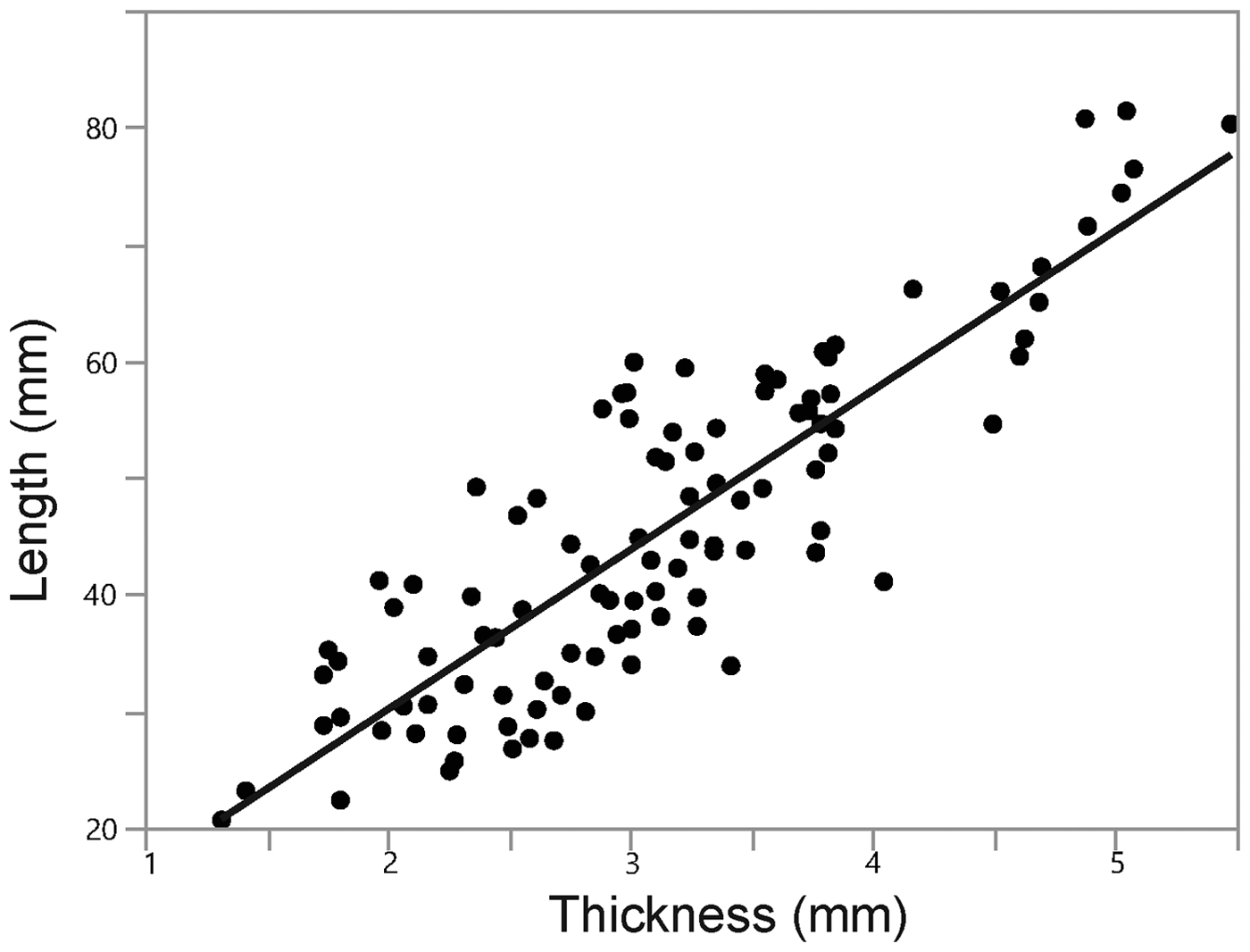
The thickness of the blade blank was taken below the bulb of force, because it is often removed during tool manufacture. For each blade we recorded the maximum length below the bulb of force, perpendicular to the striking platform. There is a strong linear relationship between the length and thickness of blades below the bulb of force (F = 285.48, df = 1, p < 0.0001, r 2 = 0.739; Figure 3). This regression value is significantly higher than other regression values used for predicting allometric relationships on stone tools based on flake dimensions, such as by Blades (Reference Blades2003; r 2 = 0.462) and Goldstein (Reference Goldstein2014; r 2 = 0.518). Muller and colleagues (Reference Muller, Clarkson, Baird and Fairbairn2018) demonstrate that using multiple measurements of thickness can increase the strength of the predictive relationship between blade thickness and length. However, because of the way in which Dhra’ points are retouched, the location of thickness measurements would change throughout the use-life of a tool. Consequently, we are unable to apply this approach here. For this assemblage, blade thickness can provide a reasonable approximation of original blade length, below the bulb of force, using the best-fit regression equation:
Estimated Blade Length = 13.661 × (Thickness) + 3.015
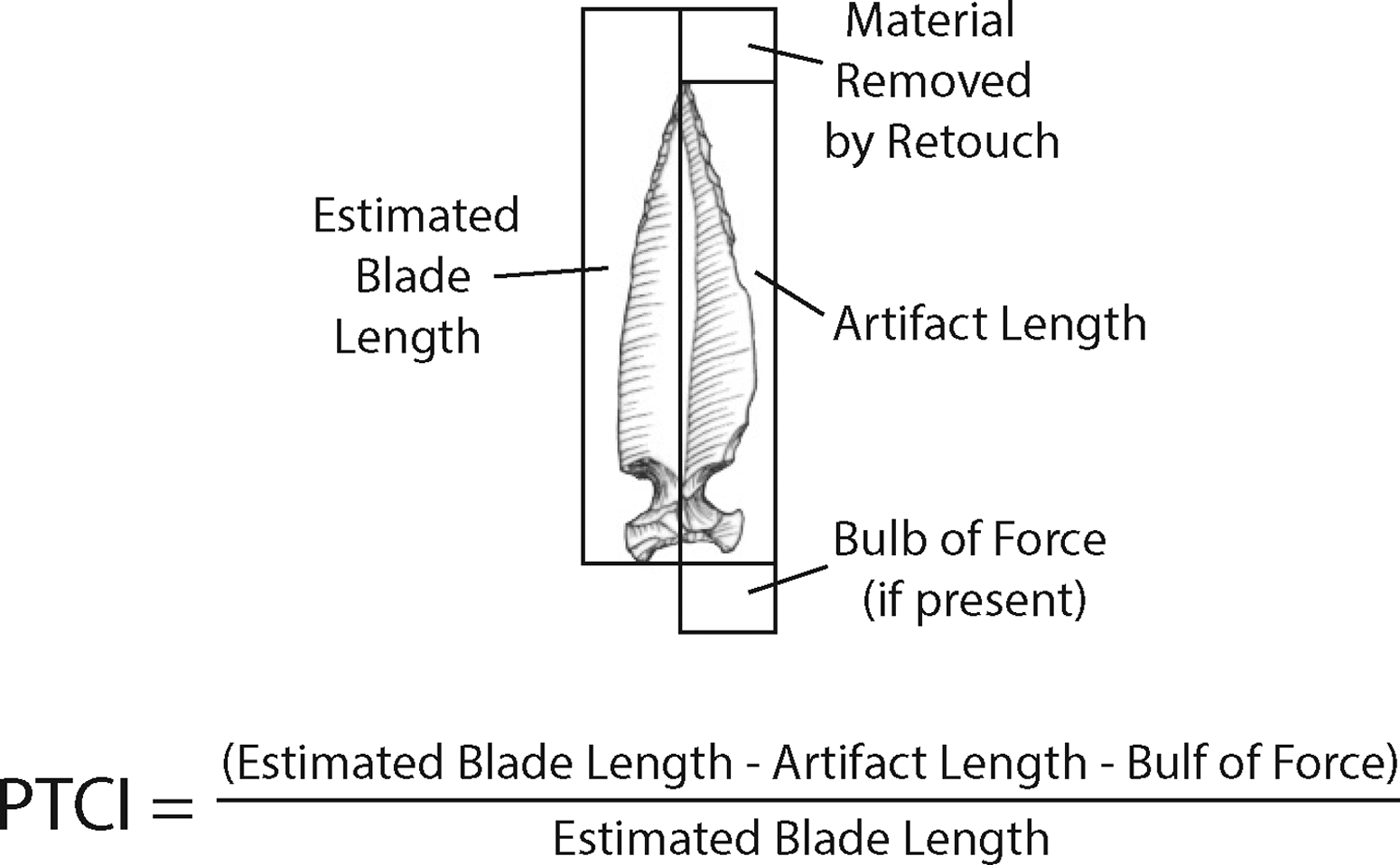
The estimated blade length serves as the measurement of maximum potential for each tool. With this estimation, we can generate the PTCI, a measure of the ratio of realized to maximum potential for these tools (see equation in Figure 4).
Regression analysis showing the estimation of blade length based on thickness. The best fit line estimates that blade length = (13.661 × blade thickness) + 3.015. (r 2 = 0.739; p < 0.0001).

Schematic illustration showing key measurements for calculating the PTCI.

The artifact length, or the unused part of the blade, is measured from base to tip (Figure 4). Because some of the pointed tools, particularly awls, still have their bulb of force present on the finished tool, we must subtract the length from the striking platform to below the bulb of force. This standardizes the length measurement for those tools that have had their bulb of force removed during basal preparation. For artifacts without a bulb of force, which are the majority of the pointed tool assemblage, this value is 0. This step ensures that the PTCI is standardized for all specimens regardless of the presence of a bulb of force and platform. The difference in the numerator becomes the dividend, which is then divided by the estimated blade length. Dividing by the estimated blade length, the quotient of the equation becomes standardized between the values of 0 and 1. The PTCI values are standardized between 0 (the minimum amount of curation) and 1 (a point that has realized all potential utility). Because of possible slight errors in estimating the original blade length from blade thickness, points can have negative dividends. In these cases (24 of 118 in the archaeological sample), the value is rounded up to the lowest possible curation score of 0. The PTCI can only be calculated on complete points, because snapped or otherwise damaged points would affect the unused blade length while not representing retouch intensity.
Applying the Pointed Tool Curation Index to the Dhra’ Assemblage
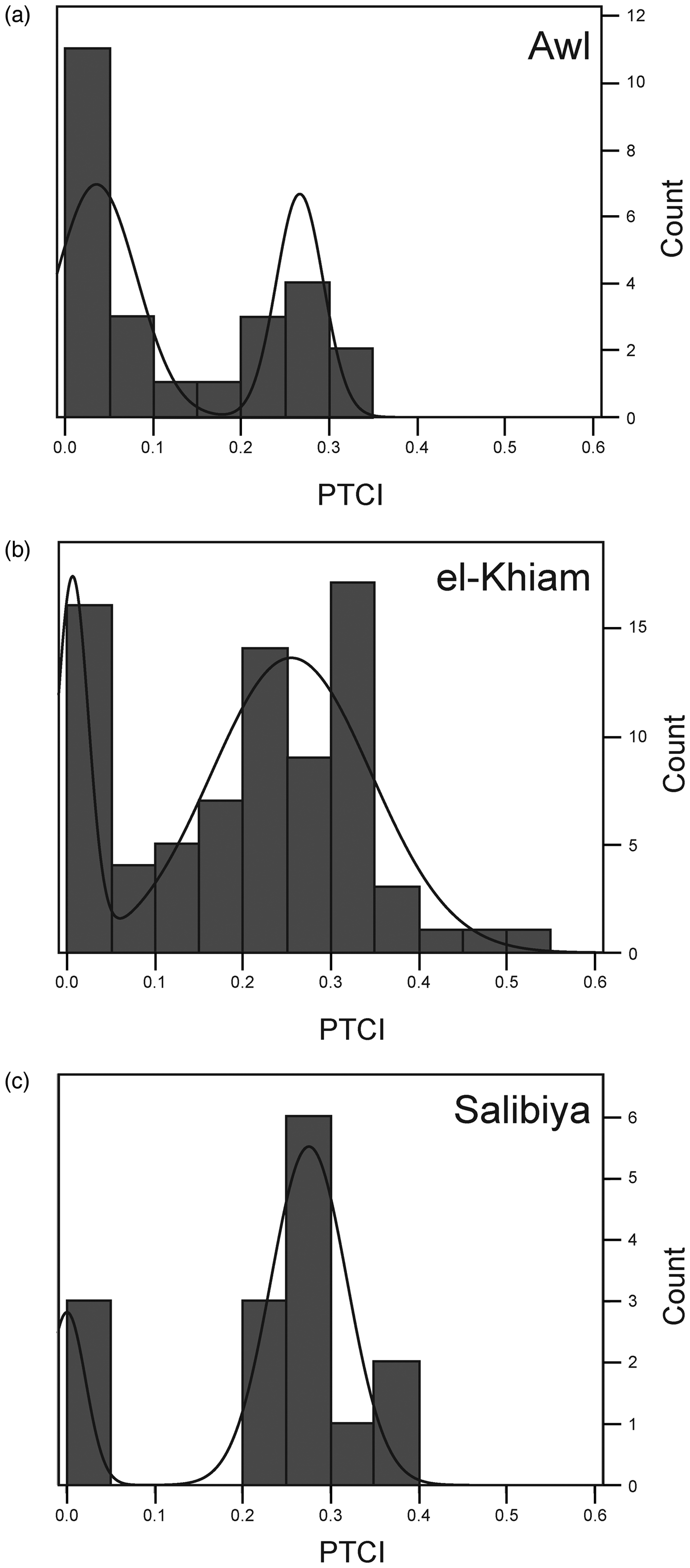
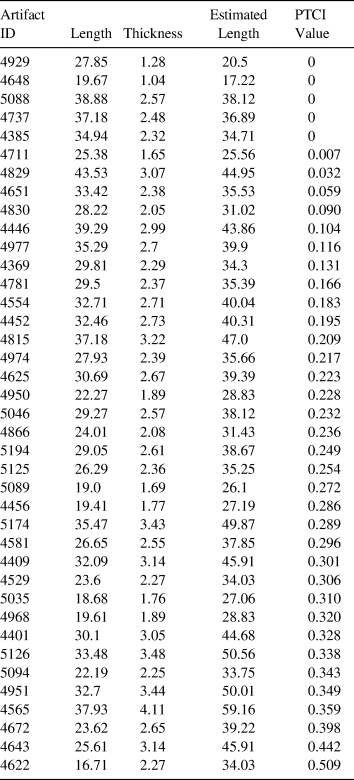
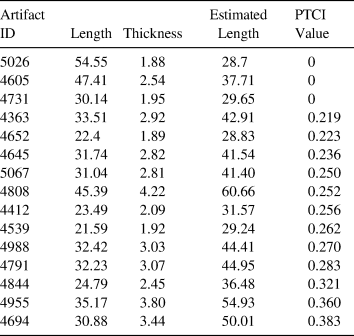
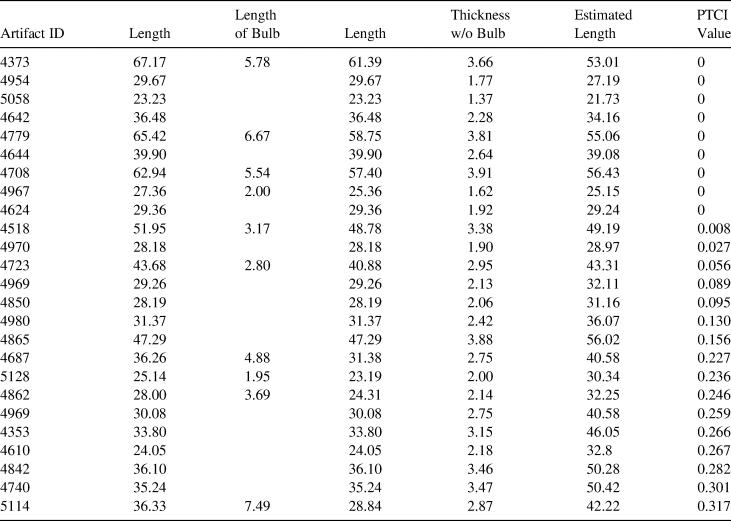
The pointed tools from the Dhra’ excavations used in this analysis included el-Khiam points (n = 78; Table 1), Salibiya points (n = 15; Table 2), and awls (n = 25; Tables 3 and 4). Salibiya and el-Khiam points averaged a similar PTCI value of 0.22 and 0.21, respectively. Awls averaged a PTCI value of only 0.12.Footnote 1 The PTCI for each pointed tool type at Dhra’ forms a bimodal distribution (Figure 5). We interpret the two modes as distinguishing between points that were discarded with little or no resharpening and those that were resharpened more intensively. The break in modes across different point types occurred at approximately the PTCI value of 0.10. Seventy-four percent (58 of 78) of el-Khiam points and 80% (12 of 15) of Salibiya points were more intensively resharpened before discard (those with PTCI values above 0.10) compared to only 44% (11 of 25) of awls. As a result, hafted tools were more intensively resharpened more often than unhafted tools (Fisher's Exact Test, p < .01). Additionally, no awls have a PTCI value over 0.32 (0 of 25), compared to 20% (3 of 15) of Salibiya points and 21% (16 of 78) el-Khiam points. In the Dhra’ assemblage, the most intensively retouched point had a PTCI valued of 0.51. However, very few points were resharpened this intensively. Only 3 of the 118 points in the Dhra’ assemblage had PTCI values above 0.40.
Distribution of Dhra’ PTCI values for (a) awls, (b) el-Khiam points, and (c) Salibiya points.

Sample of Data for Khiam Points Used in the Study.

Notes: Sample showing 50% of total artifacts used and both minimum and maximum PTCI values. All dimension measurements are in mm.
Data for Salibiya Points Used in the Study.

Notes: Data represent 100% of the sample. All dimension measurements are in mm.
Data for Awl Tools Used in the Study.

Notes: Data represent 100% of the sample. All dimension measurements are in mm.
Comparison of PTCI Values, Average Length at Discard, and Average Estimated Original Blade Length for Each Artifact Type.

Note: All dimension measurements are in mm.
These data demonstrate that awls were not resharpened as often, or as intensively, as el-Khiam points and Salibiya points. Because el-Khiam and Salibiya points were hafted while awls were not, we interpret this to mean that Dhra’ knappers took hafting into account when they made decisions on when to discard and when to resharpen tools. As we discuss later, although hafting would have had the practical result of conserving raw material, the motivations behind choices to resharpen or discard were likely more complex at Dhra’.
The size of the Dhra’ abandoned pointed tools also reflects differences in hafting techniques. If size is a determining factor in the decision to rejuvenate or discard a pointed tool, we would expect handheld tools to be discarded when they became too small to hold and use effectively (see Clarkson et al. Reference Clarkson, Haslam, Harris, Goodale and Andrefsky2015:131). Our data support this expectation: the awls were longer when discarded than the two hafted pointed tool types (see Table 4). Salibiya points were longer than el-Khiam points when discarded, even though both have similar PTCI values. This suggests that Dhra’ knappers chose slightly larger blades to make Salibiya points. This is further supported when we compare the average estimation of original blade size for Salibiya points (40.20 mm) and el-Khiam points (35.65 mm). We suggest that the Salibiya points, to compensate for the lack of notches. needed to be longer to create a stable haft. If this is true, it is likely that the amount of usable bit exposed was very similar for el-Khiam and Salibiya points—although this is nearly impossible to measure without having microwear hafting evidence on all of the points or without the hafting material being in situ, which is not preserved at Dhra’. This conclusion indicates that the sequence of awl, Salibiya, and El-Khiam point is not a reduction sequence, but reflects the production of different tool forms for the same task.
Discussion
Applying a curation index to the pointed tool assemblage at Dhra’ provides insights into the organization of lithic technology in this early village. Dhra’ knappers were quick to discard both hafted and unhafted tools, though they did retouch hafted tools more intensively than unhafted tools. At Dhra’, according to the PTCI, hafted tools were nearly twice as intensively retouched as unhafted tools. These results fall in line with suggestions by previous researchers that hafting economizes raw material (e.g., Keeley Reference Keeley1982).
Although hafting did economize on raw materials, there is little other evidence to suggest that this was a primary motivation for Dhra’ knappers, especially given the abundance of available raw material and the enormous overproduction of blanks. In contrast, the costs of acquiring and assembling handles and shafts, binding, and mastic likely informed Neolithic peoples’ choices to retouch hafted tools more often than unhafted tools. The curation index does not take into account these costs when measuring utility. In any event, because no hafts were preserved at Dhra’, we are currently unable to calculate the costs associated with their manufacture. It is likely, however, that the haft represented a more significant investment in time and used less abundant resources than the pointed lithic tools themselves, which were expediently manufactured on locally available stone.
Most hafted points, although used more economically than unhafted points, were discarded with most of their potential utility remaining. Even though manufacturing hafts required time and resources, it appears that Dhra’ tool users did not attempt to maximize the utility of pointed tools already in the hafts. The retouch patterns indicate that Dhra’ knappers preferred to curate and retool the more costly hafts using quickly manufactured unifacial pointed tools.
This leads to the question of why hafted tools were discarded with their potential utility remaining. The acquisition costs of raw material would have been very low because of the site's position next to a highly abundant flint deposit. With easy and predictable access to tool stone, raw material conservation was probably not a significant concern for Dhra’ knappers. There are many archaeological and ethnographic examples of formal tools being made using local materials when they are abundant and the need to economize raw material is low (Andrefsky Reference Andrefsky1994; Daniel Reference Daniel2001).
The PTCI helps us understand the intersection of hafting technologies and lithic technological organization. As previous studies have concluded, the pointed tool assemblage at Dhra’ was used in activities other than hunting (Quinn et al. Reference Quinn, Andrefsky, Kuijt, Finalyson and Andrefsky2008; Smith Reference Smith2005). It is likely that pointed tools used for hunting were discarded away from the village. Experimental research has demonstrated that hafting Neolithic pointed tools was not functionally necessary for leatherworking, but would have increased manual dexterity while using the tool (Quinn et al. Reference Quinn, Andrefsky, Kuijt, Finalyson and Andrefsky2008). In completing leatherworking tasks, hafting increased performance efficiency up to a certain point, after which point or bit replacement would have been more functionally effective. For instance, hafted points on drill handles might pierce thick hides more quickly than unhafted points. However, after a few resharpening episodes the overall length of the tool was reduced in a manner that rendered it less effective. This could also account for the lower mean blade length at the time of discard for the hafted tools (see Table 4). Similar retouch patterns for the two hafted point types, el-Khiam and Salibiya, suggest they are not two steps in a production sequence but were used to complete the same tasks, and there was no functional difference between them.
The evolutionary history of flintknapping and hafting demonstrates that they are learned behaviors. Given their similar function and contemporaneous occurrence in time and space, the stylistic differences between el-Khiam and Salibiya points can be best explained as resulting from being manufactured by knappers from different learning traditions. The difference in learning tradition approaches may be partly a result of different paths of information transmission, such as from parents (vertical transmission), other experienced knappers within a society (oblique transmission), or their peers (horizontal transmission; Boyd and Richerson Reference Boyd and Richerson1985). The morphological consistencies within each type and the significant morphological differences between the two hafting styles, primarily the presence (el-Khiam) or absence (Salibiya) of notches, suggest that the haft element morphology distinguishes the two types and would not have been modified, even when intensively retouched. Based on previous morphometric analysis at Dhra’, Goodale and colleagues (Reference Goodale, Andrefsky, Osterhoudt, Cueni, Kuijt, Goodale and Andrefsky2015) have argued that artifact form is a product of both the form of transmission and the knapping kits used in production.
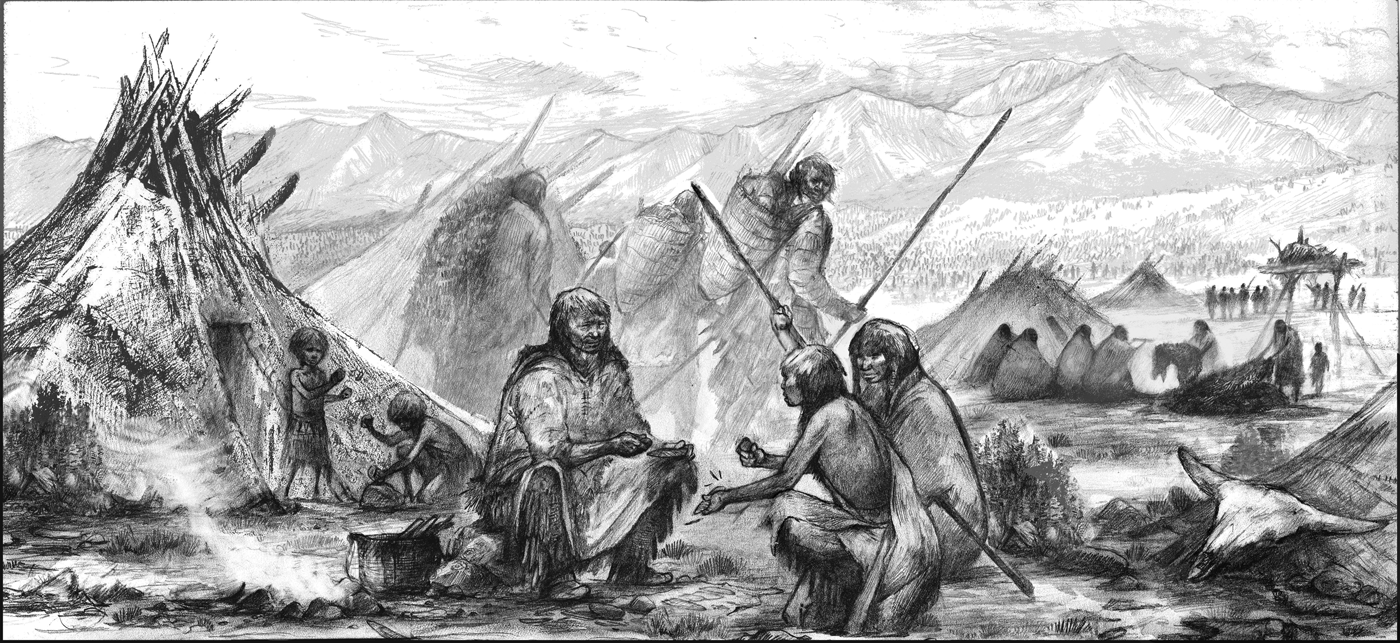
We suggest that lithic technology is one arena in which different social identities can be identified among the people who came together to live in this early Neolithic community. Flintknapping and hafting in extramural activity areas would have been a social activity (Figure 6). As the products of distinct learning traditions, the different practices of making and hafting stone tools maintained differences between the identities of individuals who manufactured el-Khiam and Salibiya points. The different haft lengths for el-Khiam and Salibiya points would likely have resulted in hafts that were visibly different to community members, even though the haft element on the stone tool itself would have been covered. By choosing to manufacture either el-Khiam or Salibiya points, people at Dhra’ asserted, or passively marked, their group affiliation within a community as part of a society where people were spending more time together in larger settlements. These groups were likely the precursors of the households and lineages that would come to characterize villages later in the Neolithic (Makarewicz and Finlayson Reference Makarewicz and Finlayson2018). It has been argued that early villages in the southern Levant show a marked delineation of space for certain activities (Kuijt and Goodale Reference Kuijt and Goodale2009). The delineation of space may be one way people at Dhra’ maintained distinct manufacturing traditions of Salibiya and El-Khiam points.
Artist reconstruction of flintknapping as a social activity. Stone tool production was an activity in which social information exchange likely played a crucial role in early village societies during the transition to agriculture-based economies (illustration by Eric Carlson).
Archaeologists have documented efforts by early Neolithic communities to create social cohesion among peoples who were living newly sedentary lives (e.g., Kuijt and Goring-Morris Reference Kuijt and Goring-Morris2002). The traditional ways of mitigating tension among these communities would have been to vote with their feet (Kelly Reference Kelly2007; Woodburn Reference Woodburn, Ingold, Riches and Woodburn1988), but life in the village would have likely required different mechanisms. Mortuary practices in the early Neolithic in the southern Levant reflect an emphasis on creating and maintaining communal equality through ancestor veneration (Kuijt Reference Kuijt1996). Grain storage at Dhra’ occurred in specialized buildings, where access would have been highly visible, maintaining an ethos of communal sharing (Finlayson Reference Finlayson and Benz2010; Kuijt and Finlayson Reference Kuijt and Finlayson2009). As communities became larger and more permanent through the course of the early Neolithic, the investment in new communal institutions that transcended lineage-based identities would have required significant resources, effort, and intention to mitigate social tensions.
These community-building activities would have been necessary if early villages were characterized by social segmentation. The presence of two distinct hafting traditions at Dhra’ suggests that social difference was reinforced through the practice of tool making. Previous work has also documented the investment in personal adornment items as costly signals to mark social difference within the Dhra’ community (Quinn Reference Quinn2006). Excavations at Dhra’ located multiple shared grain buildings and multiple food production structures, indicating that food sharing at Dhra’ was confined to subgroups within the community. These social differences, which were practiced in daily life, would have made communal integration activities, such as mortuary practices, critical to the continued existence of the village (Makarewicz and Finlayson Reference Makarewicz and Finlayson2018). As time went on, however, persistent segmentation became a fault line along which future fracturing of collective identities and increased competition among lineages occurred (Kuijt Reference Kuijt and Kuijt2000).
Conclusion
In this article, we suggest that lithic technological organization at the early Neolithic site of Dhra’, Jordan, particularly hafting and curation patterns, informs our understanding of socioeconomic strategies in early villages. This study shows that curation studies can provide quantitative data to monitor different patterns of retouch between and within hafted and unhafted tool types. At Dhra’, villagers hafted pointed tools in two distinct ways, despite the tools being used for similar tasks. These distinct hafting types indicate the maintenance of distinct learning traditions within this early village.
This case study contributes to a growing understanding of social dynamics in early villages worldwide. When people start settling down and aggregate at increasingly larger scales, the situation creates novel socioeconomic contexts (Birch Reference Birch2014; Birch and Thompson Reference Birch and Thompson2018; Gyucha Reference Gyucha2019). Archaeologists across the globe have demonstrated that there are numerous integrative mechanisms in these contexts, including through architecture (e.g., Lee and Bale Reference Lee and Bale2016), rituals in public gathering spaces (e.g., Barrier and Kassabaum Reference Barrier, Kassabaum, Price and Carr2018), monument construction (e.g., Parker Pearson Reference Parker Pearson2012), feasting (e.g., Potter Reference Potter2000), mortuary rituals (e.g., Henry Reference Henry2017), and warfare and alliance building (e.g., Birch Reference Birch2012). Through lithic technological organization and hafting, we have demonstrated how early villagers at Dhra’ practiced social difference in their daily lives. The persistence of distinct learning traditions in stone tool manufacture underscores how social segmentation persisted despite deliberate efforts through communal storage, ritual, and collective action to integrate early villages.
Acknowledgments
We wish to acknowledge the support of the institutions that have made this research possible. Excavations at Dhra’ were supported by the British Academy, the Council for British Research in the Levant, the National Science Foundation (NSF BCS 02–07662), and the Institute for Scholarship in the Liberal Arts at the University of Notre Dame. Additional support for this study was provided by Washington State University, Hamilton College, the University of Notre Dame, the Council for British Research in the Levant, and the University of Michigan. We thank Eric Carlson for his artistic reconstructions and artifact illustrations, and Ricardo Higelin Ponce de León for providing the Spanish abstract. We also thank Michael Shott and G. Tom Jones for commenting on an earlier version of this article. Discussions with and comments from colleagues over many years, including Gary Rollefson, Alan Simmons, John Speth, Alissa Nauman, Meredith Chesson, and Lacey Carpenter, have improved the organization and clarity of this study. Helpful comments from editors Lynn Gamble and Robert Kelly, Philip Carr, and two anonymous reviewers have enhanced this article's robustness and scope. Any errors or omissions are the responsibility of the authors alone.
Data Availability Statement
Digital copies of the data in this study can be acquired from the corresponding author.