

Introduction
An archaeological analysis of modern political territories such as present-day Switzerland seems to be senseless, because ancient situations could have been completely different. However, we must take into account that the practice of archaeology not only depends on the quality of source materials, but also on political and financial support. Although (even) Swiss archaeology is suffering from financial cutbacks, we probably still have the highest density of archaeologists and archaeological services in the whole of Europe. Research output is considerable, not only in the core business of archaeology, such as excavations and analysis of assemblages, but also in archaeological science, which forms an integral part of the discipline (see the Die Schweiz vom Paläolithikum bis zum frühen Mittelalter (SPM) 1993–2015). This will be briefly demonstrated in this article on the state of the art in the archaeozoology of the Roman period in Switzerland.
Following modern boundaries offers a further advantage: present-day Switzerland is a relatively small region, with a well-documented, large cultural and environmental diversity. Hence the investigation of small-scale regional differences in former times is possible, as this article hopes to show.
Environmental, Cultural, and Historical Background
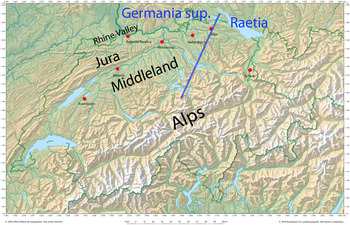
Roman ‘Switzerland’ lies at the heart of the European continent. The country consists of four topographical regions (Figure 1): the Alps (up to 4700 m asl) in the south and east, comprising about sixty per cent of the country's total area; the Swiss Plateau or Mittelland\Middleland (up to 600 m asl) in the centre-west; the Jura Mountains (up to 1700 m asl) on its western fringe; and the Basel region/Rhine Valley (260 m asl) in the north-west. Although the Alps had been used for transhumance and had been crossed since the Neolithic, prehistoric and especially Roman settlements (cities, vici, and villae) are mostly found in the midland and are located in areas up to an altitude of about 500 to 600 m. Climatic and topographical factors made agriculture unpromising at higher altitudes.
Map of Roman Switzerland and sites mentioned in this article.

In the Iron Age, the area was inhabited by Celtic tribes (e.g. the Helvetii, Raurici) and the tribe of the Raetii. But there were Roman influences from the second century bc with evidence of early urbanization (Müller et al., Reference Müller, Kaenel and Lüscher1999: 163–69). From 15 bc the area officially belonged to the Roman Empire. Present-day Switzerland then belonged to a maximum of five different Roman provinces that changed their names over time (Flutsch et al., Reference Flutsch, Niffeler and Rossi2002: 73): Gallia Narbonensis, Alpes Graiae et Poeninae, Germania Superior/Maxima Sequanorum, Raetia, Italia. The most important province in the west was Belgica, later called Germania Superior and then Maxima Sequanorum, and Raetia in the east.
Until the end of the first century ad, the river Rhine was the frontier of the Roman Empire, and Roman Switzerland was a borderland with one legionary camp (Vindonissa) and some military camps. In the second and third century the limes was situated in southern Germany. Our region became a hinterland supplying the border zone and it entered a period of prosperity. The most important and richest Roman city was Aventicum (Avenches), close to lake Morat in the western part of the Swiss Plateau; it had also been the capital of the Celtic tribe of the Helvetii (Hochuli-Gysel, Reference Hochuli-Gysel2001). Augusta Raurica (close to Basel) was founded as a colonia in the late first century bc; during its heyday in the second and third centuries ad its population may have reached 9000–15,000 people (Bossart et al., Reference Bossart, Koch, Lawrence, Straumann, Winet and Schwarz2006). From an archaeozoological point of view, this city is more important than Aventicum, because a large part of the Swiss faunal data was recovered here (see below). In the third century the cities were destroyed; the river Rhine became a frontier again and was fortified by Emperor Valentinian after ad 369. In ad 401 the last Roman troops left the region.
A Short History of Archaeozoological Research on Roman Switzerland
Archaeozoological research has a long tradition in this region. Ludwig Rütimeyer (1825–1895) was the first scientist to study and publish animal bones from Neolithic lake dwellings, and his publication Untersuchungen der Thierreste der Pfahlbauten in der Schweiz (Reference Rütimeyer1860) established the discipline of zooarchaeology. Animal bones from the Roman period were also analysed as early as in the nineteenth century. A starting point was the legionary camp of Vindonissa. For example, in Reference Krämer1899, H. Krämer published his dissertation Die Haustierfunde von Vindonissa. Mit Ausblicken in die Rassenzucht des classischen Altertums (‘The domestic animal bones from Vindonissa, with notes on breeding in Classical Antiquity’). His main interest was breed evolution, as it was the Zeitgeist. A milestone of Roman archaeology was the discovery of the so-called Schutthügel in 1906, which contained large quantities of organic finds. Unfortunately, only a few animal bones from these excavations were kept and therefore cannot be included in new analyses (Deschler-Erb & Akeret, Reference Deschler-Erb and Akeret2010: 20–22).
In the 1950s Elisabeth Schmid, professor at the University of Basel, started analysing bones from the Roman city of Augusta Raurica. The experience she gained from this work led to the publication of her Atlas of Animal Bones in Reference Schmid1972, which is still in use today. In 1988, based on Schmid's identifications, Jörg Schibler and Alex Furger published more than 200,000 animal bone fragments from Augusta Raurica, focusing on social patterns inside the city (Schibler & Furger, Reference Schibler and Furger1988). At that time (see Peters, Reference Peters1998), and arguably still today, Augusta Raurica was the Roman city with the most archaeozoological data, at least in the north-western provinces.
Since the late 1980s OssoBook, a program for recording archaeozoological data, has been developed by the archaeozoology group of the University of Basel (Schibler, Reference Schibler, Anreiter, Bartosiewicz, Jerem and Meid1998), in the last few years in collaboration with the Archaeobiocenter in Munich. This version is available as freeware.
By the end of the twentieth century bones from more than thirty Roman sites in Switzerland had been analysed, mostly from the German-speaking part of Switzerland. In 2002 a synthesis of this evidence was published in a compendium about the Roman period in Switzerland (Deschler-Erb et al., Reference Deschler-Erb, Schibler, Hüster Plogmann, Flutsch, Niffeler and Rossi2002). These data and recently published data were included in a comparative study of Dutch and northern Swiss sites, separated into military contexts (nine assemblages from four sites), urban contexts (forty-nine assemblages from Augusta Raurica), vici (thirty-four assemblages from nine sites), and villa contexts (thirty-eight assemblages from eighteen sites), in all more than 300,000 bone fragments (Groot & Deschler-Erb, Reference Groot and Deschler-Erb2015, Reference Groot and Deschler-Erb2016, Reference Groot and Deschler-Erbin press).
In these publications, the main focus was on social differences between settlement types, both inter-site and intra-site. But recently, as we shall see, other questions such as regional and functional differences are becoming more important. In this article we will look at the results from the old and new perspectives.
Social Differences
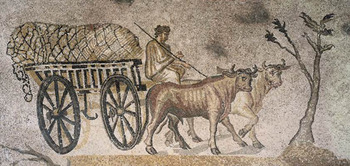
Cattle were the most important animal species in Roman culture. Cattle were used for agriculture, traction (Figure 2), food (meat, but only rarely for milk production), and craft or industry (Peters, Reference Peters1998: 25–45). They were mostly slaughtered when adult. It is therefore not surprising that the percentage of cattle bone fragments increased in our region during the time of Roman occupation (Ebersbach & Schröder, Reference Ebersbach and Schröder1998). Publications which include bone weight data (e.g. Deschler-Erb, Reference Deschler-Erb, Furger and Deschler-Erb1992: 362–65) show that the proportion of cattle would be even higher if this criterion was included in the analysis. Furthermore, cattle size increased gradually from the Late Iron Age onwards (Breuer et al., Reference Breuer, Rehazek and Stopp1999), as can be seen in other Roman provinces too, but with a delay in time (e.g. Lepetz, Reference Lepetz1996: 35-43; Groot & Deschler-Erb, Reference Groot and Deschler-Erb2015).
Mosaic of the villa of Orbe (after Flutsch et al., Reference Flutsch, Niffeler and Rossi2002: 167, fig. 168).

Beef was eaten as a matter of course in Roman times but, being chewy, it was not much prized. Pork, on the other hand, is the fastest and most efficient way to produce meat, but after Diocletian's Edict on Maximum Prices (Laufer, Reference Laufer1971) it was more expensive than beef. Therefore, meat consumption can be used as an indicator of the social status of the people who ate it, for instance people who lived in different settlement types, such as villae, military camps, towns, and vici. While cattle are more important in the towns and the vici than in the villae and military camps, the opposite applies to pigs (Deschler-Erb et al., Reference Deschler-Erb, Schibler, Hüster Plogmann, Flutsch, Niffeler and Rossi2002). Because Romans preferred pork, as written and iconographic sources show (André, Reference André1998: 115–17), we concluded that the occupants of villae and army people were more prosperous or—given that indigenous Celtic people ate beef (Schibler et al., Reference Schibler, Stopp, Studer, Müller, Kaenel and Lüscher1999) rather frequently—were more Romanized than people living in the towns. On most sites sheep/goat were not important, except in army contexts. Perhaps this has something to do with the origin of the soldiers; indeed the highest sheep/goat frequency is found in the early camp of Kaiseraugst where an inscription mentions an Ala Hispana (Spanish cavalry). In Spain, high sheep/goat frequencies are common for civilian sites (King, Reference King1999: 174). I thus had the idea that soldiers of Spanish origin came to our region and brought with them their food habits (Deschler-Erb, Reference Deschler-Erb, Deschler-Erb, Peter and Deschler-Erb1991: 129).
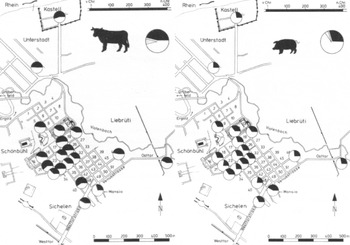
The ratio of cattle, pig, and sheep in the civilian town of Augusta Raurica is 45:38:17 on average (Schibler & Furger, Reference Schibler and Furger1988). These values vary in the individual areas of the city: in the centre more pig and fewer cattle bones were found than in the outskirts (Figure 3). Therefore, Jörg Schibler concluded that poorer or indigenous people lived in the suburbs. This interpretation has been slightly modified by Lehmann and Breuer (Reference Lehmann and Breuer1997).
Relative frequency (in per cent) of cattle and pig bones in different sites at Augusta Raurica (after Schibler & Furger, Reference Schibler and Furger1988).

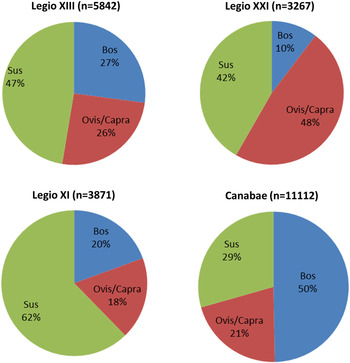
New research on Vindonissa shows that also in military contexts animal bones can help demonstrate social or ethnic differences inside the camp: the food habits of the three successive legions living in the camp were quite different. While legions XIII and XI preferred pig, legion XXI had a liking for sheep/goat (Deschler-Erb & Akeret, Reference Deschler-Erb and Akeret2010) (Figure 4). It is not clear whether the ethnic background of the troops is the reason behind this result. In the nearby canabae, however, mostly cattle bones were found (Flück et al., Reference Flück, Akeret, Deschler-Erb and Schmidigin prep.). From a social-historical point of view, this could mean that people living in the canabae, such as merchants and craftsmen, were not very rich or Romanized. On the other hand, there could also be a functional reason behind this difference. I shall return to this later.
Relative frequency (in per cent) of cattle (Bos taurus), sheep/goat (Ovis aries/Capra), and pig (Sus scrofa forma domestica) among the food remains of legions XIII, XXI, and XI in the legionary fort of Vindonissa (after Deschler-Erb & Akeret, Reference Deschler-Erb and Akeret2010).

First, I would like to focus on the food customs of three contemporary military fortresses of the fourth century ad, namely Kaiseraugst (Castra Rauracense; Schibler & Furger, Reference Schibler and Furger1988: 138-43), Schaan (in Liechtenstein; Würgler, Reference Würgler1959), and Pfyn (Ad fines; Brem, Reference Brem2008: 231–37). Kaiseraugst is located in the province of Maxima Sequanorum (formerly Germania Superior), Schaan in the province of Raetia, and Pfyn on the border between these provinces (Figure 1). The animal species frequencies in these castella are quite different (Figure 5): In Kaiseraugst cattle clearly dominate (60 per cent) and few wild animals (2 per cent) have been found. In Schaan cattle and pig are equal (around 30 per cent each) and sheep/goat are relatively well represented (21 per cent). Furthermore, a quite substantial number of wild animals (16 per cent)Footnote 1 have been found, mostly deer (Cervus elaphus), but also elk (Alces alces), roe deer (Capreolus capreolus), chamois (Rupicapra rupicapra), wild boar (Sus scrofa), fox (Vulpes vulpes), and beaver (Castor fiber). In Pfyn, pig and cattle are also equal (around 40 per cent each), but the frequency of wild animal bones is rather low (6 per cent). It can be concluded that there is a clear difference between the castella in the provinces of Maxima Sequanorum and Raetia, between the western and the eastern parts of present-day Switzerland. From the point of view of the domestic animals, Pfyn resembles the castellum of Schaan. It therefore seems that, in terms of husbandry, Pfyn was connected to the province of Raetia. These examples show that the food habits of military forces varied not only because of the units involved, but also between different regions within the same period.
Relative frequency (in per cent) of animal species in the Late Roman castella (fourth century ad) of Kaiseraugst (after Schibler & Furger, Reference Schibler and Furger1988), Pfyn/Ad Fines (after Brem, Reference Brem2008) and Schaan (after Würgler, Reference Würgler1959).

Environmental and Regional Differences
The importance of wild animals in some military camps has already been mentioned. In civilian towns and vici, the frequency of wild animals is quite low (around 2 per cent) and hunting had no economic importance. A higher frequency of wild animal bones can be found in villae, but the median is still only around 5 per cent (Deschler-Erb et al., Reference Deschler-Erb, Schibler, Hüster Plogmann, Flutsch, Niffeler and Rossi2002). Hunting was thus interpreted as a leisure activity of high-status people. Some of them could have been high-ranking military people who retired and went on with their hobbies.
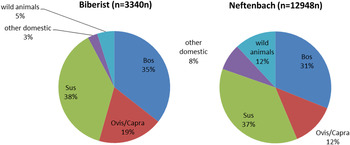
But on closer examination large differences can be found (Deschler-Erb, Reference Deschler-Erb, Frey and Hanel2001), for instance between the villae of Biberist (Solothurn) in the western part of Switzerland and Neftenbach (Zürich) further east. In Biberist, wild animals accounted for only 4 per cent of the assemblage (Deschler-Erb, Reference Deschler-Erb and Schucany2006). In Neftenbach, on the other hand, 12 per cent of the animal bones come from wild animals, mainly from red deer (Figure 6). Metric analyses suggest that red deer in the region of Neftenbach were larger and in better condition than those of Biberist. This must have been the reason for the specialized hunting of red deer observed at Neftenbach (Deschler-Erb & Schröder Fartash, Reference Deschler-Erb, Schröder Fartash and Rychener1999). Underrepresented bone elements (shoulder blades, mandibulae) and the presence of a building with a smoking oven indicate that a surplus was produced and smoked deer meat exported (Deschler-Erb & Olive, Reference Deschler-Erb and Olive1999; Deschler-Erb & Schröder Fartash, Reference Deschler-Erb, Schröder Fartash and Rychener1999). But what about the activities which were usually practised on Roman farms, such as agriculture and husbandry? In Neftenbach, there is a large proportion of grassland plants among the archaeobotanical remains (Klee & Jacomet, Reference Klee, Jacomet and Rychener1999). On this site, animal husbandry was probably more important than crops because of the unfavourable climatic conditions. In the western part of Switzerland, on the other hand, the climate was drier and intensive agriculture had been practised there since the Iron Age. The importance of cereal production in Biberist could be shown by the results of archaeobotanical analysis (Jacomet et al., Reference Jacomet, Petrucci-Bavaud, Kühn and Schucany2006) and by the presence of a large granary (Schucany, Reference Schucany2006: 257–66). It therefore seems that the human impact on the environment was greater in the Biberist region. The living conditions for wild animals were worse than in the east, where larger animals were present (Deschler-Erb Reference Deschler-Erb and Schucany2006: 662) and hunting was probably more promising. It can be concluded that between west and east there was not only a political, but also an economic, frontier due to different biogeographic conditions (see Deschler-Erb, Reference Deschler-Erb, Casa and Deschler-Erb2016).
Relative frequency (in per cent) of animal species in the villae of Biberist (Deschler-Erb, Reference Deschler-Erb and Schucany2006) and Neftenbach (Deschler-Erb & Schröder Fartash, Reference Deschler-Erb, Schröder Fartash and Rychener1999).

Function
Animal raw materials played an important role in Roman industry. Due to good (i.e. waterlogged) conditions for the preservation of organic finds and a relative abundance of archaeozoological data, much information is available for Roman Switzerland (Deschler-Erb, Reference Deschler-Erb and Polfer2005a; Amrein et al., Reference Amrein, Carlevaro, Deschler-Erb, Deschler-Erb, Duvauchelle and Pernet2012: 113–61). New research has demonstrated that there are not only social but also regional differences in the use of animal raw materials. This will be illustrated here by three examples: bone and antler working, tanning and leather production, and food preserving.
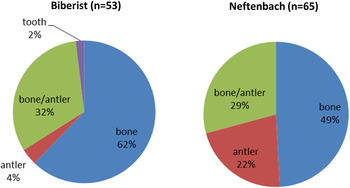
I would like to start with the two villae of Biberist and Neftenbach again. Not only was the frequency of bones of wild animals quite different (see above), but also the use of raw materials to produce everyday objects differed. By analysing the macro- and micro-morphological structure of the antlers (Deschler-Erb, Reference Deschler-Erb1998: 16–68), it can be shown that much more antler was worked in Neftenbach than in Biberist (Figure 7), probably owing to the local availability of the raw material (Deschler-Erb, Reference Deschler-Erb, Choyke and Bartosiewicz1999). It follows that differences in the landscape have an influence on the use of raw materials too. A similar trend appeared in a comparison of the animal bone remains and worked bones of Augusta Raurica and the Magdalensberg (Austria) in the eastern Alps (Deschler-Erb & Gostenčnik, Reference Deschler-Erb, Gostenčnik and Bertrand2008). It seems that these differences refer to larger regions.
Relative frequency (in per cent) of raw materials among the bone and antler artefacts of the villae of Biberist and Neftenbach (after Deschler-Erb, Reference Deschler-Erb, Choyke and Bartosiewicz1999).

There are different forms of archaeological evidence for tanning and leather production: bone waste (concentrations of skull and leg bones), specific tools and receptacles for auxiliary materials (e.g. alum, urine), and leather and wooden structures (Deschler-Erb, Reference Deschler-Erb2005b). These organic remains benefit from the fact that many Roman sites in Switzerland are waterlogged. Due to these good preservation conditions, a substantial number of tanneries (more than twenty) are known for Roman Switzerland (Amrein et al., Reference Amrein, Carlevaro, Deschler-Erb, Deschler-Erb, Duvauchelle and Pernet2012: 127–36). Most are located in the northern part, close to the Rhine. Because it is known that the Roman army was the most important customer for leather in antiquity (Van Driel-Murray, Reference Van Driel-Murray and Polfer2001), we suspected that these tanneries were mostly working for the legions in Vindonissa. Remarkably, there used to be very little evidence for tanneries in Vindonissa itself. This situation changed when the first investigations started in the canabae of Vindonissa in the 2000s (Schucany, Reference Schucany2012). To date, three strip houses in the canabae have been analysed archaeozoologically and in all of them high concentrations of skull and foot bones of cattle, goat and sheep have been found (Flück et al., Reference Flück, Akeret, Deschler-Erb and Schmidigin prep). Moreover, many vats for tanning have been found. It can be concluded that tanning was an important industry in the canabae. And so we return to the question of whether people living in the canabae were poor or not very Romanized (because they ate mostly beef; see Figure 4). It seems that the high frequency of cattle is due to a greater quantity of industrial waste than food remains. This example shows that function can be much more important than social differences.
For preserving meat, there are different forms of evidence in Roman Switzerland too: these consist of written sources, pots used as meat containers, specific bone waste such as shoulder blades and ribs, and smoking ovens (Deschler-Erb, Reference Deschler-Erb, Bélet-Gonda, Mazimann, Richard and Schifferdecker2007, Reference Deschler-Erb2013; Amrein et al., Reference Amrein, Carlevaro, Deschler-Erb, Deschler-Erb, Duvauchelle and Pernet2012: 137–142). The earliest evidence of meat preservation was found in Celtic (Late La Tène) Basel (Kamber et al., Reference Kamber, Hecht, Spichtig and Rissanen2002: 34–43). In Augusta Raurica the presence of many ovens and bone waste indicate that this local tradition continued to be practised in Roman times (Schibler & Schmid, Reference Schibler and Schmid1989: 25–26). In addition to Augusta Raurica, smoking ovens have been found in many places in Roman Switzerland, except Vindonissa (Amrein et al., Reference Amrein, Carlevaro, Deschler-Erb, Deschler-Erb, Duvauchelle and Pernet2012: 137–42). However, a recent analysis of animal bones from inside the legionary camp of Vindonissa shows that the army consumed ham and bacon because the specific waste of these meat products was found there (Deschler-Erb & Stopp, Reference Deschler-Erb, Stopp, Trumm and Flück2013: 475–76). In camps in other regions, for instance Oberstimm on the Obergermanisch-Rätischen Limes in Bavaria, military self-production is suggested by the presence of an oven inside the camp (Stettmer, Reference Stettmer1997). Probably, the lack of a local tradition forced the army in that region to produce the meat itself. In other words, the army had to react to local conditions (see Groot & Deschler-Erb, Reference Deschler-Erb and Stoppin prep.).
Rituals and Sacrifices
Finally, I would like to demonstrate that even Roman rituals and animal sacrifices were adapted to regional particularities. The first example of ritual bone waste concerns Martigny/Octodurum or Forum Claudii vallensium (Valais) and Zillis (Grisons). Both sites are located in the Alps, but one lies in the western and the other in the eastern part of present-day Switzerland. Octodurum was a large and important town, through which the road from Lake Geneva to the Great St Bernard pass and Italy passed. The structure of the temple, where nearly 30,000 bone fragments were found, is clearly that of a mithraeum (Wiblé, Reference Wiblé, Martens and de Boe2004). Pig and chicken dominate the bone assemblage, sheep is relatively rare, and cattle plays a minor role. Quite a large variety of wild animals was found (Olive, Reference Olive, Martens and de Boe2004, Reference Olive, Lepetz and van Andringa2008). The bones of Zillis were recovered in a small cave (15 × 7 m) next to the river Rhine. Very little is known about the associated settlement. Perhaps there was a mansio. Archaeological finds such as a pot decorated with a snail suggest a ritual connection with Mithras. Among the faunal material (more than 13,000 analysed fragments), chicken bones dominate, followed by sheep, then pig in third place. Only rare bones of wild animals have been found here (Rageth, Reference Rageth1994; Liver & Rageth, Reference Liver and Rageth2001; Deschler-Erb & Stopp, Reference Deschler-Erb and Stoppin prep.). The same proportions could be seen at the mithraeum of Tienen (Lentacker et al., Reference Lentacker, Ervynck, Van Neer, Martens and de Boe2004). These examples suggest that, even within the quite standardized Mithras cult, each region could have its own interpretation of Roman religion and rituals. The reasons for such divergences are still unknown.
A regional difference in rituals between the eastern and the western parts of Switzerland is also shown by the comparison of the faunal assemblages from temples in Aventicum/Avenches (Vaud) and Kempraten (St Gallen). Both places have temples in Gallo-Roman style. In the Avenches temples, mainly bones of young pig and sheep/goat were recovered. The frequency of cattle is not very high and mostly ribs are represented (Lachiche & Deschler-Erb, Reference Lachiche, Deschler-Erb and van Andringa2008; Deschler-Erb, Reference Deschler-Erb2015: 48–75). They are probably waste from preserved meat consumed during feasting. The animal bone assemblage from the sanctuary of Kempraten is entirely different: here mostly cattle, among them quite a high proportion of very young individuals, was consumed in addition to pigs and sheep/goat. Most surprisingly, horses were also sacrificed and consumed. For the moment, there is no parallel in the Roman world (Koch et al., Reference Koch, Akeret, Deschler-Erb, Hüster-Plogmann, Pümpin, Wick, Livarda and Madgwickin press).
Conclusion
Archaeozoological research concerned with Roman animal bones has a long tradition in Switzerland. Large quantities of data are available, which have been analysed mostly from a socio-historical perspective. Here, I have attempted to discuss other aspects.
The Roman economy is generally based on cattle, which was used for agriculture, traction, and industry (for example leather products, which were essential for the army, or bone artefacts). The Romans intensified local cattle husbandry wherever they arrived, in Roman Switzerland, and in other regions. On the other hand, the Romans accepted and adopted regional traditions for different reasons, such as having to adapt to biogeographic conditions, or if they could profit from the presence of local industrial sectors, or again if local ritual and religious tradition did not clash with Roman religion. For research into the Roman economy and religious life, the regional level seems to be just as important as the social status of settlements and the people living in them.
These hypotheses have been created by conventional archaeozoological methods and need to be confirmed by further research and on the basis of more data. It will also be necessary to test and improve them by other analyses, such as stable isotope analysis, morphometrics, or aDNA studies (for first results, see Schlumbaum et al., Reference Schlumbaum, Stopp, Breuer, Rehazek, Blatter, Turgay and Schibler2003). And finally, to make full use of the potential of animal bone finds for cultural and historical questions, these results must be integrated with those of other archaeological disciplines.
Acknowledgement
I am grateful to Maaike Groot for help with my draft in English.