

Introduction
Do policymakers learn from the experiences of other governments when deliberating on public policy, and if so, what do they learn? An oft-stated normative claim holds that policy can be improved when governments draw lessons from policy impacts elsewhere, that is, by intergovernmental learning (Bouche and Volden Reference Bouche and Volden2011; Rose Reference Rose1991; Walker Reference Walker1969). This claim further suggests that policymakers can and should study how that policy worked elsewhere, using that evidence to inform their decisions in considering a given proposal.
But what do policymakers learn from their peers’ policy experiences? Do they draw substantive lessons about how to accomplish a given instrumental goal, as this normative claim assumes, or do they also learn political lessons about the acceptability of a policy to the electorate? Beyond this, do all lawmakers learn the same lessons from a given policy experience elsewhere, and how might the policy context affect intergovernmental learning? Despite considerable research in related areas, fleshing out these nuances of intergovernmental learning has been challenging for political scientists, both theoretically and empirically (e.g., Gilardi Reference Gilardi2010; Nicholson-Crotty and Carley Reference Nicholson-Crotty and Carley2016; Volden Reference Volden2006). Here, we take up that challenge.
Intergovernmental learning can influence the quality of public policy. Learning substantive policy lessons from ones’ peers may increase the rationality of policymakers, hewing policy outcomes closer to policymakers’ preferences (Bouche and Volden Reference Bouche and Volden2011; Macinko and Silver Reference Macinko and Silver2015; Shipan and Volden Reference Shipan and Volden2008, Reference Shipan and Volden2012). Learning information about the political impact of a policy adopted elsewhere, if not as normatively appealing, reflects what we know about elected officials’ overriding desire for re-election, an important component of representation (Mayhew Reference Mayhew2004). Furthermore, patterns of intergovernmental learning may vary systematically across policy contexts in ways that influence both policy outcomes and representation (Mooney Reference Mooney2020, 20).
To understand intergovernmental learning better, we examine the influences on recent abortion policy diffusion in the US states. As the “quintessential morality policy” (Kreitzer Reference Kreitzer2015, 43), abortion regulation offers a tough test of intergovernmental learning because symbolism and the expression of values may receive higher priority than substantive policy impact in debates about this class of policy (Mooney Reference Mooney2001b; Mooney and Lee Reference Mooney and Lee1995). As such, abortion policymaking may involve less policy learning—at least less substantive policy learning—than do other types of policy. On the other hand, recent work on morality policy suggests that issue framing influences which factors are relevant in a policy debate (Kreitzer, Kane, and Mooney Reference Kreitzer, Kane and Mooney2019; Mucciaroni Reference Mucciaroni2011). While a values-affirmation frame may lead to political learning being of primary importance for a morality policy, framing abortion regulation as a means to substantive goals may lead to more instances of substantive policy learning.
The US Supreme Court decisions in Webster v Reproductive Health Services (1989) and Planned Parenthood v Casey (1992) relaxed federal limitations on state abortion law, leading antiabortion activists to promote a set of regulations with the substantive goal of closing abortion clinics—Targeted Regulation of Abortion Policy, or TRAP, laws (Greasley Reference Greasley2017; Greenier and Glenberg Reference Greenier and Glenberg2014; Suppe Reference Suppe2014). TRAP laws are designed to impose a significant administrative burden on abortion clinics, allowing policymakers to control behavior indirectly by making regulatory compliance difficult (Herd and Moynihan Reference Herd and Moynihan2018). Also during this period, many states continued to enact various symbolic abortion policies, such as authorizing pro-life automobile license plates. While the US Supreme Court struck down Texas’s 2013 TRAP law in Whole Woman’s Health v Hellerstedt (2016), the simultaneous diffusion of instrumental and symbolic abortion policy between Casey and Hellerstedt presents a unique opportunity to explore intergovernmental learning in some detail, including examining the impact of policy context.
We compare influences on the diffusion of instrumental TRAP laws with those of more symbolic abortion policy among the states from 1993 to 2016 to understand better the subtleties of, and conditional effects on, intergovernmental policy learning. Using directed-dyad event history analysis (DDEHA), we find evidence, first, that substantive learning did influence abortion policy diffusion, especially for instrumental TRAP laws. Additionally, TRAP law opponents appear to have been activated more by what they learned than were its proponents. When a TRAP law succeeded in closing abortion clinics in a state, other states were less likely to adopt it subsequently, all else being equal. These results reflect the logic of prospect theory, which holds that the fear of loss is more motivating than the promise of gain (Kahneman and Tversky Reference Kahneman and Tversky1979, Reference Kahneman and Tversky1984; Levy Reference Levy1992, Reference Levy1996). Thus, even for this quintessential morality policy, substantive learning can occur if it is framed instrumentally. This supports normative claims about intergovernmental learning. We also find that policymakers learned political lessons from other states’ abortion policy adoptions, but this learning is also conditioned on the policy type. Again in line with prospect theory, policy opponents appear to be more motivated than policy proponents, but only for instrumental policy. For symbolic policy, proponents seem to respond most strongly to political impacts elsewhere. Thus, even in this theoretically challenging context, policymakers can learn from other governments’ policy experiences. Our study also supports the growing literature showing that different types of policy may be diffused in different ways (e.g., Boehmke and Witmer Reference Boehmke and Witmer2004; Makse and Volden Reference Makse and Volden2011; Nicholson-Crotty Reference Nicholson-Crotty2009). Indeed, we demonstrate that framing the same policy in different ways can lead to subtle differences even within a given diffusion mechanism (Mooney and Lee Reference Mooney and Lee2000; Boushey Reference Boushey2016; Kreitzer Reference Kreitzer2015). Thus, this study contributes to the literatures on policy learning, innovation diffusion, and morality policy.
Intergovernmental Learning and Policy Diffusion
For decades, scholars have studied state policy diffusion for insights into intergovernmental learning (Mooney Reference Mooney2020). Policy diffusion results from one government’s policy decision influencing that of another government, whether directly or indirectly, intentionally or unintentionally (Graham, Shipan, and Volden Reference Graham, Shipan and Volden2013; Walker Reference Walker1969). Walker (Reference Walker1973, 1187) analogized a policy’s diffusion to a “spreading ink blot[…] on a map,” as government after government adopted it. Nations may influence each other’s policymaking (Braun and Gilardi Reference Braun and Gilardi2006; Rose Reference Rose1991; Weyland Reference Weyland2009), and “vertical” diffusion up and down levels of government within a nation occurs regularly (Karch Reference Karch2006; Karch and Rosenthal Reference Karch and Rosenthal2016; Shipan and Volden Reference Shipan and Volden2006; Zhang and Zhu Reference Zhang and Zhu2019). But the US states offer an extraordinarily useful venue in which to study diffusion, given their parallel position in the US federal system (Walker Reference Walker1969). Potential mechanisms causing state policy diffusion include coercion, emulation, competition, and learning (Mooney Reference Mooney2020). This latter mechanism—intergovernmental learning—has been the focus of most state policy diffusion scholarship to date.
Scholars and practitioners have long believed that the experiences of other governments are an excellent source of policy lessons for policymakers (Bouche and Volden Reference Bouche and Volden2011; Rose Reference Rose1991; Walker Reference Walker1969). As Rose (Reference Rose1991, 4) asserted in his seminal paper on intergovernmental “lesson-drawing,” “Confronted with a common problem, policymakers in cities, regional governments, and nations can learn from how their counterparts elsewhere respond. Programmes are judged in relation to past performance, and in anticipation of their future consequences.” For instance, when Kansas contemplates changing its high school graduation requirements, it could evaluate the impact of such changes adopted previously by Oklahoma or New York. The idea is that the impact of a policy in one state may portend its impacts in other states, should they adopt it. In this way, policymakers can learn relevant and valid, if imperfect, information about how the policy might perform in their own state. The states are parallel and equal in the US federal system. They each (except Hawaii and Alaska) border one or more other states, and a wide variety of state government and interest group officials interact regularly with their opposite numbers from around the country in national associations (Balla Reference Balla2001; Walker Reference Walker, Jacobs and Vines1971). Each of these may facilitate intergovernmental learning among the states.
The normative dimension in this literature is reflected in US Supreme Court Associate Justice Louis Brandeis’s oft-quoted analogy:
It is one of the happy incidents of the federal system that a single courageous state may, if its citizens choose, serve as a laboratory; and try novel social and economic experiments without risk to the rest of the country. (New State Ice House Co. v. Liebmann 285 US 262 [1932]).
This “laboratories of democracy” claim holds that intergovernmental learning improves policy effectiveness in the US federal system (Volden, Ting, and Carpenter Reference Volden, Ting and Carpenter2008). This is a long-used argument, but one that has only come under empirical scrutiny in recent years.
How can we know if a policy’s diffusion was driven by intergovernmental learning? As Gilardi (Reference Gilardi2010), 650) notes, this question has been “particularly elusive” because learning is a psychological process that is difficult to observe directly. Furthermore, learning the same information may have different behavioral impacts depending on a learner’s goals and prior information, making it difficult to observe in the aggregate (Mooney Reference Mooney2001a). Discussions of intergovernmental learning also tend to confound individual-level and aggregate-level learning, raising the specter of ecological fallacy (Rose Reference Rose1973).
Volden (Reference Volden2006) set the standard for the current empirical literature by arguing that intergovernmental learning occurs when the success of a policy in one state increases the odds of another state adopting it (see also Shipan and Volden Reference Shipan and Volden2014). As he writes (Volden Reference Volden2006, 295), “to serve as effective policy laboratories, states must emulate only the successful policies found elsewhere.” The idea is that policymakers “critically consider a policy’s success [elsewhere] and factor that into formulating policy” (Hinkle Reference Hinkle2015, 1013). Volden et al. (Reference Volden, Ting and Carpenter2008) demonstrate formally that such learning is beneficial.
Of course, this approach likely underestimates intergovernmental learning for at least two reasons. First, the emulation-of-success criterion only considers learning’s outward manifestations, ignoring any unexpressed changes to policymakers’ knowledge. Learning may occur even if it yields no observable policy changes, perhaps resulting only in a “change in one’s confidence in existing beliefs” (Simmons, Dobbin, and Garett Reference Simmons, Dobbin and Garett2006, 795) or a change of “ideas, beliefs, or values” (Heikkila and Gerlak Reference Heikkila and Gerlak2013, 491). For instance, policymakers may learn that a policy in another state was successful in its goal, but perhaps just not successful enough to overcome political headwinds at home (Braun and Gilardi Reference Braun and Gilardi2006; LaCombe and Boehmke Reference LaCombe, Boehmke, Curini and Franzese2020).
The second reason Volden’s (Reference Volden2006) approach likely underestimates learning follows from its implicit and problematic assumption that all policymakers learn the same lesson from a given policy experience. The naïve rationalist conclusion that success in State B leads to adoption in State A requires the assumption that “if evaluators agree that the policy achieves its stated goals, other states will enact an identical program once they are made aware of the achievement” (Karch Reference Karch2007, 5). This assumption may not always hold true. In particular, opponents and proponents of a diffusing policy may react very differently to the same evidence of policy impact. A policy that achieves “success” in State B teaches State A proponents that the policy is working well; on the other hand, it also teaches State A opponents that the policy is an effective threat to their interests. The overall impact of learning on policymaking in State A will therefore be something like a weighted average of the positive learning effects on proponents and the negative learning effects on opponents. Policymakers learning negative lessons from other states’ policy experiences may lead to no adoption or even to a backlash of counter-adoptions (Fay Reference Fay2018; Mooney Reference Mooney2001a).
Thus, “success” is clearly criterion-related, and the criterion is often left implicit in this literature. We suggest that rather than thinking about policy “success” in State B, scholars should think about learning as evidenced by a policy’s impact in State B influencing the odds of its adoption in State A. Few policies could be universally described as “successful” without a clearly stated policy impact criterion.
Negative learning, where policy impacts in State B reduce the chances of adoption in State A, could be even more prevalent than positive learning. Prospect theory holds, among other things, that people are more motivated by loss than by gain (Kahneman and Tversky Reference Kahneman and Tversky1979, Reference Kahneman and Tversky1984; for a recent overview of prospect theory, see Stein and Sheffer Reference Stein, Sheffer, Mintz and Terris2019). That is, a “loss aversion” bias leads people to perceive a utility reduction of X units as being more painful than a utility gain of X units is beneficial (Levy Reference Levy1992, Reference Levy1996; Tversky and Kahneman Reference Tversky and Kahneman1991). For example, the psychic pain a person gets from losing $100 would be greater than the psychic benefit they would get from finding $100. Relatedly, the endowment effect leads a person to put a higher value on things they already have than on things they might acquire later (Kahneman, Knetsch, and Thaler Reference Kahneman, Knetsch and Thaler1990). These processes can bias decision making, relative to a rational choice model. The impact of such bias is clearly reflected in the history of US abortion politics, where the losers of a given policy clash often become more motivated to influence future policymaking than the winners, leading to a sawtooth pattern of policy development (Epstein and Kobylka Reference Epstein and Kobylka1992; Mooney and Lee Reference Mooney and Lee1995). Perhaps especially for morality policy, opponents may be so deeply threatened by a policy’s adoption that they redouble their efforts just when the winning side rests on its laurels.
If states look to their peers for policy lessons, what do they learn? That is, what information could a state’s policymakers glean from a policy’s implementation elsewhere that would be useful in their own deliberations? First, the rationalist “laboratories of democracy” claim implies that policymakers draw substantive lessons from their peers’ experiences (Rose Reference Rose1991; Volden Reference Volden2006). State A may evaluate its peers’ experiences on whatever policy-relevant criteria its policymakers deem appropriate (Walker Reference Walker, Jacobs and Vines1971). For instance, if banning cigarette vending machines reduced youth smoking in State B, State A policymakers may learn (or infer) that it might also do so in their state (Shipan and Volden Reference Shipan and Volden2006). Thus, if State A’s policymakers want to reduce youth smoking, they could be more likely to adopt such a ban based on this evidence. This is substantive intergovernmental learning.
Policymakers may also draw political lessons from their peers’ experiences (Shipan and Volden Reference Shipan and Volden2012; Simmons, Dobbins, and Garrett Reference Simmons, Dobbin and Garett2006). Indeed, voter reaction to a policy may be more relevant to an elected official’s decision making than any substantive policy information (Gilardi Reference Gilardi2010; Mayhew Reference Mayhew2004; Seljan and Weller Reference Seljan and Weller2011; Shipan and Volden Reference Shipan and Volden2008). If policymakers in State A believe that subjectively positive political outcomes followed from State B adopting a policy, they would be more likely to support it in their state, all else equal. On the other hand, if State A officials do not like the political outcomes in State B, they would be less likely to support it. And as with substantive information, the same political information may teach different policymakers different lessons. For example, if adopting a policy led to Democratic electoral success in State B, Republicans and Democrats in State A will draw different political lessons. This is political intergovernmental learning.
Policymakers may learn both political and policy lessons from their peers’ experiences, and they may draw both positive and negative lessons from them (Braun and Gilardi Reference Braun and Gilardi2006; Karch Reference Karch2007). Political information may also be used as a cognitive shortcut to relevant substantive information, with policymakers looking to ideologically similar states for clues about whether a policy might work in their own state (Grossback, Nicholson-Crotty, and David Reference Grossback, Nicholson-Crotty and David2004; Bricker and LaCombe Reference Bricker and LaCombe2021). Finally, while political and policy lessons could be orthogonal, a policy that is a substantive success would likely be politically appreciated, assuming that policymakers had an accurate understanding of public opinion when they adopted it. This study distinguishes between substantive and political learning to help understand their unique roles in policy diffusion.
We also contribute to a growing literature that considers the influence of policy type on diffusion mechanism (Boehmke and Witmer Reference Boehmke and Witmer2004; Boushey Reference Boushey2016; Nicholson-Crotty Reference Nicholson-Crotty2009; Rogers Reference Rogers2003, 229–65). As Boushey (Reference Boushey2010, 64) wrote, “distinct diffusion patterns emerge because the characteristics of innovations invite fundamentally different political decision-making processes.” We argue below that even differences in the framing of policy in the same domain can lead to subtle differences in what is learned by whom during diffusion (Kreitzer Reference Kreitzer2015; Mooney and Lee Reference Mooney and Lee2000).
Intergovernmental Learning in Morality Policy Diffusion
To examine intergovernmental learning empirically, we identify a methodologically advantageous policy situation—the diffusion of state abortion regulation after the US Supreme Court decisions in Planned Parenthood v Casey (1992) and Webster v Reproductive Services (1989) but before Whole Woman’s Health v Hellerstedt (2016). Prior to 1992, states were relatively constrained by the Court from restricting access to the procedure, especially in the first trimester. Casey and Webster loosened those strictures, allowing states to enact a wide range of limits and rules so long as they did not place an “undue burden” on a woman seeking an abortion (Medoff Reference Medoff2010; Suppe Reference Suppe2014). The states engaged in considerable and varied abortion policymaking during the post-Casey era (Boonstra and Nash Reference Boonstra and Nash2014; Greenier and Glenberg Reference Greenier and Glenberg2014). We ask, was intergovernmental learning a factor in abortion policy diffusion in this period, and if so, what was being learned?
Scholars have long considered abortion regulation to be the “quintessential morality policy,” at least in the US context, so much so that several scholars have used these exact words to describe it (e.g., Calkin and Kaminska Reference Calkin and Kaminska2020, 87; Cocca Reference Cocca2004, 147; Patton Reference Patton2007, 472; Kreitzer Reference Kreitzer2015, 43; Stabile Reference Stabile2007, 44; Schecter Reference Schecter2001, 63). Morality policies are a class of measures that “invoke a controversial question of first principle,” representing “validations of particular sets of fundamental values” (Mooney Reference Mooney2001b, 3). While most public policy is adopted to meet a substantive goal, morality policy may be primarily about the symbolic endorsement of values. We see this when states pass antiabortion measures known to be unconstitutional or purely expressive, such as authorizing pro-life automobile license plates (Merz, Jackson, and Klerman Reference Merz, Jackson and Klerman1995). Legislatures may pass symbolic morality policy to affirm the values of the state’s residents (or a segment thereof) rather than to meet substantive policy goals. Therefore, we hypothesize that:
H1: Substantive policy learning does not occur during symbolic morality policy diffusion.
In other words, the substantive impact of a symbolic policy in State B would be irrelevant to State A policymakers’ deliberations on it.
On the other hand, a set of abortion regulations diffused among some states in the post-Casey eraFootnote 1 that had a clear substantive goal: Targeted Regulation of Abortion Providers, or TRAP, laws (Greasley Reference Greasley2017; Joyce Reference Joyce2011; Suppe Reference Suppe2014). Abortion policy studies have typically combined symbolic and substantive measures (e.g., Meier et al. Reference Meier, Haider-Markel, Stanislawski and McFarlane1996), but the notion that these are distinct types has been broached elsewhere (e.g., Kreitzer Reference Kreitzer2015; New Reference New2011). TRAP laws are instrumental abortion policy, using administrative burdens on third-party service providers to pursue substantive policy goals indirectly (Herd and Moynihan Reference Herd and Moynihan2018). TRAP laws shift regulation from the demand side of the abortion equation to the supply side, regulating abortion providers rather than women seeking an abortion. They impose stricter regulations on abortion clinics than on medical facilities providing similar or even more dangerous procedures, such as colonoscopies, liposuction, and childbirth, including significant and costly physical plant specifications and rules about who can conduct abortions (Austin and Harper Reference Austin and Harper2019). As (Mercier et al. Reference Mercier, Buchbinder, Bryant and Britton2015, 1–2) write, “While the stated purpose of such laws is the protection of women’s health and safety, the practical consequence is often restricted access to abortion” (see also Medoff and Dennis Reference Medoff and Dennis2011).Footnote 2
Anecdotal evidence from debates over TRAP laws shows that proponents could be “brazen” (Greasley Reference Greasley2017, 327) in stating that their goal was shutting down abortion clinics rather than improving women’s health. For example, Mississippi’s then-governor was widely quoted as claiming that his state’s TRAP law would make the Magnolia State “abortion free” (Suppe Reference Suppe2014, 128). In other words, they were adopted to “regulate abortion providers out of existence” (Greenier and Glenberg Reference Greenier and Glenberg2014, 1235). TRAP laws represent a strategy to make abortion “legal but inaccessible” (Kreitzer Reference Kreitzer2015, 41), or as the Washington Post editorialized, this was “an ideological crusade masquerading as concern for public health” (quoted in Gold and Nash Reference Gold and Nash2013, 12). Further evidence that TRAP laws do not target women’s health comes from the fact that medical professionals, including the American College of Obstetrics and Gynecology and the American Medical Association, have argued that these regulations “go beyond necessary and accepted standards of practice and fail to provide countervailing benefits” (Jones, Daniel, and Cloud Reference Jones, Daniel and Cloud2018, 491). Indeed, one set of scholars claimed that these regulations are “in blatant contradiction to evidence-based medicine” (Grossman et al. Reference Grossman, White, Hopkins and Potter2014, 73).
Since TRAP laws have a substantive goal (fewer abortion clinics), policymakers could assess their performance in previously adopting states and use this information in their own deliberations. The Volden (Reference Volden2006) emulation-of-success approach predicts positive learning by TRAP law proponents if the policy leads to clinic closures. That is, if State A proponents learn that abortion clinics are closing because of these laws in State B, they will be more motivated to pursue the policy. Therefore, we hypothesize that:
H2a: Positive substantive learning can occur during instrumental morality policy diffusion.
As noted, opponents likely draw different lessons from the evidence of TRAP laws’ success. When opponents learn that TRAP laws are effective in closing abortion clinics, they will be motivated more strongly to oppose them. A policy with no substantive impact might be politically beneficial to proponents, but it could be less threatening to opponents. Learning that a TRAP law led to closed clinics and increased hardship for women seeking abortion might motivate opponents to mobilize and devote resources to its defeat. Therefore, we hypothesize that:
H2b: Negative substantive learning can occur during instrumental morality policy diffusion.
The processes hypothesized in H2a and H2b could occur simultaneously, and if so, they would offset one another. The resulting bias would be toward finding no relationship between substantive policy impact in State B and adoption rates in State A. However, as noted, the loss aversion bias in decision making suggests that opponents’ negative learning may be more influential in policymaking than proponents’ positive learning (Kahneman and Tversky Reference Kahneman and Tversky1979, Reference Kahneman and Tversky1984; Levy Reference Levy1992; Tversky and Kahneman Reference Tversky and Kahneman1991).
Finally, consider political learning. Lawmakers use their legislative activities to develop their professional brands, and elected officials can be expected to act with an eye toward re-election or to move up the political ladder (Mayhew Reference Mayhew2004; Squire and Moncrief Reference Squire and Moncrief2019). Therefore, how well the public receives a policy should be highly relevant to their decision making regardless of its substantive impact. Importantly, elected officials have a special incentive to attend to their constituents’ wishes on salient and simple morality policy (Lax and Phillips Reference Lax and Phillips2009; Mooney Reference Mooney2001b). In addition, while lawmakers likely use political information in most, if not all, of their legislative decision making, it may be especially relevant for their actions on symbolic policy, with its purely political goals. Therefore, we hypothesize that:
H3: Political learning can occur during the diffusion of both instrumental and symbolic policy.
Political learning can be seen in a policy diffusion, as can substantive learning, when the impact of the policy in previously adopting State B influences the odds of its adoption in State A (Volden Reference Volden2006). The difference between these two types of learning is in their use of these impacts, with political impacts being assessed by electoral reactions to the policy rather than by its substantive effects. In 21st century US politics, antiabortion regulations, like TRAP laws, are almost exclusively advocated by Republicans, with Democrats typically opposing them (Adams Reference Adams1997; Djupe, Neiheisel, and Sokhey Reference Djupe, Neiheisel and Sokhey2018; Kreitzer Reference Kreitzer2015; Norrander and Wilcox Reference Norrander and Wilcox1999). Thus, if a state’s Republican (GOP) gains or loses political support after adopting one of these laws, Republican and Democratic lawmakers in other states may learn distinct political lessons.
Data and Analysis
To test our hypotheses, we model the diffusion of instrumental and symbolic abortion regulations among the US states from 1993 to 2016. In this period between Casey and Hellerstedt, many states took advantage of the increased leeway provided by the Supreme Court to modify their abortion regulatory regimes, largely by making them more restrictive (Boonstra and Nash Reference Boonstra and Nash2014; Jones and Jerman Reference Jones and Jerman2017; Kreitzer Reference Kreitzer2015). Many of these policies probed the boundaries of Casey, with Texas’s 2013 TRAP law (HB2) finding that limit, as the Hellerstedt decision demonstrates.
Diffusion researchers frequently employ event history analysis (EHA) to model the influences on a policy diffusion (Berry and Berry Reference Berry and Berry1990). However, monadic EHA cannot account for independent variables that are relational, that is, variables that are functions of a factor’s relative levels in different states. Our intergovernmental learning hypotheses are indeed relational, focusing State A’s response to policy decisions and outcomes in each other previously adopting State B. To model such relationships, we employ directed-dyadic EHA, or DDEHA (Boehmke Reference Boehmke2009; Volden Reference Volden2006). Monadic EHA considers policy adoption in Alabama, for example, in the context of all other 49Footnote 3 states’ actions simultaneously. DDEHA pairs each state with each other state directionally, forming a large database of relational and directed dyads. This allows us to leverage information on whether an adoption in Alabama was influenced by evidence of the policy’s impact in Alaska, or in Arizona, or in Arkansas, and so forth, allowing us to test our learning hypotheses more precisely (see also Bricker and LaCombe Reference Bricker and LaCombe2021; Gilardi and Fuglister Reference Gilardi and Fuglister2008; Nicholson-Crotty and Carley Reference Nicholson-Crotty and Carley2016). The unit of analysis for DDEHA is the dyad-year,Footnote 4 and we use logit analysis to estimate our DDEHA models.
Our hypotheses and models are directional. The dependent variable is a dummy capturing whether State A moves toward State B on a given policy indicator in a given dyad-year, that is, whether State A’s abortion policy converges with that of State B (LaCombe and Boehmke Reference LaCombe, Boehmke, Curini and Franzese2020). We operationalize our learning independent variables as 0/1 dummies based on two conditions in the previously adopting state (State B) of a dyadic pair (Volden Reference Volden2006). First, State B must have increased its abortion restrictiveness within three years of a given dyad-year.Footnote 5 Second, following such a policy change in State B, if the number of abortion clinics declinesFootnote 6 (instrumental impact), or if the GOP gains state legislative seatsFootnote 7 (political impact), in State B, the next condition is met. If both of these conditions are met, the learning variable is coded 1, and 0 otherwise, indicating whether the policy was both adopted and impactful in State B in the relevant timeframe for that dyad-year case. If this variable affects the odds of State A’s policy converging with that of State B, we can infer that learning has occurred (Gilardi Reference Gilardi2010; Gilardi, Shipan, and Wueest Reference Gilardi, Shipan and Wueest2021; Pollert Reference Pollert2021; Volden Reference Volden2006), whether positive learning (increasing the odds of convergence) or negative learning (decreasing the odds of convergence). Again, positive and negative learning may occur simultaneously, biasing the resulting estimate toward zero.
As with many typologies in the social sciences, categorizing abortion laws as “symbolic” or “instrumental” runs the risk of overprecision, as well as throwing away information on marginal cases. To avoid this in our analysis, we picked laws that were clearly symbolic, on one hand, and clearly (or at least, ostensibly) instrumental, on the other hand. Many abortion regulations could fall in the middle, having both symbolic and instrumental goals, so we avoided those for a more precise test of our hypotheses. To operationalize instrumental abortion policy, we use the three most prominent TRAP law requirements: 1) additional provider licensing, 2) a physical location within a certain proximity of a hospital or other physical specifications to provider facilities, and 3) providers having admitting privileges at a nearby hospital (Greasley Reference Greasley2017). To operationalize symbolic abortion regulation, we use four policies that are understood to have little practical effect on abortion use but that are adopted largely to validate or affirm political values: a ban on abortion before 20-weeks’ gestation, allowing physicians to refuse to do an abortion (“conscience clause”), establishing fetal “personhood” laws, and authorizing pro-life automobile license plates (Crist Reference Crist2010; Halva-Neubauer Reference Halva-Neubauer1990; Nossiff Reference Nossiff2011; Oakley Reference Oakley2009).Footnote 8 For both instrumental and symbolic policy, the adoption of any one of these provisions represents increased abortion regulation restrictiveness. We use data on the timing of these state adoptions from Kreitzer Reference Kreitzer2015, supplemented with an additional three years of data that we coded following her procedures.
Following Volden Reference Volden2006, we infer that learning has influenced a diffusion when a policy’s impact in State B influences the chances of its adoption in State A (see also Gilardi Reference Gilardi2010; Gilardi, Shipan, and Wueest Reference Gilardi, Shipan and Wueest2021; Pollert Reference Pollert2021). For abortion regulation, this pedagogic impact may be substantive or political. A substantive impact means fewer abortion clinics in operationFootnote 9; a political impact means more GOP legislative seats.
We also control for several factors internal to State A that could influence abortion policy convergence but are unrelated to intergovernmental learning. For policy convergence to occur in a dyad-year, State A has to adopt a more restrictive abortion policy, and several intrastate factors can influence this. First, public attitudes can be especially influential in morality policy debates because of their potentially high salience and relative technical simplicity (Kreitzer Reference Kreitzer2015; Lax and Phillips Reference Lax and Phillips2009; Mooney Reference Mooney2001b; Mooney and Lee Reference Mooney and Lee1995). We operationalize this with an updated version of Berry et al. (Reference Berry, Ringquist, Fording and Hanson1998) index of state mass ideology, where higher numbers indicate a more liberal state populace. While this is not a perfect surrogate for public opinion on abortion, it is preferable to alternative indicators available. For example, Pacheco Reference Pacheco2014 offers a MrP measure of direct public opinion on abortion policy, but only over a limited time period. The prevalence of Catholics and fundamentalist Protestants in the state is another dimension of public attitudes that can influence abortion policy adoption (Kreitzer Reference Kreitzer2015; Mooney and Lee Reference Mooney and Lee1995). However, in our data set, these factors are too highly correlated to include in the same model.Footnote 10 Thus, the Berry et al. (Reference Berry, Ringquist, Fording and Hanson1998) ideology index is the preferred indicator, and we use it in the models reported in Table 1. However, we also tried model specifications with alternative public attitude indicators, and our substantive conclusions remain unaffected (see section “Robustness Checks” and our Supplementary Material).
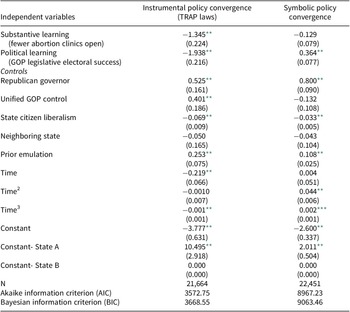
DDEHA analysis of abortion regulation diffusion, 1993–2016

Note. These are logit estimates from a directed-dyad event history analysis (DDEHA), where the dependent variable is whether State A moves toward the policy of State B in a given year. The unit of analysis is the directed dyad-year. Fixed effects are included for year and for both States A and B, in addition to the time controls included. The numbers in parentheses are robust standard errors.
*** p < 0.01;
** p < 0.05;
* p < 0.10.
The values of political elites may also influence morality policymaking (Mooney and Lee Reference Mooney and Lee2000), and in the highly partisan abortion politics of the era, Republican-controlled state governments were most likely to restrict abortion (Adams Reference Adams1997; Djupe, Neiheisel, and Sokhey Reference Djupe, Neiheisel and Sokhey2018; Kreitzer Reference Kreitzer2015; Norrander and Wilcox Reference Norrander and Wilcox1999). To control for this, we include variables for the presence of unified GOP control of state government and a GOP governor in State A. Elite values could also be assessed by state government ideology (Berry et al. Reference Berry, Ringquist, Fording and Hanson1998). Again, in our data set, these three variables (unified GOP control, GOP governor, and government ideology) are too highly correlated to include in the same model. We include only GOP control and GOP governor in Table 1, but our substantive conclusions are robust to the choice of which of these variables is included (see Supplementary Table OA3).
We also control for the “neighborhood effect” that is so often discussed in the state policy diffusion literature (Mooney Reference Mooney2020; Walker Reference Walker1969). While there is debate about whether cross-border learning exists at all (e.g., Mooney Reference Mooney2001a), especially for morality policy, we include a dummy coded 1 if States A and B are contiguous. We also control for prior emulation of State B by State A by including a count of the number of times prior to the dyad-year that State A has modified one of the policies under study to be more like that of State B (Gilardi and Fuglister Reference Gilardi and Fuglister2008; Volden Reference Volden2006). As is also typical in such models, we include polynomials to control for nonlinear trends, de-meaning these measures to prevent multicorrelation issues among t, t2, and t3 (Carter and Signorino Reference Carter and Signorino2010). Finally, we include fixed effects in our models for year and both States A and B to account for variation in convergence likelihoods over time. Several other factors might influence State A’s adoption of antiabortion policy, such as legislative professionalism, other aspects of religiosity, and urbanization. But as noted, given the nature of DDEHA and our data set, multicollinearity problems preclude including more of these indicators. Our approach is to include as many theoretically relevant State A characteristics as possible, and then estimate models with alternative specifications as robustness checks. In the end, the substantive conclusions we draw from the results in Table 1 are robust to a range of control variable specification and operationalization.
Results
Table 1 displays the results of two DDEHA models examining the influences on abortion policy convergence in the US states, 1993–2016, one modeling instrumental abortion policy diffusion (TRAP laws) and one modeling symbolic abortion policy diffusion.
First, as hypothesized based on the morality policy literature, we find evidence of political learning for both types of abortion policy, although our results show political learning running in opposite directions for instrumental and symbolic policies. When State B’s GOP gains legislative seats after passing a symbolic abortion policy, the chances of its passage in State A increase. On the other hand, GOP electoral success in State B decreases the odds of State A passing an instrumental TRAP policy. These contradictory results may be explained by the loss aversion bias from prospect theory (Kahneman and Tversky Reference Kahneman and Tversky1979, Reference Kahneman and Tversky1984; Tversky and Kahneman Reference Tversky and Kahneman1991). Policy opponents may not be overly concerned about symbolic policy that has little practical effect, but when they are credibly threatened with instrumental loss, they mobilize strongly. Overall, these results demonstrate that the electoral motivation for policymakers is strong, regardless of the type of morality policy involved (Kreitzer Reference Kreitzer2015; Mayhew Reference Mayhew2004; Mooney Reference Mooney2001b). Both instrumental and symbolic abortion policy diffusions are influenced by political learning, even if the dominant direction of this impact differs between them.
The estimates in Table 1 also show clear evidence of substantive learning—but mainly for instrumental abortion policy, as hypothesized. Again, as prospect theory would suggest, when a TRAP law is successful in closing abortion clinics in State B, opponents’ efforts to avoid loss in State A appear to overwhelm any positive lessons learned by its proponents. Even after controlling for State A’s relevant internal characteristics, when abortion clinic closures follow TRAP law adoption in State B, State A is less likely to adopt a TRAP law itself. This is consistent with State A policymakers learning substantive lessons from the policy experiences of State B, supporting the laboratories of democracy claim (Bouche and Volden Reference Bouche and Volden2011; Rose Reference Rose1991; Walker Reference Walker1969). Even accounting for any potential positive learning by TRAP law proponents, opponents’ negative substantive learning is clearly seen in this model.
On the other hand, the second model shows no evidence of substantive learning for symbolic morality policy. This fits with the argument that morality policy advocacy is driven more by an effort to affirm values than to pursue concrete policy impacts (Kreitzer, Kane, and Mooney Reference Kreitzer, Kane and Mooney2019; Mooney Reference Mooney2001b; Mooney and Lee Reference Mooney and Lee1995; Mucciaroni Reference Mucciaroni2011). Policymakers appear to learn only political, not substantive, lessons from other states’ experiences with symbolic morality policy. However, this result does not rule out any substantive learning in this symbolic policy diffusion. First, if positive and negative lessons roughly balance out, the average estimated substantive learning impact would be zero. Second, this null result may be caused by using clinic closures as the substantive impact criterion, since that is not the stated goal of these symbolic policies. As a robustness check, we re-ran this model substituting, in separate models, the clinic-closures learning variable with ones based on the state’s 1) abortion rate and 2) maternal health.Footnote 11 Our substantive conclusions remain the same in the face of these substitutes. Third, as robustness checking reveals (see the following section), changing the public attitude control variable’s measure may affect the resulting substantive learning coefficient for symbolic policy. These results suggest the potential for a negative influence of substantive learning on symbolic abortion policy, further supporting the importance of the loss aversion bias here. More research is needed to understand better the potential for substantive learning influencing symbolic morality policy diffusion. However, at a minimum, our results show that substantive learning was likely a factor in TRAP law diffusion.
The controls for State A’s partisan and ideological make-up largely behave as expected or fail to achieve statistical significance. All else equal, partisan politics and citizen ideology have a strong impact on whether State A converges with State B on either type of abortion policy, as expected with such a highly partisan issue. On the other hand, the influence of a neighboring state having previously adopted the policy is not statistically significant in either model. While this neighborhood effect figured prominently in the early state policy diffusion literature (e.g., Lutz Reference Lutz1987; Walker Reference Walker1969), our results provide further evidence that physical proximity may simply be a surrogate for other commonalities that have a more direct impact on policy choice (Braun and Gilardi Reference Braun and Gilardi2006; Grossback, Nicholson-Crotty, and Peterson Reference Grossback, Nicholson-Crotty and David2004; Mallinson Reference Mallinson2021; Weinstein and Ross Reference Weinstein and Ross1981). The statistically significant positive estimated coefficients for prior emulation show that states are more likely to follow peers that they have followed previously, suggesting an ongoing diffusion relationship. The time polynomials have results typical of diffusion models, where policy adoption becomes less likely over time, with perhaps some nonlinear effects for symbolic policy that do not occur for TRAP policy.
Robustness Checks
The choices we made in developing our main models (Table 1) required various trade-offs and judgment calls when the literature lacked clear guidance, especially in terms of variable selection and operationalization. Here, we outline three important areas where this occurs and offer an additional explanation and testing for our choices.
First, an important decision for measuring our dependent variable is setting the appropriate time lag between when State B adopted a policy and when State A is assessed as converging with that policy. Learning requires time between the lesson and the demonstration of learning, but the length of that time is context-dependent. We chose to use a two-year lag for the dependent variables in Table 1, which is typical in the literature (Boehmke Reference Boehmke2009; Bricker and LaCombe Reference Bricker and LaCombe2021; Gilardi and Fuglister Reference Gilardi and Fuglister2008; Shipan and Volden Reference Shipan and Volden2012; Volden Reference Volden2006) and which fits with the typical two-year legislative process and election cycles in the states. To check the robustness of this decision, we ran our models with dependent variables with one-year and three-year lags. The substantive results are largely consistent with those in Table 1 and ultimately align with our expectations. Varying this lag choice on instrumental learning results in no substantive differences in our conclusions (Table 2), suggesting that the effect is both persistent and robust. Table 2 shows how the key substantive learning coefficients for instrumental and symbolic policy vary with different lags, while including all the same variables as in Table 1. For symbolic learning, one- and two-year frames show no effects, while a three-year time period results suggest negative learning. Future research should explore the length of the learning lag for different policies to understand interstate policy learning better.
Robustness check—Learning time lags

Note. This table reports the estimated coefficients for the substantive learning variables from DDEHA models identical to those in Table 1, but varying the lags on the substantive learning variable. Numbers in parentheses are robust standard errors. Models are estimated in Stata using the relogit command.
Abbreviation: DDEHA, directed-dyad event history analysis.
*** p < 0.01;
** p < 0.05;
* p < 0.10.
Policies may also diffuse through emulation rather than, or in addition to, learning (Mooney Reference Mooney2020). The chosen policy and timeframe of this study suggest that other mechanisms (coercion and competition) of diffusion are not present. Still, we must control for emulation, which is largely about how states’ similarities affect diffusion (Grossback, Nicholson-Crotty, and Peterson Reference Grossback, Nicholson-Crotty and David2004). In Table 3, we present estimated coefficients from models paralleling those in Table 1, but with the addition of three different emulation measures (we report only the coefficients for the learning variables and emulation factors). Citizen and elite similarity scores are a function of the absolute differences between the two states’ scores on these variables (Berry et al. Reference Berry, Ringquist, Fording and Hanson1998; Bricker and LaCombe Reference Bricker and LaCombe2021; Volden Reference Volden2006). The final variable uses the latent network ties measurement from Desmarais et al. Reference Desmarais, Hardin and Boehmke2015. Table 3 shows that none of the emulation controls attains conventional levels of statistical significance. While learning and emulation are not mutually exclusive mechanisms, learning and emulation seem to be driving the diffusion of both instrumental and symbolic abortion policy in our dataset.
Robustness checks: Emulation measures

Note. This table reports the estimated coefficients from two DDEHA models identical to those in Table 1, except with the addition of these three emulation variables. Perceived similarity scores are from Bricker and LaCombe Reference Bricker and LaCombe2021, and latent network ties are from Desmarais et al. Reference Desmarais, Hardin and Boehmke2015. Numbers in parentheses are robust standard errors. Models are estimated in Stata using the relogit command.
*** p < 0.01;
** p < 0.05;
* p < 0.10.
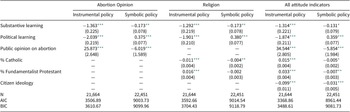
Finally, we explore the robustness of our choices regarding measures of State A policy-related attitudes, which we use as a control. In Table 1, we present results using citizen ideology scores (Berry et al. Reference Berry, Ringquist, Fording and Hanson1998), but other, related variables have also been used in the field, so we run the main model with some well-used alternatives (Table 4). Public opinion on abortion is known to influence abortion policy (e.g., Kreitzer Reference Kreitzer2015; Mooney and Lee Reference Mooney and Lee1995, Reference Mooney and Lee2000; Patton Reference Patton2007), and it is more likely be a direct indicator of the type of opinion that affects abortion policy than ideology. We include a direct indicator of abortion public opinion developed by Pacheco (Reference Pacheco2014). Her original dataset runs from 1966 to 2011, and we extend this to 2016 with linear interpolation.Footnote 12 Religion is another attitude-related factor that has long been associated with abortion policy, especially the percentage of Catholics and fundamentalist Protestants in a state (Kreitzer Reference Kreitzer2015; Mooney and Lee Reference Mooney and Lee1995; Patton Reference Patton2007). The results in Table 4 demonstrate that regardless of which intrastate attitude variables are used, political learning is positive for symbolic policy and negative for instrumental policy, as we found in Table 1. Likewise, these tests also confirm that instrumental policy’s estimated negative learning effect is robust across these specifications. However, there is an indication that negative substantive learning may also occur for symbolic policy, in contrast to our results in Table 1. Future research should explore this distinction to understand more deeply the effect of abortion policy attitudes on its diffusion.
Robustness checks—Alternate attitude controls

Note. These models represent robustness checks using different public attitude indicators. These models contain the identical variables as those in Table 1 (full results not shown for brevity), with the exception of the citizen ideology control. Citizen ideology, the percentage Catholic, the percentage fundamentalist Protestant, and abortion public opinion are medium-to highly correlated, with pairwise correlations of between 0.4 and 0.6. Abortion attitude data are drawn from Pacheco Reference Pacheco2014 for years 1993–2011; we do linear extrapolation to estimate these data for 2012–2016. Numbers in parentheses are robust standard errors.
*** p < 0.01;
** p < 0.05;
* p < 0.10.
In addition to Tables 2–4, we develop a broader series of robustness checks and report them in online Supplementary Material. Overall, we find consistency in the results presented in Table 1, and especially in the substantive conclusions drawn from that table.
Conclusion
Do policymakers learn from the policy experiences of other governments, and if so, what do they learn? We addressed these questions with a conservative empirical test—the diffusion of abortion policy among the US states in the years between the Casey and Hellerstedt Supreme Court decisions (1993–2016). As states adjusted their abortion regulation regimes in this period, did policymakers draw lessons from their peers’ prior experiences? That is, did intergovernmental learning occur, and how did the type of policy involved affect its diffusion? By modeling the diffusion of instrumental and symbolic abortion policies in this era, we contribute to our understanding of abortion policy diffusion, and, in the process, we have also contributed to our general understanding of state policymaking in several important ways.
First, our finding that states drew substantive lessons from TRAP policies adopted elsewhere supports the “laboratories of democracy” claim that federal systems act as self-educating processes with positive feedback loops (Bouche and Volden Reference Bouche and Volden2011; Macinko and Silver Reference Macinko and Silver2015; Volden et al. Reference Volden, Ting and Carpenter2008). By learning about a policy’s impact on other states, policymakers can better align their policy regime with their preferences. When TRAP laws led to abortion clinic closures elsewhere, policymakers learned better how to control this aspect of their world. Furthermore, our results support the idea from prospect theory that loss is more motivating than gain (Kahneman and Tversky Reference Kahneman and Tversky1979, Reference Kahneman and Tversky1984; Levy Reference Levy1992, Reference Levy1996; Tversky and Kahneman Reference Tversky and Kahneman1991). Substantive learning (as manifested through policy reactions to abortion clinic closures) slowed TRAP law convergence among states, suggesting that the loss of clinics inspired opponents to become more aggressive in their advocacy elsewhere. Future research is needed to sort out the subtleties, trade-offs, and contextual considerations that drive different factions to learn differently from other states’ policy experiences.
Second, we show that issue framing can affect a diffusion (Kreitzer Reference Kreitzer2015; Mooney and Lee Reference Mooney and Lee2000; Mucciaroni Reference Mucciaroni2011). While other studies have shown that policy differences may affect the type of mechanism at work in a diffusion (e.g., Makse and Volden Reference Makse and Volden2011; Nicholson-Crotty Reference Nicholson-Crotty2009), we show that even within a given mechanism and within the same general policy category, policy attributes can have a systematic effect. While learning appears to be the mechanism by which these abortion policies diffused, the type of information that was learned depended upon whether the policy in question was symbolic or instrumental.
Third, we find that substantive intergovernmental learning can occur even in that “quintessential” morality policy, abortion regulation (Calkin and Kaminska Reference Calkin and Kaminska2020, 87; Cocca Reference Cocca2004, 147; Patton Reference Patton2007, 472; Kreitzer Reference Kreitzer2015, 43; Stabile Reference Stabile2007, 44; Schecter Reference Schecter2001, 63). This contributes to the debate about whether “morality policy” exists as a distinct policy type (Burlone and Richmond Reference Burlone and Richmond2018; Euchner et al. Reference Euchner, Heichel, Nebel and Raschzok2013; Mooney and Schuldt Reference Mooney and Schuldt2008). We provide support for the argument that morality politics is contingent on debate framing rather than on any intrinsic characteristic related to the substance of the policy (Kreitzer et al. Reference Kreitzer, Kane and Mooney2019; Mucciaroni Reference Mucciaroni2011). That is, the type of learning that a policy generates may be determined more by its characterization in debate than by its underlying content. So while “morality politics” may sometimes be manifested in state policymaking, there is likely no intrinsic “morality policy.” And if abortion regulation can be “de-moralized” in this sense (Kreitzer et al. Reference Kreitzer, Kane and Mooney2019), then virtually any policy could be framed as instrumental.
Fourth, we demonstrate that political learning can also motivate policy diffusion, but again with an interesting twist explained by loss aversion and prospect theory. GOP (the primary champions of these regulations) electoral success in State B after passing a symbolic abortion policy increases the odds of State A adopting it, all else equal (Gilardi Reference Gilardi2010; Seljan and Weller Reference Seljan and Weller2011; Shipan and Volden Reference Shipan and Volden2008, Reference Shipan and Volden2012; Simmon, Dobbins, and Garret Reference Simmons, Dobbin and Garett2006). However, when the policy in question is designed to have substantive impacts, as with TRAP laws, opponents’ concern about their potential loss appears to outweigh proponents’ hope for gain. Thus, we find evidence of negative political learning for instrumental policy and positive political learning for symbolic policy. Of course, there may be substantive learning for symbolic laws, with the positive and negative learning effects canceling each other out. Again, future research needs to assess these competing influences more precisely, and address the question of the conditions under which political or substantive learning is most prevalent.
Fifth, we generalize Volden’s (Reference Volden2006) emulation-of-success indicator of intergovernmental learning by reminding researchers that “successful” is a criterion-related adjective. In particular, opponents and proponents may learn strikingly different strategic lessons from a policy’s impacts elsewhere. This raises the specter of countervailing forces biasing any aggregate evidence of learning toward zero, something with which future diffusion scholars must grapple. However, most nonabortion policy debates likely find policymakers less completely at odds in evaluating a policy’s impacts, perhaps focusing more on alternative tools to meet a given goal.
Finally, we contribute to the state policy diffusion literature by demonstrating, once again, that when other relevant factors are controlled, the influence of neighboring states in a policy diffusion is minimal (Allen, Pettus, and Haider-Markel Reference Allen, Pettus and Haider-Markel2004; Mallinson Reference Mallinson2021; Mooney Reference Mooney2001a, Reference Mooney2020). Walker’s (Reference Walker1969) original hypothesis was that geographic proximity acted, at least in part, as a proxy for many relational factors among states (such as having a common ideology or similar demographics). When controlling for such theoretically relevant factors directly, the “neighbor” proxy loses its leverage (Braun and Gilardi Reference Braun and Gilardi2006; Grossback, Nicholson-Crotty, and Peterson Reference Grossback, Nicholson-Crotty and David2004; Weinstein and Ross Reference Weinstein and Ross1981). Of course, our analysis does not examine the diffusion of policy with obvious cross-border implications, such as gasoline taxes and gambling regulations (Berry and Baybeck Reference Berry and Baybeck2005; Berry and Berry Reference Berry and Berry1990), where neighboring states may have more influence.
Thus, state policymakers can learn from the policy experiences of their 49 peer states, supporting the laboratories of democracy claim. This is true even on abortion policy, that “quintessential morality policy,” where issues of the first principle are often in conflict and where substantive information may be less relevant. However, what policymakers learn from their peers seems to vary systematically based on the framing of the policy involved. For symbolic policy, passed with little intention of substantive impact, policymakers seem to focus largely on political lessons from other states. For instrumental policy, with its substantive goals, policymakers also appear to consider how well those goals were met. This demonstrates considerable sophistication in policymakers’ thinking. Policymakers exhibit strategic intergovernmental learning regardless of whether the policy goal is political or substantive. In the end, policymakers can and do engage in intergovernmental learning, but this learning process is much more nuanced than that envisioned by Associate Justice Brandeis almost 100 years ago.
Supplementary Materials
To view supplementary material for this article, please visit http://doi.org/10.1017/spq.2022.7.
Data Availability Statement
Replication materials are available on SPPQ Dataverse at https://doi.org/10.15139/S3/ARFRCK, (Pollert and Mooney Reference Pollert and Mooney2022).
Funding Statement
The authors received no financial support for the research, authorship, and/or publication of this article.
Conflict of Interest
The authors declared no potential conflicts of interest with respect to the research, authorship, and/or publication of this article.
Acknowledgments
An earlier version of this paper was presented at the 2021 Virtual Southern Political Science Association conference. The authors would like to thank Rebecca Kreitzer and Juliana Pacheco for their help on this project and Carl Klarner, Rachel Jones, and Isaac Maddow-Zimet for their help accessing some of the data used in our analyses.
Appendix: Data sources and operations

Isaac Pollert is a post-doctoral fellow at Penn State University, where he researches policy diffusion. Mooney is professor emeritus at the University of Illinois at Chicago.