Introduction
Despite the popular misconceptions that humans have poor olfactory ability and do not rely on smell for navigating the environment, olfaction is an ancient chemical sense that provides important sensory information across many different contexts.Reference McGann 1 In fact, olfaction plays a role in number of everyday, routine processes such as eating, social communication, and attaching emotional attributes to autobiographical memories.Reference Sarafoleanu, Mella and Georgescu 2 Smell also has a primary role for survival in the detection of environmental threats and signaling of potential danger (eg, identifying spoiled/rotten food, an unseen fire, or nearby chemical spill or gas leak). Thus, enhanced olfactory function during periods when increased threat detection is required, or when perceived life threat or emotional stress is high, would likely aid in survival by alerting one to the presence of danger and facilitating avoidance behaviors.
Evidence from animal studies suggests that odor sensitivity is heightened during periods when increased threat detection is required, such as in the vicinity of a predatorReference Lukowiak, Martens and Rosenegger 3 or in response to immobilization stress.Reference Sung, Jang and Lee 4 Moreover, structural changes within the olfactory system of rodents in response to fear/threat support those changes in function.Reference Jones, Choi and Davis 5 , Reference Kass, Rosenthal and Pottackal 6 The data in humans are less clear, however, with some studies reporting fear/threat-related enhanced odor detectionReference Kass, Rosenthal and Pottackal 6 – Reference Pacharra, Schäper and Kleinbeck 11 and others demonstrating impaired function.Reference Jovanovic, Perski and Berglund 12 , Reference Takahashi, Itoh and Nishikawa 13 Odor detection/sensitivity across stress, anxiety, and other fear-related disorders is equally mixed.Reference Berlin, Stern and Ng 14 – Reference Segalàs, Labad and Alonso 19 Taken together, these findings suggest that additional variables may moderate the relationship between fear/threat and enhanced odor detection/sensitivity in humans. For instance, our research suggests that situations of real, life-threatening danger may shift olfactory system functions toward the more sensitive detection of specific, threat-related odor cues, including burning odors.Reference Cortese, Leslie and Uhde 20 Accordingly, sensitivity to certain odors, particularly those linked to real danger, may be associated with anxiety proneness and/or history of negative affective experiences. Another possible explanation for mixed evidence in the anxiety–odor sensitivity relationship may be due to differences between those with and without clinically significant odor sensitivity. It may be that persons who are impaired by their odor sensitivity (eg, endorse unpleasant physical/emotional reactions to certain odors) are indeed highly anxious, but that no relationship exists between odor sensitivity and anxiety in persons who are not impaired by their odor sensitivity (eg, endorse a keen, but nonproblematic, sense of smell).
In fact, the proposed linkage between odor sensitivity impairment and psychological distress has particular relevance to individuals who describe themselves as “chemically sensitive,” or having an enhanced ability to detect and experience distress from noxious smells, particularly harsh chemicals and environmental pollutants. Studies have found that between 11% and 33% of individuals in the general population consider themselves “chemically sensitive”Reference Kreutzer, Neutra and Lashuay 21 , Reference Meggs, Dunn and Dunn 22 and between 1–6% are impaired by the condition.Reference Bailer, Witthöft and Rist 23 Impaired individuals endorse the ability to detect very faint concentrations of certain smells (ie, much lower than harmful levels), and that the presence of such odors causes intense irritation and symptoms akin to panic attacks (eg, lightheadedness, fatigue, difficulty breathing, headaches, concentration difficulties).Reference Cullen 24 – Reference Sparks, Daniell and Black 26 However, it is currently unclear whether individuals who describe themselves as being chemically sensitive have physiological differences in olfactory function or if their sensitivity is more reflective of fear-based psychopathology. Preliminary objective testing has revealed mixed results regarding whether true differences in odor detection exist in persons with chemical sensitivity,Reference Doty, Deems and Frye 27 , Reference Kärnekull, Jönsson, Larsson and Olofsson 28 whereas data consistently suggest that persons who endorse chemical sensitivity have increased anxiety, depression, and psychological distress.Reference Bell, Miller and Schwartz 29 – Reference Devriese, Winters and Stegen 31 Yet, while this evidence provides useful information on those who endorse “chemical sensitivity,” it is unclear whether these findings would also hold true for those who consider themselves to be “odor sensitive,” which reflects a more general sensitivity to odors, rather than specific sensitivity to harsh chemicals. It stands to reason that persons with greater fear-based psychopathology may be particularly vigilant of harsh chemicals and environmental pollutants that could potentially be harmful if inhaled in large volumes. Yet, the extent to which the purported effects of stress and anxiety on olfaction would associate to greater perceptual sensitivity to both potentially dangerous and neutral odors is currently unknown.
To more clearly elucidate the relationship between odor sensitivity and psychiatric symptoms, we recruited a sample of adults who endorsed increased sensitivity to odors. To extend previous findings, we sought to determine the relationship between odor sensitivity and various indices of stress, anxiety, and depression in those impaired and not impaired by their odor sensitivity. We also sought to examine whether self-reported odor sensitivity impairment would correspond to an objective measure of odor detection, including increased differential detection of an odor potentially related to danger (smoke-like) compared to an odor typically not associated with danger (rose-like). Finally, in order to link affective variables to possible physiological differences in odor detection, we explored whether various indices of stress, anxiety, and depression were associated with objective measures of odor detection.
Methods
Participants
Participants were recruited over a 6-month time period from the Medical University of South Carolina campus and the greater Charleston, South Carolina, community through advertisement seeking “adults who are sensitive to odors.” At screening, self-reported odor sensitivity was confirmed by affirmative answers to the questions, “are you sensitive to odors?” and “do you smell things other people do not or prior to other people?” Next, impairment due to odor sensitivity was probed by the questions, “are you bothered by odors?” including “do you have unpleasant physical/emotional reactions to odors and do you avoid odors?” Participants were required to endorse “yes” to all questions to be categorized as being impaired by their odor sensitivity (OSI). All others served as odor sensitive (OS) controls, as they self-reported odor sensitivity (keen sense of smell) but were not impaired by it. We chose this recruitment methodology based on our primary hypotheses—that impairment from odor sensitivity, not odor sensitivity per se, is the critical factor regarding psychological distress. Exclusion criteria were limited and included (a) history of head trauma/concussion, (b) heavy smoking, and (3) problems with nose/sense of smell (eg, upper respiratory infection, chronic rhinosinusitis, polyps, etc). All participants signed written informed consent approved by the Institutional Review Board (IRB) at the Medical University of South Carolina prior to participation.
Materials and methods
Odor detection
Objective odor detection was measured through administration of 2 versions of the Snap and Sniff® Threshold Test (SSTT)Reference Doty 32 : the first containing phenyl-ethyl alcohol (PEA), a “rose-like” scent, and the second containing guaiacol (GUA), a “smoke-like” scent. Administration procedures were the same, regardless of odorant. The SSTT required the systematic presentation of a set of wands containing a serial dilution (half-log concentration steps ranging from the most intense, 10–2, to the least intense, 10–9) of odorant. In a single staircase method with forced choice regarding which wand smelled more strongly of the odorant, a wand containing a given concentration of odorant was presented under the nose in rapid succession with an odorless wand. Subsequent presentation of a higher or lower concentration of odorant was dependent on a correct or incorrect response from the previous trial. This method was repeated until 7 reversals (up and down the staircase) were made. Odor detection threshold score was determined by the average of the last 4 reversals.
Psychological measures
The Anxiety Sensitivity Index-3 (ASI-3) is an 18-item, self-report measure of anxiety sensitivity (AS), or the fear of experiencing anxiety and its related cognitive, physiological, and social consequences.Reference Taylor, Koch and McNally 33 Using a 5-point rating scale that ranged from 0 (very little) to 4 (very much), items were rated according to how much the respondent agreed to each statement. Total ASI-3 scores were calculated by the sum of all items and could range from 0 to 72, with higher scores indicating greater anxiety sensitivity. Three lower-order factors of anxiety sensitivity (ie, cognitive, physical, and social) were composed of 6 items each, allowing subscale scores to range from 0–24. The cognitive concerns subscale measured fear of the mental consequences of anxiety such as worry of “going crazy” or being “mentally ill.” The physical concerns subscale measured fear of anxiety-related physiological arousal including worry of a “heart attack” or “choking to death.” And finally, the social concerns subscale measured fear of the social aspects of anxiety such as worry of being evaluated negatively by others for blushing, sweating, or fainting. The psychometric properties of the ASI-3 are adequate to good on indices of reliability and validity.Reference Taylor, Koch and McNally 33 , Reference Osman, Gutierrez and Smith 34 Evidence indicates that a cut-off score of ≥ 17 reflects moderate-to-severe anxiety sensitivity versus mild-to-negligible anxiety sensitivity.Reference Allan, Korte and Capron 35 , Reference Allan, Raines and Capron 36
The State-Trait Anxiety Inventory (STAI)Reference Spielberger, Gorsuch and Lushene 37 is a 40-item, self-report measure of 2 types of anxiety: state anxiety and trait anxiety.Reference Kendall, Finch and Auerbach 38 State anxiety is conceptualized as a transitory emotional state, whereas trait anxiety is thought to be an enduring personality dimension. Each type of anxiety is measured via 20 distinct items. On the STAI, participants are asked to rate a series of statements regarding how much the statement applies to them on a 4-point rating scale ranging from 1 (“Not at all”) to 4 (“Very much so”). Total scores for the state subscale (STAI-S) and trait subscale (STAI-T) are formed by summing all items, resulting in subscale scores ranging from 20–80. Studies have shown that the STAI has good reliability and validity.Reference Barnes, Harp and Jung 39 – Reference Vautier 43 Cut-off scores for normative versus clinically significant symptoms on the STAI scales have been defined as 40 for the State scaleReference Dennis, Coghlan and Vigod 44 and 46 for the Trait scale.Reference Fisher and Durham 45
The Holmes–Rahe Social Readjustment Scale (HRSS)Reference Holmes and Rahe 46 is a 43-item, self-report measure of recent individual experiences of stressful life events. Participants are asked to indicate whether a series of stressful life events (eg, death of a spouse, change in living conditions, vacation) have occurred to them in the past year. Each life event is assigned an empirically derived point value (or “Life Change Units”) ranging from 11–100,Reference Masuda and Holmes 47 with greater values indicating greater stress impact. The total number of Life Change Units are added together from all items endorsed by the participant, resulting in a total score that reflects one’s risk for illness or maladjustment as a result of life stress. Scores are interpreted as follows: scores<150 reflect reduced risk of illness, scores between 150–299 reflect moderate risk of illness, and scores ≥ 300 reflect high risk of illness. Evidence suggests that the HRSS has good criterion validity.Reference Scully, Tosi and Banning 48
Similarly, the Life Events Checklist (LEC)Reference Gray, Litz and Hsu 49 is a 17-item, self-report measure of exposure to potentially traumatizing events. The measure lists 16 potentially traumatizing events, and participants are asked to rate whether (a) the event happened to them, (b) they witnessed the event, (c) they learned about the event, (d) the event happened as part of their job, (e) they are not sure, or (f) the event did not happen to them. In addition, an additional item allows respondents to enter any other extraordinary stressful life event. A total score is derived by adding up the number of instances and/or contexts in which someone has endorsed that they experienced a traumatic event. The LEC has adequate test–retest reliability and good convergent validity.Reference Gray, Litz and Hsu 49
The Penn State Worry Questionnaire (PSWQ)Reference Meyer, Miller and Metzger 50 is a 16-item, self-report measure of chronic and persistent worrying. Participants rate how a series of statements applies to them on a 5-point rating scale ranging from 1 (“Not at all typical of me”) to 5 (“Very typical of me”), and the total score consists of a sum of all item scores ranging from 16–80. Higher scores indicate greater trait worrying. Evidence indicates that the PSWQ possesses good reliability and excellent validity.Reference Brown, Antony and Barlow 51
The Patient Health Questionnaire–Depression scale (PHQ-9)Reference Kroenke and Spitzer 52 is a 9-item, self-report measure of the 9 diagnostic criteria for major depression from the Diagnostic and Statistical Manual of Mental Disorders, Fourth Edition (DSM-IV). Respondents rate the frequency each of the diagnostic criteria on a 4-point rating scale ranging from 0 (“Not at all”) to 3 (“Nearly every day”), resulting in total scores ranging from 0–27. A cutoff score of ≥ 10 is generally employed to detect significant depressive symptoms.Reference Manea, Gilbody and McMillan 53 Evidence generally supports the construct validity of the PHQ-9.Reference Martin, Rief and Klaiberg 54
The Pittsburg Sleep Quality Index (PSQI)Reference Buysse, Reynolds and Monk 55 is a 19-item, self-report measure designed to measure sleep quality in persons over a 1-month interval. Item content covers 7 content areas: subjective sleep quality, sleep latency, sleep duration, habitual sleep efficiency, sleep disturbances, use of sleeping medication, and daytime dysfunction. Items are rated on a 4-point rating scale ranging from 0 (“Not during the past month”) to 3 (“Three or more times a week”). The total score is computed by summing all items, which can range from 0–57. Evidence indicates that the PSQI possesses acceptable reliability and good validity.Reference Buysse, Reynolds and Monk 55 , Reference Carpentera and Andrykowskia 56
Procedure
Interested participants who responded to study advertisements and met the study criteria were mailed a comprehensive packet of questionnaires related to stress, anxiety, and mood and scheduled for a 30-minute study visit. At the visit, informed consent procedures were conducted, followed by the collection of the participants’ completed packet of questionnaires, determination of whether participants were functionally impaired by their odor sensitivity, and finally by objective odor detection testing (SSTT for PEA and GUA).
Results
Participant characteristics
Participants in the overall sample (N = 49) were mostly middle-aged (M = 37.43, SD = 13.20, range = 20–68) and predominantly white (73.5%), female (89.8%), and college-educated (73.5%). While all participants endorsed odor sensitivity, further probing revealed that 32 of the 49 participants (65.3%) reported that their odor sensitivity was impairing (OSI) and that 17 of the 49 participants (34.7%) were not impaired by their odor sensitivity (OS).
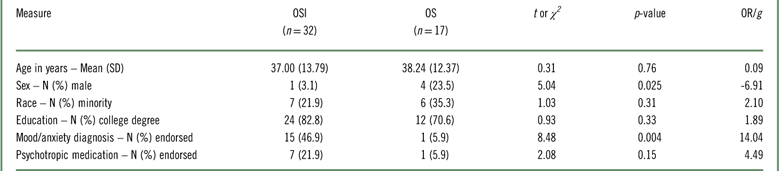
Independent t-test and chi-square analyses revealed significant differences in demographic and clinical characteristics between the OSI and OS groups (see Table 1). Most notably, persons in the OSI group were significantly more likely to be females than males. This result is likely based on the findings that only 10% of those who answered the study advertisement were male, and that only 1 (20%) of the males in the study were included in the OSI group, while 31 (70%) of the females in the sample were included in the OSI group. Additionally, the OSI participants were significantly more likely to endorse a previous diagnosis and/or treatment for anxiety or depression. In fact, of the 16 participants who endorsed a diagnosis, 15 of them were in the OSI group, meaning that of the 17 participants in the OS group, just 1 endorsed being previously treated for depression.
Demographic and clinical characteristics

OSI = participants impaired by their odor sensitivity; OS = participants not impaired by their odor sensitivity; OR = odds ratio; g = Hedge’s g.
Influence of odor sensitivity impairment on depression, anxiety, and stress
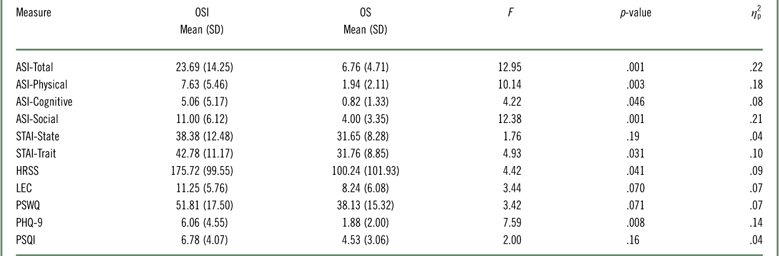
Given the high rate of mood and anxiety disorders in the OSI group, analysis of covariance (ANCOVA) with history of diagnosis/treatment added as a categorical covariate was used to determine the influence of odor sensitivity impairment on the severity of psychiatric symptoms and life stress (see Table 2). Consistent with our hypotheses, the OSI group had significantly greater overall AS, as well as greater scores on the physical, cognitive, and social ASI-3 subscales. Additionally, the OSI group reported significantly greater symptoms of depression, greater frequencies of stressful life events on the HRSS, and higher trait anxiety, but state anxiety was not elevated. Marginally higher frequencies of traumatic life events and worry severity were reported by the OSI group compared to the OS group. However, impairment from odor sensitivity did not affect sleep quality, as there were no significant differences between groups on the PSQI.
Differences between odor sensitive groups on self-report measures

OSI = participants impaired by their odor sensitivity; OS = participants not impaired by their odor sensitivity; ASI = Anxiety Sensitivity Index; STAI = State/Trait Anxiety Inventory; HRSS = Holmes–Rahe Stress Readjustment Scale; LEC = Life Events Checklist; PSWQ = Penn State Worry Questionnaire; PHQ-9 = Patient Health Questionnaire; PSQI = Pittsburg Sleep Quality Index.
We also examined whether persons who were impaired by their odor sensitivity would be more likely to be classified as having clinically significant symptoms of depression, trait anxiety, life stress, and anxiety sensitivity, as evidenced by scores greater than the cut-offs on the PHQ-9, STAI Trait Scale, HRSS, and the total score of the ASI. Results of chi-square analyses revealed that the OSI group was significantly more likely to report clinically significant symptoms of depression on the PHQ-9 (χ2 [1, 49] = 6.07, p = .014, OR = 313.99). Indeed, while 9 (29.0%) of the OSI group scored 10 or higher on the PHQ-9, none of the OS group scored at or above that cut-off. The same pattern of results was evident on the ASI, wherein the OSI group was more likely to report clinically significant symptoms of AS with scores greater than or equal to 17 (χ2 [1, 49] = 19.52, p<.001, OR = 4630.67). While 21 (65.6%) of the OSI group scored in the clinically significant range for AS, none of the OS group did. However, individuals in the OSI group were only marginally more likely to score above the clinical cut-off on the STAI Trait Anxiety Scale (χ2 [1, 49] = 3.60, p = .058, OR = 5.89), and were not more likely to score above the clinical cut-off for life stress on the HRSS (χ2 [1, 49] = 1.92, p = .17, OR = 2.40).
Influence of odor sensitivity impairment on objectively measured odor detection
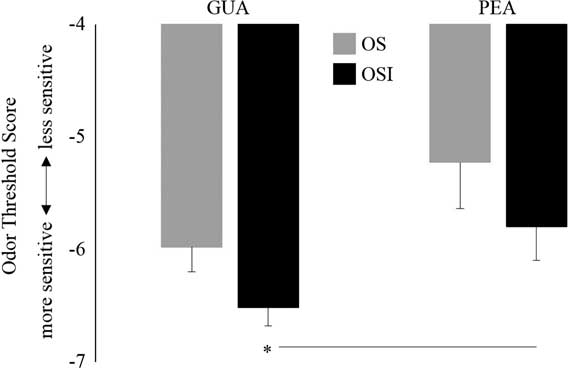
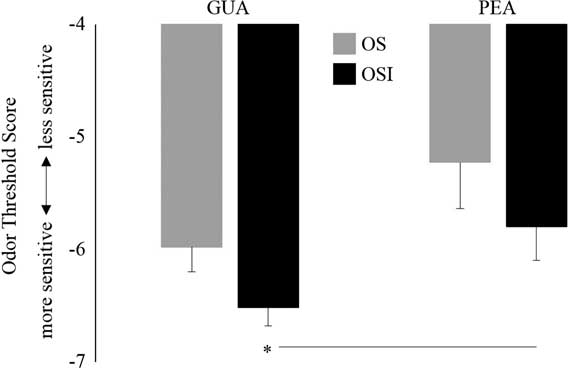
A 2 × 2 (group × odor) mixed analysis of variance (ANOVA) was used to test objectively measured odor detection of GUA and PEA between the OSI and OS groups. There was a significant main effect of odor (F[1, 47] = 7.34, p = .009, η p 2 = .14), revealing that, for the entire sample, mean odor detection threshold was lower (enhanced detection) for GUA (M = –6.34, SD = 0.94, range = –2 to –8.125) than for PEA (M = –5.60, SD = 1.70, range = –2 to –8.5). While the group by odor interaction was nonsignificant (F[1, 47] = .003, p = .95), paired samples t-tests revealed that the main effect of odor was mainly driven by the OSI group, who demonstrated significantly enhanced detection of GUA (M = –6.52, SD = 0.60, range = –4.75 to –8.125) compared to PEA (M = –5.80, SD = 1.57, range = –2.375 to –8.5; t(31) = 2.53, p = .02; d = .45). In contrast, the OS group did not show differential detection of GUA (M = -5.98, SD = 1.33, range = –2 to –7.375) compared to PEA (M = –5.23, SD = 1.91, range = –2 to –8.25; t(16) = 1.45, p = .17, d = .35). Independent samples t-tests showed that GUA threshold trended lower (enhanced detection) in the OSI group compared to the OS group (t(47) = 1.96, p = .057, g = .59), while detection thresholds for PEA did not differ between groups (t(47) = 1.12, p = .27, g = .34) (see Figure 1).
Odor threshold scores for guaiacol (GUA), a smoke-like odorant, and phenyl ethyl alcohol (PEA), a rose-like odorant, in adults impaired and not impaired by their odor sensitivity (OSI and OS, respectively). Odor detection was determined with the Snap and Sniff® Threshold Test (SSTT), wherein a lower number (more negative) indicated a lower concentration of odorant and enhanced detection. Overall, the entire sample showed enhanced detection of GUA compared to PEA. This effect was driven mainly by the OSI group, who demonstrated significantly enhanced detection for GUA compared PEA. * = p<.05.
Influence of psychological variables on objectively measured odor detection
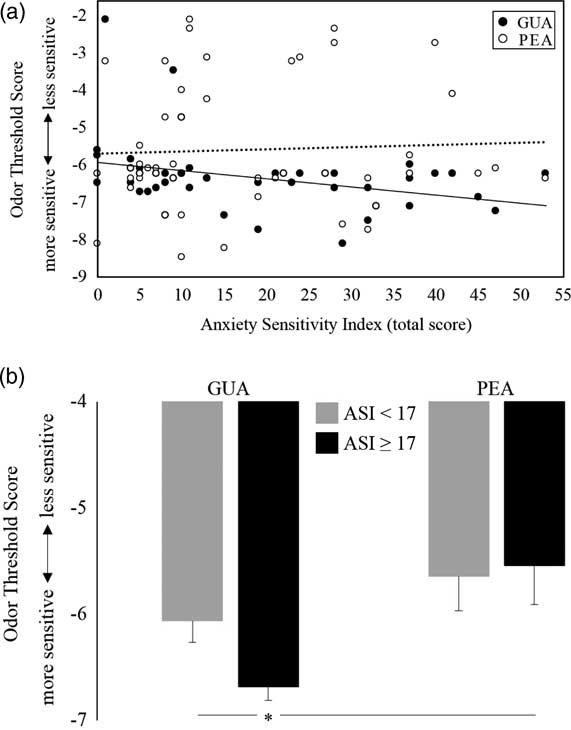
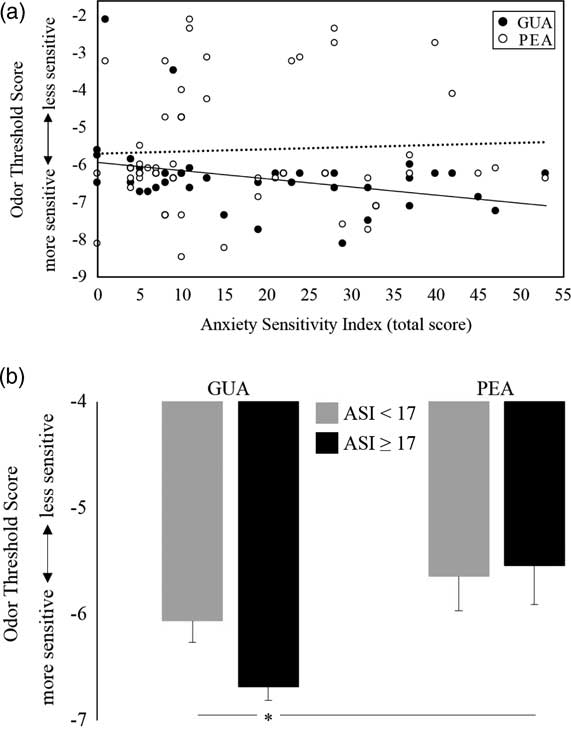
Pearson bivariate correlations were used to determine potential associations between odor threshold scores and clinical variables in the overall sample of odor sensitive adults. A significant relationship between AS and enhanced odor detection of GUA, but not PEA (r = - .33, p<.05, r = .05, p = .74, respectively), was found. Thus, detection for the smoke-like odor was best in those with the most severe AS (see Figure 2a). Participants were then grouped by those with clinically significant symptoms of AS (ASI-3 total score ≥ 17; n = 21) and those without clinically significant AS (ASI-3 total score<17; n = 28). Mixed ANOVA revealed a main effect of odor (F[1, 47] = 9.37, p = .004, η p 2 = .17) and no group by odor interaction (F[1, 47] = 2.01, p = .16, η p 2 = .04). T-tests showed that the high AS group was significantly more sensitive to only GUA, detecting it at lower concentrations than PEA (t(20) = 3.56, p = .002, d = .77), as well as GUA in the low AS group (t(47) = 2.40, p = .02, g = .69) (see Figure 2b). No other significant relationships between odor detection thresholds and psychological variables were noted.
Odor threshold scores for guaiacol (GUA), a smoke-like odorant, and phenyl ethyl alcohol (PEA), a rose-like odorant, as a function of anxiety sensitivity (AS). Odor detection was determined with the Snap and Sniff® Threshold Test (SSTT), wherein a lower number (more negative) indicated a lower concentration of odorant and enhanced detection. (a) Total AS was significantly correlated with enhanced odor detection of GUA (r = –.33, p<.05), but not PEA (r = .05, p>.1). (b) Participants who scored above the cutoff for clinically significant AS (ASI score ≥ 17; n = 21) detected GUA at lower concentrations (enhanced detection) than PEA and also compared to detection of GUA in those who scored below the clinical cutoff (ASI score<17; n = 28). * = p<.05.
Discussion
Results of the current study were consistent with our predictions. We showed that self-reported odor sensitivity impairment was associated with increased anxiety, depression, and life stress, as well as with objectively measured enhanced detection for GUA, the smoke-like, but not PEA, the rose-like, odorant. These findings suggest that self-reported impairing odor sensitivity and objective detection of an odorant related to potential danger are linked and both relate to anxiety and psychological distress.
Self-reported odor sensitivity impairment was related to a host of negative affective experiences, even when controlling for history of anxiety or depression, which was more prominent in that group. In fact, persons impaired by their odor sensitivity reported significantly increased trait anxiety, life stress, and depression, as well as a marginally greater total number of traumatic life events and marginally increased worry. Previous research has shown that anxious individuals are more perceptive of threatening stimuli than non-anxious individuals.Reference Frenkel, Lamy and Algom 57 Indeed, persons with high social anxiety are more reactive to emotional facial expressions in others,Reference Gentili, Cristea and Angstadt 58 and victims of sexual assault can experience chronic aversion to physical contact.Reference Maltz 59 Together with the present findings, these results suggest that chronic fear and psychological distress may be associated with increased attention to, and intolerance of, potential danger cues across different sensory modalities, including olfaction.
Odor sensitivity impairment related to objectively measured odor detection as well, as only those that were impaired by their odor sensitivity demonstrated significantly better detection of GUA than PEA. Moreover, there was a trend for better detection of GUA in the impaired, compared to non-impaired, odor sensitive group. These results provide support for our hypothesis that persons with odor sensitivity impairment would be more perceptive of an odor potentially related to danger, but not more perceptive of a neutral odor. Additional findings showing that enhanced detection of GUA, but not PEA, was linked to elevated anxiety sensitivity, as well as the strong association between anxiety sensitivity and odor sensitivity impairment, suggest that perhaps anxiety sensitivity is the mechanism through which persons who are impaired by odor sensitivity are more perceptive of odors potentially related to danger. Indeed, theoretical distinctions between anxiety and anxiety sensitivityReference McNally 60 suggest that odor sensitivity, regardless of impairment, may be more closely associated with fear of aversive anxiety-related sensations rather than fear of aversive stimuli, per se. Perhaps a disposition of hypervigilance to aversive sensations could reflect increased sensitivity to aversive/noxious odors, leading such individuals to report impairment due to their odor sensitivity.
There is support for the notion that odor sensitivity impairment and anxiety sensitivity are associated with intolerance of aversive odors when considering differences in the neurophysiology of sensory processing between different types of odorants. The aesthetic properties of odors are processed in the primary olfactory (piriform) cortex, which is closely intertwined with the neural structures supporting emotion in the limbic cortex (ie, the amygdala, hippocampus and surrounding cortex, anterior insula, and orbitofrontal cortices).Reference LeDoux 61 , Reference Price 62 This suggests that persons with affective psychopathology, who often demonstrate limbic hyperactivity,Reference Etkin and Wager 63 may often attach strong emotional valence to odors and thus perceive odors as more intense due to affective conflation. Some research supports this notion, as odors have a remarkable ability to elicit emotionally charged, distant memories,Reference Chu and Downes 64 , Reference Nickell and Uhde 65 and individuals with posttraumatic stress disorder (PTSD) often report that certain odors trigger re-experiencing of traumatic events.Reference Daniels and Vermetten 66 In contrast, the nociceptive properties (ie, burning, tingling) of odors are processed via the intranasal trigeminal system,Reference Doty and Cometto-Muniz 67 thereby conveying information about potentially dangerous odorant chemicals. The degree to which odorants are processed more so through the trigeminal pathway than through the primary olfactory pathway varies depending on the odorant.Reference Doty and Cometto-Muniz 67 Although PEA has some trigeminal properties, GUA and many other odors potentially related to danger have significant trigeminal properties. Indeed, GUA is still recognized as an intense odor in persons with anosmia, who cannot recognize many odors due to damage or dysfunction specific to the olfactory circuit.Reference Doty, Brugger and Jurs 68 Our laboratory has previously suggested that chronic fear may lead to a shift in central processing of odorants, from olfactory to trigeminal, such that affected individuals lose sensitivity to the hedonic qualities and perhaps intensity of many odorants, while at the same time becoming more sensitive to the danger-related aspects of odorants that possess greater trigeminal properties.Reference Cortese, Leslie and Uhde 20 In fact, we recently reported that combat veterans with chronic PTSD demonstrated decreased odor detection for PEA, but increased odor intensity ratings and brain activation in the somatosensory, but not olfactory, cortex in response to a burning-like odor cue.Reference Cortese, Schumann and Howell 17 Results of the current study are consistent with those findings; chronic sensitivity to feared stimuli (ie, anxiety sensitivity) may result in functional changes to both the olfactory and intranasal trigeminal systems, leading to odor-specific sensitivities.
Conclusion
Findings from the current study offer insights into how odor sensitivity and odor sensitivity impairment, defined subjectively or objectively, may be a marker of certain types of anxiety and psychological distress. However, these results should be viewed as preliminary given certain limitations to the study design. Certainly, the sample size between groups was relatively small, and it could be argued that a separate group of adults with average smell ability may show differences from the current groups of odor sensitive adults. The study was also constrained by the use of just 2 odorants that were not specifically tested for trigeminal activation. It would be beneficial for future studies to test a variety of pleasant and unpleasant odors that range on their ability to activate the intranasal trigeminal system. Regardless of these limitations, the present study adds to the growing literature regarding anxiety-related changes in odor processing. Taken together with previous work in this area, the present results suggest that self-reported odor sensitivity impairment and objectively measured enhanced detection of potentially dangerous odors may help identify clinically relevant levels of anxiety and psychological distress in the general population.