Since 2011, the Syrian conflict has grown to become one of the worst humanitarian crises of our lifetimes with more than 1 million people under siege. 1 , 2 One of the most important days during this conflict was when Khan al-Assal was attacked with chemical weapons on March 19, 2013.Reference Barnard 3 Khan al-Assal was one of the deadliest attacks after the suburbs of Damascus attack in August 2013Reference Patocka 4 and Khan Shaykhun attack in April 2017.Reference Barnard, Bishara, Rossback, Saad and Specia 5 , 6 It is believed that the nerve agent sarin was used.Reference Sellström, Cairns and Barbeschi 7 According to the Syrian American Medical Society, 161 chemical attacks were documented from December 2012 through October 2015. 8 These attacks include the use of sarin, chlorine gas, mustard gas or a mustard-like agent, and other toxic agents.Reference Sahloul, Monla-Hassan and Sankari 9 During the same period of time, a total of 1,491 deaths were caused by chemical attacks, with a total of 14,581 people affected. 8 Women and children were most likely to die from chemical attacks in Syria.Reference Guha-Sapir, Rodriguez-Llanes and Hicks 10
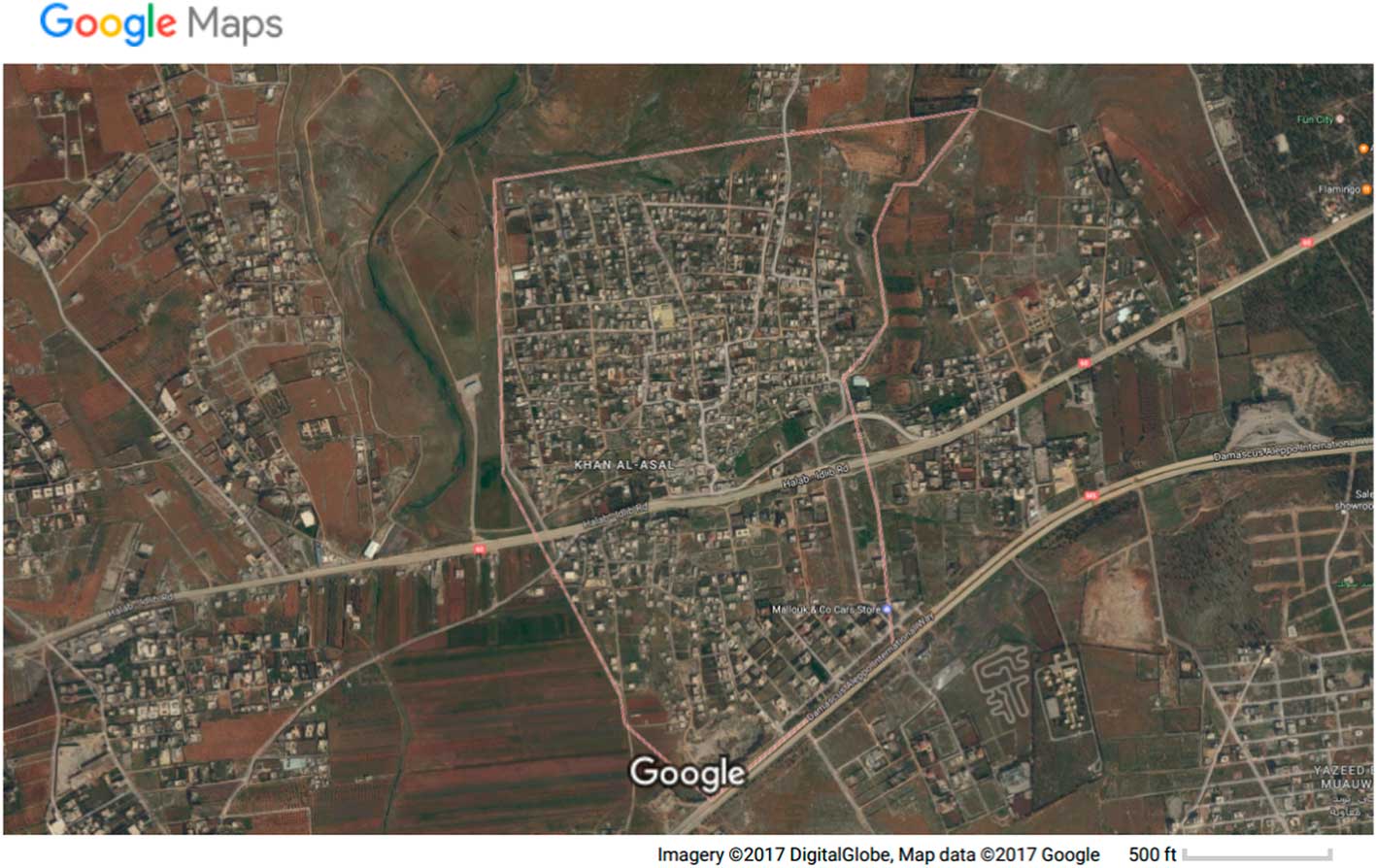
On March 19, 2013, during the first year of my residency in internal medicine (IM), I was in Aleppo University Hospital (AUH), which was the largest hospital in northern Syria with 603 beds, having my breakfast before the daily morning meeting. Around 9:00 AM local time, we heard a startling overhead announcement: the hospital was calling all physicians to go to the emergency room (ER). Usually, we would hear a call for only the surgeons to report to the ER, as they usually take care of events that could involve severe injuries. My colleagues and I reported immediately. When we arrived, we found many people coming in from the door outside of the hospital. People were carrying other people and saying they were attacked with chemical weapons in the Khan al-Assal area, which is 10.3 km from the hospital, it would take 30 minutes to drive there and cross several check points (Figure 1).
Khan al Assal town map.

The ER in AUH is divided into several sections; IM, surgery, pediatric, ear, nose, and throat (ENT), ophthalmology, and radiology. Within no time, the whole area in the ER became crowded with patients, their family members, military personnel, and fellow clinicians. No rebels were among those who came to the AUH because the hospital is under the government control areas. However, civilians can move between the 2 areas. Family members provided initial history for the victims, as they were disoriented and agitated; we soon noticed that many of these patients had dyspnea, coughing, convulsions, nausea, salivation, eye irritation, meiosis, and foaming around the mouth. Some of the patients were found to have some traumatic injuries on their bodies consistent with falls and blunt injuries, we assumed they were from hitting the floor when they lost consciousness and fell down.Reference Shahrour 11 The initial assessments for the majority of patients were life threatening airway issues, perhaps due to a pulmonary toxin or exposure. There was suspicion that this was a chemical attack from the very beginning. People in Syria know that the chemical weapons exist and have been used. Also, people reported smelling a strange odor after the rocket explosions. We didn’t wear protective gear at any point (we don’t have them at the hospital) but we wear surgical face masks all the time.
Based on what was available with limited resources as well as training in this area, we quickly made the first treatment priority to provide the patients with oxygen, initially with that provided from our still intact oxygen system and then later, with manual pumps. Additionally, senior residents recommended injecting the patients with atropine to counter-effect the most likely agents. There was initial confusion among the residents regarding the correct timing and dosage of atropine that should be given. Senior residents emphasized that the patients should be given atropine as long as they continued to have the most severe and life threatening symptoms, regardless of the total amount already given, but we did not have much firsthand experience with this kind of attack nor ability to consult references. Additionally there was confusion for our special population, pediatrics, as to the total amount that was safe. Pralidoxime, which is one of the antidotes used in similar cases of nerve agent attacks, was not used because it was not available at AUH.
Within an hour of arrival, some clinicians started to develop the same signs and symptoms as their patients including dizziness and meiosis. Shortly, some of the clinicians couldn’t stand up anymore and they lay on the ground or on the stretchers. Some were evacuated from ER area to the floors. According to Dr Abdeltawwab Shahrour, the head of the forensic medicine committee in Aleppo, between 6 and 7 clinicians were contaminated, one of them needed cardiac defibrillation for immediate resuscitation and had return of vital signs.Reference Shahrour 11 When other clinicians saw what was happening to their colleagues, some decided to leave the space due to uncertainty about the materials used, as well as lack of experience dealing with these incidents. We eventually realized that what was happening to the clinicians could be attributed to the patients’ clothing as they had not been decontaminated before coming into the hospital. The same scenario was repeated in the Gouta chemical attack on August 21, 2013 where 10 doctors among 41 staff members were contaminated with chemicals while they were treating the patients.Reference Gulland 12 Dr Omar Hakeem, a surgeon in a hospital in the Damascus suburb of Gouta, attributed this to not following the correct decontamination procedure for the large number of patients presenting for treatment after the attack.Reference Gulland 12
The hospital became chaotic and crowded with many more people, including worried families as well as a number of media and political figures. In total, 63 people affected by this attack were cared for at AUH that day.Reference Sellström, Cairns and Barbeschi 7
Out of 63 victims who arrived to AUH there were a total of 13 dead and 50 injured patients. Some of the injured victims were transferred to the ICU and some of them transferred to the oncology unit, which was one of the only places that could handle a surge of patients. Later, another injured person was declared dead in the ICU. Of the 50 injured who made it to our hospital, 14 eventually died, all of them were civilians: 7 men, 6 women, and 1 child.Reference Shahrour 11 Out of the 63 injured people, 4 belonged to the pro-government fighting groups and 1 was a government soldier.Reference Shahrour 11 Blood samples were taken from one of the deceased bodies and tests were done. Cholinesterase was measured in the blood and it was abnormal.Reference Shahrour 11 This is significant because given the clinical scenario, we assumed this was due to a chemical attack.
This incident took an entire day to control, including evacuating the dead bodies from the hospital in the best way possible to prevent further exposure and to provide respect for the families. Many patients were admitted to the oncology unit, the only unit that was not full of patients, until their symptoms became under control. The next day a senior resident held a meeting with the IM residents to evaluate the intervention. The management of the chemical weapons attack was also reviewed for any similar attack that might happen in the future. The overall known number of affected people in this attack, including those that presented to AUH, was 20 killed and an additional 124 people injured.Reference Sellström, Cairns and Barbeschi 7
Discussion
Syrian clinicians were very responsive and effective in their intervention regardless of the nature of the attack or the chemical materials used. They were brave because they continued their treatment although they saw similar symptoms among their colleagues. Medical students in Aleppo University learn about the chemical attack management through traditional textbooks and didactic lessons, but they don’t have face-to-face, or hands-on training on how to deal with such incidences, as is done consistently with developed nations training programs. The confusion regarding the timing and type of decontamination and proper medication dosages that we had among the health care providers could have been avoided if the responders had a chance to practice what they learned through prior training or being able to access available resources. Although the clinicians knew about chemical attacks theoretically, that is, they knew that the victims’ clothing is supposed to be removed, this wasn’t done due to the nature of the chaos and the overwhelming number of victims, and especially with their family members that came in.
Due to the escalation of chemical weapon use in Syria from April through September 2013, nationwide different training courses were provided in management of chemical warfare casualties. 100 decontamination centers were established. In addition, personal protective equipment, antidotes, and other medications were distributed.Reference Sahloul, Monla-Hassan and Sankari 9 Yet, the first WHO guidelines for treating chemical warfare came after several months of the attack, in August 27, 2013.Reference Vogel 13
Additionally, the physical space of the ER was quickly overrun due to the sheer number of people, including the injured, their accompanying family members, and military and additional health care providers. Therefore, the surviving patients were transferred to the oncology unit because it was the only place in the hospital that had a capacity to receive patients. All other departments were full of patients due to other services. Having an emergency plan, that is, how to call a disaster, who should respond, etc, beforehand could have also helped reduce the morbidity and mortality of the victims, including providers. Practicing responses to these infrequent but deadly events will help to overcome the lack of additional resources during that time. The attack on civilians and medical providers is untenable.