Introduction
The goal of an Emergency Medical Services (EMS) system is to prevent needless death or disability from time-sensitive disease processes. Despite growing evidence that time-sensitive illnesses and injuries contribute significantly to mortality in poor countries, there has been little focus on the development of EMS systems in poor countries. Over one-third of all deaths in low- and middle-income countries (LMICs) are easily preventable with early intervention.Reference Razzak and Kellermann 1
While many interventions in global health target a specific disease process or age group, the creation of a sustainable EMS system could address the sickest of patients across multiple specialties and age groups. Trauma, often a primary target when designing EMS systems, is a significant cause of morbidity and mortality in LMICs. Globally, one-third of deaths in young, productive individuals are related to road traffic injuries, poisonings, drowning, burns, and falls. 2 , 3 Survivors often face substantial disability. Even more impressive is the disability caused by injuries worldwide. It is estimated that 501 million disability adjusted life years (DALYS) are lost in LMICs yearly which could be addressed by an effective EMS system.Reference Kobusingye, Hyder, Bishai, Joshipura, Hicks and Mock 4 In 2004, 91% of injury-related deaths and 94% of injury-related DALYS were lost in LMICs. These countries are the least equipped to address these emergencies. For instance, Mock et al showed that over 80% of trauma-related deaths in Ghana occur outside of the hospital.Reference Mock, Jurkovich, nii-Amon-Kotei, Arreola-Risa and Maier 5
However, nontraumatic and maternal emergencies are an even more significant cause of death and disability in poor countries. Malaria and its complications cause over 650,000 deaths worldwide, mostly in Sub-Saharan Africa. 6 Effective EMS could reduce mortality, since many of these deaths are due to emergent complications such as seizures or anemia. Children bear a disproportionate burden, accounting for 86% of deaths. 7 However, many pediatric malaria cases never reach the proper level of care due to transportation difficulties. Additionally, 500,000 maternal deaths occur each year, mostly in LMICs where EMS is lacking. About 20% of all pregnant women in these countries will have life-threatening conditions requiring emergency care.Reference Kobusingye, Hyder, Bishai, Joshipura, Hicks and Mock 4 Ideally, due to the substantial magnitude of obstetric emergencies in LMICs, EMS systems would be a critical component of comprehensive emergency obstetric care (EMOC); however, EMS systems and EMOC care plans often have developed independently in practice.
Therefore, implementation of a strong EMS system will complement the prevention programs that the global health community has promoted in poor countries. Efficient, affordable emergency referral is crucial to the reduction of morbidity and mortality from the common, time-sensitive, treatable diseases which plague many of these countries. However, few attempts have been made to implement, describe, and provide lessons learned for implementation of EMS systems in rural, resource-limited communities.
Uganda is one of the poorest countries in eastern Africa, with an estimated Gross Domestic Product (GDP) per capita of US $500 in 2008. Life expectancy is 53 and 51.8 years for women and men respectively. Infant mortality rate is 74 per 1,000 live births, and is 1.6 times higher in rural areas when compared with urban areas. Almost one in 200 pregnancies results in a maternal death. 8 , 9 Transportation and communication systems are poor. An estimated 2% and 28% of people have access to the Internet and a telephone respectively, 9 and few private vehicles exist.
The Millennium Villages Project (MVP) is a 10-country initiative to demonstrate that impoverished villages in rural Africa can achieve all of the Millennium Development Goals and self-sustaining growth if helped with modest financial investment ($60 per capita).Reference Sanchez, Palm and Sachs 10 The Millennium Village of Ruhiira, Uganda is set in one of the poorest regions in Uganda, and encompasses approximately 50,000 people. Most live on less than $1 per day. Malaria, HIV, pediatric infectious disease and malnutrition, and obstetric complications were identified as the major contributors to poor health outcomes. Launching in 2006, the MVP provided Ruhiira with financial and technical support to improve its rudimentary health system. Responding to requests from the local community and health workers, an EMS system was introduced in 2009.
The objectives of this study were twofold: (1) to describe the current EMS system in Ruhiira, Uganda; and (2) to understand the utilization pattern of this system. In this way, trends applicable to EMS system development in rural Africa and other resource-poor settings could be developed.
Methods
The Institutional Review Boards (IRB) of participating universities reviewed and approved the project study protocol. Informed consent was obtained from each village headman and each study participant as part of the MVP. This study was performed from October through November of 2009. Retrospective case review included cases from July through November of 2009.
All ambulance calls since the inception of the EMS system had been logged in a hand-written ambulance logbook. Data were entered into this logbook by the sole ambulance driver, who staffed the ambulance 24 hours a day during the data collection period. The ambulance driver entered the data for each transport upon arrival at the referral facility. Data consisted of demographic data, chief complaint, physician diagnosis, and reason for transfer. On a weekly basis, the written ambulance log was entered into the electronic patient record by a single EMS data collector, who had undergone data entry training by MVP. At completion of the 6-month data collection period, the trained data collector abstracted the data from the patient's medical record to an Excel spreadsheet (Microsoft Corporation, Redmond, Washington USA), assigning each transport a unique numerical identifier. The trained data collector verified consistency of electronic abstraction with the handwritten logbook by comparing quantity of transfers, quantity by sex, and quantity by chief complaint categories. A descriptive analysis was performed to understand the following frequencies: demographics of patients, average miles per transfer, average cost per transfer, reason for call, chief complaint by category, disposition of patient, average transfer times, and the characteristics of calls. Descriptive data were presented with percentage, mean, median with 95% confidence intervals (CIs) and interquartile range (IQR). Chi-square test or Fisher's exact test, wherever appropriate, was performed to determine the association between EMS transportation route from local clinic and chief complaints. A nonparametric Kruskal-Wallis test was performed to determine the difference of response time between time of day and among transportation routes. SAS version 9.2 software (SAS Institute Inc., Cary, North Carolina, USA) was used for analysis purposes.Reference Patton 11 , Reference Goodman 12
The local finance manager captured all independent costs of the EMS initiation and management. These costs were inclusive of all unique expenses to the system such as equipment, staff training, communication equipment, and fuel. Expenditures on general health system maintenance and improvement were not considered a cost directly attributable to the EMS and were therefore not included in this figure. These figures were totaled on a yearly basis and then divided by the average catchment area for the EMS, as determined by the yearly MVP census, to estimate per capita costs of the system. Costs per life saved were estimated using standard mortality rates by cause of illness, as detailed in previous EMS costing efforts.Reference Kobusingye, Hyder, Bishai, Joshipura, Hicks and Mock 4
Results
Approximately 50,000 people live within the borders of the Ruhiira MVP cluster. The six health facilities supported by the MVP also serve a substantial number of people from outside the cluster, thus the Ruhiira EMS system covers approximately 75,000-100,000 people. Three basic health clinics provide outpatient and antenatal services. Two larger health clinics provide inpatient care, maternal services, and laboratory diagnosis in addition to basic services. A small district hospital features a surgical theater, blood bank, laboratory, and HIV and tuberculosis treatment centers. Two physicians practice at the district hospital. Senior nurses direct the other five centers. All services are provided free of charge on a walk-in basis. These centers are limited by irregular staffing, medication availability, and power supply. At times, this prevents delivery of essential services, particularly emergency obstetric and surgical care, which then necessitates referral to the regional hospital. This 246-bed facility is located 45 kilometers outside of the cluster area.
All the villages belong to specific health clusters with a cadre of Community Health Workers (CHWs) selected from the surrounding population. These are laypersons trained in basic preventive health, primarily focused on child and maternal health. The CHWs are assigned a group of 150-200 households, which they visit monthly, and receive a small salary as compensation.
When an emergency occurs in the community, the patient will contact one of the local CHWs or the nearest health center. The CHW or health center staff member will place a toll-free call to the dispatch center. All CHWs and staff members are issued cell phones to facilitate this. A physician or senior nurse at the hospital responds to these calls. Using a standard triage protocol, the respondent provides management advice and, when appropriate, dispatches the single Basic Life Support (BLS) equipped ambulance to the nearest health center. A nurse or midwife accompanies the patient from the referral center to provide resuscitation support as needed during transport, including IV access, fluid resuscitation, oxygen support, hemodynamic monitoring and titration of medications started at referral hospital. The respondent and local staff determine the most appropriate transfer facility.
A 3-month training and implementation phase preceded the launch of the EMS network. All health center staff members, drivers, and CHWs received training in the recognition and management of emergencies common to the local area. Several senior staff members received advanced training in order to serve as emergency medicine clinical officers (EMCOs). Major costs of the system include: (1) the purchase, maintenance, and fueling of the ambulance; (2) purchase of mobile phones and airtime for calls; (3) salaries for drivers; and (4) training.
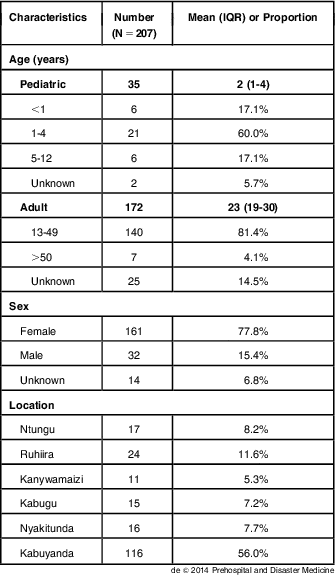
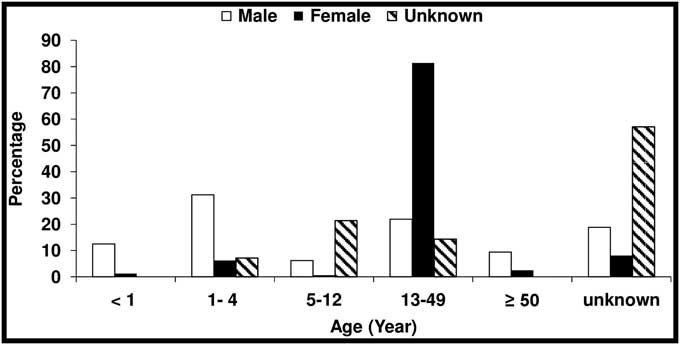
Table 1 displays the demographic information for EMS activation over the first 6-month period of implementation of the EMS system. There were a total of 207 activations. Mean age for pediatric activations (classified as 0-13 years) was two years, while 60% of pediatric activations were for one to four years of age. Mean age for adult activations (which comprised 83% of all activations) was 23 years of age (range: 19-30 years). Of all activations, 77.8% were for female patients. Figure 1 displays age distribution by sex. There was a significant difference in age distribution by sex (P < .001). Fifty-eight percent of all transfers were from the district to the regional hospital.
Population Demographics of EMS Activation

Percentage of EMS Activations by Age and Sex

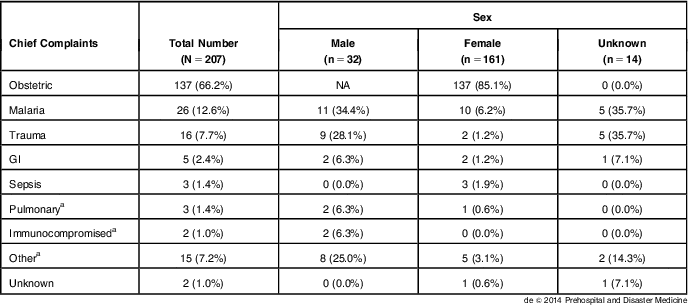
Table 2 displays chief complaints of EMS transfer by sex. Sixty-six percent of all transfers were for obstetric chief complaints, while 13% were related to malaria. Among men, 34% and 28% were related to malaria and trauma, respectively. Among women, only six percent and one percent of all cases were accounted for by malaria and trauma.
Chief Complaints Transfer by Sex

Abbreviations: GI, Gastroenterology; NA, not applicable.
aOne subject with both pulmonary and immunocompromised chief complaints and one subject with both immunocompromised and other chief complaints.
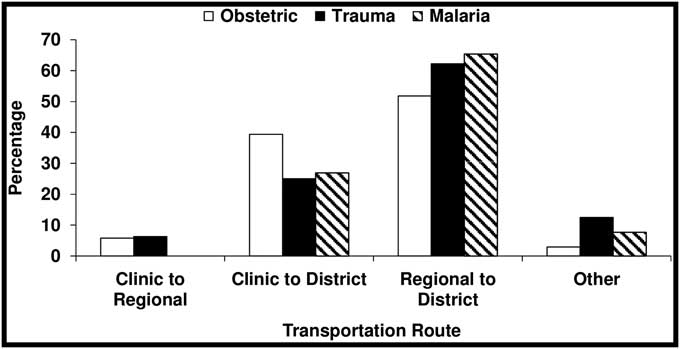
Figure 2 displays the description of transfer route by chief complaint. The regional referral hospital was the destination for nearly all referrals. Among the top three chief complaints, the most common route of transfer was district to regional. Fifty-two percent (95% CI, 43%- 60%) of all obstetric transfers, 65% (95% CI, 46%- 82%) of malaria transfers, and 62% (95% CI, 32%-78%) of all trauma transfers were from district to regional hospitals. Thirty-nine percent (95% CI, 31%- 48%), 27% (95% CI, 13%- 46%), 25% (95% CI, 8%-50%) of obstetric, malaria, and trauma cases respectively were transferred directly from the clinic to the regional hospital level.
Percentage of Transfer Routes by Chief Complaint

Among the clinics, there was no significant difference in the percentage of patients transferred for obstetric chief complaints (P = .110). Reasons for transfer were similar across all clinics with the exception of one, Ruhiira, which routinely sees more pediatric patients, and thus had a significantly more transfers related to general pediatric and malaria when compared to any other site (pediatric: P = .007; malaria: P = .006).
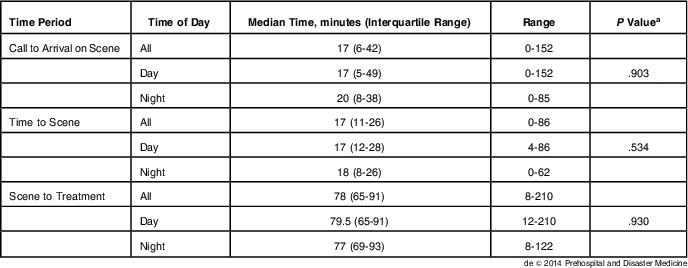
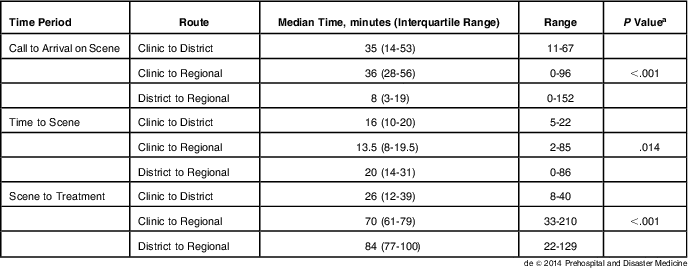
Table 3 shows response time by time of day. When comparing day and night activations, there was no difference for the call to arrival on scene time, the time to scene, or the scene to treatment time (call to arrival on scene: P = .903; time to scene: P = .534; the scene to treatment time: P = .930). Average total response time during the day was 127 minutes and 119 minutes at night (P = .762). Table 4 displays average response times broken down by segments. On average, the route from district to regional hospital took 84 minutes from scene to treatment, and was similar to the clinic to regional hospital (70 minutes) but was significantly longer than the clinic to district hospital (26 minutes, P < .001).
Response Time by Time of Day

aKruskal-Wallis Test.
Response Time by Trip Segment

aKruskal-Wallis Test.
Total initiation costs for the EMS system were $50,961, primarily for purchase of the ambulance and training of CHWs. Average annual recurring costs are approximately $4,415. This corresponds to $0.93 per capita to establish the EMS system and $0.09 per capita/year to maintain the EMS system annually. Using standard assumptions by cause of illness, as detailed in previous EMS system estimates,Reference Kobusingye, Hyder, Bishai, Joshipura, Hicks and Mock 4 this results in an average cost of $89.95 per life saved. Annual inputs to the entire Ruhiira health system have averaged $48 per person per year.
Discussion
The development of EMS systems, dating back many centuries, has revolved largely around managing patients with traumatic injuries, with many developments and improvements driven by the challenges of managing battlefield injuries.Reference Bass 13 The development of modern EMS systems in the United States began with the publication of the landmark white paper Accidental Death and Disability—the Neglected Disease of Modern Society. This paper identified a need for an organized system to manage injured patients from the time of injury to discharge from a hospital. 14 Thus, the need to adequately manage injured patients in the out-of-hospital environment has been instrumental in shaping the development of modern EMS systems.
There is increasing evidence that trauma is a cause of morbidity and mortality throughout the world.Reference Ghaffar, Hyder and Masud 15 – Reference Smith and Barss 19 For this reason alone, it is worthwhile to call for the development of EMS systems in LMICs. However, this study also demonstrates a previously undocumented benefit of a functional EMS system in an impoverished country: improvement of maternal/fetal health. Although Kirsch et al have previously described pediatric trauma as an important focus for EMS systems in the developing world,Reference Kirsch, Beaudreau, Holder and Smith 20 the benefit of an EMS system for the management of perinatal diseases has not been described previously. While patients with traumatic conditions and infectious diseases, primarily malaria, did benefit from the development of this EMS system, two-thirds of patients were transported for obstetric-related complaints. The ability to adequately manage obstetric emergencies with a novel EMS system in a developing country has significant implications.
The enactment of the Emergency Medical Services Systems Act by the United States Congress in 1973 included fifteen essential components to an EMS system. 21 The recent report on the state of EMS systems in the US by the Institute of Medicine further identifies a need for physician oversight and medical direction in the development of a quality EMS system. 22 , Reference Myers 23 Due to financial and resource constraints, it may be unreasonable to expect an EMS system in a developing country to fully implement all 15 components; however, as identified by VanRoyen et al, the evaluation of any EMS system should begin with an examination of these components.Reference VanRooyen, Thomas and Clem 24
The examination of the model EMS system in Ruhiira, Uganda reveals a number of the components of a quality EMS system. Most significantly, this system exemplifies strong community participation. The medical community in Ruhiira used local resources creatively to build their EMS system. Because of the lack of communication resources at the household level, CHWs were provided mobile telephony and utilized as access points and first responders to emergencies in the community. With only one ambulance for a population of at least 50,000, a central dispatch was instituted for effective triage. Training was provided for all levels of health staff, as emergency management skills were previously absent. A large barrier to access was removed by making all emergency services free. The program has made a commitment towards utilizing local health care providers to transport patients from the community clinics to the primary hospitals, and is in the process of development of a documentation system for continuous quality improvement. However, there are a number of essential elements that are still missing. Most importantly, continuing education of EMS providers and medical direction is absent.
The system was utilized most frequently for obstetric and malaria emergencies. This reflects patterns of local disease and triage decisions made by clinicians within the system. Uncomplicated labor, simple malaria, and a variety of other conditions are managed routinely at the clinic level. When the ambulance was utilized, it generally transported patients to the regional hospital, mostly because surgical management of obstetric complications and blood transfusions were frequently unavailable within the local health system. Should other rural African communities develop EMS systems, they might expect a similar usage pattern.
The development of this EMS system in Uganda has been dependent on community partnership with the MVP for continued funding. Most continuing costs of the EMS system have been fully integrated into the basic primary health care costs of the community. Nonetheless, costs associated with this EMS system are reasonable. The cost-benefit analysis revealed a cost of $89.95/ life saved with an estimated $0.93/capita to establish the system and $0.09/capita/year to maintain the system. The challenge for any EMS system in a developing country is to establish a quality EMS system without outside funding support. It is important to remember, however, that even local EMS system development within the United States has been dependent on funding support from the United States federal government.Reference Bailey 25
Limitations
There were limitations to this study. This is a single ambulance system in a small, rural African community. The experiences of this EMS system may not be applicable to other regions or settings. Data were collected over a 6-month period, and this may confound results due to outside influences on behavior and health such as weather, holidays, seasonal activities, or other time and season dependent factors. Also, the EMS system developed within the context of many simultaneous improvements to the rest of the local health network, which may influence health provider and community participation and utilization of the EMS system.
Conclusion
Development of rural EMS systems in resource-poor settings is a subject of much debate. The utility of such systems in rural environments with high burden of disease and extreme poverty has not been examined previously. Prospective usage patterns of these systems are also unknown.
This was the first study to analyze the initial development and utility of an EMS system in an extremely resource-constrained rural environment. The system in rural Uganda demonstrates that an EMS system is possible, affordable, and highly utilized by communities for life-threatening complaints. It grew as a response to local priorities and, as such, is distinct from those modeled after Western systems. It demonstrates the ability of a system to build on existing community infrastructure, such as community health care workers and primary care. Additional research is needed to develop a standard way to evaluate system components in settings of limited resources so that the most efficient and customized system is developed. Moreover, further work is needed to analyze scalability to the regional or national level.