

Introduction
Markets are widely recognized as sources of material wealth. In fact, the greater access and exposure to markets that individuals in a society have, the wealthier that society is likely to be. Both historical and cross-sectional evidence seems to support this conclusion. Markets have dramatically raised incomes over the past few centuries. As Deirdre McCloskey explains, although human beings survived on $3 a day for much of human history, in the past 250 years, human beings in those countries that have embraced markets have incomes of more than $100 a day.Footnote 1 Moreover, countries with market-based economies like the United States, the United Kingdom, and South Korea are considerably wealthier than countries with less economic freedom and more restrictive markets like Venezuela and North Korea. For instance, using estimates from 2015, real gross domestic product (GDP) per capita in South Korea was more than twenty times that of North Korea.Footnote 2 The connection between markets and material well-being is a robust one.
There is, however, a widely expressed concern that the relationship between markets and human capital is an exploitative one, and the relationship between markets and human flourishing (beyond simply material well-being) is a negative one. Indeed, Karl Marx was quite clear that he believes that workers are exploited, that is, receive less than they deserve. According to Marx, exploitation occurs under capitalism because the owners of capital capture the “surplus values” created by their workers—that is, the value of the products that workers produce above what the workers need to subsist.Footnote 3 Workers thus do not enjoy the fruits of their labor under capitalism. Markets, in this sense, leverage rather than contribute to our talents and capacities. Additionally, an interpretation of Marx’s alienation critique of capitalism is that wage labor results in human beings becoming less than fully human: “In his work, [the worker] does not affirm himself … but denies himself, feels miserable and unhappy, develops no free physical and mental energy but mortifies his flesh and ruins his mind.”Footnote 4 We could, then, understand Marx as arguing that markets stand in the way of human flourishing.
Interestingly, you could see similar concerns in the writings of Adam Smith, who is perhaps best known for celebrating the wealth-generating potential of markets. Smith, for instance, argued that because of the division of labor, the typical worker spends most of their life performing a “few simple operations” and, as a result,
generally becomes as stupid and ignorant as it is possible for a human creature to become. The torpor of his mind renders him, not only incapable of relishing or bearing a part in any rational conversation, but of conceiving any generous, noble, or tender sentiment, and consequently of forming any just judgment concerning many even of the ordinary duties of private life.Footnote 5
Although Smith believes that markets make us materially richer, they also make us more narrow, more self-centered, and less virtuous. His discussions of the way we generally envy the rich,Footnote 6 the quest for trinkets that seems to inspire economic activity,Footnote 7 and the ways that employers systematically drive down employee wagesFootnote 8 similarly point to the ways that markets can be exploitative and corrupting.
Human capital and human flourishing, however, depend on markets in ways that are underappreciated. Because markets typically ensure that those with more skills and those who are better able to contribute to productive processes are better compensated, they incentivize investments in human capital. Because markets typically make us wealthier, they support our investing in human capital. And because investments in human capital not only lead to the acquisition of existing knowledge but can result in the generation of new knowledge, markets also lead to improvements in human capital. Absent markets, it is likely that we would (on average) know less and be less capable. Similarly, there are at least two reasons why humans are less likely to flourish without markets. First, markets lead to material well-being, and material well-being (at least above some threshold) is a key component of human flourishing. Second, markets allow for other factors that are critical to a good life, especially health and social connection. As we argue elsewhere, people in market societies are wealthier, better educated, healthier, better connected, more moral, and happier than in nonmarket societies.Footnote 9
This essay highlights the positive relationships between markets, human capital, and human flourishing.Footnote 10 First, we highlight the positive ways that markets foster human capital investments and development. We then describe the various ways that markets promote human flourishing. Next, we introduce Amartya Sen’s capability approach as a plausible and compelling evaluative framework for assessing the moral desirability of certain social arrangements and suggest that markets (on Sen’s terms) are morally desirable social arrangements because they promote human capital development and human flourishing. Market societies’ doing well on measures of human capital development and human flourishing allows us to presume that markets promote human capabilities, which can be difficult to directly assess. We offer some concluding remarks.
Markets and human capital
Human capital refers to the broad array of talents, skills, knowledge, experiences, and competences that humans possess and utilize as they produce goods and services. Although use of the phrase is more recent, discussions of the concept of human capital within political economy date back to at least Adam Smith.Footnote 11 Smith’s central argument in An Inquiry into the Nature and Causes of the Wealth of Nations is that the division of labor is the source of the increased productivity of workers within a country, and so is a source of a country’s overall wealth. One of the key reasons that the division of labor increases worker productivity is because it allows workers to specialize and so become more adept at their respective jobs.Footnote 12 Not surprisingly, then, Smith counts human capital as part of the fixed capital of a country. That stock, Smith writes, consists
of the acquired and useful abilities of all the inhabitants or members of the society. The acquisition of such talents, by the maintenance of the acquirer during his education, study, or apprenticeship, always costs a real expence, which is a capital fixed and realized, as it were, in his person. Those talents, as they make a part of his fortune, so do they likewise of that of the society to which he belongs. The improved dexterity of a workman may be considered in the same light as a machine or instrument of trade which facilitates and abridges labour, and which, though it costs a certain expence, repays that expence with a profit.Footnote 13
For Smith, the “acquired and useful abilities” of individuals, their human capital, are not only embodied within individuals, but are also a part of a country’s capital stock in the same way that all the other productive assets (the land, the tools, and so on) are a part of its capital stock. Smith believes that workers would command higher wages as a result of their investments in human capital and that countries would grow wealthier as result of increases in human capital.
John Stuart Mill’s position in Principles of Political Economy echoes that of Smith. According to Mill, “[t]he skill, and the energy and perseverance, of the artisans of a country, are reckoned part of its wealth, no less than their tools and machinery.”Footnote 14 Also, he writes: “The human being himself … I do not class as wealth. He is the purpose for which wealth exists. But his acquired capacities, which exist only as means, and have been called into existence by labour, fall rightly, as it seems to me, within that designation.”Footnote 15 For Mill, the productive capacities that humans possess are a source of capital and contribute to the wealth of the individual and the nation.
Alfred Marshall, John R. McCulloch, Nassau Senior, and other classical political economists all discuss human capital, although not using the phrase, along similar lines.Footnote 16 The concept of human capital has matured some since its early uses, but key aspects of the concept remain unchanged. Unlike other forms of capital (for example, financial, social, and physical capital), human capital is embodied within individual human beings. Sarah knows how to build a coffee table, Eric is skilled at balancing the firm’s accounts, Jason does a good job of keeping the workshop clean, and Stacey spent the previous decade selling the furniture the firm produces. Sarah, Eric, Jason, and Stacey leaving the firm would harm the firm’s productive capacity in the same way that destroying the firm’s equipment or damaging its inputs would make it impossible for the firm to produce furniture (until they are replaced). Like other forms of capital, however, human capital is a productive asset that can be invested in and be employed in productive activities. Sarah apprenticed to become a skilled carpenter; Eric went to school to learn accounting; Jason takes pride in doing his job well and so exerts considerable care; and Stacey has improved considerably as salesperson over the years, awkward at first to now seemingly being a natural. Also, like other forms of capital, capacities only become capital when they are put to use. Much like how an uncultivated field and an abandoned tractor trailer are not capital, neither is knowledge an individual possesses that has no practical applications.
Human capital has been positively linked to wealth. Robert Lucas’s explorations of the sources of economic growth, for instance, focus on human capital acquired through schooling and human capital acquired through experience along with technological change.Footnote 17 Similarly, Rodolfo Manuelli and Ananth Seshadri’s model suggests that human capital can account for differences in income.Footnote 18 Antonio Ciccone and Elias Papaioannou observe a positive relationship between levels of human capital and output growth in human-capital-intensive industries, the drivers of wealth in modern economies.Footnote 19 Elena Pelinescu also reports that levels of human capital and GDP per capita have a positive relationship.Footnote 20
It is, arguably, this way of defining and describing human capital—as skills and knowledge that are only valuable to the extent that they can be leveraged to produce goods and services—that has led to thinking of markets as being parasitic on human capacities. Education within this framing becomes less about unleashing a human being’s potential and more about preparing human beings for labor. Abilities within this framing are only prized so long as they can be leveraged and monetized. Human beings within this framing become reducible to the ways they can be useful to others.
This is possibly one way to understand the critique of markets advanced by Jean-Jacques Rousseau in his Discourse on Inequality. He argues that markets make us dependent on one another, and we have to either convince others to share their possessions or use their skills to help us, or we have to force and defraud others into serving us. According to Rousseau, in commercial society, this constant need to convince others to behave in ways that advance our interests makes man “devious and artful with some, imperious and hard towards others, and compels him to treat badly the people he needs if he cannot make them fear him and does not judge it in his interest to be of service to them.”Footnote 21 Markets, Rousseau suggests, make us view others as means. Marx’s concern that markets reduce workers to mere commodities is also relevant here. For instance, Marx writes that markets “mutilate the labourer into a fragment of a man, degrade him to the level of an appendage of a machine.”Footnote 22 He also holds that the greater the scope of market exchange relations, “the more egoistic and asocial man becomes, the more he becomes alienated from his own nature. … [T]he division of labor [makes] man as far as possible an abstract being, an automaton, and [transforms] him into a spiritual and physical monster.”Footnote 23 If human beings in markets become valued only insofar as they represent human capital, then markets are inherently dehumanizing.
This way of thinking about the relationship between markets and human capital, however, misses several important aspects of the relationship between them. First, markets incentivize investments in human capital because markets typically ensure that those with more skills and who are better able to contribute to productive processes are better compensated. As such, more people will invest in education, the acquisition of skills, and the cultivation of their talents as a result of markets. This is the key insight of the Chicago School approach to human capital.Footnote 24 According to this approach, the quantity of human capital that an individual possesses is the result of investment decisions that were made by the individuals themselves, their families, and the firms where they work. These investment decisions, they explain, are similar to the investment decisions regarding physical capital. By this, they mean individuals invest in more training and education so long as the costs do not exceed the benefits of those investments, in terms of increased wages if the individual is doing the investing or increased productivity if the firm is making the outlays. Markets generally reward investments in human capital, thereby encouraging investments in human capital.
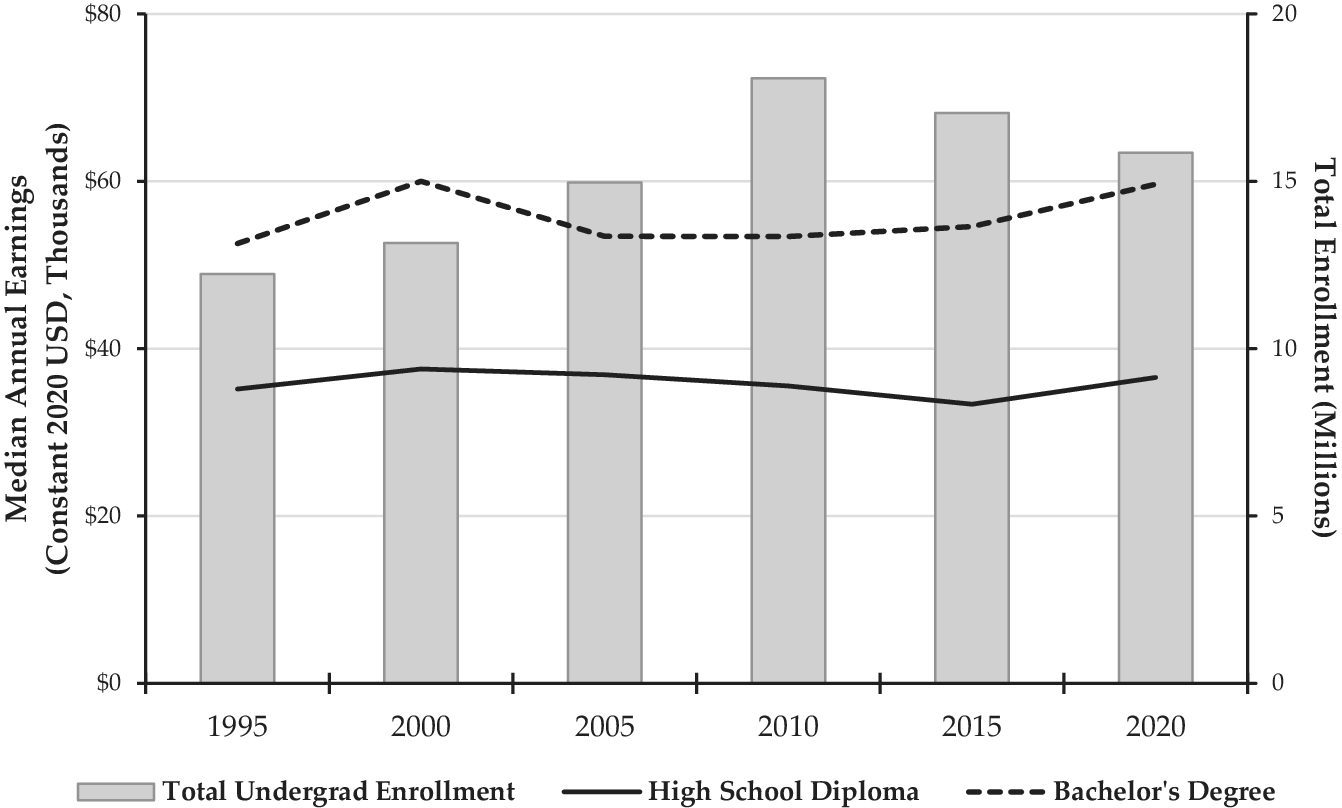
Consider, for instance, evidence on the returns to higher education and enrollment in higher education. Lisa Barrow and Ofer Malamud, using existing evidence on the value of a college education, estimate the difference between the average lifetime discounted earnings of male college graduates (across all races and ethnicities) and that of male high-school graduates as $444,450 (in 2009 U.S. dollars). They conclude that, on average, college is likely a worthwhile investment.Footnote 25 In fact, according to a report published by the U.S. Social Security Administration, “[m]en with bachelor’s degrees earn approximately $900,000 more in median lifetime earnings than high school graduates. Women with bachelor’s degrees earn $630,000 more.”Footnote 26 This earnings premium remains even when controlling for various demographic variables. The median annual wage gap between recent college graduates and those with a high school degree is similarly quite high, being as high as $20,000 in some years.Footnote 27 The high and relatively stable rates of college attendance in the United States (at least pre-COVID-19) are driven in part by the high and relatively stable returns to higher education in the United States (see Figure 1).
Total Undergraduate Enrollment and Median Annual Earnings by Education Attainment in the United States.Footnote 28

Figure 1. Long description
The x-axis lists years 1995, 2000, 2005, 2010, 2015, and 2020. The left y-axis measures median annual earnings from 0 to 80 thousand constant 2020 U S D. The right y-axis measures total enrollment from 0 to 20 million. Gray bars represent total undergraduate enrollment, which rises from about 13 million in 1995 to a peak near 18 million in 2010, then declines to about 16 million in 2020. A solid black line shows median annual earnings for high school diploma holders, starting near 35 thousand in 1995, peaking slightly above 37 thousand in 2000, then declining to about 34 thousand in 2015 before rising to 36 thousand in 2020. A dashed black line shows median annual earnings for bachelor’s degree holders, starting near 52 thousand in 1995, peaking at about 60 thousand in 2000, then declining to about 55 thousand in 2015 before rising to 60 thousand in 2020. The legend identifies gray bars as total undergrad enrollment, the solid line as high school diploma, and the dashed line as bachelor’s degree.
Total undergraduate enrollment is calculated as the total number of students enrolled at degree-granting, post-secondary universities in the fall. “Median annual earnings” refers to the median annual earnings of full-time, year-round workers between the ages of twenty-five and thirty-four years old.
Moreover, on average, more workers are employed at jobs with contracts (written, oral, or otherwise) in market societies than nonmarket societies (79.56 percent versus 48.74 percent). Jobs with contracts are typically higher paying and offer more security than noncontract jobs. Of the women employed, more than 80 percent of those in market societies have jobs with contracts, while only about 47 percent of their counterparts do in nonmarket societies (81.89 percent versus 46.60 percent).
Second, markets support our investing in human capital because markets make us wealthier. There are several channels through which this occurs. Investing in human capital takes time that could be spent earning money and resources that could be used for more proximate needs. The better off someone is materially, the more they can afford to forgo earning income or satisfying more immediate and pressing concerns while attending school or learning a skill. Families are similarly more likely to invest in the education and other capacity building of their children, and they are better positioned to allow their children to forgo the start of their work lives. Also, wealthier countries have more tax revenue as well as charitable resources available to spend on training and education. As such, levels of human capital are likely to be higher in market societies.
For instance, wealthier market societies, on average, have higher literacy rates than poorer nonmarket societies do. Max Roser and Esteban Ortiz-Ospina report that 86 percent of the world population older than fourteen years old are able to read and write and, in many countries, more than 95 percent of their population have basic literacy skills.Footnote 29 However, they highlight how some parts of the world (in particular, sub-Saharan Africa and the Asian subcontinent) lag significantly further behind than the rest of the world. In fact, our data show that market societies have an average literacy rate of 95 percent, while nonmarket societies have an average literacy rate of around 80 percent (95.48 percent versus 80.96 percent). Similarly, children in wealthier market societies generally spend more years in school and typically attend better schools. James Roberts and Ryan Olson, for instance, find that students from more economically free countries—that is, countries that more thoroughly embrace markets and are subsequently wealthier—score higher than those from less economically free countries on the Organisation for Economic Co-operation Development’s (OECD) Programme for International Student Assessment.Footnote 30 Likewise, Boris Nikolaev finds positive correlations between economic freedom and the average number of years a country’s population spends in formal education, educational attainment, and students’ math skills, reading ability, and level of science.Footnote 31 And wealthier market societies spent more on education per capita than the less wealthy nonmarket societies: US$1,486.01 versus US$177.86.
We should be mindful of the fact that while education is sometimes mere preparation for work life, it is also often liberal education. By liberal education, we mean here education that is about opening minds, reducing parochialism, improving discernment, and encouraging engagement with the world. Markets, in this way, support education as human capital development and education as human enrichment.
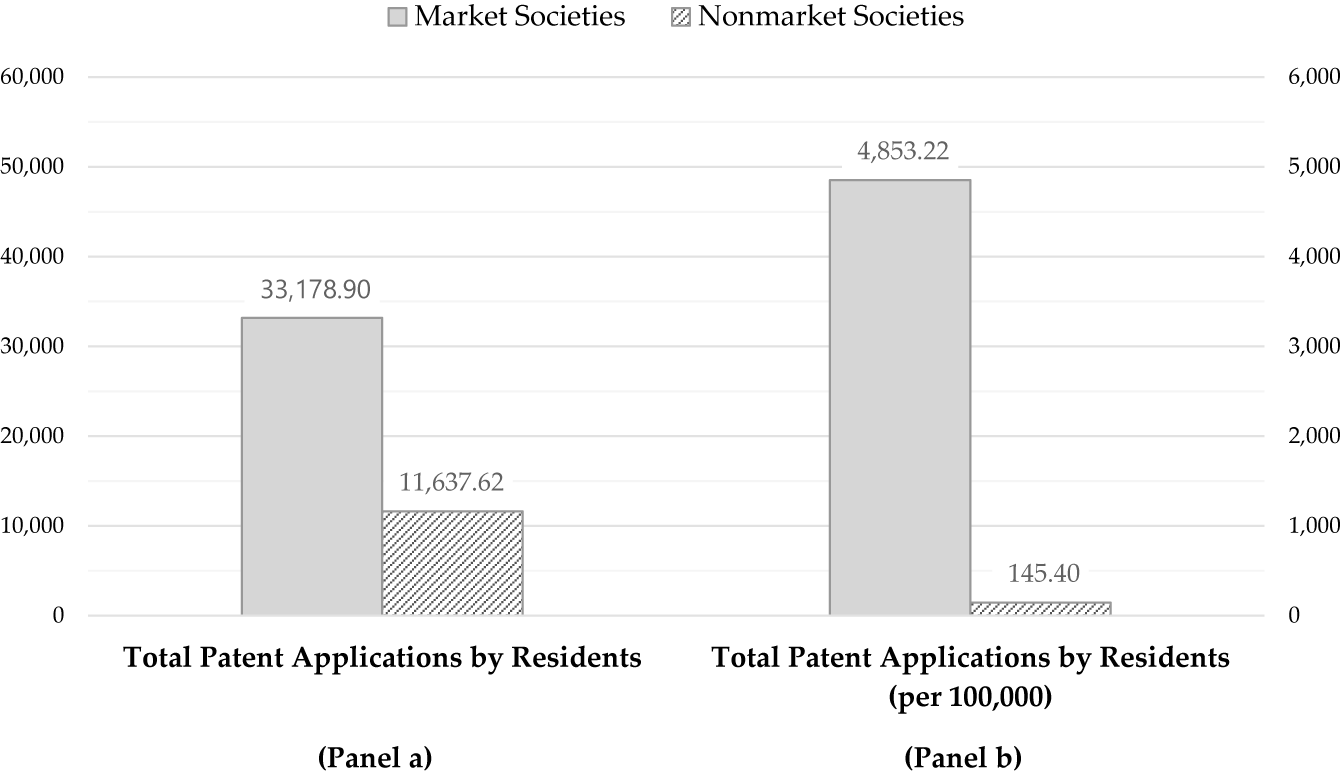
Third, markets also lead to improvements in human capital because investments in human capital not only lead to the acquisition of existing knowledge, but they can also result in the generation of new knowledge. Jacob Mincer helpfully notices that “human capital activities involve not merely the transmission and embodiment of available knowledge in people but also the production of new knowledge, which is the source of innovation and of technical change.”Footnote 32 As he explains, the continuous growth of knowledge is the source of economic growth. If new knowledge were not consistently generated, Mincer notes, it is unlikely that expanding education to an increasing number of people would lead to increases in productivity. Consistent with this argument, residents of market societies tend to apply for more patents than do those in nonmarket societies (see Figure 2, Panel a). In fact, for every one patent application submitted by residents of nonmarket societies, residents of market societies submitted thirty-three patent applications (see Figure 2, Panel b).
Patent Applications by Residents in Market Societies and Nonmarket Societies.Footnote 33

Markets do not simply leverage human capital to produce various goods and services. Markets also encourage the production of human capital. Markets lead to higher levels of education, greater refinement of skills, and the continuous growth of (scientific) knowledge. As we will discuss in the next section, markets also lead to human flourishing.
Markets and human flourishing
Humans are more likely to flourish in markets. As we argue elsewhere, people in market societies are wealthier, healthier, happier, better connected, and more moral than in nonmarket societies.Footnote 34 There are several reasons why this is true.
First, markets lead to material well-being, and material well-being (at least above some threshold) is a key component of human flourishing. Indeed, market societies outperform nonmarket societies on various measures of wealth and well-being.Footnote 35 For instance, incomes are higher in market societies than nonmarket societies. On average, market societies have a GDP per capita of $40,556.75 (PPP, constant 2017 international $) while nonmarket societies have a GDP per capita of only $10,680.15. Additionally, infrastructure in market societies is superior to infrastructure in nonmarket societies. For instance, according to our data, compared to those living in nonmarket societies, a higher proportion of people living in market societies have access to at least basic drinking water services (97.84 percent versus 82.91 percent), electricity (97.82 percent versus 77.79 percent), and clean fuels and technologies for cooking (91.86 percent versus 53.29 percent).Footnote 36 Similarly, Roberts and Olson find a positive relationship between economic freedom and access to better sanitation.Footnote 37 Nikolaev finds a positive association between economic freedom and the proportion of houses or dwellings with basic facilities for personal hygiene among OECD countries.Footnote 38
Moreover, our data show that people who live in market societies, on average, are (a) more likely to feel that their actual lives are closer to the best possible lives they could imagine for themselves (6.57 percent versus 5.10 percent), (b) less likely to report high dissatisfaction with their lives (5.79 percent versus 9.63 percent), (c) less likely to be highly dissatisfied with their current financial situation (11.74 percent versus 18.06 percent), and (d) less likely to feel as if they do not have much freedom of choice and control over their lives (6.08 percent versus 10.57 percent).Footnote 39
Markets making us wealthier has moral implications.Footnote 40 Wealth and well-being matter for human flourishing. Specifically, wealth allows us to avoid a host of moral dilemmas that poverty forces us to confront. The wealthy mother, for instance, does not have to choose between stealing to feed her children or allowing her children to go hungry. The wealthy son does not have to choose between engaging in criminal activity to help his mother financially or allowing his mother to struggle. Additionally, the wealthier we are, the greater our capacity to help others and the more willing we are to help others.Footnote 41 Market societies (and so wealthier societies) giving more to charity is telling in this regard.
Second, markets allow for other factors that are critical to a good life, especially health, social connections, and moral development. As noted above, people in market societies are generally better educated than are people in nonmarket societies. In addition, market societies outperform nonmarket societies on various measures of health. On average, at birth, the life expectancy for people living in market societies is about seventy-nine years, while the life expectancy of those in nonmarket societies is around sixty-nine years. On average, infant and maternal mortality rates are lower in market societies than in nonmarket societies (8.27 versus 27.57 infants per 1,000 live births; 38.19 versus 219.48 mothers per 100,000 live births). Moreover, on average, less than 10 percent of the population in market societies could not afford a healthy diet, but more than 50 percent of those in nonmarket societies could not (8.04 percent versus 51.55 percent).Footnote 42
Health is widely seen as a key to human flourishing. Aristotle, for instance, notes that we ought to have an appetite for health. Indeed, “[a]s embodied creatures,” John Kleinig and Nicholas Evans write that “humans will require food, water, and shelter if they are to flourish. Health too will generally be an important component of human flourishing.”Footnote 43 Similarly, as David Hershenov and Rose Hershenov explain:
Health is a necessary condition for flourishing and constitutive of a good deal of valuable well-being in a healthy person. … All flourishing depends upon health being present (to some) degree and every living being has an interest in health at every stage of its life, including its embryonic stages. When mindless, there’s probably nothing else to its good than its health, i.e. its proper functioning is constitutive of its flourishing.Footnote 44
Although health is not a sufficient condition for flourishing, it is necessary for living a good life. Markets improve health outcomes, and so, people living in market societies are generally healthier than people in nonmarket societies. In doing so, markets promote human flourishing.
Markets also promote human flourishing through the promotion of social connection. Indeed, markets are social spaces where meaningful social bonds are developed and maintained.Footnote 45 Moreover, our market activities bring us into fellowship with diverse others who we might otherwise never encounter.Footnote 46 Markets encouraging sociality has been recognized since Adam Smith, but this point arguably remains underappreciated. Smith, for instance, explains:
[T]he necessity or conveniency of mutual accommodation [in commercial societies] very frequently produces a friendship not unlike that which takes place among those who are born to live in the same family. Colleagues in office, partners in trade, call one another brothers; and frequently feel towards one another as if they really were so.Footnote 47
Likewise, Friedrich A. Hayek argues that “the interdependence of all men … which tends to make all mankind One World, not only is the effect of the market order but could not have been brought about by any other means.”Footnote 48 And Murray Rothbard maintains that
it is far more likely that feelings of friendship and communion are the effects of a regime of (contractual) social co-operation rather than the cause … . [I]n a world of voluntary social co-operation through mutually beneficial exchanges, where one man’s gain is another man’s gain, it is obvious that great scope is provided for the development of social sympathy and human friendships.Footnote 49
A variety of social connections are encouraged in markets, including friendships between co-workers, workplace romances, and close social bonds between sellers and buyers, mentors and their mentees, and supervisors and their employees.Footnote 50 Using two measures of social capital, Legatum Institute and SolAbility Sustainable Intelligence conclude that, on average, market societies have stronger social capital than people in nonmarket societies do (58.47 versus 48.82; 47.85 versus 39.39).Footnote 51 People in market societies are, unsurprisingly, better connected than people in nonmarket societies.
Like health, social connection is a necessary condition for living a good life. Indeed, Aristotle concludes that friendship is essential to the good life: “The presence of friends, then, seems desirable in all circumstances.”Footnote 52 Similarly, Ed Diener and colleagues find that the happiest people have strong social relationships.Footnote 53 David Myers, likewise, finds that people with close and supportive relationships enjoy a better quality of life.Footnote 54 Human beings are social animals, and an essential component of human life is the seeking and maintenance of social connections. While other arenas (for example, the church and social clubs) undoubtedly promote social connections, markets too are social arenas. As such, they should be seen as supporting a key ingredient of human flourishing.
Assessing the moral desirability of markets
While markets are frequently thought to be morally corrupting, we believe there are strong and compelling reasons to view markets as promoting moral development.Footnote 55 One reason markets might be a morally desirable economic arrangement is because they promote morality among market participants. That the moral entrepreneur—the honest, trustworthy, industrious entrepreneur—is likely to win in the game of the market undoubtedly speaks to the moral desirability of the market as a system.Footnote 56 This way of deciding, however, might seem to some to be inadequate because the moral standard being deployed to assess the moral desirability of an economic system is neither fully articulated nor adequately defended.
The capability approach pioneered by Sen, though, might be a plausible and compelling evaluative framework for assessing the moral desirability of markets as a social arrangement. Markets encouraging investments in and the development of human capital as well as promoting human flourishing (at least indirectly) should and would make markets morally desirable social arrangements on Sen’s terms.
Sen’s articulation of the capability approach began with his dissatisfaction of the informational bases of traditional economic models and evaluative approaches, including utilitarianism and resourcism.Footnote 57 No matter the welfare approach and no matter their particular strengths, Sen believes that none of the models provides an analysis of well-being suitable for examining well-being in the aggregate. To Sen, they all simultaneously (a) focus on the wrong things, such as utility, freedoms, and commoditiesFootnote 58; and (b) are too narrowly focused, thereby excluding too many important factors from evaluation.
Instead, Sen’s capability approach is concerned with evaluating a person’s well-being “in terms of his or her actual ability to achieve various valuable functionings as a part of living,” and takes “the sets of individual capabilities as constituting an indispensable and central part of the relevant information base of such evaluation.”Footnote 59 The approach proposes that social arrangements should be evaluated according to the degrees to which people have the freedom to undertake the activities they are able to undertake (“doings”) and to become the kinds of persons they are able to be (“beings”). The approach’s focus, in short, is on the kinds of lives people could effectively lead. At the core, it views living as a realized combination of doings and beings, and it views a person’s quality of life (also well-being or well-ness) as something to be assessed in terms of her capability to achieve valuable doings and beings. As the freedom to achieve well-being is a moral priority, the capability approach, too, is, at root, a moral framework.
Sen calls these doings and beings functionings. They are doings and beings that a person intrinsically values, and they “represent parts of the state of a person—in particular the various things that he or she manages to do or be in leading a life.”Footnote 60 Some functionings may be something as fundamental as being adequately nourished, being in good health, and having loving relationships, or as complex as achieving self-respect, being happy, and taking part in the life of a community. Although these functionings may be valued by all members of a society, the degrees to which the various functionings are valuable to each individual are heterogeneous. Furthermore, while all of the functionings may be hypothetically attainable (or achievable or accomplishable, to borrow Sen’s words) by a particular person, some functionings will not be relevant and will be of no great interest to her given her own interests, priorities, and plans. As such, individuals will choose functionings that make sense to them. Capability, then,
represents the various combinations of functionings (beings and doings) that the person can achieve. Capability is, thus, a set of vectors of functionings, reflecting the person’s freedom to lead one type of life or another. Just as the so-called ‘budget set’ in the commodity space represents a person’s freedom to buy commodity bundles, the ‘capability set’ in the functioning space reflects the person’s freedom to choose from possible livings.Footnote 61
In short, a person’s capability involves not only her ability to convert her means into functionings she values (that is, achieve her functionings), but also the extent of her freedom to achieve the potential doings and beings that she values and to choose between options (that is, to have well-being). To be clear, Sen distinguishes between achievements—the successful attainment of various functionings and objectives that people value—and freedom—the opportunity or chance to achieve said functionings and objectives that people value.
To Sen, freedom has many diverse facets. Chief among them are what he calls the opportunity aspect and the process aspect of freedom. The opportunity aspect of freedom (opportunity-freedom) pertains to people’s true (or real) capability to achieve the objectives and goals, and the process aspect of freedom (process-freedom) pertains to the process of autonomous choice.Footnote 62 Sen explains that freedom
can be valued for the substantive opportunity it gives to the pursuit of our objectives and goals. In assessing opportunities, attention has to be paid to the actual ability of a person to achieve those things that she has reason to value. In this specific context the focus is not directly on what the processes involved happened to be, but on what the real opportunities of achievement are for the persons involved. This “opportunity aspect” of freedom can be contrasted with another perspective that focuses in particular on the freedom involved in the process itself (for example, whether the person was free to choose herself, whether others intruded or obstructed, and so on). This is the “process aspect” of freedom.Footnote 63
This process aspect of freedom, in turn, has several distinct properties. For our purposes here two of these properties are relevant: (a) the autonomy to make one’s own choices and (b) immunity from interference by others or, to borrow Hayek’s definition, the absence of coercion.Footnote 64 Deeply embedded in the former—the autonomy property of process-freedom—is the sense of self-direction in one’s life. The ability to choose for oneself shapes the framing of the choice and how the choice adds to (or subtracts from) one’s life satisfaction. More concretely, while the removal of a few inferior elements from an economic agent’s set has no impact whatsoever on the welfare implications of the optimal element in the utilitarian model, it can have substantial implications for a person’s well-being (even when she ultimately chooses the same optimal element) in the capability framework.Footnote 65 As Sen writes, it is because of “the presence of this element (rather than the absence of others), that the act of choosing between the elements of a capability set has a clear relevance to the quality of life and well-being of a person.”Footnote 66 It is not surprising that, in Sen’s framework, autonomy, while conceptually disparate from immunity from interference by others, cannot be fully appreciated without the absence of coercion and confinement from other people and institutions. And it is not surprising that the autonomy to make one’s own choices would be connected to her well-being. Sen holds that choosing
may itself be a valuable part of living, and a life of genuine choice with serious options may be seen to be—for that reason—richer. In this view, at least some types of capabilities contribute directly to well-being, making one’s life richer with the opportunity of reflective choice. But, even when freedom in the form of capability is valued only instrumentally (and the level of well-being is not seen as dependent on the extent of freedom of choice as such), capability to function can nevertheless be an important part of social evaluation. The capability set gives us information on the various functioning vectors that are within reach of a person, and this information is important—no matter how exactly well-being is characterized.Footnote 67
“[T]he ‘good life,’” Sen writes, “is partly a life of genuine choice, and not one in which the person is forced into a particular life—however rich it might be in other respects.”Footnote 68 A person choosing a particular lifestyle is not identical to having the same lifestyle forced onto her; her well-being at least partially depends on how she happened upon her lifestyle.Footnote 69
As our brief overview of Sen’s capability approach hopefully highlights, human diversity and agency are two of the key driving forces underlying this approach that embraces the heterogeneity of people’s goals, objectives, values, and capabilities. It recognizes and builds on the diversity of goals and plans that people might and do have in life for themselves. And it operates on the assumption that people may want to and do actually pursue the plans and types of lives they envision for themselves. While we do not elaborate this point here, Sen’s approach also seriously accounts for the personal characteristics and circumstances that affect people’s ability to achieve their goals and objectives and realize their values and capabilities.
There is now an extensive literature applying Sen’s evaluative framework to particular theoretical and real-world social arrangements.Footnote 70 Importantly, for our purposes here, Sen applied his capabilities approach to the competitive market in his article “Markets and Freedoms.”Footnote 71 By rejecting the neoclassical economic model of the market and foregrounding the Austrian economic theory of the market,Footnote 72 he defends the market on human welfare and well-being grounds, concluding that the market can and does promote individual freedoms.
Specifically, Sen evaluates the market on process-freedom and opportunity-freedom margins. On the process-freedom margin, he is principally concerned with three properties of freedom: (a) autonomy of decisions, (b) immunity from interference from others, and (c) opportunity to achieve. The core characteristics of the Austrian economic understanding of a truly free (or unhampered) market almost instantaneously satisfies the first two properties: (1) market participants have the right to negotiate and trade freely, and (2) market activities must be permitted to take place without constraints or interference from others, including the state. The complete absence (or violation) of these core characteristics would significantly harm the ability of people to achieve the things they value and to live the type of life they wish to live. Therefore, the competitive market (as Austrian economists understand the market) proves to be morally desirable as a social arrangement on the process-freedom margin.
Process of course matters, but so do opportunities to achieve desirable outcomes. Indeed, as Sen writes, “if we really do attach importance to the actual opportunity that each person has, subject to feasibility, to lead the life that he or she would choose, then the opportunity aspect of freedom must be quite central to social evaluation.”Footnote 73 Sen believes that we must care about opportunity-freedom in addition to process-freedom: “The extent of a person’s opportunity to achieve must relate to the set of alternative achievements from which he or she can choose any one.”Footnote 74 Sen continues: “The evaluation of the freedom [people] enjoy from a certain menu of achievements must depend to a crucial extent how [they] value the elements included in that menu. The ‘size’ of a set, or the ‘extent’ of freedom enjoyed by a person, cannot, except in very special cases, be judged without reference to the person’s values and preferences.”Footnote 75 He believes that markets are at least weakly supportive of opportunity-freedom, leading to a greater diversity and quantity of commodities, and that this is generally associated with a greater command over capabilities. Stated another way, the wider range of goods and services available in markets and greater wealth achieved through markets typically means that people in market societies enjoy greater opportunities.
Although Sen’s conclusion that theoretical markets are generally supportive of process-freedom and at least weakly supportive of opportunity-freedom is important for understanding markets as a morally desirable social arrangement, what matters for our purposes here is not whether theoretical markets satisfy Sen’s criteria, but whether real-world markets come closer to satisfying Sen’s demands than their absence would. Stated another way, the key issue for us is whether market societies or nonmarket societies perform better at delivering process-freedom and opportunity-freedom for more people.
As we have seen, markets promote investments in and the development of human capital and deliver on key aspects of human flourishing. Of course, if these benefits were only to accrue to the most advantaged, we would still have grounds to worry about whether markets promote flourishing in some meaningful sense. Importantly, although inequality certainly exists, the least advantaged in market societies are generally better off than the least advantaged in nonmarket societies. For instance, the poorest 10 percent in nonmarket societies earn less than the poorest 10 percent of the population in market societies.Footnote 76 Stated another way, the inequality within markets is less relevant than the inequality between the people who live in market societies (including the least advantaged) and the people who live in nonmarket societies. This discrepancy is even larger for the least advantaged living in nonmarket societies. To adapt an example that Sen frequently deploys, while it is potentially worrisome that a disabled person in a market setting will have less capabilities than someone without said disability even were they to enjoy the same bundle, what matters more for evaluating the moral desirability of markets is that a disabled person in a market society is likely to be better off than a disabled person in a nonmarket society.Footnote 77
We do admit that this is arguably a move that Sen would object to, as he seeks to distance his capabilities approach from welfare standards that equate well-being with income and utility.Footnote 78 But, arguably, markets directly promote human flourishing and investments in human capital in ways consistent with the standard advanced by Sen. For instance, market societies outperforming nonmarket societies in terms of literacy and other education measures, longevity and other health measures, and so on suggests that people in market societies enjoy greater capabilities. One reason, albeit not the only reason that markets satisfy Sen’s demands, is because both income and utility result from markets and are positively associated with the broad-based expansion of opportunity-freedom (as Sen understands them).
Conclusion
Human capital and human flourishing rely on markets in ways that are underappreciated. In this essay, we highlighted the positive relationships between markets, human capital, and human flourishing. We argued that because markets generally better compensate those people with more skills and who are better able to contribute to productive processes, they incentivize investments in human capital. Furthermore, markets generally enrich us materially and so support our investing in human capital. And because investments in human capital lead to both the acquisition of existing knowledge (for a person investing in human capital) and the generation of new knowledge (for the society that invests in human capital), markets can lead to significant advancements in human capital. Therefore, in the absence of markets, we contend that (a) people on average would know less and be less capable (at both individual and society levels), and (b) people would less likely flourish. Markets lead to material well-being, and material well-being allows for other factors critical to a good life, such as health and social connection.
Building on Sen’s application of the capability approach to competitive markets, we suggest that markets (on Sen’s terms) are morally desirable social arrangements on process-freedom and opportunity-freedom margins. In short, society where the market cannot operate without significant interference is less able to promote freedoms and is thus less morally desirable than a society where the market not only operates but operates without significant interference. In a similar vein, a society where the market operates (whether with or without significant interference) is more morally desirable than a society without a market. Markets encouraging investments in and the development of human capital as well as promoting human flourishing (at least indirectly) make markets morally desirable social arrangements.
In closing, it is perhaps worth noting that our argument that human capital and human flourishing rely on markets does not in any way rule out the significance of other factors that contribute to valuable learning experiences or knowledge and to individuals living thriving, empowered, and meaningful lives. Instead, we can be interpreted as arguing that the market, on net, enables people and societies to develop their knowledge in ways that they wish to do so, thereby facilitating their progress toward a better life as they define it.
Competing interests
The authors declare none.

 Open access

