Introduction
Disruptive behaviors (DBs) are behavioral problems that involve violation of social rules/right of others. This umbrella term generally includes problematic behaviors observed in conduct disorder, oppositional defiant disorder, and to some extent in attention-deficit hyperactivity disorder (ADHD), such as childhood aggression. In the past decades, researchers have realized that youths exhibiting DBs are a highly heterogeneous population (Hawes, Reference Hawes2014). This may be attributable to the high rate of co-occurring psychological symptoms in children having such behaviors. Indeed, DBs are observed in 14–60% ADHD, 14–62% anxiety disorders, and 9–45% mood disorders in children (Connor & Doerfler, Reference Connor and Doerfler2008; Loeber et al., Reference Loeber, Burke, Lahey, Winters and Zera2000; Nock, Kazdin, Hiripi, & Kessler, Reference Nock, Kazdin, Hiripi and Kessler2006). This suggests that heterogeneity in DBs can be partially explained by different levels of hyperactivity/impulsivity, irritability, and anxiety. Although the co-occurrence between these three characteristics is often detected in cross-sectional studies, upstream research such as studies on developmental trajectories is crucial to better characterize the developmental heterogeneity of children psychological factors underlying DBs, as well as identifying targets for prevention.
Developmental researches have shown that from childhood to adolescence, 5–17.9% of children will follow a trajectory characterized by high levels of hyperactivity/impulsivity symptoms (Galéra et al., Reference Galéra, Côté, Bouvard, Pingault, Melchior, Michel and Tremblay2011; Musser, Karalunas, Dieckmann, Peris, & Nigg, Reference Musser, Karalunas, Dieckmann, Peris and Nigg2016; Nagin & Tremblay, Reference Nagin and Tremblay1999; Pingault et al., Reference Pingault, Côté, Lacourse, Galéra, Vitaro and Tremblay2013), 2.6–13.4% on a trajectory of high levels of irritability (Ezpeleta, Granero, de la Osa, Trepat, & Domènech, Reference Ezpeleta, Granero, de la Osa, Trepat and Domènech2016; Musser et al., Reference Musser, Karalunas, Dieckmann, Peris and Nigg2016; Nagin & Tremblay, Reference Nagin and Tremblay1999; Orri et al., Reference Orri, Galera, Turecki, Boivin, Tremblay, Geoffroy and Côté2019; Wiggins, Mitchell, Stringaris, & Leibenluft, Reference Wiggins, Mitchell, Stringaris and Leibenluft2014) and between 2.2% and 20.8% having high levels of anxiety (Allan et al., Reference Allan, Capron, Lejuez, Reynolds, MacPherson and Schmidt2014; Broeren, Muris, Diamantopoulou, & Baker, Reference Broeren, Muris, Diamantopoulou and Baker2013; Crocetti, Klimstra, Keijsers, Hale, & Meeus, Reference Crocetti, Klimstra, Keijsers, Hale and Meeus2009; Duchesne, Larose, Vitaro, & Tremblay, Reference Duchesne, Larose, Vitaro and Tremblay2010; Feng, Shaw, & Silk, Reference Feng, Shaw and Silk2008; Morin et al., Reference Morin, Maïano, Nagengast, Marsh, Morizot and Janosz2011). Interestingly, these developmental researches using univariate trajectory analysis (i.e. analyzing a single developmental characteristic) have found that maternal smoking and alcohol consumption during pregnancy, maternal depression, and harsh discipline (i.e. psychological and/or physical violence) were all predictors of high irritability trajectories (Munhoz et al., Reference Munhoz, Santos, Barros, Anselmi, Barros and Matijasevich2017; Wiggins et al., Reference Wiggins, Mitchell, Stringaris and Leibenluft2014), high anxiety trajectories (Duchesne et al., Reference Duchesne, Larose, Vitaro and Tremblay2010; Feng et al., Reference Feng, Shaw and Silk2008), and high hyperactivity/impulsivity trajectories (Galéra et al., Reference Galéra, Côté, Bouvard, Pingault, Melchior, Michel and Tremblay2011; Vergunst et al., Reference Vergunst, Tremblay, Galera, Nagin, Vitaro, Boivin and Côté2019), compared to their lower ones. Consequently, since the specificity of these early risk factors remains elusive and that child psychological traits (e.g. hyperactivity, irritability, and anxiety) are highly comorbid (Bufferd, Dougherty, Carlson, & Klein, Reference Bufferd, Dougherty, Carlson and Klein2011; Costello et al., Reference Costello, Mustillo, Erkanli, Keeler and Angold2003), there is a clear need to better understand these complex interactions by using novel person-centered approaches.
One method to investigate the complex interactions between psychopathological characteristics from childhood to adolescence is the multi-trajectory analysis (Nagin, Jones, Passos, & Tremblay, Reference Nagin, Jones, Passos and Tremblay2018) or parallel process growth mixture model (GMM) (Muthén & Muthén, Reference Muthén and Muthén1998–2011). Since the multi-trajectory groups are formed with individuals following similar developmental trajectories, this approach is highly relevant for studying heterogeneity and/or equifinality in the developmental pathways associated with childhood aggression. For instance, this method has been used to unveil the developmental joint trajectories between irritability and anxiety/depressive symptoms (Dugré, Dumais, Dellazizzo, & Potvin, Reference Dugré, Dumais, Dellazizzo and Potvin2019; Orri et al., Reference Orri, Galera, Turecki, Forte, Renaud, Boivin and Geoffroy2018), revealing that the high irritability and high anxiety/depressive traits were at substantial risk for suicide attempts and physical aggression. Additionally, Côté, Tremblay, Nagin, Zoccolillo, and Vitaro (Reference Côte, Tremblay, Nagin, Zoccolillo and Vitaro2002) observed that different combinations of childhood behavior profiles, based on hyperactivity, fearfulness, and helpfulness, were associated with different magnitudes in risk for exhibiting conduct disorder, in comparison to typically developing youths (TD). While most of the literature on developmental trajectories focus on problematic behaviors (e.g. physical/indirect aggression, conduct problems, externalizing problems, etc.) (Bevilacqua, Hale, Barker, & Viner, Reference Bevilacqua, Hale, Barker and Viner2018), there is still a very limited amount of research on multi-trajectory of psychological factors that could predispose children/adolescent to exhibit aggressive behaviors. While the heterogeneity in childhood aggression remains largely unknown, identifying homogeneous groups of individuals following several similar trajectories of factors that are potentially changeable with psychological intervention is crucial for prevention as it could lead to better management of the risk for aggressive behaviors.
Based on the current state of knowledge, in the current study, we aimed to: (1) identify the complex interactions between developmental trajectories of hyperactivity, irritability, and anxiety from childhood to adolescence; (2) examine the longitudinal associations between multi-trajectory group membership and levels of physical aggression; and (3) assess the specificity of perinatal and early risk factors for multi-trajectory groups.
Method
Study design and sample
Data were drawn from the Fragile Families and Child Wellbeing Study (FFCWS, see Reichman, Teitler, Garfinkel, & McLanahan, Reference Reichman, Teitler, Garfinkel and McLanahan2001). Briefly, the FFCWS is a longitudinal birth cohort of children from urban families (mostly unmarried parents) that were recruited at the hospitals of 20 US cities in the USA between 1998 and 2000 (n = 4898). All primary caregivers provided written informed consent and assented for child participation at each interview.
The current study is the secondary analysis of FFCWS families using data at baseline (i.e. childbirth), when the child was 1, 3, 5, 9, and 15 years of age (Y1, Y3, Y5, Y9, and Y15). Briefly, of these 4898 children, 52.2% were boys. In 61% of cases, their mothers were married or cohabiting with the child's father. The mean maternal age at childbirth was 25.25 [standard deviation (s.d.) = 6.1]. Approximately 49% and 30% of mothers were Afro-American and White, respectively.
Missing rates for the Child Behavior Checklist (CBCL) (i.e. anxiety, irritability, and hyperactivity/impulsivity) were 28.1% at Y5, 31.9% for Y9, and 26.9% for Y15. Participants were included if the primary caregiver (97.8% of biological mothers) completed In-Home Interviews in at least two time periods, in order to adequately estimate an intercept and a linear slope per individual. A total of 3569 (72.9%) completed the In-Home Interview at least at two time periods during the Y5, Y9, and Y15. Although deletion may reduce the representativeness of the sample and/or reduce statistical power, further analyses on excluded participants (i.e. completing In-Home Interviews at only one time period or never) suggest weak differences from those included in the current study in terms of mother's age at childbirth (Cohen's d = 0.10), mother's ethnicity (Cramer's V = 0.11), mother's relationship (Cramer's V = 0.07), household income at childbirth (Cohen's d = −0.07), and child sex (φ coefficient = 0.026).
Measures
Trajectory analysis: irritability, anxiety, and hyperactivity symptoms
Child psychological factors (i.e. irritability, anxiety, and hyperactivity) were assessed by primary caregivers (i.e. 97.8% of biological mothers) using the CBCL when the child was 5 (Achenbach, Reference Achenbach1991), 9, and 15 years of age (Achenbach, Dumenci, & Rescorla, Reference Achenbach, Dumenci and Rescorla2001). Irritability symptoms were assessed with the following two items (α range 0.62–0.69, means inter-item correlations 0.45, 0.51, and 0.52 for Y5, Y9, and Y15, respectively): ‘is stubborn, sullen, or irritable’; ‘has temper tantrums or a hot temper’. Anxiety was assessed with the following three items (α range 0.54–0.70, means inter-item correlations 0.29, 0.40, and 0.44 for Y5, Y9, and Y15, respectively): ‘is nervous, highstrung, or tense’; ‘is too fearful or anxious’; ‘worries’. Hyperactivity was measured with the following three items (α range 0.70–0.82, means inter-item correlations 0.44, 0.53, and 0.59 for Y5, Y9, and Y15, respectively): ‘Can't concentrate, can't pay attention for long’; ‘can't sit still, is restless or hyperactive’; ‘is impulsive or acts without thinking’. Items derived from the CBCL are rated on a three-point Likert scale regarding the frequency of the behavior in the past year (0 = never to 2 = often occurring).
Perinatal and early risk factors
Tobacco and alcohol use during pregnancy were assessed at baseline. Mothers were asked ‘During pregnancy, how many cigarettes did you smoke’ (ranging from 0 = No smoking; 1 = Less than one pack a day; 2 = One pack or more per day) and ‘During the pregnancy, how often did you drink alcohol’ (ranging from 0 = Never; 1 = Less than once a month; 2 = Several times a month; 3 = Several times a week to nearly every day).
Maternal major depressive episode was assessed using the Composite International Diagnostic Interview – Short Form (CIDI-SF) (Kessler, Andrews, Mroczek, Ustun, & Wittchen, Reference Kessler, Andrews, Mroczek, Ustun and Wittchen1998) that was administered over the phone at Y1 and Y3. Maternal depression was evaluated with eight items in the past year that lasted 2 weeks or more (e.g. [During the past year] have you ‘lost interest in hobbies/work for 2 weeks or more’). Items were then assessed at liberal (i.e. requires depressive symptoms be present for over ‘at least half of the day’) and a conservative threshold (i.e. requires depressive symptoms be present ‘most of the day’) (Walters, Kessler, Nelson, & Mroczek, Reference Walters, Kessler, Nelson and Mroczek2002). Diagnostic was made with a dichotomous score, classifying participants endorsing three or more symptoms at a liberal or conservative threshold. Frequency of maternal depression was then finally assessed using the sum of Y1 and Y3, for both liberal and conservative thresholding.
Low birth weight was assessed at baseline. Child weight lower than 2500 g regardless of gestational age was defined as low birth weight (Hughes, Black, & Katz, Reference Hughes, Black and Katz2017).
The Parent-Child Conflict Tactics scale (Straus, Hamby, Finkelhor, Moore, & Runyan, Reference Straus, Hamby, Finkelhor, Moore and Runyan1998) was used to measure the severity and frequency of harsh parenting (e.g. 10 items regarding psychological and physical violence toward kid such as yelled or screamed at children and spanked with bare hand or hit with an object, α = 0.75) when the child was 3 years old.
Child sex (0 = Boy or 1 = Girl) and mother's household income (ranging from 0 = $0–$10 000 to 10 = $100 000 or more) were used as covariates.
Outcome: physical aggression
Primary caregivers (i.e. 97.8% of biological mothers) rated child level of aggression with the following four items of the CBCL (see above) at Y5, Y9, and Y15: [CHILD] ‘is cruel, bullies, or shows meanness to others’; ‘gets in many fights’; ‘physically attacks people’; ‘threatens people’ (α range 0.73–0.75).
Statistical procedure
Trajectories of hyperactivity, anxiety, and irritability
Latent class trajectory modeling (LCGA) was used to identify unobserved but distinct classes of individuals who have homogeneous developmental trajectories from childhood to adolescence (Muthén & Muthén, Reference Muthén and Muthén2000). Since we aimed to investigate normative v. problematic levels for each psychological factor, we first estimated a two-trajectory model for anxiety, hyperactivity/impulsivity, and irritability, separately. The goodness of fit was assessed based on several criteria (Nylund, Asparouhov, & Muthén, Reference Nylund, Asparouhov and Muthén2007) such as the smallest class size (>1%, Jung and Wickrama, Reference Jung and Wickrama2008), the Vuong-Lo-Mendell-Rubin Likelihood Ratio Test (VLMR-LRT), and the Lo-Mendell-Rubin Adjusted Likelihood Ratio Test (LMR-LRT) (i.e. p > 0.05; Lo, Mendell, & Rubin, Reference Lo, Mendell and Rubin2001; Vuong, Reference Vuong1989), the entropy (Celeux & Soromenho, Reference Celeux and Soromenho1996), the average posterior probability (i.e. AvePP > 0.70), and the odds of correct classification (i.e. OCC > 5.0) (Nagin, Reference Nagin2005).
Second, the resulting parameters (e.g. number of classes and growth factors) were entered in a parallel process GMM (Muthén & Muthén, Reference Muthén and Muthén1998–2011). Briefly, this model estimates the probability of individuals being in a class for each of the two (or three in the present case) process, resulting in a cross-classification of the sets of growth mixtures. Thus, subjects were assigned to the group having the highest posterior probability. Classes of multi-trajectory were examined only if the smallest AvePP was higher than 0.70, the smallest OCC was higher than 5.0 (Nagin, Reference Nagin2005), and if the smallest group comprised a total count larger than 1% of the total sample size (Jung & Wickrama, Reference Jung and Wickrama2008).
Index scores were used in LCGA and parallel process GMM analysis for hyperactivity, anxiety, and irritability [i.e. average of items, ranging from 0 (no behavior) to 2 (frequent behavior)], to prevent convergence issue as well as for interpretability purpose. Also, to avoid local maxima, we used minimally 800 random starts with 50 optimizations. For both LCGA and parallel process analyses, we used a full-information maximum likelihood (FIML) estimator with robust standard errors (MLR) under the missing at random assumption, implemented in Mplus 6.12 statistical software (Muthén & Muthén, Reference Muthén and Muthén1998–2011).
Perinatal and early risk factors for multi-trajectory groups
To better understand the risk factors for distinct developmental trajectory groups of psychological factors, we conducted multinomial logistic regression to predict group membership (i.e. class with the lowest level of symptoms was used as the reference group). Estimates were provided with adjustments for child sex and household income. The α threshold was lowered to α = 0.005 to reduce the family-wise error rate (FWER). Statistically marginal results were reported ranging from p < 0.05 to p > 0.005. Multinomial logistic regression was performed in SPSS Statistics for Windows version 25 (IBM Corp., 2017).
Longitudinal association between multi-trajectory groups and levels of aggression
Generalized Estimating Equations (GEE) model with a negative binomial distribution and an unstructured working correlation matrix was performed to investigate the longitudinal relationship between multi-trajectory group membership and levels of aggression at Y5, Y9, and Y15. The group with the lowest levels of symptoms was used as the reference group. Since the LCGA and parallel process GMM assume that trajectory group's membership is homogeneous across time (i.e. one cannot switch trajectory group over time), group memberships of multi-trajectory were entered as a fixed effect variable for Y5, Y9, and Y15. Estimates were provided with adjustments for effects of time, child sex, and household income. GEE model was performed in SPSS Statistics for Windows version 25 (IBM Corp., 2017).
Finally, we tested whether the perinatal and early risk factors associated with the multi-trajectory groups explained their associations with childhood aggression. This was performed by adding risk factors significantly associated with multi-trajectory groups, in the GEE models assessing the relationship between multi-trajectory groups and childhood aggression. Risk factors were added sequentially to prevent overfitting. Suppressor effect was observed if the addition of a risk factor, as a main effect in the GEE model, strengthened the longitudinal association between multi-trajectory group and levels of aggression. We also conducted interaction effect (i.e. risk factor × multi-trajectory group) to assess if the multi-trajectory–aggression relationship significantly depends on the risk factor level. The α threshold was lowered to α = 0.005 to reduce the FWER. GEE models were performed in SPSS Statistics for Windows version 25 (IBM Corp., 2017).
Results
Trajectories modeling
Two trajectories model showed good fit indices for anxiety symptoms (entropy = 0.89, smallest class size = 12.78%, smallest AvePP = 0.91, smallest OCC = 6.51, VLMR = p < 0.0001, LMR-LRT = p < 0.0001), hyperactivity/impulsivity (entropy = 0.89, smallest class size = 18.88%, smallest AvePP = 0.92, smallest OCC = 9.89, VLMR = p < 0.0001, LMR-LRT = p < 0.0001), and irritability (entropy = 0.88, smallest class size = 21.23%, smallest AvePP = 0.95, smallest OCC = 9.71, VLMR = p < 0.0001, LMR-LRT = p < 0.0001).
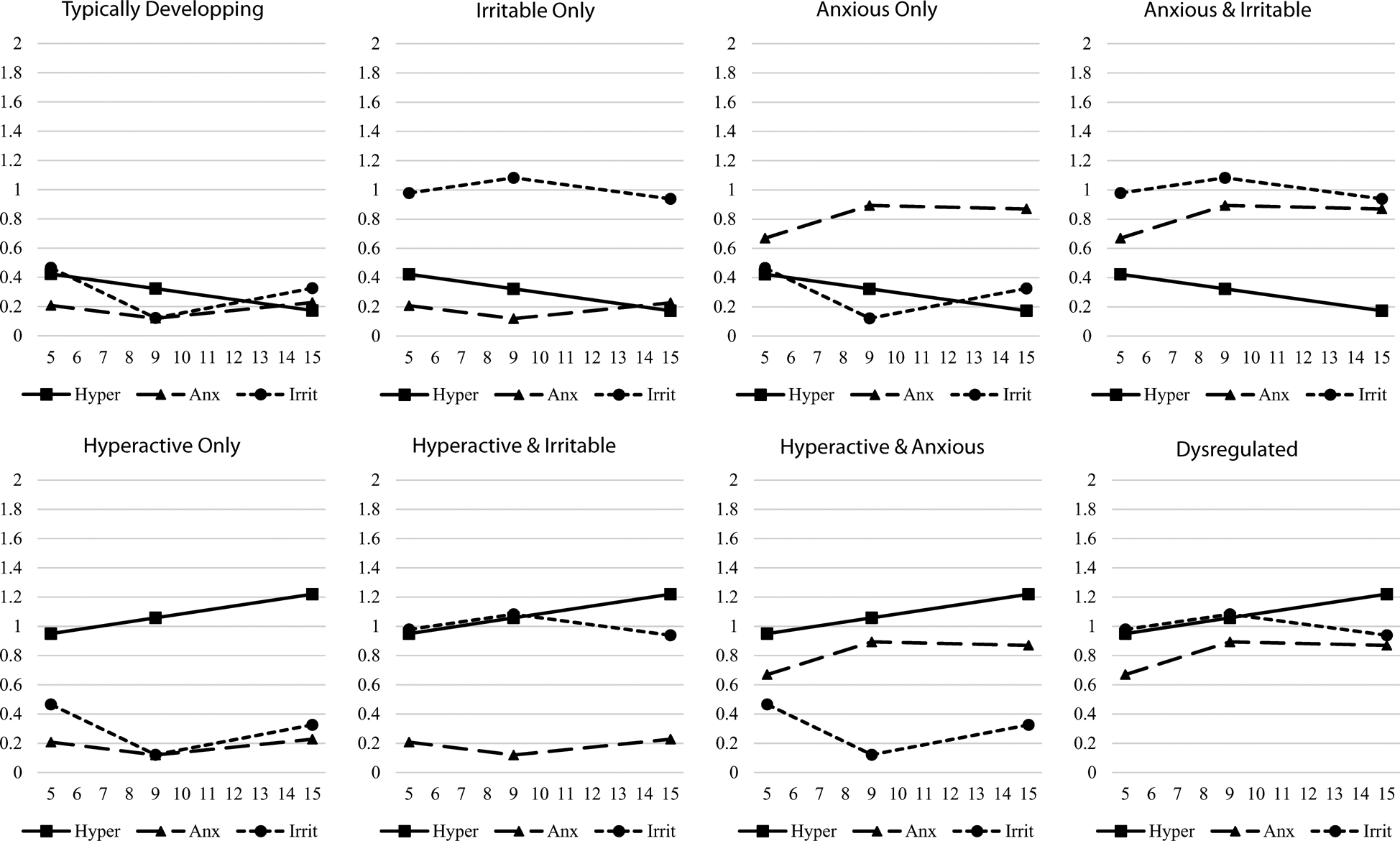
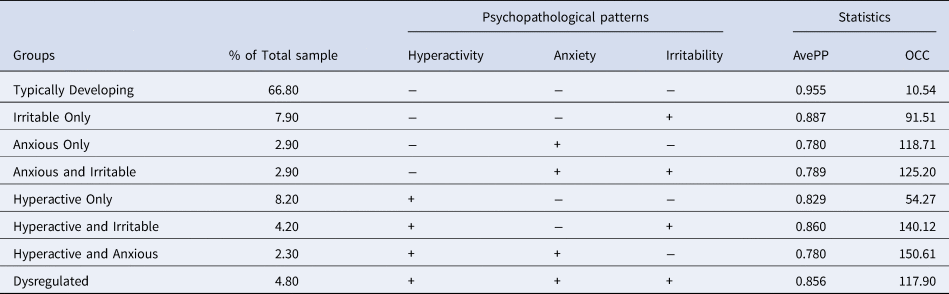
Parameters were then entered in a parallel process GMM, resulting in eight possible combinations of multi-trajectory (i.e. 2 trajectories per trajectory variables). Each multi-trajectory group showed an AvePP higher than 0.70 and an OCC higher than 5 (Nagin, Reference Nagin2005), and a minimal class size of 1% (Jung & Wickrama, Reference Jung and Wickrama2008) (see Table 1). Furthermore, model fit metrics were consistent across sexes (online Supplementary Table S1). These resulting eight distinct groups of multi-trajectory were (see Fig. 1): TD (66.8% of the total sample, 57.7% of girls), Irritable (7.9%, 43.1%), Anxious Only (2.9%, 54.4%), Anxious and Irritable (2.9%, 51.5%), Hyperactive (8.2%, 31.1%), Hyperactive and Irritable (4.2%, 36.0%), Hyperactive and Anxious (2.3%, 34.9%) and Hyperactive, Irritable, and Anxious (Dysregulated) (4.8%, 34.1%).
Multi-trajectory groups resulted from the parallel process growth mixture model on hyperactivity/impulsivity, anxiety, and irritability. Hyper, hyperactivity/impulsivity; Anx, anxiety; Irrit, irritability.

Results of the parallel process GMM with hyperactivity anxiety and irritability trajectories parameters (n = 3569)

AvePP, average posterior probabilities; OCC, odds of correct classification.
More importantly, to better support the accuracy of the multi-trajectory model based on estimated/predicted levels of psychological factors, group differences on actual/observed levels of hyperactivity/impulsivity, anxiety, and irritability were performed. Multi-trajectory groups estimated as exhibiting problematic levels of hyperactivity from childhood to adolescence (estimated) showed significantly higher levels of hyperactivity (observed) (i.e. Partial η 2 ranging from 0.30 to 0.46, p < 0.001), compared to TD. This consistency was also the case for groups estimated as having problematic levels of irritability (i.e. Partial η 2 ranging from 0.30 to 0.41, p < 0.001) and anxiety (i.e. Partial η 2 ranging from 0.16 to 0.43, p < 0.001) (online Supplementary Table S2).
Perinatal and early risk factors for multi-trajectory groups
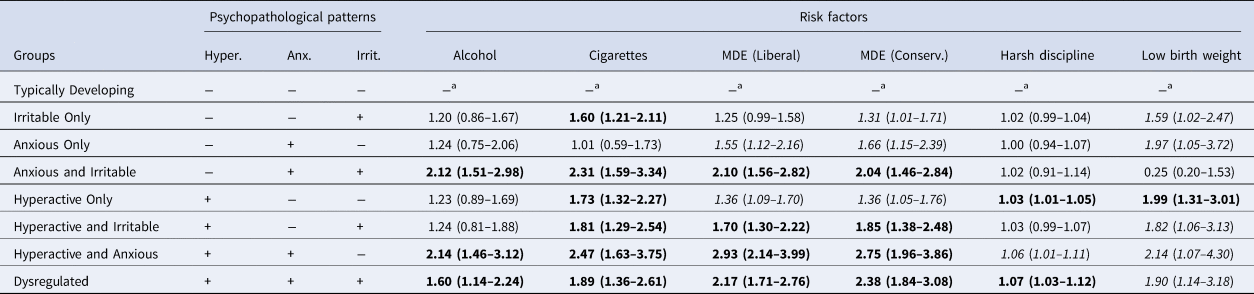
Multinomial regression analyses revealed significant differences in risk factors for multi-trajectory group membership, in comparison to children with low levels of psychological characteristics (see Table 2). We observed that the frequency of cigarette use during pregnancy significantly predicts group membership across every group, in comparison to TD, except for those following the Anxious Only (OR = 1.01, p = 0.963). However, alcohol use significantly predicted Anxious and Irritable group (OR = 2.12, p < 0.001), Hyperactive and Anxious (OR = 2.14, p < 0.001), and Dysregulated group (OR = 1.60, p = 0.005).
Frequency of maternal depression, independently of the threshold used, was also a significant risk factor for developmental multi-trajectory of anxiety, irritability, and hyperactivity (see Table 2). Maternal depression significantly predicted Anxious and Irritable (OR = 1.55–1.66, p < 0.001), Hyperactive and Irritable (OR = 1.70–1.85), Hyperactive and Anxious (OR = 2.75–2.93, p < 0.001), Dysregulated (OR = 2.17–2.38, p < 0.001). Furthermore, harsh discipline only predicted Hyperactive Only (OR = 1.03, p = 0.001) and Dysregulated (OR = 1.07, p < 0.001) group memberships. Marginally significant relationships were observed between harsh discipline and Hyperactive and Irritable (OR = 1.06, p = 0.013). Finally, child low birth weight (<2500 g) significantly predicted Hyperactive Only group (OR = 1.99, p = 0.001), while marginal significance was observed for the other groups, in comparison to TD.
Relationship between multi-trajectory groups and childhood aggression
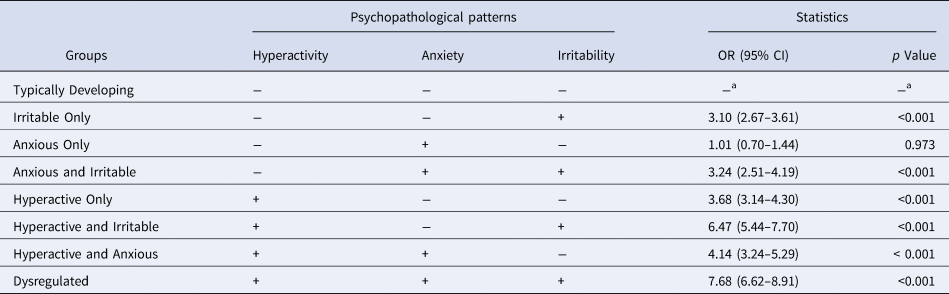
Results from the longitudinal associations between multi-trajectory groups and levels of physical aggression at Y5, Y9, and Y15 revealed that all but the Anxious Only (OR 1.01, 95% CI 0.70–1.44, p = 0.973) were associated with increased levels of aggression at 5, 9, and 15 years old (OR ranging from 3.10 to 7.68), in comparison to TD (see Table 3). More precisely, while Irritable Only was the lowest but significant group associated with physical aggression across time points (OR = 3.10, p < 0.001), Anxious and Irritable, Hyperactive, and Hyperactive and Anxious groups were all three at similar risks for displaying physical aggression (ORs = 3.24, 3.68, 4.14, respectively). Lastly, Hyperactive and Irritable and Dysregulated groups were at high risk for exhibiting physical aggression from childhood to adolescence (OR = 6.47 and 7.68, respectively) (Table 3).
Results from multinomial logistic regression analysis: risk factors associated with multi-trajectories group membership (n = 3569)

Note: Adjusted for sex and household income.
MDE, maternal major depressive episode.
a Group used as reference.
Bolded values represent statistically significant result (p < 0.005). Italicized values represent statistically marginal results (between p < 0.05 and p > 0.005). No formal correction was made for multiple comparisons.
Generalized Estimating Equations (negative binomial with log link) results on longitudinal associations between group memberships and physical aggression

Note: Adjusted for effects of time, sex, and household income.
a Group used as reference.
Finally, we tested the potential suppressor and interaction effects of perinatal and early risk factors on the longitudinal relationship between multi-trajectory groups’ membership and childhood aggression (see online Supplementary Tables S3A–F). These analyses revealed that the frequency of cigarette use during pregnancy increased the relationship between Irritable Only (compared to TD) and childhood aggression (0.11 increases in OR from baseline model). Analyses were not performed on Anxious Only since no significant risk factor was detected. Adding maternal depression (liberal thresholding) in the GEE model on Anxious and Irritable (compared to TD) revealed no suppressor or interaction effects. In the GEE model on Hyperactive Only (compared to TD), the frequency of cigarette use during pregnancy and low birth weight revealed that both factors increased the relationship between Hyperactive Only and childhood aggression (0.15 and 0.04 increases in OR, respectively from baseline model). Moreover, a significant harsh discipline × Hyperactive Only interaction term was observed (OR = 0.97, p = 0.004). This suggests that harsh parenting may increase longitudinal levels of aggression, more prominently in TD compared to the Hyperactive group. Furthermore, the frequency of cigarette use during pregnancy slightly increases the relationships between multi-trajectory groups on childhood aggression (Hyperactive and Irritable = 0.07, and Dysregulated = 0.06 increase in OR from baseline model). Finally, adding harsh discipline in the GEE model on Dysregulated (compared to TD) revealed a significant increase in the relationship between multi-trajectory group and childhood aggression (0.84 increases in OR from baseline model).
Discussion
In the current study, we aimed to unveil the complex interactions between developmental trajectories of anxiety, irritability, and hyperactivity from childhood to adolescence by using a large longitudinal study. Although most children (66.8%) followed a TD trajectory (i.e. low anxiety, low hyperactivity, and low irritability levels), we observed that six out of seven (total of 30.3%) psychological patterns were significantly more likely to exhibit aggressive behaviors than their counterpart in the TD group (minimally 3.10-fold). Moreover, approximately 1/6 of children (14.2%) followed a developmental trajectory characterized by problematic levels of at least two co-occurrent psychological symptoms (i.e. hyperactivity/impulsivity, anxiety, or irritability). This further indicates that the overlap between these three symptoms is substantial and raises the importance of studying their co-occurrence in developmental research.
Multi-trajectory groups were all longitudinally associated with physical aggression at Y9 and Y15, except for children displaying only high levels of anxiety (OR = 1.01). More specifically, the three groups: Anxious and Irritable, Hyperactive only, and Hyperactive and Anxious were similarly at risk for physical aggression at 9 and 15 years old (ranging from 3.24 to 4.14-fold), while the Hyperactive and Irritable and the Dysregulated groups were the most at-risk groups for exhibiting physical aggression in adolescence (minimally 6.5-fold).
First, following Côté et al. (Reference Côte, Tremblay, Nagin, Zoccolillo and Vitaro2002) results, we observed that hyperactivity/impulsivity dimension was the most significantly associated with childhood aggression. Moreover, we observed that this feature alone was sufficient to increase the risk for physical aggression (OR = 3.17). Interestingly, some studies observed that hyperactivity alone may not be a key factor in childhood aggression (Séguin & Tremblay, Reference Séguin, Tremblay and Zelazo2010). It is thus possible that some sub-symptoms of hyperactivity/impulsivity may be more directly related to childhood aggression, rather than the whole construct. For instance, the ‘impulsivity’ sub-symptom (e.g. self-control), but more extensively when coupled with negative emotion (e.g. emotional impulsivity), may be closely associated with impulsive aggression in children (Saylor & Amann, Reference Saylor and Amann2016). Therefore, using a broad definition of ‘hyperactivity/impulsivity’ may partially explain the discrepancies of results on the relationship between the latter construct and DBs. Future studies should seek to investigate the specific associations of impulsivity and hyperactivity, independently, in relation to childhood aggression.
In our study, children with high irritability but low hyperactivity and anxiety symptoms were three times more likely to exhibit aggressive behaviors. This echoes with past research demonstrating that propensity to experience anger (i.e. irritability, anger proneness, frustration non-reward) substantially increases the risk for behaving congruently (Hubbard, McAuliffe, Morrow, & Romano, Reference Hubbard, McAuliffe, Morrow and Romano2010; Marsee & Frick, Reference Marsee and Frick2007; Miller & Lynam, Reference Miller and Lynam2006; Vitaro, Barker, Boivin, Brendgen, & Tremblay, Reference Vitaro, Barker, Boivin, Brendgen and Tremblay2006). On the other hand, the relationship between anxiety and DBs is poorly understood. While evidence suggests that individuals exhibiting DBs often show high comorbid levels of anxiety (Bubier & Drabick, Reference Bubier and Drabick2009; Cunningham & Ollendick, Reference Cunningham and Ollendick2010), there is evidence suggesting that anxiety alone does not seem sufficient to predict DBs but rather could act as an additive problem to hyperactivity and/or irritability, exacerbating the risk for aggressive behaviors (Cote et al., Reference Côte, Tremblay, Nagin, Zoccolillo and Vitaro2002; Dugré et al., Reference Dugré, Dumais, Dellazizzo and Potvin2019; Fanti & Henrich, Reference Fanti and Henrich2010). As such, we found that overlaps in child psychological characteristics, but more precisely between hyperactivity and irritability (independently of anxiety levels), confer a high risk for exhibiting physical aggression. As past evidence suggests, impulsivity would moderate the relationship between reactivity to negative emotions and externalizing behaviors (e.g. aggressive behaviors) in children (Deming & Lochman, Reference Deming and Lochman2008; Moran, Lengua, & Zalewski, Reference Moran, Lengua and Zalewski2013).
By investigating the specificity of environmental risk factors associated with multi-trajectory groups, we observed several significant results. More precisely, the frequency of cigarette use during pregnancy consistently predicted multi-trajectory groups (except those with only high anxiety levels), in comparison with the TD group. Furthermore, alcohol use during pregnancy predicted most groups with the co-occurrence of anxiety and irritability (irrespective of hyperactivity level). Substance use during pregnancy has deleterious effects on child emotional and behavioral problems. Past results have suggested that nicotine from maternal smoking during pregnancy has adverse effects on synaptic development and functions (i.e. nicotinic acetylcholine receptors) (Slotkin, Reference Slotkin2004), interfering with key neurodevelopmental processes associated with ADHD (Huang et al., Reference Huang, Wang, Zhang, Zheng, Zhu, Qu and Mu2018) and anxiety-depressive traits (Moylan et al., Reference Moylan, Gustavson, Øverland, Karevold, Jacka, Pasco and Berk2015). Concerning alcohol use during pregnancy, a recent literature review of 71 studies on prenatal alcohol exposure showed detrimental effects on emotional functioning as reflected by greater negative affect, poor negative emotion regulation, difficult temperament and irritability (Subramoney, Eastman, Adnams, Stein, & Donald, Reference Subramoney, Eastman, Adnams, Stein and Donald2018). However, the relationship between alcohol use during pregnancy and child hyperactivity symptoms is not consistent (Jacobson & Jacobson, Reference Jacobson and Jacobson2002). The association between alcohol use during pregnancy and multi-trajectory groups may be partially explained by alterations on various offspring's neuromodulatory systems (e.g. glutamate, GABA, serotonin, and dopamine) and cerebral development (e.g. hippocampus, cerebellum, neocortex), thereby increasing the vulnerability toward a several emotional/cognitive problems in childhood (Valenzuela, Morton, Diaz, & Topper, Reference Valenzuela, Morton, Diaz and Topper2012).
Maternal depression was also one of the most important early risk factors for multi-trajectory groups. For instance, whether considering maternal depression at a liberal or at a conservative threshold, both significantly predicted every group with at least two symptoms at a problematic level, compared to TD. This reflects the importance of maternal depression in children socio-emotional and cognitive development. Several past meta-analyses have shown links between maternal pre-/postnatal depression and child behavior problems (Beck, Reference Beck1999); internalizing, externalizing, and general psychopathology (Goodman et al., Reference Goodman, Rouse, Connell, Broth, Hall and Heyward2011); and colic/crying, difficult temperament, and behavior problems (Madigan et al., Reference Madigan, Oatley, Racine, Fearon, Schumacher, Akbari and Tarabulsy2018). The hypothesized mechanisms underlying these relationships are that maternal depression may have an epigenetic influence on child emotional/cognitive development but also that peri/postnatal depression may also result in less engagement, attention, and response of the mothers to their children's needs (e.g. mood regulation, problem solving, etc.), further increasing the risk for developing emotional/cognitive problems (Bernard-Bonnin, Canadian Paediatric Society, Mental Health, & Developmental Disabilities Committee, Reference Bernard-Bonnin2004; Lester, Conradt, & Marsit, Reference Lester, Conradt and Marsit2013).
Finally, our result on the influence of low birth weight (<2500 g) follows past research indicating significant associations between low birth weight and ADHD diagnosis and its related symptomatology such as hyperactivity/impulsivity (Franz et al., Reference Franz, Bolat, Bolat, Matijasevich, Santos, Silveira and Moreira-Maia2018; Momany, Kamradt, & Nikolas, Reference Momany, Kamradt and Nikolas2018). Finally, harsh parenting significantly predicted Hyperactive Only and Dysregulated groups’ membership; however, the magnitude of the effect was very small in both cases. Although past meta-analyses and systematic reviews suggest direct associations between hostile coercive parenting and emotional dysregulation (Gorostiaga, Aliri, Balluerka, & Lameirinhas, Reference Gorostiaga, Aliri, Balluerka and Lameirinhas2019; Pinquart, Reference Pinquart2017b; Yap & Jorm, Reference Yap and Jorm2015) and DBs (Pinquart, Reference Pinquart2017a), further investigation of the effect of harsh parenting on child hyperactivity/impulsivity is needed.
Limitations
Some limitations need to be acknowledged in our study. First, the sample was derived from the FFCWS that aimed to recruit unwed couples and their child. Therefore, future studies should aim to replicate these findings using a more normally representative sample. Second, since anxiety, irritability, hyperactivity, and physical aggression were evaluated with the CBCL, future studies should replicate this study with independent measures to reduce the risk for method-variance bias. Third, irritability was assessed using only two items. Although the Cronbach αs and inter-item reliability were good to acceptable for these two items, assessments could not cover the whole construct. Fourth, although we used a broad definition of physically aggressive behaviors that could encompass reactive and proactive aggression, future studies should seek to investigate relationships between multi-trajectory and specific physically aggressive subtypes in order to better characterize developmental heterogeneity of childhood aggression. Fifth, although we assessed the longitudinal relationships between multi-trajectory and aggressive behaviors, these were cross-sectional since assessments were made at the same time points. Therefore, future studies should seek to investigate, with non-overlapping time period, the developmental sequences between multi-trajectory groups and aggressive behaviors. Sixth, the importance of genetic factors was not included in this study. Considering the non-negligible heritability of psychological traits (Faraone & Larsson, Reference Faraone and Larsson2019; Franić et al., Reference Franić, Middeldorp, Dolan, Ligthart and Boomsma2010; Stringaris et al., Reference Stringaris, Zavos, Leibenluft, Maughan and Eley2012), future studies should investigate the specific contribution of genetic factors in developmental multi-trajectories. Finally, this study only focused on childhood aggression. However, the multi-trajectory groups may also be associated with other problematic outcomes, since behaviors are often not mutually exclusive (e.g. one may be aggressive and suicidal at the same time). Similarly, although our results based on anxiety, irritability, and hyperactivity/impulsivity seems promising, it is possible that other psychological factors may be associated with heterogeneity in childhood aggression (e.g. depression). In the current study, we nonetheless demonstrated the usefulness of a novel approach to study the heterogeneity of aggressive behaviors by examining distinct multi-trajectory groups, based on levels of anxiety, irritability, and hyperactivity/impulsivity, as well as investigating their associations with childhood aggression. Results also showed the deleterious effects of environmental factors on developmental patterns of child psychological characteristics.
Conclusion
In the last decades, there has been a growing body of research suggesting that the population exhibiting physical aggression is likely to be heterogeneous (Blair, Leibenluft, & Pine, Reference Blair, Leibenluft and Pine2014; Fanti, Reference Fanti2018; Hawes, Reference Hawes2014). However, very few researches have investigated the developmental co-occurrence of psychological factors underlying this heterogeneity. In our study, we have demonstrated that the heterogeneity underlying physical aggression could be characterized by six groups of multi-trajectory (based on irritability, anxiety, and hyperactivity/impulsivity symptoms) which differed in their prevalence and magnitude of relationship with physical aggression. Although anxiety alone does not seem sufficient for predicting childhood aggression, it could remain a potential key factor for heterogeneity in aggressive behaviors (Fanti, Reference Fanti2018). In view of these promising results, researchers working on child developmental trajectories are encouraged to investigate multi-trajectory of psychological factors in relationships with problematic behaviors (e.g. DBs). Future studies should also examine prospective associations between multi-trajectory groups (in childhood) and physical aggression in late adolescence/early adulthood to investigate their stability.
Supplementary material
The supplementary material for this article can be found at https://doi.org/10.1017/S0033291720001877
Acknowledgements
The research reported in this publication was supported by the Eunice Kennedy Shriver National Institute of Child Health and Human Development (NICHD) of the National Institutes of Health under award numbers R01HD36916, R01HD39135, and R01HD40421, as well as a consortium of private foundations. The content is solely the responsibility of the authors and does not necessarily represent the official views of the National Institutes of Health.
Financial support
JRD is the holder of a scholarship from the Fonds de Recherche du Québec en Santé (FRQS). The authors declare no other financial support.
Conflict of interest
The authors declare no potential conflicts of interest.