Introduction
The taxonomy of Musa L. (Musaceae) is complex, as it is difficult (i) to make a proper judgement from herbarium specimens without living materials, (ii) to prepare voucher specimens owing to the large size of the plants, and (iii) to distinguish the cultivars from the species. This is the reason why, in North East India, this interesting group has not been given sufficient attention by the majority of workers, even though this region is also a micro-centre of evolution of wild bananas. Since the beginning of the 21st century the taxonomy of Musa has gained momentum with the discovery of numerous new species and interspecific taxa (Valmayor, Reference Valmayor2002; Häkkinen, Reference Häkkinen2002, Reference Häkkinen2003a,Reference Häkkinenb, Reference Häkkinen2004a,Reference Häkkinenb, 2005a,b, 2006a,b,c, 2007, 2009a; Häkkinen & Meekiong, Reference Häkkinen and Meekiong2004, Reference Häkkinen and Meekiong2005; Häkkinen & Wallace, Reference Häkkinen and Wallace2007; Häkkinen & Wang, Reference Häkkinen and Wang2007, Reference Häkkinen and Wang2008; Häkkinen et al., Reference Häkkinen, Suleiman and Gisil2005, Reference Häkkinen, Suchánková, Doleželová, Hribová and Doležel2007, Reference Häkkinen, Wang and Ge2008; Swangpol & Somana, Reference Swangpol and Somana2011).
The genus Musa has been divided into sections largely on the basis of chromosome numbers: Australimusa (2n = 20), Callimusa (2n = 20), Musa (2n = 22) and Rhodochlamys (2n = 22) (Cheesman & Larter, Reference Cheesman and Larter1935; Cheesman, Reference Cheesman1947, Reference Cheesman1949; Li et al., Reference Li, Häkkinen, Yuan, Hao and Ge2010). Finally, Argent (1976) established the monotypic Musa sect. Ingentimusa (2n = 14) for Musa ingens N.W.Simmonds (Reference Simmonds1960) of Papua New Guinea.
Recent molecular research indicates that there are only two sections in Musa (Wong et al., Reference Wong, Kiew, Argent, Set, Lee and Gan2002; Li et al., Reference Li, Häkkinen, Yuan, Hao and Ge2010; Christelova et al., 2011; Durai et al., Reference Durai, Uma, Saraswathi, Jayabalan and Mustaffa2011). Accordingly, Häkkinen (2013) revised the infrageneric taxonomy of Musa, merging sect. Rhodochlamys with sect. Musa, and sections Australimusa and Ingentimusa into sect. Callimusa.
The present communication is the discovery of one new species of Musa sect. Musa, named here Musa argentii Gogoi & Borah, from Arunachal Pradesh of India.
Extensive field study was carried out in different parts of eastern Arunachal Pradesh during 2011 and 2012, and in May 2013, as part of the Flora of Anjaw District and Flora of Lohit District projects, under the annual action plan of the Botanical Survey of India. During the expedition to Lohit in May 2013 the new species described here was discovered. The new species is described from observations of living plants in the field according to the INIBAP Musa Descriptor List (IPGRI-INIBAP/CIRAD, 1996). The descriptive terms here follow those used by Simmonds (Reference Simmonds1962, Reference Simmonds1966). Relevant portions of the specimens were deposited as the holotype at the Central National Herbarium, Botanical Survey of India (CAL) and isotypes at the herbaria of the Botanical Survey of India, APRC, Itanagar (ARUN) and Botanical Survey of India, ERC, Shillong (ASSAM).
Species Description
Musa argentii Gogoi & Borah, sp. nov.
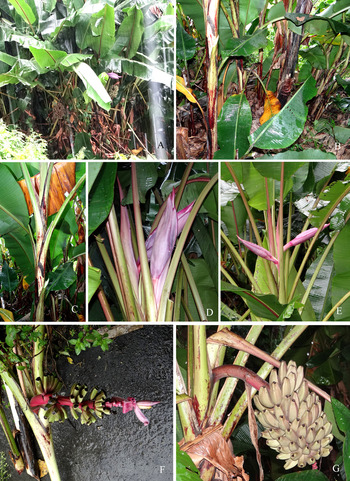
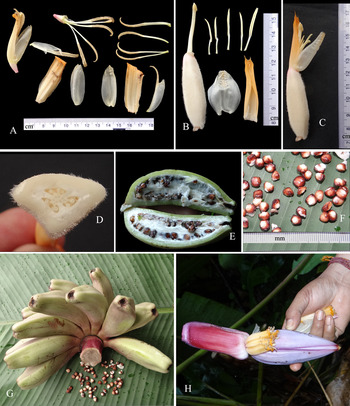
Close to M. velutina H.Wendl. & Drude in habit and hairy ovary but differing by its pendent inflorescence, purplish, rather than pink, female bud, the abortion of the male bud before maturity of fruits, 2 rows of fruits in each hand of up to 12 non-schizocarpic, much elongated, purplish tinged, glabrous fruits, with up to 121 seeds each. – Type: India, Arunachal Pradesh, Lohit District, 12 km along the road to Deban from the zero point junction at Wakro, 27°42′38.67″N, 96°19′40.39″E, 488 m, 24 v 2013, R. Gogoi & S. Borah 30303 (holo CAL; iso ARUN, ASSAM). Figs 1,2.
Musa argentii Gogoi & Borah. A & B, plants in the habitat; C, portion of the pseudostem; D & E, female buds; F, immature fruiting bunch; G, mature fruiting bunch. (See online for a colour version of this figure.)

Musa argentii Gogoi & Borah. A, male flower and dissected parts; B, dissected parts of female flower; C, female flower; D, t.s. of ovary; E, a cut fruit; F, seeds; G, one hand of fruits; H, male bud. (See online for a colour version of this figure.)

Plant slender, usually suckering close to parent plant, shoots 6–30 cm apart, rarely to 60 cm apart, 18–24 suckers; mature pseudostem to 2.2 m tall, to 8 cm diam. at base, sheaths light green with reddish blotches, shiny, sap watery. Petiole green, outside light pinkish, 60–120 cm long, 2–2.5 cm diam., not waxy, margins curved inwards, pinkish or light purplish, wings dry, brown, tightly clasping the pseudostem. Lamina elliptic, 97–120 × to 43 cm, not waxy, adaxially deep green, abaxially pale green with pinkish midrib, base asymmetrical, both sides rounded, apex truncate. Inflorescence initially erect, later pendent, peduncle pinkish white, silky pubescent, 14–30 × 2.5–3.5 cm, 2 sterile bracts present, purple on both sides, 31–52 × 6–10.5 cm, persistent at opening of the first hermaphrodite flowers. Female bud light purplish, lanceolate, 19–25 × 5–7.5 cm, convolute, apex acute, lifting 2 bracts at a time, light purple outside, deep purple inside, bracts not revolute, silky pubescent; basal flowers hermaphrodite, 6–17 flowers in 2 rows inside female bracts, flower size 8.5–9 cm long; ovary creamy, densely silky pubescent, 4.5–5 × 1–1.5 cm, curved, ridged, with ovules arranged in 2 rows per locule; compound tepal ovate, orange, to 4.5 × to 2 cm, with 2 prominently thickened keels, apex 5-lobed, curved outwards; free tepal ovate, translucent white, to 3.5 × to 2.2 cm, with a slight midrib, apex obtuse or mucronate; stamens included, 2.5–3.2 cm long, filaments cream, 0.1–0.8 cm long, with pollen, anther lobes light yellowish, 1.6–2.2 cm long, style cream, 2.8–3 cm long, stigma cream, 5 mm diam. Male bud lanceolate, aborted after lifting a few bracts, light purple, 6.5–13 × 1.5–5 cm, apex acute; bracts light purple outside, purplish to reddish inside, not waxy outside, silky pubescent, imbricate, lifting a few bracts at a time, revolute before falling; male flowers on average 4 per bract in a single row, falling with bracts; compound tepal oblong, orange, 5–5.5 × to 2 cm, with 2 thickened keels, apex 5-lobed, curved outwards; anthers 5 cm long, creamy or light orange; stamens included, filaments cream, to 2.5 cm long, anther lobes to 2.5 cm long; ovary arched, pink, without additional pigmentation, 1–1.2 × 0.5–0.6 cm, style to 4.7 cm long, stigma 3–4 mm diam. Fruit bunch pendent, peduncle deep pink, compact, 6–10 hands, 8–12 fruits per hand in 2 rows, fingers curved towards the stalk, individual fruit to 8.5 (with pedicel) × 2.5–3 cm, slightly ridged, glabrous; pedicel pink tinged, 1 × 1 cm, pilose, apex slightly pointed, immature fruit light purplish or light green with purple flush, not waxy, fruit pulp white. Seeds angular, wrinkled, 6 mm diam., brown, to 121 per fruit.
Distribution. Only known from the type locality.
Habitat. This new species grows on hilly slopes and plains in the periphery of dense tropical forests on the way to Deban from the zero point of Wakro in Lohit District. At this place, some hundred plants were seen in four large populations. Musa velutina H.Wendl. & Drude (Wendland & Drude, Reference Wendland and Drude1875) and M. itinerans Cheesman (Reference Cheesman1949) grow nearby but with non-overlapping populations.
Conservation status. This species is perceived to be under some threat due to rapid clearing of forests for agricultural purposes, hence it can be treated as ‘Vulnerable’.
Etymology. The new species is named in honour of Dr George Argent, Royal Botanic Garden Edinburgh, for his contribution to Musaceae.
Musa argentii is a very distinct species of sect. Musa. It is only the third species with a hairy ovary (excluding the related Musella lasiocarpa) after Musa velutina and M. hirta Becc. (Häkkinen & Väre, Reference Häkkinen and Väre2008) but the mature fruits of M. argentii are glabrous which distinguishes this species easily from the other two. Musa hirta (Beccari, Reference Beccari1902) belongs to sect. Callimusa and can easily be distinguished by its different fruit colour, barrel-shaped seeds and distant location in Borneo. Musa velutina subsp. velutina can easily be distinguished from M. argentii by its compact, erect inflorescence; the male bud persisting until the maturity of the fruit; the persistence of hairs on the red, schizocarpic fruits; and the single rowed arrangement and smaller number of fruits in each hand. Two other species, Musa chunii Häkkinen (Häkkinen, Reference Häkkinen2009b) and M. zaifuii Häkkinen & H.Wang (Häkkinen & Wang, Reference Häkkinen and Wang2008), with pendent inflorescence and purple-lilac buds are also similar to M. argentii but the new species differs from both these species in having pubescent bracts, the ovary densely silky hairy, a much more compact fruit bunch and up to 12 fruits in 2 rows per bract.
Key to Musa argentii and closely related species of Musa sect. Musa
1a. Plants robust, not clump forming, spreading by runners; ovary with 4 ovules in each locule M. itinerans var. itinerans
1b. Plants slender, clump forming; ovary with 2 ovules in each locule 2
2a. Inflorescence horizontal to pendent, ovary creamy white, male bud aborted before fruit maturity, fruit bunch pendent and compact, fruit tinged purple, in 2 rows, up to 12 in each hand M. argentii
2b. Inflorescence erect, ovary pink or greenish, male bud not aborted before maturity of fruit, bunch erect and lax, fruit pink, in a single row, up to 5 in each hand 3
3a. Basal flowers hermaphrodite; fruits hairy, dehiscent at maturity M. velutina subsp. velutina
3b. Basal flowers female, fruit glabrous, indehiscent at maturity M. velutina subsp. markkuana
Acknowledgements
The authors are grateful to Dr P. Singh, Director, Botanical Survey of India, Kolkata, and to HOO, APRC, Botanical Survey of India, Itanagar for support and logistics. We are also grateful to Mr Markku Häkkinen, Botanical Garden, Finnish Museum of Natural History, University of Helsinki for his constant support and guidance, not only in the determination of this taxon as new, but also in contributing to a better understanding of the wild Musa species of India. We also thank Dr K. N. Gandhi, Senior Nomenclatural Registrar, HUH, Harvard, USA, for his helpful suggestions during the preparation of the manuscript.