Problem behaviors have a large impact on children's functioning and quality of life and are a great burden to their families, their environment, and to society at large (Costello, Egger, & Angold, Reference Costello, Egger and Angold2005). Moreover, there is considerable evidence that many lifetime adult psychiatric disorders have their onset in childhood (Jones, Reference Jones2013). Children with psychiatric disorders have an increased risk of adult disorders and of maladjustments in areas such as work, social relations, law, and physical health (Costello & Maughan, Reference Costello and Maughan2015). An important path leading from children's problems to adverse outcomes in adulthood is through poor school attainment such as failing to complete school or achieving low school grades. Educational failure has been associated with lower income, unemployment, mortality, poor health status, and subjective outcomes such as happiness and perceived quality of life (McLeod & Kaiser, Reference McLeod and Kaiser2004; Riglin, Petrides, Frederickson, & Rice, Reference Riglin, Petrides, Frederickson and Rice2014). However, to successfully intervene in the detrimental cycle from problem behavior to educational attainment or vice versa depends on understanding how this cycle is operating. There is evidence that improving the educational environment early in childhood age is beneficial in reducing adverse outcomes such as substance use, violence, and unemployment in adulthood (Campbell, Ramey, Pungello, Sparling, & Miller-Johnson, Reference Campbell, Ramey, Pungello, Sparling and Miller-Johnson2002; Reynolds et al., Reference Reynolds, Temple, Ou, Robertson, Kersky and Topitzes2007), but more research is needed to determine when interventions could be most promising.
Internalizing and Externalizing
In our study, we focus on the major division of problem behavior into two dimensions: internalizing and externalizing problems. When we use the term problems we refer to continuous scores of problem behavior, that is, mostly the result of summed item scores of rating scales. We use the term disorders to denote categorical outcomes based on clinical or interview-derived diagnoses. Internalizing problems are characterized by symptoms related to anxiety and depression, whereas externalizing problems cover problem areas such as aggression, defiance, and drug abuse. This subdivision is demonstrated in studies of children (Achenbach, Reference Achenbach2009) as well as in studies of adults (Krueger & Markon, Reference Krueger and Markon2006). Disorders comprising this division affect many children worldwide. Prevalence estimates of internalizing disorders are 6.5% for anxiety disorders and 2.6% for depressive disorders. For externalizing disorders, the prevalence estimate is 5.7% (Polanczyk, Salum, Sugaya, Caye, & Rohde, Reference Polanczyk, Salum, Sugaya, Caye and Rohde2015). Although internalizing and externalizing emerge as separate dimensions, their co-occurrence is still considerable (Krueger & Markon, Reference Krueger and Markon2006). The overlap between the two dimensions warrants investigating internalizing and externalizing problems simultaneously. A number of previous studies examining bidirectional links between problem behavior and academic performance included only internalizing or only externalizing problems. However, only jointly studying both internalizing and externalizing problems accounts for the cross-sectional as well as the longitudinal co-occurrence of internalizing and externalizing problems.
Problem Behavior and Educational Outcomes
It has been well established that children's internalizing and externalizing problems are negatively related to academic performance concurrently (see Moilanen, Shaw, & Maxwell, Reference Moilanen, Shaw and Maxwell2010; Riglin et al., Reference Riglin, Petrides, Frederickson and Rice2014). In addition, the number of studies investigating longitudinal associations between these two domains is increasing, but the reports about these associations provide mixed results (Leach & Butterworth, Reference Leach and Butterworth2012; McLeod & Fettes, Reference McLeod and Fettes2007; Needham, Reference Needham2009; Patalay, Deighton, Fonagy, & Wolpert, Reference Patalay, Deighton, Fonagy and Wolpert2015; Veldman et al., Reference Veldman, Bültmann, Stewart, Ormel, Verhulst and Reijneveld2014). A meta-analysis reported significant, but small effects of internalizing problems on educational attainment (Riglin et al., Reference Riglin, Petrides, Frederickson and Rice2014). The findings from the summarized studies suggested that the association of depression with educational outcomes was stronger than that of anxiety and that the associations of internalizing problems with school failure were stronger than those with school grades. The meta-analysis did not examine the reverse effects, that is, whether educational attainment predicts internalizing problems. In contrast, the meta-analysis of Esch et al. (Reference Esch, Bocquet, Pull, Couffignal, Lehnert and Graas2014) summarized studies that examined whether school dropout predicted problem behavior and the reverse. Their findings suggested that mostly externalizing problems predicted school dropout, whereas internalizing problems were often a consequence of school dropout. Because studies investigating the path from problem behavior to school dropout outnumbered studies examining paths in the opposite direction and studies did not analyze both paths simultaneously, it is, however, difficult to draw firm conclusions regarding the direction of the pathways. Thus, for a better understanding of the pathways between problem behavior and academic performance, both directions of these pathways should be tested simultaneously in one study with long follow-up and repeated measures of internalizing and externalizing problems as well as academic performance.
Competing Models
Determining the direction between problem behavior and academic performance is essential to evaluate the validity of two competing models: the adjustment erosion hypothesis versus the academic incompetence hypothesis (Moilanen et al., Reference Moilanen, Shaw and Maxwell2010). The adjustment erosion hypothesis refers to the mechanism that internalizing or externalizing problems lead to lower later academic performance, which increases risks for problems in other domains later in life. In contrast, the academic incompetence hypothesis posits that poor academic performance provokes later internalizing or externalizing problems resulting in multiple adverse outcomes. Alternatively, shared risk factors may underlie high levels of problem behavior or poor academic performance, which may aggravate functioning further (Moilanen et al., Reference Moilanen, Shaw and Maxwell2010).
Testing Bidirectional Pathways
Cross-lagged models are an important tool to examine bidirectional effects. These models enable testing whether a construct has an effect on another construct assessed at a later occasion second construct or the reverse of this effect. It is further possible to test whether both the effect and its reverse are present simultaneously. At the same time, cross-lagged models account for concurrent relations between two different variables and for stability paths between variables of the same type (Selig & Little, Reference Selig, Little, Laursen, Little and Card2012). Thus, cross-lagged models can disentangle whether, for example, internalizing problems precede academic performance or vice versa, while they take into account the stabilities over time. We therefore used cross-lagged models as the main vehicle for our analyses.
Bidirectional Pathways Between Problem Behavior and Academic Performance
Numerous studies tested the direction of the paths between problem behavior and academic performance using cross-lagged models (Burt & Roisman, Reference Burt and Roisman2010; Chen, Huang, Chang, Wang, & Li, Reference Chen, Huang, Chang, Wang and Li2010; Defoe, Farrington, & Loeber, Reference Defoe, Farrington and Loeber2013; Englund & Siebenbruner, Reference Englund and Siebenbruner2012; Lee, Reference Lee2013; Masten, Desjardins, McCormick, Kuo, & Long, Reference Masten, Desjardins, McCormick, Kuo and Long2010; Masten et al., Reference Masten, Roisman, Long, Burt, Obradovic and Riley2005; Metsäpelto et al., Reference Metsäpelto, Pakarinen, Kiuru, Poikkeus, Lerkkanen and Nurmi2015; Moilanen et al., Reference Moilanen, Shaw and Maxwell2010; Obradović, Burt, & Masten, Reference Obradović, Burt and Masten2010; Riglin, Frederickson, Shelton, & Rice, Reference Riglin, Frederickson, Shelton and Rice2013; Vaillancourt, Brittain, McDougall, & Duku, Reference Vaillancourt, Brittain, McDougall and Duku2013; van Lier et al., Reference van Lier, Vitaro, Barker, Brendgen, Tremblay and Boivin2012; Verboom, Sijtsema, Verhulst, Penninx, & Ormel, Reference Verboom, Sijtsema, Verhulst, Penninx and Ormel2014; Zimmermann, Schutte, Taskinen, & Koller, Reference Zimmermann, Schutte, Taskinen and Koller2013). Regarding the path from internalizing or externalizing problems to academic performance, these studies reported mixed results. A longitudinal association of externalizing problems with academic performance was found in most studies, which supports the adjustment erosion hypothesis. However, these studies did not find a pathway from internalizing problems. Further, these bidirectional studies found some, but no consistent evidence for an independent path from academic performance to internalizing or externalizing problems. Arguably, the academic incompetence hypothesis received less support than the adjustment erosion hypothesis.
Pertaining to these mixed results are the many differences among the studies. For example, some studies only examined internalizing problems and not externalizing problems in the relation with academic performance. These studies (Obradović et al., Reference Obradović, Burt and Masten2010; Verboom et al., Reference Verboom, Sijtsema, Verhulst, Penninx and Ormel2014) found pathways from internalizing problems to academic performance, a pathway that only emerged once (Englund & Siebenbruner, Reference Englund and Siebenbruner2012) in those studies that investigated internalizing and externalizing problems jointly. The pathway could thus be due to lack of accounting for externalizing problems in the analysis. In line with this interpretation, the meta-analysis of Esch et al. (Reference Esch, Bocquet, Pull, Couffignal, Lehnert and Graas2014) indicated that the association between internalizing disorders and educational attainment was strongly mediated by co-occurring disruptive behavior problems, whereas independent effects could not be observed. To account for this interrelation, we tested internalizing and externalizing problems simultaneously in the relation with academic performance.
A further difference among the studies is the inclusion of mediating variables such as self-esteem, task-avoidant behavior, social competence, and victimization. A mediator can account for part or most of the association between problem behavior and subsequent academic performance. If the model without the mediators is not presented or not fully adjusted, the unmediated overall association cannot be evaluated. For example, Metsäpelto et al. (Reference Metsäpelto, Pakarinen, Kiuru, Poikkeus, Lerkkanen and Nurmi2015) found paths from externalizing problems to task-avoidant behavior and paths from task-avoiding behavior to academic performance. Direct paths between externalizing problems and academic problems were not presented in this study. In addition, van Lier et al. (Reference van Lier, Vitaro, Barker, Brendgen, Tremblay and Boivin2012) and Vaillancourt et al. (Reference Vaillancourt, Brittain, McDougall and Duku2013) reported conflicting findings regarding the direction of the pathways between problem behavior and academic performance. Both studies included victimization as a mediator; this presentation could have masked the overall the existence of pathways between problem behavior and academic performance. Although investigating mediators is in itself very meaningful, studies should report the overall results for direct and indirect associations to enable comparisons with other studies without these mediators. Our study aimed at providing a basic model without mediating pathways to test the two competing hypotheses.
Previous studies also varied much in how and whether ratings from multiple informants were incorporated. For example, many studies used only one type of informant of both problem behavior and academic performance (Lee, Reference Lee2013; van Lier et al., Reference van Lier, Vitaro, Barker, Brendgen, Tremblay and Boivin2012); others combined reports from multiple informants on outcome or determinant into latent variables (Masten et al., Reference Masten, Roisman, Long, Burt, Obradovic and Riley2005; Moilanen et al., Reference Moilanen, Shaw and Maxwell2010), or changed the type of informant across waves (Englund & Siebenbruner, Reference Englund and Siebenbruner2012). Using both ratings of problem behavior and academic performance obtained from the same informant can strongly inflate associations (Ringoot et al., Reference Ringoot, Tiemeier, Jaddoe, So, Hofman and Verhulst2015). Latent variables that also include ratings of the same informant as indicators of problem behavior or of academic performance can lead to inflated associations as well, although probably to a lesser degree, because of the shared variance between the different latent variables. To circumvent the problem of shared method variance, it is important to have different informants of problem behavior versus academic performance. Because there is low to moderate correspondence between different types of informants of problem behavior (Achenbach, McConaughy, & Howell, Reference Achenbach, McConaughy and Howell1987), we argue that it is also important to examine separate models with different informants of problem behavior. In this way only, both consistency and validity of the pathways between problem behavior and academic performance can be investigated. In the current study, this is achieved by contrasting two models: one model with parent-reported problem behavior and teacher-reported academic performance; and the reversed model, with the same informants but now using teacher-reported problem behavior and parent-reported academic performance. It should be noted, however, that different teachers reported about an individual at each time point. The mean correlation between the ratings of two different teachers is 0.64 (Achenbach et al., Reference Achenbach, McConaughy and Howell1987).
Age and Gender Effects
Bidirectional paths between internalizing and externalizing problems and academic performance can differ across age groups. A possible reason for age differences may be the higher prevalence of disorders in adolescence (12–16 years) as compared to childhood (4–11 years; Offord et al., Reference Offord, Boyle, Szatmari, Rae-Grant, Links and Cadman1987). Further, academic performance may be more demanding in adolescence than in childhood. Because of the higher prevalence of disorders and more demanding academic performance in adolescence, the bidirectional pathways may be stronger in this developmental period as well. Chen et al. (Reference Chen, Huang, Chang, Wang and Li2010) suggested that bidirectional paths involving externalizing problems were stronger in children who were 8–10 years than in children who were 10–12 years. In contrast, Obradović et al. (Reference Obradović, Burt and Masten2010) reported no differences in pathways with respect to internalizing problems in children aged 8–12 years. Only a few studies tested age differences and findings were inconsistent. We therefore tested age differences using 12 years as the cut point between childhood and adolescence. This cut point also marks the transition from primary school to secondary school in the Netherlands.
Because levels of internalizing and externalizing problems differ between boys and girls, and associations of these problems with an outcome such as academic performance may differ between boys versus girls, it is important to examine gender differences (Zahn-Waxler, Reference Zahn-Waxler1993). Verboom et al. (Reference Verboom, Sijtsema, Verhulst, Penninx and Ormel2014) only found bidirectional links between depressive problems and academic performance in girls. However, Obradović et al. (Reference Obradović, Burt and Masten2010) reported a contradicting finding. A pathway from internalizing problems to academic performance was only present in boys. In addition, Masten et al. (Reference Masten, Roisman, Long, Burt, Obradovic and Riley2005) found gender differences in cross-sectional associations, but not in bidirectional pathways between internalizing, externalizing, and academic performance. However, most previous studies testing gender differences found no differences in the cross-lagged paths or the stabilities between boys and girls (Burt & Roisman, Reference Burt and Roisman2010; Chen et al., Reference Chen, Huang, Chang, Wang and Li2010; Englund & Siebenbruner, Reference Englund and Siebenbruner2012; Masten et al., Reference Masten, Desjardins, McCormick, Kuo and Long2010; Metsäpelto et al., Reference Metsäpelto, Pakarinen, Kiuru, Poikkeus, Lerkkanen and Nurmi2015; Vaillancourt et al., Reference Vaillancourt, Brittain, McDougall and Duku2013; van Lier et al., Reference van Lier, Vitaro, Barker, Brendgen, Tremblay and Boivin2012). These contradicting previous findings warrant further tests of differences between boys and girls in bidirectional pathways of internalizing problems, externalizing problems, and academic performance in the current study.
The Current Study
In the present study we tested bidirectional pathways between problem behavior and academic performance using longitudinal data obtained from a large population-based cohort. The study used reports on children's internalizing problems, externalizing problems, and academic performance obtained from parents and teachers collected when children were 6–10 years at the first and 12–18 years at the last of four waves.
The current study enhances previous studies in several ways. First, we used different informants of problem behavior and academic performance in one model to avoid shared method variance. Second, we also tested the same model in which we interchanged the two informants on behavioral problems and academic performance. This enabled us to examine consistencies between informants. Third, we used identical measurement instruments across waves and informants. Fourth, our study covered an age range of 6–18 years, which is longer a follow-up time than in most previous studies. The study encompasses two developmental periods, namely, childhood and adolescence. Because age differences were not often examined and findings were not clear, we tested whether bidirectional paths between problem behavior and academic performance differed between ages 6 to 12 years versus 13 to 18 years. Fifth, we examined internalizing and externalizing problems simultaneously in the relation with academic performance.
We expected to find paths from externalizing problems to academic performance, because that is the most salient finding from previous studies. Findings for internalizing problems are less clear; we hypothesized that no paths involving internalizing problems would be found in this large study with a rigorous methodological approach.
Method
Sample
The study was embedded in the Zuid-Holland Study that started in 1983. Details of the initial data collection were described in Verhulst, Akkerhuis, and Althaus (Reference Verhulst, Akkerhuis and Althaus1985). The study addresses behavioral and emotional problems in children and adolescents. In the remainder of the text, we will refer to children and adolescents as children. In 1983, a random sample of 2,600 children stratified according to gender and birth year (i.e., children aged 4–16 years) was drawn from municipal registers that listed all residents in the Dutch province of Zuid-Holland. Of the 2,447 parents reached, 2,076 (i.e., 84.8%) provided usable data. We obtained no response in 524 children. Of these, 78 children lived in municipal communities that refused to give information, 357 children had parents who refused to participate or did not respond, parents of 8 children could not respond because of language difficulties, 6 children lived in a foster family or residential setting refusing cooperation, while the remaining 75 children were untraceable (e.g., moved, house was empty, or wrong address). There were no differences in gender and age between responders and nonresponders, whereas nonresponders comprised slightly more families with low socioeconomic status (SES) than responders (Verhulst et al., Reference Verhulst, Akkerhuis and Althaus1985). The 2,076 children in the final sample comprised 48.9% boys, were on average 9.9 years of age, and were mostly of North European descent (96.6%); and 34.1% of them were lived in families of low SES. The cohort was approached every 2 years from 1983 to 1991 (Wave 1 to Wave 5). Participants provided written informed consent after fully explaining the procedures. The local medical ethical committee has approved the initial study and all follow-up waves.
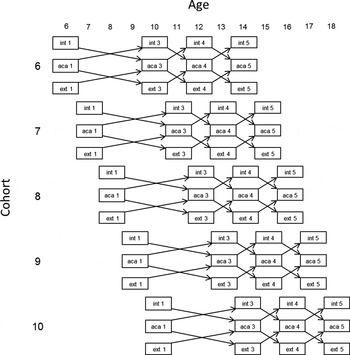
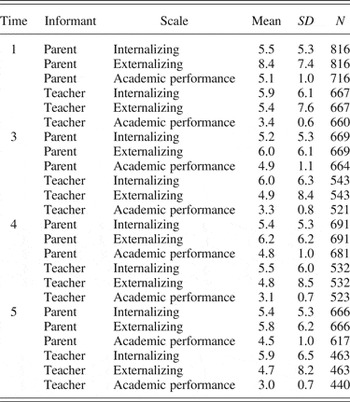
This analysis focused on the comparison of parent and teacher ratings of internalizing and externalizing problems. Therefore, we used data from Wave 1 to Wave 5, because these waves, which span 8 years, included ratings from both informants. Because we did not obtain teacher data on Wave 2, we did not include data from that wave. In addition, we selected children who were 6–10 years old on Wave 1, because in these children we obtained parent and teacher ratings of problem behavior and academic performance in the four waves. The total number of children in the selected sample is 816. A logistic regression analysis of selected and nonselected children did not reveal any differences on sex, ethnicity, and SES. The time interval between Wave 1 and Wave 3 was 4 years, whereas time intervals between Wave 3 and Wave 4 and between Wave 4 and Wave 5 were 2 years. The combination of waves and ages resulted in an age span of 12 years, from 6 to 18 years. Figure 1 shows how waves and ages are related. For example, children who were 6 years at the first wave were 12 years at the last wave, and children who were initially 10 years were 18 years at the end of the follow-up. Table 1 shows the number of children per study variable and wave. Out of eight possible parent and teacher ratings, six to eight ratings were obtained in 75% of the sample. We used logistic regression to test whether children with complete information differed from children with incomplete information. There were no differences regarding ethnicity and regarding parent-reported internalizing and externalizing problems at Wave 1. However, compared to children with complete information, children with incomplete information were more often boys (odds ratio [OR] = 1.5, p = .024), were older (OR = 1.4, p < .001), and were more often from families with low SES (OR = 0.9, p < .009).
Overview of the assessments across waves, cohorts, and ages; int, internalizing problems; ext, externalizing problems; aca, academic performance; numbers within boxes indicate waves.

Means of parent- and teacher-reported internalizing problems, externalizing problems, and academic performance across waves

Measures
Internalizing and externalizing problems
All ratings of emotional and behavioral problems were based on Dutch translations of the Child Behavior Checklist (CBCL) and the Teacher Report Form (TRF; Achenbach & Rescorla, Reference Achenbach and Rescorla2001). These measures have large overlaps of item content across informants. All instruments were translated into Dutch and backtranslated into English (Verhulst et al., Reference Verhulst, Akkerhuis and Althaus1985). The items of the measures are rated on a 3-point scale (0 = not true, 1 = somewhat or sometimes true, and 2 = very true or often true). The item scores are summed to form scales with continuous scores. For this study, we used the scales Internalizing, comprising anxiety and depressive problems, and Externalizing, comprising aggressive and rule-breaking behavior. In the remainder of the text, we refer to the scales of the CBCL and TRF when we use the terms internalizing problems or externalizing problems. The range of Cronbach αs of scores for internalizing is from 0.81 to 0.90 and of scores for externalizing is from 0.81 to 0.92 across waves and informants. Of the 816 children in the selected sample, 107 (13.1%) had scores above the clinical cutoff on parent-reported internalizing problems and 123 (15.1%) on parent-reported externalizing problems (Verhulst, Van der Ende, & Koot, Reference Verhulst, Van der Ende and Koot1996).
Academic performance
Both the CBCL and the TRF contain items that assess academic performance. Both parents and teachers can rate seven items on graded subjects. Parents also indicate whether a child repeated a grade, received special education, or had academic problems. The school scale of the CBCL is a combination of the graded subjects and the additional items. The test–retest reliability of the scores on the scale is 0.83. The academic performance scale of the TRF is the sum of the graded subjects. The test–retest reliability of the scores on the scale is 0.89. Because the school scale of the CBCL is very similar to the academic performance scale of the TRF, we refer to both scales with the term “academic performance” in the remainder of the text.
Mostly mothers completed the CBCL. Across waves, they provided 86.8%–93.5% of the ratings. In 82.0% to 87.3% of the cases, mothers completed the CBCL on adjacent waves. Different teachers of the same individual completed the TRF across waves.
Covariates
Gender was included as a dichotomous variable with boys as the reference category. Parents' SES was determined at the first wave. SES was indicated by achieved occupational level scored on a scale from 1 to 6, with 1 representing unskilled employees and 6 executives or major professionals (Westerlaak, Kropman, & Collaris, Reference Westerlaak, Kropman and Collaris1975).
Data analysis
Our hypotheses were tested with autoregressive cross-lagged or transactional models (Selig & Little, Reference Selig, Little, Laursen, Little and Card2012). In such models, the autoregressive paths reflect the continuity within a specific variable. In addition, the cross-time, cross-lagged paths between different variables are estimated. Significant cross-lagged paths indicate directional effects between different variables above and beyond the autoregressive or stability paths of these variables from one time to the next. The models also include covariances between concurrent variables as well as gender and parents' SES as covariates.
All models were fitted in Mplus version 7.3 (Muthén & Muthén, Reference Muthén and Muthén1998–2012). A robust maximum likelihood estimator, which produces robust standard errors, was used to account for possible nonnormal distribution of the study variables. We standardized each score before including them into the analyses. The standardization is convenient in comparing effect estimates. To determine model fit, we used the comparative fit index (CFI) and Tucker–Lewis index (TLI), with values >0.90 indicating acceptable fit and values >0.95 indicating close fit (Bentler & Bonett, Reference Bentler and Bonett1980), and the root mean square error of approximation (RMSEA), with values between 0.08 and 0.06 indicating acceptable fit and values <0.06 indicating close fit (Browne & Cudeck, Reference Browne and Cudeck1992). Missing data were handled using full information maximum likelihood estimation.
We tested two series of four models each. The first series examined the paths between parent-reported internalizing problems, parent-reported externalizing problems, and teacher-reported academic performance. In each series, the first model was an unconstrained model, in which all paths across waves and cohorts and all covariances were freely estimated. In the second model, we constrained paths to be equal when they were between both identical constructs and equal follow-up periods. The paths, for example, between Time 3 internalizing problems and Time 4 internalizing problems and between Time 4 internalizing problems and Time 5 internalizing problems were constrained to be equal, but were unequal to the path between Time 1 internalizing problems and Time 3 internalizing problems, which concerns a longer follow-up period. Paths across cohorts, that is, ages at Wave 1 (see Figure 1), however, were still allowed to be different. These paths were constrained to be equal in Model 3. Thus, the path between Time 3 externalizing problems and Time 4 academic performance was held to be the same across cohort 6 to 10. In addition to the paths, the covariances between concurrent constructs were also constrained to be equal across cohorts. The fourth model tested whether paths in childhood were different from paths in adolescence. Paths before age 12 years were allowed to be different from paths after age 12 years. The second series of models was based on teacher-reported internalizing problems, teacher-reported externalizing problems, and parent-reported problems with the same four-step model approach.
We conducted multigroup analyses to test whether there were model differences between boys and girls. For our previous model tests, we defined separate groups for each of the five cohorts, thus further distinguishing between boys and girls doubled the number of groups to 10. To circumvent small sample sizes, we decided to collapse the cohorts into one group and to integrally test gender invariance in separate boy and girl groups. We tested a model in which all bidirectional pathways of parent-reported internalizing and externalizing problems and parent-reported academic performance between boys and girls were constrained. Next, we tested a model in which these pathways were freely estimated. We repeated these tests of gender invariance with models of teacher-reported internalizing and externalizing problems and parent-reported academic performance.
Differences between the models were tested with a χ2 difference test. Because the robust maximum likelihood estimator was used, a standard test could not be applied. We instead followed the steps provided on the website for Mplus (chi-square, n.d.) to compute an adapted χ2 difference test.
Results
Preliminary analyses
Descriptive statistics of the study variables are given in Table 1. The means of the constructs were similar across waves. Table 1 also shows the number of individuals with valid data per construct and wave.
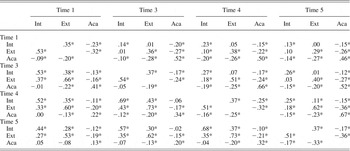
Correlations between the study variables across waves are given in Table 2. Stabilities (i.e., correlations between the same constructs assessed across time) are all high. However, stabilities between teacher reports are lower than stabilities between parent reports. This difference is because per individual the teachers virtually always differed across wave, whereas parents were largely identical reporters (>85% mother). In the Dutch primary education system until age 12 years, teachers change each academic year; similar changes occur in secondary school. As expected, internalizing and externalizing problems were negatively associated with academic performance.
Correlations among parent-reported internalizing and externalizing problems and teacher-reported academic performance versus teacher-reported internalizing and externalizing problems and parent-reported academic performance

Note: Int, Internalizing problems; Ext, externalizing problems; Aca, academic performance.
*p < .05.
Cross-lagged models
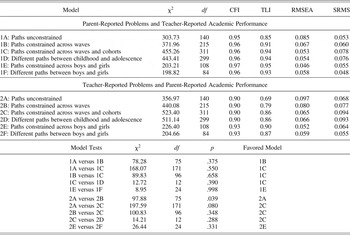
Table 3 shows the results of the tests among the models within the two series of four models each. The first series concerns the models (1a–1d) describing the paths between parent-reported internalizing problems, parent-reported externalizing problems, and teacher-reported academic problems. Models 1b, 1c, and 1d in this series have acceptable (CFI ≥ 0.90, TLI ≥ 0.90, RSMEA ≤ 0.80) to good (CFI ≥ 0.95, TLI ≥ 0.95, RMSEA ≤ 0.50) fit, whereas the TLI and RMSEA of Model 1a are somewhat below or above these thresholds, respectively. When comparing the models with χ2 difference tests, Model 1c in which paths are constrained across waves and cohorts was the best fitting model.
Fit statistics of and comparisons between cross-lagged models of bidirectional paths between internalizing problems, externalizing problems, and academic performance

Note: CFI, Comparative fit index; TLI, Tucker–Lewis index; RMSEA, root mean square error of approximation; SRMS, standardized root mean square residual.
The second series of models (2a–2d) in Table 3 concern pathways between teacher-reported problem behavior and parent-reported academic performance. The fit measures of the models in the second series are slightly worse than those in the first series. The CFIs and RMSEAs indicate acceptable fit, whereas the TLIs are below the threshold. The χ2 difference tests favor Model 2c, in line with the favored model of the first series. We thus selected Models 1c and 2c as the final models.
A formal comparison between Models 1c and 1d and between Models 2c and 2d tests whether pathways before age 12 years were different from pathways after age 12 years (1d and 2d). The χ2 difference tests suggest that there are no age differences (1c and 2c).
Regarding gender invariance, the χ2 difference test of comparing Models 1e and 1f was not significant, nor was the χ2 difference test comparing Models 2e and 2f. Thus, the models with constrained pathways between boys and girls fit best, suggesting that there were no differences between boys and girls.
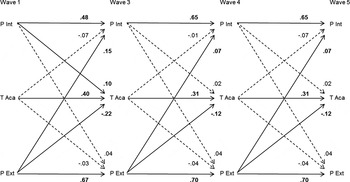
Figure 2 displays the final model that tests the cross-lagged paths of parent-reported internalizing and externalizing problems with teacher-reported academic performance. All coefficients are unstandardized estimates. We standardized all variables except gender before conducting the cross-lagged analyses; thus, the coefficients are comparable across variables, waves, and cohort. The standardized coefficients (results not shown) are very similar to the unstandardized coefficients. The model demonstrates high significant stability coefficients for internalizing (0.48–0.65) and externalizing problems (0.67–0.70) and somewhat lower stability paths for academic performance paths (0.31–0.40). Figure 2 also shows that the strongest crossed-lagged paths are from externalizing problems to academic performance (–0.12 to 0.22). There is only one significant path (0.10) from internalizing problems at Wave 1 to academic performance at Wave 3. The model does not reveal reverse paths, neither from academic performance to internalizing problems nor from academic performance to externalizing problems. Regarding problem behavior, there are only significant paths from externalizing to internalizing problems and not from internalizing to externalizing problems. All models also account for concurrent associations (not shown), which are all significant.
Cross-lagged model examining paths between parent-reported internalizing problems, parent-reported externalizing problems, and teacher-reported academic performance. Solid lines indicate significant paths (p < .05). P Int, parent-reported internalizing problems; P Ext, parent-reported externalizing problems; T Aca, teacher-reported academic performance.

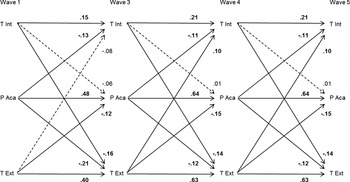
The results of the model based on teacher-reported internalizing and externalizing problems and parent-reported academic performance are shown in Figure 3. Although all paths in Model 1c are also significant in Model 2c, there are some notable differences between the two models. First, the stability paths of internalizing problems are lower than those in Model 1c, whereas the stability paths of academic performance are higher than those in Model 1c. Second, in Model 1c none of the paths from academic performance to internalizing and externalizing problems are significant, whereas all corresponding paths in Model 2c are significant with coefficients ranging from –0.11 to –0.12. Third, in addition to paths from externalizing to internalizing problems as in Model 1c, there are negative paths (–0.14 to –0.16) from internalizing to externalizing problems. Thus, higher scores of internalizing problems lead to lower scores of externalizing problems, which suggests that internalizing problems protects against externalizing problems. Like in Model 1c, all associations between concurrent variables are significant.
Cross-lagged model examining paths between teacher-reported internalizing problems, teacher-reported externalizing problems, and parent-reported academic performance. Solid lines indicate significant paths (p < .05). T Int, teacher-reported internalizing problems; T Ext, teacher-reported externalizing problems; P Aca, parent-reported academic performance.

Discussion
The current study tested two series of cross-lagged models. One series examined bidirectional paths between parent-reported internalizing and externalizing problems versus teacher-reported academic performance. The other series involved teacher-reported internalizing and externalizing problems versus parent-reported academic performance. The two final best fitting models revealed marked similarities regardless of the informants who reported on problem behavior or on academic performance. First, there were significant pathways from externalizing problems to subsequent academic performance throughout the study period, over and above within-time associations. This was consistent over time and remained accounting for the covariates gender and parents' SES in both final models. Second, pathways from internalizing problems to academic performance did not emerge in either of the final models.
However, there were some differences between the two final models as well. Paths from parent-reported academic performance to teacher-reported internalizing problems and to externalizing problems were observed, but these paths were not found when teachers reported on problem behavior and parents on academic performance. A further difference concerns the negative paths from internalizing to externalizing problems that were only observed for teacher reports. These observed pathways must be interpreted with caution given the lack of consistency across informant pair.
Unlike previous studies, we examined two series of models in which the two different informants on problem behavior and academic problems were interchanged. Some differences in findings from these series of models may be because teachers were almost always different across waves of one individual, whereas the mother was in more than 85% of the cases the informant in adjacent waves. This difference between teacher and parent report is probably not the sole reason for the difference in results, because there were also clearly consistent findings observed in the two final models.
Our study covered a broader age range and longer follow-up interval than most previous studies, which enabled us to test whether bidirectional pathways between problem behavior and academic performance in childhood differed from pathways in adolescence. However, we did not observe any differences by age period in our study.
Bidirectional paths
The consistent finding in our study concerns the pathway between externalizing problems and subsequent academic performance. This has repeatedly been reported in studies also applying cross-lagged models to test the relation between problem behavior and academic performance. Our finding clearly supports the adjustment erosion hypothesis, which suggests that problem behavior weakens academic performance and raises vulnerability to problems in other areas. Behaviors such as impulsivity or hostility, which accompany externalizing problems, may interfere with children's functioning in school. Children with these problems more often experience negative responses from their teachers and peers, which creates an unfavorable learning environment leading to poor academic performance (Chen et al., Reference Chen, Huang, Chang, Wang and Li2010; Moilanen et al., Reference Moilanen, Shaw and Maxwell2010). The pathway from externalizing problems to academic performance is especially worrisome, because there is evidence that this pathway entails risks of adverse outcomes in adulthood such as crime (Jakobsen, Fergusson, & Horwood, Reference Jakobsen, Fergusson and Horwood2012). Interventions should therefore attempt to break this pathway to circumvent problems later in life.
A second consistent finding concerns the absence of a pathway from internalizing problems to academic performance, which is in line with most previous studies (Burt & Roisman, Reference Burt and Roisman2010; Defoe et al., Reference Defoe, Farrington and Loeber2013; Masten et al., Reference Masten, Roisman, Long, Burt, Obradovic and Riley2005; Moilanen et al., Reference Moilanen, Shaw and Maxwell2010; Riglin et al., Reference Riglin, Frederickson, Shelton and Rice2013). This pathway emerged in some studies using cross-lagged models (Englund & Siebenbruner, Reference Englund and Siebenbruner2012; Obradović et al., Reference Obradović, Burt and Masten2010; Verboom et al., Reference Verboom, Sijtsema, Verhulst, Penninx and Ormel2014). However, most of these studies did not include externalizing problems in their cross-lagged models, which can have contributed to the presumed effect of internalizing problems. In line with this, the meta-analysis of Esch et al. (Reference Esch, Bocquet, Pull, Couffignal, Lehnert and Graas2014) suggested that the association between internalizing disorders and educational attainment was explained by co-occurring disruptive behaviors. The study of Obradović et al. (Reference Obradović, Burt and Masten2010) most clearly demonstrated this effect. When externalizing problems at baseline were entered in the crossed-lagged model, the pathway from baseline internalizing problems to subsequent academic functioning disappeared. Prior research also demonstrated that poor social rather than academic functioning predicted internalizing problems (Masten et al., Reference Masten, Roisman, Long, Burt, Obradovic and Riley2005). In the association between problem behavior and social competence, internalizing problems were more typically the outcome than a predictor (Burt & Roisman, Reference Burt and Roisman2010; Obradović et al., Reference Obradović, Burt and Masten2010). In contrast, externalizing problems typically precede poor academic performance (Burt & Roisman, Reference Burt and Roisman2010; Chen et al., Reference Chen, Huang, Chang, Wang and Li2010).
Our results only partially confirmed the cascading pathways from externalizing problems to subsequent academic performance and from academic performance to internalizing problems as found in previous studies (Burt & Roisman, Reference Burt and Roisman2010; Masten et al., Reference Masten, Roisman, Long, Burt, Obradovic and Riley2005; Moilanen et al., Reference Moilanen, Shaw and Maxwell2010; van Lier et al., Reference van Lier, Vitaro, Barker, Brendgen, Tremblay and Boivin2012). In the present study, we found that only if studied by teacher report, but not if studied by parent report, externalizing problems ignited a cascade of poor academic function. A possible explanation for this discrepancy of association patterns obtained by using different informants could be that teachers tend to rate problem behavior of children with low grades more negatively than parents do (Loveland, Lounsbury, Welsh, & Buboltz, Reference Loveland, Lounsbury, Welsh and Buboltz2007). Because of this reporting tendency, the model with teacher-reported problem behavior may have revealed more pathways from academic performance to internalizing problems than the model with parent-reported problem behavior. Because we found only partial support for the pathway from academic performance to internalizing problems, our results arguably corroborate the academic incompetence hypothesis, which suggests that poor academic functioning leads to problem behavior, less convincingly. However, we certainly do not rule out that children with low academic performance encounter negative feedback from teachers and parents, which in turn may lead to negative mood (Moilanen et al., Reference Moilanen, Shaw and Maxwell2010).
A further finding is that internalizing problems are negatively associated with subsequent externalizing problems, which is in line with results from previous studies (Englund & Siebenbruner, Reference Englund and Siebenbruner2012; Masten et al., Reference Masten, Roisman, Long, Burt, Obradovic and Riley2005). Thus, internalizing problems can “protect” against externalizing problems, which is supported by the finding that inhibition and anxiety protect against delinquency (Defoe et al., Reference Defoe, Farrington and Loeber2013; Kerr, Tremblay, Pagani, & Vitaro, Reference Kerr, Tremblay, Pagani and Vitaro1997). Thus, internalizing problems, an important disadvantageous outcome and an important risk factor for adverse outcomes such as suicide, is probably negatively related to other unfavorable outcomes (Masten et al., Reference Masten, Roisman, Long, Burt, Obradovic and Riley2005). Anxious children may fare better in school as a result of their conscientiousness and discipline that are associated with anxiety. Nevertheless, externalizing problems clearly preceded internalizing problems in the present study. Aggressive and hostile children may interact with peers in a damaging way leading to their rejection. As a consequence, these children are feeling worthless and may develop depressive symptoms (Moilanen et al., Reference Moilanen, Shaw and Maxwell2010; van Lier et al., Reference van Lier, Vitaro, Barker, Brendgen, Tremblay and Boivin2012).
Our sample was selected from the general population. Therefore, only a small number of children in the sample exhibited elevated levels of internalizing and externalizing problems. About 13% of the children had scores above the clinical cutoff on parent-reported internalizing problems and about 15% scored above the clinical cutoff on externalizing problems. These low numbers may have an effect on the concurrent and longitudinal associations between problem behavior and academic performance. It is possible that the associations are stronger in clinical samples than in population samples. However, clinical samples are often not representative regarding gender, age, socioeconomic background, ethnicity, and other confounders. Thus, the associations observed in clinical sample are often biased (Angold, Costello, & Erkanli, Reference Angold, Costello and Erkanli1999).
Age and gender differences
We did not find different bidirectional pathways between childhood and adolescence. Although the prevalence of disorders is higher in adolescence than in childhood (Offord et al., Reference Offord, Boyle, Szatmari, Rae-Grant, Links and Cadman1987) and cognitive task may be more challenging in adolescence, the impact of pathways from internalizing and externalizing problems to academic performance or vice versa do not differ between the two developmental periods. If the detrimental effects of externalizing problems on academic performance are observed throughout the age span from 6 to 18, intervention programs must account for these effects. To intervene at an early age may be most beneficial. Because only a few studies tested age differences of the bidirectional pathways and reveled contradicting findings, more research is needed.
We did not observe gender differences in the bidirectional pathways between problem behavior and academic problems. Our findings are in line with most previous studies that tested gender differences in cross-lagged models. The two studies that reported differences between boys and girls only included internalizing problems in their models (Obradović et al., Reference Obradović, Burt and Masten2010; Verboom et al., Reference Verboom, Sijtsema, Verhulst, Penninx and Ormel2014). Possibly, not accounting for externalizing problems contributed to the observed gender differences.
Implications
The salient finding that externalizing problems adversely affects subsequent academic performance calls for intervention programs addressing these problems (see for an overview Barnes, Smith, & Miller, Reference Barnes, Smith and Miller2014; Wilson & Lipsey, Reference Wilson and Lipsey2007). Albeit, less clearly, our results also showed pathways from academic performance to internalizing and externalizing problems, indicating that academic performance may also be a worthwhile target for interventions that may lower the risk of problem behaviors (see Campbell et al., Reference Campbell, Ramey, Pungello, Sparling and Miller-Johnson2002; Reynolds et al., Reference Reynolds, Temple, Ou, Robertson, Kersky and Topitzes2007). The finding that the adverse effect of externalizing problems on academic performance is observed across 6 to 18 years implies that effective interventions should target children. The sooner an intervention will lower externalizing problems, the more it will impede adverse effects of externalizing problems. A next step for research is to determine mediators influencing the pathway from externalizing problems to academic functioning. Victimization, self-esteem, social competence, peer influences, and parenting (Masten et al., Reference Masten, Roisman, Long, Burt, Obradovic and Riley2005; van Lier et al., Reference van Lier, Vitaro, Barker, Brendgen, Tremblay and Boivin2012) are likely candidates that may underlie the pathways from externalizing problems to academic performance demonstrated in the present study.
Strengths and limitations
A strength of this study is the consistent set of instruments that were used to assess problem behavior and academic performance. Identical instruments were used for assessments across waves and ages. Although not identical, the CBCL and TRF are instruments for parents and teachers, respectively, that overlap greatly in content and have identical item formats. Both problem behavior and academic performance were rated by different informants. The current study comprises an age span of 12 years. The multiple age cohorts from 6 to 10 years and the statistical analysis accounting for these cohorts enabled us to examine bidirectional paths from 6 to 18 years covering childhood as well as adolescence. Most previous studies comprise shorter intervals, up to 5 years, and cover only childhood or only adolescence.
We must also discuss some limitations. Our academic performance measure was based on ratings by parents and teachers. However, parents may be not the best reporters of their children's academic performance, because it is not directly observed by them. In contrast, teachers may rate children's academic performance as less favorable because of their disrupting behavior. Using independent standardized test results may resolve these two problems.
We included only a few covariates in the study, and thus cannot demonstrate whether other shared risk factors confound the associations of internalizing problems, externalizing problems, and academic performance (Moilanen et al., Reference Moilanen, Shaw and Maxwell2010). In addition, we did not add mediation analyses by parent or child characteristics such as parenting style or child temperament. However, we included gender and parents' SES as control variables in line with many previous studies. Other studies also controlled for variables such as cognitive ability, parenting, neighborhood adversity, and maternal sensitivity, although none of these affected the effect estimates of the overall cross-lagged paths substantially in previous studies.
Future directions
In light of the current study and prior research, several issues should also be addressed in future studies. The majority of previous studies examining bidirectional paths between problem behavior and academic performance comprised limited age ranges throughout the interval period. Only a few studies with repeated assessments followed children over longer intervals that crossed developmental periods (i.e., from childhood to adolescence or to adulthood). More studies are needed with longer follow-up intervals beginning at an early age. Such studies will provide more insight into when interventions may be most successful.
It is also important to study how the paths between problem behavior and academic function are mediated by other domains of functioning. Previous studies have, for example, focused on social competence, victimization, and self-esteem as mediators. However, not only must more mediators be addressed, but the role of potential mediators must be evaluated more rigorously using, for example, multiple informants in contrasting the models. We showed the value of using different combinations of the same informants in a set of analyses, where both informants' reports were used but either for the outcome or for the determinant.
Conclusion
Externalizing problems preceded academic problems, whereas such a prospective association did not emerge for internalizing problems. Some evidence for the reversed association was also found: poor academic performance predicted externalizing and internalizing problems. This direction of association was less clear because it was not independent of the rater of the academic performance. However, teacher-rated poor academic performance predicted increasing levels of internalizing and externalizing problems over a long follow-up time. All findings were observed using different raters for determinant and outcome and taking preexisting problems into account.