An association between acute kidney injury and cardiopulmonary bypass has been documented in the literature.Reference Chiravuri, Riegger and Christensen 1 – Reference Pickering, James and Palmer 3 Cardiopulmonary bypass-related acute kidney injury after paediatric cardiothoracic surgery has been shown to be associated with higher early morbidity and increased health-resource utilisation.Reference Toth, Breuer and Cserep 2 Further, a recent meta-analysis of 242,388 adult patients found that cardiopulmonary bypass-associated acute kidney injury is associated with a more than twofold increase in early postoperative mortality.Reference Pickering, James and Palmer 3
Patients born with hypoplastic left heart syndrome variant need establishment of a reliable source of pulmonary and systemic blood flow in the neonatal period. This has been achieved historically through the Norwood procedure and by placing a systemic–pulmonary shunt under cardiopulmonary bypass. In recent years, the Hybrid procedure has emerged as an alternative for palliation of hypoplastic left heart syndrome with the aim of avoiding cardiopulmonary bypass in the neonatal period.Reference Akintuerk, Michel-Behnke and Valeske 4 Although initial reports of the Hybrid procedure were promising, more recent studies have shown conflicting results.Reference Caldarone, Benson and Holtby 5 – Reference Photiadis, Sinzobahamvya and Hraska 7 A recent analysis of the Society of Thoracic Surgeons Congenital Heart Surgery Database revealed that the Hybrid procedure is being performed, not as an alternative to the Norwood operation for standard risk patients, but as a procedure reserved for patients perceived to be at a high risk for cardiopulmonary bypass.Reference Karamlou, Overman and Hill 8
There are currently no studies evaluating the prevalence of acute kidney injury after the Hybrid procedure. This analysis is important as the avoidance of cardiopulmonary bypass may be beneficial, whereas the intravenous contrast used as part of the Hybrid procedure may be detrimental to the kidneys.Reference Byrd and Sherman 9 – Reference Bianchi, Carboni and Pesce 11 Our study objective was to compare the prevalence of acute kidney injury following Hybrid procedure and after the Norwood operation in a cohort of neonates with a functionally univentricular heart. Further, we evaluated the risk factors for acute kidney injury and the association, if any, between acute kidney injury and short-term outcomes in this population.
Materials and methods
This was a single-centre retrospective study involving neonates of either gender, who underwent the Hybrid procedure or Norwood operation as initial palliation for a hypoplastic left heart syndrome variant of functionally univentricular heart between June, 2008 and June, 2015. These 7 years included three eras of institutional practice: from 2008 to October 2009, all patients with a functionally univentricular heart underwent the Norwood procedure; from November, 2009 to the first half of 2013, all patients underwent the Hybrid procedure; and from the second half of 2013 to 2015, the majority of patients underwent Norwood operation whereas the Hybrid procedure was reserved for patients who were deemed to be unfit to undergo cardiopulmonary bypass. Patients were excluded if they required cardiopulmonary bypass during the Hybrid procedure, died within 48 hours of the procedure, required extracorporeal membrane oxygenation within 24 hours of the procedure, or if their medical records were incomplete. Patients who initially underwent the Hybrid procedure followed by a Norwood procedure were only included in the Hybrid group. Approval for the study and for waiver of parental consent was obtained from the Institutional Review Board at Wayne State University.
Demographic data including age, gender, race, and primary cardiac diagnosis were collected. The primary outcome was acute kidney injury or failure categories, defined by the paediatric risk, injury, failure, loss, and end-stage (pRIFLE), criteria based on the change in glomerular filtration rate from before the procedure to the subsequent 72 hours.Reference Lex, Toth and Cserep 12 The presence of mild acute kidney injury or risk based on pRIFLE criteria was not considered in the primary outcome variable as previous studies have shown no difference between this group and patients without acute kidney injury.Reference Taylor, Carmona and Thiagarajan 13 Serum creatinine level was collected from the medical records preoperatively, at 24, 48, and 72 hours after surgery, and just before discharge. Acute kidney injury at any time point between the procedure and discharge or death was also reported.
Systolic, diastolic, and mean arterial pressures (mmHg) were collected using arterial line data during the first 48 hours of admission to the cardiac ICU. Central venous pressure measurements (mmHg) and mixed venous saturation were collected from internal jugular or femoral lines for the time they were available. Haemodynamic data, including heart rate, were collected from nursing flow sheets in the electronic medical records. Data regarding the number and volume of packed red blood cell transfusions, urine output, total daily output, total daily intake, and absolute daily fluid balance were collected. Use of nephrotoxic drugs, namely aminoglycosides, vancomycin, amphotericin, and angiotensin-converting enzyme inhibitors during the first 48 hours after arrival to the cardiac ICU was recorded.
For patients who underwent the Norwood operation, both deep hypothermic circulatory arrest and regional low-flow perfusion were used for neuroprotection. The circulatory arrest time was defined as the combined duration of deep hypothermic circulatory arrest and regional low-flow perfusion, which represents the time of renal ischaemia. Inotropic support with milrinone and a beta-agonist agent was initiated before discontinuation of cardiopulmonary bypass and, subsequently, adjusted based on the clinical condition and central blood pressure at the discretion of the attending anaesthesiologist or cardiothoracic surgeon. The titration, change, or discontinuation of vasoactive agents in the postoperative period was at the joint discretion of the cardiothoracic surgeon and paediatric intensivist guided by the clinical status of the patient. The doses of each vasoactive agent were recorded hourly for the first 48 hours upon admission to the cardiac ICU following first-stage single ventricle palliation. Hourly Vasoactive Inotropic Score was calculated using the following formula:
 $$\eqalignno{ {\rm VIS} \, \equals & \,{\rm dopamine }\ (\rm mcg/kg/min)\, \cr & \plus \, {\rm dobutamine\ (mcg/kg/min)} \cr \plus 100 \times {\rm epinephrine\ (mcg/kg/min) }\cr \plus {\rm 100\ norepinephrine \ (mcg/kg/min)}\cr + 10 \times{\rm milrinone \ (mcg/kg/min)}\cr \plus 10,\!000 \times{\rm vasopressin \ (mUnits/kg/min)}. ^{14,15} $$
The highest Vasoactive Inotropic Score in the initial and subsequent 24 hours following admission to the cardiac ICU were taken for further analysis. In addition to Vasoactive Inotropic Score, we collected data on haematological and biochemical measures. Postoperative lactate concentration was measured using ABL 800 (Radiometer America Inc., Brea, California, United States of America) with each blood gas analysis and was recorded at cardiac ICU arrival and at 3, 6, 9, 12, 24, 36, and 48 hours thereafter. The highest lactate concentrations measured in the first and second 24 hours were used for further analysis.
Data on the following outcomes were collected before discharge: death, cardiopulmonary resuscitation, arrhythmias defined as the presence of haemodynamically significant supra-ventricular tachycardia, junctional ectopic tachycardia, or ventricular tachycardia or fibrillation that required medical intervention, culture positive for infection requiring exploration or antibiotics, acute neurological injury defined as infarct demonstrated on imaging or clinical seizures that required medical intervention, and the need for renal replacement therapy.
Statistical analysis
Data were analysed using SPSS software for PC (version 20, SPSS Inc., Chicago, Illinois, United States of America). Results were expressed as the mean±SD or as the median [interquartile range (IQR)] for continuous variables and as numbers (percentage) for nominal or categorical variables. Comparison between groups was performed using χ2 test, Mann–Whitney U test, or Fisher’s exact test, as appropriate. We performed binary logistic regression analysis to examine the association between postoperative acute kidney injury and intraoperative and preoperative variables previously shown to affect acute kidney injury, such as preoperative creatinine clearance or weight, and those found to be significantly different between groups on bivariate comparative analysis. Odds ratio values were calculated with 95% confidence intervals (C.I.). Significance was taken as a p value of <0.05.
Results
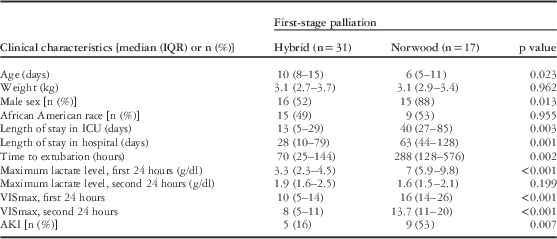
A total of 57 patients with a hypoplastic left heart syndrome variant of a functionally univentricular heart underwent first-stage palliation in our institution over the 7-year study period. We excluded five patients who had incomplete medical records, one patient who underwent the Hybrid procedure under cardiopulmonary bypass, and three patients who required early extracorporeal membrane oxygenation support. The study cohort comprised 48 patients of whom 35 had hypoplastic left heart syndrome, four had unbalanced atrioventricular canal, three had double-inlet left ventricle with arch hypoplasia, and six had other functionally univentricular heart; 31 of the 48 underwent the Hybrid procedure and 17 underwent the Norwood operation. The demographic characteristics and perioperative variables of our study cohort are summarised in Table 1. The majority of the cohort was male (65%), African Americans comprised 50%, 37.5% were Caucasian, and 12.5% belonged to other races. At the time of first-stage palliation the mean (SD) weight, height, and age were 3.1 (±0.6) kg, 49.6 (±2.6) cm, and 12 (±10) days, respectively. Significant differences between groups were noted for a higher age, female preponderance, shorter length of stay in the ICU and hospital, shorter time to extubation, lower postoperative lactate levels, and Vasoactive Inotropic Score in the Hybrid group, compared with the Norwood group.
Demographic characteristics and perioperative variables.

AKI=acute kidney injury; VIS=Vasoactive Inotropic score
The p value is for the χ2 test for categorical variables and Mann–Whitney U test for continuous variables for between-group comparisons. Data are presented as n (%) for categorical variables and as the median (25th–75th percentiles) for continuous variables
The median preoperative estimated glomerular filtration rate by the Schwartz formula (k=0.45) was 55 ml/minute/1.73 m2 (IQR: 39–71 ml/minute/1.73 m2). Baseline serum creatinine was high, defined as a creatinine value higher than the 97.5th percentile for age in seven patients (15%).Reference Boer, de Rijke and Hop 16
A total of 14 patients (29%) developed acute kidney injury within 72 hours after first-stage palliation, 12 of whom had evidence of acute kidney injury in the first 24 hours. The prevalence of acute kidney injury was 16% in the Hybrid group and 53% in the Norwood group. There was no statistical difference in the prevalence of acute kidney injury among the different surgical eras included in the study (p=0.22). Total circulatory arrest time, cardiopulmonary bypass time, and aortic cross-clamp time did not have a statistically significant impact on the development of acute kidney injury in the Norwood group (95% C.I.: Mann–Whitney U test, p=0.98, p=0.65, and p=0.52, respectively). Renal function recovered over time in most infants with only three patients, all of whom were in the Hybrid group, still showing evidence of acute kidney injury before discharge. No patient received renal replacement therapy during hospitalisation after first-stage palliation.
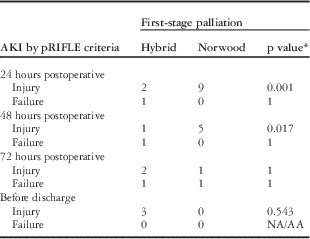
The prevalence of acute kidney injury, based on pRIFLE classification of injury or failure, was higher in the Norwood group 24 and 48 hours after the procedure but comparable at later time points (Table 2). During the first 24 hours, the risk of developing kidney injury or failure as per pRIFLE criteria for the Norwood group was 10.5 (95% C.I.: 2.3–48.2, p=0.0025) compared with the Hybrid group, and remained high at 48 hours [odds ratio (OR) 6.2 (95% C.I.: 1.02–35.55), p=0.046). Overall, infants who underwent the Hybrid procedure had a significantly lower probability of postoperative acute kidney injury [OR 0.17 (95% C.I.: 0.04–0.66), p=0.01]. The intravenous contrast used in the Hybrid procedure was Optiray 350 and the mean (SD) amount used was 4.4 (±2.4) g/kg. There was no statistical difference between the acute kidney injury and the non-acute kidney injury group in terms of the contrast amount used in the Hybrid procedure (p=0.7).
Acute kidney injury (AKI) during the first 72 hours in the ICU

pRIFLE=paediatric risk, injury, failure, loss, and end-stage
* The p value is for the Fisher’s exact test analysing independent variables for between-group comparisons
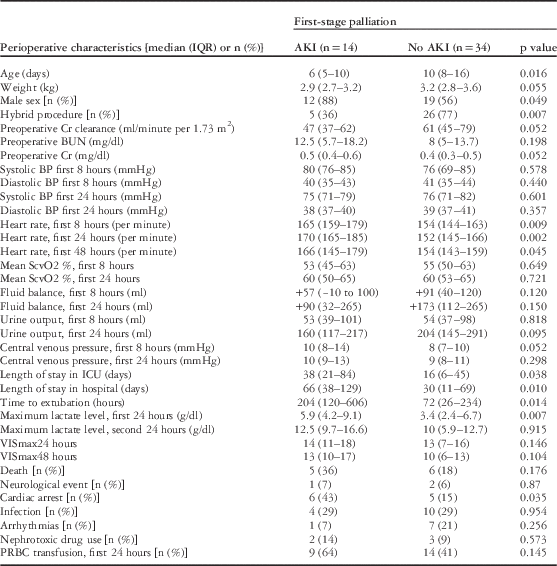
We then compared perioperative variables between the group that developed acute kidney injury and the group that did not (Table 3). There were significant differences between the groups in terms of age, sex, type of procedure – that is, Hybrid versus Norwood – average heart rate, length of stay in the cardiac ICU and in the hospital, time to extubation, maximum lactate concentration in the first 24 postoperative hours, and cardiac arrest. On binary logistic regression analysis, higher heart rate during the first 24 hours, lower weight, and lower preoperative creatinine clearance were independently associated with development of postoperative acute kidney injury (p=0.03, p=0.04, and p=0.01, respectively).
Perioperative characteristics divided by the presence of acute kidney injury (AKI)

BP=blood pressure; BUN=blood urea nitrogen; IQR=interquartile range; PRBC=packed red blood cells; ScvO2=mixed venous saturation; VIS=Vasoactive Inotropic score
The p value is for the χ2 test for categorical variables and Mann–Whitney U test for continuous variables for between-group comparisons. Data are presented as n (%) for categorical variables and as the median (25th—75th percentiles) for continuous variables
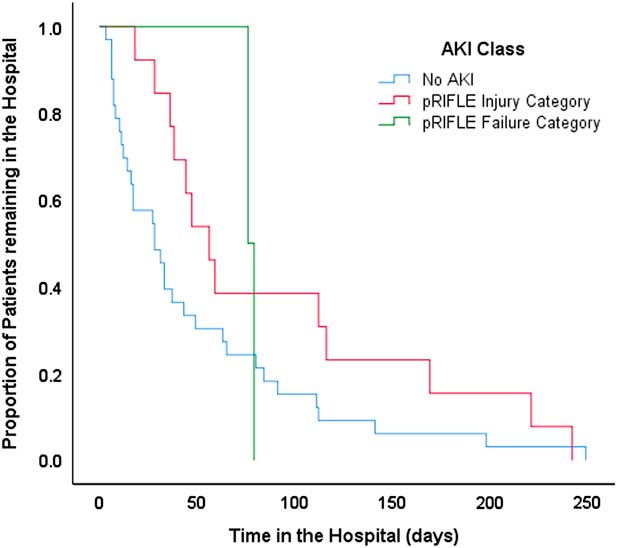
Figure 1 shows the length of hospital stay in days in groups of infants categorised by pRIFLE categories of acute kidney injury in a Kaplan–Meier curve analysis. A longer stay in the hospital was noted for patients with renal injury (pRIFLE) (Breslow; p=0.04) compared with the non-acute kidney injury group. The two patients who developed postoperative renal failure by pRIFLE had long postoperative courses and died before discharge from associated morbidities as shown in Figure 1. Follow-up investigation before stage-2 surgical palliation revealed mean (SD) creatinine and creatinine clearance of 0.3 mg/dl (0.1) and 99 ml/minute per 1.73 m2 (50), respectively; only one patient in the Hybrid group had persistent acute kidney injury.
Kaplan–Meier curve for length of hospital stay after first-stage palliation, stratified by degree of acute kidney injury by paediatric risk, injury, failure, loss, end-stage renal disease (pRIFLE) criteria.

Discussion
The prevalence of acute kidney injury after first-stage surgical palliation of a univentricular heart was 29% for our cohort. This is comparable to a previous study by Aydin et alReference Aydin, Seiden and Blaufox 17 who reported an acute kidney injury prevalence as per injury or failure categories of 32% following surgery for CHD in 87 neonates who were <1 month of age. Morgan et alReference Morgan, Zappitelli and Robertson 18 reported a 64% rate of acute kidney injury based on the acute kidney injury network (AKIN) criteria in 264 neonates undergoing complex cardiac surgery, mainly in the risk adjustment for congenital heart surgery 2–4 categories. Of these, 29% of neonates had acute kidney injury stages 2 and 3, data very similar to ours. To our knowledge, our analysis is the only one limited to a population of neonates with single ventricle physiology, who underwent surgical Norwood repair or Hybrid procedure at an early postnatal age. Reported prevalence rates of acute kidney injury, inclusive of milder “risk” categories, following congenital heart surgery in older paediatric populations range from 42% (n=311) to 51% (n=458); younger age has been identified as a risk factor for acute kidney injury.Reference Aydin, Seiden and Blaufox 17 , Reference Li, Krawczeski and Zappitelli 19
In our study, postoperative acute kidney injury at 24 and 48 hours developed significantly more often in infants who underwent Norwood repair. We attribute this finding to a combination of renal ischaemia due to circulatory arrest and an early generalised inflammatory response, putatively associated with cardiopulmonary bypass. Miklaszewska et alReference Miklaszewska, Korohoda and Zachwieja 20 included 47 children with CHD who underwent cardiopulmonary bypass and found that serum levels of the inflammatory marker interleukin-6 at 2 hours after cardiopulmonary bypass was associated with development of acute kidney injury (p=0.0427). Similarly, Greenberg and the investigators of the TRIBE-AKI Consortium recently published data on 106 children aged 1 month to 18 years undergoing cardiopulmonary bypass and found that preoperative levels of interleukin-6 were associated with a sixfold higher risk for acute kidney injury.Reference Greenberg, Whitlock and Zhang 21 Our data suggest that the effect of inflammatory deregulation surrounding cardiopulmonary bypass is not long lasting as, 72 hours after the insult, there was no difference in the prevalence of acute kidney injury between groups. This is consistent with previous data in a cohort of infants who underwent aortic arch repair, in whom renal function recovery began at a mean of 4 days and was complete 7 days after conservative management.Reference Jang, Kim and Choi 22 Further, closer to discharge, acute kidney injury had resolved in all but three patients, who were interestingly all in the Hybrid group. The acute kidney injury associated with Hybrid procedure, although rare, may be secondary to the cryptogenic renal effects of intravenous contrast agents. The relationship between intravenous contrast agents and renal injury has been well studied and reported.Reference Byrd and Sherman 9 Even in this era of new, less-nephrotoxic intravenous contrast agents, Sagy et alReference Sagy, Aladjem and Shem-Tov 10 reported that patients with left ventricular overload had significant post-contrast nephrotoxicity following cardiac catheterization (baseline creatinine 0.53±0.15 mg/dl versus 0.70±0.27 mg/dl afterwards; p<0.01). Bianchi et al reported that angiography, if performed within 14 days of cardiothoracic surgery, had a significant long-lasting effect on renal function. Patients with postoperative kidney dysfunction received a significantly (p<0.001) larger dose of iodine contrast media (4.6±2.6 g/kg) compared with others (2.8±2.2 g/kg) and an increase in relative risk of renal failure of 16% per each incremental iodine dose of 1 g/kg.Reference Bianchi, Carboni and Pesce 11 The amount of contrast used in our cohort was similarly large (4.4±2.4 g/kg), although in our cohort there was no difference between the amount of contrast used between groups with and without acute kidney injury; measures to protect the renal vasculature from contrast-induced nephrotoxicity like appropriate fluid administration should be considered when performing the Hybrid procedure.
Interestingly, the postoperative heart rate was significantly higher in the group who developed acute kidney injury, which could be attributed to a relative state of low cardiac output and renal hypoperfusion during the first postoperative hours as an antecedent for kidney damage. Further prospective studies that include fluid status assessment and intervention should be performed to test this hypothesis; elevated heart rate could also be related to postoperative pain or systemic inflammatory response syndrome.
Previous studies in neonates following congenital heart surgery have identified lower age, gestational age, and body weight, longer cardiopulmonary bypass time, preoperative aminoglycoside use, small kidneys on renal ultrasound scanning, lower preoperative serum creatinine level, absence of prerenal impairment, as well as preoperative ventilation as risk factors for postoperative acute kidney injury.Reference Taylor, Carmona and Thiagarajan 13 , Reference Morgan, Zappitelli and Robertson 18 , Reference Jang, Kim and Choi 22 , Reference Piggott, Soni and Decampli 23 These findings suggest that smaller, more vulnerable infants with relatively normal renal function are at a risk for acute kidney injury. The association of acute kidney injury with lower preoperative serum creatinine has been speculated to be due to preoperative fluid overload, lower muscle mass, poorer nutrition, or simply a reflection of the serum creatinine-based definitions of acute kidney injury.Reference Morgan, Zappitelli and Robertson 18 In addition, single ventricle physiology and risk adjustment for congenital heart surgery category have been shown to be independent risk factors for acute kidney injury. In our study, a higher preoperative creatinine clearance and Hybrid procedure were associated with a significantly lower risk for acute kidney injury. Our study included a group of full-term infants who underwent the procedure within the relatively narrow duration of two weeks of age. In this population, a higher creatinine clearance was associated with less, not more, acute kidney injury.
The presence of acute kidney injury was associated with increased length of stay and duration of ventilation in our cohort. These findings are consistent with studies on acute kidney injury in paediatric populations.Reference Taylor, Carmona and Thiagarajan 13 Toth et alReference Toth, Breuer and Cserep 2 reported longer duration of mechanical ventilation (p<0.001) and ICU stay (p<0.001) in patients with postoperative acute kidney injury compared with matched controls. A study by Sethi et al reported longer ICU stay (6±5 versus 2±1 days, p=0.005) in the presence of post-cardiothoracic surgery acute kidney injury in a pediatric cohort of 124 patients.Reference Sethi, Goyal and Yadav 24 An increase in length of hospital stay and postoperative ventilation in neonates with acute kidney injury has also been demonstrated in previous studies.Reference Morgan, Zappitelli and Robertson 18 , Reference Jang, Kim and Choi 22 , Reference Piggott, Soni and Decampli 23 , Reference Blinder, Goldstein and Lee 25 A single meta-analysis in adults found a greater than twofold increase in early mortality with cardiopulmonary bypass-associated acute kidney injury; similarly, neonates and infants with moderate or severe acute kidney injury also had a greater than twofold increase in early mortality.Reference Pickering, James and Palmer 3 , Reference Morgan, Zappitelli and Robertson 18 , Reference Blinder, Goldstein and Lee 25 We did not find a statistically significant increase in mortality with acute kidney injury, although the rates were higher. We speculate that this may have been due to the small sample size or because many infants in our cohort did not undergo cardiopulmonary bypass, making our population different from those in previous studies. The long-term effect of acute kidney injury on morbidity and mortality in patients with single ventricle should be investigated further with prospective studies.
We acknowledge the limitations of our retrospective study. As a single-centre study, the generalisability of the findings are limited. In all, nine patients met exclusion criteria, which could introduce a selection bias. The pRIFLE definition is based on increases in serum creatinine, which may occur after a certain duration and severity of renal injury. Although the pRIFLE definition is widely used and allows comparisons of paediatric data among children with CHD, other definitions have been validated exclusively in neonates. Other biomarkers of acute kidney injury were not evaluated, and neither can we comment on the long-term effects of acute kidney injury in the single ventricle population. Nonetheless, we describe the prevalence, risk factors and impact of acute kidney injury in an extremely vulnerable population of neonates with single ventricle physiology and possible under-perfusion of the kidneys. These insights are important for further interventional studies designed to protect the kidneys and, ultimately, to improve outcomes.
Acute kidney injury is a common complication after first-stage palliation for patients with a hypoplastic left heart syndrome variant of a functionally univentricular heart. Most patients will recover renal function completely before discharge; however, morbidity and health-resource utilisation increases with the presence of acute kidney injury. Interestingly, even though the prevalence of acute kidney injury was less following Hybrid, Hybrid-associated acute kidney injury tended to persist until discharge. Prospective studies should be performed to evaluate and prevent acute kidney injury after first-stage palliation for single ventricle patients.
Acknowledgements
None.
Authors’ Contribution
All authors take responsibility for all aspects of the reliability and freedom from bias of the data presented and their discussed interpretation.
Financial Support
This research received no specific grant from any funding agency, commercial, or not-for-profit sectors.
Conflicts of Interest
None.
Ethical Standards
This article does not contain any studies with research interventions in human participants or animals performed by any of the authors. Being a retrospective study, informed consent was not necessary as collected data had no patient identifiers. Also, informed consent was waived by the IRB at Wayne State University. Institution in which the work has been carried out: Children’s Hospital of Michigan, Detroit, Michigan, United States of America.