

1. Introduction
Taxation has evolved with the nation-building of the modern state and has thus contributed to shaping the critical core of state power. Taxation was once considered ‘the most significant political phenomenon that political scientists have left relatively unexplored’ (Curtis, Reference Curtis1989: 1424). Since then much effort has been expended to explore taxation in western democracies (Webber and Wildavsky, Reference Webber and Wildavsky1986; Rose and Karran, Reference Rose and Karran1987; Levi, Reference Levi1988; Peters, Reference Peters1991; Wilensky, Reference Wilensky2002). The variations in tax systems among mature democracies have been explained by factors, such as political institutions (Steinmo, Reference Steinmo1993; Hays, Reference Hays2003), the founding base of the welfare state (Kato, Reference Kato2003), and the strength of social democratic corporatism (Beramendi and Rueda, Reference Beramendi and Rueda2007).
However, tax development in newly democratized countries, which have modernized their political and economic systems in the globalized world, appears to be different from that of their predecessors (Sandford, Reference Sandford2000; Ebrill et al., Reference Ebrill, Keen, Bodin and Summers2001; Bird and Gendron, Reference Bird and Gendron2007; Bräutigam, Reference Bräutigam, Bräutigam, Fjeldstad and Moore2008; Gordon, Reference Gordon2010; Profeta and Scabrosetti, Reference Profeta and Scabrosetti2010; Corbacho et al., Reference Corbacho, Cibils and Lora2013). Although tax structures are expected to converge along with political and economic development, a significant difference remains between mature democracies and newly democratized countries. That difference does not permit an easy generalization of the relationship between tax development and democracies (Cheibub, Reference Cheibub1998; Profeta et al., Reference Profeta, Puglisi and Scabrosetti2013; Garcia and van Haldenwang, Reference Garcia and von Haldenwang2016).
Recent studies have provided two opposing views concerning the major sources of tax revenues. Some scholars associate democracies with progressive taxation on personal income. Focusing mainly on the modernization processes of Western democracies, Scheve and Stasavage (Reference Scheve and Stasavage2012, Reference Scheve and Stasavage2016) argue that progressive income taxation was developed as a tax to make the rich compensate for the unequal burdens imposed on the masses, such as sacrifices in warfare. Others argue that a regressive tax on consumption is the primary, revenue-raising measure for democracies (Timmons, Reference Timmons2010; Baskaran, Reference Baskaran2014). These views appear contradictory but not if we closely examine and compare tax structures from one country to another. Whereas mature democracies rely on income taxes as well as consumption taxes as revenue sources, young democracies tend to raise more revenue from consumption taxes (Sandford, Reference Sandford2000; Genschel and Seelkopf, Reference Genschel and Seelkopf2016; Swank, Reference Swank2016). The apparently competing views actually highlight different aspects of the modernization process that spans the last three centuries.
This paper illuminates the different development of modern taxation in mature and young democracies. Progressive income taxation was a modern form of taxation, which was developed and institutionalized during the first two waves of democratization. Before the beginning of the third wave (Huntington, Reference Huntington1991), the value-added tax (VAT) was innovated as a modern form of consumption taxation and has become an important alternative to income tax as a revenue source. As a result, most newly democratized countries, which we refer to as the third wave democratizers, introduced the VAT before regime transition and came to rely heavily on it as a major revenue source. The first and second wave democratizers continued to raise significant revenue from income taxation.Footnote 1
The history of tax development underlies the present difference in the tax structures among democracies. Democracies in different waves followed different paths of tax development and continued to rely on taxation, which they institutionalized during their modernization. In other words, the trajectory of modernization has shaped different tax structures.
The remainder of the paper is organized as follows. Section 2 shows that tax structures differ between countries in different waves and do not simply converge along with economic development. To explore the reason for the different tax structures, Section 3 uses brief, country cases to analyze the introduction of different taxes during the first, second, and third waves of democratization. Section 4 discusses the divergent paths of tax development across the waves, and Section 5 concludes with some implications about the relationship between taxation and democracies.
2. Different tax structures in three waves of democracies
Today, taxations on personal income and consumption are major revenue-raising measures, but different countries raise tax revenues in different ways (Aaron, Reference Aaron1981; Bradford, Reference Bradford1986; Boskin and McLure, Reference Boskin and McLure1990; Boskin, Reference Boskin1996). The personal income tax (PIT) is recognized as a fair tax because of its progressive tax schedule, i.e., it requires higher-income earners not only to pay higher taxes but also a larger fraction of their income compared with low-income earners. In contrast, the consumption tax is referred to as a regressive tax because of its imposition of a flat rate, which implies that the rich pay only a small fraction of their income. The public finance literature concurs that consumption taxes – either taxes on particular goods or general consumption taxes such as the VAT-, are easier to collect than income taxes when the level of national income is low and the tax administration is poor (Stiglitz and Rosengard, Reference Stiglitz and Rosengard2015, chapter 17; Mankiw, Reference Mankiw2016, chapter 12).
The literature tends to associate developing countries with a heavy reliance on consumption taxes compared with mature democracies (Sandford, Reference Sandford2000; Genschel and Seelkopf, Reference Genschel and Seelkopf2016; Swank, Reference Swank2016). When we focus on the percentage of PIT revenue in the total tax revenue in each OECD country (which we call PIT share in this paper), it is true that the countries with lower GDP per capita tend to rely less on PITs (Fig. 1a). Also, when we turn to the consumption tax share, the countries with lower GDP per capita tend to rely more heavily on consumption taxes (Fig. 1b). This tendency indicates the possibility that countries will rely more on income taxes and less on consumption taxes as their economy grows.
(a) GDP per capita and personal income tax share (2014). (b) GDP per capita and consumption tax share (2014). Tax revenues of general government. Personal income tax refers to taxes on income, profits and capital gains of individuals (category 1100) in OECD Statistics. Consumption tax refers to taxes on production, sale, transfer, etc. (category 5100) in OECD Statistics. Data: OECD (https://stats.oecd.org/Index.aspx?DataSetCode=REV accessed on 4 December 2016), World Bank (http://data.worldbank.org/indicator/NY.GDP.PCAP.CD accessed on 4 December 2016).

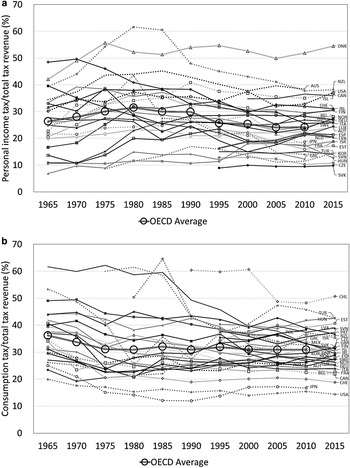
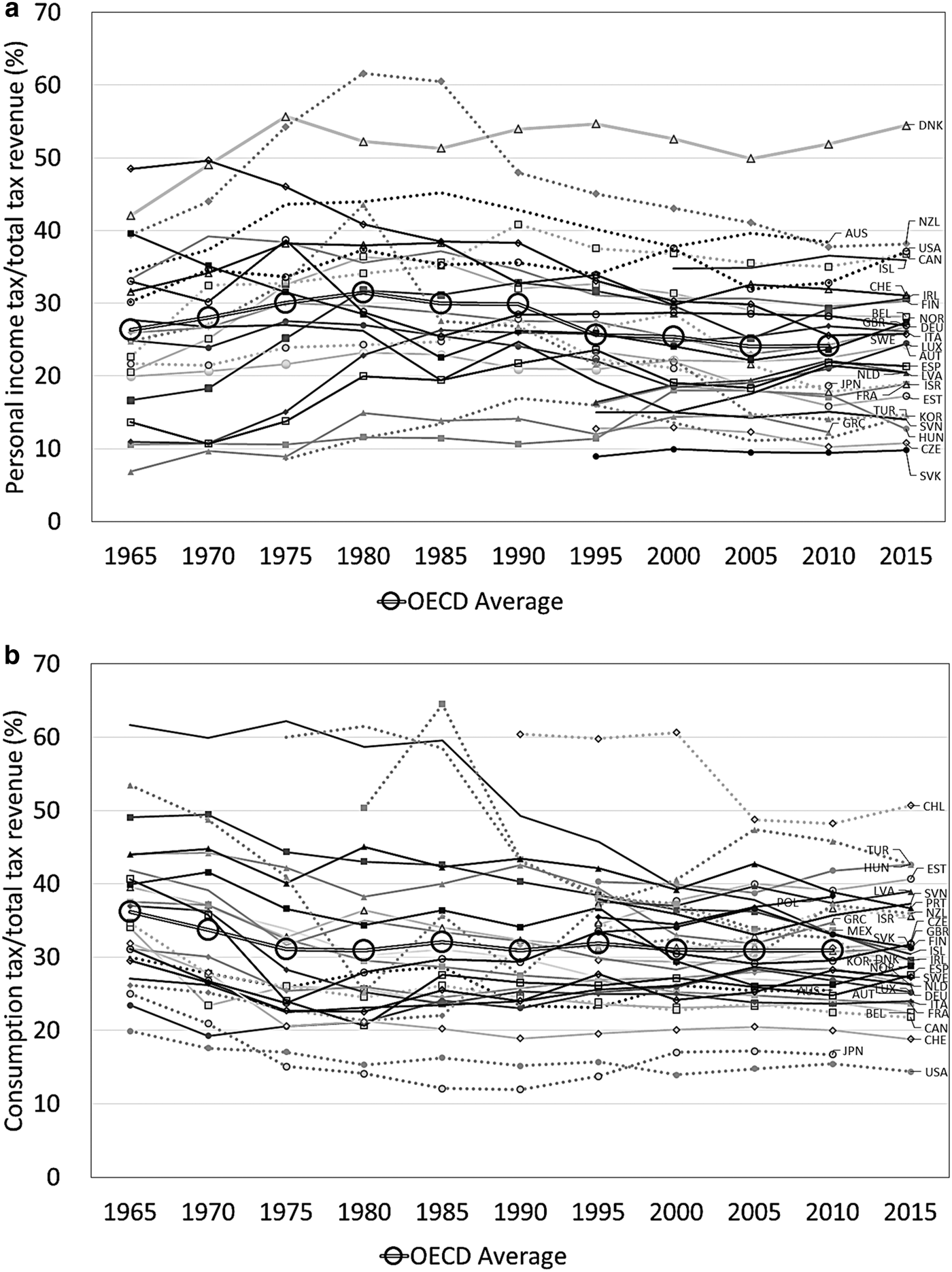
The tax structure, however, has changed very little with economic growth in new comers. Figures 2a and b show a striking stability of tax shares in each OECD countries during the past half-century. Whereas some countries, such as Denmark, Australia, and New Zealand, maintain the highest level of PIT shares throughout the period, other countries, such as Slovakia, the Czech Republic, and Greece, maintain the lowest level (Fig. 2a). As for consumption tax shares, countries such as Chile, Turkey, and Hungary are constantly at the top, and countries such as the USA, Japan, and Switzerland are always at the bottom (Fig. 2b). During the period, some countries enjoyed rapid economic growth and evolved from developing to developed economies. However, little sign of convergence was observed. As a result, the difference in the tax structure persists in mature democracies and newcomers.
(a) Personal income tax shares in OECD countries (1965–2015). (b) Consumption tax shares in OECD countries (1965–2015). Data: OECD (https://stats.oecd.org/Index.aspx?DataSetCode=REV accessed on 4 December 2016).
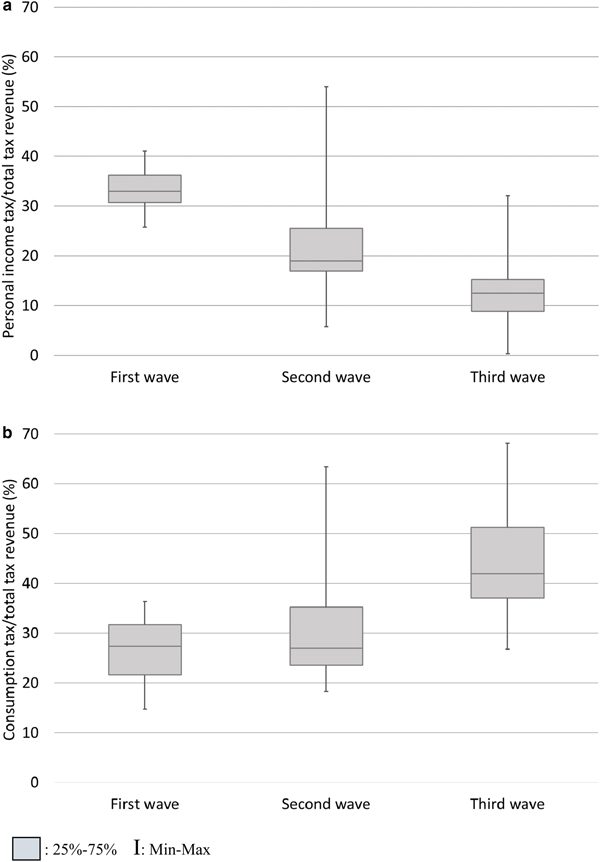
For further investigation, we included in the analysis non-OECD countries and compared the tax shares between the first, second, and third wave democratizers.Footnote 2 Figures 3a and b reveal a clear difference between the waves. As can be seen from Figure 3a, PIT shares in 2014 are highest among the first wave and lowest among the third wave democratizers, with the second wave democratizers between the two.Footnote 3 Figure 3b shows that consumption tax shares in 2014 are clearly higher among countries of the third wave than those of the first and second waves.Footnote 4
(a) Personal income tax shares in different waves (2014). (b) Consumption tax shares in different waves (2014). Data: OECD (https://stats.oecd.org/Index.aspx?DataSetCode=REV accessed on 4 December 2016), Huntington (Reference Huntington1991), Polity IV Project (http://www.systemicpeace.org/polity/polity4.htm accessed on 4 December 2016).

There is a persistent difference in the tax structures in mature democracies and newly democratized countries. Whereas the first and second wave democratizers rely on income as well consumption taxes, the third wave democratizers rely heavily on consumption taxes. This is not simply because they are experiencing different stages of economic development.
To explain the present divergence in tax structures, we first look back at the history of tax evolution. The next section analyses how and why the early democratizers and the third wave of democratizers introduced different taxes in the process of modernization. After showing that such tax choices resulted in a difference in tax structures (Section 4), we discuss the diverging paths of tax development across the waves (Section 5).
3. The adoption of different methods of modern taxation in different waves
3.1. Income taxation in the first and second waves of democratization
During the first and second waves of democratization, income taxation emerged as an effective method for collecting money from the rich. The democratizers adopted the method and replaced primitive consumption taxes. Income taxation was first introduced in Britain and then in Prussia. The USA was the first non-European country, and Japan was the first non-Western county to adopt income taxation. Britain and the USA belong to the first wave of democratization, but Germany and Japan are considered second wave democratizers, because they had reverted to autocracy in the first, reverse wave. We describe these pioneering cases to show how income taxation was adopted in the first and second wave countries.
3.1.1 Britain
Britain was at the forefront of the first wave of democratization and set a precedent for the evolution of modern taxation. Income taxation was first introduced in Britain at the end of the eighteenth century. Although it was a temporary, flat-rate tax in the beginning became fixed by the mid-nineteenth century and then became progressive in the early twentieth century.
Before the income tax, the government had relied heavily on a primitive tax on consumption – the excise. The excise was a tax on certain goods, including necessities that had been introduced during the English Civil War. The tax faced two lines of criticism. First, it was considered unfair for the poor who had to bear the burden of the tax. Second, merchants and manufacturers regarded it as an obstacle, which increased the cost of materials and labor and thus thwarted economic growth. The income tax emerged as an alternative, revenue-raising measure, which was free from these weaknesses of the excise (Kennedy, Reference Kennedy1913: 113–23, 151–56; Webber and Wildavsky, Reference Webber and Wildavsky1986: 339).
The first income tax enacted in 1799, known as Pitt's income tax, was proposed by Prime Minister William Pitt after several attempts to raise revenue from the unpopular excise and other taxes. During the French Revolutionary War, Pitt decided to introduce a temporary tax on income to collect money from the rich to finance military spending. Pitt's income tax was a flat-rate tax, but it had some progressive elements: low-income earners were exempt from taxation or taxed at lower rates.
However, Pitt's income tax was abolished when the French Revolutionary War ended. During the following Napoleonic Wars, Britain again enacted and then repealed two additional income taxes (Shehab, Reference Shehab1953: 46–64). Britain thus implemented income taxation during wartime, and, when the wars ended, returned to a tax system that favored the rich. Although expanding social expenditures required more revenue to finance the state during the Industrial Revolution, Parliament, influenced by rich landowners, instituted no income taxes in peacetime.
The tax system gradually changed as suffrage was extended and the rotten boroughs were abolished. The Reform Act of 1832, in particular, resulted in more representation of successful merchants and manufacturers, who demanded the replacement of consumption taxation with income taxation. When the Tories came into power in 1841, Prime Minister Robert Peel proposed a way to recover from the economic recession through the reduction of tariffs and the adoption of an income tax. Facing mounting criticism that imposing consumption taxation on the working-class was unfair, this reform was expected to ease political tension. Although Peel's income tax was enacted in 1842 as a temporary, flat-rate tax similar to Pitt's tax, the income tax remained an important source of revenue (Shehab, Reference Shehab1953: 79–85; Daunton, Reference Daunton2001: 77–81).
In the early twentieth century, David Lloyd George proposed the transformation of the flat-rate income tax into a progressive income tax to finance growing social and military expenditures. As Chancellor of the Exchequer, he tried to collect much more money from the rich by imposing higher tax rates on greater incomes and increasing the taxation on land. Although this proposal of a ‘People's Budget’ provoked resistance from landowners and was once rejected by the Upper House, it passed the Upper House after victories by the Liberals in the general elections of 1910, when the majority of males were eligible to vote (Seligman, Reference Seligman1911: 207–11; Daunton, Reference Daunton2001, Chapter 11). An increased reliance on income taxation in the UK has become apparent in the trends in taxation since that time (Fig. 4).
Historical trend of tax structure in the UK (1750–2010, central government). Data: Mitchell (Reference Mitchell2007).

3.1.2 Prussia
Prussia became the second country to introduce income taxation. As in the case of Britain, until the early nineteenth century, Prussia had been relying heavily on primitive consumption taxes, including the excise, which was criticized both unfair and counter to the growing economy. When Prussia lost half of its territory in the Napoleonic Wars, Chancellor Karl August von Hardenberg decided to adopt an income tax to secure a revenue source for payments to France. The income tax was enacted in 1812 as a part of his liberal reforms (Seligman, Reference Seligman1911: 224–26).
However, this tax was not as effective as the income tax in Britain in collecting money from the wealthy, landed nobility or Junkers. Although the tax had some progressive elements, such as multiple tax rates, most of the incomes were not captured by the authority, and its revenue was much smaller than expected. The tax was repealed by the end of the Napoleonic Wars.
As military spending and debt increased, Prussia introduced another direct tax in 1820. This was the class tax, which was not an income tax but imposed a fixed amount according to ‘rank’ based on social standing or occupation. Few people were classified in the highest rank, and even the poorest were not exempt. Therefore, most of the tax burden fell on the low-income class (Seligman, Reference Seligman1911: 228–30), and thus it was criticized as unfair.
The democratic movement in Prussia gave impetus to the readoption of a direct tax that was based on income. After the revolution of 1848 and inspired by the reintroduction of an income tax in Britain, the Prussian government proposed the introduction of taxation method, which would require the rich to pay more. The proposal resulted in the tax reform of 1851, which included the imposition of a new tax on the higher-income class (Seligman, Reference Seligman1911: 238–40). The new tax was named the ‘classified income tax,’ but it was not an income tax in a modern sense. Incomes above a certain amount were completely exempt from taxation, so its revenue-raising power was limited.
Prussia finally readopted an income tax in 1891 with the demise of the rule of Minister President Otto von Bismarck, who had represented the Junkers’ interests and thus opposed the introduction of an income tax. Finance minister, Johann von Miquel, replaced the class tax and the classified income tax with a modern income tax with progressive features. To finance growing military and social spending, Prussia succeeded in collecting much more money from the rich through the new income tax, although the income tax burden on the low-income class was relatively heavy compared with the income tax in Britain (Sato, Reference Sato1965: 334–36).
3.1.3 The USA
The history of income taxation in the USA also began during wartime. Until the American Civil War in the 1860s, federal revenue had been small, and most of it had come from tariffs. Increasing financial needs during the war resulted in the introduction of income taxation. In 1862, after universal suffrage had been granted to white males in most states, the Union adopted an income tax, which members of Congress supported as a fair method of taxation paid by the rich. The income tax had progressive features from the beginning; there were multiple tax rates, and low-income earners were exempt.
Unlike the cases of Britain and Prussia, the tax was not abolished as soon as the war ended but remained for years. Although it had once been repealed, Democrats proposed readopting it to cover a reduction in tariffs, which were unpopular among those in the middle- and low-income classes (Seligman, Reference Seligman1911: 430–508). This time, many Republicans opposed tax reform. They represented the interests of big businesses, including the manufacturing industry, which flourished after the War of 1812 (British-American War) when trade had been blocked. These Republicans were in favor of a protectionist, high-tariff policy. This was the opposite of the British case: the manufacturers had promoted income taxation in Britain because they were opposed to the excise and tariffs. However, as the problem of cartels became serious in the late nineteenth century, more Republicans came to support tax reform that included the adoption of an income tax and the lowering of tariffs. Eventually, Congress agreed to readopt income taxation with the Act of 1894.
Income taxation did not go into effect immediately, because the Supreme Court declared the Act of 1894 unconstitutional.Footnote 5 After a constitutional amendment, a proposal by President Thomas Woodrow Wilson led to the introduction of a permanent income tax in 1913. It was a tax on the rich, and all middle- and low-income classes were exempt (Brownlee, Reference Brownlee2004: 13–57).
3.1.4 Japan
Japan was the first non-Western county to introduce income taxation. Compared with the Western countries, a permanent income tax was adopted at an earlier stage, when it started to democratize.
In Japan, the income tax was adopted in 1887. It was 20 years after the end of the Tokugawa shogunate and the beginning of the Meiji period.Footnote 6 The cabinet system had just been introduced, and the country awaited the promulgation of the Meiji Constitution in a few years, which provided voting rights to a small number of male citizens. At this time, the government needed to increase tax revenue to finance its growing military spending. Similar to the Western cases, Japan chose income taxation as a measure to collect money from the rich in order to meet the financial needs of the government.
Before the adoption of income taxation, the government raised most of its revenue from a land tax. Thus, poor farmers and a handful of wealthy landowners bore the tax burden, whereas the merchants and manufacturers paid few taxes. The minister of finance, Masayoshi Matsushita, proposed the introduction of an income tax, so that the government could tax the rich, including the merchants and manufacturers. The Chamber of Elders agreed that it was fair to make the wealthy pay (Hayashi, Reference Hayashi1965: 294–327). Learning from the experiences of Britain and other European countries, an income tax with progressive features was adopted. As was the case in the USA, it was imposed only on the wealthiest, and all the middle and low-income classes were exempt. Although the country subsequently succumbed to autocracy and waited for the second wave of democratization, the progressive form of income taxation remained intact.
These brief, historical narratives show that early democratizers adopted income taxes when they needed to collect more money to cover military as well as social expenditures. In Britain and Prussia, low-income earners had been taxed heavily on consumption when income taxation was introduced. Although income taxes provoked antipathy from the rich, they were finally established along with the extension of suffrage. In the cases of the USA and Japan, where suffrage had already been extended to a certain degree or consumption taxation had been weak, income taxes were adopted and fixed without serious opposition from the rich. Thus, income taxation was diffused among the first and second democratizers as an effective measure to finance the emerging states during their modernization processes.
3.2. The VAT and the third wave democratizers
Unlike the first and second wave democratizers, the third wave democratizers adopted the VAT – a tax on general consumption – in the processes of their political and economic modernization. The VAT, which was implemented in developed countries, diffused among the developing countries in the late twentieth century (Tait, Reference Tait1988; Ebrill et al., Reference Ebrill, Keen, Bodin and Summers2001; Bird and Gendron, Reference Bird and Gendron2007). As shown in Table 1, it was adopted in some Latin American countries in the 1960s, and later in Asian and African countries. We describe several cases in these regions to demonstrate how it was introduced in the third wave countries.
Year of VAT introduction by the third wave democratizers

Data: Bird and Gendron (Reference Bird and Gendron2007).
3.2.1 Latin America
In Latin America, the VAT spread across the region between the late 1960s and 1980s, when many countries suffered from government deficits and the debt crisis (Sanchez, Reference Sanchez2006; Focanti et al., Reference Focanti, Hallerberg and Scartascini2016). Relying heavily on capital inflows, most countries in the region were vulnerable to external economic shocks. Following advice from the International Monetary Fund (IMF), which recommended the introduction of the VAT to increase revenue without distorting economic activities, autocratic governments tended to adopt the VAT as a part of a reform for economic and fiscal reconstruction (Wibbels and Arce, Reference Wibbels and Arce2003; Mahon, Reference Mahon2004).
Many of the Latin American countries had adopted income taxation in the first half of the twentieth century. However, once adopted, the VAT became the major or the largest revenue source in most countries in the process of modernization, when social and other expenditures rapidly expanded.
Mexico, for instance, adopted the VAT in 1980 under the autocratic, Institutional Revolutionary Party (PRI) government. The country had an income tax as well as primitive consumption taxes, but their tax bases were narrow and the revenues were limited. To cope with the economic crisis and debt, the government relied on IMF loans and introduced the VAT by replacing many of the former consumption taxes. The tax reforms resulted in a surge of consumption tax revenue when the country started to move toward democratic representation (Díaz, Reference Díaz, Boskin and McLure1990).
In Brazil, a military government adopted the VAT as early as 1967. Relying on IMF loans, the government introduced the VAT to replace primitive consumption taxes. When the military regime came to an end and shifted to the New Republic, a new constitution enacted in 1988 broadened the tax base of the VAT. In the democratizing state, the VAT became the major revenue source to finance growing expenditures (Oliveira and Giuberti, Reference Oliveira, Giuberti and Gordon2010).
3.2.2 Asia
In Asia, the diffusion of the VAT started in the late 1970s and accelerated in the 1980s. As was the case in Latin American countries, many Asian countries adopted the VAT during autocratic regimes. Unlike the Latin American cases, however, these countries were not always facing serious economic challenges or government debts. In many cases, they adopted the VAT to rationalize their tax systems to raise revenue more efficiently.
In Korea, the VAT was adopted in 1977 during the presidency of Park Chung-hee whose governance became increasingly autocratic in the 1970s. Park was interested in continuing the pace of economic growth and securing revenue to finance public infrastructure. His government decided to reform the current tax system of narrow-based income and consumption taxes into a VAT-centered system that was based on the advice of external experts, including the IMF. The reform increased overall tax revenue and made the VAT the largest tax source (Kato, Reference Kato2003: 186–90; June, Reference Jun and Gordon2010).
Indonesia was also enjoying economic growth when the VAT was adopted in 1985 under President Suharto's autocratic rule. The government had been collecting abundant tax revenue from foreign oil companies, which meant that there were no immediate needs to increase revenue, but the tax system was quite inefficient, as was the case in Korea. Replacing an inferior consumption tax with the introduction of the VAT resulted in increasing the overall tax revenue, and the VAT became the largest non-oil revenue in Indonesia (Gillis, Reference Gillis, Boskin and McLure1990).
Asian democratic countries did not increase their VAT revenues as rapidly as those in Latin America (Fig. 5). However, many of those, including Korea and Indonesia, continued to rely on the VAT as a major revenue source to finance their spending during the transition phase to democracy.Footnote 7
VAT shares of the third wave democratizers in Latin America and Asia. Data: OECD (https://stats.oecd.org/Index.aspx?DataSetCode=REV accessed on 4 December 2016), Huntington (Reference Huntington1991), Polity IV Project (http://www.systemicpeace.org/polity/polity4.htm accessed on 4 December 2016).

3.2.3 Africa
Although many countries are still non-democratic in Africa, democratizing countries adopted the VAT between the 1980s and 2000s when the autocratic governments could not rely on financial aid and thus had difficulty financing their development expenditures.
For example, Kenya adopted the VAT in 1990 when the country was suffering from debt and the suspension of aid from developed countries, which were demanding the reform of its autocratic one-party system. The tax reforms were intended to improve revenue-raising capacity and strengthen a fragile tax administration. The VAT introduction resulted in increased tax revenue in the 1990s (Eissa and Jack, Reference Eissa, Jack and Gordon2010).
Compared with the VATs in other regions, most of the African VATs are deficient. In many cases, various goods and services have been left untaxed so that the VAT's tax base is still narrow and its revenue-raising power is weak. A few countries, such as Senegal and Kenya, implemented a base-broadening reform of the VAT and enhanced its revenue-raising power during democratization. Nevertheless, the VAT has become a major revenue source in most democracies in Africa (Cnossen, Reference Cnossen2015).
In sum, the third wave democratizers adopted the VAT. The problems they were facing were different between regions and also within regions. Some Latin American and African countries were suffering from huge national debt, while other Asian countries were not. Yet, they had in common that they needed to collect tax money more efficiently. As their expenditures increased along with economic and political modernization, the VAT became the major revenue source. In these ways, the VAT diffused among the third wave countries in their modernization processes as an effective revenue-raising measure.
4. Tax development and its trajectory across three waves of modernization
The brief historical narratives in the previous section indicate that the early democratizers developed income taxes, but the third wave democratizers adopted the VAT as an effective, revenue-raising measure for modernization. This difference in the institutionalization of modern taxation is explained by historical contingencies of taxation. Whereas the VAT emerged as a modern, general consumption tax, criticism of the income tax began to mount immediately before the third-wave. These changes critically intervened in the tax development from the early to the late democratizers and subsequently affected the trajectory of tax modernization across different waves.
4.1 The emergence of the VAT
In the mid-twentieth century, an innovation took place in the field of consumption taxation: the invention of the VAT. Compared with income taxation, which evolved and increased in importance as a modern method of taxation, the modernization of consumption taxation was delayed. Tax innovation started in France with the imposition of a tax at the final level of manufacture. The tax was refined during the 1950s and 1960s to cover a wide range of goods and services and all stages of the transaction (i.e., all levels of manufacturers, wholesalers, and retailers).Footnote 8
The VAT began to diffuse in developed and then later in developing countries (Ebrill et al., Reference Ebrill, Keen, Bodin and Summers2001; Bird and Gendron, Reference Bird and Gendron2007; James, Reference James2015) and became a major alternative measure for effectively raising revenue. This may give a sense of déjà vu: in the modernization processes of the early democratizers in the nineteenth and the early twentieth centuries, income taxation emerged as the only feasible option for raising revenue. In contrast, consumption taxation remained primitive and ineffective. With the advent of the VAT, however, a tax on consumption rather than on income was considered a new option. Specifically, the VAT was considered suitable for developing economies of the third wave democratizers, because it raises tax revenue effectively and yet is neutral to economic activities.Footnote 9 International organizations helped developing countries to adopt the VAT to facilitate economic liberalization in the globalized economies (Tanzi and Zee, Reference Tanzi and Zee2000; Bird and Gendron, Reference Bird and Gendron2006, Reference Bird and Gendron2007). The IMF proposed including the VAT as a critical part of reforms (Keen and Lockwood, Reference Keen and Lockwood2010; Crivelli and Gupta, Reference Crivelli and Gupta2016). As a result, many of the third wave democratizers utilized the VAT as a major revenue source rather than effective income taxes (Rakner and Gloppen, Reference Rakner, Gloppen, Van de Walle, Ball and Ramachandran2003; Bird and Gendron, Reference Bird and Gendron2006; Aizenman and Jinjarak, Reference Aizenman and Jinjarak2009; Keen and Lockwood, Reference Keen and Lockwood2010).
Obviously, the VAT is an attractive revenue-raising measure for the third-wave democratizers. At the same time, however, why have the third wave countries not adopted the income tax as an effective revenue-raising measure? Although some countries in Latin America, such as Uruguay and Chile, have recently attempted to implement income tax reforms (Mahon et al., Reference Mahon, Bergman and Arnson2015), a revenue dependence on the VAT has remained intact in the absence of an effective income tax. Asian democratic countries have not increased their VAT revenues as rapidly as those in Latin America (Fig. 5), but they also continue to depend on the VAT as a major revenue source to finance their spending (Bernardi et al., Reference Bernardi, Fumagalli, Gandullia, Bernardi, Fraschini and Shome2006; Martinez-Vazquez, Reference Martinez-Vazquez2011).Footnote 10 This consequence is explained by the increasing criticism of income taxation, which occurred nearly simultaneously with the rise of the VAT.
4.2 Criticism of income taxation
By the mid-twentieth century, financial needs had grown rapidly during the two World Wars and in the subsequent development of the welfare state. Income taxation evolved into a more effective method to raise revenue: it included those in the middle- and low-income classes as taxpayers, and, at the same time, became more progressive by requiring the rich to pay even more. The concept of comprehensive income taxation was consolidated; it was widely accepted that each person's labor and capital income should be aggregated, and higher income earners should be taxed at a higher rate.Footnote 11 The Shoup Report in Japan (The Shoup Mission, 1949) and the Carter Report in Canada (The Royal Commission on Taxation, 1966) are typical examples of tax reform plans that embodied this concept. In spite of cross-national variations in public expenditures, income taxation constituted a prominent part of public policies among the early democratizers (Gerschenkron, Reference Gerschenkron1952; Wilensky, Reference Wilensky1975).
However, the efforts of the early democratizers to finance growing expenditures by pursuing progressive and comprehensive income taxation confronted difficulties. Political pressures spawned tax relief and exemptions that allowed some evasion from the tax base. The increased capital flight across borders in globalizing economies impeded tax authorities from capturing capital incomes.Footnote 12 These political and economic changes undermined the revenue-raising power of progressive income taxation and also hurt its reputation (for example, see Bradford Reference Bradford1986; Kato, Reference Kato2003). A global depression and stagflation in the 1970s further revealed the weakness of income taxation that revenue fluctuated along with the business cycle.
In the 1980s, the ideal of progressive and comprehensive income taxation had eroded and resulted in the extensive implementation of income taxation reforms in many early democratizers. They tried to secure revenue by broadening the tax base while lowering the tax rates applied to higher-income earners (for example, see Boskin and McLure Reference Boskin and McLure1990; Boskin, Reference Boskin1996).Footnote 13 In the USA, the Tax Reform Act of 1986 drastically lowered the top tax rate. Several Nordic countries introduced dual income taxation in the 1980s and 1990s, which treated labor income and capital income separately, and the latter was not subject to progressive taxation.
Consequently, compared with the VAT, income taxation was no longer recognized as taxation that could raise revenue effectively without interfering with economic activities. The VAT first diffused rapidly in developed countries, and often replaced the former general consumption taxes or other consumption taxes. The market harmonization of the European Community further facilitated this diffusion. In developed countries, revenue reliance shifted from the income tax to the consumption tax, i.e., the VAT (Sandford Reference Sandford2000; Kato Reference Kato2003; James Reference James2015). This implies that mature democracies had little reason to recommend that developing countries institutionalize the income tax, which had already revealed many implementation problems.
A variety of political and economic factors have affected each country's tax structure and thus we have observed a variation in tax systems in each wave of democratizers (Steinmo, Reference Steinmo1993; Kato, Reference Kato2003; Bräutigam et al., Reference Bräutigam, Fjeldstad and Moore2008; Martin et al., Reference Martin, Mehrotra and Prasad2009). However, there was a clear difference in the primary choice of modern taxation between democratic waves: the first and second wave democratizers introduced income taxation in their state building, whereas the third wave democratizers utilized the VAT to raise revenue for state revenue production. Two coincidental changes – increasing criticism of income taxation and the rise of the VAT – intervened in this development. The third wave democratizers enjoyed the advantage of being latecomers, and could thus adopt the VAT, which their predecessors had devised, instead of relying on income taxation. As a result, the trajectory of tax development has shaped subsequent differences in tax scales and structures across democratic waves as shown in the next section.
5. Divergent paths of tax development
The previous section revealed how and why the counties in different waves chose different methods of taxation in their modernization processes. To examine the effect of the modernization trajectory on tax structures over time, we compared the scales of tax revenues in 1965, 1990, and 2014 in each wave. Each bar in Figures 6a–c represents the scale of the average total tax revenue as a percentage of the GDP, showing the breakdown of the revenues from PITs, consumption taxes, the other taxes, and social security contributions.
(a) Tax structure of the first wave democratizers (average). (b) Tax structure of the second wave democratizers (average). (c) Tax structure of the third wave democratizers (average). Data: OECD (https://stats.oecd.org/Index.aspx?DataSetCode=REV accessed on 4 December 2016), Huntington (Reference Huntington1991), Polity IV Project (http://www.systemicpeace.org/polity/polity4.htm accessed on 4 December 2016).
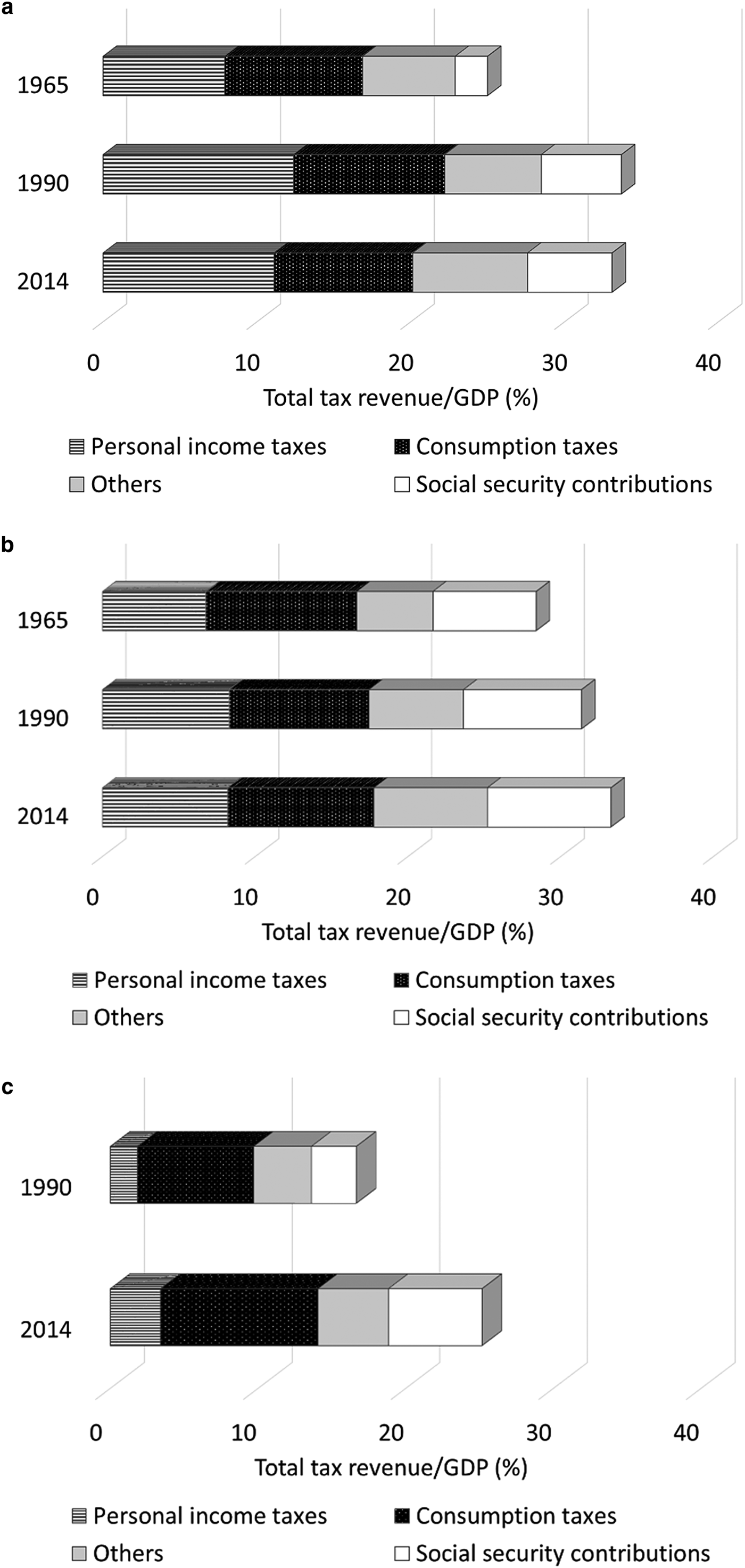
As can be seen from Figure 6a, the average scale of total tax revenue of the first wave democratizers increased between 1965 and 1990, and personal income taxation was the largest revenue source in 1990 and 2014. We can maintain that the first wave democratizers have consistently relied heavily on personal income taxes.Footnote 14
The second wave democratizers are similar but somewhat different. Figure 6b shows that the scale of total tax revenue expanded between 1965 and 2014, and taxations on personal income and consumption were the major revenue sources in each year. The second wave democratizers continued to raise revenue from income as well as consumption taxes.
The third wave democratizers are quite different from the early democratizers. Figure 6c shows that the scale of total tax revenue was limited in 1990, and the largest part came from consumption taxes. Even though the total tax revenue increased sharply by 2014 and approached the level of the first wave countries in 1965 (nearly 25% to the GDP), the third wave countries are still relying overwhelmingly on consumption taxes. Unlike their predecessors, they collect little revenue from income taxes.
In sum, the tax structures of the first, second, and third wave democratizers have not changed drastically over the last half-century. Rather, the tax structures were stable regardless of the expansion of the total tax revenues. The findings demonstrate that democracies in different waves followed divergent paths of tax development. The different timing of democratization led to different tax choices, and finally to different tax structures. In other words, the trajectory of modernization has shaped the current tax structures.
The historical development of taxation, however, shows that many factors have influenced taxation, including geopolitical and socioeconomic conditions as well as external circumstances. In particular, as mentioned in the previous section, globalization was related to the diffusion of the VAT among developing economies. This raises the possibility that the relationship between a democratic wave and tax structure might be spurious. The VAT-centered tax structures of the third wave countries may be explained by globalization and that those countries rely heavily on foreign direct investments (FDI) and trades.
Thus, we examined the effects of the democratic wave and globalization on the tax structure in 2014. As dependent variables, Table 2 presents the results of OLS regression on total tax revenue (as the percentage of GDP), PIT share (PIT revenue as the percentage of total tax revenue, referred to as PIT share), and consumption tax share (consumption tax revenue as the percentage of total tax revenue, referred to as CT share).Footnote 15 We included GDP per capita as an independent variable to examine the effect of economic development as well. As explained in Section 2, tax structures do not simply change along with economic growth, although the countries with lower GDP tend to rely less on income taxes and more on consumption taxes.
OLS regressions on tax shares (2014)
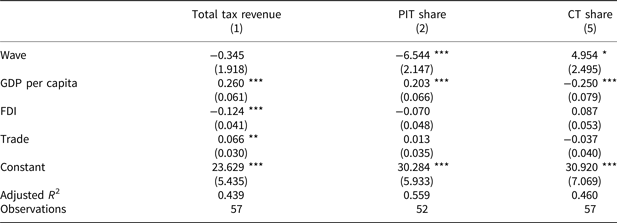
The dependent variable of (1) is total tax revenue: total tax revenue/GDP (%). The dependent variable of (2) is PIT share: personal income tax/total tax revenue (%). The dependent variable of (3) is CT share: consumption tax/total tax revenue (%). Wave: first wave democratizer = 1, second wave democratizer = 2, third wave democratizer = 3. GDP per capita: GDP per capita (thousand USD). FDI: Foreign direct investment, inward stock/GDP (%). Trade: trade/GDP (%).
Tax revenues of general government. Personal income tax refers to taxes on income, profits and capital gains of individuals (category 1100) in OECD Statistics. Consumption tax refers to taxes on production, sale, transfer, etc. (category 5100) in OECD Statistics.
*** Significant at 1% level, ** 5% level, * 10% level. Standard errors are in parentheses.
Data: OECD (https://stats.oecd.org/Index.aspx?DataSetCode=REV accessed on 4 December 2016), World Bank (http://data.worldbank.org/indicator/NY.GDP.PCAP.CD accessed on 4 December 2016, http://data.worldbank.org/indicator/NE.TRD.GNFS.ZS accessed on 31 January 2017), UNCTAD (http://unctadstat.unctad.org/wds/TableViewer/tableView.aspx?ReportId=96740 accessed on 23 February 2017).
The results clearly show the effect of the democratic wave on the tax structure. Wave is not significant for the scale of total tax revenue. Total tax revenue is rather explained by GDP per capita and globalization indicators (FDI and Trade). However, when we turn to the tax structure, Wave and GDP per capita are significant on both personal income and consumption tax shares, whereas FDI and Trade are not. The robustness check by using the IMF data also reveals the effect of democratic waves.Footnote 16 This demonstrates that the democratic wave matters even when the other factors are taken into consideration.
5. Conclusion
The analysis began with the finding that present tax structures are different in mature democracies and newly democratized countries. Although the first and second wave democratizers rely on income taxation as well as consumption taxes, the third wave democratizers rely heavily on consumption taxes. Learning from the history of tax development, we explored the reason for the differences in the adoption of modern taxation. The first and second wave democratizers established their tax systems based on income taxation in the nineteenth and early twentieth centuries and have continued to rely on it. The emergence of the VAT, together with increasing criticism of the income tax, affected a revenue reliance on the VAT in the third wave democratizers who adopted the ready-made VAT system as a modern method of taxation. The findings illuminate that countries in different democratic waves followed divergent paths of taxation development. The trajectory of modernization has shaped different tax systems.
The history of taxation suggests that both taxes on income and consumption have played critical roles in democratization. Early democratizers relied on progressive income taxation, which is consistent with the argument of Scheve and Stasavage (Reference Scheve and Stasavage2012, Reference Scheve and Stasavage2016) that the evolution of income taxation went hand-in-hand with democratization. In the late twentieth century, the VAT rapidly diffused among the early democratizers as well as the newly democratizing countries and increased its importance. Such tax development is consistent with the argument by Timmons (Reference Timmons2010) and Baskaran (Reference Baskaran2014), which regards the regressive VAT as a primary, revenue-raising measure for democracies. Although these views appear to contradict each other, they actually reflect different aspects of the modernization process. Our findings highlight the path-dependent development of taxation and the different roles of taxation across different waves of democratization.Footnote 17
Much effort has been devoted to exploring the institutional and political settings that have shaped tax policies, especially the relationship between taxation and democracies. Some research has concluded that democratic institutions were the bases of a state's capacity to extract revenue (Besley and Persson, Reference Besley and Persson2009). Others found that democracies do not necessarily extract tax revenue more effectively than autocracies (Cheibub, Reference Cheibub1998; Profeta et al., Reference Profeta, Puglisi and Scabrosetti2013; Garcia and von Haldenwang, Reference Garcia and von Haldenwang2016). However, scant attention has been paid to the distinct tax development in different trajectories of modernization. The study sheds new light on the linkage between the development of modern taxation and the waves of democratization.
Acknowledgment
This project was funded by the Japanese government grant-in-aid for scientific research to Junko Kato (15H03310). We appreciate comments from participants in the symposium "Democratization, taxation, and the welfare state in the developing world" (The University of Tokyo, January, 2017). We appreciate an excellent research assistance from Hiroko Nishikawa and Keiko Wada.
Junko Kato is Professor of Political Science at the University of Tokyo. She has authored articles in numerous journals, including American Political Science Review, British Journal of Political Science, Governance, and European Journal of Political Research. She is also an author of Regressive Taxation and the Welfare State (Cambridge University Press, 2003) in addition to other books and numerous book chapters.
Miki Toyofuku is Assistant Professor of Political Science at Ochanomizu University. Her research focuses on Japanese politics, public policy, and tax policy. Her publications have appeared in scholarly journals including Journal of Social Security Research, EPI Journal, and Contemporary Japan.
Appendix 1
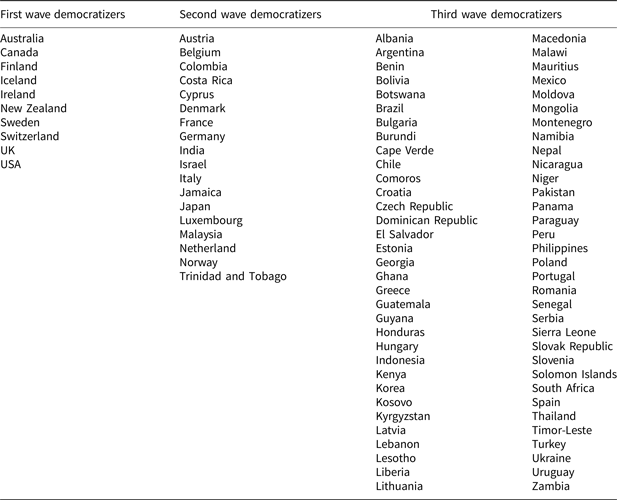
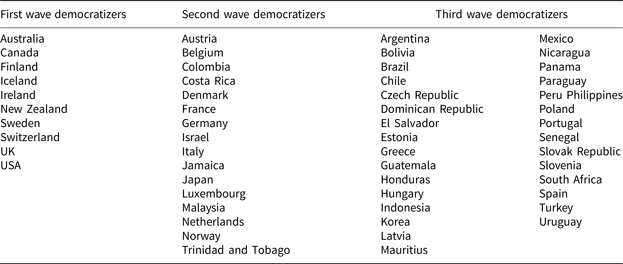
List of democratizers in all Figures and Tables in text
We have classified countries based on the data of Polity IV Project in addition to the original categorization by Huntington (Reference Huntington1991). According to Polity IV Individual Country Regime Trends, 1946–2013, countries democratized by 1962 are included in the second wave, and countries democratized after 1962 are included in the third wave.
Countries whose revenue data are available at OECD Statistics are categorized as follows.
Appendix 2-1
OLS regressions on tax shares (2013, IMF data)

Appendix 2-2
List of Democratizers in OLS regressions (Appendix 2-1)
We have classified countries based on the data of Polity IV Project in addition to the original categorization by Huntington (Reference Huntington1991). According to Polity IV Individual Country Regime Trends, 1946–2013, countries democratized by 1962 are included in the second wave, and countries democratized after 1962 are included in the third wave.
Countries whose revenue data are available at IMF Government Finance Statistics are categorized as follows.