INTRODUCTION
Exposure to parasites is ubiquitous in both livestock and wildlife species (Holmes, Reference Holmes1993). In most cases this exposure leads to subclinical infection and immunity is gradually acquired. Development of immunity to gastrointestinal nematodes usually coincides with periods of high growth rates and thus high nutrient requirements (Coop and Kyriazakis, Reference Coop and Kyriazakis2001). In addition, parasitic infection can be accompanied by variable pathology (Garside et al. Reference Garside, Kennedy, Wakelin and Lawrence2000) and anorexia (Kyriazakis, Reference Kyriazakis2010), which can readily lead to nutrient scarcity even when animals are fed on good quality foods. Under these conditions, hosts may be forced to allocate scarce nutrient resources between the competing traits of growth and parasite control (Coop and Kyriazakis, Reference Coop and Kyriazakis2001). Here, we assess whether this allocation is sensitive to infection pressure and genetic potential for growth.
It has long been proposed that a minimum level of antigenic stimulation or infection pressure may be necessary for stimulation of an immune response upon parasitic infection (Dineen, Reference Dineen1963). In agreement, a certain level of parasite infection pressure is also required to produce clinical infection (Vercruysse and Claerebout, Reference Vercruysse and Claerebout2001) and this has long been known as the case for Heligmosomoides bakeri infections (Ehrenford, Reference Ehrenford1954). It has been suggested that such ‘thresholds’ may be lower during periods of nutrient scarcity (Bransby, Reference Bransby1993). In addition, Keymer and Tarlton (Reference Keymer and Tarlton1991) observed that the accumulation of H. bakeri was proportional to the infection pressure at times of protein scarcity, whereas this pattern of accumulation was not observed at high protein levels.
Rauw et al. (Reference Rauw, Kanis, Noordhuizen-Stassen and Grommers1998) suggested that artificial selection for enhanced production traits can lead to detrimental changes in host behaviour, physiology and immunity. These changes may arise from allocation of a higher proportion of scarce environmental resources towards the trait selected for, leaving fewer resources available for investment in other physiological processes that contribute to overall fitness (Rauw et al. Reference Rauw, Kanis, Noordhuizen-Stassen and Grommers1998; Coop and Kyriazakis, Reference Coop and Kyriazakis1999; Doeschl-Wilson et al. Reference Doeschl-Wilson, Vagenas, Kyriazakis and Bishop2008). Consequently, we predict that increased resource availability would minimize these negative consequences of artificial selection for enhanced production traits.
We recently demonstrated that mice selected for high body weight (Roslin-high mice, ROH) were less resilient (measured as performance under infection (described by Albers et al. Reference Albers, Gray, Piper, Barker, Le Jambre and Barger1987)) and less resistant to a single primary infection of 250 L3H. bakeri than their low growth counterparts (Roslin low growth mice, ROL), especially when given access to low protein foods (Coltherd et al. Reference Coltherd, Bünger, Kyriazakis and Houdijk2009). This suggests that hosts with a higher potential for productive functions may allocate more nutrients to such functions when nutrients are scarce, at the expense of functions involved with limiting parasitism, including anti-helminth immune responses (Wahid et al. Reference Wahid, Behnke, Grencis, Else and Ben-Smith1994). Here, we hypothesize that this penalty on resilience in ROH mice will decrease with lower infection levels and that ROL mice will tolerate higher infection levels. We also hypothesize that the levels of infection, which would be tolerated are lower at times of protein scarcity, and that this nutritional sensitivity would be more pronounced in mice genetically selected for high growth (ROH).
MATERIALS AND METHODS
Animals and housing
A cross of 2 inbred lines (C57BL/6J×DBA/2J) was used as the foundation population for a selection experiment in which divergent selection for high and low body weight (BW) at day 42 of age took place over 20 generations, resulting in due course in ROH and ROL lines, respectively (Heath et al. Reference Heath, Bulfield, Thompson and Keightley1995; Bünger et al. Reference Bünger, Laidlaw, Bulfield, Eisen, Medrano, Bradford, Pirchner, Renne, Schlote and Hill2001a). Under maintenance conditions and when offered a standard diet, at 42 and 70 days of age respectively, ROH mice would be expected to reach, on average, weights of 36 g and 41 g, with ROL mice reaching 16 g and 19 g, respectively (Bünger et al. Reference Bünger, Renne, Buis and Reeve2001b). For this experiment, we obtained 72 ROH and 72 ROL male mice inbred for 40 generations, weaned at 21–23 days and housed individually in a controlled environment with an ambient temperature of 21±1°C and a 12 h light cycle. At weaning, our ROH mice had a body weight of 15·4±0·25 g, whereas ROL mice weighed 7·4±0·26 g. Mice were housed in solid-bottomed cages with fresh sawdust and bedding material was provided twice weekly. The experiment details described below were approved by the Animal Experiment Committee of Scottish Agricultural College (ED AE 26/2007) and carried out under Home Office regulations (PPL 60/3626).
Diets
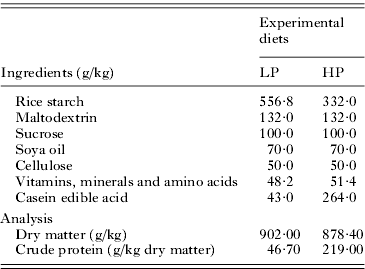
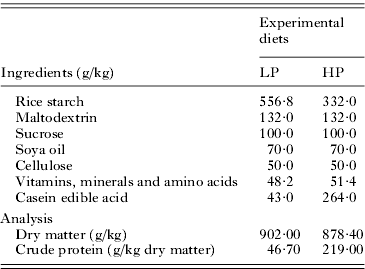
All mice were fed ad libitum standard expanded breeding diet (RM3(P), Special Diet Services, Witham, UK; digestible crude oil: 38 g/kg; digestible crude protein (CP): 202 g/kg; starch: 339 g/kg; sugars: 44 g/kg; digestible energy (DE), 12·2 MJ/kg) for 1 week after arrival. Two iso-energetic experimental diets (15 MJ DE/kg) with a fixed amino acid to CP ratio were used, formulated to provide 40 (LP) and 230 (HP) g CP per kg (Table 1). These CP levels were expected to result in protein scarcity or protein adequacy, respectively, relative to expected requirements in non-infected mice (NRC, 1995) and as informed by our previous work using a wide range of dietary CP levels on these inbred lines (Coltherd et al. Reference Coltherd, Bünger, Kyriazakis and Houdijk2009). As casein was used as the protein source, 15 g of cysteine were added to each kg of casein to account for the scarcity of sulphur-containing amino acids.
Ingredients and analysis of the experimental diets
Infection protocol and experimental design
The strain of H. bakeri used was obtained from Professor Jerzy Behnke (University of Nottingham, UK), and maintained in our laboratory through passages in C57BL/6 mice (see Jenkins and Behnke, Reference Jenkins and Behnke1977 for full origin details). The parasite corresponds to H. polygyrus bakeri reported by Durett-Desset et al. (1972). At day 0 of the experiment (see below) mice received a single infection of 0, 50, 100, 150, 200 or 250 H. bakeri infective larvae (L3) suspended in 0·2 ml of water via oral gavage. The highest level of infection pressure (250 L3) reduced growth performance in our previous work (Houdijk and Bünger, Reference Houdijk and Bünger2006, Reference Houdijk and Bünger2007; Coltherd et al. Reference Coltherd, Bünger, Kyriazakis and Houdijk2009).
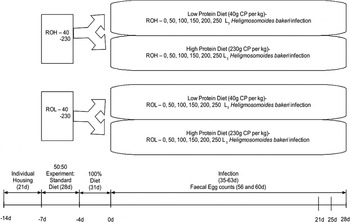
Mice within each line, infected at one of the 6 experimental infection levels (referred to as 0, 50, 100, 150, 200 and 250), were given ad libitum access to either LP or HP foods. The experiment was thus 2 lines×6 levels of infection×2 protein diets; each cell within this design contained 6 replicates, thus a total of 144 mice were used. The degree of replication was based on our previous experiment for these mouse lines and this parasite model (Coltherd et al. Reference Coltherd, Bünger, Kyriazakis and Houdijk2009). Figure 1 illustrates the experimental design and timing of procedures. Mice entered the experiment (day 0) through an adaptation phase (day −14 to day 0), which included a period where a 50:50 mix of experimental and standard diet was offered to acclimatize the mice to the experimental diet (day −7 to day −4) followed by feeding the experimental diets alone (day −4 onwards). This timescale of experimental diet feeding treatment allowed the experiment to be carried out whilst mice were still growing. Mice were humanely killed on day 28 post-infection (p.i.), for the assessment of worm burdens, colon egg count, body fat percentage and serum antibodies (see below).
Diagram of experimental design: timeline in experimental days shown along the bottom and age of mice in parentheses.

Sample measurements and collection
Body weight and food intake
Between day 0 and 28 p.i., mice and food refusals were weighed twice weekly (Tuesday and Friday) resulting in 8 experimental periods for food intake. On each of these days food refusals were weighed out and fresh food weighed in. Around 30 g were offered to ROH and 15 g to ROL mice to ensure ad libitum feeding (Coltherd et al. Reference Coltherd, Bünger, Kyriazakis and Houdijk2009). Average daily food intake was calculated per day for each of the 8 experimental periods for each mouse, as well as mean food intake over the total 8 experimental periods.
Nematode egg count in feces
Mice were placed onto wire-bottomed cages, with access to food and water, overnight for fecal sample collection on days 21 and 25 p.i. A modified flotation technique (Christie and Jackson, Reference Christie and Jackson1982) was used to assess the concentration of nematode eggs/g feces. The total period of fecal collection (finish time – start time) was recorded to calculate an estimated feces volume/12 h/mouse. This value was used to standardize egg output (EO, eggs excreted/12 h) to eliminate the dilution effect expected for ROH mice due to their larger size, food intake and thus larger volumes of feces (Coltherd et al. Reference Coltherd, Bünger, Kyriazakis and Houdijk2009).
Worm burden and nematode egg count in colon contents
Mice were killed humanely on day 28 via CO2 inhalation and dissected to obtain the small intestine and the colon. The small intestine was weighed, opened and placed directly into a 5% formaldehyde solution pending assessment of the number of male and female worms. The colon contents were weighed and a colon egg count (eggs/g) performed for every mouse. The resulting colon egg count was then multiplied by the colon contents weight to eliminate any dilution effects and obtain a final number of eggs in colon (EIC) value. The EIC was divided by the number of females counted to estimate per capita fecundity (eggs/female).
Fat percentage
To predict percentage of carcass fat, the mouse carcasses were weighed and bagged upon dissection for subsequent freeze-drying. In preparation for the freeze-drying process, incisions were made, to allow maximal water loss, in the back, tail and head of the animal. When weight loss ceased (approximately 7 days later) the dried carcasses were re-weighed. Fat percentage was calculated as ((freeze-dried weight×1·13)/carcass weight)−0·302)×100 (Hastings and Hill, Reference Hastings and Hill1989).
Enzyme-linked immunosorbent assays – ELISAs
At dissection, blood was collected from the chest cavity, after severing the vessels around the heart, into a 2 ml vol. tube containing Serasieve® (Hughes and Hughes Ltd, Wellington, UK) and serum collected via centrifugation at 1500 g. Serum IgG1 was measured as a key antibody associated with Th2 responses, whilst IgE was measured as an antibody specifically implicated in protective immunity against parasites like H. bakeri (Urban et al. Reference Urban, Katona and Finkelman1991; Reference Urban, Madden, Svetic, Cheever, Trotta, Gause, Katona and Finkelman1992; Wahid et al. Reference Wahid, Behnke, Grencis, Else and Ben-Smith1994; Negrao-Correa et al. Reference Negrao-Correa, Adams and Bell1999) and specifically regulated by the Th2 cytokine IL-4 (Silva et al. Reference Silva, Cavalcante, Faquim-Mauro and Macedo2006). Antibody levels were used as read-outs for an indirect measurement of immune costs to indicate possible trade-offs. The concentration of anti-H. bakeri antibody IgG1 was measured by an indirect ELISA. Mouse sera were measured individually. Fifty μl of H. bakeri soluble extract in carbonate buffer (5 μg/ml) were added to each well of a 96-well plate and left to incubate overnight at 4 °C. Plates were then washed with PBS-Tween and blocked using 100 μl of PBS+BSA 4% for 1 h at 37°C in the dark. Plates were again washed with PBS-Tween, 50 μl of serum, serial-diluted 11 times from 1/400 in PBS-BSA 1%, added and the plates incubated overnight at 4°C. Plates were washed with PBS-Tween and 50 μl of HRP-conjugated detection antibody was used. The plates were finally incubated in 50% TMB – 50% H2O2 (KPL) under silver foil to protect from the light until the top two standards had saturated. Colour development was then stopped using 25 μl of 1 m HCl, and plates were read at 450 nm.
The concentration of total IgE antibody was measured by a capture ELISA. Mouse sera were measured individually. The 96-well plates were coated with 50 μl of IgE (2 μg/ml) capture antibody and left at 4°C overnight. Capture antibody was flicked off and 100 μl of Marvel solution∶carbonate buffer (5%) were added and left to incubate for 2 h at 37°C. Plates were then washed in TBST, a row of standards was created from a top standard of 5 μg/ml and doubling down across the columns, the sera wells were diluted 1/10 and 1/20 and the plates were incubated at 37°C for 2 h. Plates were again washed in TBST, 50 μl of biotinylated 2° detection IgE (2 μg/ml) added then incubated for a further 1 h at 37°C. Plates were washed in TBST, 100 μl of conjugate Extravidin Peroxidase (1/8000) added and the plates incubated at 37°C for 30 min. Plates were finally washed in TBST, then in H2O before 100 μl of substrate TMB were added to each well, and the plate developed in darkness until saturation had occurred, and was then stopped using 100 μl of 1 m HCl. The plate was then read at 450 nm on a spectrophotometer.
Statistical analysis
Due to the skewed nature of the data, Egg Output (EO), Eggs In Colon (EIC) and worm burdens were Log10 (n+1) transformed. To account for the relatively large differences in performance data between the mouse lines, arising from a priori differences in body weight, feed intake and body weight gain data (both in mg per day) were also Log10 transformed before analysis (Falconer and MacKay, Reference Falconer and MacKay1996; Coltherd et al. Reference Coltherd, Bünger, Kyriazakis and Houdijk2009). Repeated measures through Restricted Maximal Likelihood (REML) was used to assess the interactive effects of line, dietary CP content, infection dose and time on food intake. The interactive effects of line, dietary protein content and infection pressure on mean food intake, body fat percentage, EO, worm burden data and serum antibody titres were analysed with REML to allow inclusion of litter origin as a random effect. Interactions that did not approach significance were omitted from the final model. EO, EIC and total worm burdens were checked for non-linearity by fitting a quadratic regression using infection pressure as an explanatory variable. Significance is indicated by a P-value less than 0·05 and where appropriate trends are indicated by a P-value between 0·051 and 0·1. All reported error values are standard errors of the mean. All statistical analyses were performed using Genstat 11 for Windows release 11.1, 2008 (Lawes Agricultural Trust, Rothamsted, UK).
RESULTS
Food intake and body weight gain
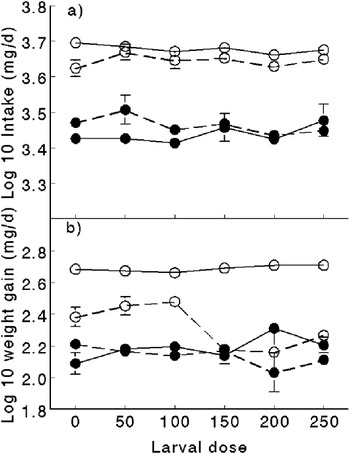
Resilience was measured by assessing food intake and weight gain under infection. Figure 2 shows Log10-transformed averaged daily food intake and average daily weight gain. Mouse line and dietary protein content interacted significantly for average daily food intake (F1,96=16·28, P<0·001; Fig. 2a). This interaction arose from ROH-0 mice on the LP food consuming less food than their HP counterparts, whilst in contrast ROL-0, ROL-50 and ROL-100 mice on the LP food consumed more food than their HP counterparts. As expected, ROH mice consumed more food than ROL mice (F1,32=260·20, P<0·001). In addition, there were no 2-, 3- or 4-way interactions containing time and infection pressure (P>0·10) indicating the absence of observable anorexia. However, time did interact with mouse line and dietary protein (F8,936=5·25, P<0·001) for food intake; ROL-LP mice ate more than ROL-HP mice in each period, whilst ROH-LP ate more than ROH-HP during periods 1 and 2 only, but ate less than ROH-HP from period 4 onwards (data not shown).
(a) Log10 transformed daily food intake and (b) body weight gain of high (ROH – open circles) and low (ROL – closed circles) body weight mice averaged over 28 days fed on a high (solid lines) or low (dashed lines) crude protein diet.

All mice gained weight during the experiment. ROH mice gained an average of 0·36±0·019 g/d while ROL mice gained on average 0·15±0·005 g/d. Genetic growth and dietary protein interacted for weight gain (F1,117=50·12, P<0·001). This was due to ROH mice reducing their weight gain on the LP diet whilst ROL mice were unaffected. A trend was observed for the 3-way interaction between genetic growth, dietary protein content and infection pressure for mean daily weight gain (F5,117=1·96, P=0·09; Fig. 2b). Weight gain of ROH-LP mice was similar as infection pressure increased from 0 to 100 L3, but significantly decreased as infection pressure further increased 150 to 200 and 250L3, whilst infection pressure did not affect weight gain of ROH-HP and ROL mice. However, in the absence of infection, the effect of dietary protein on weight gain differed between ROH and ROL mice; weight gain of ROL-LP mice was the same as that of ROL-HP mice, whilst weight gain was lower for ROH-LP mice compared to ROH-HP mice (F1,117=86·10, P<0·001).
Body fat percentage
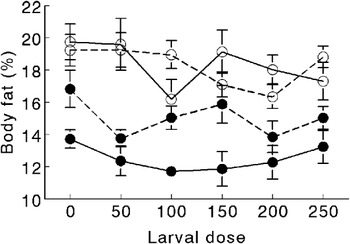
The percentage body fat was measured to assess the extent to which excess energy was stored by mice. The interaction between mouse line and dietary protein content was highly significant for body fat percentage (Fig. 3; F1,97=14·41, P<0·001); independent of infection pressure, ROL-HP mice had a lower body fat percentage than ROL-LP mice, whilst feeding treatment did not affect fat percentage in ROH mice, causing this interaction to be observed. Parasitism did not impose an energetic requirement that could not be met by the experimental diets fed in this experiment.
Average body fat percentage, taken 28 days after infection, of high (ROH – open circles) and low (ROL – closed circles) body weight mice fed on a high (solid lines) or low (dashed lines) crude protein diet.

Egg output (EO), eggs in the colon (EIC) and total worm burden (TWB)
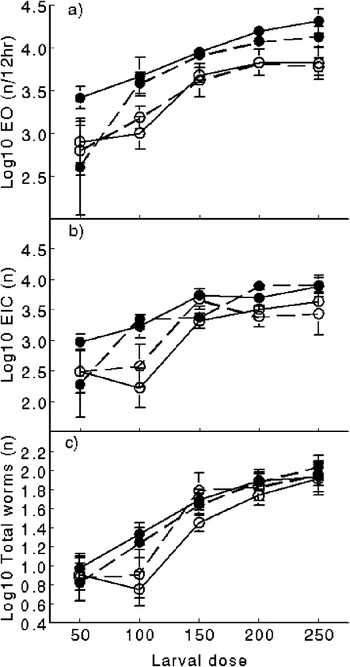
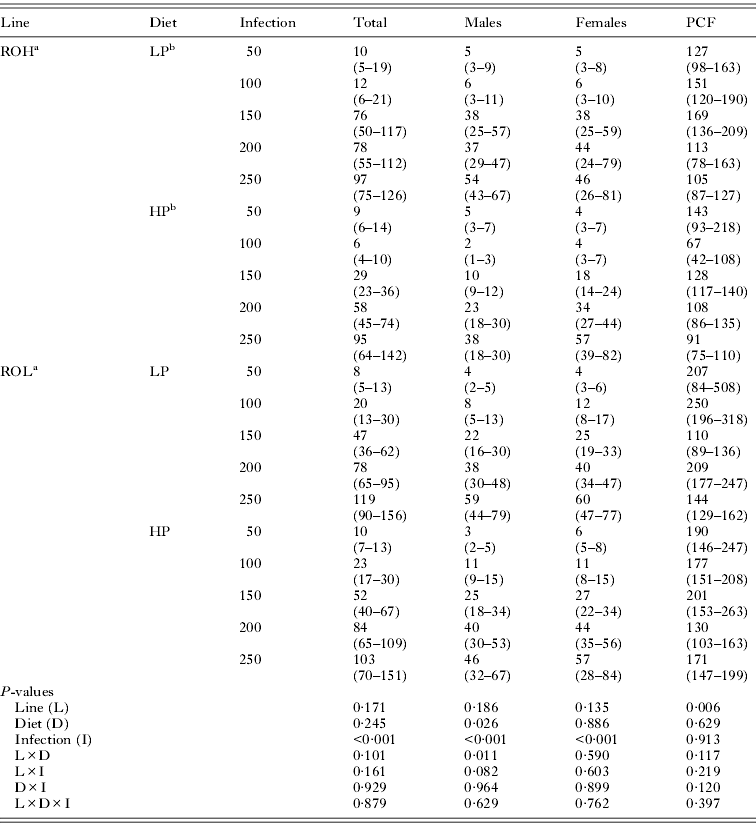
Resistance to parasitism was measured by assessing worm burden and parasite egg output. Figure 4 shows the Log10(n+1) transformed mean EO, EIC and TWB. In addition, Table 2 provides backtransformed means with 95% confidence intervals for TWB, male and female burdens and per capita fecundity. The mean EO averaged over days 21 and 25 p.i. was analysed as there was no interaction between time and infection dose, dietary protein and/or genetic mouse line (P>0·10). EO, EIC and TWB were found to be non-linear (P<0·05). EO, EIC and TWB increased with increased infection pressure (F4,83=25·93, P<0·001, F4,98=17·72, P<0·001 and F4,86=42·3, P<0·001 respectively; Fig. 4) until a plateau was reached at 150L3. ROL mice had a higher EO and EIC than ROH mice (F1,30=8·21, P=0·008 and F1,98=10·73, P=0·001 respectively). However, mouse line and dietary protein content tended to interact for EO; ROL-HP had higher EO than ROL-LP at the lowest infection pressure only (F1,83=3·26, P=0·075; Fig. 4a). Thus, increasing infection pressure over 150 L3 did not further increase parasite load.
Log10 (n+1) transformed: (a) 12 h Egg Output (EO) averaged over days 21 and 25 post-infection; (b) Eggs in the Colon (EIC) on day 28 post-infection and (c) total worm burden on day 28 post-infection for high (ROH – open circles) and low (ROL – closed circles) body weight mice, infected with different levels of Heligmosomoides bakeri and fed on a high (solid lines) or low (dashed lines) crude protein diet.

Mean total worm burdens, males and females, and per capita fecundity (PCF) in dependence of mouse line (ROH vs ROL), dietary CP content (LP vs HP) and infection pressure (50, 100, 150, 200 or 250 L3Heligmosomoides bakeri) with their 95% confidence intervals (CI)
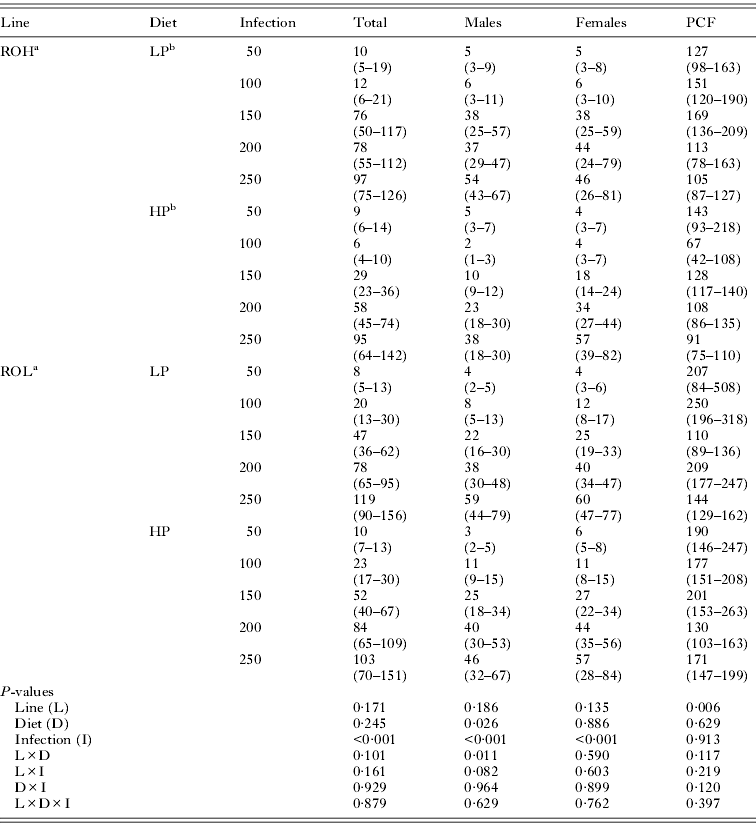
a Roslin line mice selected for high (ROH) and low (ROL) 42d body weight.
b 30 g crude protein (CP)/kg diet (LP) and 230 g CP/kg diet (HP).
Mouse line and dietary protein content interacted for a number of male worms; ROH-HP mice had fewer male worms than ROH-LP mice whilst feeding treatment did not affect the number of male worms in ROL mice (F1,99=4·48, P=0·037; Table 2). The 3-way interaction between mouse line, dietary protein content and infection pressure tended towards significance for TWB composition (F4,94=2·26, P=0·069). This was due to a higher percentage of female worms in ROH-HP (62·6±3·97%) mice across all infection pressures, when compared to ROH-LP (45·0±3·07%) whilst, in contrast, dietary protein content did not systematically affect TWB composition in ROL mice. Per capita fecundity was found to be higher in ROL mice (F1,93=8·31, P=0·005) than in ROH mice but was not affected by either dietary protein contents or infection pressure (Table 2). Sex ratios of H. bakeri were altered in ROH mice by an HP diet reducing the numbers of male worms when compared to mice on the LP diet.
Serum antibody titres
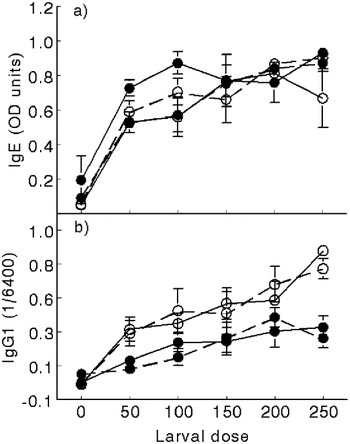
Figure 5 shows the serum IgE and IgG1 titres, which demonstrate that an immune response was induced at all infection levels. Mouse line and dietary protein content interacted for total IgE (F1,101=6·77, P=0·011; Fig. 5a); averaged IgE optical density was higher for ROL than for ROH on HP diets, but were similar for LP diets. Although Fig. 5a suggests that these interactions were observed at the 50 and 100 L3 infection pressure only, interactions between mouse line, dietary protein contents and infection pressure were not significant (P>0·17). However, total IgE increased with increased infection pressure (F5,102=51·82, P<0·001).
(a) Total serum IgE antibody titres, and (b) anti-H. bakeri IgG1 serum titre for high (ROH – open circles) and low (ROL – closed circles) body weight mice fed a high (solid lines) or low (dashed lines) crude protein diet.

Mouse line and infection pressure interacted for anti-worm IgG1 (F5,90=7·82, P<0·001; Fig. 5b). IgG1 titres in ROL mice increased in a dose-dependent manner up to 200L3, whilst IgG1 titres were higher in ROH mice (F1,31=14·69, P<0·001), and increased linearly with infection pressure up to 250L3.
DISCUSSION
The results of this study support our hypothesis that selection for increased body weight induces a penalty of parasitism on resilience above a certain level of infection (>150L3 H. Bakeri) but only when protein supply is scarce. However, contrary to our previous findings (Coltherd et al. Reference Coltherd, Bünger, Kyriazakis and Houdijk2009) and our hypothesis, selection for increased body weight did not detrimentally affect resistance traits, as mice selected for low body weight displayed increased nematode egg excretion. This leads to the suggestion that ROL mice may be more resilient to parasitic infection and can maintain growth despite higher levels of parasitism. On the other hand resilience in ROH mice is sensitive to nutrient scarcity. It remains to be ascertained whether this disparity in resistance between the mouse lines is due to selection for body weight inadvertently co-selecting genes associated with immunity (e.g. different MHC alleles; Behnke and Wahid, Reference Behnke and Wahid1991). Despite our intention, this study failed to achieve protein scarcity in ROL mice, meaning that some results and comparisons may be confounded by protein-sufficient conditions for all ROL mice being compared with protein-deficient and sufficient ROH mice. For this reason, the main comparisons between mouse lines will be between individuals fed the high protein diet to ensure a similar nutritional status.
Body weight, food intake and fat percentage
A reduction in body weight gain was observed in ROH mice due to reduced dietary protein content and, during protein scarcity, gain was further reduced when infection pressure increased to a dose over 150L3. In contrast, ROL mice performance was not affected by infection, whilst uninfected ROL-LP mice gained more weight than their HP counterparts. This weight gain in ROL-0-LP was associated with higher feed intake on the LP diet compared to the HP diet, which was likely the result of successful attempts to increase protein intake from a low protein diet (Kyriazakis et al. Reference Kyriazakis, Emmans and Whittemore1991). The resulting excess energy intake would need to be lost as heat or stored as fat (Emmans and Kyriazakis, Reference Emmans, Kyriazakis, Hill, Bishop, McGuirk, McKay, Simm and Webb2000); the latter is consistent with the higher body fat percentage observed for ROL-LP mice compared to ROL-HP mice in this and our earlier study (Coltherd et al. Reference Coltherd, Bünger, Kyriazakis and Houdijk2009). There was no effect of infection on body fat percentage in this experiment in contrast to the findings of calorie restrictive and metabolic stress experiments, which show that infection decreases body fat percentage (Kristan and Hammond, 2001, 2006).
Under the theory that nutrients are partitioned towards artificially selected traits (Rauw et al. Reference Rauw, Kanis, Noordhuizen-Stassen and Grommers1998; Coop and Kyriazakis, Reference Coop and Kyriazakis2001; Doeschl-Wilson et al. Reference Doeschl-Wilson, Brindle, Emmans and Kyriazakis2009) and away from unselected ones, ROH growth on the low protein diet suggests that this pattern of nutrient partitioning may indeed have been the case at low levels of infection. The reduction of body weight gain at higher infection pressures (150L3 and above) is possibly an outcome of the intensity of the infection being sufficiently high to potentially affect host fitness. Consequently, it would be expected that the host would divert nutrients away from growth functions and towards immune function to limit the pathology and/or fitness consequences caused by parasitism and increase the chances of host survival. Therefore, this suggests a novel hypothesis, i.e. that nutrient allocation is sensitive to infection pressure.
The lack of parasite-induced anorexia across the infected mice was unexpected because such a reduction had been observed in previous studies with this mouse–parasite model (Houdijk and Bünger, Reference Houdijk and Bünger2006; Coltherd et al. Reference Coltherd, Bünger, Kyriazakis and Houdijk2009) and in other studies using H. bakeri (Boulay et al. Reference Boulay, Scott, Conly, Stevenson and Koski1998; Ing et al. Reference Ing, Su, Scott and Koski2000; Tu et al. Reference Tu, Koski, Wykes and Scott2007). A reduction in feed intake would be expected to occur mainly during the initial stages of infection (Coltherd et al. Reference Coltherd, Bünger, Kyriazakis and Houdijk2009; Kyriazakis, Reference Kyriazakis2010), and it might be that this would only have been evident above a certain level of infection pressure (Sandberg et al. Reference Sandberg, Emmans and Kyriazakis2006). Therefore, it cannot be excluded that diluting effects of mice infected below such a level of infection pressure did not allow us to statistically detect the presence of anorexia. Indeed, assessing the effect of infection on feed intake at each infection pressure separately showed that only mice infected with 250 L3 experienced anorexia observed between days 7 and 10 post-infection (F8,296=2·68, P=0·039; data not shown). However, this effect was small, and supported by the absence of a meaningful interaction between infection pressure and time for feed intake when analysing all infection pressures simultaneously (F40,936=1·46, P=0·102).
Worm burden and egg output
As infection pressure increased, the worm burden and number of eggs released increased to a maximum level and then appeared to plateau. This maximum level was lower in ROH mice than in ROL mice, which was contrary to our previous findings (Coltherd et al. Reference Coltherd, Bünger, Kyriazakis and Houdijk2009). The observed plateau in egg output and worm burden in ROH mice suggests an optimal parasite load controlled by the host and corresponds to the further reduction in body weight gain seen at 150L3 and above. Indeed Paterson and Viney (Reference Paterson and Viney2002) proposed that host immune responses reduced parasite survival to limit parasite load as they saw no effect of infection pressure on establishment of parasites, but did observe that survivorship of parasites during a heavy infection was significantly reduced as duration of infection increased. Density-dependent effects on parasite numbers and egg output are commonly observed. For gastrointestinal parasites this relationship is usually negative (or inverse), i.e. as density of the parasite population increases worm survival and fecundity decrease (Bishop and Stear, Reference Bishop and Stear2000; Bleay et al. Reference Bleay, Wilkes, Paterson and Viney2007). Christensen et al. (Reference Christensen, Barnes, Nansen, Roepstorff and Slotved1995) found that egg production and per capita fecundity progressively reduced as infection pressure of Oesophagostomum dentatum increased from 2000 to 20 000 and 200 000 L3. This observation of per capita fecundity differs from our results, where infection pressure and dietary protein content did not affect fecundity. Observations made by Keymer and Slater (Reference Keymer and Slater1987) suggest that per capita fecundity is highly variable when worm burden is low, with around 78% of the worms having similar egg production to hosts with higher worm burdens. This observation may be an explanation for the lack of density-dependent effects on fecundity in our model, as we also found high variability in egg counts at lower levels of infection (data not shown). There are 2 main proposed mechanisms for the observation of density-dependent egg production (Anderson and Michel, Reference Anderson and Michel1977; Kerboeuf and Jolivet, Reference Kerboeuf and Jolivet1984; Irvine et al. Reference Irvine, Stien, Dallas, Halvorsen, Langvatn and Albon2001). Firstly, intra-specific competition may limit resources for the natural development of adult parasites and the production of eggs by adult females. Secondly, host immune responses may stunt worm development directly, limiting female size and thus fecundity. From the latter explanation it would be expected that infections in immune animals are more sensitive to nutritional manipulation, as has been shown in several different species (Keymer and Tarlton, Reference Keymer and Tarlton1991; Ing et al. Reference Ing, Su, Scott and Koski2000; Houdijk et al. Reference Houdijk, Jessop, Knox and Kyriazakis2005; Kidane et al. Reference Kidane, Houdijk, Tolkamp, Athanasiadou and Kyriazakis2009). This may account for the lack of evidence of density-dependent effects on egg production during this study using a single-dose primary infection.
The lower proportion of female worms present in ROH-LP TWB when compared to ROH-HP suggests that decreased protein supply may have altered the sex ratio either through altering the gut environment, e.g. causing villi atrophy (Tu et al. Reference Tu, Koski, Wykes and Scott2007) which in turn reduces preferred habitat and feeding opportunities (Bansemir and Sukhdeo, Reference Bansemir and Sukhdeo1994, Reference Bansemir and Sukhdeo1996) and may reduce mating opportunities, or alternatively through disproportionate survival of larvae (Stien et al. Reference Stien, Dallimer, Irvine, Halvorsen, Langvatn, Albon and Dallas2005). One might expect that female worms would be most affected by reduced feeding opportunities due to their larger size when compared to male worms (Poulin, Reference Poulin1997). Indeed, reduced worm egg production has been observed in animals fed very low protein diets (Athanasiadou et al. Reference Athanasiadou, Kyriazakis, Jackson and Coop2001; Coltherd et al. Reference Coltherd, Bünger, Kyriazakis and Houdijk2009). It follows that female worm development, and so capacity for egg production, may have been stunted due to limited feeding opportunities. This perhaps was not observed in the current study due to the low protein diet, 40 g CP per kg, not being sufficiently low to produce effects on fecundity which was observed at 30 g CP per kg previously (Coltherd et al. Reference Coltherd, Bünger, Kyriazakis and Houdijk2009).
Antibody concentrations
The serum antibody titres, although used as an indirect measure of a resource cost borne by the immune system, can also give some indication of the polarization of the immune system. The Th2 type antibodies IgE and IgG1 were assessed due to their previously reported elevation during parasitic helminth infection (Urban et al. Reference Urban, Katona and Finkelman1991; Romagnani, 1991; Bell et al. 1992), and specifically in H. bakeri infections (Urban et al. Reference Urban, Katona and Finkelman1991; Ben-Smith et al. Reference Ben-Smith, Wahid, Lammas and Behnke1999; Negrao-Correa et al. Reference Negrao-Correa, Adams and Bell1999). IgE levels were higher in ROL than in ROH mice, with both mice lines showing increasing IgE antibody levels with increasing infection pressure, whilst dietary protein contents did not affect IgE production. Whilst this is in agreement with Boulay et al. (Reference Boulay, Scott, Conly, Stevenson and Koski1998), Ing et al. (Reference Ing, Su, Scott and Koski2000) did find that at day 28 post-primary infection protein malnutrition reduced IgE titres in an H. bakeri infection. This may be due to the different inbred mouse strain used (Behnke et al. Reference Behnke, Mugambi, Clifford, Iraqi, Baker, Gibson and Wakelin2006) and/or a longer adaptation period to the experimental diets. Parasite-specific IgG1 levels were found to increase in response to increasing larval pressure for both mouse lines, with the exception that IgG1 concentration levelled off at 200L3 for ROL mice whilst continuing to increase in ROH mice. ROH mice also had consistently higher IgG1 levels than ROL mice. Again, we did not observe an effect of dietary protein contents for parasite-specific IgG1, which is in accordance with Boulay et al. (Reference Boulay, Scott, Conly, Stevenson and Koski1998). The increasing parasite-specific antibody response with increasing larval pressure was also observed during an early antibody response to the liver fluke Opisthorchis viverrini in hamsters, as the infection became more chronic (6-month infection) however, this relationship inverted and an infection with 25 metacercariae produced higher responses than 50 and 100 metacercariae (Sripa and Kaewkes, Reference Sripa and Kaewkes2000). In contrast, a human study using Necator americanus, found that early parasite-specific IgG antibody responses were higher in subjects given 10 larvae when compared to 25 and 50 larvae, whilst later IgG (week 13) responses were lower in subjects given 10 larvae when compared to the higher doses. Furthermore early and late IgE responses were higher in subjects given 25 larvae compared to the other doses (Mortimer et al. Reference Mortimer, Brown, Feary, Jagger, Lewis, Antoniak, Pritchard and Britton2006). In this model, selection for increased body weight does not seem to have been detrimental to serum antibody production and, indeed, IgG1 concentrations were actually higher in ROH mice than in ROL mice. The differences in patterns of IgG1 vs IgE in ROH vs ROL mice in this study may be due to the more strict dependence of IgE on IL-4 (Silva et al. Reference Silva, Cavalcante, Faquim-Mauro and Macedo2006). Thus the polyclonal IgE response, as measured here, is likely to be a robust measure of ‘Th2’ bias, while the antigen-specific IgG1 responses may provide the more reliable measure of investment in parasite-specific immunity.
In conclusion, whilst the results of this study do not support our original hypothesis as far as resistance to parasites is concerned, they are consistent with the view that selection on the basis of high body weight may reduce the resilience to pathogen challenge (Rauw et al. Reference Rauw, Kanis, Noordhuizen-Stassen and Grommers1998). This penalty on performance may be sensitive to parasite load and can be overcome to an extent by increased dietary protein contents. Although increased dietary protein content had no effect on resistance to a primary infection consistently throughout our model (Coltherd et al. Reference Coltherd, Bünger, Kyriazakis and Houdijk2009), it has been demonstrated that increased protein nutrition will improve resistance to H. bakeri to a greater extent in a challenge infection (Boulay et al. Reference Boulay, Scott, Conly, Stevenson and Koski1998; Ing et al. Reference Ing, Su, Scott and Koski2000). The observation that the ROL mice showed increased resilience but also increased worm fecundity compared to ROH mice was unexpected and requires further investigation. The data potentially imply that resilient animals can be a source of infection to other animals in their environment as they are likely to be overlooked for drenching due to their lack of symptoms, thus increasing the risk to naïve animals from environmental contamination.
ACKNOWLEDGEMENTS
This work was carried out at the Scottish Agricultural College and University of Edinburgh. Special Diet Services (Witham, UK) supplied the diets. Statistical input during the experimental design and the analysis of the experiment was received from Biomathematics and Statistics Scotland (BIOSS) colleagues, Ian Nevison and Mintu Nath, whose input is gratefully acknowledged. We would also like to thank Bianca Theeruth, John Verth, Ray McInnes, and Moira Stewart for their technical assistance.
FINANCIAL SUPPORT
Financial assistance was obtained from the Scottish Government Rural and Environmental Research and Analysis Directorate (RERAD).