1. Introduction
This article examines a group of approximately 1,600 emigrants who left the Hessian region in Germany in the eighteenth century for foreign destinations.Footnote 1 Many of these Hessians made permanent moves to the British colonies in North America, settling mostly in Pennsylvania. Yet not everyone went west across the Atlantic Ocean. Sizeable groups of Hessians settled in Russia, Hungary and other European and German states and principalities. I compare these migrants on the basis of their choice of destination, and specifically on the basis of out-of-pocket costs and how they financed their moves, the length of their journeys, their possible economic and/or religious motivations, their cash resources and occupations, and their use of family networks. Together this analysis illuminates the many complicated factors driving migration decisions during a century when travel was difficult and costly, and opportunities to move to were not easy to come by.
A number of scholars have studied German immigrants to North America, especially those who settled in the colony of Pennsylvania, for which immigrant passenger records exist from the port of Philadelphia.Footnote 2 German emigrants who did not move west in the eighteenth century have received less scrutiny in the historical literature published in English. This article aims to fills that gap by explaining which Hessians went east (or north or south), why the North American colonies were the most popular choice, and why they may have made such choices. Naturally I also compare them to Hessian emigrants who moved westward.Footnote 3 My data adds the perspective of the Hanau emigrant records, based on information collected in their homeland. These Hessian records shed more light on the background of those Germans who settled in the American colonies, and allow for a richer understanding of the motivations of those Germans who did go to Pennsylvania in the eighteenth century than is provided by the American records alone. My work here shows that different destinations attracted different types of emigrants, and thus improves our understanding of eighteenth-century emigration movements. Other scholars have done similar studies for the nineteenth century, studying migrants from one region and following them to the various destinations where they settled, which provides greater insight into their migration decisions.Footnote 4
The emigrants studied in this article all left the county of Hanau-Münzenberg, which was a territory in the Holy Roman Empire. In 1736 the ruling count of Hanau-Münzenberg died, leaving no male heir; subsequently the Landgrave of the principality of Hesse-Cassel inherited this Hanau territory.Footnote 5 As a result of this legacy, this particular county was ‘administered as a separate entity throughout the eighteenth century.’Footnote 6 Permanent emigration from the Hanau-Münzenberg county was legal during this period, unlike from the rest of this Hessian principality and much of the European continent. One can assume that the vast majority of Hanau-Hessian emigrants made permanent moves.Footnote 7 Later, emigration laws became more relaxed for much of northern Europe with the Vienna Congress in 1815.Footnote 8
For Hanau emigrants various factors loomed in their decision to move away from home. The personal reasons are impossible to know, but economic reasons were surely an important part of the decision matrix. Individuals and families only moved if they judged that they could do better in the long run at the new destination. In part, whether they thought they could do better elsewhere had to do with their economic and political rights at home. For many of the emigrants, the economic pull of a higher standard of living, the payment of fewer taxes and dues, along with the freedom to marry and practise one's faith seem to have been very important.Footnote 9 Moving costs were also a serious consideration, including the cost of transportation, setting oneself up again in a new place, the opportunity cost of not working during this period, and possibly the cost of returning. Higher moving costs served to discourage migration. The county of Hanau-Münzenberg lay in close proximity to the city of Frankfurt on the Main River, and thus within the radius of agents recruiting for various colonial projects, both in North America and elsewhere.Footnote 10 This meant that Hanau-Hessians not only were able to emigrate legally, they had good information on how to do it and where to go.
Eighteenth-century emigration movements from Germany were quite different in character from those of the nineteenth century. In the earlier century Germans emigrated not only to North America and to other German states but also in large numbers to other countries on the European continent, including Hungary and Russia. By the nineteenth century, emigration to the east had basically come to a full stop. Further, religious rights and freedoms played more of a role in the eighteenth century, with historians generally of the opinion that religion mattered more to larger numbers of seventeenth- and eighteenth-century European emigrants than it did to Europeans who moved in the nineteenth century. It is not clear how important these factors were compared to the goal of improving one's economic circumstances. Regardless, the British colonies in North America, for example, became home to various Christian minorities, including Mennonites, Calvinists, Quakers, Pietists, Amish, and Separatists (Pilgrims), among others.Footnote 11 Similarly, Catherine the Great of Russia welcomed Catholics as well as Protestants, although Jews were not welcome. In contrast to the North American colonies and Russia, the devout Catholic Hapsburgs in Hungary sought only Catholic Germans, even though many in Hungary at that time worshipped in one branch or another of a reformed Christian church.
Economic theories about migration decisions typically attribute some importance to the impact of previous migrants on the decisions of later migrants. Previous migrants can help in a myriad of ways. Such assistance lowers the setup costs for the new migrant and ultimately the risk of a long-distance move.Footnote 12 Various scholars have argued in particular that chain migration effects or networks were important in the pre-industrial period.Footnote 13 Personal networks were relevant in the financing of migration trips across the Atlantic during the eighteenth century according to Marianne Wokeck, and Farley Grubb has argued that an increase in the number of remittances, generated from existing personal networks, helps to explain the end of indentured servitude and the redemption system in the US.Footnote 14
More broadly, the idea of cumulative causation, ‘that over time international migration tends to sustain itself in ways that make additional movement progressively more likely’ applies here to some extent but not uniformly to the various Hanau-Hessian groups, as I explain further below.Footnote 15 The establishment of personal networks, the desire of individuals to improve their relative economic standing among their peers after observing the successes of previous migrants, and the opportunity to acquire land at the various destinations are among three factors that encouraged more emigration over time.Footnote 16 The use of networks was likely higher among those who went west than those who went east, which I discuss later in the article.
Below I examine the Hanau-Hessian emigrants from the eighteenth century, separating them in terms of where they settled. I compare them by occupational background, the money they took with them, the time of the year they departed, their ages, and whether they travelled with families or alone (ratio of women and children to adult men). Finally I provide maps showing emigrants’ home origins to ascertain the degree to which these emigrants used or did not use personal networks. These various perspectives of the emigrants, in terms of who they were and how they behaved, show that there were stark differences between the three main groups, those who went to North America, Hungary or Russia.
2. Analysis of the Hanau-Hessian emigrant data
Data on Hessians who emigrated in the eighteenth century have been published by Inge Auerbach and the Hessian State Archive.Footnote 17 The data provide details on individuals and families who left villages in the Hanau region, with the earliest person leaving in 1709 and the last person in these data departing in October of 1799. Hessians are prominent in American colonial history for the role they played serving as mercenaries with the British: well over 15,000 soldiers from the principality of Hesse-Cassel fought with the British in the Revolutionary War from 1776 to 1783. Of those who did not perish in this war, some settled in the new United States, while others returned to Hesse. These soldiers are not included in the data studied here. It is possible, though doubtful, that there is some overlap if some of those soldiers who returned later moved in the later 1780s or in the 1790s to the United States. Fearing a mass emigration, Hessian authorities refused the requests of soldiers who had returned from North America to then emigrate permanently to the US.
The data from the Hessian State Archive studied in this article likely represent the bulk of official eighteenth-century emigrants in documents at this archive, as the emigrants come from an extensive list of different dossiers. In addition, the data being examined in this article only include those who were officially recorded as having left. It is quite possible that others departed without official permission, including some of the Hessian soldiers mentioned above, who would not be contained in these data.Footnote 18 Further, quite a few Hessians left from the county of Fulda, north of Hanau, but the official government statistics do not list these emigrants, who were mostly Catholic and went primarily to Hungary.Footnote 19 In sum, the 1,605 emigrants studied in this article represented a large proportion of Hanau emigrants, probably the majority, but not the entire population of those who left. They are useful for comparing the migration patterns of people from this specific geographic area.
Accounting for illegal emigrants remains a concern. Insights into the extent of illegal emigration come from the various works of the scholars Werner Hacker, Annette Burgert and Aaron Fogleman. The list of Hanau emigrants produced by Inge Auerbach studied in this article is similar to the lists Werner Hacker has produced from archives for the Northern Kraichgau area south and west of Heidelberg and in the current German state of Baden-Württemberg.Footnote 20 Like Auerbach's lists, Hacker's lists cover official emigrants. Leaving illegally had advantages, as government authorities applied a 10 per cent tax on the cash emigrants took with them, and most of these emigrants had no desire to part with any amount of money.Footnote 21 Using a host of other types of primary sources, Annette Burgert provided a study of immigrants from the Kraichgau area who ended up in Pennsylvania and left on an unofficial or illegal basis. Aaron Fogleman combined Hacker's and Burgert's data to produce a study of 1,948 emigrants between 1717 and 1775. From these materials, one can calculate that nearly 40 per cent of the total emigrants left illegally, a substantial share.Footnote 22
Emigrants studied in this article left specifically from the county of Hanau-Münzenberg. In the nineteenth century most of this county was subsumed into the three counties (Kreise) of Hanau, Gelnhausen and Schlüchtern. Several hundred emigrants also left from places nearby including Büdingen, Giessen, Limburg and Dieburg, which were later part of the principality of Hesse-Darmstadt. A handful came from much further away, including Switzerland. The archival documents describe an emigrant's village as a Herkunftsort, which was understood to be the village of birth for these emigrants. For 95 per cent or more of the individuals in these data a Hessian village in the Hanau region is listed as the village of birth; for a handful of individuals, other non-Hanau places, sometimes far away, are listed as the place of birth. So, a person in these data with a village origin of Bern, Switzerland, most likely was born in Bern but emigrated to the region of Hanau at some point and then was leaving from Hanau at the point he or she enters these records, essentially stage migrants. In this section of the article, and for purposes of comparing these eighteenth-century emigrants with data collected in the American colonies and elsewhere, I have included all emigrants, even if they were not listed as having been born in the Hanau area.
A total of 1,605 emigrants from the Hanau region were counted after taking into account duplicate archival records and individuals with missing information on destination.Footnote 23 If the degree of illegal movement was the same as in the Kraichgau region of south-west Germany, the total number of Hanau emigrants would be closer to 2,400. Undercounting exists among these data, in terms of both illegal and legal emigrants, but we do not know the extent of it, although we may know more with additional research on those who went to Pennsylvania or Russia.Footnote 24 We know from other work that during the eighteenth century roughly 100,000 German emigrants settled in the North American colonies.Footnote 25 Still, the Hanau-Hessian data provide a snapshot of a minor but substantial portion of German-speaking emigrants in the eighteenth century, at least in terms of the American colonies.Footnote 26
The Hessian data source is attractive in the sense that local authorities in the home villages or towns of the emigrants collected the data, which offers several advantages. First, the information gatherers spoke the same language as the emigrants and thus probably made fewer mistakes in recording the information on the emigrants; in contrast, the ‘ship lists’ available for studying Germans who disembarked in Philadelphia were recorded from the perspective of ship captains and American colonists who may not have always completely understood the new arrivals from Germany.Footnote 27 Second, information in the Hessian data on characteristics such as occupation is in the vernacular of the emigrant, thus again leading to fewer measurement errors. Quite unusually for most historical migration documents, these Hanau records also provide data on the cash some emigrants exported, something that was easier for a local authority familiar with the local economy, local prices and currency to write down. This kind of information is absent from the Pennsylvania records. Other possible measurement errors may have arisen from three other points of recording: the recording of information on the emigrant in the eighteenth century into the official records, the transcribing of these records that make up the Auerbach publication from 1987, and finally the entering of these data in Microsoft Excel for the purposes of this study. Where possible, I have corrected errors.
In spite of such measurement problems, always a concern with any historical dataset, a great attraction of these Hessian-Hanau emigrant records is that data were collected on both those who went west to the American colonies and those who settled in Russia or Hungary. So, while the absolute values of different variables may leave something to be desired in terms of precision, the distinct advantage of these data lie in their capacity for allowing comparisons between emigrants who settled in different places.
3. Where did they go? When did they leave?
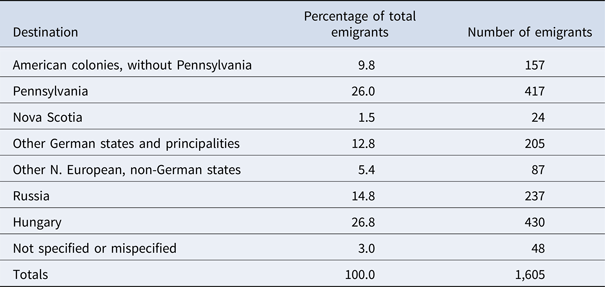
The most common destinations for these emigrants from the Hanau region were the American colonies (36 per cent) followed by Hungary (27 per cent) and Russia (15 per cent), as shown in Table 1. These three were more popular than the option of other German states or European principalities, a reflection foremost of relatively closed borders on the European continent. Settlement was much easier and in some cases only possible when other states and regions were engaged in active efforts to recruit immigrants, as in the case of Prussia, Russia and Hungary in certain years, discussed more below.
Destinations of eighteenth-century Hanau-Region emigrants

Notes: In terms of other European non-German destinations, Hanau emigrants settled in Denmark, Lithuania, London, the Netherlands, and Poland.
Source: Data in I. Auerbach, Hessische Auswanderer (HESAUS): Index nach Familiennamen, Nr. 12, Band I, Auswanderer aus Hanau im 18. Jahrhundert (Marburg, 1987).
Hessians’ great preference for the American colonies, especially Pennsylvania, suggests either that the Hessians from Hanau represent an outlier or that German emigration during the eighteenth century to Hungary and Russia has been overestimated. Scholars have provided estimates of the total numbers of German emigrants and where they went. In particular, Hans Fenske claims that Hungary, Prussia, and Russia all attracted many more German emigrants than the British colonies in North America, with the latter drawing perhaps 10 per cent of the total.Footnote 28 Other authors have accepted Fenske's estimate as a good possibility and as the best we have to go on without further scholarly efforts on this matter.Footnote 29 Evidence from other lists in the south-west parts of Germany, and published after Fenske's work, suggests that the percentage of Germans who went to the American colonies is possibly much higher than 10 per cent with one estimate of 26 per cent from the northern Baden-Durlach region.Footnote 30
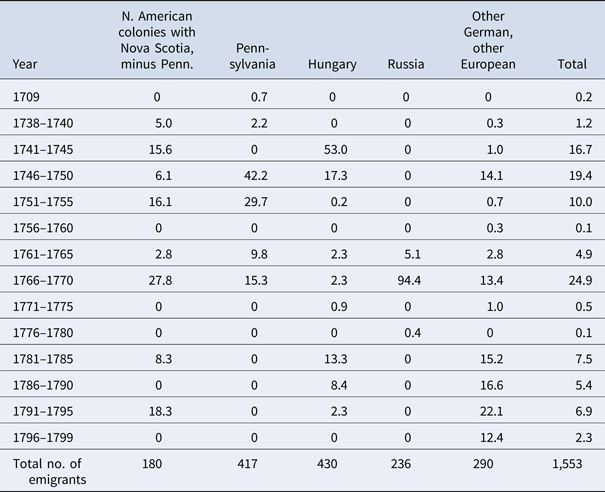
Emigration from the Hanau region of Hesse began in earnest in the 1740s, as shown in Table 2.Footnote 31 Just four people are listed as having left in 1709, three decades after the first major wave of German emigration to the American colonies in the 1680s upon the founding of Germantown, Pennsylvania. Most of the eighteenth century Hanau-Hessians left between 1740 and 1769. Hardly anyone moved in the late 1750s, which reflected the increased difficulty of travelling within Central Europe and across the Atlantic Ocean during the Seven Years’ War.Footnote 32 Emigration to the North American colonies picked up in the mid-1760s but ceased after 1769 and did not start up again until the end of the American Revolution in 1783.Footnote 33 It is not exactly clear why no Hessians were identified as having gone to Pennsylvania after 1770, although travel came to a full stop only a few years later.Footnote 34
Year of departure of eighteenth-century Hanau-region emigrants, by destination (percentages)

Source: Data in Auerbach, Hessische Auswanderer (HESAUS): Index nach Familiennamen, Nr. 12, Band I.
Emigration to Hungary among Hanau-Hessians began in 1741 as a part of Empress Maria Theresa's effort to colonise the south-west area of Hungary formerly occupied by the Ottoman Turks.Footnote 35 The Habsburg Monarchy sought to protect this area from future conquests and specifically recruited Catholic farmers and their families to settle there, providing colonists free land, materials and livestock as well as short-term tax breaks.Footnote 36 Over time, hundreds of new villages were established.Footnote 37 Similar to the migrant stream to North America, emigration to Hungary dropped off in the late 1750s due to the Seven Years’ War, but movement started back up in 1761 and then more earnestly in 1766. The Austrian-Hungarian government halted the monetary support of such colonisation efforts in 1789, which can explain why Hanau-Hessian emigration to this area declined after 1787. Travel to Hungary was by foot or carriage south to the Danube River, and then by boat (or foot) along the Danube to Hungary, and involved some kind of modest travel allowance, surely an easier journey in terms of both time and financial resources than to the British North American colonies or to Russia, covered in more detail below.Footnote 38
The Russian Empress Catherine the Great, of German origin herself, published two Manifestos, one in 1762 and the other in 1763, inviting foreigners (with the exception of Jews) to settle in the Volga region, a region she and her government felt needed to be more densely populated for both economic and security reasons. These Manifestos were published in European newspapers and pamphlets and distributed in particular throughout German-speaking regions of Europe. To entice colonists, she promised free land, a zero tax rate for 30 years, free travel costs, freedom of religion, and some kind of exclusion from military service.Footnote 39 Emigration from Hanau-Hesse to Russia took place shortly thereafter and almost entirely in the year 1766, which fits in exactly with historical descriptions. These Hanau-Hessians played a major role in the Volga settlements founded in 1766 in the region near the city of Saratov, north of the city of Volgograd, which has been characterised as ‘Hessian’ in nature. After 1766, Empress Catherine decided not to support this scheme any longer.Footnote 40
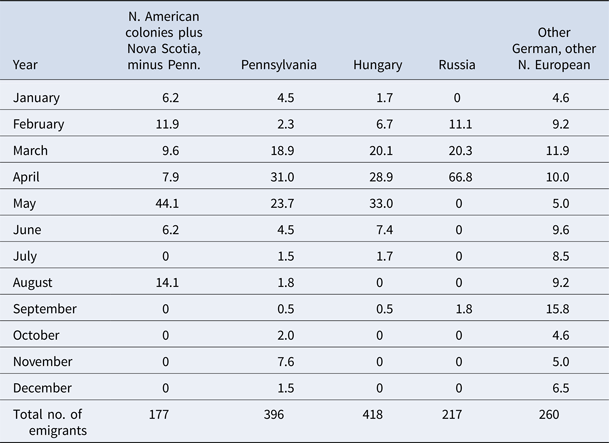
For most of the individuals the archival records recorded the month of emigration (see Table 3). About 94 per cent of those who went to Russia left in the specific year of 1766 in the months of February, March and April, which allowed Germans to get to the area around St Petersburg when waterways became navigable.Footnote 41 The least restricted emigration by season belonged to the group that went to other parts of Germany and Europe (non-Russian and non-Hungarian), as they left during all months of the year. Movement to Hungary was less restrictive than that to Russia but basically took place between the months of February and June, while movement to the North American colonies took place all year but largely during the spring months.
Month of departure of eighteenth-century Hanau-region emigrants, by destination (percentages)

Source: Data in Auerbach, Hessische Auswanderer (HESAUS): Index nach Familiennamen, Nr. 12, Band I.
The trip from Germany to the Volga region of Russia was arduous and with potential long delays around the St Petersburg area, and typically took a year, a long time to be out of work.Footnote 42 The Russian government arranged and paid for travel from Lübeck and provided supplies and cash for help in establishing German settlements. Even so, living conditions were difficult and mortality rates were high among German emigrants in the Volga region (possibly 15 per cent in the first five years of settlement). With the suspension of government support for this colonisation program in 1766, Hanau-Hessian (and all German) emigration to Russia came to a halt after 1766.
As mentioned above, departure to the British North American colonies could occur at any point in the year but was primarily undertaken in the spring months. The close proximity of the Hanau-Hessians to Frankfurt meant that they lived close to the Main River, where they could find recruiting agents for transport to Dutch ports and further to the North American colonies.Footnote 43 Most then disembarked at North American ports in the autumn.Footnote 44 Unlike the movements to Hungary and Russia, one does find small percentages of Hessians moving to Pennsylvania in the months of July through January, which may reflect the presence of a scaled-down but still continuous flow of trade. One can find some of the Hanau emigrants bound for Pennsylvania in the Philadelphia shipping records published by Ralph Strassburger. It was common for the Hanau records to list a March or April departure month, and then find evidence of the emigrant having arrived in September or October of the same year in the Philadelphia records. Here are three examples, showing on average a journey of four to five months in length:Footnote 45 Johann Peter Engel of Dörnigheim Hanau is listed in the Hanau records as departing in May of 1748 and in the Philadelphia records as arriving in Philadelphia on the ship Two Brothers approximately four-and-a-half months later, on 15 September 1748; Johannes Huth of Flörsbach, Gelnhausen departed Hanau in April of 1750 and arrived in Philadelphia on the ship Priscilla on 12 September 1750, a journey of at least four-and-a-half months and easily five months; and Konrad Lohra of Altenhasslau, Gelnhausen is found in the Hanau records as leaving in May of 1754 and in Philadelphia records as arriving in Philadelphia on the ship Edinburgh on 30 September 1754, a journey of five months. Alternative evidence, from linking letters immigrants sent home and merchant records, suggests that travel time from Germany (through England) to Pennsylvania often took over four months and could take five to six months.Footnote 46 Travelling to North America involved a journey up the Rhine river to Rotterdam, a voyage from Rotterdam to an English port (or a Scottish port if England was at war), and finally a cross-Atlantic sailing trip to one of the main ports in the American colonies, most commonly Philadelphia.Footnote 47
It is clear that there were distinct differences in the travel experiences between the three main destination groups. The shortest journey was to Hungary, and the longest was to Russia. The most expensive in terms of out-of-pocket costs, was to the British North American colonies. Becoming established at one's destination was probably most precarious in Russia, given that the Volga-German villages were rural, isolated and built from scratch by the German immigrants themselves.
4. How wealthy and skilled were these emigrants?
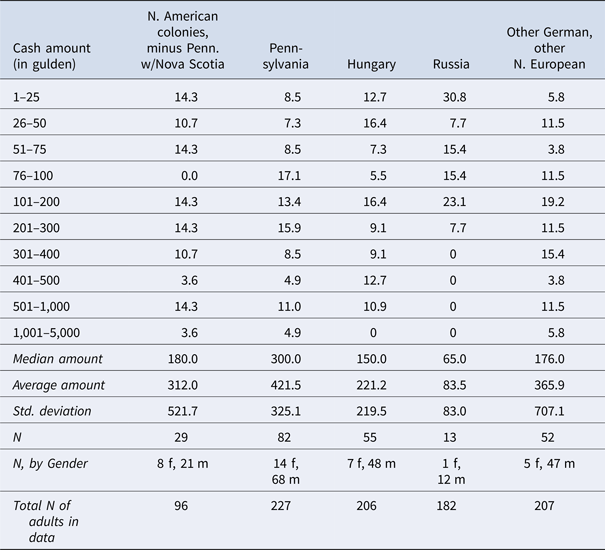
In the seventeenth and eighteenth centuries, the more southerly German states and principalities along with Austria used gulden as their form of currency. The region around the city of Frankfurt, including the Hessian principalities, also used gulden. All amounts in the emigration records are stated in gulden. This currency was also referred to as the florin and was used by other southern European states.Footnote 48 An approximate currency conversion at the time is one gulden per ten shillings.Footnote 49 In some cases the cash stated in the emigrant records was part of an estimated inheritance, and sometimes values of exported cash were guesstimates by local authorities.Footnote 50 If reported, exported cash was listed with the head of household; this information exists for only a fraction of the heads of household. The absolute values of cash that emigrants took with them are less informative than the comparisons one can make across emigrants in the various destination groups. I examine only those who stated that they were taking cash with them and thus consider only non-zero values. I have records for 231 individuals (across the five destination groups in Table 4), who were either heads of households or adults travelling by themselves. Table 4 displays the cash distributions and the average along with the median amounts. It is more useful to examine the larger groups, such as those who went to Pennsylvania, Hungary and other German and other European regions. The richest of these, with a median of 300 gulden, were overwhelmingly those who went to Pennsylvania. Those travelling to Hungary and other German and other European regions took less. Those going to Russia took the least amount, (although based on a small number), partly a reflection of the family structure of this group, something I elaborate on below, and partly because the Russian government funded the costs of travel to the Volga region, thus attracting more Hessians with fewer assets who could not move otherwise.
Distribution of exported cash, eighteenth-century Hanau-region emigrants (1709–1799), by destination (percentages)

Source: Data in Auerbach, Hessische Auswanderer (HESAUS): Index nach Familiennamen, Nr. 12, Band I.
Hanau-Hessians moving to the American colonies faced large passage fares to cross the ocean, and 300 gulden represented a hefty savings from the standpoint of a labourer's wage. Very few passenger contracts for travel across the Atlantic Ocean have survived, but one estimate of this cost is from an 1803 contract, which specified fares of 180 gulden per person above the age of 12 and 95 gulden for children from ages 4 to 12.Footnote 51 About five per cent of the Pennsylvania-bound heads of household were taking over 1,000 Gulden with them, which would have paid the full fare for a family with two adults and four children, ensuring that they would not have to turn to servitude to pay down the passage debt. At least for passengers coming from Hanau, with a median amount of 300 gulden, one can see that the majority of families moving to Pennsylvania could not pay their full passage and most likely resorted to the servitude markets. The emigration of families is discussed further below.
In contrast, those moving to Hungary or Russia did not have as great a need for cash savings and were participating in quasi-colonisation programs, where authorities used inducements like exemptions from compulsory labour and taxes, travel allowances and grants for help in settling the land. In the case of those who moved to Russia, while the journey to the Volga region took so much time, the travel costs from the German port of Lübeck to the Volga Region were financed by the Russian government. In the case of Hungary, the Hapsburgs provided some small travel allowance, but travel to the Banat region also took much less time and cost much less.
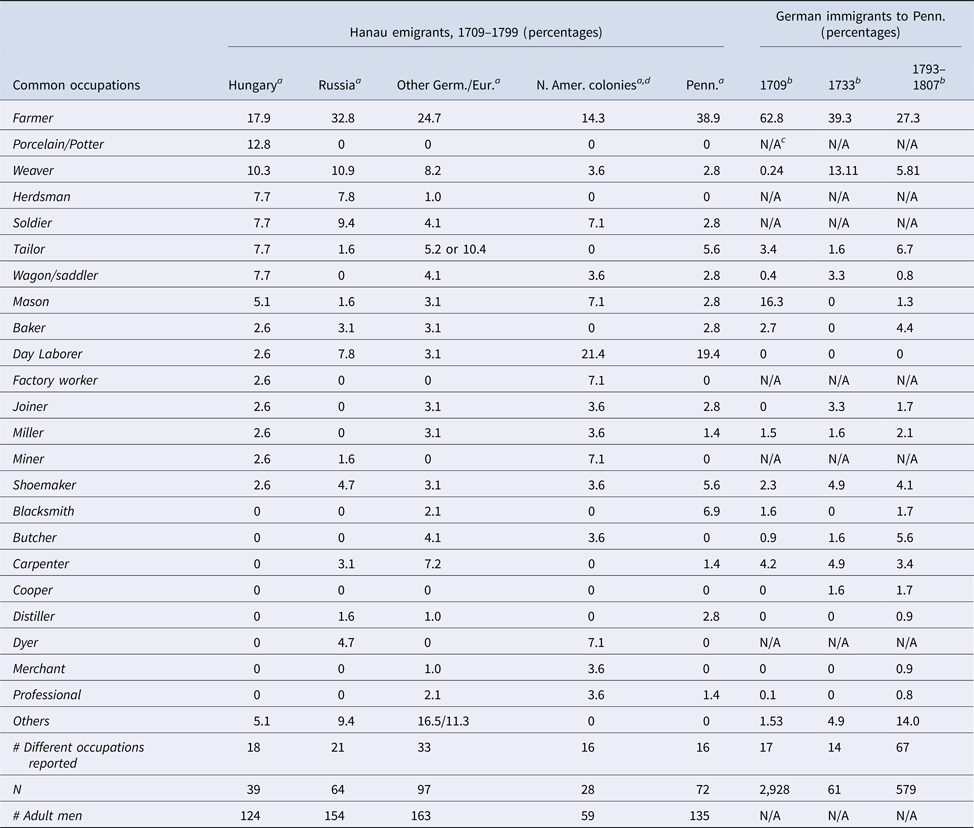
People with different occupations were attracted to different destinations. Occupational characteristics of all Hanau emigrants for whom I had data, are shown in the left hand side of Table 5, broken down by destination. On the right hand side, in the last three columns, occupational distributions for German immigrants to Pennsylvania in the years 1709 and 1733 and in the years between 1793 and 1807 are shown, based on Farley Grubb's work.Footnote 52 Occupational distributions are thus displayed for a total of eight different groups (in eight columns). For the Hanau emigrant groups the number of emigrants for which there is occupational information is small; in contrast, the Pennsylvania immigrant datasets are much larger. For most adult men no information on occupation is provided, and the last row of Table 5, the number of adult men in each destination group, provides a fairly good idea of the degree of underreporting.Footnote 53 For these data, however, the degree of occupational specificity also matters (measured by the number of different occupations, reported in the third to last row of Table 5). So while occupational information exists for a minority of Hanau-Hessian emigrants, the number of occupations reported is 16 or more and is comparable to the German immigrant data, with the exception of the 1793–1807 group that had 67 different occupations reported. A move to another country could produce occupation mobility, upward or downward, which one must take under consideration when comparing occupations of the Hanau emigrants with those of the Pennsylvania immigrants.
Occupational background of Hanau-region emigrants and German immigrants in Pennsylvania

a Source: Data from Auerbach, Hessische Auswanderer (HESAUS), Nr. 12, Band I.
b These figures are from F. Grubb, ‘German immigration to Pennsylvania, 1709 to 1820’, Journal of Interdisciplinary History 20 (winter 1990), 432, Table 5.
c N/A means this category was not displayed.
d Hanau emigrants who went to the North American colonies or Nova Scotia, excluding Pennsylvania.
Other Notes: (i) Occupations are ordered by relative percentages for the Hungary group; (ii) Professional category includes doctors, teachers and community leaders for the Hanau group and just doctors for the PA immigrants; (iii) Included in the Others category for the Hungary-bound are: one midwife and one fish trap maker; for the Russia-bound are: one coachman, two musicians, one sailor, one roofer and one cloth worker; for the Other German/Europe-bound are: one book binder, one cashier (ticket person), one wallpaper maker, one coachman, one plumber, one light maker, one painter, one paper maker, one locksmith, and one junior officer; (iv) Within the Other German/Europe-bound group are five people with an occupational code of ‘AN’, which does not exist in the HESAUS data; it is possible that these individuals were really tailors, with the code of ‘SN’ (Schneider), since the ‘A’ and ‘S’ keys are next to each other on the keyboards used in Germany.
A large percentage of those who emigrated from Germany were farmers. This is true of all five Hanau destination groups as well as of the Pennsylvania German immigrants whom Grubb studied. Empress Catherine promised grants of land, and this served as an inducement, with 32.8 per cent of the Hanau-Hessians who went to Russia listed as farmers. Similarly, ‘farmer’ was the most common occupation for those who went to Pennsylvania, at 38.9 per cent; land in Pennsylvania was relatively cheap and available in comparison with Germany.Footnote 54 The groups that went to Hungary or to North American colonies (excluding PA) show smaller proportions of farmers leaving, interesting but something I do not want to make too much of given that it is based on a handful of emigrants.
All eight groups also show varying types of artisans roughly comparable to each other in proportions, with the apparent exception of more masons among the North American-bound immigrants, more shoemakers and blacksmiths among the Pennsylvania German immigrants and more potters among those who left for Hungary. In addition, while the Hanau data describe emigrants as herdsmen, dyers, soldiers, miners, factory workers and potters, no such labels are used for the PA immigrants, unless they make up tiny percentages and are incorporated in the ‘Others’ category. This is relevant, as there were some numbers of Hanau emigrants in all of these occupational categories. Additionally, a number of Hessians had been soldiers at home, but no such occupation is listed in the Pennsylvania data, which is understandable since the North American colonies did not have any professional standing armies and relied on citizen militias.
Few merchants left the Hanau region, except in the case of those who went to the British North American colonies (3.6 per cent) or other German/European states (1 per cent); few merchants ended up in Pennsylvania, with the highest percentages at 0.9 per cent for the immigrant groups. Not a single merchant or professional emigrated to Hungary or to Russia, which may indicate that such individuals thought that their prospects under Catherine the Great or Empress Maria Theresa were not as promising as in North America or in other parts of Europe. Quite differently, the tax lists for Pennsylvania in 1773 (not displayed in Table 5) show a 10.9 per cent share of merchants in the occupational distribution.Footnote 55 If these data from Pennsylvania are reliable, they suggest that there was a significant degree of upward occupational mobility and possibly considerable wealth mobility.
One main difference between the Hanau data and the Pennsylvania data is that the former show a large percentage of labourers having emigrated out of the Hessian region, particularly to North America, while the immigrant data show a zero percentage of labourers settling in Pennsylvania. It is unclear if this represents sudden upward occupational mobility or that immigrants recorded in the American documents were fudging their stated occupations and perhaps exaggerating their true skill levels. Did German immigrants disembarking in Philadelphia have an incentive to lie to potential employers or buyers of redemptioner servant contracts? Many labourers were primarily agricultural labourers and may have reinterpreted their occupation as ‘farmer’ or as some artisan. Or was this purely a Hessian phenomenon? The majority of Pennsylvania German immigrants originated from non-Hessian regions in Germany and Switzerland, and the possibility exists that few labourers emigrated from these other areas, although this explanation seems unlikely.
It is interesting to compare the Hanau emigrants who went separate ways. Artisans seemed to be attracted to all five destinations, but least so to Russia and most so to other parts of Germany and Europe.Footnote 56 The highest diversity of occupations belonged to this latter group, with 33 different occupations recorded. Some parts of Europe could offer more than the Hessian area. Frederick II, King of Prussia from 1740 until his death in 1786, for example, actively encouraged immigration into Prussia, especially farmers who could settle land in under-populated areas or newly reclaimed lands and artisans who could contribute in the developing textile-manufacturing sector.Footnote 57 This may explain in part the diversity of skilled Hanau emigrants who left for other German states and parts of Europe. An additional explanation is that many of these artisans were young men at the journeyman stage of their careers, when seeking out further training involved leaving home.
In contrast, the Russian-bound appear the least skilled in terms of artisan occupations; if skill reflects higher earning power and potential to save, the low cash values reported for the emigrants who went to Russia discussed above align with the occupational evidence. Furthermore, among those who went to Hungary and Russia there were more herdsmen, weavers and soldiers, definitely all lower-skilled and lower-paid professions. The difference between these two groups is that there were more artisans among those who went to Hungary. Interestingly, in 1746, 16 people from the extended Euler family in the town of Steinau (Kreis of Schlüchtern) emigrated to Hungary. Within this large family were five adult men, all ceramic and porcelain artisans, the only such artisans recorded in these data. They may have participated in the nascent and eventually world-famous glass and ceramics industries in Hungary.Footnote 58
Why were labourers much more likely to go to North America and not eastward to other parts of the European continent? Agricultural labourers, especially, may have been uninterested in trading off a Hessian lord for a Hungarian or Russian one, where arguably peasants had fewer rights in the eastern parts of Europe than in the West at this time. The chances for labourers to move up the occupational ladder or buy land may have been much better in the colonies in North America. Examples exist of German labourers who immigrated to Pennsylvania and became large landowners, including the account of Caspar Wistar.Footnote 59 How pervasive his rags to riches story was, or even how well known it was, is not completely clear. Wokeck discusses letters immigrants wrote back home, and how the first letter written was usually timed when immigrants could ‘impart positive news’.Footnote 60
5. Age and families
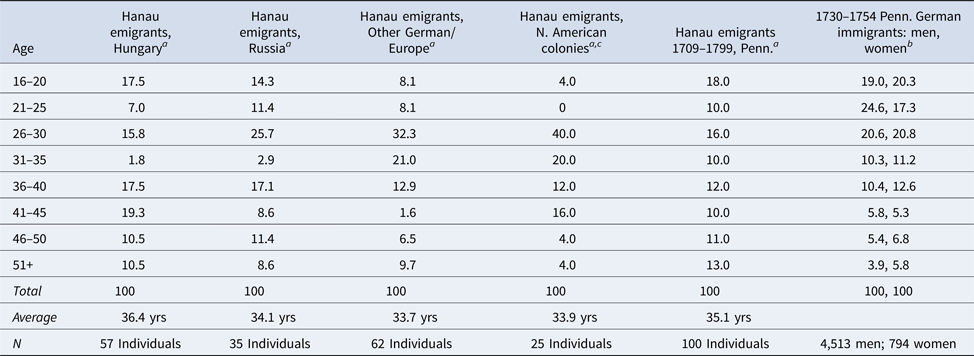
Similar to the occupational identities, the Hanau data included ages for some but not all of the emigrants. Age distributions were calculated for all five destination groups and are shown in Table 6, with only adults (both men and women) age 16 and over examined. In addition, the last column on the right displays age distribution data for Pennsylvania immigrants from 1730 to 1754.Footnote 61
Age distribution of adults among Hanau-region emigrants and German immigrants in Pennsylvania (percentages)

a Source: Data from Auerbach, Hessische Auswanderer (HESAUS), Nr. 12, Band I.
b Figures from Grubb, ‘German immigration to Pennsylvania, 1709 to 1820’, 427, Table 4.
c Hanau emigrants who went to the North American colonies or Nova Scotia, excluding Pennsylvania.
At first glance, the age group 21 to 25 for Hanau emigrants seems rather low, especially compared to the percentage for Pennsylvania immigrants. This may reflect that young men experienced difficulties emigrating due to being of military service age, a requirement for all young Hessian men with the exception of a privileged few of the upper classes. When they did indeed emigrate, doing so illegally was the easier way, and such cases would not have been included in these official records.Footnote 62 Another standout is that not as many people over the age of 40 emigrated to other German and European states and were more likely to settle in Hungary or Pennsylvania.Footnote 63 Some of the emigration to other parts of Germany may have consisted of journeymen emigrating with the purpose of fulfilling their training requirements, thus the predominance of emigrants in their late twenties.
Age is missing for most of the Hanau-Hessian emigrants (Table 6). A more appropriate comparison to make in this table is that of the Hanau emigrants who went to Pennsylvania with the German immigrants in the last column. Here, the Hanau data show an older population than that found in Grubb's Pennsylvania data, as about twice as many people from Hanau were over the age of 40. I am reluctant to make too much of this because older people, generally more established in their home communities than young people, probably were less likely or able to leave illegally and were thus more likely to be listed in the emigration records, which would lead to an upward bias in the age distribution. It bears looking at the family composition of travelling groups.
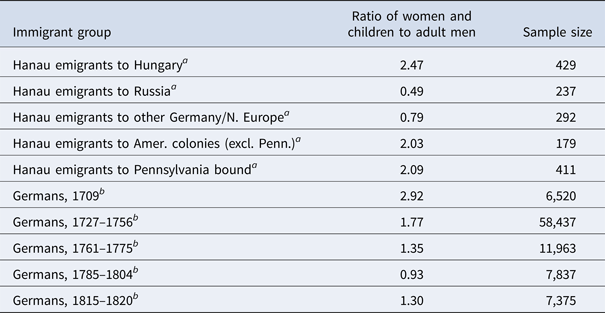
Dependency ratios (ratio of women and children to adult men) are calculated for all five Hanau groups and displayed in Table 7. The ratios reflect some degree of undercounting of the wives travelling, as Hessian authorities for some reason would document all of the heads of households as well as children but miss writing down some of the wives travelling with their husbands and children.Footnote 64 Correcting for this changes the dependency ratio number of 2.09 for the Pennsylvania-bound, for example, to 2.17, a rather minor adjustment.
Ratio of dependent migrants to adult male migrants, comparison of eighteenth-century Hanau-region emigrants with Pennsylvania immigrants

a Source: Data from Auerbach, Hessische Auswanderer (HESAUS), Nr. 12, Band I.
b Figures are from Grubb, ‘German immigration to Pennsylvania, 1709 to 1820’, 420, Table 1.
Note: The North American colonies group excludes emigrants who went to Pennsylvania and includes those who went to Nova Scotia.
One of the most interesting features here is the stark difference that exists between the emigrants from Hanau who went to Russia and other parts of Germany and Europe on the one hand and those who went to the British North American colonies and Hungary on the other. Emigration to the latter was a migration of families, while emigration to Russia and other parts of Germany and Europe (with the exception of Hungary) was dominated by adult men travelling on their own. It may be that some of these men travelling without a spouse or children still had dependants back in the Hanau-Münzenberg county, but it is also quite likely that more unmarried men were involved; some of those leaving for other German or northern European places were probably artisan journeymen.Footnote 65
It suggests too that the groups with high dependency ratios were migrating on a permanent basis with little or no thought of returning to their Hessian homelands. Those emigrating to other parts of Germany might have been engaged in a move that was not permanent, given the relatively low costs of travel involved, especially in the case of other German states. These data also point out a glaring difference between those who went to Hungary and those who went to Russia. Not all eastward emigrations were the same: compared to the Russia-bound, those moving to Hungary were mostly moving within families, taking more cash with them and usually more skilled. The Russian emigration from Hanau was primarily a one-time event, with over 93 per cent leaving in the spring of 1766 and with the lowest dependency ratio of any group. The many benefits that the Russian government promised, especially the payment of travel costs, attracted poorer Hessians or individuals and families with fewer liquid assets. That mostly individuals but few families emigrated to Russia, may reflect that there was great risk in travelling for such a long time and distance to Russia; unlike in the case of North America, there were practically no established migrant networks that would have existed in the case of substantial previous emigrations to Russia, thus no or very few Hessians living in the Volga region who could have helped new emigrants adjust. This was perhaps too risky for people with children.
The dependency ratios also agree with Farley Grubb's findings for German immigrants in Pennsylvania, namely that those who settled in Pennsylvania moved overseas mostly within family groups. Over the eighteenth century, the dependency ratio for Germans arriving in Pennsylvania gradually fell, which the large datasets for Pennsylvania German immigrants in Table 7 show. The figure for Hanau-Hessians who migrated to Pennsylvania is 2.09, a number that lies roughly in the middle of all of the values for the Pennsylvania immigrant data.
6. Spatial emigration patterns of eighteenth-century Hessian emigrants
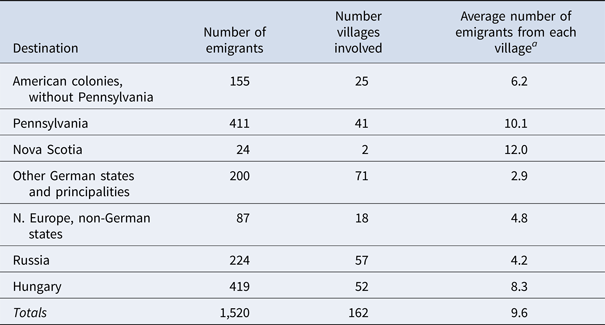
Not all villages experienced the same levels of emigration: some lost a lot of people and others lost none. Emigrants to specific destinations tended to be from particular sets of villages, with different numbers of villages losing emigrants to various destinations, as displayed in Table 8. Roughly, the more emigrants who went to a particular destination, the greater the number of different villages they came from. So those bound for Hungary made up 26 per cent of the emigrant pool and left from 52 different villages, while 2 per cent went to Nova Scotia and left from only two different villages.
Patterns in destinations of eighteenth-century Hanau-region emigrants

a These numbers are calculated from dividing number of emigrants by number of villages involved. These are not weighted averages.
Source: Data from Auerbach, Hessische Auswanderer (HESAUS), Nr. 12, Band I.
The numbers in Table 8 are also related to the flow of information. Although British North America was the most popular destination, a greater number of villages lost people to other parts of Germany. Information about closer destinations was both easily available and more widely distributed. The far-right column in Table 8 displays the average number of emigrants per village, all calculated from data in columns to the left. Of all of the possible destinations, one can imagine that information about other German states was probably more accurate for people in the Hanau-Hessian region, next door to the bustling city of Frankfurt. This particular destination group had the lowest number of emigrants per village (2.9), implying that the information about other German-speaking regions along with possible connections were indeed more accessible and widely distributed; travelling with friends and neighbours to achieve one's migration goals was less necessary.
A possible additional factor is the degree to which emigration was permanent, closely correlated to distance from home. Here, the destinations with some of the higher numbers in terms of average number emigrants per village (Pennsylvania, Nova Scotia and Hungary) involved family (permanent) migrations, and in the case of the two former destinations, long distances. It raises the question, did families operate in different information circles and networks of the time compared to men travelling by themselves?
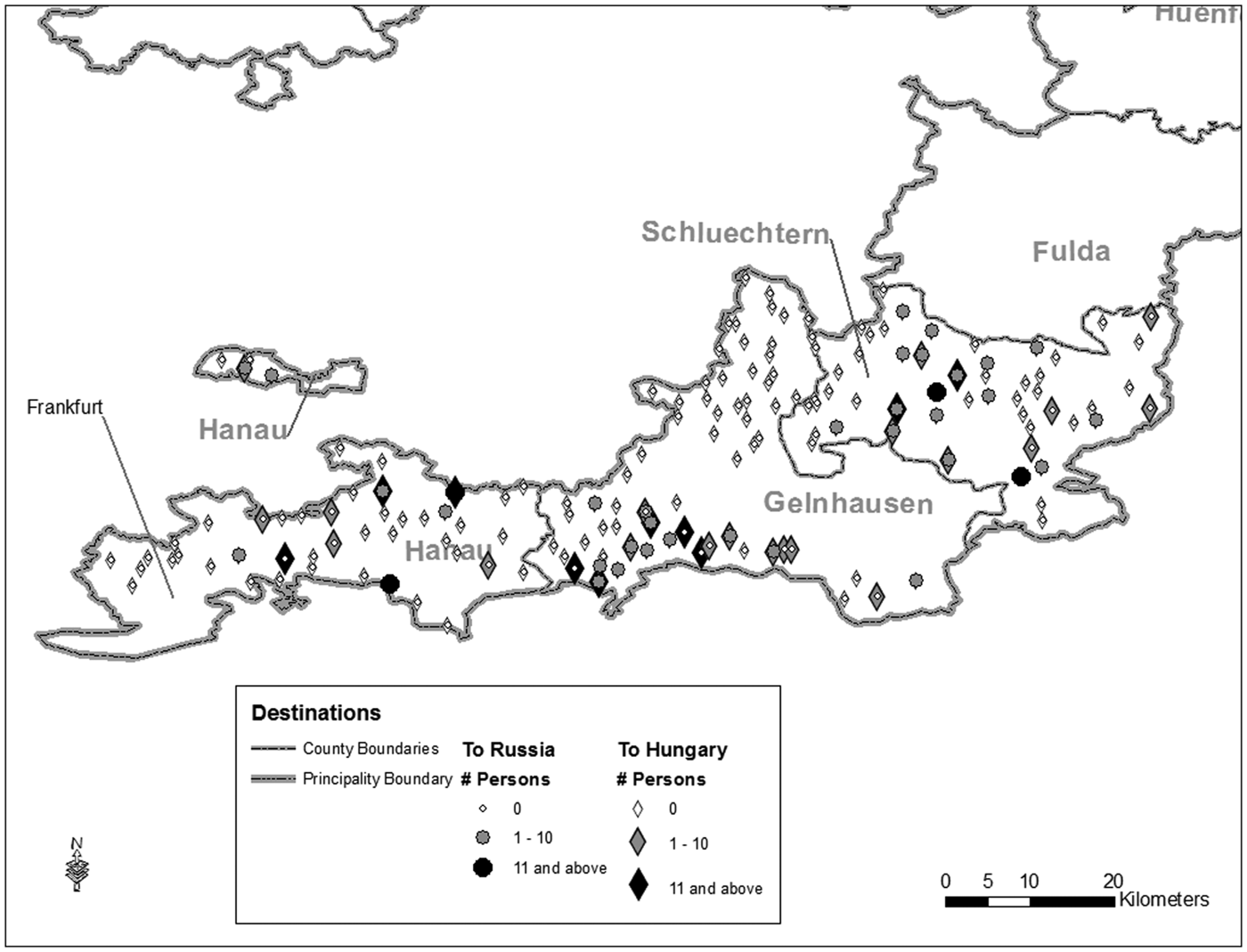
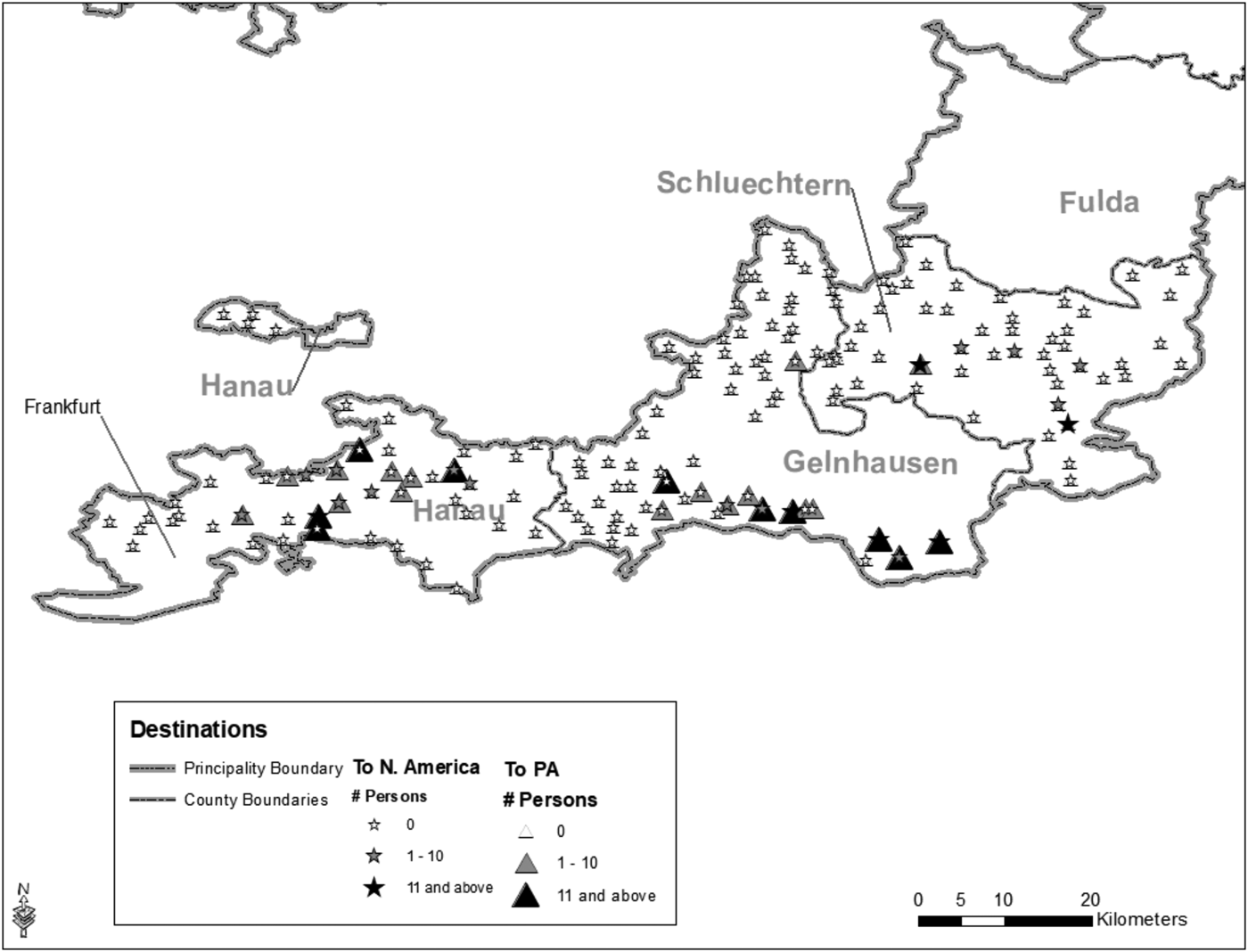
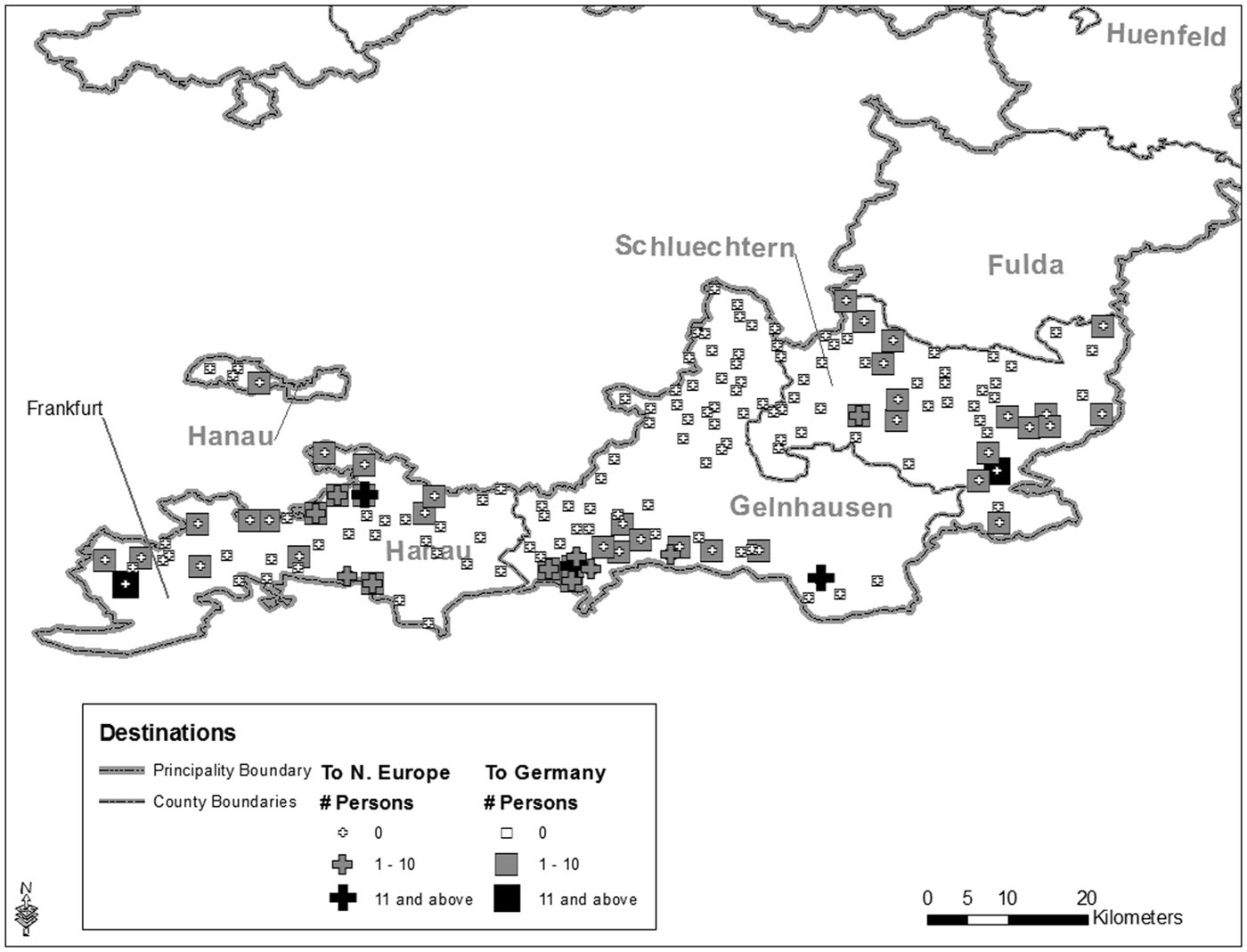
Various GIS maps, organised by destination, show the villages that Hessian emigrants left from. These maps only show emigrants who left from places within the nineteenth-century borders of the Hanau, Glenhausen and Schlüchtern districts of the principality of Hesse-Cassel. The Free City of Frankfurt lay directly on the south-western border of the Hanau district. Figure 1 compares the Hessian village origins of those who left for Hungary and Russia, Figure 2 shows the hometowns of those who went to North America (not PA) and Pennsylvania, and Figure 3 shows the village origins of those who left for other parts of northern Europe or other German places. The maps display all of the 167 different villages of these three districts, whether emigrants left from a particular village or not.
Eighteenth-century Hesse-Cassel villages of origin for emigrants to Hungary and Russia. Note: Includes only villages located within nineteenth-century Hesse-Cassel borders and excludes emigrants who left nearby villages located in the Hesse-Darmstadt principality. Source: Figure was produced using data in Auerbach, Hessische Auswanderer (HESAUS): Index nach Familiennamen, Nr. 12, Band I.

Eighteenth-century Hesse-Cassel villages of origin for emigrants to North America (not PA) and Pennsylvania. Note: Includes only villages located within nineteenth-century Hesse-Cassel borders and excludes emigrants who left nearby villages located in the Hesse-Darmstadt principality. Source: Figure was produced using data in Auerbach, Hessische Auswanderer (HESAUS): Index nach Familiennamen, Nr. 12, Band I.

Eighteenth-century Hesse-Cassel villages of origin for emigrants to northern Europe and other German states. Note: Includes only villages located within the nineteenth-century Hesse-Cassel borders and excludes emigrants who left nearby villages located in the Hesse-Darmstadt principality. Source: Figure was produced using data in Auerbach, Hessische Auswanderer (HESAUS): Index nach Familiennamen, Nr. 12, Band I.

For all six of the destinations there were clusters, indicating the path-dependent nature of migration movements over time and that emigrants banded together in terms of information and resources. Quite a few villages lost people to both Russia and Hungary, but a considerable number of villages were specialised in either emigration to Hungary or emigration to Russia (Figure 1). Almost all of the emigration to Russia occurred in the spring of 1766, and Figure 1 shows that Catherine the Great's invitation was heard and answered in a set of Hessian villages that were fairly well spread out geographically.
Those bound for Pennsylvania (Figure 2) or other parts of northern Europe (Figure 3) came almost exclusively from the districts of Gelnhausen and Hanau; only one village in Schlüchtern lost people to these two places, and it was the same village for both destinations. The village origins of the other destinations groups were more spread out among the three districts. The emigrants who left for other German states (Figure 3) left from the largest set of villages among the six destination groups in these figures. Still, for all of the destination groups, emigration from the northern parts of the Gelnhausen district was practically non-existent.
On average communities lost emigrants to one specific destination. Some of the larger communities, however, experienced emigration to more destinations: these places included Killianstädten and Windecken in the Hanau Kreis (district) and Steinau in the Schlüchtern Kreis. These three communities all had large populations and thus a higher likelihood of superior information networks on possible emigrant destinations.Footnote 66
7. Was there cumulative causation?
The first emigrants to each destination had no network to rely on, but thereafter personal networks were possible, which could, according to Douglas Massey, ‘build a strong dynamic momentum into migration’ and lead to a three-part migration cycle over time consisting of at first low levels of migration, followed by high levels and then concluding with declining migration rates that together formed ‘an inverted U-Shape’.Footnote 67 Table 2 shows migration over time for each destination group and the varying potential for cumulative causation. First, there was no possibility for cumulative causation to occur for Hessian emigration to Russia, because Empress Catherine stopped the subsidisation of German immigration to Russia in 1767, close to the time of the arrival in Russia of over two hundred Hanau-Hessians.
It was different with the remaining groups: the destination groups that came closest to exhibiting an inverse U-shape pattern were the North American and Pennsylvania-bound groups and to a lesser degree the Hessians going to other German states and other parts of Europe as well as to Hungary.Footnote 68 These more connected groups on the continent also benefited from being physically closer to each other. North American destinations, along with parts of Prussia under Frederick II, could provide the opportunity to acquire land, a huge motivating factor for migrants and potential migrants interested in improving their economic standing both in absolute terms as well as in relative ones. The formal invitation from Empress Maria Theresa (and her promise of land and other subsidies) prompted many Hanau-Hessians to migrate in the first half of the 1740s to Hungary. The attraction to Hungary lasted for several decades, only dying down around the time that government subsidisation of the colonisation efforts ended.
The degree of cumulative causation for all of these groups, with the exception of emigration to Russia, would have been more intense without the Seven Years’ War, which put a stop to emigration and slowed down communications between migrants and people in their homeland in the latter part of the 1750s; as a result, the vitality and usefulness of personal networks most likely suffered. Still, migration to the west went on longer and was greater in magnitude, allowing for more personal networks to form over time; in comparison, many of those who moved in other directions had less time to form such networks or fewer people available to them to create networks.
8. Conclusion
This project examines Germans from the Hanau-Hessian region who emigrated in the eighteenth century and offers an opportunity to compare Germans who settled in the British North American colonies with those who remained on the European continent. Most left in the middle part of the eighteenth century, and the largest proportion went to North America, with Hungary and Russia the second and third most popular destinations, respectively. More Hessians settled in the American colonies than would have been initially suspected by work from other scholars.Footnote 69 If these Hanau-Hessians can be considered as representative of all German emigration in the eighteenth century, it raises the possibility that more Germans moved to Pennsylvania and other North American colonies as a percentage of all German emigration of the eighteenth century, and possibly that German emigration to Hungary and Russia has been overestimated.
The emigrant groups who went to other parts of Germany and northern Europe as well as Russia were dominated by men travelling alone, quite different from the emigrant groups who went to North America and Hungary, both family movements. The lowest skilled, measured by the lowest concentration of artisans, were the Russian-bound. The other male-dominated group, the ones who went to other parts of Germany and northern Europe, were somewhat more skilled and the youngest on average; the migration plans of this latter group may have involved more travel for the acquisition of skills, since movement was often to places only short distances away and possibly not as likely to be permanent.
The Hungarian and Russian governments subsidised German migration to their lands, making it more feasible; in particular Russia paid the travel expenses of Hessians who moved in 1766. Compared to those who went north and east, those who went to North America took more cash with them, partly because they needed it to accomplish their migration goals. As such they were the most positively selected group in terms of all of the Hanau-Hessian emigrants. Cash resources allowed entire families to emigrate and pay for a significant component of the passage fare. Further research is required to place the specific cash resources used by families in the context of what transpired within the servitude markets in Pennsylvania and to what extent these Hanau-Hessians participated in them.
Emigrants bound for similar destinations tended to leave from particular sets of villages, but not always, as there was some degree of overlap with emigrants going to different destinations leaving from the same villages. In spite of the clusters, though, many villages were within close walking distance to another village with a different emigration experience. The maps as well as the evidence on the extent of emigration in villages (Table 8) shed some light on the spread of information and how it was related to the distance of a destination, how long an emigration pattern had existed and possibly to the permanency of a migration. The use of networks was possibly highest among those who went west to Pennsylvania, an emigration that started early in the eighteenth century and that was also family-oriented.
It remains to be seen to what degree people were linked and how much cumulative causation really occurred. Evidence points to a larger degree of cumulative causation among those who went to North America or to other German states or other parts of Europe. A study using local records of migrants at the destinations along with the existing Hanau-Hesse emigrant records could provide more information on the degree to which Hessians transplanted themselves, namely the extent to which emigrants from the same families and villages settled together in their new homelands.Footnote 70
In summary, the long-run account of Hanau-Hessian emigration in the eighteenth century suggests that the story of their migration is indeed a complex one and that different destinations attracted individuals and families with diverse goals and objectives. The broader lesson is that most migration movements involve individuals and families who make choices that are not always ideal or perfect but that are more likely the best they can do given the different types of barriers and constraints they face. A determining factor with regards to where migrants end up, as it was with the Hanau-Hessians, is often the financial resources migrants possess. A one-size-fits-all migration plan does not exist, and the ability to pay migration costs is a crucial factor here. Further, networks play an important role, and they did so even in the eighteenth century. In particular, a specific social network emanates from the physical place where one is born and the family one is born into, which helps shape the opportunities and choices that emerge for a person who wants to migrate. Obviously, no one has control over the circumstances of one's birth. Purposeful action by migrants, however, can contribute to what degree they can broaden their social network or make it more effective and thereby make their own luck.Footnote 71 The detail of how networks matter is for psychologists, sociologists, behavioural economists and perhaps philosophers to explain further. Historians must determine how much they mattered in the past.
Acknowledgements
I first thank Farley Grubb, whose body of work on Pennsylvania German immigrants inspired me to write this article. I presented an early version of this work at the 2009 Social Science History Association meetings, where Sigrid Wadauer provided many insightful comments. Figures were constructed by Nora Santiago, Urban Policy Analyst at the College of Staten Island (using data from the author), with support from the CUNY High Performance Computing Center at the College of Staten Island. Lastly, I want to thank Anne Pfaelzer de Ortiz, the anonymous reviewers and the editors of Continuity and Change for their constructive feedback and editorial assistance.