Introduction
It is exceptionally rare to encounter direct skin involvement of metastatic lymph nodes in patients with mucosal head and neck squamous cell carcinoma (SCC), in the absence of invasion of other anatomical structures. When direct skin involvement is evident at presentation, patients usually have very advanced loco-regional disease, and invasion of deep structures such as the carotid artery or pre-vertebral fascia is evident. Such direct skin involvement is traditionally considered a poor prognostic indicator as it reflects extracapsular spread and uncontrolled disease. Skin involvement in head and neck SCC patients can develop due to direct invasion from the index tumour, or can arise from metastatic lymphadenopathy or from metastatic nodular skin deposits secondary to haematogenous spread.Reference Yoskovitch, Hier, Okrainec, Black and Rochon1–Reference Pitman and Johnson3 There appears to be some controversy over the distinction between true skin metastasis and other categories of skin involvement, and the differentiation of these categories has not been adequately addressed.Reference Pitman and Johnson3 According to our literature search, there has been no previous study investigating the clinical presentation, management and outcome of patients presenting with direct skin involvement of metastatic lymph nodes from mucosal head and neck SCC, occurring in the absence of invasion of other anatomical structures.
This study aimed to analyse the clinical presentation, management and prognosis of this small subset of patients.
Materials and methods
Following review by our local ethics committee, this retrospective case notes study identified eight patients referred to the head and neck oncology unit at Guy's and St Thomas' Hospital NHS Foundation Trust between 2000 and 2007, who had direct skin involvement of metastatic lymphadenopathy from mucosal head and neck SCC.
We excluded from the study patients with metastatic skin nodules, direct invasion of the index tumour, or deep nodal invasion of other anatomical structures such as the pre-vertebral fascia and carotid artery.
All patients were fully investigated according to the unit's standard operational policy. This included full otorhinolaryngological examination together with fibre-optic examination of the upper aerodigestive tract, fine needle aspiration cytology, panendoscopy and biopsy of the index tumour site (or multiple potential tumour sites in cases of occult primary tumours), computed tomography of the head, neck and chest, and magnetic resonance imaging and positron emission tomography in selected cases.
The presenting stage of disease was classified according to the sixth edition of the International Union against Cancer tumour-node-metastasis (TNM) classification of malignant tumours.Reference Sobin and Wittekind4 All patients were discussed at the multidisciplinary head and neck oncology meeting (tumour board) and a consensus decision on staging and management was reached prior to any treatment.
Outcome data were calculated at five years.
Statistical analysis was carried out using the Statistical Package for the Social Sciences (IBM, Chicago, Illinois, USA). Survival outcomes were calculated using the Kaplan–Meier method.
Results and analysis
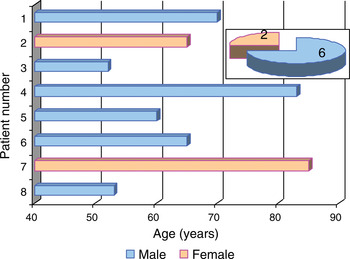
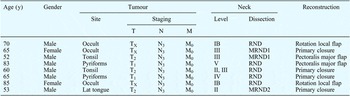
Between 2000 and 2007, eight patients presented to the otorhinolaryngology and head and neck unit at Guy's and St Thomas' NHS Foundation Trust, London, with skin involvement of metastatic cervical lymphadenopathy from head and neck SCC (Table I). Six patients were male and two female. Their ages ranged from 52 to 85 years, with a median age of 67 years (Figure 1). All patients had an Eastern Cooperative Oncology Group – World Health Organization – Zubrod performance status of zero or one at the time of presentation.Reference Oken, Creech, Tormey, Horton, Davis and McFadden5
Patients' age and sex distribution.

Patient characteristics

y = years; T = tumour; N = node; M = metastasis; RND = radical neck dissection; MRND = modified radical neck dissection; Lat = lateral
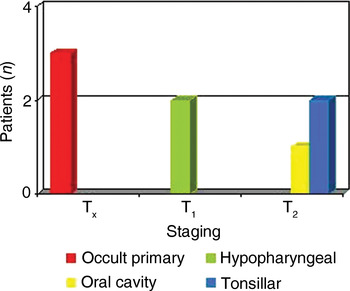
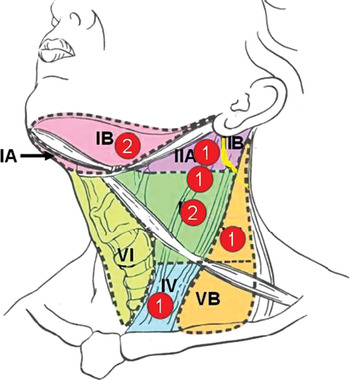
All eight patients' tumours were staged as N3 M0. Two patients had an index primary tumour in the tonsil, two in the hypopharynx and one in the oral cavity. Three patients had occult primary tumours. The patients' TNM staging is shown in Figure 2. Of the three patients with occult primaries, one had synchronous papillary thyroid carcinoma (T2 N1b), one developed bronchogenic carcinoma four years after his original presentation, and one developed breast carcinoma five years after original presentation. All these patients had their histopathology analysis cross-checked; none of their synchronous or metachronous carcinomas were related to their occult primary tumour. The location of patients' neck skin involvement is illustrated in Figure 3.
Patients' tumour (T) staging and site at presentation.

Location of cervical skin involvement: numbers in red circles indicate patients with skin involvement at that site. Adapted with permission.Reference Harish6

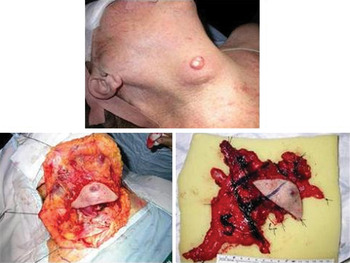
Five patients underwent extended radical neck dissection and three underwent extended modified radical neck dissection. Of the latter three patients, two had a type I procedure with preservation of the spinal accessory nerve, while one had a type II procedure with preservation of the spinal accessory nerve and internal jugular vein. The involved skin area was removed en bloc with the neck specimen (Figure 4). Intra-operative frozen section analysis of tumour margins was performed in all patients, and proved negative in all. All subsequent paraffin sections confirmed the findings of the frozen section analysis. Reconstruction of the surgical defect was performed with primary direct closure in four patients, skin local rotation flaps in two patients and pectoralis major flaps in two patients. Surgical excision of the primary index tumour involved a radical transoral tonsillectomy in two patients and a partial glossectomy in one patient.
Surgical photographs showing an extended modified radical neck dissection.

Complications included wound infection in one patient and wound dehiscence in another, for which a secondary pectoralis major flap reconstruction was required. Both wounds healed completely with no sequelae.
All patients were scheduled to receive radical radiotherapy to neck along with either radiotherapy to the primary site or pan-mucosal radiotherapy in the three patients with occult primary sites.
One patient suffered a traumatic hip fracture in the post-operative period. This was managed surgically with a hip replacement, but was complicated by hospital-acquired pneumonia which led to the death of the patient prior to radiotherapy.
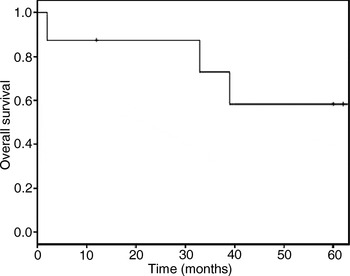
The median patient follow-up time was 50 months (range, 2–126 months). At five years, the recurrence-free survival and disease-specific survival rates were both 100 per cent. The five-year overall survival rate was 58 per cent (Figure 5).
Patients' overall five-year survival.

Discussion
Direct skin involvement of metastatic head and neck SCC is uncommon at presentation. It is usually an expression of neglected, very advanced, local disease. It is often associated with involvement of other deep structures, such as the carotid artery and pre-vertebral fascia, and carries a very poor prognosis. Direct skin involvement of metastatic cervical lymphadenopathy in the absence of invasion of other anatomical structures is exceptionally rare, and its impact on prognosis has not previously been established.
Direct skin involvement of metastatic mucosal head and neck SCC is uncommon. The medical literature is confounded by series that include patients with skin involvement due to either direct extension or iatrogenic implantation, in addition to true distant skin metastasis, which accounts for 0.8–1.3 per cent of patients with head and neck SCC.Reference Yoskovitch, Hier, Okrainec, Black and Rochon1, Reference Pitman and Johnson3, Reference Cole and McGuirt7 Part of this confusion is due to the incompletely understood mechanism of skin involvement in head and neck SCC.Reference Yoskovitch, Hier, Okrainec, Black and Rochon1
Several possible mechanisms of skin involvement have been reported: direct spread from the primary tumour; local spread via intradermal lymphatics (particularly following disruption of the normal lymphatic drainage system secondary to surgery, radiotherapy or chemoradiotherapy, with resultant skin implantation); haematogenous spread via the normal venous drainage pathway (mainly the internal jugular vein or via Batson's plexus from gastrointestinal and genitourinary tumours), or as a result of a neck dissection causing bypass of the pulmonary circulation filtration function;Reference Kmucha and Troxel2, Reference Pitman and Johnson3 and finally, direct, extracapsular spread from metastatic lymph nodes. The latter is however a very rare form of macroscopic extracapsular spread: the prevalence of extracapsular spread from pathologically positive nodes can be as high as 46 per cent, while the prevalence of direct skin involvement due to such extracapsular spread is less than 0.5 per cent.Reference Stavrianos, Ragbir, McLean, Kelly and Soames8
It should be noted that a true skin metastasis is defined as an isolated or multiple, intradermal collection of tumour cells remote from the primary tumour, regional disease or the incision site at the time of surgery.Reference Yoskovitch, Hier, Okrainec, Black and Rochon1, Reference Pitman and Johnson3, Reference Jose, Coatesworth, Johnston and MacLennan9 Such true skin metastasis almost always occurs above the level of the diaphragm, and can involve the neck, chest, scalp, face, lips, axilla, areolas, back, arms and digits.Reference Yoskovitch, Hier, Okrainec, Black and Rochon1
In the present study, all patients had a very good performance status at presentation. All had low T staging but regionally advanced disease. Interestingly, over one-third had occult primaries, and the location of those primaries which were diagnosed did not include the larynx or nasopharyx. Furthermore, two occult primaries metastasised to level IB, with subsequent skin involvement. This is unusual as the majority of reported cases of metastatic lymph nodes with extracapsular spread, from head and neck SCC, have been located at level II. Thus, such tumours appear to have unusual biological behaviour.
Patients with suspected direct skin involvement at presentation represent only a small subset of patients referred to head and neck clinics. As such skin involvement is usually a sign of locally advanced disease, these patients have an increased risk of distant metastasis at presentation. Therefore, diagnostic investigation should be performed as promptly as possible. The argument over whether to perform fine needle aspiration or incisional biopsy in such cases is probably irrelevant, since the cervical skin has already been breached by the disease. In any case, it is imperative to obtain a histological diagnosis from the node, via fine needle aspiration or a small incisional biopsy. It is also essential to complete the investigation of these patients with a full otorhinolaryngological examination, cross-sectional staging imaging, and pan-endoscopy with biopsies of overt tumours or potential index tumour sites (in case of occult primaries). In the current series, approximately one-third of patients had occult primaries. In such cases, positron emission tomography may be particularly valuable in order to diagnose the clinically occult primary and to identify nodal and skin involvement.Reference Roh, Kim, Lee, Cho, Choi and Nam10
The management of patients with direct skin involvement of metastatic cervical lymphadenopathy from mucosal head and neck SCC is challenging. It is therefore imperative that they are managed in a multidisciplinary setting, and that their management strategy is discussed at a multidisciplinary head and neck oncology team meeting without delay. As these patients have, by definition, stage IV disease, combined modality treatment will often be necessary. The presence of skin involvement may necessitate alteration of the usual sequence of the combined treatment protocol, as such patients may require surgical treatment as the first intervention in order to achieve immediate disease control and to avoid further extracapsular spread with skin breakdown.
Advanced nodal metastasis should be excised en bloc with the neck dissection specimen. In such circumstances, the neck dissection will be an extended procedure including the fungating mass as well as an adequate cuff of healthy skin to obtain a satisfactory surgical margin (Figure 4). In our series, the completeness of resection was assessed with the aid of intra-operative frozen section analysis. If the involved skin is distant from the spinal accessory nerve and/or internal jugular vein, then these structures can be preserved without compromising the principles of safe oncological resection. However, in the majority of our patients the sternocleidomastoid muscle had to be sacrificed in order to provide an adequate resection margin, as disease was adjacent to the muscle.
Our results indicate that an extended but still modified radical neck dissection can be oncologically adequate in this subgroup of patients, provided that both pre-operative and intra-operative evaluation reveals no involvement of any deeper anatomical structures. As indicated, the use of frozen section analysis in this situation is advisable; however, we accept that a negative frozen section result does not exclude intradermal lymphatic permeation. Therefore, we believe that a skin margin of at least 2 cm is necessary to ensure adequate oncological resection. Following such treatment, our patients had a recurrence-free survival rate of 100 per cent at five years.
The resultant skin defect should be dealt with using the principles of the ‘reconstructive ladder’, in an attempt to achieve adequate function and cosmesis, as well as to allow post-operative adjuvant radiotherapy without skin breakdown. Reconstructive options include primary closure, local and pedicled flaps, and free tissue transfer. In our series, various reconstruction techniques were used, tailored to each individual's defect and skin type. Two of our patients suffered wound dehiscence, which was successfully managed with the use of pedicled flaps. However, in view of our experience we advocate the primary use of pedicle flaps (e.g. pectoralis major flap) in the majority of such cases, in order to avoid the need for a second procedure, which could delay adjuvant treatment.
Direct skin involvement is a form of extracapsular spread, and this group of patients are considered to have N3 necks. Any patient with such advanced regional disease is a candidate for adjuvant radiotherapy, and concurrent chemotherapy should also be considered if the patient is fit. The presence of extracapsular spread, soft tissue deposits, and perivascular and perineural invasion are considered to adversely affect prognosis.Reference Stavrianos, Ragbir, McLean, Kelly and Soames8, Reference Prim, De Diego, Hardisson, Madero, Nistal and Gavilan11–Reference Violaris, O'Neil, Helliwell, Caslin, Roland and Jones15 However, our patients' disease-specific survival rate indicates that skin involvement of nodal disease with no evidence of any other anatomical structure involvement is not necessarily an ominous prognostic indicator. Previous studies showed that both direct skin involvement and intradermal lymphatic spread were poor prognostic indicators (particularly the latter), and compared cervical skin involvement to facial skin involvement.Reference Cole and McGuirt7, Reference Jose, Coatesworth, Johnston and MacLennan9 These studies suggested that, in such circumstances, resection offered short-term palliation only.Reference Pitman and Johnson3, Reference Oken, Creech, Tormey, Horton, Davis and McFadden5, Reference Jose, Coatesworth, Johnston and MacLennan9 Furthermore, the various subcategories of skin involvement have different effects on prognosis.Reference Pitman and Johnson3 Patients with true skin metastasis have the worst prognosis, with a mean survival time of one to three months in one series.Reference Pitman and Johnson3, Reference Dequanter, Mboti, Lothaire and Andry16
• Skin involvement of head and neck squamous cell carcinoma (SCC) can be due to direct invasion from primary tumour, from metastatic lymphadenopathy or due to haematogenous spread
• Skin involvement from neck node metastases, without invasion of other structures, is very rare
• Clinical parameters of such cases have not been investigated
• Eight such cases had five-year disease-specific and recurrence-free survival rates of 100 per cent
• Such patients can have good outcomes from multimodality, curative treatment
Ours was a small, observational, retrospective study and was therefore not sufficient to generate robust conclusions. However, based on our experience we recommend consideration of aggressive management for patients presenting with skin involvement of metastatic cervical lymphadenopathy occurring in the absence of deep structure involvement. In such patients, rapid and thorough evaluation, multidisciplinary decision-making, and carefully planned and executed surgery and adjuvant therapy can result in excellent oncological outcomes.
Conclusion
It is exceptionally rare to encounter direct skin involvement of metastatic cervical lymphadenopathy from mucosal head and neck SCC, without evidence of the involvement of other anatomical structures. Such skin involvement represents a localised form of extracapsular spread, but its mechanism is unclear. Such cases require careful evaluation and management in a multidisciplinary team setting. Surgical intervention is possible and requires comprehensive neck dissection with or without reconstruction; however, important anatomical structures can be spared. Combined modality treatment is essential. Patients should be offered treatment with curative intent, as most patients can be treated with a favourable outcome.