I. INTRODUCTION
Cu6Sn5 is an important intermetallic compound in lead-free soldering alloys and solder–substrate interfacial microstructures.Reference Nogita, Gourlay, McDonald, Wu, Read and Gu1 Cu6Sn5 exists in at least two crystal structures in the solid state, with a polymorphic transformation from hexagonal Cu6Sn5 (space group P63/mmc) to monoclinic (space group C2/c) Cu6Sn5 at an equilibrium temperature of 186 °C.Reference Nogita, Gourlay, McDonald, Wu, Read and Gu1–Reference Schwingenschlögl, Di Paola, Nogita and Gourlay8 This transformation is considered to be an important factor influencing the reliability of the solder joint.
Under nonequilibrium conditions, the crystal structure is dependent on composition, temperature, and processing history. During soldering and subsequent cooling to room temperature (RT) at typical rates, there is insufficient time for the hexagonal to monoclinic transformation and the high temperature hexagonal Cu6Sn5 remains as a metastable phase.Reference Laurila, Vuorinen and Paulasto-Kröckel9 However, at higher temperatures, it has been found that the transformation can proceed in relatively quick time framesReference Nogita, Gourlay, McDonald, Wu, Read and Gu1, Reference Luo, Wang, Fu, Cheng and Zhao10 (e.g., 100 s at 160 °C), and using synchrotron powder x-ray diffraction (PXRD), a time temperature transformation diagram has been established.Reference Nogita, Gourlay, McDonald, Wu, Read and Gu1 The temperatures involved mean that the transformation is highly possible in electronic devices, which experience even short exposures to elevated temperatures. This can have implications for reliability, as the monoclinic to hexagonal transformation of Cu6Sn5 results in a 2% volume expansion,Reference Mu, Read, Yang and Nogita11, Reference Chou and Chen12 which could result in crack initiation and/or propagation.Reference Nogita, Gourlay, McDonald, Wu, Read and Gu1, Reference Mu, Read, Yang and Nogita11 It has been proposed that stabilizing the crystal structure of Cu6Sn5could improve the joint strength and reliability.Reference Nogita, Gourlay, McDonald, Wu, Read and Gu1, Reference Yu and Duh3, Reference Laurila, Vuorinen and Paulasto-Kröckel9
While the interfacial reactions and products of lead-free soldering have been the focus of recent research, only a few studies have dealt with the stability of Cu6Sn5, which is a very common phase in solder joints. As discovered by Nogita et al.Reference Nogita, Gourlay, McDonald, Wu, Read and Gu1, Reference Nogita2, Reference Schwingenschlögl, Di Paola, Nogita and Gourlay8, Reference Mu, Read, Yang and Nogita11, Reference Nogita and Nishimura13–Reference Nogita, Mu, McDonald, Read and Wu15 using PXRD, transmission electron microscopy, and differential scanning calorimetry (DSC), the hexagonal structure of Cu6Sn5 in lead-free solder alloys with trace Ni additions is very stable down to RT. As well as stabilizing the hexagonal structure of η-Cu6Sn5 at temperatures below 186 °C, Ni is found to inhibit the thermal expansion of Cu6Sn5, particularly along the a axis, which could reduce stresses in solder joints during thermal cycling.Reference Mu, Read, Yang and Nogita11 However, it is believed that Ni is not the only element to stabilize the η-Cu6Sn structure. It has been stated that trace amounts of Sb in Cu6Sn5−xSbx can shift the transformation temperature from 186 °C down to RT.Reference Lidin and Piao16 Recently, Yu and DuhReference Yu and Duh3 also reported that Cu6(Sn,Zn)5 with minor Zn additions (0.8–2.1 at.%) can also stabilize the hexagonal structure down to the RT in both Sn–0.5Zn/Cu joints and the Sn–25Cu–0.01Zn alloy. This phenomena of Zn stabilization warrants further research as Zn is a very common element in soldering and the solubility of Zn in Cu6Sn5 is far beyond 2.1 at.%.Reference Chou and Chen12, Reference Wang, Ma and Qian17 Furthermore, the elements Ni, Zn, Au, and In, which all exhibit marked solubility in Cu6Sn5, are of significant practical importance in soldering since it is the properties of the Cu6Sn5 layer that largely determine the reliability of the solder joints.Reference Laurila, Vuorinen and Paulasto-Kröckel9 Similar to Ni, Au can substitute for the Cu in Cu6Sn5 but In and Zn are believed to replace Sn atoms.Reference Yu and Duh3, Reference Laurila, Vuorinen and Paulasto-Kröckel9, Reference Lidin and Piao16 However, it is unknown what effect, if any, Au and In have on the stability of the hexagonal Cu6Sn5 phase. This paper aims to investigate the effect of Zn, Au, and In on the polymorphic phase transformation in Cu6Sn5using synchrotron PXRD and DSC. The results are of scientific and industrial relevance and could have implications for the interfacial reliability of lead-free solder joints.
II. MATERIAL AND METHODS
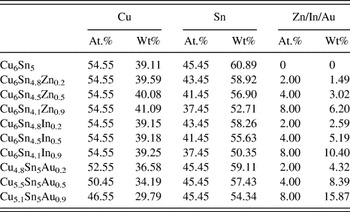
All the Cu6Sn5 (doped with 2, 4, 8 at.% Au, In, Zn) samples were produced by direct alloying, as listed in Table I. High purity copper, tin (and In, Au, Zn as required) wires (99.99%, 2 mm in diameter) were mixed in quartz ampoules according to the desired composition. The quartz ampoules were evacuated to 10−3 Torr and hermetically sealed with a blow torch. The sealed ampoules were heated at 800 °C in an electric resistance furnace for 24 h and then quenched in ice water. Samples were then held at 380 °C for 528 h with subsequent annealing at 160 °C for 148 h to encourage complete transformation of the sample to monoclinic Cu6Sn5and obtain high-quality PXRD profiles.
Composition of Cu6Sn5doped with Zn, Au, and In.

The samples were crushed in an agate mortar to obtain powder for the PXRD experiments. The powder was loaded into quartz capillaries (0.5 mm in diameter) in preparation for exposure to temperatures between 30 and 240 °C with a cooling/heating rate of 100 °C/min using an in-house designed hot air blower. High-resolution PXRD data were collected from prepared samples using a Mythen-II detector with a beam of 15 keV, in the 2θ range of 10–80°, at ambient pressure on the Powder Diffraction beamline at the Australian Synchrotron. Once the desired temperature was reached, the sample was kept at that temperature for 11 min, with 1 min for thermal stabilization and 10 min for data collection. All temperatures were calibrated using reference thermocouples and standard samples. A Si standard (NIST640C) was measured at RT for wave length calibration. The calibrated wave length was 0.8270 Å. Phase identification of x-ray peak data at each temperature was performed by using the EVA PXRD analysis software (Bruker-AXS, Karlsruhe, Germany). As a reference crystallography and atomic coordination, International Centre for Diffraction Data (ICDD) numbers of 045-1488 (for monoclinic Cu6Sn5, C2/c), 047-1575 (for hexagonal Cu6Sn5, P63/mmc), 048-1547 (for hexagonal In0.2Sn0.8, P6/mmm), and 089-2761 (for tetragonal β-Sn, I41/amd) were used for search matching the peak profiles in EVA. The density, unit cell volume, and lattice parameters of samples were calculated from the x-ray peak data using RIETAN-FP Rietveld analysis software.Reference Izumi and Momma18 The refinement parameters were optimized to minimize the residual R wp and S factors. As a reference, crystallography and atomic coordination, ICDD 047-1575 (for Hexagonal, P63/mmc), were used for initial setting of crystal structure within RIETAN-FP. DSC was also used (Mettler Toledo DSC 1, Toledo, OH) for all 10 samples to compliment the PXRD experiments and calculate the enthalpies of transformation. For DSC, 20 mg samples were loaded into a standard Al pan under normal atmospheric conditions and measured at the heating/cooling rates of 2 °C/min, in the range of 160–250 °C.
III. RESULTS AND DISCUSSION
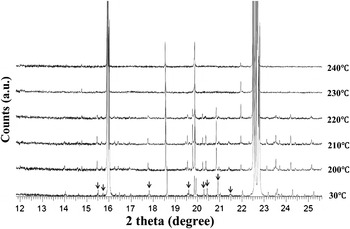
The magnified PXRD peak profiles of Cu6Sn5 between 12° and 25° in 2θ are shown in Fig. 1. The Cu6Sn5 sample clearly displays small peaks in the temperature range between 30 and 220 °C, which are characteristic peaks of the monoclinic phase. In contrast, at 240 °C, the PXRD pattern indexed as the hexagonal phase is relatively flat in this range and the small peaks have disappeared, implying that the monoclinic phase has transformed to hexagonal phase. As the sample is heated from 30 to 240 °C, it can be seen that the monoclinic to hexagonal Cu6Sn5transformation begins after 210 °C and is effectively complete by 230 °C.
Synchrotron PXRD patterns of Cu6Sn5in the range of 12–25° and temperatures of 30–240 °C.

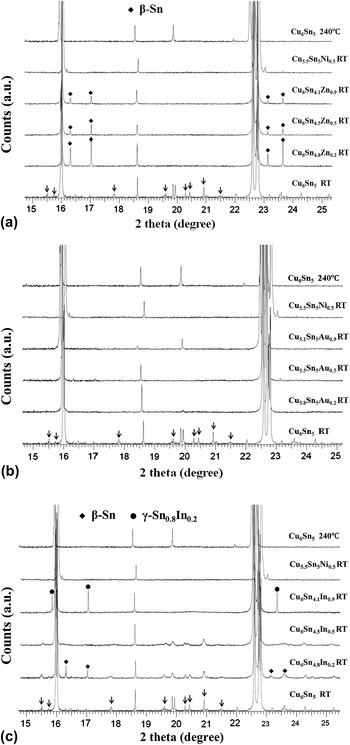
To compare the effect of Zn, In, and Au on the crystallography of Cu6Sn5, the PXRD patterns of Cu6Sn5, Cu6Sn5−xZnx, Cu6Sn5−xInx, Cu6−xAuxSn5 (x = 0.2, 0.5, 0.9) were obtained at RT of 30 °C (wave length 0.8270 Å). In the case of the Cu6Sn5 sample, the relatively weak peaks in the range of 15–25° are related to monoclinic Cu6Sn5. However, as shown in Figs. 2(a) and 2(b), no small peaks can be found in the PXRD profiles of Cu6Sn5−xZnx and Cu6−xAuxSn5 (x = 0.2, 0.5, 0.9) at 30 °C, and these samples clearly have a hexagonal structure. Therefore, it can be concluded that the high temperature hexagonal structure of Cu6Sn5 remained at low temperature, i.e., doping of Cu6Sn5 with Zn and Au (from 2 to 8 at.%) can stabilize the hexagonal structure and avoid the polymorphic phase transformation. In addition, β-Sn has also been identified in all the three Cu6Sn5−xZnx (x = 0.2, 0.5, and 0.9) samples but no Cu–Zn phase can be found, implying that the Zn has been incorporated into the Cu6Sn5 and partially substituted for Sn in the Cu6Sn5 structure. Hence, the PXRD profiles in Figs. 2(a) and 2(b) clearly demonstrate that both Zn and Au have a similar stabilization effect on the Cu6Sn5hexagonal–monoclinic phase transformation as has been well documented for Ni.Reference Nogita2, Reference Yu and Duh3, Reference Mu, Read, Yang and Nogita11, Reference Nogita and Nishimura13, Reference Nogita, Gourlay and Nishimura14
RT synchrotron PXRD patterns of (a) Cu6Sn5−xZnx, (b) Cu6−xAuxSn5, and (c) Cu6Sn5−xInx (x = 0.2, 0.5, 0.9). The pattern for Cu6Sn5at 240 °C is shown for comparison.

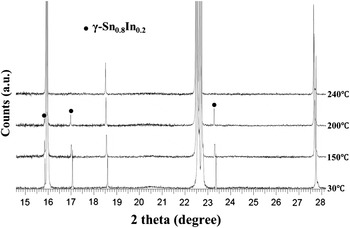
In contrast, several small peaks indicate that the monoclinic phase still existed in the PXRD patterns of Cu6Sn4.8In0.2 and Cu6Sn4.5In0.5, as shown in Fig. 2(c). It can be seen that these small peaks became broader and weaker compared to the pure Cu6Sn5 RT pattern but have not completely disappeared. Most likely, this indicates an incomplete transformation has occurred in the Cu6Sn4.8In0.2 and Cu6Sn4.5In0.5, and a mixture of hexagonal and monoclinic phases existed in these two samples. However, in the Cu6Sn4.1In0.9 sample, the PXRD profile matches the pattern of a hexagonal Cu6Sn5 structure without any additional weak monoclinic peaks but with some peaks indicative of the γ-Sn0.8In0.2 phase, which has a hexagonal (P6/mmm) crystal structure.Reference Lee, Morris and Hua19 Therefore, it is likely that 8 at.% indium has exceeded the solubility limit of indium in Cu6Sn5. During in situ PXRD measurements of Cu6Sn4.1In0.9 as the temperature rises from 30 to 240 °C as shown in Fig. 3, the intensity of peaks related to γ-Sn0.8In0.2 dramatically decrease and have disappeared by 240 °C, indicating that the γ phase has melted. The presence of γ-Sn0.8In0.2 could result in partial melting at typical service temperatures and compromise the strength of solder joints. In summary, the addition of In results in less stabilization of hexagonal Cu6Sn5 than Ni, Zn, or Au. In the case of Cu6Sn4.1In0.9 (8 at.% In), the hexagonal to monoclinic phase transformation of Cu6Sn5 is prevented but a low melting point γ-Sn0.8In0.2phase is present at RT.
PXRD peak profiles for the Cu6Sn4.1In0.9sample from 30 to 240 °C.

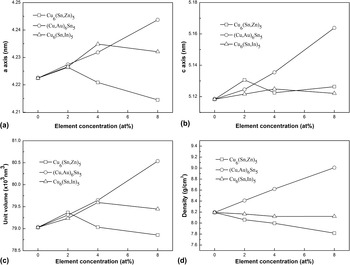
To investigate the effects of Zn, Au, and In on the lattice parameters, the hexagonal crystallographic data (space group P63/mmc) were used for all samples to conduct Rietveld refinement. As shown in Fig. 4, both the a and c axis and unit cell volume of Cu6(Sn,Zn)5 slightly increase in magnitude when doped with 2 at.% Zn, but at concentrations of 4 and 8 at.% Zn, Cu6(Sn,Zn)5 experienced a moderate decrease in these parameters compared to the pure Cu6Sn5. The addition of Zn had a stronger effect on the a axis, which displays a larger decrease than the c axis. In the case of (Cu,Au)6Sn5, the crystal structure increases in both the a and c axis and the unit cell volume increases as the concentration of Au alloyed into Cu6Sn5 increases from 0 to 8 at.%. For Cu6(Sn,In)5, there is an expansion in both the a and c axis for concentrations of 2 and 4 at.% In, but for 8 at.% In, the values of these parameters along with the cell volume slightly drop compared to Cu6Sn5 doped with 4 at.% In. This is likely to be related to the saturation of In dissolved in Cu6Sn5 and formation of the γ-Sn0.8In0.2 phase, which occurred at levels of In exceeding 4 at.%. The results of Rietveld analysis are consistent with the PXRD patterns as shown in Fig. 2, and the substitution of larger Au atoms for Cu atoms causes the expansion of (Cu,Au)6Sn5, leading to a steady shift of PXRD patterns toward smaller 2θ. Considering the density of Cu6(Sn,Zn)5, (Cu,Au)6Sn5, and Cu6(Sn,In)5, as Au is substantially larger than Cu in atomic weight, the density increases steadily as the Au concentration increases. In the case of Cu6(Sn,Zn)5 and Cu6(Sn,In)5, Zn and In are relatively smaller in atomic weight and there is a resulting density decrease as the concentration of Zn and In increases.
Effect of Zn, Au, and In on the lattice parameters, unit cell volume, and density of Cu6Sn5, (a) a axis, (b) c axis, (c) unit cell volume, (d) density.

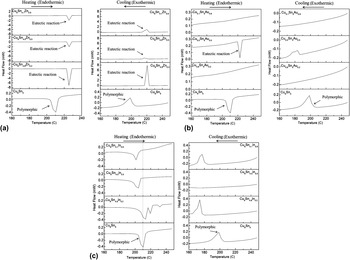
The phase stability of Cu6Sn5, Cu6Sn5−xZnx, Cu6−xAuxSn5, and Cu6Sn5−xInx (x = 0.2, 0.5, 0.9) during heating/cooling cycles was also analyzed using DSC. Figure 5 shows DSC heat flow curves of all samples at cooling/heating rates of 2 °C/min. During heating, for pure Cu6Sn5, the transformation from monoclinic to hexagonal Cu6Sn5 is an endothermic reaction and started at 206 °C, while on cooling, it experienced a reverse transformation, yielding an asymmetric exothermic peak, started at 201 °C. In contrast, no peaks were observed within the range of 190–210 °C for both Cu6Sn5−xZnx and Cu6−xAuxSn5, and the Cu6Sn5 + β-Sn ↔ L eutectic reaction at 225/220 °C was the only reaction detected during heating/cooling. Experimentally, it is difficult to produce samples containing 100% intermetallic (Cu6Sn5) and the presence of a eutectic reaction indicates that the bulk composition is slightly outside this narrow phase field. This further demonstrates that the hexagonal Cu6Sn5−xZnx/Cu6−xAuxSn5is very stable for the range of compositions investigated and no monoclinic phase forms.
DSC analysis of Cu6Sn5−xZnx, Cu6−xAuxSn5, and Cu6Sn5−xInx at the heating/cooling rate of 2 °C/min (a) Cu6Sn5−xZnx, (b) Cu6−xAuxSn5, and (c) Cu6Sn5−xInx (x = 0.2, 0.5, 0.9).

For Cu6Sn4.8In0.2, a reaction with an onset at 208 °C can be clearly observed during heating, which is nearly the same temperature as for Cu6Sn5, implying that the monoclinic to hexagonal transformation still occurred. However, during cooling, the transformation starts at 174 °C. It can be concluded that the 2 at.% In inhibited the hexagonal to monoclinic Cu6Sn5 transformation somewhat, but not completely, during the process of cooling. In the case of Cu6Sn4.5In0.5 on heating, the onset temperature shifted to 196 °C and no transformation was observed on cooling. However, a phase transformation occurred at 177 °C in Cu6Sn4.1In0.9 during 2 °C/min cooling, which is believed to be related to γ-Sn0.8In0.2 formation as consistent with the PXRD results of Fig. 2(c).
The volumetric strain energy  $\Delta G_{\rm{\varepsilon }} $ is considered to be dominant reason of polymorphic phase transformation of Cu6Sn5.Reference Yu and Duh3, Reference Li, Zhang and Kim7 Normally, in case of pure Cu6Sn5,
 $\Delta G_{\rm{\varepsilon }} $ is generated by steric hindrance during the transformation from hexagonal to monoclinic phase, which requires a driving force as supercooling (∼5 °C) to offset the increase of
 $\Delta G_{\rm{\varepsilon }} $.Reference Yu and Duh3 Meanwhile, according to our previous result,Reference Schwingenschlögl, Di Paola, Nogita and Gourlay8 Ni stabilization effect is caused by the energy reduction in cells and Ni developing distinct bonding to both Cu and Sn atoms in the hexagonal phase. The elemental additions of Zn, Au, and In replaced the Cu/Sn atoms of Cu6Sn5 in a similar way to Ni. The exact mechanisms of Zn, Au, and In in suppressing the polymorphic phase transformation of Cu6Sn5are the focus of ongoing work based on kinetics and first-principle calculation.
IV. CONCLUSIONS
The effect of Zn, Au, and In on the polymorphic transformation in Cu6Sn5 intermetallics was investigated using variable temperature synchrotron PXRD and DSC. We found that, as for the case of trace Ni additions, the alloying elements Zn and Au (at 2, 4, and 8 at.%) completely stabilize the hexagonal Cu6Sn5 phase and prevent the phase transformation. In contrast, the addition of In results in less stabilization of hexagonal Cu6Sn5 than either Ni, Zn, or Au. These findings have important implications for industry as Zn, Au, and In are commonly present in many lead-free soldering alloys. However, further study is required to reveal the effects of Zn, Au, and In on the thermal expansion and mechanical behavior of Cu6Sn5over typical operating temperatures, which could largely influence the integrity of solder joints.
ACKNOWLEDGMENTS
We gratefully acknowledge financial support from the University of Queensland-Nihon Superior collaborative research program. PXRD experiments were performed at the Australian Synchrotron Powder Diffraction Beamline (Project ID: AS121/PD/4524). The author thanks Mr. J. Read of The University of Queensland for valuable discussions and sample preparation; and the Queensland Node of the Australian National Fabrication Facility (ANFF-Q) at the University of Queensland for use of the DSC facility. G.Z. is financially supported by a University of Queensland International (UQI) Scholarship and a China Scholarship Council (CSC) Scholarship.