Introduction
Germination is the earliest trait expressed in the life history of plants, and its timing directly affects seedling survival (Baskin and Baskin, Reference Baskin and Baskin1972; Marks and Prince, Reference Marks and Prince1981; Biere, Reference Biere1991; Simons and Johnston, Reference Simons and Johnston2000) and phenotypic expression of post-germination traits (Evans and Cabin, Reference Evans and Cabin1995; Donohue et al., Reference Donohue, Rubio de Casas, Burghardt, Kovach and Willis2010), thereby affecting plant fitness (Donohue, Reference Donohue2002). Consequently, germination traits can affect the species composition of a plant community (Grubb, Reference Grubb1977; Baskin and Baskin, Reference Baskin and Baskin2014). At least to some extent, in a region with a seasonal climate, germination season determines the environmental conditions experienced by plants during seedling establishment and possibly for the rest of their lives (Donohue, Reference Donohue2005; Donohue et al., Reference Donohue, Dorn, Griffith, Kim, Aguilera, Polisetty, Schmitt and Galloway2005a; Sans and Masalles, Reference Sans and Masalles1994). For annuals, the season when seedlings emerge determines whether the resulting plant will behave as a winter annual or spring annual (Effmertova, Reference Effmertova1967; Donohue et al., Reference Donohue, Dorn, Griffith, Kim, Aguilera, Polisetty, Schmitt and Galloway2005a) or even as an annual or biennial (Baskin and Baskin, Reference Baskin and Baskin1984; Galloway, Reference Galloway2001, Reference Galloway2002). Therefore, investigating the causes of seasonal variation in germination timing provides information on variation in the overall life history of plants (Donohue, Reference Donohue2005). Such information contributes to our understanding of the fundamental processes of population establishment (Donohue et al., Reference Donohue, Dorn, Griffith, Kim, Aguilera, Polisetty and Schmitt2005b), range expansion and geographic differentiation and changes in life history (Donohue et al., Reference Donohue, Dorn, Griffith, Kim, Aguilera, Polisetty, Schmitt and Galloway2005a).
It has been hypothesized that the seed germination strategy is constrained by phylogeny and thus that closely related species have similar germination timing (Smith-Ramírez et al., Reference Smith-Ramírez, Armesto and Figueroa1998; Figueroa and Armesto, Reference Figueroa and Armesto2001). For example, some herbaceous perennial species growing in deciduous forests of North America have similar germination strategies as species in the same genera growing in eastern Asia (Baskin and Baskin, Reference Baskin and Baskin2014). Norden et al. (Reference Norden, Daws, Antoine, Gonzalez, Garwood and Chave2009) studied tree species from five tropical areas and discovered that germination timing was phylogenetically conserved in Brazil, Ivory Coast and Panama but not in India and Malaysia. Bu et al. (Reference Bu, Chen, Wang, Xu, Liu and Du2007) found that phylogenetic group explained the largest proportion of variation in germination behaviour of plants from a subalpine meadow on the eastern Tibet Plateau.
Plant traits such as seed mass and life history are related to germination timing (Fenner and Thompson, Reference Fenner and Thompson2005; Baskin and Baskin, Reference Baskin and Baskin2014). Studies have shown that seed mass influences germination timing (Zammit and Zedler, Reference Zammit and Zedler1990; Simons and Johnston, Reference Simons and Johnston2000; Coomes and Grubb, Reference Coomes and Grubb2003), and some of them support the general theoretical model that large-seeded species should germinate more rapidly than small-seeded species (Venable and Brown, Reference Venable and Brown1988; Rees, Reference Rees1994). The reason given for this is that large seeds are more likely to have higher post-dispersal seed predation than small seeds, and rapid germination of large seeds means they can germinate before they are destroyed. However, some studies reached the opposite conclusion. For example, Norden et al. (Reference Norden, Daws, Antoine, Gonzalez, Garwood and Chave2009) found that small-seeded species germinate faster than large-seeded ones. Leishman (Reference Leishman1999) stated that there is no clear relationship between seed mass and seedling survival. Thus, studies at more sites and on more species are needed for a better understanding of the relationship between seed mass and germination timing.
Life cycle type is another factor that affects germination behavior (Thompson and Grime, Reference Thompson and Grime1983; Baskin and Baskin, Reference Baskin and Baskin1988; Vandelook and Van Assche, Reference Vandelook and van Assche2008). Rees (Reference Rees1994, Reference Rees1996) found that seeds of perennials germinate faster than those of annuals/biennials. A difference in germination behaviour was found for annual and perennial species in subalpine meadows on the eastern Tibet Plateau in China, where more seeds of perennials than of annuals/biennials germinated (Bu et al., Reference Bu, Du, Chen, Xu, Liu and Wen2008). The difference between the germination of annuals and perennials may cause some difference between their field seedling emergence. Thus, comparison of seedling emergence of annuals and that of perennials is necessary.
To test the relationship of seedling emergence timing with phylogeny, life cycle type and seed mass, seedling emergence of 265 species was monitored in the field to test the predictions that (1) emergence time is associated with phylogenetic constraints and seed mass, and (2) annuals/biennials have a shorter period of seedling emergence than perennials. More specifically, we tested whether (1) large seeds emerge faster than small seeds, (2) annuals/biennials and perennials have different peak emergence seasons and (3) emergence timing is constrained by phylogeny. The results of these tests are discussed in relation to species composition of the subalpine meadow plant community.
Materials and methods
Study site
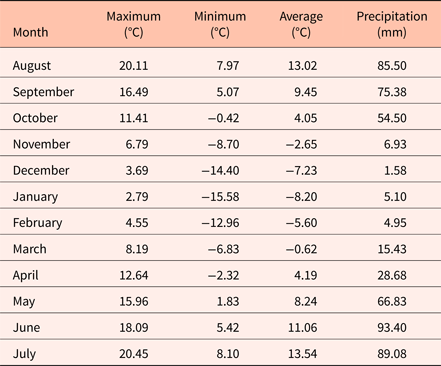
The germination experiment was carried out at the Alpine Meadow and Wetland Ecosystems Research Station of Lanzhou University located on the eastern Tibetan Plateau, in Hezuo (34°55′N, 102°53′E), Gansu Province, China. The station is situated on a broad, flat site at 2980 m above sea-level, and the vegetation is dominated by graminoids, e.g. species of Elymus, Festuca, Poa and Roegneria. The climate is cold humid-alpine with about 270 frost days. Variations in temperature and rainfall at the study site during August 2012 to July 2013 are shown in Table 1.
Temperature and precipitation at the study site during August 2012 to July 2013

Data were collected at the meteorological station of the Alpine Meadow and Wetland Ecosystems Research Station of Lanzhou University located on the eastern Tibet Plateau, in Hezuo (34°55′N, 102°53′E, 2980 m above sea-level), Gansu Province, China.
Seed collection
We collected seeds from 265 species (21 orders, 34 families and 142 genera) of angiosperms growing in the alpine meadow near the study site, including the most common species, dominant species and some rare species. Completely mature seeds of each species were collected at the beginning of natural dispersal, from 28 July to 4 October in 2012. For a single species, seeds were collected from one site but from more than 20 plants or from all the plants that could be found if there were less than 20 of them.
Emergence experiments
The seeds were used in the experiment as soon as they were collected and cleaned (visibly deficient seeds were removed), i.e. fresh seeds. Viability of the cleaned seeds was checked with the cut test prior to sowing, and it ranged from 95 to 100%, depending on the species. Seeds for each species were pooled, and then 100 seeds were sown on the soil surface in each of three pots (100 seeds × 3 pots) for each species. The pots (30 cm diameter, 30 cm depth) were filled with the soil collected from the field site that had been heated in an oven to 120°C for 24 h to kill any seeds in the soil. The pots were buried in the field with the tops flush with the soil surface and covered by transparent nylon net to prevent seed predation and introduction of extraneous seeds. The soil in the pots was watered as needed to keep it moist; however, abundant rainfall at the site kept the soil wet most of the time. The soil surface in the pots was made to vary in relief to help prevent seeds from being dislodged by wind and rain. For some seeds (usually large ones), contact with the soil surface was not good, thus they were hand-covered by <3 mm of soil.
The first and last seed sowing dates were 10 August and 4 October 2012, respectively. Seedling emergence was monitored once a month until 30 July 2013 (except during 15 November 2012 to 30 March 2013, because of the absence of seedling emergence during the winter), and seedlings were considered to be emerged after the cotyledon(s) or a leaf emerged from the soil. When field emergence was checked, new seedlings were marked with a toothpick bearing a tag with the checking date.
Data analysis
The main analysis included 144 emerged species of the 265 sown, as for 121 species there was no or very low seedling emergence (<5%) during the study. With respect to categorical data, sample size of some categories (i.e. the number of species in some categories) was too small to be analysed, and thus categories with a sample size <5 (the minimum sample size for non-parametric tests) were removed from the analysis. For example, the sample size in some families was less than five, and these samples were excluded from the analysis of the relationship between family and peak emergence season.
Seedling field emergence percentage (FE) is [(number of emerged seedlings)/(number of seeds sown)] × 100. The season in which seeds for each species had the largest proportion of its FE was recognized as the peak emergence season for the species. The categories of peak emergence season selected contained species that emerged mainly in autumn (autumn emergence), spring (spring emergence) and summer (summer emergence) (Kahmen and Poschlod, Reference Kahmen and Poschlod2008).
Mean emergence time (MET) of each species was estimated as follows: ∑(Gi×i)/∑(Gi) (Bu et al., Reference Bu, Du, Chen, Xu, Liu and Wen2008), where i is months of seedling emergence since month of sowing (month 0) and Gi is number of seeds emerged in month i (0 < i < 12). Seeds that had not emerged at the end of the assay were not considered in this calculation.
Seed mass. Seed mass included the embryo, endosperm and seed coat and in some cases the fruit coat (e.g. caryopses and achenes). Structures contributing to dispersal (appendages, fruit coat in some cases) were not included as part of the seed mass. The collected seeds were allowed to air-dry to a constant mass at room temperature (15°C) and pooled across individuals of a species before being weighed. Three subsamples of 100 seeds each were weighed (0.0001 g).
Life cycle types. To analyse the effect of plant categories on peak emergence season, species were classified into annual/biennial (33 species) and perennial (111 species), according to information obtained from the Flora of China Editorial Committee (2004).
A non-parametric chi-squared test was used to analyse the difference in distribution of emergence proportion of the 144 species in each of the three emergence seasons and the difference in proportion in life cycle and family among the different levels of each factor in three emergence seasons.
A series of ANOVAs was conducted to assess the significance of these factors in determining average FE and MET and to calculate the amount of variance in FE and MET explained independently by each factor. Measurement of the effect of each class variable on FE and MET was conducted by a series of ANOVAs, which included all variables but one (incomplete model). When each of these ANOVAs is compared with the ANOVA including all variables (complete model), the difference between the proportion of the total sum of squares (SS) explained by the complete model (its R 2) and the R 2 of the incomplete model represents the proportion of the total SS explained by the deleted class variable. This method provided an estimate of the amount of variance in FE and MET explained by each of the class variables independent of the others, and it provided information that was not available from the one-way or two-way ANOVAs.
FE and MET were log-transformed before statistical analysis to ensure homogeneity of variance. All ANOVAs were conducted using the GLM procedure of SPSS. The type III sum of squares was used to establish the significance level of each effect because the data were unbalanced. This type of analysis calculates the sum of squares for each variable when the variable is added last into the ANOVA model. All ANOVAs and non-parametric tests were performed using SPSS 17.0.
To control for the effects and degree of phylogenetic signal in the dependent variable, when correlations of log-seed mass with log-mean emergence time (MET) and log-field emergence percentage (FE) and correlation of log-MET with log-FE were tested, phylogenetic generalized linear models (PGLM) was used (Revell and Harrison, Reference Revell and Harrison2008). PGLMs were conducted using the ‘plgs’ functions of the R package ‘caper’ version 0.5 (Orme et al., Reference Orme, Freckleton, Thomas, Petzoldt, Fritz, Isaac and Pearse2011). For the PGLM, phylogenetic signal (Pagel's λ) was estimated for the dependent variable using a maximum likelihood framework. Pagel's λ can vary from 0 (no phylogenetic signal) to 1 (strong phylogenetic signal) (Pagel, Reference Pagel1999; Freckleton et al., Reference Freckleton, Harvey and Pagel2002). This PGLM test was performed using R 3.2.5, and seed mass was also compared among species with different peak emergence seasons, using phylogenetically corrected ANOVAs (phyANOVAs). The phyANOVAs were performed similarly to the PGLM, but using the ‘gls’ function and ‘corPagel’ function in the R package ‘nlme’ and R package ‘ape’ version 3.0-8 (Paradis et al., Reference Paradis, Claude and Strimmer2004; Zhang et al., Reference Zhang, Liu, Qi, Ma and Du2014).
A composite phylogeny of all species was constructed (Appendix S2) with Phylomatic v3 based on the angiosperm megatree (R20091120.new). This tree was further resolved based on the Angiosperm Phylogeny Website v12. Branch lengths were made proportional to time using the ‘bladj’ function in the program Phylocom 4.2 and divergence time estimates based on fossil data (Zhang et al., Reference Zhang, Liu, Qi, Ma and Du2014).
Results
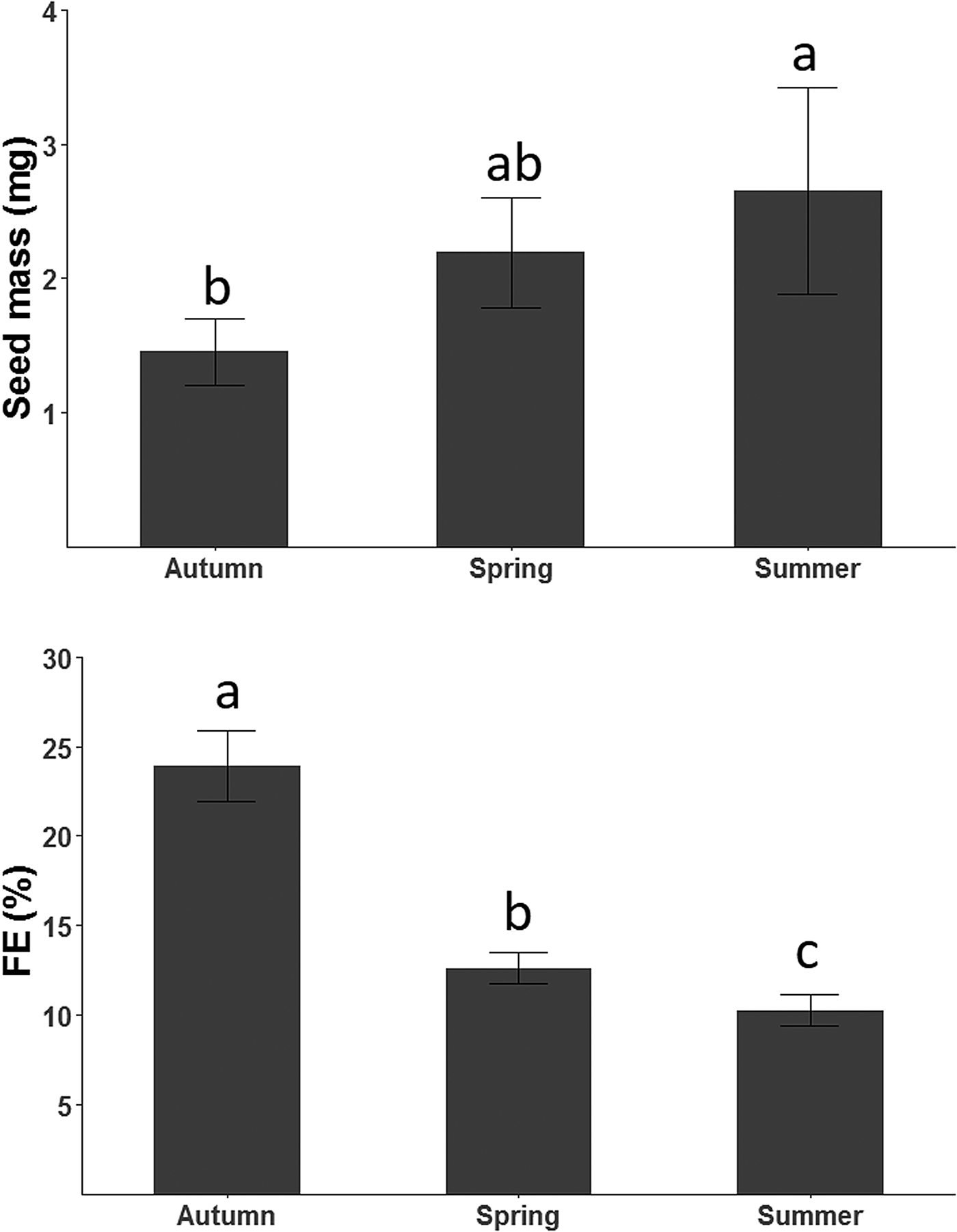
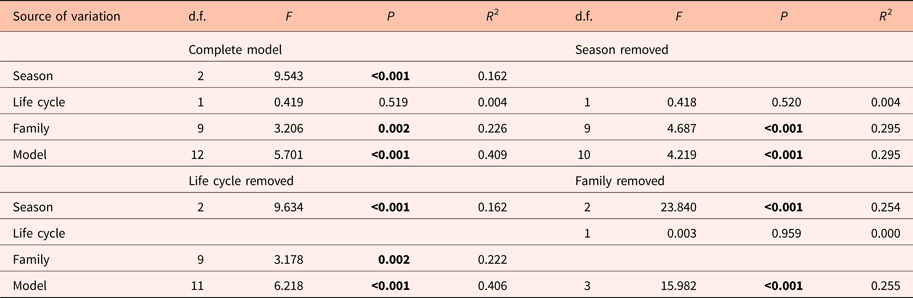
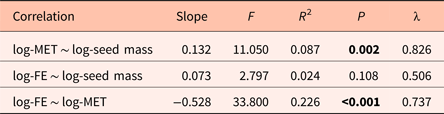
The results of the chi-squared test indicate that there was a significant statistical difference between the proportion of species with different peak emergence seasons (χ2 = 9.375, d.f. = 2, P < 0.05; Appendix S1). Thirty-three per cent of the species emerged in autumn, 44% in spring and 23% in summer. FE of species with different peak emergence seasons was significantly different (d.f. = 2, F = 24.142, P < 0.001). The result of the multifactorial ANOVAs indicated that peak emergence season independently explained 11.4% of the variance in log-FE (Table 2). Species with seedlings that emerged in autumn had a significantly higher FE than those with seedlings that emerged in spring and summer (Fig. 1). The result of PGLM also indicated that there was a significant negative relationship between log-FE and log-MET (Table 3), thus species emerging earlier had a higher FE.
Mean ± SE seed mass and field emergence (FE) of species with different peak emergence seasons. Different letters indicate significant differences (least significant difference, P < 0.05) among the different groups. N (number of species) for autumn, spring and summer is 48, 63 and 33, respectively.

Multifactorial ANOVAs of log-FE for the independent effects of each factor and their associations

Significant P values (P < 0.05) are indicated in bold.
Results of phylogenetic generalized linear models testing correlations of log-seed mass with log-mean emergence time (MET) and log-field emergence percentage (FE) and correlation of log-MET with log-FE

Significant P values (P < 0.05) are indicated in bold.
Life history and field emergence
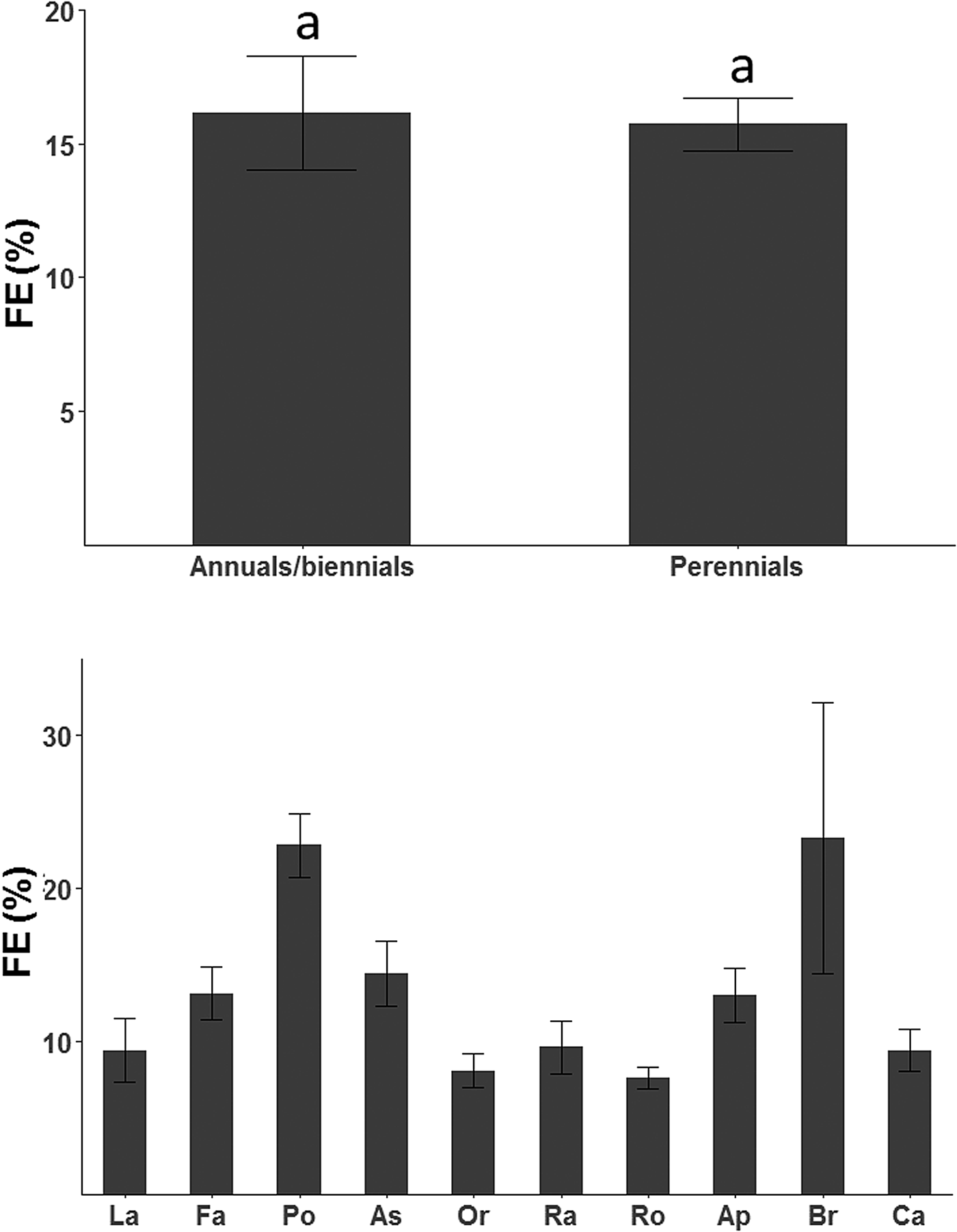
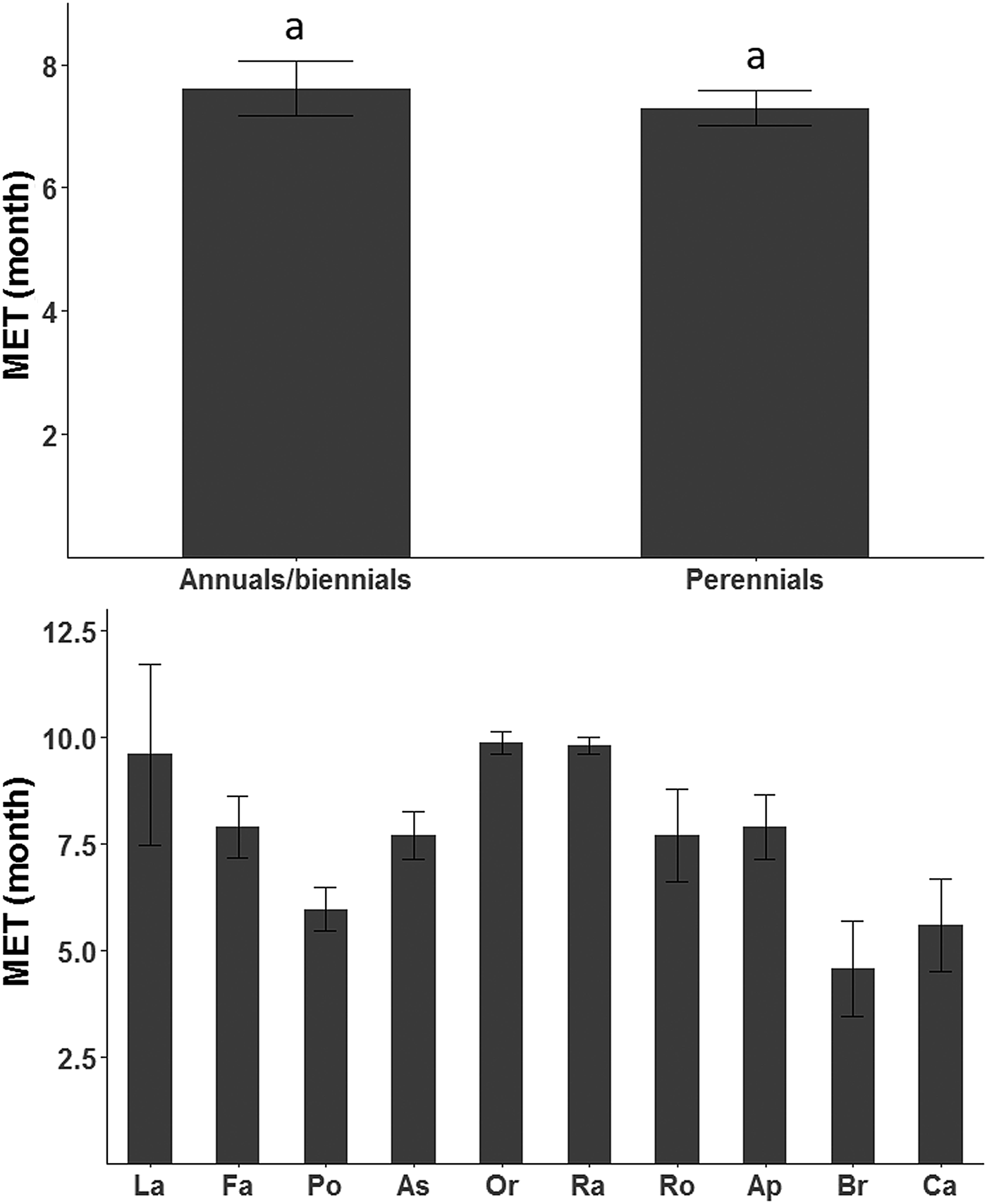
The proportion of species with different peak emergence seasons did not differ significantly between life cycle types (P > 0.05). There was no significant effect of life cycle type on log-FE (d.f. = 1, F = 0.200, P > 0.05; Fig. 2) or log-MET (d.f. = 1, F = 0.356, P > 0.05; Fig. 3).
Mean ± SE field emergence (FE) among species in relation to life cycle and family. Different letters indicate significant differences (least significant difference, P < 0.05). La, Lamiaceae; Fa, Fabaceae; Po, Poaceae; As, Asteraceae; Or, Orobanchaceae; Ra, Ranunculaceae; Ro, Rosaceae; Ap, Apiaceae; Br, Brassicaceae; Ca, Caryophyllaceae. N for annuals/biennials and perennials is 39 and 105, respectively; N for each family is given in Table 4.

Mean ± SE emergence time (MET) among species in relation to life cycle type and family. Different letters indicate significant differences (least significant difference, P < 0.05). La, Lamiaceae; Fa, Fabaceae; Po, Poaceae; As, Asteraceae; Or, Orobanchaceae; Ra, Ranunculaceae; Ro, Rosaceae; Ap, Apiaceae; Br, Brassicaceae; Ca, Caryophyllaceae. N for annuals/biennials and perennials is 39 and 105, respectively; N for each family is given in Table 4.

Phylogeny and field emergence
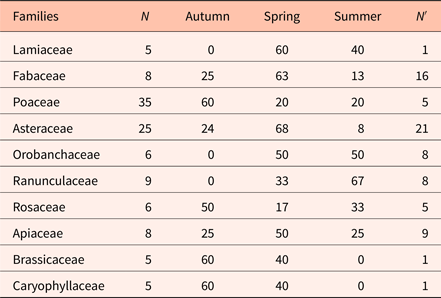
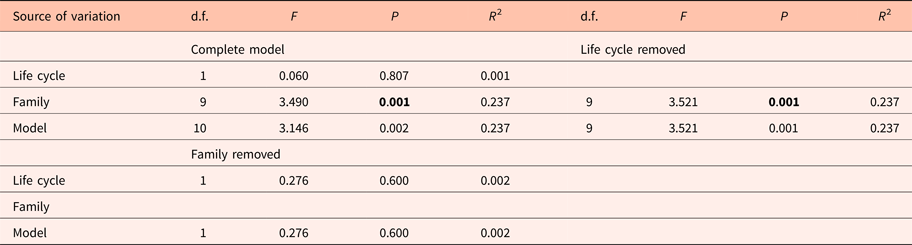
The effects of phylogeny on peak emergence season was analysed at the family level. Phylogeny significantly affected the proportion of species with different peak emergence seasons (d.f. = 9, χ2=25.661, P < 0.05). About 60% of Poaceae, Brassicaceae and Caryophyllaceae species emerged in autumn. Peak emergence season of Lamiaceae (60%), Fabaceae (63%), Asteraceae (68%) and Apiaceae (50%) was in spring. Sixty-seven per cent of Ranunculaceae species emerged in summer, while about 50% of the Orobanchaceae emerged in spring and the other 50% in summer (Table 4). Phylogeny had a significant effect on log-FE (d.f. = 9, F = 4.668, P < 0.001) and independently explained 18.4% of the variance in log-FE (Table 2). FE of species of Poaceae and Brassicaceae was generally higher than that of species in other families. Mean FE of species of Lamiaceae, Orobanchaceae, Ranunculaceae, Rosaceae and Caryophyllaceae was usually less than 10% (Fig. 2). Phylogeny significantly affected log-MET of species (d.f. = 9, F = 4.29, P < 0.001) and independently explained 23.6% of the variance in log-MET (Table 5). On average, species of Brassicaceae had the shortest mean MET (4.6 months), species of Caryophyllaceae the second shortest mean MET (5.6 months) and species of Poaceae the third shortest mean MET (6 months). Species of Lamiaceae, Orobanchaceae and Ranunculaceae had the longest MET (Fig. 3).
Percentage of species in each of 10 families with different peak emergence season

N is number of species with >5% field emergence included in data analysis for each family. N′ is number of species with 0–5% field emergence that were not included in data analysis.
Multifactorial ANOVAs of log-MET for the independent effects of each factor and their associations

Significant P values (P < 0.05) are indicated in bold.
Seed mass and field emergence
Seed mass of species with different peak emergence seasons differed significantly (F = 2.212, P = 0.029, Fig. 1), and PGLM indicated that there was a significant positive correlation between log-seed mass and log-MET (Table 3). Furthermore, results of PGLM indicated that seed mass had no significant effect on log-FE (Table 3).
Discussion
Peak emergence season
Our results indicate that spring is the most common peak emergence season for plants in subalpine meadows on the eastern Tibet Plateau. Two notable climatic features of the Tibet Plateau are the cold winter and short growing season. Thus, seedlings that emerge in spring are not exposed to the severe cold and have the whole growing season to become established. For many species, seedling emergence in autumn would result in seedlings being damaged or killed by the low winter temperatures. However, autumn-germinating seedlings of some species are cold tolerant and have the advantage of resource utilization and the full growing season in the following year.
Field emergence percentage
In general, FE of plants from subalpine meadows on the eastern Tibet Plateau is fairly low, consistent with other studies on field emergence, e.g. those on Silphium laciniatum, Ficus stupenda and Solidago altissima in a North American prairie (Pleasants and Jurik, Reference Pleasants and Jurik1992), Bornean rain forest (Laman, Reference Laman1995) and a Swiss nature reserve (Meyer and Schmid, Reference Meyer and Schmid1999), respectively. Without considering seedling emergence in the second autumn following seed dispersal, our results indicated that there was a significant negative relationship between log-FE and log-MET (Fig. 1; Table. 3), which suggests that FE decreases with time after seed dispersal, and FE of autumn-emerging species > spring-emerging species > summer-emerging species (Fig. 1); in which case, FE of species that delay emergence until conditions for seedling establishment become favourable would be low. On the other hand, an increased number of seedlings of early-emerging species could help compensate for high mortality due to increased exposure to seasonal hazards (low temperature, pathogens, predation and desiccation) (Marks and Prince, Reference Marks and Prince1981; Jones and Sharitz, Reference Jones and Sharitz1989).
Thus there may be a trade-off between emerging immediately after seed production and waiting for more favourable conditions for seedling establishment. That is, if species delay germination until conditions for seedling establishment become more favourable they can gain some advantages in seedling establishment; however, the cost incurred is a decrease in FE (e.g. seed predation, loss of seed viability). On the other hand, if a species germinates immediately it will have a high FE and a long growing season and thus an advantage in resources utilization (priority in occupancy of space and in use of other resources), but there may be a cost on seedling establishment. This putative trade-off warrants further investigation.
Relationships between seed mass and FE
Overall, large-seeded species germinated later than small-seeded species. Our results are consistent with those of Norden et al. (Reference Norden, Daws, Antoine, Gonzalez, Garwood and Chave2009) on 1037 tree species across five tropical forests and of Bu et al. (Reference Bu, Du, Chen, Xu, Liu and Wen2008) on 633 species from our study region. However, our results do not agree with the prediction that large-seeded species germinate more rapidly than small-seeded species (Venable and Brown, Reference Venable and Brown1988; Rees, Reference Rees1994). Early emergence can give small-seeded species some advantage via growth season length and resource utilization, and this may be a reason why small-seeded species can compete with large-seeded species.
Effect of life cycle type on seasonal timing of emergence
Some studies have shown that seeds of annual plants germinated faster than those of perennial plants. In a study by Grime et al. (Reference Grime, Mason, Curtis, Rodman, Band, Mowforth, Neal and Shaw1981), time to 50% germination tended to be shorter in annuals than in perennials. Shipley and Parent (Reference Shipley and Parent1991) showed that obligate wetland annual and facultative annual species initiated germination sooner than perennials after seeds of all three life cycle types were sown in July. Rees (1994) found that in a constant environment, life cycle type had no effect on seed germination, whereas in a variable environment seeds of short-lived plants were more dormant than that of long-lived plants. However, we found no statistical difference in seedling emergence, i.e. FE and MET of annuals/biennials and perennials did not differ significantly (P > 0.05, Figs 2 and 3).
Effect of phylogeny on seasonal timing of emergence
Within a family, species may or may not have similar dormancy-breaking and germination requirements (Figueroa and Armesto, Reference Figueroa and Armesto2001; Smith-Ramírez et al., Reference Smith-Ramírez, Armesto and Figueroa1998; Baskin and Baskin, Reference Baskin and Baskin2014), and in our study phylogeny significantly affected peak emergence season (χ2 = 25.661, d.f. = 9, P < 0.05). When effects of other factors were removed, phylogeny had the largest effect on log-FE and log-MET, independently explaining 16 and 22% of the variance in log-FE (Table 2) and log-MET (Table 5), respectively. Previous studies on this same subalpine meadow indicated that germination percentage, germination rate and response of germination to storage condition are significantly influenced by phylogeny (Bu et al., Reference Bu, Du, Chen, Xu, Liu and Wen2008; Liu et al., Reference Liu, Baskin, Baskin, Bu, Liu, Liu and Du2011). Our findings further show that seedling emergence timing and percentage also are phylogenetically conserved traits.
We stopped making observations on seedling emergence on 30 July 2013; as a result, observations for some species were less than 1 year. Thus seedling emergence data are lacking for August and September (autumn) 2013. Although seeds of some species may not germinate until the second autumn, this would not have greatly influenced the results, as these species were among those excluded from the analysis because too few, or none, of their seeds germinated.
Conclusions
Spring is the most common season for seedling emergence of plant species in subalpine meadows on the eastern Tibet Plateau, but field seedling emergence percentage of these species usually is fairly low. Mean emergence timing is mainly affected by phylogeny and seed mass, while field seedling emergence percentage is mainly affected by peak emergence season and phylogeny. On average, large-seeded species emerged later than small-seeded species. Furthermore, early-emerging species always had a higher FE than the late-emerging ones, which suggests that FE decreases with time after seed dispersal. This increased number of seedlings of early-emerging species could help compensate for high mortality due to increased exposure to seasonal hazards (low temperature, pathogens, predation and desiccation). In addition to a higher FE, early emergence allows a species to have a longer growth season and thus priority in occupancy of space and use of other resources. This contributes to an increase in the fitness of early-emerging species.
Supplementary material
To view supplementary material for this article, please visit https://doi.org/10.1017/S0960258518000028
Acknowledgements
The authors thank Wenjing Ge, Xuejing Wang, Guiyong He, Hang Wu and Haozhi Sun for their help in collecting seeds.
Financial support
This study was supported by the Key Program of the National Natural Science Foundation of China (grants no. 31670437, 31760132, 31470492 and 31670435), the Gansu Province Natural Science Foundation (grants no. 1606RJZA071) and Fundamental Research Funds for the Central Universities (grant no. lzujbky-2015-ot05 and lzujbky-2013-91).