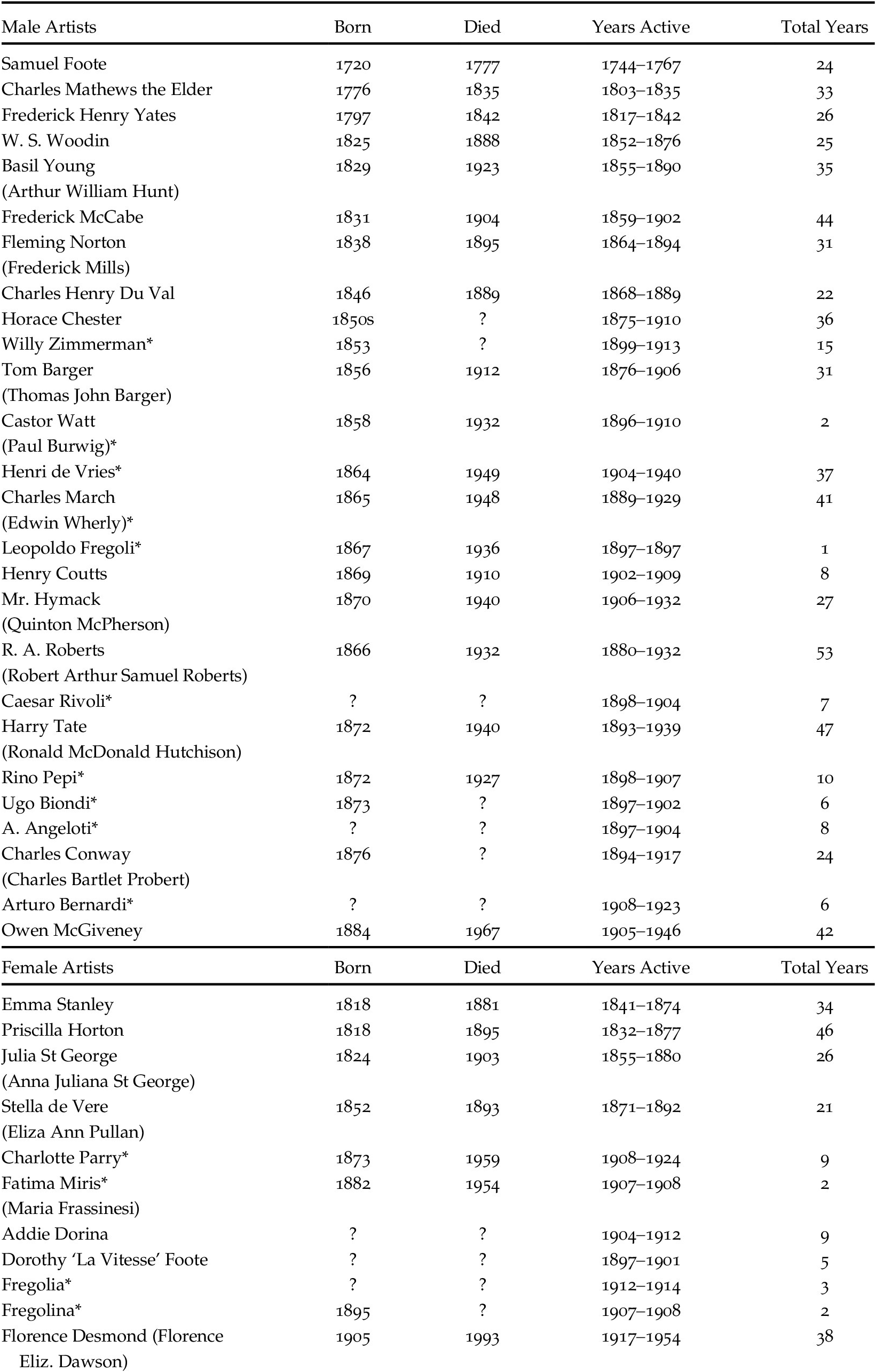



IN THIS STUDY we investigate for the first time the evolution of the performance genres in British popular entertainment (music hall, variety etc.) known as ‘quick-change’, often synonymously referred to as ‘protean acting’ (after Proteus, the shapeshifting sea god of Greek mythology), where a single male or female artist executes multiple roles or characterizations in a single act for comic and/or dramatic effect. The main focus, from a descriptive and analytical viewpoint, is on performers central to the development and popularization of these genres in the British context. While many are long forgotten or unheard of, representing a performance form/skill largely or completely lost to us, an elite few have left a legacy still remembered today. The study includes any artist who performed in Britain, irrespective of their country of origin, focusing on those for whom quick-change or protean performance was their principal discipline (notwithstanding earlier and/or later careers in the legitimate drama), but excluding those who were predominantly singers, dancers, or musicians. We argue that quick-change and protean performance are distinct sub-genres of a ‘transformational’ performance type, and present evidence supporting this taxonomy. In order to assist in contextualizing and visualizing individual contributions across time, Table 1 shows the biographical data and career timelines of all performers discussed here, as well as others whose contribution should not be forgotten.
List of quick-change/protean artists referred to in this study in approximate date-of-birth order, followed by date of death, approximate years active in Britain, and total years (including tours overseas). Names in brackets are family names for those who used a stage name. A question mark denotes unknown data. An asterisk denotes an artist born overseas. Information compiled from online, genealogical, and printed sources.

Multiple Role-Playing in the Early English Theatre
The playing of multiple roles by a single performer in British drama has been well-known since pre-Restoration times, a practice historically embedded in performance conventions. This is illustrated by a voluminous literature on so-called ‘doubling’, perhaps the oldest of theatrical devices, commonly seen in the plays of Shakespeare, among many others.Footnote 1 Pre-dating Shakespeare, we find, for example, Thomas Preston’s tragedy of 1561, Cambyses, King of Persia, in which 38 parts were divided unequally between eight players,Footnote 2 but the practice extends much further back in time to Roman comedy and the classical Greek drama.Footnote 3 For our purposes, however, Karl H. Kregor’s statement should suffice, namely that ‘Doubling is present at the outset of English drama, continues beyond its apparent need, planned by playwrights, expected by actors, and known to audiences’.Footnote 4 This illustrates that the playing of multiple roles by one artist is of very early origin, but it is necessary for this account to move forward in time several centuries before the early modern form of what came to be known as ‘quick-change’ or ‘protean’ performance first emerged, a device specifically for comedic or dramatic effect rather than of necessity. How the practice evolved over this long intervening time period, even if it could be traced, is a valid consideration but lies beyond the scope of this study, whose starting point is the early nineteenth century.
Colman, Mathews, and the French Influence
A well-documented one-act play by George Colman the Younger entitled The Actor of All Work; or, The First and Second Floor was written for the comedian Charles Mathews the Elder.Footnote 5 Performed at the Haymarket on 13 August 1817, Mathews enacted seven different parts in quick succession, a feat which, according to Jacky Bratton, developed into the protean music-hall quick-change act.Footnote 6 Bratton’s is no more than a general statement that demands more in-depth examination. The questions raised concern Colman’s source of inspiration, and how the genre developed subsequently. Less appreciated is that Mathews, although considered the supreme master in imitative entertainment of his time, was not then the only actor to take on multiple comedic roles in a single performance. William Henry Oxberry, for example, wrote a comic sketch, The Actress of All Work, which followed Colman’s creation, in which Elizabeth Rebecca Edwin, known simply as ‘Mrs. Edwin’, played six parts at the Olympic Theatre on 28 January 1819.Footnote 7 John Hamilton Reynolds wrote a one-act musical entertainment entitled One, Two, Three, Four, Five,Footnote 8 first produced at the English Opera House on 17 July 1819, in which the comic actor John Reeve played five parts.Footnote 9 Reeve later enacted six parts in the ‘imitative burletta’ Apollo Daggerwood (of unknown authorship) at the Adelphi on 6 December 1819.Footnote 10 Two further comic actors of this period may be noted, the first being Vincent De Camp, who on 1 September 1817 at the Surrey Theatre (formerly the Royal Circus) interchanged between seven characters in T. J. Dibdin’s burletta, At All in the Ring. Footnote 11 The other was T. P. Cooke’s playing of five different characters in the first performance of Dibdin’s serio-comic melodrama The Reprobate; or, The Protean Bandit at the Surrey Theatre on 26 December 1818.Footnote 12 A review of the former in the Theatrical Inquisitor declared that ‘Mr. De Camp … sustained with a force and variety [seven contrasted characters] that no actor, but Mathews, upon the London boards, could attempt to emulate. His changes were equally rapid and effective.’Footnote 13 While there are no clues as to the inspiration behind Reynolds’s Apollo Daggerwood, there are for Colman’s The Actor of All Work and Dibdin’s At All in the Ring. According to Bagster-Collins, Colman announced in the playbills that the ‘thought on which this piece is founded’ was ‘borrowed’ from a (or the) ‘well-known Comédie Proverbe, produced in the year 1779, at Paris – but it will be evident to those who take the trouble of comparing the characters and dialogue of the two dramas, that any further hint, which may have been obtained, is too slight for acknowledgement.’Footnote 14 To which Bagster-Collins added the following caveat:
It seems impossible to discover the exact extent of Colman’s reliance on his source; for there were a dozen or more playwrights producing ‘comédie proverbes’, a type of play rather than a specific title, in Paris round about 1779 [and that] One must apparently accept his statement of accounts.Footnote 15
A footnote to this passage supplies a clue as to Dibdin’s reliance on the same comédie-proverbe source as Colman, namely that ‘the same French piece was freely translated … and brought out by T. J. Dibdin at the Surrey Theatre, under the title of At All in a Ring’.
In no memoir of or by Colman or Dibdin, however, was this association with the comédie-proverbe explicitly referenced. Nevertheless, in The Actor of All Work, Mathews’s sketch of the ‘French Tragedian’ was considered a take on the great French actor François-Joseph Talma.Footnote 16 This further supports the tantalizing possibility that French influence through the comédie-proverbe helped shape early British protean performances. Although considered a minor genre within the context of French dramatic history from the mid-seventeenth to the mid-nineteenth centuries,Footnote 17 the comédie-proverbe is worthy of more detailed study, especially since its origins pre-date what emerged in Britain. It also remains to be determined if such influences extended beyond these European connections: in other words whether British protean traditions were uniquely local or part of a wider global entertainment circuit.
Samuel Foote, and Charles Mathews’s At Home
While Mathews, as witnessed in his An Actor of All Work in 1817, and later his At Home at the English Opera House in April 1818,Footnote 18 was undoubtedly a major influence in the development of the ultimate form of quick-change and protean acting in Britain, a comment on the latter piece hints at an earlier source: ‘The piece of “At Home” is the closest endeavour we have seen, since the death of Samuel Foote [in 1777], to introduce existing portraits on the stage under the thin visor of a varied nomination.’Footnote 19 This passing reference to Foote is worthy of consideration as a possible precursor to Mathews’s At Home. Foote’s early attempts at tragedy and comedy may have proved less than successful, but he was eventually to find his forte in afterpieces. His own ‘entertainment’, titled The Diversions of the Morning, played at the Haymarket in 1747, is a good example, consisting of ‘the introduction of several characters in real life’,
whose manner of conversation and expression he [Foote] ludicrously hit-off in the diction of his drama, and further represented by an imitation not only of their tone of voice, but even of their very persons … The audience saw a species of performance quite novel to the stage.Footnote 20
William Cooke’s Memoirs of Foote refers to his style of performance as a kind of ‘monologue drama’,Footnote 21 which is arguably a key moment in the genesis of quick-change/protean performance, connecting Mathews’s inspiration to Foote’s use of mimicry and real-life character portrayals in afterpieces.
Early Successors of Charles Mathews the Elder
Following Mathews’s death in 1835, the second quarter of the nineteenth century brought a broadening of acts to the stage that combined musical interludes with quick-change of the very earliest form (before the expression ‘quick-change’ assumed common usage). In this context, a select few are here considered who constituted the main post-Mathews innovators dedicated to multi-character comedic roles. In this elite group are Frederick Henry Yates, Emma Stanley, W. S. ‘Carpet Bag’ Woodin, and Frederick McCabe. In every case, bar early careers in the legitimate drama and years touring abroad, these artists respectively made a single type of performance the bedrock of almost their entire careers.
Yates came into acting in 1817 on the advice of Mathews, adopting the latter’s ‘monologue’ style thereafter, and it was Yates whom Mathews invited to play the part of ‘The Manager’ in The Actor of All Work. Footnote 22 Yates’s Reminiscences; or, Etchings from Life and Character, for example, was first performed at the Adelphi on 3 April 1826.Footnote 23 Part Three of this creation ended with a so-called ‘monopolylogue’ (again, in the style of Mathews) entitled ‘Mr Chairman’, in which he played eight different characters with ‘amazing changes of dress’,Footnote 24 perhaps presaging an early form of what came to be known as ‘quick change’. He continued in the same line of character portrayals (but with less emphasis on speed of change) with Portraits and Sketches, being imitations of celebrated performers (a theme to be popular with later artists), and the monopolylogue Stop Thief, in which he enacted nine characters.Footnote 25
Yates eventually joined forces with Mathews to open the Adelphi Theatre in September 1828,Footnote 26 and together, on 18 April 1831, they created the ‘diapolylogue’ entertainment Nos. 26 and 27; or, Next Door Neighbours, which involved them rapidly interchanging between twelve or thirteen different characters.Footnote 27 The bill actually began with Mathews’s Second Volume of his Comic Annual, followed by Yates’s monopolylogue Yates in Italy; or, the Beautiful Barmaid, in which Yates enacted nine characters.Footnote 28 These facts illustrate that, quite apart from attempting to visualize such entertainments, it is difficult to disassociate Yates from Mathews, and vice versa, in terms of their respective and combined contributions to an emerging quick-change or protean genre. While Mathews appears to have been the original creative force, the influence of Yates, through his interactions with Mathews, should not be understated.
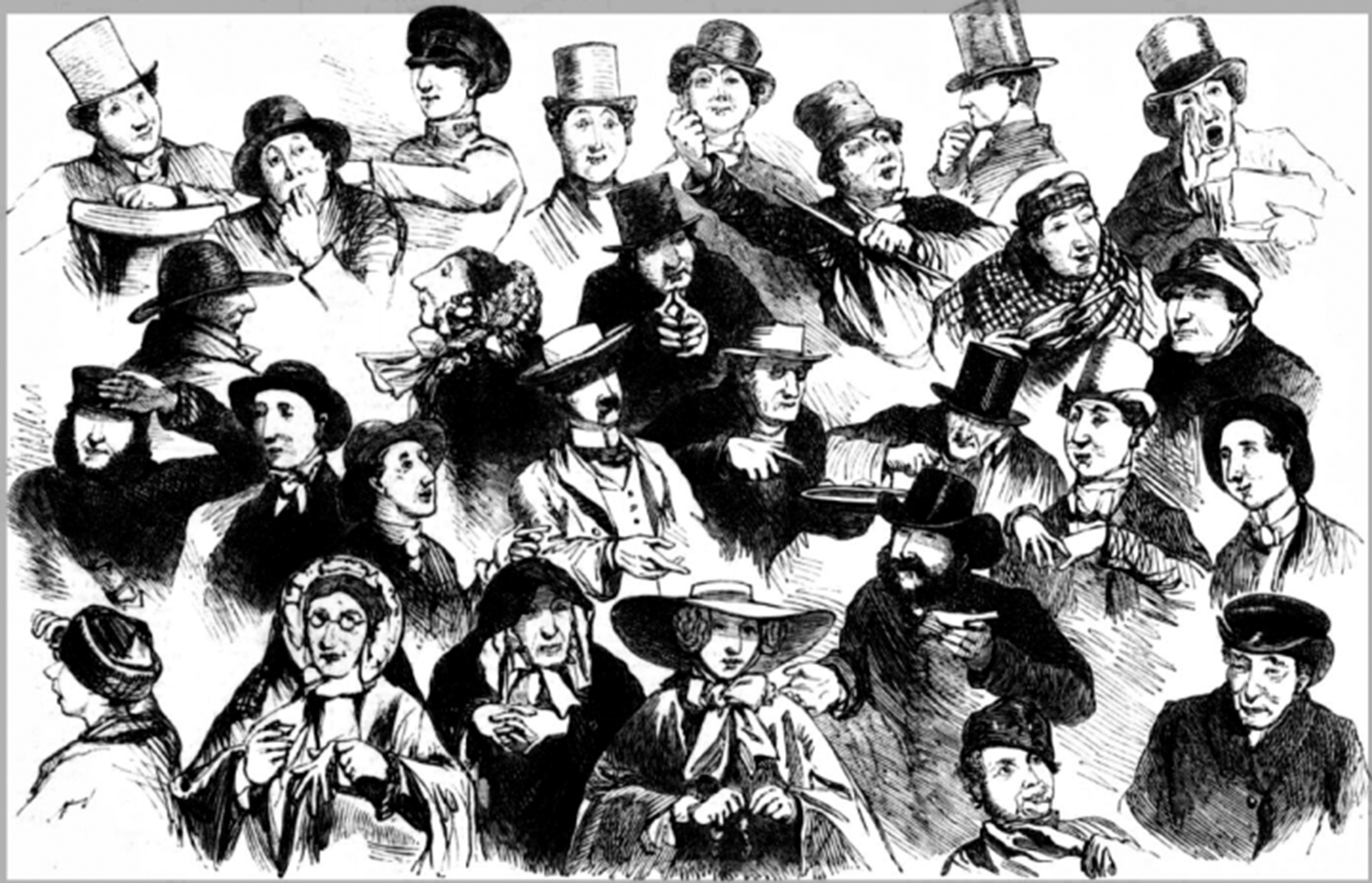
Followers of note in the Mathews style include W. S. Woodin, Basil Young, and Emma Stanley, in whose footsteps came Frederick McCabe, Charles Du Val, Fleming Norton, and others. The former three were contemporaneous, but the careers of Woodin and Stanley were each defined performatively by the pen of the playwright E. L. Blanchard, who wrote The Seven Ages of Woman for Stanley, which was first performed at St Martin’s Hall on 10 December 1855. This consisted of a monologue with thirty-seven distinct changes of character and costume, an act Stanley repeated up to 1874. Stanley’s act more or less coincided with Woodin’s Olio of Oddities, first performed on 12 May 1855 at the Polygraphic Hall, Charing Cross.Footnote 29 According to one advertisement, this act consisted of ‘50 instantaneous metamorphoses of voice, character, and costume’,Footnote 30 a feat now almost impossible to visualize. It was developed much further and later by Woodin in his Cabinet of Curiosities, which played at the Polygraphic Hall on 26 December 1860.Footnote 31 There is strong evidence in Scott and Howard’s Reminiscences of Blanchard that the Olio of Oddities was also written by the latter for Woodin.Footnote 32 Several years earlier, however, Blanchard had written The Carpet Bag and Sketch Book for Woodin, whose first performance was at the Marionette Theatre on 25 October 1852.Footnote 33 It takes a leaf out of Mathews’s monopolylogue At Home, featuring impersonations and illustrations, diversified by singing in character and costume. One newspaper article of 1911 went as far as to assert that ‘“the Great W. S. Woodin”, known as “Carpet Bag Woodin”, was the originator of quick-change entertainment’.Footnote 34 There may only be a grain of truth in this remark, given the evidence provided about Yates earlier. Woodin certainly did, however, take Mathews’s monologue style and added quick changes of dress more so than did his predecessor, the latter characteristic also being adopted by Emma Stanley (Figure 1). Once again, therefore, the influence of Yates, as far as rapidity in moving from one characterization to another is concerned, cannot be ignored, though neither Woodin nor Stanley are recorded as having acknowledged this.
Mr Woodin in his various characters (Illustrated Times, 21 June 1856, p. 12). British Library Collection.

In the context of one-person multi-role entertainments, Stanley apparently had an unremarkable career and ‘is not herself important’ in the opinion of Jacky Bratton and Gilli Bush-Bailey in their detailed account of this artist.Footnote 35 This conclusion is debatable. Although she was never referred to as a quick-change or protean artist, her inclusion here as an artist of astonishing talent is therefore considered fully justified.
Alongside Woodin and Stanley, Basil Young the Elder might easily be overlooked, being a dramatic and operatic entertainer who impersonated well-known actors and vocalists. He first appeared at the Marylebone Literary Institution,Footnote 36 and indeed for much of his career performed in such institutions, including public halls and assembly rooms. In one account he was noted as ‘the last and most gifted and versatile of the old school of monologue entertainers’.Footnote 37 Young acted in the manner of Mathews and Woodin, his A Peep at Life; or, Sketches of Everyone, Everything, and Everywhere, presented in two parts, being his first notable success.Footnote 38 Although his first creation was played throughout his career, he surpassed this with The Follies of the Age, which differed from his first monologue entertainment by dint of how the ‘satirical thrusts become more apparent; the wit of the dialogue sparkles more brightly … [presenting] a broader view of society in its quaintness and many peculiarities’.Footnote 39 An analysis of Young’s monologue pieces reveals that they were no short-lived music hall-type turns but lasted at least two hours with a piano accompaniment, and hence constituted a full evening’s entertainment. Further analysis also indicates that, less important than the speed of changing dress, at this time in the mid-nineteenth century, was the depth of characterizations and caricatures enacted, the precursor of which was Mathews. From 1858, however, Young had gradually speeded up his dress changes, bringing out numerous similar monologue entertainments, his rapid changing of character in such pieces once again redolent of how Mathews and Woodin’s influence persisted. Young’s monologues continued up to his retirement in 1890, when the drawing power of such entertainments began to wane, concomitant with the rise of the quick-change and protean artist at the fin de siècle. His performance style nevertheless illustrates that the concept ‘invented’ by Foote and Mathews could still captivate and entertain audiences
Beyond W. S. Woodin
In Woodin’s footsteps came Frederick McCabe, who was active from about 1858. His most notable and long-lasting piece was Begone Dull Care; or, the Tria Juncta in Uno of Mirth, Music, and Mimicry, an entertainment of his own creation which first appeared at the Town Hall, Newport on 29 September 1858,Footnote 40 and which ran until 1878. An analysis of McCabe’s style suggests that, above all other contemporaries, his method anticipated the arrival at the fin de siècle of the Italian genius Leopoldo Fregoli. The reason for this was McCabe’s unique (for its time) changing of voice, figure, and face, together with rapid changes of costume, in addition to superb powers of mimicry and imitation. His was a home-grown form of the so-called ‘transformism’ to come, which reached its apotheosis at the fin de siècle through the likes of Fregoli. More or less contemporary with McCabe were Tom Barger, Fleming Norton, and Charles Du Val, all skilled artists in their own right but arguably not as influential as McCabe.
Of the numerous female music-hall artists of the latter half of the nineteenth century up to the fin de siècle, Dorothy Foote stands out as the sole specialist quick-change performer of merit to have acted in Britain (Figure 2).
Miss Dorothy Foote, otherwise ‘La Vitesse’ (Music Hall and Theatre Review, 3 December 1897, p. 1). British Library Collection.

Beginning as a vocalist and dancer, she developed a unique quick-change act using the epithet ‘La Vitesse’, first performed at St James’s Hall, Plymouth in 1897, and claiming to be the only dedicated lady quick-change artist in the country at that time.Footnote 41 Dorothy Foote’s origins are uncertain. Her specialism was to impersonate celebrities, and characters from well-known paintings, within a large gilt frame, from where she manipulated electric lamps and mechanical devices, as well as managing curtain lights, changes of costume, and make-up, all by herself.Footnote 42 Her most notable ‘multiple turn’ was billed as Living Pictures by Dorothy Foote, which was subsequently taken to South Africa and performed up to 1899. The last performance found under the name ‘La Vitesse’ (assumed to be Dorothy Foote) was at the Empire Palace, Wolverhampton.Footnote 43
Italian Innovators of the Fin de Siècle
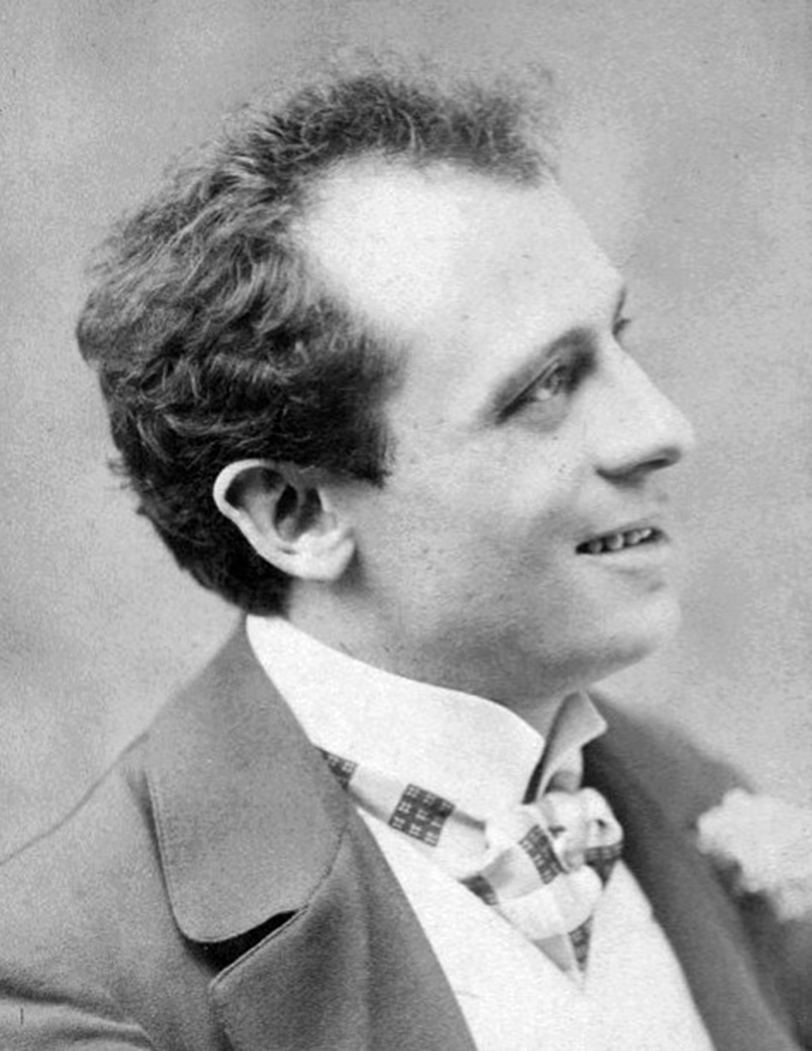
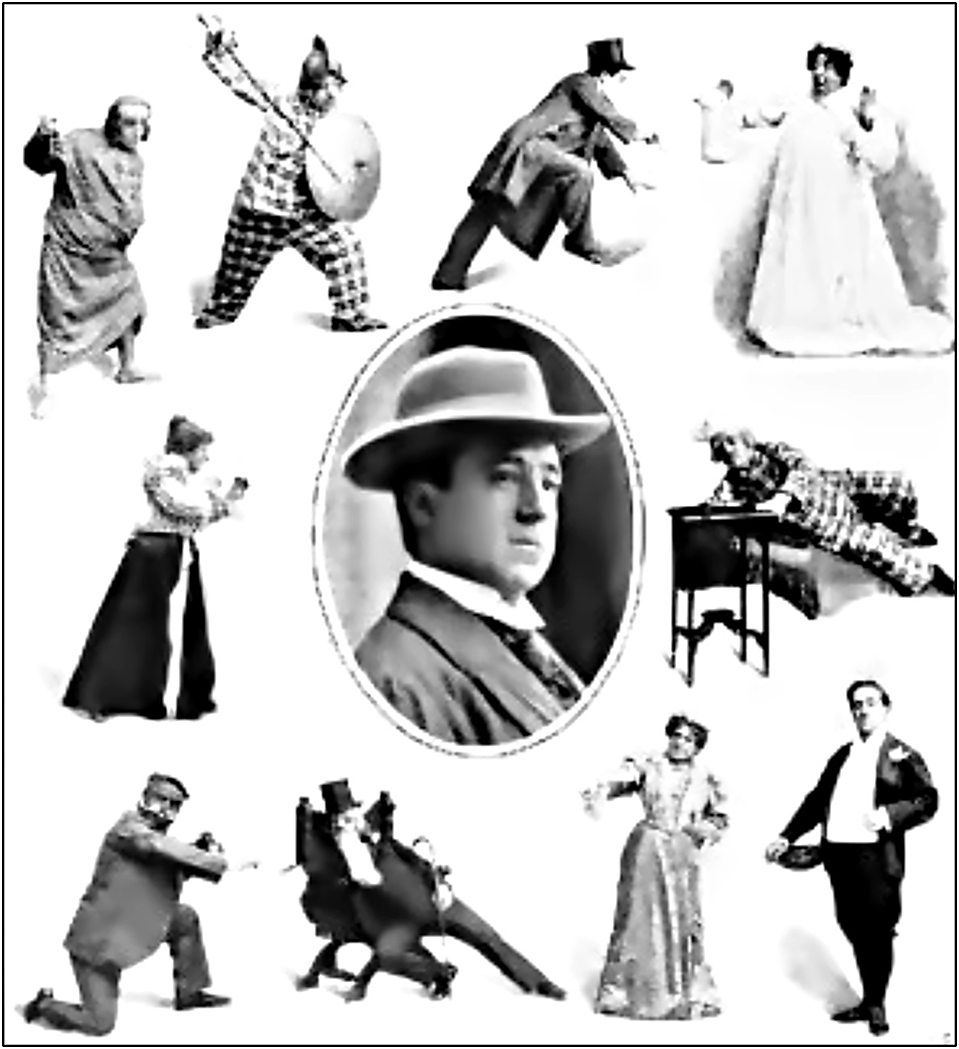
Leopoldo Fregoli and Ugo Biondi, contemporaries and each widely travelled, were the most celebrated of male transformation artists of Italian heritage seen in Britain, leaving a lasting legacy on quick-change business in the music halls from 1897 (Figures 3 and 4). Fregoli (the so-called ‘Imitator of Men and Manners’) proved a sensation at the Alhambra (at a record £350 a week) for his speed of changes and powers of mimicry.Footnote 44 Biondi (‘The One Man Italian Opera’), on the other hand, who appeared in England several months earlier, was equally famed for his performances at the Tivoli, where his Scandal in a Restaurant, in which seven characters were impersonated, was a notable success.Footnote 45
Leopoldo Fregoli c. 1900. Gigi Sciotti, Genova.

Ugo Biondi in his many characters (Music Hall and Theatre Review, 23 June 1899, p. 1). British Library Collection.

Paradoxically, while Biondi’s time spent in England was approximately six years and Fregoli’s a mere ten months, it is the latter who overall left the greatest mark. Fregoli’s genius has attracted a voluminous literature.Footnote 46 The sheer diversity of his talents extended beyond the confines of the music halls, foreshadowing early cinematic techniques.Footnote 47 In effect he fused the arts of the theatre and variety into an essentially new genre, inventing perhaps the ultimate, modern form of transformational acting (‘transformism’), which included changes of posture, accent, and voice, and not just clothes, a method similar to that created independently by McCabe decades earlier. With the Lumière brothers Fregoli invented the ‘Fregoligraph’ by which his quick-change ‘method’ was exposed to audiences, and it was Thomas Alva Edison who once remarked that ‘Fregoli really accelerated the speed of human thought’.Footnote 48 As for personal commentaries on their art, Biondi left behind several valuable accounts, including ‘The Art of Quick Changing’, ‘The Proteus of the Stage’, ‘A Chat with Ugo Biondi’, and ‘Behind the Scenes with Biondi’.Footnote 49 Unlike Biondi, however, Fregoli appears not to have given interviews in Britain, but one was published in America before he came to England.Footnote 50 One contemporary assessment was that ‘Fregoli is to Biondi as master to man. The one is a brilliant disciple, the other a brilliant master.’Footnote 51 In Biondi’s opinion, the attributes required in his line of business were ‘the finest powers of acting, singing, ventriloquism, mimicry, and a quick brain. Then every detail must be studied for weeks.’Footnote 52
Contemporaries and Followers in the Fregoli-Biondi Style
There were three other male quick-change artists, very much in the style of Fregoli and Biondi, who should not be overlooked. Of these, Angeloti, a Hungarian about whom very little is known, acted in the UK between 1897 and 1904, and was noted for his sketch An Evening’s Excitement; or, Jean, the Lightning Waiter, in which he enacted eight different roles.Footnote 53 The second worthy of mention was the Florentine artist Rino Pepi, who was famed for his time at the Darlington Hippodrome in the early twentieth century.Footnote 54 In his best known original comedy sketch, Love Always Victorious, first performed at the London Pavilion on 14 February 1898, ten characters are introduced, all impersonations of great conductors and composers using three of four ‘dressers’ involving carefully coordinated organization.Footnote 55 Arturo Bernardi, another performer of Italian heritage, may have performed in the Fregoli–Biondi style, but an analysis of what is available on his method suggests that he expanded the celerity, dexterity, and overall scope of quick-change and protean performance beyond what had been deemed possible in those exhibited by Fregoli and Biondi. Bernardi first appeared in 1908 at the London Pavilion in Gerolamo’s Escapade, a twenty-minute sketch.Footnote 56 He once quipped that he could change his costume quicker than a lady could change her mind – and show how it was done by way of transparent scenery. Towards the end of his time in Britain, he was portraying up to thirty-five distinct characters in a single performance of three scenes.Footnote 57
Two female protean artists, both closely conforming to the style typical of the continental variety stage, must also be considered in this elite group of Fregoli–Biondi-style successors: namely Fatima Miris and (Madame) Fregolia. Miris was considered a protean prodigy and natural successor to Fregoli, Fregolia first appearing five years later. Miris’s story has been covered by Guilio Piccini,Footnote 58 and more recently and comprehensively by Livio Marazzi,Footnote 59 but being written in Italian, an analysis of her ethos and style is not readily accessible, except from newspaper reports. She first appeared at the London Hippodrome in 1907 on £200 per week, a record for the venue at that time, uniquely presenting an entire theatrical company by herself in the society comedy La Marquise Divina, an act that would have to have been seen to be believed.Footnote 60 In this respect Miris was unique in acting an entire cast on her own, a feat further witnessed in The Geisha, in which she played all fifteen characters with 168 changes of costume.Footnote 61
Fregolia’s first appearance in Britain was at the Metropolitan Music Hall in 1912.Footnote 62 In her sketch, The Lightning Waiter, she impersonated eight characters, several composers, and gave an exposition of double-voice singing.Footnote 63 Fregolia, interestingly, showed how she made her lightning changes by way of a cinematograph screen, adopting a similar technique to that introduced by Bernardi above. In her own words, ‘I adore acting – I worship character delineation, I live solely for my art … Rapidity must not sacrifice truth or nature.’Footnote 64 However, because Fatima Miris preceded Fregolia as the greatest early-twentieth-century female protean star, the latter has been somewhat eclipsed.
The Post-Fregoli Period
At the fin de siècle and into the twentieth century appeared a mixed assortment of male quick-change and protean artists – home-grown and from abroad – who offered a range of distinct styles but all of which were grounded on a similar format to those who had preceded them. Newspaper reviews on these artists do not easily lend themselves to the conclusion that they were influenced by Fregoli or Biondi, instead suggesting they had developed their own, unique performative style. One feature of several of these artists, however, is their preferred self-description as ‘society’ or ‘drawing-room’ entertainers, terms that came into vogue in the 1890s – the association with quick-change and music hall ‘turns’ being avoided. Among the numerous male quick-change and protean artists who performed in Britain in the immediate pre- and post-‘Italian’ period should be mentioned Harry Tate, Horace Chester, Henry Coutts, Henri de Vries, Mr Hymack, Owen McGiveney, Caesar Rivoli, Charles Conway, and Castor Watt. Here, however, we focus more specifically on de Vries, Hymack, and McGiveney as arguably the most celebrated in this group.
Henri de Vries was of Dutch extraction and, in contrast to the aforementioned artists, had a long and distinguished career both as a true protean artist and, later, from about 1912, as a stage and film actor. His first appearance in Britain was in 1904 at the Albert Hall, in Hermann Heyerman’s six-act drama Brand in de Jonge Jan [The Fire at the Inn].Footnote 65 The English version, A Case of Arson, was performed at the Royalty Theatre the following year, in which he played seven witnesses in an arson trial.Footnote 66 An analysis of his method reveals supreme strength in mimetic acting and character differentiation, both physically and mentally, this being a rare fusion of the true artistic actor and the quick-change artist. A film version of A Case of Arson was released in 1914.Footnote 67
The variety artist known as ‘Mr Hymack’, dubbed the ‘chameleon comedian’, is a different case altogether from that of de Vries. He began his career on the provincial and London stage under his family name, Quinton Macpherson, before moving into the quick-change business as ‘Mr Hymack’ in the music halls from about 1906, only to return to the legitimate stage in the 1920s. Such a brief summary merely adumbrates the remarkable career of another unique but mostly forgotten artist who, when performing his turns, neither ‘spoke, danced, or sang, [and] as he strolled about the stage doing casual things, the weirdest changes would suddenly happen to his natty clothes’ – a secret known only to him and his wife, who assisted him.Footnote 68 She died in 1925 in Wellington, New Zealand, while on tour with her husband, but their daughter, in a letter to The Stage, left a valuable overview of his career as a fitting tribute to her late father.Footnote 69
Owen McGiveney was another of the last great protean artists of this period, and among the few whose variety and film career lasted four decades or more. Famed for his Derby Hippodrome appearances in the 1910s, he specialized in characters (in quick-change) from the novels of Charles Dickens, his sketch Bill Sikes being notable.Footnote 70
Notwithstanding Miris and Fregolia above, home-grown female quick-change/protean performers of any quality between the earlier and later twentieth century became quite rare in Britain, suggesting that the interest in this speciality was fading, for women at least. The ascent (and greater opportunities offered) of large-scale variety shows, cabaret, the wireless, and transition to film are possible factors. The earliest found for this period was Addie Dorina, who first appeared at the Pavilion, Glasgow, in 1904.Footnote 71 Variously dubbed ‘the female Fregoli’ and ‘the Original Protean Lady’, she was considered not only a quick-change artist but also a versatile and vivacious comedy actress. As there is no explicit reference of her being of foreign origin, the assumption is that she was from Britain, but her true identity and origins have not as yet been determined. Her career revolves around two protean duologue pieces that nonplussed and mystified audiences as to how her costume and character changes could possibly be executed by one person. The first of these was How She Did It (later How It Was Done), in which she interchanged rapidly between six different female characters in order to convince her husband (played by a male assistant) ‘that a wife can disguise herself out of all knowledge’.Footnote 72 The second was a sketch grounded on similar lines, Dr Spot’s Patients, set in a doctor’s waiting room, in which she impersonated six distinct characters, patients of her doctor husband, each change taking less than five seconds.Footnote 73 Both sketches were successfully performed up to 1912, after which Dorina disappears from the records.
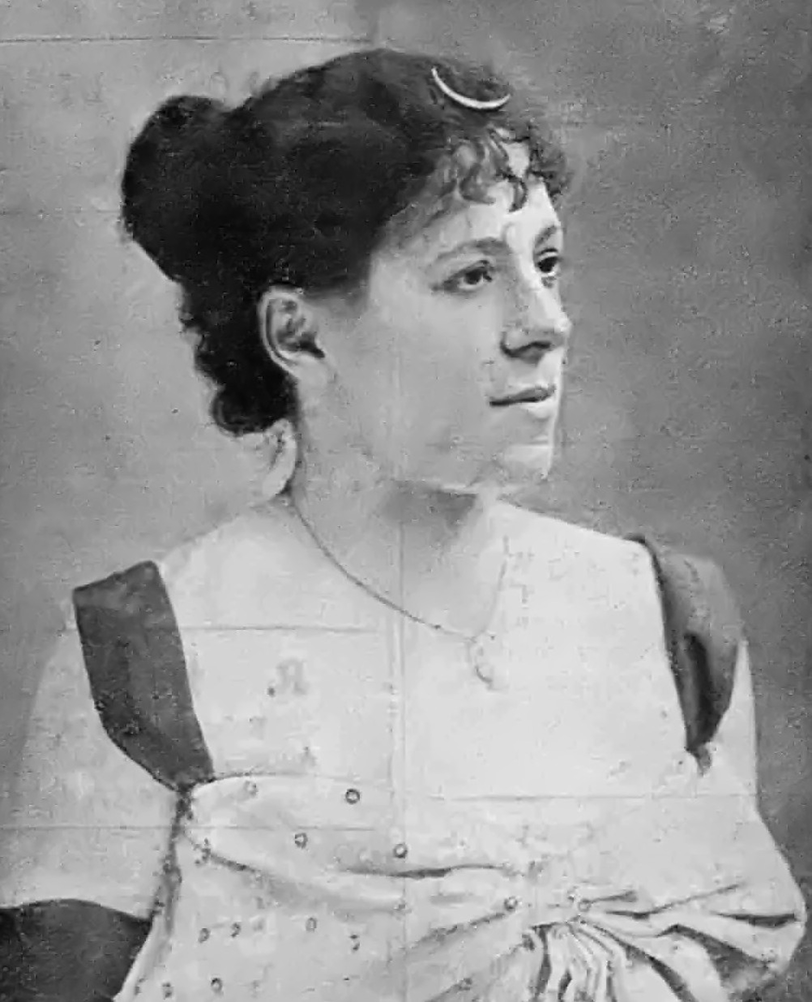
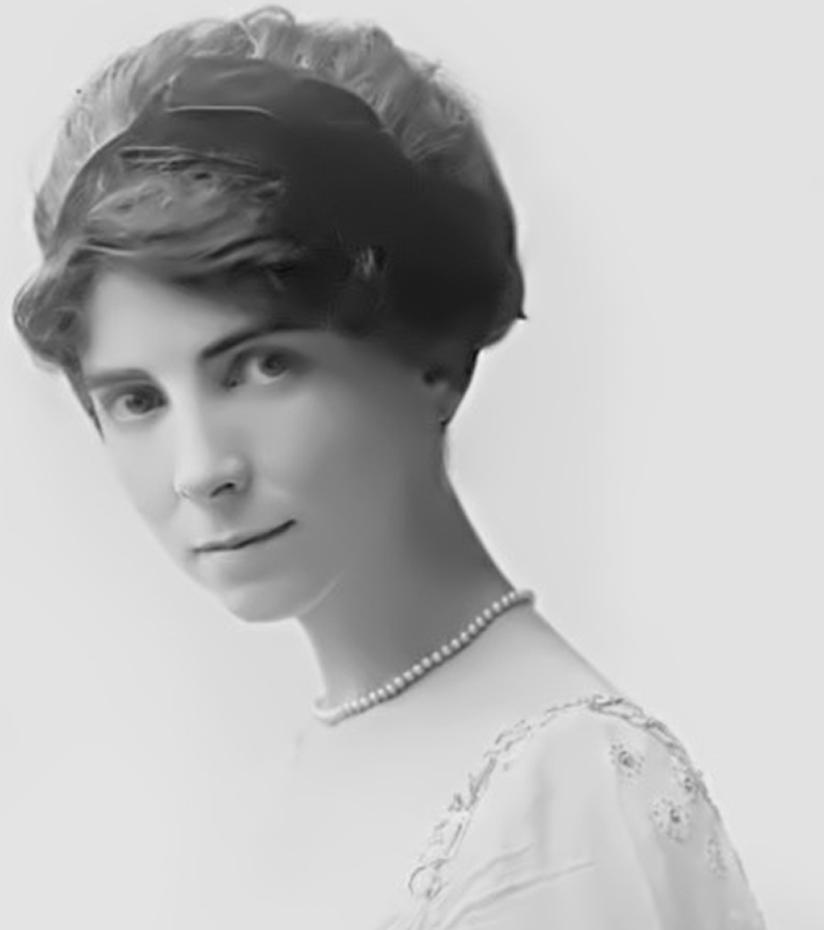
The other female artist, perhaps more worthy of consideration, was Charlotte Parry, a different case from Dorina altogether (Figure 5). Parry was already a vaudeville star in America before her intermittent visits to the United Kingdom (in 1908–9, 1912–15, and 1922–24). She first appeared at the Tivoli and Oxford music halls in London in 1908 in The Comstock Mystery, a one-act playlet by W. H. Clifford, which involved her interchanging between all of the nine characters.Footnote 74 Parry’s Comstock Mystery must be considered the best of its type since Henri de Vries’s A Case of Arson in performing every part of a play, but she surpassed this in the protean psychological fantasy Into the Light by Frank Lyman at the London Hippodrome. Here she portrayed several witnesses in a murder trial in total darkness, the spotlight being on her alone as she assumed different characterizations, a unique feature for its time.Footnote 75 Her other significant contribution was a personal account entitled ‘The Protean Art’, published in 1911.Footnote 76 Here she analyzes the different types of ‘change’ artist that passed into and out of vogue, while laying emphasis on the physical demands placed on artists, explicitly remarking on it being ‘trying and exhausting’, which was why ‘most women keep away from protean work … they dodge it like the plague’.Footnote 77 Importantly, she was one of the very few to have displayed a gift for true protean acting within the context of a single play, rather than as a solo performer in traditional quick-change turns, revealing once again the subtle distinction between the two. Among her most telling remarks in the above account was her consideration of Biondi being greater than Fregoli, her admiration for the skill and artistry of R. A. Roberts (of whom shortly), and her belief that the ‘development of the protean art is an outgrowth of the “lightning change” artist’.
Charlotte Parry, c. 1895. Courtesy of Charles Oliver.

The Protean Art in the Twentieth Century
A comment in the Pall Mall Gazette of 1916 remarked that ‘quick-change artists have rather lost their vogue’.Footnote 78 Although there is a ring of truth to this observation, we must still recognize two final elite artists whose influence was still being felt beyond the 1920s.
R. A. Roberts was generally considered the genius of British home-grown protean performers – the protean of proteans. Being a humorous, mimetic drawing-room entertainer, his stage career began in the 1880s, coming to prominence in quick-change at a time when the traditional worship of Fregoli was still tangible. Of all the artists covered in this account, British or foreign, Roberts reigns supreme for his longevity of performing at home and abroad (over fifty years in total), crediting his later success to his early years in the stock theatres of Liverpool.Footnote 79 He emerged as a solo entertainer in 1891, but as a major and long-lasting force in the British context from 1897, at the time of the quick-change boom initiated by the aforementioned Italian artists. To condense Roberts’s many achievements is not feasible here, so a consideration of only a few of his main pieces must suffice. The first that brought him to notice was Lucinda’s Elopement, a sketch played at the Egyptian Hall in 1897 in which he appeared rapidly alternating between six distinct characters, illusion being key to his style.Footnote 80 There is, however, little plot, such content in quick-change acts being of little interest to audiences, a further aspect that distinguishes it from true protean acting. Ringing the Changes, first performed in 1906, was described as a story about a ‘quaint deception practised by a young solicitor on a rather strict and confiding uncle’, where Roberts impersonated eight individuals, six male and two female, with remarkable rapidity over thirty minutes.Footnote 81 Cruel Coppinger, first played at the Theatre Royal, Bury, in 1909, was considered a masterpiece of solo protean acting, in a melodramatic context, in which Roberts assumed seven characters in his ‘Jekyll and Hyde’-type interpretation of the infamous Cornish pirate (named as the kindly and charming Paul Lavelle), changing dress upwards of twenty times in a play of two scenes set in London and Cornwall in 1790. Cruel Coppinger ran until 1926, when it was aired on the wireless.Footnote 82
In 1923, very much towards the end of his career, Roberts introduced a further and final protean masterpiece after several years’ absence from the stage, namely Jack Sheppard, based on the early eighteenth-century Cornish smuggler and criminal made famous by William Harrison Ainsworth in his novel of 1839.Footnote 83 In Roberts’s humorous and dramatic protean playlet version of two scenes (not wholly based on Ainsworth’s original) he assumed five characters, with fourteen changes of costume in twenty-five minutes, and introduced new stage and lighting effects.Footnote 84 Roberts left a valuable account entitled ‘The Art of Quick-Change: How It Is Done’, published in the Strand Magazine in 1910, which is wholly descriptive rather than analytical.Footnote 85 He freely admitted to there being no great mystery about how he accomplished his quick changes with the help of ‘dressers’. He employed no tricks, and his characters were always ‘live’ characters, ‘not mere stage conventions dressed up to look real’. The unique pictures of him being ‘dressed’ and ‘undressed’ in the article speak louder than words can, and must be seen to appreciate his method, not least the constant trial and error required to perfect even a single change.
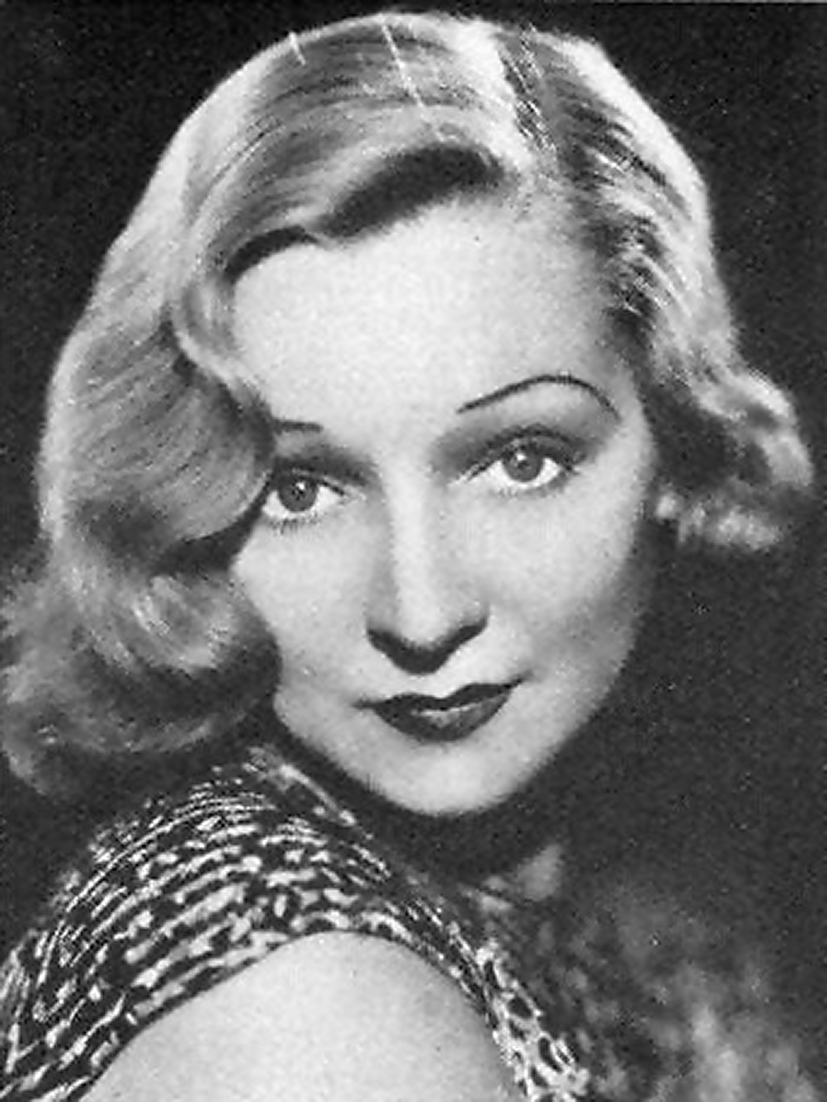
A fitting conclusion to this account is London-born Florence Desmond (known as ‘Dessie’), a true star of the variety, revue, and cabaret circuit, as well as of wireless and film, in the Britain of the 1920s and 1930s (Figure 6). Desmond first appeared in 1917 as a gifted juvenile comedienne in ‘R. J.’s Bluebird Company’, an all-ladies musical comedy and dramatic troupe,Footnote 86 then later of ‘The Barnstormers’ variety company.Footnote 87 She is about as far removed from the days of the elder Mathews and the Italian influencers as could possibly be found, excelling in mimicry and impersonation from the late 1920s. Her career is illustrative of how variety, and its requirement for versatility, developed, a story she relates in her autobiography published in 1953.Footnote 88 She was to become known as the ‘mimic of the stars’, famous for her impersonations of Alice Delysia, Greta Garbo, Gracie Fields, and especially Tallulah Bankhead. Arguably, Desmond’s true protean gifts shone through in a sketch (‘The Hollywood Party’) in Archie de Bear’s Savoy Follies at the Savoy Theatre, London, in which she impersonated a dozen male and female Hollywood stars at a party, ‘all at once and all instantly recognizable’.Footnote 89 In order to create facial resemblances of the stars being impersonated, instead of using pre-arranged wigs (as was her earlier technique), this was achieved by ‘pushing’ her hair into the shapes required for the different impersonations’. Desmond clearly does not fit neatly within the sphere of the quick-change/protean performance style as seen with other artists (male or female) because she was, first and foremost, an actress whose versatility saw few bounds.
Florence Desmond, c. 1930s. Author’s private collection.

Summary and Conclusions
This study has traced the lineage of quick-change and protean performance within British popular entertainment from its theatrical roots in pre-Restoration role-doubling to its cultural zenith in the early twentieth century. Through the recovery of forgotten or little-known male and female artists, this research challenges dominant narratives that privilege more canonical forms of theatrical practice. The principal players sketched above (many worthy of more than a sketch) demonstrate that the so-called ‘entertainment’ stage was capable of producing exceptional technical skill, creative range, and popular resonance. The arrival of continental artists at the fin de siècle redefined the parameters of transformational performance, inspiring a new wave of protean artistry into the twentieth century that blended theatrical illusion, speed, and mimicry. This account therefore broadens the scope of a performance history that is deserving of a more central place in narratives of British theatre’s development.
Also evident in this account is that female artists are in a minority by comparison with their male counterparts, a fact borne out of a thorough search of the available sources. By contrasting them with the longer tradition of male performers, we hope to have expanded an understanding of gendered aspects of the art form, an imbalance that Charlotte Parry considered was the result of protean work being too physically demanding (for women). Nevertheless, their contributions, alongside those of their male peers, underscore the rich performative diversity of this tradition. More generally, our study raises the question as to whether quick-change and protean performance are strictly synonymous (as is more commonly accepted), or whether they are sub-genres of a more generalized style of transformist entertainment, this being a recurring motif in this investigation. Our research suggests that there is a distinction. On the one hand there is quick-change, where speed of change (commonly of costume and personality) is of the essence, with little consideration of plot, and, in some cases, with more reliance on performance technologies (e.g. mechanical devices, special lighting etc.). Protean performance, by contrast, was less ‘entertainment’ in a sense, often more serious and dramatic; one where plot and the emphasis on characterization predominated over speed of change, requiring, in addition, exceptional acting skills. Overall, this research helps fill important gaps in theatrical historiography, especially in identifying transitional figures and bridging legitimate stage experiences with the variety and music-hall circuits where ephemeral, non-text-based performance practices predominated. In a wider context, this study offers a framework for more analytical engagement with contemporary performance theory or historiographical debates. The art of quick-change lives on in the present day in the form of Arturo Brachetti, an Italian, who has revived the performance model laid down by Fregoli nearly 130 years ago.