

Public support for the exchange of excludable benefits for votes (vote buying) varies across countries and individuals (Gonzalez Ocantos et al. Reference González Octanos, de Jonge and Nickerson2014; Weitz-Shapiro Reference Weitz-Shapiro2014). Parties offering goods-for-votes attract electoral support with a variety of benefits, ranging from monetary compensationFootnote 1 to goods, services, and employment.Footnote 2 While some view monetary handouts as a strong signal of politicians’ competence (Kramon Reference Kramon2016), others view the exchange of goods for votes as integral to political representation (Auerbach and Thachil Reference Auerbach and Thachil2018; Oliveros Reference Oliveros2016). Does citizen approval of vote buying depend on the type of benefit being offered? This short report presents an answer to this question, based on a survey experiment conducted on a nationally representative sample of Nicaraguans in 2017.Footnote 3 , Footnote 4
Survey-based measures of vote buying often ask about the exchange of goods, favors, and money for votes. This can affect study results: findings about how vote buying offers are targeted vary according to how vote buying is defined (Nichter Reference Nichter2014). The type of good exchanged may also affect public approval of vote buying. If differences in citizen approval of goods-for-votes exchanges are affected by the type of good, this may help explain variation in vote buying tactics and frequency, as well as individual reporting of vote buying on surveys. Understanding how the type of good being exchanged affects citizen approval of vote buying thus matters for scholarly understanding of the real-world phenomenon.
For the survey experiment analyzed here, respondents to a nationally representative survey of Nicaraguans were randomly assigned to either a “goods and favors”Footnote 5 (N = 795) or “money” condition (N = 797).Footnote 6 Respondents in both groups received two questions asking them about their approval of (1) parties engaging in vote buying practices and (2) individuals who accept votes-for-benefits offers. The English question wording follows; only the type of good being offered (in brackets below) varied across conditions.
Approval of vote buying offers: “Sometimes in Nicaragua, candidates or other people from political parties offer [favors, gifts, or other benefits] [money] to individuals so that they support or vote for them. To what extent do you approve of this type of activity?”
Approval of accepting vote buying offers: “And when this happens, sometimes people accept the [favors, gifts, or other benefits] [money]. To what extent do you approve of this type of activity?”
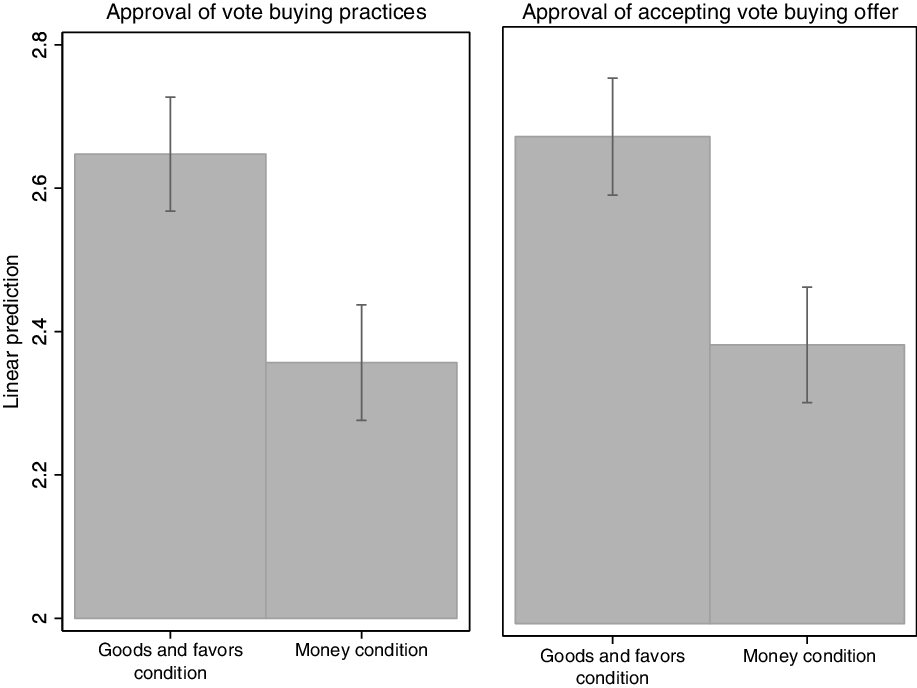
Response options for both questions were (1) strongly approve, (2) approve, (3) does not approve but understands, (4) disapprove, (5) strongly disapprove.Footnote 7 I recode both variables so that higher values indicate stronger approval of vote buying practices and of accepting the proffered benefit and maintain the five-point scale. Figure 1 presents average approval of vote buying by question and across conditions.
Approval of Vote Buying in Nicaragua.
NOTES: Figure presents approval of vote buying (estimated using OLS with survey-adjusted standard errors) with 95% confidence intervals around estimates in each condition. Models estimated without covariates.

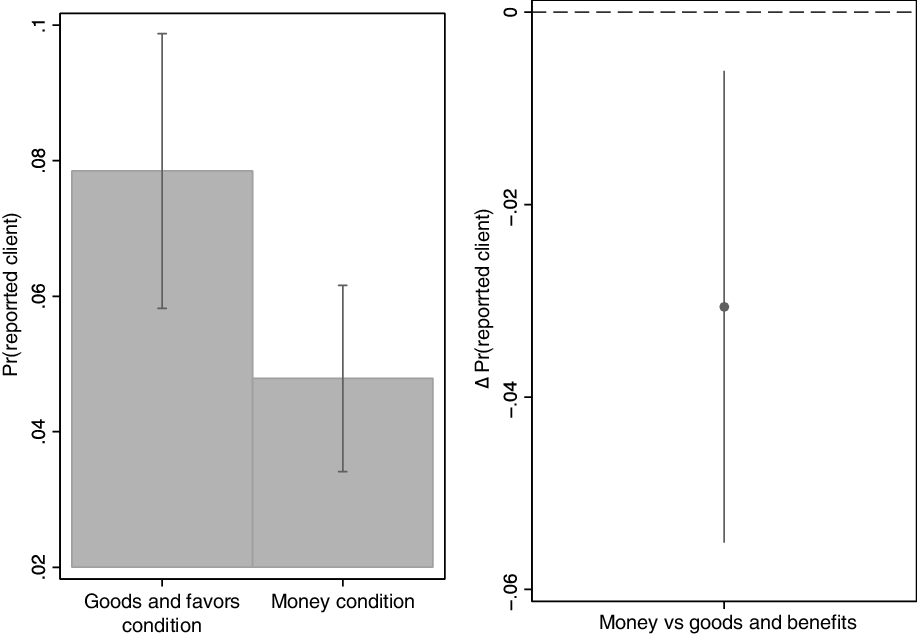
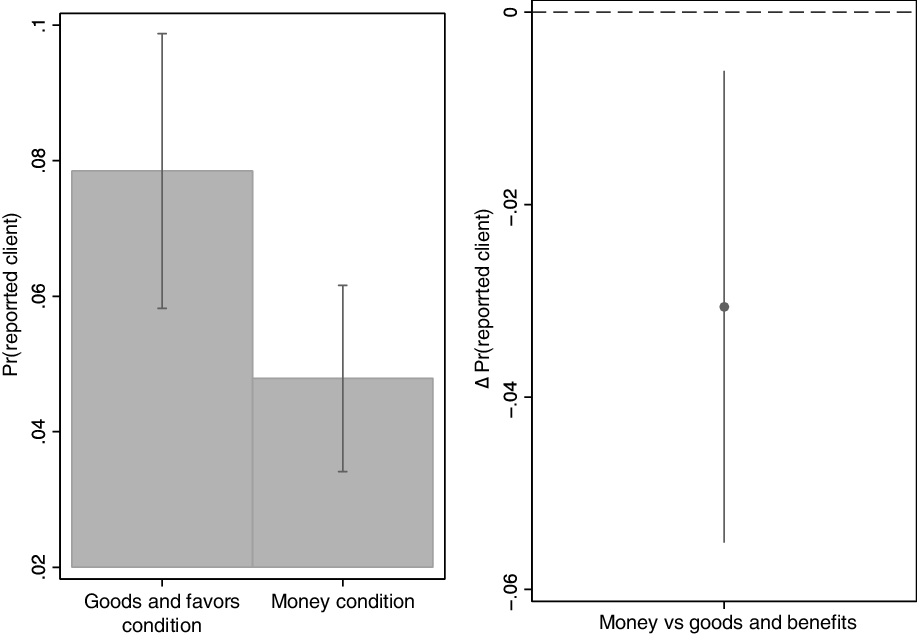
Predicted Probability of Reporting Receiving a Vote Buying Offer by Condition.
NOTES: Panel 1 of the Figure presents predicted incidence of vote buying in recent general election (predicted probabilities estimated using values from a logistic regression with survey-adjusted standard errors) with 95% confidence intervals around estimates in each condition. Panel 2 presents the estimated change in the likelihood of reporting receiving a vote buying offer in the money condition (compared to goods and benefits). Values are estimated without covariates.
Nicaraguans report significantly lower approval of vote buying practices and of those who accept vote buying offers in the money condition on average. While statistically significant, these effects are substantively moderate: individuals asked about their approval of parties offering goods and favors in exchange for votes give an average response of 2.65 on a five-point scale; approval decreases to 2.36 (0.27 standard deviations) in the money condition. Results are similar for approval of accepting vote buying offers: those in the goods and favors condition give an average response of 2.67, and approval decreases to 2.38 (0.26 standard deviations) in the money condition.Footnote 8
Because questions about vote buying can be prone to social desirability bias, scholars regularly employ sensitive survey techniques like list experiments to elicit more honest responses about citizen engagement in vote-buying exchanges (e.g., Corstange Reference Corstange2012; Gonzalez Ocantos et al. Reference González Octanos, de Jonge and Nickerson2014; Kiewiet De Jonge Reference Kiewiet De Jonge2015). If citizens view one type of exchange as more or less acceptable, asking about goods- versus money-for-votes exchanges may shape survey participants’ willingness to answer survey questions honestly. Indeed, Figure 2 shows that reported rates of vote buying are significantly lower in the money condition (4.8%) than in the goods and favors condition (7.8%) – even though the posttreatment question assessing vote buying experience was identical across conditions.Footnote 9 , Footnote 10
This study shows that approval of vote buying varies significantly depending on the type of good referenced in one context where the practice is prevalent, Nicaragua. Future research should assess whether this difference in approval varies consistently across contexts. More concretely, this study echoes other work (e.g., Nichter Reference Nichter2014) suggesting the need for care in designing questions about vote buying. Slight changes in question wording that prime participants to think about goods versus monetary exchanges have the potential to affect the reported prevalence of this behavior.
Supplementary material
To view supplementary material for this article, please visit https://doi.org/10.1017/XPS.2020.4