1 Introduction
One of the goals of Prosodic Morphology is to explain restrictions on morpheme shape, known as templates, in terms that have relevance elsewhere in phonological theory. According to McCarthy & Prince's (Reference McCarthy, Prince and Goldsmith1986) Prosodic Morphology hypothesis, templates are defined in terms of prosodic constituents such as syllable (light or heavy) and metrical foot rather than in terms of segmental CV slots (McCarthy Reference McCarthy1981, Marantz Reference Marantz1982) or X-slots (Levin Reference Levin1985). This view is recast in optimality-theoretic terms in McCarthy & Prince (Reference McCarthy and Prince1993b), where templatic shapes are dictated by violable templatic constraints. Generalised Template Theory (GTT) moves away from templates altogether, taking as its fundamental claim that templatic morpheme shapes arise from the interaction of independently motivated phonological constraints and that there is no need for any templatic machinery in Prosodic Morphology (McCarthy & Prince Reference McCarthy and Prince1994b, Spaelti Reference Spaelti1997, Gafos Reference Gafos1998, Urbanczyk Reference Urbanczyk2006, inter alia). In addition to theoretical parsimony, GTT brings a solution to the problem of templatic backcopying, which was first pointed out by René Kager and Philip Hamilton, as noted by McCarthy & Prince (Reference McCarthy, Prince, Kager, van der Hulst and Zonneveld1999: 258): if templatic constraints were real, they could interact with base-reduplicant faithfulness constraints to produce a pattern where the size restrictions on the reduplicant can be copied to the base – a pattern thought to be unattested. In this paper, I present an example of backcopying from Tonkawa, an extinct Coahuiltecan language once spoken in Texas and Oklahoma. The evidence from Tonkawa suggests that GTT is too weak as a theory of templates. To account for the pattern, the theory has to allow constraints to be specific to reduplicative morphemes.
Tonkawa reduplication has not been previously brought to bear on the issue of reduplicative templates. The reduplicative prefix of Tonkawa is limited to a single light syllable, CV. This templatic requirement is unusual in two respects: first of all, it does not apply to other prefixes, and second, an initial light syllable is a marked structure in Tonkawa, which actually prefers heavy syllables in word-initial position. Moreover, the short length of the reduplicative vowel is backcopied onto the reduplicative base – a result impossible in a GTT analysis. I propose that Tonkawa imposes specific restrictions on the shape of the reduplicative affix, whose interaction amounts to a light syllable template. These restrictions are formalised as markedness constraints that are lexically indexed to the reduplicant.
The evidence from Tonkawa bears on recent proposals to derive small morpheme size (one light syllable or smaller) from non-reduplication-specific constraints, including *Struc constraints and their ilkFootnote 1 (Spaelti Reference Spaelti1997, Gafos Reference Gafos1998, Walker Reference Walker1998, Reference Walker2000, Reference Walker2002, Kennedy Reference Kennedy2005, Urbanczyk Reference Urbanczyk2006) and an output-output version of Dep (Gouskova Reference Gouskova2004a). Some of this work discusses cases of truly atemplatic reduplication. In atemplatic reduplication, the size of the reduplicant varies depending on the environment (Gafos Reference Gafos1998): for example, in Rebi West Tarangan, the same reduplicative affix can be realised as either a single consonant, a CVC syllable or a CV syllable, depending on the phonological context (Nivens Reference Nivens1993, Spaelti Reference Spaelti1997, Gouskova Reference Gouskova2004a). Tonkawa reduplication is the opposite of this pattern: its reduplicative morpheme is invariantly small, even though the otherwise well-supported constraints of the language favour larger structures. In GTT, there is no formal distinction between atemplatic reduplication and reduplication that exhibits shape invariance: the latter is simply a special case of constraint interaction. Shape invariance can indeed be derived without templatic constraints in some cases, but not in Tonkawa. The Tonkawa pattern suggests that small reduplicant size cannot always be attributed to general principles of economy or markedness.
The discussion is also relevant to the issue of whether base-reduplicant identity effects necessitate a separate set of faithfulness constraints dedicated to reduplication (McCarthy & Prince Reference McCarthy and Prince1993b, Reference McCarthy, Prince, Beckman, Dickey and Urbanczyk1995), which is argued to be unnecessary is some theories of reduplication (e.g. Inkelas & Zoll Reference Inkelas and Zoll2005). Tonkawa reduplicative shortening is not sensitive to morphological context or indeed to phonological context; instead, base-reduplicant identity rules the system.
I start by presenting some background on syncope and shortening in Tonkawa. The underapplication of syncope and overapplication of shortening in reduplication is examined in §2. This section also presents the lexically indexed constraints whose interaction derives the light syllable template. In §3, I demonstrate why GTT cannot account for these facts, examining affix shapes in Tonkawa (§3.1) and considering two kinds of atemplatic analyses that have been proposed in OT, as well as several potential alternatives (§3.2). §4 addresses templatic backcopying in the theory, and §5 concludes.
2 Syncope, shortening and reduplication in Tonkawa
As shown in (1), the Tonkawa reduplicant constitutes a CV syllable regardless of the shape of the word that is reduplicated: initial CVC, CVV and CVVC syllables in bases all reduplicate as CV- (the reduplicative morpheme is underlined).Footnote 2
(1) Tonkawa CV- reduplication, in brief (Hoijer 1933, 1946, 1949)


We will see shortly that this pattern is anomalous when seen in the larger context of the phonology of Tonkawa: second vowel syncope normally closes the initial syllable, and long vowels normally do not shorten in initial position. The analysis presented here will make sense of both facts.
2.1 Background on stress, footing, and vowel length
Tonkawa vowels undergo a rich set of fairly complex rules of shortening and deletion, which have received considerable attention in the generative phonology literature (Kisseberth Reference Kisseberth, Sadock and Vanek1970, Phelps Reference Phelps1975, Kenstowicz & Kisseberth Reference Kenstowicz and Kisseberth1979, McCarthy Reference McCarthy1986, Gouskova Reference Gouskova2003). Much of this work has been devoted to identifying the constraints that block the application of vowel deletion, and the findings are well known: like many languages, Tonkawa bans hiatus, tautosyllabic consonant clusters and sequences of identical adjacent consonants, and syncope must obey these restrictions. It has been less clear, however, why Tonkawa vowels shorten and delete in the first place. Since understanding both of these processes is crucial to the argument for the light syllable template, I start with the analysis of the relevant aspects of the non-reduplicative phonology of Tonkawa.
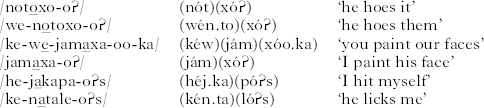
Gouskova (Reference Gouskova2003) argues that both syncope and shortening in Tonkawa are conditioned by metrical foot structure. According to Hoijer's description, ‘Tonkawa utterances consist of a succession of more or less evenly stressed syllables’ (1946: 292).Footnote 3 This characterisation is consistent with iterative footing. Although Hoijer does not mark stress on his examples, further evidence from the distribution of long vowels (see (2)) suggests trochaic feet. Long vowels in Tonkawa occur in initial syllables, but they shorten following an initial CV syllable. Shortening does not apply outside of this context, so long vowels are free to occur later in the wordFootnote 4 – including after an initial CVC or CVV syllable, which is expected if footing is iterative. If feet were iambic ( , LĹ or L, where H=heavy and L=light), then it would be difficult to explain why shortening consistently applies to the second vowel of an initial LH sequence. On the other hand, if Tonkawa has trochaic , L and ĹL feet,Footnote 5 the context of shortening is simple to state: it applies to the vowel that ends up in the weak branch of a trochaic foot.
The examples in (2) show the surface distribution of long vowels, as well as a few typical alternations. The first syllable in examples (2a–j) either contains a long vowel or is closed, and the following vowel can be long if it is long underlyingly. Note also that there are long vowels later in the word. When a CV- prefix is added to the word, the underlyingly long vowel shortens. This sensitivity of shortening to the preceding context is crucial to the argument for a metrical analysis; the vowel shortens not just in any second syllable but in a second syllable after a light initial syllable. There is no shortage of long vowels in Tonkawa; they can occur in sequences of two or more syllables in a row (2d–f) and can be either underlying or derived (as in (2e) /ew/→[oo]).Footnote 6
(2) Conditions for shortening in non-reduplicative phonology

I will assume here that footing is exhaustive in Tonkawa, i.e. that Parse-σ is not violated. I also assume that only trochaic feet are allowed in Tonkawa (in other words #L is not an option), and that degenerate feet are prohibited – indeed there do not appear to be any light monosyllables. There is pressure in Tonkawa for unstressed syllables to be light, which is due to the high ranking of the Weight-to-StressPrinciple.
(3)

If a vowel ends up in an unstressed syllable as a result of exhaustive footing, as in /xa-kaana-oʔ/, it shortens. Elsewhere, a long vowel can head its own (H) foot.
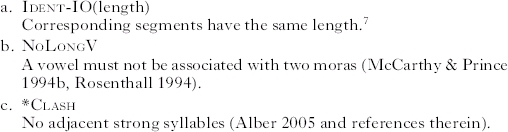
There is a length distinction in Tonkawa, so Ident-IO(length) (4a) must dominate NoLongV (4b) and any other constraints that might favour shortening of adjacent long vowels, such as *Clash (4c).
(4)
This is shown in the tableau in (5), which is presented in the comparative format proposed by Prince (Reference Prince, Carpenter, Coetzee and Lacy2002).Footnote 8
When the long vowel finds itself in the second syllable following an initial CV, it must shorten. This comes about because the initial syllable must be footed (5c), and the second syllable is unstressed and therefore should not be long in a trochaic foot (5b). Thus Parse-σ and WSP together favour shortening in the second syllable, but vowels may be long or short otherwise.
(5) Shortening in non-reduplicative contexts
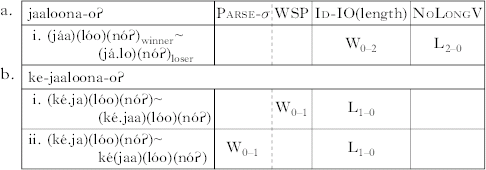
Under this analysis, a long vowel does not have to shorten in the third syllable, since it can head its own foot, and indeed long vowels do not shorten later in the word.
Although sequences of two light syllables arise as a result of shortening and in some other circumstances,Footnote 9 CVCV sequences are generally avoided and turned into heavy CVC syllables by syncope (see (6)). It should be noted that vowels in Tonkawa regularly delete and shorten, but there is apparently no epenthesis or lengthening, so the pressure to have heavy stressed syllables cannot be satisfied by lengthening vowels (or consonants). Syncope applies in a context similar to that of shortening (an insight originally due to Kisseberth Reference Kisseberth, Sadock and Vanek1970), but it also applies outside the #CVC_CV environment.
(6) Syncope in the non-reduplicative phonology of Tonkawa
The analysis of syncope involves metrical constraints such as the Stress-to-WeightPrinciple (SWP; (7a)); and Parse-σ, which both dominate Max(V) (7b).
(7)

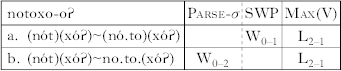
A second vowel must delete to turn CVCV into a heavy closed syllable CVC, since heavy stressed syllables are preferred to light ones, despite the unfaithfulness. Not footing the first two syllables is ruled out by Parse-σ. This is shown in tableau (8).
(8) Syncope in non-reduplicative contexts
The most important generalisation here is that in the regular phonology of Tonkawa, there is pressure for the initial syllable of the word to be heavy, which is accomplished by either syncope of the second vowel or being faithful to the length of initial long vowels. A full analysis of syncope and shortening is a bit more complicated than this; for example, long vowels shorten but do not delete even when they appear in the syncope context.Footnote 10 The background presented so far, however, is sufficient for understanding the reduplication facts. One important thing to keep in mind about shortening and deletion is that they are quite general and apply in a variety of morphological contexts, affecting both root and prefix vowels. While there are some lexical exceptions to syncope, it is quite pervasive in Hoijer's corpus. I now turn to reduplication.
2.2 Underapplication of syncope in Tonkawa reduplication
2.2.1 The underapplication pattern
Verbal reduplication is pervasive in Tonkawa. Reduplicants are prefixes and always have the shape CV-. Unlike other CV- prefixes, however, reduplicant prefixes typically fail to condition syncope. As shown in (9), in reduplication syncope underapplies.Footnote 11 Even though the second vowel of the word is in the right position for syncope, it doesn't delete – with some exceptions, to which I return in the following section. The roots listed here are not exceptions to syncope in general, according to Hoijer's (Reference Hoijer1949) dictionary, where he underlines vowels that can syncopate.Footnote 12
(9) Tonkawa reduplication: underapplication of syncope in second syllable (Hoijer 1933: 7)
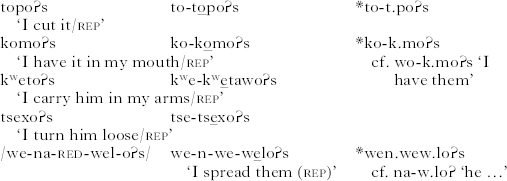
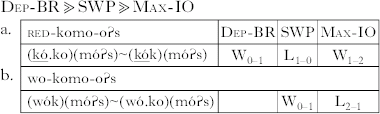
Tonkawa reduplication raises two questions: why does syncope underapply (i.e. why not *[kok.moʔs]?), and why does reduplication copy just a light syllable when heavy syllables are clearly favoured in initial position (i.e. why not *[kom.ko.moʔs]?). The answer to the first question is that underapplication of syncope is a base-reduplicant identity effect: deleting the vowel of the base eliminates a correspondent for the reduplicant vowel (see Gouskova Reference Gouskova2007). If syncope were to apply, as in *(ko1-k)(moʔs), the reduplicant vowel would not have a correspondent in the base – from the point of view of the base, the vowel would be inserted, violating Dep-BR (McCarthy & Prince Reference McCarthy, Prince, Beckman, Dickey and Urbanczyk1995). Dep-BR dominates SWP, however, blocking deletion in the base, so (ko1-ko1)(moʔs) wins.
(10) Underapplication of syncope in reduplication I
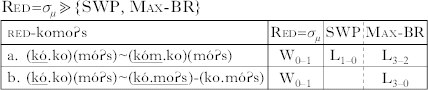
The answer to the second question – why copy just CV? – is that copying more than just a light syllable violates the template, informally defined as Red=σμ in (11) (I will return to the formal content of this requirement in §2.2.2):
(11)

This constraint must dominate not just SWP but also Max-BR, since Max-BR favours not only the heavy syllable red candidate but also the total reduplication candidate, *[ko.moʔs-ko.moʔs]. SWP does not distinguish the winner from this candidate, since both violate SWP equally if the footing is as assumed here.Footnote 13
(12) Underapplication of syncope in reduplication II
Base-reduplicant identity is violated in Tonkawa, since the base does not truncate to match the size of the reduplicant (i.e. /red-naatos/→*[na-na]). (I will return to this point in §4.) This is due to the high ranking of Max-IO, which, together with the templatic constraint, dominates Max-BR in Tonkawa. Red=σμ dominates Max-IO transitively via SWP.
(13) No truncation in backcopying

For simplicity, this analysis assumes that codas are always moraic in Tonkawa, i.e. that Weight-by-Position (Hayes Reference Hayes1989) is undominated. This is not the only conceivable analysis, of course, but the important thing here is that that codas must not be allowed into the reduplicant, whether they are moraic (and therefore ruled out by the light syllable template) or non-moraic (and therefore ruled out by a prohibition on non-moraic syllable appendices – see Rosenthall & van der Hulst Reference Rosenthall and van der Hulst1999, among others). As the following examples show, when the base begins in a closed syllable, the reduplicant is still CV-. Here, Dep-BR is not an issue, since syncope is not necessary to make the initial syllable heavy. Simply copying a closed syllable (as in *[sal-salkenos]) would satisfy both SWP and Max-BR, but the option fatally violates the template, and so light syllable reduplication is the only alternative. The prohibition on codas in red is explored in the next section.
(14) Additional evidence for the light syllable template (Hoijer 1933: 14) CVC-

2.2.2 Exceptional application of syncope and the nature of the light syllable template
Is the light syllable template a primitive of the theory, or can it be reduced to other independently motivated constraints? One of the central insights of GTT is that many aspects of templates echo general markedness constraints. For example, if red is a syllable, it is often an open one, or one that obligatorily has an onset; if red is a prosodic word, it will be perfectly parsed into a single binary foot, and so on. This insight is not itself new (see, for example, Steriade Reference Steriade1988), but it was not incorporated into the theory of Prosodic Morphology directly until the advent of OT (McCarthy & Prince Reference McCarthy and Prince1994a). McCarthy & Prince demonstrate that the various aspects of syllabic markedness (such as the onset requirement and the prohibition on codas) have effects in reduplication processes, independently of each other. They argue that the CV template we sometimes see in reduplication is not a primitive – rather, it arises from the interaction of several independently motivated constraints. To return to templatic constraints like Red=σμ (11) would be a step backwards for the theory. In this subsection, I suggest that the templatic requirement can be decomposed into several more primitive, familiar markedness constraints. These constraints are lexically indexed to the reduplicative morpheme in Tonkawa, and they interact to create the effects of a reduplicative template. A consequence of this view is that it provides a straightforward way of answering the non-obvious question of how violations of the template are reckoned, since Tonkawa presents some cases where the reduplicant does not itself constitute a light syllable. Before considering these cases, we need some background on template satisfaction.
Templatic constraints are inherently complex, incorporating several distinct component requirements. Intuitively, something like Red=σμ might be understood to require that the reduplicative morpheme consist of a single light syllable, no more, no less, with no extraneous material. If the syllable that contains red also includes material other than red, then red is not exactly a light syllable. McCarthy & Prince (Reference McCarthy and Prince1993b) discuss a case like this and conclude that when red shares the syllable with another morpheme, the template is violated: ‘Because of the dominant constraints, the templatic target σ is met only weakly, though violation is still minimal, as usual in Optimality Theory. (Complex questions, yet to be addressed, underlie the characterisation of minimal violation of a templatic target)’ (McCarthy & Prince Reference McCarthy and Prince1993b: 122, emphasis in the original). It is not obvious, though, what the difference is between red sharing the syllable with another morpheme and red itself being larger than a light syllable. Indeed, it is possible to violate different aspects of the intuitive definition separately. The candidates given in (15) for the hypothetical base /pataka/ demonstrate this (the reduplicative morpheme is underlined).
(15) Hypothetical cases of template violation for the input /pataka/

In order to cover all of the eventualities raised by (15), the formal definition of Red=σμ would have to be rather ingenious, and it would still fail to capture the Emergence of the Unmarked insight. Rather than pursuing this tack, I suggest that Red=σμ is not a primitive, but a cover term for several distinct constraints, which happen to be lexically indexed to the reduplicative affix in Tonkawa. Lexical indexation is the way to encode lexical exceptions and lexical stratification, among other things (e.g. Benua Reference Benua1997, Itô & Mester Reference Itô, Mester and Tsujimura1999, Pater Reference Pater2000, Prince & Smolensky Reference Prince and Smolensky2004, Flack Reference Flack2007): a constraint may be ‘split’ into two versions in a given language, one of which will be labelled to apply to one subset of lexical items. Lexically indexed constraints in Tonkawa include the familiar constraints NoCoda (16a) and NoLongV (16b), which together enforce the ‘lightness’ requirement, as well as the requirement for an affix to be monosyllabic.
- (16)
a. NoCodaRED
Syllables do not have codas (Prince & Smolensky 2004).
b. NoLongVRED
A vowel must not be associated with two moras (McCarthy & Prince 1994b, Rosenthall 1994).
The nature of the monosyllabicity requirement has been the subject of some recent debate, and it has several possible sources, which include gradient alignment, output-output correspondence and considerations of morphophonological complexity (see e.g. McCarthy & Prince Reference McCarthy and Prince1994b, Walker Reference Walker2000, Reference Walker2002, Gouskova Reference Gouskova2004a, Downing Reference Downing2006). For simplicity, I will use the familiar pseudotemplatic constraint in (17), though Tonkawa does not present any evidence that would rule out other accounts. This constraint is a variation on Downing's Morpheme=Syllable (2006: 120), and it belongs to the same class as the interface constraint Lx≈Pr of Prince & Smolensky (Reference Prince and Smolensky2004), which requires that a lexical word be associated with a prosodic word.
(17) Affix⩽σ
The phonological exponent of an affix is no larger than a syllable (McCarthy & Prince 1994b).
The hypothetical cases in (15) raise the issue of locality: how does the template differentiate between reduplicants that are too small for their syllables and ones that are too large? If the template is viewed as a cover term for more primitive requirements, then a ready answer is presented by existing work on lexically indexed constraints. Following Pater (Reference Pater, Bateman, O'Keefe, Reilly and Werle2006), I assume that lexically indexed constraints such as (16) are violated ‘if and only if the locus of violation contains some portion of the indexed morpheme’ (Pater Reference Pater, Bateman, O'Keefe, Reilly and Werle2006: 16, see also (18)). Thus, NoCodared would assign a violation mark to (15a) and (15d) but not to (15b), since the locus of violation (the coda consonant itself – see McCarthy Reference McCarthy2003a) is not part of the reduplicative morpheme.
(18) *Xl
Assign a violation mark to any instance of X that contains a phonological exponent of a morpheme specified as L (Pater 2006).
With this background, we are ready to consider how these assumptions allow us to understand the nature of the templatic requirement. There is a subpattern of reduplication of Tonkawa that differs from the underapplication pattern analysed earlier. In this subpattern, red is still a CV sequence, but it is embedded in a CVC syllable (see (19)). As shown below, some Tonkawa roots have syncope either in the expected position, as in [ja-j-petsos], or in the following syllable. Hoijer observes that the prefix [ja-] is often implicated in such patterns, but there are a few examples that do not involve [ja-]; he also remarks that the CV-CV pattern is unexpected, given the general trend for second vowel syncope:
(19) Exceptional application of syncope in reduplication (Hoijer 1933: 7)

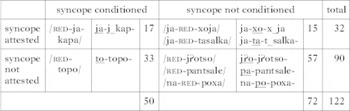
Reduplicated forms without syncope form the majority of Tonkawa verbs in Hoijer's corpus. The relative frequency of syncopating and non-syncopating forms is actually not all that central to the argument, since the very existence of two patterns demands an analysis, but it is instructive to consider how robust the patterns are. Hoijer (Reference Hoijer, Boas and Hoijer1933) classifies verbs according to whether they copy the first or the second syllable of the stem (the non-copied first syllable is most likely an older prefix) and whether the result is CV-CV or CV-C_ (with syncope). This roughly aligns with the analytical categories of whether syncope is conditioned (given the general phonology of Tonkawa) and whether it occurs. The results of my search of Hoijer's (Reference Hoijer, Boas and Hoijer1933) grammar are summarised in Table I, along with some examples of each type.
Reduplication patterns (Hoijer 1933).

Under the analysis presented in the preceding section, syncope is conditioned to apply to the second but not the third underlying vowel of the word. In words that reduplicate the initial syllable, the second vowel is eligible for syncope, but syncope is often blocked for phonological reasons (e.g. syncope cannot put a glottalised consonant in coda position, create a trisyllabic cluster or delete an underlyingly long vowel). Syncope is also blocked between identical consonants (McCarthy Reference McCarthy1986), so the forms that reduplicate a non-initial syllable (as in /ja-red-tasalka-/→[ja-ta-t_salka-]) are not expected to delete the second underlying vowel (*[ja-t_-tasalka-]), and never do. Some of the verbs with second syllable reduplication unexpectedly show syncope of the third underlying vowel, and I assume that in such forms, the first CV is lexically marked to be an extraprosodic prefix.Footnote 14 It is clear that the majority of the forms cited by Hoijer do not have syncope (though see Phelps Reference Phelps1973, who treats the majority pattern as exceptional due to assumptions about the applicability of syncope to stems vs. prefixes). Even though, in many of these cases, syncope is ruled out for independent reasons, 33 of the 50 forms expected to have syncope do not have it. The incidence of syncope is lower in reduplicated forms than would be expected by chance.Footnote 15 I conclude from this that the pattern of syncope underapplication is robust in Tonkawa, despite there being some exceptional forms that do have syncope.
Phonologically, the forms with syncope differ from the forms without syncope as follows. In both cases, the reduplicant itself contains no marked structure – it is not bigger than a syllable, and it contains no material that would contribute weight (i.e. a coda or along vowel). The status of these forms with respect to the template is therefore the same – both satisfy it. This is illustrated in (20): we find forms that reduplicate like (20a) and (20c), but none that have full reduplication, two-syllable reduplication or CVC reduplication. Each of these options is separately ruled out by the constraints that produce the effects of the template. The two attested patterns, (a) and (c), clear all three of the lexically indexed constraints:
(20) Red=σμas lexically indexed constraints
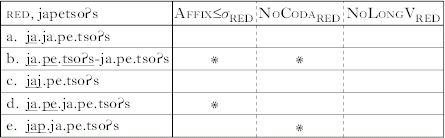
Thus the CV template comes about because red is not allowed to be more than a syllable, to contain codas or to have vowels (NoLongVred has not played a role in these cases, but it will in the next section). These limitations hold even when red shares a syllable with a non-reduplicated consonant, as with syncope. The answer to McCarthy & Prince's (Reference McCarthy and Prince1993b) concern about the minimal violation of templatic targets, then, is that the templatic target is not a monolithic unit, but an artefact of the interaction of separate constraints, each of which is separately violable. By virtue of its ability to distinguish different types of template violation, the lexical indexation approach allows fine-grained control over exceptions. For example, there is one form in Hoijer's data that does violate the CV template: /he-red-jaxa-oʔ/ [he-jax-jaxoʔ] ‘several eat it’ (Hoijer Reference Hoijer, Boas and Hoijer1933: 76). Its CVC shape can be accounted for if NoCodared is dominated by a morpheme-specific version of Max-BR, which is lexically indexed just to the stem ‘eat’. This kind of control would be difficult to achieve with gross templatic constraints such as Red=σμ.
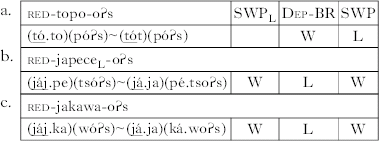
Whether syncope applies to reduplicated forms or not is also up to lexical indexation. While all reduplicated forms are subject to the lexically indexed red constraints, only some are exceptional with respect to syncope. The underapplication pattern and the normal application pattern differ in how they do on Dep-BR and SWP: syncopating forms violate faithfulness (Dep-BR), and non-syncopating ones violate markedness (SWP). This is exceptional triggering of syncope, which I attribute to the high ranking of a lexically indexed version of SWP, SWPL. SWPL is indexed to certain stems/bases, so it applies to every stressed syllable that contains any segments of the stem to which red is prefixed – even if a syllable contains only one consonant that belongs to the stem. This analysis is shown in (21). The first input, (21a), follows the underapplication pattern: Dep-BR outranks the general SWP and therefore disfavours syncope. In (21b), the stem is indexed as subject to the higher-ranked SWPL, which returns a violation for every light stressed syllable that contains some portion of the stem /japetse-/. In the winner, all stressed syllables are heavy, and all happen to contain some segments from the lexically exceptional stem. In the most viable loser, the first stressed syllable consists entirely of red and is not subject to SWPL. Since footing is exhaustive in Tonkawa, one of the other syllables would have to be stressed, and [pe] is the best option under trochaic footing. This light stressed syllable incurs a fatal violation of SWPL.
(21) Underapplication and normal application of syncope
The rankings motivated so far are summarised in (22). In this subgrammar, SWP and Max-IO interact to favour syncope in general contexts, but syncope is blocked in reduplication when required by reduplicant-specific markedness or base-reduplicant identity. Base-reduplicant identity cannot require the deletion of base segments, however, so there is no template-backcopying truncation.
(22) Ranking summary

To summarise the discussion so far, the default state of affairs in Tonkawa is for the first syllable to be heavy, but when this syllable is a reduplicative prefix, it must be light. This alone is not a devastating argument for reduplicant-specific templatic constraints; indeed, one could argue that this is nothing more than emergence of the unmarked open syllable. Under such an analysis, the general (not lexically indexed) constraint NoCoda would show its activity in reduplication by dominating Max-BR but not Max-IO. I show that this analysis does not work in §3.2.
2.3 Overapplication and backcopying of shortening
The crucial argument for reduplicant-specific templates comes from the pattern of vowel shortening in Tonkawa reduplication. Recall that shortening normally applies to the second vowel of a word, provided that it is preceded by a light syllable (see (2)). Outside of that context, long vowels contrast in length with short ones in initial syllables or in following syllables. When a word with a long vowel in the first syllable is reduplicated, however, both the reduplicant and the base that it copies have short vowels – shortening unexpectedly applies to the first syllable of the word:
(23) Overapplication of shortening in Tonkawa reduplication (Hoijer 1933: 12–14) CVV-

This is surprising, because sequences of adjacent long vowels in the first two syllables are not prohibited in Tonkawa, as was shown in (2). Nor are long vowels prohibited in the third syllable, yet shortening applies in [he-ja-ja.tse.woʔ].Footnote 16
Long vowels are banned from the reduplicative prefix, and this shortness is copied onto the base as well. The template, together with base-reduplicant identity, compels shortening, which is otherwise not motivated in Tonkawa phonology. Faithful copying of the long vowels is ruled out by the high-ranking lexically indexed constraint NoLongVred (see (24a.i)). As shown in (24a.ii), copying a short vowel without shortening the base vowel creates a configuration that is generally prohibited in Tonkawa, i.e. a long vowel following a initial #CV syllable, and it also fails on base-reduplicant identity (see (24a.ii)). This is ruled out by high-ranking Ident-BR (length), and by the constraints whose interaction produces second syllables shortening. Reduplication of non-initial syllables follows the same shortening pattern, as shown in (24b.i): both the reduplicant and the first syllable of the base must shorten, even though long vowels are allowed in the third syllable in Tonkawa. Here is the argument for the role of Ident-BR(length): neither the templatic constraint nor the general phonological rules of Tonkawa require shortening here, so it must be due to base-reduplicant identity.
(24) Analysis of shortening

An additional ranking can be justified based on forms such as /red-soopk-os/→[so-sop.koʔs]: even though Tonkawa does not normally tolerate #(LH) feet (recall that long vowels undergo shortening in second syllables), a CV syllable can be followed by a CVC syllable in the context of reduplication. The marked configuration could be avoided by copying more, as in *[sop-soop.koʔs, soo-soop.koʔs], etc. The failure of these alternative parses suggests that Parse-σ, NoLongV and NoCodared dominate WSP.
Thus this analysis produces shortening of the first and second syllables only in reduplicative contexts, and it explains why shortening occurs simultaneously in the reduplicant and the base – the template is backcopied. The crucial rankings are summarised below. In many ways, the rankings for shortening are parallel to the subgrammar in (22): here, too, high-ranking reduplicant-specific constraints and BR faithfulness interact with general prosodic constraints to produce a reduplication pattern that deviates from the default norms of the language. As I will show in the next section, a GTT analysis cannot produce this outcome.
(25) Ranking summary
3 GTT alternatives
Generalised Template Theory can be viewed as a sort of null hypothesis for prosodic morphology: nothing special has to be said about reduplicative morphemes that doesn't also have to be said about other morphemes, except that reduplicative morphemes copy their segmental content from the reduplicative base. GTT successfully explains foot-size reduplication, as in Diyari (McCarthy & Prince Reference McCarthy and Prince1994a), and GTT analyses have been proposed for smaller-size reduplicants as well, so the burden of proof is on the present theory: it is imperative to show that no analysis of Tonkawa can be constructed without some specific reference to the prosodic properties of reduplicative morphemes. My argument consists of two parts. First, no properties of Tonkawa outside reduplication motivate the claim that what goes on in reduplication is in any sense normal or unmarked: reduplicative affixes are restricted in a way that other affixes are not. Second, I will show that Tonkawa cannot be analysed using the types of constraints that have been proposed for small reduplicants, including *Struc and OO-Dep. Each of these analyses encounters a different set of problems, and neither can explain the entire paradigm.
3.1 Affix shapes in Tonkawa
One of the reductionist assumptions of GTT that makes it so appealing is that under this theory, the reduplicant needs to only be specified morphologically as either a stem or an affix, and its phonological properties will then be determined by the same interactions that generally define the phonological properties of its stem or affix class in the language. If anything, the affixal reduplicant is expected to be less marked, not more, than the corresponding stems or affixes in the language. This line of attack on reduplication has been very productive, as the long line of research in this area will attest, but it doesn't work for Tonkawa. The key reason is that no size restrictions hold of affixes in the language.
Productive reduplication is prefixing, so it is instructive to consider what other prefixes of Tonkawa look like. A search of Hoijer's (Reference Hoijer1949) morpheme dictionary shows that non-reduplicative prefixes of Tonkawa often take the shape CV-, but there are quite a few longer prefixes as well. There is no apparent size limit on suffixes either – examples of disyllabic and CVC/CVV suffixes are numerous (/-aa/ (definite noun suffix), /-nik/ (3rd person plural subject), /-ita/ (‘number of them’), /-wese/ (plural subject). From the following examples, it should be clear that no light monosyllable size limit holds of Tonkawa prefixes. The size limit is specific to reduplicants.
(26) Prefix shapes in Tonkawa (Hoijer 1949: 70–74)
In some work on prosodic morphology, it has been observed that phonological restrictions sometimes hold of a well-defined subset of a language's affixes. For example, English derivational morphemes must minimally contain a mora, but inflectional ones do not have to. Moreover, Class II monosyllabic prefixes must be heavy in English, but Class I prefixes may be light (Golston Reference Golston1991, McCarthy & Prince Reference McCarthy and Prince1994b, Downing Reference Downing2006; see also Urbanczyk Reference Urbanczyk2006). It would be hard to make an argument for those kinds of distinctions in Tonkawa. There is no apparent derivational-inflectional divide between affixes of different sizes (note the two causative morphemes differ in size: [ja-/-j-] and [nes-]). There is also no phonological evidence for a class or level distinction – the only significant phonological distinction is between the reduplicative morpheme and all the other CV- prefixes, which I attribute to reduplicant-specific constraints. All CV- prefixes induce shortening of following vowels, for example, and so does the reduplicative prefix, assuming that it is a priori limited in size to a light syllable.
3.2 Alternative analyses
This observation about Tonkawa affix shapes is important to the argument against a GTT analysis. As I will show, no ranking can produce shortening only in reduplicative affixation but not in other morphological contexts. It is impossible to capture this kind of interaction because it contradicts the very premise of GTT, which is that the grammar of reduplication does not specifically reference the phonological properties of reduplicative affixes. So what would it take to construct a GTT analysis? The analysis must explain the following: (i) why is syncope blocked in reduplicated forms but not in other affixation?; (ii) why is the reduplicant limited in size to a single syllable, but other affixes can be larger?; (iii) why are long vowels and codas not found in reduplicants?; (iv) why does shortening/backcopying apply in reduplicated forms?
The first question (why is syncope blocked?) could be answered in the same way as in the analysis I propose: BR-faith prevents syncope because everything in the reduplicant must have a correspondent in the base. The traditional answer to the second question (why just one syllable?) is that the monosyllable emerges through the interaction of a markedness constraint that penalises syllables, such as *Struc(σ) (Zoll Reference Zoll1993) or syllable alignment (Spaelti Reference Spaelti1997), with constraints that require something to be copied for the realisation of red, i.e. MorphReal (see McCarthy & Wolf Reference McCarthy and Wolf2005 for the most recent overview). Thus something must be copied, but reduplication copies just enough material to express the morpheme and no more. The answer to the third question (why not CVV/CVC?) is the Emergence of the Unmarked (McCarthy & Prince Reference McCarthy and Prince1994a): even though long vowels and codas are tolerated in Tonkawa generally (Faith-IO≫Markedness), the reduplicant is allowed to copy only what it likes because it is subject to a different set of faithfulness constraints (Markedness≫Faith-BR). The otherwise dominated markedness constraints against codas and long vowels will then determine the shape of the monosyllable (Walker Reference Walker2000, Kennedy Reference Kennedy2005, Yu Reference Yu2005et al.).
The problem with the Emergence of the Unmarked part of this account is that codas and long vowels are not only tolerated – they are actually required in the relevant context in Tonkawa. It was independently demonstrated for non-reduplicative contexts that SWP dominates Max-IO, which gives us syncope. Since the output of syncope is a CVC syllable, SWP must also dominate NoCoda. The preferences of NoCoda will not be obeyed as long as SWP is ranked above it – in fact, since the two constraints are in a Paninian special-general relationship in Tonkawa (Prince & Smolensky Reference Prince and Smolensky2004), NoCoda cannot be active in determining the shape of red, even in an Emergence of the Unmarked configuration. This argument is valid even if syncope were attributed to something other than SWP; any constraint that favours the deletion of a vowel in that context will be in a special-general relationship with NoCoda.Footnote 17 As demonstrated in the following tableau, then, NoCoda does not work as a size-limiting constraint in Tonkawa – no ranking of just these constraints will produce the observed outcome.
(27)
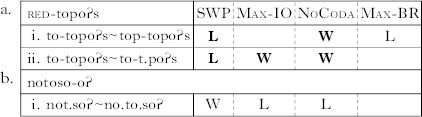
The question about backcopying turns out to be the hardest one to answer. The vowel in red cannot be short, because of the Emergence of the Unmarked (cf. Sanskrit; Steriade Reference Steriade1988, McCarthy & Prince Reference McCarthy and Prince1994b). As we know from non-reduplicative phonology, shortening in Tonkawa is not an effect of NoLongV; it is really motivated by a host of much more subtle prosodic constraints, some of which actually favour long vowels in certain positions (see (5)). Indeed, (5) showed that NoLongV must be ranked at the bottom of the relevant subhierarchy. In some contexts, reduplicant-base shortening could be attributed to base-reduplicant identity, as in (28a) – this is identical to the analysis I proposed in (24). The problem is that in the absence of a templatic constraint limiting red to a light syllable, nothing can explain why /naatoʔs/ reduplicates with shortening (see (28d)). The only constraint that favours shortening there is NoLongV, and it is ranked too low to matter.
(28)

This analysis needs Ident-IO (length) to be dominated by a constraint that favours shortening in (28a) but not in (28b) (or in, say, /jaaloona-oʔ/, which surfaces as [jaa.loo.noʔ]). *Struc constraints cannot do the job, because they would favour shortening across the board – this is in fact the reason why *Struc constraints have been so popular in GTT; they cannot produce templatic backcopying, which is what we have in Tonkawa.Footnote 18
3.2.1 OO-Dep
Yet another alternative from the work on GTT fails for a different reason. In Transderivational Correspondence Theory, there is a family of constraints that favours shortening only in affixation – including reduplicative affixation: OO-Dep (Benua Reference Benua1997, Gouskova Reference Gouskova2004a). OO-Dep requires every element of a derived form to have a correspondent in the derivational base. By this definition, every segment and mora of a prefix, including a reduplicative prefix, violates OO-Dep, so the shorter the reduplicant, the less the candidate violates OO-Dep. The problem is that OO-Dep, too, is overly general: without additional provisions, it applies to all prefixes and would favour shortening in (28b) and in (28d). Benua's theory allows us to lexically index OO constraints to certain affixes, but if this is done for red, the analysis ceases to be a Generalised Template analysis, since it invokes a reduplication-specific mechanism to derive the templatic restriction. There are some additional confounds for an OO-Dep analysis in Tonkawa, since vowels alternate with zero in morphologically related forms so regularly that it would be difficult to argue that any sort of paradigm-uniformity pressure even exists in the language.
3.2.2 *Repeat
Another alternative analysis, suggested by an anonymous reviewer,Footnote 19 would attribute the overapplication of shortening to a ban against adjacent identical syllables with long vowels (*naa.naa). Constraints against adjacent identical syllables have been proposed by Yip (Reference Yip, Lapointe, Brentari and Farrell1998) and Hicks Kennard (Reference Hicks Kennard2004), though their *Repeat constraints are silent on the issue of vowel length; see Inkelas & Zoll (Reference Inkelas and Zoll2005) for a recent critical discussion.Footnote 20 The *Repeat analysis hinges on whether there are sequences of identical syllables with long vowels outside of the reduplicative context. Fortunately, Tonkawa fusion provides derived syllables with long vowels, which are etymologically non-reduplicative. I have found some examples of this that are non-reduplicative in origin. The long-vowelled syllables in these examples come about because /h/ deletes between vowels, which fuse as a result. If this is a general pattern, the existence of such form suggests that the hypothetical constraint against identical syllables with long vowels is ranked below Ident-IO(length), which would make overapplication of shortening impossible.
(29) Sequences of identical syllables with long vowels outside reduplicative contexts Footnote 21

3.2.3 Morphological structure
Yet another alternative GTT analysis would reinterpret the morphological structure of reduplicated words. If the reduplicant is actually outside the morphological stem, then it would not have to be prosodified with the base, and its shortness could follow from other general principles (cf. McCarthy & Prince Reference McCarthy and Prince1994b, Downing Reference Downing2003, Inkelas & Zoll Reference Inkelas and Zoll2005). This analysis predicts that prefixes external to the reduplicant should never be long either. This is falsified by the following forms, in which the reduplicant is not initial in the word:
(30) Non-initial reduplicants

Since syncope applies to /#we-na-/ and shortening fails to apply to /#hee/, it appears that those are actually prosodified in the normal way – and therefore the reduplicant is as well. Thus the reduplicant is not external to the prosodic or the morphological word – it is in the middle of it.Footnote 22
3.2.4 Cophonologies
Tonkawa reduplication is relevant to another theory of reduplication, Inkelas & Zoll's (Reference Inkelas and Zoll2005) Morphological Doubling Theory. I cannot do this framework justice within the available space, but I will point out a few of its predictions and cite some potentially crucial data. The first important feature of the theory is that it has no base-reduplicant faithfulness and therefore allows neither true overapplication nor underapplication. Any deviation from default patterns is attributed to morphological idiosyncrasies or opacity, both of which are analysed in terms of cophonologies (morpheme-specific rankings). Second, the theory does include templates as a primitive and sees templates in reduplication as just a special case of morphological truncation. Inkelas & Zoll use templates in their analyses but ultimately leave CV-reduplication as an issue for future research, speculating that it may have either morphological (= truncation-templatic) or phonological (= copying) nature. My assumptions match those of Morphological Doubling Theory when it comes to the need for reduplication-specific phonology, but we disagree on how this is implemented in the theory (see Pater Reference Pater, Bateman, O'Keefe, Reilly and Werle2006 for more on cophonologies vs. lexical constraint indexation) and on the mechanisms underlying over/underapplication.
In Morphological Doubling terms, overapplication of shortening and underapplication of syncope are examples of reduplication-specific alternations and non-alternations respectively. The first can be accomplished in the theory by calling on a grammar that is specific to the concatenation of red with the base: if NoLongV dominates Ident(length) in that grammar, shortening has to apply to both red and the base long vowel. The challenge here would be to ensure that shortening applies only to those two vowels but not to the rest of the word; as Pater (Reference Pater, Bateman, O'Keefe, Reilly and Werle2006) points out, locality is a general challenge for morpheme-specific ranking theories. It appears that long vowels are not prohibited in words that contain reduplicative prefixes, so in the concatenative cophonology, Ident(length) dominates NoLongV – surface long vowels derived by h-deletion and w-fusion are unfaithful to their underlying length (alternative approaches to moraic faithfulness are possible, however). Any analysis must explain why both derived and underlying long vowels are allowed in reduplicated words (see (30) and (31)), but banned from the reduplicative morphemes themselves and from the bases they copy. BR faithfulness in conjunction with reduplication-specific markedness constraints handles locality straightforwardly (see §2.2.2); whether a reasonable cophonology analysis can be developed is a challenge for Morphological Doubling Theory.
(31) Long vowels allowed in reduplicated words

To summarise, I have discussed a number of alternatives to my analysis and argued against them on empirical grounds. The constraint that favours shortening in (28a) must be reduplicant-specific; it cannot be a general constraint of the language or a constraint that applies to all affixes. This makes a true GTT analysis of Tonkawa impossible. The main argument here is that within the context of Tonkawa phonology, there is nothing special about red except that it is limited in size to a light syllable; everything else follows from the interaction of this requirement with the language's prosodic system.
4 The Kager-Hamilton conundrum
Any theory with templatic or pseudotemplatic constraints makes a prediction that is widely thought to be problematic: under a certain ranking of BR and IO faithfulness with reduplicant-specific constraints, the base will truncate to match the size of the reduplicant, but the size limit is not generally obeyed by non-reduplicative morphemes (McCarthy & Prince Reference McCarthy, Prince, Kager, van der Hulst and Zonneveld1999). This prediction is illustrated in the following tableau. In this hypothetical language, /pataka/ maps to [pataka] when not reduplicated, but it reduplicates as [pa-pa], not as *[pa-pataka]. The only difference between this language and Tonkawa is the relative ranking of Max-BR: in Tonkawa, Max-IO dominates Max-BR.
(32) Kager-Hamilton Conundrum (templatic backcopying)
The Kager-Hamilton Conundrum is predicted even in theories without templatic constraints like Red=σμ, however. The prediction persists if Red=σμ is replaced in (32) by OO-Dep, since OO-Dep also prefers [pa-pa] to [pataka-pataka]: the latter introduces more material in the derived form that is not present in the derivational base [pataka]. OO-Dep can therefore have the same effect as templatic constraints, even though it does not expressly legislate the size of affixes (Gouskova Reference Gouskova2004a). Similarly, templatic backcopying is predicted by morpheme-specific markedness constraints (Ota Reference Ota2004, Pater Reference Pater, Bateman, O'Keefe, Reilly and Werle2006, Flack Reference Flack2007), which have been with us since Prince & Smolensky's Edgemost(um: L) (2004: 42–43). Both morpheme-specific markedness and output-output constraints are arguably independently necessary, so eliminating templatic constraints from the theory does not eliminate the prediction.
Whether the Kager-Hamilton Conundrum is a problematic prediction remains to be seen. Tonkawa shortening is argued here to be templatic backcopying: the requirement that the reduplicant be short coupled with BR-identity comples shortening in the base. In fact, the ranking in (24) exactly parallels the Kager-Hamilton ranking, in that a BR-faithfulness constraint and a reduplicant-specific constraint together dominate IO-faithfulness.Footnote 23Downing (Reference Downing2000) discusses another possible case of templatic backcopying of the truncating variety: in Hausa, reduplication copies two syllables of the base and truncates the base to two syllables, as in /red-tsakwale/ [tsakwal-tsakwal] ‘slushy’. Downing also argues that Kikuyu has templatic backcopying which is in a way the opposite of Tonkawa, i.e. red is required to be long, and this length is copied to the base. It could be, therefore, that templatic backcopying is not impossible in human languages – it may simply be rare or underrepresented in the currently available sample.
5 Conclusion
In this paper, I have presented a study of reduplication in Tonkawa and argued that it provides evidence for reduplicant-specific constraints. I showed that the Tonkawa reduplicative affix is required to be a light open syllable. This requirement comes about through the interaction of lexically indexed constraints that ban codas, long vowels and polysyllabicity in red. The requirements of these constraints are obeyed, even though this introduces configurations otherwise avoided in the language. The resulting light syllable templates is also copied by the base, reflecting a strong general preference for base-reduplicant identity.
This evidence does not invalidate the considerable body of work on atemplatic reduplication; it is clear that reduplicant size can sometimes vary under the demands of various non-templatic constraints. It does mean, however, that it is not possible to account for all types of reduplication without some reference to the properties of reduplicative affixes. Lexically indexed constraints have to be a part of phonological theory in order to account for exceptionality and lexical stratification. It is entirely reasonable to except that in some languages, the reduplicant will be the exceptional morpheme, subject to restrictions that do not apply elsewhere. Even though this account makes specific reference to the reduplicative affix, however, it is fully within the spirit of Prosodic Morphology in that it derives the light syllable template from independently necessary principles.