Introduction
Large neurocognitive impairments encompassing multiple domains are apparent from the first episode of psychosis (Mesholam-Gately et al. Reference Mesholam-Gately, Giuliano, Faraone, Goff and Seidman2009) and to a lesser extent in ultra-high-risk or clinical high-risk populations (Fusar-Poli et al. Reference Fusar-Poli, Deste, Smieskova, Barlati, Yung, Howes, Stieglitz, Vita, McGuire and Borgwardt2012), particularly in individuals who later develop full-threshold psychotic disorder (Fusar-Poli et al. Reference Fusar-Poli, Deste, Smieskova, Barlati, Yung, Howes, Stieglitz, Vita, McGuire and Borgwardt2012; Meier et al. Reference Meier, Caspi, Reichenberg, Keefe, Fisher, Harrington, Houts, Poulton and Moffitt2014). Neurocognitive deficits following first-episode psychosis (FEP) have shown relative stability (Bozikas & Andreou, Reference Bozikas and Andreou2011; Rund et al. Reference Rund, Barder, Evensen, Haahr, Hegelstad, Joa, Johannessen, Langeveld, Larsen, Melle, Opjordsmoen, Rossberg, Simonsen, Sundet, Vaglum, McGlashan and Friis2016), suggesting that neurocognitive deterioration occurs prior to psychotic disorder (Zipursky et al. Reference Zipursky, Reilly and Murray2013), offering a window of opportunity for early intervention.
There has been extensive research on the relationship between illness characteristics and outcomes and the elapsed time between the first onset of psychotic symptoms and initiation of adequate treatment – termed duration of untreated psychosis (DUP) (Marshall et al. Reference Marshall, Lewis, Lockwood, Drake, Jones and Croudace2005; Perkins et al. Reference Perkins, Gu, Boteva and Lieberman2005; Boonstra et al. Reference Boonstra, Klaassen, Sytema, Marshall, De Haan, Wunderink and Wiersma2012; Penttila et al. Reference Penttila, Jaaskelainen, Hirvonen, Isohanni and Miettunen2014; Rund, Reference Rund2014; Anderson et al. Reference Anderson, Rodrigues, Mann, Voineskos, Mulsant, George and McKenzie2015; Kane et al. Reference Kane, Robinson, Schooler, Mueser, Penn, Rosenheck, Addington, Brunette, Correll, Estroff, Marcy, Robinson, Meyer-Kalos, Gottlieb, Glynn, Lynde, Pipes, Kurian, Miller, Azrin, Goldstein, Severe, Lin, Sint, John and Heinssen2016). This line of investigation is predicated on the neurotoxicity hypothesis, which suggests that delayed treatment of ongoing or repeated acute psychotic symptoms may be associated with biological and functional ‘damage’ and poorer treatment response (Sheitman & Lieberman, Reference Sheitman and Lieberman1998; McGlashan, Reference McGlashan2006; Cropley et al. Reference Cropley, Wood and Pantelis2013; Rund, Reference Rund2014). An alternative hypothesis is that longer DUP is a marker of a more severe form of illness characterised by greater neurodevelopmental and neurocognitive impairment (McGlashan, Reference McGlashan1999, Reference McGlashan2006). A recent systematic review of 48 neuroimaging studies concluded that there was equivocal evidence for an association between DUP and brain structure in FEP, providing little support for the neurotoxicity hypothesis at the neurobiological level (Anderson et al. Reference Anderson, Rodrigues, Mann, Voineskos, Mulsant, George and McKenzie2015). On the other hand, evidence from several reviews suggests that longer DUP is associated with poorer cross-sectional and longitudinal symptomatic (particularly negative symptom) and functional outcomes (Marshall et al. Reference Marshall, Lewis, Lockwood, Drake, Jones and Croudace2005; Perkins et al. Reference Perkins, Gu, Boteva and Lieberman2005; Boonstra et al. Reference Boonstra, Klaassen, Sytema, Marshall, De Haan, Wunderink and Wiersma2012; Penttila et al. Reference Penttila, Jaaskelainen, Hirvonen, Isohanni and Miettunen2014). This finding remains after controlling for factors such as premorbid functioning and age of onset (Marshall et al. Reference Marshall, Lewis, Lockwood, Drake, Jones and Croudace2005; Perkins et al. Reference Perkins, Gu, Boteva and Lieberman2005; Penttila et al. Reference Penttila, Jaaskelainen, Hirvonen, Isohanni and Miettunen2014). While the mechanisms for the relationship between DUP and clinical outcomes remain unclear, this line of work validates the need for early psychopharmacological and psychosocial interventions to maximise symptomatic and functional outcomes, in line with a staging model of care (McGorry et al. Reference McGorry, Hickie, Yung, Pantelis and Jackson2006). There is also a need to better understand whether longer DUP is associated with poorer neurocognition, as neurocognitive impairment is a strong predictor of poorer functional outcome (Fett et al. Reference Fett, Viechtbauer, Dominguez, Penn, Van Os and Krabbendam2011) and early neurocognitive interventions might be beneficial (McGorry et al. Reference McGorry, Keshavan, Goldstone, Amminger, Allott, Berk, Lavoie, Pantelis, Yung, Wood and Hickie2014).
Two previous systematic reviews have examined the relationship between DUP and neurocognition. In the first, only two of the eight included studies found longer DUP was associated with poorer neurocognition (Perkins et al. Reference Perkins, Gu, Boteva and Lieberman2005). In the second most recent review, only six of the 22 included studies reported a significant relationship between longer DUP and poorer neurocognition (Rund, Reference Rund2014). In both reviews, it was concluded that there is minimal evidence for a longer DUP having detrimental associations with neurocognitive performance; however, results across different neurocognitive domains were aggregated and significant findings between studies were tallied rather than meta-analysed. It is possible that certain neurocognitive functions may be more susceptible than others to the deleterious effects of untreated psychosis, which may be due to variations in their developmental maturation and the extent to which differing brain regions/networks recruited for particular neurocognitive abilities are impacted by psychosis-related pathological processes (Meier et al. Reference Meier, Caspi, Reichenberg, Keefe, Fisher, Harrington, Houts, Poulton and Moffitt2014; Pantelis et al. Reference Pantelis, Wannan, Bartholomeusz, Allott and McGorry2015). Furthermore, these reviews only included studies that specifically examined the association between DUP and neurocognition, thus excluding studies that assess DUP and neurocognition as secondary variables, which can provide valuable complementary information for a quantitative analysis of this association. A comprehensive meta-analytic investigation utilising all published primary and secondary data on DUP and separate neurocognitive domains, which may vary in their susceptibility to ‘toxicity’, may produce greater precision of data synthesis.
The primary aim of this study was to conduct a systematic review and meta-analysis investigating whether DUP is associated with neurocognitive performance in specific domains or tasks in FEP, assessed cross-sectionally. The second aim was to examine the effect of demographic and clinical factors on the relationship between DUP and neurocognition in FEP. A final exploratory aim was to examine the relationship between DUP and neurocognition in studies with a mean DUP <360 days, to determine whether such a relationship might be more likely closer to illness onset. This exploratory aim was based on recent research showing that this period may represent a dynamic and critical treatment window (Boonstra et al. Reference Boonstra, Klaassen, Sytema, Marshall, De Haan, Wunderink and Wiersma2012; Kane et al. Reference Kane, Robinson, Schooler, Mueser, Penn, Rosenheck, Addington, Brunette, Correll, Estroff, Marcy, Robinson, Meyer-Kalos, Gottlieb, Glynn, Lynde, Pipes, Kurian, Miller, Azrin, Goldstein, Severe, Lin, Sint, John and Heinssen2016).
Method
Search strategy
The systematic review and meta-analysis were conducted according to Meta-analysis of Observational Studies in Epidemiology guidelines (Stroup et al. Reference Stroup, Berlin, Morton, Olkin, Williamson, Rennie, Moher, Becker, Sipe and Thacker2000) and Preferred Reporting Items for Systematic Reviews and Meta-Analyses (Moher et al. Reference Moher, Liberati, Tetzlaff and Altman2009). PubMed and EMBASE online databases were searched from inception to June 2015. The initial search covered the combination of two concepts: ‘FEP’ (OR alternative terms) AND ‘cognition’ (OR alternative terms). The search was limited to FEP samples to minimise confounding effects of treatment on neurocognitive outcomes. Cognition search terms covered multiple neurocognitive domains and were based on those used in the meta-analysis on cognition in first-episode schizophrenia by Mesholam-Gately et al. (Reference Mesholam-Gately, Giuliano, Faraone, Goff and Seidman2009). These cognition terms were subsequently entered into the Medical Subject Headings online dictionary to ensure all relevant terms were captured (see online Supplementary Material). DUP was not included in the initial search to allow collection of secondary data included in papers that did not have a primary focus on the relationship between DUP and neurocognition. A second separate search of PubMed and EMBASE was conducted that combined ‘FEP’ (OR alternative terms) AND ‘duration of untreated psychosis’ OR ‘DUP’. Finally, a manual search was performed on the reference lists of relevant reviews.
Screening and selection criteria
All papers were double-screened in author pairs from different cultural backgrounds in order to avoid potential educational/cultural bias. Screening occurred in three phases with discrepancies resolved by consensus. In phase 1, titles and abstracts were screened checking for broad eligibility (strict definitions were not applied in this phase). In phase 2, full-text articles surviving phase 1 were comprehensively reviewed for eligibility according to the following inclusion and exclusion criteria: (a) written in English; (b) peer-reviewed; (c) original empirical study; (d) N specified and ⩾5; (e) all participants had a diagnosis of psychotic disorder according to DSM or ICD criteria. Given the interest was on the role of untreated psychotic symptoms, the full spectrum of psychotic disorders were permitted, including schizophrenia, schizophreniform disorder, schizoaffective disorder, delusional disorder, mood disorders with psychotic features, psychotic disorder not otherwise specified and brief psychotic disorder. Any method of diagnostic assessment was permitted; (f) the sample was described as first episode, using any one of the following terms: FEP, recent onset psychosis, first onset psychosis, early psychosis, first-episode schizophrenia, FES, recent-onset schizophrenia, first onset schizophrenia, early onset schizophrenia or early schizophrenia. If a mixture of first-episode and multi-episode participants were included, data on the FEP group had to be reported separately; (g) DUP was measured. Any method of assessment was permitted; (h) neurocognition was assessed objectively, via standardised or experimental tests: (i) relevant statistics were provided. Studies reporting that participants had received >2 years of treatment were excluded. Up to 2 years of prior treatment was permitted because this would maximise inclusion of studies from early psychosis services internationally, with some services allowing up 2 years prior to inclusion (e.g. Daban et al. Reference Daban, Amado, Bourdel, Loo, Olie, Poirier and Krebs2005, Nuechterlein et al. Reference Nuechterlein, Subotnik, Green, Ventura, Asarnow, Gitlin, Yee, Gretchen-Doorly and Mintz2011). Furthermore, this time period was selected because the outcomes in the first 2 years after illness onset predict long-term outcomes (Menezes et al. Reference Menezes, Arenovich and Zipursky2006). Self-reported or clinician-rated cognitive functioning (e.g. PANSS) was also excluded. Phase 3 screening involved identifying papers with overlapping samples to ensure the final set of papers included independent samples. Overlapping studies were not excluded if there was no duplication of the variables of interest and data on both DUP and neurocognition were available.
Data extraction and quality assessment
Two authors (KA, EP) independently extracted data from all included papers and discrepancies were resolved via discussion. Data extracted included: location and year of the study; descriptions of the study design; premorbid, demographic, clinical and treatment characteristics of the sample; details of DUP, including definition and measurement; and neurocognitive measures. The neurocognitive test data extracted from included studies were categorised according to widely accepted and conventional neurocognitive domains (Lezak et al. Reference Lezak, Howieson and Loring2004; Mesholam-Gately et al. Reference Mesholam-Gately, Giuliano, Faraone, Goff and Seidman2009) (see online Supplementary Table S1). Each paper was rated for methodological quality by two authors (KA, EP) using a 7-item scale adapted from Anderson et al. (Reference Anderson, Rodrigues, Mann, Voineskos, Mulsant, George and McKenzie2015) and purposefully designed for the current study (see online Supplementary Table S2). Each item was scored 2, 1 or 0, with maximum score out of 14 (higher scores indicating higher quality). Discrepancies were resolved by consensus.
Data synthesis and analysis
Data were analysed with a quantitative meta-analytical approach using Comprehensive Meta-Analysis Software version 3 (Biostat, Inc., Englewood, NJ). Two different types of meta-analytical approaches were performed, depending on whether original papers provided: (i) measures of correlation between DUP and neurocognition (e.g. Pearson r) or (ii) mean and s.d. for neurocognition and mean for DUP.
The primary and more statistically powerful approach involved meta-analysis of the correlation between DUP and neurocognition, which involved separate meta-analyses performed for each neurocognitive domain/index. Meta-analyses were conducted when at least three independent studies measured a given neurocognitive domain/index. As early intervention trials show there may be a critical treatment window within the first year of FEP (Petersen et al. Reference Petersen, Jeppesen, Thorup, Abel, Ohlenschlaeger, Christensen, Krarup, Jorgensen and Nordentoft2005; Kane et al. Reference Kane, Robinson, Schooler, Mueser, Penn, Rosenheck, Addington, Brunette, Correll, Estroff, Marcy, Robinson, Meyer-Kalos, Gottlieb, Glynn, Lynde, Pipes, Kurian, Miller, Azrin, Goldstein, Severe, Lin, Sint, John and Heinssen2016) additional exploratory meta-analyses were conducted on studies with a mean DUP <360 days to determine whether potential DUP-neurocognition relationships might be evident closer to illness onset. Effect size was estimated by calculating the correlation value [with 95% confidence interval (CI)] of each paper. In the case of studies stating that the correlation was not significant, but not reporting r value, p = 1 was assumed, as this results in an effect size of zero and avoids the need for an additional assumption about the direction of the effect and thus is parsimonious and conservative. The rigour of the findings was also checked by performing a jackknife sensitivity analysis, which consists of iteratively repeating the meta-analyses excluding one study at a time to establish whether the results are replicable (Radua & Mataix-Cols, Reference Radua and Mataix-Cols2009). Effect sizes were combined to produce a single summary estimate using random-effects techniques based on the DerSimonian & Laird (Reference DerSimonian and Laird1986) method (method of maximum likelihood). Interpretation of the strength of correlations (r) was 0.10 = small, 0.30 = medium and 0.50 = large effect, while interpretation of the effect size (Cohen's d) was 0.2–0.5 = small, 0.5–0.8 = moderate and >0.8 = large (Cohen, Reference Cohen1992). To assess the heterogeneity among study point estimates, we calculated the Q statistic, with magnitude of heterogeneity being evaluated using the I 2 statistic (a measure of the proportion of variance in the summary effect size that is attributable to heterogeneity). I 2 indicates the percentage of total variation across studies due to heterogeneity rather than chance, with I 2 values of 25%, 50% and 75% considered to represent low, moderate and high heterogeneity, respectively. Publication bias was assessed by visually inspecting funnel plots. In addition, we used Orwin's (Reference Orwin1983) FSN (fail-safe number). This generated the number of unpublished studies that would be needed to move estimates to a non-significant threshold. Further, we used the Duval & Tweedie (Reference Duval and Tweedie2000) trim-and-fill method to estimate an effect size corrected for publication bias.
The influence of demographic, clinical and study quality variables was tested using weighted linear meta-regression analyses (mixed effects regression, unrestricted maximum likelihood), with study effect size as the dependent variable and either quality of study (total quality score), age (mean age of participants), sex (percentage of males), specific diagnosis (percentage of patients with schizophrenia diagnosis), education level (years of education), premorbid IQ, antipsychotic-naïve (percentage of antipsychotic-naïve patients) and antipsychotic dose (mean chlorpromazine equivalents) as the independent variables. Given the exploratory nature of these analyses, a correction for multiple comparisons was not performed (Perneger, Reference Perneger1998).
The secondary analyses involved the studies that provided mean and s.d. for neurocognitive measures and mean for DUP. Separate meta-regression analyses examining the influence of DUP on neurocognition were performed on individual neurocognitive test or index scores (rather than domains). Meta-regressions were conducted when at least four independent studies reported on a given neurocognitive measure. The slope of the meta-regression line (β-coefficient: direct [+] or inverse [−]) indicates the strength of a relationship between the moderator (DUP) and outcome (neurocognitive test score). Interpretation of β weights was <0.2 = weak, 0.2–0.5 = moderate and >0.5 = strong (Acock, Reference Acock2014).
Results
Study selection and characteristics
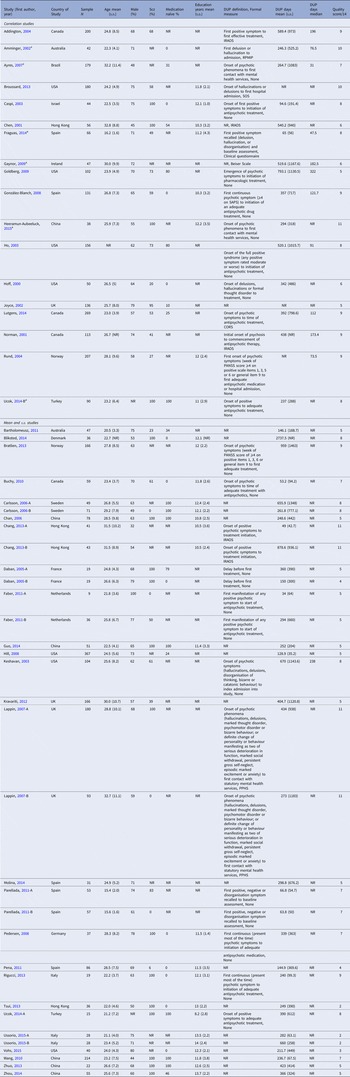
The literature search and screening process led to the inclusion of 43 independent studies (see online Supplementary Fig. S1) involving a total of 4647 individuals with FEP. Eighteen of the included studies directly examined the relationship between DUP and neurocognition and 31 studies reported means and s.d. for neurocognitive scores and mean for DUP (six studies provided both data types). The mean age of FEP patients across the 43 studies ranged from 15 to 32 years. The percentage of males across the included studies ranged from 32% to 100%, with males outnumbering females overall (65% male). Of the 34 studies that reported on specific diagnoses, the percentage of patients with a diagnosis of schizophrenia ranged from 0% to 100%, highlighting the heterogeneous diagnostic presentations across studies. Three of the correlation studies did not report the mean DUP (Joyce et al. Reference Joyce, Hutton, Mutsatsa, Gibbins, Webb, Paul, Robbins and Barnes2002; Rund et al. Reference Rund, Melle, Friis, Larsen, Midboe, Opjordsmoen, Simonsen, Vaglum and McGlashan2004; Broussard et al. Reference Broussard, Kelley, Wan, Cristofaro, Crisafio, Haggard, Myers, Reed and Compton2013). Of the remaining 40 studies, the mean DUP ranged from 34.0 (Faber et al. Reference Faber, Smid, Van Gool, Wunderink, Wiersma and van den Bosch2011) to 2737.5 (Bliksted et al. Reference Bliksted, Fagerlund, Weed, Frith and Videbech2014) days. Only 12 studies reported median DUP, which ranged from 31 to 322 days. Complete details of the included studies are shown in Table 1.
Characteristics of studies included in the meta-analysis

s.d., standard deviation; NR, not reported; Scz, schizophrenia diagnosis; IRAOS, Interview for the Retrospective Assessment of the Onset of Schizophrenia; RPMIP, Royal Park Multidiagnostic Interview for Psychosis; SOS, Symptom Onset in Schizophrenia; CORS, Circumstances of Onset and Relapse Schedule; PPHS, Personal and Psychiatric History Schedule
Note: A and B denote that sample characteristics were reported according to two subgroups in the original paper
a Also included in mean and s.d. studies
Study quality
The quality ratings for the 43 included studies are presented in Table 1. Total scores out of a possible maximum of 14 ranged from 2 to 11, with a mean of 6.88 (s.d. = 2.32). Only nine of the 43 studies reported use of a standardised DUP measure.
Meta-analysis of correlation studies
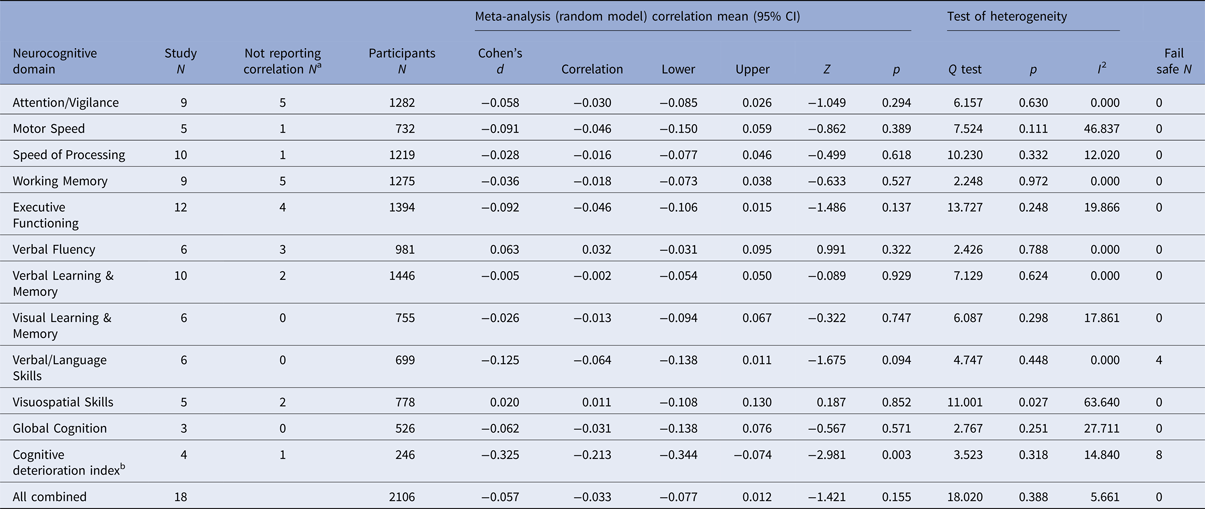
Twelve separate meta-analyses (one for each neurocognitive domain/index) were conducted with data from the 18 studies that examined the correlation between DUP and neurocognition. One meta-analysis involving four studies (N = 246) showed a significant correlation between DUP and cognitive deterioration index (a calculation of current IQ minus premorbid/‘hold’ IQ) (mean ES −0.213, 95% CI −0.344 to −0.074, p = 0.003; Fig. 1). Specifically, shorter DUP was associated with a lower cognitive deterioration index. The remaining meta-analyses, including attention/vigilance, motor speed, speed of processing, working memory, executive functioning, verbal fluency, verbal learning and memory, visual learning and memory, verbal/language skills, visuospatial skills, global cognition, and all combined, were not significant (Table 2). As specified in the method, for studies stating that the correlation was not significant, but not reporting r value, p = 1 was assumed. Given this conservative approach may bias results towards the null hypothesis, we conducted a sensitivity analysis assuming p = 0.5 (Beretta & Santaniello, Reference Beretta and Santaniello2016); this led to equivalent results. Tests of heterogeneity were nonsignificant, with the exception of the visuospatial skills domain, and there was no evidence of publication bias. Meta-regressions to assess the influence of demographic and clinical variables showed that the effects of study quality, age, sex, specific diagnosis, education level, premorbid IQ, antipsychotic-naïve status and antipsychotic dose on the meta-analytical estimates were all non-significant (results available upon request).
Meta-analysis of relationship between DUP and cognitive deterioration index.

Meta-analysis of the correlation between DUP and neurocognitive domains

DUP, duration of untreated psychosis; CI, confidence interval.
a When the correlation was not reported we used a conservative estimation of p = 1 and also conducted a sensitivity analysis with p = 0.5; these confirmed that results did not change.
b Cognitive deterioration index is a cross-sectional calculation of current IQ minus estimated premorbid IQ, with a higher discrepancy between the two indicating greater cognitive deterioration.
Meta-regression analysis of studies reporting means and standard deviations
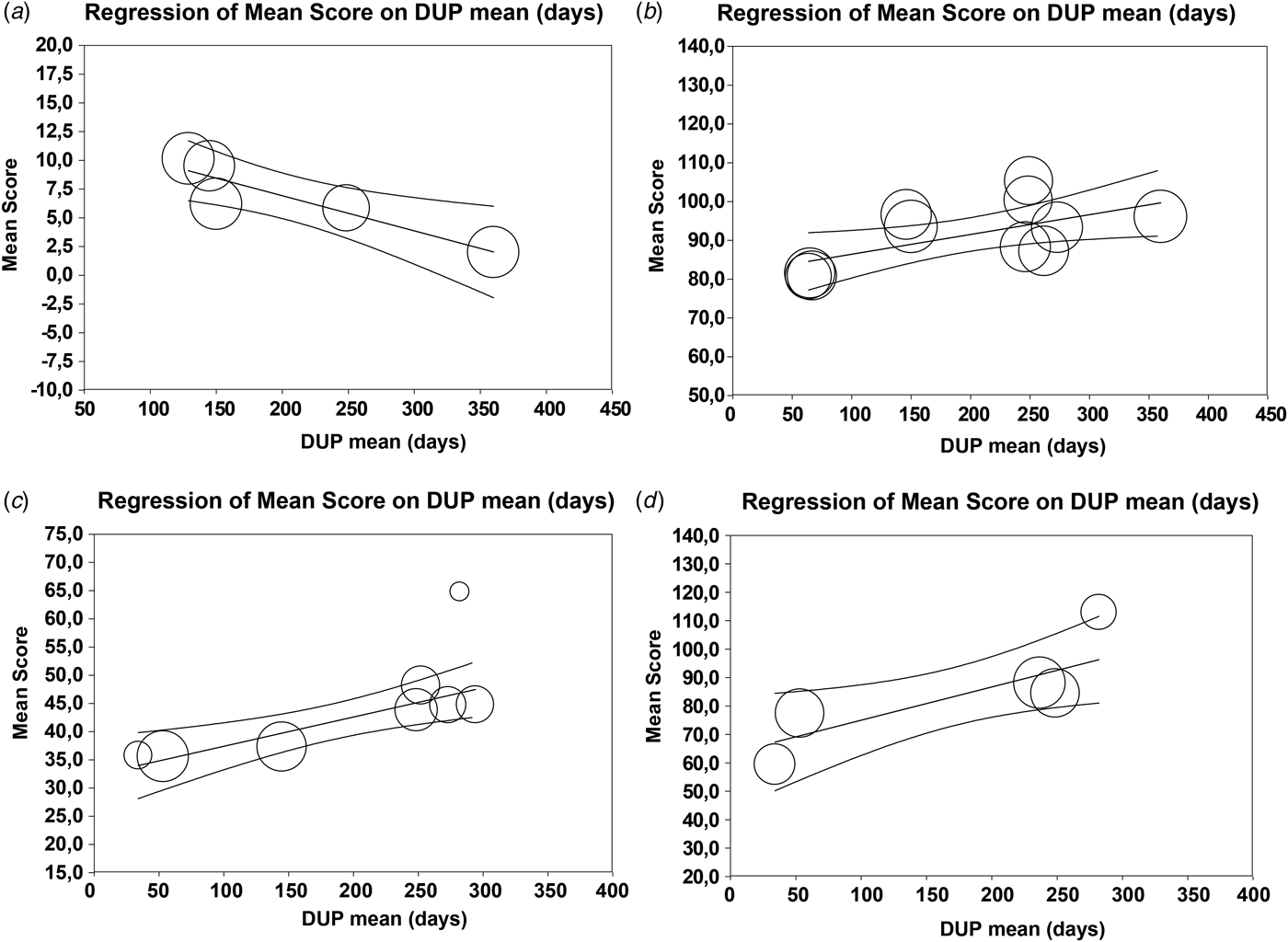
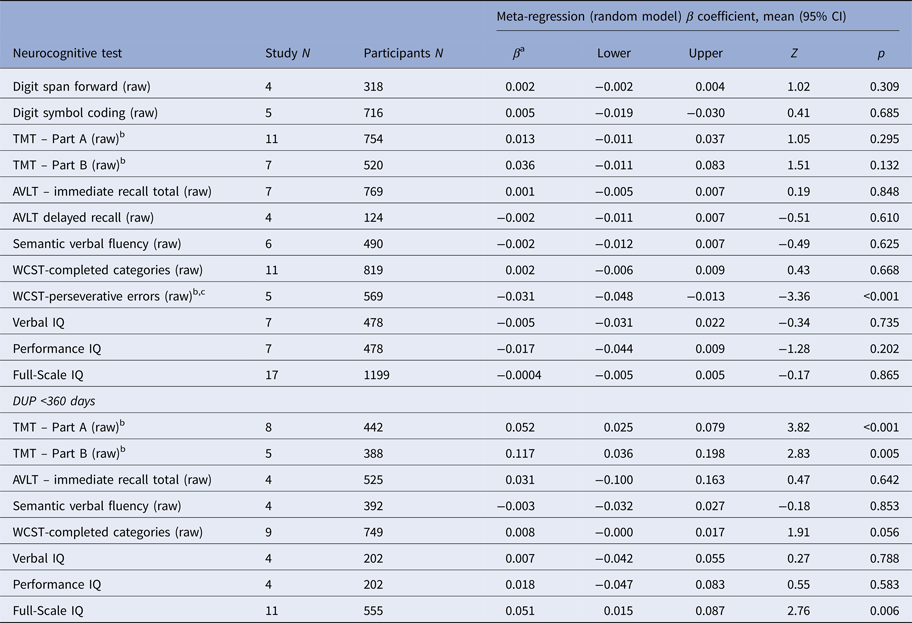
In the second set of analyses, the influence of DUP on performance on specific neurocognitive tasks or index scores using 20 separate meta-regressions was conducted (Table 3). Results showed that the influence of DUP on neurocognitive performance was significant for perseverative errors on the Wisconsin Card Sorting Test (WCST) (five studies, N = 569; mean ES −0.031, 95% CI −0.048 to −0.013, p < 0.001; Fig. 2), indicating that longer DUP was associated with fewer perseverative errors (incidentally this analysis only included studies with mean DUP <360 days). The remaining meta-analyses, including digit span forward, digit symbol coding, Trail Making Test (TMT) A and B, immediate and delayed scores on the Auditory Verbal Learning Test, semantic verbal fluency, categories on the WCST, and Verbal, Performance and Full-Scale IQ (FSIQ), were not significant.
Significant associations between DUP and neurocognitive performance in studies with DUP <360 days. (a) WCST – Perseverative Errors (b) Full-Scale IQ (c) TMT-A (d) TMT-B. DUP, duration of untreated psychosis; WCST, Wisconsin Cart Sorting Test; IQ, intelligence quotient; TMT, Trail Making Test.

Meta-regression analysis of the influence of DUP on neurocognitive task performance

DUP, duration of untreated psychosis; CI, confidence interval; TMT, Trail Making Test; AVLT, Auditory Verbal Learning Test; WCST, Wisconsin Card Sorting Test; IQ, Intelligence Quotient.
a Positive β values mean that the longer the DUP the higher the cognitive score. β < 0.2 is considered a weak, β < 0.2 to <0.50, a moderate and β > 0.5, a strong effect.
b Higher score means a poorer performance.
c All included studies had mean DUP <360 days.
Finally, exploratory meta-analyses restricted to studies with a mean DUP <360 days were conducted. In addition to WCST-perseverative errors reported above, in these studies DUP was associated with three neurocognitive scores: TMT-A (eight studies, N = 442; mean ES 0.052, 95% CI 0.025 to 0.079, p < 0.001), TMT-B (five studies, N = 388; mean ES 0.117, 95% CI 0.036 to 0.198, p = 0.005) and FSIQ (11 studies, N = 555; mean ES 0.051, 95% CI 0.015 to 0.087, p = 0.006). Specifically, longer DUP was associated with poorer performance (i.e. slower time to complete) on TMT-A and B, but higher FSIQ (see Table 3 and Fig. 2).
Discussion
Meta-analysis of FEP studies that examined the correlation between DUP and neurocognition found that there were no significant associations between DUP and most domains of neurocognition. The exception was that a longer DUP was associated with a higher cognitive deterioration index, which is a calculation of current minus premorbid/‘hold’ intellectual functioning. A confirmatory analysis using median DUP led to equivalent findings. Potentially important demographic, clinical and study quality moderating factors did not alter the results of these meta-analyses. Meta-regressions of DUP and neurocognitive test scores were mostly non-significant, except for WCST-perseverative errors (cognitive flexibility) with better performance being associated with longer DUP. Exploratory meta-regressions showed that in studies with DUP <360 days (but not in those with DUP >360 days), DUP was significantly related to poorer performance on TMT-A and B (processing speed and working memory) and higher FSIQ. Given there were few significant relative to non-significant associations, it may be reasonable to argue that there is minimal evidence for an association between DUP and neurocognition in psychosis, in line with previous reviews (Perkins et al. Reference Perkins, Gu, Boteva and Lieberman2005; Rund, Reference Rund2014). Previous reviews differed from the current meta-analysis in that neurocognition was examined as a single construct, generally without considering individual neurocognitive domains or tasks, and different ranges in the mean DUP between studies was not taken into account. Rund's (Reference Rund2014) critique of the studies he reviewed included that many were potentially underpowered to detect significant associations. The current meta-analysis was able to address these concerns, providing the most robust test to date of the relationship between DUP and neurocognition. The findings of the current review suggest that the relationship between DUP and neurocognition is complex and validates the need for hypothesis-driven longitudinal studies that examine specific domains.
The significant association between DUP and cognitive deterioration index is intriguing. This finding suggests that the longer an individual goes without treatment for their psychotic symptoms, the greater the discrepancy between their estimated premorbid and current intelligence. Explanations for this include that untreated psychotic symptoms are neurotoxic or, that those who experience greater neurocognitive deterioration delay seeking treatment for their symptoms. Four studies were included in the cognitive deterioration index meta-analysis (Norman et al. Reference Norman, Townsend and Malla2001; Amminger et al. Reference Amminger, Edwards, Brewer, Harrigan and McGorry2002; Caspi et al. Reference Caspi, Reichenberg, Weiser, Rabinowitzc, Kaplan, Knobler, Davidson-Sagi and Davidson2003; Gaynor et al. Reference Gaynor, Dooley, Lawlor, Lawoyin and O'Callaghan2009). The measurement of the deterioration index in these studies requires careful scrutiny. Caspi et al. (Reference Caspi, Reichenberg, Weiser, Rabinowitzc, Kaplan, Knobler, Davidson-Sagi and Davidson2003) calculated the magnitude of change on verbal and non-verbal intelligence tasks administered when participants were healthy at age 16–17 years and again following their first-episode of schizophrenia. However, the other three studies estimated cognitive deterioration cross-sectionally, after participants had reached full threshold for psychotic disorder (Norman et al. Reference Norman, Townsend and Malla2001; Amminger et al. Reference Amminger, Edwards, Brewer, Harrigan and McGorry2002; Gaynor et al. Reference Gaynor, Dooley, Lawlor, Lawoyin and O'Callaghan2009). Previous research has shown that assessing premorbid intellectual functioning after illness onset might be misleading (Russell et al. Reference Russell, Munro, Jones, Hayward, Hemsley and Murray2000). Indeed, examination of the forest plot (Fig. 1) shows no correlation in the study by Caspi et al. (Reference Caspi, Reichenberg, Weiser, Rabinowitzc, Kaplan, Knobler, Davidson-Sagi and Davidson2003) compared with the negative correlations of the other three studies. In two of the included studies, cognitive deterioration was assessed by examining the discrepancy between ‘hold’ (Vocabulary/Information) and ‘non-hold’ (Digit Symbol Coding) tests (Amminger et al. Reference Amminger, Edwards, Brewer, Harrigan and McGorry2002; Gaynor et al. Reference Gaynor, Dooley, Lawlor, Lawoyin and O'Callaghan2009). Comparing crystalised verbal abilities with processing speed may not be valid for estimating cognitive deterioration because processing speed (as assessed by coding tasks) is arguably a more fluid mental function that is susceptible to current mental state and thus, may not reflect global or permanent deterioration. This may be especially true for first-episode patients entering treatment for the first time. Interestingly, longitudinal research spanning ages 7–38 in people who develop schizophrenia suggests that declines are observed in processing speed and working memory (Digit Symbol Coding, TMT A and B), verbal learning (Rey Auditory Verbal Learning Test), and motor function (Grooved Pegboard), but not in ‘crystalised’ verbal skills (Similarities), which are already impaired at an early age (Meier et al. Reference Meier, Caspi, Reichenberg, Keefe, Fisher, Harrington, Houts, Poulton and Moffitt2014). These declines were not associated with use of antipsychotic medication or substances (Meier et al. Reference Meier, Caspi, Reichenberg, Keefe, Fisher, Harrington, Houts, Poulton and Moffitt2014). Given premorbid IQ was an estimate (rather than real-time measure) in one study (Norman et al. Reference Norman, Townsend and Malla2001) and cognitive deterioration was based on ‘non-hold’ tasks of neurocognitive function in two studies (Amminger et al. Reference Amminger, Edwards, Brewer, Harrigan and McGorry2002; Gaynor et al. Reference Gaynor, Dooley, Lawlor, Lawoyin and O'Callaghan2009), the finding of an association between DUP and cognitive deterioration index needs to be interpreted cautiously. Nevertheless, the current findings in combination with those of Meier et al. support the need for hypothesis-driven prospective studies examining processing speed in relation to untreated psychotic symptoms.
The remaining significant findings between DUP and neurocognitive measures were only observed in samples with a mean DUP <360 days (including the WCST-perseverative errors finding). This suggests that the relationship between neurocognitive performance and psychosis may be strongest closer to the onset of illness. Neurocognitive performance on specific tests was not reported as poorer (or better) in studies with a DUP >360 days. This finding highlights that the first year after illness onset may be especially critical for treatment and supports the rationale for early intervention in psychosis.
The finding of an association between longer DUP and poorer performance on the TMT-A and B in studies with mean DUP <360 days indicates that onset of psychosis may be particularly associated with a decline in functions mediating performance on this task, including visuomotor processing speed (Part A) and divided attention and working memory (Part B) (Lezak et al. Reference Lezak, Howieson and Loring2004). The aforementioned longitudinal study showed that measures of processing speed are especially sensitive to neurocognitive decline prior to illness onset (Meier et al. Reference Meier, Caspi, Reichenberg, Keefe, Fisher, Harrington, Houts, Poulton and Moffitt2014). Furthermore, processing speed has been found to be the most impaired neurocognitive domain in established psychotic disorder (Dickinson et al. Reference Dickinson, Ramsey and Gold2007; Mesholam-Gately et al. Reference Mesholam-Gately, Giuliano, Faraone, Goff and Seidman2009). What is unclear is whether these deficits are state-related impairments in association with symptomatology, whether they reflect progressive decline in association with a ‘neurotoxic’ process, or whether they represent developmental lag in neurocognitive functions underpinning TMT performance (Reichenberg et al. Reference Reichenberg, Caspi, Harrington, Houts, Keefe, Murray, Poulton and Moffitt2010). Another possible explanation is that longer DUP and poorer TMT performance are markers of a more severe subtype of illness (McGlashan, Reference McGlashan1999, Reference McGlashan2006). Again, hypothesis-driven studies with a specific focus on TMT performance are needed.
In studies with mean DUP <360 days, the finding that fewer WCST-perseverative errors (a putative index of cognitive flexibility) and higher FSIQ (general intelligence) were associated with longer mean DUP is unexpected. Interestingly, research in healthy adolescents and young adults has found that WCST-preservative errors and measures of intelligence are highly negatively correlated (Ardila et al. Reference Ardila, Pineda and Rosselli2000; Kafadar & Orhan, Reference Kafadar and Orhan2016), so the converging findings between these two measures may not be co-incidental. There are several speculative explanations for these findings, including that both DUP and WCST/IQ measures might be correlated with a third variable (Marshall et al. Reference Marshall, Lewis, Lockwood, Drake, Jones and Croudace2005). For example, delayed help-seeking may occur due to factors that are associated with having higher cognitive flexibility (i.e. less perseveration) and higher IQ. Such factors may include better insight (Nair et al. Reference Nair, Palmer, Aleman and David2014), higher perceived stigma, substance use (Donoghue & Doody, Reference Donoghue and Doody2012), increased social support and/or the use self-help or alternative treatment approaches.
Fewer perseverative errors on the WCST have been found to be highly correlated with better insight, particularly appropriate relabelling of symptoms, in acutely psychotic individuals with early psychosis (Drake & Lewis, Reference Drake and Lewis2003). It is possible that higher insight combined with better cognitive flexibility equips an individual with the capacity for implementing effective coping and problem-solving strategies or trialling alternative approaches to manage their illness, before seeking treatment from specialist psychosis services. It is also possible that this combination is associated with higher perceived stigma and heightened awareness regarding potentially negative long-term implications related to being treated for psychosis (Brekke et al. Reference Brekke, Kohrt and Green2001), which may lead to avoidance of and delayed treatment seeking. In support of this, concealing one's diagnosis due to anticipated discrimination was predicted by being younger and having a higher level of education (a possible proxy for IQ), in a large multi-site cohort of individuals with schizophrenia (Ucok et al. Reference Ucok, Brohan, Rose, Sartorius, Leese, Yoon, Plooy, Ertekin, Milev and Thornicroft2012).
It is known that early detection efforts can reduce delays in psychosis treatment, which is associated with better long-term clinical and functional outcomes (Petersen et al. Reference Petersen, Jeppesen, Thorup, Abel, Ohlenschlaeger, Christensen, Krarup, Jorgensen and Nordentoft2005; Hegelstad et al. Reference Hegelstad, Larsen, Auestad, Evensen, Haahr, Joa, Johannesen, Langeveld, Melle, Opjordsmoen, Rossberg, Rund, Simonsen, Sundet, Vaglum, Friis and McGlashan2012; Kane et al. Reference Kane, Robinson, Schooler, Mueser, Penn, Rosenheck, Addington, Brunette, Correll, Estroff, Marcy, Robinson, Meyer-Kalos, Gottlieb, Glynn, Lynde, Pipes, Kurian, Miller, Azrin, Goldstein, Severe, Lin, Sint, John and Heinssen2016). However, it is currently unclear whether earlier intervention for psychosis is associated with better neurocognitive outcomes. While this meta-analysis cannot address this question directly, it provides tentative evidence suggesting that the year following onset of frank psychotic symptoms may be a heightened critical period (‘window’), when interventions may maximally benefit neurocognitive course. Studies are needed to test this. While challenging from an ethical and practical perspective, study designs could ‘manipulate’ the DUP by delaying aspects of treatment such as antipsychotic prescription, to determine whether this impacts on subsequent neurocognitive outcomes (Francey et al. Reference Francey, Nelson, Thompson, Parker, Kerr, Macneil, Fraser, Hughes, Crisp, Harrigan, Wood, Berk and McGorry2010).
A limitation of this meta-analysis is that the assessment of DUP in the included studies depended on retrospective recall, which may not be reliable. Furthermore, definitions of DUP and methods for assessing it varied widely across studies and few studies used standardised assessment methods, which may influence DUP estimates (Polari et al. Reference Polari, Lavoie, Sarrasin, Pellanda, Cotton and Conus2011). Further, the severity and persistence of untreated psychotic symptoms was not taken into account and may be important, particularly in relation to the neurotoxicity hypothesis (Cropley et al. Reference Cropley, Wood and Pantelis2013). Our inclusion of studies with up to 2 years of prior treatment could be viewed as a limitation. Twenty-four of the 43 included studies reported <6 months of prior medication exposure, while the remaining 19 studies did not provide this information (but described their sample as FEP). While we assessed medication-naïve status and dose as a potential moderator of the relationship between DUP and neurocognition, as many studies did not report on medication exposure there is some uncertainty regarding medication effects. Moreover, as the second part of our meta-analysis involved use of secondary data, those studies were not hypothesis-driven and thus, not designed to specifically test the neurotoxicity hypothesis. We did not correct for multiple comparisons, which would have resulted in an alpha of 0.05/32 = 0.0016, resulting in only significant findings for TMT-A and WCST-perseverative errors. The significance level was not reported in some correlation studies that reported non-significant relationships between DUP and neurocognition, which may bias the meta-analysis. In this case, it is recommendable to use a conservative method to diminish risk of bias. We conducted a sensitivity analysis using p = 0.5 to confirm that the results were replicable. The data in this meta-analysis were cross-sectional [with the exception of Caspi et al. (Reference Caspi, Reichenberg, Weiser, Rabinowitzc, Kaplan, Knobler, Davidson-Sagi and Davidson2003)] and therefore, causality cannot be determined. Rigorous hypothesis-driven studies aimed at testing the neurotoxicity hypothesis need to comprise prospective longitudinal designs recruiting individuals before the onset of psychotic symptoms and assess whether the onset and persistence of symptoms is associated with poorer neurocognitive outcomes (Woodberry et al. Reference Woodberry, McFarlane, Giuliano, Verdi, Cook, Faraone and Seidman2013; Meier et al. Reference Meier, Caspi, Reichenberg, Keefe, Fisher, Harrington, Houts, Poulton and Moffitt2014; Rund, Reference Rund2014).
To conclude, this meta-analysis provides evidence for a significant association between longer DUP and larger cognitive deterioration index and poorer performance on the TMT in FEP. In contrast, longer DUP was associated with higher general intelligence and cognitive flexibility as indexed by FSIQ and WCST-perseverative errors. With the exception of the cognitive deterioration index, these relationships were only evident in studies with a mean DUP <360 days. Converging evidence suggests that this period reflects a critical treatment window for the prevention of poor long-term outcomes in FEP. Hypothesis-driven prospective studies are needed to clarify whether these findings are due to longer periods of untreated psychosis having a deleterious effect in patients with FEP or both factors characterising a subgroup of patients with greater severity. Future research should also aim to identify the factors associated with higher IQ and cognitive flexibility that may lead to delayed help-seeking.
Supplementary material
The supplementary material for this article can be found at https://doi.org/10.1017/S0033291717003002.
Acknowledgements
This work was supported by a Ronald Philip Griffiths Fellowship from the Faculty of Medicine, Dentistry and Health Sciences, The University of Melbourne awarded to KA. MR-C was supported by a Sara Borrell Health Research Fellowship from the Spanish Ministry of Economy and Competitiveness, Instituto de Salud Carlos III, an Alicia Koplowitz Research Grant, an Alicia Koplowitz Short-Term Visiting Fellowship from the Alicia Koplowitz Foundation, an IiSGM Fellowship Award for Short-Term Placements from the Health Research Institute from the Hospital Gregorio Marañon (IiSGM) (Madrid, Spain) and a NARSAD independent investigator Grant (#24628) from the Brain & Behavior Research Foundation. DF, CMD-C, MR-C and CA were supported by the Spanish Ministry of Economy and Competitiveness, Instituto de Salud Carlos III, co-financed by ERDF Funds from the European Commission, ‘A way of making Europe’, CIBERSAM, Madrid Regional Government (S2010/BMD-2422 AGES), European Union Structural Funds and European Union Seventh Framework Programme under grant agreements FP7-HEALTH-2009-2.2.1-2-241909 (Project EU-GEI), FP7-HEALTH-2009-2.2.1-3-242114 (Project OPTiMISE), FP7-HEALTH-2013-2.2.1-2-603196 (Project PSYSCAN) and FP7-HEALTH-2013-2.2.1-2-602478 (Project METSY); Fundación Alicia Koplowitz and Fundación Mutua Madrileña, and ERA-NET NEURON (Network of European Funding for Neuroscience Research). CMD-C has previously held a ‘Río Hortega’ fellowship from the Instituto de Salud Carlos III and an Alicia Koplowitz Short-Term Visiting Fellowship from the Alicia Koplowitz Foundation. CP was supported by a NHMRC Senior Principal Research Fellowship (#628386; 1105825).
Declaration of Interest
DF has been a consultant and/or has received fees from Eisai, Janssen-Cilag, Otsuka and Lundbeck. CA has been a consultant and/or received honoraria or grants from Abbott, Amgen, AstraZeneca, Bristol-Myers Squibb, Caja Navarra, CIBERSAM, Fundación Alicia Koplowitz, Instituto de Salud Carlos III, Janssen-Cilag, Lundbeck, Merck, Ministerio de Ciencia e Innovación, Ministerio de Sanidad, Ministerio de Economía y Competitividad, Mutua Madrileña, Otsuka, Pfizer, Roche, Servier, Shire, Takeda, and Schering-Plough. CP has participated on Advisory Boards for Janssen-Cilag, Astra-Zeneca, Lundbeck and Servier. He has received honoraria for talks presented at educational meetings organised by Astra-Zeneca, Janssen-Cilag, Eli-Lilly, Pfizer, Lundbeck and Shire.